

#opengradient
opengradient
518,912 рет көрілді
5,924 адам талқылап жатыр
Қызу саудада
Ең соңғы

OPG Breakout Unleashed! OpenGradient Bulls Target Major Highs!
Following a powerful rounding bottom accumulation phase, OPG/USDT has shattered local resistance barriers with clean, volume-backed momentum. With the major EMAs perfectly aligned and the SuperTrend holding a firm green floor, the bulls are in complete control of this recovery extension.
🎯 Entry Zone: 0.1390 – 0.1435 (Look to scale in near the 1H EMA(7) on minor intraday pullbacks rather than chasing the absolute high wick).
💰 Take Profit 1 (TP1): 0.1540 (Targeting a structural extension just past the recent local multi-day high).
💰 Take Profit 2 (TP2): 0.1650 (Next major psychological resistance pool and structural milestone).
⚠️ Stop Loss (SL): 0.1340 (Placed safely below the active green SuperTrend line and the 1H EMA(25) to protect your trading capital).
Trade with cold mechanical execution, systematically lock in your profits, and ride the trend with discipline!
#OpenGradient #OPGUSDT #CryptoSignals
{future}(OPGUSDT)
OPG Breakout Unleashed! OpenGradient Bulls Target Major Highs!
Following a powerful rounding bottom accumulation phase, OPG/USDT has shattered local resistance barriers with clean, volume-backed momentum. With the major EMAs perfectly aligned and the SuperTrend holding a firm green floor, the bulls are in complete control of this recovery extension.
🎯 Entry Zone: 0.1390 – 0.1435 (Look to scale in near the 1H EMA(7) on minor intraday pullbacks rather than chasing the absolute high wick).
💰 Take Profit 1 (TP1): 0.1540 (Targeting a structural extension just past the recent local multi-day high).
💰 Take Profit 2 (TP2): 0.1650 (Next major psychological resistance pool and structural milestone).
⚠️ Stop Loss (SL): 0.1340 (Placed safely below the active green SuperTrend line and the 1H EMA(25) to protect your trading capital).
Trade with cold mechanical execution, systematically lock in your profits, and ride the trend with discipline!
#OpenGradient #OPGUSDT #CryptoSignals
Following a powerful rounding bottom accumulation phase, OPG/USDT has shattered local resistance barriers with clean, volume-backed momentum. With the major EMAs perfectly aligned and the SuperTrend holding a firm green floor, the bulls are in complete control of this recovery extension.
🎯 Entry Zone: 0.1390 – 0.1435 (Look to scale in near the 1H EMA(7) on minor intraday pullbacks rather than chasing the absolute high wick).
💰 Take Profit 1 (TP1): 0.1540 (Targeting a structural extension just past the recent local multi-day high).
💰 Take Profit 2 (TP2): 0.1650 (Next major psychological resistance pool and structural milestone).
⚠️ Stop Loss (SL): 0.1340 (Placed safely below the active green SuperTrend line and the 1H EMA(25) to protect your trading capital).
Trade with cold mechanical execution, systematically lock in your profits, and ride the trend with discipline!
#OpenGradient #OPGUSDT #CryptoSignals
1
16
·
--
#opg $OPG 🔥 Everyone talks about token prices.
Few people talk about utility.
OpenGradient's ecosystem is designed around verifiable AI, where OPG helps power payments, rewards participants, and supports governance decisions.
If OpenGradient reaches mass adoption, who benefits the most?
✅ Early holders
✅ Active traders
✅ Node operators
✅ Developers building on the ecosystem
My prediction:
The biggest winners may not be the people watching charts all day, but the people actively participating in the ecosystem.
What's your prediction for OpenGradient in 2030? 👇
@OpenGradient $OPG #OpenGradient #AI
#opg $OPG 🔥 Everyone talks about token prices.
Few people talk about utility.
OpenGradient's ecosystem is designed around verifiable AI, where OPG helps power payments, rewards participants, and supports governance decisions.
If OpenGradient reaches mass adoption, who benefits the most?
✅ Early holders
✅ Active traders
✅ Node operators
✅ Developers building on the ecosystem
My prediction:
The biggest winners may not be the people watching charts all day, but the people actively participating in the ecosystem.
What's your prediction for OpenGradient in 2030? 👇
@OpenGradient $OPG #OpenGradient #AI
Few people talk about utility.
OpenGradient's ecosystem is designed around verifiable AI, where OPG helps power payments, rewards participants, and supports governance decisions.
If OpenGradient reaches mass adoption, who benefits the most?
✅ Early holders
✅ Active traders
✅ Node operators
✅ Developers building on the ecosystem
My prediction:
The biggest winners may not be the people watching charts all day, but the people actively participating in the ecosystem.
What's your prediction for OpenGradient in 2030? 👇
@OpenGradient $OPG #OpenGradient #AI
3
76

·
--
#opg $OPG
🔒 Stop trusting centralized AI corporations with your data. It is time for cryptographic proof.
I’ve been tracking @OpenGradient and their innovative OpenGradient Chat platform. Traditional AI models process your private conversations in vulnerable, centralized databases. OpenGradient completely changes the game by executing multi-model AI inference entirely within hardware-isolated Trusted Execution Environments (TEEs).
What this means for the user: Whether you are running complex queries on frontier models or interacting with unfiltered chat options, every request is protected by hardware-level cryptographic attestation that settles directly on-chain. This gives the $OPG token real, fundamental utility in an era where data privacy is non-negotiable.
If you believe the future of Decentralized AI (DeAI) relies on math over corporate promises, keep an eye on this project.
How do you see the utility of $OPG expanding as web3 AI gains mainstream adoption? 👇
#OPG #DeAI #Web3AI #CryptoPrivacy #OpenGradient
#opg $OPG
🔒 Stop trusting centralized AI corporations with your data. It is time for cryptographic proof.
I’ve been tracking @OpenGradient and their innovative OpenGradient Chat platform. Traditional AI models process your private conversations in vulnerable, centralized databases. OpenGradient completely changes the game by executing multi-model AI inference entirely within hardware-isolated Trusted Execution Environments (TEEs).
What this means for the user: Whether you are running complex queries on frontier models or interacting with unfiltered chat options, every request is protected by hardware-level cryptographic attestation that settles directly on-chain. This gives the $OPG token real, fundamental utility in an era where data privacy is non-negotiable.
If you believe the future of Decentralized AI (DeAI) relies on math over corporate promises, keep an eye on this project.
How do you see the utility of $OPG expanding as web3 AI gains mainstream adoption? 👇
#OPG #DeAI #Web3AI #CryptoPrivacy #OpenGradient
🔒 Stop trusting centralized AI corporations with your data. It is time for cryptographic proof.
I’ve been tracking @OpenGradient and their innovative OpenGradient Chat platform. Traditional AI models process your private conversations in vulnerable, centralized databases. OpenGradient completely changes the game by executing multi-model AI inference entirely within hardware-isolated Trusted Execution Environments (TEEs).
What this means for the user: Whether you are running complex queries on frontier models or interacting with unfiltered chat options, every request is protected by hardware-level cryptographic attestation that settles directly on-chain. This gives the $OPG token real, fundamental utility in an era where data privacy is non-negotiable.
If you believe the future of Decentralized AI (DeAI) relies on math over corporate promises, keep an eye on this project.
How do you see the utility of $OPG expanding as web3 AI gains mainstream adoption? 👇
#OPG #DeAI #Web3AI #CryptoPrivacy #OpenGradient
94

🔥 AI NEEDS TRUST NOT JUST INTELLIGENCE
Most AI projects are competing to create smarter and more powerful models.
@OpenGradient is focused on a much bigger challenge.
How can AI operate in a decentralized world where every output can be verified instead of blindly trusted?
The future of AI will not be defined only by intelligence. It will be defined by transparency accountability and verifiability.
With OpenGradient every prediction inference and decision can move closer to onchain verification creating a foundation for trustworthy AI systems.
As AI becomes a critical part of finance applications and digital infrastructure the demand for verifiable intelligence will continue to grow.
That is why I am watching @OpenGradient closely.
$OPG is not simply another AI token.
It represents a vision where decentralized AI can operate with trust transparency and accountability at scale.
#OPG #OpenGradient
{spot}(OPGUSDT)
#opg
$H
{future}(HUSDT)
$LAB
{future}(LABUSDT)
🔥 AI NEEDS TRUST NOT JUST INTELLIGENCE
Most AI projects are competing to create smarter and more powerful models.
@OpenGradient is focused on a much bigger challenge.
How can AI operate in a decentralized world where every output can be verified instead of blindly trusted?
The future of AI will not be defined only by intelligence. It will be defined by transparency accountability and verifiability.
With OpenGradient every prediction inference and decision can move closer to onchain verification creating a foundation for trustworthy AI systems.
As AI becomes a critical part of finance applications and digital infrastructure the demand for verifiable intelligence will continue to grow.
That is why I am watching @OpenGradient closely.
$OPG is not simply another AI token.
It represents a vision where decentralized AI can operate with trust transparency and accountability at scale.
#OPG #OpenGradient
#opg
$H
$LAB
Most AI projects are competing to create smarter and more powerful models.
@OpenGradient is focused on a much bigger challenge.
How can AI operate in a decentralized world where every output can be verified instead of blindly trusted?
The future of AI will not be defined only by intelligence. It will be defined by transparency accountability and verifiability.
With OpenGradient every prediction inference and decision can move closer to onchain verification creating a foundation for trustworthy AI systems.
As AI becomes a critical part of finance applications and digital infrastructure the demand for verifiable intelligence will continue to grow.
That is why I am watching @OpenGradient closely.
$OPG is not simply another AI token.
It represents a vision where decentralized AI can operate with trust transparency and accountability at scale.
#OPG #OpenGradient
#opg
$H
$LAB
1
1
12

·
--
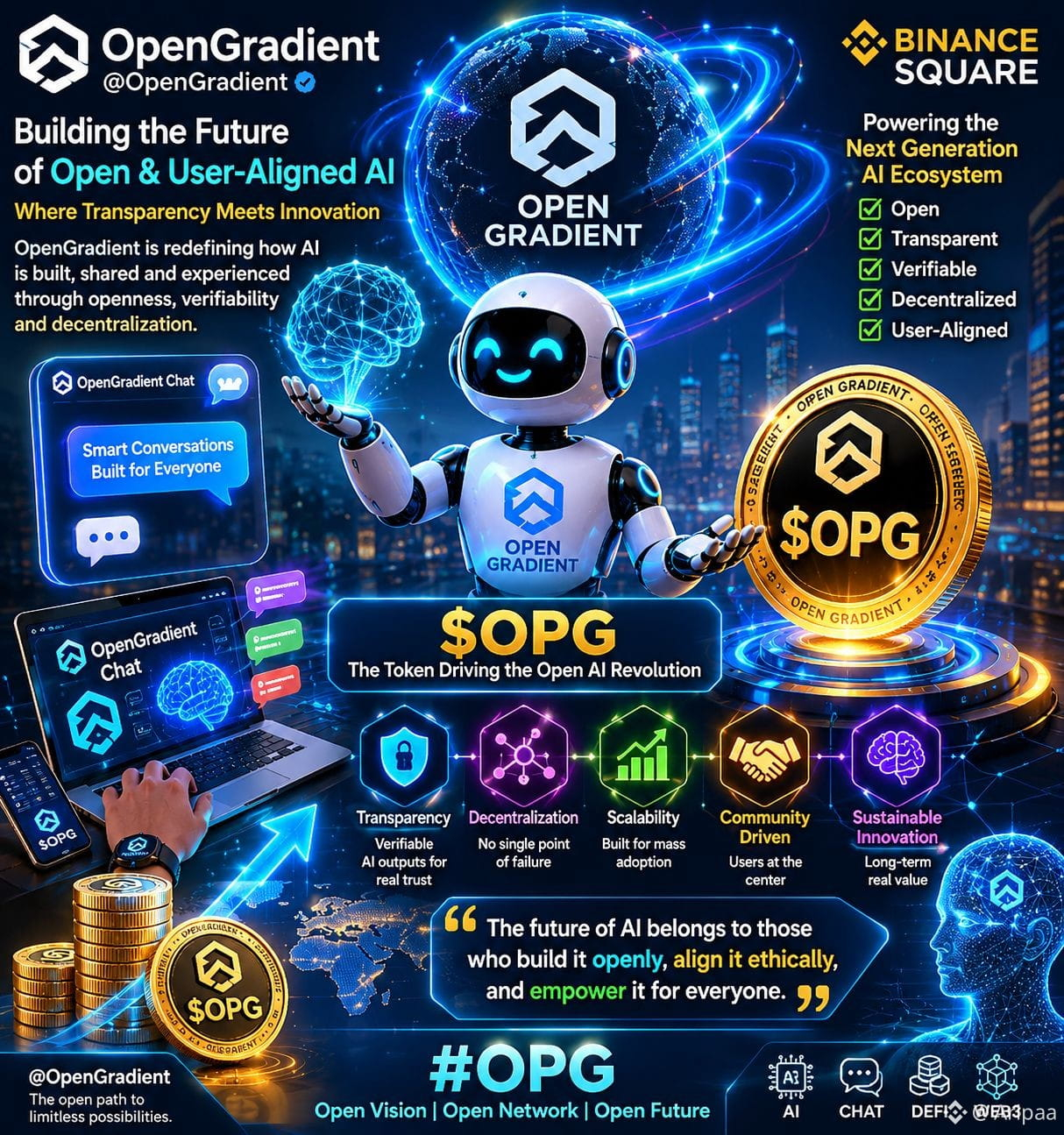
As AI continues to evolve, one of the biggest questions is not how powerful models can become, but how accessible, transparent, and verifiable they are for everyday users. This is why I’ve been paying close attention to @OpenGradient and the growing role of #OpenGradient Chat in the decentralized AI landscape.
Many AI platforms operate as black boxes, where users have little visibility into how outputs are generated or how data is handled. OpenGradient takes a different approach by focusing on openness, verifiability, and user alignment. This creates an environment where trust can be built through transparency rather than assumptions.
OpenGradient Chat demonstrates how AI can become more useful when users are given greater confidence in the systems they interact with. Instead of relying solely on centralized control, decentralized infrastructure can help create a more resilient and community-driven ecosystem. As adoption grows, this model could become increasingly important for developers, creators, researchers, and businesses seeking reliable AI tools.
The long-term opportunity for $OPG is not just about participating in the AI narrative. It is about supporting infrastructure that enables sustainable innovation while maintaining transparency and accountability. In a market filled with hype, projects that focus on real utility and verifiable outcomes may be the ones that create lasting value.
The future of AI may ultimately belong to platforms that balance performance, openness, and trust. OpenGradient is positioning itself at the intersection of these trends, making it a project worth following closely.
$OPG #OPG
#opg $OPG
As AI continues to evolve, one of the biggest questions is not how powerful models can become, but how accessible, transparent, and verifiable they are for everyday users. This is why I’ve been paying close attention to @OpenGradient and the growing role of #OpenGradient Chat in the decentralized AI landscape.
Many AI platforms operate as black boxes, where users have little visibility into how outputs are generated or how data is handled. OpenGradient takes a different approach by focusing on openness, verifiability, and user alignment. This creates an environment where trust can be built through transparency rather than assumptions.
OpenGradient Chat demonstrates how AI can become more useful when users are given greater confidence in the systems they interact with. Instead of relying solely on centralized control, decentralized infrastructure can help create a more resilient and community-driven ecosystem. As adoption grows, this model could become increasingly important for developers, creators, researchers, and businesses seeking reliable AI tools.
The long-term opportunity for $OPG is not just about participating in the AI narrative. It is about supporting infrastructure that enables sustainable innovation while maintaining transparency and accountability. In a market filled with hype, projects that focus on real utility and verifiable outcomes may be the ones that create lasting value.
The future of AI may ultimately belong to platforms that balance performance, openness, and trust. OpenGradient is positioning itself at the intersection of these trends, making it a project worth following closely.
$OPG #OPG
#opg $OPG
Many AI platforms operate as black boxes, where users have little visibility into how outputs are generated or how data is handled. OpenGradient takes a different approach by focusing on openness, verifiability, and user alignment. This creates an environment where trust can be built through transparency rather than assumptions.
OpenGradient Chat demonstrates how AI can become more useful when users are given greater confidence in the systems they interact with. Instead of relying solely on centralized control, decentralized infrastructure can help create a more resilient and community-driven ecosystem. As adoption grows, this model could become increasingly important for developers, creators, researchers, and businesses seeking reliable AI tools.
The long-term opportunity for $OPG is not just about participating in the AI narrative. It is about supporting infrastructure that enables sustainable innovation while maintaining transparency and accountability. In a market filled with hype, projects that focus on real utility and verifiable outcomes may be the ones that create lasting value.
The future of AI may ultimately belong to platforms that balance performance, openness, and trust. OpenGradient is positioning itself at the intersection of these trends, making it a project worth following closely.
$OPG #OPG
#opg $OPG
5
2
83

·
--
Everyone's obsessed with which chain is "fastest" but nobody's asking what actually happens after the transaction gets finalized.
That's where the real architecture debate lives.
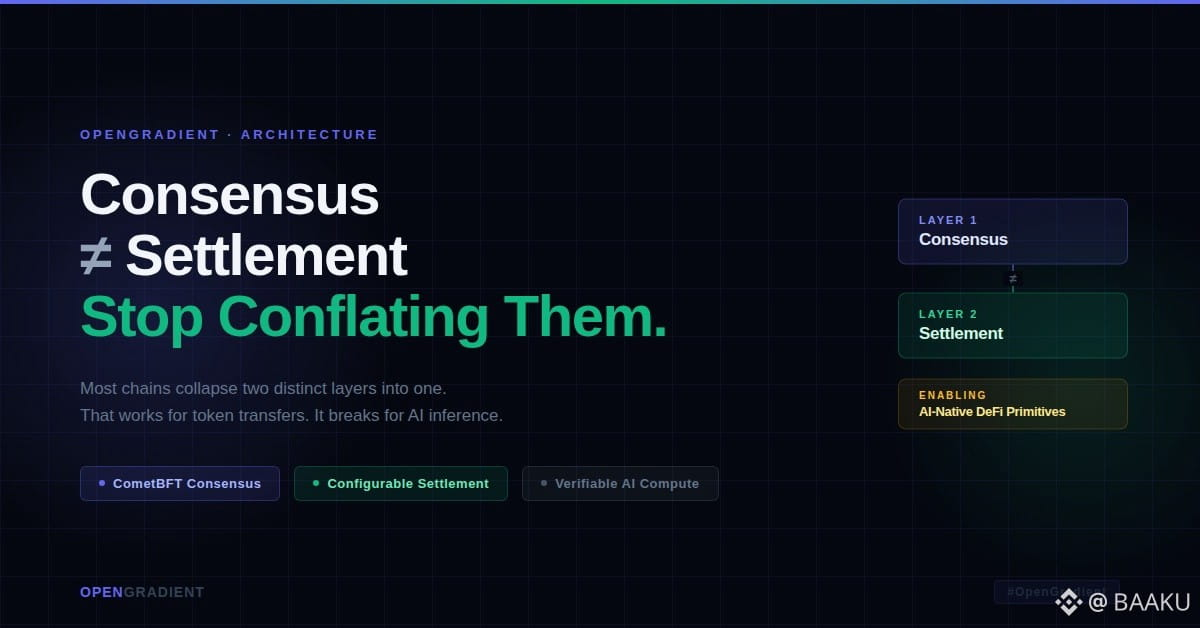
Most L1s treat consensus and settlement like they're the same thing. They're not. Consensus is nodes agreeing something happened. Settlement is the network actually committing to a state that downstream systems can trust and act on. Collapsing those two into one process feels clean until you're building something real on top of it.
The moment you need external systems — oracles, AI inference layers, cross-chain apps — to consume finalized state, you realize the gap matters enormously. A chain that finalizes fast but settles ambiguously is a liability disguised as a feature.
OpenGradient separates these. Consensus runs through CometBFT. Settlement operates as a distinct layer with configurable modes — you pick the settlement behavior that matches your use case. That design decision is quiet. Most people scroll past it. But if you're building AI-powered DeFi or on-chain inference pipelines, it changes what's actually possible.
Here's why: AI model outputs aren't static. They're probabilistic. They need a settlement layer that can handle verification of compute, not just token transfers. A monolithic consensus-settlement system was never designed for that. It was designed for "did wallet A send tokens to wallet B." Full stop.
The honest limitation? Separating consensus and settlement adds architectural complexity. More components means more surface area for failure. Any chain making this tradeoff is betting that the added expressiveness is worth the engineering overhead. That bet could absolutely be wrong depending on how the application layer evolves.
But collapsing them to stay simple also means you're permanently limited to what simple state transitions can express. And the next wave of on-chain primitives — verifiable AI inference, compute markets, model attestation — doesn't fit inside that box.
#OpenGradient #DeFi #Web3
#opg $OPG @OpenGradient
Everyone's obsessed with which chain is "fastest" but nobody's asking what actually happens after the transaction gets finalized.
That's where the real architecture debate lives.
Most L1s treat consensus and settlement like they're the same thing. They're not. Consensus is nodes agreeing something happened. Settlement is the network actually committing to a state that downstream systems can trust and act on. Collapsing those two into one process feels clean until you're building something real on top of it.
The moment you need external systems — oracles, AI inference layers, cross-chain apps — to consume finalized state, you realize the gap matters enormously. A chain that finalizes fast but settles ambiguously is a liability disguised as a feature.
OpenGradient separates these. Consensus runs through CometBFT. Settlement operates as a distinct layer with configurable modes — you pick the settlement behavior that matches your use case. That design decision is quiet. Most people scroll past it. But if you're building AI-powered DeFi or on-chain inference pipelines, it changes what's actually possible.
Here's why: AI model outputs aren't static. They're probabilistic. They need a settlement layer that can handle verification of compute, not just token transfers. A monolithic consensus-settlement system was never designed for that. It was designed for "did wallet A send tokens to wallet B." Full stop.
The honest limitation? Separating consensus and settlement adds architectural complexity. More components means more surface area for failure. Any chain making this tradeoff is betting that the added expressiveness is worth the engineering overhead. That bet could absolutely be wrong depending on how the application layer evolves.
But collapsing them to stay simple also means you're permanently limited to what simple state transitions can express. And the next wave of on-chain primitives — verifiable AI inference, compute markets, model attestation — doesn't fit inside that box.
#OpenGradient #DeFi #Web3
#opg $OPG @OpenGradient
That's where the real architecture debate lives.
Most L1s treat consensus and settlement like they're the same thing. They're not. Consensus is nodes agreeing something happened. Settlement is the network actually committing to a state that downstream systems can trust and act on. Collapsing those two into one process feels clean until you're building something real on top of it.
The moment you need external systems — oracles, AI inference layers, cross-chain apps — to consume finalized state, you realize the gap matters enormously. A chain that finalizes fast but settles ambiguously is a liability disguised as a feature.
OpenGradient separates these. Consensus runs through CometBFT. Settlement operates as a distinct layer with configurable modes — you pick the settlement behavior that matches your use case. That design decision is quiet. Most people scroll past it. But if you're building AI-powered DeFi or on-chain inference pipelines, it changes what's actually possible.
Here's why: AI model outputs aren't static. They're probabilistic. They need a settlement layer that can handle verification of compute, not just token transfers. A monolithic consensus-settlement system was never designed for that. It was designed for "did wallet A send tokens to wallet B." Full stop.
The honest limitation? Separating consensus and settlement adds architectural complexity. More components means more surface area for failure. Any chain making this tradeoff is betting that the added expressiveness is worth the engineering overhead. That bet could absolutely be wrong depending on how the application layer evolves.
But collapsing them to stay simple also means you're permanently limited to what simple state transitions can express. And the next wave of on-chain primitives — verifiable AI inference, compute markets, model attestation — doesn't fit inside that box.
#OpenGradient #DeFi #Web3
#opg $OPG @OpenGradient
1
1
105

·
--
OPG 的模型调用,不是"交给后台"就算完了
我对 AI 上链这件事一直有个偏见:
只要听到"模型帮你跑",我手里的暂停键就准备好了。
"帮你跑"这三个字太轻了。
轻到可以盖住一连串没人回答的问题:跑的是哪个版本?在什么环境里跑的?输出有没有被中途碰过?验证的人看的是原始结果,还是二手包装?#OPG
这些不是技术洁癖,是信任的基本材料。
没有这些材料,AI 上链就是从"相信代码"变成"相信某个你不认识的节点"。
这让我想到远洋货轮的报关单。
一艘船可以全自动航行,GPS、雷达、自动驾驶全配齐。但船舱里装的是什么,在哪个港口装的,中途有没有换过集装箱,这些不是"自动驾驶"能回答的。报关单必须在启航前锁死,每一站的海关都按同一张单子核对。如果单子能临时改,船再智能也是一艘黑船。
所以我看 @OpenGradient,不会先问它支持多少模型、TPS 多高。$OPG
我会先看它的 HACA 把"开船"和"验货"拆成了两件事。
执行节点负责跑模型,验证节点只负责核对证明。更关键的是,它给了开发者一张可选的验证清单:要数学确定性就上 ZKML,要硬件级证明就进 TEE,要低延迟就走 Vanilla。三种模式不是"后台随便挑",而是用户在调用前就选定的报关等级。
这个设计不如"一键调用 AI"听起来舒服。
但它把舒服让给了更重要的事:边界感。
用户交出去的是一段意图,系统还回来的是一张可核对的报关单。模型版本、输入环境、输出签名,全在链上留档。不是"我们相信节点没作恶",而是"节点就算想作恶,也得先过这一关证明"。
所以我对 #opengradient 的兴趣不在"它让 AI 调用变简单了"。
我在意的是,它有没有让"藏起来的推理"变成"可检查的档案"。
算力可以外包。
但每一趟推理的档案,最好先封好章,再靠岸。@OpenGradient $BTC $ETH
OPG 的模型调用,不是"交给后台"就算完了
我对 AI 上链这件事一直有个偏见:
只要听到"模型帮你跑",我手里的暂停键就准备好了。
"帮你跑"这三个字太轻了。
轻到可以盖住一连串没人回答的问题:跑的是哪个版本?在什么环境里跑的?输出有没有被中途碰过?验证的人看的是原始结果,还是二手包装?#OPG
这些不是技术洁癖,是信任的基本材料。
没有这些材料,AI 上链就是从"相信代码"变成"相信某个你不认识的节点"。
这让我想到远洋货轮的报关单。
一艘船可以全自动航行,GPS、雷达、自动驾驶全配齐。但船舱里装的是什么,在哪个港口装的,中途有没有换过集装箱,这些不是"自动驾驶"能回答的。报关单必须在启航前锁死,每一站的海关都按同一张单子核对。如果单子能临时改,船再智能也是一艘黑船。
所以我看 @OpenGradient,不会先问它支持多少模型、TPS 多高。$OPG
我会先看它的 HACA 把"开船"和"验货"拆成了两件事。
执行节点负责跑模型,验证节点只负责核对证明。更关键的是,它给了开发者一张可选的验证清单:要数学确定性就上 ZKML,要硬件级证明就进 TEE,要低延迟就走 Vanilla。三种模式不是"后台随便挑",而是用户在调用前就选定的报关等级。
这个设计不如"一键调用 AI"听起来舒服。
但它把舒服让给了更重要的事:边界感。
用户交出去的是一段意图,系统还回来的是一张可核对的报关单。模型版本、输入环境、输出签名,全在链上留档。不是"我们相信节点没作恶",而是"节点就算想作恶,也得先过这一关证明"。
所以我对 #opengradient 的兴趣不在"它让 AI 调用变简单了"。
我在意的是,它有没有让"藏起来的推理"变成"可检查的档案"。
算力可以外包。
但每一趟推理的档案,最好先封好章,再靠岸。@OpenGradient $BTC $ETH
我对 AI 上链这件事一直有个偏见:
只要听到"模型帮你跑",我手里的暂停键就准备好了。
"帮你跑"这三个字太轻了。
轻到可以盖住一连串没人回答的问题:跑的是哪个版本?在什么环境里跑的?输出有没有被中途碰过?验证的人看的是原始结果,还是二手包装?#OPG
这些不是技术洁癖,是信任的基本材料。
没有这些材料,AI 上链就是从"相信代码"变成"相信某个你不认识的节点"。
这让我想到远洋货轮的报关单。
一艘船可以全自动航行,GPS、雷达、自动驾驶全配齐。但船舱里装的是什么,在哪个港口装的,中途有没有换过集装箱,这些不是"自动驾驶"能回答的。报关单必须在启航前锁死,每一站的海关都按同一张单子核对。如果单子能临时改,船再智能也是一艘黑船。
所以我看 @OpenGradient,不会先问它支持多少模型、TPS 多高。$OPG
我会先看它的 HACA 把"开船"和"验货"拆成了两件事。
执行节点负责跑模型,验证节点只负责核对证明。更关键的是,它给了开发者一张可选的验证清单:要数学确定性就上 ZKML,要硬件级证明就进 TEE,要低延迟就走 Vanilla。三种模式不是"后台随便挑",而是用户在调用前就选定的报关等级。
这个设计不如"一键调用 AI"听起来舒服。
但它把舒服让给了更重要的事:边界感。
用户交出去的是一段意图,系统还回来的是一张可核对的报关单。模型版本、输入环境、输出签名,全在链上留档。不是"我们相信节点没作恶",而是"节点就算想作恶,也得先过这一关证明"。
所以我对 #opengradient 的兴趣不在"它让 AI 调用变简单了"。
我在意的是,它有没有让"藏起来的推理"变成"可检查的档案"。
算力可以外包。
但每一趟推理的档案,最好先封好章,再靠岸。@OpenGradient $BTC $ETH
358

·
--
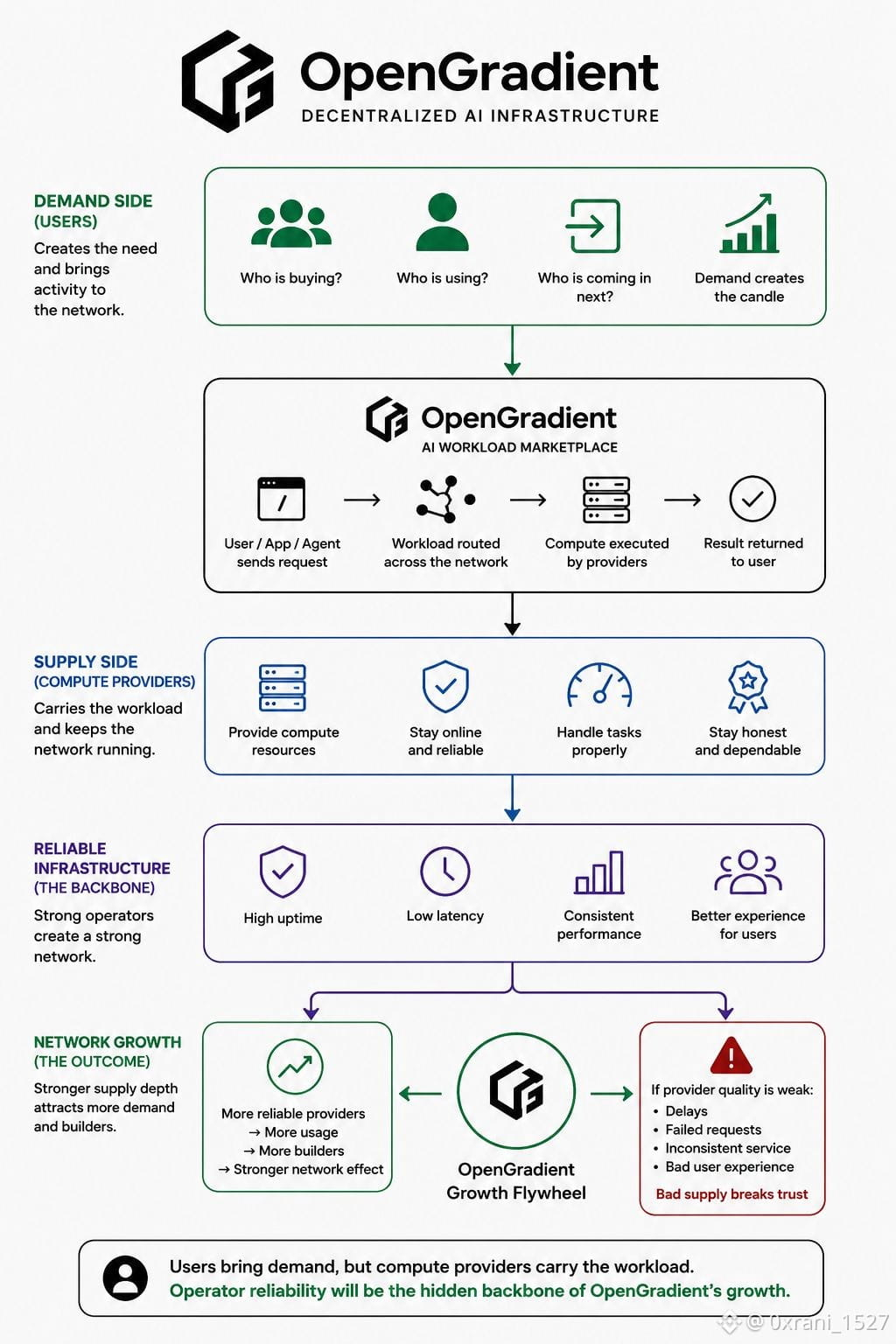
I have seen networks look strong from the user side, then struggle because the supply side was weak. Traders usually focus on demand first. Who is buying? Who is using? Who is coming in next? But every working system also needs reliable suppliers behind the screen.
That is how I think about OpenGradient’s compute side. AI infrastructure does not run on narrative alone. Models need machines. Requests need operators. Workloads need nodes that can stay online, handle tasks properly, and keep the experience from breaking when usage grows.
This is where decentralized AI becomes harder than it sounds. It is not only about letting people use AI. It is about building a network where compute providers have a real reason to stay honest, stay available, and keep serving useful work. In trader language, demand can create the candle, but supply depth keeps the market from falling apart.
The upside is clear. If OpenGradient can keep attracting reliable compute providers, the network becomes more useful for apps, agents, and builders. A stronger operator base can turn AI infrastructure from an idea into something people can actually depend on.
But the risk is also real. If provider quality is weak, users will feel it quickly through delays, failed requests, or inconsistent service. In infrastructure, bad supply shows up as bad user experience.
My view is simple: decentralized AI will not be judged only by how many people want to use it. It will also be judged by how many reliable operators can keep it running.
If users bring demand, but compute providers carry the workload, will operator reliability become the hidden backbone of OpenGradient’s growth?
@OpenGradient $OPG #OpenGradient #OPG
I have seen networks look strong from the user side, then struggle because the supply side was weak. Traders usually focus on demand first. Who is buying? Who is using? Who is coming in next? But every working system also needs reliable suppliers behind the screen.
That is how I think about OpenGradient’s compute side. AI infrastructure does not run on narrative alone. Models need machines. Requests need operators. Workloads need nodes that can stay online, handle tasks properly, and keep the experience from breaking when usage grows.
This is where decentralized AI becomes harder than it sounds. It is not only about letting people use AI. It is about building a network where compute providers have a real reason to stay honest, stay available, and keep serving useful work. In trader language, demand can create the candle, but supply depth keeps the market from falling apart.
The upside is clear. If OpenGradient can keep attracting reliable compute providers, the network becomes more useful for apps, agents, and builders. A stronger operator base can turn AI infrastructure from an idea into something people can actually depend on.
But the risk is also real. If provider quality is weak, users will feel it quickly through delays, failed requests, or inconsistent service. In infrastructure, bad supply shows up as bad user experience.
My view is simple: decentralized AI will not be judged only by how many people want to use it. It will also be judged by how many reliable operators can keep it running.
If users bring demand, but compute providers carry the workload, will operator reliability become the hidden backbone of OpenGradient’s growth?
@OpenGradient $OPG #OpenGradient #OPG
That is how I think about OpenGradient’s compute side. AI infrastructure does not run on narrative alone. Models need machines. Requests need operators. Workloads need nodes that can stay online, handle tasks properly, and keep the experience from breaking when usage grows.
This is where decentralized AI becomes harder than it sounds. It is not only about letting people use AI. It is about building a network where compute providers have a real reason to stay honest, stay available, and keep serving useful work. In trader language, demand can create the candle, but supply depth keeps the market from falling apart.
The upside is clear. If OpenGradient can keep attracting reliable compute providers, the network becomes more useful for apps, agents, and builders. A stronger operator base can turn AI infrastructure from an idea into something people can actually depend on.
But the risk is also real. If provider quality is weak, users will feel it quickly through delays, failed requests, or inconsistent service. In infrastructure, bad supply shows up as bad user experience.
My view is simple: decentralized AI will not be judged only by how many people want to use it. It will also be judged by how many reliable operators can keep it running.
If users bring demand, but compute providers carry the workload, will operator reliability become the hidden backbone of OpenGradient’s growth?
@OpenGradient $OPG #OpenGradient #OPG
4
2
153

·
--
我反而觉得OpenGradient这个团队挺聪明的。他们愿意公开讨论行政依赖的问题,说明内部已经在思考怎么解决。很多人一听到“集中”就害怕,但早期项目本来就需要一个强力团队去推进法律、技术方向和生态合作。问题不是出在“有没有依赖”,而是“有没有预案”。 作者提出的三个维度:干扰概率、依赖程度、恢复能力。重点其实在恢复能力上。只要团队提前把文档、权限和操作流程标准化,哪怕出现人员流动,新的人也能快速上手。你看OPG代币目前涨了4.96%,市场对这个项目似乎挺有信心。HEI更是夸张地涨了65%,说明资金在追捧和OpenGradient相关的生态。 长期来看,我更看好“更快恢复”这个选项。因为完全消除依赖不现实,尤其对于新网络。但如果你能设计一套系统,让关键职能在48小时内平滑转移,那风险就大大降低了。OpenGradient如果能把恢复机制做扎实,OPG的价值只会越来越稳。投票结果还有23小时,我觉得降低依赖和更快恢复两者并不冲突,团队同时推进才是最优解。 #OPG #OpenGradient
我反而觉得OpenGradient这个团队挺聪明的。他们愿意公开讨论行政依赖的问题,说明内部已经在思考怎么解决。很多人一听到“集中”就害怕,但早期项目本来就需要一个强力团队去推进法律、技术方向和生态合作。问题不是出在“有没有依赖”,而是“有没有预案”。 作者提出的三个维度:干扰概率、依赖程度、恢复能力。重点其实在恢复能力上。只要团队提前把文档、权限和操作流程标准化,哪怕出现人员流动,新的人也能快速上手。你看OPG代币目前涨了4.96%,市场对这个项目似乎挺有信心。HEI更是夸张地涨了65%,说明资金在追捧和OpenGradient相关的生态。 长期来看,我更看好“更快恢复”这个选项。因为完全消除依赖不现实,尤其对于新网络。但如果你能设计一套系统,让关键职能在48小时内平滑转移,那风险就大大降低了。OpenGradient如果能把恢复机制做扎实,OPG的价值只会越来越稳。投票结果还有23小时,我觉得降低依赖和更快恢复两者并不冲突,团队同时推进才是最优解。 #OPG #OpenGradient
65
·
--
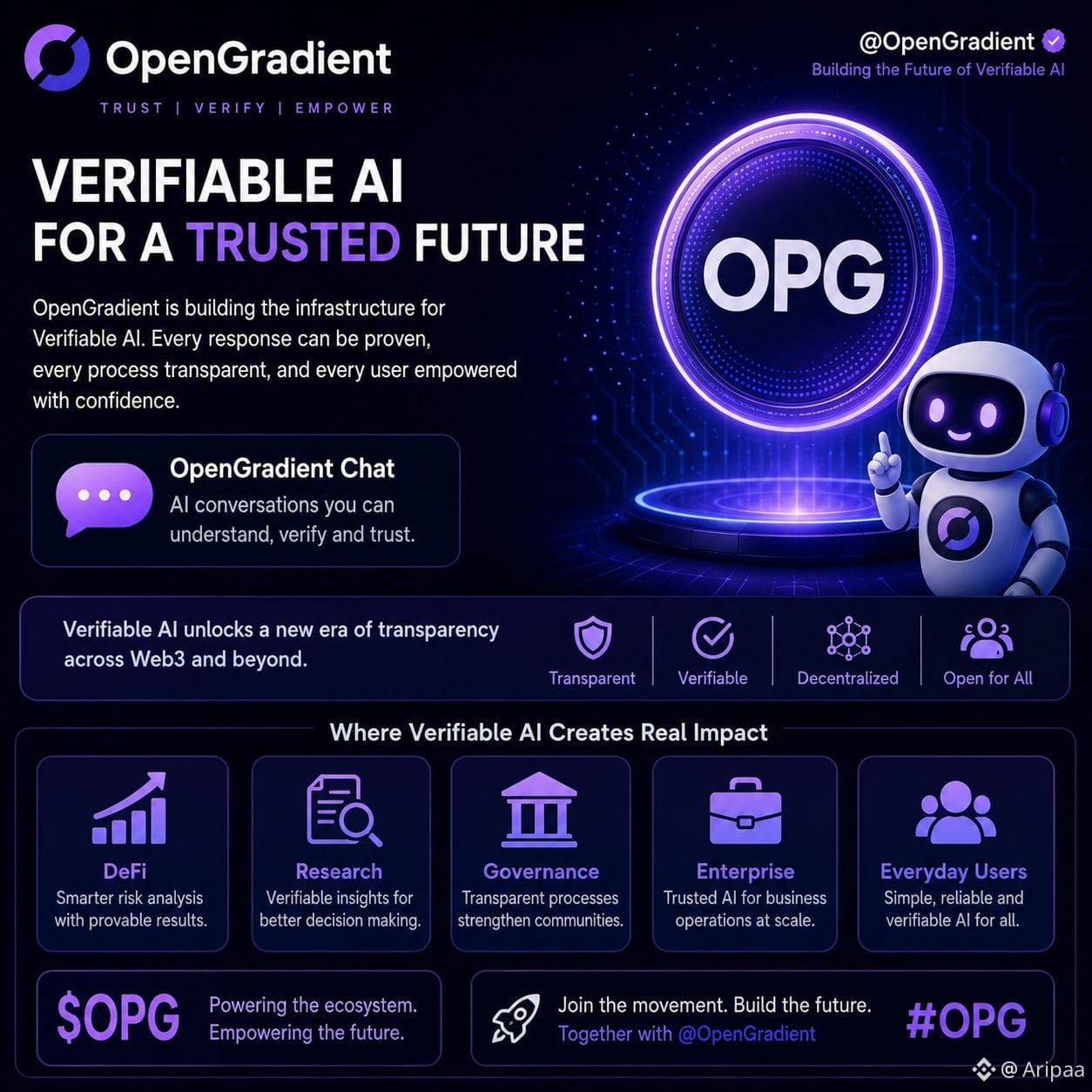
As AI becomes part of everyday decision-making, the biggest challenge is no longer just intelligence—it is trust. Powerful models are useful, but users also need confidence that every response is generated through a transparent and verifiable process. That is why I find @OpenGradient particularly interesting. Instead of asking the community to rely on blind trust, OpenGradient is building an ecosystem where AI outputs can be verified, creating a stronger foundation for developers, businesses, and everyday users.
#OpenGradient Chat represents this vision in a practical way. It combines the convenience of conversational AI with the principles of verifiable computation, helping users understand that trustworthy AI is possible without sacrificing usability. As decentralized technologies continue to evolve, projects that prioritize transparency may become the standard rather than the exception.
The long-term value of AI will depend on accountability just as much as performance. Verifiable AI can unlock new opportunities across DeFi, governance, research, and enterprise applications where confidence in AI-generated results truly matters. I believe @OpenGradient is taking meaningful steps toward that future, and it will be exciting to watch how the ecosystem grows alongside the adoption of $OPG.
#OPG $OPG
#opg $OPG
As AI becomes part of everyday decision-making, the biggest challenge is no longer just intelligence—it is trust. Powerful models are useful, but users also need confidence that every response is generated through a transparent and verifiable process. That is why I find @OpenGradient particularly interesting. Instead of asking the community to rely on blind trust, OpenGradient is building an ecosystem where AI outputs can be verified, creating a stronger foundation for developers, businesses, and everyday users.
#OpenGradient Chat represents this vision in a practical way. It combines the convenience of conversational AI with the principles of verifiable computation, helping users understand that trustworthy AI is possible without sacrificing usability. As decentralized technologies continue to evolve, projects that prioritize transparency may become the standard rather than the exception.
The long-term value of AI will depend on accountability just as much as performance. Verifiable AI can unlock new opportunities across DeFi, governance, research, and enterprise applications where confidence in AI-generated results truly matters. I believe @OpenGradient is taking meaningful steps toward that future, and it will be exciting to watch how the ecosystem grows alongside the adoption of $OPG .
#OPG $OPG
#opg $OPG
#OpenGradient Chat represents this vision in a practical way. It combines the convenience of conversational AI with the principles of verifiable computation, helping users understand that trustworthy AI is possible without sacrificing usability. As decentralized technologies continue to evolve, projects that prioritize transparency may become the standard rather than the exception.
The long-term value of AI will depend on accountability just as much as performance. Verifiable AI can unlock new opportunities across DeFi, governance, research, and enterprise applications where confidence in AI-generated results truly matters. I believe @OpenGradient is taking meaningful steps toward that future, and it will be exciting to watch how the ecosystem grows alongside the adoption of $OPG .
#OPG $OPG
#opg $OPG
10
2
118

·
--
#opg $OPG
A few days ago, I used to think building a global AI network was pretty straightforward.
Just add more nodes.
Expand into more countries.
Lower the latency.
Done.
But then I came across a discussion about OpenGradient that made me rethink everything.
Someone sent a request to the closest node, yet it ended up being slower than another node that was much farther away.
At first, that didn’t make sense.
But the reason was simple.
Distance wasn’t the issue.
The model wasn’t ready.
The queue was overloaded.
The system needed better coordination, not just physical closeness.
That really stuck with me.
It made me realize that scaling AI infrastructure isn’t just about spreading out geographically.
It’s about how well everything works together under pressure.
The networks that will matter most aren’t just the biggest ones.
They’re the ones that stay reliable when things don’t go as planned.
That’s why I’ve been paying closer attention to OpenGradient and $OPG.
So I’m curious what you think matters more for AI infrastructure:
🔹 Speed
🔹 Resilience
Explain your answer 👇
#OpenGradient #OPG #DePIN $OPG
{future}(OPGUSDT)
#opg $OPG
A few days ago, I used to think building a global AI network was pretty straightforward.
Just add more nodes.
Expand into more countries.
Lower the latency.
Done.
But then I came across a discussion about OpenGradient that made me rethink everything.
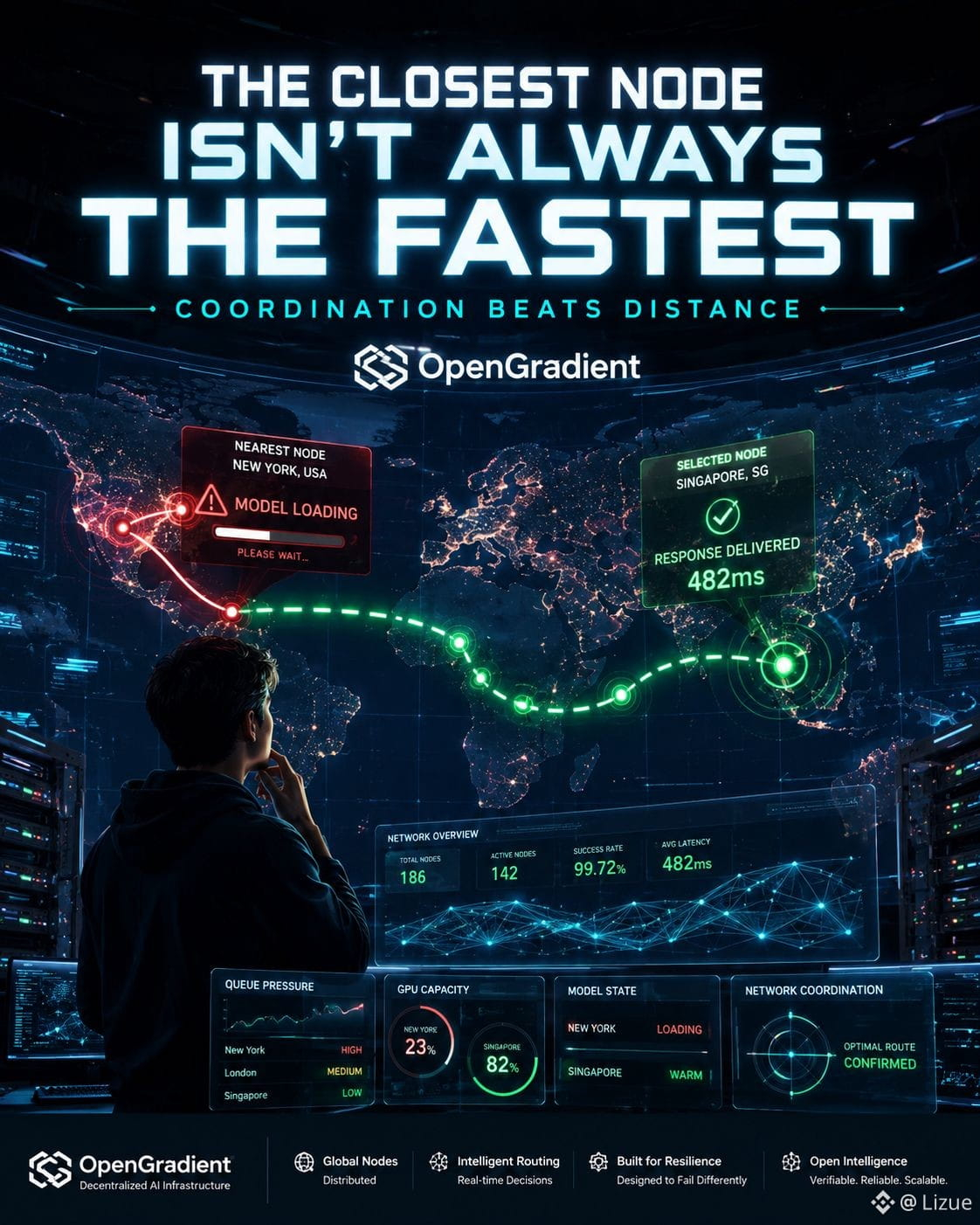
Someone sent a request to the closest node, yet it ended up being slower than another node that was much farther away.
At first, that didn’t make sense.
But the reason was simple.
Distance wasn’t the issue.
The model wasn’t ready.
The queue was overloaded.
The system needed better coordination, not just physical closeness.
That really stuck with me.
It made me realize that scaling AI infrastructure isn’t just about spreading out geographically.
It’s about how well everything works together under pressure.
The networks that will matter most aren’t just the biggest ones.
They’re the ones that stay reliable when things don’t go as planned.
That’s why I’ve been paying closer attention to OpenGradient and $OPG .
So I’m curious what you think matters more for AI infrastructure:
🔹 Speed
🔹 Resilience
Explain your answer 👇
#OpenGradient #OPG #DePIN $OPG
A few days ago, I used to think building a global AI network was pretty straightforward.
Just add more nodes.
Expand into more countries.
Lower the latency.
Done.
But then I came across a discussion about OpenGradient that made me rethink everything.
Someone sent a request to the closest node, yet it ended up being slower than another node that was much farther away.
At first, that didn’t make sense.
But the reason was simple.
Distance wasn’t the issue.
The model wasn’t ready.
The queue was overloaded.
The system needed better coordination, not just physical closeness.
That really stuck with me.
It made me realize that scaling AI infrastructure isn’t just about spreading out geographically.
It’s about how well everything works together under pressure.
The networks that will matter most aren’t just the biggest ones.
They’re the ones that stay reliable when things don’t go as planned.
That’s why I’ve been paying closer attention to OpenGradient and $OPG .
So I’m curious what you think matters more for AI infrastructure:
🔹 Speed
🔹 Resilience
Explain your answer 👇
#OpenGradient #OPG #DePIN $OPG
81
1
30
293

·
--
$OPG believe $OPG has strong long-term potential. The vision behind @OpenGradient is exciting, and many supporters are watching its growth closely. If adoption continues to expand, the future could be bright. Always do your own research before investing. #OPG #OpenGradient
$OPG believe $OPG has strong long-term potential. The vision behind @OpenGradient is exciting, and many supporters are watching its growth closely. If adoption continues to expand, the future could be bright. Always do your own research before investing. #OPG #OpenGradient
2
1
110

·
--
Жоғары (өспелі)
#opg $OPG I'm not entirely comfortable with how quickly I've stopped asking questions.
Somewhere along the way, AI answers started feeling normal. I read them, use them, move on. Most of the time I don't know what model produced them, where the computation happened, or whether any of it could actually be verified afterward. That seemed like a temporary compromise at first. Now it feels like a habit.
I've spent long enough around both crypto and AI to recognize a familiar pattern. We get absorbed by the visible layer and mostly ignore the infrastructure underneath until something breaks. Then everyone suddenly remembers that incentives, ownership, and control were never abstract topics to begin with.
That's partly why OpenGradient ($OPG) has been sitting in the back of my mind. Not because I think decentralization automatically solves trust, and not because every new infrastructure project deserves attention. If anything, years of watching narratives repeat has made me slower to believe them. But the idea that hosting models, running inference, and verifying what actually happened could matter as much as model capability feels difficult to dismiss.
I still wonder whether "open intelligence" remains open once real-world economics and scale enter the picture. Verification sounds straightforward until different interests collide.
Maybe the bigger problem isn't building more capable AI anymore. Maybe it's deciding who gets to verify the systems we increasingly depend on, and whether that trust quietly becomes an infrastructure question before most people notice.
#OpenGradient @OpenGradient $OPG
{future}(OPGUSDT)
#opg $OPG I'm not entirely comfortable with how quickly I've stopped asking questions.
Somewhere along the way, AI answers started feeling normal. I read them, use them, move on. Most of the time I don't know what model produced them, where the computation happened, or whether any of it could actually be verified afterward. That seemed like a temporary compromise at first. Now it feels like a habit.
I've spent long enough around both crypto and AI to recognize a familiar pattern. We get absorbed by the visible layer and mostly ignore the infrastructure underneath until something breaks. Then everyone suddenly remembers that incentives, ownership, and control were never abstract topics to begin with.
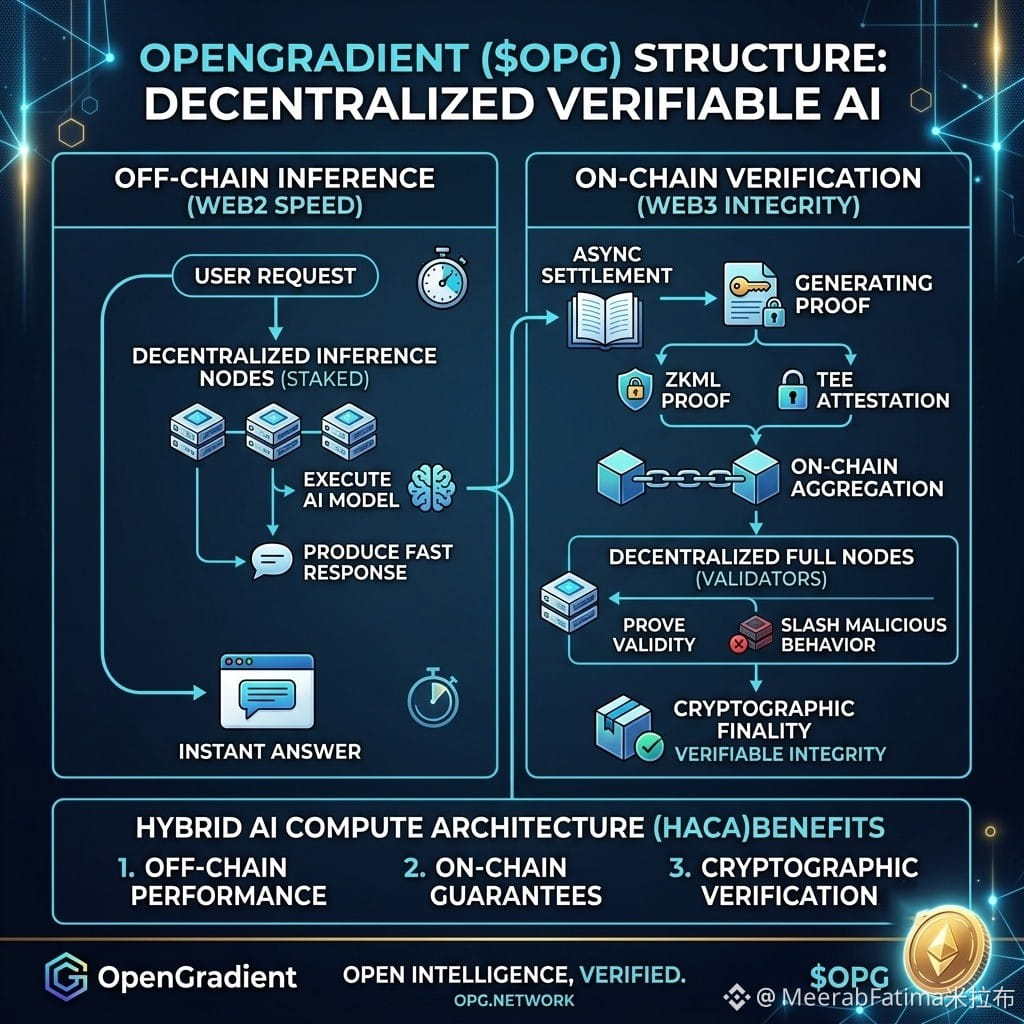
That's partly why OpenGradient ($OPG ) has been sitting in the back of my mind. Not because I think decentralization automatically solves trust, and not because every new infrastructure project deserves attention. If anything, years of watching narratives repeat has made me slower to believe them. But the idea that hosting models, running inference, and verifying what actually happened could matter as much as model capability feels difficult to dismiss.
I still wonder whether "open intelligence" remains open once real-world economics and scale enter the picture. Verification sounds straightforward until different interests collide.
Maybe the bigger problem isn't building more capable AI anymore. Maybe it's deciding who gets to verify the systems we increasingly depend on, and whether that trust quietly becomes an infrastructure question before most people notice.
#OpenGradient @OpenGradient $OPG
Somewhere along the way, AI answers started feeling normal. I read them, use them, move on. Most of the time I don't know what model produced them, where the computation happened, or whether any of it could actually be verified afterward. That seemed like a temporary compromise at first. Now it feels like a habit.
I've spent long enough around both crypto and AI to recognize a familiar pattern. We get absorbed by the visible layer and mostly ignore the infrastructure underneath until something breaks. Then everyone suddenly remembers that incentives, ownership, and control were never abstract topics to begin with.
That's partly why OpenGradient ($OPG ) has been sitting in the back of my mind. Not because I think decentralization automatically solves trust, and not because every new infrastructure project deserves attention. If anything, years of watching narratives repeat has made me slower to believe them. But the idea that hosting models, running inference, and verifying what actually happened could matter as much as model capability feels difficult to dismiss.
I still wonder whether "open intelligence" remains open once real-world economics and scale enter the picture. Verification sounds straightforward until different interests collide.
Maybe the bigger problem isn't building more capable AI anymore. Maybe it's deciding who gets to verify the systems we increasingly depend on, and whether that trust quietly becomes an infrastructure question before most people notice.
#OpenGradient @OpenGradient $OPG
4
10
130

·
--
Расталды
What caught my attention wasn’t the price action on June 15 — it was the deposit restriction. When Upbit listed $OPG , withdrawals and deposits were supported *exclusively* through the Base network , and the first two hours only allowed limit orders. That’s a small operational detail, but it told me something about how OpenGradient (#OpenGradient @OpenGradient ) actually sits in the stack not as a standalone chain people natively bridge to, but as something that routes through Base for legitimacy and liquidity access. The infrastructure dependency is real.
The network has crossed 263,500 unique wallets and processes over 10,000 transactions daily , which sounds decent until you realize that most of that activity is inference calls, not token transfers. That’s an unusual ratio. The “on-chain activity” here isn’t people moving value around it’s AI compute being logged. I kept expecting that to feel more abstract than it did.
The thing I got wrong going in: I assumed the token would feel loosely attached to actual usage, like most AI projects. Every verified AI call on the network settles in $OPG on Base , so the payment rail is real, not decorative. The Upbit listing made that concrete Korean exchanges don’t list tokens without scrutinizing that utility claim carefully, and they went BTC/USDT pairs, not KRW, which signals caution rather than hype.
What I still can’t resolve is whether verifiable inference actually matters to the builders deploying agents here, or whether it’s just a technical comfort blanket. Who’s auditing those cryptographic proofs in practice?
@OpenGradient $OPG #OPG
What caught my attention wasn’t the price action on June 15 — it was the deposit restriction. When Upbit listed $OPG , withdrawals and deposits were supported *exclusively* through the Base network , and the first two hours only allowed limit orders. That’s a small operational detail, but it told me something about how OpenGradient (#OpenGradient @OpenGradient ) actually sits in the stack not as a standalone chain people natively bridge to, but as something that routes through Base for legitimacy and liquidity access. The infrastructure dependency is real.
The network has crossed 263,500 unique wallets and processes over 10,000 transactions daily , which sounds decent until you realize that most of that activity is inference calls, not token transfers. That’s an unusual ratio. The “on-chain activity” here isn’t people moving value around it’s AI compute being logged. I kept expecting that to feel more abstract than it did.
The thing I got wrong going in: I assumed the token would feel loosely attached to actual usage, like most AI projects. Every verified AI call on the network settles in $OPG on Base , so the payment rail is real, not decorative. The Upbit listing made that concrete Korean exchanges don’t list tokens without scrutinizing that utility claim carefully, and they went BTC/USDT pairs, not KRW, which signals caution rather than hype.
What I still can’t resolve is whether verifiable inference actually matters to the builders deploying agents here, or whether it’s just a technical comfort blanket. Who’s auditing those cryptographic proofs in practice?
@OpenGradient $OPG #OPG
The network has crossed 263,500 unique wallets and processes over 10,000 transactions daily , which sounds decent until you realize that most of that activity is inference calls, not token transfers. That’s an unusual ratio. The “on-chain activity” here isn’t people moving value around it’s AI compute being logged. I kept expecting that to feel more abstract than it did.
The thing I got wrong going in: I assumed the token would feel loosely attached to actual usage, like most AI projects. Every verified AI call on the network settles in $OPG on Base , so the payment rail is real, not decorative. The Upbit listing made that concrete Korean exchanges don’t list tokens without scrutinizing that utility claim carefully, and they went BTC/USDT pairs, not KRW, which signals caution rather than hype.
What I still can’t resolve is whether verifiable inference actually matters to the builders deploying agents here, or whether it’s just a technical comfort blanket. Who’s auditing those cryptographic proofs in practice?
@OpenGradient $OPG #OPG

76
36
443

·
--
Расталды
#opg $OPG
I came across #OpenGradient recently Thinking it was just another project focused on AI models
But after spending some time understanding it.I realized the real story is not the models—it is the infrastructure Behind them.
We often talk about how powerful AI Models are.
We rarely talk about what makes them Dependable.
As AI becomes part of more products and workflows.Questions like Where is the model running?.Can the output be Verified?.and Can it handle demand at scale? become just as important as the Model itself.
That changed how I look at AI infrastructure.
I think about it with a simple framework:
Open Intelligence = Hosting + Inference + Verification
If one of these pieces is weak.The entire experience suffers.
Reliable hosting keeps models available.
Fast inference makes them useful.
Verification builds trust in the results.
What stands out about OpenGradient is that it's building a decentralized network designed to support all three instead of depending on a single centralized layer.
As AI continues to grow.The winners May not be the ones with the biggest models they may be the ones building The most reliable infrastructure around Them.
Curious to hear your thoughts
As AI matures.Will dependable infrastructure become a bigger competitive advantage than the models Themselves?
@OpenGradient $OPG #OPG
#opg $OPG
I came across #OpenGradient recently Thinking it was just another project focused on AI models
But after spending some time understanding it.I realized the real story is not the models—it is the infrastructure Behind them.
We often talk about how powerful AI Models are.
We rarely talk about what makes them Dependable.
As AI becomes part of more products and workflows.Questions like Where is the model running?.Can the output be Verified?.and Can it handle demand at scale? become just as important as the Model itself.
That changed how I look at AI infrastructure.
I think about it with a simple framework:
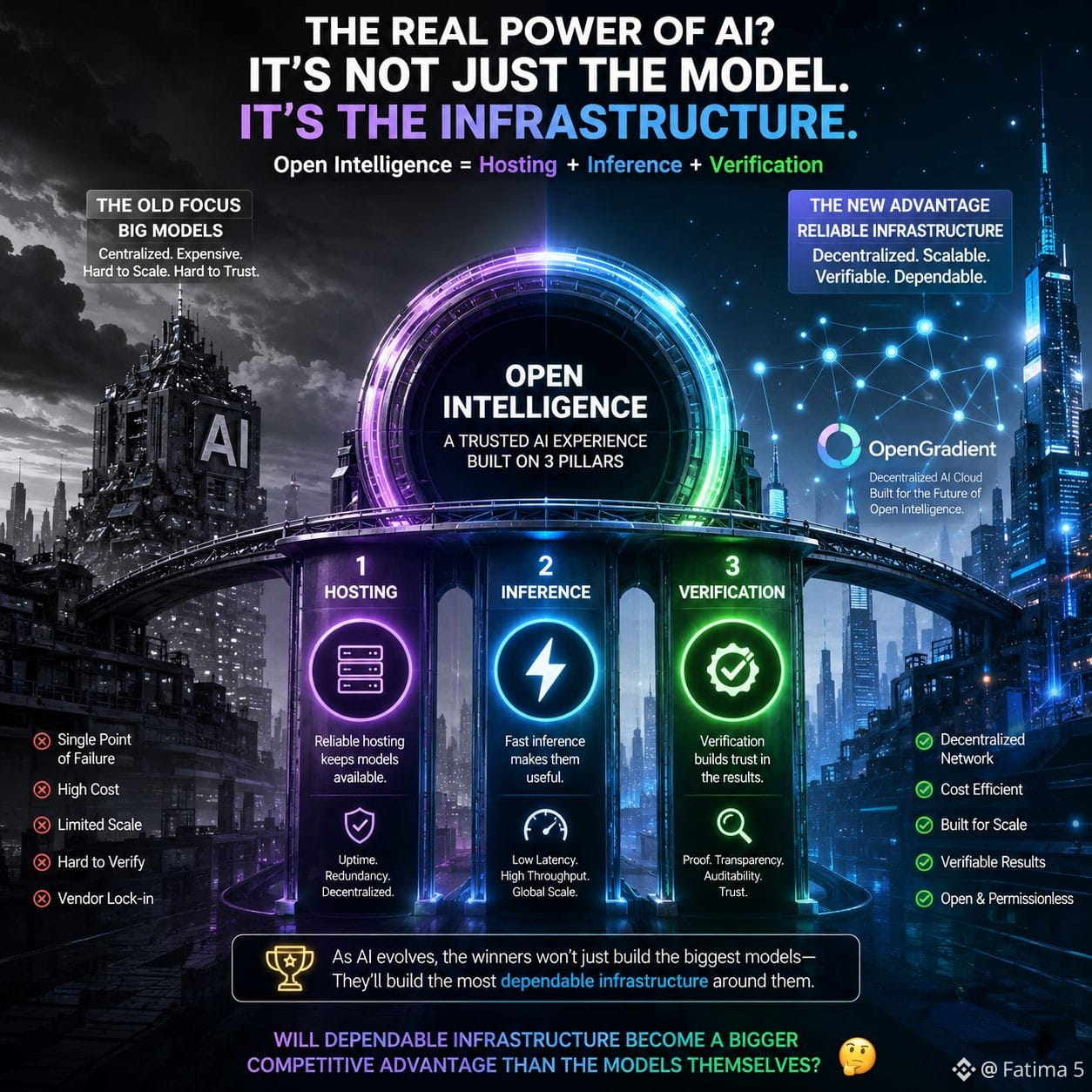
Open Intelligence = Hosting + Inference + Verification
If one of these pieces is weak.The entire experience suffers.
Reliable hosting keeps models available.
Fast inference makes them useful.
Verification builds trust in the results.
What stands out about OpenGradient is that it's building a decentralized network designed to support all three instead of depending on a single centralized layer.
As AI continues to grow.The winners May not be the ones with the biggest models they may be the ones building The most reliable infrastructure around Them.
Curious to hear your thoughts
As AI matures.Will dependable infrastructure become a bigger competitive advantage than the models Themselves?
@OpenGradient $OPG #OPG
I came across #OpenGradient recently Thinking it was just another project focused on AI models
But after spending some time understanding it.I realized the real story is not the models—it is the infrastructure Behind them.
We often talk about how powerful AI Models are.
We rarely talk about what makes them Dependable.
As AI becomes part of more products and workflows.Questions like Where is the model running?.Can the output be Verified?.and Can it handle demand at scale? become just as important as the Model itself.
That changed how I look at AI infrastructure.
I think about it with a simple framework:
Open Intelligence = Hosting + Inference + Verification
If one of these pieces is weak.The entire experience suffers.
Reliable hosting keeps models available.
Fast inference makes them useful.
Verification builds trust in the results.
What stands out about OpenGradient is that it's building a decentralized network designed to support all three instead of depending on a single centralized layer.
As AI continues to grow.The winners May not be the ones with the biggest models they may be the ones building The most reliable infrastructure around Them.
Curious to hear your thoughts
As AI matures.Will dependable infrastructure become a bigger competitive advantage than the models Themselves?
@OpenGradient $OPG #OPG
52
1
20
637

·
--
I caught myself doing something today that I bet a lot of us do without realizing it.
I asked an AI a question, got a confident answer, nodded... and moved on. I didn't even think about how that answer was produced.
The more I thought about it, the weirder it felt.
We have spent years talking about making AI smarter, but I don't think we talk enough about making it accountable. if AI ends up powering finance, research, or automation, "just trust the output" doesn't sound like a great long-term plan.
That is honestly why I started reading more about OpenGradient.
The idea that grabbed me wasn't just decentralized AI. It was the focus on verifying model execution instead of expecting users to trust a black box. That reminds me of the early blockchain days when people stopped asking, "Do I trust this?" and started asking, "Can I verify this?"
Maybe I am wrong, but I have a feeling this shift is bigger than most people realize.
Everyone loves speed and lower costs. I do too. But if I had to choose between a fast answer I can't verify and one I can actually trust, I think I'd pick the second option every time.
I am still curious to see how this performs under real-world demand. That's the real test.
For me, the future of AI is not just about intelligence.
It's about intelligence you can prove.
@OpenGradient $OPG #OPG #opg
#OpenGradient
What's OpenGradient's biggest long-term advantage?
I caught myself doing something today that I bet a lot of us do without realizing it.
I asked an AI a question, got a confident answer, nodded... and moved on. I didn't even think about how that answer was produced.
The more I thought about it, the weirder it felt.
We have spent years talking about making AI smarter, but I don't think we talk enough about making it accountable. if AI ends up powering finance, research, or automation, "just trust the output" doesn't sound like a great long-term plan.
That is honestly why I started reading more about OpenGradient.
The idea that grabbed me wasn't just decentralized AI. It was the focus on verifying model execution instead of expecting users to trust a black box. That reminds me of the early blockchain days when people stopped asking, "Do I trust this?" and started asking, "Can I verify this?"
Maybe I am wrong, but I have a feeling this shift is bigger than most people realize.
Everyone loves speed and lower costs. I do too. But if I had to choose between a fast answer I can't verify and one I can actually trust, I think I'd pick the second option every time.
I am still curious to see how this performs under real-world demand. That's the real test.
For me, the future of AI is not just about intelligence.
It's about intelligence you can prove.
@OpenGradient $OPG #OPG #opg
#OpenGradient
What's OpenGradient's biggest long-term advantage?
I asked an AI a question, got a confident answer, nodded... and moved on. I didn't even think about how that answer was produced.
The more I thought about it, the weirder it felt.
We have spent years talking about making AI smarter, but I don't think we talk enough about making it accountable. if AI ends up powering finance, research, or automation, "just trust the output" doesn't sound like a great long-term plan.
That is honestly why I started reading more about OpenGradient.
The idea that grabbed me wasn't just decentralized AI. It was the focus on verifying model execution instead of expecting users to trust a black box. That reminds me of the early blockchain days when people stopped asking, "Do I trust this?" and started asking, "Can I verify this?"
Maybe I am wrong, but I have a feeling this shift is bigger than most people realize.
Everyone loves speed and lower costs. I do too. But if I had to choose between a fast answer I can't verify and one I can actually trust, I think I'd pick the second option every time.
I am still curious to see how this performs under real-world demand. That's the real test.
For me, the future of AI is not just about intelligence.
It's about intelligence you can prove.
@OpenGradient $OPG #OPG #opg
#OpenGradient
What's OpenGradient's biggest long-term advantage?
🔍 Verifiable inference
100%
⚡ Scalable AI network
0%
🤝 Open AI ecosystem
0%
2 дауыс • Дауыс беру жабық
161
61
713

·
--
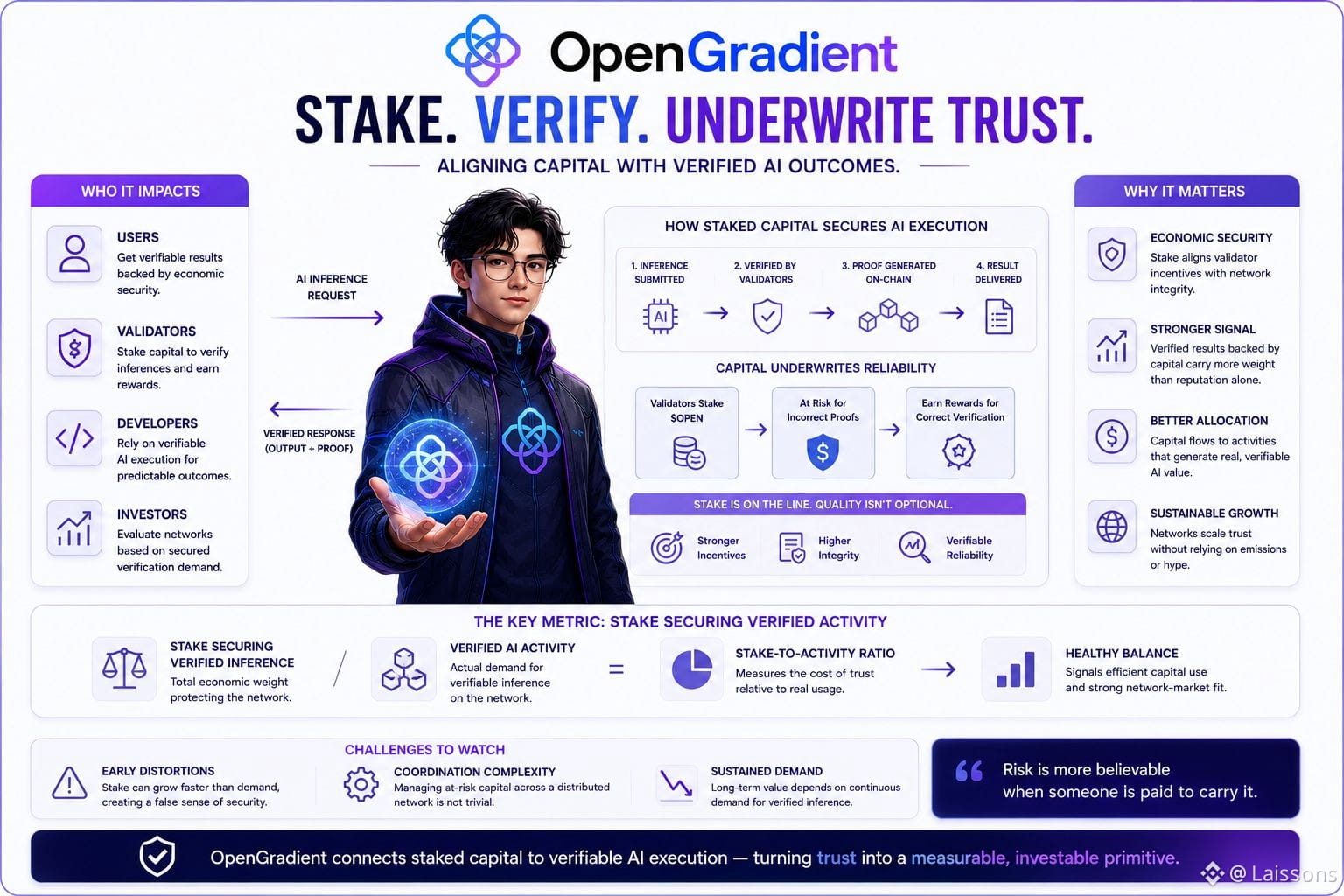
One thing I keep tracking with OpenGradient is not how many AI tasks can be verified, but how verification changes capital allocation inside the network.
When staking is connected to proof verification, capital is effectively being asked to underwrite the reliability of AI execution. That creates a different dynamic from many token networks where staking exists primarily for emissions.
For users, the signal becomes stronger. A verified result backed by economically exposed validators carries a different level of credibility than a result secured only by reputation.
"Risk is more believable when someone is paid to carry it."
From an investor perspective, the interesting metric may eventually be how much stake is securing each unit of verified AI activity. That ratio says something about how expensive trust is becoming relative to actual usage.
The challenge is that this relationship can be distorted early on. Staked capital can grow faster than demand for verified inference, creating the appearance of strong security before the network has proven its economic relevance.
I suspect the market spends a lot of time measuring staking participation and not enough time measuring whether that stake is supporting real verification demand. For OpenGradient, the connection between those two variables may matter more than either one independently.
#OpenGradient #OPG
@OpenGradient $HEI
{future}(HEIUSDT)
$BEAT
{future}(BEATUSDT)
$OPG
{future}(OPGUSDT)
One thing I keep tracking with OpenGradient is not how many AI tasks can be verified, but how verification changes capital allocation inside the network.
When staking is connected to proof verification, capital is effectively being asked to underwrite the reliability of AI execution. That creates a different dynamic from many token networks where staking exists primarily for emissions.
For users, the signal becomes stronger. A verified result backed by economically exposed validators carries a different level of credibility than a result secured only by reputation.
"Risk is more believable when someone is paid to carry it."
From an investor perspective, the interesting metric may eventually be how much stake is securing each unit of verified AI activity. That ratio says something about how expensive trust is becoming relative to actual usage.
The challenge is that this relationship can be distorted early on. Staked capital can grow faster than demand for verified inference, creating the appearance of strong security before the network has proven its economic relevance.
I suspect the market spends a lot of time measuring staking participation and not enough time measuring whether that stake is supporting real verification demand. For OpenGradient, the connection between those two variables may matter more than either one independently.
#OpenGradient #OPG
@OpenGradient $HEI
$BEAT
$OPG
When staking is connected to proof verification, capital is effectively being asked to underwrite the reliability of AI execution. That creates a different dynamic from many token networks where staking exists primarily for emissions.
For users, the signal becomes stronger. A verified result backed by economically exposed validators carries a different level of credibility than a result secured only by reputation.
"Risk is more believable when someone is paid to carry it."
From an investor perspective, the interesting metric may eventually be how much stake is securing each unit of verified AI activity. That ratio says something about how expensive trust is becoming relative to actual usage.
The challenge is that this relationship can be distorted early on. Staked capital can grow faster than demand for verified inference, creating the appearance of strong security before the network has proven its economic relevance.
I suspect the market spends a lot of time measuring staking participation and not enough time measuring whether that stake is supporting real verification demand. For OpenGradient, the connection between those two variables may matter more than either one independently.
#OpenGradient #OPG
@OpenGradient $HEI
$BEAT
$OPG
206
95
1.1k

Spent an hour poking around OpenGradient’s Model Hub for a CreatorPad task and the thing that actually stuck with me wasn’t the 2,000-model number everyone quotes, it was watching a single inference call settle on Base in close to real time, paid in $OPG , no intermediary step. #OpenGradient @OpenGradient frames this as “AI inference as composable as any on-chain transaction,” and technically that checks out, the call resolves into a wallet-signed transaction like anything else on Base.
What surprised me was how unglamorous that moment was. I expected some kind of visible “verification” step, a proof being checked in front of me. Instead it just looked like a normal gas-paying transaction with an inference result attached. The verifiable part is happening, but it’s abstracted away enough that as a user you mostly have to trust the UI is showing you the proof rather than seeing the cryptography do its work.
That’s the part I keep turning over. The pitch is auditability over trust, but the actual experience of calling a model still asks you to take the front end’s word for it unless you go digging through validator attestations yourself. Maybe that’s fine, most people don’t verify Etherscan receipts either. Still, there’s a gap between “the network is verifiable” and “I, the user, verified anything,” and I’m not sure that gap closes just because the rails are on-chain.
@OpenGradient $OPG #OPG
Spent an hour poking around OpenGradient’s Model Hub for a CreatorPad task and the thing that actually stuck with me wasn’t the 2,000-model number everyone quotes, it was watching a single inference call settle on Base in close to real time, paid in $OPG , no intermediary step. #OpenGradient @OpenGradient frames this as “AI inference as composable as any on-chain transaction,” and technically that checks out, the call resolves into a wallet-signed transaction like anything else on Base.
What surprised me was how unglamorous that moment was. I expected some kind of visible “verification” step, a proof being checked in front of me. Instead it just looked like a normal gas-paying transaction with an inference result attached. The verifiable part is happening, but it’s abstracted away enough that as a user you mostly have to trust the UI is showing you the proof rather than seeing the cryptography do its work.
That’s the part I keep turning over. The pitch is auditability over trust, but the actual experience of calling a model still asks you to take the front end’s word for it unless you go digging through validator attestations yourself. Maybe that’s fine, most people don’t verify Etherscan receipts either. Still, there’s a gap between “the network is verifiable” and “I, the user, verified anything,” and I’m not sure that gap closes just because the rails are on-chain.
@OpenGradient $OPG #OPG
What surprised me was how unglamorous that moment was. I expected some kind of visible “verification” step, a proof being checked in front of me. Instead it just looked like a normal gas-paying transaction with an inference result attached. The verifiable part is happening, but it’s abstracted away enough that as a user you mostly have to trust the UI is showing you the proof rather than seeing the cryptography do its work.
That’s the part I keep turning over. The pitch is auditability over trust, but the actual experience of calling a model still asks you to take the front end’s word for it unless you go digging through validator attestations yourself. Maybe that’s fine, most people don’t verify Etherscan receipts either. Still, there’s a gap between “the network is verifiable” and “I, the user, verified anything,” and I’m not sure that gap closes just because the rails are on-chain.
@OpenGradient $OPG #OPG

13
16
146
Расталды
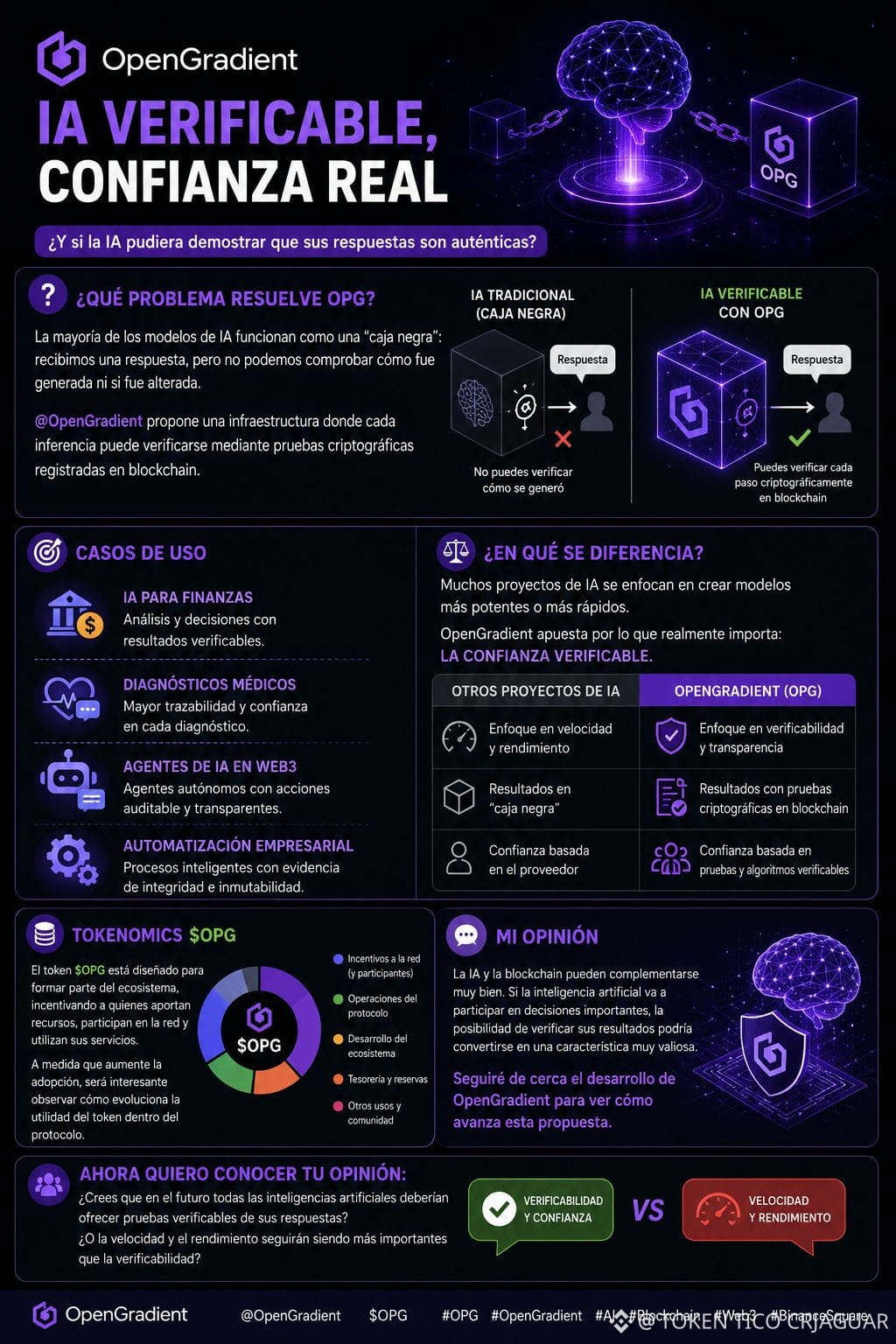
🤖 ¿Y si la inteligencia artificial pudiera demostrar que sus respuestas son auténticas en lugar de pedirnos que simplemente confiemos?
Ese es el problema que busca resolver OpendGradient. Hoy, la mayoría de los modelos de IA funcionan como una "caja negra": recibimos una respuesta, pero no podemos comprobar cómo fue generada ni si fue alterada. OpenGradient propone una infraestructura donde cada inferencia puede verificarse mediante pruebas criptográficas registradas en blockchain.
📌 Casos de uso
IA para finanzas con resultados verificables.
Diagnósticos médicos con mayor trazabilidad.
Agentes de IA en Web3.
Automatización empresarial con evidencia de integridad.
🔍 ¿En qué se diferencia de otros proyectos de IA? Muchos proyectos se enfocan en crear modelos más potentes o más rápidos. OpenGradient apuesta por un aspecto igual de importante: la confianza verificable, permitiendo demostrar que un resultado no fue manipulado.
💰 Tokenomics El token $OPG está diseñado para formar parte del ecosistema, incentivando a quienes aportan recursos, participan en la red y utilizan sus servicios. A medida que aumente la adopción, será interesante observar cómo evoluciona la utilidad del token dentro del protocolo.
📰 Mi opinión La IA y la blockchain pueden complementarse muy bien. Si la inteligencia artificial va a participar en decisiones importantes, la posibilidad de verificar sus resultados podría convertirse en una característica muy valiosa. Seguiré de cerca el desarrollo de OpenGradient para ver cómo avanza esta propuesta.
💬 Ahora quiero conocer tu opinión: ¿Crees que en el futuro todas las inteligencias artificiales deberían ofrecer pruebas verificables de sus respuestas? ¿O la velocidad y el rendimiento seguirán siendo más importantes que la verificabilidad?
@OpenGradient @Binancelatam @Binance_Labs
$OPG
#OPG #OpenGradient #AI #blockchain #Web3
🤖 ¿Y si la inteligencia artificial pudiera demostrar que sus respuestas son auténticas en lugar de pedirnos que simplemente confiemos?
Ese es el problema que busca resolver OpendGradient. Hoy, la mayoría de los modelos de IA funcionan como una "caja negra": recibimos una respuesta, pero no podemos comprobar cómo fue generada ni si fue alterada. OpenGradient propone una infraestructura donde cada inferencia puede verificarse mediante pruebas criptográficas registradas en blockchain.
📌 Casos de uso
IA para finanzas con resultados verificables.
Diagnósticos médicos con mayor trazabilidad.
Agentes de IA en Web3.
Automatización empresarial con evidencia de integridad.
🔍 ¿En qué se diferencia de otros proyectos de IA? Muchos proyectos se enfocan en crear modelos más potentes o más rápidos. OpenGradient apuesta por un aspecto igual de importante: la confianza verificable, permitiendo demostrar que un resultado no fue manipulado.
💰 Tokenomics El token $OPG está diseñado para formar parte del ecosistema, incentivando a quienes aportan recursos, participan en la red y utilizan sus servicios. A medida que aumente la adopción, será interesante observar cómo evoluciona la utilidad del token dentro del protocolo.
📰 Mi opinión La IA y la blockchain pueden complementarse muy bien. Si la inteligencia artificial va a participar en decisiones importantes, la posibilidad de verificar sus resultados podría convertirse en una característica muy valiosa. Seguiré de cerca el desarrollo de OpenGradient para ver cómo avanza esta propuesta.
💬 Ahora quiero conocer tu opinión: ¿Crees que en el futuro todas las inteligencias artificiales deberían ofrecer pruebas verificables de sus respuestas? ¿O la velocidad y el rendimiento seguirán siendo más importantes que la verificabilidad?
@OpenGradient @Binance LATAM Official @Binance Labs
$OPG
#OPG #OpenGradient #AI #blockchain #Web3
Ese es el problema que busca resolver OpendGradient. Hoy, la mayoría de los modelos de IA funcionan como una "caja negra": recibimos una respuesta, pero no podemos comprobar cómo fue generada ni si fue alterada. OpenGradient propone una infraestructura donde cada inferencia puede verificarse mediante pruebas criptográficas registradas en blockchain.
📌 Casos de uso
IA para finanzas con resultados verificables.
Diagnósticos médicos con mayor trazabilidad.
Agentes de IA en Web3.
Automatización empresarial con evidencia de integridad.
🔍 ¿En qué se diferencia de otros proyectos de IA? Muchos proyectos se enfocan en crear modelos más potentes o más rápidos. OpenGradient apuesta por un aspecto igual de importante: la confianza verificable, permitiendo demostrar que un resultado no fue manipulado.
💰 Tokenomics El token $OPG está diseñado para formar parte del ecosistema, incentivando a quienes aportan recursos, participan en la red y utilizan sus servicios. A medida que aumente la adopción, será interesante observar cómo evoluciona la utilidad del token dentro del protocolo.
📰 Mi opinión La IA y la blockchain pueden complementarse muy bien. Si la inteligencia artificial va a participar en decisiones importantes, la posibilidad de verificar sus resultados podría convertirse en una característica muy valiosa. Seguiré de cerca el desarrollo de OpenGradient para ver cómo avanza esta propuesta.
💬 Ahora quiero conocer tu opinión: ¿Crees que en el futuro todas las inteligencias artificiales deberían ofrecer pruebas verificables de sus respuestas? ¿O la velocidad y el rendimiento seguirán siendo más importantes que la verificabilidad?
@OpenGradient @Binance LATAM Official @Binance Labs
$OPG
#OPG #OpenGradient #AI #blockchain #Web3
6
6
257

·
--
$OPG OPG is one of the most exciting projects in crypto! With a fixed supply of only 1 Billion OPG, strong tokenomics, and listings on Binance, Bybit, and MEXC, the future looks bright. 📈 The foundation is strong, the community is growing, and the potential is worth watching. Stay informed, do your own research, and keep building. 🖤⬛📯💯 #OPG #OpenGradient
$OPG OPG is one of the most exciting projects in crypto! With a fixed supply of only 1 Billion OPG, strong tokenomics, and listings on Binance, Bybit, and MEXC, the future looks bright. 📈 The foundation is strong, the community is growing, and the potential is worth watching. Stay informed, do your own research, and keep building. 🖤⬛📯💯 #OPG #OpenGradient
1
1
98
Көбірек контент көру үшін кіріңіз
Binance Square платформасында әлемдік криптоқоғамдастыққа қосылыңыз
⚡️ Криптовалюта туралы ең соңғы және пайдалы ақпаратты алыңыз.
💬 Әлемдегі ең ірі криптобиржаның сеніміне ие.
👍 Расталған авторлардың нақты пікірлерін табыңыз.
Электрондық пошта/телефон нөмірі
Трендтегі тақырыптар
1
#BNBSurpasses$790
11,486 рет көрілді
89 адам талқылап жатыр
2
#ZamaRises15.99%ToIntradayHigh$0.09
6,281 рет көрілді
75 адам талқылап жатыр
3
#BitcoinSpotETFsDraw$6.34BInflowsInQ3
3,865 рет көрілді
63 адам талқылап жатыр
4
#EthereumValidatorExitQueueJumps392%
60,579 рет көрілді
735 адам талқылап жатыр
5
#IMFApprovesElSalvador$138MWithBitcoinWaiver
8,185 рет көрілді
43 адам талқылап жатыр
6
#SECHaltsCryptoETFReviewsAmidFundingLapse
214,467 рет көрілді
1,626 адам талқылап жатыр
7
#ZcashETFPostsFirstWeeklyOutflow$93.6M
90,058 рет көрілді
247 адам талқылап жатыр
8
#GreekPoliceBustCryptoScamRingArrest17
344,393 рет көрілді
2,293 адам талқылап жатыр
9
#BitcoinRejectedAt$87K
208,269 рет көрілді
309 адам талқылап жатыр
10
#FedOctoberRateHikeOddsFallTo17%
343,294 рет көрілді
2,414 адам талқылап жатыр