
#elysium
elysium
9,906 рет көрілді
62 адам талқылап жатыр
Қызу саудада
Ең соңғы


·
--
今晚9点 @Enter_Elysium 主网上线,需关注的项目:
NFT: 链接见原帖
NFT: 链接见原帖
NFT: 链接见原帖
NFT: 链接见原帖
Robinhood 铭文: 链接见原帖
对了另外@squeekchain这项目,团队说一些建设者将获得免费mint,这个细节没公告
同时也提醒大家 #Elysium 虽然有热度但是各种妖魔鬼怪也来了,记要注意安全!
仅做信息分享,不做任何投资建议
今晚9点 @Enter_Elysium 主网上线,需关注的项目:
NFT: 链接见原帖
NFT: 链接见原帖
NFT: 链接见原帖
NFT: 链接见原帖
Robinhood 铭文: 链接见原帖
对了另外@squeekchain这项目,团队说一些建设者将获得免费mint,这个细节没公告
同时也提醒大家 #Elysium 虽然有热度但是各种妖魔鬼怪也来了,记要注意安全!
仅做信息分享,不做任何投资建议
NFT: 链接见原帖
NFT: 链接见原帖
NFT: 链接见原帖
NFT: 链接见原帖
Robinhood 铭文: 链接见原帖
对了另外@squeekchain这项目,团队说一些建设者将获得免费mint,这个细节没公告
同时也提醒大家 #Elysium 虽然有热度但是各种妖魔鬼怪也来了,记要注意安全!
仅做信息分享,不做任何投资建议
19

·
--
Расталды
Elysium launches TODAY - HYPE is its gas. But price is down 3.6% on launch day. Sell the news, or buy the dip?
SNAPSHOT (Binance, 9 Nov ~10:30 PKT)
$HYPE $74.52, -3.6% 24h. Range $73.78-$78.16. Binance vol $29.7M, total $789M. MC $17.8B, rank 11. BTC $74,664, ETH $2,140. Fear & Greed 29 (Fear).
CATALYST - VERIFIED
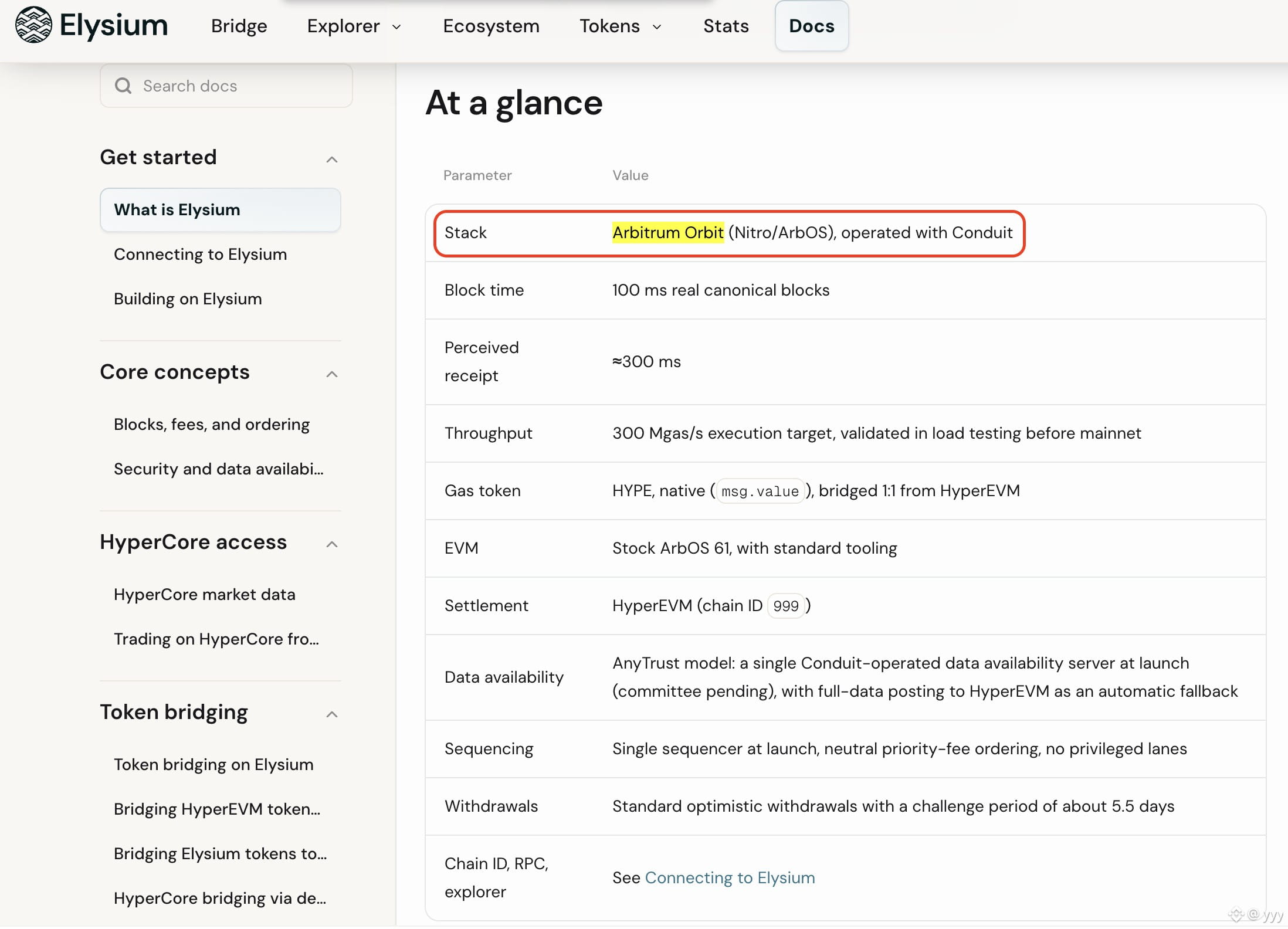
Elysium, Hyperliquid's first Layer 2, opens public mainnet TODAY, 9 Nov (Kinetiq blog 20 Oct; CoinPaper, Alchemy). Arbitrum Orbit rollup settling to HyperEVM, HYPE as gas, bridged 1:1. Sequencer revenue: 50% buys back KNTQ for the Assistance Fund, 25% to apps, 25% to treasury. fomo and Pumpfun apps go live on it today.
THE CATCH
Kinetiq's docs still said "pre-launch" on 8 Nov. Only the bridge audit is done (24 Oct). HyperCore access is NOT at launch - about 4 weeks later. Stage one only. Market votes sell-the-news: $9.04M liquidations in 24h, 98.8% longs (CoinStats).
TECHNICALS (Binance daily, 8 Nov close)
EMA20 $81.44 - price 8.6% below it. RSI 47.5. 7d -15.1%, 30d -12.8%. ATH $97.96 (23 Sep), -24% below it. 30d low $73.78 - price ~1% above it. FDV $71.3B = 4.0x MC - unlock overhang.
EXPECTATIONS - BASE-RATE STUDY, NOT A GUARANTEE
No options market for HYPE - odds from its own history (CoinGecko daily closes, 366 days). Setup: close 5%+ below EMA20, RSI 40-55, 7d -10% or worse. Symmetric 8% barriers, 7 days, episodes 7+ days apart.
MAIN: N=5 only - UP first 40%, DOWN first 20%, NEITHER 40%. 7 days later higher just 1 of 5. N is small - treat with care.
Wider: N=13 - UP 54%, DOWN 8%; N=15 - UP 47%, DOWN 13%. Same message: bounce first slightly more likely, but most episodes drift sideways. No strong edge. Launch hype alone does not flip the base rate.
PLAN - SPOT ONLY, HALF SIZE MAX
No chasing, no knife-catching. Bounce trade only on daily close above $78.16, safer above EMA20 $81.44. Dip only if $73.78 holds and close back above $75.50 - tiny size. Invalidation: daily close below $73.78 opens $70, then $68.81. Targets: $78.16 / $81.44 / $85.10. Confidence: Low. Tomorrow's CPI (10 Nov, 8:30 ET) moves the whole market.
#HYPE #Hyperliquid #Elysium
151

·
--
Elysium, L2 pertama Hyperliquid, buka mainnet hari ini — tapi jangan keburu bayangin semua fiturnya langsung jalan.
Fakta: L2 buatan Kinetiq ini (Arbitrum Orbit, settle ke HyperEVM, HYPE dipakai buat gas) menargetkan blok 100 ms dan kapasitas ~300 juta gas/detik. Tanggal mainnet 9 Nov diumumkan resmi Kinetiq sejak 20 Okt, dan laporan hari ini menyebut peluncurannya berjalan.
Status: tanggalnya TERKONFIRMASI, cakupannya TERBATAS. Akses ke order book Hyperliquid (HyperCore) baru sekitar 4 minggu lagi, audit yang selesai baru jembatan tokennya (24 Okt), dan sequencer-nya masih satu. Ini mainnet yang dibuka, bukan yang sudah selesai.
Opiniku: infrastrukturnya masuk akal, tapi pasar belum merayakan — HYPE sekitar $73,6, turun dari kisaran $77 kemarin, di tengah pasar yang masih takut dan CPI AS besok 20:30 WIB yang jadi penentu.
Yang aku pantau: konfirmasi aktivasi penuh di dokumen resmi, dan apakah aplikasi hari pertama (Nest DEX, pump.fun, Derive) benar-benar jalan.
⚠️ Tidak ada token resmi Elysium dan tidak ada program points — tautan klaim airdrop Elysium adalah scam. Verifikasi hanya lewat akun resmi Kinetiq, bukan dari tautan di komentar/DM.
Menurut kalian, L2 khusus trading begini bakal mengubah peta DEX, atau cuma jadi chain baru yang sepi?
#Hyperliquid #Elysium #Web3 $HYPE
128



·
--
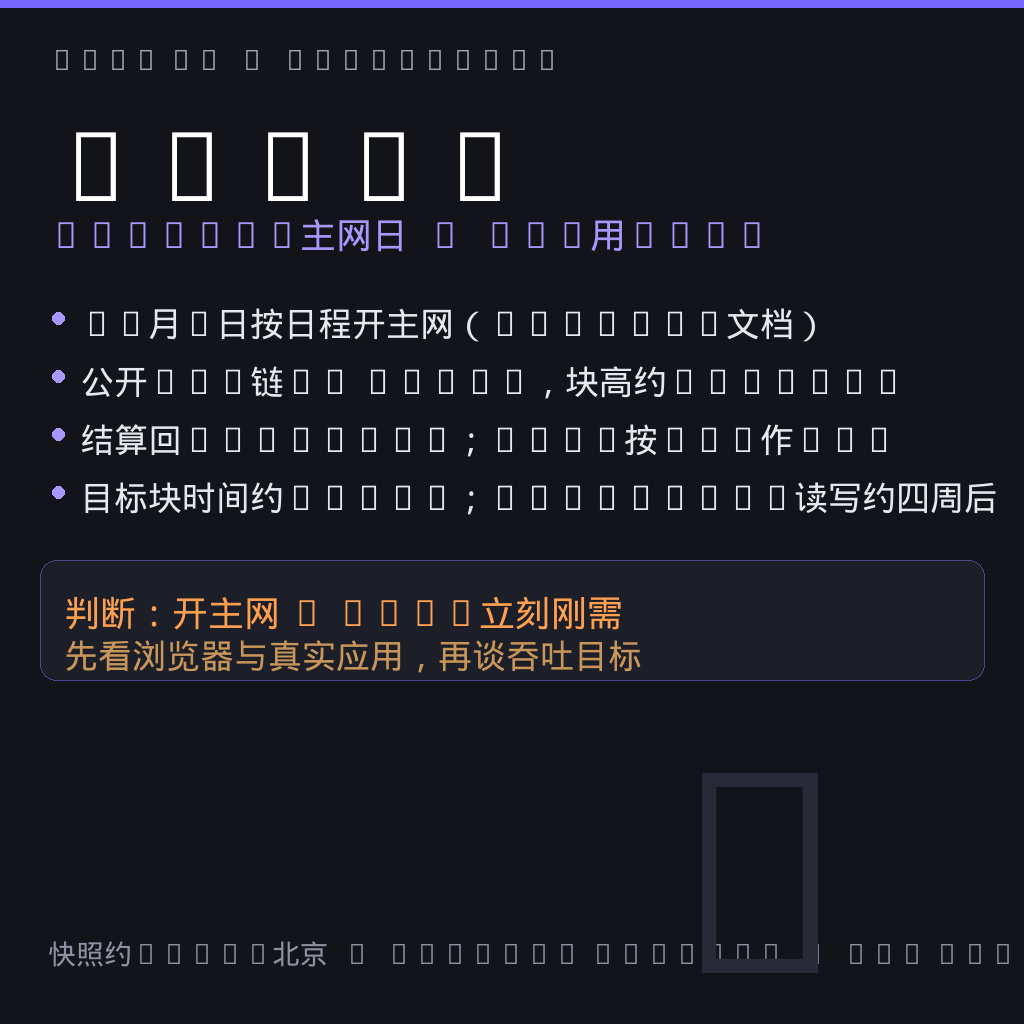
今天按日程该开闸了:Kinetiq给Hyperliquid做的二层Elysium,主网日期就钉在11月9日。公开RPC已返回主网链ID 99901,当前块高约2905831;官方文档写明,结算回HyperEVM,gas用HYPE按1比1跨过去,目标块时间约100毫秒。HyperCore订单簿读写要等上线约四周后的升级,今天先开基础执行层,不等于生态已经齐活。
开主网不等于把Hyperliquid做成第二条万能链。反方会把它读成HYPE立刻多了一层刚需;更稳的读法是先看有没有稳定浏览器和真实应用迁过来,别把测试里的吞吐目标当成现货成交理由。
这一周若出块和应用交互都稀少,就把今天当仪式;有稳定流量再谈gas刚需。快照约12:03北京,Binance HYPE约$74.58,24小时约-3.8%。
$HYPE
#HYPE #Elysium #加密货币
开主网不等于把Hyperliquid做成第二条万能链。反方会把它读成HYPE立刻多了一层刚需;更稳的读法是先看有没有稳定浏览器和真实应用迁过来,别把测试里的吞吐目标当成现货成交理由。
这一周若出块和应用交互都稀少,就把今天当仪式;有稳定流量再谈gas刚需。快照约12:03北京,Binance HYPE约$74.58,24小时约-3.8%。
$HYPE
#HYPE #Elysium #加密货币
187

刚爬起来刷了眼手机,好家伙,Hyperliquid 首条 L2 Elysium 今天正式开闸。
昨天还在倒计时,今天直接上线。Alchemy 当启动 RPC,QuickNode 首日就接上了,Pump.fun、fomo、GMGN 说好第一天就进场。
账算得很明白:排序器手续费 50% 拿去回购销毁 KNTQ,25% 分给 builder 做激励,25% 归国库。Ascend 内测首日就干了 597 万美元成交、47254 笔、发了 873 个币。
最实在的是 gas:这条链只认 $HYPE 当油钱,链上每笔交易都得先买 HYPE。HYPE 现价 77 美元上下,7 天已经跌了 12%,9 月高点 98 美元。
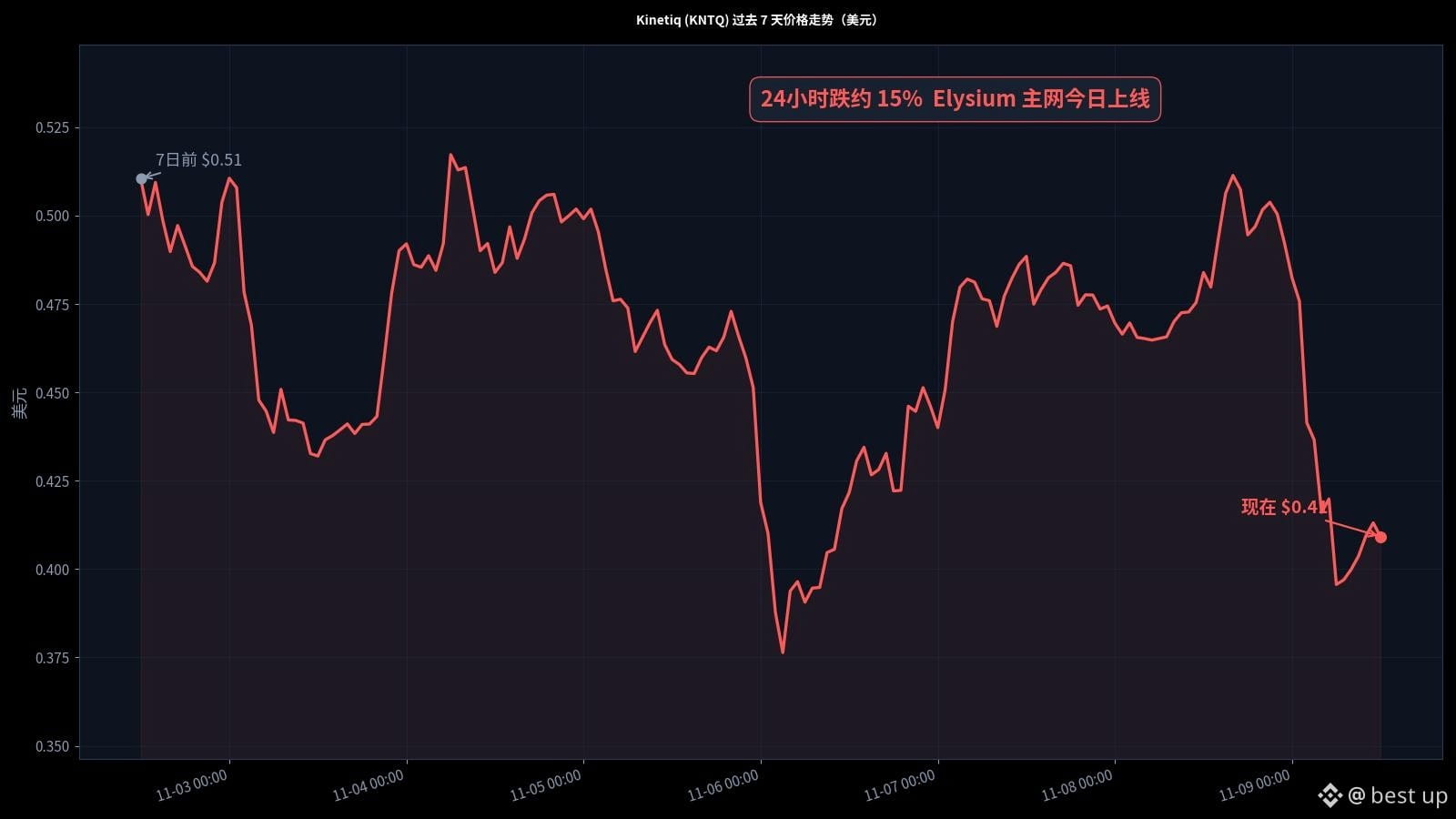
当然冷水也得泼:官方到现在没给具体几点上线,空投也没官宣;上线前链上土狗已经提前开跑,BLOB、BOXA、KLEOS 这些名字都开始刷屏了;KNTQ 自己 0.47 美元,11 月 27 日还有 3.1 亿枚解锁悬崖等着。
A:今天就冲,gas 需求是实打实的,先上车再说。
B:等第一波土狗割完、KNTQ 解锁靴子落地再说。
$HYPE $BTC
#Hyperliquid #Elysium #Kinetiq

·
--
⚡ ELYSIUM, A HYPERLIQUID L2, LAUNCHES MAINNET MONDAY!!
Elysium, a Hyperliquid ecosystem L2, plans to launch its mainnet on Nov 9. Watch $HYPE for volatility.
⚠️ Launch days are often "sell the news." Use stops.!
#TradFiForBeginners #JobsReportRaisesHikeOdds #Elysium $HYPE $BTC
{spot}(HYPEUSDT)
⚡ ELYSIUM, A HYPERLIQUID L2, LAUNCHES MAINNET MONDAY!!
Elysium, a Hyperliquid ecosystem L2, plans to launch its mainnet on Nov 9. Watch $HYPE for volatility.
⚠️ Launch days are often "sell the news." Use stops.!
#TradFiForBeginners #JobsReportRaisesHikeOdds #Elysium $HYPE $BTC
Elysium, a Hyperliquid ecosystem L2, plans to launch its mainnet on Nov 9. Watch $HYPE for volatility.
⚠️ Launch days are often "sell the news." Use stops.!
#TradFiForBeginners #JobsReportRaisesHikeOdds #Elysium $HYPE $BTC
86
明天11月9日,Hyperliquid首条L2 Elysium主网上线,KNTQ这周先跌为敬:现价0.47美元,7天-18%,30天还+53%。
数字摆这儿:排序器费50%回购销毁KNTQ,首日Pump.fun、Uniswap都到场,3.5万枚$HYPE已提前跨过去当gas。
另一面:11月27日3.1亿枚解锁悬崖到期,流通盘才三成出头,FDV是市值的3倍多。
A:上线是新故事起点,$HYPE 77.5美元跟着喝汤
B:利好出尽+解锁在即,先跌为敬就是预演
你站哪边?
$HYPE $BTC
#Hyperliquid #Elysium #Kinetiq
明天11月9日,Hyperliquid首条L2 Elysium主网上线,KNTQ这周先跌为敬:现价0.47美元,7天-18%,30天还+53%。
数字摆这儿:排序器费50%回购销毁KNTQ,首日Pump.fun、Uniswap都到场,3.5万枚$HYPE 已提前跨过去当gas。
另一面:11月27日3.1亿枚解锁悬崖到期,流通盘才三成出头,FDV是市值的3倍多。
A:上线是新故事起点,$HYPE 77.5美元跟着喝汤
B:利好出尽+解锁在即,先跌为敬就是预演
你站哪边?
$HYPE $BTC
#Hyperliquid #Elysium #Kinetiq
数字摆这儿:排序器费50%回购销毁KNTQ,首日Pump.fun、Uniswap都到场,3.5万枚$HYPE 已提前跨过去当gas。
另一面:11月27日3.1亿枚解锁悬崖到期,流通盘才三成出头,FDV是市值的3倍多。
A:上线是新故事起点,$HYPE 77.5美元跟着喝汤
B:利好出尽+解锁在即,先跌为敬就是预演
你站哪边?
$HYPE $BTC
#Hyperliquid #Elysium #Kinetiq
73
·
--
Senin 9 Nov, Hyperliquid dapat L2-nya sendiri: Elysium meluncur — dan Uniswap sudah antre di hari pertama.
Fakta: Elysium, L2 besutan Kinetiq untuk Hyperliquid, mainnet 9 Nov 2026 (pengumuman Elysium; KuCoin & PANews, 7 Nov). Gas dibayar HYPE, blok ditargetkan ~100 milidetik, settlement ke HyperEVM, dibangun di atas Arbitrum Orbit. Uniswap V4 Hooks akan didukung di Elysium — developer bisa membangun pool dengan fee dinamis dan logika kustom. pump.fun dan fomo sudah konfirmasi dukung trading sejak hari pertama; Wormhole bermitra 5 Nov; Bitget Wallet dukung peluncuran.
Status: TERKONFIRMASI — mainnet 9 Nov. Catatan jujur: integrasi Uniswap berupa deployment kontrak di chain, bukan dukungan resmi Uniswap Labs — dua hal yang berbeda.
Yang aku pantau selanjutnya: apakah sambungan ke order book HyperCore benar hadir ~4 minggu pasca-mainnet, dan apakah likuiditas hari pertama benar-benar datang atau cuma janji peluncuran.
⚠️ Hati-hati penipuan: mainnet BELUM live sebelum 9 Nov — situs palsu yang mengklaim "Season 2/3" Hyperliquid atau klaim awal Elysium sudah beredar (MEXC, Nov 2026). Klaim resmi tidak pernah meminta seed phrase/private key. Verifikasi lewat akun resmi proyek, bukan tautan di komentar/DM.
Menurut kalian, Elysium bakal jadi rumah baru meme dan DeFi Hyperliquid, atau sekadar L2 lain yang sepi setelah minggu pertama?
Ini analisisku, bukan nasihat finansial — DYOR selalu.
#Elysium #Hyperliquid $HYPE $UNI
116

·
--
三天后就上主网,今儿个价先跌了一成多——Derive 这出戏,老农看得有点意思。
11 月 9 号,Elysium 主网上线,Derive 的 V3 期权跟着首批就上。这条链是 Kinetiq 给 Hyperliquid 搭的,gas 拿 HYPE 付,结算走 HyperEVM,首批上线的应用里点名有 Derive 的期权。10 月 27 号那头,Spicenet 刚拿了 500 万美元 A 轮,跨场所保证金产品 Spice Edge 临近 beta,第一个合作方也是 Derive。两件好事都摆在台面上了,日子就剩三天。
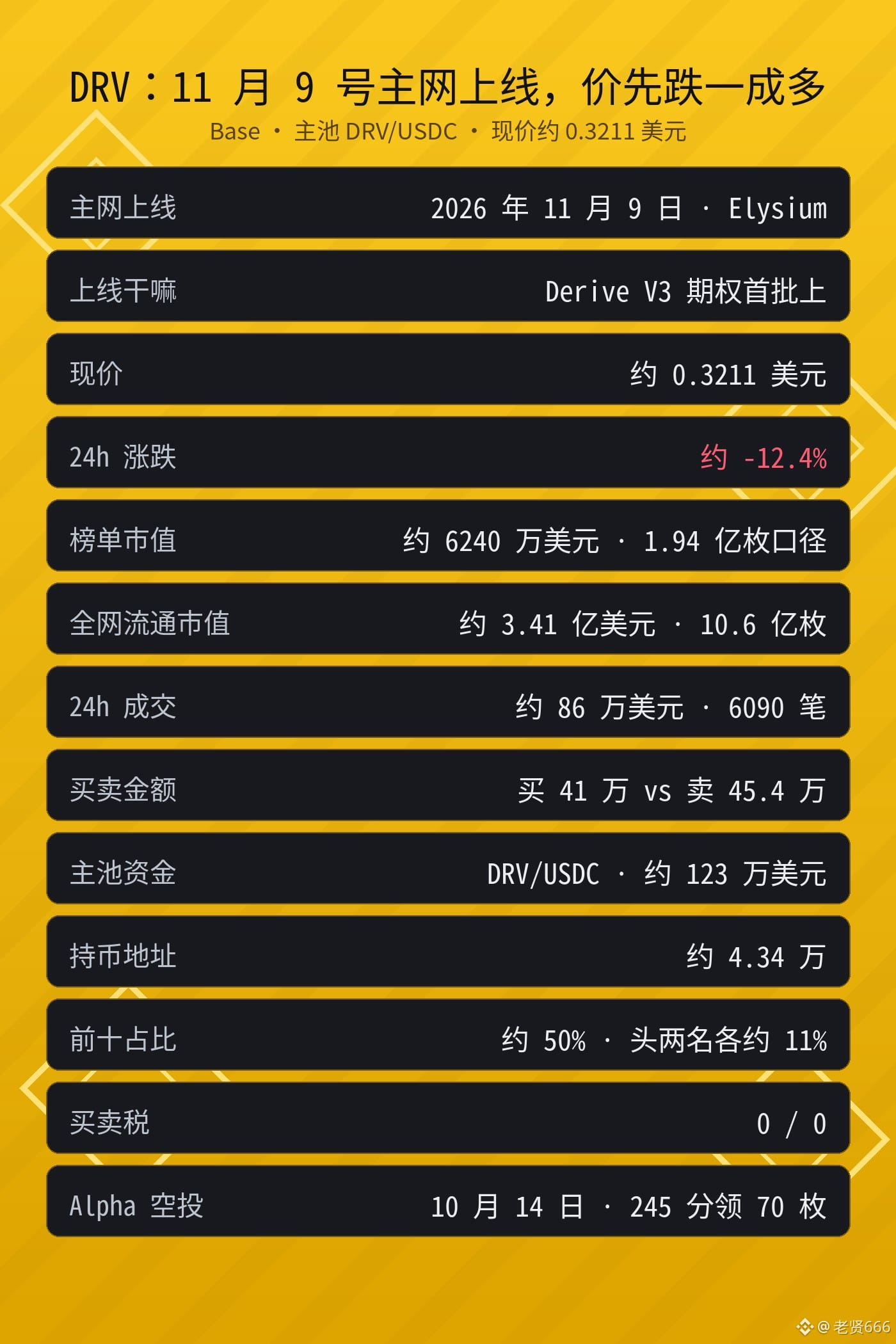
可价不买账。$DRV 现价约 0.3211 美元,一天跌了约 12.4%,24 小时成交约 86 万美元,6090 笔里买 3314 笔 41 万美元、卖 2787 笔 45.4 万美元,卖的比买的多约 4.4 万美元。主池是 DRV/$USDC,池子约 123 万美元,一天成交还不到池子一倍。
市值先问清是哪本账:榜单上约 6240 万美元,是 1.94 亿枚有效总量那本;全网流通市值约 3.41 亿美元,流通约 10.6 亿枚,两本账差 5 倍多。拿着的人约 4.34 万,前十捏着约五成,头两名各占约一成一。买卖税是 0,DEV、狙击、老鼠仓也都是 0,合约是可升级代理那款。10 月 14 号上的 Alpha,245 分领 70 枚、扣 15 分,空投那会儿的事了。
老农就盯两处:11 月 9 号那天,V3 期权真上线了没、成交量有没有跟着放大;要是上线日冷冷清清,价还往下走,这出"利好在途"就先放一边。拿着的人现在查什么:官方主网公告有没有改期,Spice Edge 的 beta 有没有新动静。
11 月 9 号那天,你赌它借着主网上线翻身,还是觉得利好早兑现完了?
不构成投资建议,Alpha 项目高风险,可能归零。关注我,11 月 9 号那天回来对账。
#BinanceAlpha #DRV #Elysium
三天后就上主网,今儿个价先跌了一成多——Derive 这出戏,老农看得有点意思。
11 月 9 号,Elysium 主网上线,Derive 的 V3 期权跟着首批就上。这条链是 Kinetiq 给 Hyperliquid 搭的,gas 拿 HYPE 付,结算走 HyperEVM,首批上线的应用里点名有 Derive 的期权。10 月 27 号那头,Spicenet 刚拿了 500 万美元 A 轮,跨场所保证金产品 Spice Edge 临近 beta,第一个合作方也是 Derive。两件好事都摆在台面上了,日子就剩三天。
可价不买账。$DRV 现价约 0.3211 美元,一天跌了约 12.4%,24 小时成交约 86 万美元,6090 笔里买 3314 笔 41 万美元、卖 2787 笔 45.4 万美元,卖的比买的多约 4.4 万美元。主池是 DRV/$USDC ,池子约 123 万美元,一天成交还不到池子一倍。
市值先问清是哪本账:榜单上约 6240 万美元,是 1.94 亿枚有效总量那本;全网流通市值约 3.41 亿美元,流通约 10.6 亿枚,两本账差 5 倍多。拿着的人约 4.34 万,前十捏着约五成,头两名各占约一成一。买卖税是 0,DEV、狙击、老鼠仓也都是 0,合约是可升级代理那款。10 月 14 号上的 Alpha,245 分领 70 枚、扣 15 分,空投那会儿的事了。
老农就盯两处:11 月 9 号那天,V3 期权真上线了没、成交量有没有跟着放大;要是上线日冷冷清清,价还往下走,这出"利好在途"就先放一边。拿着的人现在查什么:官方主网公告有没有改期,Spice Edge 的 beta 有没有新动静。
11 月 9 号那天,你赌它借着主网上线翻身,还是觉得利好早兑现完了?
不构成投资建议,Alpha 项目高风险,可能归零。关注我,11 月 9 号那天回来对账。
#BinanceAlpha #DRV #Elysium
32
·
--
Расталды
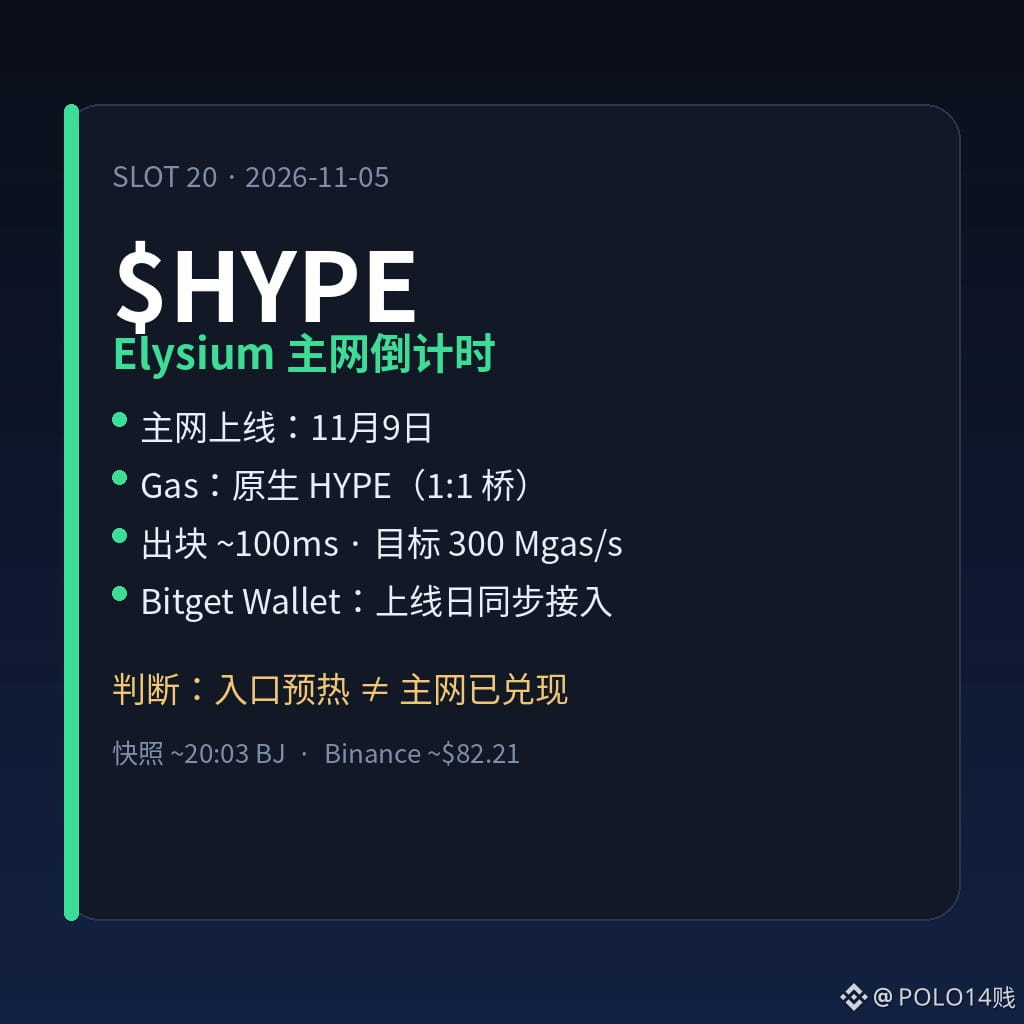
钱包接好了,不等于链已经跑起来。Bitget Wallet今天官宣:Kinetiq给Hyperliquid做的L2 Elysium,主网定在11月9日上线,上线当天钱包会同步接上价格、转账、DEX和跨链入口。Elysium官方文档写明:用HYPE当gas,出块约100毫秒,吞吐目标300 Mgas/s,和HyperEVM按1:1桥接,不另发新gas币。OpenSea、Kyber也在排Day1。
真正变的是入口先就位,不是买盘已经进场。主网日RPC、浏览器、桥合约地址都还没公布;HyperCore读写升级还要再等大约四周。反方会把生态预热读成HYPE效用扩张;没有可验证主网流量,最多算日历事件。
11月9日当天若主网参数仍空着,或首日独立地址和TVL起不来,就把这波当接入口预热,不当成新买盘。快照约20:03北京,Binance HYPE约$82.21,24小时约-4.6%。
$HYPE
#HYPE #Elysium #加密货币
真正变的是入口先就位,不是买盘已经进场。主网日RPC、浏览器、桥合约地址都还没公布;HyperCore读写升级还要再等大约四周。反方会把生态预热读成HYPE效用扩张;没有可验证主网流量,最多算日历事件。
11月9日当天若主网参数仍空着,或首日独立地址和TVL起不来,就把这波当接入口预热,不当成新买盘。快照约20:03北京,Binance HYPE约$82.21,24小时约-4.6%。
$HYPE
#HYPE #Elysium #加密货币
1
448

测试网上的"市值"也能拿出来喊,这届Hyperliquid生态是真敢。
Kinetiq在做的Elysium,Arbitrum Orbit链,结算到HyperEVM,gas用HYPE,主网定在11月9日。X上的生态汇总写着:测试网launchpad里STOCKIUM市值91.7万刀。测试网的币,用测试网的HYPE买,算出来的市值……这数字能换几碗粉?
再看叙事本身。HyperEVM现在3M gas/s,推它的原帖自己承认是为了保护Hyperliquid的核心撮合。Elysium目标300M gas/s、100-200ms出块。翻译一下:主链EVM故意不让跑快,那就再叠一层,把"快"包装成一门新生意。gas照样收HYPE,排序器收入拿25%分给开发者,剩下75%归谁,宣传帖里一个字没提。
还有满屏的"免费、每天10-15分钟、still early、still worth the daily grind"教程。免费的是你的时间,你刷出来的交互数据是项目方拿去讲故事、谈估值的素材。
100ms出块对做市确实有用,这点我认。但主网还没上,测试网市值已经被截图当战绩发了,这节奏老韭菜都懂。
#Hyperliquid #Elysium
176

Мақала
Elysium: A New Era for HyperliquidWhy Kinetiq’s New Layer 2 Could Change the Economics of Hyperliquid DeFi
Layer 2s were supposed to solve a simple problem: make blockchain applications faster and cheaper.
But another question has become increasingly important:
Where does the value created by an L2 actually go?
Kinetiq’s Elysium approaches that question differently.
Rather than positioning another execution layer as a destination competing with its underlying network, Elysium is being designed specifically around Hyperliquid, with HyperCore connectivity at its foundation.
Kinetiq describes it as “the first, and only value accretive L2 in history.”
That is an ambitious claim.
But the interesting part is not the slogan.
It is the architecture and economic model behind it.
Why Hyperliquid Needs Elysium
Hyperliquid has already established a powerful onchain trading environment through HyperCore.
According to Kinetiq, however, the growth of Hyperliquid DeFi has exposed significant limitations in HyperEVM.
The manifesto points specifically to its dual block architecture, limited performance and throughput, and the resulting difficulty for both traders and builders.
The problem becomes particularly obvious when transaction demand increases.
Kinetiq states that simple swaps on HyperEVM have reached costs of as much as $20, describing this as unsustainable for new users.
That creates a difficult situation.
Hyperliquid has sophisticated traders and substantial economic activity, but the general purpose environment surrounding HyperCore has struggled to provide the execution experience required to support the next wave of applications.
Kinetiq’s answer is not to abandon Hyperliquid.
It is to build a specialized environment around it.
That environment is Elysium.
$HYPE Becomes the Gas
One of Elysium’s simplest decisions could also be one of its most important.
$HYPE will be the gas token.
Kinetiq describes this as providing “zero net-new asset friction.”
Instead of introducing another gas asset and creating another isolated economic system, Elysium remains connected to Hyperliquid’s native asset.
The architecture therefore aims to make Elysium feel less like a separate blockchain and more like an additional execution environment within the Hyperliquid ecosystem.
🔹For builders, that means fewer unnecessary asset boundaries.
🔹For users, it means one less token economy to navigate.
🔹And for Hyperliquid, it creates another environment where $HYPE has utility.
Of course, greater utility should not automatically be interpreted as guaranteed price appreciation.
The actual economic effect depends on how much activity Elysium attracts and how much $HYPE is ultimately consumed as gas.
That distinction matters.
Supercharging Hyperliquid Spot Trading
This may be one of Elysium’s most consequential objectives.
Hyperliquid is widely recognized for perpetual futures, but Kinetiq argues that its spot markets remain underutilized.
The manifesto points to several indicators.
Hyperliquid’s weekly spot volume share against Binance has fallen to a 15 month low.
Monthly spot volume is described as being at its second lowest level since launch.
And HIP 2, Hyperliquid’s native orderbook bootstrapping mechanism, is also described as being at its lowest point since Q4 2024.
The conclusion from Kinetiq is straightforward:
Hyperliquid needs a more competitive spot environment.
Elysium is designed to address that through substantially higher performance and throughput, with eventual block time parity with HyperCore.
Kinetiq describes the Day 1 production environment as “orders of magnitude more performant than HyperEVM.”
If that performance materializes, it could enable trading applications that are difficult or impractical to operate on the existing HyperEVM environment.
🔹And that matters because liquidity attracts liquidity.
🔹Better execution can encourage more applications.
🔹More applications can create more markets.
🔹More markets can attract more traders.
🔹And more traders can deepen the overall ecosystem.
Why PropAMMs Matter
The PropAMM opportunity is particularly interesting.
Kinetiq points to Solana’s spot market activity, arguing that PropAMMs there consistently generate volumes many times larger than HyperCore’s spot markets.
Elysium is designed to make PropAMMs more attractive by combining high performance execution with proximity to HyperCore.
But the more interesting component may be the oracle infrastructure.
Kinetiq says its customization of the L1Read precompile can provide PropAMMs with “a free oracle” featuring top of block freshness.
That could create a distinctive environment for market makers.
A PropAMM operating close to HyperCore can potentially hedge against Hyperliquid liquidity and pricing while accessing highly current market information.
This is more than simply adding another AMM.
It is an attempt to connect automated market making directly to Hyperliquid’s existing trading infrastructure.
Hyperliquid Becomes the Native Oracle
Another important Elysium innovation is its treatment of the L1Read precompile.
Kinetiq says Elysium will leverage and adapt L1Read so that Hyperliquid pricing and liquidity can become the native oracle infrastructure for the ecosystem.
The current HyperEVM implementation exposes BBO information.
Elysium intends to customize L1Read to expose additional information that traders and builders can use.
This could have significant implications.
An oracle is not merely a data feed.
It is infrastructure that determines what applications can safely and efficiently build around market information.
If Hyperliquid’s own market data becomes deeply integrated into Elysium’s execution environment, developers could construct applications around the same liquidity and pricing infrastructure that already powers Hyperliquid’s trading ecosystem.
That creates a much tighter relationship between the L2 and the underlying L1.
A Native Token Lifecycle
Perhaps the most compelling builder proposition is Elysium’s approach to token generation.
Kinetiq argues that launching tokens within the Hyperliquid ecosystem has historically been difficult, whether on HyperCore or HyperEVM.
Elysium is designed to change that.
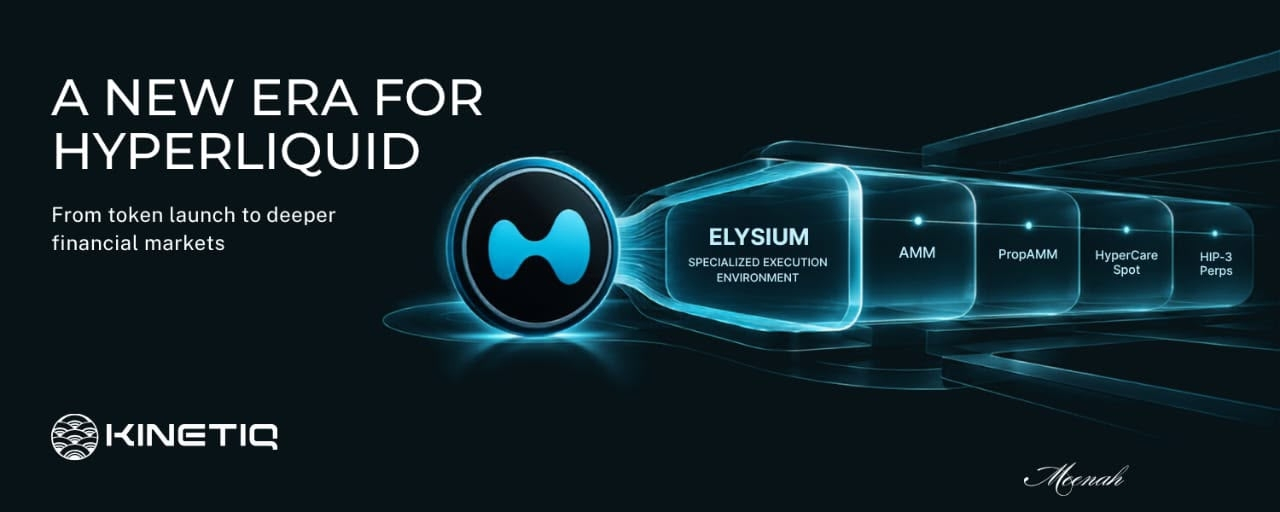
A token could potentially move through an entire lifecycle:
Long tail AMM
↓
Elysium PropAMM
↓
HyperCore Spot
↓
HIP 3 Perpetuals
This is enabled by four characteristics Kinetiq highlights:
🔹Co location with HyperCore.
🔹A high performance EVM environment.
🔹Access to HIP 3 permissionless perpetual deployments.
🔹And deep connectivity between these components.
This creates something more significant than a token launchpad.
It creates a potential market lifecycle.
A new token can begin with liquidity discovery, progress into deeper market making, potentially reach a HyperCore spot orderbook and eventually access perpetual markets.
Kinetiq describes this composability as an “Elysium specific offering.”
If executed as designed, this could give builders a clearer path from token creation to mature financial markets without forcing them to stitch together completely separate ecosystems.
The Most Important Part: Sequencer Fees
This is where Elysium’s economic design becomes particularly interesting.
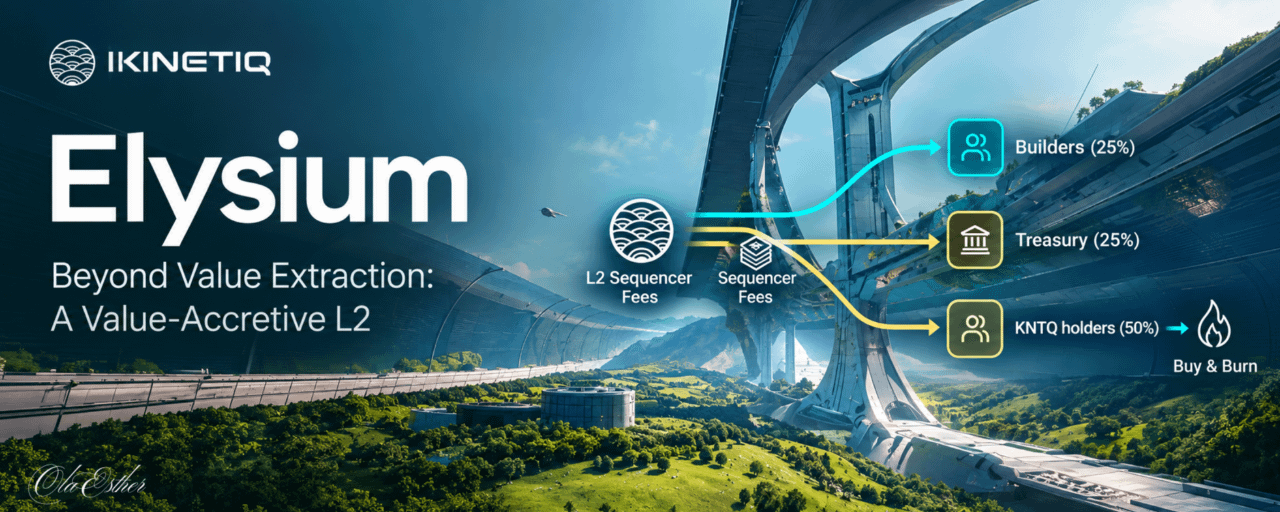
Kinetiq proposes the following distribution of sequencer fees:
25% → Builders
25% → Treasury
50% → KNTQ
The builder allocation is directed toward applications consuming Elysium blockspace and can be used for incentives, rebates and other growth mechanisms.
The treasury allocation goes toward Kinetiq’s operations.
The remaining 50% is used for programmatic purchases of KNTQ on the open market.
And Kinetiq makes the mechanism explicit:
“100% of the purchased KNTQ will be burned.”
The tokens are sent to the Hyperliquid Assistance Fund.
This creates a potential economic loop:
Elysium activity
↓
Sequencer fees
↓
25% Builders + 25% Treasury + 50% KNTQ
↓
KNTQ market purchases
↓
KNTQ permanently removed through the burn mechanism
This is the central reason the value accretive thesis is interesting.
Aligning Builders, Users and KNTQ
Traditional L2 economics can create a separation between the execution layer and the underlying network.
An L2 can attract users, capture fees and build its own economic moat.
Elysium is attempting to reverse that relationship.
The proposed model directs economic activity toward three destinations.
Builders receive incentives to create applications.
The treasury receives resources to maintain and grow the ecosystem.
And KNTQ holders receive the largest allocation through buybacks and burns.
Kinetiq summarizes the intended alignment clearly:
“Elysium’s success is Hyperliquid’s success.”
That is the core thesis.
The more valuable Elysium becomes as an execution environment, the more blockspace it should theoretically consume.
More blockspace generates more sequencer fees.
And 50% of those fees are designed to flow into KNTQ purchases and burns.
But there is an important analytical caveat.
The mechanism itself does not guarantee value creation.
The 50% allocation becomes economically meaningful only when Elysium generates meaningful sequencer revenue.
That means the real test begins after launch.
🔹Transaction volume.
🔹Active users.
🔹Spot trading volume.
🔹PropAMM activity.
🔹$HYPE gas consumption.
🔹Sequencer revenue.
🔹And actual KNTQ purchased and burned.
These will matter more than the headline percentages.
Why Elysium Is Different
The most interesting distinction is therefore not simply that Elysium is an L2.
🔹It is the relationship it is designed to have with Hyperliquid.
🔹Elysium uses $HYPE as gas.
🔹It is designed to be co located with HyperCore.
🔹It brings Hyperliquid market data directly into the execution environment.
🔹It targets the spot trading problem.
🔹It supports PropAMMs.
🔹It creates a potential lifecycle for new tokens.
And its sequencer economics are designed to return half of the generated fees toward KNTQ buybacks and burns.
This is why the phrase “value accretive L2” deserves attention.
The proposition is not that Elysium will automatically create value simply because it exists.
The proposition is that economic activity on Elysium is designed to reinforce the ecosystem around it rather than extract value away from it.
That is a much more interesting experiment.
The Real Question Is Adoption
Elysium’s manifesto presents a compelling technical and economic thesis.
But the thesis still has to survive contact with the market.
Can developers build on it?
Can traders find better execution and deeper liquidity?
Can #Elysium make Hyperliquid spot markets substantially more competitive?
Will PropAMMs generate meaningful volume?
Will the token lifecycle actually encourage more projects to launch and mature within Hyperliquid?
And ultimately, will the resulting sequencer revenue be large enough for KNTQ buybacks and burns to become a meaningful source of value capture?
Those are the questions I will be watching.
The most important thing about Elysium may therefore not be that it promises to make Hyperliquid faster.
It is that Kinetiq is attempting to design an execution layer where growth, infrastructure and token economics point in the same direction.
If the architecture delivers and the market adopts it, Elysium could become more than an L2.
It could become an additional economic engine for the Hyperliquid ecosystem.
And that is the experiment worth watching.
#Web3 #Hyperliquid #Kinetiq
Elysium: A New Era for Hyperliquid
Why Kinetiq’s New Layer 2 Could Change the Economics of Hyperliquid DeFi
Layer 2s were supposed to solve a simple problem: make blockchain applications faster and cheaper.
But another question has become increasingly important:
Where does the value created by an L2 actually go?
Kinetiq’s Elysium approaches that question differently.
Rather than positioning another execution layer as a destination competing with its underlying network, Elysium is being designed specifically around Hyperliquid, with HyperCore connectivity at its foundation.
Kinetiq describes it as “the first, and only value accretive L2 in history.”
That is an ambitious claim.
But the interesting part is not the slogan.
It is the architecture and economic model behind it.
Why Hyperliquid Needs Elysium
Hyperliquid has already established a powerful onchain trading environment through HyperCore.
According to Kinetiq, however, the growth of Hyperliquid DeFi has exposed significant limitations in HyperEVM.
The manifesto points specifically to its dual block architecture, limited performance and throughput, and the resulting difficulty for both traders and builders.
The problem becomes particularly obvious when transaction demand increases.
Kinetiq states that simple swaps on HyperEVM have reached costs of as much as $20, describing this as unsustainable for new users.
That creates a difficult situation.
Hyperliquid has sophisticated traders and substantial economic activity, but the general purpose environment surrounding HyperCore has struggled to provide the execution experience required to support the next wave of applications.
Kinetiq’s answer is not to abandon Hyperliquid.
It is to build a specialized environment around it.
That environment is Elysium.
$HYPE Becomes the Gas
One of Elysium’s simplest decisions could also be one of its most important.
$HYPE will be the gas token.
Kinetiq describes this as providing “zero net-new asset friction.”
Instead of introducing another gas asset and creating another isolated economic system, Elysium remains connected to Hyperliquid’s native asset.
The architecture therefore aims to make Elysium feel less like a separate blockchain and more like an additional execution environment within the Hyperliquid ecosystem.
🔹For builders, that means fewer unnecessary asset boundaries.
🔹For users, it means one less token economy to navigate.
🔹And for Hyperliquid, it creates another environment where $HYPE has utility.
Of course, greater utility should not automatically be interpreted as guaranteed price appreciation.
The actual economic effect depends on how much activity Elysium attracts and how much $HYPE is ultimately consumed as gas.
That distinction matters.
Supercharging Hyperliquid Spot Trading
This may be one of Elysium’s most consequential objectives.
Hyperliquid is widely recognized for perpetual futures, but Kinetiq argues that its spot markets remain underutilized.
The manifesto points to several indicators.
Hyperliquid’s weekly spot volume share against Binance has fallen to a 15 month low.
Monthly spot volume is described as being at its second lowest level since launch.
And HIP 2, Hyperliquid’s native orderbook bootstrapping mechanism, is also described as being at its lowest point since Q4 2024.
The conclusion from Kinetiq is straightforward:
Hyperliquid needs a more competitive spot environment.
Elysium is designed to address that through substantially higher performance and throughput, with eventual block time parity with HyperCore.
Kinetiq describes the Day 1 production environment as “orders of magnitude more performant than HyperEVM.”
If that performance materializes, it could enable trading applications that are difficult or impractical to operate on the existing HyperEVM environment.
🔹And that matters because liquidity attracts liquidity.
🔹Better execution can encourage more applications.
🔹More applications can create more markets.
🔹More markets can attract more traders.
🔹And more traders can deepen the overall ecosystem.
Why PropAMMs Matter
The PropAMM opportunity is particularly interesting.
Kinetiq points to Solana’s spot market activity, arguing that PropAMMs there consistently generate volumes many times larger than HyperCore’s spot markets.
Elysium is designed to make PropAMMs more attractive by combining high performance execution with proximity to HyperCore.
But the more interesting component may be the oracle infrastructure.
Kinetiq says its customization of the L1Read precompile can provide PropAMMs with “a free oracle” featuring top of block freshness.
That could create a distinctive environment for market makers.
A PropAMM operating close to HyperCore can potentially hedge against Hyperliquid liquidity and pricing while accessing highly current market information.
This is more than simply adding another AMM.
It is an attempt to connect automated market making directly to Hyperliquid’s existing trading infrastructure.
Hyperliquid Becomes the Native Oracle
Another important Elysium innovation is its treatment of the L1Read precompile.
Kinetiq says Elysium will leverage and adapt L1Read so that Hyperliquid pricing and liquidity can become the native oracle infrastructure for the ecosystem.
The current HyperEVM implementation exposes BBO information.
Elysium intends to customize L1Read to expose additional information that traders and builders can use.
This could have significant implications.
An oracle is not merely a data feed.
It is infrastructure that determines what applications can safely and efficiently build around market information.
If Hyperliquid’s own market data becomes deeply integrated into Elysium’s execution environment, developers could construct applications around the same liquidity and pricing infrastructure that already powers Hyperliquid’s trading ecosystem.
That creates a much tighter relationship between the L2 and the underlying L1.
A Native Token Lifecycle
Perhaps the most compelling builder proposition is Elysium’s approach to token generation.
Kinetiq argues that launching tokens within the Hyperliquid ecosystem has historically been difficult, whether on HyperCore or HyperEVM.
Elysium is designed to change that.
A token could potentially move through an entire lifecycle:
Long tail AMM
↓
Elysium PropAMM
↓
HyperCore Spot
↓
HIP 3 Perpetuals
This is enabled by four characteristics Kinetiq highlights:
🔹Co location with HyperCore.
🔹A high performance EVM environment.
🔹Access to HIP 3 permissionless perpetual deployments.
🔹And deep connectivity between these components.
This creates something more significant than a token launchpad.
It creates a potential market lifecycle.
A new token can begin with liquidity discovery, progress into deeper market making, potentially reach a HyperCore spot orderbook and eventually access perpetual markets.
Kinetiq describes this composability as an “Elysium specific offering.”
If executed as designed, this could give builders a clearer path from token creation to mature financial markets without forcing them to stitch together completely separate ecosystems.
The Most Important Part: Sequencer Fees
This is where Elysium’s economic design becomes particularly interesting.
Kinetiq proposes the following distribution of sequencer fees:
25% → Builders
25% → Treasury
50% → KNTQ
The builder allocation is directed toward applications consuming Elysium blockspace and can be used for incentives, rebates and other growth mechanisms.
The treasury allocation goes toward Kinetiq’s operations.
The remaining 50% is used for programmatic purchases of KNTQ on the open market.
And Kinetiq makes the mechanism explicit:
“100% of the purchased KNTQ will be burned.”
The tokens are sent to the Hyperliquid Assistance Fund.
This creates a potential economic loop:
Elysium activity
↓
Sequencer fees
↓
25% Builders + 25% Treasury + 50% KNTQ
↓
KNTQ market purchases
↓
KNTQ permanently removed through the burn mechanism
This is the central reason the value accretive thesis is interesting.
Aligning Builders, Users and KNTQ
Traditional L2 economics can create a separation between the execution layer and the underlying network.
An L2 can attract users, capture fees and build its own economic moat.
Elysium is attempting to reverse that relationship.
The proposed model directs economic activity toward three destinations.
Builders receive incentives to create applications.
The treasury receives resources to maintain and grow the ecosystem.
And KNTQ holders receive the largest allocation through buybacks and burns.
Kinetiq summarizes the intended alignment clearly:
“Elysium’s success is Hyperliquid’s success.”
That is the core thesis.
The more valuable Elysium becomes as an execution environment, the more blockspace it should theoretically consume.
More blockspace generates more sequencer fees.
And 50% of those fees are designed to flow into KNTQ purchases and burns.
But there is an important analytical caveat.
The mechanism itself does not guarantee value creation.
The 50% allocation becomes economically meaningful only when Elysium generates meaningful sequencer revenue.
That means the real test begins after launch.
🔹Transaction volume.
🔹Active users.
🔹Spot trading volume.
🔹PropAMM activity.
🔹$HYPE gas consumption.
🔹Sequencer revenue.
🔹And actual KNTQ purchased and burned.
These will matter more than the headline percentages.
Why Elysium Is Different
The most interesting distinction is therefore not simply that Elysium is an L2.
🔹It is the relationship it is designed to have with Hyperliquid.
🔹Elysium uses $HYPE as gas.
🔹It is designed to be co located with HyperCore.
🔹It brings Hyperliquid market data directly into the execution environment.
🔹It targets the spot trading problem.
🔹It supports PropAMMs.
🔹It creates a potential lifecycle for new tokens.
And its sequencer economics are designed to return half of the generated fees toward KNTQ buybacks and burns.
This is why the phrase “value accretive L2” deserves attention.
The proposition is not that Elysium will automatically create value simply because it exists.
The proposition is that economic activity on Elysium is designed to reinforce the ecosystem around it rather than extract value away from it.
That is a much more interesting experiment.
The Real Question Is Adoption
Elysium’s manifesto presents a compelling technical and economic thesis.
But the thesis still has to survive contact with the market.
Can developers build on it?
Can traders find better execution and deeper liquidity?
Can #Elysium make Hyperliquid spot markets substantially more competitive?
Will PropAMMs generate meaningful volume?
Will the token lifecycle actually encourage more projects to launch and mature within Hyperliquid?
And ultimately, will the resulting sequencer revenue be large enough for KNTQ buybacks and burns to become a meaningful source of value capture?
Those are the questions I will be watching.
The most important thing about Elysium may therefore not be that it promises to make Hyperliquid faster.
It is that Kinetiq is attempting to design an execution layer where growth, infrastructure and token economics point in the same direction.
If the architecture delivers and the market adopts it, Elysium could become more than an L2.
It could become an additional economic engine for the Hyperliquid ecosystem.
And that is the experiment worth watching.
#Web3 #Hyperliquid #Kinetiq
4
7
212

·
--
Мақала
Elysium: Beyond Value Extraction – Why Hyperliquid’s First L2 Redefines On-Chain Capital EfficiencyFor months, the Layer 2 scaling debate across #Web3 has revolved around an uncomfortable reality: many L2s can introduce new layers of liquidity fragmentation, execution overhead, and token incentives without necessarily creating a strong economic connection to their underlying Layer 1.
Within the #Hyperliquid ecosystem, Kinetiq Research is taking a different approach.
As a major liquid staking protocol within the ecosystem, Kinetiq is introducing Elysium, a purpose-built L2 designed not to compete with Hyperliquid but to extend HyperCore’s capabilities while connecting execution activity to ecosystem value accrual.
The result is an infrastructure model focused on one central question:
What if an L2 could scale execution without disconnecting that activity from the economic engine of its parent network?
1. The Bottleneck: Why HyperEVM Needs an Execution Engine
Hyperliquid’s dual architecture, combining HyperCore for low-latency trading with HyperEVM for smart-contract execution, was designed with deliberate constraints.
Those constraints help protect HyperCore’s high-performance order-book environment. However, during periods of elevated network activity and market volatility, they can create friction for more demanding on-chain applications.
Three key challenges stand out:
Gas Spikes: Simple token swaps on HyperEVM can become significantly more expensive during periods of congestion.Dual-Block Friction: High-frequency strategies, algorithmic market makers, and liquidation systems can face limitations when operating around EVM execution timelines.Throughput Constraints: More complex DeFi applications can be restricted by available EVM execution capacity.
This creates a clear infrastructure requirement.
Hyperliquid does not necessarily need another generic EVM environment. It needs an execution layer that can expand application capacity while remaining tightly connected to HyperCore.
Elysium is designed around that premise, targeting 300 Mgas/s throughput and 100–200 ms block times.
2. Core Architectural Breakthroughs
Elysium approaches the L2-L1 relationship through three major architectural components.
A. Native HYPE Gas Integration
Rather than introducing another gas asset that users must acquire and manage, Elysium uses native HYPE for gas.
$HYPE bridges on a 1:1 basis, reducing the complexity associated with wrapped assets and helping maintain a more unified economic experience across the Hyperliquid ecosystem.
The objective is straightforward: scale execution without unnecessarily fragmenting the user experience or economic structure.
B. The L1Read Precompile: A Native Oracle Advantage
One of Elysium’s most important architectural components is its L1Read precompile, which is co-located with a Hyperliquid node.
Rather than depending entirely on external oracle updates, #Elysium contracts can access relevant HyperCore information directly.
“Contracts on Elysium can query live HyperCore order book state, mark prices, and position data at ~100 ms granularity for standard call gas.”
This architecture has significant implications for applications that depend on timely market information.
AMMs, algorithmic trading systems, and PropAMMs can access HyperCore data with substantially lower latency, creating an environment better suited to applications where pricing precision and execution speed matter.
C. A Complete Token Lifecycle
Elysium also introduces a structured pathway for assets to progress from initial liquidity formation toward deeper market infrastructure.
The lifecycle can be viewed in three stages:
Bootstrapping: New assets begin within low-cost Elysium AMMs.Maturation: As liquidity develops, assets can transition into PropAMMs using native L1Read market-depth data.HyperCore Graduation: More mature assets can progress into HyperCore Spot order books and, where applicable, HIP-3 perpetual markets.
This creates more than an isolated L2 environment.
It establishes a potential lifecycle connecting asset creation, liquidity formation, market maturation, and deeper Hyperliquid-native markets.
3. The Sequencer Fee Model: Rethinking Value Accrual
The most distinctive part of Elysium’s design may be its approach to sequencer revenue.
Instead of treating sequencer revenue as an isolated source of income, Elysium distributes 100% of sequencer fee proceeds across builders, the ecosystem treasury, and KNTQ buy-and-burn activity.
Elysium Sequencer Revenue
25% → Builders Automatically compensates developer teams according to network block-space usage.
25% → Ecosystem Treasury Supports long-term protocol development, security, and ecosystem initiatives.
50% → KNTQ Buy & Burn Half of sequencer fee proceeds are directed toward purchasing and burning $KNTQ.
The economic relationship is therefore straightforward:
More network execution → more sequencer fees → more KNTQ buy-and-burn activity.
This creates a direct connection between Elysium’s network utilization and KNTQ’s token-supply dynamics.
Rather than relying solely on governance utility, KNTQ becomes economically connected to the activity generated by the infrastructure surrounding it.
That distinction is important when evaluating L2 token models.
4. Why Elysium Matters for Hyperliquid
Elysium represents a different approach to scaling.
Instead of positioning an L2 as an independent destination that competes for liquidity and users, its architecture is designed around complementarity with the underlying Hyperliquid stack.
For developers, it provides additional execution capacity.
For traders and market makers, it creates infrastructure designed around faster access to HyperCore data.
For the broader ecosystem, its sequencing model creates a mechanism through which network activity can contribute to ecosystem development and KNTQ supply reduction.
And for Hyperliquid itself, the broader proposition is about expanding execution capacity without abandoning the economic and technical advantages of HyperCore.
Elysium is not simply about adding another execution layer. Its larger proposition is about making that execution layer economically connected to the ecosystem it extends.
5. The Bigger Picture
The evolution of Layer 2 infrastructure is moving beyond the simple question of “How much throughput can this chain provide?”
The more important questions are becoming:
Where does the liquidity go?Who captures the economic value created by execution?How closely is the L2 connected to its underlying network?Does increased activity strengthen the broader ecosystem or simply create another isolated economy?
Elysium attempts to address these questions through a purpose-built architecture combining HYPE-native gas, direct HyperCore data access, high-throughput execution, structured token lifecycles, and a sequencer-fee model connected to KNTQ.
That makes its significance larger than simply being another L2.
Elysium represents an attempt to build an execution layer where scaling, composability, and value accrual are designed to reinforce one another.
As Hyperliquid’s ecosystem continues to expand, this model could provide an interesting blueprint for how future L2s approach the relationship between execution infrastructure and the economic systems they are built to extend.
Elysium: Beyond Value Extraction – Why Hyperliquid’s First L2 Redefines On-Chain Capital Efficiency
For months, the Layer 2 scaling debate across #Web3 has revolved around an uncomfortable reality: many L2s can introduce new layers of liquidity fragmentation, execution overhead, and token incentives without necessarily creating a strong economic connection to their underlying Layer 1.
Within the #Hyperliquid ecosystem, Kinetiq Research is taking a different approach.
As a major liquid staking protocol within the ecosystem, Kinetiq is introducing Elysium, a purpose-built L2 designed not to compete with Hyperliquid but to extend HyperCore’s capabilities while connecting execution activity to ecosystem value accrual.
The result is an infrastructure model focused on one central question:
What if an L2 could scale execution without disconnecting that activity from the economic engine of its parent network?
1. The Bottleneck: Why HyperEVM Needs an Execution Engine
Hyperliquid’s dual architecture, combining HyperCore for low-latency trading with HyperEVM for smart-contract execution, was designed with deliberate constraints.
Those constraints help protect HyperCore’s high-performance order-book environment. However, during periods of elevated network activity and market volatility, they can create friction for more demanding on-chain applications.
Three key challenges stand out:
Gas Spikes: Simple token swaps on HyperEVM can become significantly more expensive during periods of congestion.Dual-Block Friction: High-frequency strategies, algorithmic market makers, and liquidation systems can face limitations when operating around EVM execution timelines.Throughput Constraints: More complex DeFi applications can be restricted by available EVM execution capacity.
This creates a clear infrastructure requirement.
Hyperliquid does not necessarily need another generic EVM environment. It needs an execution layer that can expand application capacity while remaining tightly connected to HyperCore.
Elysium is designed around that premise, targeting 300 Mgas/s throughput and 100–200 ms block times.
2. Core Architectural Breakthroughs
Elysium approaches the L2-L1 relationship through three major architectural components.
A. Native HYPE Gas Integration
Rather than introducing another gas asset that users must acquire and manage, Elysium uses native HYPE for gas.
$HYPE bridges on a 1:1 basis, reducing the complexity associated with wrapped assets and helping maintain a more unified economic experience across the Hyperliquid ecosystem.
The objective is straightforward: scale execution without unnecessarily fragmenting the user experience or economic structure.
B. The L1Read Precompile: A Native Oracle Advantage
One of Elysium’s most important architectural components is its L1Read precompile, which is co-located with a Hyperliquid node.
Rather than depending entirely on external oracle updates, #Elysium contracts can access relevant HyperCore information directly.
“Contracts on Elysium can query live HyperCore order book state, mark prices, and position data at ~100 ms granularity for standard call gas.”
This architecture has significant implications for applications that depend on timely market information.
AMMs, algorithmic trading systems, and PropAMMs can access HyperCore data with substantially lower latency, creating an environment better suited to applications where pricing precision and execution speed matter.
C. A Complete Token Lifecycle
Elysium also introduces a structured pathway for assets to progress from initial liquidity formation toward deeper market infrastructure.
The lifecycle can be viewed in three stages:
Bootstrapping: New assets begin within low-cost Elysium AMMs.Maturation: As liquidity develops, assets can transition into PropAMMs using native L1Read market-depth data.HyperCore Graduation: More mature assets can progress into HyperCore Spot order books and, where applicable, HIP-3 perpetual markets.
This creates more than an isolated L2 environment.
It establishes a potential lifecycle connecting asset creation, liquidity formation, market maturation, and deeper Hyperliquid-native markets.
3. The Sequencer Fee Model: Rethinking Value Accrual
The most distinctive part of Elysium’s design may be its approach to sequencer revenue.
Instead of treating sequencer revenue as an isolated source of income, Elysium distributes 100% of sequencer fee proceeds across builders, the ecosystem treasury, and KNTQ buy-and-burn activity.
Elysium Sequencer Revenue
25% → Builders Automatically compensates developer teams according to network block-space usage.
25% → Ecosystem Treasury Supports long-term protocol development, security, and ecosystem initiatives.
50% → KNTQ Buy & Burn Half of sequencer fee proceeds are directed toward purchasing and burning $KNTQ.
The economic relationship is therefore straightforward:
More network execution → more sequencer fees → more KNTQ buy-and-burn activity.
This creates a direct connection between Elysium’s network utilization and KNTQ’s token-supply dynamics.
Rather than relying solely on governance utility, KNTQ becomes economically connected to the activity generated by the infrastructure surrounding it.
That distinction is important when evaluating L2 token models.
4. Why Elysium Matters for Hyperliquid
Elysium represents a different approach to scaling.
Instead of positioning an L2 as an independent destination that competes for liquidity and users, its architecture is designed around complementarity with the underlying Hyperliquid stack.
For developers, it provides additional execution capacity.
For traders and market makers, it creates infrastructure designed around faster access to HyperCore data.
For the broader ecosystem, its sequencing model creates a mechanism through which network activity can contribute to ecosystem development and KNTQ supply reduction.
And for Hyperliquid itself, the broader proposition is about expanding execution capacity without abandoning the economic and technical advantages of HyperCore.
Elysium is not simply about adding another execution layer. Its larger proposition is about making that execution layer economically connected to the ecosystem it extends.
5. The Bigger Picture
The evolution of Layer 2 infrastructure is moving beyond the simple question of “How much throughput can this chain provide?”
The more important questions are becoming:
Where does the liquidity go?Who captures the economic value created by execution?How closely is the L2 connected to its underlying network?Does increased activity strengthen the broader ecosystem or simply create another isolated economy?
Elysium attempts to address these questions through a purpose-built architecture combining HYPE-native gas, direct HyperCore data access, high-throughput execution, structured token lifecycles, and a sequencer-fee model connected to KNTQ.
That makes its significance larger than simply being another L2.
Elysium represents an attempt to build an execution layer where scaling, composability, and value accrual are designed to reinforce one another.
As Hyperliquid’s ecosystem continues to expand, this model could provide an interesting blueprint for how future L2s approach the relationship between execution infrastructure and the economic systems they are built to extend.
1
2
170

·
--
Elysium: A New Era for Hyperliquid — Analyzing the First Value-Accretive L2The growth of #Hyperliquid has created a new challenge: how can its infrastructure continue scaling while keeping trading fast, efficient, and deeply connected to HyperCore?
This is where #Elysium enters the picture.
Proposed by Kinetiq, Elysium is a purpose-built Layer 2 designed specifically around the Hyperliquid ecosystem. Rather than functioning as an isolated chain, Elysium aims to connect execution, liquidity, token creation, and trading more closely with HyperCore.
For the #DeFi ecosystem, this presents an interesting question: can an L2 create value for the ecosystem it is built around instead of simply extracting value from it?
Why Does Hyperliquid Need Elysium?
Hyperliquid has built a powerful on-chain trading ecosystem, but increasing activity also exposes infrastructure limitations.
The current HyperEVM environment faces challenges involving its dual-block architecture, throughput, and transaction costs. These issues become particularly relevant for applications that require frequent transactions, such as automated market makers, spot trading platforms, and token-launch infrastructure.
Elysium is designed to address these bottlenecks with a dedicated execution environment optimized for high-performance applications.
One of its most notable design choices is using $HYPE as gas.
Instead of introducing another gas token, Elysium keeps its execution environment economically connected to Hyperliquid. This can simplify the user experience while giving $HYPE additional utility as activity expands.
Supercharging Spot Trading
Elysium is also designed with trading applications in mind.
Its architecture aims to support faster spot trading and specialized liquidity systems such as PropAMMs. This could give builders more flexibility when creating markets and financial applications within the Hyperliquid ecosystem.The potential benefit is not only speed.
By connecting Elysium with HyperCore, applications can potentially access infrastructure that would otherwise require separate systems and liquidity environments.
For traders, this could mean a more connected experience between applications and Hyperliquid's native trading infrastructure.
Of course, these are architectural goals. Their actual impact will depend on adoption, liquidity, execution quality, and real-world usage.
The Token Generation Lifecycle
Another major concept behind Elysium is its approach to token creation and market development.
The proposed lifecycle can be summarized as: AMM → PropAMM → HyperCore Spot → HIP-3 Perps
A new project can begin with an AMM-based market, progress toward a PropAMM structure, and potentially move into HyperCore spot markets as liquidity and demand develop. From there, projects can potentially expand into perpetual markets through HIP-3.
This creates a more connected path for projects moving from initial liquidity toward more advanced markets.
Instead of treating token creation, spot trading, and derivatives as completely separate stages, Elysium attempts to bring them into one ecosystem.
The 50% KNTQ Buy-and-Burn Mechanism
The most interesting part of the #Kinetiq thesis is arguably Elysium's proposed sequencer fee distribution.
The model allocates:
25% → Builders
25% → Treasury
50% → KNTQ Buy & Burn
That final 50% is particularly important.
If Elysium generates sequencer fees, half of those fees are intended to fund purchases of KNTQ, with the purchased tokens then burned.
The theoretical cycle is simple:
More Elysium activity → More sequencer fees → More KNTQ purchases → More KNTQ burned
This creates a direct connection between network activity and KNTQ's supply.
The builder allocation is also significant because applications contributing to the ecosystem receive a portion of the generated fees. Meanwhile, the treasury receives another 25%, creating funding for the broader Kinetiq ecosystem.
Why This Could Be Different From Traditional L2s
Many L2 models primarily focus on increasing transaction capacity while capturing economic activity within their own ecosystems.
Elysium takes a different approach by attempting to align several participants at the same time.
Builders receive 25% of sequencer fees.
The Treasury receives another 25%.
KNTQ holders are connected to the remaining 50% through buybacks and burns.
At the same time, Elysium is designed to remain connected to Hyperliquid through $HYPE, HyperCore, and its trading infrastructure.
This is where the idea of a “value-accretive L2” comes from.
But There Is an Important Reality Check
The mechanism itself does not guarantee value creation.
A 50% buy-and-burn allocation only becomes meaningful if Elysium generates substantial and sustainable sequencer revenue.
Likewise, better infrastructure only matters if developers actually build on it and users actually use it.
This is why I think Elysium should be evaluated not just through its tokenomics, but through actual adoption.
Will builders migrate?
•Will traders use the new infrastructure?
•Will PropAMMs create meaningful liquidity?
•Will projects successfully move through the token-generation lifecycle?
•And can Elysium generate enough economic activity to make the KNTQ buy-and-burn mechanism significant?
These are the questions that will ultimately determine whether the value-accrual thesis works in practice.
My Perspective:
Elysium is an interesting technical and economic experiment for #Web3.
Its biggest difference is not simply that it wants to make transactions faster or cheaper. Its broader objective is to create an execution layer that connects builders, traders, token launches, HyperCore, and Kinetiq's token economics.
If the network succeeds in generating real activity, the proposed sequencer model creates a feedback loop where ecosystem usage can potentially contribute to KNTQ supply reduction.
That makes Elysium worth watching as a #Layer2 designed around a financial ecosystem rather than simply operating alongside one.
For me, the real test is not the narrative. It is execution, adoption, liquidity, and sustainable revenue.
If Elysium can deliver those four things, its impact on the Hyperliquid ecosystem could be much larger than simply providing another place to execute transactions.
Elysium: A New Era for Hyperliquid — Analyzing the First Value-Accretive L2
The growth of #Hyperliquid has created a new challenge: how can its infrastructure continue scaling while keeping trading fast, efficient, and deeply connected to HyperCore?
This is where #Elysium enters the picture.
Proposed by Kinetiq, Elysium is a purpose-built Layer 2 designed specifically around the Hyperliquid ecosystem. Rather than functioning as an isolated chain, Elysium aims to connect execution, liquidity, token creation, and trading more closely with HyperCore.
For the #DeFi ecosystem, this presents an interesting question: can an L2 create value for the ecosystem it is built around instead of simply extracting value from it?
Why Does Hyperliquid Need Elysium?
Hyperliquid has built a powerful on-chain trading ecosystem, but increasing activity also exposes infrastructure limitations.
The current HyperEVM environment faces challenges involving its dual-block architecture, throughput, and transaction costs. These issues become particularly relevant for applications that require frequent transactions, such as automated market makers, spot trading platforms, and token-launch infrastructure.
Elysium is designed to address these bottlenecks with a dedicated execution environment optimized for high-performance applications.
One of its most notable design choices is using $HYPE as gas.
Instead of introducing another gas token, Elysium keeps its execution environment economically connected to Hyperliquid. This can simplify the user experience while giving $HYPE additional utility as activity expands.
Supercharging Spot Trading
Elysium is also designed with trading applications in mind.
Its architecture aims to support faster spot trading and specialized liquidity systems such as PropAMMs. This could give builders more flexibility when creating markets and financial applications within the Hyperliquid ecosystem.The potential benefit is not only speed.
By connecting Elysium with HyperCore, applications can potentially access infrastructure that would otherwise require separate systems and liquidity environments.
For traders, this could mean a more connected experience between applications and Hyperliquid's native trading infrastructure.
Of course, these are architectural goals. Their actual impact will depend on adoption, liquidity, execution quality, and real-world usage.
The Token Generation Lifecycle
Another major concept behind Elysium is its approach to token creation and market development.
The proposed lifecycle can be summarized as: AMM → PropAMM → HyperCore Spot → HIP-3 Perps
A new project can begin with an AMM-based market, progress toward a PropAMM structure, and potentially move into HyperCore spot markets as liquidity and demand develop. From there, projects can potentially expand into perpetual markets through HIP-3.
This creates a more connected path for projects moving from initial liquidity toward more advanced markets.
Instead of treating token creation, spot trading, and derivatives as completely separate stages, Elysium attempts to bring them into one ecosystem.
The 50% KNTQ Buy-and-Burn Mechanism
The most interesting part of the #Kinetiq thesis is arguably Elysium's proposed sequencer fee distribution.
The model allocates:
25% → Builders
25% → Treasury
50% → KNTQ Buy & Burn
That final 50% is particularly important.
If Elysium generates sequencer fees, half of those fees are intended to fund purchases of KNTQ, with the purchased tokens then burned.
The theoretical cycle is simple:
More Elysium activity → More sequencer fees → More KNTQ purchases → More KNTQ burned
This creates a direct connection between network activity and KNTQ's supply.
The builder allocation is also significant because applications contributing to the ecosystem receive a portion of the generated fees. Meanwhile, the treasury receives another 25%, creating funding for the broader Kinetiq ecosystem.
Why This Could Be Different From Traditional L2s
Many L2 models primarily focus on increasing transaction capacity while capturing economic activity within their own ecosystems.
Elysium takes a different approach by attempting to align several participants at the same time.
Builders receive 25% of sequencer fees.
The Treasury receives another 25%.
KNTQ holders are connected to the remaining 50% through buybacks and burns.
At the same time, Elysium is designed to remain connected to Hyperliquid through $HYPE , HyperCore, and its trading infrastructure.
This is where the idea of a “value-accretive L2” comes from.
But There Is an Important Reality Check
The mechanism itself does not guarantee value creation.
A 50% buy-and-burn allocation only becomes meaningful if Elysium generates substantial and sustainable sequencer revenue.
Likewise, better infrastructure only matters if developers actually build on it and users actually use it.
This is why I think Elysium should be evaluated not just through its tokenomics, but through actual adoption.
Will builders migrate?
•Will traders use the new infrastructure?
•Will PropAMMs create meaningful liquidity?
•Will projects successfully move through the token-generation lifecycle?
•And can Elysium generate enough economic activity to make the KNTQ buy-and-burn mechanism significant?
These are the questions that will ultimately determine whether the value-accrual thesis works in practice.
My Perspective:
Elysium is an interesting technical and economic experiment for #Web3.
Its biggest difference is not simply that it wants to make transactions faster or cheaper. Its broader objective is to create an execution layer that connects builders, traders, token launches, HyperCore, and Kinetiq's token economics.
If the network succeeds in generating real activity, the proposed sequencer model creates a feedback loop where ecosystem usage can potentially contribute to KNTQ supply reduction.
That makes Elysium worth watching as a #Layer2 designed around a financial ecosystem rather than simply operating alongside one.
For me, the real test is not the narrative. It is execution, adoption, liquidity, and sustainable revenue.
If Elysium can deliver those four things, its impact on the Hyperliquid ecosystem could be much larger than simply providing another place to execute transactions.
150

·
--
Мақала
Elysium: A New Era for HyperliquidWhat happens after a token launches?
Launching an asset is only the first step. A token can find an initial liquidity pool, attract early traders and establish a market. But as activity grows, harder questions begin: can liquidity deepen, can the asset reach native spot infrastructure, and can it eventually support derivatives?
That is the bigger question behind #Elysium
Kinetiq is proposing a purpose-built Layer 2 for financial activity within the #Hyperliquid ecosystem. Instead of treating an L2 simply as another place to execute transactions, Elysium is designed around the connection between token launches, liquidity, spot markets and perpetuals.
That makes its economic design just as important as its technical architecture.
The Problem Isn't More Blockspace
Hyperliquid already has two important environments.
HyperCore provides native spot and perpetual markets, while HyperEVM provides general-purpose smart contract execution that can interact with HyperCore. Its dual-block architecture separates fast, smaller blocks from slower, larger blocks, allowing different workloads to operate under different constraints.
That architecture was deliberate. HyperCore and HyperEVM share state, so increasing HyperEVM capacity is not simply a matter of pushing throughput higher. The network has to balance additional capacity with the safety of its shared-state design.
For #Web3 financial applications, this raises a more useful question: should every financial workload have to operate within the same general-purpose execution environment?
Elysium takes a different approach.
As a specialized Layer 2, it is being designed around financial applications such as spot trading, PropAMMs, token launches and HIP-3 perpetuals, while using $HYPE as its gas token.
When demand becomes concentrated, the cost of executing activity on available HyperEVM blockspace can also become a practical concern, particularly for trading strategies where repeated transactions make execution costs matter.
That distinction matters.
Elysium is not trying to replace Hyperliquid's existing infrastructure. It is designed to work around and with it, creating an execution environment focused more directly on financial activity.
The proposition is therefore not simply about adding more blockspace. It is about designing execution around the needs of financial markets.
What Elysium Changes
Execution is only one part of a financial application.
A market-making system also needs information about the market it is interacting with. It needs to understand prices, liquidity and the conditions that affect the position it is managing.
This is where @kinetiq_research's work around Elysium's proposed L1Read architecture becomes significant.
The concept is to give applications on Elysium richer access to information from Hyperliquid's underlying L1 infrastructure. Instead of execution and market information sitting further apart, more of the underlying market state can be brought closer to the applications acting on it.
For #DeFi , that connection could matter considerably.
A PropAMM with access to useful HyperCore information has a stronger foundation for pricing, managing liquidity and hedging exposure. The application is not simply executing transactions. It can operate with a better view of the market it is trying to serve.
That is a more specific proposition than simply claiming that an L2 can process transactions faster.
The potential value comes from combining specialized execution with access to the financial infrastructure already operating on Hyperliquid.
A Graduation Path for Tokens
This may be the clearest way to understand what Elysium is trying to build.
A new token could start with an AMM, giving it an initial source of liquidity and a place for the market to discover whether genuine demand exists.
If activity develops, it could move toward a PropAMM, where more sophisticated liquidity and market-making can support the asset.
If demand and liquidity become strong enough, the asset could progress toward a HyperCore spot market.
And if the market eventually reaches a level where derivatives make sense, HIP-3 perpetuals could provide another stage.
AMM → PropAMM → HyperCore Spot → HIP-3 Perps
Each stage asks a different question.
The AMM tests whether people are willing to trade the asset. PropAMM can support deeper liquidity and more active market making. HyperCore spot connects the asset to native market infrastructure. HIP-3 introduces the possibility of derivatives.
This changes how an L2 can be viewed.
It is not only a place where transactions happen. It can become part of a broader path through which an asset moves from early liquidity toward more mature financial markets.
But there is a condition that matters throughout this progression:
Graduation is earned, not automatic.
Elysium cannot create demand for an asset simply by making these stages available. A token still needs users, liquidity and sustained market activity before progressing into deeper infrastructure makes sense.
That is why the lifecycle is more than a list of products. It represents a potential path for assets that prove themselves to move from early liquidity toward increasingly mature markets.
Where the Economics Get Serious
The technical architecture becomes an economic thesis when the network starts generating fees.
Kinetiq's proposed sequencer fee model allocates 25% to builders, 25% to the treasury and 50% toward open-market KNTQ purchases and burns.
That is a notable design choice, but the allocation itself does not guarantee value creation.
Traditional L2s can direct sequencer revenue toward operating costs, treasuries or ecosystem initiatives. Elysium's proposed model differs because half of its sequencer revenue is explicitly connected to KNTQ purchases and burns.
The more important question, however, is where those fees come from.
#Kinetiq already has several value-accrual mechanisms. Its documentation describes buybacks connected to Markets income, Launch revenue, KIP-2 revenue and validator commissions. Elysium would add another potential activity-linked source to that existing system.
If builders create useful applications, traders use them, liquidity deepens and new markets generate meaningful fees, network activity can become connected to KNTQ purchases and burns.
That could create deflationary pressure on KNTQ over time.
But there is another side to the equation.
If Elysium mainly redirects activity that would have taken place elsewhere within the Hyperliquid ecosystem, establishing meaningful incremental value becomes more difficult.
The burn is not the product. The activity producing the burn is the product.
That is the economic test.
The Test Elysium Still Has to Pass
A Layer 2 can have an attractive economic model and still fail to become a meaningful economic engine.
Infrastructure can make something possible. It cannot make people use it.
Builders have to choose Elysium. Traders have to find applications worth using. Liquidity has to deepen. And the resulting activity has to generate enough fees for the proposed economic model to matter.
There are also technical questions that still need answers as the network develops, including detailed infrastructure specifications, independent audits, public performance benchmarks and how its different components will operate in practice.
Those questions do not invalidate the thesis. They define what still needs to be proven.
HyperEVM can also evolve. If its capacity and capabilities improve over time, Elysium will need to show that specialization creates something more valuable than simply faster execution.
That is the real test.
If Elysium works as intended, its value would not come from being another chain surrounding Hyperliquid. It would come from connecting different stages of market development.
An asset could begin with an AMM, develop deeper liquidity through a PropAMM, reach native spot infrastructure and eventually support perpetual markets.
That progression could create more sustained financial activity across the wider Hyperliquid ecosystem.
And this is where the #Layer2 thesis becomes more meaningful.
The question is not simply whether Elysium can process transactions.
It is whether specialized infrastructure can turn early token activity into deeper markets while allowing part of the economic value created along that journey to reinforce the ecosystem around it.
That is a harder problem than launching another chain, but solving it would mean much more.
Web3 infrastructure is moving toward a point where execution, liquidity and economics cannot be evaluated separately. Elysium is an attempt to connect all three within the Hyperliquid ecosystem.
The real question is not whether a token can launch.
It is whether the ecosystem can give that token somewhere to graduate to.
For #Elysium, that is ultimately the test: whether execution, liquidity and economic value can reinforce one another instead of operating as separate pieces of the same market.
Note: Elysium is currently pre-launch, and the technical specifications discussed here may be refined before mainnet. This analysis is based on Kinetiq’s current documentation.
Elysium: A New Era for Hyperliquid
What happens after a token launches?
Launching an asset is only the first step. A token can find an initial liquidity pool, attract early traders and establish a market. But as activity grows, harder questions begin: can liquidity deepen, can the asset reach native spot infrastructure, and can it eventually support derivatives?
That is the bigger question behind #Elysium
Kinetiq is proposing a purpose-built Layer 2 for financial activity within the #Hyperliquid ecosystem. Instead of treating an L2 simply as another place to execute transactions, Elysium is designed around the connection between token launches, liquidity, spot markets and perpetuals.
That makes its economic design just as important as its technical architecture.
The Problem Isn't More Blockspace
Hyperliquid already has two important environments.
HyperCore provides native spot and perpetual markets, while HyperEVM provides general-purpose smart contract execution that can interact with HyperCore. Its dual-block architecture separates fast, smaller blocks from slower, larger blocks, allowing different workloads to operate under different constraints.
That architecture was deliberate. HyperCore and HyperEVM share state, so increasing HyperEVM capacity is not simply a matter of pushing throughput higher. The network has to balance additional capacity with the safety of its shared-state design.
For #Web3 financial applications, this raises a more useful question: should every financial workload have to operate within the same general-purpose execution environment?
Elysium takes a different approach.
As a specialized Layer 2, it is being designed around financial applications such as spot trading, PropAMMs, token launches and HIP-3 perpetuals, while using $HYPE as its gas token.
When demand becomes concentrated, the cost of executing activity on available HyperEVM blockspace can also become a practical concern, particularly for trading strategies where repeated transactions make execution costs matter.
That distinction matters.
Elysium is not trying to replace Hyperliquid's existing infrastructure. It is designed to work around and with it, creating an execution environment focused more directly on financial activity.
The proposition is therefore not simply about adding more blockspace. It is about designing execution around the needs of financial markets.
What Elysium Changes
Execution is only one part of a financial application.
A market-making system also needs information about the market it is interacting with. It needs to understand prices, liquidity and the conditions that affect the position it is managing.
This is where @kinetiq_research's work around Elysium's proposed L1Read architecture becomes significant.
The concept is to give applications on Elysium richer access to information from Hyperliquid's underlying L1 infrastructure. Instead of execution and market information sitting further apart, more of the underlying market state can be brought closer to the applications acting on it.
For #DeFi , that connection could matter considerably.
A PropAMM with access to useful HyperCore information has a stronger foundation for pricing, managing liquidity and hedging exposure. The application is not simply executing transactions. It can operate with a better view of the market it is trying to serve.
That is a more specific proposition than simply claiming that an L2 can process transactions faster.
The potential value comes from combining specialized execution with access to the financial infrastructure already operating on Hyperliquid.
A Graduation Path for Tokens
This may be the clearest way to understand what Elysium is trying to build.
A new token could start with an AMM, giving it an initial source of liquidity and a place for the market to discover whether genuine demand exists.
If activity develops, it could move toward a PropAMM, where more sophisticated liquidity and market-making can support the asset.
If demand and liquidity become strong enough, the asset could progress toward a HyperCore spot market.
And if the market eventually reaches a level where derivatives make sense, HIP-3 perpetuals could provide another stage.
AMM → PropAMM → HyperCore Spot → HIP-3 Perps
Each stage asks a different question.
The AMM tests whether people are willing to trade the asset. PropAMM can support deeper liquidity and more active market making. HyperCore spot connects the asset to native market infrastructure. HIP-3 introduces the possibility of derivatives.
This changes how an L2 can be viewed.
It is not only a place where transactions happen. It can become part of a broader path through which an asset moves from early liquidity toward more mature financial markets.
But there is a condition that matters throughout this progression:
Graduation is earned, not automatic.
Elysium cannot create demand for an asset simply by making these stages available. A token still needs users, liquidity and sustained market activity before progressing into deeper infrastructure makes sense.
That is why the lifecycle is more than a list of products. It represents a potential path for assets that prove themselves to move from early liquidity toward increasingly mature markets.
Where the Economics Get Serious
The technical architecture becomes an economic thesis when the network starts generating fees.
Kinetiq's proposed sequencer fee model allocates 25% to builders, 25% to the treasury and 50% toward open-market KNTQ purchases and burns.
That is a notable design choice, but the allocation itself does not guarantee value creation.
Traditional L2s can direct sequencer revenue toward operating costs, treasuries or ecosystem initiatives. Elysium's proposed model differs because half of its sequencer revenue is explicitly connected to KNTQ purchases and burns.
The more important question, however, is where those fees come from.
#Kinetiq already has several value-accrual mechanisms. Its documentation describes buybacks connected to Markets income, Launch revenue, KIP-2 revenue and validator commissions. Elysium would add another potential activity-linked source to that existing system.
If builders create useful applications, traders use them, liquidity deepens and new markets generate meaningful fees, network activity can become connected to KNTQ purchases and burns.
That could create deflationary pressure on KNTQ over time.
But there is another side to the equation.
If Elysium mainly redirects activity that would have taken place elsewhere within the Hyperliquid ecosystem, establishing meaningful incremental value becomes more difficult.
The burn is not the product. The activity producing the burn is the product.
That is the economic test.
The Test Elysium Still Has to Pass
A Layer 2 can have an attractive economic model and still fail to become a meaningful economic engine.
Infrastructure can make something possible. It cannot make people use it.
Builders have to choose Elysium. Traders have to find applications worth using. Liquidity has to deepen. And the resulting activity has to generate enough fees for the proposed economic model to matter.
There are also technical questions that still need answers as the network develops, including detailed infrastructure specifications, independent audits, public performance benchmarks and how its different components will operate in practice.
Those questions do not invalidate the thesis. They define what still needs to be proven.
HyperEVM can also evolve. If its capacity and capabilities improve over time, Elysium will need to show that specialization creates something more valuable than simply faster execution.
That is the real test.
If Elysium works as intended, its value would not come from being another chain surrounding Hyperliquid. It would come from connecting different stages of market development.
An asset could begin with an AMM, develop deeper liquidity through a PropAMM, reach native spot infrastructure and eventually support perpetual markets.
That progression could create more sustained financial activity across the wider Hyperliquid ecosystem.
And this is where the #Layer2 thesis becomes more meaningful.
The question is not simply whether Elysium can process transactions.
It is whether specialized infrastructure can turn early token activity into deeper markets while allowing part of the economic value created along that journey to reinforce the ecosystem around it.
That is a harder problem than launching another chain, but solving it would mean much more.
Web3 infrastructure is moving toward a point where execution, liquidity and economics cannot be evaluated separately. Elysium is an attempt to connect all three within the Hyperliquid ecosystem.
The real question is not whether a token can launch.
It is whether the ecosystem can give that token somewhere to graduate to.
For #Elysium, that is ultimately the test: whether execution, liquidity and economic value can reinforce one another instead of operating as separate pieces of the same market.
Note: Elysium is currently pre-launch, and the technical specifications discussed here may be refined before mainnet. This analysis is based on Kinetiq’s current documentation.
7
1
10
121

Мақала
Elysium: A New Era for HyperliquidAnalyzing the First Value-Accretive L2
“To the Elysian plain… where life is easiest for men.”
— Homer, Odyssey
My first reaction to Elysium was that this isn't really a story about another Layer 2. It's a story about what happens when an ecosystem becomes successful enough that its own infrastructure starts becoming the bottleneck.
Hyperliquid has built one of the most compelling trading ecosystems in #defi , but growth has exposed limitations in HyperEVM. As more users and applications compete for blockspace, its dual-block architecture, performance constraints and transaction costs become increasingly difficult to ignore.
The official #Elysium manifesto makes that problem the starting point.
Developed by KINETIQ, Elysium is designed as a purpose-built #Layer2 for Hyperliquid, with HyperCore connectivity at its foundation. The goal isn't simply to build a faster chain. It is to create additional execution capacity while keeping that activity deeply connected to Hyperliquid.
And that's the part I find most interesting.
HYPE as Gas
One of Elysium's simplest but most important decisions is using HYPE as its gas token.
Rather than introducing another asset into the ecosystem, Elysium aims for what Kinetiq describes as “zero net-new asset friction.”
Users therefore remain connected to the existing Hyperliquid economy while developers get an environment designed for higher-performance applications.
For #Web3 infrastructure, that economic continuity matters.
Supercharging Spot Trading
Hyperliquid's strength has largely been its perpetuals market, while spot trading remains an area with significant room for expansion.
Elysium is designed to change that.
Its higher performance and eventual HyperCore block-time parity are intended to enable a new generation of spot applications. More importantly, its proximity to HyperCore creates an interesting environment for PropAMMs, giving professional market makers access to Hyperliquid data for tighter pricing and hedging.
Elysium also adapts the L1Read precompile to expose additional HyperCore information, effectively turning Hyperliquid into a native data source for applications.
That could become one of Elysium's most important advantages for DeFi builders.
A Complete Token Lifecycle
Launching and bootstrapping new tokens on Hyperliquid can be difficult. Elysium proposes a more connected path:
AMM → PropAMM → HyperCore Spot → HIP-3 Perps
A token can begin with a long-tail AMM, develop deeper liquidity through PropAMMs, optionally bootstrap a HyperCore spot orderbook, and eventually secure a perpetual market through HIP-3.
The important point is composability. These stages can exist within one ecosystem rather than forcing projects to piece together infrastructure across disconnected networks.
The 25/25/50 Economic Model
This is where Elysium's value-accretion thesis becomes particularly interesting.
Sequencer fees are proposed to be distributed as follows:
25% → BuildersUsed for incentives, rebates and other programs designed to encourage applications to consume Elysium blockspace.25% → TreasuryDirected to the Kinetiq treasury for operations.50% → KNTQUsed for programmatic KNTQ purchases on the open market, with 100% of purchased KNTQ burned through the Hyperliquid Assistance Fund.
The intended feedback loop is clear:
More activity → more sequencer fees → more KNTQ purchased → more KNTQ burned.
That gives KNTQ holders direct exposure to the economic activity Elysium generates.
Why “Value-Accretive” Matters
Traditional L2s have often been designed primarily around scaling their underlying L1 by moving activity into cheaper and faster execution environments.
Kinetiq's argument is that Elysium can take a different path.
HYPE remains the gas asset. HyperCore remains central to liquidity and market data. New tokens can progress toward HyperCore spot and HIP-3 perpetuals. Builders receive a portion of sequencer fees, while half of those fees are directed toward KNTQ purchases and burns.
In other words, Elysium's success is designed to feed back into the ecosystem supporting it.
Personally, this is the part of the proposal I find most compelling. The technical improvements matter, but the economic alignment is what makes Elysium more interesting than simply “another faster L2.”
Of course, the thesis still needs to be tested in the real world. Mainnet adoption, builder activity, trading volume, liquidity and actual sequencer revenue will determine whether the proposed flywheel becomes meaningful.
For now, Elysium represents an ambitious attempt to scale Hyperliquid without creating an isolated economic island.
And if Kinetiq Research executes the vision successfully, #Elysium could make growth itself part of the value proposition for Hyperliquid and KNTQ.
Elysium: A New Era for Hyperliquid
Analyzing the First Value-Accretive L2
“To the Elysian plain… where life is easiest for men.”
— Homer, Odyssey
My first reaction to Elysium was that this isn't really a story about another Layer 2. It's a story about what happens when an ecosystem becomes successful enough that its own infrastructure starts becoming the bottleneck.
Hyperliquid has built one of the most compelling trading ecosystems in #defi , but growth has exposed limitations in HyperEVM. As more users and applications compete for blockspace, its dual-block architecture, performance constraints and transaction costs become increasingly difficult to ignore.
The official #Elysium manifesto makes that problem the starting point.
Developed by KINETIQ, Elysium is designed as a purpose-built #Layer2 for Hyperliquid, with HyperCore connectivity at its foundation. The goal isn't simply to build a faster chain. It is to create additional execution capacity while keeping that activity deeply connected to Hyperliquid.
And that's the part I find most interesting.
HYPE as Gas
One of Elysium's simplest but most important decisions is using HYPE as its gas token.
Rather than introducing another asset into the ecosystem, Elysium aims for what Kinetiq describes as “zero net-new asset friction.”
Users therefore remain connected to the existing Hyperliquid economy while developers get an environment designed for higher-performance applications.
For #Web3 infrastructure, that economic continuity matters.
Supercharging Spot Trading
Hyperliquid's strength has largely been its perpetuals market, while spot trading remains an area with significant room for expansion.
Elysium is designed to change that.
Its higher performance and eventual HyperCore block-time parity are intended to enable a new generation of spot applications. More importantly, its proximity to HyperCore creates an interesting environment for PropAMMs, giving professional market makers access to Hyperliquid data for tighter pricing and hedging.
Elysium also adapts the L1Read precompile to expose additional HyperCore information, effectively turning Hyperliquid into a native data source for applications.
That could become one of Elysium's most important advantages for DeFi builders.
A Complete Token Lifecycle
Launching and bootstrapping new tokens on Hyperliquid can be difficult. Elysium proposes a more connected path:
AMM → PropAMM → HyperCore Spot → HIP-3 Perps
A token can begin with a long-tail AMM, develop deeper liquidity through PropAMMs, optionally bootstrap a HyperCore spot orderbook, and eventually secure a perpetual market through HIP-3.
The important point is composability. These stages can exist within one ecosystem rather than forcing projects to piece together infrastructure across disconnected networks.
The 25/25/50 Economic Model
This is where Elysium's value-accretion thesis becomes particularly interesting.
Sequencer fees are proposed to be distributed as follows:
25% → BuildersUsed for incentives, rebates and other programs designed to encourage applications to consume Elysium blockspace.25% → TreasuryDirected to the Kinetiq treasury for operations.50% → KNTQUsed for programmatic KNTQ purchases on the open market, with 100% of purchased KNTQ burned through the Hyperliquid Assistance Fund.
The intended feedback loop is clear:
More activity → more sequencer fees → more KNTQ purchased → more KNTQ burned.
That gives KNTQ holders direct exposure to the economic activity Elysium generates.
Why “Value-Accretive” Matters
Traditional L2s have often been designed primarily around scaling their underlying L1 by moving activity into cheaper and faster execution environments.
Kinetiq's argument is that Elysium can take a different path.
HYPE remains the gas asset. HyperCore remains central to liquidity and market data. New tokens can progress toward HyperCore spot and HIP-3 perpetuals. Builders receive a portion of sequencer fees, while half of those fees are directed toward KNTQ purchases and burns.
In other words, Elysium's success is designed to feed back into the ecosystem supporting it.
Personally, this is the part of the proposal I find most compelling. The technical improvements matter, but the economic alignment is what makes Elysium more interesting than simply “another faster L2.”
Of course, the thesis still needs to be tested in the real world. Mainnet adoption, builder activity, trading volume, liquidity and actual sequencer revenue will determine whether the proposed flywheel becomes meaningful.
For now, Elysium represents an ambitious attempt to scale Hyperliquid without creating an isolated economic island.
And if Kinetiq Research executes the vision successfully, #Elysium could make growth itself part of the value proposition for Hyperliquid and KNTQ.
4
6
220

·
--
Мақала
ELYSIUM: THE L2 BUILT TO FEED THE CORE.Most Layer 2s are designed to move activity away from the base layer.
Kinetiq’s Elysium takes a different approach: build a faster execution environment around Hyperliquid while keeping economic activity connected to the Core.
That sounds simple, but the architecture and economics behind it are worth examining.
Why Hyperliquid Needs Another Execution Layer
#Hyperliquid already has a powerful on-chain trading engine through HyperCore, particularly for perpetuals.
The challenge is HyperEVM.
Today, HyperEVM uses different block types, mempools and fee markets for fast and slow execution. It also has limitations around atomicity between EVM transactions and HyperCore actions.
The research points to real examples of this friction, including a documented gas spike from around 0.15 to 60 gwei and reports of simple swaps costing more than $10.
At the same time, HyperCore perps generate roughly $1M–$6M in daily revenue, while HyperEVM's reported revenue has been much smaller.
#Elysium is essentially an attempt to close that execution gap.
What Elysium Is Actually Trying to Change
Elysium is proposed as an OP Stack-based L2 that settles to HyperEVM while using $HYPE as its gas token.
That distinction matters.
There is no new Elysium gas token being introduced, meaning the design does not follow the common L2 model of creating another token-based economy.
Instead, Elysium is designed to extend Hyperliquid's existing ecosystem.
Two major pieces stand out:
➜ PropAMMs
The idea is to create a faster EVM environment where professional market makers can operate while accessing HyperCore data and liquidity more closely.
➜ Expanded L1Read
Elysium proposes deeper access to HyperCore order-book data, potentially turning Hyperliquid into a more native source of market data and oracle infrastructure.
Kinetiq also describes a token lifecycle that could move from AMM → PropAMM → HyperCore spot → HIP-3 perpetuals.
The architecture is interesting, but actual adoption by market makers and users remains an open question.
Where KNTQ Becomes Central
The most important part of Elysium may not be the technology.
It is the fee model.
Kinetiq proposes splitting sequencer fees:
- 25% → builders
- 25% → Kinetiq treasury
- 50% → KNTQ open-market purchases and burns
That creates a direct relationship between Elysium activity and KNTQ.
But there is an important distinction:
The 50% allocation is for KNTQ, not $HYPE.
Meanwhile, $HYPE benefits from being the gas asset used by Elysium.
The 25% treasury allocation is intended for Kinetiq Inc./Foundation operations.
So there are effectively three different economic beneficiaries:
➜ Hyperliquid / $HYPE: gas demand and potential additional Core activity.
➜ Kinetiq: treasury revenue and a new execution environment for its ecosystem.
➜ KNTQ holders: the proposed buy-and-burn mechanism.
Also, calling KNTQ “hyper-deflationary” today would be premature. Elysium is not live yet, so this mechanism is still a proposed future design.
Elysium vs. the Traditional L2 Playbook
Traditional L2s often introduce their own token, attract users and liquidity away from the base layer, and capture sequencer economics.
Elysium is designed around a different philosophy:
Build on the edge. Flow back to the Core.
Kinetiq describes this as the first “value-accretive L2” model, although that is a Kinetiq positioning claim rather than an independently established fact.
There are still important questions.
The sequencer appears centralized in the proposed architecture, and details around decentralization, upgrade control and the proof pipeline are not yet public.
There are also no published independent benchmarks, audits, named launch partners or confirmed mainnet date as of the research period.
And one feature in the manifesto is deliberately redacted, so its impact cannot be evaluated yet.
My Take
Elysium is more interesting when viewed as infrastructure rather than simply another L2 launch.
Its thesis is straightforward:
make EVM execution faster and more useful without forcing activity to leave Hyperliquid.
That could create a stronger connection between EVM applications, HyperCore liquidity, professional market makers and Hyperliquid's broader economy.
There is also a business angle for Kinetiq. Its kHYPE supply contracted significantly from its 2025 peak, so building another execution venue can be viewed partly as an attempt to expand where Kinetiq's ecosystem can generate activity.
But the thesis is still unproven.
The things I would watch most closely are:
- Elysium's actual mainnet launch
- independent audits and performance benchmarks
- PropAMM adoption
- real user and spot-market activity
- sequencer decentralization
- how the proposed fee/burn model performs in practice
The architecture has a clear idea behind it. The next step is proving that the idea works under real economic activity.
ELYSIUM: THE L2 BUILT TO FEED THE CORE.
Most Layer 2s are designed to move activity away from the base layer.
Kinetiq’s Elysium takes a different approach: build a faster execution environment around Hyperliquid while keeping economic activity connected to the Core.
That sounds simple, but the architecture and economics behind it are worth examining.
Why Hyperliquid Needs Another Execution Layer
#Hyperliquid already has a powerful on-chain trading engine through HyperCore, particularly for perpetuals.
The challenge is HyperEVM.
Today, HyperEVM uses different block types, mempools and fee markets for fast and slow execution. It also has limitations around atomicity between EVM transactions and HyperCore actions.
The research points to real examples of this friction, including a documented gas spike from around 0.15 to 60 gwei and reports of simple swaps costing more than $10.
At the same time, HyperCore perps generate roughly $1M–$6M in daily revenue, while HyperEVM's reported revenue has been much smaller.
#Elysium is essentially an attempt to close that execution gap.
What Elysium Is Actually Trying to Change
Elysium is proposed as an OP Stack-based L2 that settles to HyperEVM while using $HYPE as its gas token.
That distinction matters.
There is no new Elysium gas token being introduced, meaning the design does not follow the common L2 model of creating another token-based economy.
Instead, Elysium is designed to extend Hyperliquid's existing ecosystem.
Two major pieces stand out:
➜ PropAMMs
The idea is to create a faster EVM environment where professional market makers can operate while accessing HyperCore data and liquidity more closely.
➜ Expanded L1Read
Elysium proposes deeper access to HyperCore order-book data, potentially turning Hyperliquid into a more native source of market data and oracle infrastructure.
Kinetiq also describes a token lifecycle that could move from AMM → PropAMM → HyperCore spot → HIP-3 perpetuals.
The architecture is interesting, but actual adoption by market makers and users remains an open question.
Where KNTQ Becomes Central
The most important part of Elysium may not be the technology.
It is the fee model.
Kinetiq proposes splitting sequencer fees:
- 25% → builders
- 25% → Kinetiq treasury
- 50% → KNTQ open-market purchases and burns
That creates a direct relationship between Elysium activity and KNTQ.
But there is an important distinction:
The 50% allocation is for KNTQ, not $HYPE .
Meanwhile, $HYPE benefits from being the gas asset used by Elysium.
The 25% treasury allocation is intended for Kinetiq Inc./Foundation operations.
So there are effectively three different economic beneficiaries:
➜ Hyperliquid / $HYPE : gas demand and potential additional Core activity.
➜ Kinetiq: treasury revenue and a new execution environment for its ecosystem.
➜ KNTQ holders: the proposed buy-and-burn mechanism.
Also, calling KNTQ “hyper-deflationary” today would be premature. Elysium is not live yet, so this mechanism is still a proposed future design.
Elysium vs. the Traditional L2 Playbook
Traditional L2s often introduce their own token, attract users and liquidity away from the base layer, and capture sequencer economics.
Elysium is designed around a different philosophy:
Build on the edge. Flow back to the Core.
Kinetiq describes this as the first “value-accretive L2” model, although that is a Kinetiq positioning claim rather than an independently established fact.
There are still important questions.
The sequencer appears centralized in the proposed architecture, and details around decentralization, upgrade control and the proof pipeline are not yet public.
There are also no published independent benchmarks, audits, named launch partners or confirmed mainnet date as of the research period.
And one feature in the manifesto is deliberately redacted, so its impact cannot be evaluated yet.
My Take
Elysium is more interesting when viewed as infrastructure rather than simply another L2 launch.
Its thesis is straightforward:
make EVM execution faster and more useful without forcing activity to leave Hyperliquid.
That could create a stronger connection between EVM applications, HyperCore liquidity, professional market makers and Hyperliquid's broader economy.
There is also a business angle for Kinetiq. Its kHYPE supply contracted significantly from its 2025 peak, so building another execution venue can be viewed partly as an attempt to expand where Kinetiq's ecosystem can generate activity.
But the thesis is still unproven.
The things I would watch most closely are:
- Elysium's actual mainnet launch
- independent audits and performance benchmarks
- PropAMM adoption
- real user and spot-market activity
- sequencer decentralization
- how the proposed fee/burn model performs in practice
The architecture has a clear idea behind it. The next step is proving that the idea works under real economic activity.
1
204

·
--
Мақала
Elysium: The Layer 2 Built Around HyperliquidHyperliquid has built a serious trading ecosystem around $HYPE , HyperCore and its growing DeFi stack.
But scaling the EVM side for high-frequency activity creates a different problem.
HyperEVM is deliberately constrained so it can compose with HyperCore. Elysium is designed by #Kinetiq to provide a separate, high-performance EVM environment while staying tightly connected to the Hyperliquid ecosystem.
Elysium is currently pre-launch, but its proposed architecture is worth studying.
The chain uses $HYPE as native gas, meaning users do not need to acquire another token just to transact.
HYPE bridges in and out 1:1, keeping the economic experience tied to Hyperliquid.
The execution target is also significantly higher than the constrained HyperEVM environment, with a stated 300 Mgas/s target and 100 to 200 ms canonical blocks.
That matters for applications that need frequent execution, especially trading systems and professional market makers.
But the bigger story is composability.
Elysium is designed to connect application-level activity with HyperCore.
A token can move through a lifecycle from an AMM to a PropAMM, then into HyperCore Spot and eventually toward HIP-3 perpetual markets.
That gives builders a much clearer path from launching an asset to accessing deeper native Hyperliquid markets.
Then there is the fee model.
The proposed sequencer revenue split is:
25% Builders
25% Treasury
50% KNTQ buy and burn
This is where Elysium becomes more than an execution layer.
The model attempts to align the people building applications, the treasury supporting the ecosystem and KNTQ holders around the same source of activity.
More usage creates more sequencer fees.
A portion goes back to builders.
A portion supports the treasury.
And half is directed toward KNTQ buybacks and burns.
Kinetiq's documentation already describes KNTQ as the governance token through which protocol value accrues, alongside existing buyback and burn mechanisms.
I would not blindly call this a guaranteed "hyper-deflationary powerhouse."
That depends on actual adoption, fee revenue and future token economics.
But the mechanism is interesting because it gives KNTQ a defined connection to Elysium's economic activity.
For me, that is the real thesis.
Elysium is not trying to be another generic L2.
It is trying to become an execution layer specifically designed around the needs of the Hyperliquid ecosystem.
Faster execution.
HYPE-native gas.
HyperCore composability.
Better infrastructure for builders and traders.
And a fee model designed to send part of the value back toward KNTQ.
If that architecture works in production, Elysium could become an important piece of the next phase of Hyperliquid DeFi.
#Web3 #Hyperliquid #Elysium
Elysium: The Layer 2 Built Around Hyperliquid
Hyperliquid has built a serious trading ecosystem around $HYPE , HyperCore and its growing DeFi stack.
But scaling the EVM side for high-frequency activity creates a different problem.
HyperEVM is deliberately constrained so it can compose with HyperCore. Elysium is designed by #Kinetiq to provide a separate, high-performance EVM environment while staying tightly connected to the Hyperliquid ecosystem.
Elysium is currently pre-launch, but its proposed architecture is worth studying.
The chain uses $HYPE as native gas, meaning users do not need to acquire another token just to transact.
HYPE bridges in and out 1:1, keeping the economic experience tied to Hyperliquid.
The execution target is also significantly higher than the constrained HyperEVM environment, with a stated 300 Mgas/s target and 100 to 200 ms canonical blocks.
That matters for applications that need frequent execution, especially trading systems and professional market makers.
But the bigger story is composability.
Elysium is designed to connect application-level activity with HyperCore.
A token can move through a lifecycle from an AMM to a PropAMM, then into HyperCore Spot and eventually toward HIP-3 perpetual markets.
That gives builders a much clearer path from launching an asset to accessing deeper native Hyperliquid markets.
Then there is the fee model.
The proposed sequencer revenue split is:
25% Builders
25% Treasury
50% KNTQ buy and burn
This is where Elysium becomes more than an execution layer.
The model attempts to align the people building applications, the treasury supporting the ecosystem and KNTQ holders around the same source of activity.
More usage creates more sequencer fees.
A portion goes back to builders.
A portion supports the treasury.
And half is directed toward KNTQ buybacks and burns.
Kinetiq's documentation already describes KNTQ as the governance token through which protocol value accrues, alongside existing buyback and burn mechanisms.
I would not blindly call this a guaranteed "hyper-deflationary powerhouse."
That depends on actual adoption, fee revenue and future token economics.
But the mechanism is interesting because it gives KNTQ a defined connection to Elysium's economic activity.
For me, that is the real thesis.
Elysium is not trying to be another generic L2.
It is trying to become an execution layer specifically designed around the needs of the Hyperliquid ecosystem.
Faster execution.
HYPE-native gas.
HyperCore composability.
Better infrastructure for builders and traders.
And a fee model designed to send part of the value back toward KNTQ.
If that architecture works in production, Elysium could become an important piece of the next phase of Hyperliquid DeFi.
#Web3 #Hyperliquid #Elysium
1
197
Көбірек контент көру үшін кіріңіз
Binance Square платформасында әлемдік криптоқоғамдастыққа қосылыңыз
⚡️ Криптовалюта туралы ең соңғы және пайдалы ақпаратты алыңыз.
💬 Әлемдегі ең ірі криптобиржаның сеніміне ие.
👍 Расталған авторлардың нақты пікірлерін табыңыз.
Электрондық пошта/телефон нөмірі
Трендтегі тақырыптар
1
#NvidiaInvestigatesAfterHuang’sAffairApology
115,863 рет көрілді
1,250 адам талқылап жатыр
2
#BitcoinFiveWeeklyLosses
142,339 рет көрілді
1,720 адам талқылап жатыр
3
#AIChipSlumpNasdaq
73,644 рет көрілді
1,076 адам талқылап жатыр
4
#CPITestsDecemberRateOutlook
569,841 рет көрілді
2,509 адам талқылап жатыр
5
#AnthropicRejectsIPODelayValuationinQuestion
14,356 рет көрілді
278 адам талқылап жатыр
6
#CryptoLiquidationsReach$1.16BIn24Hours
1,677 рет көрілді
23 адам талқылап жатыр
7
#BrentCrudeDrops3.8%To$94.56
1,589 рет көрілді
15 адам талқылап жатыр
8
#EUInstitutionsInviteIndustryToSetTokenizedSecuritiesStandards
786 рет көрілді
8 адам талқылап жатыр
9
#ChinaCACListsFiveIssuesAffectingBlockchainFilings
4,575 рет көрілді
88 адам талқылап жатыр
10
#UKBanksCanNowApplyToConductCryptoAssetBusiness
3,384 рет көрілді
64 адам талқылап жатыр