

S1R0Z
1.1k 投稿

S1R0Z
報告
ユーザーをブロック
258 フォロー
128 フォロワー
722 いいね
投稿
すべて
引用
·
--
#BitgetHackerMoves$83MStolenXRP
🚨 Bitgetから盗まれたXRPは今も動いています。
9月24日のセキュリティ侵害の後、約103M $XRP(当時約$157M〜$160M相当)が、5つの攻撃者が管理するウォレットへ移されました。
9月26日までに、そのうち3つのウォレットからすでに約54M XRP($83M)が流出していました。各約20M XRPを保有していた2つのウォレットはほぼ完全に空にされ、一方別のウォレットは約5.8M XRPまで減っていました。
残るのは、当時約$75M相当の約49M XRPで、これは元のウォレットにまだ残っています。
夜の間に送金が再び活発化し、資金は新しいウォレットに分割されて送られました。報道によっては、XRPの一部がTHORChainを通じてBitcoinへ移されたとも伝えられています。
ウォレットの動きが今、最も注目すべきポイントです。
#xrp #Bitget #CryptoSecurity #crypto
#BitgetHackerMoves$83MStolenXRP
🚨 Bitgetから盗まれたXRPは今も動いています。
9月24日のセキュリティ侵害の後、約103M $XRP(当時約$157M〜$160M相当)が、5つの攻撃者が管理するウォレットへ移されました。
9月26日までに、そのうち3つのウォレットからすでに約54M XRP($83M)が流出していました。各約20M XRPを保有していた2つのウォレットはほぼ完全に空にされ、一方別のウォレットは約5.8M XRPまで減っていました。
残るのは、当時約$75M相当の約49M XRPで、これは元のウォレットにまだ残っています。
夜の間に送金が再び活発化し、資金は新しいウォレットに分割されて送られました。報道によっては、XRPの一部がTHORChainを通じてBitcoinへ移されたとも伝えられています。
ウォレットの動きが今、最も注目すべきポイントです。
#xrp #Bitget #CryptoSecurity #crypto
🚨 Bitgetから盗まれたXRPは今も動いています。
9月24日のセキュリティ侵害の後、約103M $XRP(当時約$157M〜$160M相当)が、5つの攻撃者が管理するウォレットへ移されました。
9月26日までに、そのうち3つのウォレットからすでに約54M XRP($83M)が流出していました。各約20M XRPを保有していた2つのウォレットはほぼ完全に空にされ、一方別のウォレットは約5.8M XRPまで減っていました。
残るのは、当時約$75M相当の約49M XRPで、これは元のウォレットにまだ残っています。
夜の間に送金が再び活発化し、資金は新しいウォレットに分割されて送られました。報道によっては、XRPの一部がTHORChainを通じてBitcoinへ移されたとも伝えられています。
ウォレットの動きが今、最も注目すべきポイントです。
#xrp #Bitget #CryptoSecurity #crypto
26
·
--
本人確認中
記事
翻訳参照
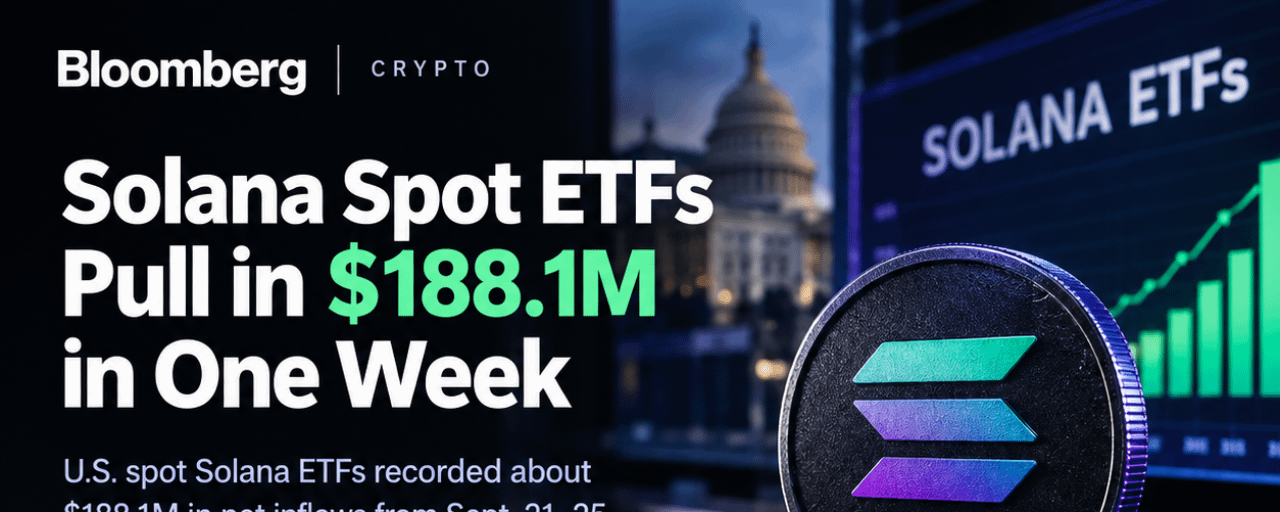
Solana Spot ETFs See $188.1M Weekly Inflows as Institutional Demand Surges#SOLSpotETFWeeklyInflow$188M
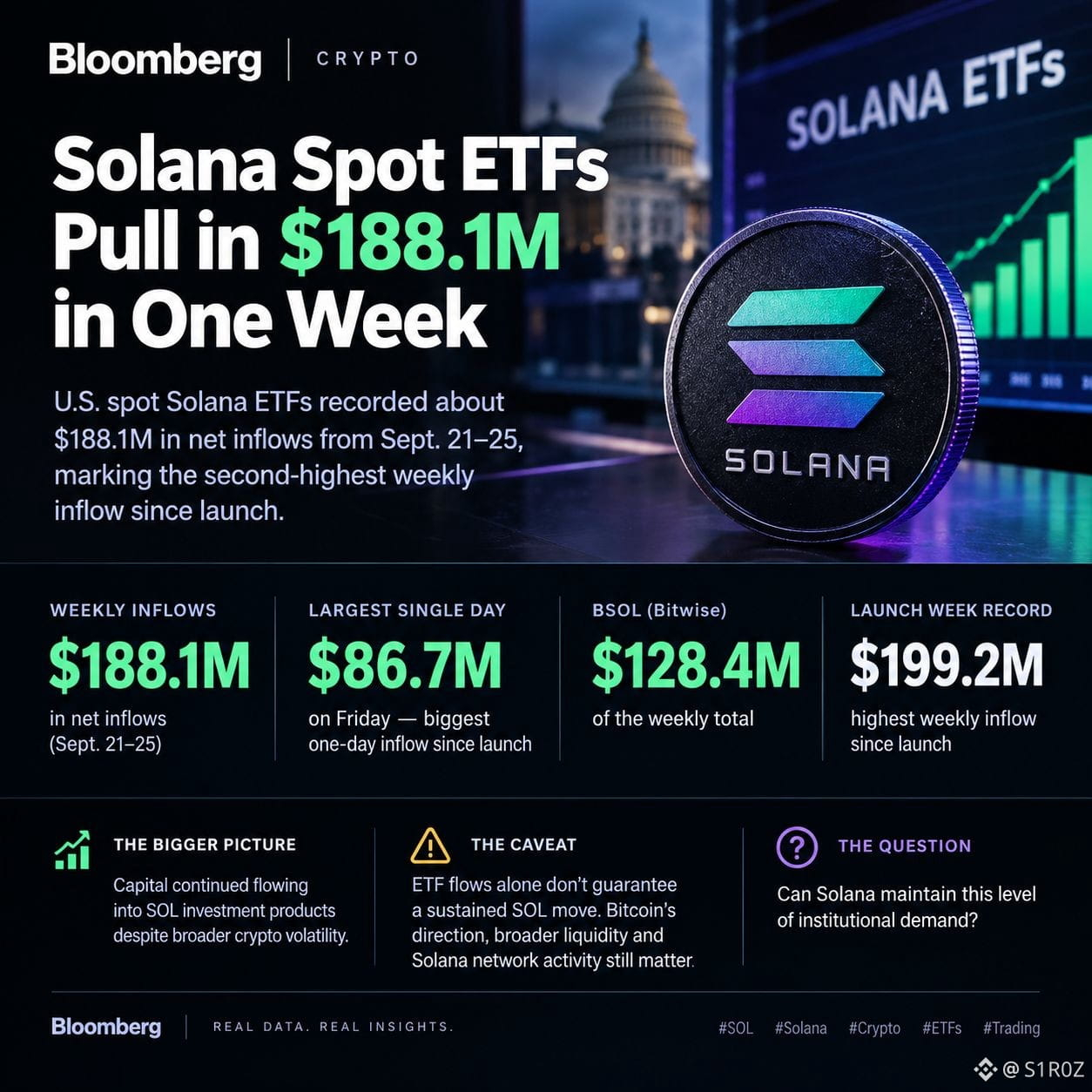
Solana Spot ETFs Pull In $188.1M in One Week
U.S. spot Solana ETFs recorded approximately $188.1 million in net inflows between September 21 and 25, marking their second-highest weekly inflow since launch.
The strongest session came on Friday, when Solana ETFs attracted $86.7 million in a single day. That was the largest one-day inflow recorded since the products launched.
Bitwise’s BSOL was the biggest contributor, accounting for approximately $128.4 million of the weekly total. Despite the strong performance, the current weekly figure remains below the launch-week record of $199.2 million.
The flow data gives traders another metric to watch as institutional access to SOL continues developing. Capital continued moving into Solana investment products even as the broader crypto market remained volatile.
But ETF inflows should not be treated as a standalone signal for SOL’s next move. Bitcoin’s direction, overall market liquidity and activity across the Solana network can also influence whether this demand translates into sustained price strength.
For now, the key question is whether the recent ETF demand represents a temporary burst of buying or the beginning of a more consistent institutional allocation trend.
Can Solana maintain this level of institutional demand in the weeks ahead?
#SOL #Solana #Crypto #ETFs #Trading
Solana Spot ETFs See $188.1M Weekly Inflows as Institutional Demand Surges
#SOLSpotETFWeeklyInflow$188M
Solana Spot ETFs Pull In $188.1M in One Week
U.S. spot Solana ETFs recorded approximately $188.1 million in net inflows between September 21 and 25, marking their second-highest weekly inflow since launch.
The strongest session came on Friday, when Solana ETFs attracted $86.7 million in a single day. That was the largest one-day inflow recorded since the products launched.
Bitwise’s BSOL was the biggest contributor, accounting for approximately $128.4 million of the weekly total. Despite the strong performance, the current weekly figure remains below the launch-week record of $199.2 million.
The flow data gives traders another metric to watch as institutional access to SOL continues developing. Capital continued moving into Solana investment products even as the broader crypto market remained volatile.
But ETF inflows should not be treated as a standalone signal for SOL’s next move. Bitcoin’s direction, overall market liquidity and activity across the Solana network can also influence whether this demand translates into sustained price strength.
For now, the key question is whether the recent ETF demand represents a temporary burst of buying or the beginning of a more consistent institutional allocation trend.
Can Solana maintain this level of institutional demand in the weeks ahead?
#SOL #Solana #Crypto #ETFs #Trading
Solana Spot ETFs Pull In $188.1M in One Week
U.S. spot Solana ETFs recorded approximately $188.1 million in net inflows between September 21 and 25, marking their second-highest weekly inflow since launch.
The strongest session came on Friday, when Solana ETFs attracted $86.7 million in a single day. That was the largest one-day inflow recorded since the products launched.
Bitwise’s BSOL was the biggest contributor, accounting for approximately $128.4 million of the weekly total. Despite the strong performance, the current weekly figure remains below the launch-week record of $199.2 million.
The flow data gives traders another metric to watch as institutional access to SOL continues developing. Capital continued moving into Solana investment products even as the broader crypto market remained volatile.
But ETF inflows should not be treated as a standalone signal for SOL’s next move. Bitcoin’s direction, overall market liquidity and activity across the Solana network can also influence whether this demand translates into sustained price strength.
For now, the key question is whether the recent ETF demand represents a temporary burst of buying or the beginning of a more consistent institutional allocation trend.
Can Solana maintain this level of institutional demand in the weeks ahead?
#SOL #Solana #Crypto #ETFs #Trading
2
·
--
本人確認中
#SOLSpotETFWeeklyInflow$188M
🚨 ソラナの現物ETFが1週間で1億8810万ドルを集めた。
米国の現物ソラナETFは9月21日〜25日に約1億8810万ドルの純流入を記録し、導入以来の週次純流入としては最高額に次ぐ2番目となった。
注目すべき数字は金曜日で、ソラナETFは1日で8610万7000ドルを集めた——これは導入以来最大の1日純流入だ。
ビットワイズのBSOLが週次合計の128.4Mドルを占めた一方、記録はローンチ週の199.2Mドルのままだ。
トレーダーにとって興味深いのは、暗号資産全体のボラティリティがある中でも、資金がSOLの投資商品に流入し続けている点だ。
ただし、ETFの資金フローだけでは、持続的なSOLの値動きを保証するわけではない。ビットコインの方向性、より広い流動性、そしてソラナのネットワーク活動も依然として重要だ。
ソラナはこの水準の機関投資家需要を維持できるのか?
$SOL
{spot}(SOLUSDT)
#SOL #solana #crypto #ETFs #trading
#SOLSpotETFWeeklyInflow$188M
🚨 ソラナの現物ETFが1週間で1億8810万ドルを集めた。
米国の現物ソラナETFは9月21日〜25日に約1億8810万ドルの純流入を記録し、導入以来の週次純流入としては最高額に次ぐ2番目となった。
注目すべき数字は金曜日で、ソラナETFは1日で8610万7000ドルを集めた——これは導入以来最大の1日純流入だ。
ビットワイズのBSOLが週次合計の128.4Mドルを占めた一方、記録はローンチ週の199.2Mドルのままだ。
トレーダーにとって興味深いのは、暗号資産全体のボラティリティがある中でも、資金がSOLの投資商品に流入し続けている点だ。
ただし、ETFの資金フローだけでは、持続的なSOLの値動きを保証するわけではない。ビットコインの方向性、より広い流動性、そしてソラナのネットワーク活動も依然として重要だ。
ソラナはこの水準の機関投資家需要を維持できるのか?
$SOL
#SOL #solana #crypto #ETFs #trading
🚨 ソラナの現物ETFが1週間で1億8810万ドルを集めた。
米国の現物ソラナETFは9月21日〜25日に約1億8810万ドルの純流入を記録し、導入以来の週次純流入としては最高額に次ぐ2番目となった。
注目すべき数字は金曜日で、ソラナETFは1日で8610万7000ドルを集めた——これは導入以来最大の1日純流入だ。
ビットワイズのBSOLが週次合計の128.4Mドルを占めた一方、記録はローンチ週の199.2Mドルのままだ。
トレーダーにとって興味深いのは、暗号資産全体のボラティリティがある中でも、資金がSOLの投資商品に流入し続けている点だ。
ただし、ETFの資金フローだけでは、持続的なSOLの値動きを保証するわけではない。ビットコインの方向性、より広い流動性、そしてソラナのネットワーク活動も依然として重要だ。
ソラナはこの水準の機関投資家需要を維持できるのか?
$SOL
#SOL #solana #crypto #ETFs #trading
3
68
·
--

記事
翻訳参照
Polymarket Bank-Failure Bets Draw FDIC Attention: Could Prediction Markets Fuel Panic?#polymarketbankfailurebetsdrawfdicconcern
🚨 Polymarket’s Bank-Failure Bets Are Drawing FDIC Attention
Prediction markets are increasingly moving into areas that regulators normally watch closely.
Polymarket contracts tied to potential failures of major banks — including JPMorgan Chase, Wells Fargo and Bank of America — have reportedly drawn scrutiny from US banking officials, according to Bloomberg.
The contracts are still relatively small compared with the broader prediction-market ecosystem. Recent wagers tied to banks failing by the end of 2026 had around $76,000 in total volume, while an earlier group of bank-failure contracts generated about $591,000.
But the size of the market isn't the only issue.
🏦 Why is the FDIC paying attention?
The Federal Deposit Insurance Corporation reportedly discussed whether these contracts could create risks if they became larger and more influential.
The concern is not simply that traders are betting on whether a bank will fail.
It's what could happen after the prediction gets attention.
A prediction market can turn a possibility into a highly visible headline. If enough people see a market suggesting that a bank could fail, that information could potentially influence how depositors behave.
That creates a feedback loop worth watching:
Prediction → attention → depositor reaction → liquidity pressure
Bloomberg reported that FDIC officials specifically considered whether these contracts could eventually contribute to a real-world bank run. The agency also discussed whether its existing ethics rules were sufficient to prevent employees with access to confidential information from trading on such markets.
📊 But a prediction isn't proof of a bank problem
This distinction matters.
The existence of a market where traders can bet on a bank failure doesn't mean the bank is actually approaching failure.
In fact, research from the Federal Reserve Bank of Richmond published in 2026 notes that bank failures are generally preceded by weak fundamentals such as poor loan performance, low capital or declining earnings. Depositor runs can accelerate a crisis, but the research says they are rarely the fundamental root cause.
So traders shouldn't automatically interpret prediction-market activity as a fundamental signal.
It's another piece of information — and one that needs context.
🔄 The interesting part: markets can influence what they measure
This is where prediction markets become particularly interesting.
Normally, markets are expected to reflect information.
But when the underlying event involves human behavior, the market itself can potentially become part of the information environment.
Imagine a scenario:
A prediction market shows increased trading around a potential bank failure.
↓
The market receives attention on social media.
↓
More people become aware of the possibility.
↓
Some depositors become concerned and move money.
↓
The bank experiences additional liquidity pressure.
The original prediction hasn't necessarily been correct.
Yet the attention surrounding it could potentially affect the outcome.
That's the regulatory concern worth watching.
🌐 Why this matters for crypto
Crypto traders are already familiar with prediction markets becoming a real-time source of market sentiment.
Polymarket covers everything from crypto and finance to politics, sports and technology. The expansion into financial-system events creates a different question:
Where does information discovery end and market influence begin?
For crypto, this matters because prediction markets increasingly sit at the intersection of trading, information and social media.
A market can move quickly when a headline breaks. But the headline can also change what traders believe, which can change their behavior.
That's why volume alone shouldn't be treated as confirmation.
👀 What traders should watch
For markets, the important signals are likely to be:
Changes in prediction-market volumeWhether major financial news confirms the underlying narrativeBank deposit and liquidity dataCredit-market stressOfficial statements from regulatorsWhether social-media discussion begins acceleratingWhether actual bank fundamentals are changing
The FDIC's reported concerns don't establish that any of the named banks are facing imminent failure.
The more interesting question is whether prediction markets can remain information tools without becoming catalysts for the events they're measuring.
My take
Prediction markets are designed to aggregate information.
But when the event being predicted is a potential bank failure, the information itself can influence behavior.
That's the loop traders should keep an eye on:
Prediction → attention → reaction → liquidity.
The line between predicting a market event and influencing it could become increasingly important as prediction markets expand into financial-system risks.
#Polymarket #Crypto #PredictionMarkets #Markets #FDIC #Banking #Trading
Polymarket Bank-Failure Bets Draw FDIC Attention: Could Prediction Markets Fuel Panic?
#polymarketbankfailurebetsdrawfdicconcern
🚨 Polymarket’s Bank-Failure Bets Are Drawing FDIC Attention
Prediction markets are increasingly moving into areas that regulators normally watch closely.
Polymarket contracts tied to potential failures of major banks — including JPMorgan Chase, Wells Fargo and Bank of America — have reportedly drawn scrutiny from US banking officials, according to Bloomberg.
The contracts are still relatively small compared with the broader prediction-market ecosystem. Recent wagers tied to banks failing by the end of 2026 had around $76,000 in total volume, while an earlier group of bank-failure contracts generated about $591,000.
But the size of the market isn't the only issue.
🏦 Why is the FDIC paying attention?
The Federal Deposit Insurance Corporation reportedly discussed whether these contracts could create risks if they became larger and more influential.
The concern is not simply that traders are betting on whether a bank will fail.
It's what could happen after the prediction gets attention.
A prediction market can turn a possibility into a highly visible headline. If enough people see a market suggesting that a bank could fail, that information could potentially influence how depositors behave.
That creates a feedback loop worth watching:
Prediction → attention → depositor reaction → liquidity pressure
Bloomberg reported that FDIC officials specifically considered whether these contracts could eventually contribute to a real-world bank run. The agency also discussed whether its existing ethics rules were sufficient to prevent employees with access to confidential information from trading on such markets.
📊 But a prediction isn't proof of a bank problem
This distinction matters.
The existence of a market where traders can bet on a bank failure doesn't mean the bank is actually approaching failure.
In fact, research from the Federal Reserve Bank of Richmond published in 2026 notes that bank failures are generally preceded by weak fundamentals such as poor loan performance, low capital or declining earnings. Depositor runs can accelerate a crisis, but the research says they are rarely the fundamental root cause.
So traders shouldn't automatically interpret prediction-market activity as a fundamental signal.
It's another piece of information — and one that needs context.
🔄 The interesting part: markets can influence what they measure
This is where prediction markets become particularly interesting.
Normally, markets are expected to reflect information.
But when the underlying event involves human behavior, the market itself can potentially become part of the information environment.
Imagine a scenario:
A prediction market shows increased trading around a potential bank failure.
↓
The market receives attention on social media.
↓
More people become aware of the possibility.
↓
Some depositors become concerned and move money.
↓
The bank experiences additional liquidity pressure.
The original prediction hasn't necessarily been correct.
Yet the attention surrounding it could potentially affect the outcome.
That's the regulatory concern worth watching.
🌐 Why this matters for crypto
Crypto traders are already familiar with prediction markets becoming a real-time source of market sentiment.
Polymarket covers everything from crypto and finance to politics, sports and technology. The expansion into financial-system events creates a different question:
Where does information discovery end and market influence begin?
For crypto, this matters because prediction markets increasingly sit at the intersection of trading, information and social media.
A market can move quickly when a headline breaks. But the headline can also change what traders believe, which can change their behavior.
That's why volume alone shouldn't be treated as confirmation.
👀 What traders should watch
For markets, the important signals are likely to be:
Changes in prediction-market volumeWhether major financial news confirms the underlying narrativeBank deposit and liquidity dataCredit-market stressOfficial statements from regulatorsWhether social-media discussion begins acceleratingWhether actual bank fundamentals are changing
The FDIC's reported concerns don't establish that any of the named banks are facing imminent failure.
The more interesting question is whether prediction markets can remain information tools without becoming catalysts for the events they're measuring.
My take
Prediction markets are designed to aggregate information.
But when the event being predicted is a potential bank failure, the information itself can influence behavior.
That's the loop traders should keep an eye on:
Prediction → attention → reaction → liquidity.
The line between predicting a market event and influencing it could become increasingly important as prediction markets expand into financial-system risks.
#Polymarket #Crypto #PredictionMarkets #Markets #FDIC #Banking #Trading
🚨 Polymarket’s Bank-Failure Bets Are Drawing FDIC Attention
Prediction markets are increasingly moving into areas that regulators normally watch closely.
Polymarket contracts tied to potential failures of major banks — including JPMorgan Chase, Wells Fargo and Bank of America — have reportedly drawn scrutiny from US banking officials, according to Bloomberg.
The contracts are still relatively small compared with the broader prediction-market ecosystem. Recent wagers tied to banks failing by the end of 2026 had around $76,000 in total volume, while an earlier group of bank-failure contracts generated about $591,000.
But the size of the market isn't the only issue.
🏦 Why is the FDIC paying attention?
The Federal Deposit Insurance Corporation reportedly discussed whether these contracts could create risks if they became larger and more influential.
The concern is not simply that traders are betting on whether a bank will fail.
It's what could happen after the prediction gets attention.
A prediction market can turn a possibility into a highly visible headline. If enough people see a market suggesting that a bank could fail, that information could potentially influence how depositors behave.
That creates a feedback loop worth watching:
Prediction → attention → depositor reaction → liquidity pressure
Bloomberg reported that FDIC officials specifically considered whether these contracts could eventually contribute to a real-world bank run. The agency also discussed whether its existing ethics rules were sufficient to prevent employees with access to confidential information from trading on such markets.
📊 But a prediction isn't proof of a bank problem
This distinction matters.
The existence of a market where traders can bet on a bank failure doesn't mean the bank is actually approaching failure.
In fact, research from the Federal Reserve Bank of Richmond published in 2026 notes that bank failures are generally preceded by weak fundamentals such as poor loan performance, low capital or declining earnings. Depositor runs can accelerate a crisis, but the research says they are rarely the fundamental root cause.
So traders shouldn't automatically interpret prediction-market activity as a fundamental signal.
It's another piece of information — and one that needs context.
🔄 The interesting part: markets can influence what they measure
This is where prediction markets become particularly interesting.
Normally, markets are expected to reflect information.
But when the underlying event involves human behavior, the market itself can potentially become part of the information environment.
Imagine a scenario:
A prediction market shows increased trading around a potential bank failure.
↓
The market receives attention on social media.
↓
More people become aware of the possibility.
↓
Some depositors become concerned and move money.
↓
The bank experiences additional liquidity pressure.
The original prediction hasn't necessarily been correct.
Yet the attention surrounding it could potentially affect the outcome.
That's the regulatory concern worth watching.
🌐 Why this matters for crypto
Crypto traders are already familiar with prediction markets becoming a real-time source of market sentiment.
Polymarket covers everything from crypto and finance to politics, sports and technology. The expansion into financial-system events creates a different question:
Where does information discovery end and market influence begin?
For crypto, this matters because prediction markets increasingly sit at the intersection of trading, information and social media.
A market can move quickly when a headline breaks. But the headline can also change what traders believe, which can change their behavior.
That's why volume alone shouldn't be treated as confirmation.
👀 What traders should watch
For markets, the important signals are likely to be:
Changes in prediction-market volumeWhether major financial news confirms the underlying narrativeBank deposit and liquidity dataCredit-market stressOfficial statements from regulatorsWhether social-media discussion begins acceleratingWhether actual bank fundamentals are changing
The FDIC's reported concerns don't establish that any of the named banks are facing imminent failure.
The more interesting question is whether prediction markets can remain information tools without becoming catalysts for the events they're measuring.
My take
Prediction markets are designed to aggregate information.
But when the event being predicted is a potential bank failure, the information itself can influence behavior.
That's the loop traders should keep an eye on:
Prediction → attention → reaction → liquidity.
The line between predicting a market event and influencing it could become increasingly important as prediction markets expand into financial-system risks.
#Polymarket #Crypto #PredictionMarkets #Markets #FDIC #Banking #Trading
6
·
--
本人確認中
翻訳参照
#polymarketbankfailurebetsdrawfdicconcern
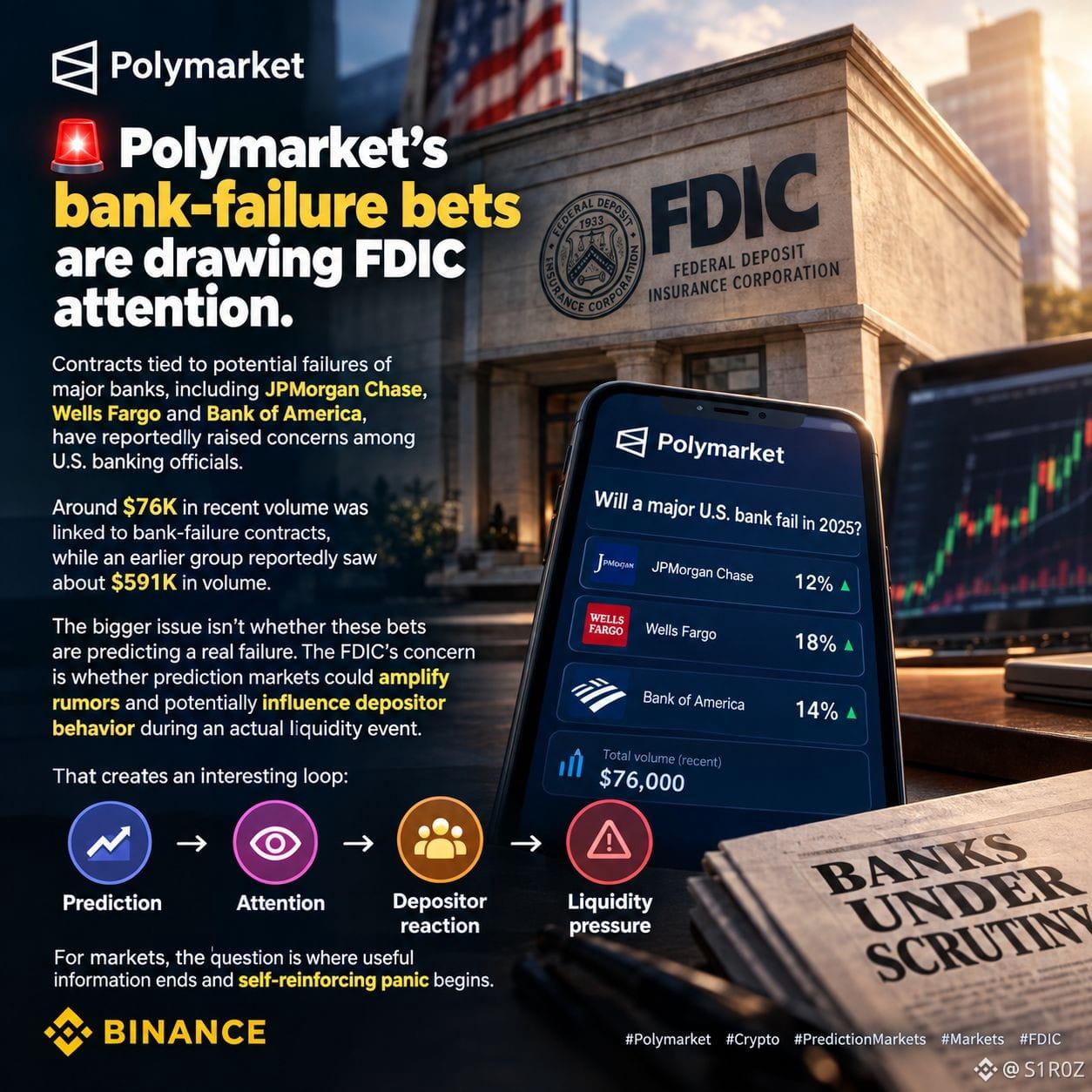
🚨 Polymarket’s bank-failure bets are drawing FDIC attention.
Contracts tied to potential failures of major banks, including JPMorgan Chase, Wells Fargo and Bank of America, have reportedly raised concerns among U.S. banking officials.
Around $76K in recent volume was linked to bank-failure contracts, while an earlier group reportedly saw about $591K in volume.
The bigger issue isn’t whether these bets are predicting a real failure. The FDIC’s concern is whether prediction markets could amplify rumors and potentially influence depositor behavior during an actual liquidity event.
That creates an interesting loop:
Prediction → attention → depositor reaction → liquidity pressure
For markets, the question is where useful information ends and self-reinforcing panic begins.
$MARSCOIN $KMNO $2Z
{spot}(2ZUSDT)
{spot}(KMNOUSDT)
{spot}(MARSCOINUSDT)
#Polymarket #crypto #PredictionMarkets #markets #FDIC
#polymarketbankfailurebetsdrawfdicconcern
🚨 Polymarket’s bank-failure bets are drawing FDIC attention.
Contracts tied to potential failures of major banks, including JPMorgan Chase, Wells Fargo and Bank of America, have reportedly raised concerns among U.S. banking officials.
Around $76K in recent volume was linked to bank-failure contracts, while an earlier group reportedly saw about $591K in volume.
The bigger issue isn’t whether these bets are predicting a real failure. The FDIC’s concern is whether prediction markets could amplify rumors and potentially influence depositor behavior during an actual liquidity event.
That creates an interesting loop:
Prediction → attention → depositor reaction → liquidity pressure
For markets, the question is where useful information ends and self-reinforcing panic begins.
$MARSCOIN $KMNO $2Z
#Polymarket #crypto #PredictionMarkets #markets #FDIC
🚨 Polymarket’s bank-failure bets are drawing FDIC attention.
Contracts tied to potential failures of major banks, including JPMorgan Chase, Wells Fargo and Bank of America, have reportedly raised concerns among U.S. banking officials.
Around $76K in recent volume was linked to bank-failure contracts, while an earlier group reportedly saw about $591K in volume.
The bigger issue isn’t whether these bets are predicting a real failure. The FDIC’s concern is whether prediction markets could amplify rumors and potentially influence depositor behavior during an actual liquidity event.
That creates an interesting loop:
Prediction → attention → depositor reaction → liquidity pressure
For markets, the question is where useful information ends and self-reinforcing panic begins.
$MARSCOIN $KMNO $2Z
#Polymarket #crypto #PredictionMarkets #markets #FDIC
11
·
--
記事
米中貿易協定は300億ドルの物品をカバー:暗号資産トレーダーが注目すべきポイント#ChinaUSAgreeOn$30BTariffCut
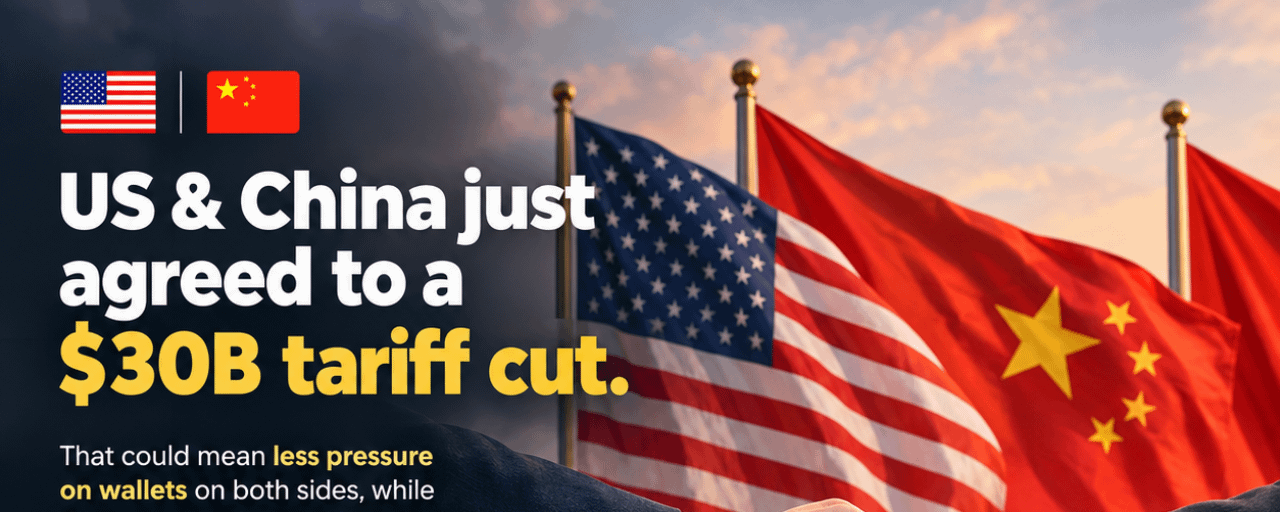
🇺🇸🇨🇳 米中貿易協定は300億ドルの物品をカバー—なぜ暗号資産トレーダーは注目すべきか
ロイターによると、米国と中国は、各方向で300億ドル相当の物品を対象とする新たな貿易協定に到達した。さらに、人工知能に関する新たな対話の計画もある。
この協定には、特定の非センシティブな品目に対するより有利な関税待遇が含まれると報じられている。両国はまた、日中の二国間貿易協議会を設立し、先の貿易交渉からの議論を継続する計画だ。
米中貿易協定は300億ドルの物品をカバー:暗号資産トレーダーが注目すべきポイント
#ChinaUSAgreeOn$30BTariffCut
🇺🇸🇨🇳 米中貿易協定は300億ドルの物品をカバー—なぜ暗号資産トレーダーは注目すべきか
ロイターによると、米国と中国は、各方向で300億ドル相当の物品を対象とする新たな貿易協定に到達した。さらに、人工知能に関する新たな対話の計画もある。
この協定には、特定の非センシティブな品目に対するより有利な関税待遇が含まれると報じられている。両国はまた、日中の二国間貿易協議会を設立し、先の貿易交渉からの議論を継続する計画だ。
🇺🇸🇨🇳 米中貿易協定は300億ドルの物品をカバー—なぜ暗号資産トレーダーは注目すべきか
ロイターによると、米国と中国は、各方向で300億ドル相当の物品を対象とする新たな貿易協定に到達した。さらに、人工知能に関する新たな対話の計画もある。
この協定には、特定の非センシティブな品目に対するより有利な関税待遇が含まれると報じられている。両国はまた、日中の二国間貿易協議会を設立し、先の貿易交渉からの議論を継続する計画だ。
14
·
--
#ChinaUSAgreeOn$30BTariffCut
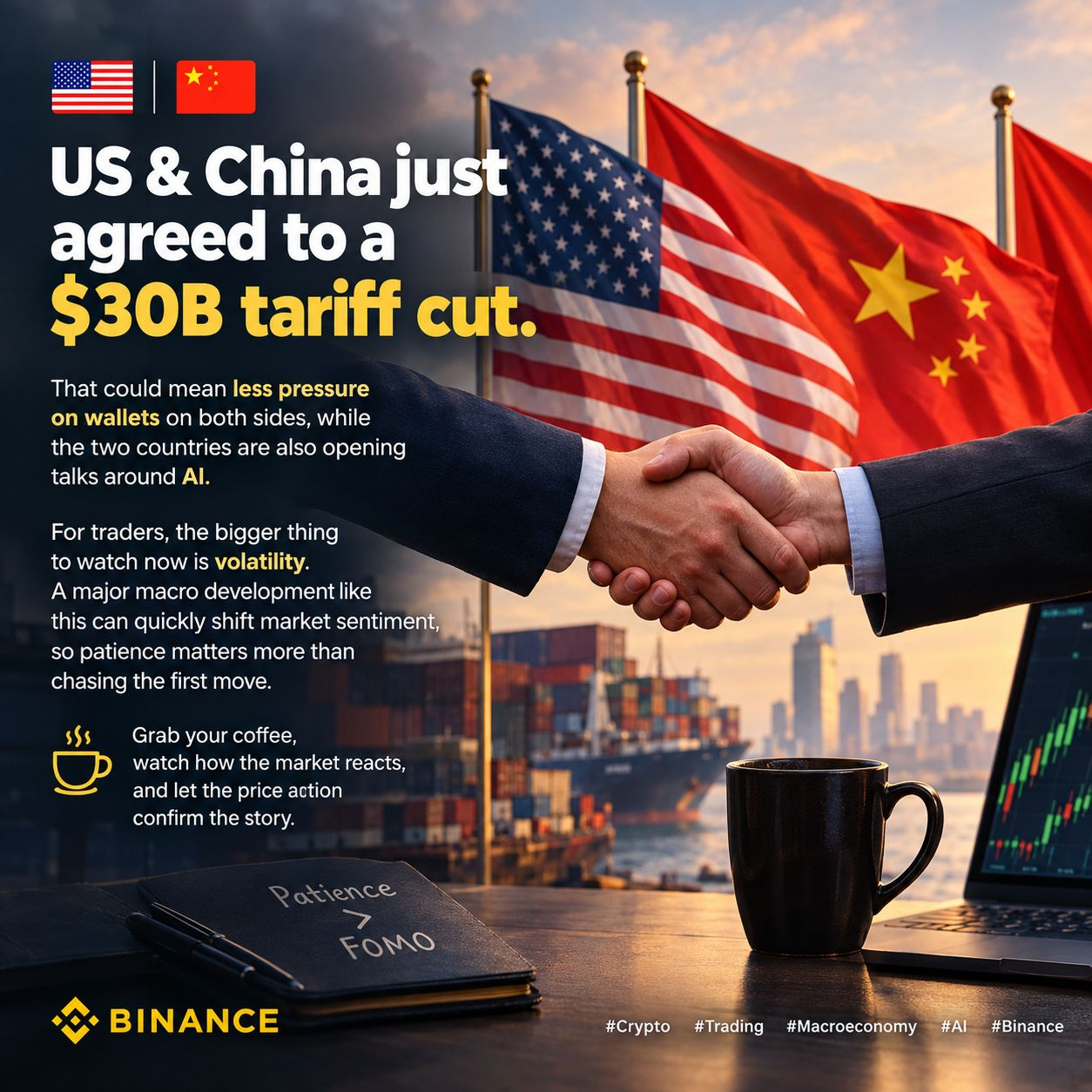
🇺🇸🇨🇳 米国と中国が300億ドル規模の関税引き下げで合意した。
これは双方の財布への負担が軽くなる可能性がある。さらに両国はAIに関する対話も開始している。
トレーダーにとって今より大きく注目すべきは「ボラティリティ(変動性)」だ。こうした主要なマクロの出来事は、市場のセンチメントを素早く変えてしまうことがあるので、最初の動きに飛びつくよりも忍耐が重要になる。
コーヒーを片手に、市場がどう反応するかを見て、値動きが物語を裏付けてくれるのを確認しよう。☕📊
#Crypto #trading #macroeconomy #Aİ #Binance
#ChinaUSAgreeOn$30BTariffCut
🇺🇸🇨🇳 米国と中国が300億ドル規模の関税引き下げで合意した。
これは双方の財布への負担が軽くなる可能性がある。さらに両国はAIに関する対話も開始している。
トレーダーにとって今より大きく注目すべきは「ボラティリティ(変動性)」だ。こうした主要なマクロの出来事は、市場のセンチメントを素早く変えてしまうことがあるので、最初の動きに飛びつくよりも忍耐が重要になる。
コーヒーを片手に、市場がどう反応するかを見て、値動きが物語を裏付けてくれるのを確認しよう。☕📊
#Crypto #trading #macroeconomy #Aİ #Binance
🇺🇸🇨🇳 米国と中国が300億ドル規模の関税引き下げで合意した。
これは双方の財布への負担が軽くなる可能性がある。さらに両国はAIに関する対話も開始している。
トレーダーにとって今より大きく注目すべきは「ボラティリティ(変動性)」だ。こうした主要なマクロの出来事は、市場のセンチメントを素早く変えてしまうことがあるので、最初の動きに飛びつくよりも忍耐が重要になる。
コーヒーを片手に、市場がどう反応するかを見て、値動きが物語を裏付けてくれるのを確認しよう。☕📊
#Crypto #trading #macroeconomy #Aİ #Binance
15
·
--
本人確認中
記事
翻訳参照
Trump Rejects Iran’s 7-Day Hormuz Plan as Oil Markets Watch $95 Crude#trumprejectsiranhormuzreopening
Trump Rejects Iran’s 7-Day Hormuz Plan as Oil Markets Watch $95 Crude
The Strait of Hormuz is back at the center of global energy markets after President Donald Trump rejected an Iranian proposal that Tehran said could reopen the strategic waterway within seven days.
Iran’s proposal, delivered through mediators, called for several conditions from Washington, including lifting the naval blockade on Iranian ports, easing sanctions on Iranian oil sales, releasing roughly $12 billion in frozen Iranian assets, and observing a regional ceasefire. Iranian Foreign Minister Abbas Araghchi said the Strait could return to normal maritime traffic within seven days if those conditions were accepted.
Trump confirmed his position on September 26, telling reporters: “I reject their proposal.”
Why the Strait of Hormuz matters
Hormuz is one of the world's most important energy chokepoints. During normal conditions, roughly one-fifth to one-quarter of global oil flows through the waterway, making disruptions there particularly significant for crude markets and energy companies.
The current disruption has already affected global energy flows and contributed to higher oil prices.
Brent crude recently moved below $100 after Iran signaled that it could reopen the Strait within a week, while WTI was around $94.80 in the market reaction reported at the time.
What happens next?
The immediate question for energy markets is whether the diplomatic deadlock continues or whether further negotiations can produce an agreement.
The Wall Street Journal, citing unnamed U.S. officials, has reported that Trump expects renewed bombing after the November midterm elections. That remains a reported expectation rather than a confirmed future event, and the diplomatic process is still developing.
For energy traders, the Strait's status remains a key variable.
A sustained reopening could ease some of the supply pressure surrounding crude transportation. Continued disruption, meanwhile, could keep geopolitical risk elevated across oil markets.
That makes companies such as Exxon Mobil ($XOM) and Chevron ($CVX) worth watching alongside crude prices—but the direction of their shares will depend on more than Hormuz alone, including oil prices, production, refining margins and broader equity-market conditions.
The bigger market question is simple:
Does Hormuz reopen through diplomacy, or does the disruption continue into the next phase of the conflict?
Trump Rejects Iran’s 7-Day Hormuz Plan as Oil Markets Watch $95 Crude
#trumprejectsiranhormuzreopening
Trump Rejects Iran’s 7-Day Hormuz Plan as Oil Markets Watch $95 Crude
The Strait of Hormuz is back at the center of global energy markets after President Donald Trump rejected an Iranian proposal that Tehran said could reopen the strategic waterway within seven days.
Iran’s proposal, delivered through mediators, called for several conditions from Washington, including lifting the naval blockade on Iranian ports, easing sanctions on Iranian oil sales, releasing roughly $12 billion in frozen Iranian assets, and observing a regional ceasefire. Iranian Foreign Minister Abbas Araghchi said the Strait could return to normal maritime traffic within seven days if those conditions were accepted.
Trump confirmed his position on September 26, telling reporters: “I reject their proposal.”
Why the Strait of Hormuz matters
Hormuz is one of the world's most important energy chokepoints. During normal conditions, roughly one-fifth to one-quarter of global oil flows through the waterway, making disruptions there particularly significant for crude markets and energy companies.
The current disruption has already affected global energy flows and contributed to higher oil prices.
Brent crude recently moved below $100 after Iran signaled that it could reopen the Strait within a week, while WTI was around $94.80 in the market reaction reported at the time.
What happens next?
The immediate question for energy markets is whether the diplomatic deadlock continues or whether further negotiations can produce an agreement.
The Wall Street Journal, citing unnamed U.S. officials, has reported that Trump expects renewed bombing after the November midterm elections. That remains a reported expectation rather than a confirmed future event, and the diplomatic process is still developing.
For energy traders, the Strait's status remains a key variable.
A sustained reopening could ease some of the supply pressure surrounding crude transportation. Continued disruption, meanwhile, could keep geopolitical risk elevated across oil markets.
That makes companies such as Exxon Mobil ($XOM) and Chevron ($CVX) worth watching alongside crude prices—but the direction of their shares will depend on more than Hormuz alone, including oil prices, production, refining margins and broader equity-market conditions.
The bigger market question is simple:
Does Hormuz reopen through diplomacy, or does the disruption continue into the next phase of the conflict?
Trump Rejects Iran’s 7-Day Hormuz Plan as Oil Markets Watch $95 Crude
The Strait of Hormuz is back at the center of global energy markets after President Donald Trump rejected an Iranian proposal that Tehran said could reopen the strategic waterway within seven days.
Iran’s proposal, delivered through mediators, called for several conditions from Washington, including lifting the naval blockade on Iranian ports, easing sanctions on Iranian oil sales, releasing roughly $12 billion in frozen Iranian assets, and observing a regional ceasefire. Iranian Foreign Minister Abbas Araghchi said the Strait could return to normal maritime traffic within seven days if those conditions were accepted.
Trump confirmed his position on September 26, telling reporters: “I reject their proposal.”
Why the Strait of Hormuz matters
Hormuz is one of the world's most important energy chokepoints. During normal conditions, roughly one-fifth to one-quarter of global oil flows through the waterway, making disruptions there particularly significant for crude markets and energy companies.
The current disruption has already affected global energy flows and contributed to higher oil prices.
Brent crude recently moved below $100 after Iran signaled that it could reopen the Strait within a week, while WTI was around $94.80 in the market reaction reported at the time.
What happens next?
The immediate question for energy markets is whether the diplomatic deadlock continues or whether further negotiations can produce an agreement.
The Wall Street Journal, citing unnamed U.S. officials, has reported that Trump expects renewed bombing after the November midterm elections. That remains a reported expectation rather than a confirmed future event, and the diplomatic process is still developing.
For energy traders, the Strait's status remains a key variable.
A sustained reopening could ease some of the supply pressure surrounding crude transportation. Continued disruption, meanwhile, could keep geopolitical risk elevated across oil markets.
That makes companies such as Exxon Mobil ($XOM) and Chevron ($CVX) worth watching alongside crude prices—but the direction of their shares will depend on more than Hormuz alone, including oil prices, production, refining margins and broader equity-market conditions.
The bigger market question is simple:
Does Hormuz reopen through diplomacy, or does the disruption continue into the next phase of the conflict?
1
189
·
--
本人確認中
#trumprejectsiranhormuzreopening
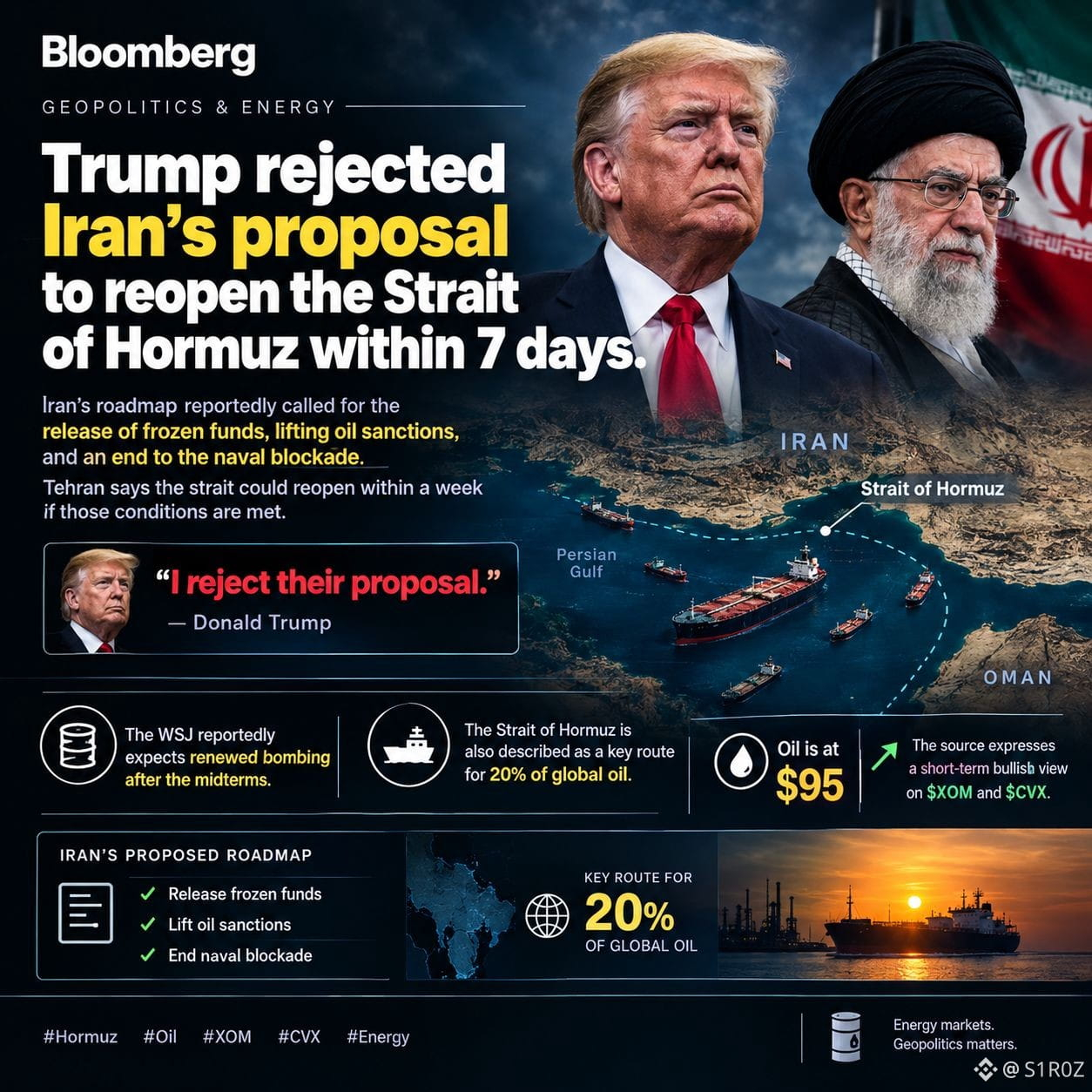
💥 トランプ氏、7日以内にホルムズ海峡を再開するイラン側の提案を拒否
報道によると、イランのロードマップには凍結資金の解放、石油制裁の解除、そして海上封鎖の終了が盛り込まれていた。テヘランは、これらの条件が満たされれば、海峡は1週間以内に再開し得ると述べている。
トランプ氏は「私は彼らの提案を拒否する」と語った。
WSJによれば、中間選挙後に爆撃が再開されることを見込んでいるという。ホルムズ海峡は、世界の原油の20%を運ぶ主要ルートでもあるとされる。
原油は95ドル。一方で、当該ソースは短期的に強気との見方を示している:$XOM.US and $CVX.US
{stock_us}(XOM.US)
{stock_us}(CVX.US)
#Hormuz #oil #XOM #CVX #energy
#trumprejectsiranhormuzreopening
💥 トランプ氏、7日以内にホルムズ海峡を再開するイラン側の提案を拒否
報道によると、イランのロードマップには凍結資金の解放、石油制裁の解除、そして海上封鎖の終了が盛り込まれていた。テヘランは、これらの条件が満たされれば、海峡は1週間以内に再開し得ると述べている。
トランプ氏は「私は彼らの提案を拒否する」と語った。
WSJによれば、中間選挙後に爆撃が再開されることを見込んでいるという。ホルムズ海峡は、世界の原油の20%を運ぶ主要ルートでもあるとされる。
原油は95ドル。一方で、当該ソースは短期的に強気との見方を示している:$XOM.US and $CVX.US
#Hormuz #oil #XOM #CVX #energy
💥 トランプ氏、7日以内にホルムズ海峡を再開するイラン側の提案を拒否
報道によると、イランのロードマップには凍結資金の解放、石油制裁の解除、そして海上封鎖の終了が盛り込まれていた。テヘランは、これらの条件が満たされれば、海峡は1週間以内に再開し得ると述べている。
トランプ氏は「私は彼らの提案を拒否する」と語った。
WSJによれば、中間選挙後に爆撃が再開されることを見込んでいるという。ホルムズ海峡は、世界の原油の20%を運ぶ主要ルートでもあるとされる。
原油は95ドル。一方で、当該ソースは短期的に強気との見方を示している:$XOM.US and $CVX.US
#Hormuz #oil #XOM #CVX #energy
1
65
·
--
記事
翻訳参照
CoinMarketCap Acquires Coinglass, Bringing Derivatives Data to 115M Users#coinmarketcapcompletescoinglassacquisition
CoinMarketCap Acquires Coinglass, Bringing Derivatives Data to 115M Users
CoinMarketCap has completed its acquisition of Coinglass, bringing derivatives-focused market data into one of the crypto industry's largest market-data platforms.
The deal gives CoinMarketCap's reported 115 million users access to data covering liquidations, funding rates, open interest and other derivatives metrics.
For traders, the combination could make it easier to view spot-market information and derivatives positioning within the same broader ecosystem.
But there's an important detail: Coinglass will continue operating independently, with its existing products and pricing remaining unchanged.
That means the acquisition isn't immediately changing how Coinglass users access its platform. Instead, the bigger development is the integration of derivatives intelligence into CoinMarketCap's wider market-data ecosystem.
Derivatives data has become increasingly important for traders because metrics such as open interest, funding rates and liquidation activity can provide additional context around market positioning.
With Coinglass remaining independent, the next thing to watch is how the two platforms eventually connect their data and user experiences.
For crypto traders, having broader market and derivatives information available across the same ecosystem could make market analysis more streamlined.
CoinMarketCap Acquires Coinglass, Bringing Derivatives Data to 115M Users
#coinmarketcapcompletescoinglassacquisition
CoinMarketCap Acquires Coinglass, Bringing Derivatives Data to 115M Users
CoinMarketCap has completed its acquisition of Coinglass, bringing derivatives-focused market data into one of the crypto industry's largest market-data platforms.
The deal gives CoinMarketCap's reported 115 million users access to data covering liquidations, funding rates, open interest and other derivatives metrics.
For traders, the combination could make it easier to view spot-market information and derivatives positioning within the same broader ecosystem.
But there's an important detail: Coinglass will continue operating independently, with its existing products and pricing remaining unchanged.
That means the acquisition isn't immediately changing how Coinglass users access its platform. Instead, the bigger development is the integration of derivatives intelligence into CoinMarketCap's wider market-data ecosystem.
Derivatives data has become increasingly important for traders because metrics such as open interest, funding rates and liquidation activity can provide additional context around market positioning.
With Coinglass remaining independent, the next thing to watch is how the two platforms eventually connect their data and user experiences.
For crypto traders, having broader market and derivatives information available across the same ecosystem could make market analysis more streamlined.
CoinMarketCap Acquires Coinglass, Bringing Derivatives Data to 115M Users
CoinMarketCap has completed its acquisition of Coinglass, bringing derivatives-focused market data into one of the crypto industry's largest market-data platforms.
The deal gives CoinMarketCap's reported 115 million users access to data covering liquidations, funding rates, open interest and other derivatives metrics.
For traders, the combination could make it easier to view spot-market information and derivatives positioning within the same broader ecosystem.
But there's an important detail: Coinglass will continue operating independently, with its existing products and pricing remaining unchanged.
That means the acquisition isn't immediately changing how Coinglass users access its platform. Instead, the bigger development is the integration of derivatives intelligence into CoinMarketCap's wider market-data ecosystem.
Derivatives data has become increasingly important for traders because metrics such as open interest, funding rates and liquidation activity can provide additional context around market positioning.
With Coinglass remaining independent, the next thing to watch is how the two platforms eventually connect their data and user experiences.
For crypto traders, having broader market and derivatives information available across the same ecosystem could make market analysis more streamlined.
2
·
--
本人確認中
翻訳参照
#coinmarketcapcompletescoinglassacquisition
📊 CoinMarketCap just brought Coinglass into its ecosystem.
CoinMarketCap has completed its acquisition of Coinglass, giving its 115 million users access to derivatives data including liquidations, funding rates, open interest, and more.
The interesting part is that Coinglass will remain independent, with no changes to its products or pricing.
For traders, that puts more derivatives-focused market data directly alongside the broader crypto market information already available through CoinMarketCap.
#CoinMarketCap #coinglass #crypto #trading
#coinmarketcapcompletescoinglassacquisition
📊 CoinMarketCap just brought Coinglass into its ecosystem.
CoinMarketCap has completed its acquisition of Coinglass, giving its 115 million users access to derivatives data including liquidations, funding rates, open interest, and more.
The interesting part is that Coinglass will remain independent, with no changes to its products or pricing.
For traders, that puts more derivatives-focused market data directly alongside the broader crypto market information already available through CoinMarketCap.
#CoinMarketCap #coinglass #crypto #trading
📊 CoinMarketCap just brought Coinglass into its ecosystem.
CoinMarketCap has completed its acquisition of Coinglass, giving its 115 million users access to derivatives data including liquidations, funding rates, open interest, and more.
The interesting part is that Coinglass will remain independent, with no changes to its products or pricing.
For traders, that puts more derivatives-focused market data directly alongside the broader crypto market information already available through CoinMarketCap.
#CoinMarketCap #coinglass #crypto #trading

11
·
--
記事
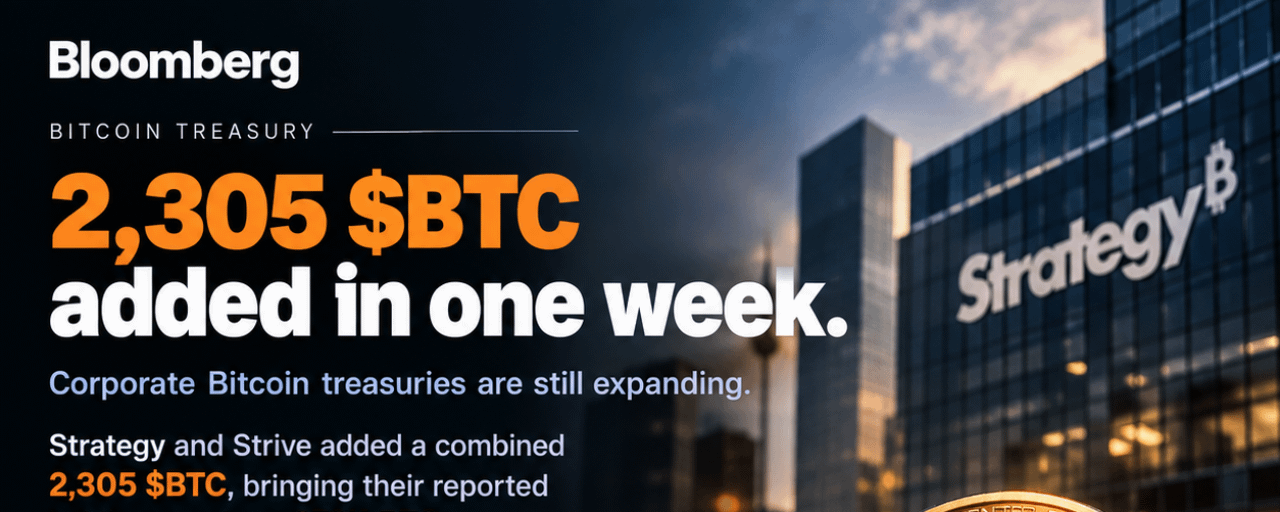
StrategyとStriveが企業のBTCトレジャリー拡大に伴い2,305ビットコインを追加#strategystriveadd2305bitcointhisweek
StrategyとStriveが企業のBTCトレジャリー拡大に伴い2,305ビットコインを追加
法人のビットコイン準備(トレジャリー)は、企業がバランスシートにさらに多くのBTCを追加し続けることで拡大し続けています。
過去1週間で、StrategyとStriveは合計2,305BTCを追加し、保有残高は約872,000BTCに達しました。
この積み増しは、企業がビットコインを短期の現金や証券に頼るのではなく、長期のバランスシート資産として活用するという、より広範な法人トレジャリーの潮流を後押ししています。
ビットコイン市場においては、その意義は週間の購入額という数字を超えます。
StrategyとStriveが企業のBTCトレジャリー拡大に伴い2,305ビットコインを追加
#strategystriveadd2305bitcointhisweek
StrategyとStriveが企業のBTCトレジャリー拡大に伴い2,305ビットコインを追加
法人のビットコイン準備(トレジャリー)は、企業がバランスシートにさらに多くのBTCを追加し続けることで拡大し続けています。
過去1週間で、StrategyとStriveは合計2,305BTCを追加し、保有残高は約872,000BTCに達しました。
この積み増しは、企業がビットコインを短期の現金や証券に頼るのではなく、長期のバランスシート資産として活用するという、より広範な法人トレジャリーの潮流を後押ししています。
ビットコイン市場においては、その意義は週間の購入額という数字を超えます。
StrategyとStriveが企業のBTCトレジャリー拡大に伴い2,305ビットコインを追加
法人のビットコイン準備(トレジャリー)は、企業がバランスシートにさらに多くのBTCを追加し続けることで拡大し続けています。
過去1週間で、StrategyとStriveは合計2,305BTCを追加し、保有残高は約872,000BTCに達しました。
この積み増しは、企業がビットコインを短期の現金や証券に頼るのではなく、長期のバランスシート資産として活用するという、より広範な法人トレジャリーの潮流を後押ししています。
ビットコイン市場においては、その意義は週間の購入額という数字を超えます。
29
·
--
翻訳参照
#strategystriveadd2305bitcointhisweek
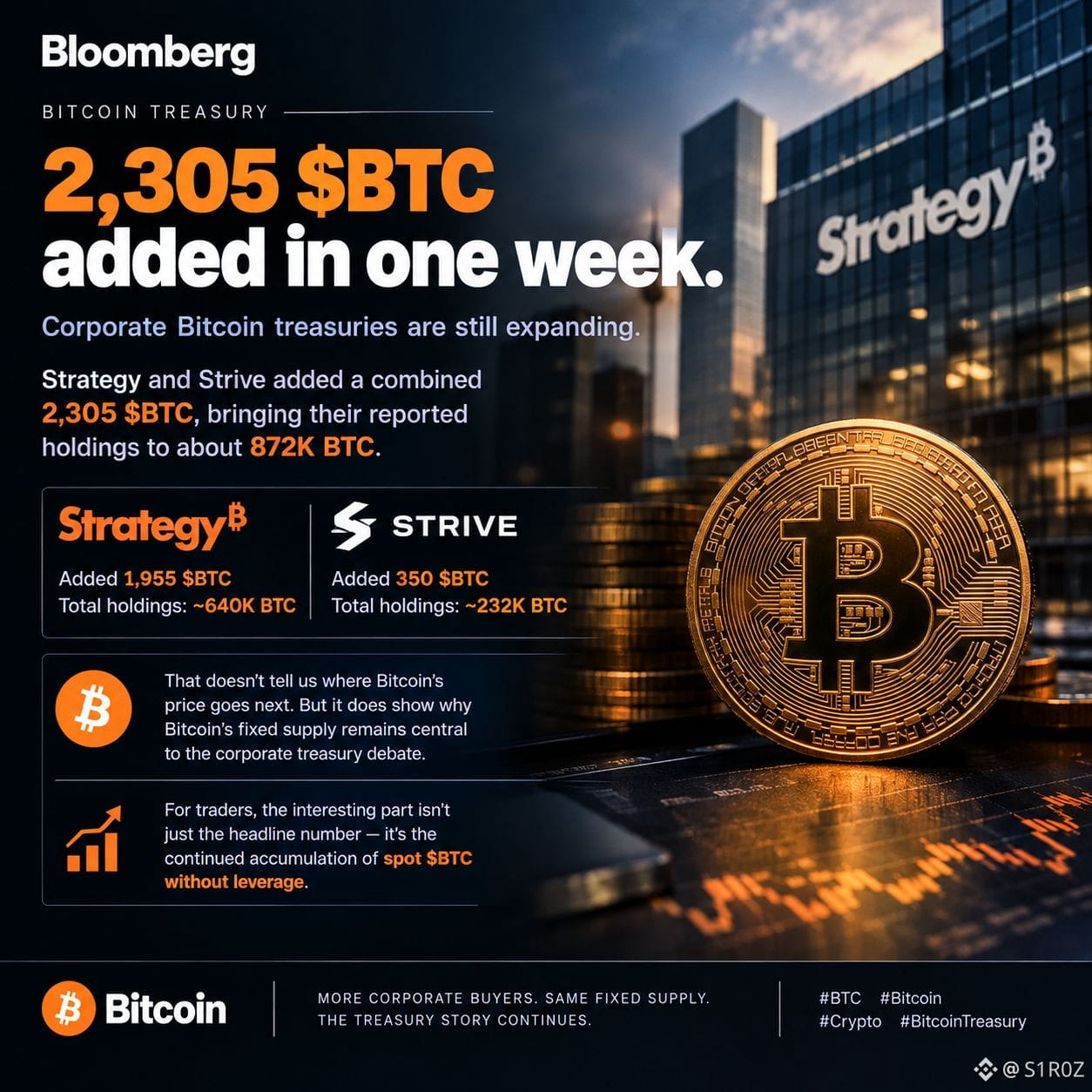
🟠 2,305 $BTC added in one week.
Corporate Bitcoin treasuries are still expanding.
Strategy and Strive added a combined 2,305 $BTC, bringing their reported holdings to about 872K BTC.
That doesn't tell us where Bitcoin's price goes next. But it does show why Bitcoin's fixed supply remains central to the corporate treasury debate.
For traders, the interesting part isn't just the headline number — it's the continued accumulation of spot $BTC without leverage.
$BTC
{spot}(BTCUSDT)
#BTC #bitcoin #crypto #BitcoinTreasury
#strategystriveadd2305bitcointhisweek
🟠 2,305 $BTC added in one week.
Corporate Bitcoin treasuries are still expanding.
Strategy and Strive added a combined 2,305 $BTC , bringing their reported holdings to about 872K BTC.
That doesn't tell us where Bitcoin's price goes next. But it does show why Bitcoin's fixed supply remains central to the corporate treasury debate.
For traders, the interesting part isn't just the headline number — it's the continued accumulation of spot $BTC without leverage.
$BTC
#BTC #bitcoin #crypto #BitcoinTreasury
🟠 2,305 $BTC added in one week.
Corporate Bitcoin treasuries are still expanding.
Strategy and Strive added a combined 2,305 $BTC , bringing their reported holdings to about 872K BTC.
That doesn't tell us where Bitcoin's price goes next. But it does show why Bitcoin's fixed supply remains central to the corporate treasury debate.
For traders, the interesting part isn't just the headline number — it's the continued accumulation of spot $BTC without leverage.
$BTC
#BTC #bitcoin #crypto #BitcoinTreasury
26
·
--
記事
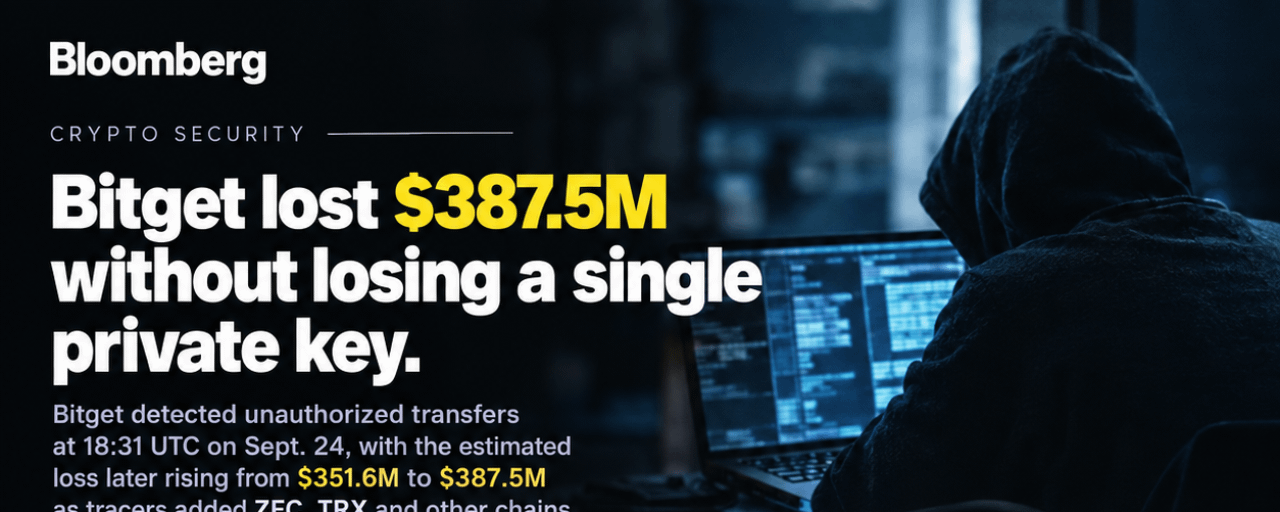
Bitgetハック解説:プライベートキーなしで3億8,750万ドルはどう盗まれたのか#circletetherfreezebitgethackerwallet
Bitgetハック解説:プライベートキーなしで3億8,750万ドルはどう盗まれたのか
Bitgetは、攻撃者が取引所のホットおよびウォーム・ウォレット基盤の一部から約3億8,750万ドルを移したことで、2026年の暗号資産分野における最大級のサイバーセキュリティ事件の1つに対応している。
今回の事件が異例なのは、攻撃者が報告によればプライベートキーを盗まなかったことだ。
Bitgetは、9月24日18:31(UTC)に不正送金が検出されたと発表しており、当初は影響を受けた資産を約3億5,160万ドルと見積もった。その後、オンチェーンの調査担当者が、ZcashやTRONを含むネットワークに関連する追加資産を特定したことにより、被害額は3億8,750万ドルに引き上げられた。
Bitgetハック解説:プライベートキーなしで3億8,750万ドルはどう盗まれたのか
#circletetherfreezebitgethackerwallet
Bitgetハック解説:プライベートキーなしで3億8,750万ドルはどう盗まれたのか
Bitgetは、攻撃者が取引所のホットおよびウォーム・ウォレット基盤の一部から約3億8,750万ドルを移したことで、2026年の暗号資産分野における最大級のサイバーセキュリティ事件の1つに対応している。
今回の事件が異例なのは、攻撃者が報告によればプライベートキーを盗まなかったことだ。
Bitgetは、9月24日18:31(UTC)に不正送金が検出されたと発表しており、当初は影響を受けた資産を約3億5,160万ドルと見積もった。その後、オンチェーンの調査担当者が、ZcashやTRONを含むネットワークに関連する追加資産を特定したことにより、被害額は3億8,750万ドルに引き上げられた。
Bitgetハック解説:プライベートキーなしで3億8,750万ドルはどう盗まれたのか
Bitgetは、攻撃者が取引所のホットおよびウォーム・ウォレット基盤の一部から約3億8,750万ドルを移したことで、2026年の暗号資産分野における最大級のサイバーセキュリティ事件の1つに対応している。
今回の事件が異例なのは、攻撃者が報告によればプライベートキーを盗まなかったことだ。
Bitgetは、9月24日18:31(UTC)に不正送金が検出されたと発表しており、当初は影響を受けた資産を約3億5,160万ドルと見積もった。その後、オンチェーンの調査担当者が、ZcashやTRONを含むネットワークに関連する追加資産を特定したことにより、被害額は3億8,750万ドルに引き上げられた。
1
176
·
--
翻訳参照
#circletetherfreezebitgethackerwallet
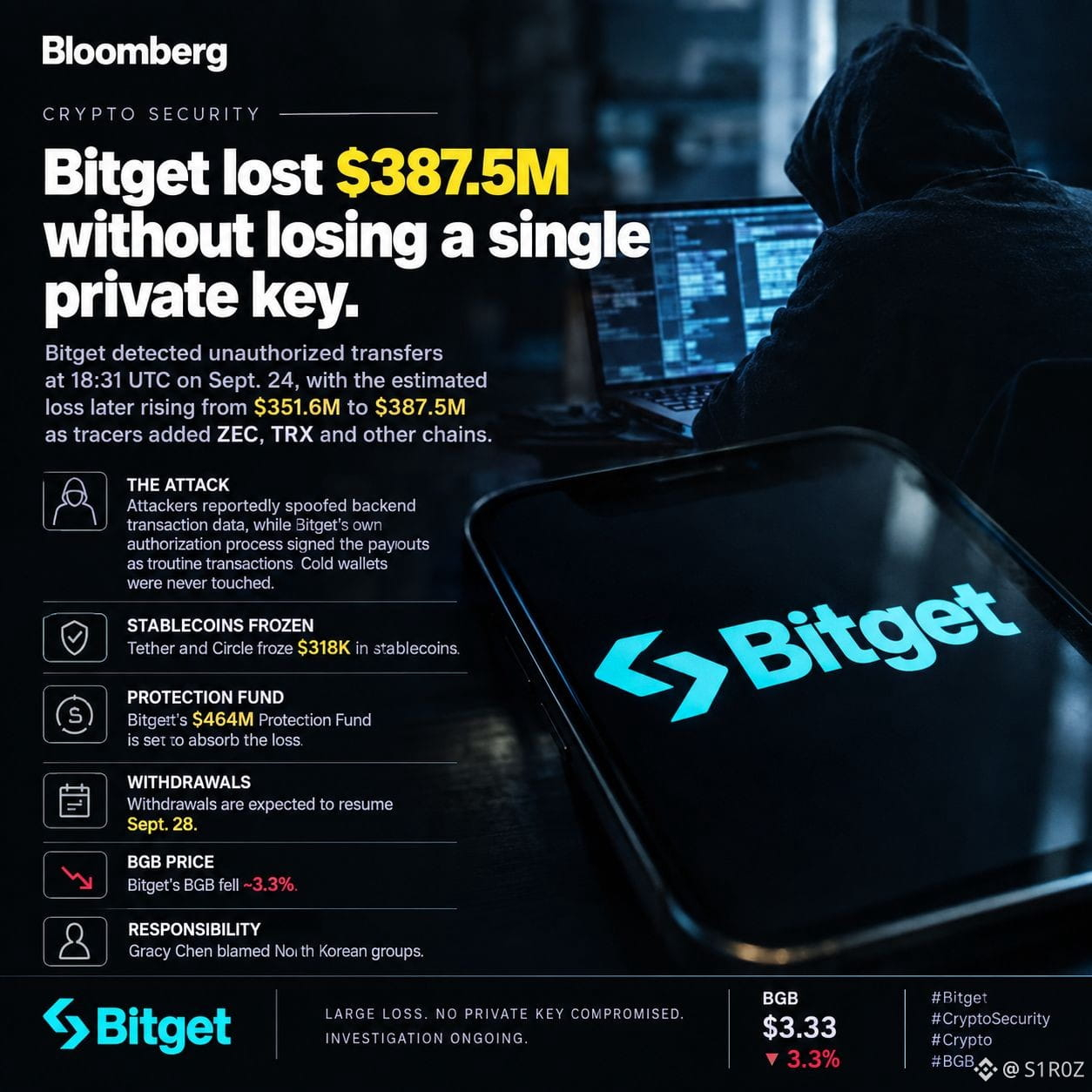
🔧 Bitget lost $387.5M without losing a single private key.
Bitget detected unauthorized transfers at 18:31 UTC on Sept. 24, with the estimated loss later rising from $351.6M to $387.5M as tracers added ZEC, TRX and other chains.
The interesting part: attackers reportedly spoofed backend transaction data, while Bitget’s own authorization process signed the payouts as routine transactions. Cold wallets were never touched.
Tether and Circle froze $318K in stablecoins, while the $464M Protection Fund is set to absorb the loss. Withdrawals are expected to resume Sept. 28.
Bitget’s BGB fell ~3.3%. Gracy Chen blamed North Korean groups.
#Bitget #CryptoSecurity #crypto #BGB
#circletetherfreezebitgethackerwallet
🔧 Bitget lost $387.5M without losing a single private key.
Bitget detected unauthorized transfers at 18:31 UTC on Sept. 24, with the estimated loss later rising from $351.6M to $387.5M as tracers added ZEC, TRX and other chains.
The interesting part: attackers reportedly spoofed backend transaction data, while Bitget’s own authorization process signed the payouts as routine transactions. Cold wallets were never touched.
Tether and Circle froze $318K in stablecoins, while the $464M Protection Fund is set to absorb the loss. Withdrawals are expected to resume Sept. 28.
Bitget’s BGB fell ~3.3%. Gracy Chen blamed North Korean groups.
#Bitget #CryptoSecurity #crypto #BGB
🔧 Bitget lost $387.5M without losing a single private key.
Bitget detected unauthorized transfers at 18:31 UTC on Sept. 24, with the estimated loss later rising from $351.6M to $387.5M as tracers added ZEC, TRX and other chains.
The interesting part: attackers reportedly spoofed backend transaction data, while Bitget’s own authorization process signed the payouts as routine transactions. Cold wallets were never touched.
Tether and Circle froze $318K in stablecoins, while the $464M Protection Fund is set to absorb the loss. Withdrawals are expected to resume Sept. 28.
Bitget’s BGB fell ~3.3%. Gracy Chen blamed North Korean groups.
#Bitget #CryptoSecurity #crypto #BGB
36
·
--

記事
トランプの拒否後、イランはホルムズ海峡提案に関する米国の正式な対応を待つ#trumprejectsiranhormuzreopening
イラン、ホルムズ海峡をめぐり外交の扉を開いたままに
イランは、ドナルド・トランプ大統領がホルムズ海峡に関する最新提案を公に退けたにもかかわらず、ワシントンとの外交チャンネルは開いたままだと述べた。
イランの外相アッバース・アラグチは、テヘランはトランプの当初の反応は聞いているが、仲介者を通じてワシントンの最終的な立場が正式に伝達されるのをまだ待っていると述べた。さらに、海峡の再開に向けた動き、または交渉の前進は、イランが定める要件が満たされることが条件になると付け加えた。
トランプの拒否後、イランはホルムズ海峡提案に関する米国の正式な対応を待つ
#trumprejectsiranhormuzreopening
イラン、ホルムズ海峡をめぐり外交の扉を開いたままに
イランは、ドナルド・トランプ大統領がホルムズ海峡に関する最新提案を公に退けたにもかかわらず、ワシントンとの外交チャンネルは開いたままだと述べた。
イランの外相アッバース・アラグチは、テヘランはトランプの当初の反応は聞いているが、仲介者を通じてワシントンの最終的な立場が正式に伝達されるのをまだ待っていると述べた。さらに、海峡の再開に向けた動き、または交渉の前進は、イランが定める要件が満たされることが条件になると付け加えた。
イラン、ホルムズ海峡をめぐり外交の扉を開いたままに
イランは、ドナルド・トランプ大統領がホルムズ海峡に関する最新提案を公に退けたにもかかわらず、ワシントンとの外交チャンネルは開いたままだと述べた。
イランの外相アッバース・アラグチは、テヘランはトランプの当初の反応は聞いているが、仲介者を通じてワシントンの最終的な立場が正式に伝達されるのをまだ待っていると述べた。さらに、海峡の再開に向けた動き、または交渉の前進は、イランが定める要件が満たされることが条件になると付け加えた。
1
162
·
--
#trumprejectsiranhormuzreopening
🚨 トランプがホルムズ海峡案を拒否したにもかかわらず、イランは外交の扉を開いたままにしている。
イラン外相アッバス・アラグチ氏は、テヘランは依然として交渉による解決を望んでおり、ホルムズ海峡の再開は同国が提示する条件が満たされることに左右されると述べた。
興味深い点は、トランプが公に計画を拒否している一方で、アラグチ氏は仲介者がまだイランへのワシントンの最終回答を公式に届けていないと語っていることだ。
そのため、テヘランの観点では状況は完全には決着していない。
市場にとっても、外交が進展する中でホルムズ海峡は注視すべき重要なポイントであり続ける。
#TRUMP #Hormuz #iran #crypto
#trumprejectsiranhormuzreopening
🚨 トランプがホルムズ海峡案を拒否したにもかかわらず、イランは外交の扉を開いたままにしている。
イラン外相アッバス・アラグチ氏は、テヘランは依然として交渉による解決を望んでおり、ホルムズ海峡の再開は同国が提示する条件が満たされることに左右されると述べた。
興味深い点は、トランプが公に計画を拒否している一方で、アラグチ氏は仲介者がまだイランへのワシントンの最終回答を公式に届けていないと語っていることだ。
そのため、テヘランの観点では状況は完全には決着していない。
市場にとっても、外交が進展する中でホルムズ海峡は注視すべき重要なポイントであり続ける。
#TRUMP #Hormuz #iran #crypto
🚨 トランプがホルムズ海峡案を拒否したにもかかわらず、イランは外交の扉を開いたままにしている。
イラン外相アッバス・アラグチ氏は、テヘランは依然として交渉による解決を望んでおり、ホルムズ海峡の再開は同国が提示する条件が満たされることに左右されると述べた。
興味深い点は、トランプが公に計画を拒否している一方で、アラグチ氏は仲介者がまだイランへのワシントンの最終回答を公式に届けていないと語っていることだ。
そのため、テヘランの観点では状況は完全には決着していない。
市場にとっても、外交が進展する中でホルムズ海峡は注視すべき重要なポイントであり続ける。
#TRUMP #Hormuz #iran #crypto

1
86
·
--
#circletetherfreezebitgethackerwallet
🔒 Circle と Tether は Bitget のエクスプロイトに関連して約 318K ドルが凍結されました。
セキュリティ事故を受けて、ステーブルコインの発行体は盗まれた資金に接続されているアドレスをブラックリストに登録し、約 318K ドルを $USDC
{spot}(USDCUSDT)
および $USDT により凍結しました。
しかし、より重要なポイントは攻撃がどのように起きたとされているかです。
このエクスプロイトは、侵害されたコールドストレージや秘密鍵ではなく、偽装された取引データが使われたものだと報じられています。ステーブルコインを凍結できる一方で、盗まれた資金の大半は $ETH のような資産にスワップされており、中央集権的なブラックリストの管理ではブロックできない可能性があります。
トレーダーにとっては、明確なトレードオフです。ステーブルコインの凍結メカニズムは損失の封じ込めに役立つ一方で、追加の中央集権性も生み出します。
より強力な凍結コントロールを優先しますか、それとも検閲への耐性を高めることを優先しますか?
{spot}(ETHUSDT)
#USDT #USDC #ETH #Bitget #crypto
#circletetherfreezebitgethackerwallet
🔒 Circle と Tether は Bitget のエクスプロイトに関連して約 318K ドルが凍結されました。
セキュリティ事故を受けて、ステーブルコインの発行体は盗まれた資金に接続されているアドレスをブラックリストに登録し、約 318K ドルを $USDC
および $USDT により凍結しました。
しかし、より重要なポイントは攻撃がどのように起きたとされているかです。
このエクスプロイトは、侵害されたコールドストレージや秘密鍵ではなく、偽装された取引データが使われたものだと報じられています。ステーブルコインを凍結できる一方で、盗まれた資金の大半は $ETH のような資産にスワップされており、中央集権的なブラックリストの管理ではブロックできない可能性があります。
トレーダーにとっては、明確なトレードオフです。ステーブルコインの凍結メカニズムは損失の封じ込めに役立つ一方で、追加の中央集権性も生み出します。
より強力な凍結コントロールを優先しますか、それとも検閲への耐性を高めることを優先しますか?
#USDT #USDC #ETH #Bitget #crypto
🔒 Circle と Tether は Bitget のエクスプロイトに関連して約 318K ドルが凍結されました。
セキュリティ事故を受けて、ステーブルコインの発行体は盗まれた資金に接続されているアドレスをブラックリストに登録し、約 318K ドルを $USDC
および $USDT により凍結しました。
しかし、より重要なポイントは攻撃がどのように起きたとされているかです。
このエクスプロイトは、侵害されたコールドストレージや秘密鍵ではなく、偽装された取引データが使われたものだと報じられています。ステーブルコインを凍結できる一方で、盗まれた資金の大半は $ETH のような資産にスワップされており、中央集権的なブラックリストの管理ではブロックできない可能性があります。
トレーダーにとっては、明確なトレードオフです。ステーブルコインの凍結メカニズムは損失の封じ込めに役立つ一方で、追加の中央集権性も生み出します。
より強力な凍結コントロールを優先しますか、それとも検閲への耐性を高めることを優先しますか?
#USDT #USDC #ETH #Bitget #crypto
1
83
·
--
記事
翻訳参照
Circle and Tether Freeze $318K in Stablecoins Linked to Bitget Exploit#circletetherfreezebitgethackerwallet
The Bitget security breach is highlighting one of the key differences between stablecoins and native crypto assets: issuer-level control.
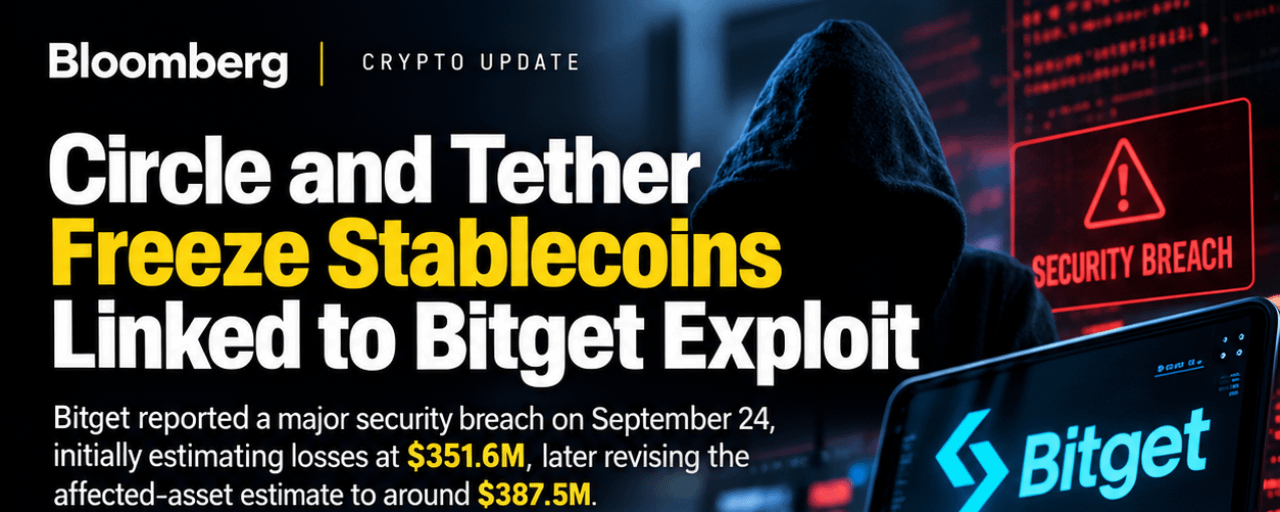
Bitget reported the exploit on September 24, initially estimating losses at $351.6 million, before revising the affected-asset estimate to around $387.5 million.
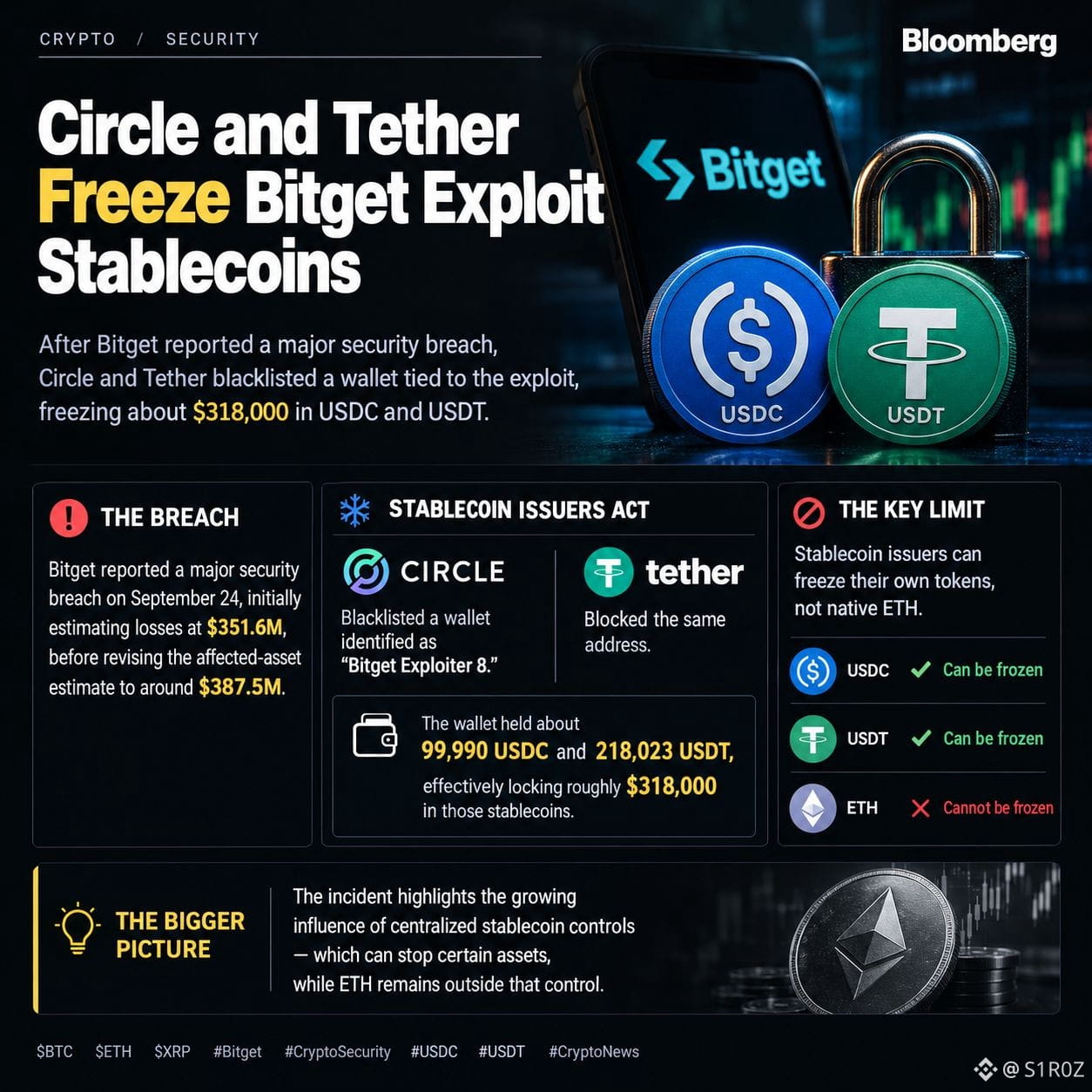
Following the incident, Circle and Tether moved to freeze stablecoins linked to one of the wallets identified in the exploit.
Circle blacklisted an address labeled “Bitget Exploiter 8,” while Tether blocked the same wallet. The address reportedly held around 99,990 USDC and 218,023 USDT, putting roughly $318,000 worth of those stablecoins under issuer control.
But there’s an important distinction here.
Circle can freeze USDC, and Tether can freeze USDT. They cannot apply the same issuer-level freeze to native ETH, because ETH is not issued or controlled by either company.
For traders, this is a useful reminder of the trade-off built into centralized stablecoins. Their issuer controls can help respond to stolen funds, but those controls don't extend across an entire blockchain or every asset involved in an exploit.
The bigger question now is how much of the affected assets can still be traced, frozen, or recovered as the investigation develops.
$BTC $ETH $XRP
#Bitget #CryptoSecurity #USDC #USDT #CryptoNews
Circle and Tether Freeze $318K in Stablecoins Linked to Bitget Exploit
#circletetherfreezebitgethackerwallet
The Bitget security breach is highlighting one of the key differences between stablecoins and native crypto assets: issuer-level control.
Bitget reported the exploit on September 24, initially estimating losses at $351.6 million, before revising the affected-asset estimate to around $387.5 million.
Following the incident, Circle and Tether moved to freeze stablecoins linked to one of the wallets identified in the exploit.
Circle blacklisted an address labeled “Bitget Exploiter 8,” while Tether blocked the same wallet. The address reportedly held around 99,990 USDC and 218,023 USDT, putting roughly $318,000 worth of those stablecoins under issuer control.
But there’s an important distinction here.
Circle can freeze USDC, and Tether can freeze USDT. They cannot apply the same issuer-level freeze to native ETH, because ETH is not issued or controlled by either company.
For traders, this is a useful reminder of the trade-off built into centralized stablecoins. Their issuer controls can help respond to stolen funds, but those controls don't extend across an entire blockchain or every asset involved in an exploit.
The bigger question now is how much of the affected assets can still be traced, frozen, or recovered as the investigation develops.
$BTC $ETH $XRP
#Bitget #CryptoSecurity #USDC #USDT #CryptoNews
The Bitget security breach is highlighting one of the key differences between stablecoins and native crypto assets: issuer-level control.
Bitget reported the exploit on September 24, initially estimating losses at $351.6 million, before revising the affected-asset estimate to around $387.5 million.
Following the incident, Circle and Tether moved to freeze stablecoins linked to one of the wallets identified in the exploit.
Circle blacklisted an address labeled “Bitget Exploiter 8,” while Tether blocked the same wallet. The address reportedly held around 99,990 USDC and 218,023 USDT, putting roughly $318,000 worth of those stablecoins under issuer control.
But there’s an important distinction here.
Circle can freeze USDC, and Tether can freeze USDT. They cannot apply the same issuer-level freeze to native ETH, because ETH is not issued or controlled by either company.
For traders, this is a useful reminder of the trade-off built into centralized stablecoins. Their issuer controls can help respond to stolen funds, but those controls don't extend across an entire blockchain or every asset involved in an exploit.
The bigger question now is how much of the affected assets can still be traced, frozen, or recovered as the investigation develops.
$BTC $ETH $XRP
#Bitget #CryptoSecurity #USDC #USDT #CryptoNews
3
·
--
#circletetherfreezebitgethackerwallet
🚨 CircleとTetherは、Bitgetのエクスプロイトに紐づくステーブルコインを凍結しました。
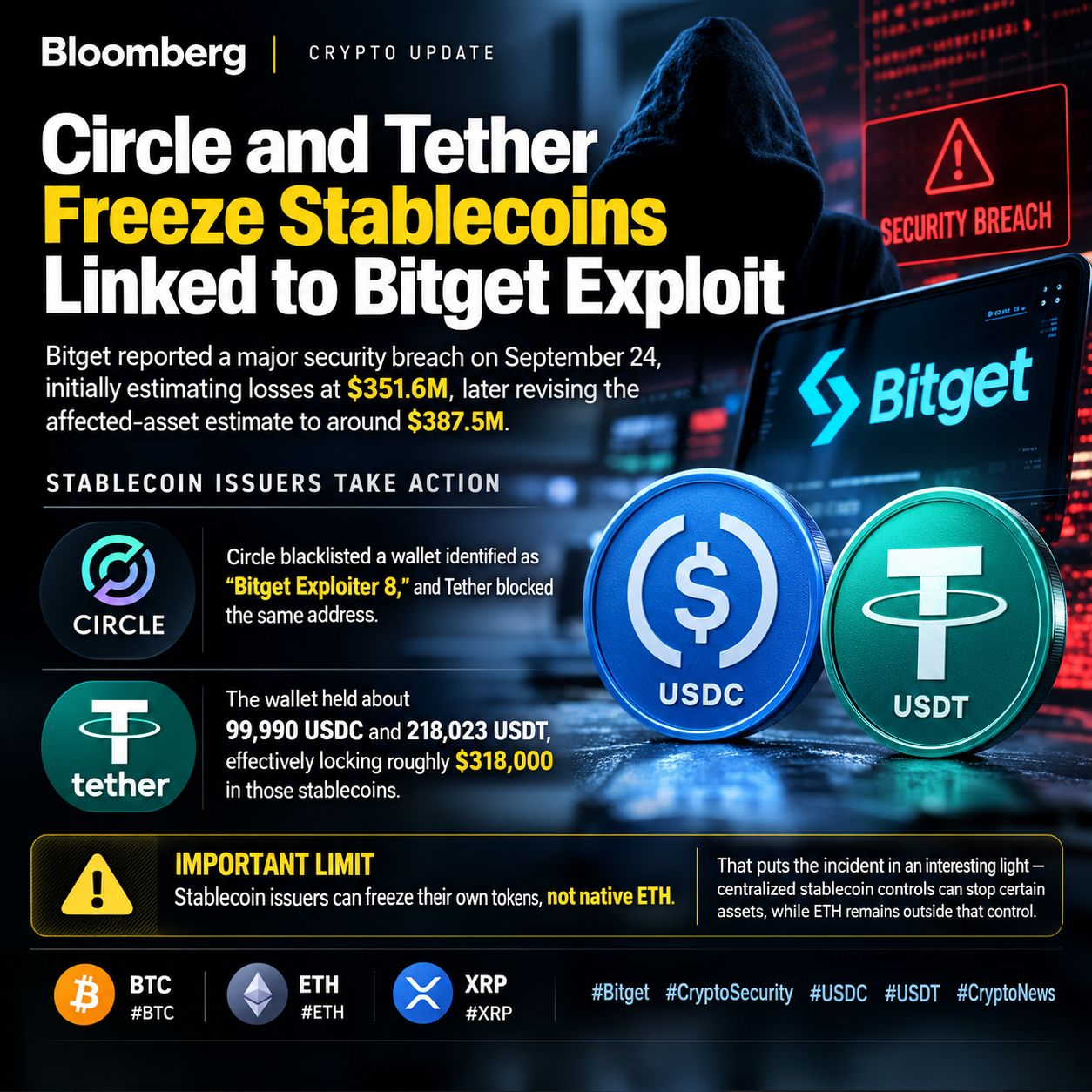
Bitgetは9月24日に重大なセキュリティ侵害を報告し、当初は損失を3億5,160万ドルと見積もった後、影響を受けた資産の推定額を約3億8,750万ドルに修正しました。
その後、2つのステーブルコイン発行者が対応しました。
Circleは「Bitget Exploiter 8」と特定されたウォレットをブラックリストに登録し、Tetherも同じアドレスをブロックしました。このウォレットには約99,990 USDCと218,023 USDTが保管されており、事実上、それらのステーブルコインで約31.8万ドルがロックされた形です。
しかし重要な制限があります。ステーブルコイン発行者は自分のトークンのみを凍結でき、ネイティブのETHは凍結できません。
このため、今回の出来事は興味深い様相を呈しています――集中型のステーブルコイン管理は特定の資産を止められる一方で、ETHはその管理の外にあります。
$BTC
{spot}(BTCUSDT)
$ETH
{spot}(ETHUSDT)
$XRP
{spot}(XRPUSDT)
#Bitget #CryptoSecurity #USDC #USDT #CryptoNews
#circletetherfreezebitgethackerwallet
🚨 CircleとTetherは、Bitgetのエクスプロイトに紐づくステーブルコインを凍結しました。
Bitgetは9月24日に重大なセキュリティ侵害を報告し、当初は損失を3億5,160万ドルと見積もった後、影響を受けた資産の推定額を約3億8,750万ドルに修正しました。
その後、2つのステーブルコイン発行者が対応しました。
Circleは「Bitget Exploiter 8」と特定されたウォレットをブラックリストに登録し、Tetherも同じアドレスをブロックしました。このウォレットには約99,990 USDCと218,023 USDTが保管されており、事実上、それらのステーブルコインで約31.8万ドルがロックされた形です。
しかし重要な制限があります。ステーブルコイン発行者は自分のトークンのみを凍結でき、ネイティブのETHは凍結できません。
このため、今回の出来事は興味深い様相を呈しています――集中型のステーブルコイン管理は特定の資産を止められる一方で、ETHはその管理の外にあります。
$BTC
$ETH
$XRP
#Bitget #CryptoSecurity #USDC #USDT #CryptoNews
🚨 CircleとTetherは、Bitgetのエクスプロイトに紐づくステーブルコインを凍結しました。
Bitgetは9月24日に重大なセキュリティ侵害を報告し、当初は損失を3億5,160万ドルと見積もった後、影響を受けた資産の推定額を約3億8,750万ドルに修正しました。
その後、2つのステーブルコイン発行者が対応しました。
Circleは「Bitget Exploiter 8」と特定されたウォレットをブラックリストに登録し、Tetherも同じアドレスをブロックしました。このウォレットには約99,990 USDCと218,023 USDTが保管されており、事実上、それらのステーブルコインで約31.8万ドルがロックされた形です。
しかし重要な制限があります。ステーブルコイン発行者は自分のトークンのみを凍結でき、ネイティブのETHは凍結できません。
このため、今回の出来事は興味深い様相を呈しています――集中型のステーブルコイン管理は特定の資産を止められる一方で、ETHはその管理の外にあります。
$BTC
$ETH
$XRP
#Bitget #CryptoSecurity #USDC #USDT #CryptoNews
1
311
ログインして、さらにコンテンツを読む
厳選トピックで世界の暗号資産トレーダーの仲間入り
⚡️ 暗号資産に関する最新かつ有益な情報が見つかります。
💬 世界最大の暗号資産取引所から信頼されています。
👍 認証を受けたクリエイターから、有益なインサイトを得られます。
メール / 電話番号
トレンドトピック
BitwiseFilesFinalNEARSpotETFProspectus
閲覧回数 19,816
597人が討論中
#bitwisefilesfinalnearspotetfprospectus 🚀
NEARトークンは$562.$NEAR に到達できますか?
ビットワイズは、NYSEアーカのティッカー「NRR」で上場する現物NEAR ETFを準備しています。マネージャーはすでに、$155、あるいは2030年までに$562といった目標について議論していました。$RESOLV $DASH
Rajo C
·いいね:5件
·閲覧回数 3.3k
BitgetHackerMoves$83MStolenXRP
閲覧回数 16,812
106人が討論中
SOLSpotETFWeeklyInflow$188M
閲覧回数 8,111
79人が討論中