
mikeskcv
28 Publications

mikeskcv
Signaler
Bloquer l’utilisateur
5 Suivis
1 Abonnés
10 J’aime
Publications
·
--
Les taux des banques centrales sont de nouveau dans l’actualité, et il est intéressant d’observer la façon dont les actifs traditionnels y réagissent. La TradFi sur Binance est pratique en ce sens qu’il n’est pas nécessaire de garder ouverts cinq onglets avec différentes bourses : tout est au même endroit, et l’image du marché se met en place plus vite.
#TradFi #Binance #CreateWithBinance #ринок
Les taux des banques centrales sont de nouveau dans l’actualité, et il est intéressant d’observer la façon dont les actifs traditionnels y réagissent. La TradFi sur Binance est pratique en ce sens qu’il n’est pas nécessaire de garder ouverts cinq onglets avec différentes bourses : tout est au même endroit, et l’image du marché se met en place plus vite.
#TradFi #Binance #CreateWithBinance #ринок
#TradFi #Binance #CreateWithBinance #ринок
114
·
--
J’ai essayé bStocks cette semaine. J’ai acheté une petite part d’Apple — l’ordre a été validé plus rapidement qu’avec un courtier classique, et la commission m’a agréablement surpris. Pour l’instant, c’est positif.
#bStocks #Binance #CreateWithBinance #інвестиції
J’ai essayé bStocks cette semaine. J’ai acheté une petite part d’Apple — l’ordre a été validé plus rapidement qu’avec un courtier classique, et la commission m’a agréablement surpris. Pour l’instant, c’est positif.
#bStocks #Binance #CreateWithBinance #інвестиції
#bStocks #Binance #CreateWithBinance #інвестиції
181
·
--
Voir la traduction
#termmax @termmax
What if the most interesting part of DeFi lending isn't the yield?
But who gets to choose the terms?
That's what I find interesting about TermMax.
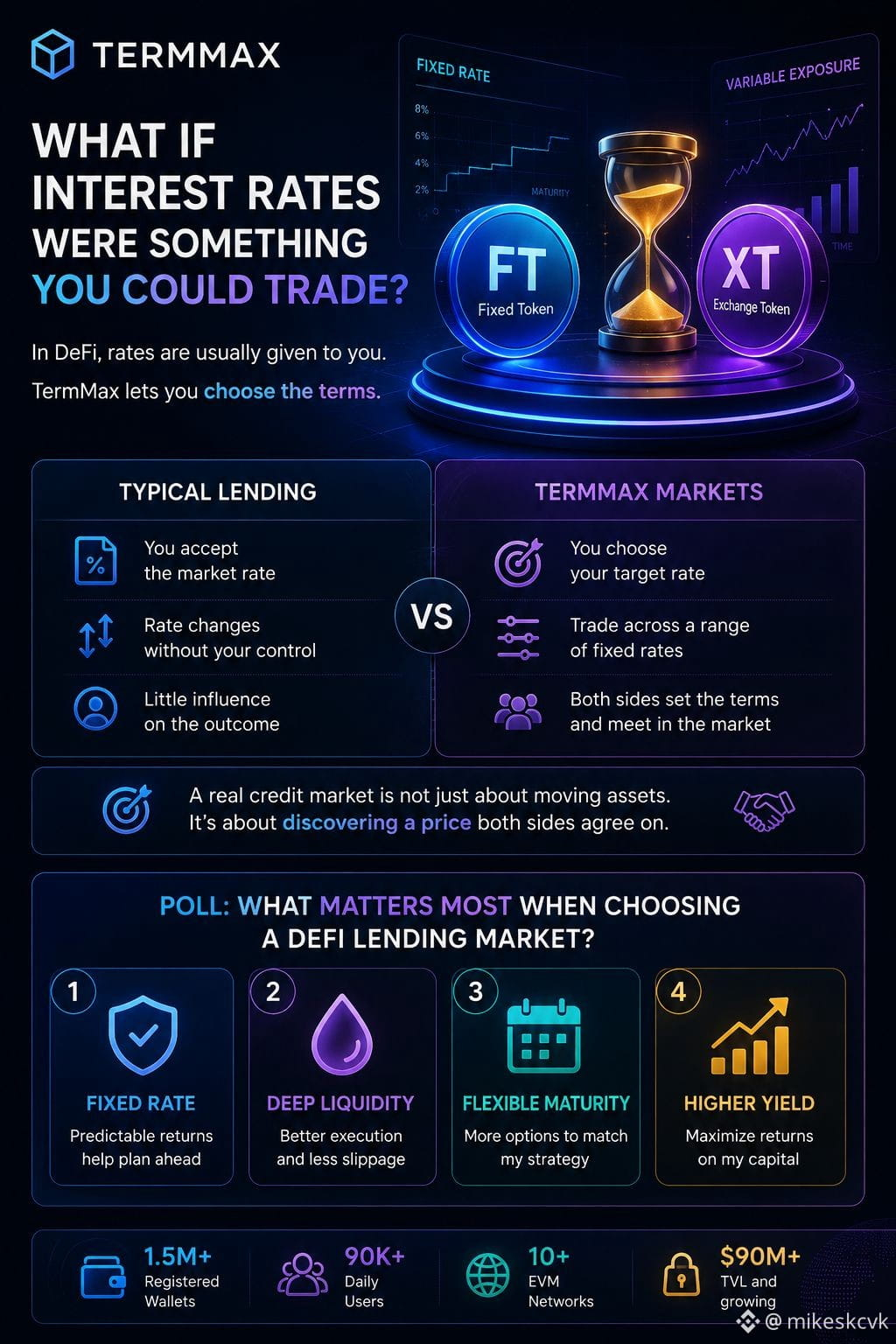
In a typical lending market, you mostly accept whatever rate the market is giving you.
But fixed-rate markets introduce another possibility.
A borrower can think:
“At what rate does this loan actually make sense for
me?”
And a lender can think:
“At what return am I comfortable locking my capital?”
Now the interest rate isn't just a number on a dashboard.
It's part of the negotiation.
That changes how I look at on-chain credit.
Because a real financial market isn't only about moving assets from A to B.
It's about discovering a price that both sides are willing to accept.
TermMax is experimenting with that idea on-chain.
And honestly, I think this is a more interesting question than chasing the highest APY:
Can DeFi create efficient markets for the price of time and capital?
That's what I'll be watching.
#termmax @TermMax
What if the most interesting part of DeFi lending isn't the yield?
But who gets to choose the terms?
That's what I find interesting about TermMax.
In a typical lending market, you mostly accept whatever rate the market is giving you.
But fixed-rate markets introduce another possibility.
A borrower can think:
“At what rate does this loan actually make sense for
me?”
And a lender can think:
“At what return am I comfortable locking my capital?”
Now the interest rate isn't just a number on a dashboard.
It's part of the negotiation.
That changes how I look at on-chain credit.
Because a real financial market isn't only about moving assets from A to B.
It's about discovering a price that both sides are willing to accept.
TermMax is experimenting with that idea on-chain.
And honestly, I think this is a more interesting question than chasing the highest APY:
Can DeFi create efficient markets for the price of time and capital?
That's what I'll be watching.
What if the most interesting part of DeFi lending isn't the yield?
But who gets to choose the terms?
That's what I find interesting about TermMax.
In a typical lending market, you mostly accept whatever rate the market is giving you.
But fixed-rate markets introduce another possibility.
A borrower can think:
“At what rate does this loan actually make sense for
me?”
And a lender can think:
“At what return am I comfortable locking my capital?”
Now the interest rate isn't just a number on a dashboard.
It's part of the negotiation.
That changes how I look at on-chain credit.
Because a real financial market isn't only about moving assets from A to B.
It's about discovering a price that both sides are willing to accept.
TermMax is experimenting with that idea on-chain.
And honestly, I think this is a more interesting question than chasing the highest APY:
Can DeFi create efficient markets for the price of time and capital?
That's what I'll be watching.
88
·
--
Voir la traduction
#termmax @termmax
The most interesting TermMax update isn't the $TMX TGE.
It's something much less exciting at first glance:
App V2.
Why?
Because DeFi has a fragmentation problem.
One chain for this position.
Another chain for that vault.
Different interfaces.
Different orders.
Different liquidity.
You can have a great protocol and still make the user experience feel like managing five different accounts.
TermMax V2 is moving in the opposite direction.
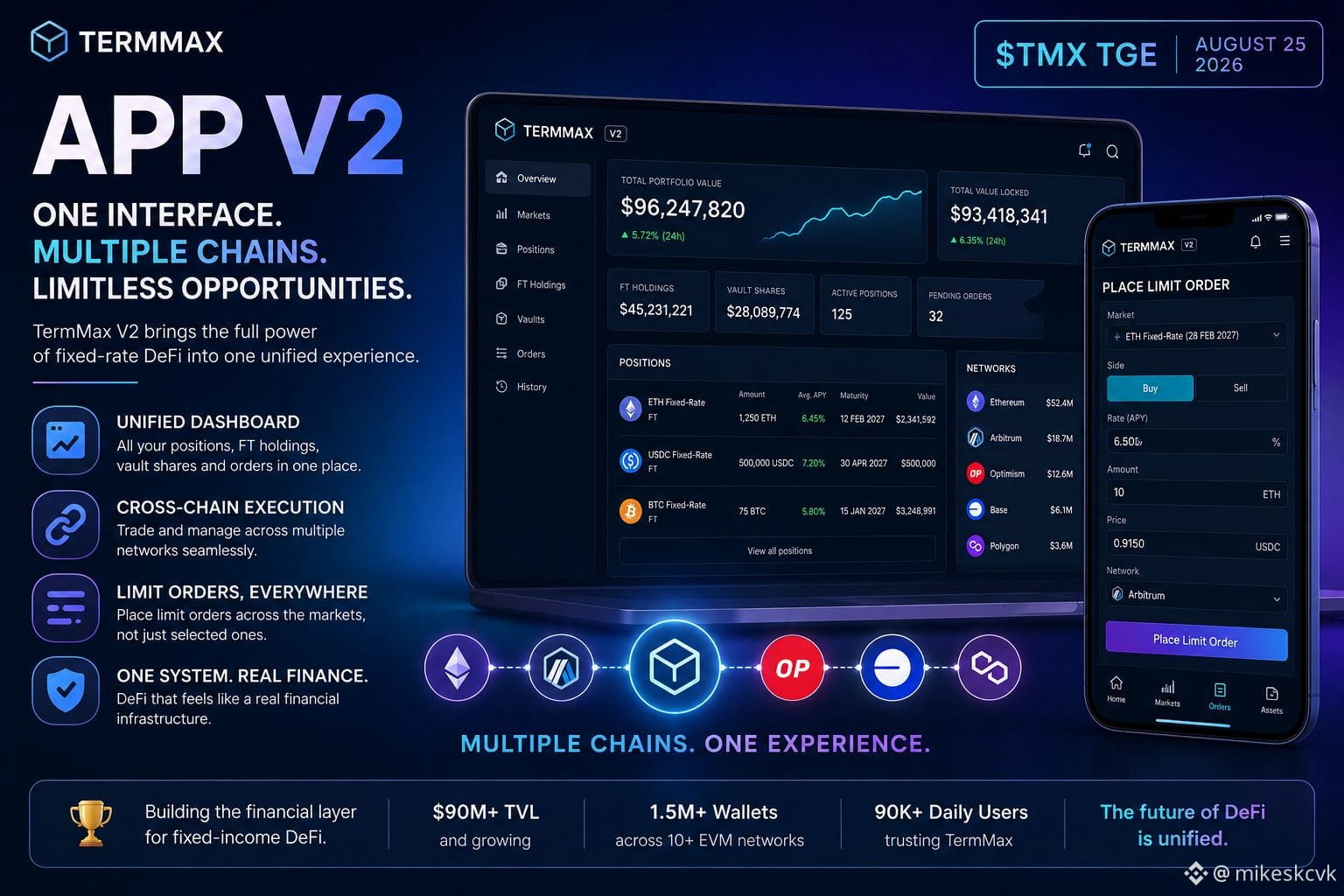
One interface for multiple chains.
One dashboard for positions, FT holdings, vault shares and orders.
And limit orders across the markets instead of restricting them to selected ones.
That might sound like a UX improvement.
I think it's more important than that.
If fixed-rate DeFi is supposed to become actual financial infrastructure, users shouldn't have to think about the underlying chain every time they make a transaction.
The chain should become the infrastructure.
The product should be the market.
And this is where TermMax gets interesting to me.
The next stage of DeFi may not be about adding more protocols.
It may be about making the protocols we already have feel like one financial system.
$TMX TGE is coming on August 25.
But I'm more interested in what happens after the infrastructure is already built.
#termmax @TermMax
The most interesting TermMax update isn't the $TMX TGE.
It's something much less exciting at first glance:
App V2.
Why?
Because DeFi has a fragmentation problem.
One chain for this position.
Another chain for that vault.
Different interfaces.
Different orders.
Different liquidity.
You can have a great protocol and still make the user experience feel like managing five different accounts.
TermMax V2 is moving in the opposite direction.
One interface for multiple chains.
One dashboard for positions, FT holdings, vault shares and orders.
And limit orders across the markets instead of restricting them to selected ones.
That might sound like a UX improvement.
I think it's more important than that.
If fixed-rate DeFi is supposed to become actual financial infrastructure, users shouldn't have to think about the underlying chain every time they make a transaction.
The chain should become the infrastructure.
The product should be the market.
And this is where TermMax gets interesting to me.
The next stage of DeFi may not be about adding more protocols.
It may be about making the protocols we already have feel like one financial system.
$TMX TGE is coming on August 25.
But I'm more interested in what happens after the infrastructure is already built.
The most interesting TermMax update isn't the $TMX TGE.
It's something much less exciting at first glance:
App V2.
Why?
Because DeFi has a fragmentation problem.
One chain for this position.
Another chain for that vault.
Different interfaces.
Different orders.
Different liquidity.
You can have a great protocol and still make the user experience feel like managing five different accounts.
TermMax V2 is moving in the opposite direction.
One interface for multiple chains.
One dashboard for positions, FT holdings, vault shares and orders.
And limit orders across the markets instead of restricting them to selected ones.
That might sound like a UX improvement.
I think it's more important than that.
If fixed-rate DeFi is supposed to become actual financial infrastructure, users shouldn't have to think about the underlying chain every time they make a transaction.
The chain should become the infrastructure.
The product should be the market.
And this is where TermMax gets interesting to me.
The next stage of DeFi may not be about adding more protocols.
It may be about making the protocols we already have feel like one financial system.
$TMX TGE is coming on August 25.
But I'm more interested in what happens after the infrastructure is already built.
1
82
·
--
Haussier
Voir la traduction
#termmax @termmax
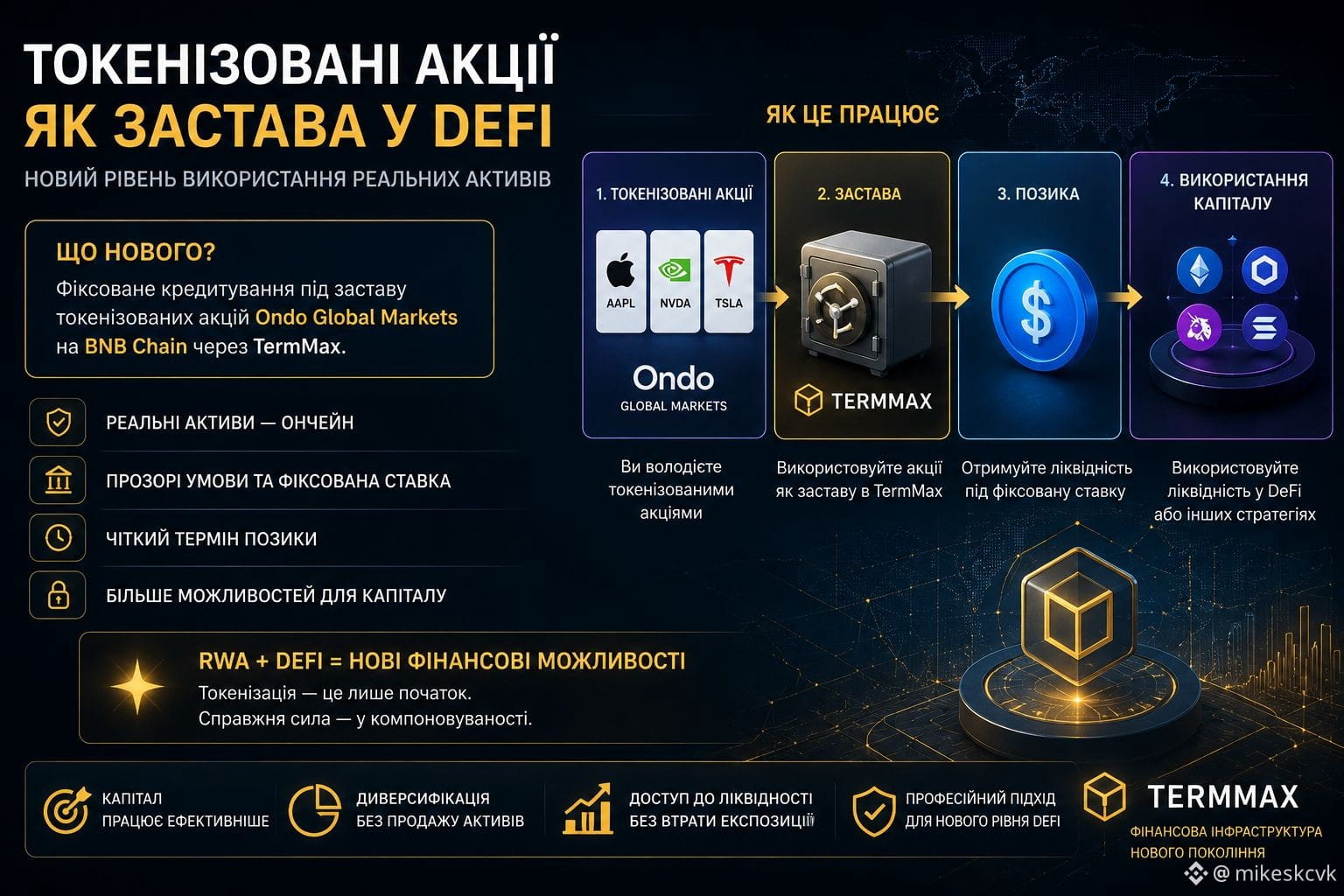
Більшість людей дивляться на токенізовані акції як на спосіб отримати доступ до традиційних ринків через блокчейн.
Але мені цікавіше інше питання.
Що, якщо такі активи можуть не просто лежати в портфелі?
Що, якщо вони можуть працювати як фінансовий інструмент?
Саме тут стає цікаво.
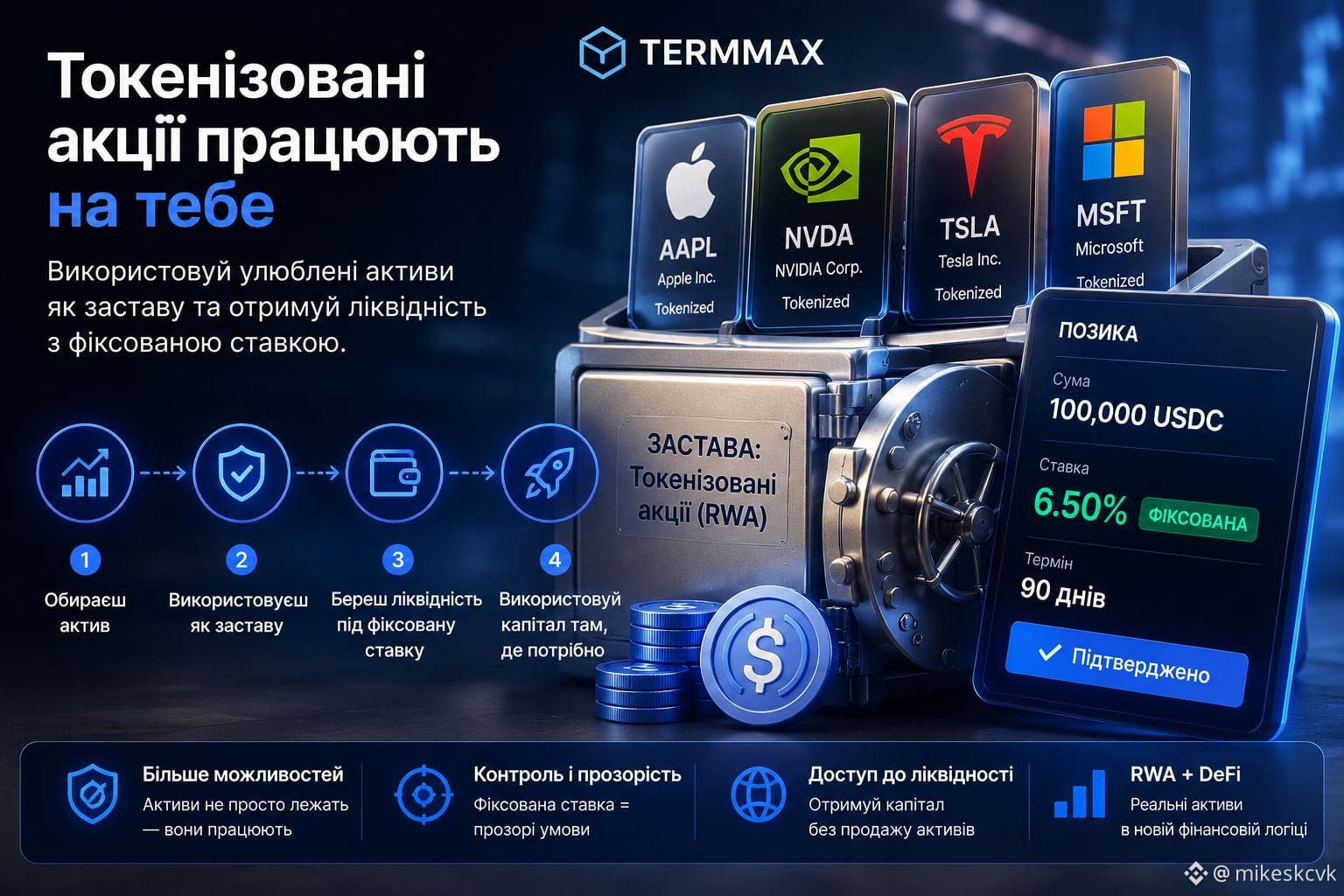
TermMax дозволяє використовувати токенізовані акції як заставу для отримання ліквідності під фіксовану ставку.
Тобто актив не просто відображає ціну акції.
Він стає частиною DeFi-екосистеми.
У результаті з'являється нова логіка:
📈 Тримаєш токенізовані акції
🔒 Використовуєш їх як заставу
💵 Отримуєш ліквідність
🚀 Використовуєш капітал в інших стратегіях
На мою думку, саме тут прихований справжній потенціал RWA.
Не в самій токенізації.
А в тому, що реальні активи починають взаємодіяти з DeFi так само гнучко, як криптоактиви.
І що більше таких сценаріїв з'являтиметься, то цікавішою ставатиме вся екосистема.
Токенізація — це лише перший крок.
Справжня цінність починається тоді, коли активи можна використовувати по-новому.
#termmax @TermMax
Більшість людей дивляться на токенізовані акції як на спосіб отримати доступ до традиційних ринків через блокчейн.
Але мені цікавіше інше питання.
Що, якщо такі активи можуть не просто лежати в портфелі?
Що, якщо вони можуть працювати як фінансовий інструмент?
Саме тут стає цікаво.
TermMax дозволяє використовувати токенізовані акції як заставу для отримання ліквідності під фіксовану ставку.
Тобто актив не просто відображає ціну акції.
Він стає частиною DeFi-екосистеми.
У результаті з'являється нова логіка:
📈 Тримаєш токенізовані акції
🔒 Використовуєш їх як заставу
💵 Отримуєш ліквідність
🚀 Використовуєш капітал в інших стратегіях
На мою думку, саме тут прихований справжній потенціал RWA.
Не в самій токенізації.
А в тому, що реальні активи починають взаємодіяти з DeFi так само гнучко, як криптоактиви.
І що більше таких сценаріїв з'являтиметься, то цікавішою ставатиме вся екосистема.
Токенізація — це лише перший крок.
Справжня цінність починається тоді, коли активи можна використовувати по-новому.
Більшість людей дивляться на токенізовані акції як на спосіб отримати доступ до традиційних ринків через блокчейн.
Але мені цікавіше інше питання.
Що, якщо такі активи можуть не просто лежати в портфелі?
Що, якщо вони можуть працювати як фінансовий інструмент?
Саме тут стає цікаво.
TermMax дозволяє використовувати токенізовані акції як заставу для отримання ліквідності під фіксовану ставку.
Тобто актив не просто відображає ціну акції.
Він стає частиною DeFi-екосистеми.
У результаті з'являється нова логіка:
📈 Тримаєш токенізовані акції
🔒 Використовуєш їх як заставу
💵 Отримуєш ліквідність
🚀 Використовуєш капітал в інших стратегіях
На мою думку, саме тут прихований справжній потенціал RWA.
Не в самій токенізації.
А в тому, що реальні активи починають взаємодіяти з DeFi так само гнучко, як криптоактиви.
І що більше таких сценаріїв з'являтиметься, то цікавішою ставатиме вся екосистема.
Токенізація — це лише перший крок.
Справжня цінність починається тоді, коли активи можна використовувати по-новому.
138
·
--
Voir la traduction
Most people look at a lending protocol and ask:
“What's the APY?”
I think that's only half the story.
The other half is what happens to your capital while you're earning that APY.
Can you predict when the position ends?
Do you know exactly what you're lending into?
Can you build a strategy around a specific maturity?
That's the part of TermMax I find interesting.
Its approach treats lending more like an actual financial instrument: the position has defined terms and a maturity instead of being just another deposit sitting in a pool.
And this matters beyond retail DeFi.
If on-chain credit is ever going to attract serious capital, investors will need more than attractive yields.
They'll need products they can understand, price and plan around.
Maybe DeFi's next upgrade isn't another way to chase yield.
Maybe it's making lending feel more like a real financial market.
That's a much more interesting direction to me.
#termmax @termmax
Quick DeFi poll 👇
When you choose a lending opportunity, what do you care about MOST?
Most people look at a lending protocol and ask:
“What's the APY?”
I think that's only half the story.
The other half is what happens to your capital while you're earning that APY.
Can you predict when the position ends?
Do you know exactly what you're lending into?
Can you build a strategy around a specific maturity?
That's the part of TermMax I find interesting.
Its approach treats lending more like an actual financial instrument: the position has defined terms and a maturity instead of being just another deposit sitting in a pool.
And this matters beyond retail DeFi.
If on-chain credit is ever going to attract serious capital, investors will need more than attractive yields.
They'll need products they can understand, price and plan around.
Maybe DeFi's next upgrade isn't another way to chase yield.
Maybe it's making lending feel more like a real financial market.
That's a much more interesting direction to me.
#termmax @TermMax
Quick DeFi poll 👇
When you choose a lending opportunity, what do you care about MOST?
“What's the APY?”
I think that's only half the story.
The other half is what happens to your capital while you're earning that APY.
Can you predict when the position ends?
Do you know exactly what you're lending into?
Can you build a strategy around a specific maturity?
That's the part of TermMax I find interesting.
Its approach treats lending more like an actual financial instrument: the position has defined terms and a maturity instead of being just another deposit sitting in a pool.
And this matters beyond retail DeFi.
If on-chain credit is ever going to attract serious capital, investors will need more than attractive yields.
They'll need products they can understand, price and plan around.
Maybe DeFi's next upgrade isn't another way to chase yield.
Maybe it's making lending feel more like a real financial market.
That's a much more interesting direction to me.
#termmax @TermMax
Quick DeFi poll 👇
When you choose a lending opportunity, what do you care about MOST?
Higher APY
0%
Fixed maturity
0%
Liquidity
0%
Risk / security
0%
0 Votes • Vote fermé
56
·
--
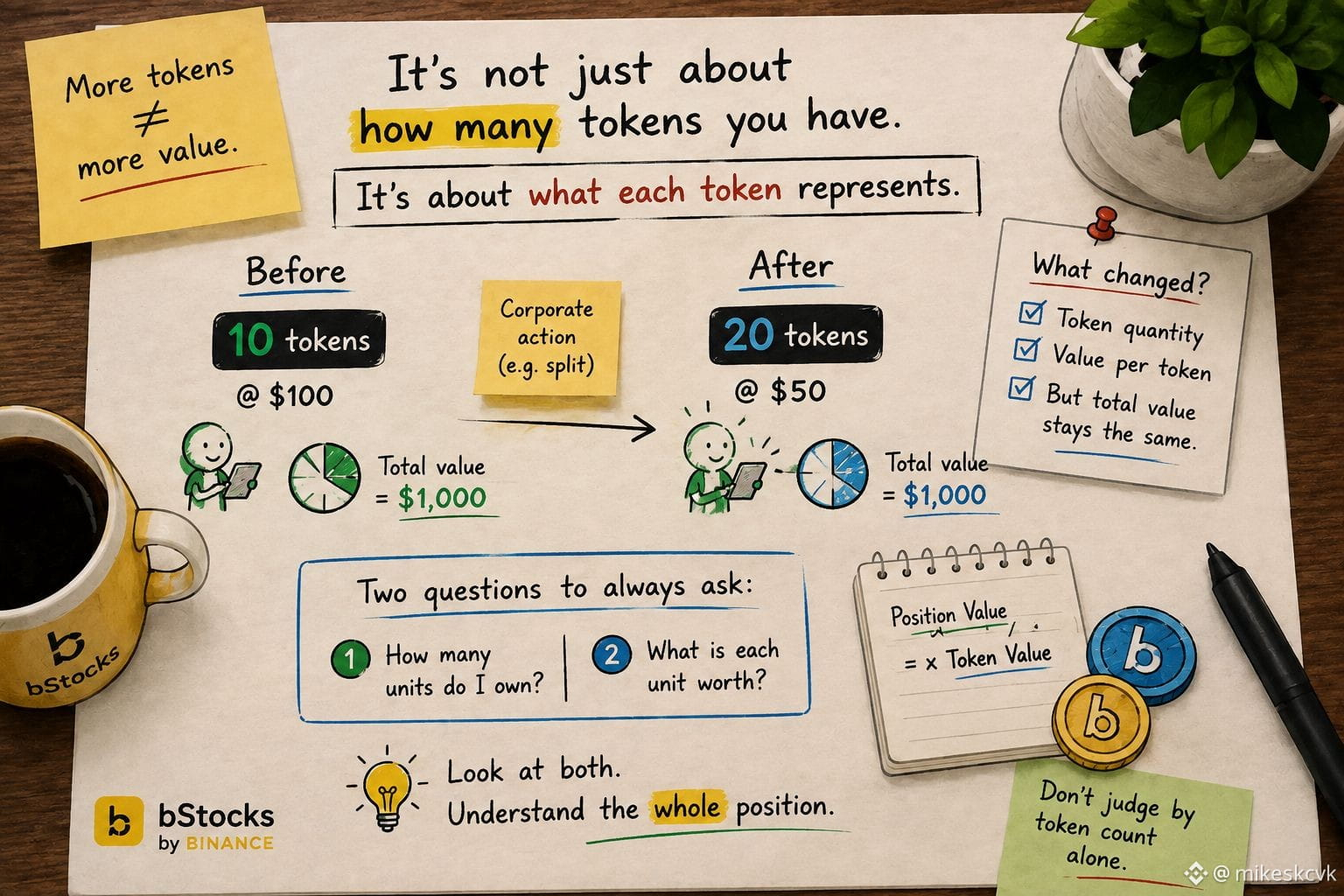
Je pensais autrefois qu’un solde plus élevé signifiait automatiquement une position plus importante.
Puis j’ai commencé à prêter davantage attention à ce que représente réellement une seule unité.
Imaginez que j’aie 10 tokens.
Plus tard, je regarde à nouveau et je vois 20.
Ma première réaction serait probablement :
« Super. J’ai doublé ma position. »
Mais cette conclusion peut être totalement fausse.
Si une opération sur titres modifie la structure de l’unité, le nombre de tokens peut changer tout en ajustant en même temps l’exposition économique.
Ainsi, le solde à lui seul ne suffit pas.
Aujourd’hui, je le considère comme deux questions distinctes :
Combien d’unités est-ce que je possède ?
et
Combien vaut chaque unité ?
Ces deux chiffres doivent être examinés ensemble.
Sinon, un simple changement de quantité peut créer une impression très trompeuse.
C’est la même raison pour laquelle je ne juge pas une entreprise uniquement par le nombre de ses actions.
Plus d’actions ne veut pas forcément dire plus de valeur.
L’unité compte.
Le prix compte.
Et la relation entre les deux compte encore plus.
C’est un petit détail, mais c’est exactement le genre de détail qui peut rendre un actif tokenisé déroutant alors qu’aucune situation inhabituelle n’est en réalité survenue dans la position économique sous-jacente.
Vous vérifiez d’abord la quantité de tokens, ou d’abord la valeur totale de la position ?
#bstockscis @BinanceCIS
Je pensais autrefois qu’un solde plus élevé signifiait automatiquement une position plus importante.
Puis j’ai commencé à prêter davantage attention à ce que représente réellement une seule unité.
Imaginez que j’aie 10 tokens.
Plus tard, je regarde à nouveau et je vois 20.
Ma première réaction serait probablement :
« Super. J’ai doublé ma position. »
Mais cette conclusion peut être totalement fausse.
Si une opération sur titres modifie la structure de l’unité, le nombre de tokens peut changer tout en ajustant en même temps l’exposition économique.
Ainsi, le solde à lui seul ne suffit pas.
Aujourd’hui, je le considère comme deux questions distinctes :
Combien d’unités est-ce que je possède ?
et
Combien vaut chaque unité ?
Ces deux chiffres doivent être examinés ensemble.
Sinon, un simple changement de quantité peut créer une impression très trompeuse.
C’est la même raison pour laquelle je ne juge pas une entreprise uniquement par le nombre de ses actions.
Plus d’actions ne veut pas forcément dire plus de valeur.
L’unité compte.
Le prix compte.
Et la relation entre les deux compte encore plus.
C’est un petit détail, mais c’est exactement le genre de détail qui peut rendre un actif tokenisé déroutant alors qu’aucune situation inhabituelle n’est en réalité survenue dans la position économique sous-jacente.
Vous vérifiez d’abord la quantité de tokens, ou d’abord la valeur totale de la position ?
#bstockscis @BinanceCIS
Puis j’ai commencé à prêter davantage attention à ce que représente réellement une seule unité.
Imaginez que j’aie 10 tokens.
Plus tard, je regarde à nouveau et je vois 20.
Ma première réaction serait probablement :
« Super. J’ai doublé ma position. »
Mais cette conclusion peut être totalement fausse.
Si une opération sur titres modifie la structure de l’unité, le nombre de tokens peut changer tout en ajustant en même temps l’exposition économique.
Ainsi, le solde à lui seul ne suffit pas.
Aujourd’hui, je le considère comme deux questions distinctes :
Combien d’unités est-ce que je possède ?
et
Combien vaut chaque unité ?
Ces deux chiffres doivent être examinés ensemble.
Sinon, un simple changement de quantité peut créer une impression très trompeuse.
C’est la même raison pour laquelle je ne juge pas une entreprise uniquement par le nombre de ses actions.
Plus d’actions ne veut pas forcément dire plus de valeur.
L’unité compte.
Le prix compte.
Et la relation entre les deux compte encore plus.
C’est un petit détail, mais c’est exactement le genre de détail qui peut rendre un actif tokenisé déroutant alors qu’aucune situation inhabituelle n’est en réalité survenue dans la position économique sous-jacente.
Vous vérifiez d’abord la quantité de tokens, ou d’abord la valeur totale de la position ?
#bstockscis @BinanceCIS
1
1
99
·
--
Voir la traduction
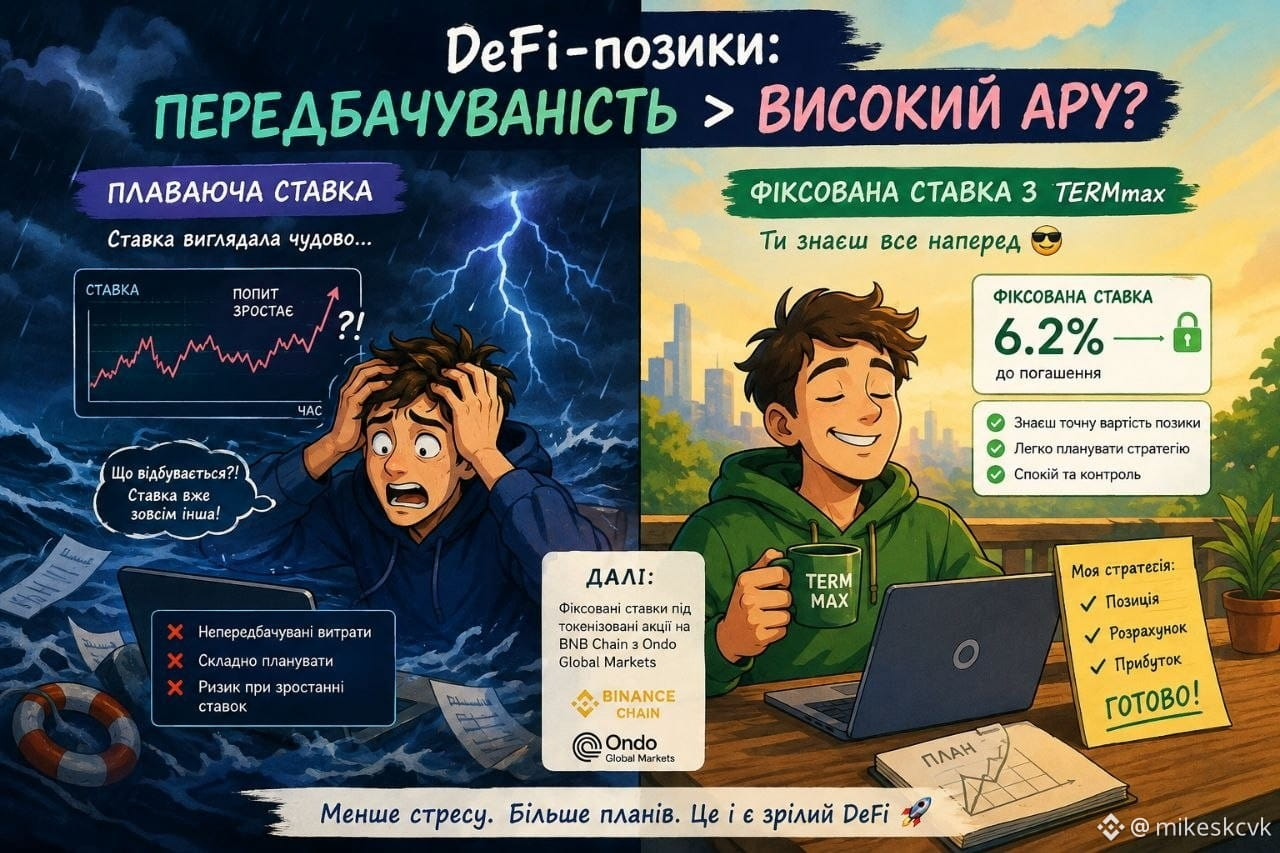
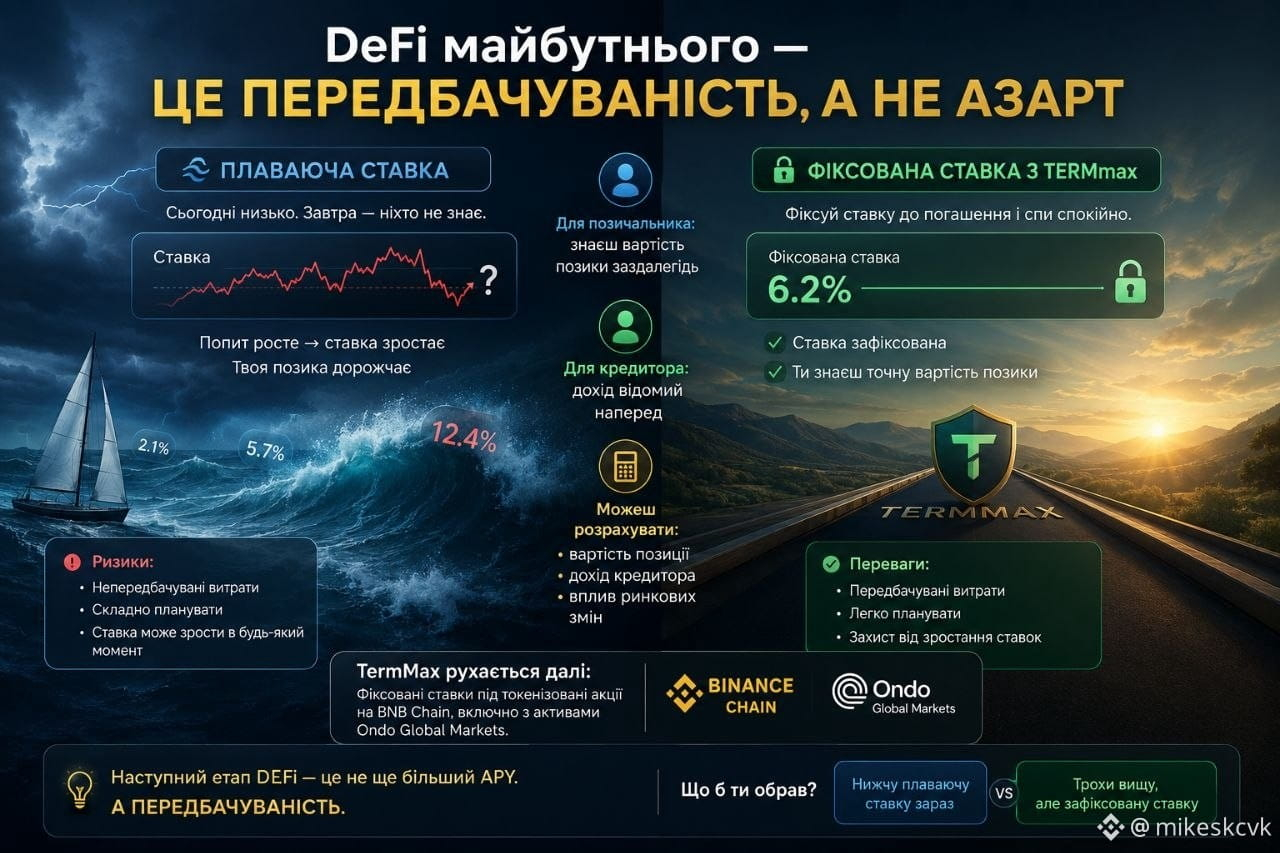
DeFi привчив нас до плаваючих ставок.
Поки тобі не знадобиться позика на кілька місяців.
Сьогодні ставка вигідна. Завтра через зміну попиту чи ліквідності вартість позики вже інша.
Саме тому мені цікавий TermMax.
Тут можна зафіксувати ставку до моменту погашення.
Для позичальника — зрозуміла вартість позики.
Для кредитора — прогнозований дохід.
І це особливо цікаво для більших стратегій, де важливо заздалегідь знати вартість капіталу.
Ще цікавіше, що TermMax рухається у бік RWA. Команда вже інтегрувала fixed-rate borrowing під токенізовані акції на BNB Chain.
Можливо, наступний етап DeFi — не максимальний APY.
А передбачуваність.
Що оберете: нижчу плаваючу ставку чи трохи вищу, але зафіксовану?
#termmax @termmax
DeFi привчив нас до плаваючих ставок.
Поки тобі не знадобиться позика на кілька місяців.
Сьогодні ставка вигідна. Завтра через зміну попиту чи ліквідності вартість позики вже інша.
Саме тому мені цікавий TermMax.
Тут можна зафіксувати ставку до моменту погашення.
Для позичальника — зрозуміла вартість позики.
Для кредитора — прогнозований дохід.
І це особливо цікаво для більших стратегій, де важливо заздалегідь знати вартість капіталу.
Ще цікавіше, що TermMax рухається у бік RWA. Команда вже інтегрувала fixed-rate borrowing під токенізовані акції на BNB Chain.
Можливо, наступний етап DeFi — не максимальний APY.
А передбачуваність.
Що оберете: нижчу плаваючу ставку чи трохи вищу, але зафіксовану?
#termmax @TermMax
Поки тобі не знадобиться позика на кілька місяців.
Сьогодні ставка вигідна. Завтра через зміну попиту чи ліквідності вартість позики вже інша.
Саме тому мені цікавий TermMax.
Тут можна зафіксувати ставку до моменту погашення.
Для позичальника — зрозуміла вартість позики.
Для кредитора — прогнозований дохід.
І це особливо цікаво для більших стратегій, де важливо заздалегідь знати вартість капіталу.
Ще цікавіше, що TermMax рухається у бік RWA. Команда вже інтегрувала fixed-rate borrowing під токенізовані акції на BNB Chain.
Можливо, наступний етап DeFi — не максимальний APY.
А передбачуваність.
Що оберете: нижчу плаваючу ставку чи трохи вищу, але зафіксовану?
#termmax @TermMax
131
·
--
Voir la traduction
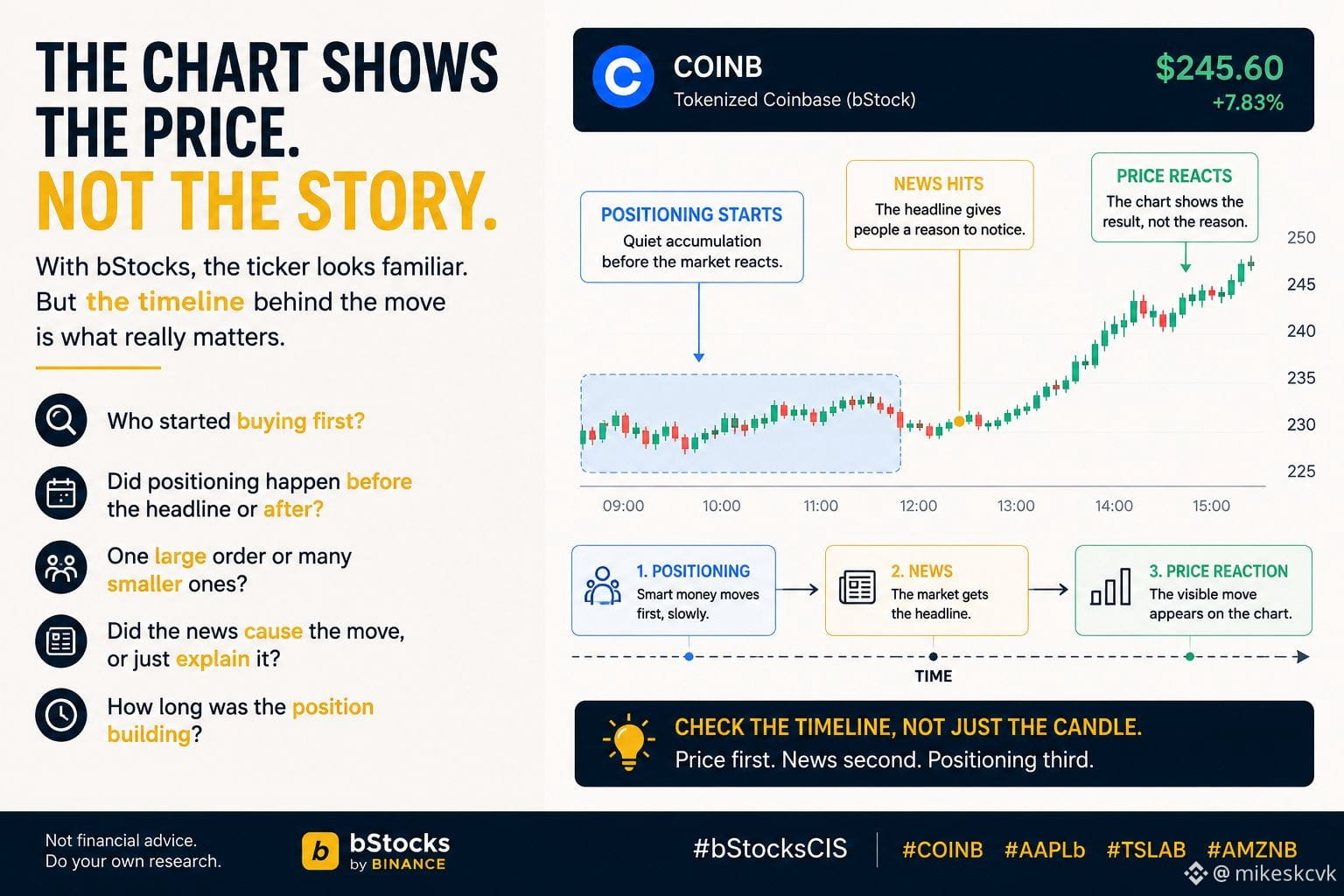
One thing I’ve started paying more attention to with tokenized stocks is the difference between what the chart shows and what actually happened before the chart moved.
Take #COINB as an example.
A sharp green candle can make it look like the market suddenly “decided” that the company was worth more.
But the candle only tells me where the market traded.
It doesn’t tell me: — who started buying first
— how long the position was building
— whether the move came from one large order or many smaller ones
— whether the price reaction happened before or after the headline
— or whether the headline simply gave traders a reason to notice the move.
That last part is easy to miss.
Sometimes the news is the explanation people remember, while the positioning happened much earlier.
And that changes how I read a chart.
Instead of asking:
“Why did #COINB go up today?”
I’d rather ask:
“What was already happening before today?”
For bStocks, I think this distinction is especially useful because the interface can make a traditional stock ticker feel very familiar. The familiar ticker doesn’t mean every piece of market information should be interpreted exactly like a normal brokerage position.
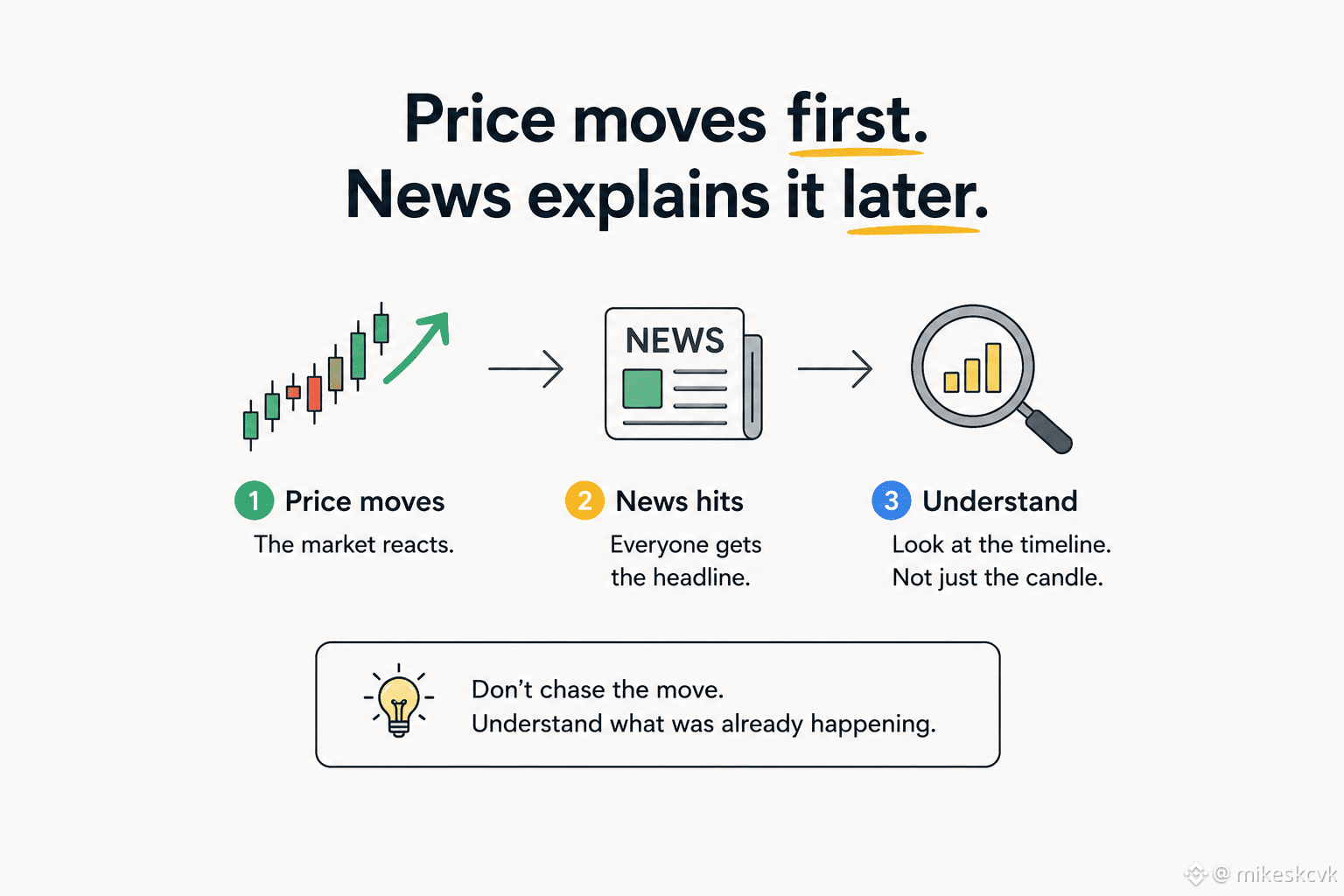
So now, when I see a big move, my first instinct isn’t to chase the candle.
I check the timeline.
Price first.
News second.
Positioning third.
The order matters more than I thought.
#bstockscis @BinanceCIS
One thing I’ve started paying more attention to with tokenized stocks is the difference between what the chart shows and what actually happened before the chart moved.
Take #COINB as an example.
A sharp green candle can make it look like the market suddenly “decided” that the company was worth more.
But the candle only tells me where the market traded.
It doesn’t tell me: — who started buying first
— how long the position was building
— whether the move came from one large order or many smaller ones
— whether the price reaction happened before or after the headline
— or whether the headline simply gave traders a reason to notice the move.
That last part is easy to miss.
Sometimes the news is the explanation people remember, while the positioning happened much earlier.
And that changes how I read a chart.
Instead of asking:
“Why did #COINB go up today?”
I’d rather ask:
“What was already happening before today?”
For bStocks, I think this distinction is especially useful because the interface can make a traditional stock ticker feel very familiar. The familiar ticker doesn’t mean every piece of market information should be interpreted exactly like a normal brokerage position.
So now, when I see a big move, my first instinct isn’t to chase the candle.
I check the timeline.
Price first.
News second.
Positioning third.
The order matters more than I thought.
#bstockscis @BinanceCIS
Take #COINB as an example.
A sharp green candle can make it look like the market suddenly “decided” that the company was worth more.
But the candle only tells me where the market traded.
It doesn’t tell me: — who started buying first
— how long the position was building
— whether the move came from one large order or many smaller ones
— whether the price reaction happened before or after the headline
— or whether the headline simply gave traders a reason to notice the move.
That last part is easy to miss.
Sometimes the news is the explanation people remember, while the positioning happened much earlier.
And that changes how I read a chart.
Instead of asking:
“Why did #COINB go up today?”
I’d rather ask:
“What was already happening before today?”
For bStocks, I think this distinction is especially useful because the interface can make a traditional stock ticker feel very familiar. The familiar ticker doesn’t mean every piece of market information should be interpreted exactly like a normal brokerage position.
So now, when I see a big move, my first instinct isn’t to chase the candle.
I check the timeline.
Price first.
News second.
Positioning third.
The order matters more than I thought.
#bstockscis @BinanceCIS
82
·
--
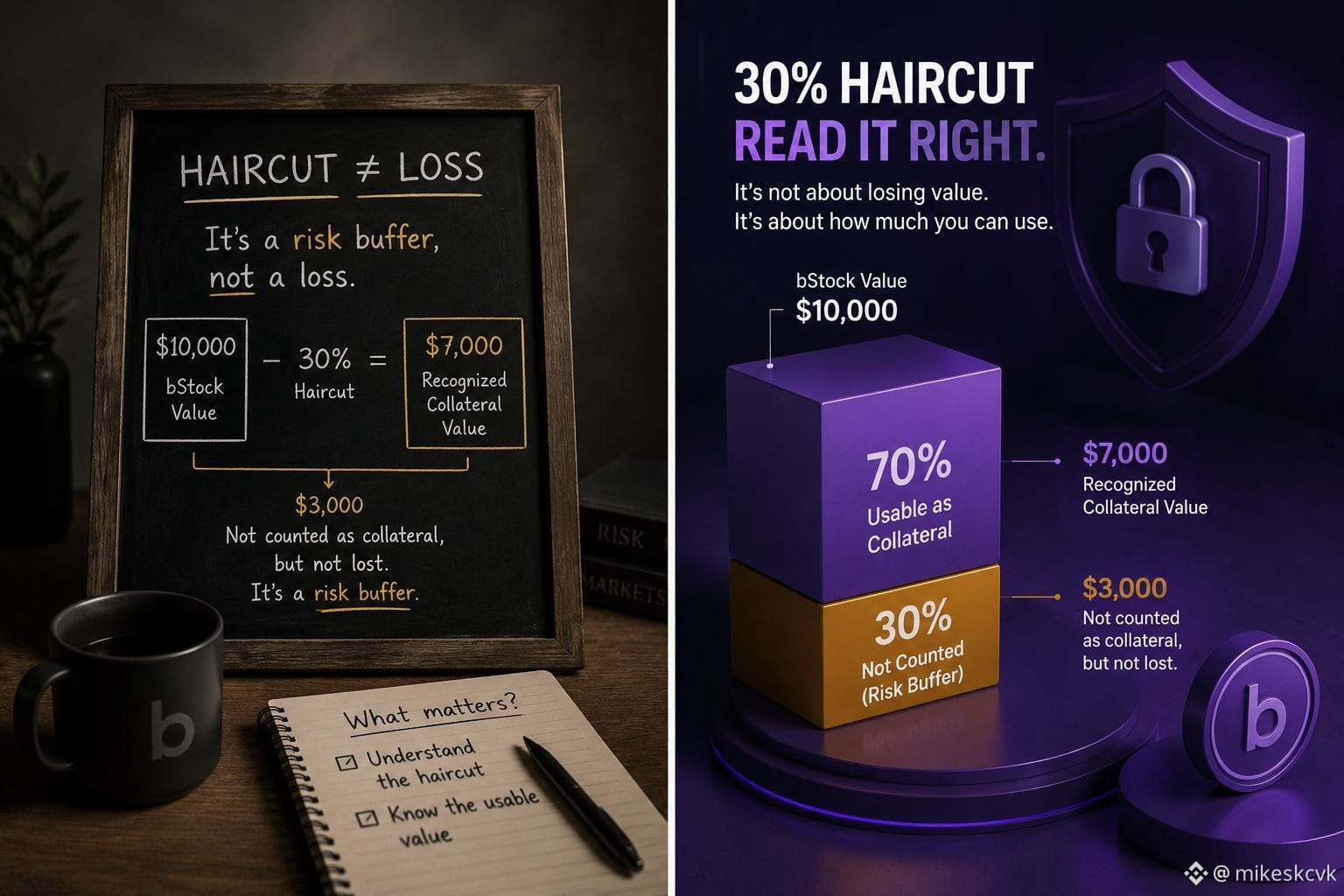
J’avais l’habitude de lire une décote (haircut) appliquée à une garantie comme si c’était une simple réduction.
C’était un mauvais modèle mental.
Imaginons qu’un titre tokenisé ait une décote de 30%.
Mon premier réflexe serait :
« D’accord, donc 30% de l’actif est en gros disparu. »
Mais ce n’est pas ce que le chiffre vous dit.
La question plus utile est :
Quelle part de la valeur de l’actif peut réellement être reconnue comme garantie ?
Si vous avez 10 000 $ d’un bStock et que la décote applicable est de 30%, la valeur de garantie reconnue est de 7 000 $.
Les 3 000 $ restants n’ont pas disparu.
Ils ne sont simplement pas pris en compte dans la valeur de garantie selon cette hypothèse de décote.
Cette distinction compte parce que les calculs de garantie servent à évaluer des coussins de risque, pas à déclarer qu’une partie d’un actif est sans valeur.
Et il y a un autre point que je vérifierais avant de faire un quelconque calcul :
La décote s’applique exactement à quoi ?
La réponse peut dépendre de l’actif, des règles pertinentes et du cadre de garantie spécifique.
Donc au lieu de retenir :
« Décote de 30% = perte de 30% »,
je retiens désormais :
« Décote de 30% = 70% de la valeur de garantie reconnue. »
La différence est légère dans la formulation, mais c’est une manière totalement différente de lire le chiffre.
Pour moi, c’est l’un de ces concepts de bStocks qui devient beaucoup plus simple dès que vous cessez de penser au pourcentage comme à une « perte » et que vous commencez à le voir comme une valeur de garantie ajustée au risque.
Interpréteriez-vous correctement une décote de 30% sans faire le calcul ?
{spot}(NVDABUSDT)
$NVDAB
#bstockscis @BinanceCIS
J’avais l’habitude de lire une décote (haircut) appliquée à une garantie comme si c’était une simple réduction.
C’était un mauvais modèle mental.
Imaginons qu’un titre tokenisé ait une décote de 30%.
Mon premier réflexe serait :
« D’accord, donc 30% de l’actif est en gros disparu. »
Mais ce n’est pas ce que le chiffre vous dit.
La question plus utile est :
Quelle part de la valeur de l’actif peut réellement être reconnue comme garantie ?
Si vous avez 10 000 $ d’un bStock et que la décote applicable est de 30%, la valeur de garantie reconnue est de 7 000 $.
Les 3 000 $ restants n’ont pas disparu.
Ils ne sont simplement pas pris en compte dans la valeur de garantie selon cette hypothèse de décote.
Cette distinction compte parce que les calculs de garantie servent à évaluer des coussins de risque, pas à déclarer qu’une partie d’un actif est sans valeur.
Et il y a un autre point que je vérifierais avant de faire un quelconque calcul :
La décote s’applique exactement à quoi ?
La réponse peut dépendre de l’actif, des règles pertinentes et du cadre de garantie spécifique.
Donc au lieu de retenir :
« Décote de 30% = perte de 30% »,
je retiens désormais :
« Décote de 30% = 70% de la valeur de garantie reconnue. »
La différence est légère dans la formulation, mais c’est une manière totalement différente de lire le chiffre.
Pour moi, c’est l’un de ces concepts de bStocks qui devient beaucoup plus simple dès que vous cessez de penser au pourcentage comme à une « perte » et que vous commencez à le voir comme une valeur de garantie ajustée au risque.
Interpréteriez-vous correctement une décote de 30% sans faire le calcul ?
$NVDAB
#bstockscis @BinanceCIS
C’était un mauvais modèle mental.
Imaginons qu’un titre tokenisé ait une décote de 30%.
Mon premier réflexe serait :
« D’accord, donc 30% de l’actif est en gros disparu. »
Mais ce n’est pas ce que le chiffre vous dit.
La question plus utile est :
Quelle part de la valeur de l’actif peut réellement être reconnue comme garantie ?
Si vous avez 10 000 $ d’un bStock et que la décote applicable est de 30%, la valeur de garantie reconnue est de 7 000 $.
Les 3 000 $ restants n’ont pas disparu.
Ils ne sont simplement pas pris en compte dans la valeur de garantie selon cette hypothèse de décote.
Cette distinction compte parce que les calculs de garantie servent à évaluer des coussins de risque, pas à déclarer qu’une partie d’un actif est sans valeur.
Et il y a un autre point que je vérifierais avant de faire un quelconque calcul :
La décote s’applique exactement à quoi ?
La réponse peut dépendre de l’actif, des règles pertinentes et du cadre de garantie spécifique.
Donc au lieu de retenir :
« Décote de 30% = perte de 30% »,
je retiens désormais :
« Décote de 30% = 70% de la valeur de garantie reconnue. »
La différence est légère dans la formulation, mais c’est une manière totalement différente de lire le chiffre.
Pour moi, c’est l’un de ces concepts de bStocks qui devient beaucoup plus simple dès que vous cessez de penser au pourcentage comme à une « perte » et que vous commencez à le voir comme une valeur de garantie ajustée au risque.
Interpréteriez-vous correctement une décote de 30% sans faire le calcul ?
$NVDAB
#bstockscis @BinanceCIS
96
·
--
Voir la traduction
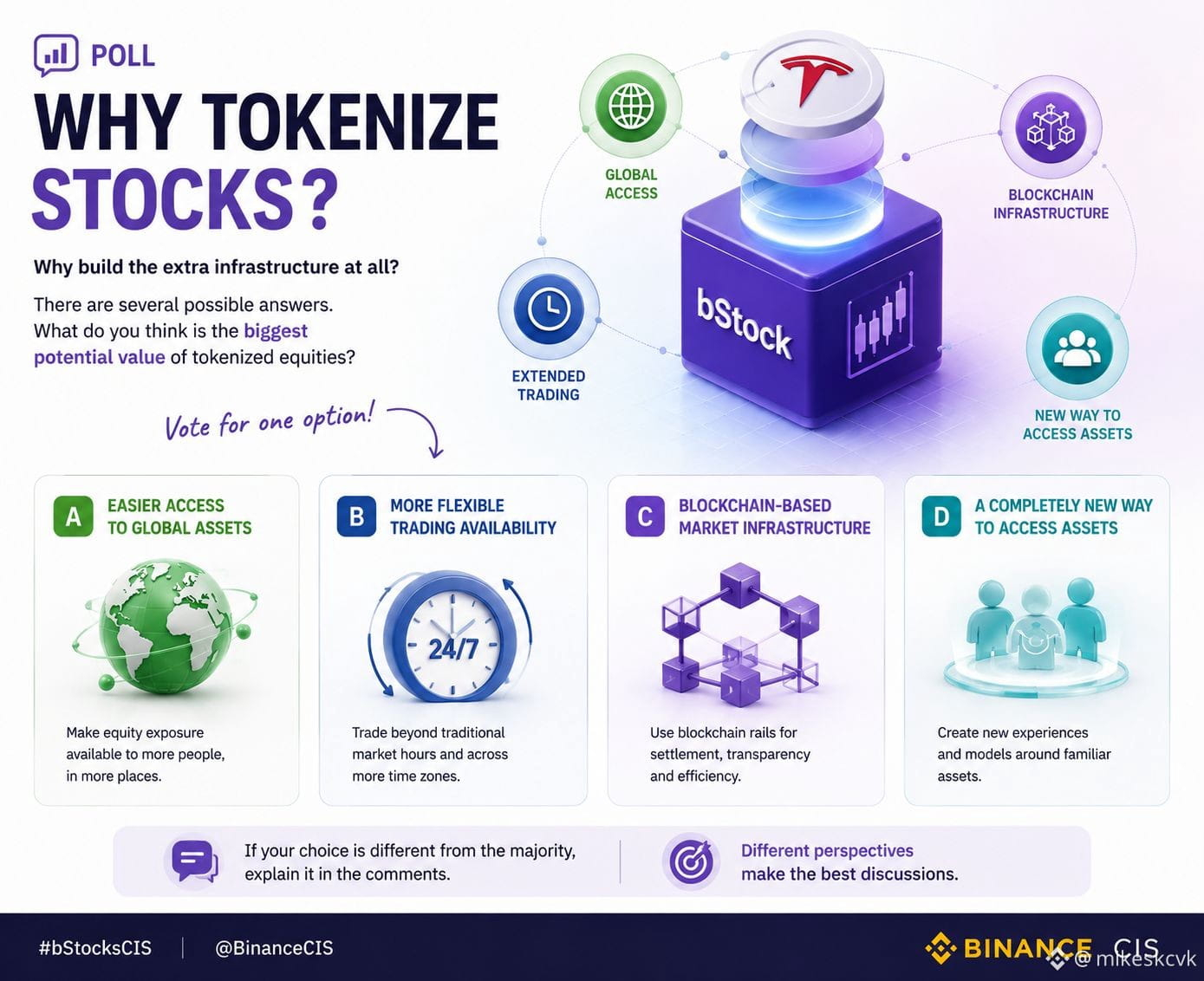
I keep seeing the same assumption:
“Tokenized stocks are just traditional stocks in another format.”
But if that were the whole point, the question becomes pretty simple:
Why build the extra infrastructure at all?
There are several possible answers.
Maybe the biggest value is making equity exposure more accessible.
Maybe it is the ability to interact with markets through blockchain infrastructure.
May$be extended trading availability matters more.
Or maybe the real advantage is simply creating a different way for people to access familiar assets.
I don't think there is one universal answer.
So I'm curious what the community actually thinks.
What is the biggest potential value of tokenized equities?
A — Easier access to global assets
B — More flexible trading availability
C — Blockchain-based market infrastructure
D — A completely new way to access familiar assets
Vote for one.
And if your choice is different from the majority, explain it — that's probably where the interesting discussion starts.
#bstockscis @BinanceCIS
I keep seeing the same assumption:
“Tokenized stocks are just traditional stocks in another format.”
But if that were the whole point, the question becomes pretty simple:
Why build the extra infrastructure at all?
There are several possible answers.
Maybe the biggest value is making equity exposure more accessible.
Maybe it is the ability to interact with markets through blockchain infrastructure.
May$be extended trading availability matters more.
Or maybe the real advantage is simply creating a different way for people to access familiar assets.
I don't think there is one universal answer.
So I'm curious what the community actually thinks.
What is the biggest potential value of tokenized equities?
A — Easier access to global assets
B — More flexible trading availability
C — Blockchain-based market infrastructure
D — A completely new way to access familiar assets
Vote for one.
And if your choice is different from the majority, explain it — that's probably where the interesting discussion starts.
#bstockscis @BinanceCIS
“Tokenized stocks are just traditional stocks in another format.”
But if that were the whole point, the question becomes pretty simple:
Why build the extra infrastructure at all?
There are several possible answers.
Maybe the biggest value is making equity exposure more accessible.
Maybe it is the ability to interact with markets through blockchain infrastructure.
May$be extended trading availability matters more.
Or maybe the real advantage is simply creating a different way for people to access familiar assets.
I don't think there is one universal answer.
So I'm curious what the community actually thinks.
What is the biggest potential value of tokenized equities?
A — Easier access to global assets
B — More flexible trading availability
C — Blockchain-based market infrastructure
D — A completely new way to access familiar assets
Vote for one.
And if your choice is different from the majority, explain it — that's probably where the interesting discussion starts.
#bstockscis @BinanceCIS
76
·
--
Haussier
Voir la traduction
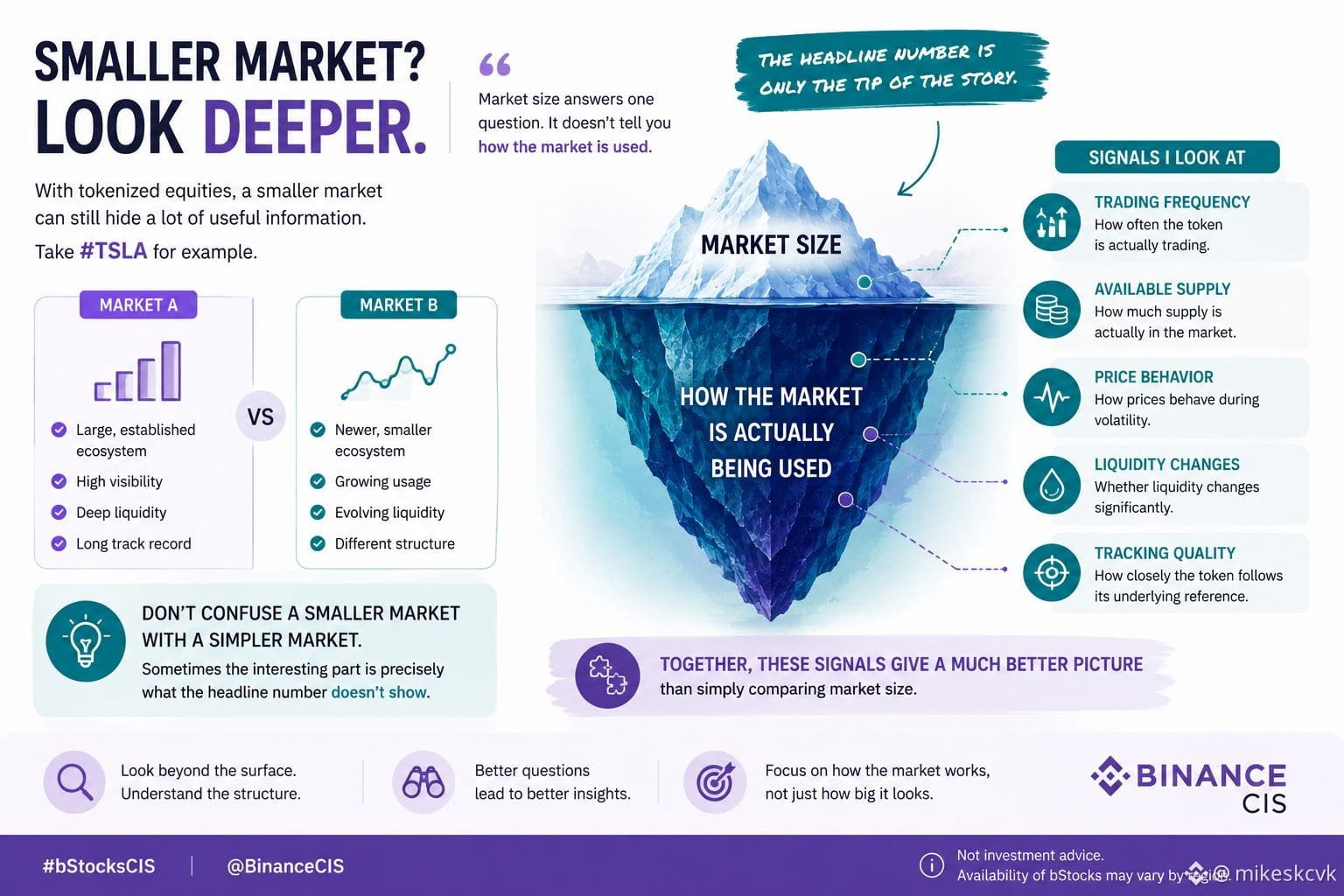
A smaller market does not automatically mean an uninteresting market.
That is something I keep in mind when looking at tokenized equities.
Imagine two markets showing almost the same underlying asset.
One has a huge established ecosystem.
The other is newer, smaller, and built around tokenized exposure.
It would be easy to look at the second one and say:
“Too small. Move on.”
But size answers only one question.
It doesn't tell me how the market is being used.
For example, with #TSLA I would rather look at several signals together:
→ how often the token trades
→ how much supply is actually available
→ how prices behave during volatility
→ whether liquidity changes significantly
→ how closely the token follows its underlying reference
None of these tells the whole story alone.
But together, they give a much better picture than simply comparing market size.
That is probably my biggest takeaway from studying bStocks:
Don't confuse a smaller market with a simpler market.
Sometimes the interesting part is precisely what the headline number doesn't show.
#bstockscis @BinanceCIS
A smaller market does not automatically mean an uninteresting market.
That is something I keep in mind when looking at tokenized equities.
Imagine two markets showing almost the same underlying asset.
One has a huge established ecosystem.
The other is newer, smaller, and built around tokenized exposure.
It would be easy to look at the second one and say:
“Too small. Move on.”
But size answers only one question.
It doesn't tell me how the market is being used.
For example, with #TSLA I would rather look at several signals together:
→ how often the token trades
→ how much supply is actually available
→ how prices behave during volatility
→ whether liquidity changes significantly
→ how closely the token follows its underlying reference
None of these tells the whole story alone.
But together, they give a much better picture than simply comparing market size.
That is probably my biggest takeaway from studying bStocks:
Don't confuse a smaller market with a simpler market.
Sometimes the interesting part is precisely what the headline number doesn't show.
#bstockscis @BinanceCIS
That is something I keep in mind when looking at tokenized equities.
Imagine two markets showing almost the same underlying asset.
One has a huge established ecosystem.
The other is newer, smaller, and built around tokenized exposure.
It would be easy to look at the second one and say:
“Too small. Move on.”
But size answers only one question.
It doesn't tell me how the market is being used.
For example, with #TSLA I would rather look at several signals together:
→ how often the token trades
→ how much supply is actually available
→ how prices behave during volatility
→ whether liquidity changes significantly
→ how closely the token follows its underlying reference
None of these tells the whole story alone.
But together, they give a much better picture than simply comparing market size.
That is probably my biggest takeaway from studying bStocks:
Don't confuse a smaller market with a simpler market.
Sometimes the interesting part is precisely what the headline number doesn't show.
#bstockscis @BinanceCIS
1
80
·
--
Voir la traduction
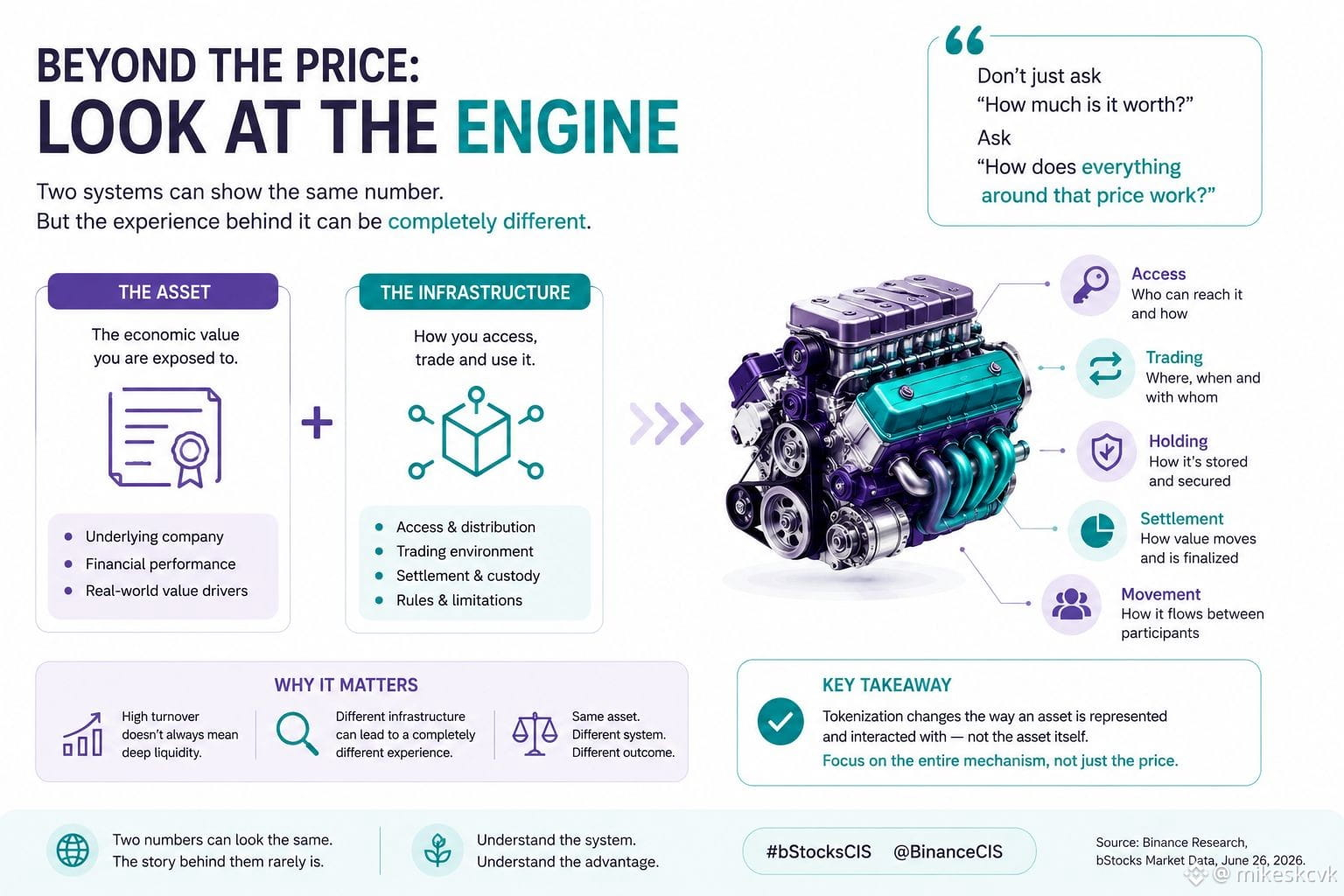
I used to think that when evaluating a new financial product, the most important thing was understanding what exactly you are buying.
Now I'd add another question:
What happens around that asset after you buy it?
That's where tokenized stocks become much more interesting than a simple comparison with traditional markets.
An asset isn't just a price.
There is an entire process around it:
access → trading → holding → settlement → movement between participants
If you only look at the price chart, most of that story disappears.
So I try to separate two things.
The asset — what the economic value is connected to.
The infrastructure — how that asset is represented and accessed by the user.
Those are not the same thing.
And that's one of the parts of bStocks I find most interesting.
Tokenization doesn't magically change the underlying asset.
It changes the way that asset is represented and interacted with inside a different financial environment.
So my main takeaway is simple:
Don't evaluate a tokenized product only by asking:
“How much is it worth?”
Ask:
“How does everything around that price actually work?”
Two systems can display a very similar number on a screen while providing a completely different experience underneath.
And that's the difference I'm most interested in watching with bStocks.
@BinanceCIS #bstockscis
I used to think that when evaluating a new financial product, the most important thing was understanding what exactly you are buying.
Now I'd add another question:
What happens around that asset after you buy it?
That's where tokenized stocks become much more interesting than a simple comparison with traditional markets.
An asset isn't just a price.
There is an entire process around it:
access → trading → holding → settlement → movement between participants
If you only look at the price chart, most of that story disappears.
So I try to separate two things.
The asset — what the economic value is connected to.
The infrastructure — how that asset is represented and accessed by the user.
Those are not the same thing.
And that's one of the parts of bStocks I find most interesting.
Tokenization doesn't magically change the underlying asset.
It changes the way that asset is represented and interacted with inside a different financial environment.
So my main takeaway is simple:
Don't evaluate a tokenized product only by asking:
“How much is it worth?”
Ask:
“How does everything around that price actually work?”
Two systems can display a very similar number on a screen while providing a completely different experience underneath.
And that's the difference I'm most interested in watching with bStocks.
@BinanceCIS #bstockscis
Now I'd add another question:
What happens around that asset after you buy it?
That's where tokenized stocks become much more interesting than a simple comparison with traditional markets.
An asset isn't just a price.
There is an entire process around it:
access → trading → holding → settlement → movement between participants
If you only look at the price chart, most of that story disappears.
So I try to separate two things.
The asset — what the economic value is connected to.
The infrastructure — how that asset is represented and accessed by the user.
Those are not the same thing.
And that's one of the parts of bStocks I find most interesting.
Tokenization doesn't magically change the underlying asset.
It changes the way that asset is represented and interacted with inside a different financial environment.
So my main takeaway is simple:
Don't evaluate a tokenized product only by asking:
“How much is it worth?”
Ask:
“How does everything around that price actually work?”
Two systems can display a very similar number on a screen while providing a completely different experience underneath.
And that's the difference I'm most interested in watching with bStocks.
@BinanceCIS #bstockscis
1
80
·
--
Voir la traduction
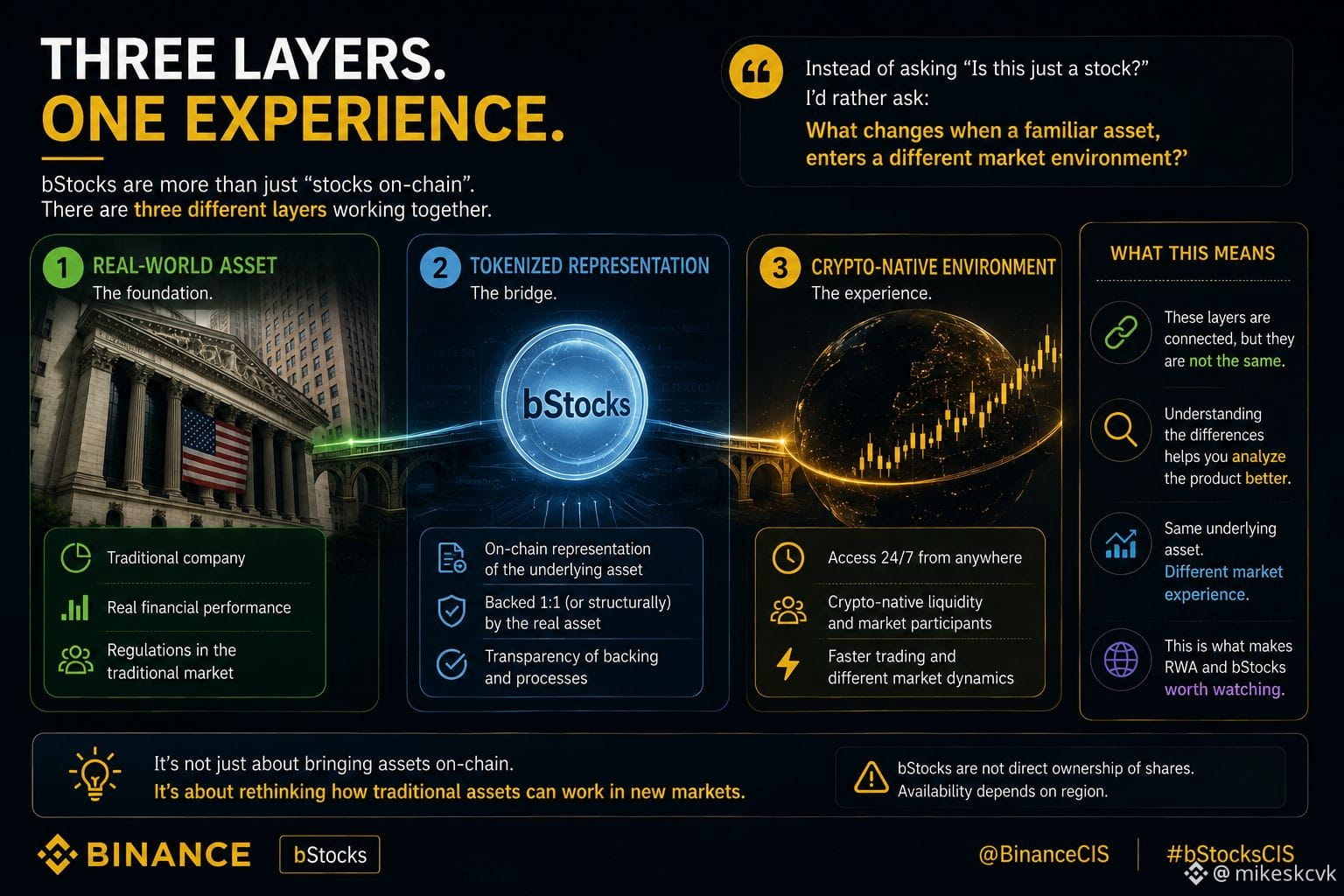
I think one of the easiest ways to misunderstand tokenized stocks is to focus only on the word “stock”.
The more I look at bStocks, the more I see three different things happening at once.
There is the real-world asset.
Then there is the tokenized representation.
And finally, there is the crypto-native environment where the token can be traded.
Those three layers are connected, but they are not the same thing.
And that changes how I would look at the product.
Instead of asking:
“Is this just a stock?”
I'd rather ask:
“What changes when a familiar asset enters a different market environment?”
Trading hours, access, liquidity and the way people interact with the asset can all become part of the picture.
That shift in perspective makes much more sense to me than simply comparing a token to a traditional share.
Same underlying idea.
Different market experience. 🔎
That's what makes this space worth watching. 🌍@BinanceCIS 😀 #bstockscis
I think one of the easiest ways to misunderstand tokenized stocks is to focus only on the word “stock”.
The more I look at bStocks, the more I see three different things happening at once.
There is the real-world asset.
Then there is the tokenized representation.
And finally, there is the crypto-native environment where the token can be traded.
Those three layers are connected, but they are not the same thing.
And that changes how I would look at the product.
Instead of asking:
“Is this just a stock?”
I'd rather ask:
“What changes when a familiar asset enters a different market environment?”
Trading hours, access, liquidity and the way people interact with the asset can all become part of the picture.
That shift in perspective makes much more sense to me than simply comparing a token to a traditional share.
Same underlying idea.
Different market experience. 🔎
That's what makes this space worth watching. 🌍@BinanceCIS 😀 #bstockscis
The more I look at bStocks, the more I see three different things happening at once.
There is the real-world asset.
Then there is the tokenized representation.
And finally, there is the crypto-native environment where the token can be traded.
Those three layers are connected, but they are not the same thing.
And that changes how I would look at the product.
Instead of asking:
“Is this just a stock?”
I'd rather ask:
“What changes when a familiar asset enters a different market environment?”
Trading hours, access, liquidity and the way people interact with the asset can all become part of the picture.
That shift in perspective makes much more sense to me than simply comparing a token to a traditional share.
Same underlying idea.
Different market experience. 🔎
That's what makes this space worth watching. 🌍@BinanceCIS 😀 #bstockscis
73
·
--
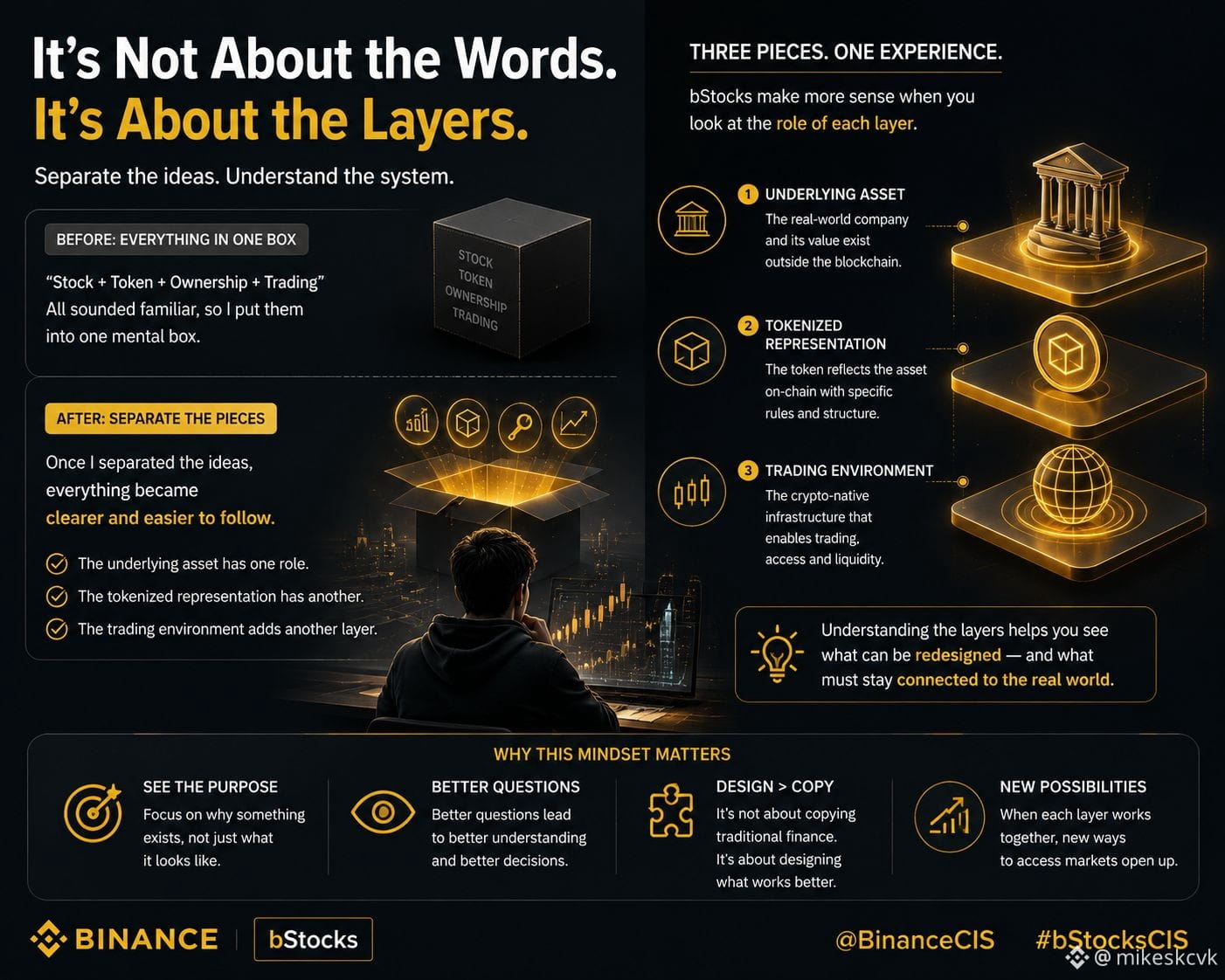
Je pensais que la partie la plus difficile de la compréhension des actions tokenisées, c’était la technologie.
Honnêtement, je pense que ce sont plutôt les termes.
Des mots comme « action », « token », « propriété » et « trading » semblent familiers, donc il est très facile de tout mettre dans une seule boîte mentale.
Mais bStocks m’a fait ralentir et séparer ces idées.
Un actif tokenisé n’est pas intéressant juste parce que ça ressemble à quelque chose de familier.
Ce qui est intéressant, c’est l’infrastructure qui l’entoure.
L’actif sous-jacent a un rôle.
La représentation tokenisée en a un autre.
Et l’environnement de trading ajoute une autre couche par-dessus.
Quand j’ai commencé à séparer ces éléments, tout le concept est devenu beaucoup plus facile à suivre.
Peut-être que c’est aussi pour ça que la RWA m’intéresse.
Il ne s’agit pas simplement d’amener des actifs traditionnels sur la blockchain.
Il s’agit de déterminer quelles parties de l’ancienne expérience financière peuvent être repensées sans perdre le lien avec l’actif sous-jacent.
Je continue d’apprendre, mais je regarde clairement la tokenisation différemment maintenant. 🔎
@BinanceCIS #bstockscis
Je pensais que la partie la plus difficile de la compréhension des actions tokenisées, c’était la technologie.
Honnêtement, je pense que ce sont plutôt les termes.
Des mots comme « action », « token », « propriété » et « trading » semblent familiers, donc il est très facile de tout mettre dans une seule boîte mentale.
Mais bStocks m’a fait ralentir et séparer ces idées.
Un actif tokenisé n’est pas intéressant juste parce que ça ressemble à quelque chose de familier.
Ce qui est intéressant, c’est l’infrastructure qui l’entoure.
L’actif sous-jacent a un rôle.
La représentation tokenisée en a un autre.
Et l’environnement de trading ajoute une autre couche par-dessus.
Quand j’ai commencé à séparer ces éléments, tout le concept est devenu beaucoup plus facile à suivre.
Peut-être que c’est aussi pour ça que la RWA m’intéresse.
Il ne s’agit pas simplement d’amener des actifs traditionnels sur la blockchain.
Il s’agit de déterminer quelles parties de l’ancienne expérience financière peuvent être repensées sans perdre le lien avec l’actif sous-jacent.
Je continue d’apprendre, mais je regarde clairement la tokenisation différemment maintenant. 🔎
@BinanceCIS #bstockscis
Honnêtement, je pense que ce sont plutôt les termes.
Des mots comme « action », « token », « propriété » et « trading » semblent familiers, donc il est très facile de tout mettre dans une seule boîte mentale.
Mais bStocks m’a fait ralentir et séparer ces idées.
Un actif tokenisé n’est pas intéressant juste parce que ça ressemble à quelque chose de familier.
Ce qui est intéressant, c’est l’infrastructure qui l’entoure.
L’actif sous-jacent a un rôle.
La représentation tokenisée en a un autre.
Et l’environnement de trading ajoute une autre couche par-dessus.
Quand j’ai commencé à séparer ces éléments, tout le concept est devenu beaucoup plus facile à suivre.
Peut-être que c’est aussi pour ça que la RWA m’intéresse.
Il ne s’agit pas simplement d’amener des actifs traditionnels sur la blockchain.
Il s’agit de déterminer quelles parties de l’ancienne expérience financière peuvent être repensées sans perdre le lien avec l’actif sous-jacent.
Je continue d’apprendre, mais je regarde clairement la tokenisation différemment maintenant. 🔎
@BinanceCIS #bstockscis
92
·
--
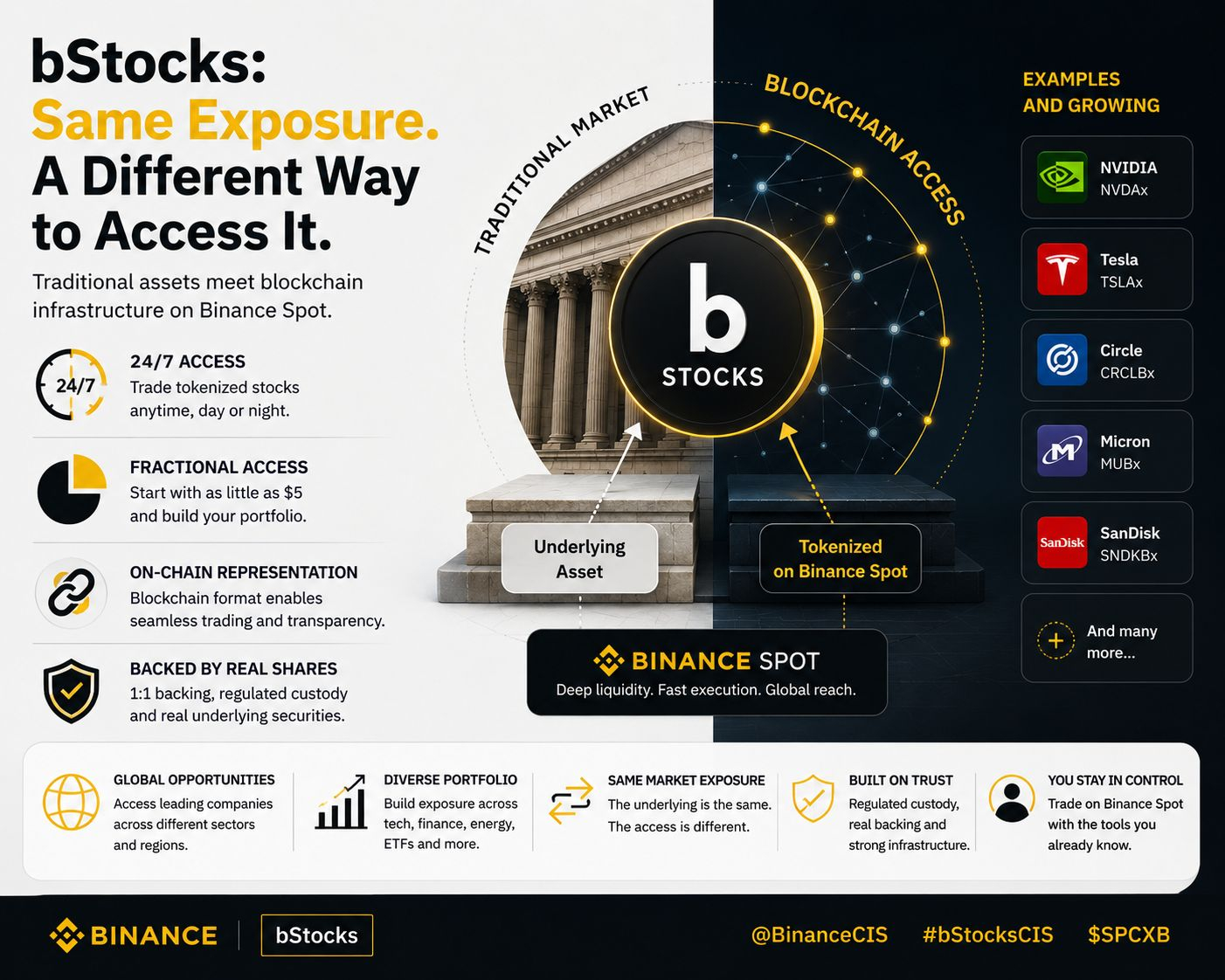
Je pensais aux bStocks dans l’autre sens aujourd’hui.
Au lieu de demander « quel est le token bourse ? », je pense que la meilleure question est « qu’est-ce qui change quand la même exposition de marché prend une forme basée sur une blockchain ? »
Vous obtenez un environnement de trading différent, un accès 24/7 sur Binance Spot, un accès fractionné et une représentation on-chain — tout en conservant une structure sous-jacente qui reste reliée à l’actif traditionnel.
Ce mélange est probablement la partie la plus intéressante pour moi.
Il ne s’agit pas de remplacer le marché boursier. Il s’agit d’expérimenter une autre manière d’y accéder. 🔎🌍
@BinanceCIS #bStocksCIS $SPCXB
Je pensais aux bStocks dans l’autre sens aujourd’hui.
Au lieu de demander « quel est le token bourse ? », je pense que la meilleure question est « qu’est-ce qui change quand la même exposition de marché prend une forme basée sur une blockchain ? »
Vous obtenez un environnement de trading différent, un accès 24/7 sur Binance Spot, un accès fractionné et une représentation on-chain — tout en conservant une structure sous-jacente qui reste reliée à l’actif traditionnel.
Ce mélange est probablement la partie la plus intéressante pour moi.
Il ne s’agit pas de remplacer le marché boursier. Il s’agit d’expérimenter une autre manière d’y accéder. 🔎🌍
@BinanceCIS #bStocksCIS $SPCXB
Au lieu de demander « quel est le token bourse ? », je pense que la meilleure question est « qu’est-ce qui change quand la même exposition de marché prend une forme basée sur une blockchain ? »
Vous obtenez un environnement de trading différent, un accès 24/7 sur Binance Spot, un accès fractionné et une représentation on-chain — tout en conservant une structure sous-jacente qui reste reliée à l’actif traditionnel.
Ce mélange est probablement la partie la plus intéressante pour moi.
Il ne s’agit pas de remplacer le marché boursier. Il s’agit d’expérimenter une autre manière d’y accéder. 🔎🌍
@BinanceCIS #bStocksCIS $SPCXB
162
·
--
Voir la traduction
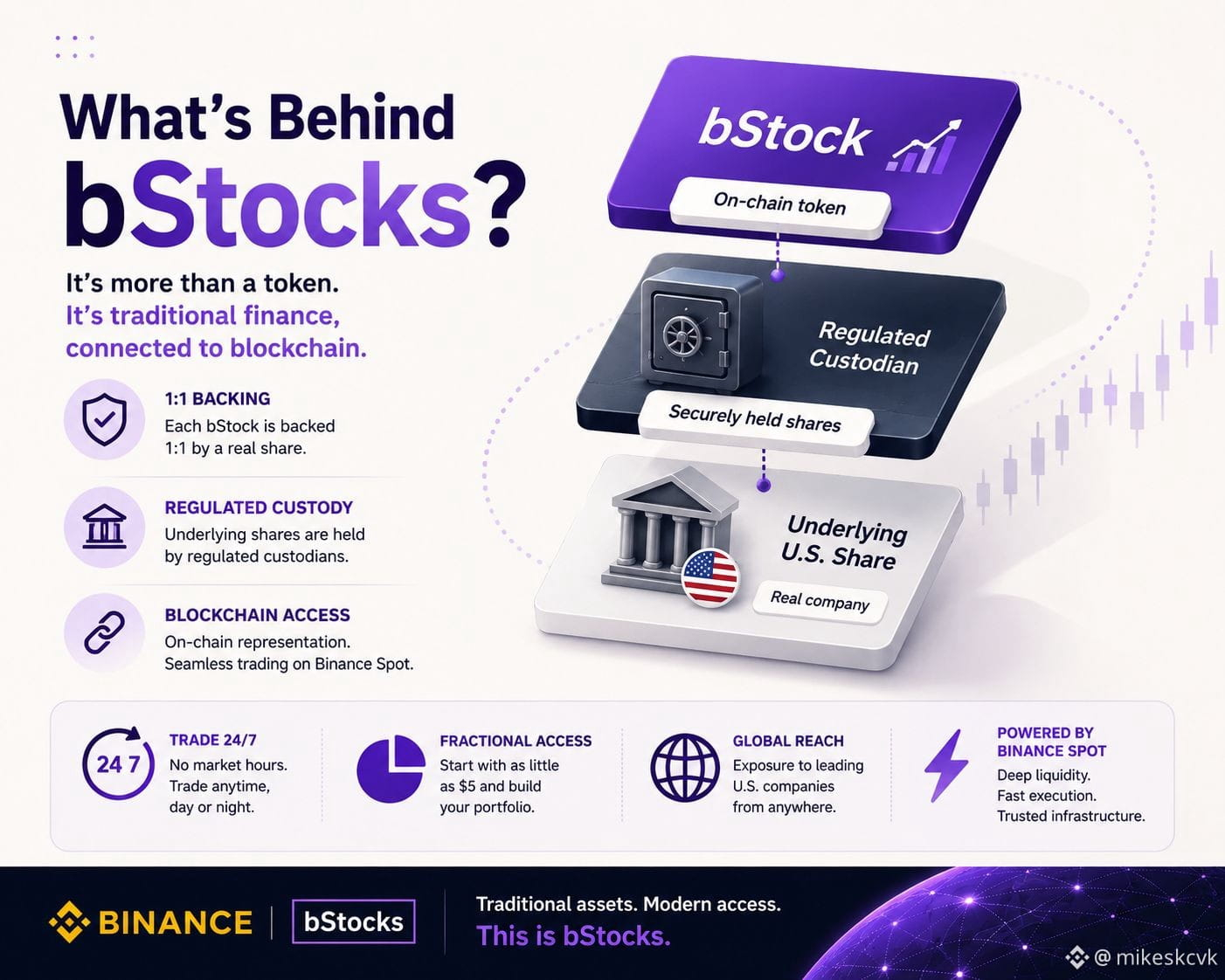
Something I found interesting while digging into bStocks is the difference between the asset itself and the way you access it.
There’s still an underlying security behind the structure, with 1:1 backing and regulated custody. The blockchain part changes the way that exposure is represented and traded.
So I wouldn’t describe bStocks simply as “a stock put on a blockchain”.
There’s quite a bit more going on underneath — custody, tokenization, trading infrastructure and the connection to Binance Spot.
That’s honestly the part I find more interesting than just looking at the price chart. 😅🔎
@BinanceCIS $SPCXB #bstockscis
Something I found interesting while digging into bStocks is the difference between the asset itself and the way you access it.
There’s still an underlying security behind the structure, with 1:1 backing and regulated custody. The blockchain part changes the way that exposure is represented and traded.
So I wouldn’t describe bStocks simply as “a stock put on a blockchain”.
There’s quite a bit more going on underneath — custody, tokenization, trading infrastructure and the connection to Binance Spot.
That’s honestly the part I find more interesting than just looking at the price chart. 😅🔎
@BinanceCIS $SPCXB #bstockscis
There’s still an underlying security behind the structure, with 1:1 backing and regulated custody. The blockchain part changes the way that exposure is represented and traded.
So I wouldn’t describe bStocks simply as “a stock put on a blockchain”.
There’s quite a bit more going on underneath — custody, tokenization, trading infrastructure and the connection to Binance Spot.
That’s honestly the part I find more interesting than just looking at the price chart. 😅🔎
@BinanceCIS $SPCXB #bstockscis
1
114
·
--
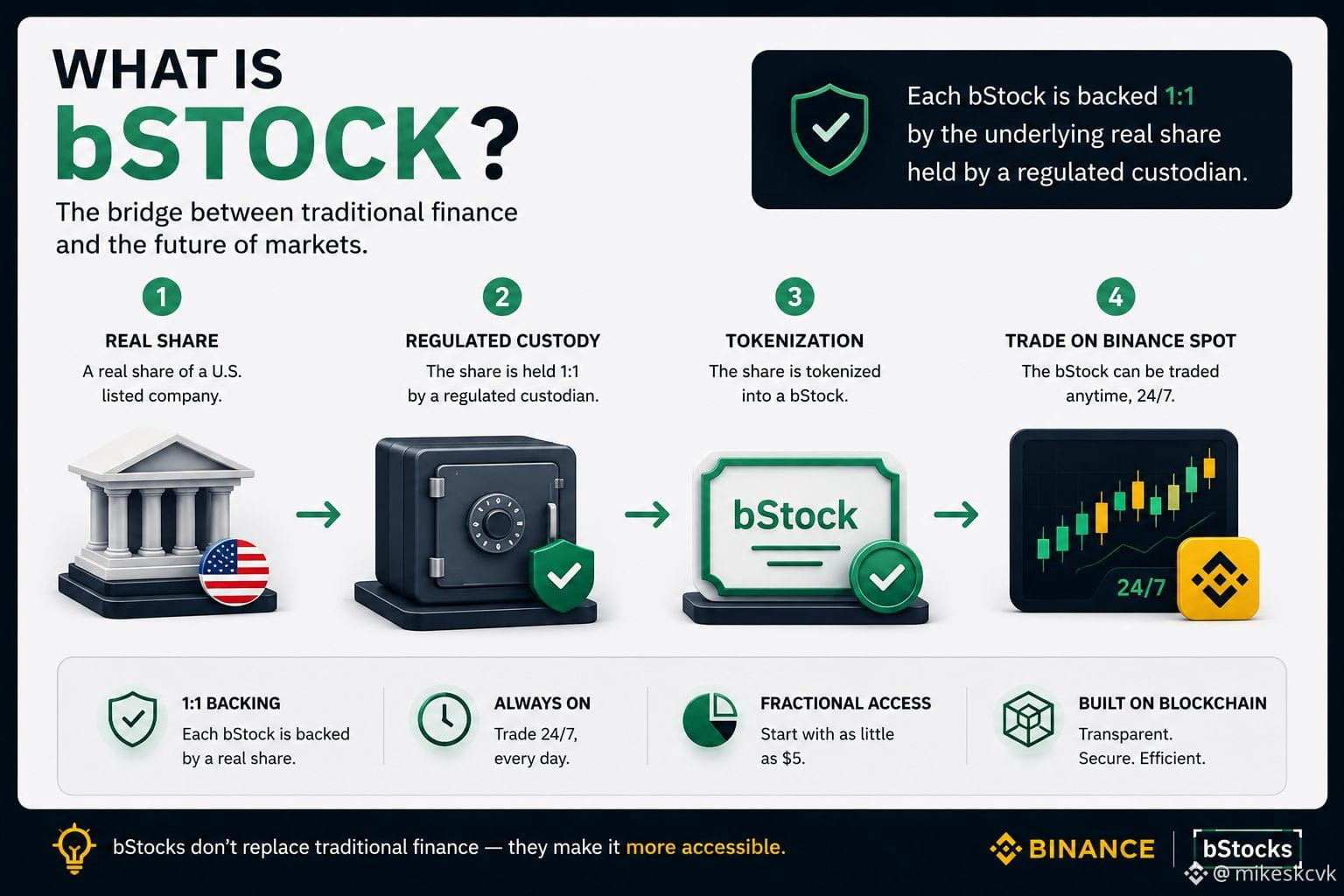
Je pensais que la valeur des bStocks se résumait à la simple mise en bourse sur la blockchain.
Après avoir lu davantage sur la façon dont ils fonctionnent, je pense que la vraie valeur réside dans la structure qui les sous-tend.
Binance explique que chaque bStock est adossé à 1:1 à une action sous-jacente détenue par un dépositaire réglementé. C’est ce lien entre la finance traditionnelle et la blockchain qui rend le concept intéressant à mes yeux.
Parfois, comprendre comment fonctionne un produit est plus précieux que de regarder son graphique de prix.
Vous avez passé plus de temps à apprendre le fonctionnement des bStocks, ou vous suivez principalement le marché ? 📚💭
#bstockscis
Je pensais que la valeur des bStocks se résumait à la simple mise en bourse sur la blockchain.
Après avoir lu davantage sur la façon dont ils fonctionnent, je pense que la vraie valeur réside dans la structure qui les sous-tend.
Binance explique que chaque bStock est adossé à 1:1 à une action sous-jacente détenue par un dépositaire réglementé. C’est ce lien entre la finance traditionnelle et la blockchain qui rend le concept intéressant à mes yeux.
Parfois, comprendre comment fonctionne un produit est plus précieux que de regarder son graphique de prix.
Vous avez passé plus de temps à apprendre le fonctionnement des bStocks, ou vous suivez principalement le marché ? 📚💭
#bstockscis
Après avoir lu davantage sur la façon dont ils fonctionnent, je pense que la vraie valeur réside dans la structure qui les sous-tend.
Binance explique que chaque bStock est adossé à 1:1 à une action sous-jacente détenue par un dépositaire réglementé. C’est ce lien entre la finance traditionnelle et la blockchain qui rend le concept intéressant à mes yeux.
Parfois, comprendre comment fonctionne un produit est plus précieux que de regarder son graphique de prix.
Vous avez passé plus de temps à apprendre le fonctionnement des bStocks, ou vous suivez principalement le marché ? 📚💭
#bstockscis
1
103
·
--
Voir la traduction
One thing I like about blockchain is that it's not only about crypto anymore.
Projects like bStocks show how technology can be used to represent traditional financial assets in a digital way. Whether this model becomes mainstream or not, it's interesting to watch how finance keeps evolving.
I'm curious to see where tokenization will be in the next few years.
What real-world asset do you think could be tokenized next? 💭🚀
@BinanceCIS $SPCXB #bstockscis
One thing I like about blockchain is that it's not only about crypto anymore.
Projects like bStocks show how technology can be used to represent traditional financial assets in a digital way. Whether this model becomes mainstream or not, it's interesting to watch how finance keeps evolving.
I'm curious to see where tokenization will be in the next few years.
What real-world asset do you think could be tokenized next? 💭🚀
@BinanceCIS $SPCXB #bstockscis
Projects like bStocks show how technology can be used to represent traditional financial assets in a digital way. Whether this model becomes mainstream or not, it's interesting to watch how finance keeps evolving.
I'm curious to see where tokenization will be in the next few years.
What real-world asset do you think could be tokenized next? 💭🚀
@BinanceCIS $SPCXB #bstockscis

1
1
109
·
--
Voir la traduction
Я помітив цікаву особливість bStocks: найважливіше тут не лише сам актив, а спосіб його представлення.
Токенізація не створює нову компанію і не змінює базову цінну паперу. Вона дозволяє взаємодіяти з активом через блокчейн-інфраструктуру, зберігаючи зв'язок із реальним базовим активом.
Мені здається, саме такі рішення показують, як поступово поєднуються традиційні фінанси та Web3.
Як думаєте, які ще реальні активи можуть бути токенізовані в майбутньому?
@BinanceCIS #bStocksCIS $SPCXB #BinanceSquare
{spot}(SPCXBUSDT)
#bstockscis
Я помітив цікаву особливість bStocks: найважливіше тут не лише сам актив, а спосіб його представлення.
Токенізація не створює нову компанію і не змінює базову цінну паперу. Вона дозволяє взаємодіяти з активом через блокчейн-інфраструктуру, зберігаючи зв'язок із реальним базовим активом.
Мені здається, саме такі рішення показують, як поступово поєднуються традиційні фінанси та Web3.
Як думаєте, які ще реальні активи можуть бути токенізовані в майбутньому?
@BinanceCIS #bStocksCIS $SPCXB #BinanceSquare
#bstockscis
Токенізація не створює нову компанію і не змінює базову цінну паперу. Вона дозволяє взаємодіяти з активом через блокчейн-інфраструктуру, зберігаючи зв'язок із реальним базовим активом.
Мені здається, саме такі рішення показують, як поступово поєднуються традиційні фінанси та Web3.
Як думаєте, які ще реальні активи можуть бути токенізовані в майбутньому?
@BinanceCIS #bStocksCIS $SPCXB #BinanceSquare
#bstockscis

1
1
65
Connectez-vous pour découvrir plus de contenu
Rejoignez la communauté mondiale des adeptes de cryptomonnaies sur Binance Square
⚡️ Suviez les dernières informations importantes sur les cryptomonnaies.
💬 Jugé digne de confiance par la plus grande plateforme d’échange de cryptomonnaies au monde.
👍 Découvrez les connaissances que partagent les créateurs vérifiés.
Adresse e-mail/Nº de téléphone
Sujets d’actualité
StellarActivatesProtocol28At211TPS
1,832 vues
77 mentions
#stellaractivatesprotocol28at211tps
Qu’est-ce que Stellar Protocol 28 change pour les smart contracts
La mise à niveau de Stellar Protocol 28 introduit plusieurs changements visant à rendre les smart contracts Soroban plus faciles à maintenir, à mettre à niveau et à migrer. La Stellar Development Foundation décrit Adapter comme une version orientée vers les développeurs, avec CAP-85 et CAP-86 qui traitent des problèmes concrets rencontrés par ceux qui gèrent des contrats en production.
L’un des changements clés est CAP-85. Les applications qui déploient de nombreuses copies du même smart contract peuvent utiliser une référence exécutable gérée de manière externe. Le fait de modifier cette référence partagée permet aux contrats participants de passer à un code mis à jour via une seule opération atomique.
Cela peut être particulièrement utile lors de mises à niveau logicielles ou de corrections de sécurité, car les développeurs n’ont pas besoin de mettre à jour individuellement chaque instance de contrat.
CAP-86 traite un défi différent : la modification des structures de données du contrat. Les fonctions hôtes de sparse-map permettent aux applications de fonctionner avec des champs manquants ou supplémentaires, offrant davantage de flexibilité pour migrer des données stockées vers un nouveau schéma.
Le troisième grand élément, CAP-83, cible la couche de consensus. Il permet aux validateurs d’avancer sans attendre nécessairement l’ensemble d’un lot de transactions et introduit une prise en charge des lots tardifs ou invalides.
Ensemble, ces changements font de Protocol 28 principalement une mise à jour d’infrastructure et pour les développeurs plutôt qu’un simple rehaussement de la vitesse des transactions. La documentation interne de Stellar indique que les améliorations de performance associées au téléchargement parallèle des ensembles de transactions seront introduites progressivement.
$XLM
$ONE
$COTI
Crypto Futrures Afridi
·0 mentions J’aime
·630 vues
SECGrantsInnovationExemptionForTokenizedStocks
1,833 vues
105 mentions
XRPGains3%AsRippleAddsMPPSupport
1,094 vues
75 mentions