

Rest4ndRelax
66 Publications

Rest4ndRelax
Signaler
Bloquer l’utilisateur
Crypto content creator and XION community contributor focused on simplifying Web3 updates, ecosystem news, and builder insights for both crypto natives and new
11 Suivis
28 Abonnés
89 J’aime
Publications
PINNED
·
--
Haussier
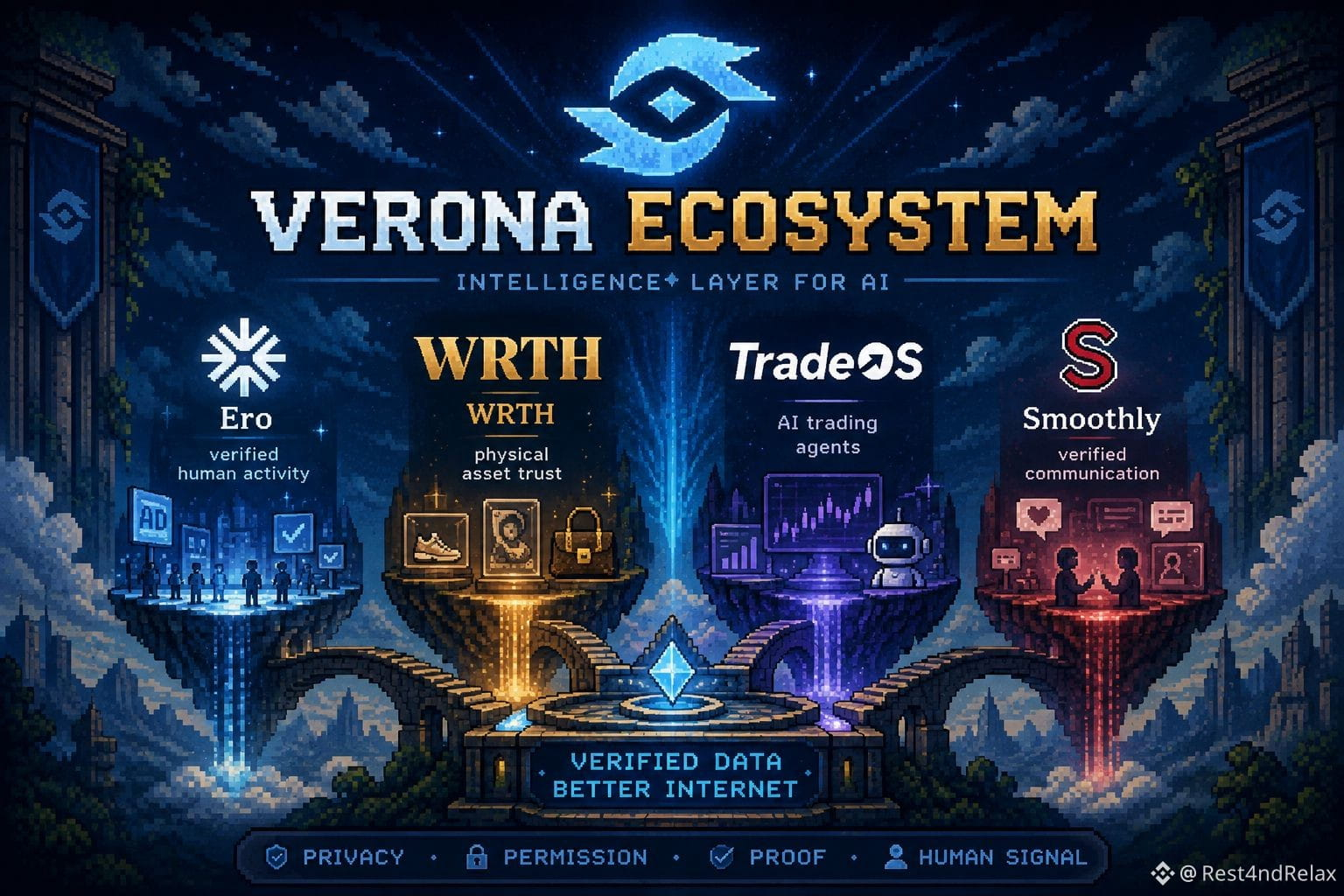
Verona isn’t building just one AI use case.
At first glance, Ero, WRTH, TradeOS, and Smoothly look completely unrelated.
But there’s a pattern behind all four:
making real-world data, activity, and human intelligence more useful and trustworthy for AI.
🔹 Ero by EarnOS
Turns verified human activity into stronger signals for brands.
🔹 WRTH
Uses AI to help identify, price, and manage physical assets, while making important asset information more verifiable.
🔹 TradeOS
Lets users turn trading ideas written in natural language into AI agents that can monitor and analyze markets.
🔹 Smoothly
Uses assessed human communication skills to help build AI agents based on how real people think and respond.
Simplified:
Ero → verified human activity
WRTH → verifiable physical asset data
TradeOS → human strategy → AI agent
Smoothly → verified human skill → AI intelligence
That’s what makes Verona interesting to me.
AI can keep getting smarter.
But if the input comes from bots, fake activity, weak signals, or unverifiable information, smarter models alone won’t solve the problem.
Verona is taking a different approach:
better intelligence starts with better signals.
And Ero, WRTH, TradeOS, and Smoothly are starting to show what that looks like in real applications.
Not just smarter AI.
AI with better reasons to trust the information it uses.
#verona #ero #ai #layer1 #ecosytem
Verona isn’t building just one AI use case.
At first glance, Ero, WRTH, TradeOS, and Smoothly look completely unrelated.
But there’s a pattern behind all four:
making real-world data, activity, and human intelligence more useful and trustworthy for AI.
🔹 Ero by EarnOS
Turns verified human activity into stronger signals for brands.
🔹 WRTH
Uses AI to help identify, price, and manage physical assets, while making important asset information more verifiable.
🔹 TradeOS
Lets users turn trading ideas written in natural language into AI agents that can monitor and analyze markets.
🔹 Smoothly
Uses assessed human communication skills to help build AI agents based on how real people think and respond.
Simplified:
Ero → verified human activity
WRTH → verifiable physical asset data
TradeOS → human strategy → AI agent
Smoothly → verified human skill → AI intelligence
That’s what makes Verona interesting to me.
AI can keep getting smarter.
But if the input comes from bots, fake activity, weak signals, or unverifiable information, smarter models alone won’t solve the problem.
Verona is taking a different approach:
better intelligence starts with better signals.
And Ero, WRTH, TradeOS, and Smoothly are starting to show what that looks like in real applications.
Not just smarter AI.
AI with better reasons to trust the information it uses.
#verona #ero #ai #layer1 #ecosytem
At first glance, Ero, WRTH, TradeOS, and Smoothly look completely unrelated.
But there’s a pattern behind all four:
making real-world data, activity, and human intelligence more useful and trustworthy for AI.
🔹 Ero by EarnOS
Turns verified human activity into stronger signals for brands.
🔹 WRTH
Uses AI to help identify, price, and manage physical assets, while making important asset information more verifiable.
🔹 TradeOS
Lets users turn trading ideas written in natural language into AI agents that can monitor and analyze markets.
🔹 Smoothly
Uses assessed human communication skills to help build AI agents based on how real people think and respond.
Simplified:
Ero → verified human activity
WRTH → verifiable physical asset data
TradeOS → human strategy → AI agent
Smoothly → verified human skill → AI intelligence
That’s what makes Verona interesting to me.
AI can keep getting smarter.
But if the input comes from bots, fake activity, weak signals, or unverifiable information, smarter models alone won’t solve the problem.
Verona is taking a different approach:
better intelligence starts with better signals.
And Ero, WRTH, TradeOS, and Smoothly are starting to show what that looks like in real applications.
Not just smarter AI.
AI with better reasons to trust the information it uses.
#verona #ero #ai #layer1 #ecosytem
1
119
PINNED
·
--
Haussier
One leaderboard. One winner. $500 up for grabs. 🐦💰
Verona’s Raven Run is live, and the competition is simple:
No prize split between ten players.
No consolation rewards.
The player at the top of the leaderboard takes the entire $500 prize.
The competition runs until August 7, so there is still time to play, improve your score, and climb the rankings.
Why should people care?
Because exploring crypto and the Verona ecosystem does not always have to begin with complicated documentation or technical concepts.
Sometimes, the easiest first step is simply playing, competing, and experiencing how a community can grow through something fun and interactive.
In my opinion, Raven Run shows that onboarding into Verona can be simple, engaging, and accessible even for people who are still new to Web3.
Think you have the reflexes and competitive mindset to win?
Play Raven Run, reach first place before August 7, and claim the $500 prize.
Who is ready to dominate the leaderboard? 👇
https://builtonverona.com/raven-run
#verona #ravenrun #game #leaderboard
One leaderboard. One winner. $500 up for grabs. 🐦💰
Verona’s Raven Run is live, and the competition is simple:
No prize split between ten players.
No consolation rewards.
The player at the top of the leaderboard takes the entire $500 prize.
The competition runs until August 7, so there is still time to play, improve your score, and climb the rankings.
Why should people care?
Because exploring crypto and the Verona ecosystem does not always have to begin with complicated documentation or technical concepts.
Sometimes, the easiest first step is simply playing, competing, and experiencing how a community can grow through something fun and interactive.
In my opinion, Raven Run shows that onboarding into Verona can be simple, engaging, and accessible even for people who are still new to Web3.
Think you have the reflexes and competitive mindset to win?
Play Raven Run, reach first place before August 7, and claim the $500 prize.
Who is ready to dominate the leaderboard? 👇
https://builtonverona.com/raven-run
#verona #ravenrun #game #leaderboard
Verona’s Raven Run is live, and the competition is simple:
No prize split between ten players.
No consolation rewards.
The player at the top of the leaderboard takes the entire $500 prize.
The competition runs until August 7, so there is still time to play, improve your score, and climb the rankings.
Why should people care?
Because exploring crypto and the Verona ecosystem does not always have to begin with complicated documentation or technical concepts.
Sometimes, the easiest first step is simply playing, competing, and experiencing how a community can grow through something fun and interactive.
In my opinion, Raven Run shows that onboarding into Verona can be simple, engaging, and accessible even for people who are still new to Web3.
Think you have the reflexes and competitive mindset to win?
Play Raven Run, reach first place before August 7, and claim the $500 prize.
Who is ready to dominate the leaderboard? 👇
https://builtonverona.com/raven-run
#verona #ravenrun #game #leaderboard

1
121
·
--
Haussier
Al agents tidak cuma butuh data yang bisa dipercaya. Mereka juga butuh cara untuk membayar.
Itu yang membuat verUSD dari Verona menarik untuk diperhatikan.
verUSD adalah stablecoin berbasis USD yang dirancang untuk mendukung pembayaran oleh Al agents, terutama ketika agent perlu mengakses verified data atau layanan digital
Sederhananya:
Verona memverifıkasi informasinya. verUSD menjadi jalur pembayarannya.
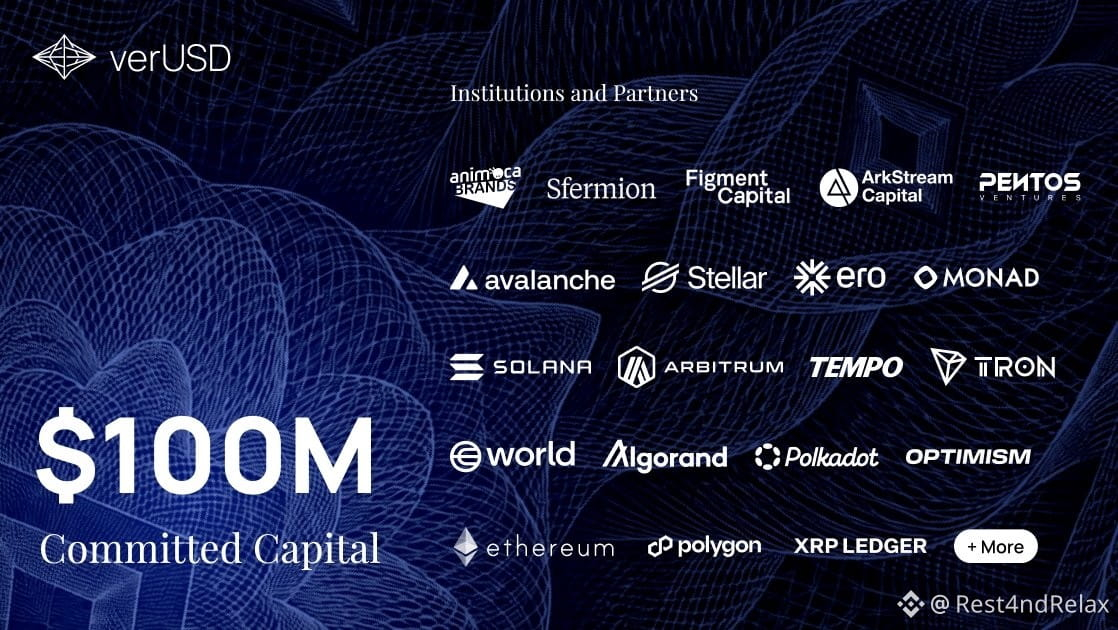
Saat launch, verUSD tersedia secara native di beberapa jaringan besar seperti Ethereum, Solana, Polygon, Avalanche, Optimism, Arbitrum, dan Celo.
Verona juga mengumumkan lebih dari $100M launch commitments dari berbagai institusi dan partner ekosistem.
Yang penting: ini bukan berarti $100M verUSD sudah beredar. Verona menyebut lebih dari $60M sebagai signed, committed revenue yang nantinya akan mengalir melalui verUSD sebagai pembayaran.
Menurut saya, bagian paling menarik bukan sekadar angka $100M.
Tapi bagaimana Verona mulai menghubungkan:
Verified Data → Al Agents → Payments → Action
Jika Al agents benar-benar menjadi bagian besar dari internet, mereka akan membutuhkan data yang terpercaya dan payment rails yang bisa bekerja tanpa bergantung pada proses manual manusia.
Dan verUSD terlihat seperti salah satu langkah Verona untuk membangun ekonomi tersebut.
#Verona #verUSD #Ai #Stablecoin #Crypto
Al agents tidak cuma butuh data yang bisa dipercaya. Mereka juga butuh cara untuk membayar.
Itu yang membuat verUSD dari Verona menarik untuk diperhatikan.
verUSD adalah stablecoin berbasis USD yang dirancang untuk mendukung pembayaran oleh Al agents, terutama ketika agent perlu mengakses verified data atau layanan digital
Sederhananya:
Verona memverifıkasi informasinya. verUSD menjadi jalur pembayarannya.
Saat launch, verUSD tersedia secara native di beberapa jaringan besar seperti Ethereum, Solana, Polygon, Avalanche, Optimism, Arbitrum, dan Celo.
Verona juga mengumumkan lebih dari $100M launch commitments dari berbagai institusi dan partner ekosistem.
Yang penting: ini bukan berarti $100M verUSD sudah beredar. Verona menyebut lebih dari $60M sebagai signed, committed revenue yang nantinya akan mengalir melalui verUSD sebagai pembayaran.
Menurut saya, bagian paling menarik bukan sekadar angka $100M.
Tapi bagaimana Verona mulai menghubungkan:
Verified Data → Al Agents → Payments → Action
Jika Al agents benar-benar menjadi bagian besar dari internet, mereka akan membutuhkan data yang terpercaya dan payment rails yang bisa bekerja tanpa bergantung pada proses manual manusia.
Dan verUSD terlihat seperti salah satu langkah Verona untuk membangun ekonomi tersebut.
#Verona #verUSD #Ai #Stablecoin #Crypto
Itu yang membuat verUSD dari Verona menarik untuk diperhatikan.
verUSD adalah stablecoin berbasis USD yang dirancang untuk mendukung pembayaran oleh Al agents, terutama ketika agent perlu mengakses verified data atau layanan digital
Sederhananya:
Verona memverifıkasi informasinya. verUSD menjadi jalur pembayarannya.
Saat launch, verUSD tersedia secara native di beberapa jaringan besar seperti Ethereum, Solana, Polygon, Avalanche, Optimism, Arbitrum, dan Celo.
Verona juga mengumumkan lebih dari $100M launch commitments dari berbagai institusi dan partner ekosistem.
Yang penting: ini bukan berarti $100M verUSD sudah beredar. Verona menyebut lebih dari $60M sebagai signed, committed revenue yang nantinya akan mengalir melalui verUSD sebagai pembayaran.
Menurut saya, bagian paling menarik bukan sekadar angka $100M.
Tapi bagaimana Verona mulai menghubungkan:
Verified Data → Al Agents → Payments → Action
Jika Al agents benar-benar menjadi bagian besar dari internet, mereka akan membutuhkan data yang terpercaya dan payment rails yang bisa bekerja tanpa bergantung pada proses manual manusia.
Dan verUSD terlihat seperti salah satu langkah Verona untuk membangun ekonomi tersebut.
#Verona #verUSD #Ai #Stablecoin #Crypto
1
48
·
--
Haussier
Vérifié
AI agents are getting smarter. Now they need a way to pay.
Big update from VERONA!
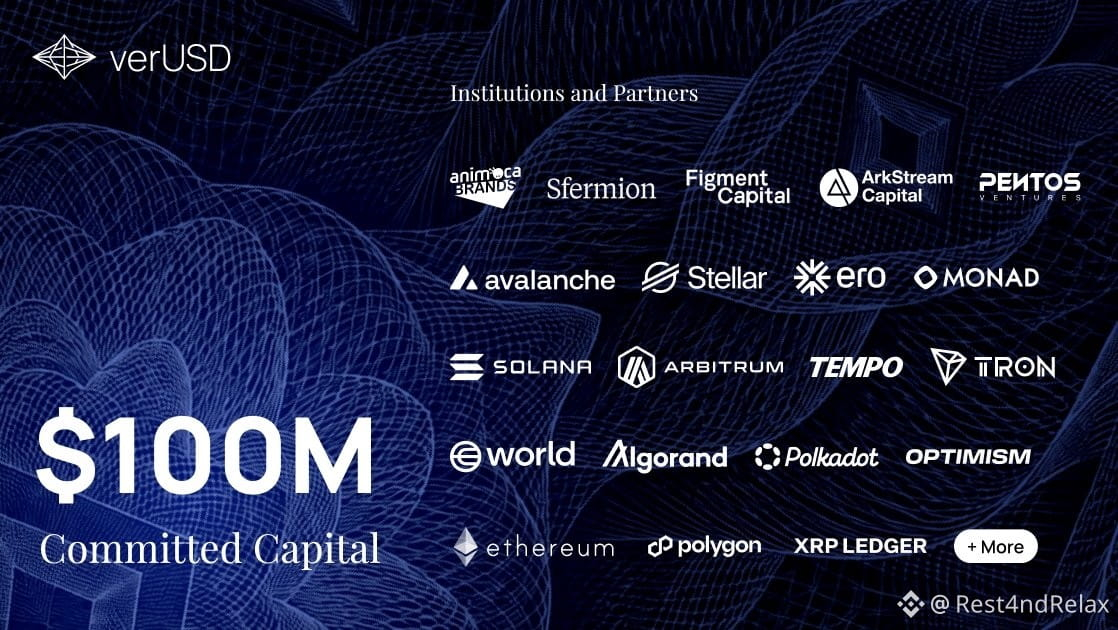
Verona has officially introduced verUSD (Verona USD), a stablecoin designed for AI agents, launching with over $100M in institutional and ecosystem commitments.
The announcement includes Animoca Ventures, Figment Capital, Sfermion, Pentos Ventures, ArkStream, and others.
But there's more to this than just another stablecoin.
Here's what caught my attention:
🔹 Over $60M in signed, contracted revenue is set to flow through verUSD as payments.
🔹 Native issuance across Ethereum, Solana, Polygon, Avalanche, Optimism, Arbitrum, and Celo, rather than relying on bridged versions.
🔹 Built around an ecosystem that has already been using USDC for dollar-based payments.
So why does this matter?
Imagine AI agents accessing verified information and paying for services automatically, potentially thousands of times a day.
Traditional payment systems weren't really built around this kind of activity.
That's where Verona connects two important pieces:
Verona provides privacy-preserving, verified information.
verUSD gives AI agents a way to pay for it.
In simple terms:
Verona verifies the facts. verUSD handles the payments.
For me, this is another interesting step toward building an internet where AI agents can access trustworthy information and transact on it.
The AI economy needs more than intelligence. It needs proof and payment infrastructure.
🔗 Official announcement: https://x.com/verona_dev/status/2104585564058239327
#Verona #verUSD #AI #Stablecoin #Web3
AI agents are getting smarter. Now they need a way to pay.
Big update from VERONA!
Verona has officially introduced verUSD (Verona USD), a stablecoin designed for AI agents, launching with over $100M in institutional and ecosystem commitments.
The announcement includes Animoca Ventures, Figment Capital, Sfermion, Pentos Ventures, ArkStream, and others.
But there's more to this than just another stablecoin.
Here's what caught my attention:
🔹 Over $60M in signed, contracted revenue is set to flow through verUSD as payments.
🔹 Native issuance across Ethereum, Solana, Polygon, Avalanche, Optimism, Arbitrum, and Celo, rather than relying on bridged versions.
🔹 Built around an ecosystem that has already been using USDC for dollar-based payments.
So why does this matter?
Imagine AI agents accessing verified information and paying for services automatically, potentially thousands of times a day.
Traditional payment systems weren't really built around this kind of activity.
That's where Verona connects two important pieces:
Verona provides privacy-preserving, verified information.
verUSD gives AI agents a way to pay for it.
In simple terms:
Verona verifies the facts. verUSD handles the payments.
For me, this is another interesting step toward building an internet where AI agents can access trustworthy information and transact on it.
The AI economy needs more than intelligence. It needs proof and payment infrastructure.
🔗 Official announcement: https://x.com/verona_dev/status/2104585564058239327
#Verona #verUSD #AI #Stablecoin #Web3
Big update from VERONA!
Verona has officially introduced verUSD (Verona USD), a stablecoin designed for AI agents, launching with over $100M in institutional and ecosystem commitments.
The announcement includes Animoca Ventures, Figment Capital, Sfermion, Pentos Ventures, ArkStream, and others.
But there's more to this than just another stablecoin.
Here's what caught my attention:
🔹 Over $60M in signed, contracted revenue is set to flow through verUSD as payments.
🔹 Native issuance across Ethereum, Solana, Polygon, Avalanche, Optimism, Arbitrum, and Celo, rather than relying on bridged versions.
🔹 Built around an ecosystem that has already been using USDC for dollar-based payments.
So why does this matter?
Imagine AI agents accessing verified information and paying for services automatically, potentially thousands of times a day.
Traditional payment systems weren't really built around this kind of activity.
That's where Verona connects two important pieces:
Verona provides privacy-preserving, verified information.
verUSD gives AI agents a way to pay for it.
In simple terms:
Verona verifies the facts. verUSD handles the payments.
For me, this is another interesting step toward building an internet where AI agents can access trustworthy information and transact on it.
The AI economy needs more than intelligence. It needs proof and payment infrastructure.
🔗 Official announcement: https://x.com/verona_dev/status/2104585564058239327
#Verona #verUSD #AI #Stablecoin #Web3
1
610
·
--
Article
AI Agents Need More Than Intelligence. Verona Just Introduced verUSD.AI can already answer questions, analyze information, and perform complex tasks.
But here's something we rarely discuss:
How will AI agents actually pay for the services and information they use?
This is where Verona's latest announcement gets interesting.
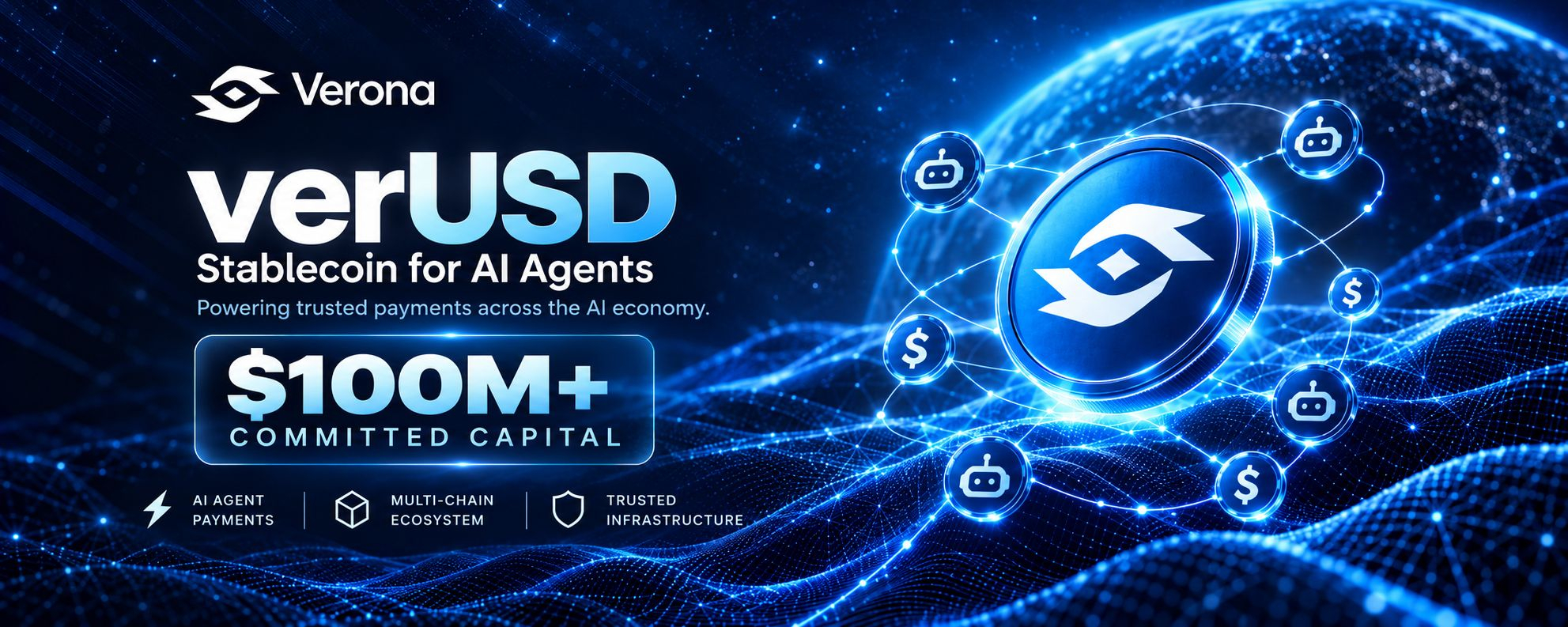
On September 28, @verona_dev officially introduced verUSD (Verona USD), a dollar-based stablecoin designed for AI agents, launching with over $100 million in institutional and ecosystem commitments.
The announcement includes Animoca Ventures, Figment Capital, Sfermion, Pentos Ventures, ArkStream, and others.
What makes verUSD interesting?
A few important details from the announcement:
• Over $100M in total launch commitments, including more than $60M in signed, contracted revenue expected to flow through verUSD as payments.
• verUSD is designed for native issuance across major networks, including Ethereum, Solana, Polygon, Avalanche, Optimism, Arbitrum, and Celo, rather than relying on bridged versions.
• Verona's ecosystem already has experience using USDC for dollar-based payments. verUSD now introduces its own dollar into that existing payment model.
But why does AI need this?
Think about an AI agent that needs verified information to complete a task.
Traditional payment systems were primarily designed around people, not software making frequent, automated transactions.
Verona is approaching this problem from two connected directions:
Verona provides verified information. verUSD provides a way for AI agents to pay for it.
This creates an interesting connection between trusted data and programmable payments.
And that's what caught my attention.
We're watching AI evolve from a tool that simply provides answers into systems capable of interacting with applications and performing economic activities.
For that future to work, reliable information and payment infrastructure will both matter.
verUSD represents another step in Verona's broader vision of becoming the intelligence layer for AI.
The internet doesn't just need smarter agents. It needs agents that can access trustworthy information and transact on it.
What do you think? Could AI agent payments become an important use case for the next generation of stablecoins?
🔗 Official announcement: https://x.com/verona_dev/status/2104585564058239327
#Verona #verUSD #AI #AIAgents #Stablecoin #Web3
AI Agents Need More Than Intelligence. Verona Just Introduced verUSD.
AI can already answer questions, analyze information, and perform complex tasks.
But here's something we rarely discuss:
How will AI agents actually pay for the services and information they use?
This is where Verona's latest announcement gets interesting.
On September 28, @verona_dev officially introduced verUSD (Verona USD), a dollar-based stablecoin designed for AI agents, launching with over $100 million in institutional and ecosystem commitments.
The announcement includes Animoca Ventures, Figment Capital, Sfermion, Pentos Ventures, ArkStream, and others.
What makes verUSD interesting?
A few important details from the announcement:
• Over $100M in total launch commitments, including more than $60M in signed, contracted revenue expected to flow through verUSD as payments.
• verUSD is designed for native issuance across major networks, including Ethereum, Solana, Polygon, Avalanche, Optimism, Arbitrum, and Celo, rather than relying on bridged versions.
• Verona's ecosystem already has experience using USDC for dollar-based payments. verUSD now introduces its own dollar into that existing payment model.
But why does AI need this?
Think about an AI agent that needs verified information to complete a task.
Traditional payment systems were primarily designed around people, not software making frequent, automated transactions.
Verona is approaching this problem from two connected directions:
Verona provides verified information. verUSD provides a way for AI agents to pay for it.
This creates an interesting connection between trusted data and programmable payments.
And that's what caught my attention.
We're watching AI evolve from a tool that simply provides answers into systems capable of interacting with applications and performing economic activities.
For that future to work, reliable information and payment infrastructure will both matter.
verUSD represents another step in Verona's broader vision of becoming the intelligence layer for AI.
The internet doesn't just need smarter agents. It needs agents that can access trustworthy information and transact on it.
What do you think? Could AI agent payments become an important use case for the next generation of stablecoins?
🔗 Official announcement: https://x.com/verona_dev/status/2104585564058239327
#Verona #verUSD #AI #AIAgents #Stablecoin #Web3
But here's something we rarely discuss:
How will AI agents actually pay for the services and information they use?
This is where Verona's latest announcement gets interesting.
On September 28, @verona_dev officially introduced verUSD (Verona USD), a dollar-based stablecoin designed for AI agents, launching with over $100 million in institutional and ecosystem commitments.
The announcement includes Animoca Ventures, Figment Capital, Sfermion, Pentos Ventures, ArkStream, and others.
What makes verUSD interesting?
A few important details from the announcement:
• Over $100M in total launch commitments, including more than $60M in signed, contracted revenue expected to flow through verUSD as payments.
• verUSD is designed for native issuance across major networks, including Ethereum, Solana, Polygon, Avalanche, Optimism, Arbitrum, and Celo, rather than relying on bridged versions.
• Verona's ecosystem already has experience using USDC for dollar-based payments. verUSD now introduces its own dollar into that existing payment model.
But why does AI need this?
Think about an AI agent that needs verified information to complete a task.
Traditional payment systems were primarily designed around people, not software making frequent, automated transactions.
Verona is approaching this problem from two connected directions:
Verona provides verified information. verUSD provides a way for AI agents to pay for it.
This creates an interesting connection between trusted data and programmable payments.
And that's what caught my attention.
We're watching AI evolve from a tool that simply provides answers into systems capable of interacting with applications and performing economic activities.
For that future to work, reliable information and payment infrastructure will both matter.
verUSD represents another step in Verona's broader vision of becoming the intelligence layer for AI.
The internet doesn't just need smarter agents. It needs agents that can access trustworthy information and transact on it.
What do you think? Could AI agent payments become an important use case for the next generation of stablecoins?
🔗 Official announcement: https://x.com/verona_dev/status/2104585564058239327
#Verona #verUSD #AI #AIAgents #Stablecoin #Web3
1
78
·
--
Haussier
AI Is Getting Smarter. But Can It Trust the Information It Uses?
Today in Seoul, Verona is hosting “Behind the Scenes of AI” together with Kite AI, Pieverse, OpenRoboto, and Hippo Protocol.
The event focuses on three simple questions:
Who Verifies?
Who Pays?
Who Trains?
At first, these may sound like technical questions.
But as AI agents become more autonomous, they become much more important.
An AI agent may be able to search, analyze, communicate, and eventually transact on our behalf.
But before that can work at scale, several problems still need to be solved.
AI needs information it can trust.
Agents need infrastructure to make payments.
Sensitive data needs privacy.
And AI systems need reliable ways to learn and improve.
This is where Verona’s role becomes interesting.
Verona is focused on verified information making it possible for facts to be proven and used by authorized apps or AI agents without necessarily exposing the raw data behind them.
That changes the conversation.
The future of AI may not only depend on building smarter models.
It may also depend on building a stronger layer underneath them:
verification, privacy, payments, training, and trust.
Because an intelligent agent working with unreliable information is still a problem.
And as AI begins to act more independently, being able to verify what it knows could become just as important as intelligence itself.
📍 Seoul
📅 September 17
🕐 19:00–21:00 KST
📌 SparkPlus Seolleung 3
RSVP: https://luma.com/zvmcaqns
#verona #ai
AI Is Getting Smarter. But Can It Trust the Information It Uses?
Today in Seoul, Verona is hosting “Behind the Scenes of AI” together with Kite AI, Pieverse, OpenRoboto, and Hippo Protocol.
The event focuses on three simple questions:
Who Verifies?
Who Pays?
Who Trains?
At first, these may sound like technical questions.
But as AI agents become more autonomous, they become much more important.
An AI agent may be able to search, analyze, communicate, and eventually transact on our behalf.
But before that can work at scale, several problems still need to be solved.
AI needs information it can trust.
Agents need infrastructure to make payments.
Sensitive data needs privacy.
And AI systems need reliable ways to learn and improve.
This is where Verona’s role becomes interesting.
Verona is focused on verified information making it possible for facts to be proven and used by authorized apps or AI agents without necessarily exposing the raw data behind them.
That changes the conversation.
The future of AI may not only depend on building smarter models.
It may also depend on building a stronger layer underneath them:
verification, privacy, payments, training, and trust.
Because an intelligent agent working with unreliable information is still a problem.
And as AI begins to act more independently, being able to verify what it knows could become just as important as intelligence itself.
📍 Seoul
📅 September 17
🕐 19:00–21:00 KST
📌 SparkPlus Seolleung 3
RSVP: https://luma.com/zvmcaqns
#verona #ai
Today in Seoul, Verona is hosting “Behind the Scenes of AI” together with Kite AI, Pieverse, OpenRoboto, and Hippo Protocol.
The event focuses on three simple questions:
Who Verifies?
Who Pays?
Who Trains?
At first, these may sound like technical questions.
But as AI agents become more autonomous, they become much more important.
An AI agent may be able to search, analyze, communicate, and eventually transact on our behalf.
But before that can work at scale, several problems still need to be solved.
AI needs information it can trust.
Agents need infrastructure to make payments.
Sensitive data needs privacy.
And AI systems need reliable ways to learn and improve.
This is where Verona’s role becomes interesting.
Verona is focused on verified information making it possible for facts to be proven and used by authorized apps or AI agents without necessarily exposing the raw data behind them.
That changes the conversation.
The future of AI may not only depend on building smarter models.
It may also depend on building a stronger layer underneath them:
verification, privacy, payments, training, and trust.
Because an intelligent agent working with unreliable information is still a problem.
And as AI begins to act more independently, being able to verify what it knows could become just as important as intelligence itself.
📍 Seoul
📅 September 17
🕐 19:00–21:00 KST
📌 SparkPlus Seolleung 3
RSVP: https://luma.com/zvmcaqns
#verona #ai

1
101
·
--
Verona × Pulsar Money: Why Verified Data Matters Before AI Touches Your MoneyAI agents are getting smarter.
They can already help people research, compare products, summarize information, and automate simple tasks.
But once AI starts getting closer to money, the standard has to be much higher.
A wrong restaurant recommendation is annoying.
A wrong financial decision can actually cost you.
That is what makes the partnership between Verona_dev and Pulsar Money App interesting.
This is not just another “AI + payments” collaboration.
The bigger question behind it is much simpler:
How does an AI know the information behind a financial decision is actually true?
What is Pulsar Money?
Pulsar Money is building a consumer money app that brings several financial tools into one experience.
The app includes USD and EUR accounts, stablecoin funding, transfers, swaps, a virtual card, and an AI companion designed to operate inside the user's account.
That last part is important.
If an AI companion eventually helps users make or execute financial decisions, it may need to understand things like:
Should I use cash or points?
Does this user already have a subscription somewhere else?
Is this reward actually available to them?
Which option makes more sense based on information the user has shared?
An AI cannot simply guess.
Especially when money is involved.
This is where Verona enters the picture
Verona describes itself as an intelligence layer for AI.
The idea is that information about a user can be verified once from its original source, with the user controlling the proof.
Then, an application or AI agent that receives permission can reuse that verified information without necessarily needing access to all of the raw underlying data.
In simple terms:
Instead of asking AI to trust whatever information it finds, Verona is trying to give AI access to facts that can actually be proven.
Pulsar is bringing its AI companion and points program to Verona.
When agentic payment capabilities arrive in the app, the goal is for the companion to make decisions using verified facts rather than simply relying on assumptions or data it cannot independently check.
And that could become increasingly important as AI agents are given more responsibility.
The partnership is also about Pulsar Points
This part may look smaller, but I think it is worth paying attention to.
Think about most loyalty programs today.
If an app says you have 5,000 points, you usually trust that number because it appears inside the company's database.
You cannot really prove much beyond that.
Pulsar says it is working with Verona to make Pulsar Points cryptographically verifiable.
That sounds technical, but the idea is simple:
The points become something the user can prove, rather than just a number they are told to trust.
This creates an interesting combination.
The user can have verified facts.
The user can have provable points.
And an authorized AI companion can potentially use that information when deciding what action makes sense.
You can think of it as:
Proof → Decision → Action
Why does this matter?
A lot of AI development today focuses on making models more intelligent.
Better reasoning.
Better memory.
Better tools.
Better automation.
But intelligence alone does not solve the trust problem.
An AI agent can be extremely capable and still make a bad decision if the information underneath it is wrong.
That becomes much more serious when the agent can act on behalf of the user.
Especially when payments are involved.
This is why I think the Verona × Pulsar Money partnership is a useful example of what Verona's broader vision could look like in a real consumer product.
Pulsar does not need Verona to simply move money.
That is Pulsar's side of the experience.
The interesting part is what happens before the money moves.
What facts does the AI know?
Can those facts be verified?
Did the user actually authorize the agent to use them?
Can the agent trust the points or rewards it is evaluating?
Those questions become increasingly important as AI agents move from simply answering questions to actually taking actions.
The bigger picture
The easiest way to understand this partnership is:
Pulsar moves the money.
Verona helps make the information behind the decision verifiable.
Different roles, but one shared problem:
How do you give AI more responsibility without asking users to blindly trust it?
As AI agents become more involved in payments, shopping, subscriptions, rewards, and everyday financial decisions, verified information could become just as important as intelligence itself.
Because when an AI starts acting on your behalf, being smart is useful.
Knowing what is actually true is essential.
Verona × Pulsar Money: Why Verified Data Matters Before AI Touches Your Money
AI agents are getting smarter.
They can already help people research, compare products, summarize information, and automate simple tasks.
But once AI starts getting closer to money, the standard has to be much higher.
A wrong restaurant recommendation is annoying.
A wrong financial decision can actually cost you.
That is what makes the partnership between Verona_dev and Pulsar Money App interesting.
This is not just another “AI + payments” collaboration.
The bigger question behind it is much simpler:
How does an AI know the information behind a financial decision is actually true?
What is Pulsar Money?
Pulsar Money is building a consumer money app that brings several financial tools into one experience.
The app includes USD and EUR accounts, stablecoin funding, transfers, swaps, a virtual card, and an AI companion designed to operate inside the user's account.
That last part is important.
If an AI companion eventually helps users make or execute financial decisions, it may need to understand things like:
Should I use cash or points?
Does this user already have a subscription somewhere else?
Is this reward actually available to them?
Which option makes more sense based on information the user has shared?
An AI cannot simply guess.
Especially when money is involved.
This is where Verona enters the picture
Verona describes itself as an intelligence layer for AI.
The idea is that information about a user can be verified once from its original source, with the user controlling the proof.
Then, an application or AI agent that receives permission can reuse that verified information without necessarily needing access to all of the raw underlying data.
In simple terms:
Instead of asking AI to trust whatever information it finds, Verona is trying to give AI access to facts that can actually be proven.
Pulsar is bringing its AI companion and points program to Verona.
When agentic payment capabilities arrive in the app, the goal is for the companion to make decisions using verified facts rather than simply relying on assumptions or data it cannot independently check.
And that could become increasingly important as AI agents are given more responsibility.
The partnership is also about Pulsar Points
This part may look smaller, but I think it is worth paying attention to.
Think about most loyalty programs today.
If an app says you have 5,000 points, you usually trust that number because it appears inside the company's database.
You cannot really prove much beyond that.
Pulsar says it is working with Verona to make Pulsar Points cryptographically verifiable.
That sounds technical, but the idea is simple:
The points become something the user can prove, rather than just a number they are told to trust.
This creates an interesting combination.
The user can have verified facts.
The user can have provable points.
And an authorized AI companion can potentially use that information when deciding what action makes sense.
You can think of it as:
Proof → Decision → Action
Why does this matter?
A lot of AI development today focuses on making models more intelligent.
Better reasoning.
Better memory.
Better tools.
Better automation.
But intelligence alone does not solve the trust problem.
An AI agent can be extremely capable and still make a bad decision if the information underneath it is wrong.
That becomes much more serious when the agent can act on behalf of the user.
Especially when payments are involved.
This is why I think the Verona × Pulsar Money partnership is a useful example of what Verona's broader vision could look like in a real consumer product.
Pulsar does not need Verona to simply move money.
That is Pulsar's side of the experience.
The interesting part is what happens before the money moves.
What facts does the AI know?
Can those facts be verified?
Did the user actually authorize the agent to use them?
Can the agent trust the points or rewards it is evaluating?
Those questions become increasingly important as AI agents move from simply answering questions to actually taking actions.
The bigger picture
The easiest way to understand this partnership is:
Pulsar moves the money.
Verona helps make the information behind the decision verifiable.
Different roles, but one shared problem:
How do you give AI more responsibility without asking users to blindly trust it?
As AI agents become more involved in payments, shopping, subscriptions, rewards, and everyday financial decisions, verified information could become just as important as intelligence itself.
Because when an AI starts acting on your behalf, being smart is useful.
Knowing what is actually true is essential.
They can already help people research, compare products, summarize information, and automate simple tasks.
But once AI starts getting closer to money, the standard has to be much higher.
A wrong restaurant recommendation is annoying.
A wrong financial decision can actually cost you.
That is what makes the partnership between Verona_dev and Pulsar Money App interesting.
This is not just another “AI + payments” collaboration.
The bigger question behind it is much simpler:
How does an AI know the information behind a financial decision is actually true?
What is Pulsar Money?
Pulsar Money is building a consumer money app that brings several financial tools into one experience.
The app includes USD and EUR accounts, stablecoin funding, transfers, swaps, a virtual card, and an AI companion designed to operate inside the user's account.
That last part is important.
If an AI companion eventually helps users make or execute financial decisions, it may need to understand things like:
Should I use cash or points?
Does this user already have a subscription somewhere else?
Is this reward actually available to them?
Which option makes more sense based on information the user has shared?
An AI cannot simply guess.
Especially when money is involved.
This is where Verona enters the picture
Verona describes itself as an intelligence layer for AI.
The idea is that information about a user can be verified once from its original source, with the user controlling the proof.
Then, an application or AI agent that receives permission can reuse that verified information without necessarily needing access to all of the raw underlying data.
In simple terms:
Instead of asking AI to trust whatever information it finds, Verona is trying to give AI access to facts that can actually be proven.
Pulsar is bringing its AI companion and points program to Verona.
When agentic payment capabilities arrive in the app, the goal is for the companion to make decisions using verified facts rather than simply relying on assumptions or data it cannot independently check.
And that could become increasingly important as AI agents are given more responsibility.
The partnership is also about Pulsar Points
This part may look smaller, but I think it is worth paying attention to.
Think about most loyalty programs today.
If an app says you have 5,000 points, you usually trust that number because it appears inside the company's database.
You cannot really prove much beyond that.
Pulsar says it is working with Verona to make Pulsar Points cryptographically verifiable.
That sounds technical, but the idea is simple:
The points become something the user can prove, rather than just a number they are told to trust.
This creates an interesting combination.
The user can have verified facts.
The user can have provable points.
And an authorized AI companion can potentially use that information when deciding what action makes sense.
You can think of it as:
Proof → Decision → Action
Why does this matter?
A lot of AI development today focuses on making models more intelligent.
Better reasoning.
Better memory.
Better tools.
Better automation.
But intelligence alone does not solve the trust problem.
An AI agent can be extremely capable and still make a bad decision if the information underneath it is wrong.
That becomes much more serious when the agent can act on behalf of the user.
Especially when payments are involved.
This is why I think the Verona × Pulsar Money partnership is a useful example of what Verona's broader vision could look like in a real consumer product.
Pulsar does not need Verona to simply move money.
That is Pulsar's side of the experience.
The interesting part is what happens before the money moves.
What facts does the AI know?
Can those facts be verified?
Did the user actually authorize the agent to use them?
Can the agent trust the points or rewards it is evaluating?
Those questions become increasingly important as AI agents move from simply answering questions to actually taking actions.
The bigger picture
The easiest way to understand this partnership is:
Pulsar moves the money.
Verona helps make the information behind the decision verifiable.
Different roles, but one shared problem:
How do you give AI more responsibility without asking users to blindly trust it?
As AI agents become more involved in payments, shopping, subscriptions, rewards, and everyday financial decisions, verified information could become just as important as intelligence itself.
Because when an AI starts acting on your behalf, being smart is useful.
Knowing what is actually true is essential.
1
292
·
--
AI agents don’t just need intelligence. They need boundaries.
Verona is partnering with ATBASH to tackle both sides of AI trust.
Verona helps agents work with verified information.
Atbash helps ensure those agents only take allowed actions.
Simple idea:
Verona proves what’s true.
Atbash controls what’s permitted.
As AI agents start handling money, data, and real-world actions, that combination could become increasingly important.
#verona #CryptoAi #AI
AI agents don’t just need intelligence. They need boundaries.
Verona is partnering with ATBASH to tackle both sides of AI trust.
Verona helps agents work with verified information.
Atbash helps ensure those agents only take allowed actions.
Simple idea:
Verona proves what’s true.
Atbash controls what’s permitted.
As AI agents start handling money, data, and real-world actions, that combination could become increasingly important.
#verona #CryptoAi #AI
Verona is partnering with ATBASH to tackle both sides of AI trust.
Verona helps agents work with verified information.
Atbash helps ensure those agents only take allowed actions.
Simple idea:
Verona proves what’s true.
Atbash controls what’s permitted.
As AI agents start handling money, data, and real-world actions, that combination could become increasingly important.
#verona #CryptoAi #AI
1
97
·
--
Haussier
Partiellement vrai
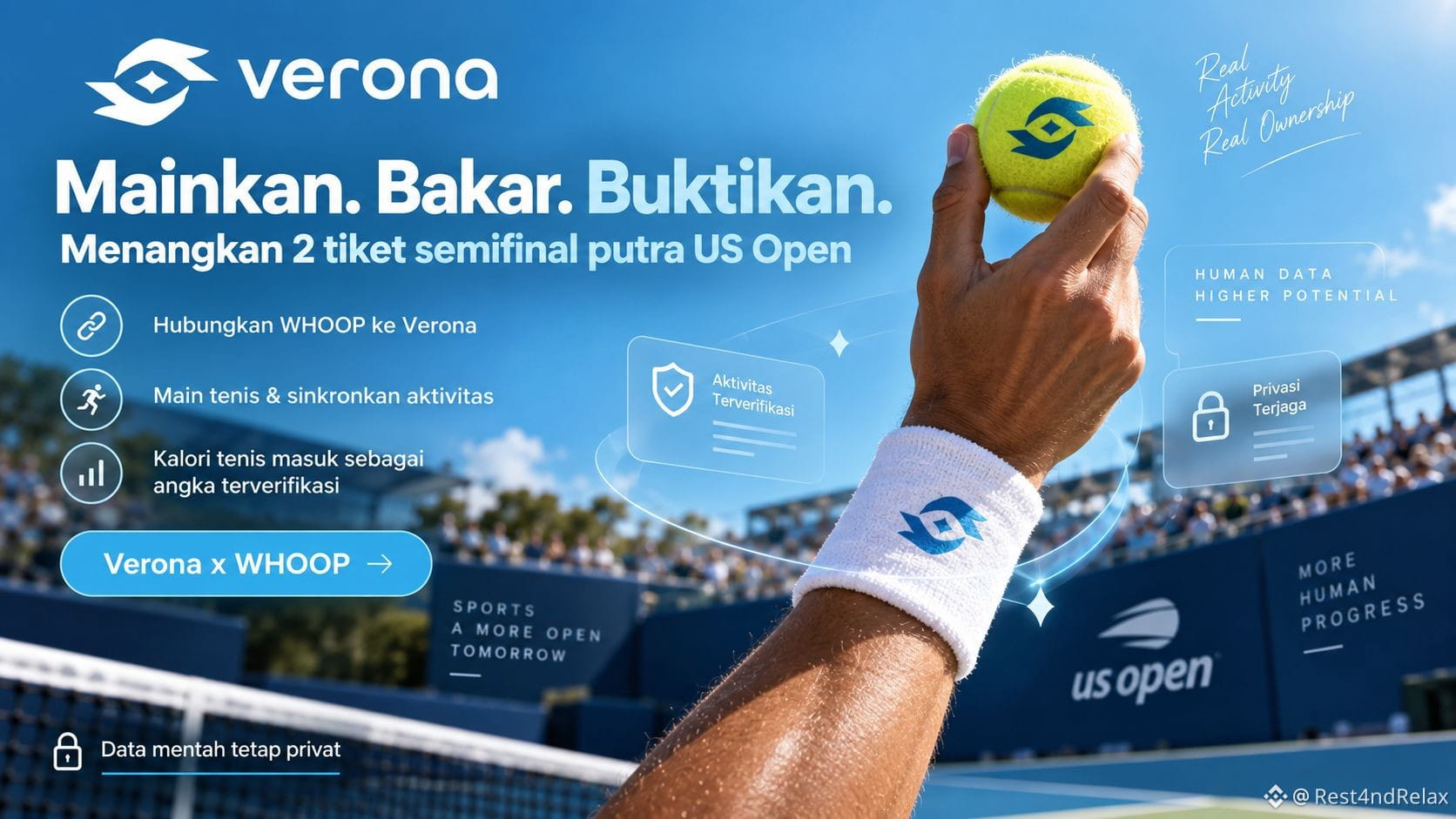
Awalnya gue kira ini cuma campaign buat menang 2 tiket semifinal US Open.
Ternyata bagian paling menarik justru bukan tiketnya.
Verona sedang menunjukkan seperti apa verified data + privacy ketika benar-benar dipakai user biasa.
Caranya simpel:
Connect akun Verona ke WHOOP.
Main tenis.
Sync aktivitas.
Kalori tenis lo masuk ke leaderboard sebagai angka yang terverifikasi.
Di belakang layar, Verona menjelaskan bahwa workout dari WHOOP diproses melalui sesi zkTLS untuk menghitung kalori tenis dan menghasilkan proof.
Yang menurut gue penting:
Verona tidak perlu menjadikan seluruh data workout lo sebagai sesuatu yang harus terus disimpan.
Setelah totalnya terbentuk, raw workouts dan access token dihancurkan menurut mekanisme yang mereka jelaskan di campaign.
Jadi hasil akhirnya kurang lebih seperti:
“Orang ini membakar X kalori dari aktivitas tenis.”
Yang perlu dibuktikan adalah faktanya.
Bukan berarti semua data di belakang fakta tersebut harus ikut dibuka.
Dan menurut gue di sinilah use case Verona mulai terasa lebih nyata.
Hari ini contohnya kalori tenis.
Besok pola yang sama secara konsep bisa relevan ketika sebuah app atau AI hanya membutuhkan satu fakta tertentu tentang user, bukan seluruh data pribadi mereka.
Ada satu detail lain yang gue suka.
Top 10 calorie scores masuk ke tahap akhir, lalu satu pemenang dipilih secara random on-chain menggunakan public seed, sehingga hasilnya bisa diperiksa sendiri.
Jadi campaign ini menggabungkan:
real-world activity → verified data → privacy → verifiable outcome.
Tiket US Open memang bikin orang tertarik.
Tapi buat gue, demo sebenarnya adalah ini:
prove what matters, without exposing everything else.
Dan itu jauh lebih besar daripada sekadar campaign tenis.
#verona #whoop #tennis #kalori
Awalnya gue kira ini cuma campaign buat menang 2 tiket semifinal US Open.
Ternyata bagian paling menarik justru bukan tiketnya.
Verona sedang menunjukkan seperti apa verified data + privacy ketika benar-benar dipakai user biasa.
Caranya simpel:
Connect akun Verona ke WHOOP.
Main tenis.
Sync aktivitas.
Kalori tenis lo masuk ke leaderboard sebagai angka yang terverifikasi.
Di belakang layar, Verona menjelaskan bahwa workout dari WHOOP diproses melalui sesi zkTLS untuk menghitung kalori tenis dan menghasilkan proof.
Yang menurut gue penting:
Verona tidak perlu menjadikan seluruh data workout lo sebagai sesuatu yang harus terus disimpan.
Setelah totalnya terbentuk, raw workouts dan access token dihancurkan menurut mekanisme yang mereka jelaskan di campaign.
Jadi hasil akhirnya kurang lebih seperti:
“Orang ini membakar X kalori dari aktivitas tenis.”
Yang perlu dibuktikan adalah faktanya.
Bukan berarti semua data di belakang fakta tersebut harus ikut dibuka.
Dan menurut gue di sinilah use case Verona mulai terasa lebih nyata.
Hari ini contohnya kalori tenis.
Besok pola yang sama secara konsep bisa relevan ketika sebuah app atau AI hanya membutuhkan satu fakta tertentu tentang user, bukan seluruh data pribadi mereka.
Ada satu detail lain yang gue suka.
Top 10 calorie scores masuk ke tahap akhir, lalu satu pemenang dipilih secara random on-chain menggunakan public seed, sehingga hasilnya bisa diperiksa sendiri.
Jadi campaign ini menggabungkan:
real-world activity → verified data → privacy → verifiable outcome.
Tiket US Open memang bikin orang tertarik.
Tapi buat gue, demo sebenarnya adalah ini:
prove what matters, without exposing everything else.
Dan itu jauh lebih besar daripada sekadar campaign tenis.
#verona #whoop #tennis #kalori
Ternyata bagian paling menarik justru bukan tiketnya.
Verona sedang menunjukkan seperti apa verified data + privacy ketika benar-benar dipakai user biasa.
Caranya simpel:
Connect akun Verona ke WHOOP.
Main tenis.
Sync aktivitas.
Kalori tenis lo masuk ke leaderboard sebagai angka yang terverifikasi.
Di belakang layar, Verona menjelaskan bahwa workout dari WHOOP diproses melalui sesi zkTLS untuk menghitung kalori tenis dan menghasilkan proof.
Yang menurut gue penting:
Verona tidak perlu menjadikan seluruh data workout lo sebagai sesuatu yang harus terus disimpan.
Setelah totalnya terbentuk, raw workouts dan access token dihancurkan menurut mekanisme yang mereka jelaskan di campaign.
Jadi hasil akhirnya kurang lebih seperti:
“Orang ini membakar X kalori dari aktivitas tenis.”
Yang perlu dibuktikan adalah faktanya.
Bukan berarti semua data di belakang fakta tersebut harus ikut dibuka.
Dan menurut gue di sinilah use case Verona mulai terasa lebih nyata.
Hari ini contohnya kalori tenis.
Besok pola yang sama secara konsep bisa relevan ketika sebuah app atau AI hanya membutuhkan satu fakta tertentu tentang user, bukan seluruh data pribadi mereka.
Ada satu detail lain yang gue suka.
Top 10 calorie scores masuk ke tahap akhir, lalu satu pemenang dipilih secara random on-chain menggunakan public seed, sehingga hasilnya bisa diperiksa sendiri.
Jadi campaign ini menggabungkan:
real-world activity → verified data → privacy → verifiable outcome.
Tiket US Open memang bikin orang tertarik.
Tapi buat gue, demo sebenarnya adalah ini:
prove what matters, without exposing everything else.
Dan itu jauh lebih besar daripada sekadar campaign tenis.
#verona #whoop #tennis #kalori
1
62
·
--
Vérifié
Article
Three Different Projects, One Problem: Why Verona’s First GIA Cohort MattersAt first glance, I didn’t think much of Verona’s latest accelerator update.
Three projects were selected.
One works on AI marketing.
One works on robotics.
One works on professional credentials.
Pretty standard accelerator stuff, right?
But the more I looked at them, the more interesting the pattern became.
Because these three projects may operate in completely different industries, but underneath, they are all running into a very similar problem:
How do you know which information can actually be trusted?
And I think that tells us more about where Verona is heading than the accelerator announcement itself.
Three Projects That Shouldn’t Have Much in Common
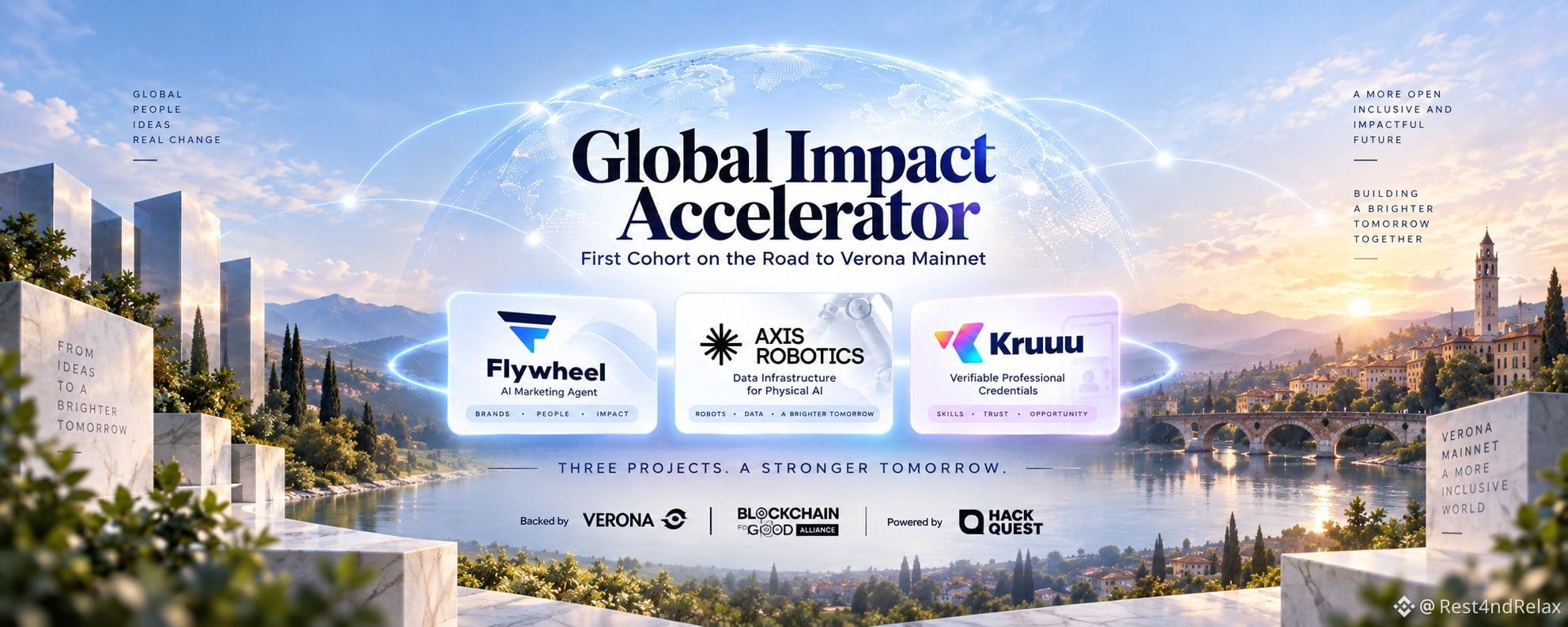
The Global Impact Accelerator brings together Verona, HackQuest, and Chain for Good.
Its first cohort includes:
Flywheel AI.
Axis Robotics.
Kruuu Marketplace.
And over the next two months, each team will work toward full deployment and verification on Verona Mainnet.
That last part matters.
Because instead of looking only at Verona’s positioning, we can now start looking at the kinds of products being brought toward its Mainnet.
And they are surprisingly diverse.
Flywheel AI: What Happens When AI Stops Waiting for Prompts?
Most people still interact with AI in the same way.
You ask.
AI answers.
You ask again.
AI answers again.
Flywheel AI is exploring something more proactive.
It is building an AI marketing agent for small and medium-sized businesses that can look at business performance, identify potential growth opportunities, and turn those opportunities into marketing actions across areas such as SEO, GEO, and social campaigns.
The interesting part isn’t simply “AI for marketing.”
We already have plenty of that.
The bigger shift is toward AI agents that can increasingly observe information and act on it.
And once AI starts taking more actions, the quality of the information behind those actions becomes much more important.
A chatbot giving you a bad suggestion is annoying.
An autonomous system acting on bad information is a much bigger problem.
That is where the question of trusted data becomes interesting.
Axis Robotics: AI Needs More Than Internet Data
Then there is Axis Robotics.
This one moves the conversation away from screens and into the physical world.
Axis is building data infrastructure for Physical AI and robotics, including tools for browser-based teleoperation and spatial data collection through smartphones.
That immediately creates another version of the same question.
What happens when AI needs to understand the real world?
Robots cannot rely only on text scraped from the internet.
They need information about physical environments, movements, objects, and interactions.
And as AI systems move closer to making decisions in the physical world, data quality matters even more.
Because intelligence is only as useful as the information it can rely on.
A powerful model working with unreliable input doesn’t magically produce trustworthy output.
Sometimes it simply produces a more confident mistake.
Kruuu: From “Trust My Profile” to “Verify My Credentials”
Kruuu Marketplace may be the easiest example to understand.
It focuses on Indonesia’s entertainment industry and professional credentials.
Think about how professional reputation works online today.
Someone can write:
“I worked on this production.”
“I have this qualification.”
“I have this experience.”
And in many cases, everyone else is expected to trust that claim or manually investigate it.
Kruuu is working toward making professional credentials verifiable and harder to fake, while keeping the user experience walletless and gasless.
That last part is important too.
Because verification infrastructure does not become useful to normal users simply because it uses blockchain.
The underlying technology can be sophisticated.
The user experience shouldn’t have to be.
A filmmaker, creative worker, or professional shouldn’t need to understand wallets, gas fees, or blockchain architecture just to prove something about their career.
Ideally, they should simply get the benefit:
a claim that can be verified.
Different Products. Same Underlying Problem.
This is the part that caught my attention.
Flywheel is dealing with information used by AI agents.
Axis is dealing with data used by robotics and Physical AI.
Kruuu is dealing with information about human credentials.
Completely different markets.
But zoom out and the pattern starts to look familiar.
AI needs information it can rely on.
Robots need trustworthy real-world data.
People need claims that can be proven.
The internet already has more information than any human could consume.
AI makes that information even easier to generate.
But that might create a new bottleneck.
Not access.
Not creation.
Trust.
The question may increasingly become:
Where did this information come from?
Is it authentic?
Can this claim be verified?
Should an AI agent be allowed to act on it?
That is a very different internet from the one we grew up with.
This Is Where Verona’s Positioning Starts to Make More Sense
This is also why I think looking at Verona only as another blockchain misses the more interesting thesis.
Verona has been positioning itself around verified data, AI agents, privacy, proof, and trust.
The idea is not simply to put more information onchain.
The more interesting idea is creating infrastructure where information can be verified and then used by applications or AI systems that have permission to access it.
And the first GIA cohort gives us three different examples of where that kind of infrastructure could matter.
Not theoretical categories.
Actual products working across AI marketing, robotics, and professional credentials.
To be clear, the announcement does not mean these products are already fully deployed on Verona today.
The stated next step is that, over the next two months, each team will work toward full deployment and verification on Verona Mainnet.
That distinction matters.
But so does the direction.
AI Probably Won’t Have a Data Shortage
For years, the internet economy was built around collecting more data.
More clicks.
More profiles.
More activity.
More content.
More signals.
AI makes generating and processing all of that information dramatically easier.
Which makes me think the next problem may not be:
“How do we get more data?”
It may be:
“How do we know which data deserves to be trusted?”
Because in a world filled with AI-generated content, bots, synthetic identities, automated agents, and endless information, proof becomes more valuable.
Not because everything needs to live on a blockchain.
It doesn’t.
But because the difference between a claim and a verifiable fact becomes much more important when machines start making decisions too.
That is why I find this cohort interesting.
Flywheel.
Axis Robotics.
Kruuu.
Three very different products.
But potentially one much bigger theme:
The future of AI won’t just need intelligence.
It will need something trustworthy to be intelligent about.
And that is exactly why Verona is worth watching.
#verona #hackquest #layer1 #AImodel
Three Different Projects, One Problem: Why Verona’s First GIA Cohort Matters
At first glance, I didn’t think much of Verona’s latest accelerator update.
Three projects were selected.
One works on AI marketing.
One works on robotics.
One works on professional credentials.
Pretty standard accelerator stuff, right?
But the more I looked at them, the more interesting the pattern became.
Because these three projects may operate in completely different industries, but underneath, they are all running into a very similar problem:
How do you know which information can actually be trusted?
And I think that tells us more about where Verona is heading than the accelerator announcement itself.
Three Projects That Shouldn’t Have Much in Common
The Global Impact Accelerator brings together Verona, HackQuest, and Chain for Good.
Its first cohort includes:
Flywheel AI.
Axis Robotics.
Kruuu Marketplace.
And over the next two months, each team will work toward full deployment and verification on Verona Mainnet.
That last part matters.
Because instead of looking only at Verona’s positioning, we can now start looking at the kinds of products being brought toward its Mainnet.
And they are surprisingly diverse.
Flywheel AI: What Happens When AI Stops Waiting for Prompts?
Most people still interact with AI in the same way.
You ask.
AI answers.
You ask again.
AI answers again.
Flywheel AI is exploring something more proactive.
It is building an AI marketing agent for small and medium-sized businesses that can look at business performance, identify potential growth opportunities, and turn those opportunities into marketing actions across areas such as SEO, GEO, and social campaigns.
The interesting part isn’t simply “AI for marketing.”
We already have plenty of that.
The bigger shift is toward AI agents that can increasingly observe information and act on it.
And once AI starts taking more actions, the quality of the information behind those actions becomes much more important.
A chatbot giving you a bad suggestion is annoying.
An autonomous system acting on bad information is a much bigger problem.
That is where the question of trusted data becomes interesting.
Axis Robotics: AI Needs More Than Internet Data
Then there is Axis Robotics.
This one moves the conversation away from screens and into the physical world.
Axis is building data infrastructure for Physical AI and robotics, including tools for browser-based teleoperation and spatial data collection through smartphones.
That immediately creates another version of the same question.
What happens when AI needs to understand the real world?
Robots cannot rely only on text scraped from the internet.
They need information about physical environments, movements, objects, and interactions.
And as AI systems move closer to making decisions in the physical world, data quality matters even more.
Because intelligence is only as useful as the information it can rely on.
A powerful model working with unreliable input doesn’t magically produce trustworthy output.
Sometimes it simply produces a more confident mistake.
Kruuu: From “Trust My Profile” to “Verify My Credentials”
Kruuu Marketplace may be the easiest example to understand.
It focuses on Indonesia’s entertainment industry and professional credentials.
Think about how professional reputation works online today.
Someone can write:
“I worked on this production.”
“I have this qualification.”
“I have this experience.”
And in many cases, everyone else is expected to trust that claim or manually investigate it.
Kruuu is working toward making professional credentials verifiable and harder to fake, while keeping the user experience walletless and gasless.
That last part is important too.
Because verification infrastructure does not become useful to normal users simply because it uses blockchain.
The underlying technology can be sophisticated.
The user experience shouldn’t have to be.
A filmmaker, creative worker, or professional shouldn’t need to understand wallets, gas fees, or blockchain architecture just to prove something about their career.
Ideally, they should simply get the benefit:
a claim that can be verified.
Different Products. Same Underlying Problem.
This is the part that caught my attention.
Flywheel is dealing with information used by AI agents.
Axis is dealing with data used by robotics and Physical AI.
Kruuu is dealing with information about human credentials.
Completely different markets.
But zoom out and the pattern starts to look familiar.
AI needs information it can rely on.
Robots need trustworthy real-world data.
People need claims that can be proven.
The internet already has more information than any human could consume.
AI makes that information even easier to generate.
But that might create a new bottleneck.
Not access.
Not creation.
Trust.
The question may increasingly become:
Where did this information come from?
Is it authentic?
Can this claim be verified?
Should an AI agent be allowed to act on it?
That is a very different internet from the one we grew up with.
This Is Where Verona’s Positioning Starts to Make More Sense
This is also why I think looking at Verona only as another blockchain misses the more interesting thesis.
Verona has been positioning itself around verified data, AI agents, privacy, proof, and trust.
The idea is not simply to put more information onchain.
The more interesting idea is creating infrastructure where information can be verified and then used by applications or AI systems that have permission to access it.
And the first GIA cohort gives us three different examples of where that kind of infrastructure could matter.
Not theoretical categories.
Actual products working across AI marketing, robotics, and professional credentials.
To be clear, the announcement does not mean these products are already fully deployed on Verona today.
The stated next step is that, over the next two months, each team will work toward full deployment and verification on Verona Mainnet.
That distinction matters.
But so does the direction.
AI Probably Won’t Have a Data Shortage
For years, the internet economy was built around collecting more data.
More clicks.
More profiles.
More activity.
More content.
More signals.
AI makes generating and processing all of that information dramatically easier.
Which makes me think the next problem may not be:
“How do we get more data?”
It may be:
“How do we know which data deserves to be trusted?”
Because in a world filled with AI-generated content, bots, synthetic identities, automated agents, and endless information, proof becomes more valuable.
Not because everything needs to live on a blockchain.
It doesn’t.
But because the difference between a claim and a verifiable fact becomes much more important when machines start making decisions too.
That is why I find this cohort interesting.
Flywheel.
Axis Robotics.
Kruuu.
Three very different products.
But potentially one much bigger theme:
The future of AI won’t just need intelligence.
It will need something trustworthy to be intelligent about.
And that is exactly why Verona is worth watching.
#verona #hackquest #layer1 #AImodel
Three projects were selected.
One works on AI marketing.
One works on robotics.
One works on professional credentials.
Pretty standard accelerator stuff, right?
But the more I looked at them, the more interesting the pattern became.
Because these three projects may operate in completely different industries, but underneath, they are all running into a very similar problem:
How do you know which information can actually be trusted?
And I think that tells us more about where Verona is heading than the accelerator announcement itself.
Three Projects That Shouldn’t Have Much in Common
The Global Impact Accelerator brings together Verona, HackQuest, and Chain for Good.
Its first cohort includes:
Flywheel AI.
Axis Robotics.
Kruuu Marketplace.
And over the next two months, each team will work toward full deployment and verification on Verona Mainnet.
That last part matters.
Because instead of looking only at Verona’s positioning, we can now start looking at the kinds of products being brought toward its Mainnet.
And they are surprisingly diverse.
Flywheel AI: What Happens When AI Stops Waiting for Prompts?
Most people still interact with AI in the same way.
You ask.
AI answers.
You ask again.
AI answers again.
Flywheel AI is exploring something more proactive.
It is building an AI marketing agent for small and medium-sized businesses that can look at business performance, identify potential growth opportunities, and turn those opportunities into marketing actions across areas such as SEO, GEO, and social campaigns.
The interesting part isn’t simply “AI for marketing.”
We already have plenty of that.
The bigger shift is toward AI agents that can increasingly observe information and act on it.
And once AI starts taking more actions, the quality of the information behind those actions becomes much more important.
A chatbot giving you a bad suggestion is annoying.
An autonomous system acting on bad information is a much bigger problem.
That is where the question of trusted data becomes interesting.
Axis Robotics: AI Needs More Than Internet Data
Then there is Axis Robotics.
This one moves the conversation away from screens and into the physical world.
Axis is building data infrastructure for Physical AI and robotics, including tools for browser-based teleoperation and spatial data collection through smartphones.
That immediately creates another version of the same question.
What happens when AI needs to understand the real world?
Robots cannot rely only on text scraped from the internet.
They need information about physical environments, movements, objects, and interactions.
And as AI systems move closer to making decisions in the physical world, data quality matters even more.
Because intelligence is only as useful as the information it can rely on.
A powerful model working with unreliable input doesn’t magically produce trustworthy output.
Sometimes it simply produces a more confident mistake.
Kruuu: From “Trust My Profile” to “Verify My Credentials”
Kruuu Marketplace may be the easiest example to understand.
It focuses on Indonesia’s entertainment industry and professional credentials.
Think about how professional reputation works online today.
Someone can write:
“I worked on this production.”
“I have this qualification.”
“I have this experience.”
And in many cases, everyone else is expected to trust that claim or manually investigate it.
Kruuu is working toward making professional credentials verifiable and harder to fake, while keeping the user experience walletless and gasless.
That last part is important too.
Because verification infrastructure does not become useful to normal users simply because it uses blockchain.
The underlying technology can be sophisticated.
The user experience shouldn’t have to be.
A filmmaker, creative worker, or professional shouldn’t need to understand wallets, gas fees, or blockchain architecture just to prove something about their career.
Ideally, they should simply get the benefit:
a claim that can be verified.
Different Products. Same Underlying Problem.
This is the part that caught my attention.
Flywheel is dealing with information used by AI agents.
Axis is dealing with data used by robotics and Physical AI.
Kruuu is dealing with information about human credentials.
Completely different markets.
But zoom out and the pattern starts to look familiar.
AI needs information it can rely on.
Robots need trustworthy real-world data.
People need claims that can be proven.
The internet already has more information than any human could consume.
AI makes that information even easier to generate.
But that might create a new bottleneck.
Not access.
Not creation.
Trust.
The question may increasingly become:
Where did this information come from?
Is it authentic?
Can this claim be verified?
Should an AI agent be allowed to act on it?
That is a very different internet from the one we grew up with.
This Is Where Verona’s Positioning Starts to Make More Sense
This is also why I think looking at Verona only as another blockchain misses the more interesting thesis.
Verona has been positioning itself around verified data, AI agents, privacy, proof, and trust.
The idea is not simply to put more information onchain.
The more interesting idea is creating infrastructure where information can be verified and then used by applications or AI systems that have permission to access it.
And the first GIA cohort gives us three different examples of where that kind of infrastructure could matter.
Not theoretical categories.
Actual products working across AI marketing, robotics, and professional credentials.
To be clear, the announcement does not mean these products are already fully deployed on Verona today.
The stated next step is that, over the next two months, each team will work toward full deployment and verification on Verona Mainnet.
That distinction matters.
But so does the direction.
AI Probably Won’t Have a Data Shortage
For years, the internet economy was built around collecting more data.
More clicks.
More profiles.
More activity.
More content.
More signals.
AI makes generating and processing all of that information dramatically easier.
Which makes me think the next problem may not be:
“How do we get more data?”
It may be:
“How do we know which data deserves to be trusted?”
Because in a world filled with AI-generated content, bots, synthetic identities, automated agents, and endless information, proof becomes more valuable.
Not because everything needs to live on a blockchain.
It doesn’t.
But because the difference between a claim and a verifiable fact becomes much more important when machines start making decisions too.
That is why I find this cohort interesting.
Flywheel.
Axis Robotics.
Kruuu.
Three very different products.
But potentially one much bigger theme:
The future of AI won’t just need intelligence.
It will need something trustworthy to be intelligent about.
And that is exactly why Verona is worth watching.
#verona #hackquest #layer1 #AImodel
1
51
·
--
Haussier
Verona is starting to show what its real-world use cases could actually look like.
Through the Global Impact Accelerator (GIA) with HackQuest and Chain for Good, three selected teams are now working toward deployment and verification on Verona Mainnet over the next two months.
The interesting part is that all three projects come from very different industries.
Flywheel AI
Building a proactive AI marketing agent designed to help small businesses identify growth opportunities and execute campaigns without constantly waiting for prompts.
Axis Robotics
Building data infrastructure for Physical AI and robotics, including spatial data collection and browser-based teleoperation.
Kruuu Marketplace
Working on verifiable professional credentials for Indonesia’s entertainment industry, making credentials easier to verify and harder to fake without forcing users through complicated crypto UX.
At first, these projects may look unrelated.
But they all point to the same underlying problem:
trust.
AI needs reliable information.
Robots need trustworthy real-world data.
People need credentials that can actually be verified.
And that helps make Verona’s direction much clearer.
It is not only about putting information onchain.
It is about building infrastructure where information can be verified before humans, applications, or AI agents rely on it.
According to the program announcement, over the next two months, each team will work toward full deployment and verification on Verona Mainnet.
That is the part I think deserves more attention.
The future of AI probably won’t suffer from a lack of data.
The bigger problem may be figuring out:
Which data can actually be trusted?
And that is where Verona’s thesis starts to become much more interesting.
#verona #HackQuest #chainforgood
Verona is starting to show what its real-world use cases could actually look like.
Through the Global Impact Accelerator (GIA) with HackQuest and Chain for Good, three selected teams are now working toward deployment and verification on Verona Mainnet over the next two months.
The interesting part is that all three projects come from very different industries.
Flywheel AI
Building a proactive AI marketing agent designed to help small businesses identify growth opportunities and execute campaigns without constantly waiting for prompts.
Axis Robotics
Building data infrastructure for Physical AI and robotics, including spatial data collection and browser-based teleoperation.
Kruuu Marketplace
Working on verifiable professional credentials for Indonesia’s entertainment industry, making credentials easier to verify and harder to fake without forcing users through complicated crypto UX.
At first, these projects may look unrelated.
But they all point to the same underlying problem:
trust.
AI needs reliable information.
Robots need trustworthy real-world data.
People need credentials that can actually be verified.
And that helps make Verona’s direction much clearer.
It is not only about putting information onchain.
It is about building infrastructure where information can be verified before humans, applications, or AI agents rely on it.
According to the program announcement, over the next two months, each team will work toward full deployment and verification on Verona Mainnet.
That is the part I think deserves more attention.
The future of AI probably won’t suffer from a lack of data.
The bigger problem may be figuring out:
Which data can actually be trusted?
And that is where Verona’s thesis starts to become much more interesting.
#verona #HackQuest #chainforgood
Through the Global Impact Accelerator (GIA) with HackQuest and Chain for Good, three selected teams are now working toward deployment and verification on Verona Mainnet over the next two months.
The interesting part is that all three projects come from very different industries.
Flywheel AI
Building a proactive AI marketing agent designed to help small businesses identify growth opportunities and execute campaigns without constantly waiting for prompts.
Axis Robotics
Building data infrastructure for Physical AI and robotics, including spatial data collection and browser-based teleoperation.
Kruuu Marketplace
Working on verifiable professional credentials for Indonesia’s entertainment industry, making credentials easier to verify and harder to fake without forcing users through complicated crypto UX.
At first, these projects may look unrelated.
But they all point to the same underlying problem:
trust.
AI needs reliable information.
Robots need trustworthy real-world data.
People need credentials that can actually be verified.
And that helps make Verona’s direction much clearer.
It is not only about putting information onchain.
It is about building infrastructure where information can be verified before humans, applications, or AI agents rely on it.
According to the program announcement, over the next two months, each team will work toward full deployment and verification on Verona Mainnet.
That is the part I think deserves more attention.
The future of AI probably won’t suffer from a lack of data.
The bigger problem may be figuring out:
Which data can actually be trusted?
And that is where Verona’s thesis starts to become much more interesting.
#verona #HackQuest #chainforgood
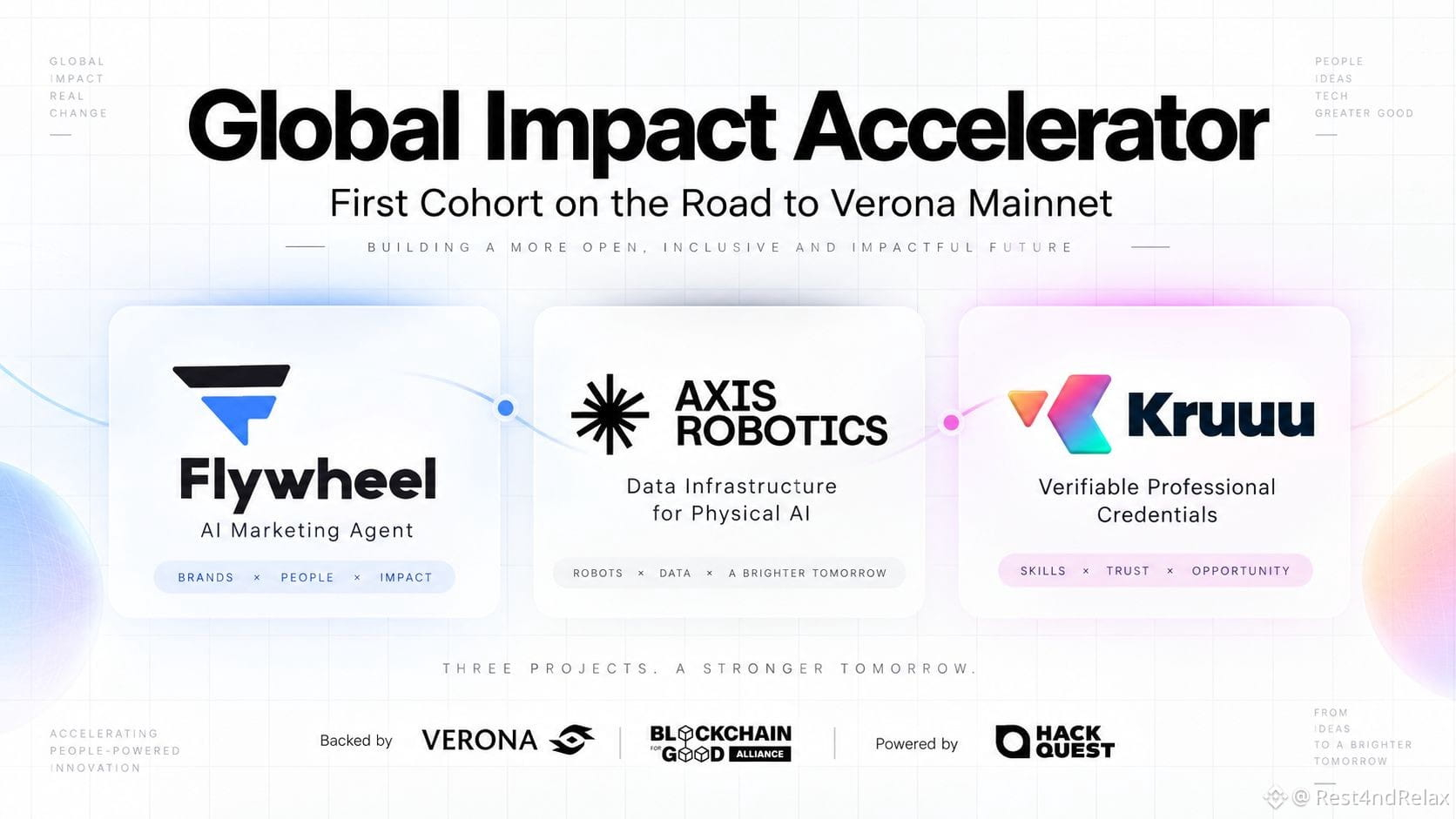
1
95
·
--
15 million transactions sounds impressive. But that’s not the Verona metric I’m watching most closely.
According to Mintscan, Verona has recorded more than 15.06 million total transactions.
That tells us the network has accumulated meaningful on-chain history.
But cumulative numbers have one limitation:
They tell us what happened in the past.
If I want to understand what is happening right now, I’d rather look at active accounts.
The latest Mintscan snapshot shows:
→ 1,273 Daily Active Accounts
→ 4,856 Weekly Active Accounts
→ 11,278 Monthly Active Accounts
And this is where things become more interesting.
Verona is repositioning itself around a much bigger problem than simply making blockchain easier to use.
The goal is to become an intelligence layer for AI helping applications and AI agents interact with information that can be verified, permissioned, and used without exposing unnecessary raw data.
For that vision to matter, Verona eventually needs more than a good AI narrative.
It needs people, applications, agents, and real activity continuously touching the network.
That’s why I think active accounts may become one of the most important Verona metrics to watch.
15 million transactions show where the network has been.
Active users may tell us where it is going.
The next question is simple:
Can Verona turn its verified data + AI thesis into steadily growing real usage?
That’s the chart I’ll be watching.
Source: Mintscan Verona Network
#verona #ai #web3 #layer1 #crypto
15 million transactions sounds impressive. But that’s not the Verona metric I’m watching most closely.
According to Mintscan, Verona has recorded more than 15.06 million total transactions.
That tells us the network has accumulated meaningful on-chain history.
But cumulative numbers have one limitation:
They tell us what happened in the past.
If I want to understand what is happening right now, I’d rather look at active accounts.
The latest Mintscan snapshot shows:
→ 1,273 Daily Active Accounts
→ 4,856 Weekly Active Accounts
→ 11,278 Monthly Active Accounts
And this is where things become more interesting.
Verona is repositioning itself around a much bigger problem than simply making blockchain easier to use.
The goal is to become an intelligence layer for AI helping applications and AI agents interact with information that can be verified, permissioned, and used without exposing unnecessary raw data.
For that vision to matter, Verona eventually needs more than a good AI narrative.
It needs people, applications, agents, and real activity continuously touching the network.
That’s why I think active accounts may become one of the most important Verona metrics to watch.
15 million transactions show where the network has been.
Active users may tell us where it is going.
The next question is simple:
Can Verona turn its verified data + AI thesis into steadily growing real usage?
That’s the chart I’ll be watching.
Source: Mintscan Verona Network
#verona #ai #web3 #layer1 #crypto
According to Mintscan, Verona has recorded more than 15.06 million total transactions.
That tells us the network has accumulated meaningful on-chain history.
But cumulative numbers have one limitation:
They tell us what happened in the past.
If I want to understand what is happening right now, I’d rather look at active accounts.
The latest Mintscan snapshot shows:
→ 1,273 Daily Active Accounts
→ 4,856 Weekly Active Accounts
→ 11,278 Monthly Active Accounts
And this is where things become more interesting.
Verona is repositioning itself around a much bigger problem than simply making blockchain easier to use.
The goal is to become an intelligence layer for AI helping applications and AI agents interact with information that can be verified, permissioned, and used without exposing unnecessary raw data.
For that vision to matter, Verona eventually needs more than a good AI narrative.
It needs people, applications, agents, and real activity continuously touching the network.
That’s why I think active accounts may become one of the most important Verona metrics to watch.
15 million transactions show where the network has been.
Active users may tell us where it is going.
The next question is simple:
Can Verona turn its verified data + AI thesis into steadily growing real usage?
That’s the chart I’ll be watching.
Source: Mintscan Verona Network
#verona #ai #web3 #layer1 #crypto
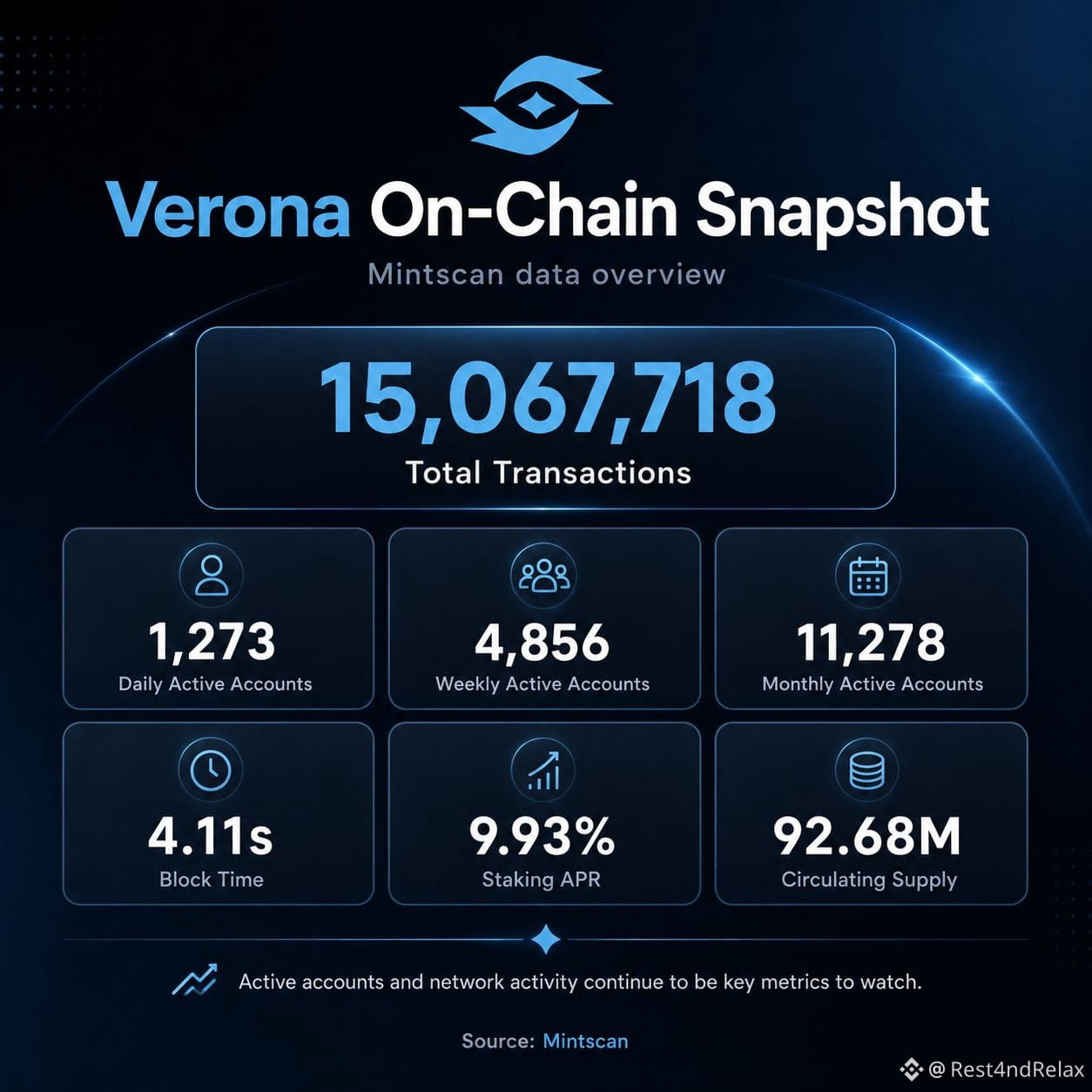
113
·
--
Haussier
Harga bisa berisik. Data on-chain biasanya lebih jujur.
Belakangan saya mencoba melihat Verona bukan hanya dari sisi narrative, tapi dari data yang benar-benar terlihat di Mintscan.
Dan snapshot yang ada menurut saya cukup menarik:
➡️ 15,067,718 total transactions
➡️ 11,278 monthly active accounts
➡️ 4,856 weekly active accounts
➡️ 1,273 daily active accounts
Di luar itu, dashboard juga menunjukkan:
➡️ Block time: 4.11 detik
➡️ Staking APR: 9.93%.
➡️ Circulating supply: 92.68M
➡️ Supply tokens: 211.57M
Bagi saya, angka-angka ini penting karena menunjukkan satu hal sederhana:
Verona bukan cuma hidup di timeline. Jaringannya juga punya aktivitas yang bisa dilihat.
Tentu, data ini tidak otomatis berarti mass adoption. Dan total transaksi yang besar juga tidak selalu berarti semua metrik sudah sempurna.
Tapi justru di situlah menariknya.
Saat banyak proyek berlomba menjual narasi AI, Verona sedang membangun positioning yang lebih spesifik: intelligence layer for AI sebuah lapisan yang berfokus pada verified data, privacy, proof, dan trust.
Kalau arah ini benar-benar dieksekusi dengan baik, maka yang dibangun Verona bukan cuma chain biasa, melainkan fondasi untuk internet yang lebih bisa dipercaya oleh apps dan AI agents.
Jadi buat saya, pertanyaan paling menarik sekarang bukan cuma:
Apakah narrative Verona bagus?
Tapi:
Apakah activity, users, dan utility-nya terus tumbuh seiring visinya berkembang?
Karena dalam jangka panjang, itu yang jauh lebih penting untuk dipantau.
Source: Mintscan Verona dashboard snapshot
#verona #Mintscan #ai #web3 #Layer1
Harga bisa berisik. Data on-chain biasanya lebih jujur.
Belakangan saya mencoba melihat Verona bukan hanya dari sisi narrative, tapi dari data yang benar-benar terlihat di Mintscan.
Dan snapshot yang ada menurut saya cukup menarik:
➡️ 15,067,718 total transactions
➡️ 11,278 monthly active accounts
➡️ 4,856 weekly active accounts
➡️ 1,273 daily active accounts
Di luar itu, dashboard juga menunjukkan:
➡️ Block time: 4.11 detik
➡️ Staking APR: 9.93%.
➡️ Circulating supply: 92.68M
➡️ Supply tokens: 211.57M
Bagi saya, angka-angka ini penting karena menunjukkan satu hal sederhana:
Verona bukan cuma hidup di timeline. Jaringannya juga punya aktivitas yang bisa dilihat.
Tentu, data ini tidak otomatis berarti mass adoption. Dan total transaksi yang besar juga tidak selalu berarti semua metrik sudah sempurna.
Tapi justru di situlah menariknya.
Saat banyak proyek berlomba menjual narasi AI, Verona sedang membangun positioning yang lebih spesifik: intelligence layer for AI sebuah lapisan yang berfokus pada verified data, privacy, proof, dan trust.
Kalau arah ini benar-benar dieksekusi dengan baik, maka yang dibangun Verona bukan cuma chain biasa, melainkan fondasi untuk internet yang lebih bisa dipercaya oleh apps dan AI agents.
Jadi buat saya, pertanyaan paling menarik sekarang bukan cuma:
Apakah narrative Verona bagus?
Tapi:
Apakah activity, users, dan utility-nya terus tumbuh seiring visinya berkembang?
Karena dalam jangka panjang, itu yang jauh lebih penting untuk dipantau.
Source: Mintscan Verona dashboard snapshot
#verona #Mintscan #ai #web3 #Layer1
Belakangan saya mencoba melihat Verona bukan hanya dari sisi narrative, tapi dari data yang benar-benar terlihat di Mintscan.
Dan snapshot yang ada menurut saya cukup menarik:
➡️ 15,067,718 total transactions
➡️ 11,278 monthly active accounts
➡️ 4,856 weekly active accounts
➡️ 1,273 daily active accounts
Di luar itu, dashboard juga menunjukkan:
➡️ Block time: 4.11 detik
➡️ Staking APR: 9.93%.
➡️ Circulating supply: 92.68M
➡️ Supply tokens: 211.57M
Bagi saya, angka-angka ini penting karena menunjukkan satu hal sederhana:
Verona bukan cuma hidup di timeline. Jaringannya juga punya aktivitas yang bisa dilihat.
Tentu, data ini tidak otomatis berarti mass adoption. Dan total transaksi yang besar juga tidak selalu berarti semua metrik sudah sempurna.
Tapi justru di situlah menariknya.
Saat banyak proyek berlomba menjual narasi AI, Verona sedang membangun positioning yang lebih spesifik: intelligence layer for AI sebuah lapisan yang berfokus pada verified data, privacy, proof, dan trust.
Kalau arah ini benar-benar dieksekusi dengan baik, maka yang dibangun Verona bukan cuma chain biasa, melainkan fondasi untuk internet yang lebih bisa dipercaya oleh apps dan AI agents.
Jadi buat saya, pertanyaan paling menarik sekarang bukan cuma:
Apakah narrative Verona bagus?
Tapi:
Apakah activity, users, dan utility-nya terus tumbuh seiring visinya berkembang?
Karena dalam jangka panjang, itu yang jauh lebih penting untuk dipantau.
Source: Mintscan Verona dashboard snapshot
#verona #Mintscan #ai #web3 #Layer1
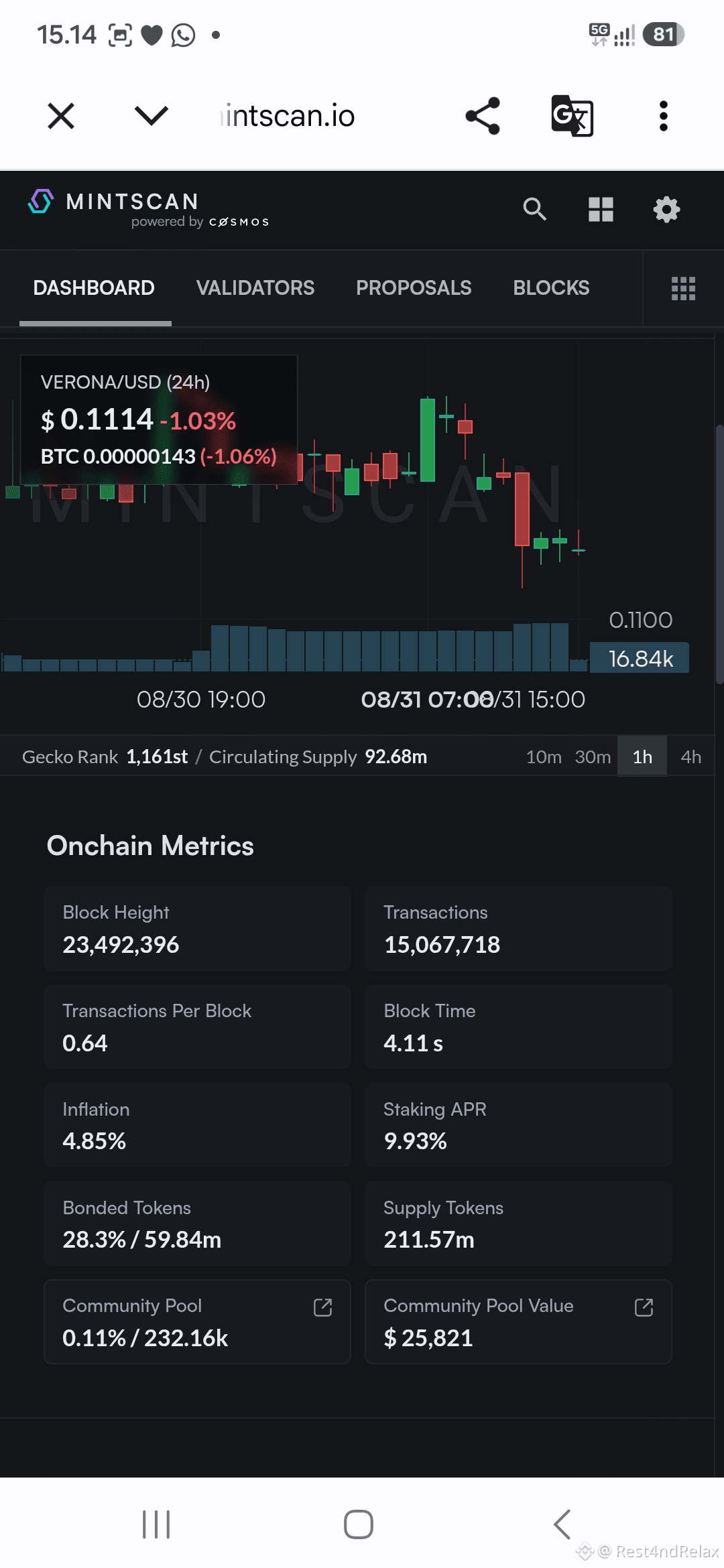
1
91
·
--
Article
Ekosistem Verona Mulai Memperlihatkan Gambaran yang Lebih BesarSekilas, Ero, WRTH, TradeOS, dan Smoothly hampir tidak memiliki hubungan satu sama lain.
Ada yang berurusan dengan perhatian manusia.
Ada yang fokus pada aset fisik.
Ada yang membangun AI untuk trading.
Ada juga yang berhubungan dengan kemampuan komunikasi manusia.
Namun ketika dilihat lebih dalam, semuanya mulai menunjukkan satu pola yang sama.
AI membutuhkan informasi yang bisa dipercaya.
Dan menurut saya, di situlah ekosistem Verona mulai menjadi menarik.
Ero by EarnOS → Aktivitas Manusia yang Terverifikasi
Brand tidak hanya membutuhkan tayangan atau klik.
Mereka membutuhkan keyakinan bahwa ada manusia sungguhan di balik aktivitas tersebut.
Ero memungkinkan pengguna melakukan berbagai aktivitas dan mendapatkan imbalan ketika aktivitas tersebut berhasil diverifikasi.
Artinya, perhatian manusia mulai berubah dari sekadar angka menjadi sinyal yang memiliki bukti di belakangnya.
WRTH → Aset Fisik + Informasi yang Dapat Diverifikasi
Untuk barang koleksi fisik, masalahnya berbeda.
Perangkat lunak bisa mengenali sebuah barang, tetapi bagaimana kita tahu bahwa informasi mengenai barang tersebut benar-benar dapat dipercaya?
WRTH menggunakan AI untuk membantu mengidentifikasi, menentukan harga, dan mengelola aset fisik.
Di sinilah konsep Verona menjadi relevan: informasi penting mengenai sebuah aset dapat dibuat lebih mudah diverifikasi, daripada hanya mengandalkan klaim dari satu pihak.
TradeOS → Strategi Manusia Menjadi AI Agent
Pasar bergerak 24/7.
Manusia tidak mungkin terus berada di depan grafik sepanjang waktu.
TradeOS memungkinkan pengguna menjelaskan strategi atau ide trading menggunakan bahasa sehari-hari, kemudian mengubahnya menjadi AI agent yang dapat membantu memantau dan menganalisis pasar.
Dengan kata lain, cara manusia mengambil keputusan mulai bisa dijalankan oleh perangkat lunak secara terus-menerus.
Smoothly → Kemampuan Manusia yang Terverifikasi Menjadi Kecerdasan AI
Smoothly membawa konsep ini ke arah yang berbeda.
Orang-orang dengan kemampuan komunikasi terlebih dahulu menjalani penilaian.
Jawaban dan gaya komunikasi dari komunikator yang telah terverifikasi tersebut kemudian digunakan untuk membangun AI agent.
Jadi AI tidak hanya menghasilkan jawaban generik.
Ada kemampuan manusia yang terlebih dahulu dinilai dan diverifikasi di balik AI tersebut.
Kalau disederhanakan:
Ero → bukti aktivitas manusia nyata
WRTH → bukti dan informasi seputar aset fisik
TradeOS → strategi manusia diubah menjadi AI agent
Smoothly → kemampuan manusia yang terverifikasi diubah menjadi kecerdasan AI
Empat produk.
Empat pasar yang berbeda.
Tetapi satu arah yang semakin jelas:
membuat informasi yang digunakan perangkat lunak dan AI menjadi lebih dapat dipercaya.
AI kemungkinan akan terus menjadi semakin pintar.
Tetapi AI yang sangat pintar tetap akan menghadapi masalah jika data yang digunakannya berasal dari bot, aktivitas palsu, informasi yang tidak terverifikasi, atau sinyal tanpa bukti.
Itulah mengapa menurut saya perkembangan ekosistem Verona menarik untuk diperhatikan.
Bukan hanya karena semakin banyak aplikasi yang muncul.
Tetapi karena kita mulai melihat seperti apa lapisan kecerdasan untuk AI ketika konsep tersebut diterapkan pada penggunaan nyata:
aktivitas manusia, aset fisik, kecerdasan pasar, dan kemampuan manusia.
Masa depan AI mungkin bukan hanya tentang membangun model yang semakin pintar.
Mungkin salah satu bagian terpenting justru memastikan satu hal:
AI tahu informasi mana yang benar-benar layak dipercaya.
#verona #ai #ecosystem
Ekosistem Verona Mulai Memperlihatkan Gambaran yang Lebih Besar
Sekilas, Ero, WRTH, TradeOS, dan Smoothly hampir tidak memiliki hubungan satu sama lain.
Ada yang berurusan dengan perhatian manusia.
Ada yang fokus pada aset fisik.
Ada yang membangun AI untuk trading.
Ada juga yang berhubungan dengan kemampuan komunikasi manusia.
Namun ketika dilihat lebih dalam, semuanya mulai menunjukkan satu pola yang sama.
AI membutuhkan informasi yang bisa dipercaya.
Dan menurut saya, di situlah ekosistem Verona mulai menjadi menarik.
Ero by EarnOS → Aktivitas Manusia yang Terverifikasi
Brand tidak hanya membutuhkan tayangan atau klik.
Mereka membutuhkan keyakinan bahwa ada manusia sungguhan di balik aktivitas tersebut.
Ero memungkinkan pengguna melakukan berbagai aktivitas dan mendapatkan imbalan ketika aktivitas tersebut berhasil diverifikasi.
Artinya, perhatian manusia mulai berubah dari sekadar angka menjadi sinyal yang memiliki bukti di belakangnya.
WRTH → Aset Fisik + Informasi yang Dapat Diverifikasi
Untuk barang koleksi fisik, masalahnya berbeda.
Perangkat lunak bisa mengenali sebuah barang, tetapi bagaimana kita tahu bahwa informasi mengenai barang tersebut benar-benar dapat dipercaya?
WRTH menggunakan AI untuk membantu mengidentifikasi, menentukan harga, dan mengelola aset fisik.
Di sinilah konsep Verona menjadi relevan: informasi penting mengenai sebuah aset dapat dibuat lebih mudah diverifikasi, daripada hanya mengandalkan klaim dari satu pihak.
TradeOS → Strategi Manusia Menjadi AI Agent
Pasar bergerak 24/7.
Manusia tidak mungkin terus berada di depan grafik sepanjang waktu.
TradeOS memungkinkan pengguna menjelaskan strategi atau ide trading menggunakan bahasa sehari-hari, kemudian mengubahnya menjadi AI agent yang dapat membantu memantau dan menganalisis pasar.
Dengan kata lain, cara manusia mengambil keputusan mulai bisa dijalankan oleh perangkat lunak secara terus-menerus.
Smoothly → Kemampuan Manusia yang Terverifikasi Menjadi Kecerdasan AI
Smoothly membawa konsep ini ke arah yang berbeda.
Orang-orang dengan kemampuan komunikasi terlebih dahulu menjalani penilaian.
Jawaban dan gaya komunikasi dari komunikator yang telah terverifikasi tersebut kemudian digunakan untuk membangun AI agent.
Jadi AI tidak hanya menghasilkan jawaban generik.
Ada kemampuan manusia yang terlebih dahulu dinilai dan diverifikasi di balik AI tersebut.
Kalau disederhanakan:
Ero → bukti aktivitas manusia nyata
WRTH → bukti dan informasi seputar aset fisik
TradeOS → strategi manusia diubah menjadi AI agent
Smoothly → kemampuan manusia yang terverifikasi diubah menjadi kecerdasan AI
Empat produk.
Empat pasar yang berbeda.
Tetapi satu arah yang semakin jelas:
membuat informasi yang digunakan perangkat lunak dan AI menjadi lebih dapat dipercaya.
AI kemungkinan akan terus menjadi semakin pintar.
Tetapi AI yang sangat pintar tetap akan menghadapi masalah jika data yang digunakannya berasal dari bot, aktivitas palsu, informasi yang tidak terverifikasi, atau sinyal tanpa bukti.
Itulah mengapa menurut saya perkembangan ekosistem Verona menarik untuk diperhatikan.
Bukan hanya karena semakin banyak aplikasi yang muncul.
Tetapi karena kita mulai melihat seperti apa lapisan kecerdasan untuk AI ketika konsep tersebut diterapkan pada penggunaan nyata:
aktivitas manusia, aset fisik, kecerdasan pasar, dan kemampuan manusia.
Masa depan AI mungkin bukan hanya tentang membangun model yang semakin pintar.
Mungkin salah satu bagian terpenting justru memastikan satu hal:
AI tahu informasi mana yang benar-benar layak dipercaya.
#verona #ai #ecosystem
Ada yang berurusan dengan perhatian manusia.
Ada yang fokus pada aset fisik.
Ada yang membangun AI untuk trading.
Ada juga yang berhubungan dengan kemampuan komunikasi manusia.
Namun ketika dilihat lebih dalam, semuanya mulai menunjukkan satu pola yang sama.
AI membutuhkan informasi yang bisa dipercaya.
Dan menurut saya, di situlah ekosistem Verona mulai menjadi menarik.
Ero by EarnOS → Aktivitas Manusia yang Terverifikasi
Brand tidak hanya membutuhkan tayangan atau klik.
Mereka membutuhkan keyakinan bahwa ada manusia sungguhan di balik aktivitas tersebut.
Ero memungkinkan pengguna melakukan berbagai aktivitas dan mendapatkan imbalan ketika aktivitas tersebut berhasil diverifikasi.
Artinya, perhatian manusia mulai berubah dari sekadar angka menjadi sinyal yang memiliki bukti di belakangnya.
WRTH → Aset Fisik + Informasi yang Dapat Diverifikasi
Untuk barang koleksi fisik, masalahnya berbeda.
Perangkat lunak bisa mengenali sebuah barang, tetapi bagaimana kita tahu bahwa informasi mengenai barang tersebut benar-benar dapat dipercaya?
WRTH menggunakan AI untuk membantu mengidentifikasi, menentukan harga, dan mengelola aset fisik.
Di sinilah konsep Verona menjadi relevan: informasi penting mengenai sebuah aset dapat dibuat lebih mudah diverifikasi, daripada hanya mengandalkan klaim dari satu pihak.
TradeOS → Strategi Manusia Menjadi AI Agent
Pasar bergerak 24/7.
Manusia tidak mungkin terus berada di depan grafik sepanjang waktu.
TradeOS memungkinkan pengguna menjelaskan strategi atau ide trading menggunakan bahasa sehari-hari, kemudian mengubahnya menjadi AI agent yang dapat membantu memantau dan menganalisis pasar.
Dengan kata lain, cara manusia mengambil keputusan mulai bisa dijalankan oleh perangkat lunak secara terus-menerus.
Smoothly → Kemampuan Manusia yang Terverifikasi Menjadi Kecerdasan AI
Smoothly membawa konsep ini ke arah yang berbeda.
Orang-orang dengan kemampuan komunikasi terlebih dahulu menjalani penilaian.
Jawaban dan gaya komunikasi dari komunikator yang telah terverifikasi tersebut kemudian digunakan untuk membangun AI agent.
Jadi AI tidak hanya menghasilkan jawaban generik.
Ada kemampuan manusia yang terlebih dahulu dinilai dan diverifikasi di balik AI tersebut.
Kalau disederhanakan:
Ero → bukti aktivitas manusia nyata
WRTH → bukti dan informasi seputar aset fisik
TradeOS → strategi manusia diubah menjadi AI agent
Smoothly → kemampuan manusia yang terverifikasi diubah menjadi kecerdasan AI
Empat produk.
Empat pasar yang berbeda.
Tetapi satu arah yang semakin jelas:
membuat informasi yang digunakan perangkat lunak dan AI menjadi lebih dapat dipercaya.
AI kemungkinan akan terus menjadi semakin pintar.
Tetapi AI yang sangat pintar tetap akan menghadapi masalah jika data yang digunakannya berasal dari bot, aktivitas palsu, informasi yang tidak terverifikasi, atau sinyal tanpa bukti.
Itulah mengapa menurut saya perkembangan ekosistem Verona menarik untuk diperhatikan.
Bukan hanya karena semakin banyak aplikasi yang muncul.
Tetapi karena kita mulai melihat seperti apa lapisan kecerdasan untuk AI ketika konsep tersebut diterapkan pada penggunaan nyata:
aktivitas manusia, aset fisik, kecerdasan pasar, dan kemampuan manusia.
Masa depan AI mungkin bukan hanya tentang membangun model yang semakin pintar.
Mungkin salah satu bagian terpenting justru memastikan satu hal:
AI tahu informasi mana yang benar-benar layak dipercaya.
#verona #ai #ecosystem
1
96
·
--
Haussier
AI tidak kekurangan data. AI kekurangan data yang bisa dipercaya.
Kita terus bicara soal AI agents yang semakin pintar dan bisa bekerja untuk manusia.
Tapi ada pertanyaan yang menurut saya jauh lebih penting:
Bagaimana AI tahu informasi yang diterimanya benar?
Internet penuh dengan data, tapi tersedia ≠ terpercaya.
Identitas bisa dipalsukan.
Aktivitas bisa dibuat bot.
Informasi bisa dimanipulasi.
Inilah yang akan dibahas Verona dalam event Proof of Reality di Beijing.
📍 AGI Bar, Beijing
📅 August 16
⏰ 14:30
Diskusinya akan membahas bagaimana AI mengetahui sebuah informasi itu benar, bagaimana agents mendapatkan data yang bisa dipercaya, dan bagaimana pengguna tetap mengontrol informasi yang sudah mereka verifikasi.
Event ini juga menghadirkan orang-orang dari Verona, EarnOS, Axis Robotics, dan CMU SV Accelerator.
Menurut saya, ini salah satu masalah terbesar yang akan muncul ketika AI agents mulai melakukan pekerjaan nyata.
AI yang sangat pintar tetap bisa mengambil keputusan buruk kalau data dasarnya salah.
Karena itu, masa depan AI mungkin bukan hanya soal model dan compute.
Kita juga membutuhkan proof, verified data, privacy, dan trust.
Dan di sinilah narasi Verona menjadi menarik:
bukan sekadar memberi AI lebih banyak data, tetapi membantu menciptakan data yang bisa dipercaya dan diverifikasi tanpa menghilangkan kontrol pengguna.
Smart AI is powerful.
AI that knows what to trust is the next step.
Detail & registrasi: https://luma.com/1byieukd
#verona #ai #verify #proof
AI tidak kekurangan data. AI kekurangan data yang bisa dipercaya.
Kita terus bicara soal AI agents yang semakin pintar dan bisa bekerja untuk manusia.
Tapi ada pertanyaan yang menurut saya jauh lebih penting:
Bagaimana AI tahu informasi yang diterimanya benar?
Internet penuh dengan data, tapi tersedia ≠ terpercaya.
Identitas bisa dipalsukan.
Aktivitas bisa dibuat bot.
Informasi bisa dimanipulasi.
Inilah yang akan dibahas Verona dalam event Proof of Reality di Beijing.
📍 AGI Bar, Beijing
📅 August 16
⏰ 14:30
Diskusinya akan membahas bagaimana AI mengetahui sebuah informasi itu benar, bagaimana agents mendapatkan data yang bisa dipercaya, dan bagaimana pengguna tetap mengontrol informasi yang sudah mereka verifikasi.
Event ini juga menghadirkan orang-orang dari Verona, EarnOS, Axis Robotics, dan CMU SV Accelerator.
Menurut saya, ini salah satu masalah terbesar yang akan muncul ketika AI agents mulai melakukan pekerjaan nyata.
AI yang sangat pintar tetap bisa mengambil keputusan buruk kalau data dasarnya salah.
Karena itu, masa depan AI mungkin bukan hanya soal model dan compute.
Kita juga membutuhkan proof, verified data, privacy, dan trust.
Dan di sinilah narasi Verona menjadi menarik:
bukan sekadar memberi AI lebih banyak data, tetapi membantu menciptakan data yang bisa dipercaya dan diverifikasi tanpa menghilangkan kontrol pengguna.
Smart AI is powerful.
AI that knows what to trust is the next step.
Detail & registrasi: https://luma.com/1byieukd
#verona #ai #verify #proof
Kita terus bicara soal AI agents yang semakin pintar dan bisa bekerja untuk manusia.
Tapi ada pertanyaan yang menurut saya jauh lebih penting:
Bagaimana AI tahu informasi yang diterimanya benar?
Internet penuh dengan data, tapi tersedia ≠ terpercaya.
Identitas bisa dipalsukan.
Aktivitas bisa dibuat bot.
Informasi bisa dimanipulasi.
Inilah yang akan dibahas Verona dalam event Proof of Reality di Beijing.
📍 AGI Bar, Beijing
📅 August 16
⏰ 14:30
Diskusinya akan membahas bagaimana AI mengetahui sebuah informasi itu benar, bagaimana agents mendapatkan data yang bisa dipercaya, dan bagaimana pengguna tetap mengontrol informasi yang sudah mereka verifikasi.
Event ini juga menghadirkan orang-orang dari Verona, EarnOS, Axis Robotics, dan CMU SV Accelerator.
Menurut saya, ini salah satu masalah terbesar yang akan muncul ketika AI agents mulai melakukan pekerjaan nyata.
AI yang sangat pintar tetap bisa mengambil keputusan buruk kalau data dasarnya salah.
Karena itu, masa depan AI mungkin bukan hanya soal model dan compute.
Kita juga membutuhkan proof, verified data, privacy, dan trust.
Dan di sinilah narasi Verona menjadi menarik:
bukan sekadar memberi AI lebih banyak data, tetapi membantu menciptakan data yang bisa dipercaya dan diverifikasi tanpa menghilangkan kontrol pengguna.
Smart AI is powerful.
AI that knows what to trust is the next step.
Detail & registrasi: https://luma.com/1byieukd
#verona #ai #verify #proof

1
94
·
--
Haussier
Why AI Agents Need Verified Data
AI agents are getting smarter.
But there’s a problem most people still underestimate:
An AI agent is only as trustworthy as the information it acts on.
Imagine an AI agent that can automatically approve applications, recommend financial decisions, personalize services, or interact with other apps on your behalf.
Sounds powerful.
But what happens if the data it receives is outdated, manipulated, fake, or impossible to verify?
A smarter AI doesn’t automatically solve that problem.
It may simply make a bad decision faster.
That’s why I think verified data could become one of the most important pieces of AI infrastructure.
Instead of AI agents blindly trusting claims, the better model is allowing them to work with information that can be proven.
For example:
Someone shouldn’t always have to expose their entire identity just to prove they’re over 18.
They shouldn’t need to send every detail of their financial history just to prove they meet a certain requirement.
The agent may only need one thing:
proof that the required fact is true.
This is where Verona becomes interesting to me.
Verona is focused on a world where verified information, privacy, proof, and AI agents can work together so applications and agents can use trusted signals without unnecessarily exposing raw personal data.
And I think this becomes more important as AI agents start doing more things for us.
Because the future of AI isn’t just about making agents more autonomous.
It’s about making sure they have better information to act on.
More intelligence makes AI powerful.
Verified data can help make that intelligence trustworthy.
That distinction could matter a lot more than people realize.
#verona #ai #verified #trust
Why AI Agents Need Verified Data
AI agents are getting smarter.
But there’s a problem most people still underestimate:
An AI agent is only as trustworthy as the information it acts on.
Imagine an AI agent that can automatically approve applications, recommend financial decisions, personalize services, or interact with other apps on your behalf.
Sounds powerful.
But what happens if the data it receives is outdated, manipulated, fake, or impossible to verify?
A smarter AI doesn’t automatically solve that problem.
It may simply make a bad decision faster.
That’s why I think verified data could become one of the most important pieces of AI infrastructure.
Instead of AI agents blindly trusting claims, the better model is allowing them to work with information that can be proven.
For example:
Someone shouldn’t always have to expose their entire identity just to prove they’re over 18.
They shouldn’t need to send every detail of their financial history just to prove they meet a certain requirement.
The agent may only need one thing:
proof that the required fact is true.
This is where Verona becomes interesting to me.
Verona is focused on a world where verified information, privacy, proof, and AI agents can work together so applications and agents can use trusted signals without unnecessarily exposing raw personal data.
And I think this becomes more important as AI agents start doing more things for us.
Because the future of AI isn’t just about making agents more autonomous.
It’s about making sure they have better information to act on.
More intelligence makes AI powerful.
Verified data can help make that intelligence trustworthy.
That distinction could matter a lot more than people realize.
#verona #ai #verified #trust
AI agents are getting smarter.
But there’s a problem most people still underestimate:
An AI agent is only as trustworthy as the information it acts on.
Imagine an AI agent that can automatically approve applications, recommend financial decisions, personalize services, or interact with other apps on your behalf.
Sounds powerful.
But what happens if the data it receives is outdated, manipulated, fake, or impossible to verify?
A smarter AI doesn’t automatically solve that problem.
It may simply make a bad decision faster.
That’s why I think verified data could become one of the most important pieces of AI infrastructure.
Instead of AI agents blindly trusting claims, the better model is allowing them to work with information that can be proven.
For example:
Someone shouldn’t always have to expose their entire identity just to prove they’re over 18.
They shouldn’t need to send every detail of their financial history just to prove they meet a certain requirement.
The agent may only need one thing:
proof that the required fact is true.
This is where Verona becomes interesting to me.
Verona is focused on a world where verified information, privacy, proof, and AI agents can work together so applications and agents can use trusted signals without unnecessarily exposing raw personal data.
And I think this becomes more important as AI agents start doing more things for us.
Because the future of AI isn’t just about making agents more autonomous.
It’s about making sure they have better information to act on.
More intelligence makes AI powerful.
Verified data can help make that intelligence trustworthy.
That distinction could matter a lot more than people realize.
#verona #ai #verified #trust
1
257
·
--
Haussier
Masalah terbesar trader sering kali bukan salah analisis. Tapi gagal mengikuti strateginya sendiri.
Kita semua pernah ngalamin:
Harga naik → FOMO buy.
Harga turun → panik sell.
Lihat candle besar → lupa trading plan. 😭
Padahal sebelum market bergerak, kita sudah punya aturan sendiri.
Di sinilah TradeOS menurut saya menarik.
Trader bisa menuliskan strategi dengan bahasa biasa aset apa yang ingin dipantau, indikator yang digunakan, kondisi entry, sampai aturan risikonya.
TradeOS kemudian mengubahnya menjadi AI Agent Crew yang membantu memonitor lebih dari 13.000 aset di crypto, saham, forex, dan komoditas.
Saat kondisi yang kita tentukan muncul, agent bisa membantu mendeteksi dan memvalidasi setup tersebut serta memberikan reasoning di baliknya.
Jadi menurut saya value terbesarnya bukan:
“AI kasih tahu koin apa yang bakal naik.”
Tapi:
“AI membantu kita menunggu sampai kondisi yang kita sendiri tentukan benar-benar muncul.”
Buat trader, perbedaannya cukup besar.
Kita tidak harus terus menatap chart.
Tidak mudah kehilangan setup.
Strategi bisa dipantau lebih konsisten.
Dan keputusan akhirnya tetap berada di tangan kita.
TradeOS juga tidak menjanjikan profit atau mengambil alih keputusan trading.
AI membantu monitoring.
Trader tetap memegang kendali.
Dan ada bagian lain yang menurut saya penting untuk Verona.
Subscription TradeOS dibayar menggunakan stablecoin melalui Verona Meta Accounts, sementara komisi creator juga diselesaikan melalui infrastruktur Verona.
Artinya, ketika orang benar-benar menggunakan produk, membayar subscription, dan creator memperoleh komisi, aktivitas ekonomi nyata ikut bergerak melalui network.
Ini membuat narasi “GDP, not TVL” Verona terasa lebih konkret.
Bukan sekadar berapa banyak modal yang dikunci.
Tapi berapa banyak aktivitas nyata yang tercipta karena orang benar-benar memakai produknya.
Bagi saya, masa depan AI dalam trading mungkin bukan tentang menemukan “AI yang selalu benar.”
Tapi tentang memberi trader alat yang membantu mereka lebih konsisten menjalankan strategi mereka sendiri.
Masalah terbesar trader sering kali bukan salah analisis. Tapi gagal mengikuti strateginya sendiri.
Kita semua pernah ngalamin:
Harga naik → FOMO buy.
Harga turun → panik sell.
Lihat candle besar → lupa trading plan. 😭
Padahal sebelum market bergerak, kita sudah punya aturan sendiri.
Di sinilah TradeOS menurut saya menarik.
Trader bisa menuliskan strategi dengan bahasa biasa aset apa yang ingin dipantau, indikator yang digunakan, kondisi entry, sampai aturan risikonya.
TradeOS kemudian mengubahnya menjadi AI Agent Crew yang membantu memonitor lebih dari 13.000 aset di crypto, saham, forex, dan komoditas.
Saat kondisi yang kita tentukan muncul, agent bisa membantu mendeteksi dan memvalidasi setup tersebut serta memberikan reasoning di baliknya.
Jadi menurut saya value terbesarnya bukan:
“AI kasih tahu koin apa yang bakal naik.”
Tapi:
“AI membantu kita menunggu sampai kondisi yang kita sendiri tentukan benar-benar muncul.”
Buat trader, perbedaannya cukup besar.
Kita tidak harus terus menatap chart.
Tidak mudah kehilangan setup.
Strategi bisa dipantau lebih konsisten.
Dan keputusan akhirnya tetap berada di tangan kita.
TradeOS juga tidak menjanjikan profit atau mengambil alih keputusan trading.
AI membantu monitoring.
Trader tetap memegang kendali.
Dan ada bagian lain yang menurut saya penting untuk Verona.
Subscription TradeOS dibayar menggunakan stablecoin melalui Verona Meta Accounts, sementara komisi creator juga diselesaikan melalui infrastruktur Verona.
Artinya, ketika orang benar-benar menggunakan produk, membayar subscription, dan creator memperoleh komisi, aktivitas ekonomi nyata ikut bergerak melalui network.
Ini membuat narasi “GDP, not TVL” Verona terasa lebih konkret.
Bukan sekadar berapa banyak modal yang dikunci.
Tapi berapa banyak aktivitas nyata yang tercipta karena orang benar-benar memakai produknya.
Bagi saya, masa depan AI dalam trading mungkin bukan tentang menemukan “AI yang selalu benar.”
Tapi tentang memberi trader alat yang membantu mereka lebih konsisten menjalankan strategi mereka sendiri.
Kita semua pernah ngalamin:
Harga naik → FOMO buy.
Harga turun → panik sell.
Lihat candle besar → lupa trading plan. 😭
Padahal sebelum market bergerak, kita sudah punya aturan sendiri.
Di sinilah TradeOS menurut saya menarik.
Trader bisa menuliskan strategi dengan bahasa biasa aset apa yang ingin dipantau, indikator yang digunakan, kondisi entry, sampai aturan risikonya.
TradeOS kemudian mengubahnya menjadi AI Agent Crew yang membantu memonitor lebih dari 13.000 aset di crypto, saham, forex, dan komoditas.
Saat kondisi yang kita tentukan muncul, agent bisa membantu mendeteksi dan memvalidasi setup tersebut serta memberikan reasoning di baliknya.
Jadi menurut saya value terbesarnya bukan:
“AI kasih tahu koin apa yang bakal naik.”
Tapi:
“AI membantu kita menunggu sampai kondisi yang kita sendiri tentukan benar-benar muncul.”
Buat trader, perbedaannya cukup besar.
Kita tidak harus terus menatap chart.
Tidak mudah kehilangan setup.
Strategi bisa dipantau lebih konsisten.
Dan keputusan akhirnya tetap berada di tangan kita.
TradeOS juga tidak menjanjikan profit atau mengambil alih keputusan trading.
AI membantu monitoring.
Trader tetap memegang kendali.
Dan ada bagian lain yang menurut saya penting untuk Verona.
Subscription TradeOS dibayar menggunakan stablecoin melalui Verona Meta Accounts, sementara komisi creator juga diselesaikan melalui infrastruktur Verona.
Artinya, ketika orang benar-benar menggunakan produk, membayar subscription, dan creator memperoleh komisi, aktivitas ekonomi nyata ikut bergerak melalui network.
Ini membuat narasi “GDP, not TVL” Verona terasa lebih konkret.
Bukan sekadar berapa banyak modal yang dikunci.
Tapi berapa banyak aktivitas nyata yang tercipta karena orang benar-benar memakai produknya.
Bagi saya, masa depan AI dalam trading mungkin bukan tentang menemukan “AI yang selalu benar.”
Tapi tentang memberi trader alat yang membantu mereka lebih konsisten menjalankan strategi mereka sendiri.
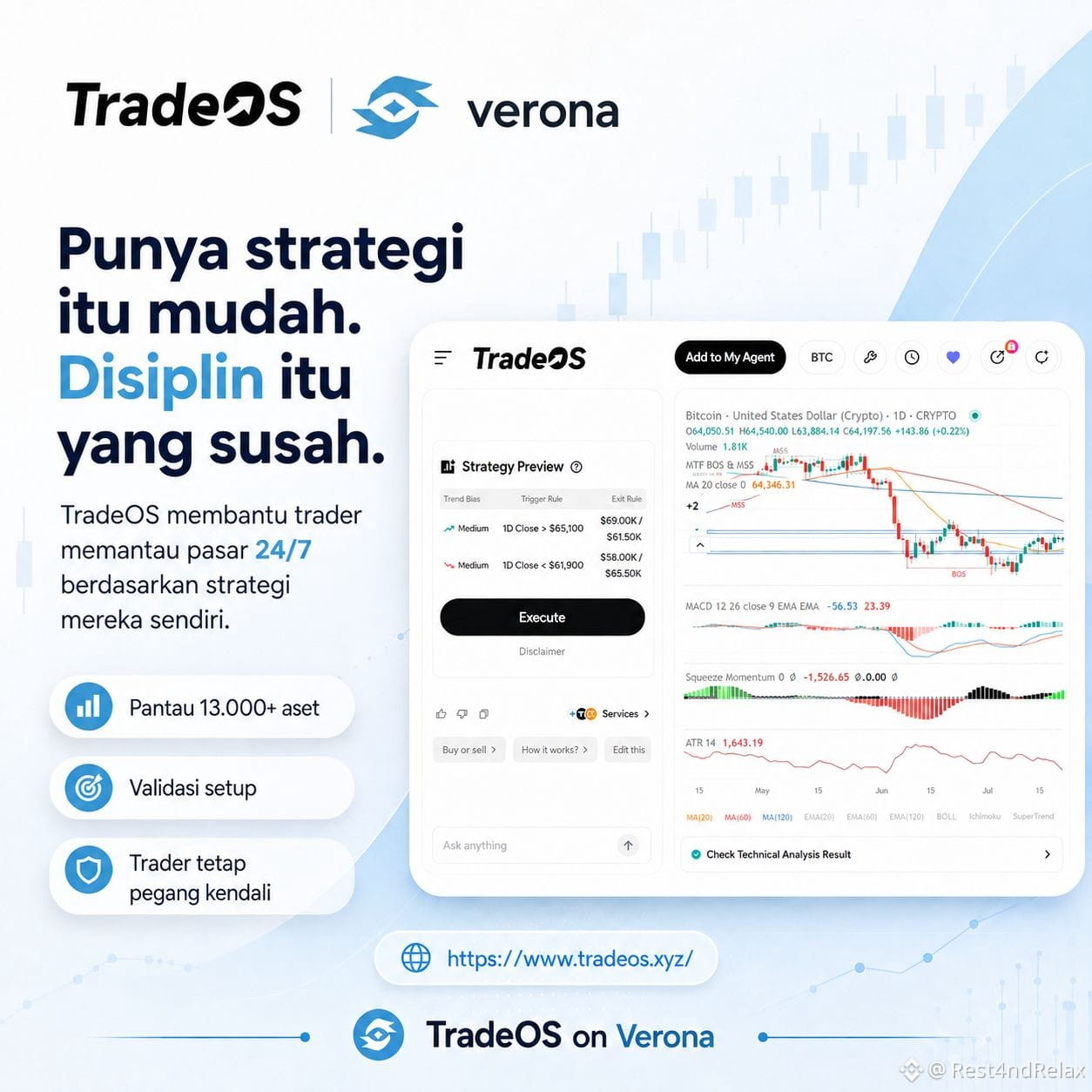
1
78
·
--
Haussier
AI may change trading communities before it changes trading itself.
Most crypto communities still work in a very human way.
Someone watches the charts.
Finds an interesting setup.
Writes an analysis.
Then sends it to Telegram or Discord.
The problem?
Humans can’t monitor markets 24/7.
This is where I think TradeOS gets interesting.
TradeOS allows users to describe their own strategy in plain English, assets, indicators, and risk rules and turn it into an Agent Crew capable of monitoring 13,000+ assets across crypto, stocks, forex, and commodities.
But there’s another part that deserves more attention.
If you run a community, those agents can also help deliver watchlist alerts and market analysis directly to Discord or Telegram, based on your strategy and style.
In other words, a trader’s market knowledge can start becoming something closer to infrastructure.
Instead of manually watching every chart and sending every update yourself, AI agents can help scale the monitoring.
And the creator economy sits on top of it.
According to Verona, TradeOS also has a creator program where referrals can generate commissions.
Subscriptions are paid in stablecoins through Verona Meta Accounts, while creator commissions settle through the same rails.
So the loop becomes:
Trader creates a strategy → AI agents monitor it → community receives useful information → users subscribe → creators earn → payments move through Verona.
That’s the part I find most interesting.
Not AI replacing traders.
Not another “guaranteed signal” product.
But AI helping traders and creators turn their own knowledge into something that can operate at a much larger scale.
And if products like this attract real paying users, Verona benefits from something much more important than temporary hype:
real economic activity.
That’s what the “GDP, not TVL” thesis starts to look like in practice.
learn more: https://www.tradeos.xyz/
#verona #tradeos #aiagent #trading #traders
AI may change trading communities before it changes trading itself.
Most crypto communities still work in a very human way.
Someone watches the charts.
Finds an interesting setup.
Writes an analysis.
Then sends it to Telegram or Discord.
The problem?
Humans can’t monitor markets 24/7.
This is where I think TradeOS gets interesting.
TradeOS allows users to describe their own strategy in plain English, assets, indicators, and risk rules and turn it into an Agent Crew capable of monitoring 13,000+ assets across crypto, stocks, forex, and commodities.
But there’s another part that deserves more attention.
If you run a community, those agents can also help deliver watchlist alerts and market analysis directly to Discord or Telegram, based on your strategy and style.
In other words, a trader’s market knowledge can start becoming something closer to infrastructure.
Instead of manually watching every chart and sending every update yourself, AI agents can help scale the monitoring.
And the creator economy sits on top of it.
According to Verona, TradeOS also has a creator program where referrals can generate commissions.
Subscriptions are paid in stablecoins through Verona Meta Accounts, while creator commissions settle through the same rails.
So the loop becomes:
Trader creates a strategy → AI agents monitor it → community receives useful information → users subscribe → creators earn → payments move through Verona.
That’s the part I find most interesting.
Not AI replacing traders.
Not another “guaranteed signal” product.
But AI helping traders and creators turn their own knowledge into something that can operate at a much larger scale.
And if products like this attract real paying users, Verona benefits from something much more important than temporary hype:
real economic activity.
That’s what the “GDP, not TVL” thesis starts to look like in practice.
learn more: https://www.tradeos.xyz/
#verona #tradeos #aiagent #trading #traders
Most crypto communities still work in a very human way.
Someone watches the charts.
Finds an interesting setup.
Writes an analysis.
Then sends it to Telegram or Discord.
The problem?
Humans can’t monitor markets 24/7.
This is where I think TradeOS gets interesting.
TradeOS allows users to describe their own strategy in plain English, assets, indicators, and risk rules and turn it into an Agent Crew capable of monitoring 13,000+ assets across crypto, stocks, forex, and commodities.
But there’s another part that deserves more attention.
If you run a community, those agents can also help deliver watchlist alerts and market analysis directly to Discord or Telegram, based on your strategy and style.
In other words, a trader’s market knowledge can start becoming something closer to infrastructure.
Instead of manually watching every chart and sending every update yourself, AI agents can help scale the monitoring.
And the creator economy sits on top of it.
According to Verona, TradeOS also has a creator program where referrals can generate commissions.
Subscriptions are paid in stablecoins through Verona Meta Accounts, while creator commissions settle through the same rails.
So the loop becomes:
Trader creates a strategy → AI agents monitor it → community receives useful information → users subscribe → creators earn → payments move through Verona.
That’s the part I find most interesting.
Not AI replacing traders.
Not another “guaranteed signal” product.
But AI helping traders and creators turn their own knowledge into something that can operate at a much larger scale.
And if products like this attract real paying users, Verona benefits from something much more important than temporary hype:
real economic activity.
That’s what the “GDP, not TVL” thesis starts to look like in practice.
learn more: https://www.tradeos.xyz/
#verona #tradeos #aiagent #trading #traders
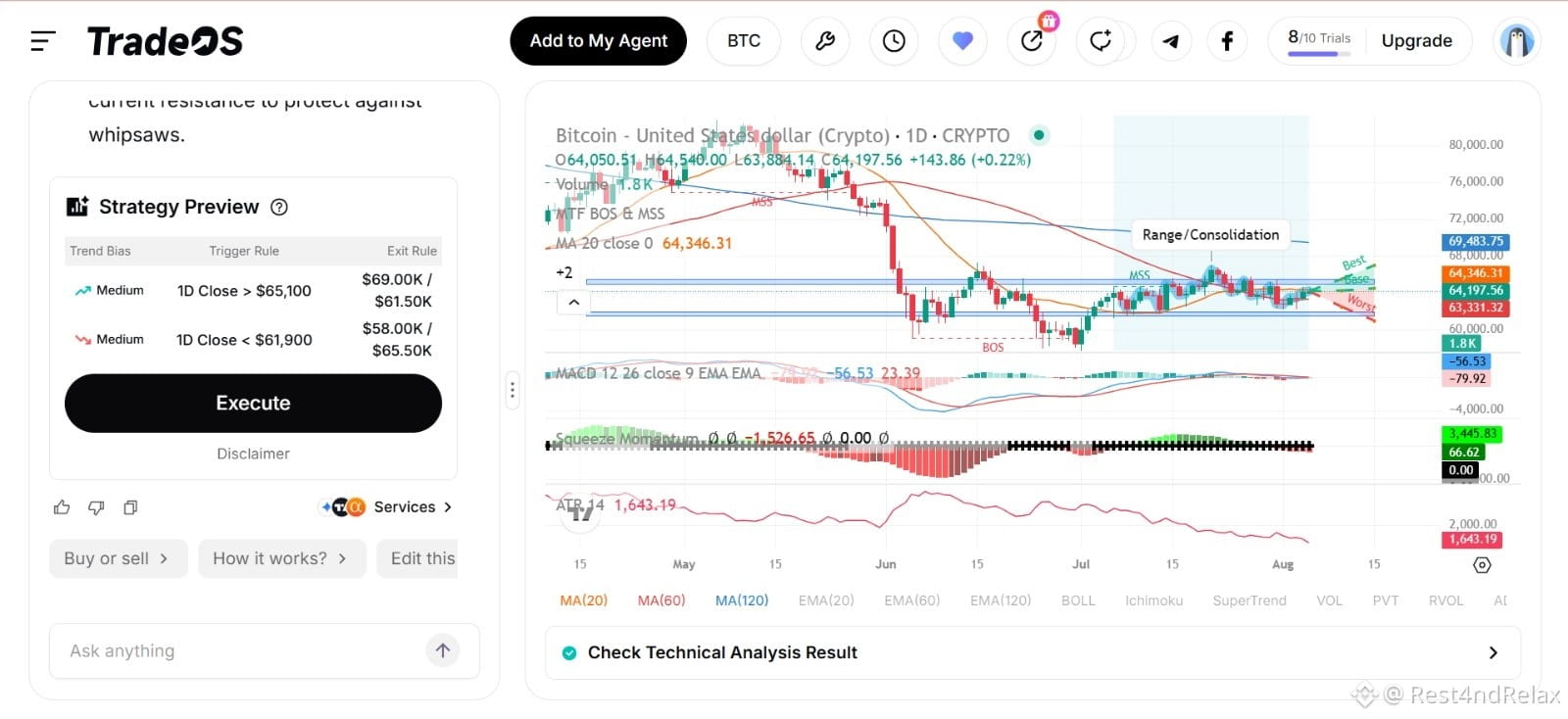
1
103
·
--
Haussier
AI mungkin bisa menulis kalimat yang terdengar benar. Tapi belum tentu memahami manusia.
Itulah masalah yang coba diselesaikan Smoothly, platform komunikasi yang berjalan di atas Verona.
Alih-alih hanya mengandalkan AI generik, Smoothly memulai dari manusia yang benar-benar mampu berkomunikasi. Calon Communicator mengikuti assessment berbasis skenario untuk menguji kemampuan membaca emosi, memahami situasi, dan memilih respons yang tepat.
Jika lolos, jawaban dan gaya komunikasi mereka digunakan untuk membangun AI Agent. Saat Agent tersebut dipilih pengguna lain, Communicator mendapatkan 35–40% dari pengeluaran pengguna, dibayarkan setiap bulan.
Dari sisi pengguna, caranya sederhana:
Paste pesan yang sulit dibalas, pilih gaya Communicator yang cocok, lalu dapatkan rekomendasi respons beserta alasan mengapa respons tersebut bekerja.
Namun, bagian terpentingnya bukan sekadar bantuan membalas chat.
Setiap Communicator yang lolos mendapat SVC badge on-chain sebagai bukti bahwa mereka telah melewati standar penilaian. Bukti tersebut dimiliki oleh pengguna dan tetap dapat diverifikasi tanpa bergantung sepenuhnya pada Smoothly.
Menurut saya, ini menunjukkan arah baru bagi ekonomi AI:
Skill manusia tidak harus hilang di balik mesin. Skill tersebut bisa dibuktikan, diubah menjadi Agent, digunakan banyak orang, dan menghasilkan pendapatan bagi pemiliknya.
Inilah alasan Verona berbicara tentang GDP, bukan hanya TVL.
Bukan sekadar berapa banyak modal yang terkunci, tetapi berapa banyak pengguna nyata yang membayar produk nyata dan menciptakan aktivitas ekonomi nyata.
Masa depan AI mungkin bukan tentang mesin menggantikan manusia.
Mungkin justru tentang manusia akhirnya memiliki dan mendapat bagian dari nilai yang diciptakan oleh kecerdasannya.
Apakah kalian tertarik mengubah kemampuan pribadi menjadi AI Agent yang bisa menghasilkan?
#Verona #Smoothly #AI #Web3 #ConsumerCrypto #BinanceSquare
AI mungkin bisa menulis kalimat yang terdengar benar. Tapi belum tentu memahami manusia.
Itulah masalah yang coba diselesaikan Smoothly, platform komunikasi yang berjalan di atas Verona.
Alih-alih hanya mengandalkan AI generik, Smoothly memulai dari manusia yang benar-benar mampu berkomunikasi. Calon Communicator mengikuti assessment berbasis skenario untuk menguji kemampuan membaca emosi, memahami situasi, dan memilih respons yang tepat.
Jika lolos, jawaban dan gaya komunikasi mereka digunakan untuk membangun AI Agent. Saat Agent tersebut dipilih pengguna lain, Communicator mendapatkan 35–40% dari pengeluaran pengguna, dibayarkan setiap bulan.
Dari sisi pengguna, caranya sederhana:
Paste pesan yang sulit dibalas, pilih gaya Communicator yang cocok, lalu dapatkan rekomendasi respons beserta alasan mengapa respons tersebut bekerja.
Namun, bagian terpentingnya bukan sekadar bantuan membalas chat.
Setiap Communicator yang lolos mendapat SVC badge on-chain sebagai bukti bahwa mereka telah melewati standar penilaian. Bukti tersebut dimiliki oleh pengguna dan tetap dapat diverifikasi tanpa bergantung sepenuhnya pada Smoothly.
Menurut saya, ini menunjukkan arah baru bagi ekonomi AI:
Skill manusia tidak harus hilang di balik mesin. Skill tersebut bisa dibuktikan, diubah menjadi Agent, digunakan banyak orang, dan menghasilkan pendapatan bagi pemiliknya.
Inilah alasan Verona berbicara tentang GDP, bukan hanya TVL.
Bukan sekadar berapa banyak modal yang terkunci, tetapi berapa banyak pengguna nyata yang membayar produk nyata dan menciptakan aktivitas ekonomi nyata.
Masa depan AI mungkin bukan tentang mesin menggantikan manusia.
Mungkin justru tentang manusia akhirnya memiliki dan mendapat bagian dari nilai yang diciptakan oleh kecerdasannya.
Apakah kalian tertarik mengubah kemampuan pribadi menjadi AI Agent yang bisa menghasilkan?
#Verona #Smoothly #AI #Web3 #ConsumerCrypto #BinanceSquare
Itulah masalah yang coba diselesaikan Smoothly, platform komunikasi yang berjalan di atas Verona.
Alih-alih hanya mengandalkan AI generik, Smoothly memulai dari manusia yang benar-benar mampu berkomunikasi. Calon Communicator mengikuti assessment berbasis skenario untuk menguji kemampuan membaca emosi, memahami situasi, dan memilih respons yang tepat.
Jika lolos, jawaban dan gaya komunikasi mereka digunakan untuk membangun AI Agent. Saat Agent tersebut dipilih pengguna lain, Communicator mendapatkan 35–40% dari pengeluaran pengguna, dibayarkan setiap bulan.
Dari sisi pengguna, caranya sederhana:
Paste pesan yang sulit dibalas, pilih gaya Communicator yang cocok, lalu dapatkan rekomendasi respons beserta alasan mengapa respons tersebut bekerja.
Namun, bagian terpentingnya bukan sekadar bantuan membalas chat.
Setiap Communicator yang lolos mendapat SVC badge on-chain sebagai bukti bahwa mereka telah melewati standar penilaian. Bukti tersebut dimiliki oleh pengguna dan tetap dapat diverifikasi tanpa bergantung sepenuhnya pada Smoothly.
Menurut saya, ini menunjukkan arah baru bagi ekonomi AI:
Skill manusia tidak harus hilang di balik mesin. Skill tersebut bisa dibuktikan, diubah menjadi Agent, digunakan banyak orang, dan menghasilkan pendapatan bagi pemiliknya.
Inilah alasan Verona berbicara tentang GDP, bukan hanya TVL.
Bukan sekadar berapa banyak modal yang terkunci, tetapi berapa banyak pengguna nyata yang membayar produk nyata dan menciptakan aktivitas ekonomi nyata.
Masa depan AI mungkin bukan tentang mesin menggantikan manusia.
Mungkin justru tentang manusia akhirnya memiliki dan mendapat bagian dari nilai yang diciptakan oleh kecerdasannya.
Apakah kalian tertarik mengubah kemampuan pribadi menjadi AI Agent yang bisa menghasilkan?
#Verona #Smoothly #AI #Web3 #ConsumerCrypto #BinanceSquare
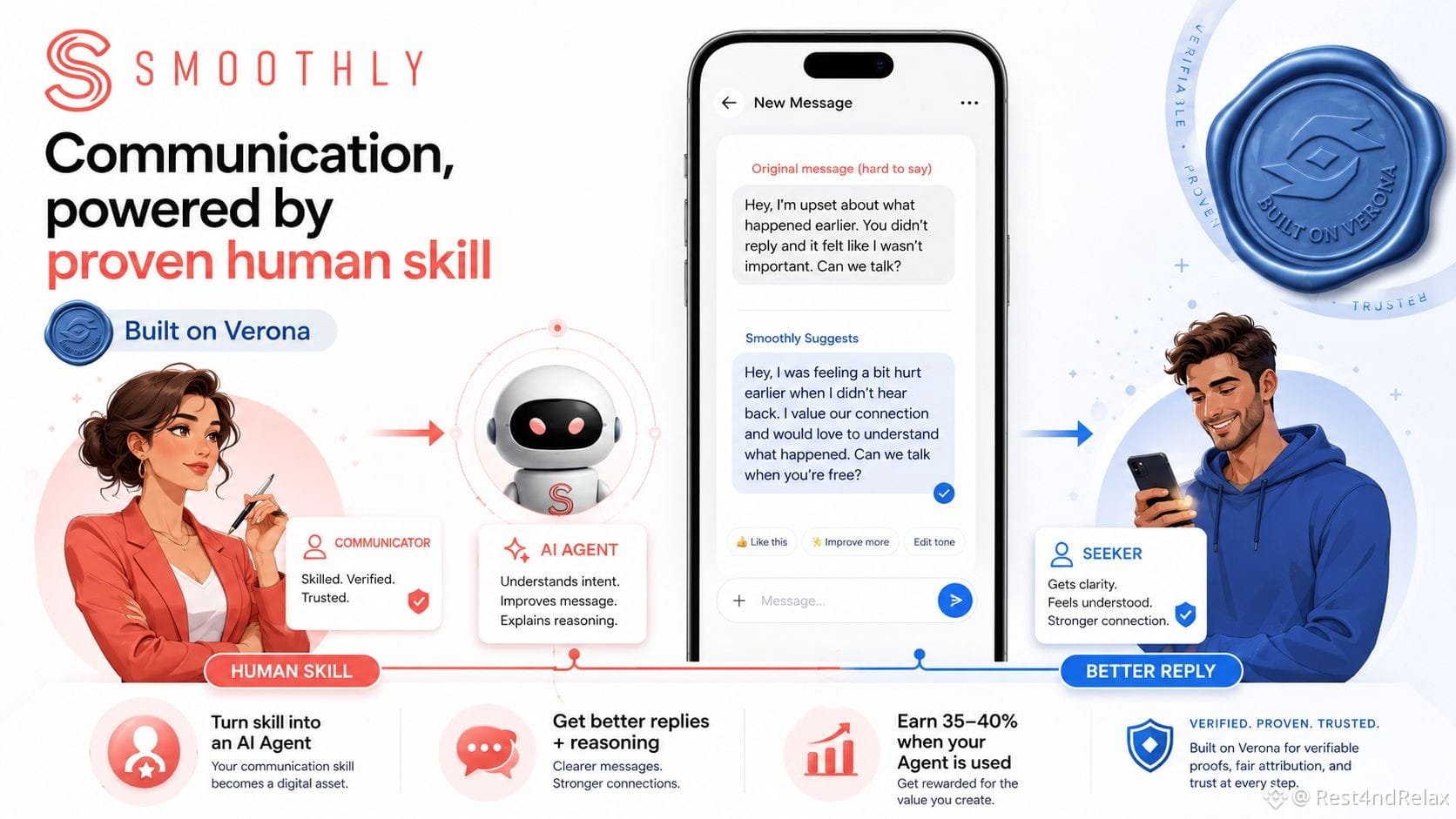
1
101
·
--
Haussier
The next AI winners may not be the people building the models. They may be the people whose judgment makes those models useful.
That is the overlooked story behind Smoothly, a product running on Verona.
Smoothly helps users respond to difficult messages, but it does not rely only on generic AI trained on average internet conversations.
It starts with real people who prove their communication ability through a scenario-based assessment.
Those who pass can have an AI Agent built from their own answers, voice, and communication style. When users choose that Agent, the Communicator receives 35–40% of the spending, paid monthly.
But the most interesting part is not the reply generator.
It is the creation of a new type of AI economy:
Human judgment becomes a scalable digital service.
A skilled communicator can help one person manually or their Agent can help thousands while preserving their unique style.
Each successful Communicator also receives an on-chain SVC badge, creating user-owned proof that they passed the assessment. Unlike a normal platform badge, that proof can remain verifiable beyond Smoothly.
Why does this matter?
Most AI platforms extract human knowledge, turn it into a product, and keep nearly all the value.
Smoothly is testing a different model: humans provide the intelligence, AI scales it, and the people behind that intelligence share in the revenue.
To me, this looks like an early blueprint for a verified human intelligence marketplace where real skills, reputation, and taste can power AI Agents without becoming invisible platform data.
This is also why Verona talks about GDP instead of only TVL.
Not just capital sitting inside a network, but real users paying for real services and creating real economic activity.
The future of AI may not be humans versus machines.
It may be humans owning the value their intelligence creates.
Would you let an AI Agent represent your skills if every use generated income for you?
Learn more: https://smoothly.me/
#Verona #AI #Web3 #ConsumerCrypto #CryptoAI #BinanceSquare
The next AI winners may not be the people building the models. They may be the people whose judgment makes those models useful.
That is the overlooked story behind Smoothly, a product running on Verona.
Smoothly helps users respond to difficult messages, but it does not rely only on generic AI trained on average internet conversations.
It starts with real people who prove their communication ability through a scenario-based assessment.
Those who pass can have an AI Agent built from their own answers, voice, and communication style. When users choose that Agent, the Communicator receives 35–40% of the spending, paid monthly.
But the most interesting part is not the reply generator.
It is the creation of a new type of AI economy:
Human judgment becomes a scalable digital service.
A skilled communicator can help one person manually or their Agent can help thousands while preserving their unique style.
Each successful Communicator also receives an on-chain SVC badge, creating user-owned proof that they passed the assessment. Unlike a normal platform badge, that proof can remain verifiable beyond Smoothly.
Why does this matter?
Most AI platforms extract human knowledge, turn it into a product, and keep nearly all the value.
Smoothly is testing a different model: humans provide the intelligence, AI scales it, and the people behind that intelligence share in the revenue.
To me, this looks like an early blueprint for a verified human intelligence marketplace where real skills, reputation, and taste can power AI Agents without becoming invisible platform data.
This is also why Verona talks about GDP instead of only TVL.
Not just capital sitting inside a network, but real users paying for real services and creating real economic activity.
The future of AI may not be humans versus machines.
It may be humans owning the value their intelligence creates.
Would you let an AI Agent represent your skills if every use generated income for you?
Learn more: https://smoothly.me/
#Verona #AI #Web3 #ConsumerCrypto #CryptoAI #BinanceSquare
That is the overlooked story behind Smoothly, a product running on Verona.
Smoothly helps users respond to difficult messages, but it does not rely only on generic AI trained on average internet conversations.
It starts with real people who prove their communication ability through a scenario-based assessment.
Those who pass can have an AI Agent built from their own answers, voice, and communication style. When users choose that Agent, the Communicator receives 35–40% of the spending, paid monthly.
But the most interesting part is not the reply generator.
It is the creation of a new type of AI economy:
Human judgment becomes a scalable digital service.
A skilled communicator can help one person manually or their Agent can help thousands while preserving their unique style.
Each successful Communicator also receives an on-chain SVC badge, creating user-owned proof that they passed the assessment. Unlike a normal platform badge, that proof can remain verifiable beyond Smoothly.
Why does this matter?
Most AI platforms extract human knowledge, turn it into a product, and keep nearly all the value.
Smoothly is testing a different model: humans provide the intelligence, AI scales it, and the people behind that intelligence share in the revenue.
To me, this looks like an early blueprint for a verified human intelligence marketplace where real skills, reputation, and taste can power AI Agents without becoming invisible platform data.
This is also why Verona talks about GDP instead of only TVL.
Not just capital sitting inside a network, but real users paying for real services and creating real economic activity.
The future of AI may not be humans versus machines.
It may be humans owning the value their intelligence creates.
Would you let an AI Agent represent your skills if every use generated income for you?
Learn more: https://smoothly.me/
#Verona #AI #Web3 #ConsumerCrypto #CryptoAI #BinanceSquare
1
95
Connectez-vous pour découvrir plus de contenu
Rejoignez la communauté mondiale des adeptes de cryptomonnaies sur Binance Square
⚡️ Suviez les dernières informations importantes sur les cryptomonnaies.
💬 Jugé digne de confiance par la plus grande plateforme d’échange de cryptomonnaies au monde.
👍 Découvrez les connaissances que partagent les créateurs vérifiés.
Adresse e-mail/Nº de téléphone
Sujets d’actualité
SECHaltsCryptoETFReviewsAmidFundingLapse
8,368 vues
162 mentions
#SECHaltsCryptoETFReviewsAmidFundingLapse
SEC Halts Crypto ETF Reviews Amid Funding Lapse
The U.S. Securities and Exchange Commission (SEC) has reportedly paused certain cryptocurrency ETF review activities amid a government funding lapse.
This development has created uncertainty in the crypto market, particularly for investors and companies waiting for regulatory decisions on crypto-related exchange-traded funds (ETFs).
Impact on the Crypto Market
The delay could affect the approval timeline of pending crypto ETF applications. Investors are closely monitoring the situation as regulatory clarity remains an important factor in the growth of the digital asset industry.
Although the pause does not necessarily mean that crypto ETF applications will be rejected, it highlights how government funding disruptions can influence financial regulatory processes.
What Happens Next?
Market participants will be watching for updates on government funding and the SEC's ability to resume normal operations.
Crypto ETFs remain an important topic for institutional adoption, market development, and investor confidence.
Conclusion: The temporary halt highlights the importance of regulatory stability for the future of cryptocurrency investments.
#Crypto #Bitcoin #ETF #SEC #CryptoNews #Blockchain #Binance
King2112
·0 mentions J’aime
·109 vues
ZcashETFPostsFirstWeeklyOutflow$93.6M
56,729 vues
173 mentions
GreekPoliceBustCryptoScamRingArrest17
171,142 vues
1,199 mentions