
#verona
verona
3,318 views
52 Discussing
Hot
Latest

I’m not criticizing Verona’s Fermi upgrade itself; what I’m criticizing is the way it’s being promoted.
At 21:30 Beijing time on October 28, the official account posted, “Fermi is now on mainnet, and Verona has officially become a quantum-resistant blockchain.” Three minutes later, accounts across the space started piling on: “i called it,” “FINALLY the big announcement is here,” “the future of blockchain is live.” For over forty minutes, they churned out a string of explainer posts that were almost identical, all starting with “Quantum computers could change encryption forever.” I checked the numbers: quite a few posts had only double-digit views—14, 22, 48—and some had single-digit views. That’s not community consensus; that’s people clocking in for their shifts.
More importantly, the messaging is misleading. One account wrote, “All accounts on the network are quantum-resistant now,” but other posts admit that it’s “an option for users”: you have to add a new quantum-resistant key (ML-DSA, NIST FIPS 204) to your smart contract account yourself, then disable the old key. Your address and balance stay the same. In other words, it’s “possible to do,” not “already done.” Accounts that don’t take action are no different from yesterday.
Technically, this “add a key, remove a key” approach is more elegant than BTC’s route of moving coins across the entire network—I’ll give it that. But using timelines like “Google’s 2029 target” and “NIST will phase out some older algorithms after 2030” as fear fuel to promote a project is a bit much.
Quantum resistance is a real issue, but right now its biggest use seems to be giving airdrop-farming accounts a new template.
#量子计算 #Verona
6

·
--
Bullish
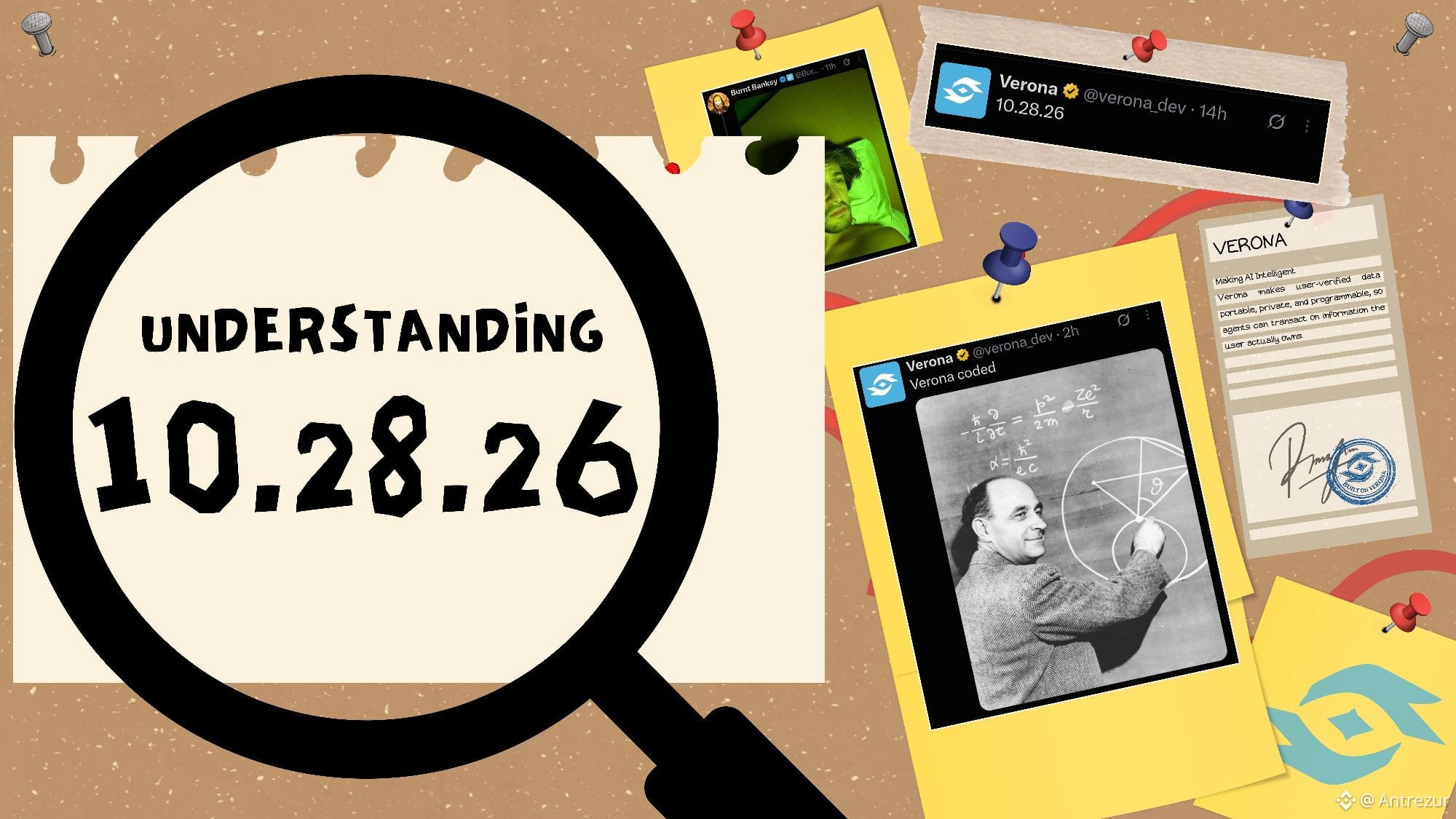
First, 10.28.26.
Then, "Verona coded."
Two posts, one date, and a phrase that feels like it might mean more than it says.
Is October 28 the day something gets revealed? Is "Verona coded" a clue, or just a hint at what’s coming?
Could these two posts be connected, or is the bigger picture still missing a piece?
No answers yet. Just a date, a phrase, and a reason to pay attention.
Let’s see what October 28 brings.
#Verona
66

·
--
Bullish
AI Can Trade 24/7, But Does It Really Know Our Risks?
This is what makes the latest VERONA × AlphioAI collaboration so interesting.
Imagine you have trading positions on 3 exchanges, while the AI trading tool you use is connected to just 1 account.
The AI might follow all the risk limits you set. But what if it makes those decisions without knowing your total exposure?
That’s where Verona and Alphio play an interesting role.
🔹 Alphio brings AI trading agent technology to Verona. The AI is designed to monitor markets, run trading strategies, and execute orders according to users’ permissions and risk limits.
🔹 Verona focuses on verified data, allowing AI agents to use verified facts without having to access all of a user’s personal data.
This means the approach could help AI understand trading risks more comprehensively, rather than just looking at a single connected account.
In my view, the future of AI trading isn’t just about execution speed or smart algorithms.
AI also needs accurate information before making decisions.
Of course, this collaboration doesn’t guarantee profits or risk-free trading.
But one thing is interesting: the more decisions we delegate to AI, the more important trustworthy data becomes.
Smart AI is great. AI backed by verified facts is even better.
#Verona #Alphio #AITrading #Web3
2
99
·
--
Verified

Article
AI Is Learning to Remember Us. But Should It Remember Everything? Verona × ZetaChainAI is getting smarter every day. But the more it learns about us, the bigger the question becomes: who actually controls what it remembers?
Think about how we use AI today.
We ask it to help with work, explain complicated topics, plan our schedules, and sometimes even discuss personal matters.
Over time, AI can start learning our preferences, habits, and how we like things done.
That sounds useful, right?
But here's something worth thinking about.
Just because AI remembers something about you doesn't mean that information is true. And just because it knows something doesn't mean it should be allowed to keep it forever.
That's why the recent collaboration between Verona (@verona_dev) and ZetaChain (@ZetaChain) caught my attention.
They're looking at two important pieces of the AI puzzle: private memory and verified information.
ZetaChain: Giving Users Control Over AI Memory
Imagine spending months teaching an AI assistant how you work.
It remembers your writing style, favorite tools, ongoing projects, and personal preferences.
Then one day, you decide to switch to a better AI model.
Wouldn't it be frustrating to start teaching everything from scratch?
This is one of the problems ZetaChain is trying to solve.
Through its Private Memory Layer for AI, ZetaChain is working toward AI experiences where users control their information and can carry their memory across different AI models.
Its consumer application, Anuma, already demonstrates this approach.
According to ZetaChain, more than 320,000 Anuma accounts have been created since February 2026, with over 1.3 million AI requests across 38 models.
The interesting part isn't just the numbers.
It's the idea that your AI memory should belong to you, rather than being locked inside a single AI platform.
Verona: Remembering Something Isn't the Same as Proving It
Now, this is where Verona enters the picture.
Let's say you tell an AI assistant that you're over 18 years old.
The AI might remember that statement.
But remembering your claim doesn't automatically prove that it's true.
Verona approaches this problem differently.
As an intelligence layer for AI, Verona focuses on turning information verified at its original source into reusable proof that users control.
Instead of revealing sensitive personal information every time an application needs verification, authorized AI agents can use that proof without accessing the underlying raw data.
For example, imagine an application needs to confirm that you're old enough to access a particular service.
The goal is to prove that you meet the age requirement without unnecessarily exposing your full date of birth or identity documents.
That's the difference between information an AI remembers and information it can actually verify.
Memory makes AI more personal. Proof makes the information it uses more trustworthy.
And I think that distinction is going to matter a lot as AI agents become more involved in our daily lives.
Why This Collaboration Matters
What makes Verona × ZetaChain interesting is how their approaches could complement each other.
ZetaChain focuses on private, user-controlled AI memory.
Verona focuses on verified information that can be reused without exposing the sensitive data behind it.
Now imagine an AI assistant that remembers your preferences while also being able to verify specific facts when necessary.
It could potentially offer a more personalized experience without requiring users to hand over unnecessary private information.
That's a much more interesting direction for AI than simply building models that remember more and more data.
To be clear, the teams are currently exploring how these capabilities could work together. This isn't an announcement that a fully integrated product is already live.
But the direction itself is worth watching.
The Most Interesting Part? They're Asking Users First
Instead of deciding everything behind closed doors, Verona and ZetaChain have launched a joint research initiative to understand what people actually want from AI memory.
They're asking questions such as:
• What information should AI remember about you?
• What information should it never keep?
• Should your AI memory follow you when switching models?
• Who should decide what gets stored or deleted?
• Would you allow AI to verify certain facts without sharing the underlying data?
• What personal information would you allow an AI to use when connecting you with other people?
These aren't just technical questions.
They're questions that could shape how people interact with AI in the future.
The research includes the Anuma community, Verona's community, and anyone who uses AI.
Both teams plan to publish the findings in November 2026.
My Take: The Future of AI Isn't Just About Intelligence
For a long time, much of the conversation around AI has focused on which model is faster, smarter, or more powerful.
But I think we're entering a stage where another question matters just as much.
Can we actually trust what AI knows about us, and can we control how it uses that information?
An AI assistant that remembers everything might sound impressive.
But an AI assistant that respects our privacy, gives us control, and can verify important information without exposing unnecessary personal details?
That's a future I'd be much more interested in.
And this is why I'm paying attention to what Verona and ZetaChain are exploring.
Because the next big improvement in AI might not just be a smarter model.
It might be a better relationship between AI and the people using it.
Your Opinion Matters Too
Verona and ZetaChain are inviting AI users to participate in their research.
The survey is anonymous, requires no account, takes around five minutes, and closes on October 27, 2026.
If you use AI, consider sharing your perspective.
👉 Official Survey:
https://docs.google.com/forms/d/e/1FAIpQLSdjzQjUk_q0wfL5fEQ4xq1Z86N_rEfDD9zL2o8oGMZe8BApyg/viewform
One final question:
If AI could remember everything about you, what's the ONE thing you would never want it to keep?
I'd love to hear your thoughts.
Official Sources:
Verona announcement: https://x.com/verona_dev/status/2110008524596298093
ZetaChain article: https://www.zetachain.com/blog/zetachain-x-verona-asking-300000-users-what-ai-should-remember
#Verona #Zetachain #AI #Web3 #Privacy
AI Is Learning to Remember Us. But Should It Remember Everything? Verona × ZetaChain
AI is getting smarter every day. But the more it learns about us, the bigger the question becomes: who actually controls what it remembers?
Think about how we use AI today.
We ask it to help with work, explain complicated topics, plan our schedules, and sometimes even discuss personal matters.
Over time, AI can start learning our preferences, habits, and how we like things done.
That sounds useful, right?
But here's something worth thinking about.
Just because AI remembers something about you doesn't mean that information is true. And just because it knows something doesn't mean it should be allowed to keep it forever.
That's why the recent collaboration between Verona (@verona_dev) and ZetaChain (@ZetaChain) caught my attention.
They're looking at two important pieces of the AI puzzle: private memory and verified information.
ZetaChain: Giving Users Control Over AI Memory
Imagine spending months teaching an AI assistant how you work.
It remembers your writing style, favorite tools, ongoing projects, and personal preferences.
Then one day, you decide to switch to a better AI model.
Wouldn't it be frustrating to start teaching everything from scratch?
This is one of the problems ZetaChain is trying to solve.
Through its Private Memory Layer for AI, ZetaChain is working toward AI experiences where users control their information and can carry their memory across different AI models.
Its consumer application, Anuma, already demonstrates this approach.
According to ZetaChain, more than 320,000 Anuma accounts have been created since February 2026, with over 1.3 million AI requests across 38 models.
The interesting part isn't just the numbers.
It's the idea that your AI memory should belong to you, rather than being locked inside a single AI platform.
Verona: Remembering Something Isn't the Same as Proving It
Now, this is where Verona enters the picture.
Let's say you tell an AI assistant that you're over 18 years old.
The AI might remember that statement.
But remembering your claim doesn't automatically prove that it's true.
Verona approaches this problem differently.
As an intelligence layer for AI, Verona focuses on turning information verified at its original source into reusable proof that users control.
Instead of revealing sensitive personal information every time an application needs verification, authorized AI agents can use that proof without accessing the underlying raw data.
For example, imagine an application needs to confirm that you're old enough to access a particular service.
The goal is to prove that you meet the age requirement without unnecessarily exposing your full date of birth or identity documents.
That's the difference between information an AI remembers and information it can actually verify.
Memory makes AI more personal. Proof makes the information it uses more trustworthy.
And I think that distinction is going to matter a lot as AI agents become more involved in our daily lives.
Why This Collaboration Matters
What makes Verona × ZetaChain interesting is how their approaches could complement each other.
ZetaChain focuses on private, user-controlled AI memory.
Verona focuses on verified information that can be reused without exposing the sensitive data behind it.
Now imagine an AI assistant that remembers your preferences while also being able to verify specific facts when necessary.
It could potentially offer a more personalized experience without requiring users to hand over unnecessary private information.
That's a much more interesting direction for AI than simply building models that remember more and more data.
To be clear, the teams are currently exploring how these capabilities could work together. This isn't an announcement that a fully integrated product is already live.
But the direction itself is worth watching.
The Most Interesting Part? They're Asking Users First
Instead of deciding everything behind closed doors, Verona and ZetaChain have launched a joint research initiative to understand what people actually want from AI memory.
They're asking questions such as:
• What information should AI remember about you?
• What information should it never keep?
• Should your AI memory follow you when switching models?
• Who should decide what gets stored or deleted?
• Would you allow AI to verify certain facts without sharing the underlying data?
• What personal information would you allow an AI to use when connecting you with other people?
These aren't just technical questions.
They're questions that could shape how people interact with AI in the future.
The research includes the Anuma community, Verona's community, and anyone who uses AI.
Both teams plan to publish the findings in November 2026.
My Take: The Future of AI Isn't Just About Intelligence
For a long time, much of the conversation around AI has focused on which model is faster, smarter, or more powerful.
But I think we're entering a stage where another question matters just as much.
Can we actually trust what AI knows about us, and can we control how it uses that information?
An AI assistant that remembers everything might sound impressive.
But an AI assistant that respects our privacy, gives us control, and can verify important information without exposing unnecessary personal details?
That's a future I'd be much more interested in.
And this is why I'm paying attention to what Verona and ZetaChain are exploring.
Because the next big improvement in AI might not just be a smarter model.
It might be a better relationship between AI and the people using it.
Your Opinion Matters Too
Verona and ZetaChain are inviting AI users to participate in their research.
The survey is anonymous, requires no account, takes around five minutes, and closes on October 27, 2026.
If you use AI, consider sharing your perspective.
👉 Official Survey:
https://docs.google.com/forms/d/e/1FAIpQLSdjzQjUk_q0wfL5fEQ4xq1Z86N_rEfDD9zL2o8oGMZe8BApyg/viewform
One final question:
If AI could remember everything about you, what's the ONE thing you would never want it to keep?
I'd love to hear your thoughts.
Official Sources:
Verona announcement: https://x.com/verona_dev/status/2110008524596298093
ZetaChain article: https://www.zetachain.com/blog/zetachain-x-verona-asking-300000-users-what-ai-should-remember
#Verona #Zetachain #AI #Web3 #Privacy
1
192
·
--
Bullish
Verified
AI Is Getting Smarter, But Can We Trust It With Our Money?
Imagine a future where AI can shop, pay bills, and even make crypto transactions for us.
Sounds convenient, right? But how do we know the AI is using accurate information and truly acting on its owner's behalf?
That's what makes the latest collaboration between Verona and Billions Network interesting.
🔹 Verona helps AI use verified information without exposing users' personal data.
🔹 Billions helps ensure AI agents are connected to verified humans without revealing their personal identities.
Interestingly, Verona has recorded more than 70 million verified interactions, while Billions has over 2.5 million verified users and more than 25,000 AI agents with IDs.
In my opinion, the future of AI isn't just about who's the smartest, but also who can be trusted.
Because when AI starts managing real money, trust is just as important as intelligence.
What do you think—are you ready to trust AI with your transactions? 👀
#Verona #Billions #AI #Web3 #AIAgent
1
677
·
--
Bullish
AI agents can search, analyze, and make decisions. But one part is often overlooked: how do they actually pay for things?
That’s where verUSD becomes interesting.
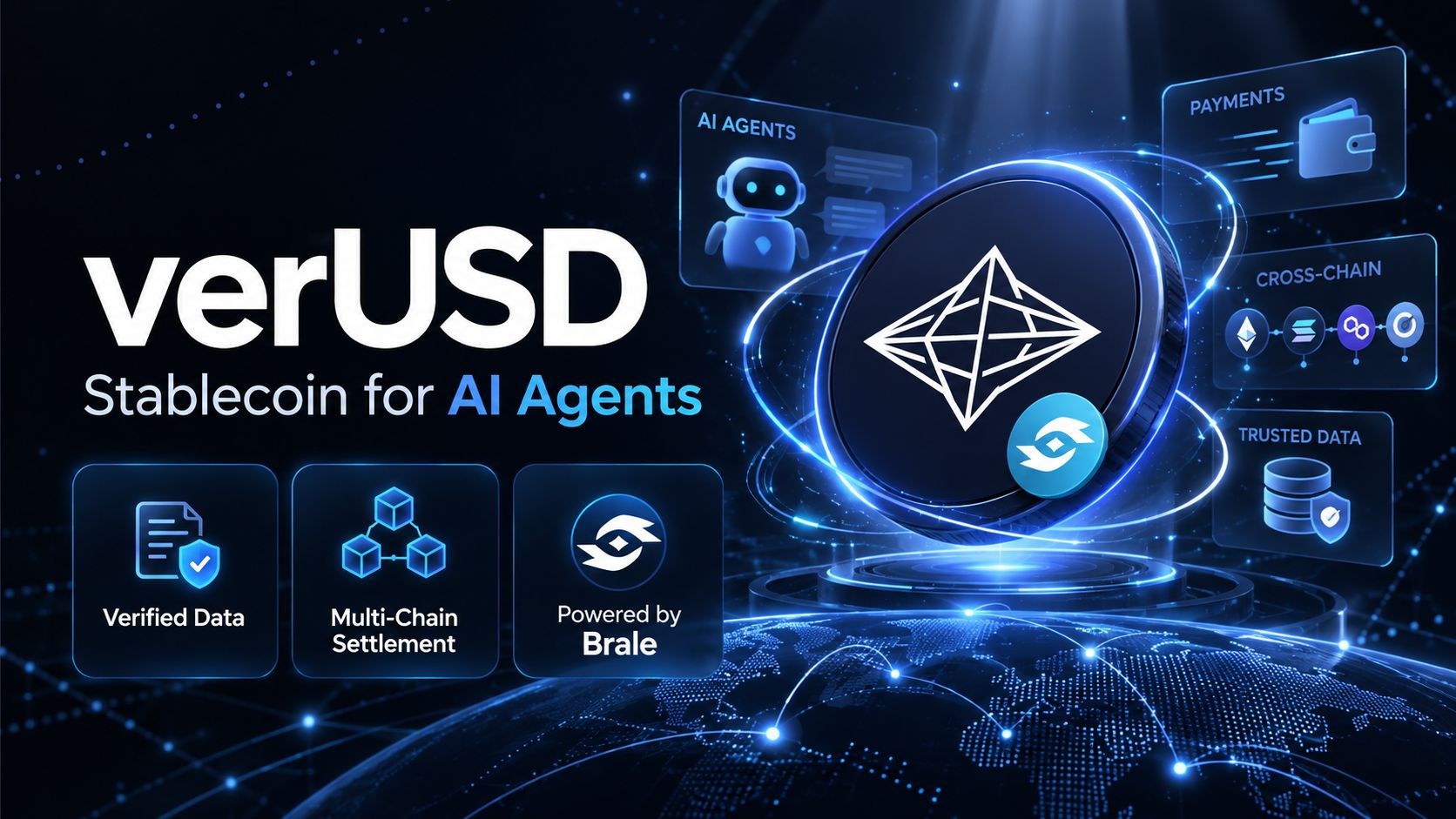
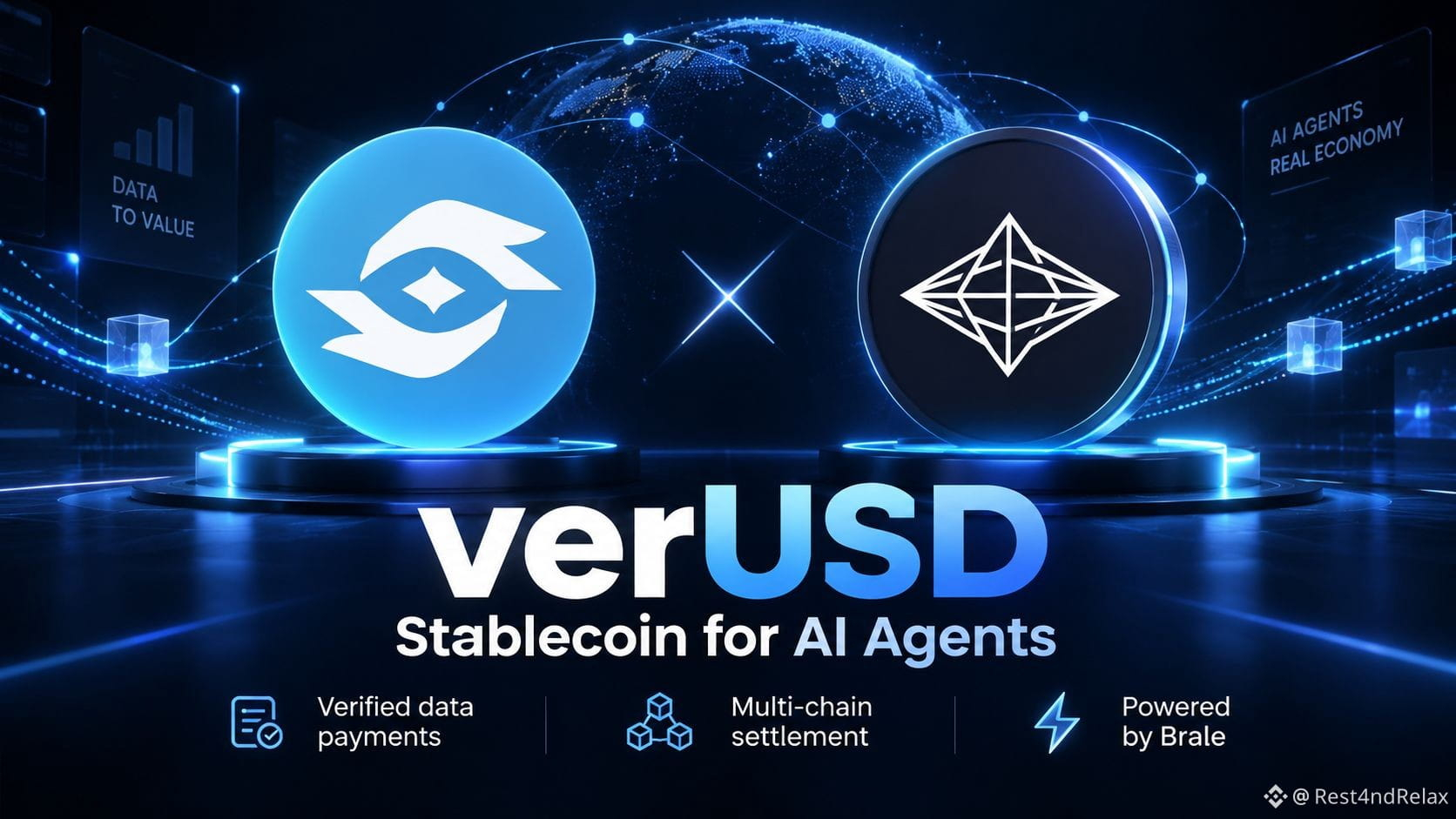
Verona launched verUSD, powered by Brale, as a stablecoin designed to support AI agent transactions, including payments for verified data and settlement across supported blockchains.
To me, this shows that the AI economy needs more than smarter models.
Agents also need infrastructure that helps them move from knowing to doing.
They need access to information they can trust, the ability to act on it, and a way to complete payments or transactions.
Brale handles much of the stablecoin complexity behind the scenes, including issuance, reserves, mint/burn operations, and multi-chain infrastructure. That allows Verona to stay focused on building its network around verified information and AI agents.
Another key point: verUSD is designed with a native multi-chain approach, rather than simply relying on wrapped versions everywhere.
There is also early demand behind the launch. Verona previously announced $100M+ in institutional launch commitments, along with $60M+ in signed committed revenue planned to flow through verUSD as a payment rail.
But the most interesting part may be the end experience.
Users may never open an app because they want to “use verUSD.”
They open the app because they want something done.
The AI agent finds the right data, verifies what it needs, makes the payment, and completes the transaction while the crypto infrastructure stays mostly invisible.
Maybe that’s what real crypto adoption looks like: less about using crypto, more about crypto simply working.
#Verona #Stablecoin #ai #web3
1
152
·
--
Bullish
AI agents can search for information, make decisions, and even carry out tasks. But there’s one part that’s often overlooked: how do they pay for things?
This is where verUSD starts to get interesting.
Verona has launched verUSD, built on infrastructure from Brale, as a stablecoin designed to support AI agent transactions, including payments for verified data and settlement across supported blockchains.
To me, this shows that the AI economy needs more than just smarter models.
Agents also need infrastructure to move from “knowing” to “doing.”
They need to obtain verifiable information, then use it to take action and complete payments.
Brale handles the complex stablecoin operations behind the scenes, from issuance, reserves, and minting/burning to multi-chain operations. Meanwhile, Verona can focus on its network for verified information and AI agents.
What’s particularly interesting is that verUSD is also built with a native multi-chain approach. So the idea isn’t to create a single asset and then rely on wrapped versions everywhere.
And there are signs of demand from the outset: Verona previously announced $100M+ in institutional launch commitments and $60M+ in signed committed revenue, with plans to use verUSD as a payment rail.
In my view, the ultimate vision is the most compelling part.
We might not open an app because we want to “use verUSD.”
We open an app because we want something done.
An AI agent does the work, gets the data it needs, pays, and completes the transaction—while crypto infrastructure quietly runs behind the scenes.
Maybe that’s what real crypto adoption looks like: less about using crypto, more about crypto simply working.
#Verona #Stablecoin #Ai #Web3
1
160
·
--
Bullish
Most TVL in crypto is just rented money.
A chain launches, incentives go live, capital rushes in, dashboards look beautiful… then rewards slow down and the money quietly leaves.
That is the problem with using TVL as the main signal.
Sometimes it shows demand. But often, it only shows that people are being paid to park capital somewhere.
Verona is taking a different route.
Instead of asking, “How much money is sitting here?”
The better question is:
“How much real economic activity is this network actually creating?”
According to Verona, the network now has over $35M in projected annual recurring revenue from 150+ real brands, including names like Uber and Nike.
These brands are not coming for farming rewards.
They are paying for data verification because they need better signals: verified users, verified actions, and proof that online activity is actually real.
That matters because the internet is getting harder to trust.
Bots can fake clicks. AI can generate engagement. Fake accounts can inflate numbers.
But paying customers solving real problems are much harder to fake.
Verona has also processed more than 68 million verified interactions.
That means this is not just crypto activity looping inside crypto.
It is closer to revenue from the real economy entering an onchain system.
And here is the interesting part:
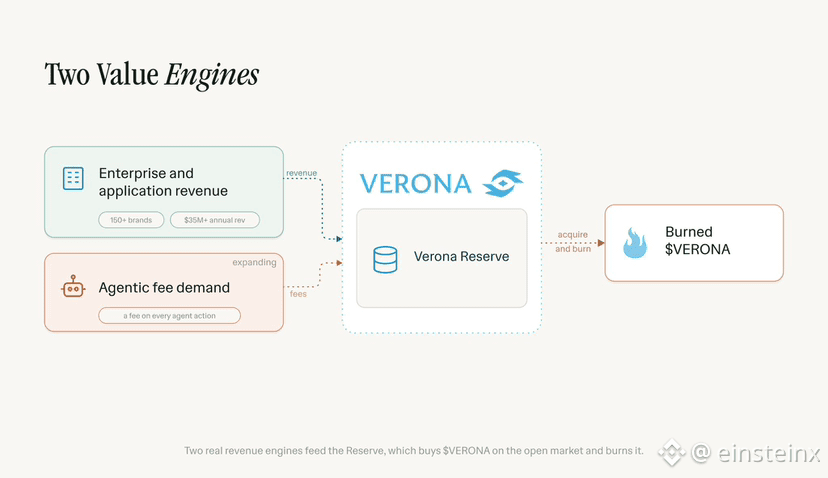
A portion of Verona’s network revenue is allocated to buy $VERONA on the open market and burn it.
So when the network gets used, revenue can translate into buyback pressure and reduced supply.
That is a very different model from “please deposit liquidity so our TVL chart looks good.”
You can fake TVL.
You can rent liquidity.
But you cannot easily fake brands paying for verification because they actually need it.
This is why Verona’s message hits different:
GDP > TVL.
Not just bigger numbers.
Better signals. Better revenue. Better proof. A more sustainable crypto economy.
Be honest: would you rather invest in high TVL or real paying customers?
#verona #ai #web3 #crypto #layer1

1
132

·
--
Verona Tokenomics: The Flywheel Behind $VERONA
The most interesting part of Verona’s tokenomics isn’t the burn—it’s what funds it.
The network already has a foundation of:
* 68M+ verified interactions
* 150+ brands live
* $35M+ in signed annualized revenue
Instead of relying on token emissions or liquidity mining, a portion of network revenue is used to buy back and burn $VERONA.
Another key design choice is that users are rewarded in stable-value terms when their verified data is reused, helping reduce token sell pressure.
The AI component is where the model becomes interesting.
AI agents don’t verify information once—they do it constantly. Every time a verified fact is reused by an authorized app or AI agent, it generates another fee for the network.
That creates a simple flywheel:
More verified facts → More reuse → More revenue → More $VERONA bought and burned.
The burn isn’t the story.
The flywheel is.
#BTC #CashCatTops$200MMarketCap #ETH #JapanUrgesGPIFToBoostDomesticAssets #verona
1
162
·
--
Bullish
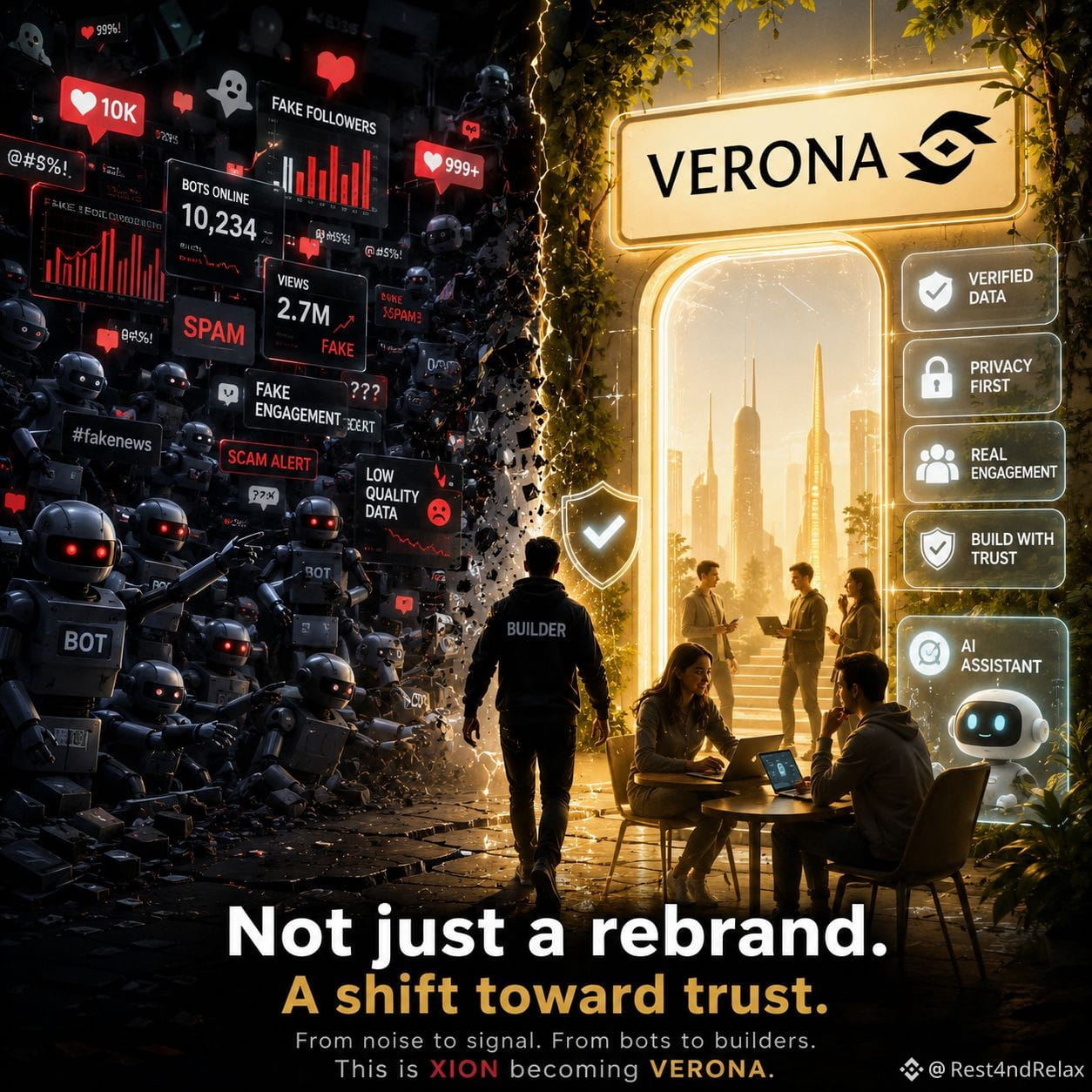
XION becoming Verona is not just a rebrand.
It feels more like a shift in category.
For years, XION was known for making web3 easier to use. Less friction. Better onboarding. A more user-friendly blockchain experience.
But Verona takes that mission into a bigger arena:
trust, verified data, privacy, and AI.
And this matters because the internet is entering a very different phase.
AI can generate content. Bots can fake activity. Fake accounts can create noise. Engagement metrics can be manipulated.
So the next big problem is no longer just access.
It is proof.
How do we know a user is real?
How do we know data comes from a valid source?
How can AI agents act on behalf of users without exposing sensitive information?
How can applications verify facts without forcing people to give up privacy?
This is where Verona becomes interesting.
The idea is not only to make blockchain invisible.
The bigger idea is to make verified information usable across apps, AI agents, enterprises, and everyday users.
In simple terms:
XION focused on making web3 easier.
Verona seems focused on making the internet more trustworthy.
That is a much bigger story than a logo change.
Of course, a rebrand alone does not prove execution. Verona still needs real adoption, real products, and real usage.
But from a narrative perspective, this move makes sense.
Because as AI grows, verified data becomes more valuable.
As bots become harder to detect, proof of human and proof of source become more important.
As digital activity becomes easier to fake, trust becomes one of the most important layers of the next internet.
That is why I think Verona is worth watching.
Not because it has a new name.
But because the new name points to a much bigger question:
What does trust look like when humans, AI agents, apps, and data all interact at internet scale?
Verona is now trying to answer that.
#verona #rebranding #ai #web3
1
195
·
--
Bullish
AI Is Getting Smarter. But There’s One Problem: Can We Trust It?
Everyone is racing to build AI that’s smarter.
Faster models.
More independent agents.
More advanced automation.
But Verona views the problem differently:
How do we make AI trustworthy enough to actually take action?
When AI is only generating text or images, mistakes can still be fixed.
But once AI agents start doing things for us, the stakes become much more serious.
For example, using information about a person’s identity, eligibility, history, or specific facts.
The question is simple:
Is the information the AI uses true—and can it be proven?
That’s where Verona becomes interesting.
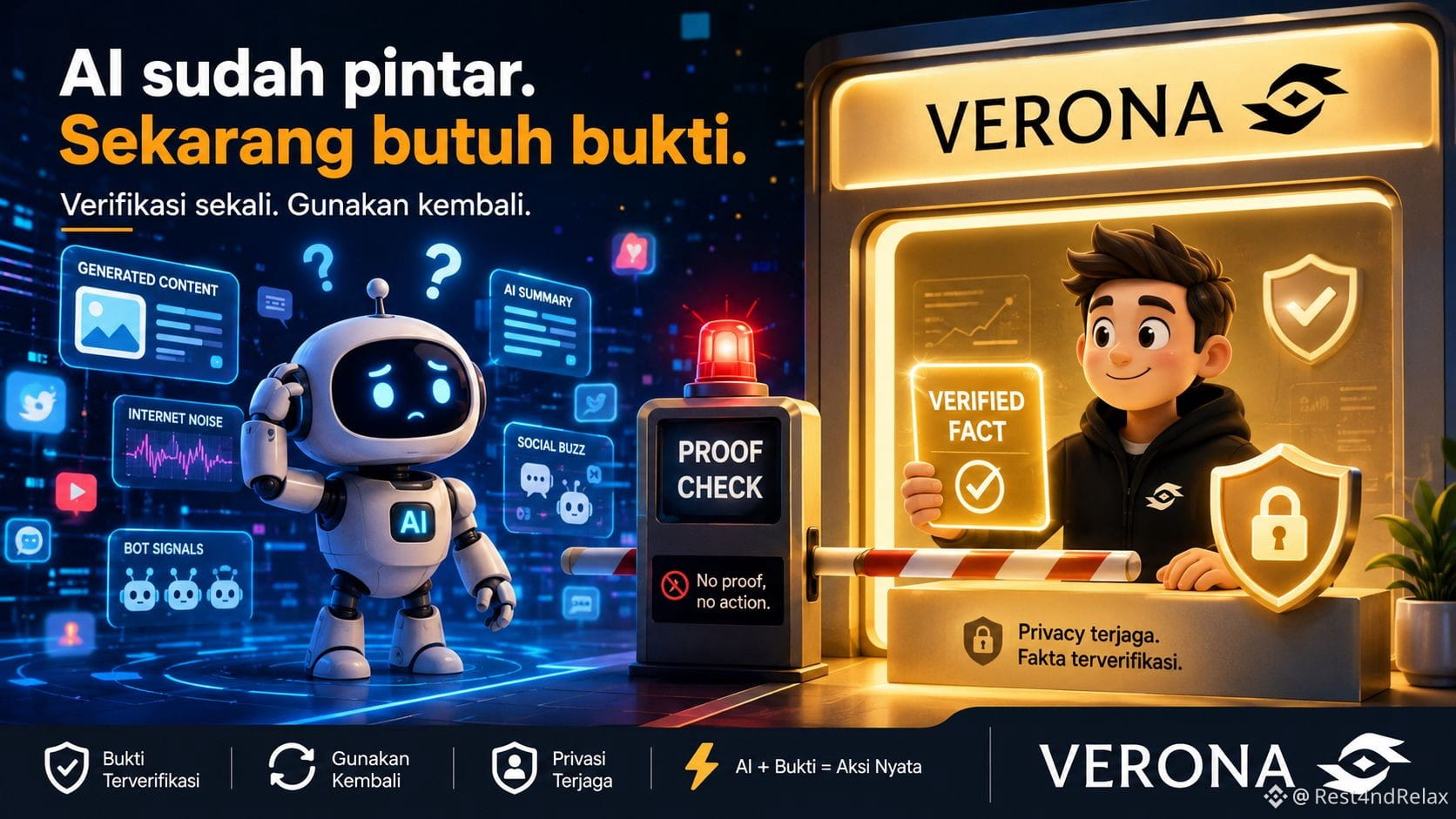
Verona builds an intelligence layer for AI using data that has been verified by users, kept private, and can be reused by authorized agents.
In simple terms:
Verify once.
Reuse when needed.
Without having to expose all your personal data.
Imagine an AI agent only needs to know whether you meet certain requirements.
Why should you hand over all your personal data?
Wouldn’t it make more sense to share proof that the required facts are indeed true?
Not the whole file.
Not every personal detail.
Only relevant proof.
I think this will become even more important.
The internet is now flooded with AI-generated content, automated activities, bots, and AI agents.
So the big question in the future may no longer be:
“How much data do we have?”
But rather:
“What can we truly prove?”
That’s why Verona deserves attention.
Not just because AI needs more intelligence.
But because AI also needs verified facts and proof before we’re willing to trust it enough to let it act.
AI already has a brain.
Now maybe AI needs a receipt. 😭
What do you think—will verified data become one of the most important layers for AI agents in the future?
#verona #ai #verify
1
130
·
--
Bullish
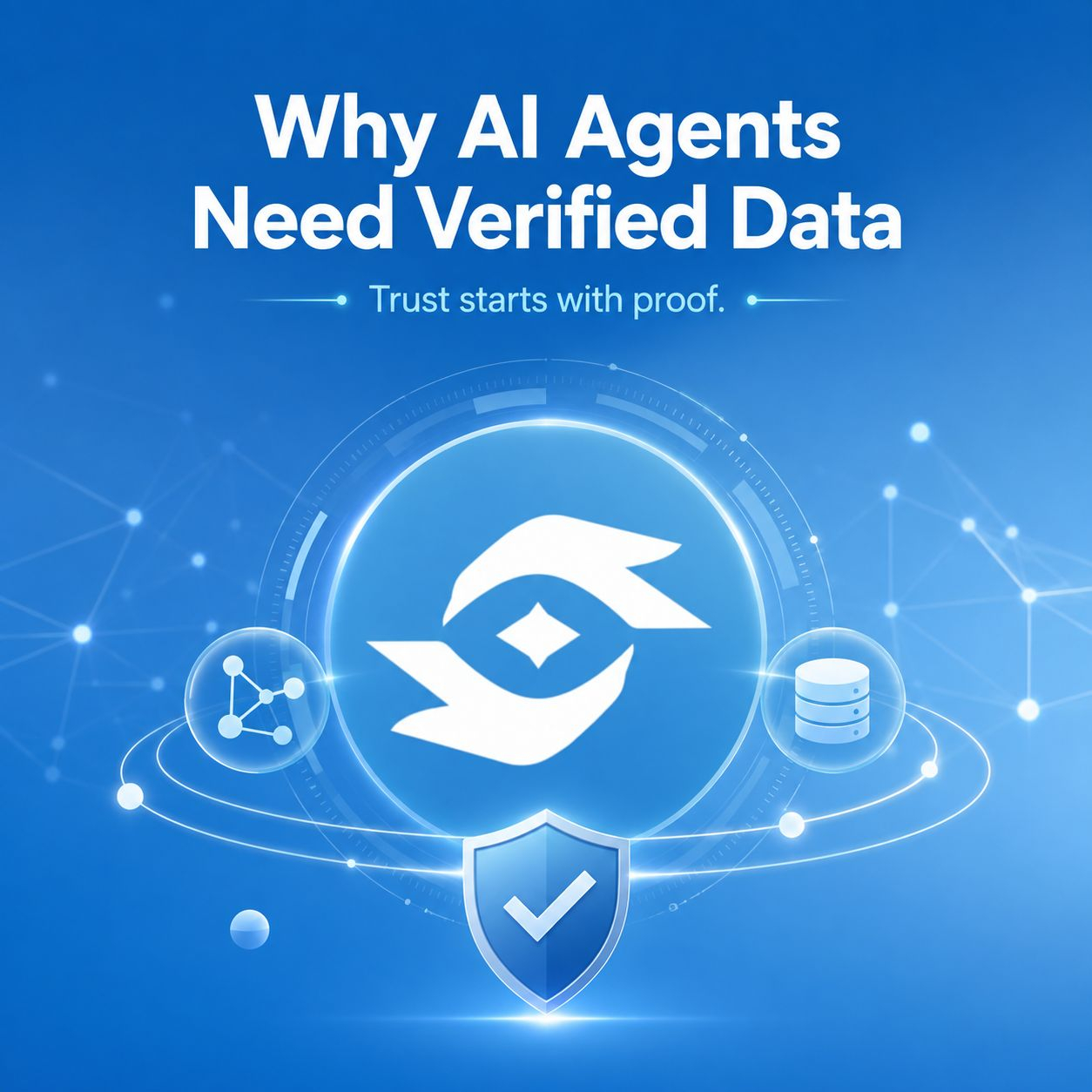
Why AI Agents Need Verified Data
AI agents are getting smarter.
But there’s a problem most people still underestimate:
An AI agent is only as trustworthy as the information it acts on.
Imagine an AI agent that can automatically approve applications, recommend financial decisions, personalize services, or interact with other apps on your behalf.
Sounds powerful.
But what happens if the data it receives is outdated, manipulated, fake, or impossible to verify?
A smarter AI doesn’t automatically solve that problem.
It may simply make a bad decision faster.
That’s why I think verified data could become one of the most important pieces of AI infrastructure.
Instead of AI agents blindly trusting claims, the better model is allowing them to work with information that can be proven.
For example:
Someone shouldn’t always have to expose their entire identity just to prove they’re over 18.
They shouldn’t need to send every detail of their financial history just to prove they meet a certain requirement.
The agent may only need one thing:
proof that the required fact is true.
This is where Verona becomes interesting to me.
Verona is focused on a world where verified information, privacy, proof, and AI agents can work together so applications and agents can use trusted signals without unnecessarily exposing raw personal data.
And I think this becomes more important as AI agents start doing more things for us.
Because the future of AI isn’t just about making agents more autonomous.
It’s about making sure they have better information to act on.
More intelligence makes AI powerful.
Verified data can help make that intelligence trustworthy.
That distinction could matter a lot more than people realize.
#verona #ai #verified #trust
1
278
·
--
Bullish
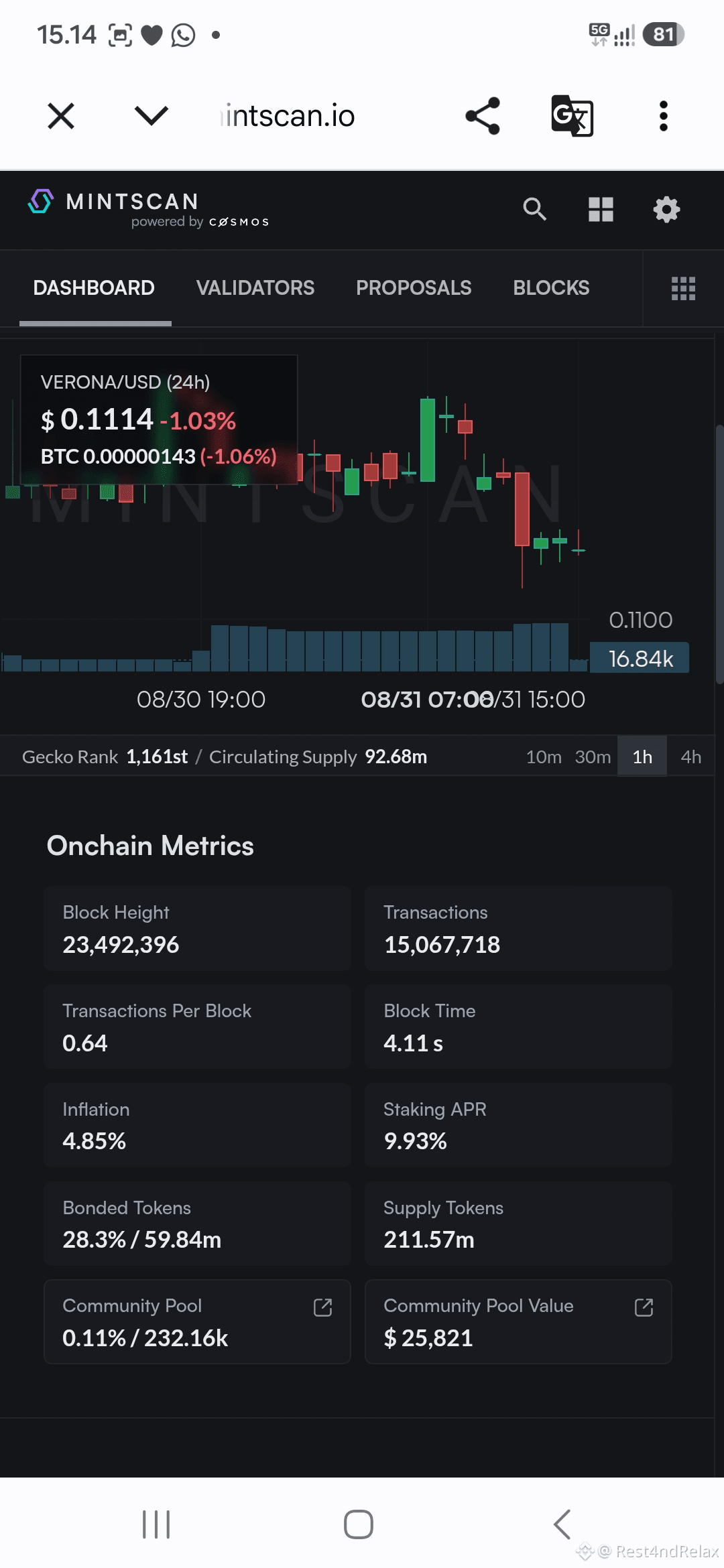
Noise is possible in pricing. On-chain data is usually more honest.
Lately, I’ve been trying to look at Verona not just from the narrative side, but from the data that’s truly visible on Mintscan.
And the snapshot available, in my opinion, is quite interesting:
➡️ 15,067,718 total transactions
➡️ 11,278 monthly active accounts
➡️ 4,856 weekly active accounts
➡️ 1,273 daily active accounts
Beyond that, the dashboard also shows:
➡️ Block time: 4.11 seconds
➡️ Staking APR: 9.93%.
➡️ Circulating supply: 92.68M
➡️ Supply tokens: 211.57M
For me, these numbers matter because they point to one simple thing:
Verona isn’t just alive in the timeline. Its network also has activity that can be seen.
Of course, this data doesn’t automatically mean mass adoption. And a large number of transactions doesn’t always mean every metric is already perfect.
But that’s exactly what makes it interesting.
While many projects are competing to sell AI narratives, Verona is building a more specific positioning: an intelligence layer for AI—a layer focused on verified data, privacy, proof, and trust.
If this direction is truly executed well, then what Verona is building won’t be just an ordinary chain, but a foundation for an internet that apps and AI agents can trust more.
So for me, the most interesting question right now isn’t only:
Is Verona’s narrative good?
But:
Will its activity, users, and utility keep growing as its vision develops?
Because in the long run, that’s what matters much more to monitor.
Source: Mintscan Verona dashboard snapshot
#verona #Mintscan #ai #web3 #Layer1
1
110
·
--
Bullish
Verified
AI agents are getting smarter. Now they need a way to pay.
Big update from VERONA!
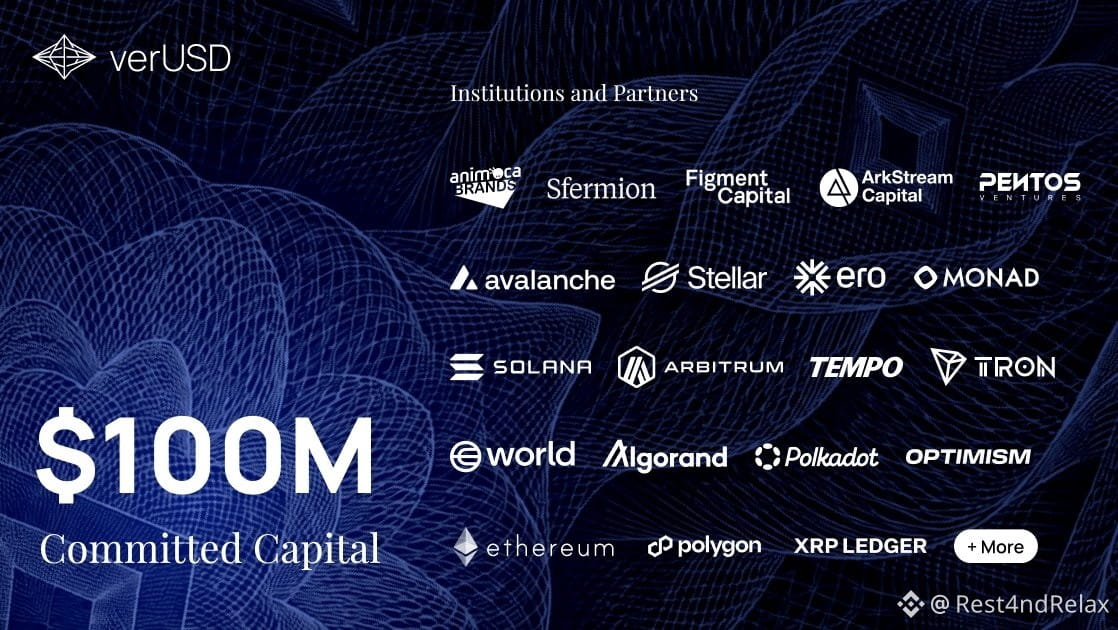
Verona has officially introduced verUSD (Verona USD), a stablecoin designed for AI agents, launching with over $100M in institutional and ecosystem commitments.
The announcement includes Animoca Ventures, Figment Capital, Sfermion, Pentos Ventures, ArkStream, and others.
But there's more to this than just another stablecoin.
Here's what caught my attention:
🔹 Over $60M in signed, contracted revenue is set to flow through verUSD as payments.
🔹 Native issuance across Ethereum, Solana, Polygon, Avalanche, Optimism, Arbitrum, and Celo, rather than relying on bridged versions.
🔹 Built around an ecosystem that has already been using USDC for dollar-based payments.
So why does this matter?
Imagine AI agents accessing verified information and paying for services automatically, potentially thousands of times a day.
Traditional payment systems weren't really built around this kind of activity.
That's where Verona connects two important pieces:
Verona provides privacy-preserving, verified information.
verUSD gives AI agents a way to pay for it.
In simple terms:
Verona verifies the facts. verUSD handles the payments.
For me, this is another interesting step toward building an internet where AI agents can access trustworthy information and transact on it.
The AI economy needs more than intelligence. It needs proof and payment infrastructure.
🔗 Official announcement: https://x.com/verona_dev/status/2104585564058239327
#Verona #verUSD #AI #Stablecoin #Web3
1
635
·
--
Verified
Article
Three Different Projects, One Problem: Why Verona’s First GIA Cohort MattersAt first glance, I didn’t think much of Verona’s latest accelerator update.
Three projects were selected.
One works on AI marketing.
One works on robotics.
One works on professional credentials.
Pretty standard accelerator stuff, right?
But the more I looked at them, the more interesting the pattern became.
Because these three projects may operate in completely different industries, but underneath, they are all running into a very similar problem:
How do you know which information can actually be trusted?
And I think that tells us more about where Verona is heading than the accelerator announcement itself.
Three Projects That Shouldn’t Have Much in Common
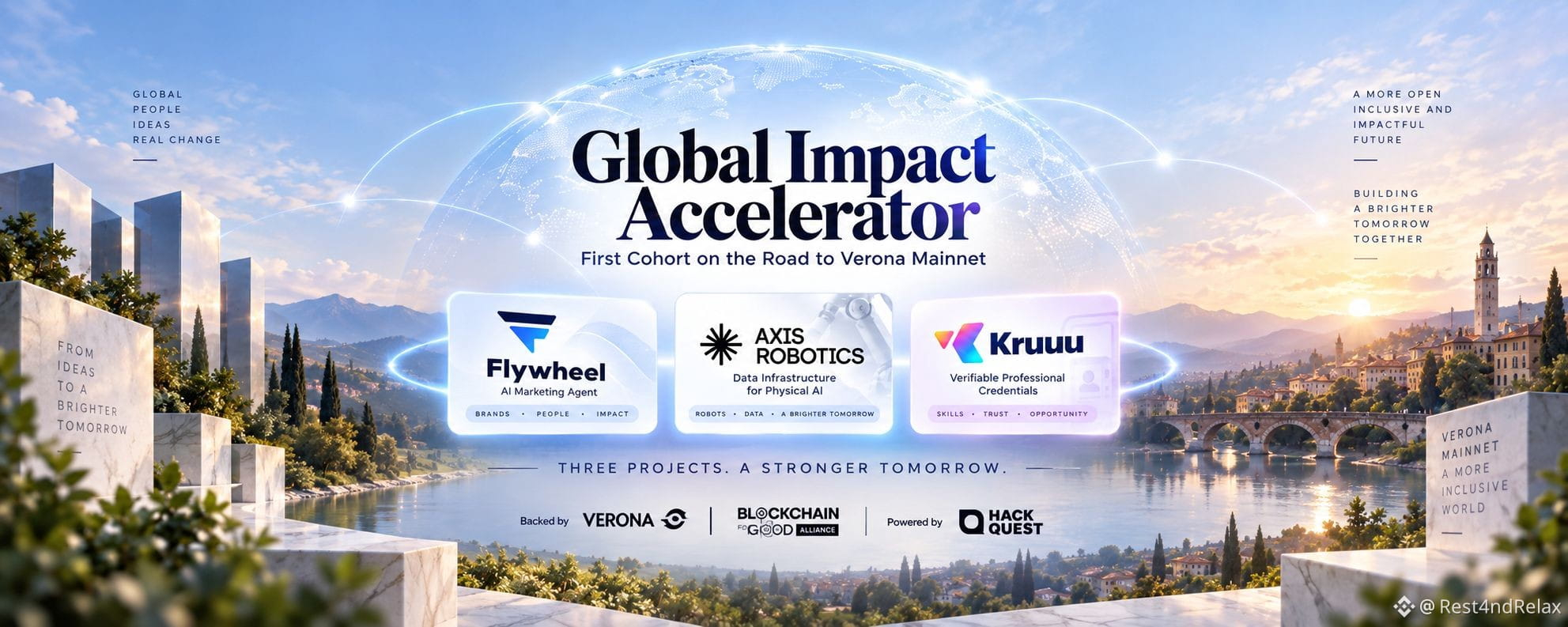
The Global Impact Accelerator brings together Verona, HackQuest, and Chain for Good.
Its first cohort includes:
Flywheel AI.
Axis Robotics.
Kruuu Marketplace.
And over the next two months, each team will work toward full deployment and verification on Verona Mainnet.
That last part matters.
Because instead of looking only at Verona’s positioning, we can now start looking at the kinds of products being brought toward its Mainnet.
And they are surprisingly diverse.
Flywheel AI: What Happens When AI Stops Waiting for Prompts?
Most people still interact with AI in the same way.
You ask.
AI answers.
You ask again.
AI answers again.
Flywheel AI is exploring something more proactive.
It is building an AI marketing agent for small and medium-sized businesses that can look at business performance, identify potential growth opportunities, and turn those opportunities into marketing actions across areas such as SEO, GEO, and social campaigns.
The interesting part isn’t simply “AI for marketing.”
We already have plenty of that.
The bigger shift is toward AI agents that can increasingly observe information and act on it.
And once AI starts taking more actions, the quality of the information behind those actions becomes much more important.
A chatbot giving you a bad suggestion is annoying.
An autonomous system acting on bad information is a much bigger problem.
That is where the question of trusted data becomes interesting.
Axis Robotics: AI Needs More Than Internet Data
Then there is Axis Robotics.
This one moves the conversation away from screens and into the physical world.
Axis is building data infrastructure for Physical AI and robotics, including tools for browser-based teleoperation and spatial data collection through smartphones.
That immediately creates another version of the same question.
What happens when AI needs to understand the real world?
Robots cannot rely only on text scraped from the internet.
They need information about physical environments, movements, objects, and interactions.
And as AI systems move closer to making decisions in the physical world, data quality matters even more.
Because intelligence is only as useful as the information it can rely on.
A powerful model working with unreliable input doesn’t magically produce trustworthy output.
Sometimes it simply produces a more confident mistake.
Kruuu: From “Trust My Profile” to “Verify My Credentials”
Kruuu Marketplace may be the easiest example to understand.
It focuses on Indonesia’s entertainment industry and professional credentials.
Think about how professional reputation works online today.
Someone can write:
“I worked on this production.”
“I have this qualification.”
“I have this experience.”
And in many cases, everyone else is expected to trust that claim or manually investigate it.
Kruuu is working toward making professional credentials verifiable and harder to fake, while keeping the user experience walletless and gasless.
That last part is important too.
Because verification infrastructure does not become useful to normal users simply because it uses blockchain.
The underlying technology can be sophisticated.
The user experience shouldn’t have to be.
A filmmaker, creative worker, or professional shouldn’t need to understand wallets, gas fees, or blockchain architecture just to prove something about their career.
Ideally, they should simply get the benefit:
a claim that can be verified.
Different Products. Same Underlying Problem.
This is the part that caught my attention.
Flywheel is dealing with information used by AI agents.
Axis is dealing with data used by robotics and Physical AI.
Kruuu is dealing with information about human credentials.
Completely different markets.
But zoom out and the pattern starts to look familiar.
AI needs information it can rely on.
Robots need trustworthy real-world data.
People need claims that can be proven.
The internet already has more information than any human could consume.
AI makes that information even easier to generate.
But that might create a new bottleneck.
Not access.
Not creation.
Trust.
The question may increasingly become:
Where did this information come from?
Is it authentic?
Can this claim be verified?
Should an AI agent be allowed to act on it?
That is a very different internet from the one we grew up with.
This Is Where Verona’s Positioning Starts to Make More Sense
This is also why I think looking at Verona only as another blockchain misses the more interesting thesis.
Verona has been positioning itself around verified data, AI agents, privacy, proof, and trust.
The idea is not simply to put more information onchain.
The more interesting idea is creating infrastructure where information can be verified and then used by applications or AI systems that have permission to access it.
And the first GIA cohort gives us three different examples of where that kind of infrastructure could matter.
Not theoretical categories.
Actual products working across AI marketing, robotics, and professional credentials.
To be clear, the announcement does not mean these products are already fully deployed on Verona today.
The stated next step is that, over the next two months, each team will work toward full deployment and verification on Verona Mainnet.
That distinction matters.
But so does the direction.
AI Probably Won’t Have a Data Shortage
For years, the internet economy was built around collecting more data.
More clicks.
More profiles.
More activity.
More content.
More signals.
AI makes generating and processing all of that information dramatically easier.
Which makes me think the next problem may not be:
“How do we get more data?”
It may be:
“How do we know which data deserves to be trusted?”
Because in a world filled with AI-generated content, bots, synthetic identities, automated agents, and endless information, proof becomes more valuable.
Not because everything needs to live on a blockchain.
It doesn’t.
But because the difference between a claim and a verifiable fact becomes much more important when machines start making decisions too.
That is why I find this cohort interesting.
Flywheel.
Axis Robotics.
Kruuu.
Three very different products.
But potentially one much bigger theme:
The future of AI won’t just need intelligence.
It will need something trustworthy to be intelligent about.
And that is exactly why Verona is worth watching.
#verona #hackquest #layer1 #AImodel
Three Different Projects, One Problem: Why Verona’s First GIA Cohort Matters
At first glance, I didn’t think much of Verona’s latest accelerator update.
Three projects were selected.
One works on AI marketing.
One works on robotics.
One works on professional credentials.
Pretty standard accelerator stuff, right?
But the more I looked at them, the more interesting the pattern became.
Because these three projects may operate in completely different industries, but underneath, they are all running into a very similar problem:
How do you know which information can actually be trusted?
And I think that tells us more about where Verona is heading than the accelerator announcement itself.
Three Projects That Shouldn’t Have Much in Common
The Global Impact Accelerator brings together Verona, HackQuest, and Chain for Good.
Its first cohort includes:
Flywheel AI.
Axis Robotics.
Kruuu Marketplace.
And over the next two months, each team will work toward full deployment and verification on Verona Mainnet.
That last part matters.
Because instead of looking only at Verona’s positioning, we can now start looking at the kinds of products being brought toward its Mainnet.
And they are surprisingly diverse.
Flywheel AI: What Happens When AI Stops Waiting for Prompts?
Most people still interact with AI in the same way.
You ask.
AI answers.
You ask again.
AI answers again.
Flywheel AI is exploring something more proactive.
It is building an AI marketing agent for small and medium-sized businesses that can look at business performance, identify potential growth opportunities, and turn those opportunities into marketing actions across areas such as SEO, GEO, and social campaigns.
The interesting part isn’t simply “AI for marketing.”
We already have plenty of that.
The bigger shift is toward AI agents that can increasingly observe information and act on it.
And once AI starts taking more actions, the quality of the information behind those actions becomes much more important.
A chatbot giving you a bad suggestion is annoying.
An autonomous system acting on bad information is a much bigger problem.
That is where the question of trusted data becomes interesting.
Axis Robotics: AI Needs More Than Internet Data
Then there is Axis Robotics.
This one moves the conversation away from screens and into the physical world.
Axis is building data infrastructure for Physical AI and robotics, including tools for browser-based teleoperation and spatial data collection through smartphones.
That immediately creates another version of the same question.
What happens when AI needs to understand the real world?
Robots cannot rely only on text scraped from the internet.
They need information about physical environments, movements, objects, and interactions.
And as AI systems move closer to making decisions in the physical world, data quality matters even more.
Because intelligence is only as useful as the information it can rely on.
A powerful model working with unreliable input doesn’t magically produce trustworthy output.
Sometimes it simply produces a more confident mistake.
Kruuu: From “Trust My Profile” to “Verify My Credentials”
Kruuu Marketplace may be the easiest example to understand.
It focuses on Indonesia’s entertainment industry and professional credentials.
Think about how professional reputation works online today.
Someone can write:
“I worked on this production.”
“I have this qualification.”
“I have this experience.”
And in many cases, everyone else is expected to trust that claim or manually investigate it.
Kruuu is working toward making professional credentials verifiable and harder to fake, while keeping the user experience walletless and gasless.
That last part is important too.
Because verification infrastructure does not become useful to normal users simply because it uses blockchain.
The underlying technology can be sophisticated.
The user experience shouldn’t have to be.
A filmmaker, creative worker, or professional shouldn’t need to understand wallets, gas fees, or blockchain architecture just to prove something about their career.
Ideally, they should simply get the benefit:
a claim that can be verified.
Different Products. Same Underlying Problem.
This is the part that caught my attention.
Flywheel is dealing with information used by AI agents.
Axis is dealing with data used by robotics and Physical AI.
Kruuu is dealing with information about human credentials.
Completely different markets.
But zoom out and the pattern starts to look familiar.
AI needs information it can rely on.
Robots need trustworthy real-world data.
People need claims that can be proven.
The internet already has more information than any human could consume.
AI makes that information even easier to generate.
But that might create a new bottleneck.
Not access.
Not creation.
Trust.
The question may increasingly become:
Where did this information come from?
Is it authentic?
Can this claim be verified?
Should an AI agent be allowed to act on it?
That is a very different internet from the one we grew up with.
This Is Where Verona’s Positioning Starts to Make More Sense
This is also why I think looking at Verona only as another blockchain misses the more interesting thesis.
Verona has been positioning itself around verified data, AI agents, privacy, proof, and trust.
The idea is not simply to put more information onchain.
The more interesting idea is creating infrastructure where information can be verified and then used by applications or AI systems that have permission to access it.
And the first GIA cohort gives us three different examples of where that kind of infrastructure could matter.
Not theoretical categories.
Actual products working across AI marketing, robotics, and professional credentials.
To be clear, the announcement does not mean these products are already fully deployed on Verona today.
The stated next step is that, over the next two months, each team will work toward full deployment and verification on Verona Mainnet.
That distinction matters.
But so does the direction.
AI Probably Won’t Have a Data Shortage
For years, the internet economy was built around collecting more data.
More clicks.
More profiles.
More activity.
More content.
More signals.
AI makes generating and processing all of that information dramatically easier.
Which makes me think the next problem may not be:
“How do we get more data?”
It may be:
“How do we know which data deserves to be trusted?”
Because in a world filled with AI-generated content, bots, synthetic identities, automated agents, and endless information, proof becomes more valuable.
Not because everything needs to live on a blockchain.
It doesn’t.
But because the difference between a claim and a verifiable fact becomes much more important when machines start making decisions too.
That is why I find this cohort interesting.
Flywheel.
Axis Robotics.
Kruuu.
Three very different products.
But potentially one much bigger theme:
The future of AI won’t just need intelligence.
It will need something trustworthy to be intelligent about.
And that is exactly why Verona is worth watching.
#verona #hackquest #layer1 #AImodel
1
73
·
--
Bullish
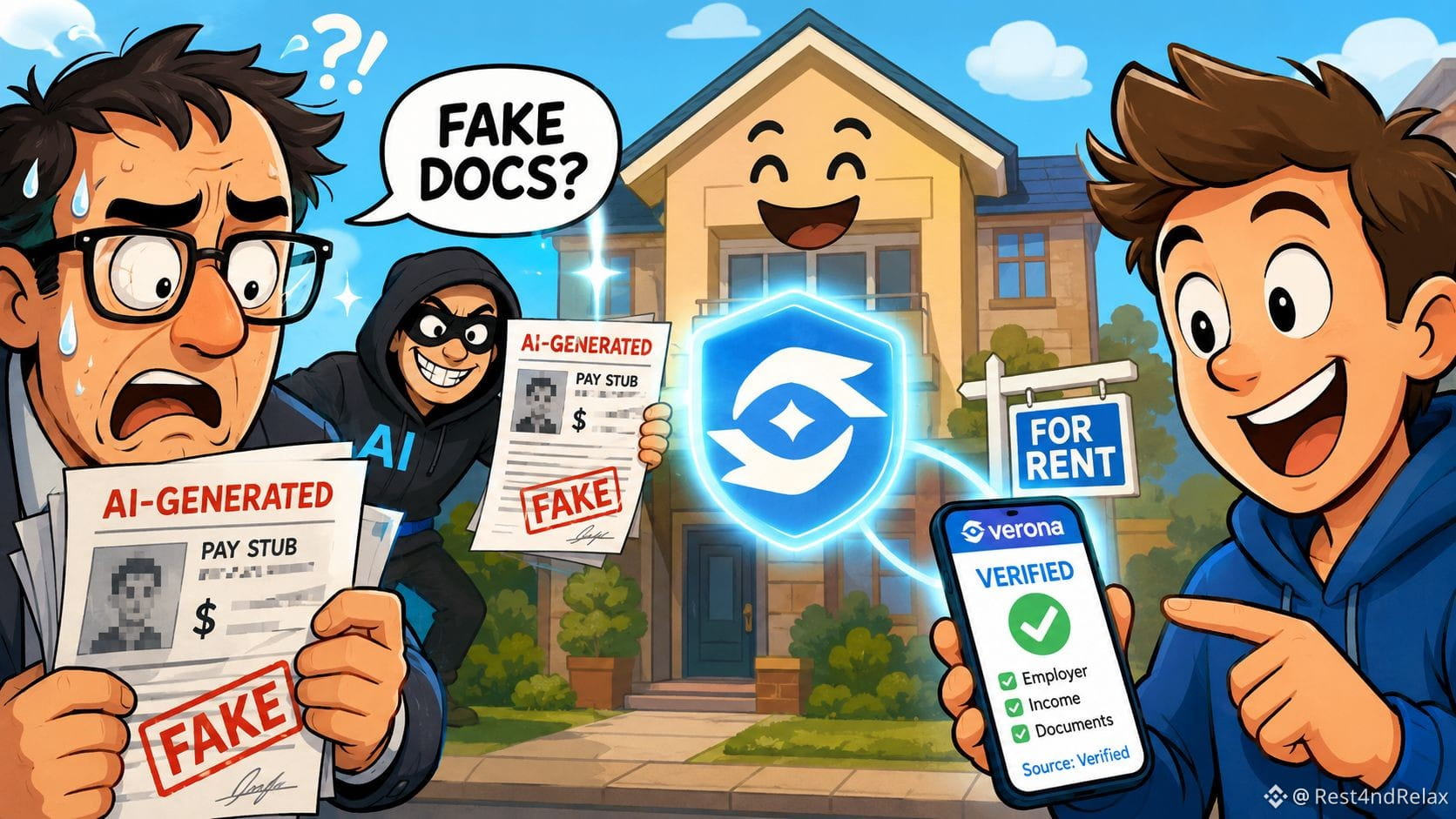
AI is making fake documents almost impossible to detect. Burnt’s solution is simple: remove the document entirely.
Rental screening still relies on uploaded pay stubs and bank statements files that can now be edited or generated by AI in minutes.
Tenant Screening by Burnt takes a different approach.
Instead of inspecting PDFs, applicants connect directly to their payroll provider or employer portal. Landlords receive verified facts such as income, employment status, and start date straight from the source.
No document to Photoshop.
No file to manipulate.
No sensitive paperwork sitting in someone’s inbox.
What I find most important is that this benefits both sides.
Landlords can make faster, more reliable decisions, while renters do not need to expose full pay stubs, W-2s, or Social Security numbers just to prove one fact.
This is where Verona’s bigger vision becomes practical: verify data at the source, let users control it, and share only the proof an application needs.
Tenant screening may be the first use case, but the same verification engine could eventually support lending, insurance, mortgages, and other industries that still depend on documents AI can fake.
AI made trust expensive. Burnt and Verona are working to make it cheap again.
Do you think source verified data will eventually replace document uploads?
#VERONA #ai #verify #trust
1
119


·
--
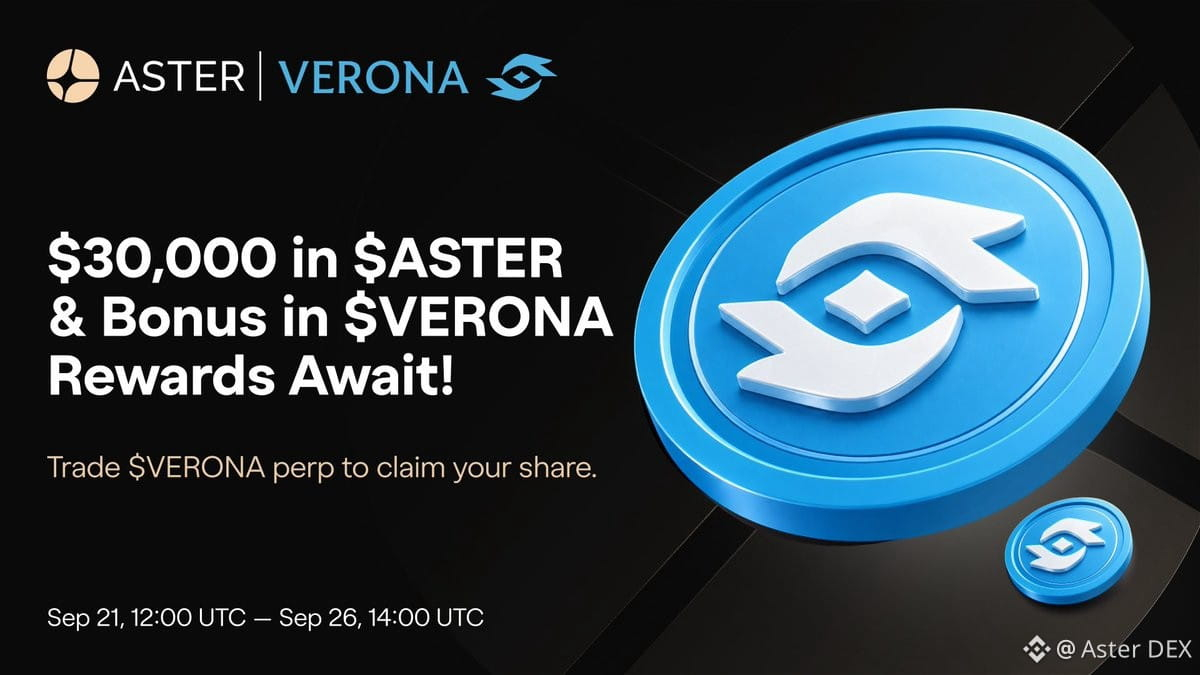
👁️🗨️ Trade $VERONA Perp on Aster: $30,000 in $ASTER + Bonus $VERONA Rewards Await
VERONA ( $VERONA ) perpetuals are now listed on Aster. To mark the listing, Aster is launching a new Trade Arena campaign.
📋 Campaign Details
- Eligible pair: VERONAUSDT (Perp)
- Perp listing: https://t.co/qJNb1whG6a
#VERONA #ASTER
🔗 Twitter 原文: https://x.com/i/status/2102005040785637532
VERONA ( $VERONA ) perpetuals are now listed on Aster. To mark the listing, Aster is launching a new Trade Arena campaign.
📋 Campaign Details
- Eligible pair: VERONAUSDT (Perp)
- Perp listing: https://t.co/qJNb1whG6a
#VERONA #ASTER
🔗 Twitter 原文: https://x.com/i/status/2102005040785637532
1
1
3.3k
·
--
Bullish
AI Is Getting Smarter. But Can It Trust the Information It Uses?
Today in Seoul, Verona is hosting “Behind the Scenes of AI” together with Kite AI, Pieverse, OpenRoboto, and Hippo Protocol.
The event focuses on three simple questions:
Who Verifies?
Who Pays?
Who Trains?
At first, these may sound like technical questions.
But as AI agents become more autonomous, they become much more important.
An AI agent may be able to search, analyze, communicate, and eventually transact on our behalf.
But before that can work at scale, several problems still need to be solved.
AI needs information it can trust.
Agents need infrastructure to make payments.
Sensitive data needs privacy.
And AI systems need reliable ways to learn and improve.
This is where Verona’s role becomes interesting.
Verona is focused on verified information making it possible for facts to be proven and used by authorized apps or AI agents without necessarily exposing the raw data behind them.
That changes the conversation.
The future of AI may not only depend on building smarter models.
It may also depend on building a stronger layer underneath them:
verification, privacy, payments, training, and trust.
Because an intelligent agent working with unreliable information is still a problem.
And as AI begins to act more independently, being able to verify what it knows could become just as important as intelligence itself.
📍 Seoul
📅 September 17
🕐 19:00–21:00 KST
📌 SparkPlus Seolleung 3
RSVP: https://luma.com/zvmcaqns
#verona #ai

1
140
·
--
Bullish
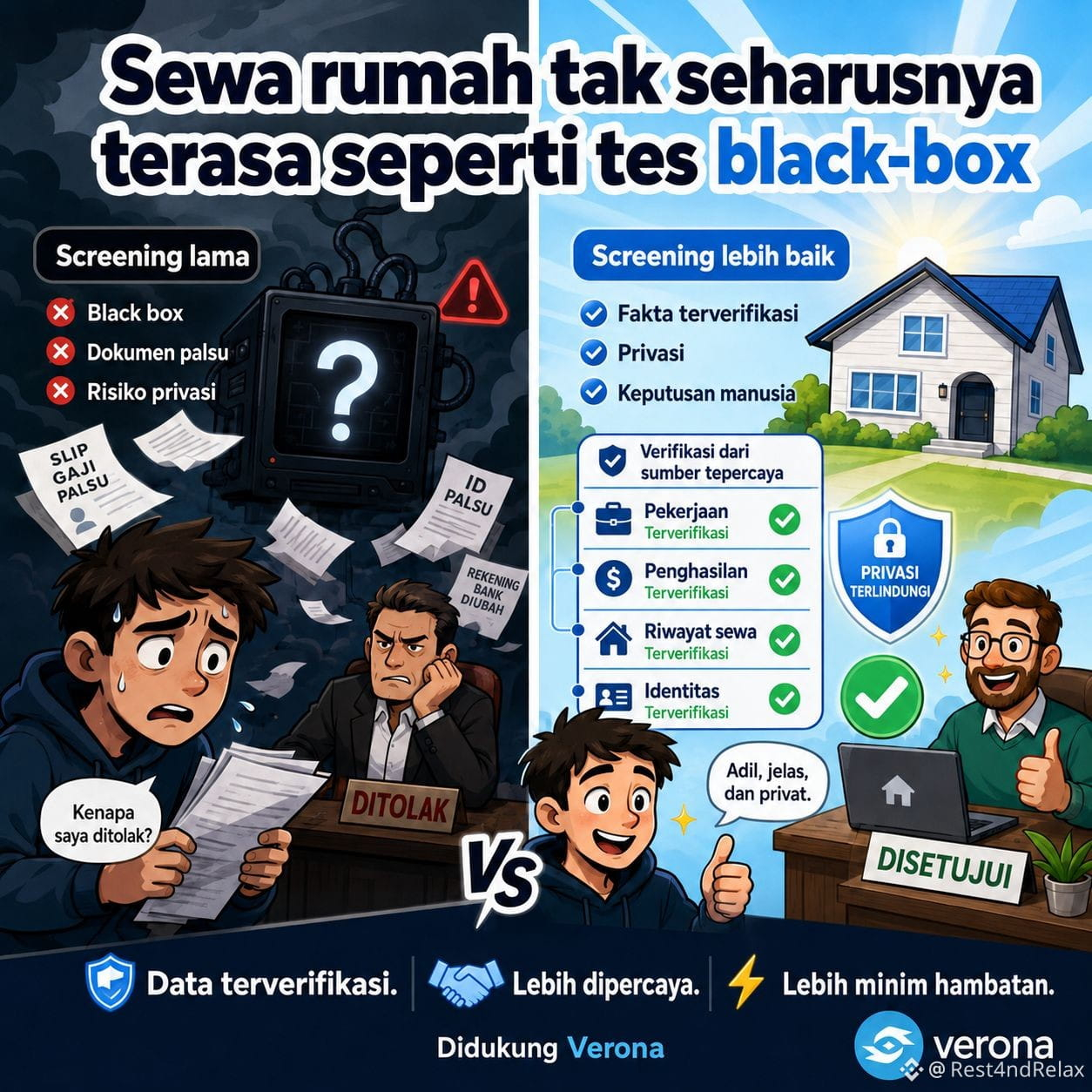
Imagine applying for a house rental, then an algorithm score rejects you without clear explanation.
Or you have to submit pay stubs, bank statements, and personal data just to prove you can afford the rent.
The problem is that old tenant screening systems still often rely on black boxes and documents that are now even easier to manipulate.
In my opinion, that’s what makes Burnt Tenant Screening compelling.
Burnt doesn’t provide scores, rankings, or approval/decline recommendations. Applicants verify income, employment, and identity directly from the sources. After that, the property side receives verified results and still makes decisions based on their own criteria.
Meaning:
Raw data doesn’t need to be shared everywhere.
Reliance on pay stubs that are easy to fake is reduced.
The screening process can be applied more consistently while still staying under human control.
Why does this matter?
Because access to housing is too important to be handed over to an opaque algorithm or documents that are easy to tamper with.
This is a real example of Verona as an intelligence layer: bringing verified data, privacy, and human control into an industry that truly needs trust.
Not just some crypto narrative. This is utility that touches everyday life.
Learn the process: screening.burnt.com/applicants
#verona #ai #burnt #VerifiedNews
1
120

·
--
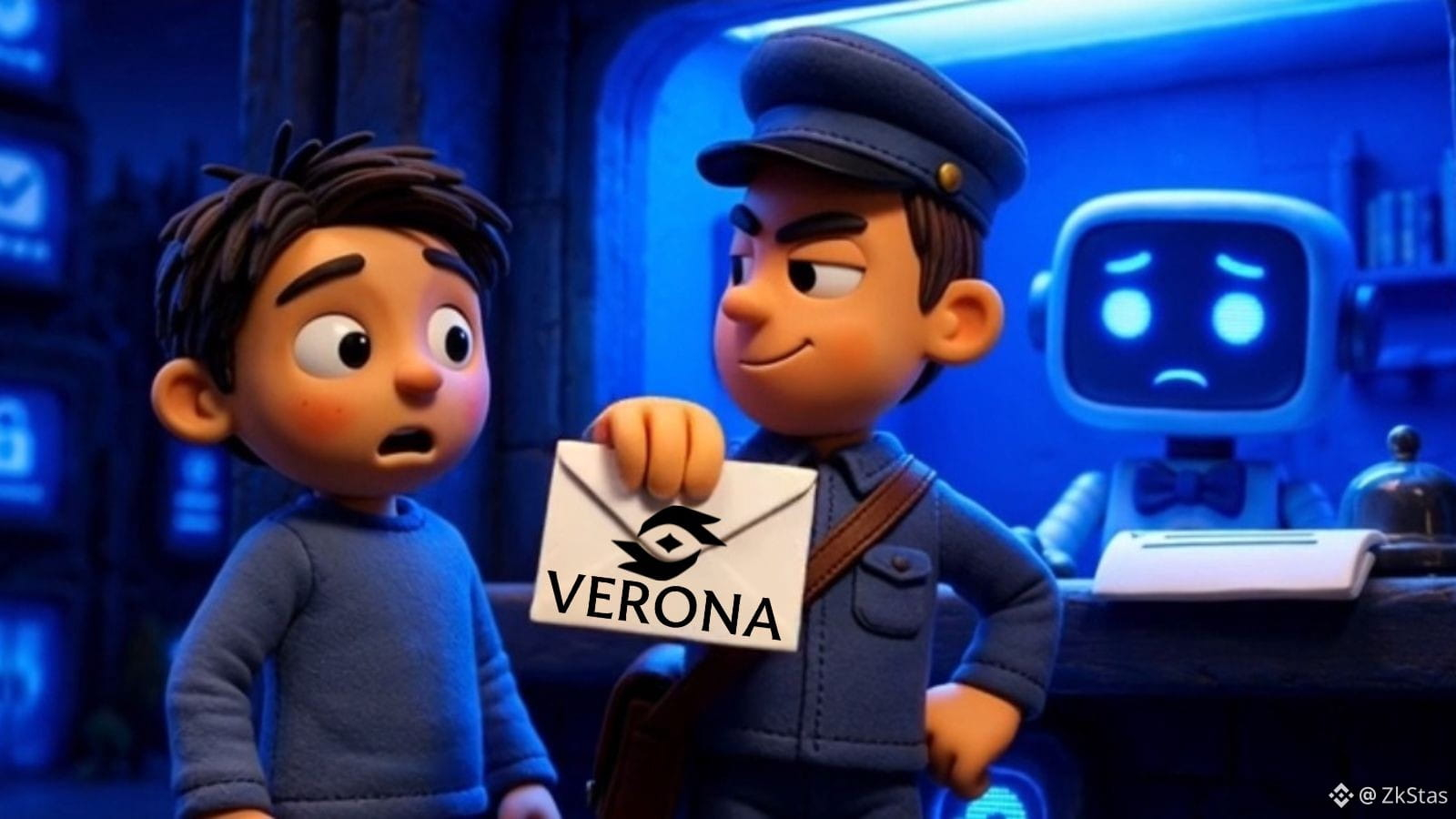
Some people still see $VERONA as a rebrand.
I see it as a repositioning for the next internet era.
AI will not just answer questions.
It will act, decide, connect with apps, move through data, and work on behalf of users.
But before AI can act, it needs something simple:
verified truth.
That is where Verona comes in —
the intelligence layer for AI.
Not just a new name.
A new direction.
#verona #Ai_sector
125
Log in to explore more content
Join global crypto users on Binance Square
⚡️ Get latest and useful information about crypto.
💬 Trusted by the world’s largest crypto exchange.
👍 Discover real insights from verified creators.
Email / Phone number
Trending Topics
1
#BinanceReopensWithdrawalsForMoreAssets
18,556 views
553 Discussing
2
#AppleReportsMixedResults
12,419 views
423 Discussing
3
#BinanceHourlyDepositsExceedWithdrawals
1,668 views
104 Discussing
4
#PalantirSlides3PercentOn$2BRevenue
0 views
2 Discussing
5
#USMidtermElections
706,510 views
3,822 Discussing
6
#USOctoberNFP-AreRateCutsStillPossible
104,811 views
893 Discussing
7
#Verify1to1BinanceReserves
94,296 views
658 Discussing
8
#SBIFirstHalfCryptoRevenueFalls30.1%
437 views
14 Discussing
9
#NEARVoteApprovesCutInMaxAnnualIssuanceTo1.6%
2,751 views
30 Discussing
10
#BinanceRestores28FiatWithdrawals
244,303 views
1,329 Discussing