

#cryptofees
cryptofees
38,928 vues
187 mentions
Populaire
Récents

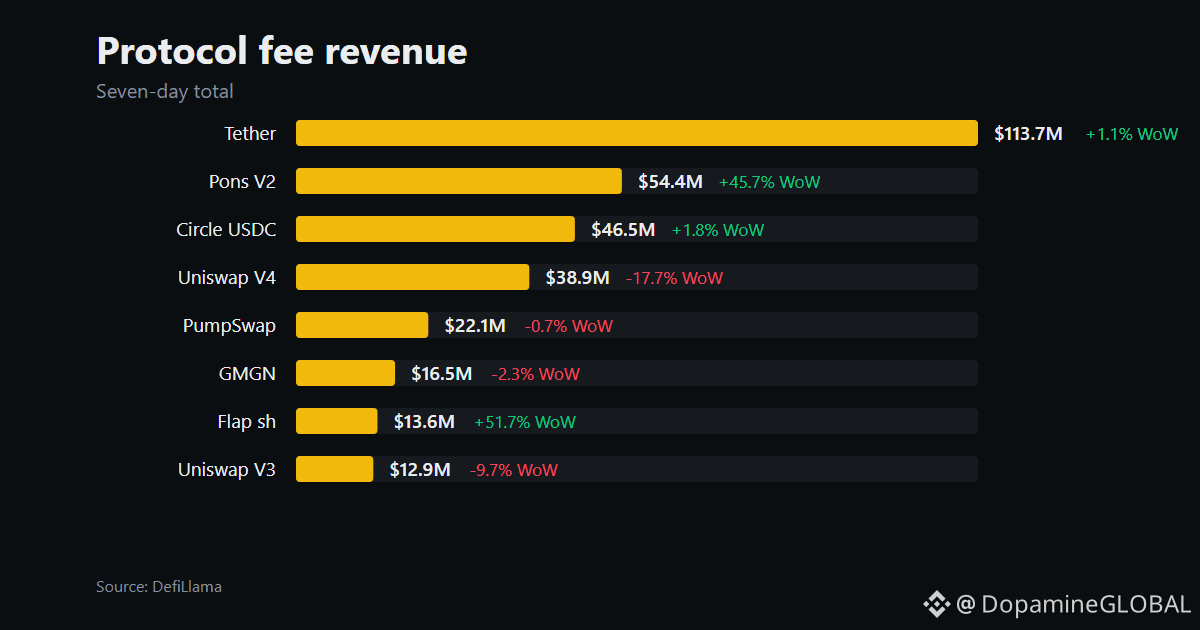
Stablecoin rails are doing more fee work than the biggest DEXs this week. Tether produced $113.75M in seven-day fees, while Circle USDC added $46.51M. Uniswap V4 came in at $38.91M, down 18% week over week.
That gap matters, but don’t read the leaderboard as a trading-volume ranking. It mixes issuer activity with DEX execution fees, so $USDT and $USDC can lead even when the market isn’t seeing a broad surge in speculative trading. The fee chart shows who monetised activity, not where traders’ risk appetite went.
Pons V2 is the outlier in the other direction: $54.36M, up 46%. That’s meaningful growth, but fees alone can’t tell us whether it came from organic usage, incentives, or a change in routing. The full sector reached $606.11M, up 8.89%, with stablecoin-related protocols taking a large share of the visible cash flow.
Fee leadership is real demand for blockspace or settlement, but it isn’t a clean proxy for bullish positioning.
Not financial advice. Do your own research.
#Stablecoins #DeFi #CryptoFees
Stablecoin rails are doing more fee work than the biggest DEXs this week. Tether produced $113.75M in seven-day fees, while Circle USDC added $46.51M. Uniswap V4 came in at $38.91M, down 18% week over week.
That gap matters, but don’t read the leaderboard as a trading-volume ranking. It mixes issuer activity with DEX execution fees, so $USDT and $USDC can lead even when the market isn’t seeing a broad surge in speculative trading. The fee chart shows who monetised activity, not where traders’ risk appetite went.
Pons V2 is the outlier in the other direction: $54.36M, up 46%. That’s meaningful growth, but fees alone can’t tell us whether it came from organic usage, incentives, or a change in routing. The full sector reached $606.11M, up 8.89%, with stablecoin-related protocols taking a large share of the visible cash flow.
Fee leadership is real demand for blockspace or settlement, but it isn’t a clean proxy for bullish positioning.
Not financial advice. Do your own research.
#Stablecoins #DeFi #CryptoFees
That gap matters, but don’t read the leaderboard as a trading-volume ranking. It mixes issuer activity with DEX execution fees, so $USDT and $USDC can lead even when the market isn’t seeing a broad surge in speculative trading. The fee chart shows who monetised activity, not where traders’ risk appetite went.
Pons V2 is the outlier in the other direction: $54.36M, up 46%. That’s meaningful growth, but fees alone can’t tell us whether it came from organic usage, incentives, or a change in routing. The full sector reached $606.11M, up 8.89%, with stablecoin-related protocols taking a large share of the visible cash flow.
Fee leadership is real demand for blockspace or settlement, but it isn’t a clean proxy for bullish positioning.
Not financial advice. Do your own research.
#Stablecoins #DeFi #CryptoFees
14

Last month I pulled up my account after a quiet stretch of trading, half-expecting my VIP level to have already slipped.
A lot of crypto traders don't factor in how VIP perks can vanish if volume isn't there. Those extra fees start adding up the moment the market gets choppy, turning what should be a small loss into something bigger.
My status depended partly on monthly volume, and that was the piece I wasn't producing. I opened the dashboard knowing a downgrade was likely. Most people treat these levels as set-it-and-forget-it, but the requirements roll continuously. Even a few weeks of low activity in $BTC pairs can push you down, and suddenly every $ETH trade costs more.
The real risk shows up later. Higher fees compound across dozens of trades, especially if you're rotating into $USDT during uncertainty. It's easy to miss until you calculate the yearly hit. Consistency in volume isn't just about ranking. It's about protecting your edge when conditions turn.
What's your experience with keeping VIP status intact through slow months?
#TradingVolume #CryptoFees #MarketRisks
Last month I pulled up my account after a quiet stretch of trading, half-expecting my VIP level to have already slipped.
A lot of crypto traders don't factor in how VIP perks can vanish if volume isn't there. Those extra fees start adding up the moment the market gets choppy, turning what should be a small loss into something bigger.
My status depended partly on monthly volume, and that was the piece I wasn't producing. I opened the dashboard knowing a downgrade was likely. Most people treat these levels as set-it-and-forget-it, but the requirements roll continuously. Even a few weeks of low activity in $BTC pairs can push you down, and suddenly every $ETH trade costs more.
The real risk shows up later. Higher fees compound across dozens of trades, especially if you're rotating into $USDT during uncertainty. It's easy to miss until you calculate the yearly hit. Consistency in volume isn't just about ranking. It's about protecting your edge when conditions turn.
What's your experience with keeping VIP status intact through slow months?
#TradingVolume #CryptoFees #MarketRisks
A lot of crypto traders don't factor in how VIP perks can vanish if volume isn't there. Those extra fees start adding up the moment the market gets choppy, turning what should be a small loss into something bigger.
My status depended partly on monthly volume, and that was the piece I wasn't producing. I opened the dashboard knowing a downgrade was likely. Most people treat these levels as set-it-and-forget-it, but the requirements roll continuously. Even a few weeks of low activity in $BTC pairs can push you down, and suddenly every $ETH trade costs more.
The real risk shows up later. Higher fees compound across dozens of trades, especially if you're rotating into $USDT during uncertainty. It's easy to miss until you calculate the yearly hit. Consistency in volume isn't just about ranking. It's about protecting your edge when conditions turn.
What's your experience with keeping VIP status intact through slow months?
#TradingVolume #CryptoFees #MarketRisks
33

Alright guys, I've got $5,400 worth of pain from ADA, DOGE, SOL futures, and it wasn't just my dumb calls. There's a silent killer nobody talks about: trading fees. Imagine a tiny leak under your sink. You ignore it, but those little drips fill a bucket over time. Every single trade – entry, exit, especially with leverage – costs you. That 0.05% fee seems like nothing. But if you're trading with $500, making 10 round-trip trades a day, 5 days a week, at just 0.08% total fee per trade, you're paying $20 a week. That's $80 in a month! 16% of your $500 capital just bled to fees, *before* any profit or loss. I learned this the hard way, thinking tiny fees don't matter. They do. Hard. Your takeaway: factor fees into *every* trade. They can quietly drain you dry.
#CryptoFees #TradingTips #LeverageLoss #BinanceSquare #SilentKiller
Alright guys, I've got $5,400 worth of pain from ADA, DOGE, SOL futures, and it wasn't just my dumb calls. There's a silent killer nobody talks about: trading fees. Imagine a tiny leak under your sink. You ignore it, but those little drips fill a bucket over time. Every single trade – entry, exit, especially with leverage – costs you. That 0.05% fee seems like nothing. But if you're trading with $500, making 10 round-trip trades a day, 5 days a week, at just 0.08% total fee per trade, you're paying $20 a week. That's $80 in a month! 16% of your $500 capital just bled to fees, *before* any profit or loss. I learned this the hard way, thinking tiny fees don't matter. They do. Hard. Your takeaway: factor fees into *every* trade. They can quietly drain you dry.
#CryptoFees #TradingTips #LeverageLoss #BinanceSquare #SilentKiller
#CryptoFees #TradingTips #LeverageLoss #BinanceSquare #SilentKiller
117
Man, back when I was blindly chasing 100x on ADA, DOGE, SOL, I completely ignored trading fees. Think of them as a tiny, invisible leak in your trading wallet. You barely notice it day-to-day, but over time, your funds just… vanish. Say you make a $100 trade. A 0.1% fee sounds tiny, right? That’s 10 cents. But you buy and sell, so it's 20 cents for one round trip. Do that just 100 times a month, and you've paid $20 in fees! That $20 isn’t from your profits; it’s directly from your capital. It silently shrinks your starting pot and makes it so much harder to recover. Don’t make my mistake. Always factor in fees. They really stack up.
#CryptoFees #TradingTips #BewareTheFees #FuturesTrading #LearnTheHardWay
Man, back when I was blindly chasing 100x on ADA, DOGE, SOL, I completely ignored trading fees. Think of them as a tiny, invisible leak in your trading wallet. You barely notice it day-to-day, but over time, your funds just… vanish. Say you make a $100 trade. A 0.1% fee sounds tiny, right? That’s 10 cents. But you buy and sell, so it's 20 cents for one round trip. Do that just 100 times a month, and you've paid $20 in fees! That $20 isn’t from your profits; it’s directly from your capital. It silently shrinks your starting pot and makes it so much harder to recover. Don’t make my mistake. Always factor in fees. They really stack up.
#CryptoFees #TradingTips #BewareTheFees #FuturesTrading #LearnTheHardWay
#CryptoFees #TradingTips #BewareTheFees #FuturesTrading #LearnTheHardWay
104
Alright folks, forgot to live here. Let's talk about the silent killer I ignored chasing those insane leverages: trading fees. It’s like having a tiny, constant leak in your wallet. You don't notice the drip, but over time, your cash is gone.
Imagine you're trading SOL with 50x leverage. You open and close a $1,000 position. Even with a tiny 0.04% fee *each way*, that's 40 cents to open, 40 cents to close – 80 cents for one round trip. Sounds small, right? But if you're like I was, making 10 frantic trades a day hoping to recover losses? That’s $8 daily. Over a month? Boom, $240 vanished. That $240 could be your whole trading capital getting eaten before you even make a profit. Every single flip costs you. Be intentional. Don't let these tiny fees quietly bleed you dry.
#CryptoFees #TradingTips #RiskManagement #LeverageLessons
Alright folks, forgot to live here. Let's talk about the silent killer I ignored chasing those insane leverages: trading fees. It’s like having a tiny, constant leak in your wallet. You don't notice the drip, but over time, your cash is gone.
Imagine you're trading SOL with 50x leverage. You open and close a $1,000 position. Even with a tiny 0.04% fee *each way*, that's 40 cents to open, 40 cents to close – 80 cents for one round trip. Sounds small, right? But if you're like I was, making 10 frantic trades a day hoping to recover losses? That’s $8 daily. Over a month? Boom, $240 vanished. That $240 could be your whole trading capital getting eaten before you even make a profit. Every single flip costs you. Be intentional. Don't let these tiny fees quietly bleed you dry.
#CryptoFees #TradingTips #RiskManagement #LeverageLessons
Imagine you're trading SOL with 50x leverage. You open and close a $1,000 position. Even with a tiny 0.04% fee *each way*, that's 40 cents to open, 40 cents to close – 80 cents for one round trip. Sounds small, right? But if you're like I was, making 10 frantic trades a day hoping to recover losses? That’s $8 daily. Over a month? Boom, $240 vanished. That $240 could be your whole trading capital getting eaten before you even make a profit. Every single flip costs you. Be intentional. Don't let these tiny fees quietly bleed you dry.
#CryptoFees #TradingTips #RiskManagement #LeverageLessons
96
Man, when I was burning cash chasing 100x on SOL, I was so focused on big swings, I ignored the silent killer: trading fees. We all talk liquidation, but these small cuts add up fast.
Imagine a tiny leak in your wallet. Each trade, you pay a small percentage – say 0.1%. On a $100 trade, that's 10 cents. Insignificant? Make 50 trades a week, that's $5 gone. Do that for a year, and you've lost $260 without even knowing it. Real money, especially for smaller portfolios.
These tiny cuts eat into your potential gains or make losses worse. Always factor fees into your strategy. They're always taking their slice.
#CryptoFees #TradingTips #RiskManagement #BinanceSquare
Man, when I was burning cash chasing 100x on SOL, I was so focused on big swings, I ignored the silent killer: trading fees. We all talk liquidation, but these small cuts add up fast.
Imagine a tiny leak in your wallet. Each trade, you pay a small percentage – say 0.1%. On a $100 trade, that's 10 cents. Insignificant? Make 50 trades a week, that's $5 gone. Do that for a year, and you've lost $260 without even knowing it. Real money, especially for smaller portfolios.
These tiny cuts eat into your potential gains or make losses worse. Always factor fees into your strategy. They're always taking their slice.
#CryptoFees #TradingTips #RiskManagement #BinanceSquare
Imagine a tiny leak in your wallet. Each trade, you pay a small percentage – say 0.1%. On a $100 trade, that's 10 cents. Insignificant? Make 50 trades a week, that's $5 gone. Do that for a year, and you've lost $260 without even knowing it. Real money, especially for smaller portfolios.
These tiny cuts eat into your potential gains or make losses worse. Always factor fees into your strategy. They're always taking their slice.
#CryptoFees #TradingTips #RiskManagement #BinanceSquare
65
Look, I learned the hard way. That $600 I lost on ADA and DOGE futures wasn't just bad calls, it was the system itself. Exchange fee structures – maker/taker, funding rates, and even liquidation protocols – are designed to profit from your active trading. Every flip, every hour you hold a leveraged position, fees are extracting value. During sideways markets, funding rates silently drain you. They thrive on volume and duration, ensuring a constant stream of income from your capital, whether you're up or down. It's a brilliant business model... for them. When you trade, whose pockets are you really filling?
#CryptoFees #TradingTruth #ExchangeFees #FuturesFails #ProtectRetail
Look, I learned the hard way. That $600 I lost on ADA and DOGE futures wasn't just bad calls, it was the system itself. Exchange fee structures – maker/taker, funding rates, and even liquidation protocols – are designed to profit from your active trading. Every flip, every hour you hold a leveraged position, fees are extracting value. During sideways markets, funding rates silently drain you. They thrive on volume and duration, ensuring a constant stream of income from your capital, whether you're up or down. It's a brilliant business model... for them. When you trade, whose pockets are you really filling?
#CryptoFees #TradingTruth #ExchangeFees #FuturesFails #ProtectRetail
#CryptoFees #TradingTruth #ExchangeFees #FuturesFails #ProtectRetail
126
Alright, folks, let's talk about something I learned the hard way after too many painful trades: exchange fees. It's easy to dismiss them as tiny percentages, but believe me, they're a finely tuned extraction machine. Every single maker/taker fee, every hourly funding rate on perpetuals – they're not just a cost of doing business. When you're actively trading, especially with leverage, these small cuts become a constant, silent drain on your capital. The structure incentivizes high volume and frequent activity, ensuring the platform gets its share regardless of your P&L. It’s set up to make you trade more, not necessarily profit more. So ask yourself: how much of your capital is really being siphoned away by these fees, even before your trade has a chance to breathe?
#CryptoFees...
Alright, folks, let's talk about something I learned the hard way after too many painful trades: exchange fees. It's easy to dismiss them as tiny percentages, but believe me, they're a finely tuned extraction machine. Every single maker/taker fee, every hourly funding rate on perpetuals – they're not just a cost of doing business. When you're actively trading, especially with leverage, these small cuts become a constant, silent drain on your capital. The structure incentivizes high volume and frequent activity, ensuring the platform gets its share regardless of your P&L. It’s set up to make you trade more, not necessarily profit more. So ask yourself: how much of your capital is really being siphoned away by these fees, even before your trade has a chance to breathe?
#CryptoFees...
#CryptoFees...

16
You know I lost my shirt on futures. A big part wasn't just bad calls, it was the hidden killer: fees. Every single trade, every funding payment, especially with high leverage on perpetuals, adds up. Exchanges profit massively from your constant activity. They earn on every open, every close, every hourly funding rate. It’s a structural setup, designed to slowly drain active traders’ capital, even when you're just trying to break even. Are you truly trading for profit, or just generating revenue for the platform?
#CryptoFees #TradingTips #FuturesTrading #BinanceSquare #RetailTrader
You know I lost my shirt on futures. A big part wasn't just bad calls, it was the hidden killer: fees. Every single trade, every funding payment, especially with high leverage on perpetuals, adds up. Exchanges profit massively from your constant activity. They earn on every open, every close, every hourly funding rate. It’s a structural setup, designed to slowly drain active traders’ capital, even when you're just trying to break even. Are you truly trading for profit, or just generating revenue for the platform?
#CryptoFees #TradingTips #FuturesTrading #BinanceSquare #RetailTrader
#CryptoFees #TradingTips #FuturesTrading #BinanceSquare #RetailTrader
32
Remember that $600 I blew? A big chunk wasn't just bad trades; it was the exchange getting its cut. Every single open, every close, every funding rate payment, especially on those insane 100x DOGE futures I was playing. They make money whether you win or lose, simply by you *trading*. Taker fees hit hard when you’re desperate to exit, and those daily funding rates add up fast. This system isn't built for your long-term gains, it’s designed for constant transaction volume. They profit from your impatience, your activity, and every tiny fraction of a percent you pay them. It's their business model.
Given how much we trade, are we just paying for a service, or fueling a machine that thrives on our constant churn?
#CryptoFees #FuturesTrading #KnowYourFees #RetailProtection #TradingWisdom
Remember that $600 I blew? A big chunk wasn't just bad trades; it was the exchange getting its cut. Every single open, every close, every funding rate payment, especially on those insane 100x DOGE futures I was playing. They make money whether you win or lose, simply by you *trading*. Taker fees hit hard when you’re desperate to exit, and those daily funding rates add up fast. This system isn't built for your long-term gains, it’s designed for constant transaction volume. They profit from your impatience, your activity, and every tiny fraction of a percent you pay them. It's their business model.
Given how much we trade, are we just paying for a service, or fueling a machine that thrives on our constant churn?
#CryptoFees #FuturesTrading #KnowYourFees #RetailProtection #TradingWisdom
Given how much we trade, are we just paying for a service, or fueling a machine that thrives on our constant churn?
#CryptoFees #FuturesTrading #KnowYourFees #RetailProtection #TradingWisdom
39
Remember those frantic nights, glued to the charts, chasing green candles? Every single 'execute' on a futures trade, especially with leverage, means the exchange takes a piece. Taker fees are a constant drain. And let's not forget funding fees – those tiny charges every eight hours that chip away at your capital, even if your position is slightly in profit. It's structurally designed to extract maximum value from active traders like us. They profit massively from the sheer *volume* of transactions and the duration of leveraged positions. It's their business model. Given how much you're paying in micro-transactions and funding fees, are you trading for profit, or just fueling the exchange's bottom line?
#CryptoFees #LeverageTrading #TradingTruth #RetailProtection
Remember those frantic nights, glued to the charts, chasing green candles? Every single 'execute' on a futures trade, especially with leverage, means the exchange takes a piece. Taker fees are a constant drain. And let's not forget funding fees – those tiny charges every eight hours that chip away at your capital, even if your position is slightly in profit. It's structurally designed to extract maximum value from active traders like us. They profit massively from the sheer *volume* of transactions and the duration of leveraged positions. It's their business model. Given how much you're paying in micro-transactions and funding fees, are you trading for profit, or just fueling the exchange's bottom line?
#CryptoFees #LeverageTrading #TradingTruth #RetailProtection
#CryptoFees #LeverageTrading #TradingTruth #RetailProtection
16


·
--
Article
He Pays 20% Less Commission Than You. Same Exchange. Same Trades.Someone in this community just cut their Binance fees by 20%. Permanently. Why are you still paying full price?
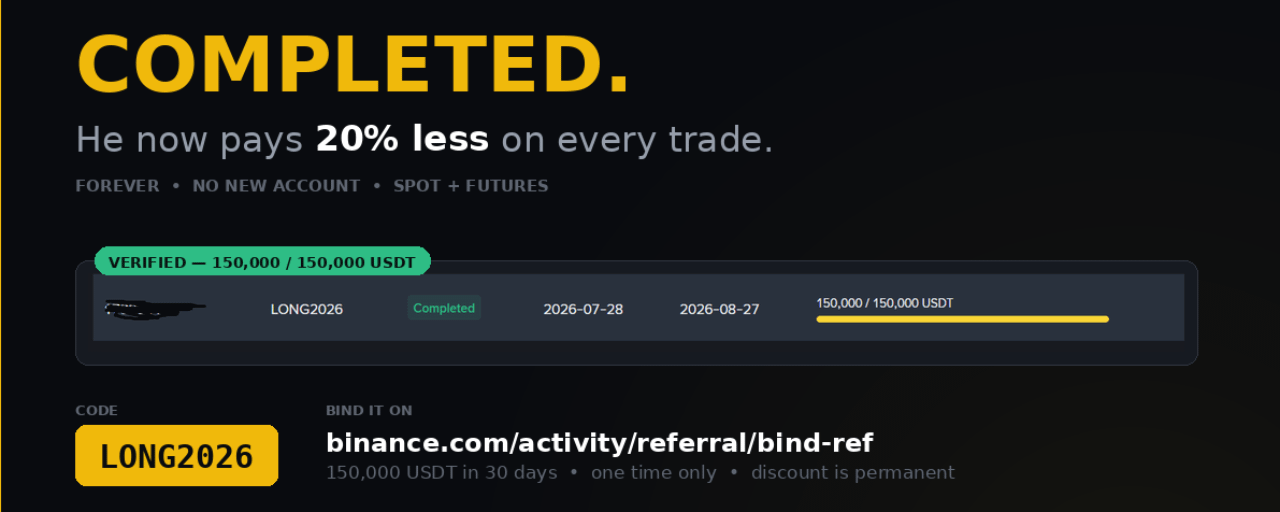
TL;DR: Existing Binance users can now bind a referral code to an account they already own — something that was impossible until recently. One of my followers did it this week. Every trade from here on costs them 20% less in commission. One condition: $150,000 in volume within 30 days, and all of it counts — spot and futures combined.
Look at what this week did to your fee bill
BTC is up over 20% in seven days. Volumes are up across the board. Everyone is trading more — spot, futures, everything.
More trading means one thing nobody looks at: more commission.
Do the math on yourself. 500,000 USDT of futures volume in a month at 0.05% taker is 250 USDT gone. Two million in volume is 1,000 USDT gone. In a market moving like this one, those aren't unusual numbers.
Now take 20% off every one of those trades. Forever. Same strategy, same platform, same risk — just less leaking out the bottom.
"I already have a Binance account, it's too late for me"
That used to be true. It isn't anymore.
Binance opened a referral binding page for existing users:
🔗 [https://www.binance.com/activity/referral/bind-ref](https://www.binance.com/activity/referral/bind-ref)
Write Code : LONG2026
You bind a code to the account you already have. No new account. No moving funds. No re-doing KYC.
Conditions:
✅ No referral code has ever been bound to your account
✅ Your trading volume in the last 90 days is below the threshold
⚠️ $150,000 in trading volume within 30 days of binding — spot and futures both count
That $150,000 is smaller than it sounds
Read the condition properly, because most people misread it.
It is not futures-only. Every trade counts — spot, futures, all of it, added together. And it's one time, 30 days. Not monthly. Not recurring.
Here's what that actually looks like:
📊 Buy 5,000 USDT of BTC and sell it → that's 10,000 USDT of volume. Not 5,000.
📊 Do that fifteen times in a month → you're done.
📊 Any futures position you open adds on top of that.
📊 Rotating between coins in a week like this one racks it up fast without you noticing.
Open your Binance volume history right now and look at your last 30 days. A lot of people find they're already past $150,000 and had no idea. If you're one of them, this condition costs you literally nothing — you'd hit it doing exactly what you already do.
And if $150,000 in a month is genuinely far from your reach, then be honest with yourself: you weren't paying enough in fees for a 20% discount to matter much anyway. The condition isn't a wall. It's a filter that sorts out the people who benefit most.
How to do it
1️⃣ Open [https://www.binance.com/activity/referral/bind-ref](https://www.binance.com/activity/referral/bind-ref)
2️⃣ Check whether your account is eligible
3️⃣ Enter code LONG2026
4️⃣ Confirm the binding
5️⃣ Reach $150,000 in combined volume within 30 days
Done. 20% off commission, for the life of the account.
Not on Binance yet? You don't need the binding page at all — register with LONG2026 and the discount applies from your first trade, with no volume requirement at all.
FAQ
Does this cost me anything?
No. The discount comes out of the referral commission, not out of your pocket.
Spot or futures?
Both — for the discount, and for the $150,000 requirement.
Is the $150,000 every month?
No. Once, within 30 days of binding. The discount that follows is permanent.
Does spot really count toward the volume?
Yes. All trading volume is combined. This is the part most people get wrong.
What if I already have a code bound?
Then you're not eligible. This is only for accounts that never bound one.
Should I wait?
Every trade between now and whenever "later" arrives is a trade you overpaid on. In a week where BTC moved 20%, later is expensive.
💬 Bound it successfully? Drop a ✅ below so people can see it actually works.
❓ Not sure if you qualify? Ask in the comments and I'll answer.
#Binance #BinanceReferral #CryptoFees
He Pays 20% Less Commission Than You. Same Exchange. Same Trades.
Someone in this community just cut their Binance fees by 20%. Permanently. Why are you still paying full price?
TL;DR: Existing Binance users can now bind a referral code to an account they already own — something that was impossible until recently. One of my followers did it this week. Every trade from here on costs them 20% less in commission. One condition: $150,000 in volume within 30 days, and all of it counts — spot and futures combined.
Look at what this week did to your fee bill
BTC is up over 20% in seven days. Volumes are up across the board. Everyone is trading more — spot, futures, everything.
More trading means one thing nobody looks at: more commission.
Do the math on yourself. 500,000 USDT of futures volume in a month at 0.05% taker is 250 USDT gone. Two million in volume is 1,000 USDT gone. In a market moving like this one, those aren't unusual numbers.
Now take 20% off every one of those trades. Forever. Same strategy, same platform, same risk — just less leaking out the bottom.
"I already have a Binance account, it's too late for me"
That used to be true. It isn't anymore.
Binance opened a referral binding page for existing users:
🔗 https://www.binance.com/activity/referral/bind-ref
Write Code : LONG2026
You bind a code to the account you already have. No new account. No moving funds. No re-doing KYC.
Conditions:
✅ No referral code has ever been bound to your account
✅ Your trading volume in the last 90 days is below the threshold
⚠️ $150,000 in trading volume within 30 days of binding — spot and futures both count
That $150,000 is smaller than it sounds
Read the condition properly, because most people misread it.
It is not futures-only. Every trade counts — spot, futures, all of it, added together. And it's one time, 30 days. Not monthly. Not recurring.
Here's what that actually looks like:
📊 Buy 5,000 USDT of BTC and sell it → that's 10,000 USDT of volume. Not 5,000.
📊 Do that fifteen times in a month → you're done.
📊 Any futures position you open adds on top of that.
📊 Rotating between coins in a week like this one racks it up fast without you noticing.
Open your Binance volume history right now and look at your last 30 days. A lot of people find they're already past $150,000 and had no idea. If you're one of them, this condition costs you literally nothing — you'd hit it doing exactly what you already do.
And if $150,000 in a month is genuinely far from your reach, then be honest with yourself: you weren't paying enough in fees for a 20% discount to matter much anyway. The condition isn't a wall. It's a filter that sorts out the people who benefit most.
How to do it
1️⃣ Open https://www.binance.com/activity/referral/bind-ref
2️⃣ Check whether your account is eligible
3️⃣ Enter code LONG2026
4️⃣ Confirm the binding
5️⃣ Reach $150,000 in combined volume within 30 days
Done. 20% off commission, for the life of the account.
Not on Binance yet? You don't need the binding page at all — register with LONG2026 and the discount applies from your first trade, with no volume requirement at all.
FAQ
Does this cost me anything?
No. The discount comes out of the referral commission, not out of your pocket.
Spot or futures?
Both — for the discount, and for the $150,000 requirement.
Is the $150,000 every month?
No. Once, within 30 days of binding. The discount that follows is permanent.
Does spot really count toward the volume?
Yes. All trading volume is combined. This is the part most people get wrong.
What if I already have a code bound?
Then you're not eligible. This is only for accounts that never bound one.
Should I wait?
Every trade between now and whenever "later" arrives is a trade you overpaid on. In a week where BTC moved 20%, later is expensive.
💬 Bound it successfully? Drop a ✅ below so people can see it actually works.
❓ Not sure if you qualify? Ask in the comments and I'll answer.
#Binance #BinanceReferral #CryptoFees
TL;DR: Existing Binance users can now bind a referral code to an account they already own — something that was impossible until recently. One of my followers did it this week. Every trade from here on costs them 20% less in commission. One condition: $150,000 in volume within 30 days, and all of it counts — spot and futures combined.
Look at what this week did to your fee bill
BTC is up over 20% in seven days. Volumes are up across the board. Everyone is trading more — spot, futures, everything.
More trading means one thing nobody looks at: more commission.
Do the math on yourself. 500,000 USDT of futures volume in a month at 0.05% taker is 250 USDT gone. Two million in volume is 1,000 USDT gone. In a market moving like this one, those aren't unusual numbers.
Now take 20% off every one of those trades. Forever. Same strategy, same platform, same risk — just less leaking out the bottom.
"I already have a Binance account, it's too late for me"
That used to be true. It isn't anymore.
Binance opened a referral binding page for existing users:
🔗 https://www.binance.com/activity/referral/bind-ref
Write Code : LONG2026
You bind a code to the account you already have. No new account. No moving funds. No re-doing KYC.
Conditions:
✅ No referral code has ever been bound to your account
✅ Your trading volume in the last 90 days is below the threshold
⚠️ $150,000 in trading volume within 30 days of binding — spot and futures both count
That $150,000 is smaller than it sounds
Read the condition properly, because most people misread it.
It is not futures-only. Every trade counts — spot, futures, all of it, added together. And it's one time, 30 days. Not monthly. Not recurring.
Here's what that actually looks like:
📊 Buy 5,000 USDT of BTC and sell it → that's 10,000 USDT of volume. Not 5,000.
📊 Do that fifteen times in a month → you're done.
📊 Any futures position you open adds on top of that.
📊 Rotating between coins in a week like this one racks it up fast without you noticing.
Open your Binance volume history right now and look at your last 30 days. A lot of people find they're already past $150,000 and had no idea. If you're one of them, this condition costs you literally nothing — you'd hit it doing exactly what you already do.
And if $150,000 in a month is genuinely far from your reach, then be honest with yourself: you weren't paying enough in fees for a 20% discount to matter much anyway. The condition isn't a wall. It's a filter that sorts out the people who benefit most.
How to do it
1️⃣ Open https://www.binance.com/activity/referral/bind-ref
2️⃣ Check whether your account is eligible
3️⃣ Enter code LONG2026
4️⃣ Confirm the binding
5️⃣ Reach $150,000 in combined volume within 30 days
Done. 20% off commission, for the life of the account.
Not on Binance yet? You don't need the binding page at all — register with LONG2026 and the discount applies from your first trade, with no volume requirement at all.
FAQ
Does this cost me anything?
No. The discount comes out of the referral commission, not out of your pocket.
Spot or futures?
Both — for the discount, and for the $150,000 requirement.
Is the $150,000 every month?
No. Once, within 30 days of binding. The discount that follows is permanent.
Does spot really count toward the volume?
Yes. All trading volume is combined. This is the part most people get wrong.
What if I already have a code bound?
Then you're not eligible. This is only for accounts that never bound one.
Should I wait?
Every trade between now and whenever "later" arrives is a trade you overpaid on. In a week where BTC moved 20%, later is expensive.
💬 Bound it successfully? Drop a ✅ below so people can see it actually works.
❓ Not sure if you qualify? Ask in the comments and I'll answer.
#Binance #BinanceReferral #CryptoFees
5
1
20
1.7k
Yo, it's 'forgot to live' here. That $600 I blew? Yeah, the biggest chunk went in a flash, but a silent killer was the endless stream of fees. Think about it: every trade, maker/taker fees. Holding futures? Funding rates, sometimes multiple times a day. And if you get liquidated, there are even more fees taken out for the 'insurance fund'. These exchanges aren't just providing a service; their models are built to extract maximum value from active traders, especially us degens on leverage. Every single move you make, win or lose, they're taking a cut. It’s their bread and butter. Have you ever truly calculated how much of your trading capital just vanishes into these fee structures?
#CryptoFees #FuturesTrading #RetailTrader #BinanceSquare #LearnTheHardWay
Yo, it's 'forgot to live' here. That $600 I blew? Yeah, the biggest chunk went in a flash, but a silent killer was the endless stream of fees. Think about it: every trade, maker/taker fees. Holding futures? Funding rates, sometimes multiple times a day. And if you get liquidated, there are even more fees taken out for the 'insurance fund'. These exchanges aren't just providing a service; their models are built to extract maximum value from active traders, especially us degens on leverage. Every single move you make, win or lose, they're taking a cut. It’s their bread and butter. Have you ever truly calculated how much of your trading capital just vanishes into these fee structures?
#CryptoFees #FuturesTrading #RetailTrader #BinanceSquare #LearnTheHardWay
#CryptoFees #FuturesTrading #RetailTrader #BinanceSquare #LearnTheHardWay
17
When I blew up my account, it wasn't just bad luck or dumb decisions on ADA and DOGE at 100x. A huge chunk of that $600 went straight into exchange pockets via fees. Every single leveraged trade you make, every time you open or close a position, pays the house. Maker/taker fees, funding rates – they all add up, magnified by leverage. Exchanges aren't just providing a service; they're fundamentally structured to profit from high-volume, active trading, regardless of your PnL. Your constant activity, especially on futures, is their guaranteed income stream. Are you really trading for yourself, or are you just a revenue generator for the platform?
#CryptoFees #LeverageTrap #ExchangeGames #TradeSmart
When I blew up my account, it wasn't just bad luck or dumb decisions on ADA and DOGE at 100x. A huge chunk of that $600 went straight into exchange pockets via fees. Every single leveraged trade you make, every time you open or close a position, pays the house. Maker/taker fees, funding rates – they all add up, magnified by leverage. Exchanges aren't just providing a service; they're fundamentally structured to profit from high-volume, active trading, regardless of your PnL. Your constant activity, especially on futures, is their guaranteed income stream. Are you really trading for yourself, or are you just a revenue generator for the platform?
#CryptoFees #LeverageTrap #ExchangeGames #TradeSmart
#CryptoFees #LeverageTrap #ExchangeGames #TradeSmart
68
Guys, when I blew up my $600 chasing DOGE dreams, I was so focused on chasing PnL, I totally forgot about the tiny things. I’m talking about trading fees. They’re like sand slipping through your fingers – each grain seems tiny, but enough of it and your whole pile disappears without you even noticing.
Say you’re doing 10 leveraged trades a day, trying to scalp small profits. Even if each trade costs just $0.50 in fees, that's $5 a day. Over a month, that's $150! Imagine doing that for a year. That’s $1800 in fees alone. Suddenly, your small gains are eaten away, or your losses are amplified, all silently. It happened to me.
Always know your fee structure. It's not just the big losses that hurt; it's the constant drip of fees silently draining your capital.
#CryptoFees #TradingTips #FuturesTrading #RiskManagement
Guys, when I blew up my $600 chasing DOGE dreams, I was so focused on chasing PnL, I totally forgot about the tiny things. I’m talking about trading fees. They’re like sand slipping through your fingers – each grain seems tiny, but enough of it and your whole pile disappears without you even noticing.
Say you’re doing 10 leveraged trades a day, trying to scalp small profits. Even if each trade costs just $0.50 in fees, that's $5 a day. Over a month, that's $150! Imagine doing that for a year. That’s $1800 in fees alone. Suddenly, your small gains are eaten away, or your losses are amplified, all silently. It happened to me.
Always know your fee structure. It's not just the big losses that hurt; it's the constant drip of fees silently draining your capital.
#CryptoFees #TradingTips #FuturesTrading #RiskManagement
Say you’re doing 10 leveraged trades a day, trying to scalp small profits. Even if each trade costs just $0.50 in fees, that's $5 a day. Over a month, that's $150! Imagine doing that for a year. That’s $1800 in fees alone. Suddenly, your small gains are eaten away, or your losses are amplified, all silently. It happened to me.
Always know your fee structure. It's not just the big losses that hurt; it's the constant drip of fees silently draining your capital.
#CryptoFees #TradingTips #FuturesTrading #RiskManagement
59
Remember that $600 I lost on ADA and DOGE futures? Part of that wasn't just bad calls; it was the slow bleed of fees, designed to eat you alive when you're trading constantly. Every single leveraged trade, especially with high multipliers like 100x, means every tiny taker fee or funding rate payment is magnified. You're giving away a piece of your capital even when you're just *trying* to stay in the game. These structures aren't accidental; they funnel value directly from active traders, especially the ones chasing quick gains or trying to dig out of a hole. It's a constant drain that adds up massively, making it nearly impossible to consistently profit if you're not aware. Do you ever stop to calculate how much you're actually paying just to *trade* on these platforms?
#CryptoFees #RetailTrader #FuturesTrading #KnowYourExchange
Remember that $600 I lost on ADA and DOGE futures? Part of that wasn't just bad calls; it was the slow bleed of fees, designed to eat you alive when you're trading constantly. Every single leveraged trade, especially with high multipliers like 100x, means every tiny taker fee or funding rate payment is magnified. You're giving away a piece of your capital even when you're just *trying* to stay in the game. These structures aren't accidental; they funnel value directly from active traders, especially the ones chasing quick gains or trying to dig out of a hole. It's a constant drain that adds up massively, making it nearly impossible to consistently profit if you're not aware. Do you ever stop to calculate how much you're actually paying just to *trade* on these platforms?
#CryptoFees #RetailTrader #FuturesTrading #KnowYourExchange
#CryptoFees #RetailTrader #FuturesTrading #KnowYourExchange
73
You think you're battling the market? Nah, you're just bleeding fees. When I was deep in those ADA, DOGE, SOL 100x futures, every single flip, win or lose, was a guaranteed cut for the exchange. It ain't just the maker/taker fees – that's obvious. But look at futures funding rates. They're literally structured to skim capital off the longer or shorter side, constantly, simply for holding a position. It's passive income for the platform, taken directly from your potential gains or speeding up your losses. They thrive on your activity, not your success. Are we active traders, or are we just fueling their balance sheets with our constant transaction taxes?
#CryptoFees #FuturesTrading #RetailTrap #BinanceSquare
You think you're battling the market? Nah, you're just bleeding fees. When I was deep in those ADA, DOGE, SOL 100x futures, every single flip, win or lose, was a guaranteed cut for the exchange. It ain't just the maker/taker fees – that's obvious. But look at futures funding rates. They're literally structured to skim capital off the longer or shorter side, constantly, simply for holding a position. It's passive income for the platform, taken directly from your potential gains or speeding up your losses. They thrive on your activity, not your success. Are we active traders, or are we just fueling their balance sheets with our constant transaction taxes?
#CryptoFees #FuturesTrading #RetailTrap #BinanceSquare
#CryptoFees #FuturesTrading #RetailTrap #BinanceSquare
39
Remember all those 12x-100x SOL and DOGE futures trades I talked about? The ones that ate my portfolio alive? A big chunk of that $5,400 wasn't just my bad calls. It was the constant drip-drip of fees. Every open, every close, every funding rate payment on leveraged positions. Exchanges profit whether you win or lose, but they *really* win when you trade often with leverage. Maker/taker fees might seem tiny, but when you're in and out multiple times a day on volatile assets, those fractions of a percent add up fast. It's a structural design: more trades = more fees, more leverage = higher funding rates. It's brilliant for them, brutal for us. Are you truly trading for profit, or just generating revenue for the exchange?
#CryptoFees #TradingWisdom #ProtectRetail #FuturesTrading #MarketStructure
Remember all those 12x-100x SOL and DOGE futures trades I talked about? The ones that ate my portfolio alive? A big chunk of that $5,400 wasn't just my bad calls. It was the constant drip-drip of fees. Every open, every close, every funding rate payment on leveraged positions. Exchanges profit whether you win or lose, but they *really* win when you trade often with leverage. Maker/taker fees might seem tiny, but when you're in and out multiple times a day on volatile assets, those fractions of a percent add up fast. It's a structural design: more trades = more fees, more leverage = higher funding rates. It's brilliant for them, brutal for us. Are you truly trading for profit, or just generating revenue for the exchange?
#CryptoFees #TradingWisdom #ProtectRetail #FuturesTrading #MarketStructure
#CryptoFees #TradingWisdom #ProtectRetail #FuturesTrading #MarketStructure
50

·
--
Article
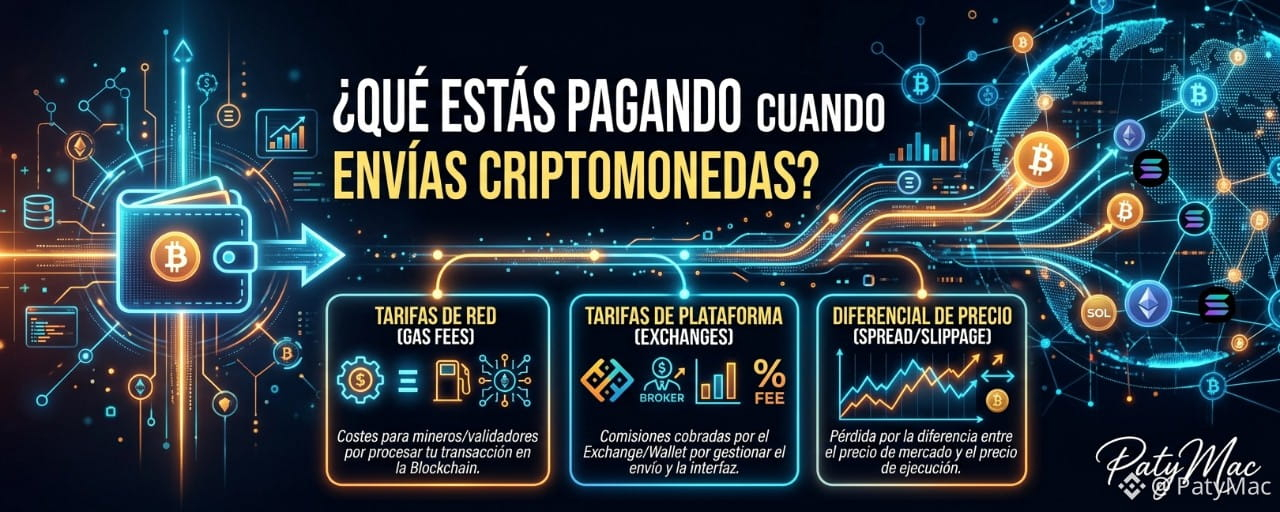
¿QUÉ ESTÁS PAGANDO CUANDO ENVÍAS CRIPTOMONEDAS?REDES, GAS Y COMISIONES EXPLICADOS DESDE CERO
En el episodio anterior descubrimos qué es una blockchain.
Ahora aparece una situación que prácticamente todo usuario de criptomonedas termina encontrando:
Estás intentando enviar USDT.
La plataforma te pregunta:
¿Qué red quieres utilizar?
Y aparecen opciones.
Ethereum.
Tron.
BNB Chain.
Solana.
u otras.
Después aparece otra sorpresa:
“Network Fee”.
Y entonces surge la pregunta:
¿POR QUÉ TENGO QUE PAGAR PARA ENVIAR MIS PROPIAS CRIPTOMONEDAS?
Vamos por partes.
🌐 PRIMERO: ¿QUÉ ES UNA RED?
Una red blockchain es el entorno tecnológico y protocolario en el que se procesan y registran las operaciones.
Bitcoin tiene su propia red.
Ethereum tiene su propia red.
Solana tiene su propia red.
BNB Chain tiene su propia red.
Y cada una tiene:
reglas;participantes;mecanismo de consenso;estructura de transacciones;activos nativos;tarifas;y características técnicas diferentes.
Por eso:
“Criptomoneda” y “red” no son necesariamente la misma cosa.
🪙 EL EJEMPLO PERFECTO: USDT
Supongamos que tienes:
100 USDT.
Podrías encontrar USDT disponible en diferentes redes.
Por ejemplo:
Ethereum
Tron
BNB Smart Chain
entre otras, dependiendo del servicio y del momento.
Entonces:
USDT es el activo.
Ethereum, Tron o BNB Chain son redes diferentes.
Esto es fundamental.
Porque dos saldos que dicen:
100 USDT
pueden estar asociados con infraestructuras de red diferentes.
🚨 “PERO TODOS DICEN USDT…”
Exactamente.
Y ahí está la confusión.
El nombre del activo no siempre te dice automáticamente qué red estás utilizando.
Por eso, cuando haces un retiro o depósito, debes comprobar:
ACTIVO + RED + DIRECCIÓN
No solamente:
ACTIVO.
💸 ¿QUÉ ES UNA NETWORK FEE?
Una network fee es una tarifa asociada con el procesamiento de una operación en una blockchain.
No es necesariamente una “comisión que se queda el exchange”.
Esto es importante.
Hay que distinguir:
Tarifa de la red
de
comisión del proveedor.
Un exchange puede cobrarte una tarifa por procesar un retiro.
Esa tarifa puede estar relacionada con sus propios costos y políticas.
Mientras que una blockchain puede requerir recursos económicos para procesar una transacción.
Son conceptos relacionados, pero no necesariamente idénticos.
⛽ ¿QUÉ ES EL GAS?
“Gas” es un término especialmente asociado con Ethereum y redes compatibles con su modelo de ejecución.
En Ethereum, el gas mide la cantidad de esfuerzo computacional necesario para ejecutar determinadas operaciones.
Los usuarios pagan por ese trabajo computacional.
La tarifa se calcula, simplificando, como:
gas utilizado × precio por unidad de gas
Ethereum denomina el precio de la unidad de gas en gwei, una unidad de ETH.
⛽ ¿POR QUÉ EXISTE EL GAS?
Imagina que cualquiera pudiera enviar infinitas operaciones a una blockchain sin ningún costo.
La red podría ser inundada con solicitudes.
Además, ejecutar contratos inteligentes consume recursos computacionales.
El sistema necesita una forma de asignar y pagar esos recursos.
Por eso, en Ethereum:
Las operaciones computacionales consumen gas.
Y ese gas tiene un costo.
🧠 ¿GAS Y COMISIÓN SON EXACTAMENTE LO MISMO?
No.
Esta distinción es importante.
GAS
Es una unidad que mide el trabajo computacional requerido.
GAS FEE
Es el costo económico de ese trabajo.
NETWORK FEE
Es un término más general que puede utilizarse para referirse a las tarifas asociadas con una operación en una red.
No todas las blockchains utilizan exactamente el mismo modelo de tarifas.
📈 ¿POR QUÉ LAS COMISIONES CAMBIAN?
Porque las redes tienen diferentes mecanismos para gestionar los recursos y la demanda.
En Ethereum, por ejemplo, la tarifa incluye una base fee determinada por el protocolo y puede incluir una priority fee o propina para incentivar la inclusión de una transacción.
Cuando aumenta la demanda por espacio de ejecución, los costos pueden cambiar.
Por eso:
Una transacción que hoy cuesta poco podría costar más en otro momento.
Y viceversa.
🧮 UN EJEMPLO SENCILLO
Imagina una operación que requiere:
21.000 unidades de gas.
Si el costo efectivo por unidad fuera:
20 gwei
la tarifa sería:
21.000 × 20 gwei
=
420.000 gwei
=
0,00042 ETH
Este es solamente un ejemplo matemático para comprender el mecanismo; la tarifa real depende de las condiciones de la red y de la operación concreta.
En Ethereum, una transferencia simple de ETH requiere 21.000 unidades de gas bajo el modelo actual documentado.
🪙 ¿Y CON USDT QUÉ PASA?
Aquí viene una de las confusiones más frecuentes.
Supongamos que tienes USDT en una red compatible con contratos inteligentes.
Para mover ese USDT, la operación puede requerir pagar la tarifa de la red utilizando el activo nativo correspondiente.
Por ejemplo, en Ethereum normalmente necesitas ETH para pagar las tarifas de gas.
Esto significa que podrías tener:
100 USDT
y aun así no poder realizar una determinada operación si no tienes suficiente activo nativo para cubrir la tarifa correspondiente.
😱 “¡PERO TENGO USDT!”
Sí.
Pero:
Tener el token no necesariamente significa tener el activo utilizado para pagar la red.
Esta diferencia puede ahorrar muchos dolores de cabeza.
🔄 ¿POR QUÉ UNA MISMA MONEDA APARECE EN VARIAS REDES?
Porque un activo puede ser emitido o representado en diferentes infraestructuras.
Esto permite utilizarlo dentro de distintos ecosistemas.
Pero también genera un riesgo:
Puedes confundir el activo con la red.
Y ese error puede ser costoso.
⚠️ ERC-20, TRC-20, BEP-20…
Estos términos aparecen constantemente en exchanges.
Simplificando:
ERC-20
Hace referencia al estándar de tokens fungibles utilizado en Ethereum.
TRC-20
Hace referencia a un estándar de tokens en la red Tron.
BEP-20
Hace referencia al estándar de tokens utilizado en BNB Smart Chain.
No son simplemente “tres versiones del mismo Internet”.
Son estándares asociados a ecosistemas de redes diferentes.
🚨 ¿QUÉ PASA SI ELIJO LA RED EQUIVOCADA?
Aquí hay que tener muchísimo cuidado.
Supongamos que quieres enviar USDT.
La persona te proporciona una dirección.
Pero seleccionas una red que el destinatario no admite.
El resultado depende de las redes, plataformas y mecanismos concretos involucrados.
En algunos casos existen procedimientos técnicos para recuperar fondos.
En otros, la recuperación puede ser difícil.
Y en determinadas situaciones puede ser imposible.
Por eso:
NO ELIJAS UNA RED PORQUE “PARECE MÁS BARATA”.
Primero confirma que el destinatario acepta esa red.
💡 EL ERROR DE PENSAR:
“La dirección es la misma, entonces cualquier red sirve”.
No necesariamente.
Una dirección puede tener formatos compatibles visualmente con determinadas redes, pero eso no significa que cualquier activo o red sea compatible con el destino.
La compatibilidad debe verificarse antes de enviar.
🧪 UNA REGLA PRÁCTICA
Antes de realizar una transferencia importante:
1️⃣ Pregunta qué activo vas a enviar.
2️⃣ Pregunta qué red debes utilizar.
3️⃣ Comprueba la dirección.
4️⃣ Comprueba si necesitas Memo/Tag.
5️⃣ Comprueba la comisión.
6️⃣ Si corresponde, realiza primero una transferencia de prueba.
No existe garantía absoluta, pero este procedimiento puede reducir errores operativos.
🏦 ¿Y EL EXCHANGE POR QUÉ ME COBRA?
Aquí debemos separar dos situaciones.
RETIRO DESDE UN EXCHANGE
La plataforma puede mostrarte una tarifa de retiro.
La estructura de esa tarifa depende del proveedor.
TRANSACCIÓN DIRECTA EN BLOCKCHAIN
Si estás utilizando una wallet de autocustodia, normalmente debes pagar la tarifa requerida por la red según su mecanismo.
Por eso:
Exchange fee ≠ necesariamente network fee.
Aunque en algunos servicios pueden estar relacionadas.
🧠 ¿QUIÉN RECIBE LAS COMISIONES?
Depende de la blockchain y de su mecanismo de consenso.
En Ethereum, por ejemplo, la tarifa tiene componentes como la base fee y la priority fee; la documentación de Ethereum explica que la base fee se quema y la priority fee funciona como incentivo para los validadores.
En otras blockchains, la estructura puede ser diferente.
Por eso no debemos hablar de “las comisiones de las criptomonedas” como si todas funcionaran igual.
🔥 ¿MÁS BARATO SIGNIFICA MEJOR?
No necesariamente.
Cuando alguien dice:
“Esta red es más barata”.
La siguiente pregunta debería ser:
¿Qué red es?
¿Qué seguridad ofrece?
¿Qué descentralización tiene?
¿Qué liquidez existe?
¿El destinatario la admite?
¿Qué infraestructura la soporta?
Una tarifa baja puede ser atractiva.
Pero una transferencia correcta vale más que ahorrar unos centavos y terminar enviando fondos a una infraestructura incompatible.
🇵🇾 EJEMPLO PARA UN USUARIO PARAGUAYO
Imagina que Patricia compra USDT y quiere enviar el equivalente a Gs. 500.000 a otra persona.
El receptor le dice:
“Mandame USDT”.
Patricia no debería limitarse a copiar una dirección.
Debe preguntar:
“¿Por qué red?”
El receptor podría responder:
“TRC-20”.
Entonces Patricia debe verificar que su plataforma permita retirar USDT por esa red y que la dirección proporcionada sea compatible.
Si el receptor hubiese dicho:
“ERC-20”.
La operación sería diferente.
El activo puede seguir llamándose USDT.
Pero la infraestructura de transferencia cambió.
⚖️ Y ESTO TAMBIÉN TIENE UNA DIMENSIÓN JURÍDICA
Una transferencia blockchain genera datos técnicos.
Dependiendo de la red, pueden quedar registrados:
dirección de origen;dirección de destino;cantidad;momento;identificador de transacción;tarifa;contrato involucrado.
Esto puede ser relevante como evidencia.
Pero nuevamente:
dato técnico no equivale automáticamente a identidad jurídica.
Para atribuir una dirección a una persona puede ser necesaria evidencia adicional.
🧠 LA GRAN IDEA
Cuando envías criptomonedas, no estás simplemente:
“mandando una moneda por Internet”.
Estás interactuando con una infraestructura tecnológica específica.
Por eso tienes que pensar en:
ACTIVO
↓
RED
↓
DIRECCIÓN
↓
TRANSACCIÓN
↓
COMISIÓN
↓
CONFIRMACIÓN
Si entiendes esa cadena, ya estás muy por delante de alguien que simplemente presiona:
“Enviar”.
🚨 CHECKLIST FINAL ANTES DE ENVIAR
Antes de confirmar:
☑ ¿Estoy enviando el activo correcto?
☑ ¿Elegí la red correcta?
☑ ¿La dirección está correctamente copiada?
☑ ¿El destinatario acepta esa red?
☑ ¿Necesito Memo o Tag?
☑ ¿Tengo suficiente activo nativo para la comisión?
☑ ¿Verifiqué la tarifa?
☑ ¿Estoy seguro de la operación?
Y recuerda:
Una comisión pequeña no compensa una transferencia equivocada.
❓ PREGUNTAS INTERESANTES
¿Gas y comisión son lo mismo?
No exactamente. Gas mide el trabajo computacional en determinados sistemas; la tarifa es el costo económico asociado a ese trabajo.
¿Por qué necesito ETH para mover algunos tokens?
Porque en Ethereum las operaciones requieren gas y las tarifas se pagan en ETH.
¿USDT es una blockchain?
No. USDT es un activo que puede existir en diferentes redes.
¿ERC-20 es una moneda?
No. Es un estándar de tokens utilizado en Ethereum.
¿TRC-20 es USDT?
No exactamente. TRC-20 es un estándar de tokens asociado a Tron. USDT puede emitirse bajo ese estándar.
¿La red más barata es siempre la mejor?
No. Debes verificar compatibilidad, seguridad, infraestructura, liquidez y destino.
¿Puedo recuperar una transferencia enviada por la red equivocada?
A veces existen mecanismos técnicos para recuperar fondos, dependiendo de dónde fueron enviados y quién controla el destino. Pero no debes asumir que será posible.
¿Por qué una transferencia puede costar más hoy que ayer?
Porque las tarifas dependen del funcionamiento y demanda de cada red, entre otros factores.
📌 GLOSARIO CRIPTO #8
RED = infraestructura blockchain específica mediante la cual se procesan y registran las operaciones.
GAS = unidad utilizada para medir el trabajo computacional requerido en determinadas redes como Ethereum.
NETWORK FEE = tarifa asociada al procesamiento de una operación en una red blockchain.
Y ahora que ya sabemos cómo se mueve una transacción, el siguiente episodio será todavía más práctico:
🔎 ¿QUÉ ES UN BLOCK EXPLORER Y CÓMO PUEDES COMPROBAR TU PROPIA TRANSACCIÓN?
$BTC
{future}(BTCUSDT)
$ETH
{future}(ETHUSDT)
$BNB
{future}(BNBUSDT)
#GlosarioCripto #CryptoFees #Blockchain #CryptoEducation #CryptoSecurity
¿QUÉ ESTÁS PAGANDO CUANDO ENVÍAS CRIPTOMONEDAS?
REDES, GAS Y COMISIONES EXPLICADOS DESDE CERO
En el episodio anterior descubrimos qué es una blockchain.
Ahora aparece una situación que prácticamente todo usuario de criptomonedas termina encontrando:
Estás intentando enviar USDT.
La plataforma te pregunta:
¿Qué red quieres utilizar?
Y aparecen opciones.
Ethereum.
Tron.
BNB Chain.
Solana.
u otras.
Después aparece otra sorpresa:
“Network Fee”.
Y entonces surge la pregunta:
¿POR QUÉ TENGO QUE PAGAR PARA ENVIAR MIS PROPIAS CRIPTOMONEDAS?
Vamos por partes.
🌐 PRIMERO: ¿QUÉ ES UNA RED?
Una red blockchain es el entorno tecnológico y protocolario en el que se procesan y registran las operaciones.
Bitcoin tiene su propia red.
Ethereum tiene su propia red.
Solana tiene su propia red.
BNB Chain tiene su propia red.
Y cada una tiene:
reglas;participantes;mecanismo de consenso;estructura de transacciones;activos nativos;tarifas;y características técnicas diferentes.
Por eso:
“Criptomoneda” y “red” no son necesariamente la misma cosa.
🪙 EL EJEMPLO PERFECTO: USDT
Supongamos que tienes:
100 USDT.
Podrías encontrar USDT disponible en diferentes redes.
Por ejemplo:
Ethereum
Tron
BNB Smart Chain
entre otras, dependiendo del servicio y del momento.
Entonces:
USDT es el activo.
Ethereum, Tron o BNB Chain son redes diferentes.
Esto es fundamental.
Porque dos saldos que dicen:
100 USDT
pueden estar asociados con infraestructuras de red diferentes.
🚨 “PERO TODOS DICEN USDT…”
Exactamente.
Y ahí está la confusión.
El nombre del activo no siempre te dice automáticamente qué red estás utilizando.
Por eso, cuando haces un retiro o depósito, debes comprobar:
ACTIVO + RED + DIRECCIÓN
No solamente:
ACTIVO.
💸 ¿QUÉ ES UNA NETWORK FEE?
Una network fee es una tarifa asociada con el procesamiento de una operación en una blockchain.
No es necesariamente una “comisión que se queda el exchange”.
Esto es importante.
Hay que distinguir:
Tarifa de la red
de
comisión del proveedor.
Un exchange puede cobrarte una tarifa por procesar un retiro.
Esa tarifa puede estar relacionada con sus propios costos y políticas.
Mientras que una blockchain puede requerir recursos económicos para procesar una transacción.
Son conceptos relacionados, pero no necesariamente idénticos.
⛽ ¿QUÉ ES EL GAS?
“Gas” es un término especialmente asociado con Ethereum y redes compatibles con su modelo de ejecución.
En Ethereum, el gas mide la cantidad de esfuerzo computacional necesario para ejecutar determinadas operaciones.
Los usuarios pagan por ese trabajo computacional.
La tarifa se calcula, simplificando, como:
gas utilizado × precio por unidad de gas
Ethereum denomina el precio de la unidad de gas en gwei, una unidad de ETH.
⛽ ¿POR QUÉ EXISTE EL GAS?
Imagina que cualquiera pudiera enviar infinitas operaciones a una blockchain sin ningún costo.
La red podría ser inundada con solicitudes.
Además, ejecutar contratos inteligentes consume recursos computacionales.
El sistema necesita una forma de asignar y pagar esos recursos.
Por eso, en Ethereum:
Las operaciones computacionales consumen gas.
Y ese gas tiene un costo.
🧠 ¿GAS Y COMISIÓN SON EXACTAMENTE LO MISMO?
No.
Esta distinción es importante.
GAS
Es una unidad que mide el trabajo computacional requerido.
GAS FEE
Es el costo económico de ese trabajo.
NETWORK FEE
Es un término más general que puede utilizarse para referirse a las tarifas asociadas con una operación en una red.
No todas las blockchains utilizan exactamente el mismo modelo de tarifas.
📈 ¿POR QUÉ LAS COMISIONES CAMBIAN?
Porque las redes tienen diferentes mecanismos para gestionar los recursos y la demanda.
En Ethereum, por ejemplo, la tarifa incluye una base fee determinada por el protocolo y puede incluir una priority fee o propina para incentivar la inclusión de una transacción.
Cuando aumenta la demanda por espacio de ejecución, los costos pueden cambiar.
Por eso:
Una transacción que hoy cuesta poco podría costar más en otro momento.
Y viceversa.
🧮 UN EJEMPLO SENCILLO
Imagina una operación que requiere:
21.000 unidades de gas.
Si el costo efectivo por unidad fuera:
20 gwei
la tarifa sería:
21.000 × 20 gwei
=
420.000 gwei
=
0,00042 ETH
Este es solamente un ejemplo matemático para comprender el mecanismo; la tarifa real depende de las condiciones de la red y de la operación concreta.
En Ethereum, una transferencia simple de ETH requiere 21.000 unidades de gas bajo el modelo actual documentado.
🪙 ¿Y CON USDT QUÉ PASA?
Aquí viene una de las confusiones más frecuentes.
Supongamos que tienes USDT en una red compatible con contratos inteligentes.
Para mover ese USDT, la operación puede requerir pagar la tarifa de la red utilizando el activo nativo correspondiente.
Por ejemplo, en Ethereum normalmente necesitas ETH para pagar las tarifas de gas.
Esto significa que podrías tener:
100 USDT
y aun así no poder realizar una determinada operación si no tienes suficiente activo nativo para cubrir la tarifa correspondiente.
😱 “¡PERO TENGO USDT!”
Sí.
Pero:
Tener el token no necesariamente significa tener el activo utilizado para pagar la red.
Esta diferencia puede ahorrar muchos dolores de cabeza.
🔄 ¿POR QUÉ UNA MISMA MONEDA APARECE EN VARIAS REDES?
Porque un activo puede ser emitido o representado en diferentes infraestructuras.
Esto permite utilizarlo dentro de distintos ecosistemas.
Pero también genera un riesgo:
Puedes confundir el activo con la red.
Y ese error puede ser costoso.
⚠️ ERC-20, TRC-20, BEP-20…
Estos términos aparecen constantemente en exchanges.
Simplificando:
ERC-20
Hace referencia al estándar de tokens fungibles utilizado en Ethereum.
TRC-20
Hace referencia a un estándar de tokens en la red Tron.
BEP-20
Hace referencia al estándar de tokens utilizado en BNB Smart Chain.
No son simplemente “tres versiones del mismo Internet”.
Son estándares asociados a ecosistemas de redes diferentes.
🚨 ¿QUÉ PASA SI ELIJO LA RED EQUIVOCADA?
Aquí hay que tener muchísimo cuidado.
Supongamos que quieres enviar USDT.
La persona te proporciona una dirección.
Pero seleccionas una red que el destinatario no admite.
El resultado depende de las redes, plataformas y mecanismos concretos involucrados.
En algunos casos existen procedimientos técnicos para recuperar fondos.
En otros, la recuperación puede ser difícil.
Y en determinadas situaciones puede ser imposible.
Por eso:
NO ELIJAS UNA RED PORQUE “PARECE MÁS BARATA”.
Primero confirma que el destinatario acepta esa red.
💡 EL ERROR DE PENSAR:
“La dirección es la misma, entonces cualquier red sirve”.
No necesariamente.
Una dirección puede tener formatos compatibles visualmente con determinadas redes, pero eso no significa que cualquier activo o red sea compatible con el destino.
La compatibilidad debe verificarse antes de enviar.
🧪 UNA REGLA PRÁCTICA
Antes de realizar una transferencia importante:
1️⃣ Pregunta qué activo vas a enviar.
2️⃣ Pregunta qué red debes utilizar.
3️⃣ Comprueba la dirección.
4️⃣ Comprueba si necesitas Memo/Tag.
5️⃣ Comprueba la comisión.
6️⃣ Si corresponde, realiza primero una transferencia de prueba.
No existe garantía absoluta, pero este procedimiento puede reducir errores operativos.
🏦 ¿Y EL EXCHANGE POR QUÉ ME COBRA?
Aquí debemos separar dos situaciones.
RETIRO DESDE UN EXCHANGE
La plataforma puede mostrarte una tarifa de retiro.
La estructura de esa tarifa depende del proveedor.
TRANSACCIÓN DIRECTA EN BLOCKCHAIN
Si estás utilizando una wallet de autocustodia, normalmente debes pagar la tarifa requerida por la red según su mecanismo.
Por eso:
Exchange fee ≠ necesariamente network fee.
Aunque en algunos servicios pueden estar relacionadas.
🧠 ¿QUIÉN RECIBE LAS COMISIONES?
Depende de la blockchain y de su mecanismo de consenso.
En Ethereum, por ejemplo, la tarifa tiene componentes como la base fee y la priority fee; la documentación de Ethereum explica que la base fee se quema y la priority fee funciona como incentivo para los validadores.
En otras blockchains, la estructura puede ser diferente.
Por eso no debemos hablar de “las comisiones de las criptomonedas” como si todas funcionaran igual.
🔥 ¿MÁS BARATO SIGNIFICA MEJOR?
No necesariamente.
Cuando alguien dice:
“Esta red es más barata”.
La siguiente pregunta debería ser:
¿Qué red es?
¿Qué seguridad ofrece?
¿Qué descentralización tiene?
¿Qué liquidez existe?
¿El destinatario la admite?
¿Qué infraestructura la soporta?
Una tarifa baja puede ser atractiva.
Pero una transferencia correcta vale más que ahorrar unos centavos y terminar enviando fondos a una infraestructura incompatible.
🇵🇾 EJEMPLO PARA UN USUARIO PARAGUAYO
Imagina que Patricia compra USDT y quiere enviar el equivalente a Gs. 500.000 a otra persona.
El receptor le dice:
“Mandame USDT”.
Patricia no debería limitarse a copiar una dirección.
Debe preguntar:
“¿Por qué red?”
El receptor podría responder:
“TRC-20”.
Entonces Patricia debe verificar que su plataforma permita retirar USDT por esa red y que la dirección proporcionada sea compatible.
Si el receptor hubiese dicho:
“ERC-20”.
La operación sería diferente.
El activo puede seguir llamándose USDT.
Pero la infraestructura de transferencia cambió.
⚖️ Y ESTO TAMBIÉN TIENE UNA DIMENSIÓN JURÍDICA
Una transferencia blockchain genera datos técnicos.
Dependiendo de la red, pueden quedar registrados:
dirección de origen;dirección de destino;cantidad;momento;identificador de transacción;tarifa;contrato involucrado.
Esto puede ser relevante como evidencia.
Pero nuevamente:
dato técnico no equivale automáticamente a identidad jurídica.
Para atribuir una dirección a una persona puede ser necesaria evidencia adicional.
🧠 LA GRAN IDEA
Cuando envías criptomonedas, no estás simplemente:
“mandando una moneda por Internet”.
Estás interactuando con una infraestructura tecnológica específica.
Por eso tienes que pensar en:
ACTIVO
↓
RED
↓
DIRECCIÓN
↓
TRANSACCIÓN
↓
COMISIÓN
↓
CONFIRMACIÓN
Si entiendes esa cadena, ya estás muy por delante de alguien que simplemente presiona:
“Enviar”.
🚨 CHECKLIST FINAL ANTES DE ENVIAR
Antes de confirmar:
☑ ¿Estoy enviando el activo correcto?
☑ ¿Elegí la red correcta?
☑ ¿La dirección está correctamente copiada?
☑ ¿El destinatario acepta esa red?
☑ ¿Necesito Memo o Tag?
☑ ¿Tengo suficiente activo nativo para la comisión?
☑ ¿Verifiqué la tarifa?
☑ ¿Estoy seguro de la operación?
Y recuerda:
Una comisión pequeña no compensa una transferencia equivocada.
❓ PREGUNTAS INTERESANTES
¿Gas y comisión son lo mismo?
No exactamente. Gas mide el trabajo computacional en determinados sistemas; la tarifa es el costo económico asociado a ese trabajo.
¿Por qué necesito ETH para mover algunos tokens?
Porque en Ethereum las operaciones requieren gas y las tarifas se pagan en ETH.
¿USDT es una blockchain?
No. USDT es un activo que puede existir en diferentes redes.
¿ERC-20 es una moneda?
No. Es un estándar de tokens utilizado en Ethereum.
¿TRC-20 es USDT?
No exactamente. TRC-20 es un estándar de tokens asociado a Tron. USDT puede emitirse bajo ese estándar.
¿La red más barata es siempre la mejor?
No. Debes verificar compatibilidad, seguridad, infraestructura, liquidez y destino.
¿Puedo recuperar una transferencia enviada por la red equivocada?
A veces existen mecanismos técnicos para recuperar fondos, dependiendo de dónde fueron enviados y quién controla el destino. Pero no debes asumir que será posible.
¿Por qué una transferencia puede costar más hoy que ayer?
Porque las tarifas dependen del funcionamiento y demanda de cada red, entre otros factores.
📌 GLOSARIO CRIPTO #8
RED = infraestructura blockchain específica mediante la cual se procesan y registran las operaciones.
GAS = unidad utilizada para medir el trabajo computacional requerido en determinadas redes como Ethereum.
NETWORK FEE = tarifa asociada al procesamiento de una operación en una red blockchain.
Y ahora que ya sabemos cómo se mueve una transacción, el siguiente episodio será todavía más práctico:
🔎 ¿QUÉ ES UN BLOCK EXPLORER Y CÓMO PUEDES COMPROBAR TU PROPIA TRANSACCIÓN?
$BTC
$ETH
$BNB
#GlosarioCripto #CryptoFees #Blockchain #CryptoEducation #CryptoSecurity
En el episodio anterior descubrimos qué es una blockchain.
Ahora aparece una situación que prácticamente todo usuario de criptomonedas termina encontrando:
Estás intentando enviar USDT.
La plataforma te pregunta:
¿Qué red quieres utilizar?
Y aparecen opciones.
Ethereum.
Tron.
BNB Chain.
Solana.
u otras.
Después aparece otra sorpresa:
“Network Fee”.
Y entonces surge la pregunta:
¿POR QUÉ TENGO QUE PAGAR PARA ENVIAR MIS PROPIAS CRIPTOMONEDAS?
Vamos por partes.
🌐 PRIMERO: ¿QUÉ ES UNA RED?
Una red blockchain es el entorno tecnológico y protocolario en el que se procesan y registran las operaciones.
Bitcoin tiene su propia red.
Ethereum tiene su propia red.
Solana tiene su propia red.
BNB Chain tiene su propia red.
Y cada una tiene:
reglas;participantes;mecanismo de consenso;estructura de transacciones;activos nativos;tarifas;y características técnicas diferentes.
Por eso:
“Criptomoneda” y “red” no son necesariamente la misma cosa.
🪙 EL EJEMPLO PERFECTO: USDT
Supongamos que tienes:
100 USDT.
Podrías encontrar USDT disponible en diferentes redes.
Por ejemplo:
Ethereum
Tron
BNB Smart Chain
entre otras, dependiendo del servicio y del momento.
Entonces:
USDT es el activo.
Ethereum, Tron o BNB Chain son redes diferentes.
Esto es fundamental.
Porque dos saldos que dicen:
100 USDT
pueden estar asociados con infraestructuras de red diferentes.
🚨 “PERO TODOS DICEN USDT…”
Exactamente.
Y ahí está la confusión.
El nombre del activo no siempre te dice automáticamente qué red estás utilizando.
Por eso, cuando haces un retiro o depósito, debes comprobar:
ACTIVO + RED + DIRECCIÓN
No solamente:
ACTIVO.
💸 ¿QUÉ ES UNA NETWORK FEE?
Una network fee es una tarifa asociada con el procesamiento de una operación en una blockchain.
No es necesariamente una “comisión que se queda el exchange”.
Esto es importante.
Hay que distinguir:
Tarifa de la red
de
comisión del proveedor.
Un exchange puede cobrarte una tarifa por procesar un retiro.
Esa tarifa puede estar relacionada con sus propios costos y políticas.
Mientras que una blockchain puede requerir recursos económicos para procesar una transacción.
Son conceptos relacionados, pero no necesariamente idénticos.
⛽ ¿QUÉ ES EL GAS?
“Gas” es un término especialmente asociado con Ethereum y redes compatibles con su modelo de ejecución.
En Ethereum, el gas mide la cantidad de esfuerzo computacional necesario para ejecutar determinadas operaciones.
Los usuarios pagan por ese trabajo computacional.
La tarifa se calcula, simplificando, como:
gas utilizado × precio por unidad de gas
Ethereum denomina el precio de la unidad de gas en gwei, una unidad de ETH.
⛽ ¿POR QUÉ EXISTE EL GAS?
Imagina que cualquiera pudiera enviar infinitas operaciones a una blockchain sin ningún costo.
La red podría ser inundada con solicitudes.
Además, ejecutar contratos inteligentes consume recursos computacionales.
El sistema necesita una forma de asignar y pagar esos recursos.
Por eso, en Ethereum:
Las operaciones computacionales consumen gas.
Y ese gas tiene un costo.
🧠 ¿GAS Y COMISIÓN SON EXACTAMENTE LO MISMO?
No.
Esta distinción es importante.
GAS
Es una unidad que mide el trabajo computacional requerido.
GAS FEE
Es el costo económico de ese trabajo.
NETWORK FEE
Es un término más general que puede utilizarse para referirse a las tarifas asociadas con una operación en una red.
No todas las blockchains utilizan exactamente el mismo modelo de tarifas.
📈 ¿POR QUÉ LAS COMISIONES CAMBIAN?
Porque las redes tienen diferentes mecanismos para gestionar los recursos y la demanda.
En Ethereum, por ejemplo, la tarifa incluye una base fee determinada por el protocolo y puede incluir una priority fee o propina para incentivar la inclusión de una transacción.
Cuando aumenta la demanda por espacio de ejecución, los costos pueden cambiar.
Por eso:
Una transacción que hoy cuesta poco podría costar más en otro momento.
Y viceversa.
🧮 UN EJEMPLO SENCILLO
Imagina una operación que requiere:
21.000 unidades de gas.
Si el costo efectivo por unidad fuera:
20 gwei
la tarifa sería:
21.000 × 20 gwei
=
420.000 gwei
=
0,00042 ETH
Este es solamente un ejemplo matemático para comprender el mecanismo; la tarifa real depende de las condiciones de la red y de la operación concreta.
En Ethereum, una transferencia simple de ETH requiere 21.000 unidades de gas bajo el modelo actual documentado.
🪙 ¿Y CON USDT QUÉ PASA?
Aquí viene una de las confusiones más frecuentes.
Supongamos que tienes USDT en una red compatible con contratos inteligentes.
Para mover ese USDT, la operación puede requerir pagar la tarifa de la red utilizando el activo nativo correspondiente.
Por ejemplo, en Ethereum normalmente necesitas ETH para pagar las tarifas de gas.
Esto significa que podrías tener:
100 USDT
y aun así no poder realizar una determinada operación si no tienes suficiente activo nativo para cubrir la tarifa correspondiente.
😱 “¡PERO TENGO USDT!”
Sí.
Pero:
Tener el token no necesariamente significa tener el activo utilizado para pagar la red.
Esta diferencia puede ahorrar muchos dolores de cabeza.
🔄 ¿POR QUÉ UNA MISMA MONEDA APARECE EN VARIAS REDES?
Porque un activo puede ser emitido o representado en diferentes infraestructuras.
Esto permite utilizarlo dentro de distintos ecosistemas.
Pero también genera un riesgo:
Puedes confundir el activo con la red.
Y ese error puede ser costoso.
⚠️ ERC-20, TRC-20, BEP-20…
Estos términos aparecen constantemente en exchanges.
Simplificando:
ERC-20
Hace referencia al estándar de tokens fungibles utilizado en Ethereum.
TRC-20
Hace referencia a un estándar de tokens en la red Tron.
BEP-20
Hace referencia al estándar de tokens utilizado en BNB Smart Chain.
No son simplemente “tres versiones del mismo Internet”.
Son estándares asociados a ecosistemas de redes diferentes.
🚨 ¿QUÉ PASA SI ELIJO LA RED EQUIVOCADA?
Aquí hay que tener muchísimo cuidado.
Supongamos que quieres enviar USDT.
La persona te proporciona una dirección.
Pero seleccionas una red que el destinatario no admite.
El resultado depende de las redes, plataformas y mecanismos concretos involucrados.
En algunos casos existen procedimientos técnicos para recuperar fondos.
En otros, la recuperación puede ser difícil.
Y en determinadas situaciones puede ser imposible.
Por eso:
NO ELIJAS UNA RED PORQUE “PARECE MÁS BARATA”.
Primero confirma que el destinatario acepta esa red.
💡 EL ERROR DE PENSAR:
“La dirección es la misma, entonces cualquier red sirve”.
No necesariamente.
Una dirección puede tener formatos compatibles visualmente con determinadas redes, pero eso no significa que cualquier activo o red sea compatible con el destino.
La compatibilidad debe verificarse antes de enviar.
🧪 UNA REGLA PRÁCTICA
Antes de realizar una transferencia importante:
1️⃣ Pregunta qué activo vas a enviar.
2️⃣ Pregunta qué red debes utilizar.
3️⃣ Comprueba la dirección.
4️⃣ Comprueba si necesitas Memo/Tag.
5️⃣ Comprueba la comisión.
6️⃣ Si corresponde, realiza primero una transferencia de prueba.
No existe garantía absoluta, pero este procedimiento puede reducir errores operativos.
🏦 ¿Y EL EXCHANGE POR QUÉ ME COBRA?
Aquí debemos separar dos situaciones.
RETIRO DESDE UN EXCHANGE
La plataforma puede mostrarte una tarifa de retiro.
La estructura de esa tarifa depende del proveedor.
TRANSACCIÓN DIRECTA EN BLOCKCHAIN
Si estás utilizando una wallet de autocustodia, normalmente debes pagar la tarifa requerida por la red según su mecanismo.
Por eso:
Exchange fee ≠ necesariamente network fee.
Aunque en algunos servicios pueden estar relacionadas.
🧠 ¿QUIÉN RECIBE LAS COMISIONES?
Depende de la blockchain y de su mecanismo de consenso.
En Ethereum, por ejemplo, la tarifa tiene componentes como la base fee y la priority fee; la documentación de Ethereum explica que la base fee se quema y la priority fee funciona como incentivo para los validadores.
En otras blockchains, la estructura puede ser diferente.
Por eso no debemos hablar de “las comisiones de las criptomonedas” como si todas funcionaran igual.
🔥 ¿MÁS BARATO SIGNIFICA MEJOR?
No necesariamente.
Cuando alguien dice:
“Esta red es más barata”.
La siguiente pregunta debería ser:
¿Qué red es?
¿Qué seguridad ofrece?
¿Qué descentralización tiene?
¿Qué liquidez existe?
¿El destinatario la admite?
¿Qué infraestructura la soporta?
Una tarifa baja puede ser atractiva.
Pero una transferencia correcta vale más que ahorrar unos centavos y terminar enviando fondos a una infraestructura incompatible.
🇵🇾 EJEMPLO PARA UN USUARIO PARAGUAYO
Imagina que Patricia compra USDT y quiere enviar el equivalente a Gs. 500.000 a otra persona.
El receptor le dice:
“Mandame USDT”.
Patricia no debería limitarse a copiar una dirección.
Debe preguntar:
“¿Por qué red?”
El receptor podría responder:
“TRC-20”.
Entonces Patricia debe verificar que su plataforma permita retirar USDT por esa red y que la dirección proporcionada sea compatible.
Si el receptor hubiese dicho:
“ERC-20”.
La operación sería diferente.
El activo puede seguir llamándose USDT.
Pero la infraestructura de transferencia cambió.
⚖️ Y ESTO TAMBIÉN TIENE UNA DIMENSIÓN JURÍDICA
Una transferencia blockchain genera datos técnicos.
Dependiendo de la red, pueden quedar registrados:
dirección de origen;dirección de destino;cantidad;momento;identificador de transacción;tarifa;contrato involucrado.
Esto puede ser relevante como evidencia.
Pero nuevamente:
dato técnico no equivale automáticamente a identidad jurídica.
Para atribuir una dirección a una persona puede ser necesaria evidencia adicional.
🧠 LA GRAN IDEA
Cuando envías criptomonedas, no estás simplemente:
“mandando una moneda por Internet”.
Estás interactuando con una infraestructura tecnológica específica.
Por eso tienes que pensar en:
ACTIVO
↓
RED
↓
DIRECCIÓN
↓
TRANSACCIÓN
↓
COMISIÓN
↓
CONFIRMACIÓN
Si entiendes esa cadena, ya estás muy por delante de alguien que simplemente presiona:
“Enviar”.
🚨 CHECKLIST FINAL ANTES DE ENVIAR
Antes de confirmar:
☑ ¿Estoy enviando el activo correcto?
☑ ¿Elegí la red correcta?
☑ ¿La dirección está correctamente copiada?
☑ ¿El destinatario acepta esa red?
☑ ¿Necesito Memo o Tag?
☑ ¿Tengo suficiente activo nativo para la comisión?
☑ ¿Verifiqué la tarifa?
☑ ¿Estoy seguro de la operación?
Y recuerda:
Una comisión pequeña no compensa una transferencia equivocada.
❓ PREGUNTAS INTERESANTES
¿Gas y comisión son lo mismo?
No exactamente. Gas mide el trabajo computacional en determinados sistemas; la tarifa es el costo económico asociado a ese trabajo.
¿Por qué necesito ETH para mover algunos tokens?
Porque en Ethereum las operaciones requieren gas y las tarifas se pagan en ETH.
¿USDT es una blockchain?
No. USDT es un activo que puede existir en diferentes redes.
¿ERC-20 es una moneda?
No. Es un estándar de tokens utilizado en Ethereum.
¿TRC-20 es USDT?
No exactamente. TRC-20 es un estándar de tokens asociado a Tron. USDT puede emitirse bajo ese estándar.
¿La red más barata es siempre la mejor?
No. Debes verificar compatibilidad, seguridad, infraestructura, liquidez y destino.
¿Puedo recuperar una transferencia enviada por la red equivocada?
A veces existen mecanismos técnicos para recuperar fondos, dependiendo de dónde fueron enviados y quién controla el destino. Pero no debes asumir que será posible.
¿Por qué una transferencia puede costar más hoy que ayer?
Porque las tarifas dependen del funcionamiento y demanda de cada red, entre otros factores.
📌 GLOSARIO CRIPTO #8
RED = infraestructura blockchain específica mediante la cual se procesan y registran las operaciones.
GAS = unidad utilizada para medir el trabajo computacional requerido en determinadas redes como Ethereum.
NETWORK FEE = tarifa asociada al procesamiento de una operación en una red blockchain.
Y ahora que ya sabemos cómo se mueve una transacción, el siguiente episodio será todavía más práctico:
🔎 ¿QUÉ ES UN BLOCK EXPLORER Y CÓMO PUEDES COMPROBAR TU PROPIA TRANSACCIÓN?
$BTC
$ETH
$BNB
#GlosarioCripto #CryptoFees #Blockchain #CryptoEducation #CryptoSecurity
1
286
💸 What Are Blockchain Transaction Fees?
Whenever you send, deposit, or withdraw crypto, you may need to pay a transaction fee.
These fees are paid to the network for processing and confirming the transaction. They also help prevent spam and unnecessary activity on the blockchain.
Fees can vary depending on:
🔹 The blockchain network
🔹 Network congestion
🔹 The type of transaction
🔹 The amount of computational work required
On Ethereum, these fees are commonly called gas fees. A simple transfer may cost less than a complex smart-contract transaction.
Always check the network and fee before confirming a crypto transfer.
Have you ever checked the network fee before sending crypto? 👇
Follow for simple, beginner-friendly crypto lessons.
Educational content only—not financial advice.
#CryptoFees #crypto #aneesacryptoinsights #CryptoBeginners #BinanceSquare
💸 What Are Blockchain Transaction Fees?
Whenever you send, deposit, or withdraw crypto, you may need to pay a transaction fee.
These fees are paid to the network for processing and confirming the transaction. They also help prevent spam and unnecessary activity on the blockchain.
Fees can vary depending on:
🔹 The blockchain network
🔹 Network congestion
🔹 The type of transaction
🔹 The amount of computational work required
On Ethereum, these fees are commonly called gas fees. A simple transfer may cost less than a complex smart-contract transaction.
Always check the network and fee before confirming a crypto transfer.
Have you ever checked the network fee before sending crypto? 👇
Follow for simple, beginner-friendly crypto lessons.
Educational content only—not financial advice.
#CryptoFees #crypto #aneesacryptoinsights #CryptoBeginners #BinanceSquare
Whenever you send, deposit, or withdraw crypto, you may need to pay a transaction fee.
These fees are paid to the network for processing and confirming the transaction. They also help prevent spam and unnecessary activity on the blockchain.
Fees can vary depending on:
🔹 The blockchain network
🔹 Network congestion
🔹 The type of transaction
🔹 The amount of computational work required
On Ethereum, these fees are commonly called gas fees. A simple transfer may cost less than a complex smart-contract transaction.
Always check the network and fee before confirming a crypto transfer.
Have you ever checked the network fee before sending crypto? 👇
Follow for simple, beginner-friendly crypto lessons.
Educational content only—not financial advice.
#CryptoFees #crypto #aneesacryptoinsights #CryptoBeginners #BinanceSquare
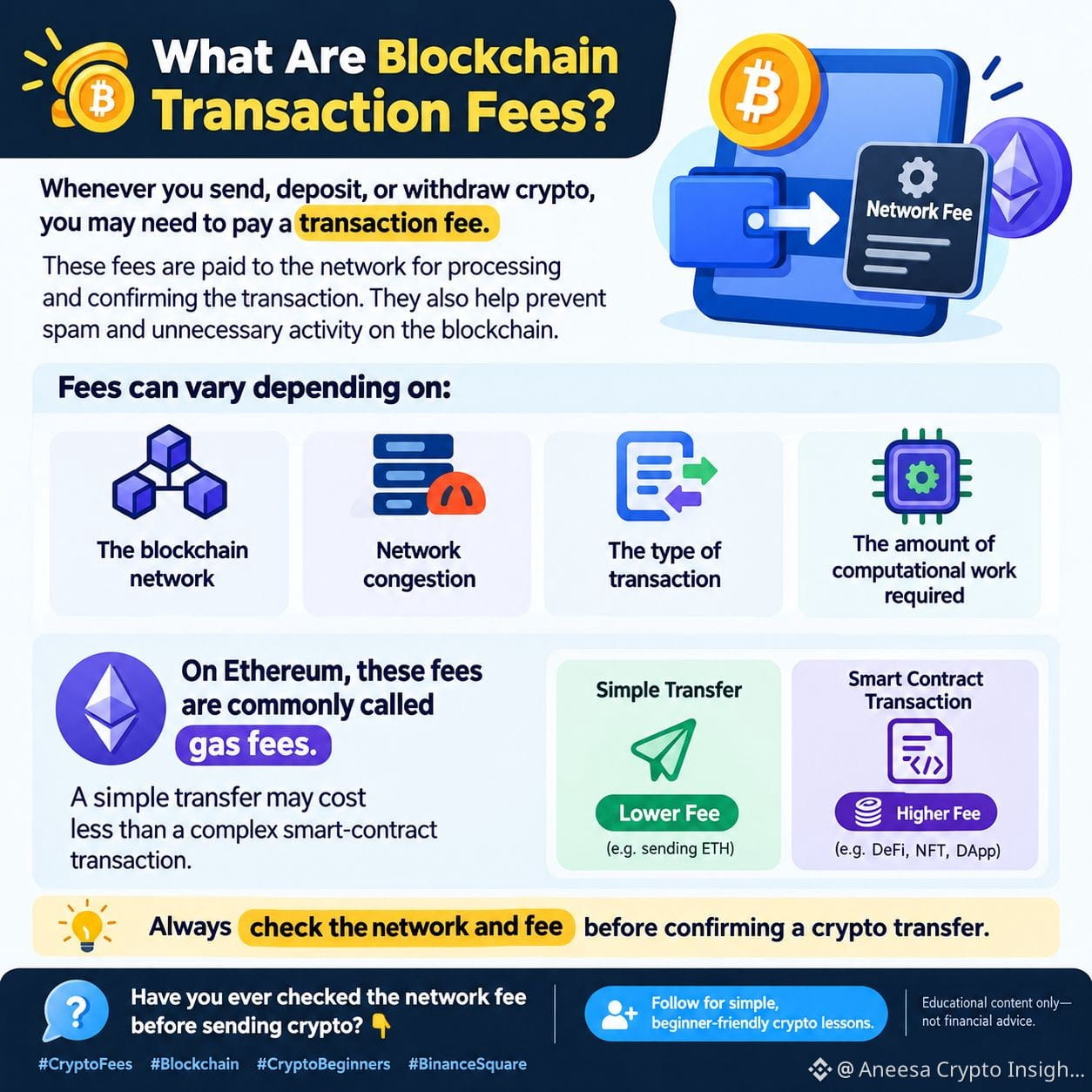
90
Connectez-vous pour découvrir plus de contenu
Rejoignez la communauté mondiale des adeptes de cryptomonnaies sur Binance Square
⚡️ Suviez les dernières informations importantes sur les cryptomonnaies.
💬 Jugé digne de confiance par la plus grande plateforme d’échange de cryptomonnaies au monde.
👍 Découvrez les connaissances que partagent les créateurs vérifiés.
Adresse e-mail/Nº de téléphone
Sujets d’actualité
1
#BitcoinClears$85200
2,535 vues
102 mentions
2
#AltcoinSeasonIndexHoldsAbove60For5Days
17,615 vues
675 mentions
3
#USADPAdds90000JobsInSeptember
5,970 vues
360 mentions
4
#USCorePCEEasesTo3%InAugust
5,312 vues
308 mentions
5
#KospiPostsWorstQuarterSince2020
4,833 vues
339 mentions
6
#SECToClarifyOnChainFundraisingRules
12,770 vues
517 mentions
7
#UKFCAOpensCryptoFirmAuthorization
15,814 vues
467 mentions
8
#JapanMOFStudyGroupOnTokenizedGovtBonds
13,691 vues
374 mentions
9
#QNTRises287%
62,410 vues
789 mentions
10
#TrumpRejectsAIRulesForVoluntaryAudits
38,747 vues
704 mentions