

Sulaiman 零号猎人
2.4k Posts

Sulaiman 零号猎人
Report
Block User
ZeroHunter | Hunting 10X potential in micro-caps & RWA with on-chain research. I show how I check a project's data before I trust it. NFA. #ZeroResearch
Open Trade
Frequent Trader
6.1 Years
140 Following
806 Followers
2.2K+ Liked
Posts
Portfolio
All
Quotes
Live
PINNED

Article
I lost 750 USDT on LUNA because I skipped one stepDisclosure: I hold no Terra coins (LUNA or LUNC).
I lost around 750 USDT on one coin, and it was my own fault.
The worst part? I bought it without checking anything.
LUNA (the old Terra) was a hero back then. Many people, including me, wanted it in their portfolio.
One morning in May 2022, I woke up and saw it at 3.5 USDT. I did not check the news. I did not ask why. I just bought around 350 USDT worth, fast.
Then I opened X and saw CZ's thread. He said some users kept buying LUNA without understanding the risk.
That was me. 👇
Source: CZ (@cz_binance) on X, May 13, 2022
So I started DCA to "save" my money. I kept buying while the supply kept growing and I saw no clear plan from the team. In my opinion, that silence was a red flag.
Later I looked at the burn mechanism and made a decision. I closed my position with a loss of around 750 USDT.
Here's my advice:
"It was a hero before" is not a reason to buy.
Check first, buy later. Five minutes of research could have saved me.
Buying more of a broken project is not a rescue plan. In my opinion, it only makes the loss bigger.
That day changed how I research. Now, before I trust any project, I check:
Supply: Can new tokens be minted? Who controls it?Holders: Do a few wallets own most of the supply?Liquidity: Can people sell without crashing the price?Team: Does the team respond when there is a problem?Real usage: Are people using it, or only talking about it?
None of these guarantees safety. But skipping them cost me.
I share these checks step by step, so you can learn the process too.
Every project is high risk, big names and micro caps both. I could be wrong, and I have been wrong before.
This is my personal opinion, not financial advice. Do your own research.
What is one mistake that taught you the most?
#ZeroResearch
#CryptoEducation
#DYOR
I lost 750 USDT on LUNA because I skipped one step
Disclosure: I hold no Terra coins (LUNA or LUNC).
I lost around 750 USDT on one coin, and it was my own fault.
The worst part? I bought it without checking anything.
LUNA (the old Terra) was a hero back then. Many people, including me, wanted it in their portfolio.
One morning in May 2022, I woke up and saw it at 3.5 USDT. I did not check the news. I did not ask why. I just bought around 350 USDT worth, fast.
Then I opened X and saw CZ's thread. He said some users kept buying LUNA without understanding the risk.
That was me. 👇
Source: CZ (@cz_binance) on X, May 13, 2022
So I started DCA to "save" my money. I kept buying while the supply kept growing and I saw no clear plan from the team. In my opinion, that silence was a red flag.
Later I looked at the burn mechanism and made a decision. I closed my position with a loss of around 750 USDT.
Here's my advice:
"It was a hero before" is not a reason to buy.
Check first, buy later. Five minutes of research could have saved me.
Buying more of a broken project is not a rescue plan. In my opinion, it only makes the loss bigger.
That day changed how I research. Now, before I trust any project, I check:
Supply: Can new tokens be minted? Who controls it?Holders: Do a few wallets own most of the supply?Liquidity: Can people sell without crashing the price?Team: Does the team respond when there is a problem?Real usage: Are people using it, or only talking about it?
None of these guarantees safety. But skipping them cost me.
I share these checks step by step, so you can learn the process too.
Every project is high risk, big names and micro caps both. I could be wrong, and I have been wrong before.
This is my personal opinion, not financial advice. Do your own research.
What is one mistake that taught you the most?
#ZeroResearch
#CryptoEducation
#DYOR
I lost around 750 USDT on one coin, and it was my own fault.
The worst part? I bought it without checking anything.
LUNA (the old Terra) was a hero back then. Many people, including me, wanted it in their portfolio.
One morning in May 2022, I woke up and saw it at 3.5 USDT. I did not check the news. I did not ask why. I just bought around 350 USDT worth, fast.
Then I opened X and saw CZ's thread. He said some users kept buying LUNA without understanding the risk.
That was me. 👇
Source: CZ (@cz_binance) on X, May 13, 2022
So I started DCA to "save" my money. I kept buying while the supply kept growing and I saw no clear plan from the team. In my opinion, that silence was a red flag.
Later I looked at the burn mechanism and made a decision. I closed my position with a loss of around 750 USDT.
Here's my advice:
"It was a hero before" is not a reason to buy.
Check first, buy later. Five minutes of research could have saved me.
Buying more of a broken project is not a rescue plan. In my opinion, it only makes the loss bigger.
That day changed how I research. Now, before I trust any project, I check:
Supply: Can new tokens be minted? Who controls it?Holders: Do a few wallets own most of the supply?Liquidity: Can people sell without crashing the price?Team: Does the team respond when there is a problem?Real usage: Are people using it, or only talking about it?
None of these guarantees safety. But skipping them cost me.
I share these checks step by step, so you can learn the process too.
Every project is high risk, big names and micro caps both. I could be wrong, and I have been wrong before.
This is my personal opinion, not financial advice. Do your own research.
What is one mistake that taught you the most?
#ZeroResearch
#CryptoEducation
#DYOR
1
3
907

Article
Ondo has JPMorgan, Fidelity, Mastercard in its pipeline. Token still down 80%.I've gone back and forth on whether to post this one, because the easy version of this story is "institutions are coming, buy the token." That's not quite true, and I'd rather say the less comfortable version.
Ondo's TVL grew from $2.6B to $3.53B in Q1 2026. Revenue printed $13.26M in the same quarter. Fidelity, PayPal, Mastercard, and JPMorgan have all integrated Ondo products. RWA tokenization as a category just crossed $20B in on-chain value, and there are 40+ institutional tokenized fund products sitting in SEC pre-registration.
By every adoption metric, this is one of the strongest RWA stories in the market right now.
But—
Holding ONDO doesn't give you a claim on Ondo Finance Inc.'s revenue. Zero. The $13.26M in quarterly revenue and the token you can buy on an exchange are, right now, two separate things.
This is the gap nobody wants to say out loud: adoption and token value capture are not the same curve. ONDO has been rewarded for the first. It has not been rewarded for the second — because the second doesn't exist yet.
There's a fee-switch vote scheduled for H2 2026. If it passes, a share of Ondo's ~$48M+ annual revenue could start flowing to token holders through buybacks or direct distribution. This is the whole bet. Not the TVL chart. Not the bank logos. A governance vote that hasn't happened yet.
$737M in tokens unlocked in January 2026. The token is trading roughly 80% below its all-time high. If the fee-switch vote fails or gets delayed, the thesis doesn't weaken — it disappears.
Adoption tells you a protocol is winning. It doesn't tell you the token is. Those are two different questions, and 2026 is the year the market started asking both.
Not financial advice. The fee-switch is a proposed vote, not a confirmed outcome — verify status before acting on this.
$ONDO #RWA #TokenomicsCheck #mostsearched
Ondo has JPMorgan, Fidelity, Mastercard in its pipeline. Token still down 80%.
I've gone back and forth on whether to post this one, because the easy version of this story is "institutions are coming, buy the token." That's not quite true, and I'd rather say the less comfortable version.
Ondo's TVL grew from $2.6B to $3.53B in Q1 2026. Revenue printed $13.26M in the same quarter. Fidelity, PayPal, Mastercard, and JPMorgan have all integrated Ondo products. RWA tokenization as a category just crossed $20B in on-chain value, and there are 40+ institutional tokenized fund products sitting in SEC pre-registration.
By every adoption metric, this is one of the strongest RWA stories in the market right now.
But—
Holding ONDO doesn't give you a claim on Ondo Finance Inc.'s revenue. Zero. The $13.26M in quarterly revenue and the token you can buy on an exchange are, right now, two separate things.
This is the gap nobody wants to say out loud: adoption and token value capture are not the same curve. ONDO has been rewarded for the first. It has not been rewarded for the second — because the second doesn't exist yet.
There's a fee-switch vote scheduled for H2 2026. If it passes, a share of Ondo's ~$48M+ annual revenue could start flowing to token holders through buybacks or direct distribution. This is the whole bet. Not the TVL chart. Not the bank logos. A governance vote that hasn't happened yet.
$737M in tokens unlocked in January 2026. The token is trading roughly 80% below its all-time high. If the fee-switch vote fails or gets delayed, the thesis doesn't weaken — it disappears.
Adoption tells you a protocol is winning. It doesn't tell you the token is. Those are two different questions, and 2026 is the year the market started asking both.
Not financial advice. The fee-switch is a proposed vote, not a confirmed outcome — verify status before acting on this.
$ONDO #RWA #TokenomicsCheck #mostsearched
Ondo's TVL grew from $2.6B to $3.53B in Q1 2026. Revenue printed $13.26M in the same quarter. Fidelity, PayPal, Mastercard, and JPMorgan have all integrated Ondo products. RWA tokenization as a category just crossed $20B in on-chain value, and there are 40+ institutional tokenized fund products sitting in SEC pre-registration.
By every adoption metric, this is one of the strongest RWA stories in the market right now.
But—
Holding ONDO doesn't give you a claim on Ondo Finance Inc.'s revenue. Zero. The $13.26M in quarterly revenue and the token you can buy on an exchange are, right now, two separate things.
This is the gap nobody wants to say out loud: adoption and token value capture are not the same curve. ONDO has been rewarded for the first. It has not been rewarded for the second — because the second doesn't exist yet.
There's a fee-switch vote scheduled for H2 2026. If it passes, a share of Ondo's ~$48M+ annual revenue could start flowing to token holders through buybacks or direct distribution. This is the whole bet. Not the TVL chart. Not the bank logos. A governance vote that hasn't happened yet.
$737M in tokens unlocked in January 2026. The token is trading roughly 80% below its all-time high. If the fee-switch vote fails or gets delayed, the thesis doesn't weaken — it disappears.
Adoption tells you a protocol is winning. It doesn't tell you the token is. Those are two different questions, and 2026 is the year the market started asking both.
Not financial advice. The fee-switch is a proposed vote, not a confirmed outcome — verify status before acting on this.
$ONDO #RWA #TokenomicsCheck #mostsearched
1
165
Verified
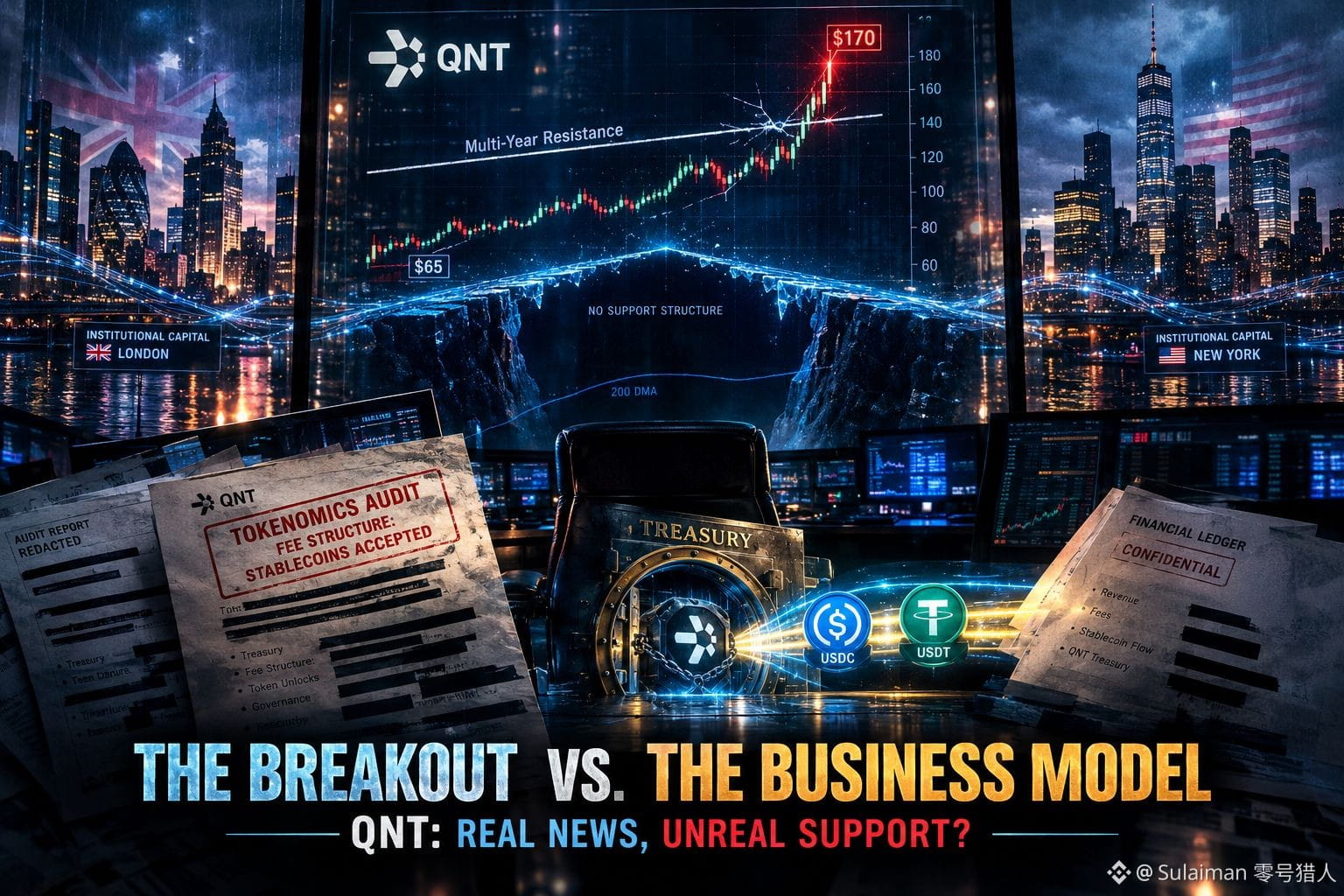
Before you ape into QNT at $170+, read this one paragraph from its Tokenomics audit.
On Sept 24, The Clearing House (processes $2T+ in daily US payments) picked Quant to power its bank tokenization project — 25 US banks involved, 2027 launch target. In the UK, 7 banks are already running live payments on Quant's stack.
From ~$65-70 to $170+ — roughly 160-178% in 7 days. Technically a real breakout — broke a multi-year resistance trendline.
An independent tokenomics audit found banks aren't required to pay fees in QNT — they can pay in stablecoins, and Quant just locks equivalent QNT from its own treasury. So the business wins, but token demand doesn't automatically rise with it — that's the biggest question mark on this rally.
Price moved from $100 to $170 so fast there's almost no support structure built in between — it's extremely extended above its 200-day MA. A sharp pullback could hit at any time.
The news is real, the breakout is real — but the token's fundamentals haven't caught up with the price yet. DYOR, elevated risk here.
Are you holding through this or waiting for a pullback?
#QNT #Quant #mostsearched
Before you ape into QNT at $170+, read this one paragraph from its Tokenomics audit.
On Sept 24, The Clearing House (processes $2T+ in daily US payments) picked Quant to power its bank tokenization project — 25 US banks involved, 2027 launch target. In the UK, 7 banks are already running live payments on Quant's stack.
From ~$65-70 to $170+ — roughly 160-178% in 7 days. Technically a real breakout — broke a multi-year resistance trendline.
An independent tokenomics audit found banks aren't required to pay fees in QNT — they can pay in stablecoins, and Quant just locks equivalent QNT from its own treasury. So the business wins, but token demand doesn't automatically rise with it — that's the biggest question mark on this rally.
Price moved from $100 to $170 so fast there's almost no support structure built in between — it's extremely extended above its 200-day MA. A sharp pullback could hit at any time.
The news is real, the breakout is real — but the token's fundamentals haven't caught up with the price yet. DYOR, elevated risk here.
Are you holding through this or waiting for a pullback?
#QNT #Quant #mostsearched
On Sept 24, The Clearing House (processes $2T+ in daily US payments) picked Quant to power its bank tokenization project — 25 US banks involved, 2027 launch target. In the UK, 7 banks are already running live payments on Quant's stack.
From ~$65-70 to $170+ — roughly 160-178% in 7 days. Technically a real breakout — broke a multi-year resistance trendline.
An independent tokenomics audit found banks aren't required to pay fees in QNT — they can pay in stablecoins, and Quant just locks equivalent QNT from its own treasury. So the business wins, but token demand doesn't automatically rise with it — that's the biggest question mark on this rally.
Price moved from $100 to $170 so fast there's almost no support structure built in between — it's extremely extended above its 200-day MA. A sharp pullback could hit at any time.
The news is real, the breakout is real — but the token's fundamentals haven't caught up with the price yet. DYOR, elevated risk here.
Are you holding through this or waiting for a pullback?
#QNT #Quant #mostsearched
129
🔥 One name is pulling more attention than the rest today. The hunters zoom in.
🐸 THE SOLO HUNT: $QNT
$QNT → 178.56
+74% in a single search window isn't routine Rapid Riser behavior — this is an outlier move. Could be a real catalyst, could be a short-term spike. Either way, it demands attention before it demands belief.
I don't get excited by the number.
I hunt the reason behind the number.
NFA. Manage risk.
#QNT #RapidRiser #MostSearched #ZeroResearch
👉 Follow for the next @SulemaOFCrypto watchlist.
🔥 One name is pulling more attention than the rest today. The hunters zoom in.
🐸 THE SOLO HUNT: $QNT
$QNT → 178.56
+74% in a single search window isn't routine Rapid Riser behavior — this is an outlier move. Could be a real catalyst, could be a short-term spike. Either way, it demands attention before it demands belief.
I don't get excited by the number.
I hunt the reason behind the number.
NFA. Manage risk.
#QNT #RapidRiser #MostSearched #ZeroResearch
👉 Follow for the next @Sulaiman 零号猎人 watchlist.
🐸 THE SOLO HUNT: $QNT
$QNT → 178.56
+74% in a single search window isn't routine Rapid Riser behavior — this is an outlier move. Could be a real catalyst, could be a short-term spike. Either way, it demands attention before it demands belief.
I don't get excited by the number.
I hunt the reason behind the number.
NFA. Manage risk.
#QNT #RapidRiser #MostSearched #ZeroResearch
👉 Follow for the next @Sulaiman 零号猎人 watchlist.
106
🔥 Same tag, different scale — from the biggest name on the board to fast-moving alts.
🐸 THE RAPID RISER HUNTERS
$BTC → 84,538
$SUI → 1.1898
$OP → 0.14643
BTC holding steady above 84K while SUI and OP both outpace it in % terms — a sign liquidity is rotating from BTC into higher-beta names.
I don't just watch the majors.
I hunt where the rotation is actually flowing.
NFA. Manage risk.
#BTC #SUI #OP #RapidRiser #ZeroResearch
👉 Follow for the next @SulemaOFCrypto watchlist.
🔥 Same tag, different scale — from the biggest name on the board to fast-moving alts.
🐸 THE RAPID RISER HUNTERS
$BTC → 84,538
$SUI → 1.1898
$OP → 0.14643
BTC holding steady above 84K while SUI and OP both outpace it in % terms — a sign liquidity is rotating from BTC into higher-beta names.
I don't just watch the majors.
I hunt where the rotation is actually flowing.
NFA. Manage risk.
#BTC #SUI #OP #RapidRiser #ZeroResearch
👉 Follow for the next @Sulaiman 零号猎人 watchlist.
🐸 THE RAPID RISER HUNTERS
$BTC → 84,538
$SUI → 1.1898
$OP → 0.14643
BTC holding steady above 84K while SUI and OP both outpace it in % terms — a sign liquidity is rotating from BTC into higher-beta names.
I don't just watch the majors.
I hunt where the rotation is actually flowing.
NFA. Manage risk.
#BTC #SUI #OP #RapidRiser #ZeroResearch
👉 Follow for the next @Sulaiman 零号猎人 watchlist.
1
306
🔥 Rapid Risers are flashing on the board again. The hunters don't wait for confirmation — they position before it.
🐸 THE RAPID RISER HUNTERS
$ZEC → 1,662.24
$XLM → 0.21634
$CHZ → 0.01659
ZEC is leading with a clean +8.62% breakout in search-to-price flow. XLM is pulling back slightly despite the tag — a possible reload zone. CHZ stays steady with low volatility.
I don't chase green candles.
I hunt the setup before the crowd.
NFA. Manage risk.
#ZEC #XLM #CHZ #RapidRiser #ZeroResearch
👉 Follow for the next @SulemaOFCrypto watchlist.
🔥 Rapid Risers are flashing on the board again. The hunters don't wait for confirmation — they position before it.
🐸 THE RAPID RISER HUNTERS
$ZEC → 1,662.24
$XLM → 0.21634
$CHZ → 0.01659
ZEC is leading with a clean +8.62% breakout in search-to-price flow. XLM is pulling back slightly despite the tag — a possible reload zone. CHZ stays steady with low volatility.
I don't chase green candles.
I hunt the setup before the crowd.
NFA. Manage risk.
#ZEC #XLM #CHZ #RapidRiser #ZeroResearch
👉 Follow for the next @Sulaiman 零号猎人 watchlist.
🐸 THE RAPID RISER HUNTERS
$ZEC → 1,662.24
$XLM → 0.21634
$CHZ → 0.01659
ZEC is leading with a clean +8.62% breakout in search-to-price flow. XLM is pulling back slightly despite the tag — a possible reload zone. CHZ stays steady with low volatility.
I don't chase green candles.
I hunt the setup before the crowd.
NFA. Manage risk.
#ZEC #XLM #CHZ #RapidRiser #ZeroResearch
👉 Follow for the next @Sulaiman 零号猎人 watchlist.
1
407
🔥 Before the "Rapid Riser" tag even shows up, the search volume is already telling the story.
🐸 THE MOST-SEARCHED HUNTERS
$AR → 4.798 (+6.95%)
$FIL → 1.1418 (+7.91%)
$ETC → 9.441 (+0.47%)
AR and FIL are already up near +7-8% without a Rapid Riser flag — the crowd hasn't caught up yet. ETC is quieter but still holding its place on the search list.
I don't wait for the tag to confirm it.
I hunt the setup before the label appears.
NFA. Manage risk.
#AR #FIL #ETC #ZeroResearch #Sulaiman零号猎人
👉 Follow for the next @SulemaOFCrypto watchlist.
🔥 Before the "Rapid Riser" tag even shows up, the search volume is already telling the story.
🐸 THE MOST-SEARCHED HUNTERS
$AR → 4.798 (+6.95%)
$FIL → 1.1418 (+7.91%)
$ETC → 9.441 (+0.47%)
AR and FIL are already up near +7-8% without a Rapid Riser flag — the crowd hasn't caught up yet. ETC is quieter but still holding its place on the search list.
I don't wait for the tag to confirm it.
I hunt the setup before the label appears.
NFA. Manage risk.
#AR #FIL #ETC #ZeroResearch #Sulaiman零号猎人
👉 Follow for the next @Sulaiman 零号猎人 watchlist.
🐸 THE MOST-SEARCHED HUNTERS
$AR → 4.798 (+6.95%)
$FIL → 1.1418 (+7.91%)
$ETC → 9.441 (+0.47%)
AR and FIL are already up near +7-8% without a Rapid Riser flag — the crowd hasn't caught up yet. ETC is quieter but still holding its place on the search list.
I don't wait for the tag to confirm it.
I hunt the setup before the label appears.
NFA. Manage risk.
#AR #FIL #ETC #ZeroResearch #Sulaiman零号猎人
👉 Follow for the next @Sulaiman 零号猎人 watchlist.
639
🎙️ Welcome to the Tangbao livestream room—come chat with us about the Web3 wealth secrets

End
03 h 36 m 24 s
5.3k
45
76
🔥 Red doesn't scare a hunter. It's where the next setup gets built.
🐸 THE PULLBACK HUNTERS
$ARB → 0.22278 (-2.69%)
$PEPE → 0.00000435 (-3.33%)
$APT → 0.8452 (-2.01%)
Rapid Riser tag + short-term pullback = volatility compressing before the next leg. If risk sentiment flips, these can snap back fast.
I don't panic on red.
I hunt the reload zone before the crowd.
NFA. Manage risk.
#ARB #PEPE #APT #RapidRiser #ZeroResearch
👉 Follow for the next @SulemaOFCrypto watchlist.
🔥 Red doesn't scare a hunter. It's where the next setup gets built.
🐸 THE PULLBACK HUNTERS
$ARB → 0.22278 (-2.69%)
$PEPE → 0.00000435 (-3.33%)
$APT → 0.8452 (-2.01%)
Rapid Riser tag + short-term pullback = volatility compressing before the next leg. If risk sentiment flips, these can snap back fast.
I don't panic on red.
I hunt the reload zone before the crowd.
NFA. Manage risk.
#ARB #PEPE #APT #RapidRiser #ZeroResearch
👉 Follow for the next @Sulaiman 零号猎人 watchlist.
🐸 THE PULLBACK HUNTERS
$ARB → 0.22278 (-2.69%)
$PEPE → 0.00000435 (-3.33%)
$APT → 0.8452 (-2.01%)
Rapid Riser tag + short-term pullback = volatility compressing before the next leg. If risk sentiment flips, these can snap back fast.
I don't panic on red.
I hunt the reload zone before the crowd.
NFA. Manage risk.
#ARB #PEPE #APT #RapidRiser #ZeroResearch
👉 Follow for the next @Sulaiman 零号猎人 watchlist.
1
469
🔥 One name is pulling more attention than the rest today. The hunters zoom in.
🐸 THE SOLO HUNT: $WLD
$WLD → 0.5239 (+7.64%)
WLD is leading today's Rapid Riser board — the strongest search-to-price correlation on the list right now. If momentum holds into the next session, follow-through is likely.
I don't chase the pump after it's obvious.
I hunt the name before it trends everywhere.
NFA. Manage risk.
#WLD #RapidRiser #MostSearched #ZeroResearch
👉 Follow for the next @SulemaOFCrypto watchlist.
🔥 One name is pulling more attention than the rest today. The hunters zoom in.
🐸 THE SOLO HUNT: $WLD
$WLD → 0.5239 (+7.64%)
WLD is leading today's Rapid Riser board — the strongest search-to-price correlation on the list right now. If momentum holds into the next session, follow-through is likely.
I don't chase the pump after it's obvious.
I hunt the name before it trends everywhere.
NFA. Manage risk.
#WLD #RapidRiser #MostSearched #ZeroResearch
👉 Follow for the next @Sulaiman 零号猎人 watchlist.
🐸 THE SOLO HUNT: $WLD
$WLD → 0.5239 (+7.64%)
WLD is leading today's Rapid Riser board — the strongest search-to-price correlation on the list right now. If momentum holds into the next session, follow-through is likely.
I don't chase the pump after it's obvious.
I hunt the name before it trends everywhere.
NFA. Manage risk.
#WLD #RapidRiser #MostSearched #ZeroResearch
👉 Follow for the next @Sulaiman 零号猎人 watchlist.
1
445
🔥 Rapid Risers are flashing on the board. The hunters don't wait for confirmation — they position before it.
🐸 THE RAPID RISER HUNTERS
$BTC → 84,307.9 (+0.31%)
$SUI → 1.1574 (-2.32%)
$ORDI → 4.842 (+2.43%)
A "Rapid Riser" tag often precedes short-term volume spikes as search interest converts into order flow. If BTC dominance holds while alts spike in search, rotation into SUI/ORDI could accelerate.
I don't chase green candles.
I hunt the setup before the crowd.
NFA. Manage risk.
#BTC #SUI #ORDI #RapidRiser #ZeroResearch
👉 Follow for the next Zero Hunter watchlist.
🔥 Rapid Risers are flashing on the board. The hunters don't wait for confirmation — they position before it.
🐸 THE RAPID RISER HUNTERS
$BTC → 84,307.9 (+0.31%)
$SUI → 1.1574 (-2.32%)
$ORDI → 4.842 (+2.43%)
A "Rapid Riser" tag often precedes short-term volume spikes as search interest converts into order flow. If BTC dominance holds while alts spike in search, rotation into SUI/ORDI could accelerate.
I don't chase green candles.
I hunt the setup before the crowd.
NFA. Manage risk.
#BTC #SUI #ORDI #RapidRiser #ZeroResearch
👉 Follow for the next Zero Hunter watchlist.
🐸 THE RAPID RISER HUNTERS
$BTC → 84,307.9 (+0.31%)
$SUI → 1.1574 (-2.32%)
$ORDI → 4.842 (+2.43%)
A "Rapid Riser" tag often precedes short-term volume spikes as search interest converts into order flow. If BTC dominance holds while alts spike in search, rotation into SUI/ORDI could accelerate.
I don't chase green candles.
I hunt the setup before the crowd.
NFA. Manage risk.
#BTC #SUI #ORDI #RapidRiser #ZeroResearch
👉 Follow for the next Zero Hunter watchlist.
404
🔥 The board is heating up again. The hunters are already watching the most searched names.
🐸 THE MOST-SEARCHED HUNTERS
$FIL → 1.1238 (+7.4%)
$ETC → 9.397 (-1.12%)
$DOT → 1.2388 (+1.92%)
Search volume often leads price action — before liquidity fully rotates in. If L1 rotation confirms, these names can extend fast.
I don't chase the trend after it prints green.
I hunt the names before the crowd starts searching.
NFA. Manage risk.
#FIL #ETC #DOT #Layer1 #ZeroResearch
🔥 The board is heating up again. The hunters are already watching the most searched names.
🐸 THE MOST-SEARCHED HUNTERS
$FIL → 1.1238 (+7.4%)
$ETC → 9.397 (-1.12%)
$DOT → 1.2388 (+1.92%)
Search volume often leads price action — before liquidity fully rotates in. If L1 rotation confirms, these names can extend fast.
I don't chase the trend after it prints green.
I hunt the names before the crowd starts searching.
NFA. Manage risk.
#FIL #ETC #DOT #Layer1 #ZeroResearch
🐸 THE MOST-SEARCHED HUNTERS
$FIL → 1.1238 (+7.4%)
$ETC → 9.397 (-1.12%)
$DOT → 1.2388 (+1.92%)
Search volume often leads price action — before liquidity fully rotates in. If L1 rotation confirms, these names can extend fast.
I don't chase the trend after it prints green.
I hunt the names before the crowd starts searching.
NFA. Manage risk.
#FIL #ETC #DOT #Layer1 #ZeroResearch
1
667

QIU球比特
·
--
🧧 Thank you all for your amazing support! Your exclusive crypto Red Packet is ready. Like & follow to claim it—first come, first served! Wishing everyone massive gains in your daily trades!#Circle在Solana增发5亿枚USDC #Polymarket银行倒闭押注引FDIC关注
$BTC
$BTC

12

Muzamil Abbas⁷⁵ 穆扎米尔_阿巴斯
·
--
Bullish$ONE
🎁 $50 ONE COIN GIVEAWAY 🚀
Giving away $50 worth of ONE COIN to 5,000 lucky winners! 🪙🔥
How to join:
👤 Follow me
❤️ Like
🔁 Repost
💬 Comment 1
That’s it! 😎
5,000 winners — good luck everyone! 🍀💛
#Binance #Giveaway #ONE #Crypto
#MuzammilAbbas⁷⁵穆扎米拉巴斯
$MARSCOIN
$BEAT
🎁 $50 ONE COIN GIVEAWAY 🚀
Giving away $50 worth of ONE COIN to 5,000 lucky winners! 🪙🔥
How to join:
👤 Follow me
❤️ Like
🔁 Repost
💬 Comment 1
That’s it! 😎
5,000 winners — good luck everyone! 🍀💛
#Binance #Giveaway #ONE #Crypto
#MuzammilAbbas⁷⁵穆扎米拉巴斯
$MARSCOIN
$BEAT

9
Verified
Bangladesh's First Foreign-Currency Sovereign Bond: A Major Shift
Bangladesh is preparing to enter the international capital markets for the first time, targeting $500 million to $1 billion through a dollar-denominated sovereign bond within the next three months.
This isn't just a fundraising headline — it signals a structural shift in how the country manages debt. Bangladesh has historically leaned on domestic bank borrowing, national savings certificates, and multilateral lenders. Tapping global markets now means building a new channel to handle rising external repayment pressure.
The challenge: Fitch recently revised Bangladesh's long-term foreign-currency outlook from "stable" to "negative," while keeping the B+ rating intact. A weaker outlook typically means higher borrowing costs, so success here will hinge on investor confidence and market timing.
My take: this looks like a calculated "test run" rather than the endgame — a first step toward deeper access to global capital markets down the line.
#Bangladesh #SovereignBond #MacroNews #Sulaiman零号猎人 #ZeroResearch
Bangladesh's First Foreign-Currency Sovereign Bond: A Major Shift
Bangladesh is preparing to enter the international capital markets for the first time, targeting $500 million to $1 billion through a dollar-denominated sovereign bond within the next three months.
This isn't just a fundraising headline — it signals a structural shift in how the country manages debt. Bangladesh has historically leaned on domestic bank borrowing, national savings certificates, and multilateral lenders. Tapping global markets now means building a new channel to handle rising external repayment pressure.
The challenge: Fitch recently revised Bangladesh's long-term foreign-currency outlook from "stable" to "negative," while keeping the B+ rating intact. A weaker outlook typically means higher borrowing costs, so success here will hinge on investor confidence and market timing.
My take: this looks like a calculated "test run" rather than the endgame — a first step toward deeper access to global capital markets down the line.
#Bangladesh #SovereignBond #MacroNews #Sulaiman零号猎人 #ZeroResearch
Bangladesh is preparing to enter the international capital markets for the first time, targeting $500 million to $1 billion through a dollar-denominated sovereign bond within the next three months.
This isn't just a fundraising headline — it signals a structural shift in how the country manages debt. Bangladesh has historically leaned on domestic bank borrowing, national savings certificates, and multilateral lenders. Tapping global markets now means building a new channel to handle rising external repayment pressure.
The challenge: Fitch recently revised Bangladesh's long-term foreign-currency outlook from "stable" to "negative," while keeping the B+ rating intact. A weaker outlook typically means higher borrowing costs, so success here will hinge on investor confidence and market timing.
My take: this looks like a calculated "test run" rather than the endgame — a first step toward deeper access to global capital markets down the line.
#Bangladesh #SovereignBond #MacroNews #Sulaiman零号猎人 #ZeroResearch
315


Binance News
·
--
Bangladesh Plans First Foreign-Currency Sovereign Bond Sale
Bangladesh is preparing its first foreign-currency sovereign bond sale and aims to raise between $500 million and $1 billion within the next three months, a senior government official said, according to Bloomberg.
26
🚨 Fed October Rate Hike Odds Jump to 69.7%
The market is suddenly pricing in a much higher chance of another Fed hike.
According to CME FedWatch, traders were pricing:
• 69.7% — 25 bps hike
• 30.3% — rates unchanged
The shift came after stronger U.S. economic data, with the latest flash PMI showing a sharp acceleration in activity.
But here's the part I find more interesting:
This isn't the Fed saying a hike is coming.
It's the market repricing the probability of one.
And that changes the environment for risk assets.
Higher rate expectations can mean:
→ Stronger pressure on liquidity
→ Higher Treasury yields
→ More support for the dollar
→ More cautious positioning across stocks and crypto
For $BTC, the question isn't simply whether the Fed hikes.
It's whether incoming data keeps pushing expectations in the same direction.
One number can move quickly.
The bigger story is whether the narrative becomes persistent.
Macro is back in the driver's seat. 👀
#Fed #FOMC #Bitcoin
$QI
{spot}(QIUSDT)
$SAGA
{spot}(SAGAUSDT)
$ONDO
{spot}(ONDOUSDT)
#fedoctoberratehikeoddsriseto69.7%
🚨 Fed October Rate Hike Odds Jump to 69.7%
The market is suddenly pricing in a much higher chance of another Fed hike.
According to CME FedWatch, traders were pricing:
• 69.7% — 25 bps hike
• 30.3% — rates unchanged
The shift came after stronger U.S. economic data, with the latest flash PMI showing a sharp acceleration in activity.
But here's the part I find more interesting:
This isn't the Fed saying a hike is coming.
It's the market repricing the probability of one.
And that changes the environment for risk assets.
Higher rate expectations can mean:
→ Stronger pressure on liquidity
→ Higher Treasury yields
→ More support for the dollar
→ More cautious positioning across stocks and crypto
For $BTC, the question isn't simply whether the Fed hikes.
It's whether incoming data keeps pushing expectations in the same direction.
One number can move quickly.
The bigger story is whether the narrative becomes persistent.
Macro is back in the driver's seat. 👀
#Fed #FOMC #Bitcoin
$QI
$SAGA
$ONDO
#fedoctoberratehikeoddsriseto69.7%
The market is suddenly pricing in a much higher chance of another Fed hike.
According to CME FedWatch, traders were pricing:
• 69.7% — 25 bps hike
• 30.3% — rates unchanged
The shift came after stronger U.S. economic data, with the latest flash PMI showing a sharp acceleration in activity.
But here's the part I find more interesting:
This isn't the Fed saying a hike is coming.
It's the market repricing the probability of one.
And that changes the environment for risk assets.
Higher rate expectations can mean:
→ Stronger pressure on liquidity
→ Higher Treasury yields
→ More support for the dollar
→ More cautious positioning across stocks and crypto
For $BTC, the question isn't simply whether the Fed hikes.
It's whether incoming data keeps pushing expectations in the same direction.
One number can move quickly.
The bigger story is whether the narrative becomes persistent.
Macro is back in the driver's seat. 👀
#Fed #FOMC #Bitcoin
$QI
$SAGA
$ONDO
#fedoctoberratehikeoddsriseto69.7%
1
91
A 19-year high in the U.S. 10-year yield deserves attention from crypto investors.
Recent market reports said the U.S. 10-year Treasury yield reached its highest level in roughly 19 years as investors reassessed the path for interest rates and inflation.
Why does this matter to $BTC?
Because the 10-year Treasury is one of the most important reference points for global capital.
When its yield rises, investors have to rethink the return they demand from riskier assets.
Crypto doesn't exist outside that system.
Bitcoin may have a unique monetary narrative, but the people buying Bitcoin still operate inside the global financial market.
That's why I think macro research belongs beside crypto research.
Not because Treasury yields tell us exactly where Bitcoin will go.
They don't.
But they can tell us something about the environment investors are operating in.
And right now, that environment is changing.
This is my personal opinion, not financial advice. Do your own research.
$QNT
{spot}(QNTUSDT)
$ONDO
{spot}(ONDOUSDT)
$HYPE
{spot}(HYPEUSDT)
#US10YTreasuryYieldHits19YearHigh
A 19-year high in the U.S. 10-year yield deserves attention from crypto investors.
Recent market reports said the U.S. 10-year Treasury yield reached its highest level in roughly 19 years as investors reassessed the path for interest rates and inflation.
Why does this matter to $BTC?
Because the 10-year Treasury is one of the most important reference points for global capital.
When its yield rises, investors have to rethink the return they demand from riskier assets.
Crypto doesn't exist outside that system.
Bitcoin may have a unique monetary narrative, but the people buying Bitcoin still operate inside the global financial market.
That's why I think macro research belongs beside crypto research.
Not because Treasury yields tell us exactly where Bitcoin will go.
They don't.
But they can tell us something about the environment investors are operating in.
And right now, that environment is changing.
This is my personal opinion, not financial advice. Do your own research.
$QNT
$ONDO
$HYPE
#US10YTreasuryYieldHits19YearHigh
Recent market reports said the U.S. 10-year Treasury yield reached its highest level in roughly 19 years as investors reassessed the path for interest rates and inflation.
Why does this matter to $BTC?
Because the 10-year Treasury is one of the most important reference points for global capital.
When its yield rises, investors have to rethink the return they demand from riskier assets.
Crypto doesn't exist outside that system.
Bitcoin may have a unique monetary narrative, but the people buying Bitcoin still operate inside the global financial market.
That's why I think macro research belongs beside crypto research.
Not because Treasury yields tell us exactly where Bitcoin will go.
They don't.
But they can tell us something about the environment investors are operating in.
And right now, that environment is changing.
This is my personal opinion, not financial advice. Do your own research.
$QNT
$ONDO
$HYPE
#US10YTreasuryYieldHits19YearHigh
1
115
The next big stablecoin story may have less to do with crypto—and more to do with the dollar.
Reports say the U.S. government is considering ways to encourage dollar-backed stablecoins overseas, potentially involving public-private partnerships. The proposal remains under consideration.
If such a policy moves forward, the bigger story isn't simply “stablecoins go global.”
It's the potential expansion of digital dollars as payment infrastructure.
Imagine sending a dollar-based digital asset across borders without using the traditional banking process for every step.
That could matter for:
> Payments
> Remittances
> Digital commerce
> Global savings
> On-chain finance
But adoption isn't automatic.
People still need easy conversion, reliable redemption, clear regulation and useful local payment rails.
So I wouldn't treat this as an instant crypto catalyst.
I'd treat it as a potentially important financial infrastructure story.
The question is simple:
Could stablecoins become one of the main ways the world interacts with digital dollars?
This is my personal opinion, not financial advice. Do your own research.
Why stablecoin adoption could matter even if Bitcoin doesn't move.
$TRX
{spot}(TRXUSDT)
$QNT
{spot}(QNTUSDT)
$ONDO
{spot}(ONDOUSDT)
#usweighspromotingdollarstablecoinsabroad
The next big stablecoin story may have less to do with crypto—and more to do with the dollar.
Reports say the U.S. government is considering ways to encourage dollar-backed stablecoins overseas, potentially involving public-private partnerships. The proposal remains under consideration.
If such a policy moves forward, the bigger story isn't simply “stablecoins go global.”
It's the potential expansion of digital dollars as payment infrastructure.
Imagine sending a dollar-based digital asset across borders without using the traditional banking process for every step.
That could matter for:
> Payments
> Remittances
> Digital commerce
> Global savings
> On-chain finance
But adoption isn't automatic.
People still need easy conversion, reliable redemption, clear regulation and useful local payment rails.
So I wouldn't treat this as an instant crypto catalyst.
I'd treat it as a potentially important financial infrastructure story.
The question is simple:
Could stablecoins become one of the main ways the world interacts with digital dollars?
This is my personal opinion, not financial advice. Do your own research.
Why stablecoin adoption could matter even if Bitcoin doesn't move.
$TRX
$QNT
$ONDO
#usweighspromotingdollarstablecoinsabroad
Reports say the U.S. government is considering ways to encourage dollar-backed stablecoins overseas, potentially involving public-private partnerships. The proposal remains under consideration.
If such a policy moves forward, the bigger story isn't simply “stablecoins go global.”
It's the potential expansion of digital dollars as payment infrastructure.
Imagine sending a dollar-based digital asset across borders without using the traditional banking process for every step.
That could matter for:
> Payments
> Remittances
> Digital commerce
> Global savings
> On-chain finance
But adoption isn't automatic.
People still need easy conversion, reliable redemption, clear regulation and useful local payment rails.
So I wouldn't treat this as an instant crypto catalyst.
I'd treat it as a potentially important financial infrastructure story.
The question is simple:
Could stablecoins become one of the main ways the world interacts with digital dollars?
This is my personal opinion, not financial advice. Do your own research.
Why stablecoin adoption could matter even if Bitcoin doesn't move.
$TRX
$QNT
$ONDO
#usweighspromotingdollarstablecoinsabroad
1
140
$ETH crossing $2,700 gets attention. But price alone doesn't answer the important question.**
Ethereum recently traded above the $2,700 area after a strong multi-session advance.
The bigger question is whether this move is being supported by real interest in the Ethereum ecosystem.
Price can attract attention.
Attention can attract traders.
But long-term value usually needs something underneath it.
For Ethereum, I keep coming back to:
> Network activity
> Developer activity
> Stablecoin usage
> DeFi demand
> Institutional interest
A higher price is interesting.
Growing usage is more interesting.
That distinction matters because crypto markets can move much faster than fundamentals.
So I wouldn't reduce the ETH story to one number.
The useful question is:
**Is Ethereum becoming more useful while the market is becoming more interested?**
If both happen together, the story becomes much more meaningful.
What are you watching for ETH beyond price?
This is my personal opinion, not financial advice. Do your own research.
5 Ethereum metrics I would check before forming a long-term view.
$QNT
{spot}(QNTUSDT)
$ONDO
{spot}(ONDOUSDT)
#ETHBreaksAbove$2 ,700
#ETHBrakes2k
$ETH crossing $2,700 gets attention. But price alone doesn't answer the important question.**
Ethereum recently traded above the $2,700 area after a strong multi-session advance.
The bigger question is whether this move is being supported by real interest in the Ethereum ecosystem.
Price can attract attention.
Attention can attract traders.
But long-term value usually needs something underneath it.
For Ethereum, I keep coming back to:
> Network activity
> Developer activity
> Stablecoin usage
> DeFi demand
> Institutional interest
A higher price is interesting.
Growing usage is more interesting.
That distinction matters because crypto markets can move much faster than fundamentals.
So I wouldn't reduce the ETH story to one number.
The useful question is:
**Is Ethereum becoming more useful while the market is becoming more interested?**
If both happen together, the story becomes much more meaningful.
What are you watching for ETH beyond price?
This is my personal opinion, not financial advice. Do your own research.
5 Ethereum metrics I would check before forming a long-term view.
$QNT
$ONDO
#ETHBreaksAbove$2 ,700
#ETHBrakes2k
Ethereum recently traded above the $2,700 area after a strong multi-session advance.
The bigger question is whether this move is being supported by real interest in the Ethereum ecosystem.
Price can attract attention.
Attention can attract traders.
But long-term value usually needs something underneath it.
For Ethereum, I keep coming back to:
> Network activity
> Developer activity
> Stablecoin usage
> DeFi demand
> Institutional interest
A higher price is interesting.
Growing usage is more interesting.
That distinction matters because crypto markets can move much faster than fundamentals.
So I wouldn't reduce the ETH story to one number.
The useful question is:
**Is Ethereum becoming more useful while the market is becoming more interested?**
If both happen together, the story becomes much more meaningful.
What are you watching for ETH beyond price?
This is my personal opinion, not financial advice. Do your own research.
5 Ethereum metrics I would check before forming a long-term view.
$QNT
$ONDO
#ETHBreaksAbove$2 ,700
#ETHBrakes2k
18
Log in to explore more content
Join global crypto users on Binance Square
⚡️ Get latest and useful information about crypto.
💬 Trusted by the world’s largest crypto exchange.
👍 Discover real insights from verified creators.
Email / Phone number
Trending Topics
BitwiseFilesFinalNEARSpotETFProspectus
16,554 views
514 Discussing
#bitwisefilesfinalnearspotetfprospectus 🚀
Can the NEAR token reach $562?$NEAR
Bitwise is preparing a spot NEAR ETF, listed under the ticker NRR on NYSE Arca. The manager was already discussing targets of $155, or even $562 by 2030.$RESOLV $DASH
Rajo C
·4 Likes
·3.2k views
BitgetHackerMoves$83MStolenXRP
15,829 views
98 Discussing
SOLSpotETFWeeklyInflow$188M
7,094 views
71 Discussing