

lfgdao
34 Posts

lfgdao
Report
Block User
6 Following
14 Followers
28 Liked
Posts
PINNED
·
--
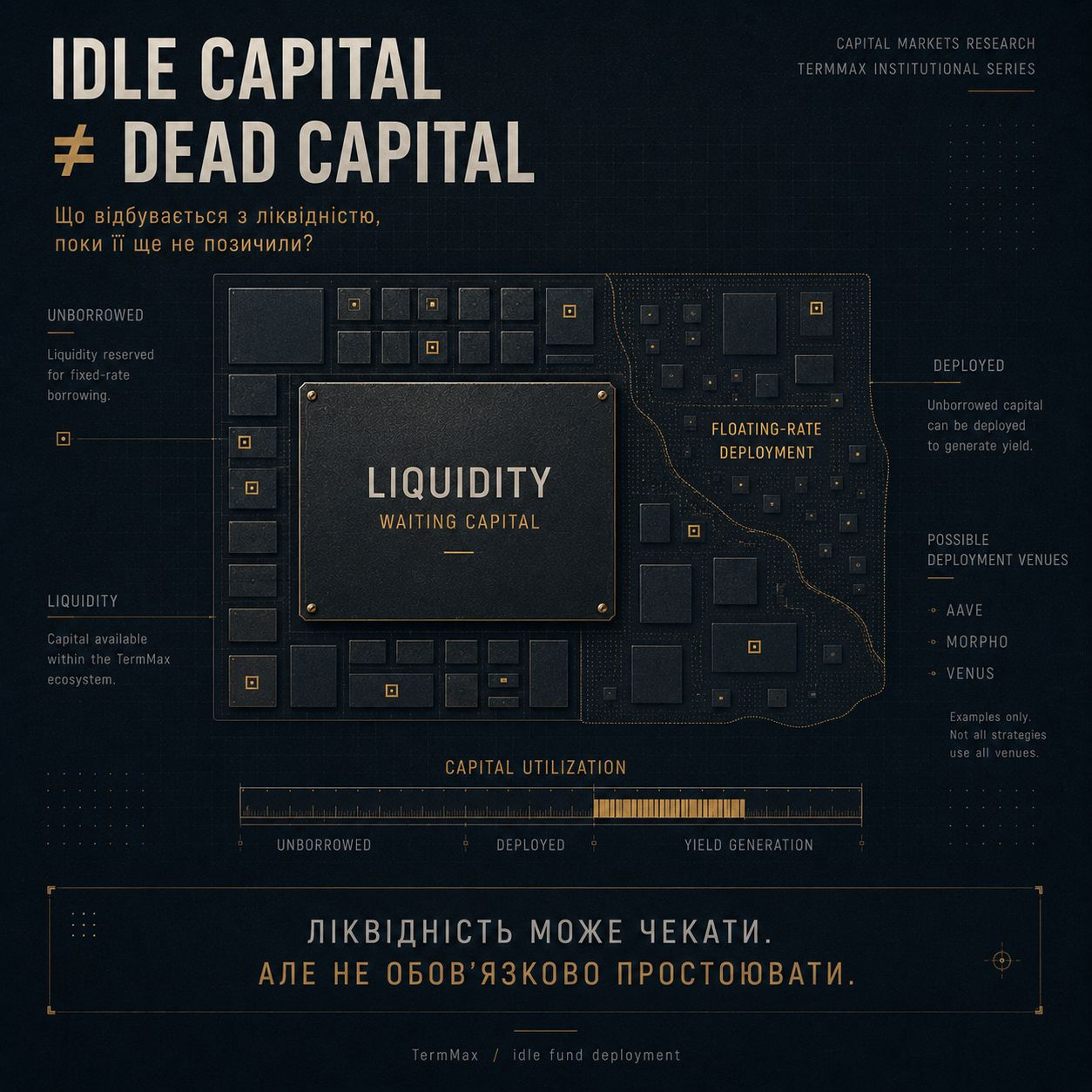
IDLE CAPITAL ≠ DEAD CAPITAL
With fixed-rate lending, there’s a problem that people often overlook.
What do you do with liquidity before it’s been borrowed?
Just hold it unused?
At TermMax, there’s a different approach.
Unborrowed capital can be allocated to floating-rate protocols—specifically Aave, Morpho, or Venus—while it waits to be used in the fixed-rate market.
That means liquidity doesn’t have to sit idle.
In short:
FIXED-RATE LIQUIDITY
+
WAITING PERIOD
≠
ZERO YIELD
That’s important for capital efficiency.
Because a good lending market isn’t only about the rate for the end borrower.
It’s also about:
“How effectively is capital used BEFORE someone borrows it?”
These are the kinds of details I’m interested in when it comes to TermMax’s architecture
#termmax @termmax
IDLE CAPITAL ≠ DEAD CAPITAL
With fixed-rate lending, there’s a problem that people often overlook.
What do you do with liquidity before it’s been borrowed?
Just hold it unused?
At TermMax, there’s a different approach.
Unborrowed capital can be allocated to floating-rate protocols—specifically Aave, Morpho, or Venus—while it waits to be used in the fixed-rate market.
That means liquidity doesn’t have to sit idle.
In short:
FIXED-RATE LIQUIDITY
+
WAITING PERIOD
≠
ZERO YIELD
That’s important for capital efficiency.
Because a good lending market isn’t only about the rate for the end borrower.
It’s also about:
“How effectively is capital used BEFORE someone borrows it?”
These are the kinds of details I’m interested in when it comes to TermMax’s architecture
#termmax @TermMax
With fixed-rate lending, there’s a problem that people often overlook.
What do you do with liquidity before it’s been borrowed?
Just hold it unused?
At TermMax, there’s a different approach.
Unborrowed capital can be allocated to floating-rate protocols—specifically Aave, Morpho, or Venus—while it waits to be used in the fixed-rate market.
That means liquidity doesn’t have to sit idle.
In short:
FIXED-RATE LIQUIDITY
+
WAITING PERIOD
≠
ZERO YIELD
That’s important for capital efficiency.
Because a good lending market isn’t only about the rate for the end borrower.
It’s also about:
“How effectively is capital used BEFORE someone borrows it?”
These are the kinds of details I’m interested in when it comes to TermMax’s architecture
#termmax @TermMax
1
293
·
--
How do I see the role of three products in the strategy?
bStocks — for exposure to traditional assets through a tokenized form.
TradFi Perpetuals — for short-term trading based on price movement or for hedging.
Binance Earn — for the portion of capital that I don’t plan to actively use.
So the logic is simple:
bStocks → exposure
TradFi → tactics / hedging
Earn → working with idle capital
My main takeaway:
**you don’t need to use one product for all tasks.**
Each tool has its place — the key is to understand its risks correctly.
#TradFi #BinanceEarn
How do I see the role of three products in the strategy?
bStocks — for exposure to traditional assets through a tokenized form.
TradFi Perpetuals — for short-term trading based on price movement or for hedging.
Binance Earn — for the portion of capital that I don’t plan to actively use.
So the logic is simple:
bStocks → exposure
TradFi → tactics / hedging
Earn → working with idle capital
My main takeaway:
**you don’t need to use one product for all tasks.**
Each tool has its place — the key is to understand its risks correctly.
#TradFi #BinanceEarn
bStocks — for exposure to traditional assets through a tokenized form.
TradFi Perpetuals — for short-term trading based on price movement or for hedging.
Binance Earn — for the portion of capital that I don’t plan to actively use.
So the logic is simple:
bStocks → exposure
TradFi → tactics / hedging
Earn → working with idle capital
My main takeaway:
**you don’t need to use one product for all tasks.**
Each tool has its place — the key is to understand its risks correctly.
#TradFi #BinanceEarn
69
·
--
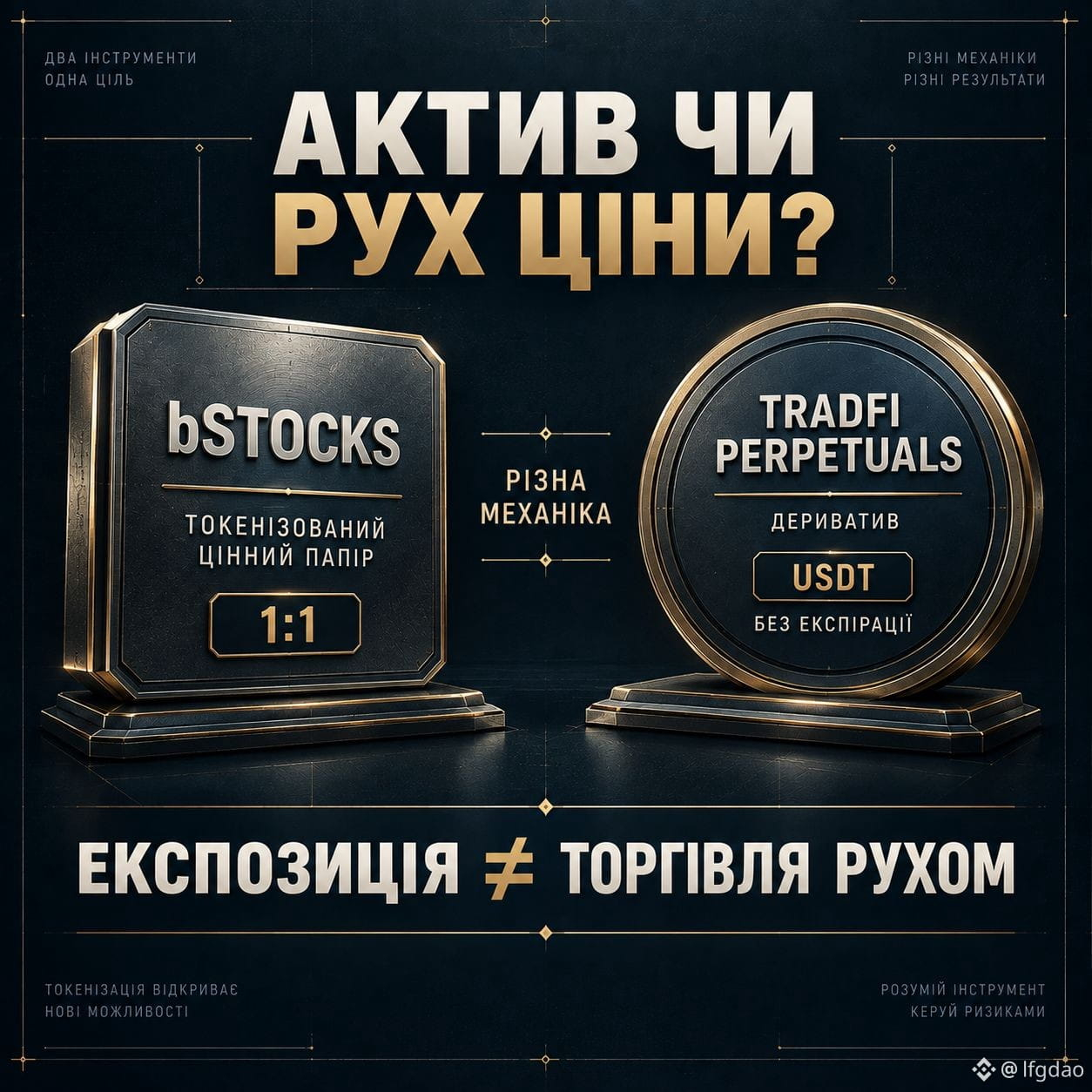
bStocks and TradFi Perpetuals can provide exposure to the traditional market.
But the mechanics are different.
bStocks:
• tokenized security
• 1:1 collateral
• exposure to the underlying asset
TradFi Perpetuals:
• derivative
• trading price movement
• USDT margin
• no expiration
• possible leverage
So the question for me is not “what’s better?”.
Question:
Do I need exposure to the asset or trading its price movement?
bStocks and TradFi Perpetuals can provide exposure to the traditional market.
But the mechanics are different.
bStocks:
• tokenized security
• 1:1 collateral
• exposure to the underlying asset
TradFi Perpetuals:
• derivative
• trading price movement
• USDT margin
• no expiration
• possible leverage
So the question for me is not “what’s better?”.
Question:
Do I need exposure to the asset or trading its price movement?
But the mechanics are different.
bStocks:
• tokenized security
• 1:1 collateral
• exposure to the underlying asset
TradFi Perpetuals:
• derivative
• trading price movement
• USDT margin
• no expiration
• possible leverage
So the question for me is not “what’s better?”.
Question:
Do I need exposure to the asset or trading its price movement?
101
·
--
Why are TradFi Perpetuals interesting even when the traditional market is closed?
Stock and other traditional markets have set trading hours.
And the crypto market is open around the clock.
TradFi Perpetuals let you get exposure to the movement of traditional assets 24/7.
This is especially relevant when an important event happens:
• in the evening
• at night
• on weekends
But 24/7 doesn’t mean “risk-free.”
It simply means a different way to respond to market movement.
Why are TradFi Perpetuals interesting even when the traditional market is closed?
Stock and other traditional markets have set trading hours.
And the crypto market is open around the clock.
TradFi Perpetuals let you get exposure to the movement of traditional assets 24/7.
This is especially relevant when an important event happens:
• in the evening
• at night
• on weekends
But 24/7 doesn’t mean “risk-free.”
It simply means a different way to respond to market movement.
Stock and other traditional markets have set trading hours.
And the crypto market is open around the clock.
TradFi Perpetuals let you get exposure to the movement of traditional assets 24/7.
This is especially relevant when an important event happens:
• in the evening
• at night
• on weekends
But 24/7 doesn’t mean “risk-free.”
It simply means a different way to respond to market movement.

89
·
--
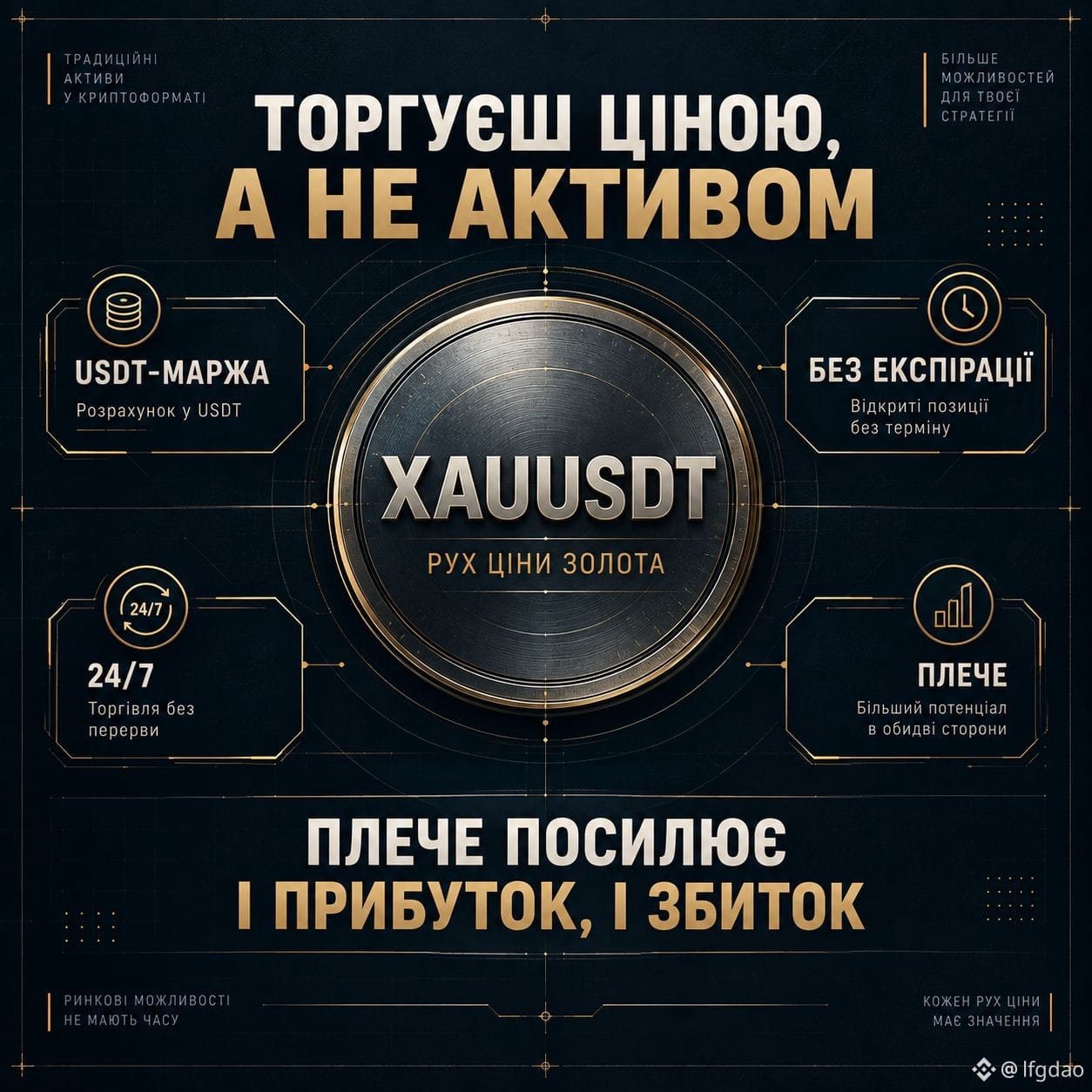
What are TradFi Perpetuals?
If very simply, it’s a way to trade the price movement of a traditional asset through a perpetual contract.
For example, XAUUSDT lets you trade the price movement of gold.
You don’t need to buy physical gold.
Key features:
• USDT margin
• no expiration date
• trading 24/7
• you can use leverage
But leverage is the part that needs the most attention.
It increases not only potential profit, but also potential loss.
What are TradFi Perpetuals?
If very simply, it’s a way to trade the price movement of a traditional asset through a perpetual contract.
For example, XAUUSDT lets you trade the price movement of gold.
You don’t need to buy physical gold.
Key features:
• USDT margin
• no expiration date
• trading 24/7
• you can use leverage
But leverage is the part that needs the most attention.
It increases not only potential profit, but also potential loss.
If very simply, it’s a way to trade the price movement of a traditional asset through a perpetual contract.
For example, XAUUSDT lets you trade the price movement of gold.
You don’t need to buy physical gold.
Key features:
• USDT margin
• no expiration date
• trading 24/7
• you can use leverage
But leverage is the part that needs the most attention.
It increases not only potential profit, but also potential loss.
155
·
--
How can you use bStocks in practice?
Let’s imagine that I want exposure to a U.S. stock, but I don’t want to buy it through a traditional broker.
One option is to use a tokenized asset.
For example:
$500 → bStock → change in the underlying asset’s price → change in the position’s value.
That means I get exposure to a traditional asset through Binance’s infrastructure.
But it’s important:
tokenization does not eliminate market risk.
If the underlying asset falls, my position can fall too.
How can you use bStocks in practice?
Let’s imagine that I want exposure to a U.S. stock, but I don’t want to buy it through a traditional broker.
One option is to use a tokenized asset.
For example:
$500 → bStock → change in the underlying asset’s price → change in the position’s value.
That means I get exposure to a traditional asset through Binance’s infrastructure.
But it’s important:
tokenization does not eliminate market risk.
If the underlying asset falls, my position can fall too.
Let’s imagine that I want exposure to a U.S. stock, but I don’t want to buy it through a traditional broker.
One option is to use a tokenized asset.
For example:
$500 → bStock → change in the underlying asset’s price → change in the position’s value.
That means I get exposure to a traditional asset through Binance’s infrastructure.
But it’s important:
tokenization does not eliminate market risk.
If the underlying asset falls, my position can fall too.

103
·
--
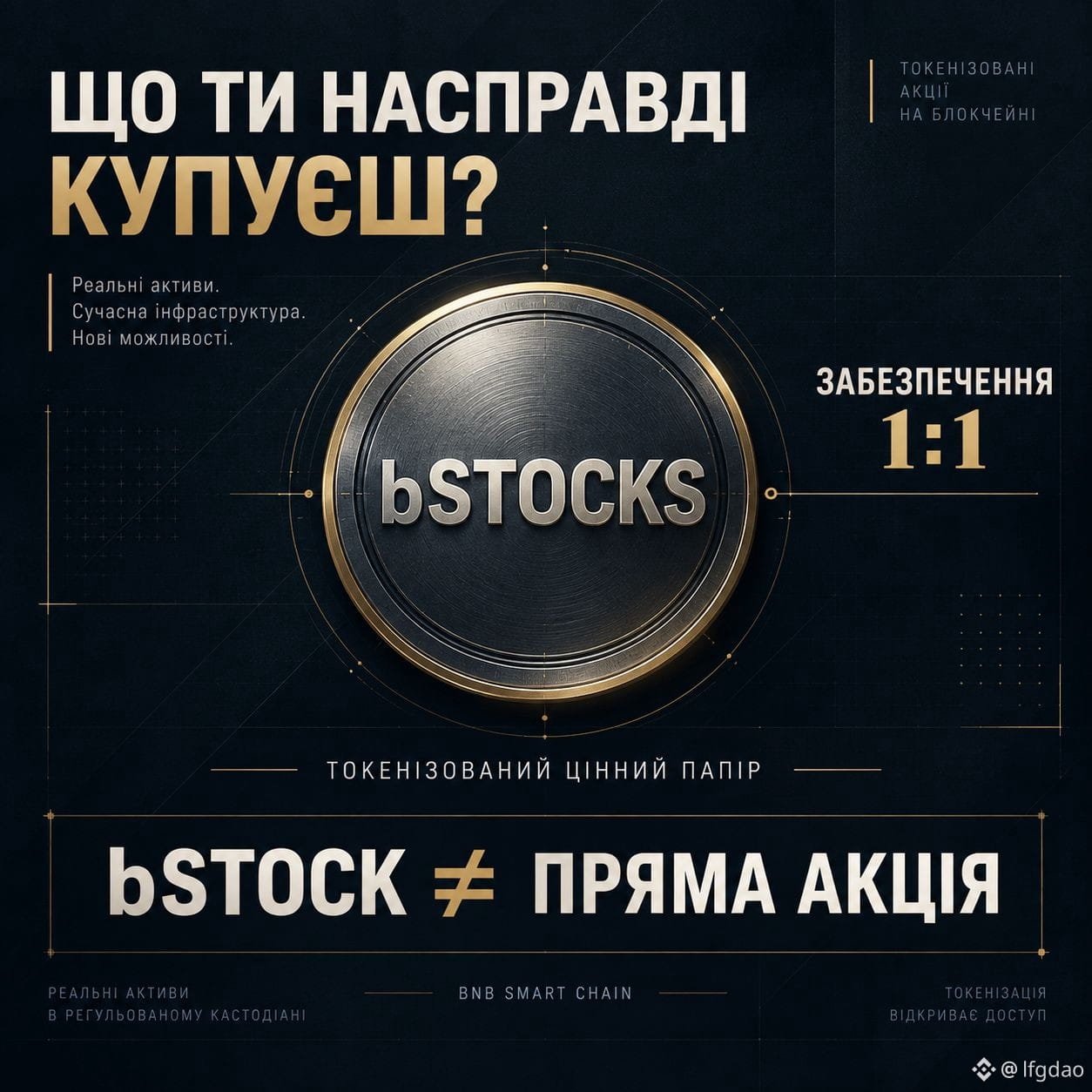
bStocks — это not just “a stock on the blockchain.”
In simple words:
• the real asset is held with a regulated custodian
• bStock represents an interest in this asset
• collateral is 1:1
• the token can be traded on Binance
• you can get exposure to the traditional market via crypto infrastructure
But there’s an important nuance: bStock ≠ direct ownership of the stock.
That’s why, before buying, it’s worth understanding not only the asset price, but also the product structure itself.
bStocks — это not just “a stock on the blockchain.”
In simple words:
• the real asset is held with a regulated custodian
• bStock represents an interest in this asset
• collateral is 1:1
• the token can be traded on Binance
• you can get exposure to the traditional market via crypto infrastructure
But there’s an important nuance: bStock ≠ direct ownership of the stock.
That’s why, before buying, it’s worth understanding not only the asset price, but also the product structure itself.
In simple words:
• the real asset is held with a regulated custodian
• bStock represents an interest in this asset
• collateral is 1:1
• the token can be traded on Binance
• you can get exposure to the traditional market via crypto infrastructure
But there’s an important nuance: bStock ≠ direct ownership of the stock.
That’s why, before buying, it’s worth understanding not only the asset price, but also the product structure itself.
82
·
--
FIXED ≠ LOCKED
One of the things that’s easy to misunderstand in fixed-rate DeFi:
fixed rate ≠ necessarily “hold until the end.”
In TermMax, a fixed-rate position can have its own market value up to maturity.
That means there are two different things:
FIXED RATE
→ the terms under which the position was created
MARKET VALUE
→ the price at which the position can be valued or traded up to maturity
This is where the secondary market comes in.
You don’t necessarily have to wait for the maturity date to get a way to exit the position.
This is an important point for fixed-income DeFi:
a fixed-rate product can have
both predictable yield
and market liquidity.
So:
FIXED ≠ FROZEN
And that’s what makes a fixed-rate position far more interesting than just a “deposit with an interest rate.”
#termmax @termmax
FIXED ≠ LOCKED
One of the things that’s easy to misunderstand in fixed-rate DeFi:
fixed rate ≠ necessarily “hold until the end.”
In TermMax, a fixed-rate position can have its own market value up to maturity.
That means there are two different things:
FIXED RATE
→ the terms under which the position was created
MARKET VALUE
→ the price at which the position can be valued or traded up to maturity
This is where the secondary market comes in.
You don’t necessarily have to wait for the maturity date to get a way to exit the position.
This is an important point for fixed-income DeFi:
a fixed-rate product can have
both predictable yield
and market liquidity.
So:
FIXED ≠ FROZEN
And that’s what makes a fixed-rate position far more interesting than just a “deposit with an interest rate.”
#termmax @TermMax
One of the things that’s easy to misunderstand in fixed-rate DeFi:
fixed rate ≠ necessarily “hold until the end.”
In TermMax, a fixed-rate position can have its own market value up to maturity.
That means there are two different things:
FIXED RATE
→ the terms under which the position was created
MARKET VALUE
→ the price at which the position can be valued or traded up to maturity
This is where the secondary market comes in.
You don’t necessarily have to wait for the maturity date to get a way to exit the position.
This is an important point for fixed-income DeFi:
a fixed-rate product can have
both predictable yield
and market liquidity.
So:
FIXED ≠ FROZEN
And that’s what makes a fixed-rate position far more interesting than just a “deposit with an interest rate.”
#termmax @TermMax

1
83
·
--
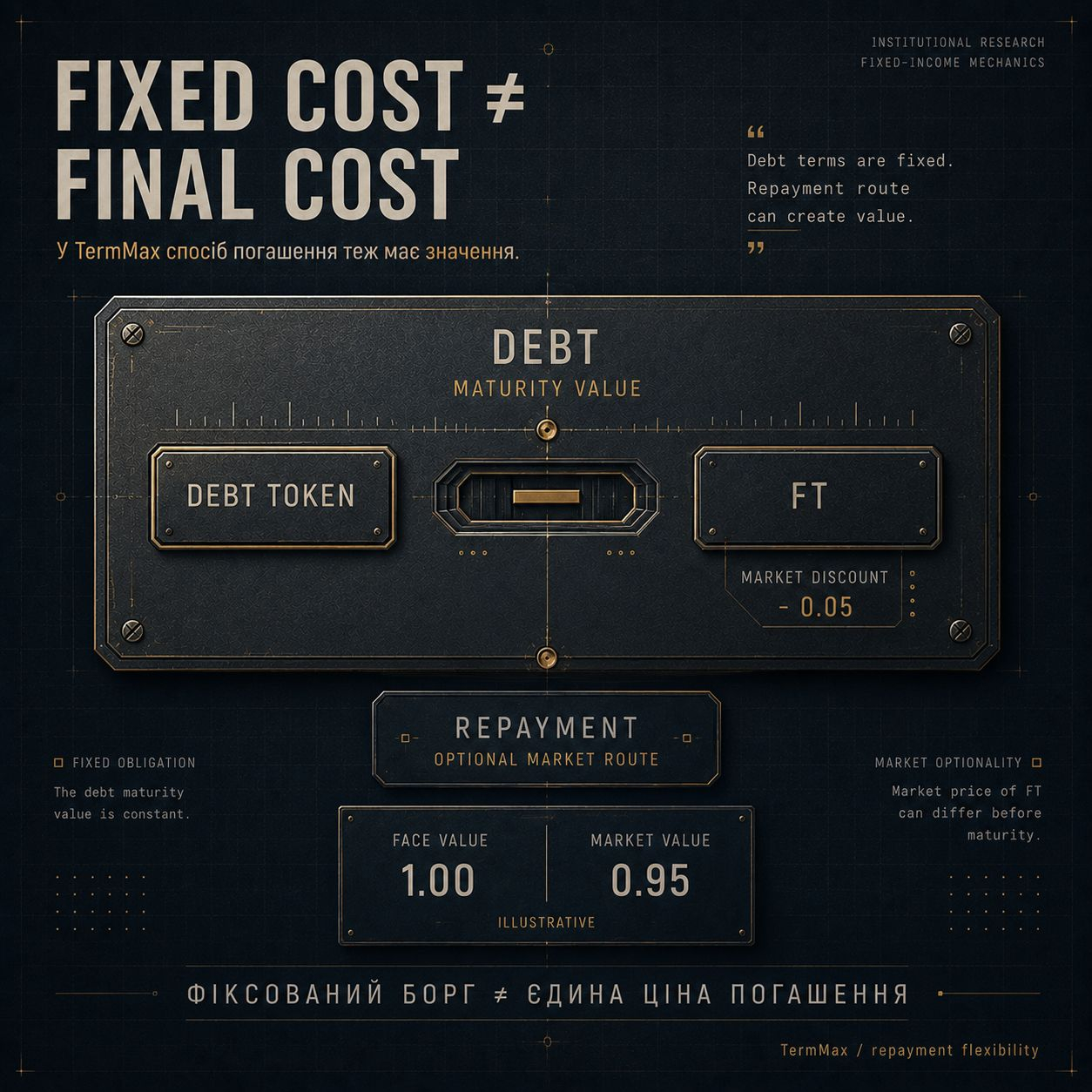
REPAYMENT ≠ ORIGINAL COST
Here’s a detail in TermMax that’s easy to miss.
You set the borrowing rate at the time you open the position.
But that doesn’t mean this exact amount will necessarily be your best repayment price.
There are two options before maturity:
→ repay the debt directly with the debt token
or
→ buy the corresponding FTs on the market and use them for repayment.
And that’s where an interesting asymmetry comes in.
If an FT trades for less than its face value, buying it can reduce the actual cost of repayment.
So the fixed rate gives you a predictable maximum condition,
but the FT market leaves room to optimize repayment.
For me, this is one of the most interesting TermMax mechanics:
FIXED COST ≠ ALWAYS FINAL COST
#termmax @termmax
REPAYMENT ≠ ORIGINAL COST
Here’s a detail in TermMax that’s easy to miss.
You set the borrowing rate at the time you open the position.
But that doesn’t mean this exact amount will necessarily be your best repayment price.
There are two options before maturity:
→ repay the debt directly with the debt token
or
→ buy the corresponding FTs on the market and use them for repayment.
And that’s where an interesting asymmetry comes in.
If an FT trades for less than its face value, buying it can reduce the actual cost of repayment.
So the fixed rate gives you a predictable maximum condition,
but the FT market leaves room to optimize repayment.
For me, this is one of the most interesting TermMax mechanics:
FIXED COST ≠ ALWAYS FINAL COST
#termmax @TermMax
Here’s a detail in TermMax that’s easy to miss.
You set the borrowing rate at the time you open the position.
But that doesn’t mean this exact amount will necessarily be your best repayment price.
There are two options before maturity:
→ repay the debt directly with the debt token
or
→ buy the corresponding FTs on the market and use them for repayment.
And that’s where an interesting asymmetry comes in.
If an FT trades for less than its face value, buying it can reduce the actual cost of repayment.
So the fixed rate gives you a predictable maximum condition,
but the FT market leaves room to optimize repayment.
For me, this is one of the most interesting TermMax mechanics:
FIXED COST ≠ ALWAYS FINAL COST
#termmax @TermMax
94
·
--
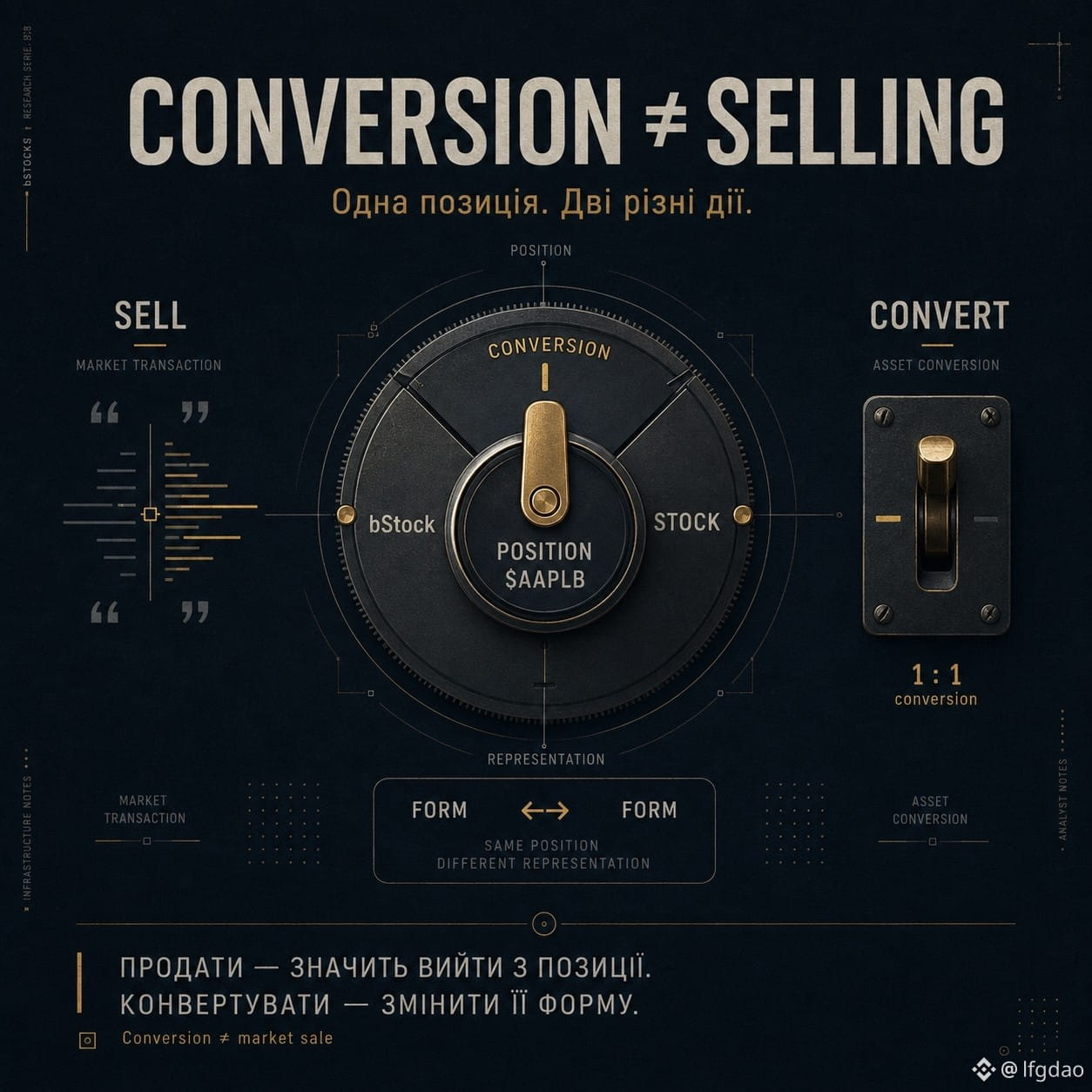
CONVERSION ≠ SELLING.
This is another bStocks detail that’s easy to miss.
When you sell a bStock, you exit your position through the market.
But conversion is a different operation.
A bStock can be converted back into the corresponding stock on a 1:1 basis.
So:
SELL → you sell your position to another market participant.
CONVERT → you change the form of the asset.
This is where tokenization becomes more interesting than just a “stock on the blockchain.”
You can have the same economic exposure, but use different asset representation forms.
And an important nuance: conversion may be temporarily paused during certain corporate actions or technical maintenance.
So I’d look at bStocks not only as a way to buy a stock.
A more interesting question:
HOW EASY IS IT TO CHANGE THE FORM OF THIS ASSET?
#bstockscis @BinanceCIS $TSLAB
CONVERSION ≠ SELLING.
This is another bStocks detail that’s easy to miss.
When you sell a bStock, you exit your position through the market.
But conversion is a different operation.
A bStock can be converted back into the corresponding stock on a 1:1 basis.
So:
SELL → you sell your position to another market participant.
CONVERT → you change the form of the asset.
This is where tokenization becomes more interesting than just a “stock on the blockchain.”
You can have the same economic exposure, but use different asset representation forms.
And an important nuance: conversion may be temporarily paused during certain corporate actions or technical maintenance.
So I’d look at bStocks not only as a way to buy a stock.
A more interesting question:
HOW EASY IS IT TO CHANGE THE FORM OF THIS ASSET?
#bstockscis @BinanceCIS $TSLAB
This is another bStocks detail that’s easy to miss.
When you sell a bStock, you exit your position through the market.
But conversion is a different operation.
A bStock can be converted back into the corresponding stock on a 1:1 basis.
So:
SELL → you sell your position to another market participant.
CONVERT → you change the form of the asset.
This is where tokenization becomes more interesting than just a “stock on the blockchain.”
You can have the same economic exposure, but use different asset representation forms.
And an important nuance: conversion may be temporarily paused during certain corporate actions or technical maintenance.
So I’d look at bStocks not only as a way to buy a stock.
A more interesting question:
HOW EASY IS IT TO CHANGE THE FORM OF THIS ASSET?
#bstockscis @BinanceCIS $TSLAB
3
3
64
·
--
TERMMAX IS NOT JUST “LENDING”.
It has a more interesting setup.
One debt position is split into two parts:
FT + XT.
FT — Fixed-rate Token.
For the lender, it represents the right to receive the face value at maturity.
XT — Yield Token.
It represents an interest obligation associated with the loan.
So TermMax effectively splits:
PRINCIPAL
and
INTEREST.
And that’s an important detail.
The borrower can access liquidity through the principal part, while the interest component becomes a separate part of the structure.
That kind of tokenization allows TermMax to build a fixed-rate market instead of standard variable-rate lending.
I like this part of the protocol most:
not simply “borrowing an asset”,
but breaking down the economics of debt into separate components.
FT + XT is one of the things you should understand before evaluating TermMax.
#termmax @termmax
TERMMAX IS NOT JUST “LENDING”.
It has a more interesting setup.
One debt position is split into two parts:
FT + XT.
FT — Fixed-rate Token.
For the lender, it represents the right to receive the face value at maturity.
XT — Yield Token.
It represents an interest obligation associated with the loan.
So TermMax effectively splits:
PRINCIPAL
and
INTEREST.
And that’s an important detail.
The borrower can access liquidity through the principal part, while the interest component becomes a separate part of the structure.
That kind of tokenization allows TermMax to build a fixed-rate market instead of standard variable-rate lending.
I like this part of the protocol most:
not simply “borrowing an asset”,
but breaking down the economics of debt into separate components.
FT + XT is one of the things you should understand before evaluating TermMax.
#termmax @TermMax
It has a more interesting setup.
One debt position is split into two parts:
FT + XT.
FT — Fixed-rate Token.
For the lender, it represents the right to receive the face value at maturity.
XT — Yield Token.
It represents an interest obligation associated with the loan.
So TermMax effectively splits:
PRINCIPAL
and
INTEREST.
And that’s an important detail.
The borrower can access liquidity through the principal part, while the interest component becomes a separate part of the structure.
That kind of tokenization allows TermMax to build a fixed-rate market instead of standard variable-rate lending.
I like this part of the protocol most:
not simply “borrowing an asset”,
but breaking down the economics of debt into separate components.
FT + XT is one of the things you should understand before evaluating TermMax.
#termmax @TermMax

63
·
--
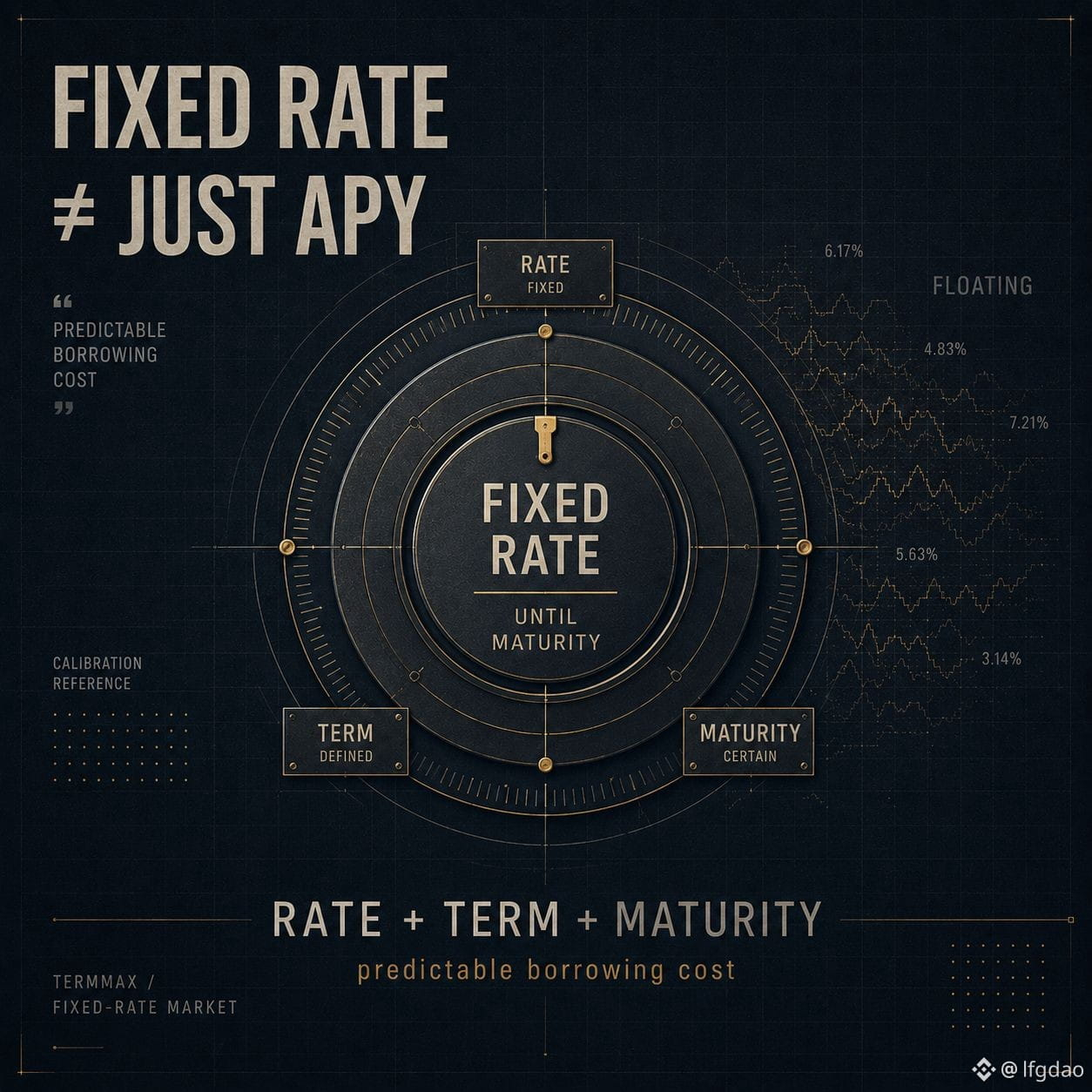
FIXED RATE ≠ JUST APY.
In DeFi, we’re used to looking at one number — APY.
But for a loan, that may not be enough.
If the rate is variable, your cost of capital can change along with the market.
TermMax builds a different model:
RATE + TERM + MATURITY.
That means it’s not only the rate itself that matters.
What matters is knowing:
— what rate you locked in;
— for what term;
— when the position is repaid.
For the borrower, that means a more predictable loan cost.
For the lender, it means a clear time horizon and income fixed until maturity.
That’s why fixed-rate DeFi is more interesting to me than a simple APY comparison.
Here, you’re not just buying a number.
You’re buying certainty in the terms.
TermMax → fixed-rate borrowing & lending.
#termmax @termmax
FIXED RATE ≠ JUST APY.
In DeFi, we’re used to looking at one number — APY.
But for a loan, that may not be enough.
If the rate is variable, your cost of capital can change along with the market.
TermMax builds a different model:
RATE + TERM + MATURITY.
That means it’s not only the rate itself that matters.
What matters is knowing:
— what rate you locked in;
— for what term;
— when the position is repaid.
For the borrower, that means a more predictable loan cost.
For the lender, it means a clear time horizon and income fixed until maturity.
That’s why fixed-rate DeFi is more interesting to me than a simple APY comparison.
Here, you’re not just buying a number.
You’re buying certainty in the terms.
TermMax → fixed-rate borrowing & lending.
#termmax @TermMax
In DeFi, we’re used to looking at one number — APY.
But for a loan, that may not be enough.
If the rate is variable, your cost of capital can change along with the market.
TermMax builds a different model:
RATE + TERM + MATURITY.
That means it’s not only the rate itself that matters.
What matters is knowing:
— what rate you locked in;
— for what term;
— when the position is repaid.
For the borrower, that means a more predictable loan cost.
For the lender, it means a clear time horizon and income fixed until maturity.
That’s why fixed-rate DeFi is more interesting to me than a simple APY comparison.
Here, you’re not just buying a number.
You’re buying certainty in the terms.
TermMax → fixed-rate borrowing & lending.
#termmax @TermMax
62
·
--
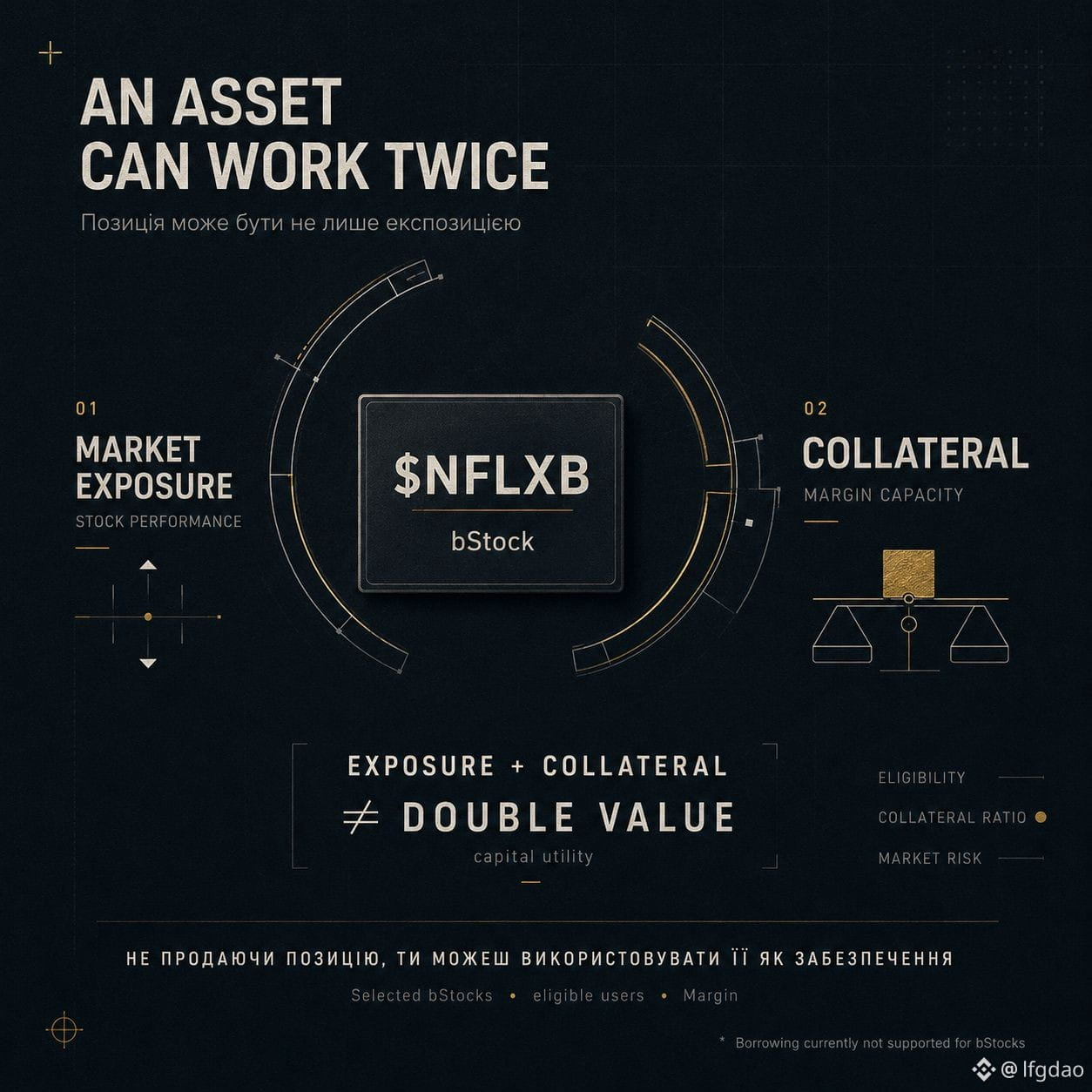
bStock ≠ just a position in a portfolio.
I’m more interested in a different question: can this asset work while I’m simply holding it?
For some bStocks, the answer is yes—right now.
Binance allows certain bStocks to be used as collateral in Cross Margin, Portfolio Margin, and Portfolio Margin Pro.
And that changes the role of the asset itself.
Previously, the logic was simple:
buy → hold → sell.
Now, for eligible users, another scenario appears:
hold a bStock → use it as collateral → get margin capacity for other positions.
But there’s an important nuance:
this does NOT mean Binance already allows borrowing money against any bStock.
Borrowing for bStocks is currently not supported.
So it’s more accurate to think of it as:
EXPOSURE + CAPITAL EFFICIENCY
not just a “tokenized stock.”
This feature, in my opinion, is what makes tokenized securities much more interesting.
#bStocksCIS @BinanceCIS $NFLXB
bStock ≠ just a position in a portfolio.
I’m more interested in a different question: can this asset work while I’m simply holding it?
For some bStocks, the answer is yes—right now.
Binance allows certain bStocks to be used as collateral in Cross Margin, Portfolio Margin, and Portfolio Margin Pro.
And that changes the role of the asset itself.
Previously, the logic was simple:
buy → hold → sell.
Now, for eligible users, another scenario appears:
hold a bStock → use it as collateral → get margin capacity for other positions.
But there’s an important nuance:
this does NOT mean Binance already allows borrowing money against any bStock.
Borrowing for bStocks is currently not supported.
So it’s more accurate to think of it as:
EXPOSURE + CAPITAL EFFICIENCY
not just a “tokenized stock.”
This feature, in my opinion, is what makes tokenized securities much more interesting.
#bStocksCIS @BinanceCIS $NFLXB
I’m more interested in a different question: can this asset work while I’m simply holding it?
For some bStocks, the answer is yes—right now.
Binance allows certain bStocks to be used as collateral in Cross Margin, Portfolio Margin, and Portfolio Margin Pro.
And that changes the role of the asset itself.
Previously, the logic was simple:
buy → hold → sell.
Now, for eligible users, another scenario appears:
hold a bStock → use it as collateral → get margin capacity for other positions.
But there’s an important nuance:
this does NOT mean Binance already allows borrowing money against any bStock.
Borrowing for bStocks is currently not supported.
So it’s more accurate to think of it as:
EXPOSURE + CAPITAL EFFICIENCY
not just a “tokenized stock.”
This feature, in my opinion, is what makes tokenized securities much more interesting.
#bStocksCIS @BinanceCIS $NFLXB
78
·
--
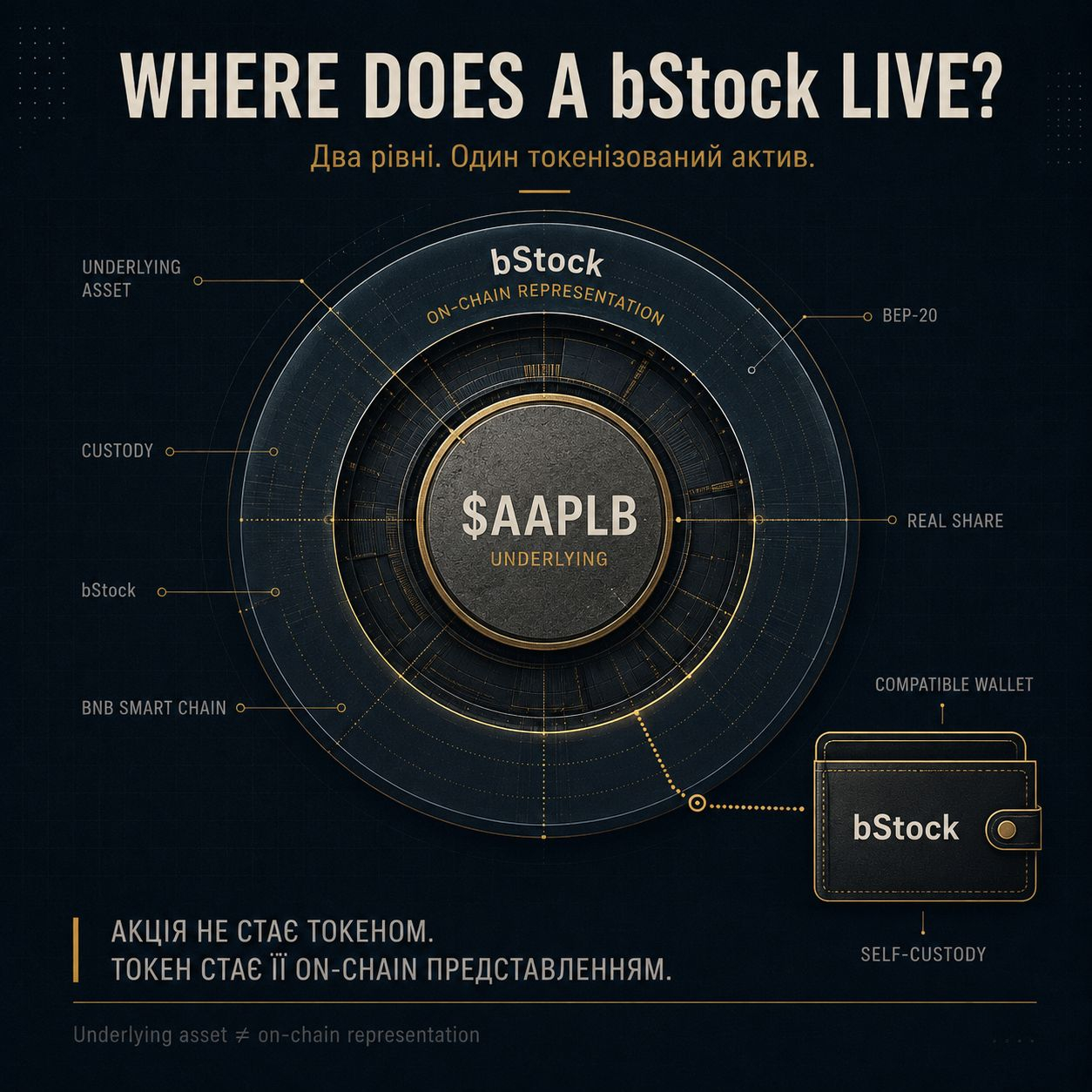
WHERE DOES A bStock LIVE?
This question is more interesting than it seems.
When you buy bStock, the underlying share doesn’t just “move” into the blockchain.
There are two different layers:
UNDERLYING ASSET
→ the real share with a regulated custodian
bStock
→ a tokenized security on BNB Smart Chain
You can also withdraw the bStock into a compatible wallet and keep it outside of an exchange account.
So tokenization doesn’t change the storage location of the share itself.
It creates a new digital layer around a traditional asset.
And that, in my opinion, is one of the most interesting things about bStocks.
Not “a stock became crypto.”
Instead, a traditional asset gained an on-chain representation.
@BinanceCIS #bStocksCIS $AAPLB
WHERE DOES A bStock LIVE?
This question is more interesting than it seems.
When you buy bStock, the underlying share doesn’t just “move” into the blockchain.
There are two different layers:
UNDERLYING ASSET
→ the real share with a regulated custodian
bStock
→ a tokenized security on BNB Smart Chain
You can also withdraw the bStock into a compatible wallet and keep it outside of an exchange account.
So tokenization doesn’t change the storage location of the share itself.
It creates a new digital layer around a traditional asset.
And that, in my opinion, is one of the most interesting things about bStocks.
Not “a stock became crypto.”
Instead, a traditional asset gained an on-chain representation.
@BinanceCIS #bStocksCIS $AAPLB
This question is more interesting than it seems.
When you buy bStock, the underlying share doesn’t just “move” into the blockchain.
There are two different layers:
UNDERLYING ASSET
→ the real share with a regulated custodian
bStock
→ a tokenized security on BNB Smart Chain
You can also withdraw the bStock into a compatible wallet and keep it outside of an exchange account.
So tokenization doesn’t change the storage location of the share itself.
It creates a new digital layer around a traditional asset.
And that, in my opinion, is one of the most interesting things about bStocks.
Not “a stock became crypto.”
Instead, a traditional asset gained an on-chain representation.
@BinanceCIS #bStocksCIS $AAPLB
5
3
94
·
--
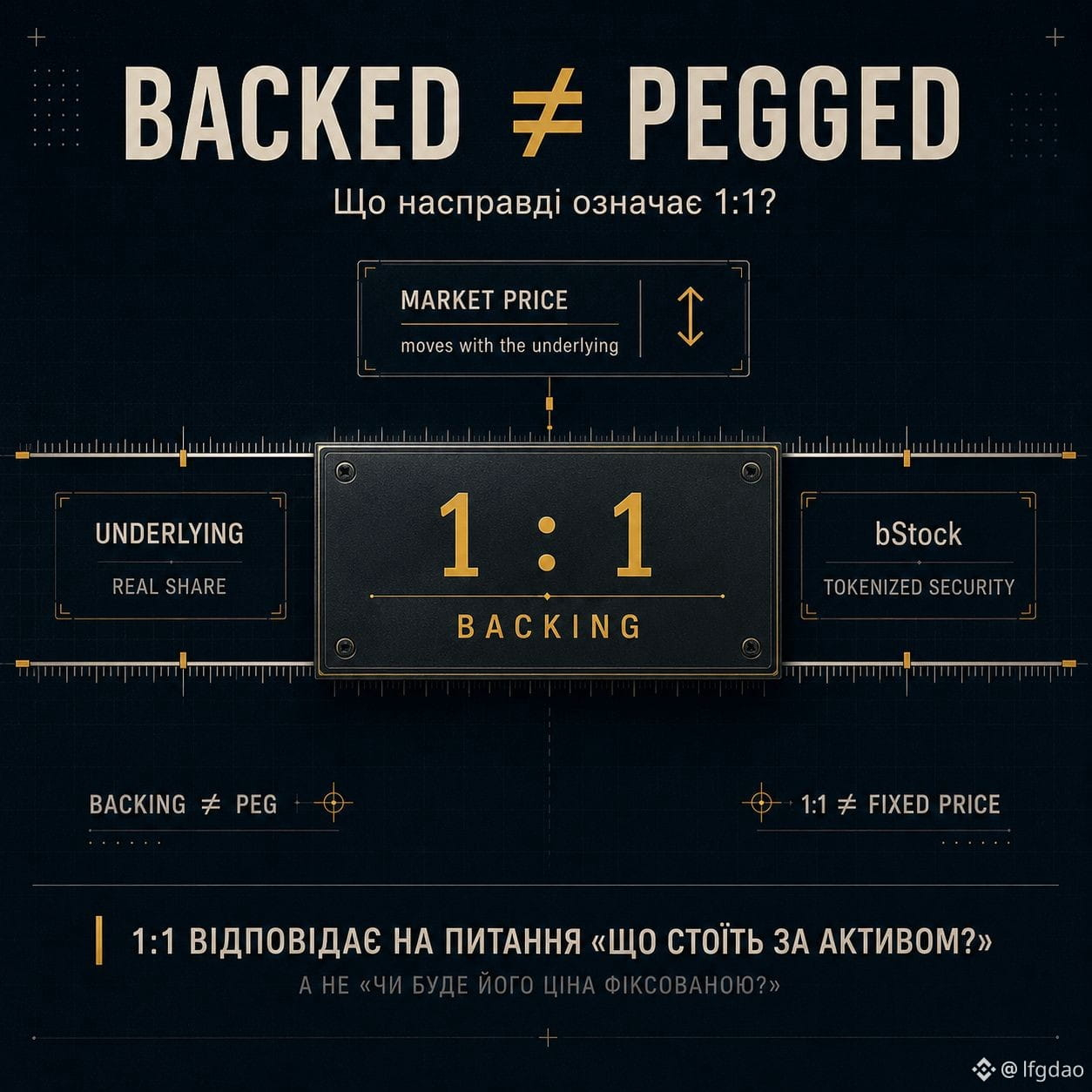
1:1 BACKING — THIS IS NOT PEG.
Right here, in my opinion, it’s easy to misunderstand bStocks.
If a bStock is backed 1:1 with a share, it does not mean:
“1 bStock is always = a fixed price.”
Here, 1:1 refers to the backing—an appropriate underlying asset stands behind the token.
And the price is a different story.
It continues to respond to the market of the underlying asset itself.
So:
BACKING → what stands behind the bStock
PRICE → how much the market is willing to pay for it
PEG → a completely different construct
That’s why I wouldn’t treat “1:1” as a promise of a stable price.
It’s rather an answer to a different question:
“What exactly backs this instrument?”
And that’s where bStocks become more interesting than just “shares in a token.”
@BinanceCIS $AAPLB #bStocksCIS
1:1 BACKING — THIS IS NOT PEG.
Right here, in my opinion, it’s easy to misunderstand bStocks.
If a bStock is backed 1:1 with a share, it does not mean:
“1 bStock is always = a fixed price.”
Here, 1:1 refers to the backing—an appropriate underlying asset stands behind the token.
And the price is a different story.
It continues to respond to the market of the underlying asset itself.
So:
BACKING → what stands behind the bStock
PRICE → how much the market is willing to pay for it
PEG → a completely different construct
That’s why I wouldn’t treat “1:1” as a promise of a stable price.
It’s rather an answer to a different question:
“What exactly backs this instrument?”
And that’s where bStocks become more interesting than just “shares in a token.”
@BinanceCIS $AAPLB #bStocksCIS
Right here, in my opinion, it’s easy to misunderstand bStocks.
If a bStock is backed 1:1 with a share, it does not mean:
“1 bStock is always = a fixed price.”
Here, 1:1 refers to the backing—an appropriate underlying asset stands behind the token.
And the price is a different story.
It continues to respond to the market of the underlying asset itself.
So:
BACKING → what stands behind the bStock
PRICE → how much the market is willing to pay for it
PEG → a completely different construct
That’s why I wouldn’t treat “1:1” as a promise of a stable price.
It’s rather an answer to a different question:
“What exactly backs this instrument?”
And that’s where bStocks become more interesting than just “shares in a token.”
@BinanceCIS $AAPLB #bStocksCIS
7
5
86
·
--
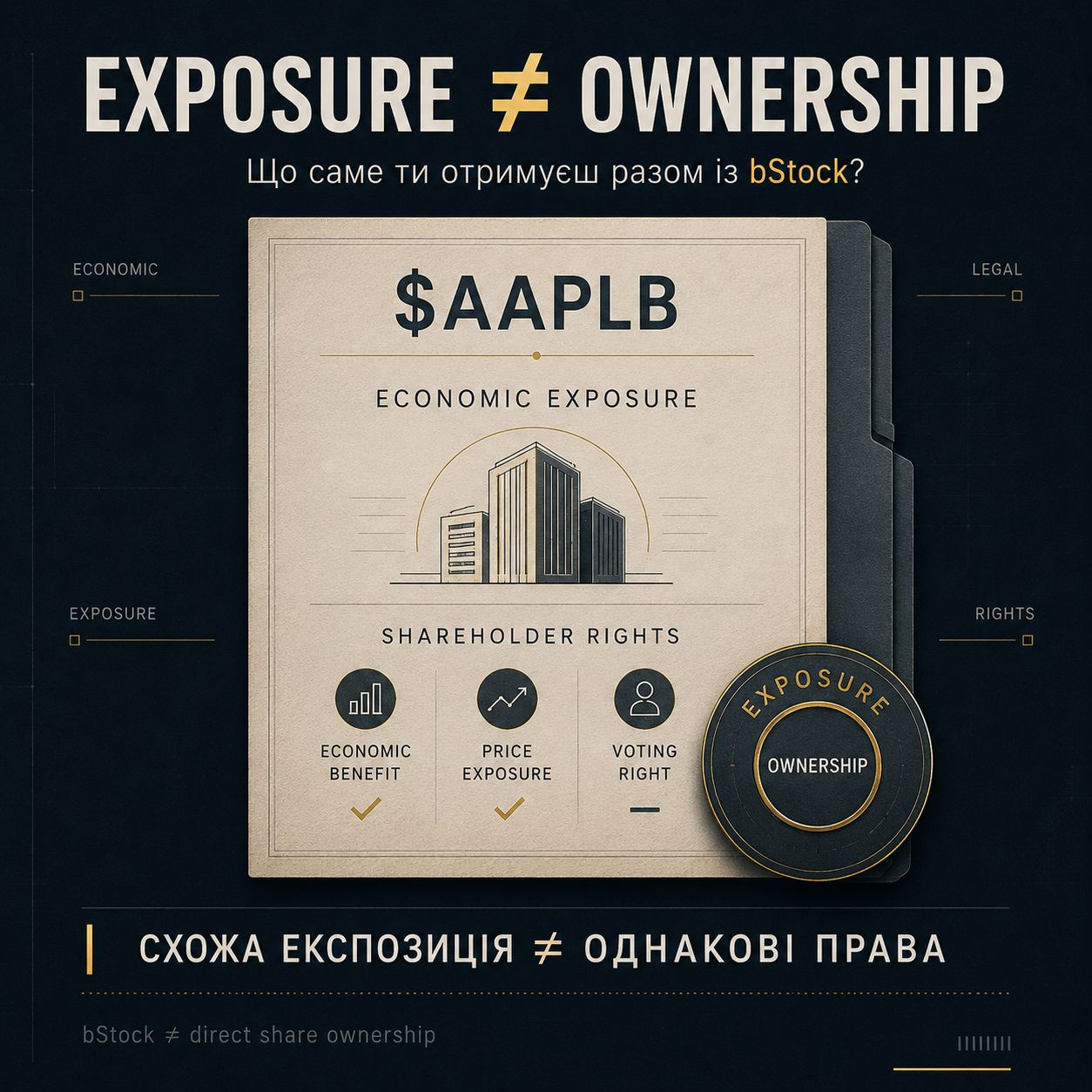
EXPOSURE ≠ OWNERSHIP.
One of the most interesting details of bStocks is what you actually get when you buy such an asset.
At first glance, everything seems quite simple:
you buy $AAPLB → you get exposure to AAPL.
But “exposure to a stock” and “ownership of a stock” are not the same.
bStock is not a direct stock of the company.
So the logic here is a bit different:
stock price
→ economic exposure
→ bStock
but that doesn’t automatically mean you receive all the rights of a regular shareholder.
For example, a bStock holder does not receive the direct right to vote like an owner of a common share.
And in my opinion, this difference matters more than the fact that the asset looks almost the same on the chart.
Because two assets can provide a similar exposure to the same business,
but legally and economically be different instruments.
That’s why before buying, I would ask not only:
“What will happen to the price?”
But also:
“What exactly am I getting along with this exposure?”
For bStocks, this is especially important.
Tokenization changes not only the way you trade an asset.
It changes the way traditional financial exposure is represented in the digital environment.
And that’s where things get really interesting.
@BinanceCIS $AAPLB #bStocksCIS
EXPOSURE ≠ OWNERSHIP.
One of the most interesting details of bStocks is what you actually get when you buy such an asset.
At first glance, everything seems quite simple:
you buy $AAPLB → you get exposure to AAPL.
But “exposure to a stock” and “ownership of a stock” are not the same.
bStock is not a direct stock of the company.
So the logic here is a bit different:
stock price
→ economic exposure
→ bStock
but that doesn’t automatically mean you receive all the rights of a regular shareholder.
For example, a bStock holder does not receive the direct right to vote like an owner of a common share.
And in my opinion, this difference matters more than the fact that the asset looks almost the same on the chart.
Because two assets can provide a similar exposure to the same business,
but legally and economically be different instruments.
That’s why before buying, I would ask not only:
“What will happen to the price?”
But also:
“What exactly am I getting along with this exposure?”
For bStocks, this is especially important.
Tokenization changes not only the way you trade an asset.
It changes the way traditional financial exposure is represented in the digital environment.
And that’s where things get really interesting.
@BinanceCIS $AAPLB #bStocksCIS
One of the most interesting details of bStocks is what you actually get when you buy such an asset.
At first glance, everything seems quite simple:
you buy $AAPLB → you get exposure to AAPL.
But “exposure to a stock” and “ownership of a stock” are not the same.
bStock is not a direct stock of the company.
So the logic here is a bit different:
stock price
→ economic exposure
→ bStock
but that doesn’t automatically mean you receive all the rights of a regular shareholder.
For example, a bStock holder does not receive the direct right to vote like an owner of a common share.
And in my opinion, this difference matters more than the fact that the asset looks almost the same on the chart.
Because two assets can provide a similar exposure to the same business,
but legally and economically be different instruments.
That’s why before buying, I would ask not only:
“What will happen to the price?”
But also:
“What exactly am I getting along with this exposure?”
For bStocks, this is especially important.
Tokenization changes not only the way you trade an asset.
It changes the way traditional financial exposure is represented in the digital environment.
And that’s where things get really interesting.
@BinanceCIS $AAPLB #bStocksCIS
3
2
103
·
--
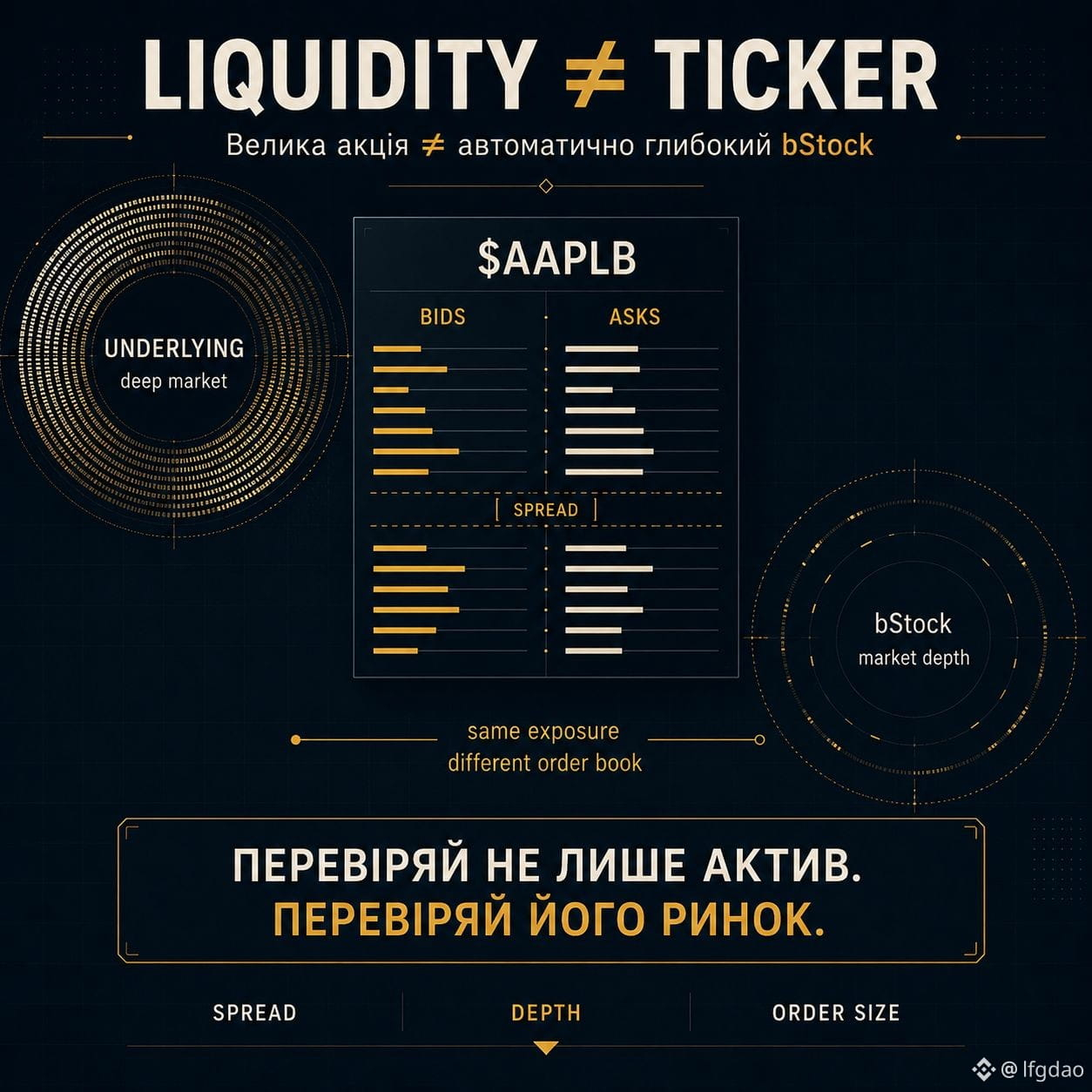
TICKER ONE. LIQUIDITY IS NOT NECESSARILY REQUIRED.
When you see bStock from a big company, it’s easy to make an automatic assumption:
“If the stock itself is liquid, then bStock will be the same.”
But there’s an important detail here.
You’re not trading directly in the same order book where the underlying stock is traded.
bStock has its own trading environment.
So, for me, it’s more correct to separate two things:
liquidity of the UNDERLYING
≠
liquidity of bSTOCK
Large trading volumes of the underlying stock don’t automatically mean the same market depth for the tokenized representation.
And that’s where an interesting question comes in:
is it enough to simply look at the bStock price?
I would also look at:
→ bid / ask
→ spread
→ order book volume
→ market depth
Because the same price can look completely different depending on how much liquidity sits nearby.
For a small position, this may be almost unnoticeable.
For a large one, it’s a totally different story.
So for me, bStock is not just:
“Oh, it’s tokenized $AAPL.”
It’s also a separate trading market that needs to be evaluated on its own.
And maybe the most useful question before a Buy isn’t:
“How liquid is this stock?”
But:
“How liquid is this bStock right now?”
#bstockscis @BinanceCIS
TICKER ONE. LIQUIDITY IS NOT NECESSARILY REQUIRED.
When you see bStock from a big company, it’s easy to make an automatic assumption:
“If the stock itself is liquid, then bStock will be the same.”
But there’s an important detail here.
You’re not trading directly in the same order book where the underlying stock is traded.
bStock has its own trading environment.
So, for me, it’s more correct to separate two things:
liquidity of the UNDERLYING
≠
liquidity of bSTOCK
Large trading volumes of the underlying stock don’t automatically mean the same market depth for the tokenized representation.
And that’s where an interesting question comes in:
is it enough to simply look at the bStock price?
I would also look at:
→ bid / ask
→ spread
→ order book volume
→ market depth
Because the same price can look completely different depending on how much liquidity sits nearby.
For a small position, this may be almost unnoticeable.
For a large one, it’s a totally different story.
So for me, bStock is not just:
“Oh, it’s tokenized $AAPL.”
It’s also a separate trading market that needs to be evaluated on its own.
And maybe the most useful question before a Buy isn’t:
“How liquid is this stock?”
But:
“How liquid is this bStock right now?”
#bstockscis @BinanceCIS
When you see bStock from a big company, it’s easy to make an automatic assumption:
“If the stock itself is liquid, then bStock will be the same.”
But there’s an important detail here.
You’re not trading directly in the same order book where the underlying stock is traded.
bStock has its own trading environment.
So, for me, it’s more correct to separate two things:
liquidity of the UNDERLYING
≠
liquidity of bSTOCK
Large trading volumes of the underlying stock don’t automatically mean the same market depth for the tokenized representation.
And that’s where an interesting question comes in:
is it enough to simply look at the bStock price?
I would also look at:
→ bid / ask
→ spread
→ order book volume
→ market depth
Because the same price can look completely different depending on how much liquidity sits nearby.
For a small position, this may be almost unnoticeable.
For a large one, it’s a totally different story.
So for me, bStock is not just:
“Oh, it’s tokenized $AAPL.”
It’s also a separate trading market that needs to be evaluated on its own.
And maybe the most useful question before a Buy isn’t:
“How liquid is this stock?”
But:
“How liquid is this bStock right now?”
#bstockscis @BinanceCIS
1
129
·
--
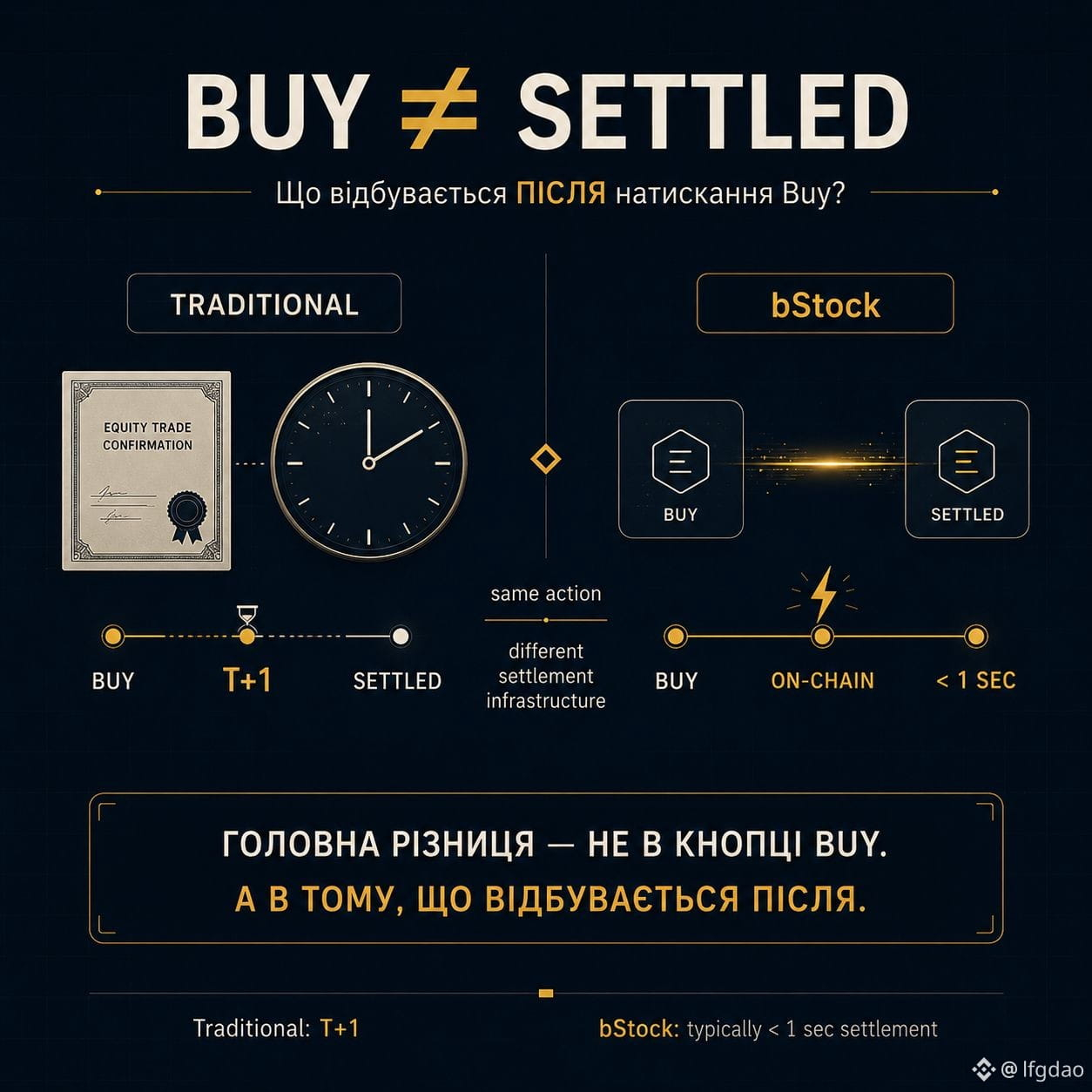
BUY ≠ END THE AGREEMENT.
In the stock market, pressing Buy is not the whole story.
There’s also settlement.
You buy a stock today, but the traditional system can only complete settlement on the next business day.
That’s what T+1 is.
In bStocks, the logic is different.
The deal goes through blockchain infrastructure, so Binance states that settlement usually takes less than a second.
So it’s not just about where you clicked Buy.
It’s about what happens AFTER.
Traditional stock:
BUY
↓
waiting
↓
T+1
↓
settlement
bStock:
BUY
↓
on-chain settlement
↓
< 1 sec
For me, this is one of the most interesting parts of tokenization.
Because when we say “a stock on the blockchain,” it’s easy to think only about the token.
But the real shift may be in the infrastructure around it.
Less waiting.
Different settlement process.
Different logic of asset movement.
And here’s the question:
if the asset itself can be settled almost instantly—
how much could that change the future infrastructure of the stock market?
@BinanceCIS $AAPLB #bStocksCIS
BUY ≠ END THE AGREEMENT.
In the stock market, pressing Buy is not the whole story.
There’s also settlement.
You buy a stock today, but the traditional system can only complete settlement on the next business day.
That’s what T+1 is.
In bStocks, the logic is different.
The deal goes through blockchain infrastructure, so Binance states that settlement usually takes less than a second.
So it’s not just about where you clicked Buy.
It’s about what happens AFTER.
Traditional stock:
BUY
↓
waiting
↓
T+1
↓
settlement
bStock:
BUY
↓
on-chain settlement
↓
< 1 sec
For me, this is one of the most interesting parts of tokenization.
Because when we say “a stock on the blockchain,” it’s easy to think only about the token.
But the real shift may be in the infrastructure around it.
Less waiting.
Different settlement process.
Different logic of asset movement.
And here’s the question:
if the asset itself can be settled almost instantly—
how much could that change the future infrastructure of the stock market?
@BinanceCIS $AAPLB #bStocksCIS
In the stock market, pressing Buy is not the whole story.
There’s also settlement.
You buy a stock today, but the traditional system can only complete settlement on the next business day.
That’s what T+1 is.
In bStocks, the logic is different.
The deal goes through blockchain infrastructure, so Binance states that settlement usually takes less than a second.
So it’s not just about where you clicked Buy.
It’s about what happens AFTER.
Traditional stock:
BUY
↓
waiting
↓
T+1
↓
settlement
bStock:
BUY
↓
on-chain settlement
↓
< 1 sec
For me, this is one of the most interesting parts of tokenization.
Because when we say “a stock on the blockchain,” it’s easy to think only about the token.
But the real shift may be in the infrastructure around it.
Less waiting.
Different settlement process.
Different logic of asset movement.
And here’s the question:
if the asset itself can be settled almost instantly—
how much could that change the future infrastructure of the stock market?
@BinanceCIS $AAPLB #bStocksCIS
1
85
·
--
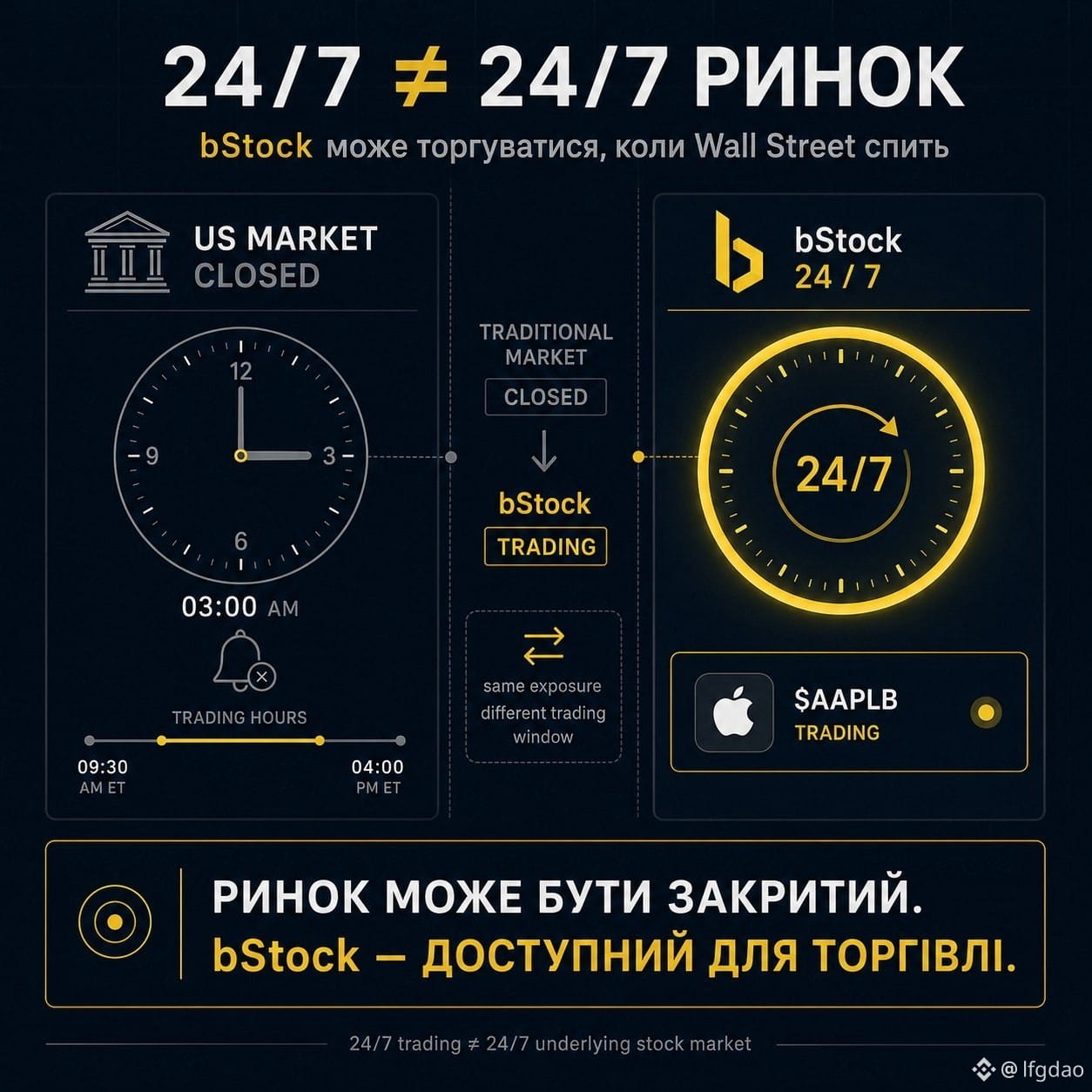
24/7 ≠ 24/7 stock market.
And this is exactly where bStocks has a detail that’s easy to miss.
Imagine $AAPLB .
On Monday at 03:00 Kyiv time, the US exchange is asleep.
But bStock isn’t.
It continues trading on Binance.
At first glance, this is just a convenience.
But in reality, it changes the very context in which you read the price.
A traditional stock is tied to the trading session.
bStock has crypto trading infrastructure.
So:
NYSE / NASDAQ → trading hours
bStock → 24/7
And this doesn’t mean that an American stock suddenly started trading in the middle of the night.
It means something else:
you can gain and adjust exposure to the asset when the traditional market is closed.
That’s why I wouldn’t put an equals sign between:
“the stock market is open right now”
and
“bStock can be bought or sold right now.”
Those are two different things.
And this brings up a more interesting question:
how does the bStock price behave during hours when the main market is closed?
For me, it’s exactly these kinds of details that make tokenization more interesting than just
“a stock, only on the blockchain.”
@BinanceCIS $AAPLB #bStocksCIS
24/7 ≠ 24/7 stock market.
And this is exactly where bStocks has a detail that’s easy to miss.
Imagine $AAPLB .
On Monday at 03:00 Kyiv time, the US exchange is asleep.
But bStock isn’t.
It continues trading on Binance.
At first glance, this is just a convenience.
But in reality, it changes the very context in which you read the price.
A traditional stock is tied to the trading session.
bStock has crypto trading infrastructure.
So:
NYSE / NASDAQ → trading hours
bStock → 24/7
And this doesn’t mean that an American stock suddenly started trading in the middle of the night.
It means something else:
you can gain and adjust exposure to the asset when the traditional market is closed.
That’s why I wouldn’t put an equals sign between:
“the stock market is open right now”
and
“bStock can be bought or sold right now.”
Those are two different things.
And this brings up a more interesting question:
how does the bStock price behave during hours when the main market is closed?
For me, it’s exactly these kinds of details that make tokenization more interesting than just
“a stock, only on the blockchain.”
@BinanceCIS $AAPLB #bStocksCIS
And this is exactly where bStocks has a detail that’s easy to miss.
Imagine $AAPLB .
On Monday at 03:00 Kyiv time, the US exchange is asleep.
But bStock isn’t.
It continues trading on Binance.
At first glance, this is just a convenience.
But in reality, it changes the very context in which you read the price.
A traditional stock is tied to the trading session.
bStock has crypto trading infrastructure.
So:
NYSE / NASDAQ → trading hours
bStock → 24/7
And this doesn’t mean that an American stock suddenly started trading in the middle of the night.
It means something else:
you can gain and adjust exposure to the asset when the traditional market is closed.
That’s why I wouldn’t put an equals sign between:
“the stock market is open right now”
and
“bStock can be bought or sold right now.”
Those are two different things.
And this brings up a more interesting question:
how does the bStock price behave during hours when the main market is closed?
For me, it’s exactly these kinds of details that make tokenization more interesting than just
“a stock, only on the blockchain.”
@BinanceCIS $AAPLB #bStocksCIS
1
105
·
--
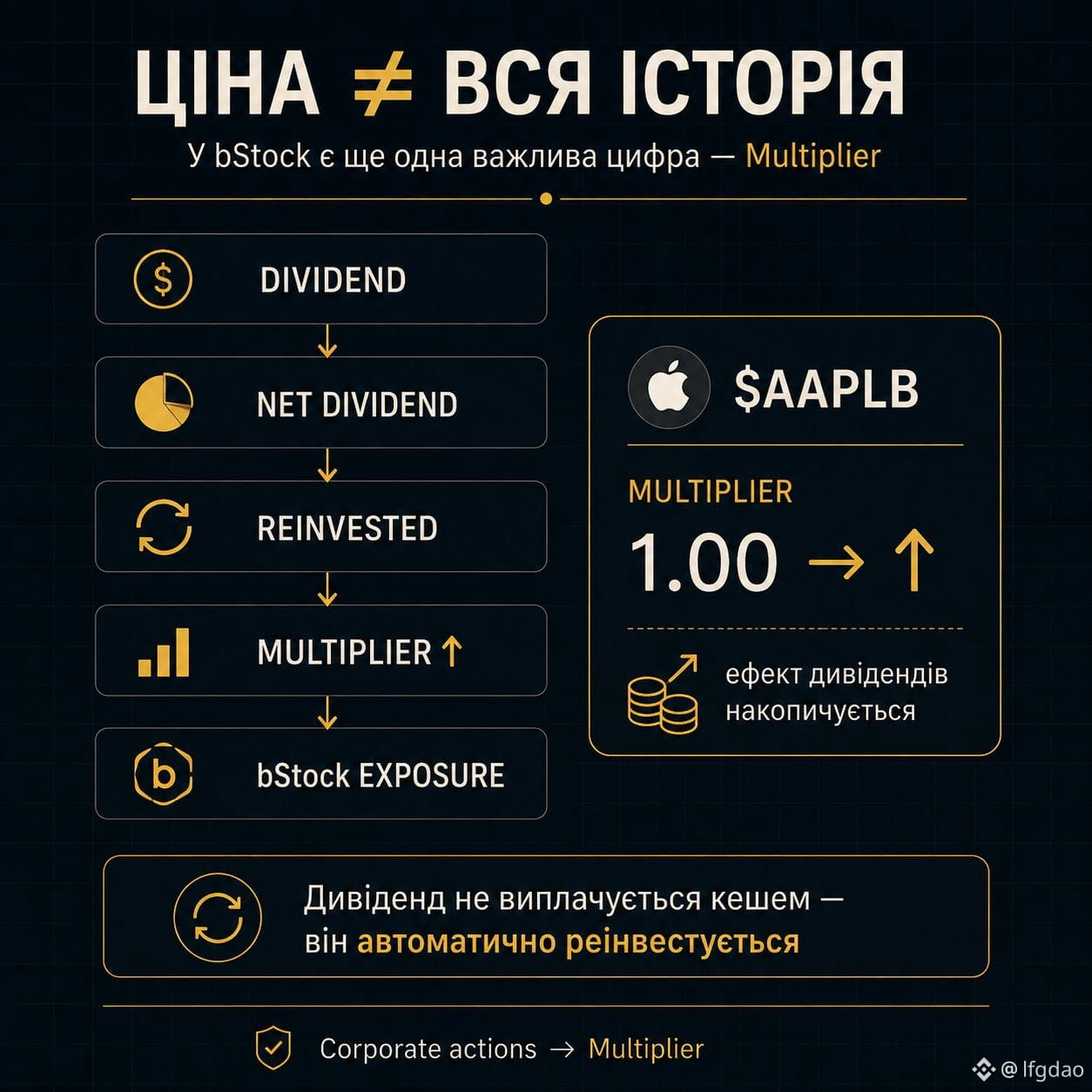
PRICE ≠ THE WHOLE STORY.
At bStock there’s another important number — Multiplier.
When you look at bStock, the simplest thing is to follow the chart.
But there’s another figure that’s easy to miss — Multiplier.
For a regular stock, the dividend comes as a payout.
With bStocks, the mechanics are different:
dividend → net dividend → reinvestment → increase in bStock balance
That means the dividend doesn’t sit in separate cash.
It goes back into the underlying stock, and your position is adjusted through the Multiplier.
And that’s where something interesting happens:
the same price ≠ the same amount of economic exposure.
Multiplier can accumulate the effect of dividends over time.
So when analyzing bStock, I would look not only at:
“How much does the token cost?”
but also:
“What's behind this token and how does its Multiplier change?”
For me, this is one of the most interesting parts of stock tokenization.
@BinanceCIS $AAPLB #bStocksCIS
PRICE ≠ THE WHOLE STORY.
At bStock there’s another important number — Multiplier.
When you look at bStock, the simplest thing is to follow the chart.
But there’s another figure that’s easy to miss — Multiplier.
For a regular stock, the dividend comes as a payout.
With bStocks, the mechanics are different:
dividend → net dividend → reinvestment → increase in bStock balance
That means the dividend doesn’t sit in separate cash.
It goes back into the underlying stock, and your position is adjusted through the Multiplier.
And that’s where something interesting happens:
the same price ≠ the same amount of economic exposure.
Multiplier can accumulate the effect of dividends over time.
So when analyzing bStock, I would look not only at:
“How much does the token cost?”
but also:
“What's behind this token and how does its Multiplier change?”
For me, this is one of the most interesting parts of stock tokenization.
@BinanceCIS $AAPLB #bStocksCIS
At bStock there’s another important number — Multiplier.
When you look at bStock, the simplest thing is to follow the chart.
But there’s another figure that’s easy to miss — Multiplier.
For a regular stock, the dividend comes as a payout.
With bStocks, the mechanics are different:
dividend → net dividend → reinvestment → increase in bStock balance
That means the dividend doesn’t sit in separate cash.
It goes back into the underlying stock, and your position is adjusted through the Multiplier.
And that’s where something interesting happens:
the same price ≠ the same amount of economic exposure.
Multiplier can accumulate the effect of dividends over time.
So when analyzing bStock, I would look not only at:
“How much does the token cost?”
but also:
“What's behind this token and how does its Multiplier change?”
For me, this is one of the most interesting parts of stock tokenization.
@BinanceCIS $AAPLB #bStocksCIS
1
70
Log in to explore more content
Join global crypto users on Binance Square
⚡️ Get latest and useful information about crypto.
💬 Trusted by the world’s largest crypto exchange.
👍 Discover real insights from verified creators.
Email / Phone number
Trending Topics
CircleMints500MUSDCOnSolana
12,913 views
529 Discussing
#circlemints500musdconsolana
🚨 HUGE Liquidity Boost! Circle Mints $500 Million USDC on Solana — Is a Massive DeFi Rally Next? 🚀
💵 What Happened?
In a major on-chain event, the USDC Treasury issued $500 million in USDC directly on the Solana network across two $250M transactions.
This massive influx of real-fiat-backed capital highlights a growing appetite for stablecoins in high-speed, low-cost ecosystems.
🔑 Key Takeaways & Headlines
Fresh On-Chain Liquidity: Freshly minted USDC boosts liquidity pools across Solana-based DEXs, lending markets, and yield protocols.
$SOL
Institutional Signal: Because every USDC is backed 1:1 by real reserves, large minting events reflect actual institutional or commercial capital entering the ecosystem.
Solana’s Market Share Expansion: Solana continues to capture an increasing share of total USDC circulation, threatening traditional stablecoin market distributions.
Macro & Fed Context: As traders monitor global macroeconomic developments and interest rate outlooks, high-yield on-chain opportunities attract resting capital back to Web3.
💡 Why It Matters for Traders
Lower Slippage & Better Swaps: Higher stablecoin depth means larger trades can occur without heavy market impact.
DeFi Yield Potential: Increased USDC reserves encourage higher TVL (Total Value Locked) in Solana lending and farming protocols.
Sentiment Shift: Massive stablecoin injections are historically bullish indicators for ecosystem tokens ($SOL,$JUP, $RAY,$KMNO).
What’s your play? Are you keeping cash on the sidelines or riding the Solana liquidity wave? Drop your thoughts below! 👇
#BlackRockBuildsTokenizedPortfoliosForOndo #solana #defi
Lily星星
·4 Likes
·2.3k views
PolymarketBankFailureBetsDrawFDICConcern
28,410 views
725 Discussing
BlackRockBuildsTokenizedPortfoliosForOndo
22,479 views
494 Discussing