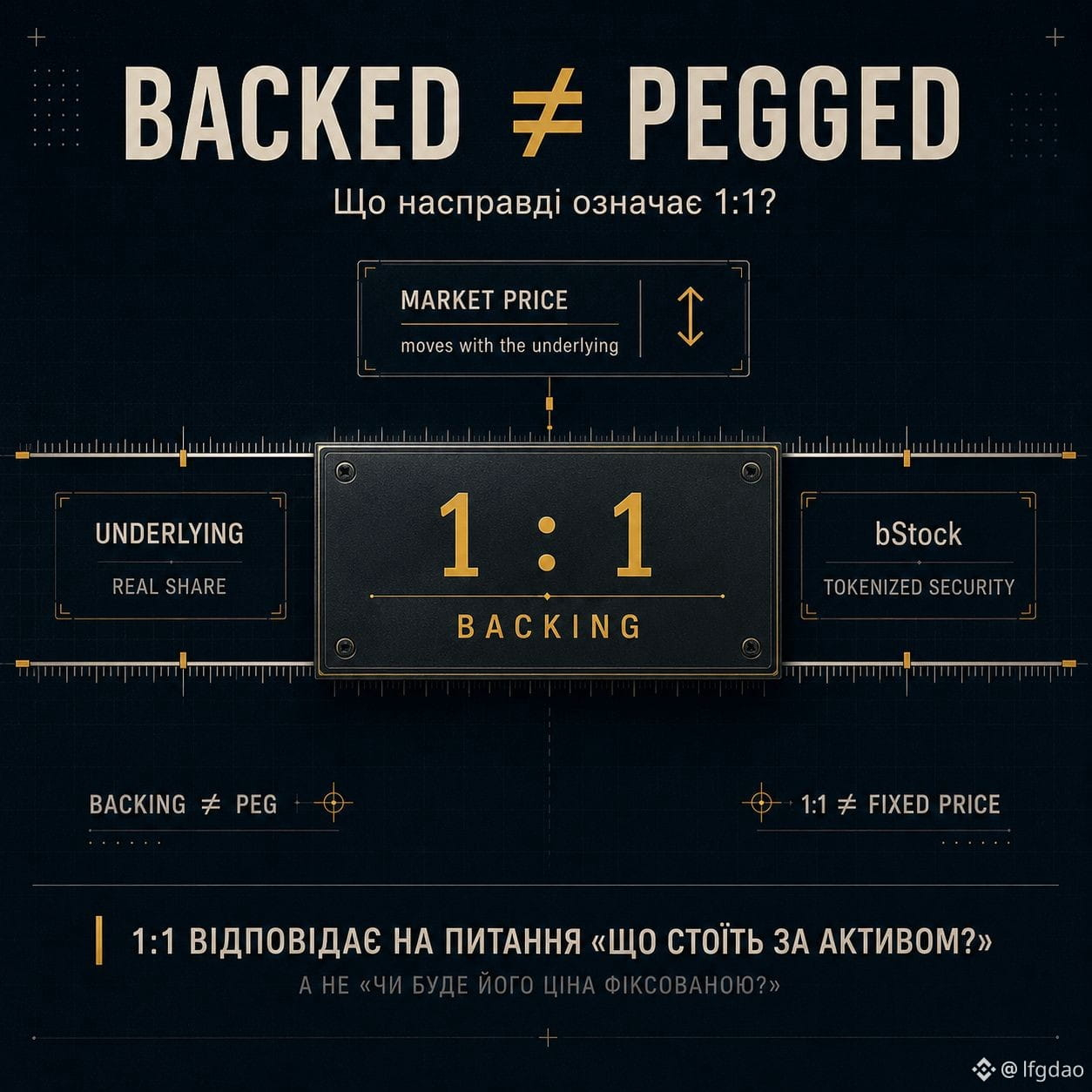
1:1 BACKING — THIS IS NOT PEG.
Right here, in my opinion, it’s easy to misunderstand bStocks.
If a bStock is backed 1:1 with a share, it does not mean:
“1 bStock is always = a fixed price.”
Here, 1:1 refers to the backing—an appropriate underlying asset stands behind the token.
And the price is a different story.
It continues to respond to the market of the underlying asset itself.
So:
BACKING → what stands behind the bStock
PRICE → how much the market is willing to pay for it
PEG → a completely different construct
That’s why I wouldn’t treat “1:1” as a promise of a stable price.
It’s rather an answer to a different question:
“What exactly backs this instrument?”
And that’s where bStocks become more interesting than just “shares in a token.”
@BinanceCIS $AAPLB #bStocksCIS
Right here, in my opinion, it’s easy to misunderstand bStocks.
If a bStock is backed 1:1 with a share, it does not mean:
“1 bStock is always = a fixed price.”
Here, 1:1 refers to the backing—an appropriate underlying asset stands behind the token.
And the price is a different story.
It continues to respond to the market of the underlying asset itself.
So:
BACKING → what stands behind the bStock
PRICE → how much the market is willing to pay for it
PEG → a completely different construct
That’s why I wouldn’t treat “1:1” as a promise of a stable price.
It’s rather an answer to a different question:
“What exactly backs this instrument?”
And that’s where bStocks become more interesting than just “shares in a token.”
@BinanceCIS $AAPLB #bStocksCIS