REPAYMENT ≠ ORIGINAL COST
Here’s a detail in TermMax that’s easy to miss.
You set the borrowing rate at the time you open the position.
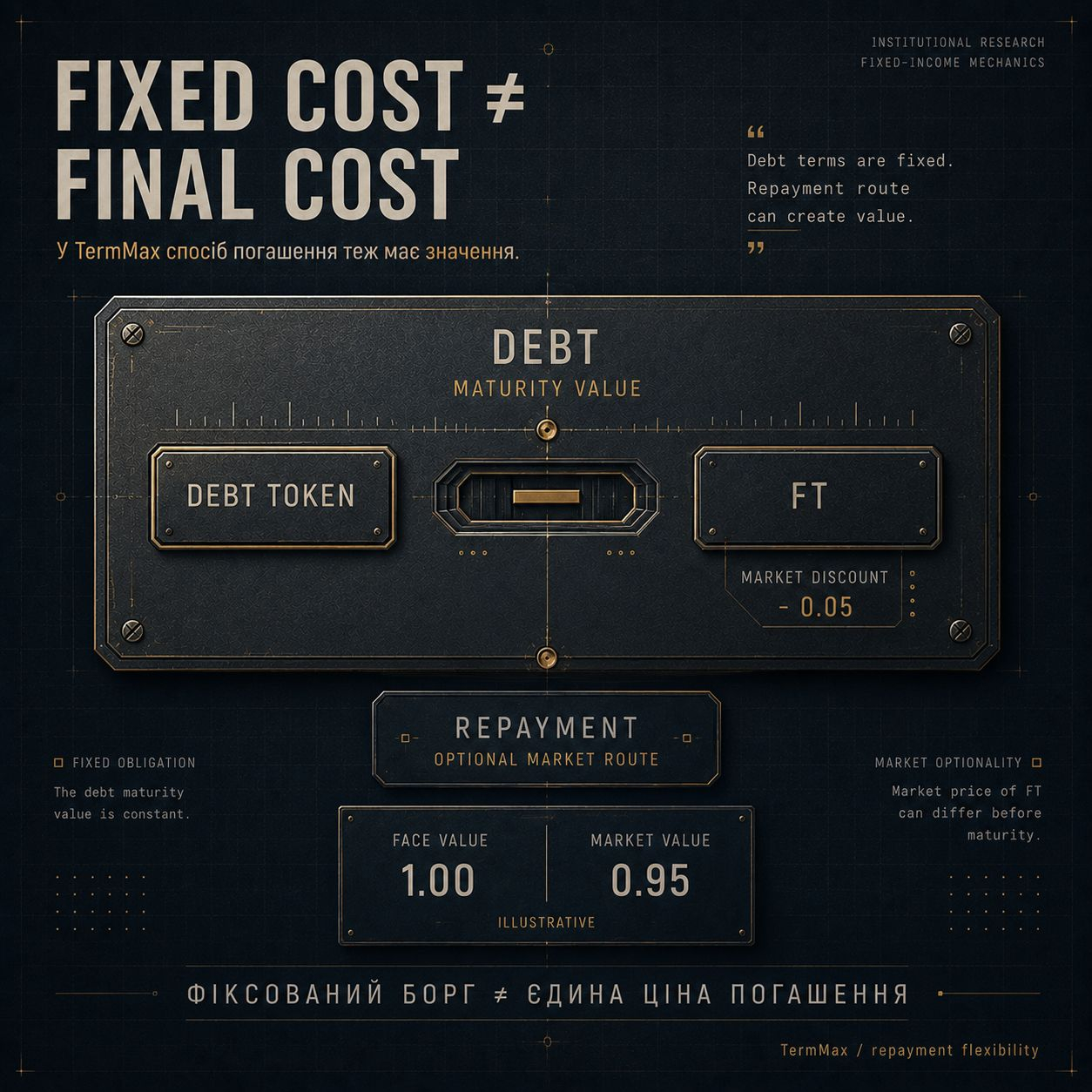
But that doesn’t mean this exact amount will necessarily be your best repayment price.
There are two options before maturity:
→ repay the debt directly with the debt token
or
→ buy the corresponding FTs on the market and use them for repayment.
And that’s where an interesting asymmetry comes in.
If an FT trades for less than its face value, buying it can reduce the actual cost of repayment.
So the fixed rate gives you a predictable maximum condition,
but the FT market leaves room to optimize repayment.
For me, this is one of the most interesting TermMax mechanics:
FIXED COST ≠ ALWAYS FINAL COST
#termmax @TermMax
Here’s a detail in TermMax that’s easy to miss.
You set the borrowing rate at the time you open the position.
But that doesn’t mean this exact amount will necessarily be your best repayment price.
There are two options before maturity:
→ repay the debt directly with the debt token
or
→ buy the corresponding FTs on the market and use them for repayment.
And that’s where an interesting asymmetry comes in.
If an FT trades for less than its face value, buying it can reduce the actual cost of repayment.
So the fixed rate gives you a predictable maximum condition,
but the FT market leaves room to optimize repayment.
For me, this is one of the most interesting TermMax mechanics:
FIXED COST ≠ ALWAYS FINAL COST
#termmax @TermMax