Binance Square
carro_t
5 Posts

carro_t

2 Following
0 Followers
0 Liked
Posts
·
--
🚨 Bitcoin is no longer just a "tech stock." It is becoming digital gold. Anyone who hasn’t noticed yet is already late. Here’s the chart that 90% of the "analysts" on this platform are ignoring right now: Over the past 12 months, BTC’s 90-day correlation with gold has surged from negative values to above +50%, and on the 30-day horizon it reached about 0.8 in early September 2026 — a six-year high. At the same time, BTC’s link with the Nasdaq 100 collapsed from above 60% to around 33% — a one-year low. The reason is simple: U.S. national debt has topped $40 trillion, the deficit is about $1.9 trillion a year, and capital is running toward what cannot be printed. That used to be only gold; now Bitcoin is in the running too. Here’s where the debate begins: Bearish argument: correlation is unstable. As recently as July 2026, BTC’s 30-day correlation with Nasdaq reached 0.85–0.88, while its correlation with gold was near zero — meaning two months ago the narrative was the opposite. Bullish argument: the scale and speed of the shift are no longer noise, but a change in the asset’s behavior amid systemic distrust of fiat. Question to think about: if Bitcoin really is becoming "digital gold," are you ready to hold it as a hedge against inflation instead of stocks? Or is this just a temporary trend driven by panic over U.S. debt?#gold #NASDAQ #bitcoin
🚨 Bitcoin is no longer just a "tech stock." It is becoming digital gold. Anyone who hasn’t noticed yet is already late.

Here’s the chart that 90% of the "analysts" on this platform are ignoring right now:

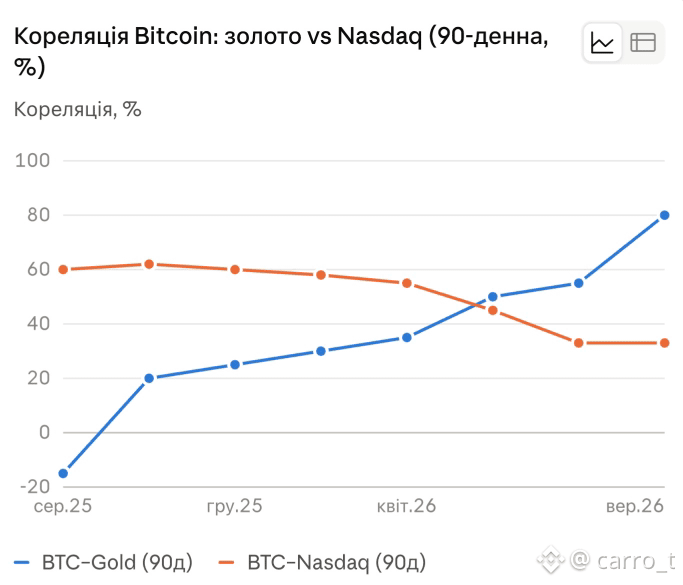
Over the past 12 months, BTC’s 90-day correlation with gold has surged from negative values to above +50%, and on the 30-day horizon it reached about 0.8 in early September 2026 — a six-year high. At the same time, BTC’s link with the Nasdaq 100 collapsed from above 60% to around 33% — a one-year low. The reason is simple: U.S. national debt has topped $40 trillion, the deficit is about $1.9 trillion a year, and capital is running toward what cannot be printed. That used to be only gold; now Bitcoin is in the running too.

Here’s where the debate begins:
Bearish argument: correlation is unstable. As recently as July 2026, BTC’s 30-day correlation with Nasdaq reached 0.85–0.88, while its correlation with gold was near zero — meaning two months ago the narrative was the opposite. Bullish argument: the scale and speed of the shift are no longer noise, but a change in the asset’s behavior amid systemic distrust of fiat.

Question to think about: if Bitcoin really is becoming "digital gold," are you ready to hold it as a hedge against inflation instead of stocks? Or is this just a temporary trend driven by panic over U.S. debt?#gold #NASDAQ #bitcoin
Article
What Are Market Orders, Limit Orders, and Stop-Loss?Market Order, Limit Order, and Stop-Loss are three terms every crypto beginner should understand. If you have ever opened Binance and seen buttons like Buy, Sell, Limit, Market, and Stop-Loss and thought: “Wait… what exactly am I supposed to click?” Don’t worry. In this guide, we’ll break everything down in simple language — no complicated trading terminology and no unnecessary theory. By the end, you’ll understand the difference between Market and Limit Orders, how Stop-Loss works, and why choosing the wrong order type can cost you money. First: What Is an Order? An order is basically an instruction you give an exchange to buy or sell an asset under certain conditions. For example, you might say: “Buy Bitcoin for me right now.” That’s a Market Order. Or: “Buy Bitcoin only if the price drops to $95,000.” That’s a Limit Order. Or: “If Bitcoin drops to a certain level, sell my position to limit my potential loss.” That’s the basic idea behind a Stop-Loss. So the difference is actually quite simple. 🟢 1. Market Order — “Buy It Now” A Market Order tells the exchange to buy or sell an asset as quickly as possible at the best available market price. Imagine Bitcoin is currently trading around: $100,000 You select: Buy → Market You are essentially telling the exchange: “I want to buy now. The exact price is less important than getting the order executed.” The exchange matches your order with available orders in the market. The main advantage? ⚡ Speed. You don't have to wait for Bitcoin to reach a specific price. But there is an important detail. The final execution price may not be exactly the price you see on your screen. During periods of high volatility or low liquidity, you can experience slippage — the difference between the expected price and the actual execution price. So remember: Market = “I want execution now.” 🔵 2. Limit Order — “Buy It, But Only at My Price” Now imagine Bitcoin is trading at: $100,000 But you only want to buy if the price drops to: $95,000 You could place a: Limit Buy → $95,000 Now the exchange waits. If the market reaches your specified price, your order may be executed. But what if Bitcoin goes: $100K → $105K → $110K? Your $95,000 order may simply remain unfilled. That’s because a Limit Order gives you price control, but execution is not guaranteed. So: Limit = “I’m willing to wait for my price.” 🟠 Market vs. Limit Here’s the easiest way to remember the difference: Market OrderLimit OrderExecutionAs quickly as possibleOnly when conditions are metPriceBest available market priceYou specify the pricePrice control❌ Lower✅ HigherExecution guaranteed?Generally prioritized for execution❌ NoBest forImmediate tradesTargeting a specific price In one sentence: Want to trade now? → Market. Want a specific price? → Limit. 🔴 3. Stop-Loss — Your “Emergency Exit” Now we get to one of the most important concepts in trading: Stop-Loss. Imagine you bought Bitcoin at: $100,000 You don't want to sit in front of the chart all day. But you also don't want to wake up tomorrow and discover Bitcoin has dropped dramatically. So you can define a price level where you want to exit the position if the market moves against you. For example: Stop-Loss = $95,000 If the relevant trigger condition is reached, the system can activate the order according to the type of stop order you selected. In simple terms: Stop-Loss = “If the market moves against me to this level, get me out.” The purpose isn't to guarantee a profit. It's to help you manage risk. ⚠️ Important: Stop-Loss Doesn't Guarantee Your Exact Exit Price This is one of the biggest things beginners misunderstand. Imagine you set a Stop-Loss at: $95,000 But the market suddenly moves: $96K → $94K → $92K Depending on the order type and market conditions, your actual execution price can differ from your stop level. This is particularly important with stop-market orders because once triggered, they become market orders. So: Stop-Loss is a risk-management tool — not a guarantee of a specific execution price. 🧠 Stop-Market vs. Stop-Limit This is where things can get confusing. Stop-Market You define a: Stop Price When the trigger is reached, a Market Order is activated. The focus is: “Get the order into the market.” But the exact execution price isn't guaranteed. Stop-Limit Here you have two prices: Stop Price → Limit Price When the stop price is reached, a Limit Order is placed. For example: Stop Price: $95,000 Limit Price: $94,500 If the stop is triggered, a Limit Order is placed at the specified limit price. This gives you more control over the price, but introduces another risk: If the market moves below your limit price too quickly, the order may not be filled. So: Stop-Market → greater focus on execution. Stop-Limit → greater price control, but potentially greater risk of non-execution. 📊 Let's Look at a Simple Example Imagine you buy Bitcoin at: Entry: $100,000 You decide: Take Profit: $110,000 Stop-Loss: $95,000 Now there are two basic scenarios. 🚀 Scenario #1 — Bitcoin Goes Up $100K → $103K → $107K → $110K You reach your target and can choose to take profit. 📉 Scenario #2 — Bitcoin Goes Down $100K → $98K → $96K → $95K Your Stop-Loss level is reached. Your predefined exit mechanism is triggered. You may take a loss — but the entire purpose of the Stop-Loss was to avoid allowing a potentially larger loss to continue unchecked. ❌ 5 Mistakes Beginners Make 1. Using Market Orders Without Understanding Them Market doesn't mean: “Buy exactly at the price I see.” It means: “Execute my order using the available market liquidity.” 2. Thinking Every Limit Order Will Be Filled It won't. If the market never reaches your specified price, your order may remain unfilled. 3. Assuming Stop-Loss Guarantees an Exact Price It doesn't. Fast-moving markets can cause the actual execution price to differ from your stop level. 4. Setting Stop-Loss Randomly There is no universal rule like: “Always set your Stop-Loss at -5%.” The appropriate level depends on the asset, volatility, strategy, and how much risk you're willing to accept. 5. Jumping Straight Into Futures This is especially important for beginners. Leverage can magnify both gains and losses. Before experimenting with Futures, make sure you actually understand basic Spot trading, order types, and risk management. 🎯 Which Order Should You Use? Here's your cheat sheet: I want to buy or sell immediately: → MARKET I want to buy or sell at a specific price: → LIMIT I want to automatically exit if the market moves against me: → STOP-LOSS I want to control both the trigger and the execution price: → STOP-LIMIT Easy, right? 💡 Quick Quiz Let's see if you really understood it. Bitcoin is currently trading at: $100,000 You want to buy Bitcoin only if the price drops to $95,000. Which order would you use? A. Market B. Limit C. Stop-Loss D. Futures 👇 Drop your answer in the comments. Now here's the second question: You bought BTC at $100,000 and want to automatically exit if the market moves below a certain level. Which tool would you use? A, B, C, or D? Let's see how many people can get both answers right. 👀 🔥 The Most Important Rule Trading isn't just about knowing: “When should I buy?” It's also about knowing: What price am I willing to pay? When will I take profit? Where will I exit if I'm wrong? How much am I willing to lose? That's exactly why different order types exist. Market gives you speed. Limit gives you price control. Stop-Loss helps you manage risk. And the better you understand these tools, the less likely you are to make an expensive mistake when the market suddenly moves. 🚀 Want to Learn Binance Step by Step? Follow this profile if you're learning crypto from the ground up. Next, we can break down: OCO Orders Take Profit Trailing Stop Order Book Spread Slippage and the other Binance tools that beginners often see but don't fully understand. And now it's your turn: 👇 Which order do you use more often — Market or Limit? If you're completely new to crypto, comment: “BEGINNER” Let's see how many beginners are here. 👇 #market_tips #Binance #TradingCommunity #TradingSignals #TradeSignal

What Are Market Orders, Limit Orders, and Stop-Loss?

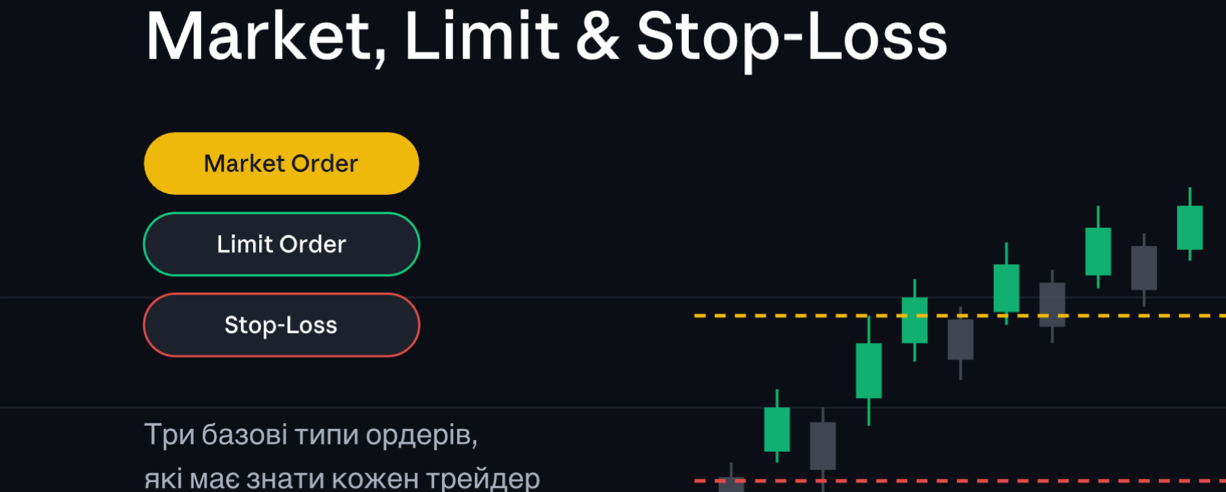
Market Order, Limit Order, and Stop-Loss are three terms every crypto beginner should understand.
If you have ever opened Binance and seen buttons like Buy, Sell, Limit, Market, and Stop-Loss and thought:
“Wait… what exactly am I supposed to click?”
Don’t worry.
In this guide, we’ll break everything down in simple language — no complicated trading terminology and no unnecessary theory.
By the end, you’ll understand the difference between Market and Limit Orders, how Stop-Loss works, and why choosing the wrong order type can cost you money.
First: What Is an Order?
An order is basically an instruction you give an exchange to buy or sell an asset under certain conditions.
For example, you might say:
“Buy Bitcoin for me right now.”
That’s a Market Order.
Or:
“Buy Bitcoin only if the price drops to $95,000.”
That’s a Limit Order.
Or:
“If Bitcoin drops to a certain level, sell my position to limit my potential loss.”
That’s the basic idea behind a Stop-Loss.
So the difference is actually quite simple.
🟢 1. Market Order — “Buy It Now”
A Market Order tells the exchange to buy or sell an asset as quickly as possible at the best available market price.
Imagine Bitcoin is currently trading around:
$100,000
You select:
Buy → Market
You are essentially telling the exchange:
“I want to buy now. The exact price is less important than getting the order executed.”
The exchange matches your order with available orders in the market.
The main advantage?
⚡ Speed.
You don't have to wait for Bitcoin to reach a specific price.
But there is an important detail.
The final execution price may not be exactly the price you see on your screen.
During periods of high volatility or low liquidity, you can experience slippage — the difference between the expected price and the actual execution price.
So remember:
Market = “I want execution now.”
🔵 2. Limit Order — “Buy It, But Only at My Price”
Now imagine Bitcoin is trading at:
$100,000
But you only want to buy if the price drops to:
$95,000
You could place a:
Limit Buy → $95,000
Now the exchange waits.
If the market reaches your specified price, your order may be executed.
But what if Bitcoin goes:
$100K → $105K → $110K?
Your $95,000 order may simply remain unfilled.
That’s because a Limit Order gives you price control, but execution is not guaranteed.
So:
Limit = “I’m willing to wait for my price.”
🟠 Market vs. Limit
Here’s the easiest way to remember the difference:
Market OrderLimit OrderExecutionAs quickly as possibleOnly when conditions are metPriceBest available market priceYou specify the pricePrice control❌ Lower✅ HigherExecution guaranteed?Generally prioritized for execution❌ NoBest forImmediate tradesTargeting a specific price
In one sentence:
Want to trade now? → Market.
Want a specific price? → Limit.
🔴 3. Stop-Loss — Your “Emergency Exit”
Now we get to one of the most important concepts in trading:
Stop-Loss.
Imagine you bought Bitcoin at:
$100,000
You don't want to sit in front of the chart all day.
But you also don't want to wake up tomorrow and discover Bitcoin has dropped dramatically.
So you can define a price level where you want to exit the position if the market moves against you.
For example:
Stop-Loss = $95,000
If the relevant trigger condition is reached, the system can activate the order according to the type of stop order you selected.
In simple terms:
Stop-Loss = “If the market moves against me to this level, get me out.”
The purpose isn't to guarantee a profit.
It's to help you manage risk.
⚠️ Important: Stop-Loss Doesn't Guarantee Your Exact Exit Price
This is one of the biggest things beginners misunderstand.
Imagine you set a Stop-Loss at:
$95,000
But the market suddenly moves:
$96K → $94K → $92K
Depending on the order type and market conditions, your actual execution price can differ from your stop level.
This is particularly important with stop-market orders because once triggered, they become market orders.
So:
Stop-Loss is a risk-management tool — not a guarantee of a specific execution price.
🧠 Stop-Market vs. Stop-Limit
This is where things can get confusing.
Stop-Market
You define a:
Stop Price
When the trigger is reached, a Market Order is activated.
The focus is:
“Get the order into the market.”
But the exact execution price isn't guaranteed.
Stop-Limit
Here you have two prices:
Stop Price → Limit Price
When the stop price is reached, a Limit Order is placed.
For example:
Stop Price: $95,000
Limit Price: $94,500
If the stop is triggered, a Limit Order is placed at the specified limit price.
This gives you more control over the price, but introduces another risk:
If the market moves below your limit price too quickly, the order may not be filled.
So:
Stop-Market → greater focus on execution.
Stop-Limit → greater price control, but potentially greater risk of non-execution.
📊 Let's Look at a Simple Example
Imagine you buy Bitcoin at:
Entry: $100,000
You decide:
Take Profit: $110,000
Stop-Loss: $95,000
Now there are two basic scenarios.
🚀 Scenario #1 — Bitcoin Goes Up
$100K → $103K → $107K → $110K
You reach your target and can choose to take profit.
📉 Scenario #2 — Bitcoin Goes Down
$100K → $98K → $96K → $95K
Your Stop-Loss level is reached.
Your predefined exit mechanism is triggered.
You may take a loss — but the entire purpose of the Stop-Loss was to avoid allowing a potentially larger loss to continue unchecked.
❌ 5 Mistakes Beginners Make
1. Using Market Orders Without Understanding Them
Market doesn't mean:
“Buy exactly at the price I see.”
It means:
“Execute my order using the available market liquidity.”
2. Thinking Every Limit Order Will Be Filled
It won't.
If the market never reaches your specified price, your order may remain unfilled.
3. Assuming Stop-Loss Guarantees an Exact Price
It doesn't.
Fast-moving markets can cause the actual execution price to differ from your stop level.
4. Setting Stop-Loss Randomly
There is no universal rule like:
“Always set your Stop-Loss at -5%.”
The appropriate level depends on the asset, volatility, strategy, and how much risk you're willing to accept.
5. Jumping Straight Into Futures
This is especially important for beginners.
Leverage can magnify both gains and losses.
Before experimenting with Futures, make sure you actually understand basic Spot trading, order types, and risk management.
🎯 Which Order Should You Use?
Here's your cheat sheet:
I want to buy or sell immediately:
→ MARKET
I want to buy or sell at a specific price:
→ LIMIT
I want to automatically exit if the market moves against me:
→ STOP-LOSS
I want to control both the trigger and the execution price:
→ STOP-LIMIT
Easy, right?
💡 Quick Quiz
Let's see if you really understood it.
Bitcoin is currently trading at:
$100,000
You want to buy Bitcoin only if the price drops to $95,000.
Which order would you use?
A. Market
B. Limit
C. Stop-Loss
D. Futures
👇 Drop your answer in the comments.
Now here's the second question:
You bought BTC at $100,000 and want to automatically exit if the market moves below a certain level.
Which tool would you use?
A, B, C, or D?
Let's see how many people can get both answers right. 👀
🔥 The Most Important Rule
Trading isn't just about knowing:
“When should I buy?”
It's also about knowing:
What price am I willing to pay?
When will I take profit?
Where will I exit if I'm wrong?
How much am I willing to lose?
That's exactly why different order types exist.
Market gives you speed.
Limit gives you price control.
Stop-Loss helps you manage risk.
And the better you understand these tools, the less likely you are to make an expensive mistake when the market suddenly moves.
🚀 Want to Learn Binance Step by Step?
Follow this profile if you're learning crypto from the ground up.
Next, we can break down:
OCO Orders
Take Profit
Trailing Stop
Order Book
Spread
Slippage
and the other Binance tools that beginners often see but don't fully understand.
And now it's your turn:
👇 Which order do you use more often — Market or Limit?
If you're completely new to crypto, comment:
“BEGINNER”
Let's see how many beginners are here. 👇
#market_tips #Binance #TradingCommunity #TradingSignals #TradeSignal
Article
What is Blockchain and why is everyone talking about it?If you are just starting to explore cryptocurrencies, you have probably come across the word Blockchain dozens of times. Bitcoin runs on the blockchain. Ethereum uses blockchain. NFTs, DeFi, stablecoins, and many other crypto projects are also built on this technology. But what does the word Blockchain actually mean?

What is Blockchain and why is everyone talking about it?

If you are just starting to explore cryptocurrencies, you have probably come across the word Blockchain dozens of times.
Bitcoin runs on the blockchain. Ethereum uses blockchain. NFTs, DeFi, stablecoins, and many other crypto projects are also built on this technology.
But what does the word Blockchain actually mean?
·
--
Bullish
🚨 What if the stock market never had to close? For decades, stocks have lived inside traditional financial infrastructure: ⏰ limited trading hours 🏦 centralized brokers ⏳ settlement delays 🌍 fragmented access bStocks are changing that model. Binance bStocks are tokenized securities backed 1:1 by the corresponding U.S. shares held with a regulated custodian. They can be traded on Binance Spot 24/7, including outside traditional U.S. market hours. And the numbers make the idea even more interesting: 💰 From $5 — fractional exposure to supported U.S. stocks 🔄 1:1 backing — each bStock is backed by the corresponding underlying share ⚡ 24/7 trading — no traditional market-hour restrictions 🔐 Self-custody — bStocks can be withdrawn to compatible BNB Smart Chain wallets 🌐 DeFi-ready — bStocks can interact with supported DeFi applications 📈 Automatic corporate actions — dividends and stock splits are processed through the Multiplier mechanism. But there is an even bigger story here. bStocks are part of the tokenization trend. Stocks are no longer necessarily just something you hold through a traditional brokerage. They can become on-chain financial assets — transferable, programmable and integrated with blockchain infrastructure. This is where TradFi meets DeFi. And if more real-world assets move on-chain, the line between the traditional financial system and crypto could become increasingly blurred. ⚠️ Important: bStocks are tokenized securities, not direct ownership of the underlying company’s shares, and availability is restricted to eligible users in permitted jurisdictions. The question is: 🔥 Would you rather trade stocks during traditional market hours — or have access 24/7 on-chain? Comment ON-CHAIN if you think tokenized stocks are the future 👇 #bStocks #Binance #RWA #Web3 #stocks
🚨 What if the stock market never had to close?

For decades, stocks have lived inside traditional financial infrastructure:

⏰ limited trading hours
🏦 centralized brokers
⏳ settlement delays
🌍 fragmented access

bStocks are changing that model.

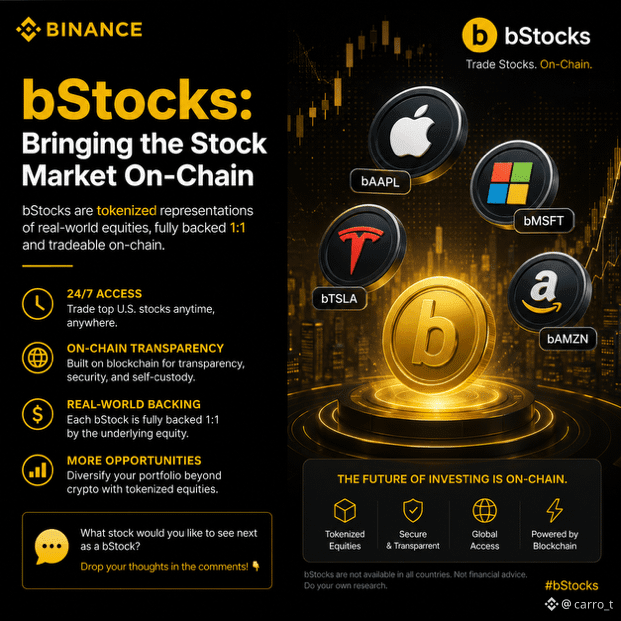
Binance bStocks are tokenized securities backed 1:1 by the corresponding U.S. shares held with a regulated custodian. They can be traded on Binance Spot 24/7, including outside traditional U.S. market hours.

And the numbers make the idea even more interesting:

💰 From $5 — fractional exposure to supported U.S. stocks
🔄 1:1 backing — each bStock is backed by the corresponding underlying share
⚡ 24/7 trading — no traditional market-hour restrictions
🔐 Self-custody — bStocks can be withdrawn to compatible BNB Smart Chain wallets
🌐 DeFi-ready — bStocks can interact with supported DeFi applications
📈 Automatic corporate actions — dividends and stock splits are processed through the Multiplier mechanism.

But there is an even bigger story here.

bStocks are part of the tokenization trend.

Stocks are no longer necessarily just something you hold through a traditional brokerage.

They can become on-chain financial assets — transferable, programmable and integrated with blockchain infrastructure.

This is where TradFi meets DeFi.

And if more real-world assets move on-chain, the line between the traditional financial system and crypto could become increasingly blurred.

⚠️ Important: bStocks are tokenized securities, not direct ownership of the underlying company’s shares, and availability is restricted to eligible users in permitted jurisdictions.

The question is:

🔥 Would you rather trade stocks during traditional market hours — or have access 24/7 on-chain?

Comment ON-CHAIN if you think tokenized stocks are the future 👇

#bStocks #Binance #RWA #Web3 #stocks
·
--
Bullish
🚨TradFi is no longer watching crypto. It is building on it. For years, the narrative was: Crypto vs. Traditional Finance. But 2026 is telling a different story. The real trend may be TradFi + Blockchain Here are 3 numbers worth watching 👇 📊 $270B+ — combined assets of stablecoins exceeded this level by December 2025, according to the BIS. Stablecoins are increasingly connected to traditional markets through their holdings of short-term assets such as U.S. Treasuries. ₿ $4.6B — trading volume of U.S. spot Bitcoin ETPs on their first trading day, January 11, 2024. The SEC had approved the products one day earlier. 🏦 21 financial institutions — including Goldman Sachs, Bank of America, Citi and Deutsche Bank — are planning a company to issue a U.S. dollar-backed stablecoin, with a potential launch in the first half of 2027. And this is bigger than Bitcoin. Tokenization is becoming one of the key bridges between TradFi and blockchain. The BIS has highlighted tokenized central-bank reserves, commercial-bank money and government bonds as potential building blocks of a next-generation financial system. So what happens next? 👉 Banks tokenize financial assets. 👉 Stablecoins become part of payment infrastructure. 👉 ETFs make crypto exposure easier for traditional investors. 👉 Blockchain moves from a speculative technology toward financial infrastructure. The interesting question is no longer: Will TradFi adopt crypto? The better question is: 🔥 How much of TradFi will eventually run on blockchain? What do you think? А) TradFi will dominate crypto B) Crypto will disrupt TradFi C) They will merge into one financial system Drop A, B or C in the comments 👇 #TradFi #crypto #bitcoin #blockchain #Tokenization
🚨TradFi is no longer watching crypto. It is building on it.

For years, the narrative was:

Crypto vs. Traditional Finance.

But 2026 is telling a different story.

The real trend may be TradFi + Blockchain

Here are 3 numbers worth watching 👇

📊 $270B+ — combined assets of stablecoins exceeded this level by December 2025, according to the BIS. Stablecoins are increasingly connected to traditional markets through their holdings of short-term assets such as U.S. Treasuries.

₿ $4.6B — trading volume of U.S. spot Bitcoin ETPs on their first trading day, January 11, 2024. The SEC had approved the products one day earlier.

🏦 21 financial institutions — including Goldman Sachs, Bank of America, Citi and Deutsche Bank — are planning a company to issue a U.S. dollar-backed stablecoin, with a potential launch in the first half of 2027.

And this is bigger than Bitcoin.

Tokenization is becoming one of the key bridges between TradFi and blockchain.

The BIS has highlighted tokenized central-bank reserves, commercial-bank money and government bonds as potential building blocks of a next-generation financial system.

So what happens next?

👉 Banks tokenize financial assets.
👉 Stablecoins become part of payment infrastructure.
👉 ETFs make crypto exposure easier for traditional investors.
👉 Blockchain moves from a speculative technology toward financial infrastructure.

The interesting question is no longer:

Will TradFi adopt crypto?

The better question is:

🔥 How much of TradFi will eventually run on blockchain?

What do you think?

А) TradFi will dominate crypto
B) Crypto will disrupt TradFi
C) They will merge into one financial system

Drop A, B or C in the comments 👇

#TradFi #crypto #bitcoin #blockchain #Tokenization
Log in to explore more content
Join global crypto users on Binance Square
⚡️ Get latest and useful information about crypto.
💬 Trusted by the world’s largest crypto exchange.
👍 Discover real insights from verified creators.
Email / Phone number
Sitemap
Cookie Preferences
Platform T&Cs