
Bella_Blocks
6.1k Posts

Bella_Blocks
Report
Block User
Crypto Strategist | Binance Creator
Open Trade
Frequent Trader
1 Years
5 Following
11.7K+ Followers
5.0K+ Liked
Posts
Portfolio
All
Quotes
Live
·
--
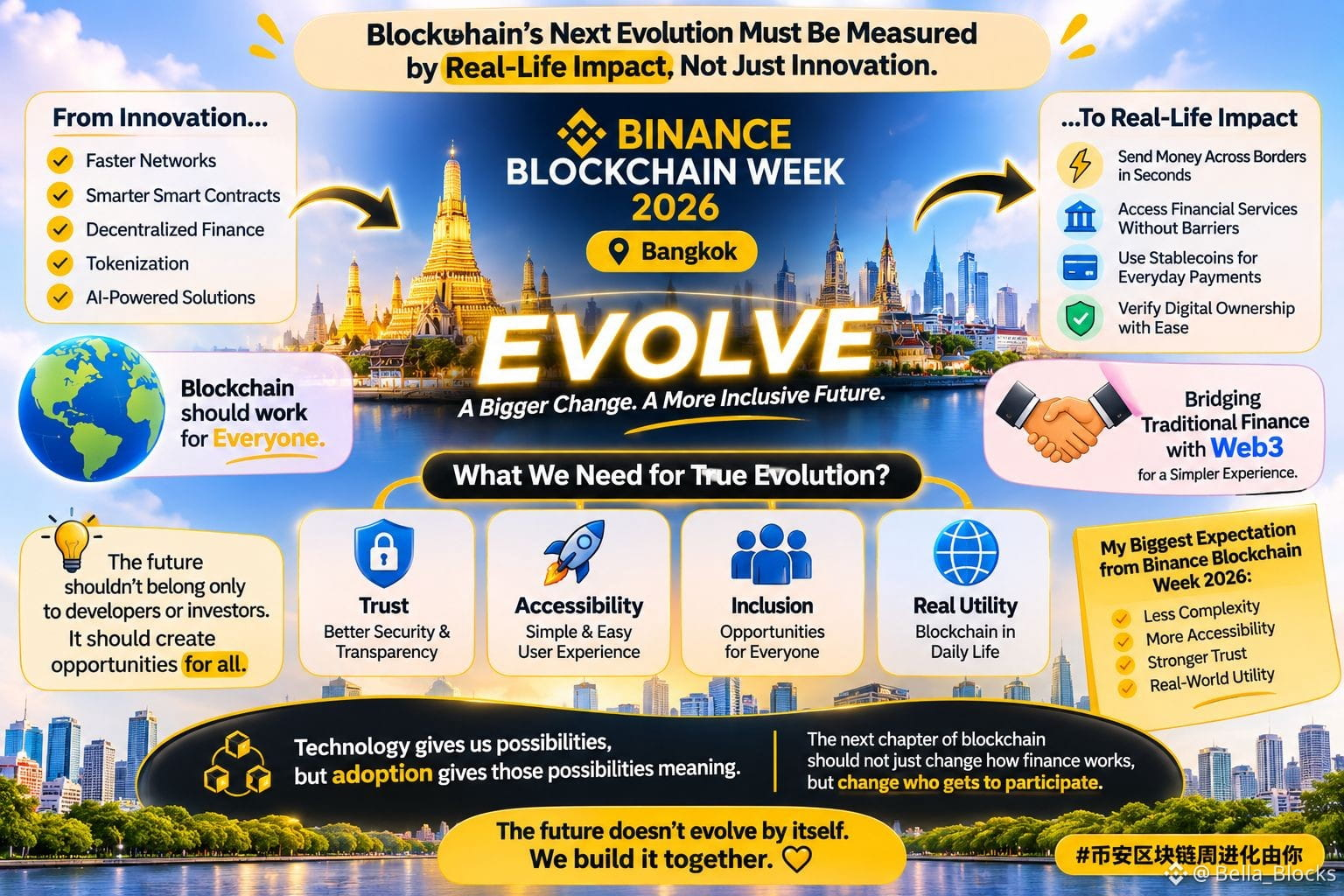
Blockchain's Next Evolution Must Be Measured by Real-Life Impact, Not Just Innovation.
As Binance Blockchain Week 2026 approaches in Bangkok, one thought stands out to me:
We have spent years building faster networks, smarter smart contracts, decentralized finance, tokenization, and AI-powered blockchain solutions. But the biggest question is still waiting for an answer:
How much easier can this technology make everyday life?
For me, the theme EVOLVE represents something bigger than technological progress.
I want to see blockchain move beyond trading screens and become useful in real financial activities. Imagine sending money across borders in seconds, accessing financial services without unnecessary barriers, using stablecoins for everyday payments, and verifying digital ownership without complicated processes.
But real evolution also requires trust. Better security, transparent systems, responsible innovation, and simpler user experiences must grow alongside adoption.
One thing I hope the conversations in Bangkok explore is how we can connect traditional finance with Web3 without making the experience difficult for ordinary users.
Because the future shouldn't belong only to developers, investors, or institutions. It should create opportunities for everyone.
My biggest expectation from @BinanceBlockchainWeek 2026 is simple:
Less complexity. More accessibility. Stronger trust. Real-world utility.
Technology gives us possibilities, but adoption gives those possibilities meaning.
The next chapter of blockchain should not just change how finance works. It should change who gets to participate.
The future doesn't evolve by itself. We build it together. 💛
#币安区块链周进化由你
$HAEDAL
{spot}(HAEDALUSDT)
$CFG
{spot}(CFGUSDT)
$INIT
{spot}(INITUSDT)
Blockchain's Next Evolution Must Be Measured by Real-Life Impact, Not Just Innovation.
As Binance Blockchain Week 2026 approaches in Bangkok, one thought stands out to me:
We have spent years building faster networks, smarter smart contracts, decentralized finance, tokenization, and AI-powered blockchain solutions. But the biggest question is still waiting for an answer:
How much easier can this technology make everyday life?
For me, the theme EVOLVE represents something bigger than technological progress.
I want to see blockchain move beyond trading screens and become useful in real financial activities. Imagine sending money across borders in seconds, accessing financial services without unnecessary barriers, using stablecoins for everyday payments, and verifying digital ownership without complicated processes.
But real evolution also requires trust. Better security, transparent systems, responsible innovation, and simpler user experiences must grow alongside adoption.
One thing I hope the conversations in Bangkok explore is how we can connect traditional finance with Web3 without making the experience difficult for ordinary users.
Because the future shouldn't belong only to developers, investors, or institutions. It should create opportunities for everyone.
My biggest expectation from @Binance Blockchain Week 2026 is simple:
Less complexity. More accessibility. Stronger trust. Real-world utility.
Technology gives us possibilities, but adoption gives those possibilities meaning.
The next chapter of blockchain should not just change how finance works. It should change who gets to participate.
The future doesn't evolve by itself. We build it together. 💛
#币安区块链周进化由你
$HAEDAL
$CFG
$INIT
27
·
--
Article
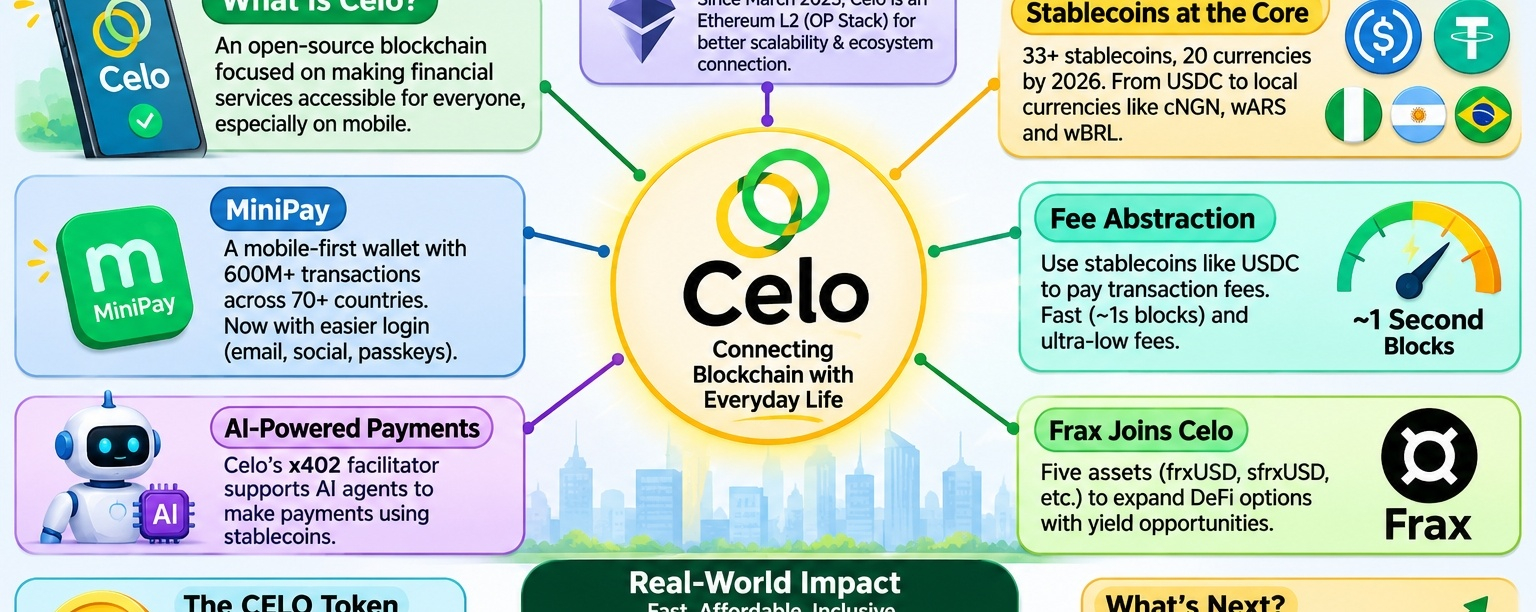
Celo Is Becoming More Than a Blockchain How It's Connecting Ethereum Stablecoins Real-World PaymentsWhen I look at the blockchain industry, one question keeps coming to mind: What happens when blockchain technology stops being something people simply invest in and starts becoming something they actually use in everyday life?
That's where Celo caught my attention.
Many blockchain projects compete over transaction speed, scalability, and new technologies. Celo is taking a slightly different direction. Its focus is on making digital money easier to access, transfer, and use, particularly through mobile devices and stablecoins.
But there is much more happening with Celo than its original mobile-first vision. Its transition to Ethereum Layer 2, growing stablecoin ecosystem, MiniPay expansion, and new infrastructure for AI-powered payments make it an interesting project to understand.
Let's explore what is changing and why it matters.
1. What Exactly Is Celo?
Celo is an open-source blockchain ecosystem designed to make financial services more accessible.
Its original vision was simple: people should be able to send, receive, and use digital money without needing complicated financial infrastructure.
Think about someone who wants to send money to family in another country. Traditional financial services can involve multiple intermediaries, delays, and expensive fees.
Celo aims to make these transactions faster and more affordable through blockchain technology.
It supports smart contracts, decentralized applications, stablecoins, and financial services while maintaining a strong focus on mobile accessibility.
One important thing to understand is that Celo is not just a payment application. It is the underlying infrastructure on which developers can build financial products.
2. The Biggest Change: Celo Became an Ethereum Layer 2
This is one of the most important developments in Celo's history.
On March 26, 2025, Celo officially transitioned from an independent Layer 1 blockchain to an Ethereum Layer 2 built using the OP Stack.
Why does this matter?
A Layer 1 blockchain operates with its own consensus and security infrastructure. A Layer 2 processes transactions separately while connecting to an underlying blockchain such as Ethereum.
By becoming an Ethereum L2, Celo gained a closer connection to Ethereum's ecosystem, including its developer infrastructure, interoperability, and settlement framework.
The migration also preserved Celo's existing network history and ecosystem.
But Celo did not simply copy another Layer 2.
It continued developing features that make its network different, especially around mobile payments, stablecoin transactions, and low transaction costs.
Its architecture also uses EigenDA for data availability and OP Succinct Lite for proof-based dispute resolution.
In simple terms, Celo is trying to combine Ethereum compatibility with infrastructure designed for everyday financial activity.
3. Stablecoins Are at the Center of Celo's Strategy
This is where I think Celo becomes particularly interesting.
Stablecoins are digital assets designed to maintain a relatively stable value, often by tracking a currency such as the US dollar.
Unlike Bitcoin or many other cryptocurrencies, stablecoins are not primarily designed around price appreciation.
Their usefulness comes from transferring and holding value.
Celo has been expanding its stablecoin ecosystem beyond dollar-based assets.
By September 2026, its ecosystem reported 33 live stablecoins representing 20 currencies.
That includes assets connected to different local markets, such as:
- USDC and USD₮ for dollar-based transactions.
- cNGN for the Nigerian naira.
- wARS for the Argentine peso.
- wBRL for the Brazilian real.
- IDRX for the Indonesian rupiah.
Why is this important?
Imagine a person in Nigeria receiving digital money in a currency relevant to their local economy, while another person in Brazil uses a Brazilian real-based stablecoin.
This creates opportunities for local payments and onchain currency exchange without forcing every transaction into the same financial system.
The bigger idea is to connect global digital money with local financial needs.
4. MiniPay: Bringing Blockchain Closer to Everyday Users
Technology becomes meaningful when people can actually use it.
That's why MiniPay deserves attention in the Celo ecosystem.
MiniPay is a self-custodial stablecoin wallet developed by Opera and built on Celo. It was designed to make sending and receiving digital dollars easier through a mobile-friendly experience.
In November 2026, MiniPay announced an important upgrade: its 20 million-plus activated wallets are moving to Privy, the wallet infrastructure company owned by Stripe.
What makes this development interesting?
Users will be able to access their wallets using familiar options such as email, social accounts, and passkeys instead of having to manage a traditional seed phrase.
Importantly, MiniPay remains self-custodial, meaning users retain control of their funds and can export their keys.
The announcement also reported more than 600 million transactions across over 70 countries and 77 Mini Apps.
This is an important distinction: blockchain adoption does not always begin with someone understanding smart contracts or gas fees. Sometimes it begins with a simple wallet that makes sending digital money easier.
5. Celo Is Making Transactions Easier Through Fee Abstraction
Here is another feature that deserves more attention.
On many blockchains, users need the network's native token to pay transaction fees.
For newcomers, this can create an unnecessary complication.
Imagine holding USDC but needing to purchase another cryptocurrency just to send it.
Celo addresses this problem through fee abstraction.
It allows supported ERC-20 tokens, including stablecoins, to be used for transaction fees.
This means users can interact with applications without always needing to maintain a separate balance of CELO for gas.
Celo also offers approximately one-second block times and sub-cent average transaction fees according to its current network information.
For payment applications, these details matter because users generally care more about completing a transaction smoothly than understanding the technical process behind it.
6. A New Direction: Celo and AI-Powered Payments
One of the newer developments I find particularly interesting is Celo's work around autonomous AI agents.
AI agents are software systems that can perform tasks and interact with other services.
In the future, some agents may need to purchase data, access APIs, pay for computing resources, or exchange services without requiring a human to approve every individual transaction.
But how would these agents make payments?
This is where payment infrastructure such as x402 becomes relevant.
Celo has developed a native x402 facilitator that supports stablecoin-based payments for agents.
In October 2026, Celo expanded this infrastructure to support 10 stablecoins across eight currencies, including US dollars, Nigerian naira, and several Latin American currencies.
This opens an interesting possibility: AI agents could potentially transact using digital currencies that better match the local markets they serve.
It is still an emerging area, but it shows that Celo is exploring use cases beyond traditional human-to-human payments.
7. A Fresh Development: Frax Joins the Celo Ecosystem
There is another recent development worth highlighting.
On November 24, 2026, Frax brought five assets to Celo:
- frxUSD
- sfrxUSD
- WFRAX
- frxETH
- sfrxETH
One particularly interesting asset is sfrxUSD, a yield-bearing stablecoin designed to provide a savings option within DeFi.
Celo Core Co. also announced an allocation of up to $9 million of reserve collateral into sfrxUSD, while Frax committed to buying and holding native CELO.
Why does this matter?
A healthy financial ecosystem needs more than payment infrastructure. It also needs ways to save, borrow, provide liquidity, and use assets across different applications.
Integrations like this can expand the financial products available to users and developers.
Of course, yield-bearing assets also come with smart-contract, liquidity, and market risks that users should understand.
8. What Is the Role of the CELO Token?
Understanding the network without understanding its native token would leave an important part of the picture missing.
CELO is the native token of the Celo ecosystem.
It has several roles, including:
- Participating in network governance.
- Supporting staking and network security.
- Paying transaction fees.
- Participating in the ecosystem's economic structure.
Celo's 2026 CELOccelerate tokenomics initiative also introduced changes aimed at connecting network usage with token economics.
According to Celo's September 2026 ecosystem update, net sequencer revenue is being converted into CELO through programmatic buybacks and directed to the Community Fund.
This creates an important question for anyone studying the project:
Can increasing network usage translate into sustainable economic value for the ecosystem and its token holders?
That is something worth following over time rather than assuming that more transactions automatically mean a higher token price.
9. What Should We Watch Next?
I believe Celo's next chapter should be judged by actual adoption, not just announcements.
There are several things worth watching:
Real stablecoin usage: Are people consistently using these assets for payments, savings, and transfers?
MiniPay growth: Can its growing wallet base translate into regular active users and meaningful financial activity?
Developer adoption: Are more applications choosing Celo because its infrastructure solves real problems?
AI payment activity: Can autonomous agents develop sustainable economic activity rather than generating temporary transaction numbers?
Network economics: Can the growing use of Celo create lasting value for its ecosystem and CELO token?
These questions will tell us much more about the project's long-term direction than promotional headlines alone.
Final Thoughts
What makes Celo interesting to me is that its story is gradually expanding.
It started with a vision of making financial services accessible through mobile phones. Today, it is building around Ethereum Layer 2 infrastructure, local-currency stablecoins, self-custodial wallets, DeFi integrations, and payments for AI agents.
The most important part is not how many technical features a blockchain can introduce. It is whether those features solve problems that people and businesses actually face.
Celo still has challenges to overcome, particularly around sustainable adoption, infrastructure security, and converting network activity into long-term economic value.
But its direction raises an important question for the wider industry:
What if the next major blockchain breakthrough isn't another complicated financial product, but making digital money so easy to use that people no longer need to think about the blockchain behind it?
That is the kind of evolution I will be watching from Celo.
#Celo #CELO @celo $CELO
{spot}(CELOUSDT)
Celo Is Becoming More Than a Blockchain How It's Connecting Ethereum Stablecoins Real-World Payments
When I look at the blockchain industry, one question keeps coming to mind: What happens when blockchain technology stops being something people simply invest in and starts becoming something they actually use in everyday life?
That's where Celo caught my attention.
Many blockchain projects compete over transaction speed, scalability, and new technologies. Celo is taking a slightly different direction. Its focus is on making digital money easier to access, transfer, and use, particularly through mobile devices and stablecoins.
But there is much more happening with Celo than its original mobile-first vision. Its transition to Ethereum Layer 2, growing stablecoin ecosystem, MiniPay expansion, and new infrastructure for AI-powered payments make it an interesting project to understand.
Let's explore what is changing and why it matters.
1. What Exactly Is Celo?
Celo is an open-source blockchain ecosystem designed to make financial services more accessible.
Its original vision was simple: people should be able to send, receive, and use digital money without needing complicated financial infrastructure.
Think about someone who wants to send money to family in another country. Traditional financial services can involve multiple intermediaries, delays, and expensive fees.
Celo aims to make these transactions faster and more affordable through blockchain technology.
It supports smart contracts, decentralized applications, stablecoins, and financial services while maintaining a strong focus on mobile accessibility.
One important thing to understand is that Celo is not just a payment application. It is the underlying infrastructure on which developers can build financial products.
2. The Biggest Change: Celo Became an Ethereum Layer 2
This is one of the most important developments in Celo's history.
On March 26, 2025, Celo officially transitioned from an independent Layer 1 blockchain to an Ethereum Layer 2 built using the OP Stack.
Why does this matter?
A Layer 1 blockchain operates with its own consensus and security infrastructure. A Layer 2 processes transactions separately while connecting to an underlying blockchain such as Ethereum.
By becoming an Ethereum L2, Celo gained a closer connection to Ethereum's ecosystem, including its developer infrastructure, interoperability, and settlement framework.
The migration also preserved Celo's existing network history and ecosystem.
But Celo did not simply copy another Layer 2.
It continued developing features that make its network different, especially around mobile payments, stablecoin transactions, and low transaction costs.
Its architecture also uses EigenDA for data availability and OP Succinct Lite for proof-based dispute resolution.
In simple terms, Celo is trying to combine Ethereum compatibility with infrastructure designed for everyday financial activity.
3. Stablecoins Are at the Center of Celo's Strategy
This is where I think Celo becomes particularly interesting.
Stablecoins are digital assets designed to maintain a relatively stable value, often by tracking a currency such as the US dollar.
Unlike Bitcoin or many other cryptocurrencies, stablecoins are not primarily designed around price appreciation.
Their usefulness comes from transferring and holding value.
Celo has been expanding its stablecoin ecosystem beyond dollar-based assets.
By September 2026, its ecosystem reported 33 live stablecoins representing 20 currencies.
That includes assets connected to different local markets, such as:
- USDC and USD₮ for dollar-based transactions.
- cNGN for the Nigerian naira.
- wARS for the Argentine peso.
- wBRL for the Brazilian real.
- IDRX for the Indonesian rupiah.
Why is this important?
Imagine a person in Nigeria receiving digital money in a currency relevant to their local economy, while another person in Brazil uses a Brazilian real-based stablecoin.
This creates opportunities for local payments and onchain currency exchange without forcing every transaction into the same financial system.
The bigger idea is to connect global digital money with local financial needs.
4. MiniPay: Bringing Blockchain Closer to Everyday Users
Technology becomes meaningful when people can actually use it.
That's why MiniPay deserves attention in the Celo ecosystem.
MiniPay is a self-custodial stablecoin wallet developed by Opera and built on Celo. It was designed to make sending and receiving digital dollars easier through a mobile-friendly experience.
In November 2026, MiniPay announced an important upgrade: its 20 million-plus activated wallets are moving to Privy, the wallet infrastructure company owned by Stripe.
What makes this development interesting?
Users will be able to access their wallets using familiar options such as email, social accounts, and passkeys instead of having to manage a traditional seed phrase.
Importantly, MiniPay remains self-custodial, meaning users retain control of their funds and can export their keys.
The announcement also reported more than 600 million transactions across over 70 countries and 77 Mini Apps.
This is an important distinction: blockchain adoption does not always begin with someone understanding smart contracts or gas fees. Sometimes it begins with a simple wallet that makes sending digital money easier.
5. Celo Is Making Transactions Easier Through Fee Abstraction
Here is another feature that deserves more attention.
On many blockchains, users need the network's native token to pay transaction fees.
For newcomers, this can create an unnecessary complication.
Imagine holding USDC but needing to purchase another cryptocurrency just to send it.
Celo addresses this problem through fee abstraction.
It allows supported ERC-20 tokens, including stablecoins, to be used for transaction fees.
This means users can interact with applications without always needing to maintain a separate balance of CELO for gas.
Celo also offers approximately one-second block times and sub-cent average transaction fees according to its current network information.
For payment applications, these details matter because users generally care more about completing a transaction smoothly than understanding the technical process behind it.
6. A New Direction: Celo and AI-Powered Payments
One of the newer developments I find particularly interesting is Celo's work around autonomous AI agents.
AI agents are software systems that can perform tasks and interact with other services.
In the future, some agents may need to purchase data, access APIs, pay for computing resources, or exchange services without requiring a human to approve every individual transaction.
But how would these agents make payments?
This is where payment infrastructure such as x402 becomes relevant.
Celo has developed a native x402 facilitator that supports stablecoin-based payments for agents.
In October 2026, Celo expanded this infrastructure to support 10 stablecoins across eight currencies, including US dollars, Nigerian naira, and several Latin American currencies.
This opens an interesting possibility: AI agents could potentially transact using digital currencies that better match the local markets they serve.
It is still an emerging area, but it shows that Celo is exploring use cases beyond traditional human-to-human payments.
7. A Fresh Development: Frax Joins the Celo Ecosystem
There is another recent development worth highlighting.
On November 24, 2026, Frax brought five assets to Celo:
- frxUSD
- sfrxUSD
- WFRAX
- frxETH
- sfrxETH
One particularly interesting asset is sfrxUSD, a yield-bearing stablecoin designed to provide a savings option within DeFi.
Celo Core Co. also announced an allocation of up to $9 million of reserve collateral into sfrxUSD, while Frax committed to buying and holding native CELO.
Why does this matter?
A healthy financial ecosystem needs more than payment infrastructure. It also needs ways to save, borrow, provide liquidity, and use assets across different applications.
Integrations like this can expand the financial products available to users and developers.
Of course, yield-bearing assets also come with smart-contract, liquidity, and market risks that users should understand.
8. What Is the Role of the CELO Token?
Understanding the network without understanding its native token would leave an important part of the picture missing.
CELO is the native token of the Celo ecosystem.
It has several roles, including:
- Participating in network governance.
- Supporting staking and network security.
- Paying transaction fees.
- Participating in the ecosystem's economic structure.
Celo's 2026 CELOccelerate tokenomics initiative also introduced changes aimed at connecting network usage with token economics.
According to Celo's September 2026 ecosystem update, net sequencer revenue is being converted into CELO through programmatic buybacks and directed to the Community Fund.
This creates an important question for anyone studying the project:
Can increasing network usage translate into sustainable economic value for the ecosystem and its token holders?
That is something worth following over time rather than assuming that more transactions automatically mean a higher token price.
9. What Should We Watch Next?
I believe Celo's next chapter should be judged by actual adoption, not just announcements.
There are several things worth watching:
Real stablecoin usage: Are people consistently using these assets for payments, savings, and transfers?
MiniPay growth: Can its growing wallet base translate into regular active users and meaningful financial activity?
Developer adoption: Are more applications choosing Celo because its infrastructure solves real problems?
AI payment activity: Can autonomous agents develop sustainable economic activity rather than generating temporary transaction numbers?
Network economics: Can the growing use of Celo create lasting value for its ecosystem and CELO token?
These questions will tell us much more about the project's long-term direction than promotional headlines alone.
Final Thoughts
What makes Celo interesting to me is that its story is gradually expanding.
It started with a vision of making financial services accessible through mobile phones. Today, it is building around Ethereum Layer 2 infrastructure, local-currency stablecoins, self-custodial wallets, DeFi integrations, and payments for AI agents.
The most important part is not how many technical features a blockchain can introduce. It is whether those features solve problems that people and businesses actually face.
Celo still has challenges to overcome, particularly around sustainable adoption, infrastructure security, and converting network activity into long-term economic value.
But its direction raises an important question for the wider industry:
What if the next major blockchain breakthrough isn't another complicated financial product, but making digital money so easy to use that people no longer need to think about the blockchain behind it?
That is the kind of evolution I will be watching from Celo.
#Celo #CELO @celo $CELO
1
127
·
--
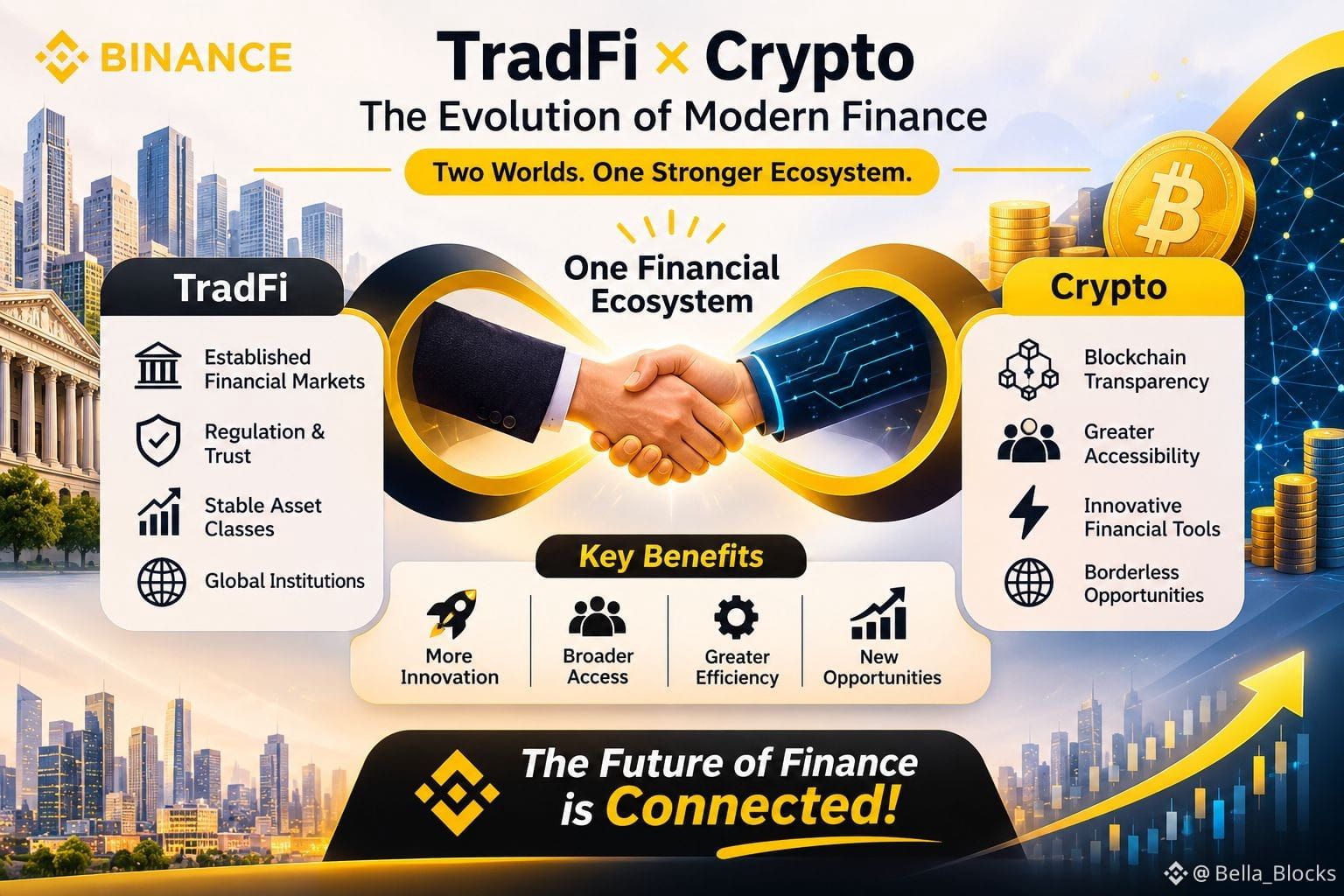
💛 TradFi Meets Crypto: One Financial World, More Opportunities.
The line between traditional finance and crypto is becoming smaller, and that's one of the most interesting developments in today's financial industry.
TradFi brings established financial markets, assets, and institutions, while blockchain introduces transparency, accessibility, and new ways to interact with financial products.
The real evolution isn't about choosing between TradFi and DeFi. It's about making financial markets more connected, efficient, and accessible.
And that's where platforms like Binance can play an important role by bringing traditional financial exposure closer to the crypto ecosystem.
My biggest takeaway: The future of finance won't be defined by one market, but by how seamlessly different markets work together.
💛 Learning, adapting, and evolving with Binance!
@BinanceTG
#BinanceSquareTG $BNB
{spot}(BNBUSDT)
💛 TradFi Meets Crypto: One Financial World, More Opportunities.
The line between traditional finance and crypto is becoming smaller, and that's one of the most interesting developments in today's financial industry.
TradFi brings established financial markets, assets, and institutions, while blockchain introduces transparency, accessibility, and new ways to interact with financial products.
The real evolution isn't about choosing between TradFi and DeFi. It's about making financial markets more connected, efficient, and accessible.
And that's where platforms like Binance can play an important role by bringing traditional financial exposure closer to the crypto ecosystem.
My biggest takeaway: The future of finance won't be defined by one market, but by how seamlessly different markets work together.
💛 Learning, adapting, and evolving with Binance!
@Binance TG Community
#BinanceSquareTG $BNB


Binance TG Community
·
--
Design a TradFI knowledge card 💛 and win your share of $1,000 in USDC.
🔸 Follow @Binance TG Community ( Square )
🔸 Follow @Binance Blockchain Week ( Square )
🔸 🏷️Make your Binance Branded TradFI knowledge card on Square with 💛#BinanceSquareTG and make a separate post. Like+RT
🔸 add your TradFI token ticker to your post ( example $BNB )
🔸 Fill out the survey: here
🔸 subscribe to our next live stream here
📅 Campaign Period: November 24, 2026, 10:00 UTC – December 4th, 2026, 17:00 UTC.
61
·
--
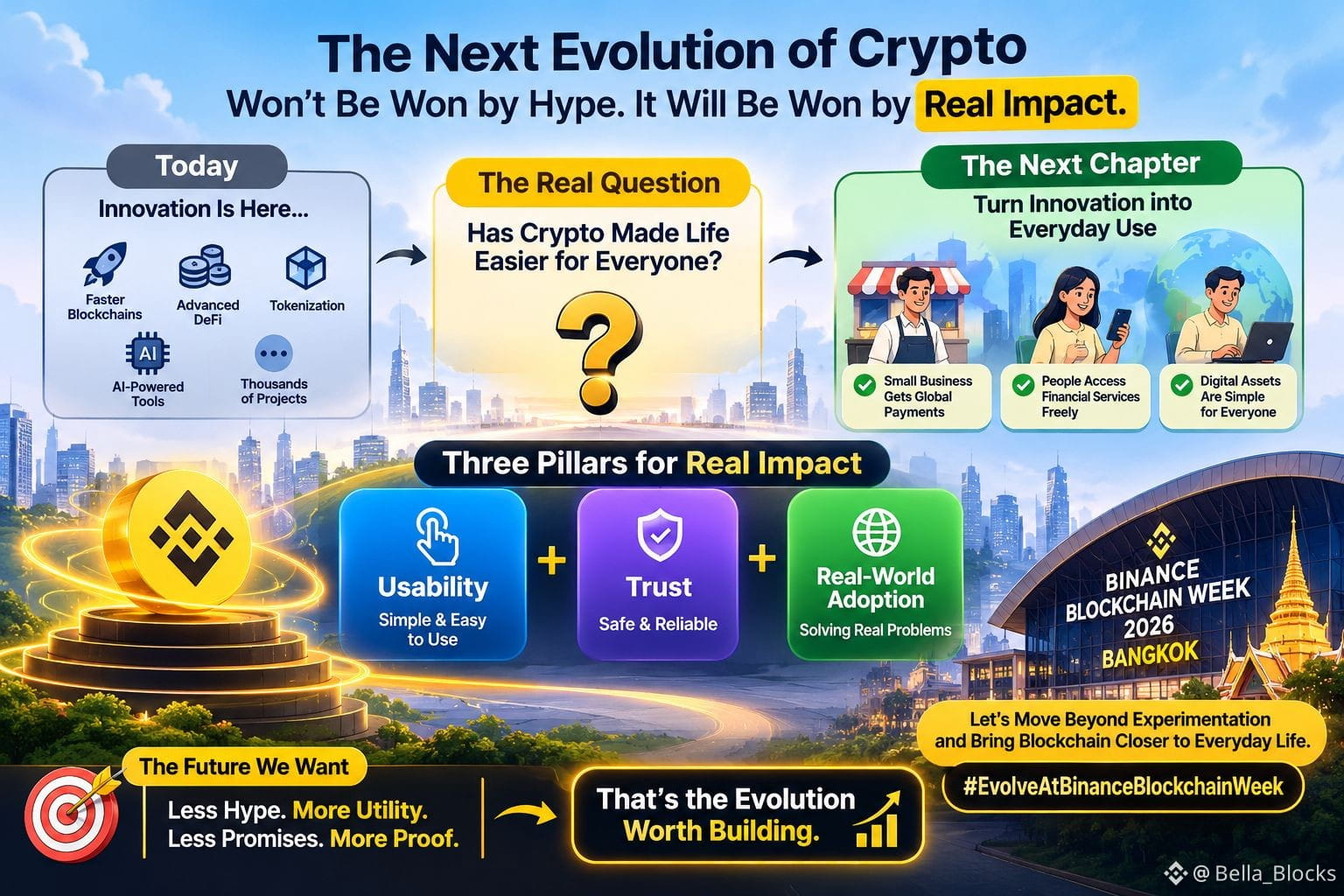
The Next Evolution of Crypto Won’t Be Won by Hype. It Will Be Won by Real Impact. 🌍
Something I've been thinking about lately:
Crypto has built incredible technology, but has it made life significantly easier for people outside the crypto community?
We have faster blockchains, advanced DeFi protocols, tokenization, AI-powered tools and thousands of new projects. Yet, the biggest opportunity is still ahead of us: turning all this innovation into something people can actually use and trust.
Imagine a small business receiving international payments without unnecessary delays and costs.
Imagine someone accessing financial services without depending on traditional banking infrastructure.
Imagine digital assets becoming simple enough for ordinary people to use without understanding every technical detail behind them.
That's the kind of progress I want to see.
For me, the next stage of blockchain evolution comes down to three things: Usability, Trust and Real-World Adoption.
Technology matters, but technology alone isn't success. What matters is whether it solves a genuine problem, creates sustainable value and earns people's trust.
That's why I'm looking forward to @BinanceBlockchainWeek 2026 in Bangkok, under this year's theme EVOLVE.
I want to hear how builders, founders and industry leaders plan to move beyond experimentation and bring blockchain closer to everyday life.
Because the next big milestone shouldn't simply be another record-breaking market cycle.
It should be the moment when people start using blockchain without even needing to think about the technology behind it.
Less hype. More utility. Less promises. More proof.
That's the evolution worth building.
What is the one real-world problem you believe blockchain should solve next?
#EvolveAtBinanceBlockchainWeek
$BULLA
{future}(BULLAUSDT)
$SPACE
{future}(SPACEUSDT)
$AIOT
{future}(AIOTUSDT)
The Next Evolution of Crypto Won’t Be Won by Hype. It Will Be Won by Real Impact. 🌍
Something I've been thinking about lately:
Crypto has built incredible technology, but has it made life significantly easier for people outside the crypto community?
We have faster blockchains, advanced DeFi protocols, tokenization, AI-powered tools and thousands of new projects. Yet, the biggest opportunity is still ahead of us: turning all this innovation into something people can actually use and trust.
Imagine a small business receiving international payments without unnecessary delays and costs.
Imagine someone accessing financial services without depending on traditional banking infrastructure.
Imagine digital assets becoming simple enough for ordinary people to use without understanding every technical detail behind them.
That's the kind of progress I want to see.
For me, the next stage of blockchain evolution comes down to three things: Usability, Trust and Real-World Adoption.
Technology matters, but technology alone isn't success. What matters is whether it solves a genuine problem, creates sustainable value and earns people's trust.
That's why I'm looking forward to @Binance Blockchain Week 2026 in Bangkok, under this year's theme EVOLVE.
I want to hear how builders, founders and industry leaders plan to move beyond experimentation and bring blockchain closer to everyday life.
Because the next big milestone shouldn't simply be another record-breaking market cycle.
It should be the moment when people start using blockchain without even needing to think about the technology behind it.
Less hype. More utility. Less promises. More proof.
That's the evolution worth building.
What is the one real-world problem you believe blockchain should solve next?
#EvolveAtBinanceBlockchainWeek
$BULLA
$SPACE
$AIOT
517
·
--
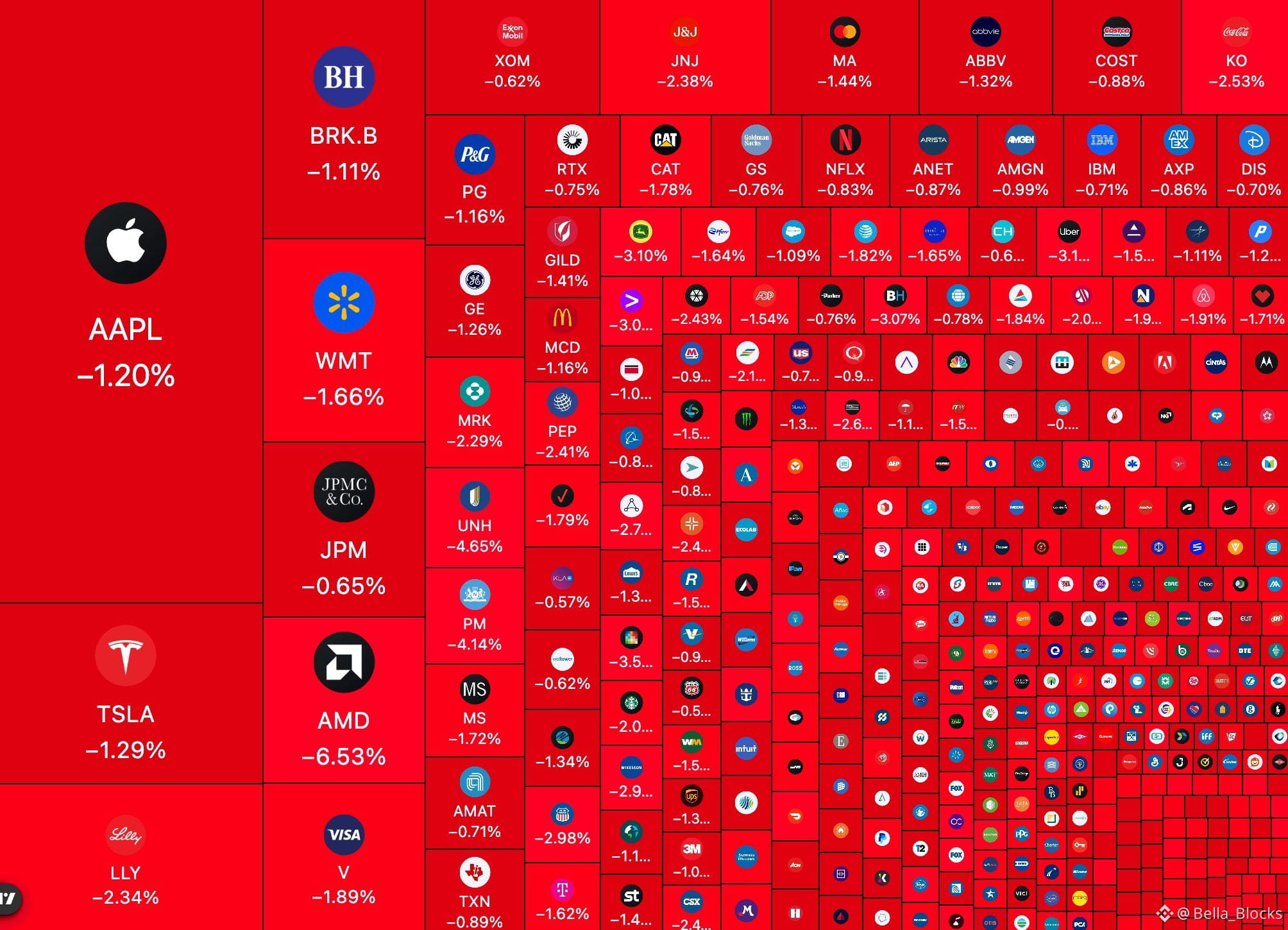
🚨 MASSIVE CRASH IN US STOCK MARKET
$1.16 TRILLION wiped out in just 60 minutes.
🚨 MASSIVE CRASH IN US STOCK MARKET
$1.16 TRILLION wiped out in just 60 minutes.
$1.16 TRILLION wiped out in just 60 minutes.
81
·
--
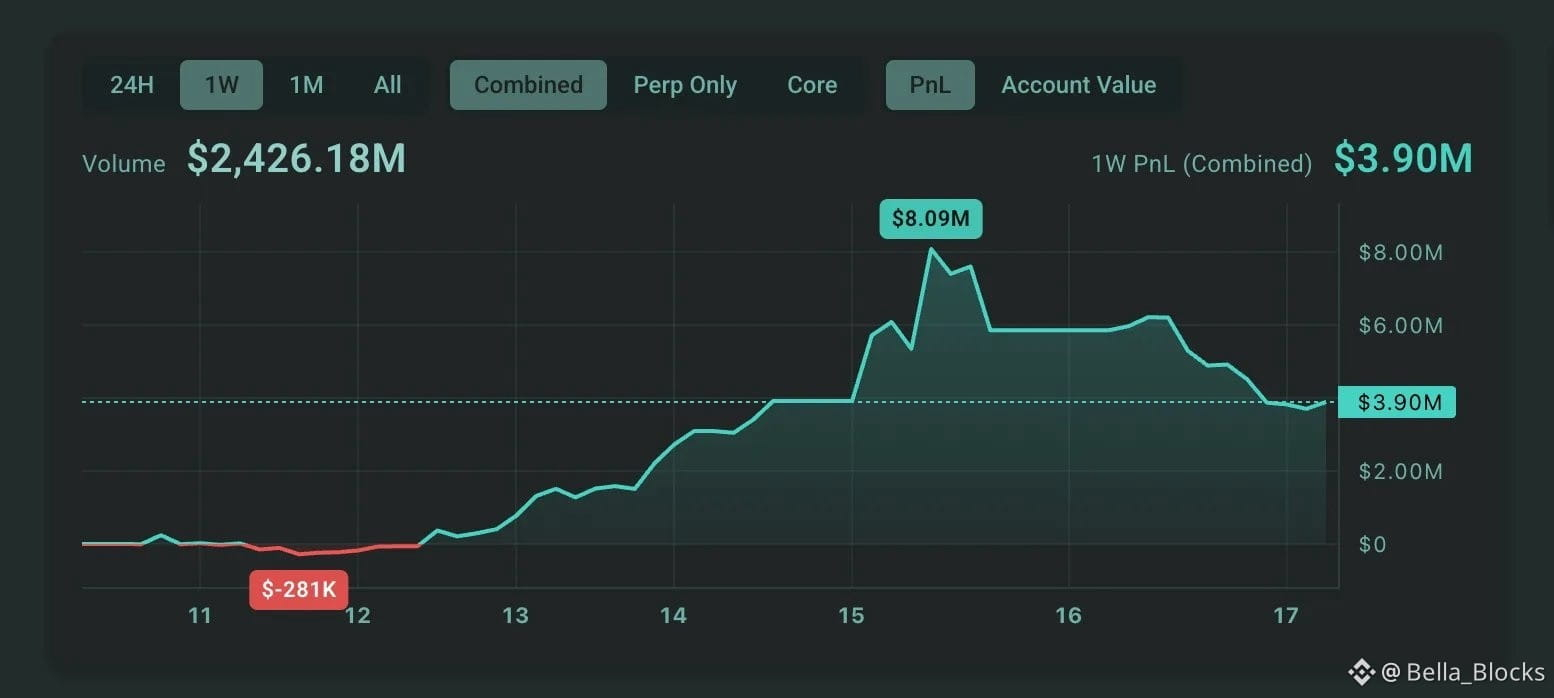
🚨 ONE WEEK. $650K → $3.90 MILLION! 🐋
A smart trader reportedly turned $650K into $3.9M, generated $2.426 BILLION in trading volume, and reached a peak PnL of $8.09M.
Now he's opening a massive $96 MILLION $BTC SHORT! 👀
What is he seeing that the market isn't?
Is a major correction coming, or is this the ultimate high-conviction bet?
Whales are making moves. Stay alert!
{spot}(BTCUSDT)
🚨 ONE WEEK. $650K → $3.90 MILLION! 🐋
A smart trader reportedly turned $650K into $3.9M, generated $2.426 BILLION in trading volume, and reached a peak PnL of $8.09M.
Now he's opening a massive $96 MILLION $BTC SHORT! 👀
What is he seeing that the market isn't?
Is a major correction coming, or is this the ultimate high-conviction bet?
Whales are making moves. Stay alert!
41
·
--
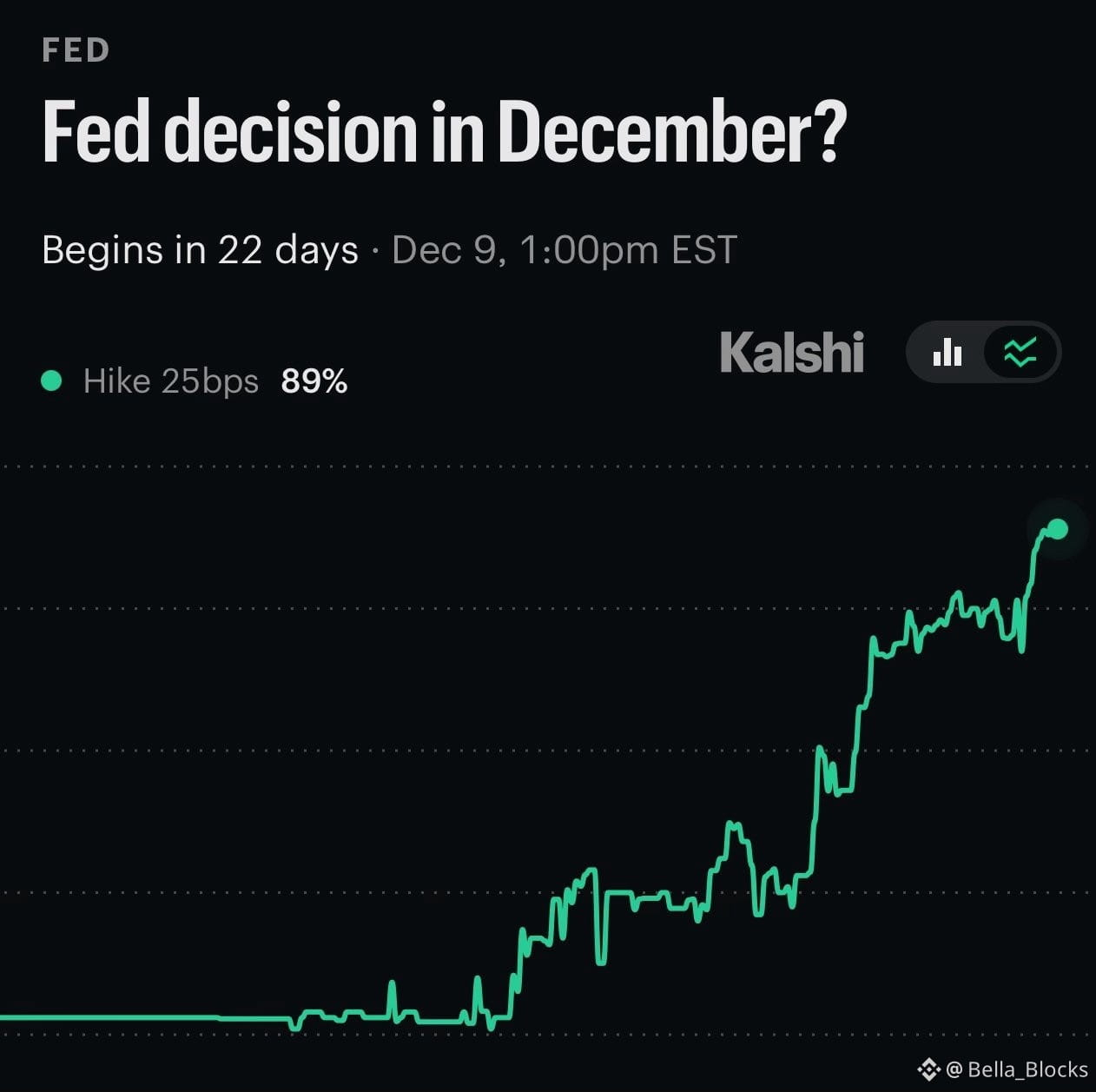
🚨 FED WATCH! 🇺🇸 Markets are pricing in an 89% chance of a 25 bps rate hike in December, according to Kalshi. 📈
A rate hike could shake risk assets, increase volatility, and put crypto bags under pressure. December could get wild! 👀
Buckle up, crypto holders. Protect your bags! 🔥
🚨 FED WATCH! 🇺🇸 Markets are pricing in an 89% chance of a 25 bps rate hike in December, according to Kalshi. 📈
A rate hike could shake risk assets, increase volatility, and put crypto bags under pressure. December could get wild! 👀
Buckle up, crypto holders. Protect your bags! 🔥
A rate hike could shake risk assets, increase volatility, and put crypto bags under pressure. December could get wild! 👀
Buckle up, crypto holders. Protect your bags! 🔥

36
·
--
What if the biggest risk in the AI economy isn’t what an agent can do, but how much authority we give it?
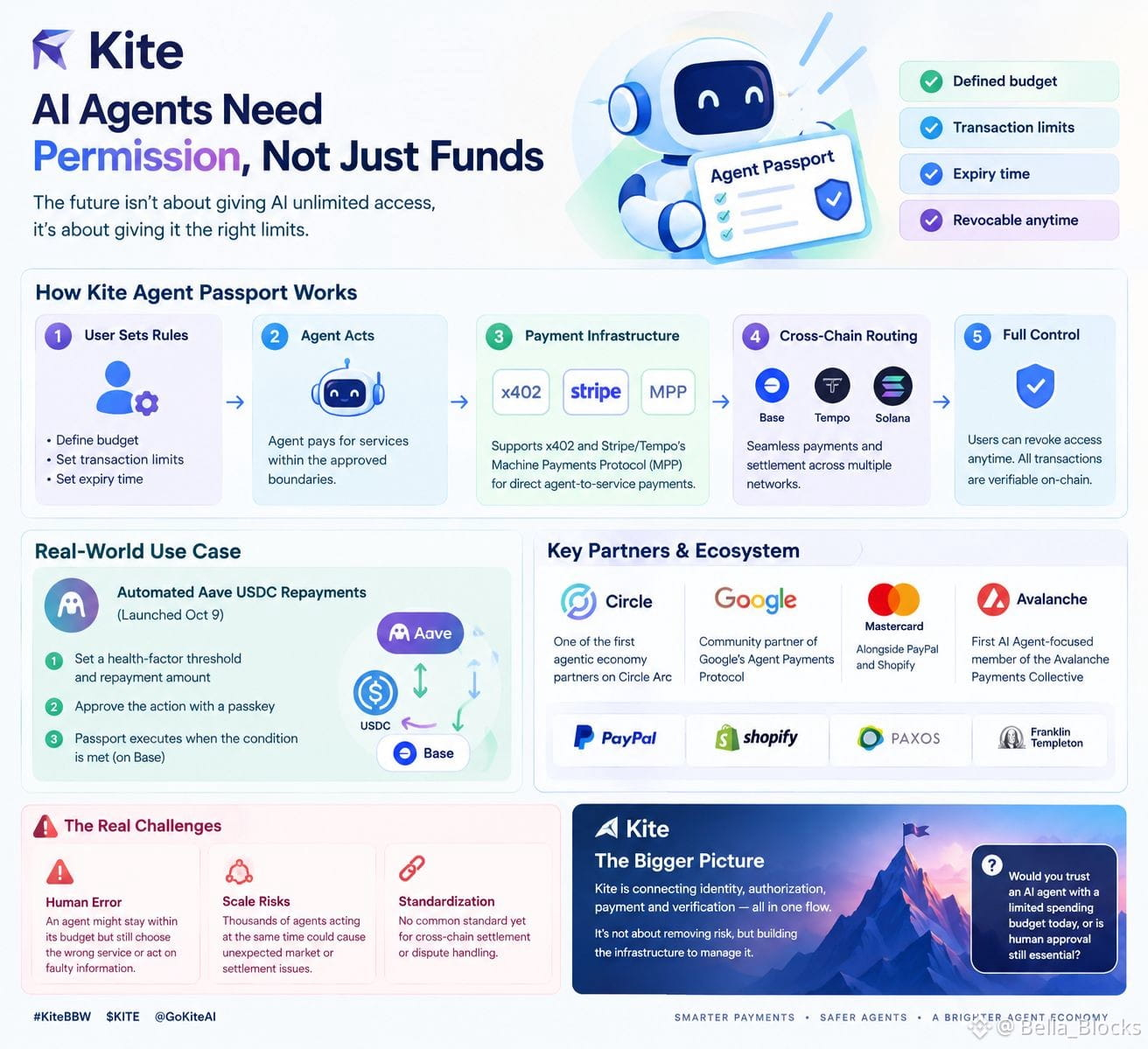
I’ve been looking at Kite from this angle, and one feature stands out: Agent Passport turns spending permission into something more controlled than simply handing an AI a funded wallet.
Users can approve spending sessions with defined budgets, transaction limits and expiry times. Agents can then pay for services within those boundaries, while users retain the ability to revoke access. That’s an important distinction: autonomy doesn’t have to mean unlimited control.
The infrastructure goes beyond a single payment route. Kite Passport supports x402 and Stripe/Tempo’s Machine Payments Protocol (MPP), allowing compatible services to request payment directly from agents. Its cross-chain routing also supports payments involving Base, Tempo and Solana, helping reduce the friction of funding and settlement across networks.
There’s a practical example, too. Kite’s October 9 release introduced automated Aave USDC loan repayments on Base. Users set a health-factor threshold and repayment amount, approve the action with a passkey, and Passport can execute when the specified condition is met.
Still, permission controls aren’t a guarantee against bad outcomes. An agent might stay within its budget and still choose the wrong service, act on faulty information, or make a costly decision. Auditable transactions help explain what happened; they don’t automatically recover lost funds.
That’s the real challenge for agent-native finance: connecting identity, authorization, payment and verification without pretending risk disappears.
Kite is building toward that model, but adoption, reliability and interoperability will determine how far it goes.
Would you trust an AI agent with a limited spending budget today, or is human approval still essential? 🪁
#KiteBBW $KITE @GoKiteAI
{spot}(KITEUSDT)
What if the biggest risk in the AI economy isn’t what an agent can do, but how much authority we give it?
I’ve been looking at Kite from this angle, and one feature stands out: Agent Passport turns spending permission into something more controlled than simply handing an AI a funded wallet.
Users can approve spending sessions with defined budgets, transaction limits and expiry times. Agents can then pay for services within those boundaries, while users retain the ability to revoke access. That’s an important distinction: autonomy doesn’t have to mean unlimited control.
The infrastructure goes beyond a single payment route. Kite Passport supports x402 and Stripe/Tempo’s Machine Payments Protocol (MPP), allowing compatible services to request payment directly from agents. Its cross-chain routing also supports payments involving Base, Tempo and Solana, helping reduce the friction of funding and settlement across networks.
There’s a practical example, too. Kite’s October 9 release introduced automated Aave USDC loan repayments on Base. Users set a health-factor threshold and repayment amount, approve the action with a passkey, and Passport can execute when the specified condition is met.
Still, permission controls aren’t a guarantee against bad outcomes. An agent might stay within its budget and still choose the wrong service, act on faulty information, or make a costly decision. Auditable transactions help explain what happened; they don’t automatically recover lost funds.
That’s the real challenge for agent-native finance: connecting identity, authorization, payment and verification without pretending risk disappears.
Kite is building toward that model, but adoption, reliability and interoperability will determine how far it goes.
Would you trust an AI agent with a limited spending budget today, or is human approval still essential? 🪁
#KiteBBW $KITE @KITE AI 中文
5
8
429
·
--
Bullish
Verified
AI stocks are rising, but I think the more interesting question now is: what gets paid when the AI buildout moves beyond GPUs?
NVIDIA just reported $96.2B in quarterly revenue, with Data Center revenue reaching $89B, up 117% YoY. Jensen Huang also said NVIDIA expects roughly 70% revenue growth for fiscal 2028, while its earnings call highlighted nearly $800B of 2026 capex from the top five hyperscalers.
But this spending creates a second investment layer.
AI data centers need electricity, grids, networking, cooling, memory, construction and cybersecurity. The IEA estimates global data-center electricity consumption could roughly double from 485 TWh in 2025 to 950 TWh by 2030, while AI-focused data centers are expected to grow even faster. In the US, data centers could account for around half of electricity-demand growth through 2030.
That changes how I look at the AI trade. It isn't only a semiconductor story anymore.
The opportunity may be spreading into the companies building the physical and digital infrastructure around AI—but so is the risk. If hyperscaler capex eventually slows, companies depending on constant AI spending could face pressure.
So I'm watching two things together: AI revenue growth vs. the cost of building all this compute.
If revenue keeps catching up with capex, the AI cycle could have much more room. If spending runs far ahead of monetization, today's excitement could become tomorrow's valuation problem.
I’m bullish on the long-term AI theme, but I’m increasingly interested in the picks-and-shovels behind it rather than simply chasing the headline.
#AIStocksWhatNext
$4Stock
{alpha}(560xd270d4e1ec6e6e0d28c0ecb8be966ec75997ffff)
$AGT
{future}(AGTUSDT)
$AKE
{future}(AKEUSDT)
AI stocks are rising, but I think the more interesting question now is: what gets paid when the AI buildout moves beyond GPUs?
NVIDIA just reported $96.2B in quarterly revenue, with Data Center revenue reaching $89B, up 117% YoY. Jensen Huang also said NVIDIA expects roughly 70% revenue growth for fiscal 2028, while its earnings call highlighted nearly $800B of 2026 capex from the top five hyperscalers.
But this spending creates a second investment layer.
AI data centers need electricity, grids, networking, cooling, memory, construction and cybersecurity. The IEA estimates global data-center electricity consumption could roughly double from 485 TWh in 2025 to 950 TWh by 2030, while AI-focused data centers are expected to grow even faster. In the US, data centers could account for around half of electricity-demand growth through 2030.
That changes how I look at the AI trade. It isn't only a semiconductor story anymore.
The opportunity may be spreading into the companies building the physical and digital infrastructure around AI—but so is the risk. If hyperscaler capex eventually slows, companies depending on constant AI spending could face pressure.
So I'm watching two things together: AI revenue growth vs. the cost of building all this compute.
If revenue keeps catching up with capex, the AI cycle could have much more room. If spending runs far ahead of monetization, today's excitement could become tomorrow's valuation problem.
I’m bullish on the long-term AI theme, but I’m increasingly interested in the picks-and-shovels behind it rather than simply chasing the headline.
#AIStocksWhatNext
$4Stock
$AGT
$AKE

1
1
974
·
--
Bullish
I’m watching the Fed this week less for the 25bp headline and more for what comes AFTER it.
August core CPI rose 0.3% MoM, headline CPI hit 3.4% YoY, and markets are now pricing roughly a 92% chance of a 25bp hike. The bigger problem? The 10Y Treasury yield has pushed above 5%.
So if the Fed hikes to 3.75–4.00%, I don’t think the first reaction tells the whole story.
BTC could face volatility as liquidity tightens, but if traders interpret the hike as a “one-off” rather than the beginning of another cycle, the selloff could fade quickly.
Tech stocks have a tougher setup because higher yields increase the discount rate on future growth. Gold is also feeling pressure as higher yields and a stronger dollar raise the opportunity cost of holding a non-yielding asset. Gold was already down 0.4% today amid rising hike expectations.
My trade plan: I’d rather wait for the Fed statement and Powell’s guidance than blindly trade the 25bp itself. The real signal is whether September is the END of tightening—or the beginning of something bigger.
That distinction could decide the next move in BTC, tech and gold.
#FedRateWatch
$POWER
{future}(POWERUSDT)
$AIN
{future}(AINUSDT)
$AI
{spot}(AIUSDT)
I’m watching the Fed this week less for the 25bp headline and more for what comes AFTER it.
August core CPI rose 0.3% MoM, headline CPI hit 3.4% YoY, and markets are now pricing roughly a 92% chance of a 25bp hike. The bigger problem? The 10Y Treasury yield has pushed above 5%.
So if the Fed hikes to 3.75–4.00%, I don’t think the first reaction tells the whole story.
BTC could face volatility as liquidity tightens, but if traders interpret the hike as a “one-off” rather than the beginning of another cycle, the selloff could fade quickly.
Tech stocks have a tougher setup because higher yields increase the discount rate on future growth. Gold is also feeling pressure as higher yields and a stronger dollar raise the opportunity cost of holding a non-yielding asset. Gold was already down 0.4% today amid rising hike expectations.
My trade plan: I’d rather wait for the Fed statement and Powell’s guidance than blindly trade the 25bp itself. The real signal is whether September is the END of tightening—or the beginning of something bigger.
That distinction could decide the next move in BTC, tech and gold.
#FedRateWatch
$POWER
$AIN
$AI

177
·
--
Bullish
🔥 CPI WATCH: Will Inflation Decide the Fed’s Next Move?
Nonfarm payrolls came in stronger than expected, adding fresh pressure to the market ahead of the upcoming CPI report. Now the big question is: Will the Federal Reserve hike rates, or hold?
A hotter-than-expected CPI could signal that inflation is still sticky. That may strengthen the case for tighter policy, potentially putting pressure on stocks and gold while supporting the dollar. 📉
But if CPI comes in cooler than expected, markets could interpret it as a sign that inflation is easing. A rate-hold narrative could become stronger, potentially supporting risk assets and improving sentiment toward stocks. 📈
My view? I’m watching the CPI surprise more than the headline number. The bigger the gap between actual inflation and expectations, the bigger the potential market reaction.
Are you bullish or bearish going into CPI? I’m watching the reaction in stocks and gold closely.
What’s your call: FED HIKE 🔴 or HOLD 🟢?
#CPIWatch
$NES
{alpha}(560x097acf27503753e77bca940277806156c5925b81)
$4Stock
{alpha}(560xd270d4e1ec6e6e0d28c0ecb8be966ec75997ffff)
$MEME
{spot}(MEMEUSDT)
🔥 CPI WATCH: Will Inflation Decide the Fed’s Next Move?
Nonfarm payrolls came in stronger than expected, adding fresh pressure to the market ahead of the upcoming CPI report. Now the big question is: Will the Federal Reserve hike rates, or hold?
A hotter-than-expected CPI could signal that inflation is still sticky. That may strengthen the case for tighter policy, potentially putting pressure on stocks and gold while supporting the dollar. 📉
But if CPI comes in cooler than expected, markets could interpret it as a sign that inflation is easing. A rate-hold narrative could become stronger, potentially supporting risk assets and improving sentiment toward stocks. 📈
My view? I’m watching the CPI surprise more than the headline number. The bigger the gap between actual inflation and expectations, the bigger the potential market reaction.
Are you bullish or bearish going into CPI? I’m watching the reaction in stocks and gold closely.
What’s your call: FED HIKE 🔴 or HOLD 🟢?
#CPIWatch
$NES
$4Stock
$MEME

17
19
267
·
--
#dusk $DUSK @Dusk_Foundation
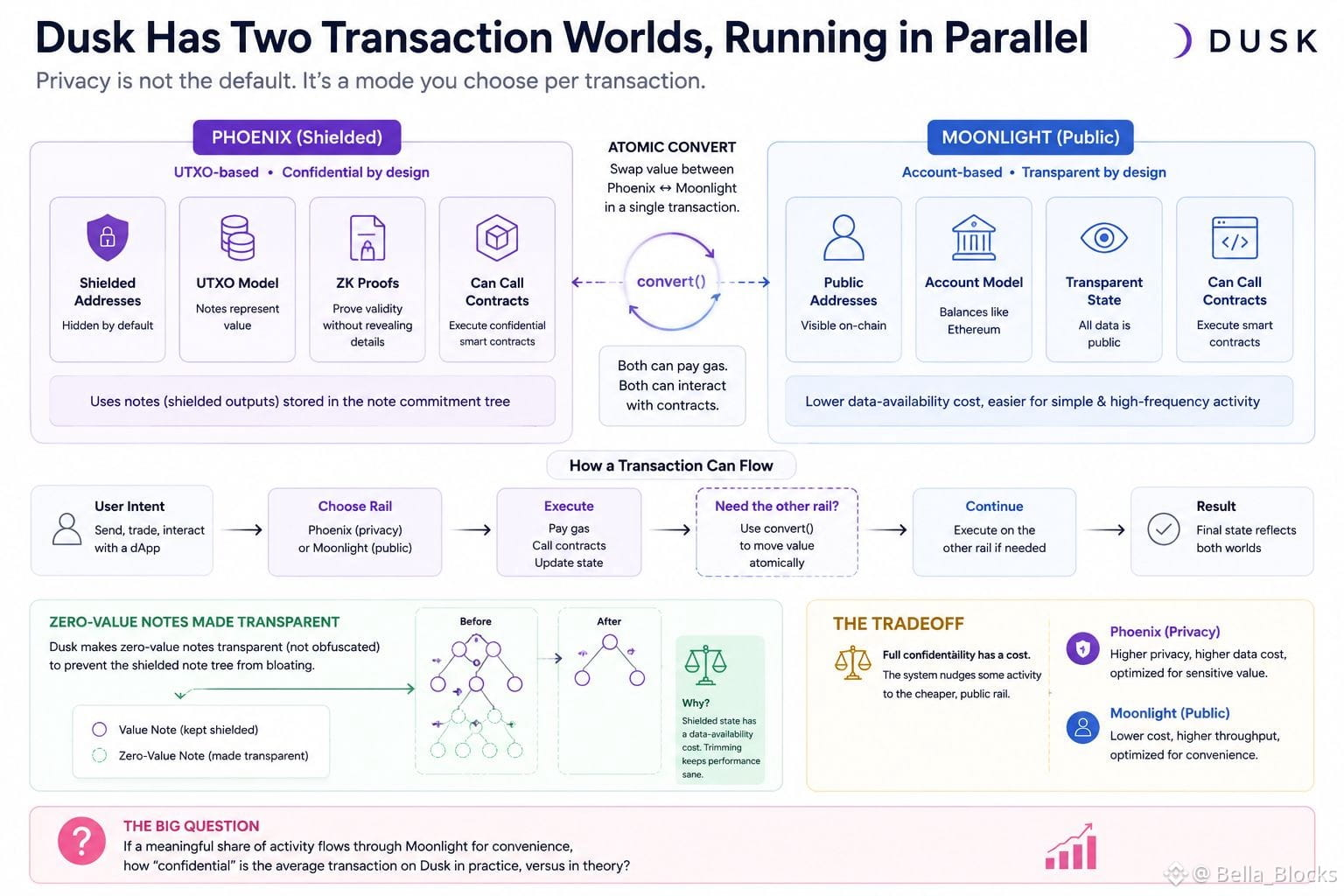
I was digging through Dusk's docs trying to understand what "confidential dApp" actually means at the transaction level, and I ran into something that made me pause. Dusk doesn't have one transaction type — it has two, running in parallel. Phoenix is the shielded, UTXO-based model. Moonlight is public and account-based, closer to how Ethereum works. Both can pay gas, both can call contracts, and there's literally a convert function that lets you atomically swap value between the two.
That's not what I expected. I'd assumed "privacy-first chain" meant privacy by default. It doesn't. Privacy is a mode you opt into per transaction, not a property of the network itself.
I went back to the engineering notes twice because I thought I'd misread it, but there's another detail buried in there: Dusk started making zero-value notes transparent instead of obfuscated, specifically to stop the shielded note tree from bloating with non-value entries. So shielded state isn't free to maintain — the protocol is actively trimming what it hides to keep performance sane.
None of this feels like a flaw. It reads more like an honest tradeoff: full confidentiality has a data-availability cost, so the system nudges some activity toward the cheaper, public rail.
Which raises the question — if a meaningful share of activity ends up flowing through Moonlight for convenience, how "confidential" is the average transaction on Dusk in practice, versus in theory?
$BMT
{spot}(BMTUSDT)
$STX
{spot}(STXUSDT)
{spot}(DUSKUSDT)
#dusk $DUSK @Dusk
I was digging through Dusk's docs trying to understand what "confidential dApp" actually means at the transaction level, and I ran into something that made me pause. Dusk doesn't have one transaction type — it has two, running in parallel. Phoenix is the shielded, UTXO-based model. Moonlight is public and account-based, closer to how Ethereum works. Both can pay gas, both can call contracts, and there's literally a convert function that lets you atomically swap value between the two.
That's not what I expected. I'd assumed "privacy-first chain" meant privacy by default. It doesn't. Privacy is a mode you opt into per transaction, not a property of the network itself.
I went back to the engineering notes twice because I thought I'd misread it, but there's another detail buried in there: Dusk started making zero-value notes transparent instead of obfuscated, specifically to stop the shielded note tree from bloating with non-value entries. So shielded state isn't free to maintain — the protocol is actively trimming what it hides to keep performance sane.
None of this feels like a flaw. It reads more like an honest tradeoff: full confidentiality has a data-availability cost, so the system nudges some activity toward the cheaper, public rail.
Which raises the question — if a meaningful share of activity ends up flowing through Moonlight for convenience, how "confidential" is the average transaction on Dusk in practice, versus in theory?
$BMT
$STX
1
189
·
--
#dusk $DUSK @Dusk_Foundation
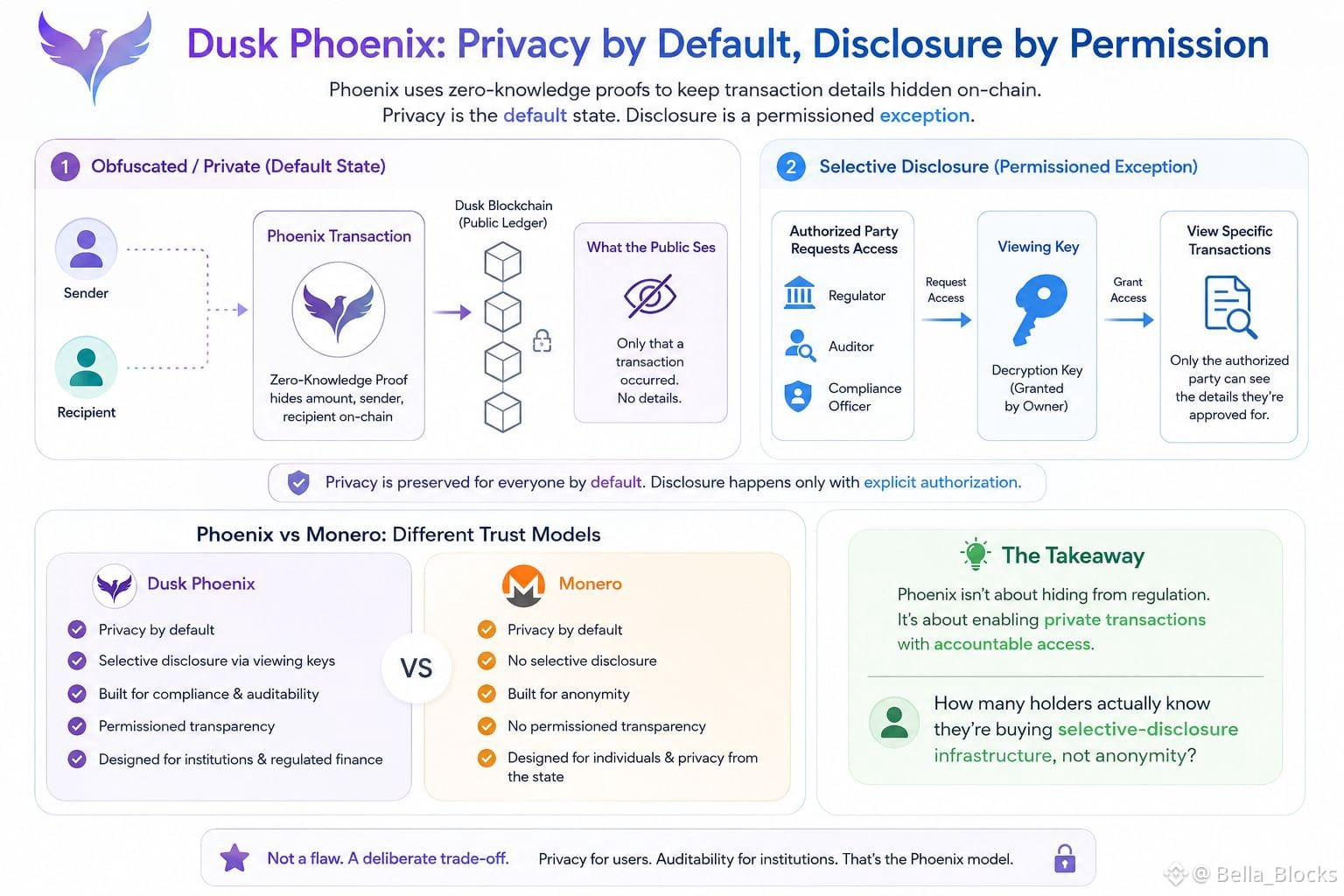
I was digging through Dusk's documentation on their Phoenix transaction model, trying to understand how they actually balance privacy with the compliance requirements banks would need. And I got stuck on something that isn't really talked about outside the technical docs: the difference between "obfuscated" and "private" in their own framing.
Dusk uses zero-knowledge proofs so transaction amounts and participants aren't visible on-chain by default. Fine, that's the pitch everyone repeats. But then I noticed they specifically build in the ability for selective disclosure — meaning a regulator or auditor can be given a viewing key to see specific transactions without the whole network being exposed. That's not the same thing as "private" in the way most retail crypto users mean it when they hear the word.
I went back to the docs twice because I wanted to make sure I wasn't overreading this. What it actually creates is a system where privacy is the default state, but disclosure is a permissioned exception — not a public one. That's a meaningfully different trust model than something like Monero, and it's clearly designed for institutions that need audit trails, not anonymity from the state.
It's not a flaw. It's a deliberate trade-off. But it does mean the "privacy coin" label gets thrown around loosely.
How many holders actually know they're buying selective-disclosure infrastructure, not anonymity?
$SPK
{spot}(SPKUSDT)
$MORPHO
{spot}(MORPHOUSDT)
{spot}(DUSKUSDT)
#dusk $DUSK @Dusk
I was digging through Dusk's documentation on their Phoenix transaction model, trying to understand how they actually balance privacy with the compliance requirements banks would need. And I got stuck on something that isn't really talked about outside the technical docs: the difference between "obfuscated" and "private" in their own framing.
Dusk uses zero-knowledge proofs so transaction amounts and participants aren't visible on-chain by default. Fine, that's the pitch everyone repeats. But then I noticed they specifically build in the ability for selective disclosure — meaning a regulator or auditor can be given a viewing key to see specific transactions without the whole network being exposed. That's not the same thing as "private" in the way most retail crypto users mean it when they hear the word.
I went back to the docs twice because I wanted to make sure I wasn't overreading this. What it actually creates is a system where privacy is the default state, but disclosure is a permissioned exception — not a public one. That's a meaningfully different trust model than something like Monero, and it's clearly designed for institutions that need audit trails, not anonymity from the state.
It's not a flaw. It's a deliberate trade-off. But it does mean the "privacy coin" label gets thrown around loosely.
How many holders actually know they're buying selective-disclosure infrastructure, not anonymity?
$SPK
$MORPHO
3
2
199
·
--
#dusk $DUSK @Dusk_Foundation
I was digging through Dusk's own use-case docs on Smart Bulletin Boards, expecting some kind of automated matching engine, and the wording that jumped out was that they indirectly match qualified buyers and sellers of security tokens Dusk , and only once both parties come to terms and a deal is struck, they can execute the trade Dusk .
That word "indirectly" made me stop. I went back to the docs twice because I'd assumed "smart bulletin board" meant some on-chain orderbook doing the matching for you. It doesn't, at least not from what's published. The board is a discovery layer — it surfaces qualified counterparties — but the actual negotiation (price, terms, timing) still happens off-chain, human to human. What's trustless is the settlement, not the deal-making.
That's not a flaw, it's a design choice that maps to how private securities already trade OTC, where Dusk's own materials point out that broker/lawyer involvement typically costs somewhere in the 2.5%-15% Dusk range. The bulletin board is aimed at compressing that cost by cutting the settlement friction, not the negotiation itself. It's more like a matchmaking app that still leaves the actual date up to you than a vending machine that closes the deal automatically.
So the incentive this creates is interesting: it rewards parties who already know how to negotiate OTC, while the "trustless" part only kicks in at the very end. How many people assume the whole process is automated, versus just the settlement?
$TUT
{spot}(TUTUSDT)
$PORTAL
{spot}(PORTALUSDT)
{spot}(DUSKUSDT)
How automated do you think Dusk’s Smart Bulletin Board is?
#dusk $DUSK @Dusk
I was digging through Dusk's own use-case docs on Smart Bulletin Boards, expecting some kind of automated matching engine, and the wording that jumped out was that they indirectly match qualified buyers and sellers of security tokens Dusk , and only once both parties come to terms and a deal is struck, they can execute the trade Dusk .
That word "indirectly" made me stop. I went back to the docs twice because I'd assumed "smart bulletin board" meant some on-chain orderbook doing the matching for you. It doesn't, at least not from what's published. The board is a discovery layer — it surfaces qualified counterparties — but the actual negotiation (price, terms, timing) still happens off-chain, human to human. What's trustless is the settlement, not the deal-making.
That's not a flaw, it's a design choice that maps to how private securities already trade OTC, where Dusk's own materials point out that broker/lawyer involvement typically costs somewhere in the 2.5%-15% Dusk range. The bulletin board is aimed at compressing that cost by cutting the settlement friction, not the negotiation itself. It's more like a matchmaking app that still leaves the actual date up to you than a vending machine that closes the deal automatically.
So the incentive this creates is interesting: it rewards parties who already know how to negotiate OTC, while the "trustless" part only kicks in at the very end. How many people assume the whole process is automated, versus just the settlement?
$TUT
$PORTAL
How automated do you think Dusk’s Smart Bulletin Board is?
🤖 Fully automated
67%
🤝 Discovery+human negotiation
0%
🔐 Trustless settlement only
33%
🤔 Not sure
0%
3 votes • Voting closed
3
1.3k
·
--
#dusk $DUSK @Dusk_Foundation
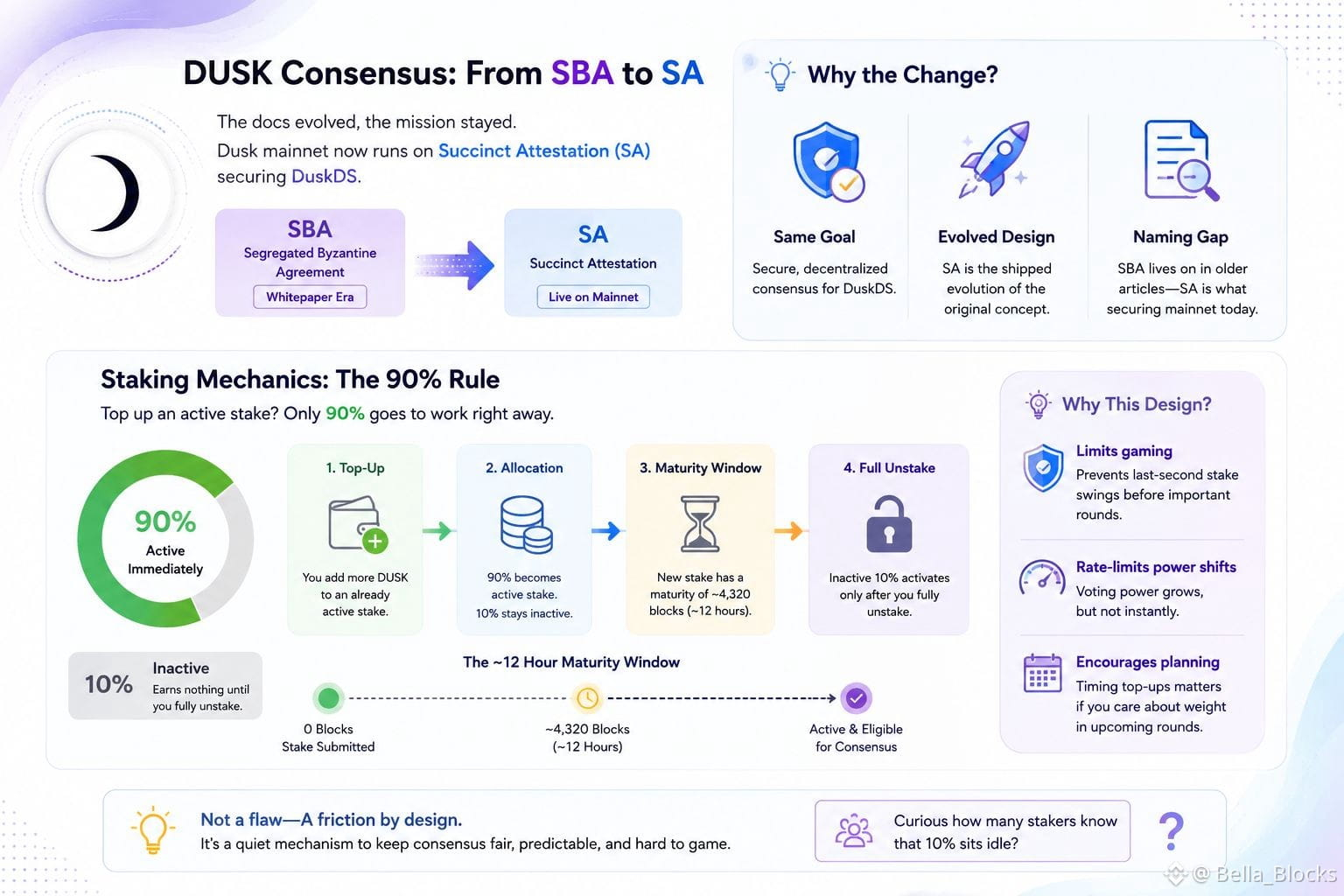
I was digging through Dusk's current docs to refresh myself on the SBA consensus everyone still references in write-ups, and I noticed the docs don't actually call it that anymore. The live mainnet documentation refers to "Succinct Attestation" (SA) as the consensus protocol securing DuskDS, while most explainer articles, exchange listings, and even parts of the community still talk about Segregated Byzantine Agreement like it's the current thing. Went back and checked twice because I assumed I'd mixed up two different mechanisms — but no, SA is described as the evolution that shipped for mainnet, and SBA is mostly whitepaper-era language now.
That's a naming gap, not a red flag, but it led me somewhere more interesting: the staking mechanics underneath it. If you top up an already-active stake, only 90% of the new amount goes active immediately — the other 10% sits inactive, earning nothing, until you fully unstake. It's a quiet friction point. Combined with a ~4,320 block (roughly 12-hour) maturity window on any new stake, it means compounding isn't as frictionless as "just add more DUSK" — there's a deliberate lag baked in, presumably to limit gaming of sortition weight right before rounds where stake size matters.
None of this is hidden, it's just not front-page material. It reads less like a flaw and more like a rate-limiter on how fast voting power can shift.
Curious how many stakers actually know that 10% sits idle — and whether that's shaping how people time their top-ups.
$TRUMP
{spot}(TRUMPUSDT)
$TRB
{future}(TRBUSDT)
{spot}(DUSKUSDT)
#dusk $DUSK @Dusk
I was digging through Dusk's current docs to refresh myself on the SBA consensus everyone still references in write-ups, and I noticed the docs don't actually call it that anymore. The live mainnet documentation refers to "Succinct Attestation" (SA) as the consensus protocol securing DuskDS, while most explainer articles, exchange listings, and even parts of the community still talk about Segregated Byzantine Agreement like it's the current thing. Went back and checked twice because I assumed I'd mixed up two different mechanisms — but no, SA is described as the evolution that shipped for mainnet, and SBA is mostly whitepaper-era language now.
That's a naming gap, not a red flag, but it led me somewhere more interesting: the staking mechanics underneath it. If you top up an already-active stake, only 90% of the new amount goes active immediately — the other 10% sits inactive, earning nothing, until you fully unstake. It's a quiet friction point. Combined with a ~4,320 block (roughly 12-hour) maturity window on any new stake, it means compounding isn't as frictionless as "just add more DUSK" — there's a deliberate lag baked in, presumably to limit gaming of sortition weight right before rounds where stake size matters.
None of this is hidden, it's just not front-page material. It reads less like a flaw and more like a rate-limiter on how fast voting power can shift.
Curious how many stakers actually know that 10% sits idle — and whether that's shaping how people time their top-ups.
$TRUMP
$TRB
1
1
294
·
--
#dusk $DUSK @Dusk_Foundation
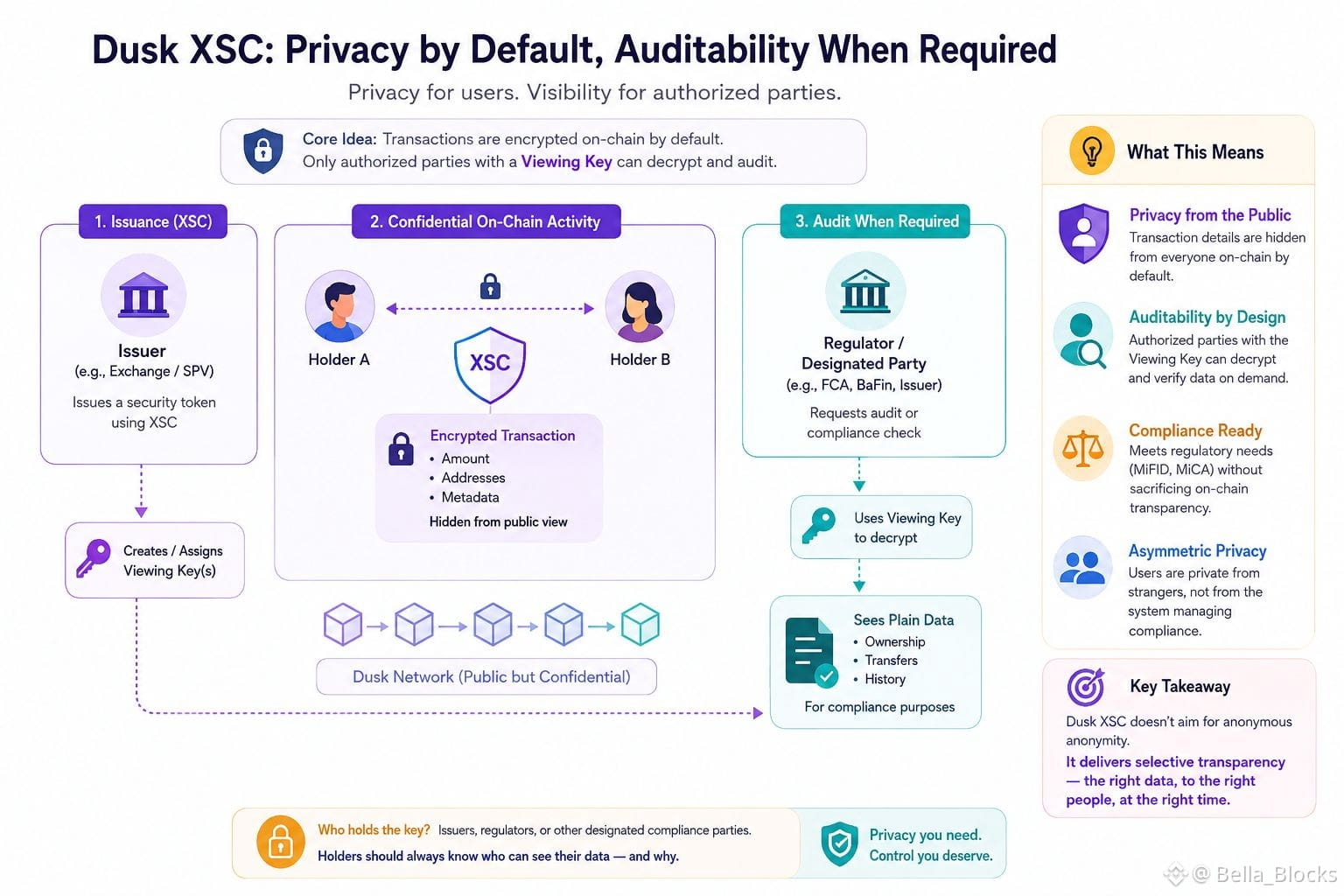
I was digging through Dusk's docs trying to understand what "privacy by default, auditability when required" actually means at the protocol level, because that phrase shows up everywhere in their RWA materials and I wanted to know who's doing the auditing.
Turns out the XSC standard bakes in optional viewing keys tied to the compliance layer — so when a security token gets issued through XSC, the issuer (or a designated regulator) can hold a key that decrypts transaction details that stay hidden from everyone else on-chain. I went back to the docs twice because I initially read it as full end-to-end privacy, the kind you'd get with a typical shielded transaction. It's not quite that. It's privacy from the public, not necessarily from the counterparty running the compliance rules.
That's not a flaw, it's the whole point — you can't get a MiFID or MiCA-compliant security token without someone being able to prove ownership and flow of funds on demand. But it does mean the privacy guarantee is asymmetric by design, and I don't think that's obvious to someone reading "confidential" on the homepage and assuming symmetric anonymity like a privacy coin.
The incentive this creates is interesting: issuers get comfortable putting real securities on a public chain precisely because they retain visibility. Users get privacy from strangers, not from the system managing them. Worth asking how many holders actually know who's holding that key on any given asset.
{spot}(DUSKUSDT)
#dusk $DUSK @Dusk
I was digging through Dusk's docs trying to understand what "privacy by default, auditability when required" actually means at the protocol level, because that phrase shows up everywhere in their RWA materials and I wanted to know who's doing the auditing.
Turns out the XSC standard bakes in optional viewing keys tied to the compliance layer — so when a security token gets issued through XSC, the issuer (or a designated regulator) can hold a key that decrypts transaction details that stay hidden from everyone else on-chain. I went back to the docs twice because I initially read it as full end-to-end privacy, the kind you'd get with a typical shielded transaction. It's not quite that. It's privacy from the public, not necessarily from the counterparty running the compliance rules.
That's not a flaw, it's the whole point — you can't get a MiFID or MiCA-compliant security token without someone being able to prove ownership and flow of funds on demand. But it does mean the privacy guarantee is asymmetric by design, and I don't think that's obvious to someone reading "confidential" on the homepage and assuming symmetric anonymity like a privacy coin.
The incentive this creates is interesting: issuers get comfortable putting real securities on a public chain precisely because they retain visibility. Users get privacy from strangers, not from the system managing them. Worth asking how many holders actually know who's holding that key on any given asset.
12
10
621
·
--
#termmax @termmax
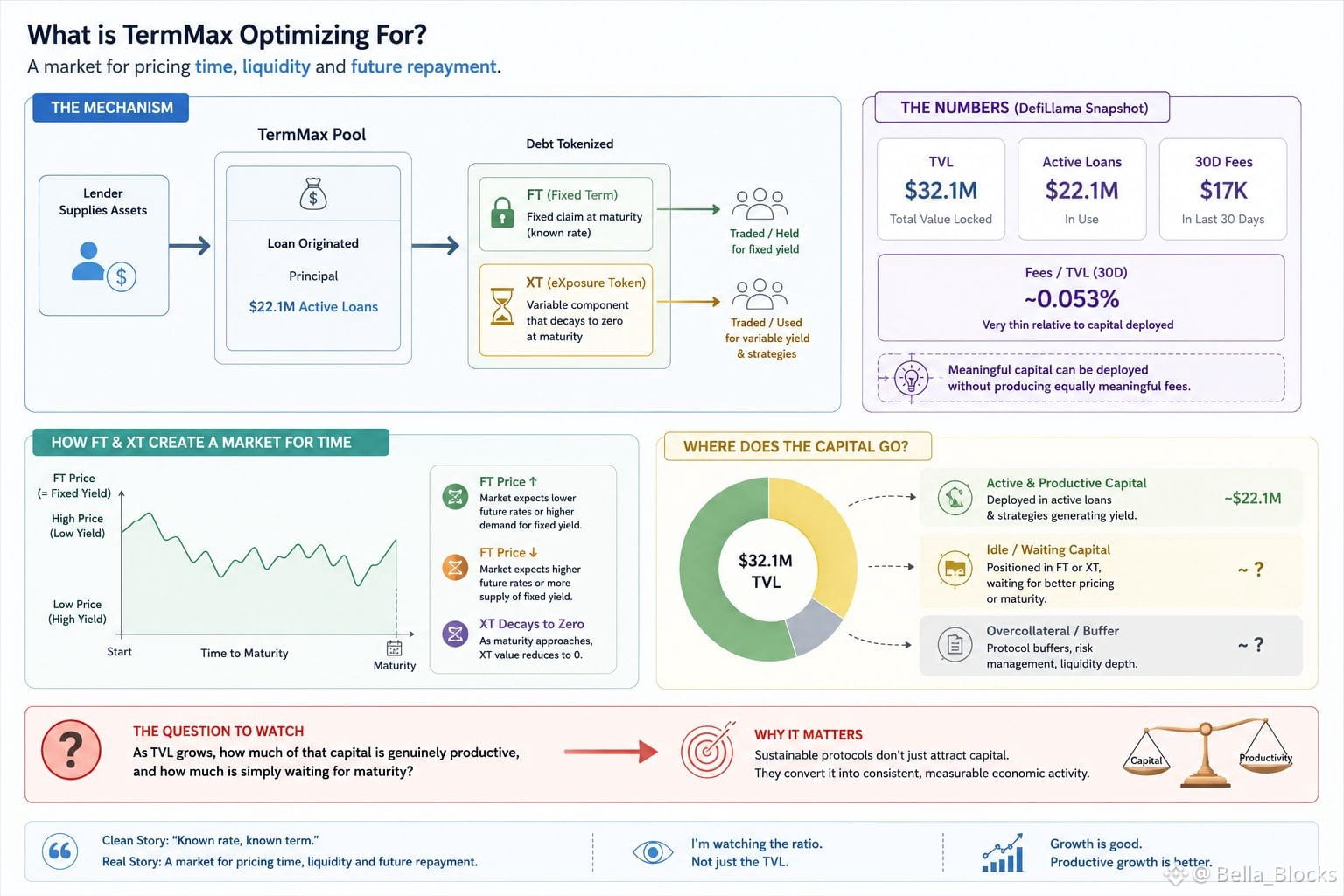
I keep coming back to one number while digging through TermMax: the gap between capital sitting in the protocol and the fees it’s actually generating.
The latest DefiLlama snapshot I found shows about $32.1M TVL, with roughly $22.1M in active loans, while 30-day fees were only around $17K.
I thought I had misread it, so I went back into the docs to understand what TermMax is actually optimizing for.
The mechanism is more interesting than a simple “fixed-rate lending” label suggests. TermMax tokenizes debt into FT and XT. FT represents the fixed claim at maturity, while XT carries the remaining variable component and eventually goes to zero.
That creates a different behavior from a normal lending pool. Capital isn’t simply earning a floating rate. Users are trading around specific maturities, and the FT price effectively determines the fixed yield.
So the clean story is “known rate, known term.” Underneath, it’s really a market for pricing time, liquidity and future repayment.
The interesting part is that meaningful capital can be deployed without producing equally meaningful fees. That isn’t automatically a problem. Usage could still be concentrated in certain markets or strategies.
But it raises a question I think is worth watching:
As TVL grows, how much of that capital is genuinely productive, and how much is simply waiting for maturity?
$ONG
{spot}(ONGUSDT)
$PEOPLE
{spot}(PEOPLEUSDT)
$NEIRO
{spot}(NEIROUSDT)
#termmax @TermMax
I keep coming back to one number while digging through TermMax: the gap between capital sitting in the protocol and the fees it’s actually generating.
The latest DefiLlama snapshot I found shows about $32.1M TVL, with roughly $22.1M in active loans, while 30-day fees were only around $17K.
I thought I had misread it, so I went back into the docs to understand what TermMax is actually optimizing for.
The mechanism is more interesting than a simple “fixed-rate lending” label suggests. TermMax tokenizes debt into FT and XT. FT represents the fixed claim at maturity, while XT carries the remaining variable component and eventually goes to zero.
That creates a different behavior from a normal lending pool. Capital isn’t simply earning a floating rate. Users are trading around specific maturities, and the FT price effectively determines the fixed yield.
So the clean story is “known rate, known term.” Underneath, it’s really a market for pricing time, liquidity and future repayment.
The interesting part is that meaningful capital can be deployed without producing equally meaningful fees. That isn’t automatically a problem. Usage could still be concentrated in certain markets or strategies.
But it raises a question I think is worth watching:
As TVL grows, how much of that capital is genuinely productive, and how much is simply waiting for maturity?
$ONG
$PEOPLE
$NEIRO
1
3
105
·
--
#dusk $DUSK @Dusk_Foundation
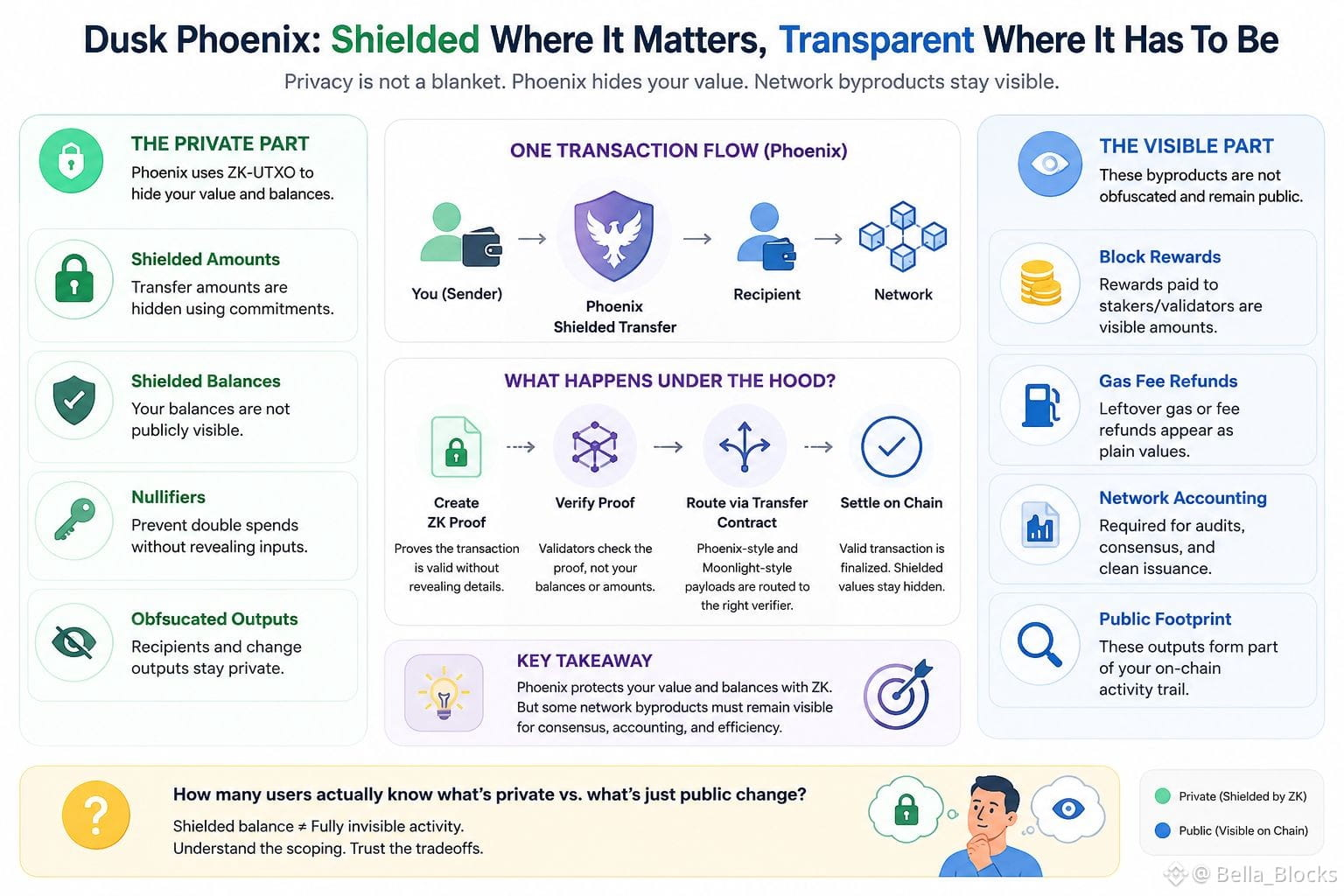
I was digging through Dusk's docs trying to understand what "shielded" actually means in Phoenix, and I hit a line that made me stop and reread it. One official description of Phoenix says it gives complete on-chain privacy — even for non-obfuscated outputs such as block rewards and gas fee refunds Complete privacy" and "non-obfuscated outputs" sitting in the same sentence felt like a contradiction, so I went back to the docs twice thinking I'd misread it.
Turns out it's not a mistake, it's a scoping choice. Phoenix is the zero-knowledge UTXO transaction model built into Dusk's Transfer contract, supporting both transparent and obfuscated transactions and at the settlement layer a Transfer Contract routes Phoenix-style and Moonlight-style payloads to the appropriate verification logic meaning shielded and transparent value can coexist on the same chain, sometimes in the same transaction flow.
So the "privacy" isn't a blanket. Your transfer amounts and balances can be obfuscated behind commitments and nullifiers, but the mechanical byproducts of actually using the network — leftover gas refunds, staking/block rewards — apparently surface as plain values rather than hidden ones.
That's not broken, it's a tradeoff: full obfuscation everywhere adds proving cost, and reward issuance likely needs to stay auditable for consensus to function cleanly. But it does mean part of your on-chain footprint stays visible even when your "balance" is technically shielded.
How many people running Phoenix transactions actually know which piece of their activity is the private part, and which is just public change?
$AVAAI
{future}(AVAAIUSDT)
{spot}(DUSKUSDT)
$BOME
{spot}(BOMEUSDT)
#dusk $DUSK @Dusk
I was digging through Dusk's docs trying to understand what "shielded" actually means in Phoenix, and I hit a line that made me stop and reread it. One official description of Phoenix says it gives complete on-chain privacy — even for non-obfuscated outputs such as block rewards and gas fee refunds Complete privacy" and "non-obfuscated outputs" sitting in the same sentence felt like a contradiction, so I went back to the docs twice thinking I'd misread it.
Turns out it's not a mistake, it's a scoping choice. Phoenix is the zero-knowledge UTXO transaction model built into Dusk's Transfer contract, supporting both transparent and obfuscated transactions and at the settlement layer a Transfer Contract routes Phoenix-style and Moonlight-style payloads to the appropriate verification logic meaning shielded and transparent value can coexist on the same chain, sometimes in the same transaction flow.
So the "privacy" isn't a blanket. Your transfer amounts and balances can be obfuscated behind commitments and nullifiers, but the mechanical byproducts of actually using the network — leftover gas refunds, staking/block rewards — apparently surface as plain values rather than hidden ones.
That's not broken, it's a tradeoff: full obfuscation everywhere adds proving cost, and reward issuance likely needs to stay auditable for consensus to function cleanly. But it does mean part of your on-chain footprint stays visible even when your "balance" is technically shielded.
How many people running Phoenix transactions actually know which piece of their activity is the private part, and which is just public change?
$AVAAI
$BOME
2
3
305
·
--
#termmax @termmax
I was pulling numbers from TermMax's market list trying to understand how their fixed-rate mechanism actually prices debt, and something about the maturity structure caught me off guard.
Each TermMax market isn't a continuous pool like Aave or Compound — it's tied to a specific maturity date, after which that market just... ends. The fixed rate gets locked in at origination through what they call an order book style matching between lenders and borrowers, not an algorithmic curve. That's a meaningfully different design than the "utilization goes up, rate goes up" model most of us are used to.
Here's what made me pause: because liquidity is siloed per maturity, a market close to expiry can look thin even if the protocol's total TVL seems healthy. I went back to the docs twice because I wanted to make sure I wasn't misreading how rollover works — whether users get migrated automatically into the next maturity or have to manually re-enter. From what I could tell, that's on the user, not the protocol.
That's not necessarily a flaw. Fixed-rate lending inherently trades convenience for rate certainty, and forcing explicit rollover decisions might actually protect people from silently drifting into a rate environment they didn't choose. But it does create a UX cliff — a moment where inattentive users could sit in matured, non-earning positions without realizing it.
I still want to check actual rollover volume near past maturities before drawing conclusions. Anyone tracked what percentage of positions actually get renewed versus left dangling?
$ACE
{spot}(ACEUSDT)
$ONG
{spot}(ONGUSDT)
$BOME
{spot}(BOMEUSDT)
TermMax rollover: what do you think happens most?
#termmax @TermMax
I was pulling numbers from TermMax's market list trying to understand how their fixed-rate mechanism actually prices debt, and something about the maturity structure caught me off guard.
Each TermMax market isn't a continuous pool like Aave or Compound — it's tied to a specific maturity date, after which that market just... ends. The fixed rate gets locked in at origination through what they call an order book style matching between lenders and borrowers, not an algorithmic curve. That's a meaningfully different design than the "utilization goes up, rate goes up" model most of us are used to.
Here's what made me pause: because liquidity is siloed per maturity, a market close to expiry can look thin even if the protocol's total TVL seems healthy. I went back to the docs twice because I wanted to make sure I wasn't misreading how rollover works — whether users get migrated automatically into the next maturity or have to manually re-enter. From what I could tell, that's on the user, not the protocol.
That's not necessarily a flaw. Fixed-rate lending inherently trades convenience for rate certainty, and forcing explicit rollover decisions might actually protect people from silently drifting into a rate environment they didn't choose. But it does create a UX cliff — a moment where inattentive users could sit in matured, non-earning positions without realizing it.
I still want to check actual rollover volume near past maturities before drawing conclusions. Anyone tracked what percentage of positions actually get renewed versus left dangling?
$ACE
$ONG
$BOME
TermMax rollover: what do you think happens most?
🔄 Renewed
0%
😴 Left idle
0%
⚖️ 50/50
0%
❓ Not sure
0%
0 votes • Voting closed
1
2
453
·
--
#dusk $DUSK @Dusk_Foundation
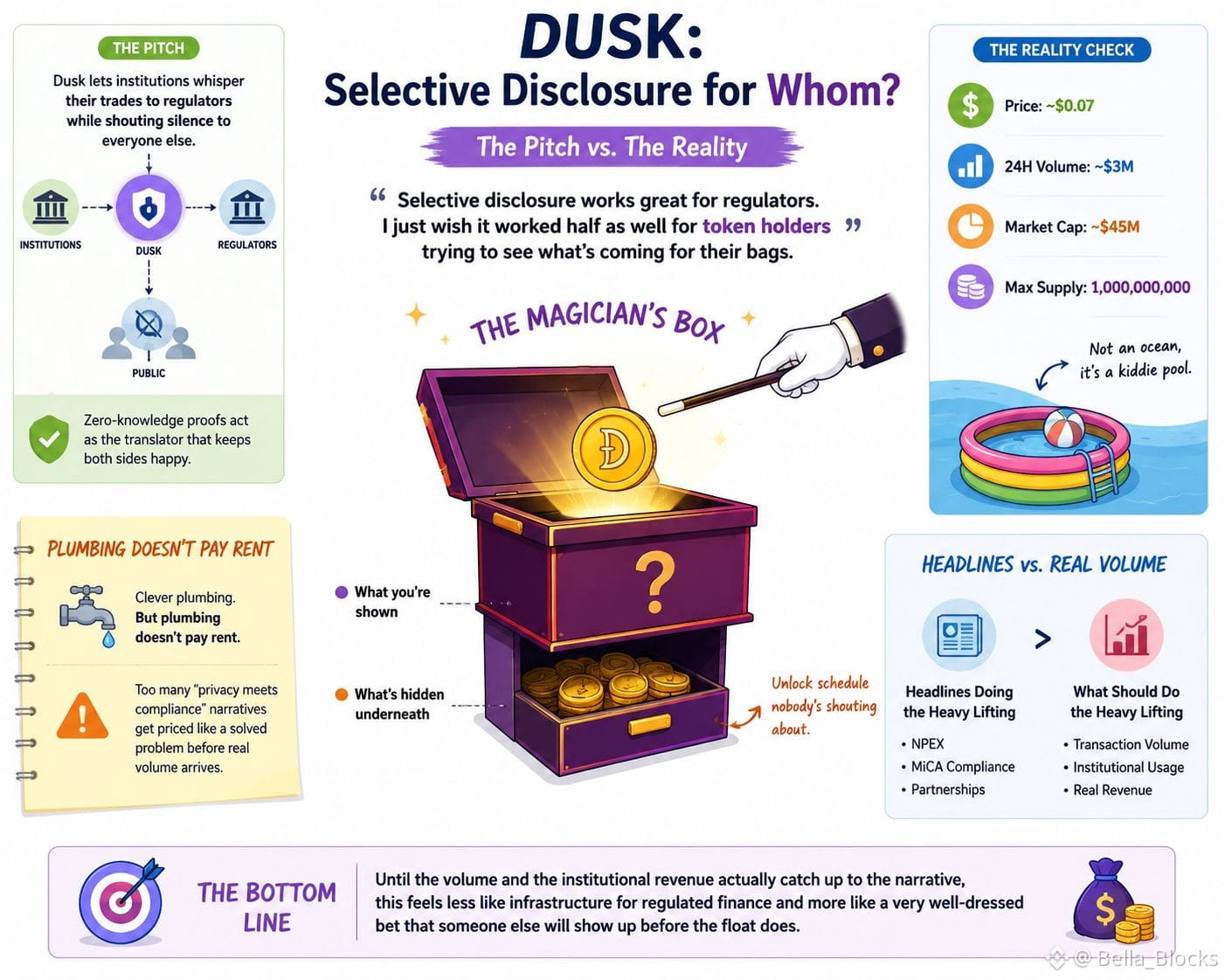
I keep staring at that phrase "selective disclosure" like it's supposed to make me feel safe, and instead it just makes me feel like I'm reading a prenup dressed up as a love letter. The whole pitch is that Dusk lets institutions whisper their trades to regulators while shouting silence to everyone else, zero-knowledge proofs standing in as the translator that keeps both sides happy. Fine. Clever plumbing. But plumbing doesn't pay rent, and I've watched enough "privacy meets compliance" narratives get priced like a solved problem before a single institution actually moves real volume through the pipes.
Right now DUSK is trading around seven cents with barely three million dollars moving through it in a day, sitting on a market cap near forty-five million against a max supply of a billion tokens. That's not a market, that's a kiddie pool being marketed as an ocean. Half the supply is still sitting offstage waiting to walk on, and every headline about NPEX or MiCA compliance is doing the heavy lifting that actual transaction volume should be doing.
The metaphor I keep coming back to is a magician's box with a false bottom, you're shown a coin disappearing and told it's gone, but the real trick is what's hidden underneath the stage the whole time, the unlock schedule nobody's shouting about while the compliance story gets all the airtime. Selective disclosure works great for regulators. I just wish it worked half as well for token holders trying to see what's coming for their bags.
Until the volume and the institutional revenue actually catch up to the narrative, this feels less like infrastructure for regulated finance and more like a very well-dressed bet that someone else will show up before the float does.
$MRNAon
{alpha}(560x01486675da0764ee780ea7cb65c33062e9b2d28c)
$RICE
{alpha}(560xb5761f36fdfe2892f1b54bc8ee8babb2a1b698d3)
{spot}(DUSKUSDT)
#dusk $DUSK @Dusk
I keep staring at that phrase "selective disclosure" like it's supposed to make me feel safe, and instead it just makes me feel like I'm reading a prenup dressed up as a love letter. The whole pitch is that Dusk lets institutions whisper their trades to regulators while shouting silence to everyone else, zero-knowledge proofs standing in as the translator that keeps both sides happy. Fine. Clever plumbing. But plumbing doesn't pay rent, and I've watched enough "privacy meets compliance" narratives get priced like a solved problem before a single institution actually moves real volume through the pipes.
Right now DUSK is trading around seven cents with barely three million dollars moving through it in a day, sitting on a market cap near forty-five million against a max supply of a billion tokens. That's not a market, that's a kiddie pool being marketed as an ocean. Half the supply is still sitting offstage waiting to walk on, and every headline about NPEX or MiCA compliance is doing the heavy lifting that actual transaction volume should be doing.
The metaphor I keep coming back to is a magician's box with a false bottom, you're shown a coin disappearing and told it's gone, but the real trick is what's hidden underneath the stage the whole time, the unlock schedule nobody's shouting about while the compliance story gets all the airtime. Selective disclosure works great for regulators. I just wish it worked half as well for token holders trying to see what's coming for their bags.
Until the volume and the institutional revenue actually catch up to the narrative, this feels less like infrastructure for regulated finance and more like a very well-dressed bet that someone else will show up before the float does.
$MRNAon
$RICE
5
8
458
Log in to explore more content
Join global crypto users on Binance Square
⚡️ Get latest and useful information about crypto.
💬 Trusted by the world’s largest crypto exchange.
👍 Discover real insights from verified creators.
Email / Phone number