#dusk $DUSK @Dusk
I was digging through Dusk's docs trying to understand what "privacy by default, auditability when required" actually means at the protocol level, because that phrase shows up everywhere in their RWA materials and I wanted to know who's doing the auditing.
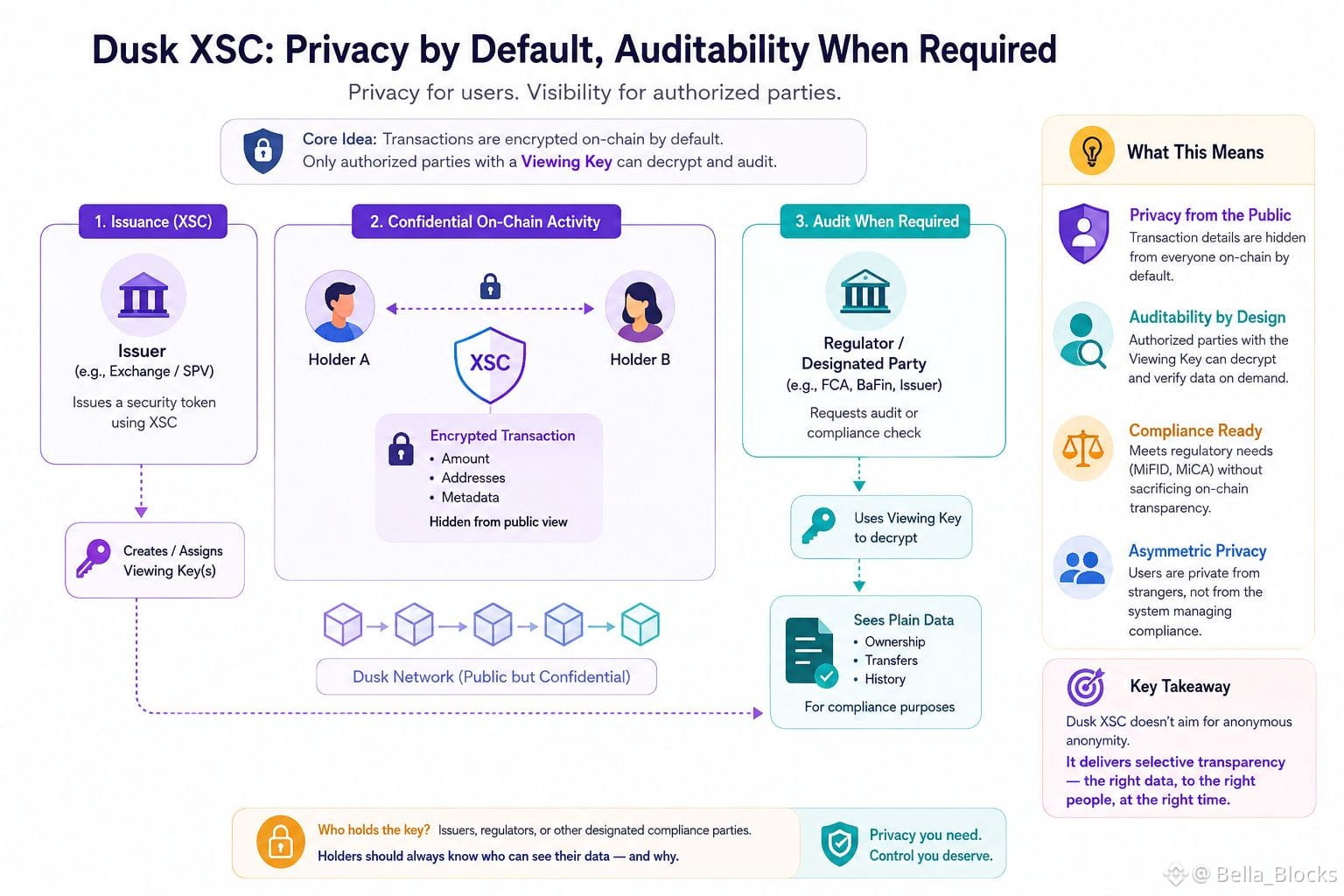
Turns out the XSC standard bakes in optional viewing keys tied to the compliance layer — so when a security token gets issued through XSC, the issuer (or a designated regulator) can hold a key that decrypts transaction details that stay hidden from everyone else on-chain. I went back to the docs twice because I initially read it as full end-to-end privacy, the kind you'd get with a typical shielded transaction. It's not quite that. It's privacy from the public, not necessarily from the counterparty running the compliance rules.
That's not a flaw, it's the whole point — you can't get a MiFID or MiCA-compliant security token without someone being able to prove ownership and flow of funds on demand. But it does mean the privacy guarantee is asymmetric by design, and I don't think that's obvious to someone reading "confidential" on the homepage and assuming symmetric anonymity like a privacy coin.
The incentive this creates is interesting: issuers get comfortable putting real securities on a public chain precisely because they retain visibility. Users get privacy from strangers, not from the system managing them. Worth asking how many holders actually know who's holding that key on any given asset.
I was digging through Dusk's docs trying to understand what "privacy by default, auditability when required" actually means at the protocol level, because that phrase shows up everywhere in their RWA materials and I wanted to know who's doing the auditing.
Turns out the XSC standard bakes in optional viewing keys tied to the compliance layer — so when a security token gets issued through XSC, the issuer (or a designated regulator) can hold a key that decrypts transaction details that stay hidden from everyone else on-chain. I went back to the docs twice because I initially read it as full end-to-end privacy, the kind you'd get with a typical shielded transaction. It's not quite that. It's privacy from the public, not necessarily from the counterparty running the compliance rules.
That's not a flaw, it's the whole point — you can't get a MiFID or MiCA-compliant security token without someone being able to prove ownership and flow of funds on demand. But it does mean the privacy guarantee is asymmetric by design, and I don't think that's obvious to someone reading "confidential" on the homepage and assuming symmetric anonymity like a privacy coin.
The incentive this creates is interesting: issuers get comfortable putting real securities on a public chain precisely because they retain visibility. Users get privacy from strangers, not from the system managing them. Worth asking how many holders actually know who's holding that key on any given asset.