What if the biggest risk in the AI economy isn’t what an agent can do, but how much authority we give it?
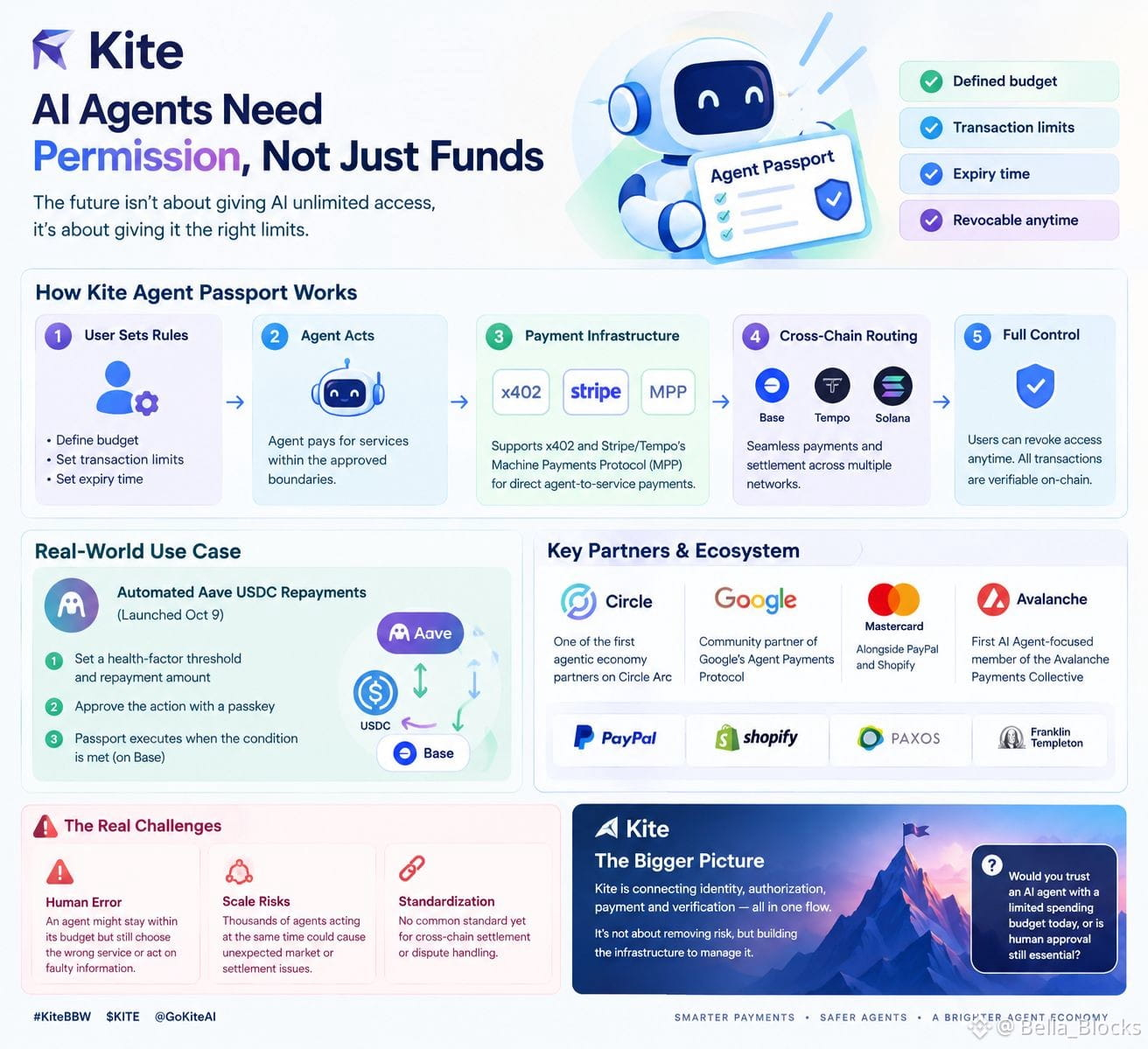
I’ve been looking at Kite from this angle, and one feature stands out: Agent Passport turns spending permission into something more controlled than simply handing an AI a funded wallet.
Users can approve spending sessions with defined budgets, transaction limits and expiry times. Agents can then pay for services within those boundaries, while users retain the ability to revoke access. That’s an important distinction: autonomy doesn’t have to mean unlimited control.
The infrastructure goes beyond a single payment route. Kite Passport supports x402 and Stripe/Tempo’s Machine Payments Protocol (MPP), allowing compatible services to request payment directly from agents. Its cross-chain routing also supports payments involving Base, Tempo and Solana, helping reduce the friction of funding and settlement across networks.
There’s a practical example, too. Kite’s October 9 release introduced automated Aave USDC loan repayments on Base. Users set a health-factor threshold and repayment amount, approve the action with a passkey, and Passport can execute when the specified condition is met.
Still, permission controls aren’t a guarantee against bad outcomes. An agent might stay within its budget and still choose the wrong service, act on faulty information, or make a costly decision. Auditable transactions help explain what happened; they don’t automatically recover lost funds.
That’s the real challenge for agent-native finance: connecting identity, authorization, payment and verification without pretending risk disappears.
Kite is building toward that model, but adoption, reliability and interoperability will determine how far it goes.
Would you trust an AI agent with a limited spending budget today, or is human approval still essential? 🪁
#KiteBBW $KITE @KITE AI 中文