
长盈
272 Posts

长盈
Report
Block User
想知道发生了什么,就找长盈分析!🔥数据分析师&大数据架构师,🎯优质项目调研 & 空投教程 & 数据分析报告 & 低风险投资机会。➕关注长盈 @Alex,一起长久稳定盈利!
23 Following
609 Followers
1.2K+ Liked
Posts
All
Quotes
·
--
Article
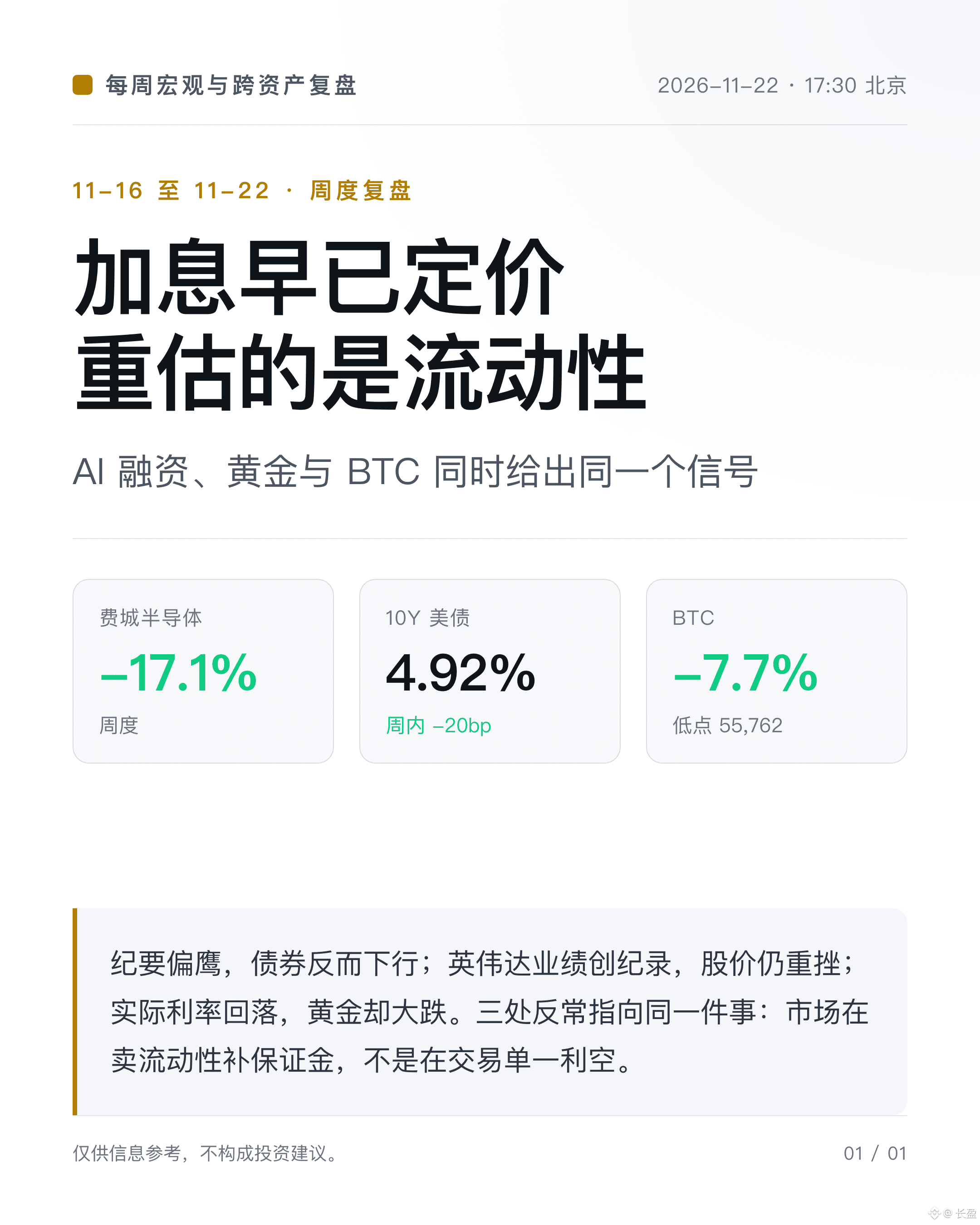
Rate hikes are priced in; what’s really being repriced is the AI financing chain and cross-market liquidityData cutoff: 2026-11-22 17:30 Beijing time
This is a snapshot as of the cutoff time and does not include information released afterward; it is not investment advice.
▍My Take
What truly changed this week was not the rate-hike path, but how the market prices AI financing, governance, and liquidity. The minutes were hawkish on inflation, yet bond yields fell; Nvidia posted record results, but its stock still plunged; gold and real rates moved in the same direction. Taken together, these point to a single main theme: deleveraging, not one isolated negative catalyst.
$BTC $ETH $BNB
【Key Takeaways】
· Rate hikes were not an independent cause of this week’s asset declines. The 11-18 FOMC minutes were hawkish, but 2-year and 10-year par yields each fell by about 20 bp from 11-16 to 11-20; a 25 bp hike in December had long been priced in, while the odds of a 50 bp move at the tail end of the distribution actually declined.
Rate hikes are priced in; what’s really being repriced is the AI financing chain and cross-market liquidity
Data cutoff: 2026-11-22 17:30 Beijing time
This is a snapshot as of the cutoff time and does not include information released afterward; it is not investment advice.
▍My Take
What truly changed this week was not the rate-hike path, but how the market prices AI financing, governance, and liquidity. The minutes were hawkish on inflation, yet bond yields fell; Nvidia posted record results, but its stock still plunged; gold and real rates moved in the same direction. Taken together, these point to a single main theme: deleveraging, not one isolated negative catalyst.
$BTC $ETH $BNB
【Key Takeaways】
· Rate hikes were not an independent cause of this week’s asset declines. The 11-18 FOMC minutes were hawkish, but 2-year and 10-year par yields each fell by about 20 bp from 11-16 to 11-20; a 25 bp hike in December had long been priced in, while the odds of a 50 bp move at the tail end of the distribution actually declined.
532
·
--
Article
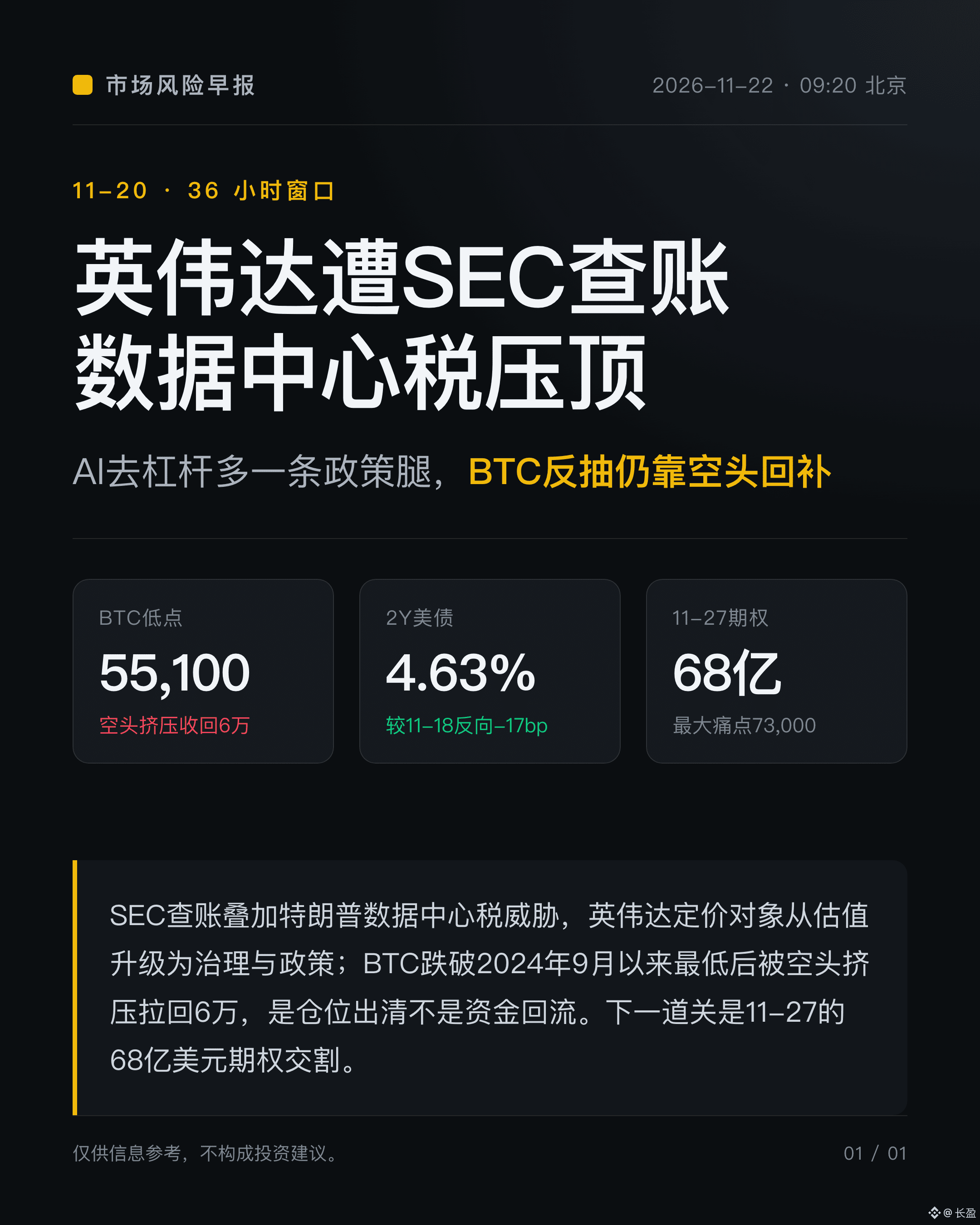
SEC Scrutiny of Nvidia’s Books, Trump Threatens Data Center Tax: AI Deleveraging Gets a Policy Leg; BTC Rebound Still Driven by Short CoveringData cutoff: 2026-11-22 09:20 Beijing time (36-hour window)
This article is a snapshot as of the cutoff and does not include information released afterward; it is not investment advice.
▍My Take
Nvidia fell 23% in a week. The market is no longer pricing in record revenue, but two new governance and policy pressures: an SEC investigation into its books and a data center tax. After BTC broke down, a short squeeze pulled it back to 60,000—a position unwind, not a return of capital. The next real hurdle is the $6.8 billion options expiry on 11-27.
$BTC $ETH $NVDA
【Key Takeaways】
· The nature of the rebound hasn’t changed, but the evidence is clearer: BTC fell below 56,000 on 11-21, hitting a low of 55,100—its lowest since September 2024—then was quickly driven back to 60,000 in a V-shaped short squeeze. It stood at 60,301 at the cutoff. On 11-27, 112,323 BTC in options worth about $6.8 billion expire on Deribit, with a max pain level of 73,000. This expiry next week matters more than intraday moves.
SEC Scrutiny of Nvidia’s Books, Trump Threatens Data Center Tax: AI Deleveraging Gets a Policy Leg; BTC Rebound Still Driven by Short Covering
Data cutoff: 2026-11-22 09:20 Beijing time (36-hour window)
This article is a snapshot as of the cutoff and does not include information released afterward; it is not investment advice.
▍My Take
Nvidia fell 23% in a week. The market is no longer pricing in record revenue, but two new governance and policy pressures: an SEC investigation into its books and a data center tax. After BTC broke down, a short squeeze pulled it back to 60,000—a position unwind, not a return of capital. The next real hurdle is the $6.8 billion options expiry on 11-27.
$BTC $ETH $NVDA
【Key Takeaways】
· The nature of the rebound hasn’t changed, but the evidence is clearer: BTC fell below 56,000 on 11-21, hitting a low of 55,100—its lowest since September 2024—then was quickly driven back to 60,000 in a V-shaped short squeeze. It stood at 60,301 at the cutoff. On 11-27, 112,323 BTC in options worth about $6.8 billion expire on Deribit, with a max pain level of 73,000. This expiry next week matters more than intraday moves.
2
571
·
--
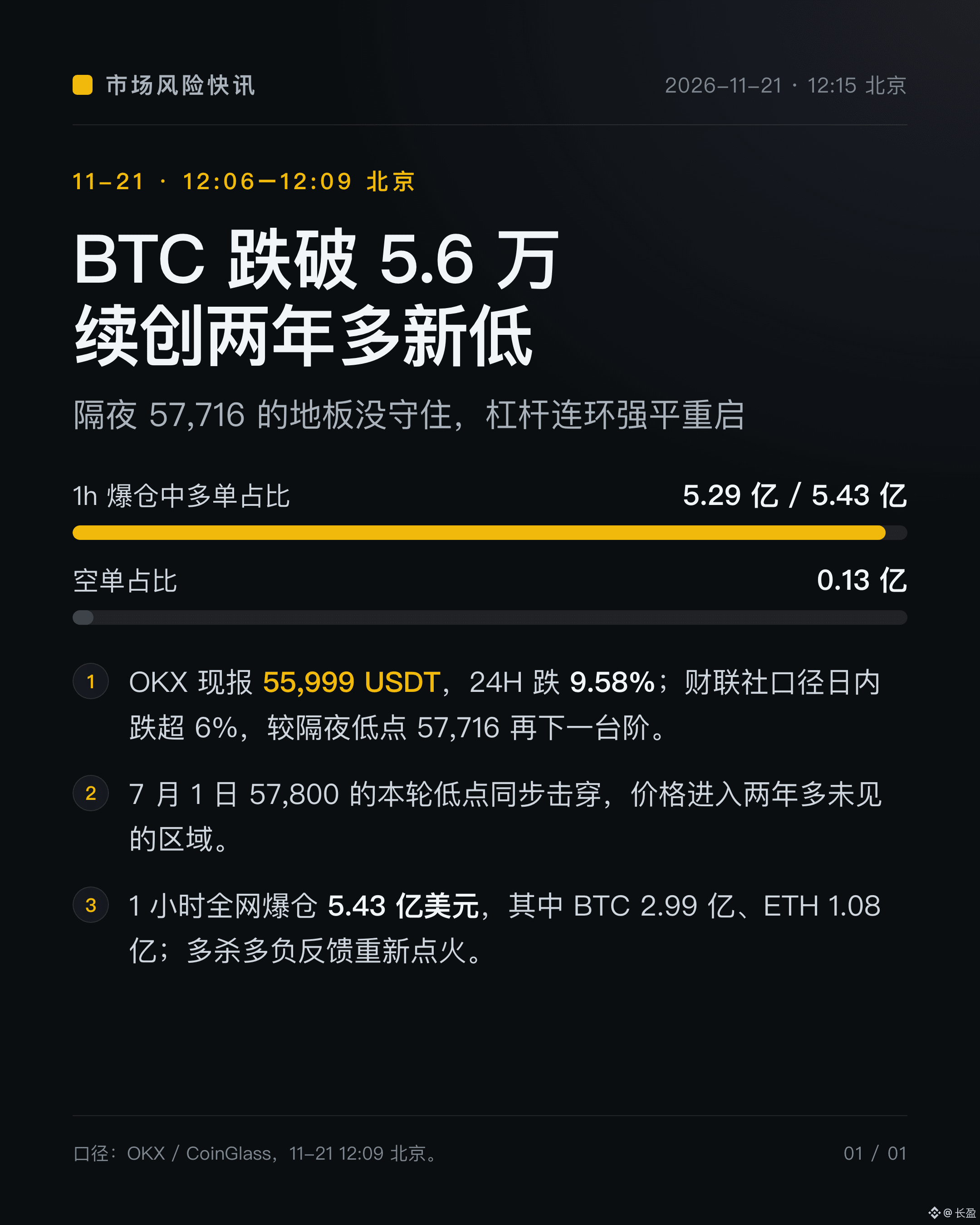
BTC fell below 56,000, breaking through the floor that had held all night during the overnight session by midday.
Data as of: 2026-11-21 12:10 Beijing time. The chart contains all the figures for this edition; the text is interpretation only.
▍My take
The key issue isn't the size of the drop, but that this breakdown has changed the structure: 57,716 overnight was the low since September 2024, and it had held until now. Today, BTC also broke through July's 57,800 low, effectively invalidating the assumption that the lower end of the range would hold. Long positions accounted for 97% of liquidations, suggesting the sell-off wasn't driven by new negative news, but by leveraged longs triggering a cascade of liquidations—each leg down triggered another round of forced closures. Traditional markets are closed on Saturday, so there's no new pricing in stocks or interest rates to absorb the flow. BTC became the only real-time risk barometer still trading, and drops in this kind of vacuum are often steeper than when there's support. I don't take this as confirmation of a trend reversal, but it does reopen the question of whether deleveraging is over: until liquidations taper off and the price gets back above 58,000, any dip-buying is just a bet that forced selling has run its course.
$BTC
Chart 1 | BTC falls below 56,000, hitting a new low in more than two years
BTC failed to hold its overnight floor, falling below 56,000. $543 million in liquidations in one hour as long liquidations triggered a fresh cascade.
Source: OKX, CoinGlass, Cailian Press, Odaily
Do you think 55,000 is the bottom of this deleveraging cycle, or the starting point for the next wave of liquidations?
#Macro
The above is a compilation of public information and personal views, and does not constitute investment advice. Digital assets are highly volatile. Please verify information yourself and make independent decisions.
1
591
·
--
Personally, I actually think that after losing both chambers, Trump deliberately let the Democrats crack down on tech companies, then said, “See? This is what happens when you don’t believe me. The Democrats you elected will wreck the U.S. economy.”
Personally, I actually think that after losing both chambers, Trump deliberately let the Democrats crack down on tech companies, then said, “See? This is what happens when you don’t believe me. The Democrats you elected will wreck the U.S. economy.”
长盈
·
--
Why Did the Market Suddenly Plunge Last Night? Anthropic Falls Back to Its Offering Price—AI Deleveraging, Not a Rate Hike | 11-21 Morning Brief
Data as of: 2026-11-21 08:14 Beijing time (36-hour window)
This article is a snapshot as of the stated time and does not include information that emerged afterward. It is not investment advice.
▍My take
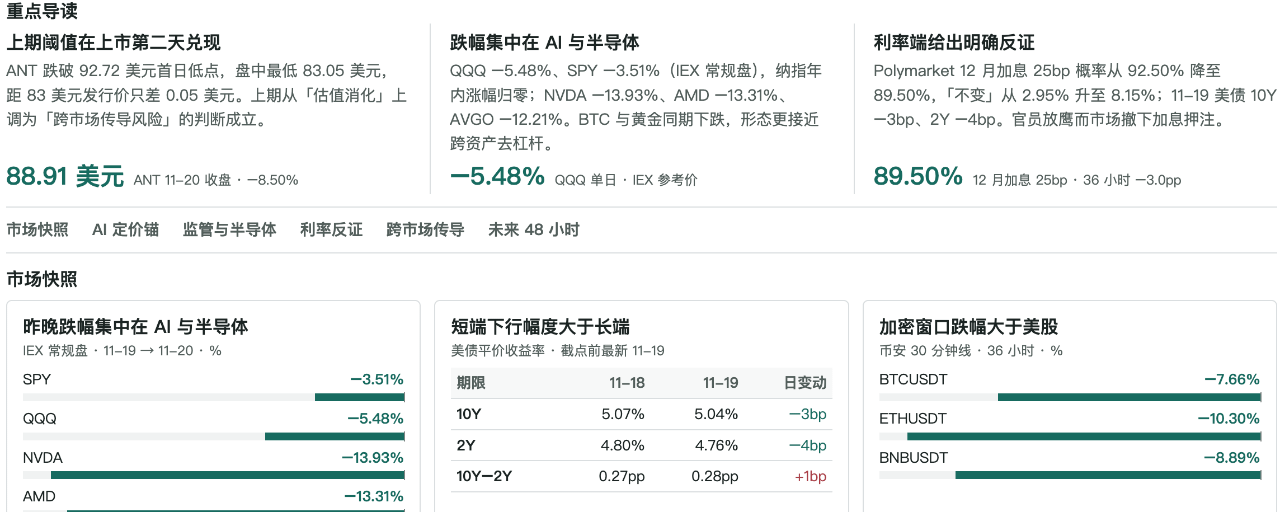
Why did the market suddenly plunge last night? Many people’s first instinct is to look for a piece of bad news. Here are three clues that make things clear: First, Anthropic fell below its first-day low on its second day of trading, coming within just 5 cents of its $83 offering price intraday, while stabilization positions were exited at the same time. Second, the SEC accounting review, California subpoenas, and congressional inquiries involving Nvidia are all advancing on multiple fronts, making semiconductors a focal point of the sell-off. Third—and the easiest to misread—odds of a December rate hike fell rather than rose, while Treasury yields also declined. So this wasn’t a rate shock, but a repricing of the AI financing chain, compounded by cross-market contagion from leveraged liquidations.
2
185
·
--
Article
Why Did the Market Suddenly Plunge Last Night? Anthropic Falls Back to Its Offering Price—AI Deleveraging, Not a Rate Hike | 11-21 Morning BriefData as of: 2026-11-21 08:14 Beijing time (36-hour window)
This article is a snapshot as of the stated time and does not include information that emerged afterward. It is not investment advice.
▍My take
Why did the market suddenly plunge last night? Many people’s first instinct is to look for a piece of bad news. Here are three clues that make things clear: First, Anthropic fell below its first-day low on its second day of trading, coming within just 5 cents of its $83 offering price intraday, while stabilization positions were exited at the same time. Second, the SEC accounting review, California subpoenas, and congressional inquiries involving Nvidia are all advancing on multiple fronts, making semiconductors a focal point of the sell-off. Third—and the easiest to misread—odds of a December rate hike fell rather than rose, while Treasury yields also declined. So this wasn’t a rate shock, but a repricing of the AI financing chain, compounded by cross-market contagion from leveraged liquidations.
Why Did the Market Suddenly Plunge Last Night? Anthropic Falls Back to Its Offering Price—AI Deleveraging, Not a Rate Hike | 11-21 Morning Brief
Data as of: 2026-11-21 08:14 Beijing time (36-hour window)
This article is a snapshot as of the stated time and does not include information that emerged afterward. It is not investment advice.
▍My take
Why did the market suddenly plunge last night? Many people’s first instinct is to look for a piece of bad news. Here are three clues that make things clear: First, Anthropic fell below its first-day low on its second day of trading, coming within just 5 cents of its $83 offering price intraday, while stabilization positions were exited at the same time. Second, the SEC accounting review, California subpoenas, and congressional inquiries involving Nvidia are all advancing on multiple fronts, making semiconductors a focal point of the sell-off. Third—and the easiest to misread—odds of a December rate hike fell rather than rose, while Treasury yields also declined. So this wasn’t a rate shock, but a repricing of the AI financing chain, compounded by cross-market contagion from leveraged liquidations.
This article is a snapshot as of the stated time and does not include information that emerged afterward. It is not investment advice.
▍My take
Why did the market suddenly plunge last night? Many people’s first instinct is to look for a piece of bad news. Here are three clues that make things clear: First, Anthropic fell below its first-day low on its second day of trading, coming within just 5 cents of its $83 offering price intraday, while stabilization positions were exited at the same time. Second, the SEC accounting review, California subpoenas, and congressional inquiries involving Nvidia are all advancing on multiple fronts, making semiconductors a focal point of the sell-off. Third—and the easiest to misread—odds of a December rate hike fell rather than rose, while Treasury yields also declined. So this wasn’t a rate shock, but a repricing of the AI financing chain, compounded by cross-market contagion from leveraged liquidations.
2
1
1
1.2k
·
--
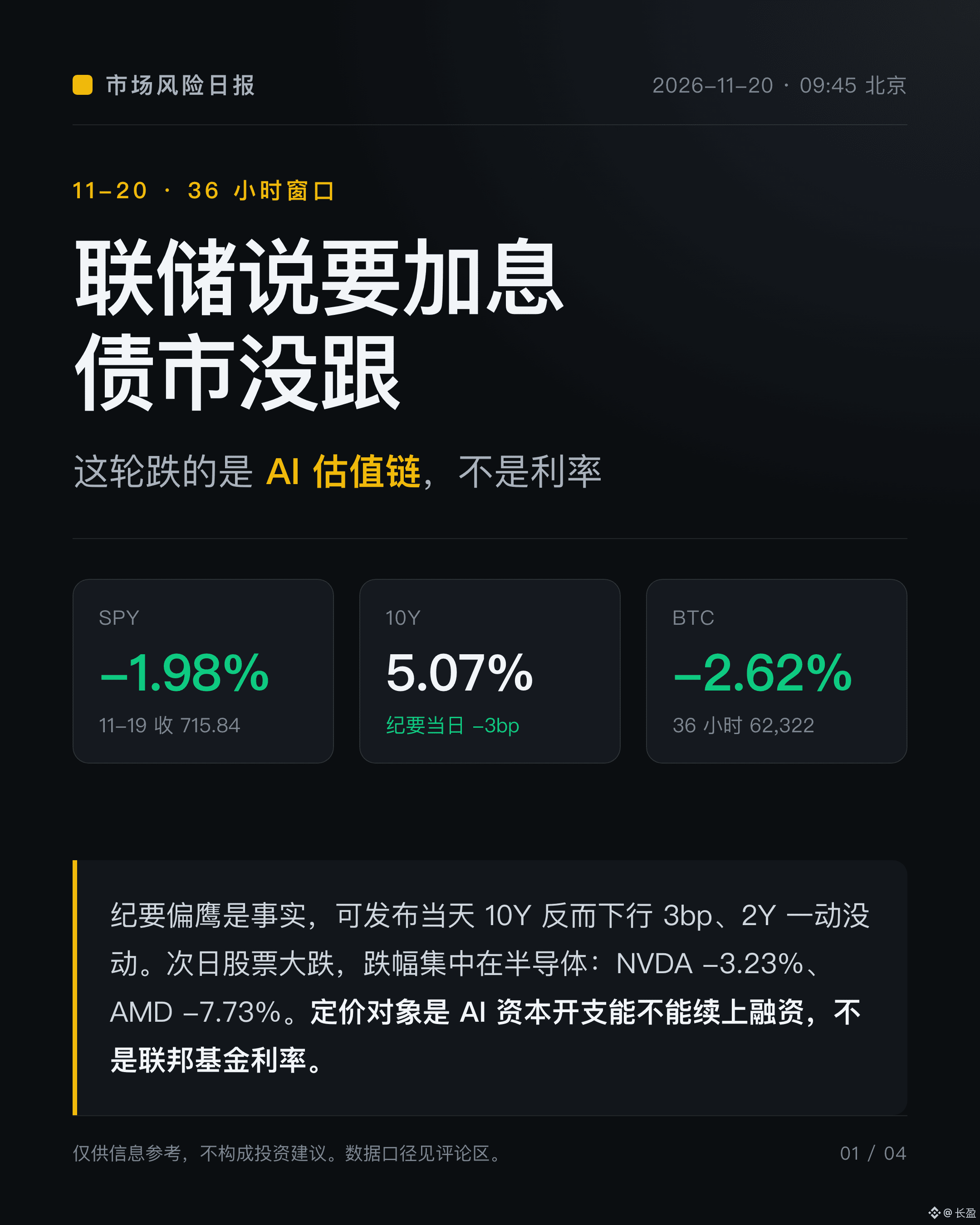
The Fed says more rate hikes are coming, but the bond market isn't buying it
Data as of: 2026-11-20 09:45 Beijing time. The four charts contain all the numbers in this edition; the text is for interpretation only.
▍My take
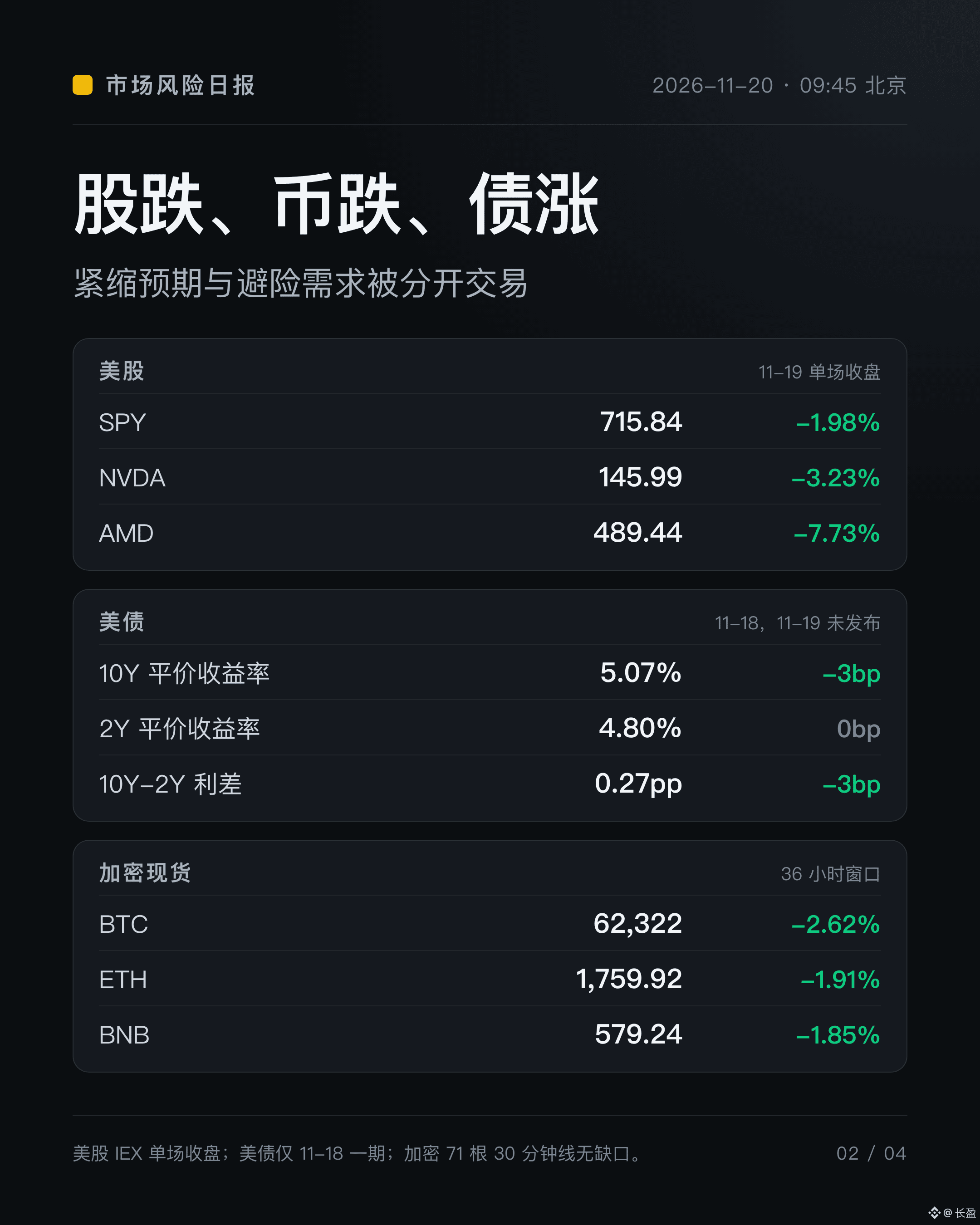
I’m more inclined to read the drop on 11-19 as a shift in what the market is pricing, rather than a rate-hike trade. The minutes were hawkish, that’s a fact. But 10-year yields actually fell 3bp that day, while 2-year yields didn’t budge. If the market were really repricing for a December rate hike, the short end wouldn’t be this quiet. What’s actually moving is the AI story: Nvidia beat expectations but fell 6% over two days; Anthropic opened at its high on its first day of trading, then closed 13% below its opening price.
$BTC $ETH
Chart 1|The Fed says rates will rise, but the bond market isn't buying it
Rate hikes have long been fully priced into the bond market; stocks are pricing in something else.
Chart 2|Stocks down, crypto down, bonds up
Bond prices rose while stock prices fell. The two narratives aren’t in conflict; they’re just being traded separately.
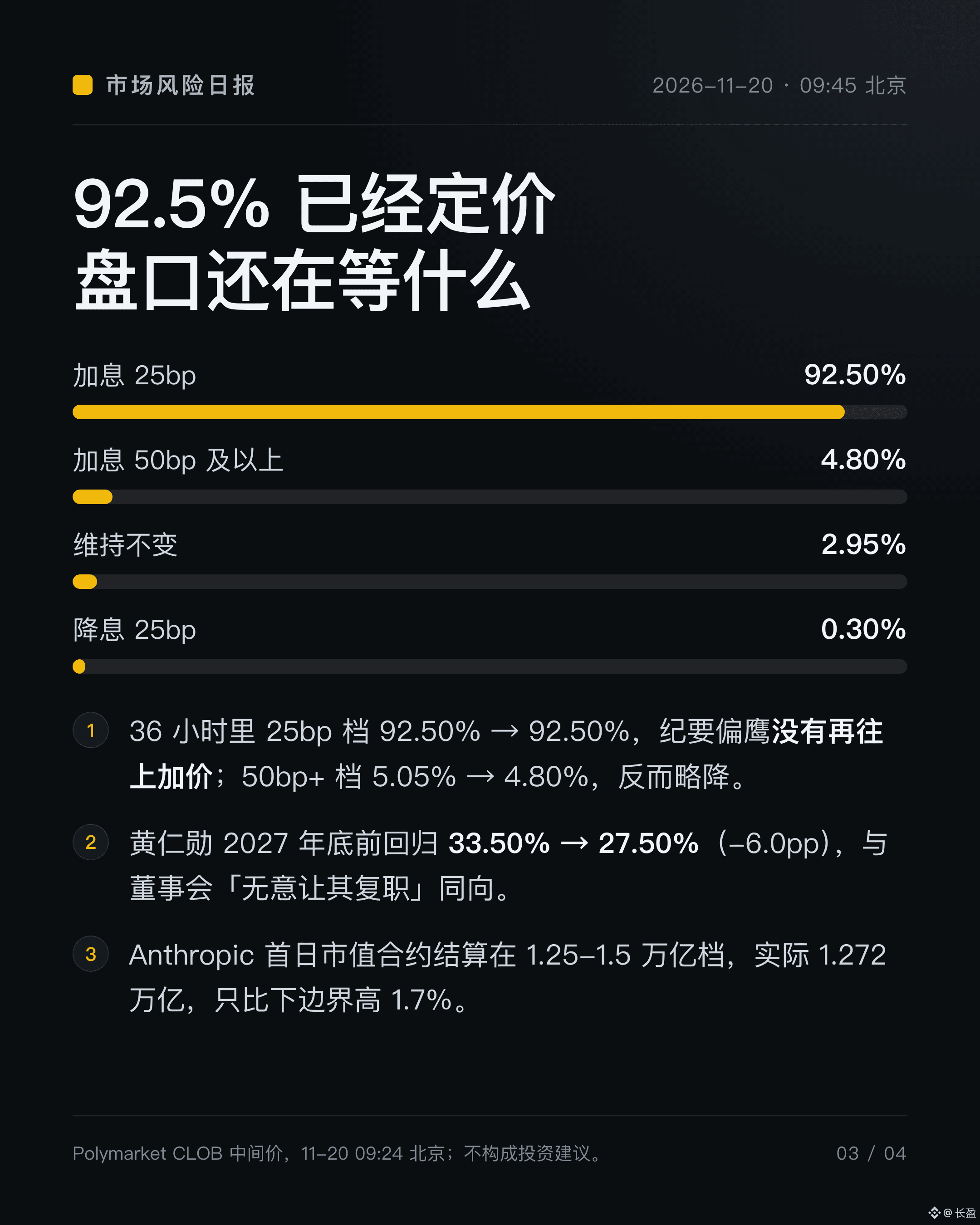
Chart 3|92.5% already priced in—what is the market still waiting for?
The 25bp bracket didn’t move at all after the minutes were released. Hawkishness wasn’t new information.
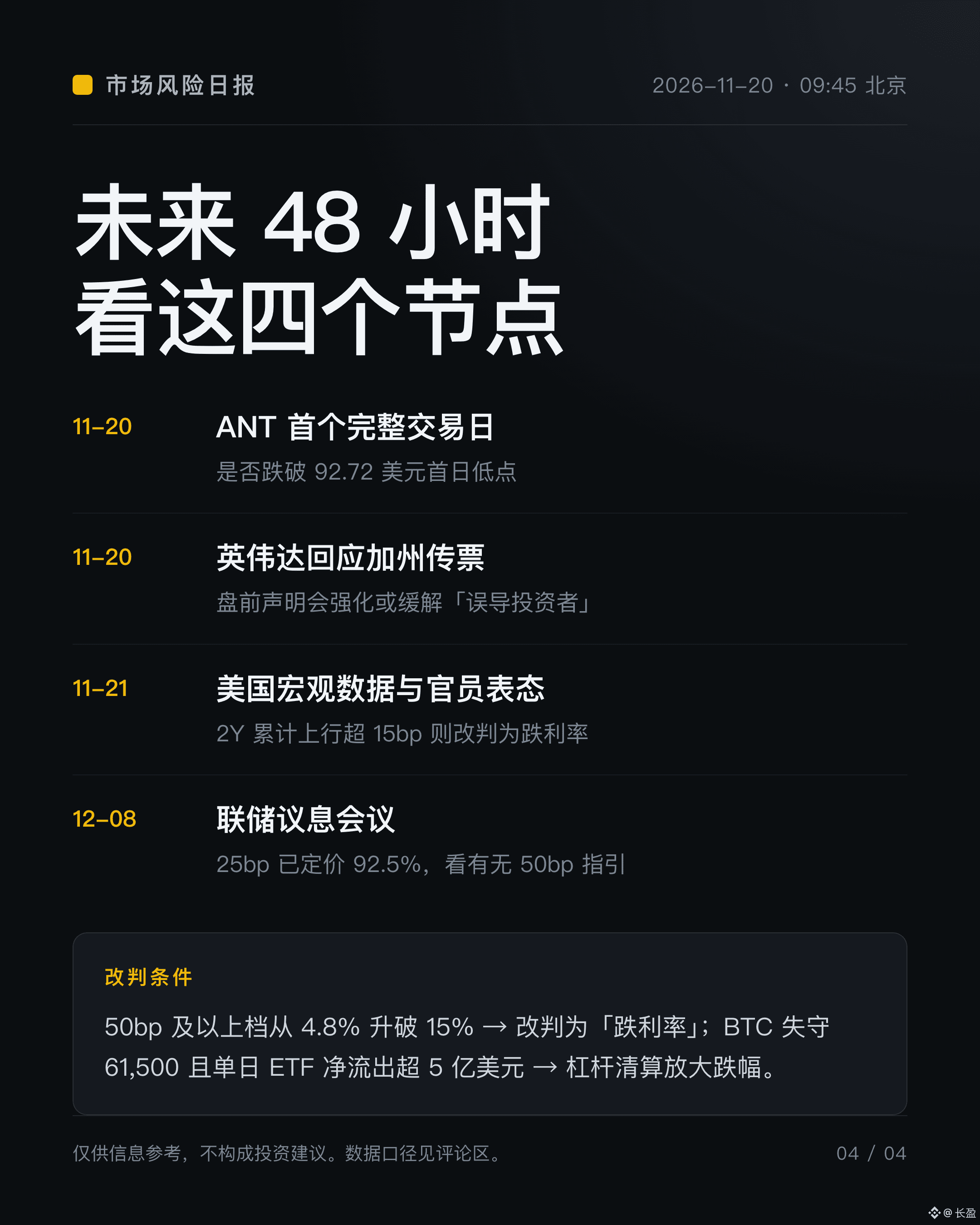
Chart 4|The next 48 hours: watch these four signals
Only two things could change my view over the next 48 hours: 2Y yields catching up by 15bp, or ANT falling below 92.72.
Sources: Federal Reserve, U.S. Treasury, Polymarket, CNBC
Are you more concerned about the size of a December rate hike, or marginal changes in AI companies’ financing pipelines?
#Macro #Bitcoin
The above is a compilation of public information and personal views, and does not constitute investment advice. Digital assets are highly volatile; please verify information and make your own independent decisions.
4
1
617
·
--
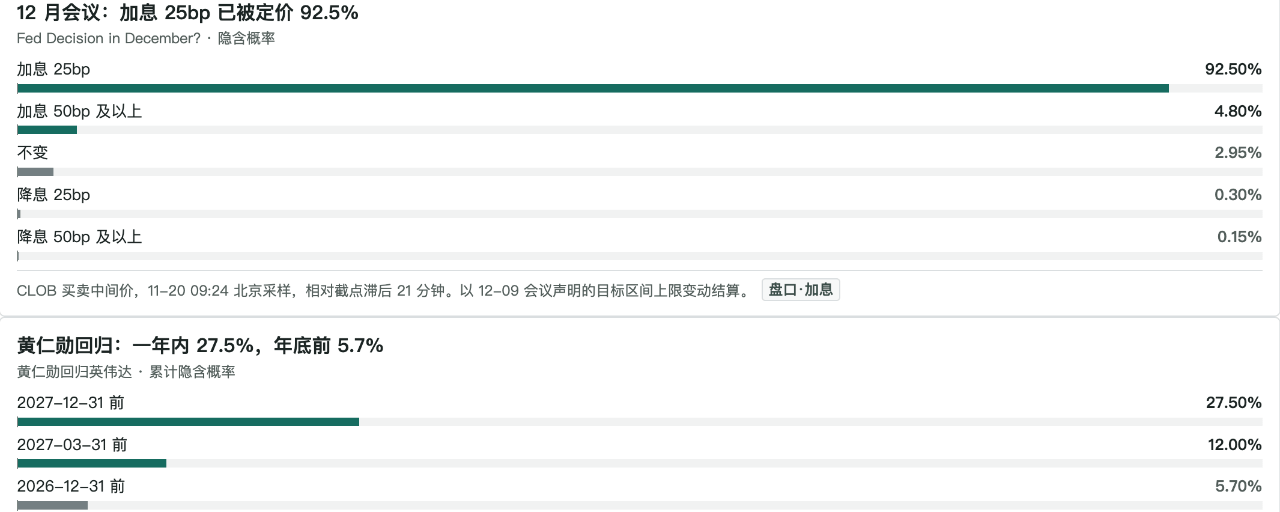
Article
Daily Market Brief | 2026-11-20I was originally going to have the agent post this automatically, but after looking it over, there are still a lot of issues. This automated AI employee isn’t ready yet.
Fed minutes say rate hikes are still needed, but bonds aren’t following: this selloff is hitting the AI valuation chain
▍My assessment
I’m more inclined to read the 11-19 decline as a shift in what the market is pricing, rather than as a rate-hike trade. The minutes were hawkish, but the 10-year yield actually fell 3bp that day, while the 2-year yield was unchanged; if markets were really repricing for a December rate hike, the short end would not have been so quiet. What was actually moving was the AI story: Nvidia beat earnings expectations but fell 6% over two days; Anthropic opened at its first-day high and closed 13% below its opening price; and the California attorney general served a subpoena after the market closed. Rate hikes are the backdrop; the sustainability of financing is the main story.
Daily Market Brief | 2026-11-20
I was originally going to have the agent post this automatically, but after looking it over, there are still a lot of issues. This automated AI employee isn’t ready yet.
Fed minutes say rate hikes are still needed, but bonds aren’t following: this selloff is hitting the AI valuation chain
▍My assessment
I’m more inclined to read the 11-19 decline as a shift in what the market is pricing, rather than as a rate-hike trade. The minutes were hawkish, but the 10-year yield actually fell 3bp that day, while the 2-year yield was unchanged; if markets were really repricing for a December rate hike, the short end would not have been so quiet. What was actually moving was the AI story: Nvidia beat earnings expectations but fell 6% over two days; Anthropic opened at its first-day high and closed 13% below its opening price; and the California attorney general served a subpoena after the market closed. Rate hikes are the backdrop; the sustainability of financing is the main story.
1
1
603
·
--
I have an idea. AMD should fire Lisa Su. Then Nvidia can hire her as CEO, and AMD can hire Jensen Huang as CEO.
#黄仁勋 $AMDB
{spot}(AMDBUSDT)
I have an idea. AMD should fire Lisa Su. Then Nvidia can hire her as CEO, and AMD can hire Jensen Huang as CEO.
#黄仁勋 $AMDB
#黄仁勋 $AMDB
3
735
·
--
Verified
Holding $AMDB 977 USDT
$AMDB suddenly plunged 13%... just because short-selling firms suspect AMD may also have violated export restrictions. What should I do if I don't have money to buy more?
$AMDB suddenly plunged 13%... just because short-selling firms suspect AMD may also have violated export restrictions. What should I do if I don't have money to buy more?
1
1
594
·
--
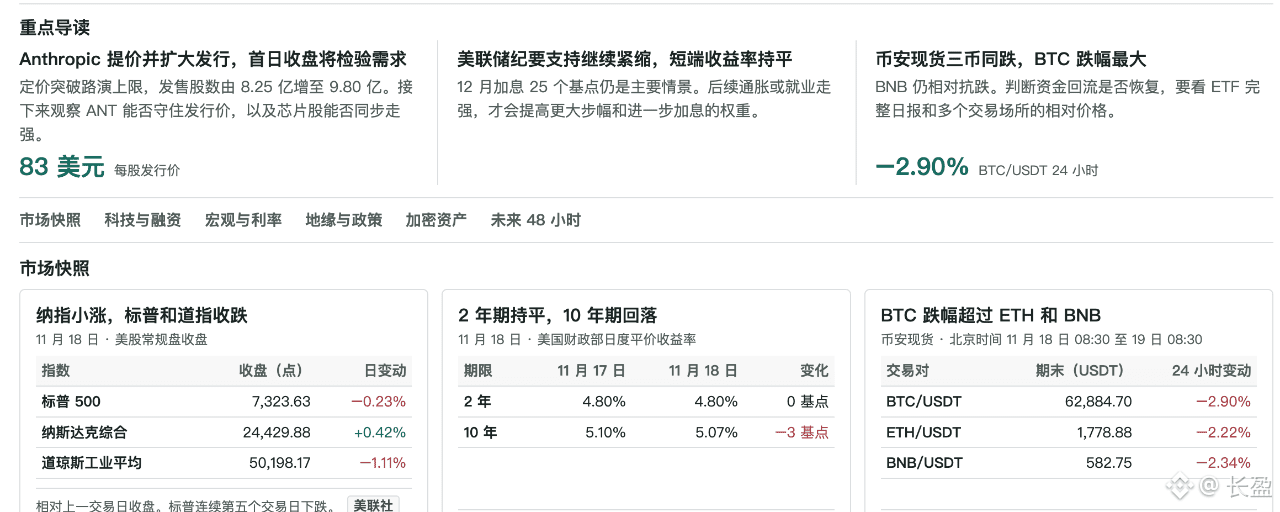
Article
November 19 Daily Analysis: Technology, AI, and CryptocurrencyToday's analysis has added prediction data for trending events
$ANTHROPIC raises prices and expands its issuance; its market cap will most likely fall between 1.25 trillion and 1.5 trillion
The probability of a 25 bp rate hike in December has reached 91.5%
The cryptocurrency market continues to decline, and $BTC has now reached 62,000, adding to the pressure
The hottest topic in AI: The chance of Jensen Huang returning to $NVDAB before year-end is below 7%
Would you buy Nvida without Jensen Huang?
A 25% rate hike in December looks all but certain. Has the market already priced it in?Restrictions on remote computing power have greatly affected the development of China's large language models. Could the gap between domestic and foreign models widen again?
November 19 Daily Analysis: Technology, AI, and Cryptocurrency
Today's analysis has added prediction data for trending events
$ANTHROPIC raises prices and expands its issuance; its market cap will most likely fall between 1.25 trillion and 1.5 trillion
The probability of a 25 bp rate hike in December has reached 91.5%
The cryptocurrency market continues to decline, and $BTC has now reached 62,000, adding to the pressure
The hottest topic in AI: The chance of Jensen Huang returning to $NVDAB before year-end is below 7%
Would you buy Nvida without Jensen Huang?
A 25% rate hike in December looks all but certain. Has the market already priced it in?Restrictions on remote computing power have greatly affected the development of China's large language models. Could the gap between domestic and foreign models widen again?
1
2
597
·
--
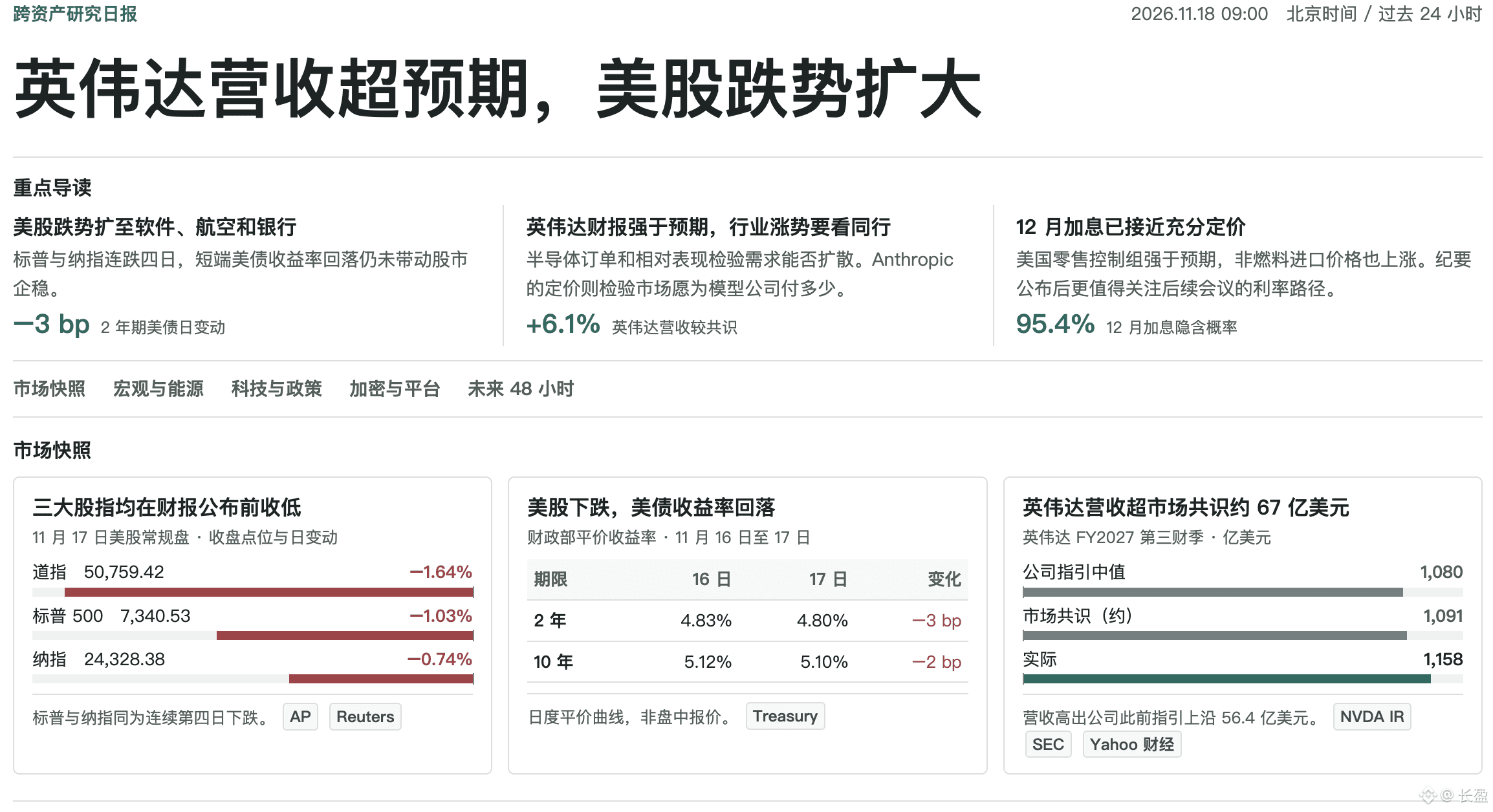
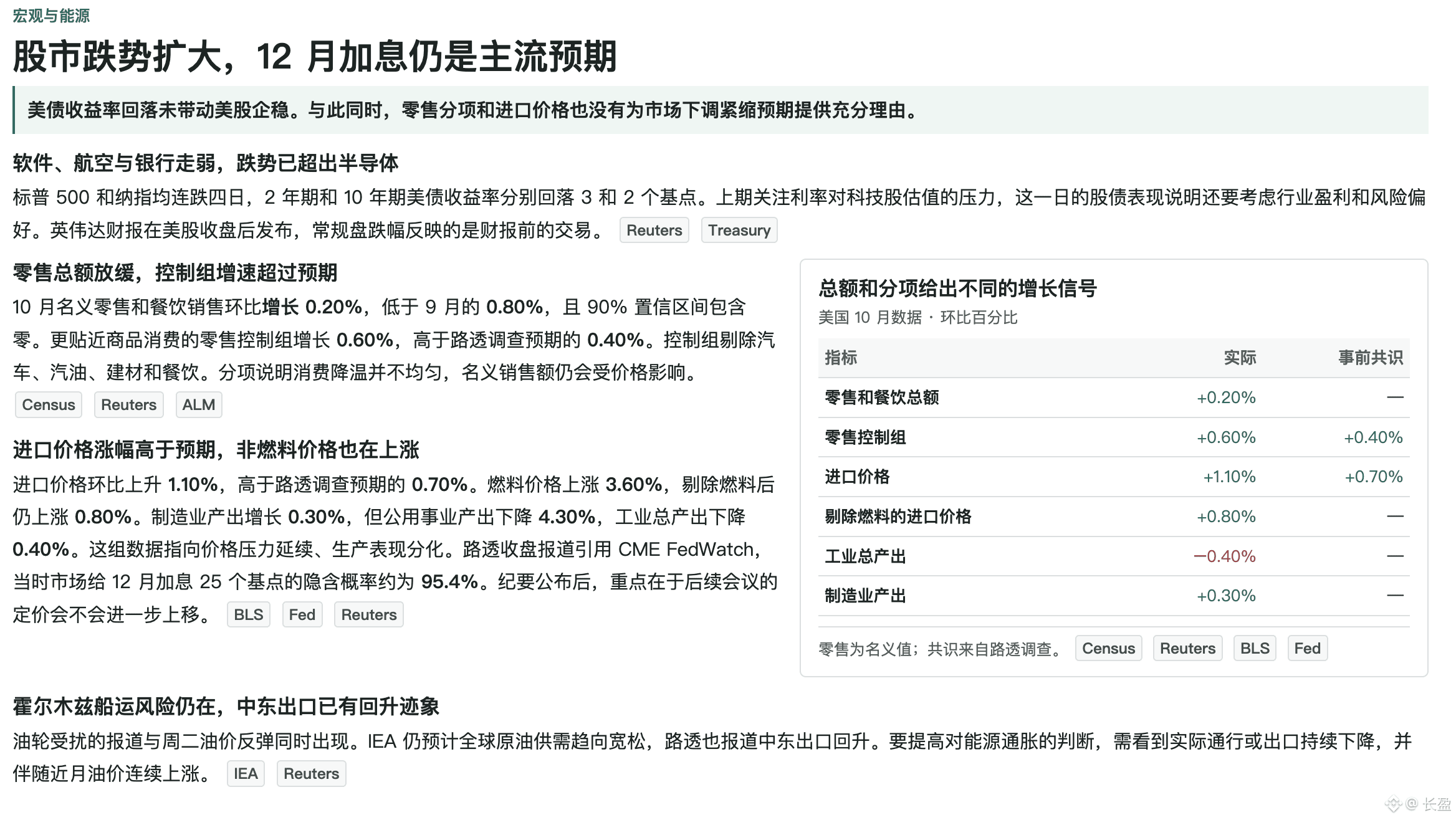
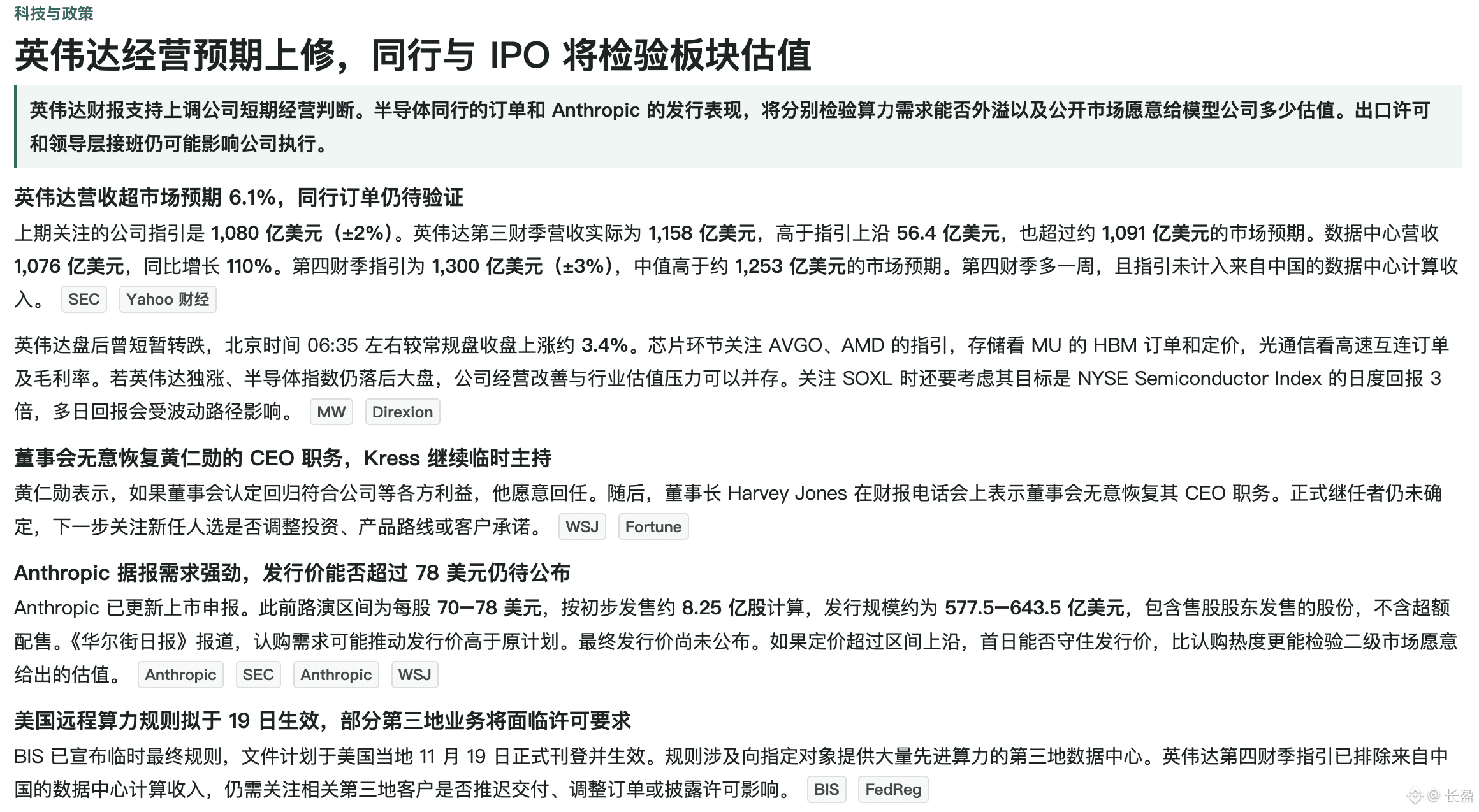
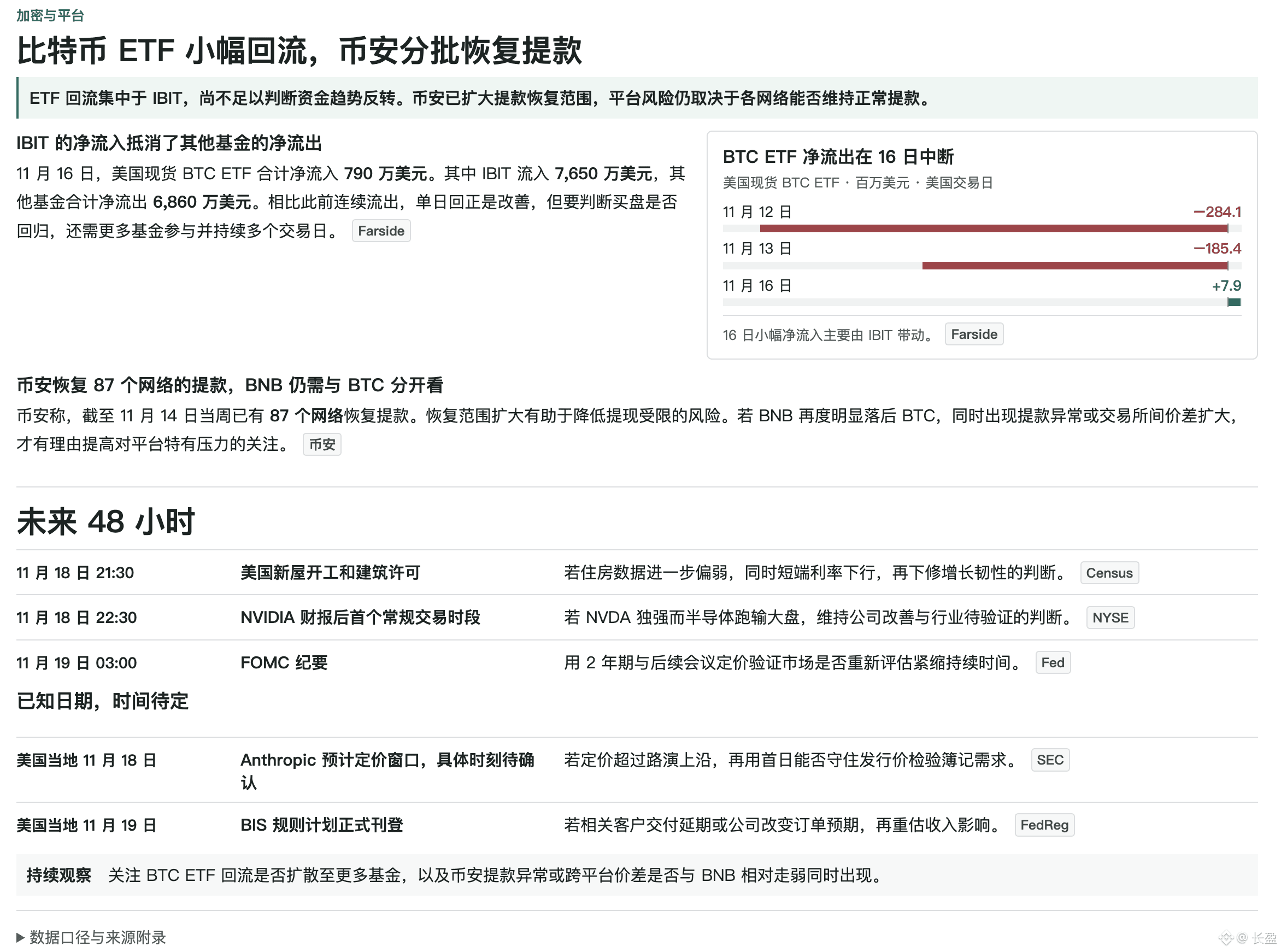
After developing it on and off for several months, the project died a few times along the way, and by the end I just couldn't get it to work anymore. Fortunately, over the past few months, as new technologies have become available and large language models have improved, my agent analyst has been simplified and refactored over several weeks—and can finally produce an analysis report worth reading.
After developing it on and off for several months, the project died a few times along the way, and by the end I just couldn't get it to work anymore. Fortunately, over the past few months, as new technologies have become available and large language models have improved, my agent analyst has been simplified and refactored over several weeks—and can finally produce an analysis report worth reading.
2
737
·
--
U.S. stocks and crypto are both falling; I'm holding my full spot position and riding it out. $BTC $BNB
U.S. stocks and crypto are both falling; I'm holding my full spot position and riding it out. $BTC $BNB
1
644
·
--
Global Macro and Cross-Asset Weekly Investment Report — Week 45I. Key takeaways of the week
The biggest shift this week was that markets moved from worrying about returns on AI investment to worrying about the combined pressures of U.S. inflation, interest rates, and AI valuations.
Four signals deserve attention.
First, U.S. employment was unexpectedly strong, and expectations for a December rate hike rose significantly. Nonfarm payrolls increased by 165,000 in October, well above expectations of 65,000. The market-implied probability of a 25-basis-point Fed rate hike in December rose from around 67% the previous day to nearly 80%. The dollar and Treasury yields rose accordingly. Reuters
Second, AI tech stocks saw a significant valuation correction. On November 5, the Nasdaq fell about 5.5% in a single day. Markets were concerned about the sustainability of capital spending on AI infrastructure and reassessed the potential risk of technology regulation after the U.S. midterm elections. Reuters
Global Macro and Cross-Asset Weekly Investment Report — Week 45
I. Key takeaways of the week
The biggest shift this week was that markets moved from worrying about returns on AI investment to worrying about the combined pressures of U.S. inflation, interest rates, and AI valuations.
Four signals deserve attention.
First, U.S. employment was unexpectedly strong, and expectations for a December rate hike rose significantly. Nonfarm payrolls increased by 165,000 in October, well above expectations of 65,000. The market-implied probability of a 25-basis-point Fed rate hike in December rose from around 67% the previous day to nearly 80%. The dollar and Treasury yields rose accordingly. Reuters
Second, AI tech stocks saw a significant valuation correction. On November 5, the Nasdaq fell about 5.5% in a single day. Markets were concerned about the sustainability of capital spending on AI infrastructure and reassessed the potential risk of technology regulation after the U.S. midterm elections. Reuters
1
598
·
--
U.S. Midterm Election Results Prompt Global AI Tech Stocks to Reprice🚨 Major Market Risk Alert | U.S. Midterm Election Results Prompt Global AI Tech Stocks to Reprice
Verification time: November 4, 2026, 12:46 (Beijing time)
Review window: 11:46–12:46
Event severity: High (global tech stocks and risk appetite)
Risk direction: Bearish for AI tech stocks, with indirect downside risk for BTC/BNB.
I. Newly confirmed developments
Democrats have made a new breakthrough in the U.S. midterm election count.
Reuters reported between 12:12 and 12:34 Beijing time that Democratic candidates had scored major Senate election victories in Ohio, Kansas, and Iowa. In Iowa, the Senate seat flipped from Republican to Democrat.
U.S. Midterm Election Results Prompt Global AI Tech Stocks to Reprice
🚨 Major Market Risk Alert | U.S. Midterm Election Results Prompt Global AI Tech Stocks to Reprice
Verification time: November 4, 2026, 12:46 (Beijing time)
Review window: 11:46–12:46
Event severity: High (global tech stocks and risk appetite)
Risk direction: Bearish for AI tech stocks, with indirect downside risk for BTC/BNB.
I. Newly confirmed developments
Democrats have made a new breakthrough in the U.S. midterm election count.
Reuters reported between 12:12 and 12:34 Beijing time that Democratic candidates had scored major Senate election victories in Ohio, Kansas, and Iowa. In Iowa, the Senate seat flipped from Republican to Democrat.
1
459
·
--
That's absurd—the world's largest trading platform, yet its security measures are so "open". It's hard to believe this won't happen again.
That's absurd—the world's largest trading platform, yet its security measures are so "open". It's hard to believe this won't happen again.


币安Binance华语
·
--
Binance Security Incident on October 30, 2026: Update on Preliminary Investigation Findings and Response
On October 30, 2026 (UTC+8), Binance experienced a serious and highly complex security incident. This should not have happened. We sincerely apologize for the concern, disruption, and uncertainty this incident has caused our users, partners, and the industry as a whole.
Protecting our users is our top priority. Binance will bear the full cost of the stolen funds, not our users. We have set aside more than 100% of the funds to cover losses resulting from this incident. As of October 31, 2026 (UTC+8), 98% of the affected token assets have been replenished. Users can verify this on our 储备金证明 page. We are purchasing the remaining less liquid assets.
Protecting our users is our top priority. Binance will bear the full cost of the stolen funds, not our users. We have set aside more than 100% of the funds to cover losses resulting from this incident. As of October 31, 2026 (UTC+8), 98% of the affected token assets have been replenished. Users can verify this on our 储备金证明 page. We are purchasing the remaining less liquid assets.

1
1
78
·
--
Security incident at Brazilian cryptocurrency exchangeThe U.S. ISM Manufacturing PMI rose to 55.5 in October, above the Reuters poll forecast of 54.5 and the previous reading of 54.5, marking the 10th consecutive month of expansion in the manufacturing sector. The production index rose to 59.0, while the new orders index stood at 55.5. The prices paid index fell to 75.2 from 77.9, below the market forecast of 77.5. The data point to a combination of stronger-than-expected economic growth and a slower pace of input price increases, although price pressures remain relatively high. The figures were cross-checked against the official ISM report and Reuters.
Crypto markets: At 15:17 UTC on November 2, media reported a security incident at a Brazilian cryptocurrency exchange. A preliminary estimate by an on-chain security firm put the amount of unusual outflows at around $40 million. The exchange reportedly suspended deposits and withdrawals.
Security incident at Brazilian cryptocurrency exchange
The U.S. ISM Manufacturing PMI rose to 55.5 in October, above the Reuters poll forecast of 54.5 and the previous reading of 54.5, marking the 10th consecutive month of expansion in the manufacturing sector. The production index rose to 59.0, while the new orders index stood at 55.5. The prices paid index fell to 75.2 from 77.9, below the market forecast of 77.5. The data point to a combination of stronger-than-expected economic growth and a slower pace of input price increases, although price pressures remain relatively high. The figures were cross-checked against the official ISM report and Reuters.
Crypto markets: At 15:17 UTC on November 2, media reported a security incident at a Brazilian cryptocurrency exchange. A preliminary estimate by an on-chain security firm put the amount of unusual outflows at around $40 million. The exchange reportedly suspended deposits and withdrawals.
Crypto markets: At 15:17 UTC on November 2, media reported a security incident at a Brazilian cryptocurrency exchange. A preliminary estimate by an on-chain security firm put the amount of unusual outflows at around $40 million. The exchange reportedly suspended deposits and withdrawals.
1
333
·
--
Global Macro Investment Intelligence | November 1, 2026Global Macro Investment Intelligence | November 1, 2026
08:54 Beijing time | Sunday
Key takeaway today: Global risk assets continue to face three sources of pressure—energy-driven inflation, doubts about returns on AI investment, and a crisis of trust in crypto platforms. However, the latest South Korean semiconductor export data suggests that demand for AI hardware has not yet suffered a broad-based downturn.
The most notable developments over the past 24 hours are: South Korea’s semiconductor exports surged in October, China’s manufacturing PMI came in below expectations, OPEC+ is close to keeping its production targets unchanged, and Binance continues to replenish stolen assets.
I. Key Developments Over the Past 24 Hours
Global Macro Investment Intelligence | November 1, 2026
Global Macro Investment Intelligence | November 1, 2026
08:54 Beijing time | Sunday
Key takeaway today: Global risk assets continue to face three sources of pressure—energy-driven inflation, doubts about returns on AI investment, and a crisis of trust in crypto platforms. However, the latest South Korean semiconductor export data suggests that demand for AI hardware has not yet suffered a broad-based downturn.
The most notable developments over the past 24 hours are: South Korea’s semiconductor exports surged in October, China’s manufacturing PMI came in below expectations, OPEC+ is close to keeping its production targets unchanged, and Binance continues to replenish stolen assets.
I. Key Developments Over the Past 24 Hours
1
248
·
--
Binance Sets Aside $6.34 Billion; Nasdaq Posts Its Biggest One-Day Percentage Decline Since June 5Crypto markets: Binance’s second official security incident update (October 30 at 19:33 UTC, or October 31 at 03:33 Beijing time) confirmed that the platform has set aside more than $6.34 billion to cover losses, including about $5 billion in affected assets; approximately $3 billion in assets involved in the incident have been frozen. Withdrawals remain suspended and are planned to resume in phases. The proof of reserves is expected to be published on November 2.
AI technology stocks: U.S. markets officially closed at 04:00 Beijing time. Reuters and the Associated Press confirmed that the Nasdaq Composite fell 2.86%, the S&P 500 fell 1.82%, and the Philadelphia Semiconductor Index dropped about 7.2%; Intel fell 28.6%, Nvidia fell 4.2%, and AMD fell 10.9%. The Nasdaq posted its biggest one-day percentage decline since June 5, though losses ultimately narrowed from the extreme levels seen earlier in the session. The main drivers remain reported earnings and concerns about returns on AI capital expenditure.
Binance Sets Aside $6.34 Billion; Nasdaq Posts Its Biggest One-Day Percentage Decline Since June 5
Crypto markets: Binance’s second official security incident update (October 30 at 19:33 UTC, or October 31 at 03:33 Beijing time) confirmed that the platform has set aside more than $6.34 billion to cover losses, including about $5 billion in affected assets; approximately $3 billion in assets involved in the incident have been frozen. Withdrawals remain suspended and are planned to resume in phases. The proof of reserves is expected to be published on November 2.
AI technology stocks: U.S. markets officially closed at 04:00 Beijing time. Reuters and the Associated Press confirmed that the Nasdaq Composite fell 2.86%, the S&P 500 fell 1.82%, and the Philadelphia Semiconductor Index dropped about 7.2%; Intel fell 28.6%, Nvidia fell 4.2%, and AMD fell 10.9%. The Nasdaq posted its biggest one-day percentage decline since June 5, though losses ultimately narrowed from the extreme levels seen earlier in the session. The main drivers remain reported earnings and concerns about returns on AI capital expenditure.
AI technology stocks: U.S. markets officially closed at 04:00 Beijing time. Reuters and the Associated Press confirmed that the Nasdaq Composite fell 2.86%, the S&P 500 fell 1.82%, and the Philadelphia Semiconductor Index dropped about 7.2%; Intel fell 28.6%, Nvidia fell 4.2%, and AMD fell 10.9%. The Nasdaq posted its biggest one-day percentage decline since June 5, though losses ultimately narrowed from the extreme levels seen earlier in the session. The main drivers remain reported earnings and concerns about returns on AI capital expenditure.
1
99
·
--
Partly True
Gold has reached 3880October 31, 2026, 00:50 (Beijing time) | Major Market Risk Review
Review window: October 30, 23:50–October 31, 00:50. No independent event warranting a new high-importance alert was confirmed in this review.
$XAUT At 3882, a considerable decline
AI tech stocks: The sell-off in U.S. stocks is continuing. Reuters reported intraday on October 30 that the Nasdaq Composite was down about 2.21%, the Philadelphia Semiconductor Index was down about 5.7%, Intel had fallen more than 30%, and AMD was down about 9.3%. A subsequent Associated Press report put the Nasdaq’s decline at about 2.5% and Nvidia’s at about 3.8%. The main pressures remain concerns over previously reported earnings, AI capital spending, and cash flow. Although the declines are significant, no new, independent catalyst has been confirmed this hour, so no duplicate alert is being issued.
Gold has reached 3880
October 31, 2026, 00:50 (Beijing time) | Major Market Risk Review
Review window: October 30, 23:50–October 31, 00:50. No independent event warranting a new high-importance alert was confirmed in this review.
$XAUT At 3882, a considerable decline
AI tech stocks: The sell-off in U.S. stocks is continuing. Reuters reported intraday on October 30 that the Nasdaq Composite was down about 2.21%, the Philadelphia Semiconductor Index was down about 5.7%, Intel had fallen more than 30%, and AMD was down about 9.3%. A subsequent Associated Press report put the Nasdaq’s decline at about 2.5% and Nvidia’s at about 3.8%. The main pressures remain concerns over previously reported earnings, AI capital spending, and cash flow. Although the declines are significant, no new, independent catalyst has been confirmed this hour, so no duplicate alert is being issued.
1
796
·
--
Major Market Risk ReviewOctober 30, 2026, 17:27 (Beijing time) | Major Market Risk Review
Review window: 16:27–17:27. No independent event requiring a new high-priority alert was confirmed in this review.
AI tech stocks: Reuters reported at 16:46 Beijing time that Nasdaq 100 futures were down about 2.16%, Intel was down about 25% in premarket trading, AMD was down about 7%, Broadcom was down about 4%, and Nvidia was down about 2.5%. Market data indicates considerable selling pressure on tech stocks, but the main concerns remain those already known: Amazon and Intel earnings, and the returns on AI capital expenditures. The futures data cited in the report was timestamped 16:04 Beijing time, before the current review window, so the declines cannot be considered new during this hour. No repeat alert for now.
Major Market Risk Review
October 30, 2026, 17:27 (Beijing time) | Major Market Risk Review
Review window: 16:27–17:27. No independent event requiring a new high-priority alert was confirmed in this review.
AI tech stocks: Reuters reported at 16:46 Beijing time that Nasdaq 100 futures were down about 2.16%, Intel was down about 25% in premarket trading, AMD was down about 7%, Broadcom was down about 4%, and Nvidia was down about 2.5%. Market data indicates considerable selling pressure on tech stocks, but the main concerns remain those already known: Amazon and Intel earnings, and the returns on AI capital expenditures. The futures data cited in the report was timestamped 16:04 Beijing time, before the current review window, so the declines cannot be considered new during this hour. No repeat alert for now.
2
395
Log in to explore more content
Join global crypto users on Binance Square
⚡️ Get latest and useful information about crypto.
💬 Trusted by the world’s largest crypto exchange.
👍 Discover real insights from verified creators.
Email / Phone number
Trending Topics
BTCReboundsAbove$60KAmidWhaleDipBuying
31,465 views
180 Discussing
Abraxas Capital, Other Whales Buy the BTC Dip as Bitcoin Briefly Reclaims $60,000
Binance News
·30 Likes
·45.4k views
SolanaSets2027RoadmapToDoubleComputeCapacity
13,790 views
391 Discussing
CaliforniaNvidiaProbeExaminesPotentialCriminalViolations
4,617 views
60 Discussing