

I was originally going to have the agent post this automatically, but after looking it over, there are still a lot of issues. This automated AI employee isn’t ready yet.
Fed minutes say rate hikes are still needed, but bonds aren’t following: this selloff is hitting the AI valuation chain
▍My assessment
I’m more inclined to read the 11-19 decline as a shift in what the market is pricing, rather than as a rate-hike trade. The minutes were hawkish, but the 10-year yield actually fell 3bp that day, while the 2-year yield was unchanged; if markets were really repricing for a December rate hike, the short end would not have been so quiet. What was actually moving was the AI story: Nvidia beat earnings expectations but fell 6% over two days; Anthropic opened at its first-day high and closed 13% below its opening price; and the California attorney general served a subpoena after the market closed. Rate hikes are the backdrop; the sustainability of financing is the main story.
【Key takeaways】
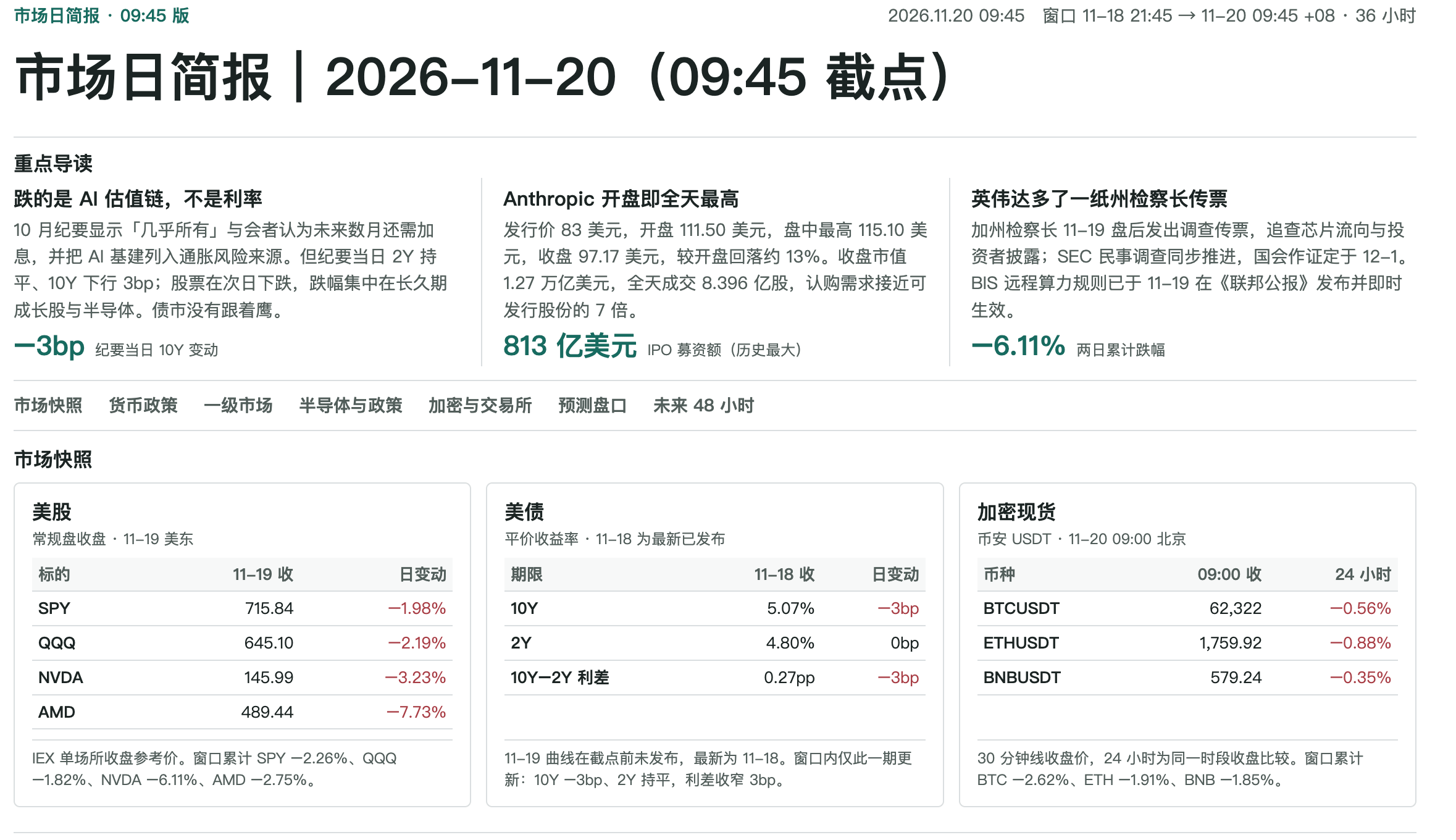
· The Fed’s October minutes show that “almost all” participants thought further rate hikes would be needed over the coming months, and identified AI infrastructure as a source of inflation risk. Yet on the day the minutes were released, the 10-year par yield fell 3bp and the 2-year was unchanged. Stocks fell, but bonds did not follow the hawkish signal—suggesting this round of repricing is about the AI financing chain, not the rate-hike path.
· Anthropic raised $81.3 billion, setting a global IPO record, but its stock opened at its intraday high on the first day and closed about 13% below the opening price, at a market capitalization of $1.27 trillion. For the first time, oversubscription in the primary market and buying support in the secondary market are being put side by side in the same set of numbers.
· Nvidia faced a California attorney general’s subpoena, an SEC civil investigation, and a congressional testimony schedule all at once over two days. Shipments of Hopper products to China have stopped, and the BIS remote-computing rule was published in the Federal Register on 11-19 and took effect immediately. Export controls and legal proceedings are two separate tracks.
【Monetary policy: consensus forms around rate hikes, AI infrastructure added to inflation risks】
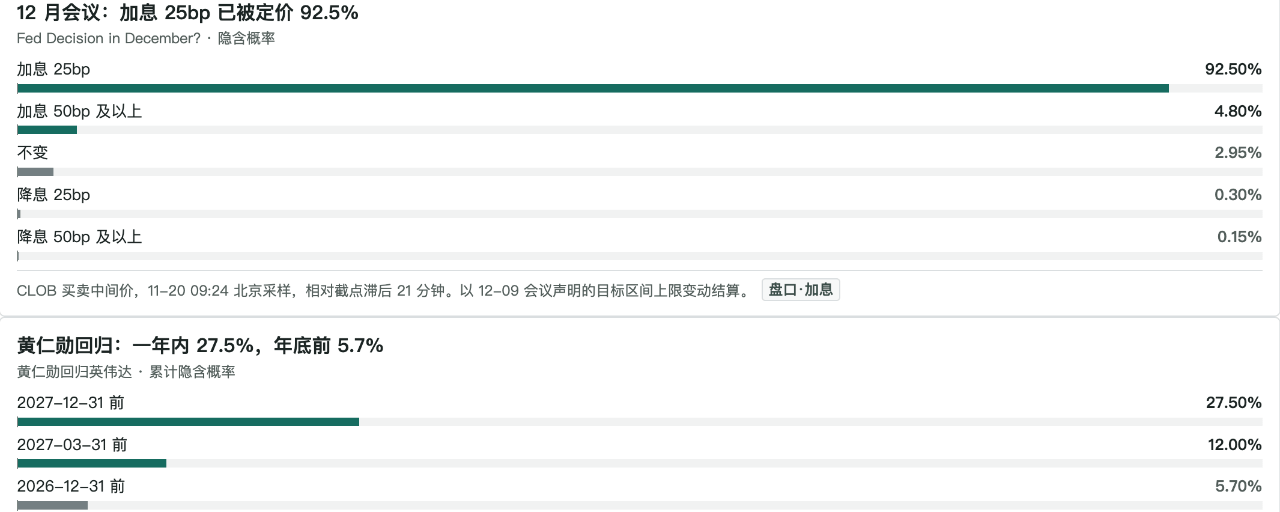
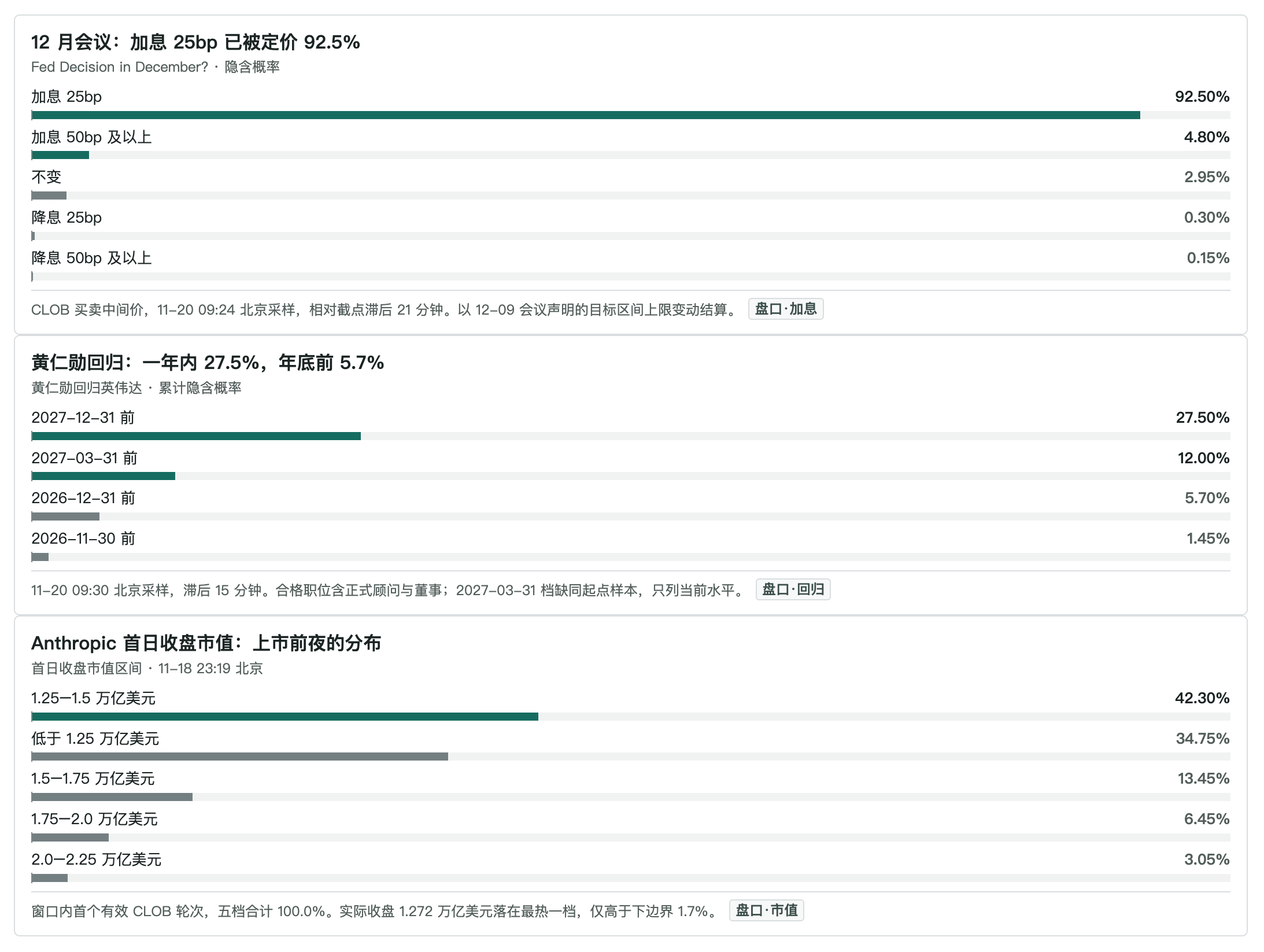
Facts. On 11-18, the Fed released minutes from its October 27-28 meeting, where it voted 10-2 to maintain the federal funds target range at 3.75%-4.00%; the two dissenters favored a 25bp hike. “Almost all” participants judged that, under the baseline outlook, further increases to the target range over the coming months would likely be appropriate. Two participants said the December 8-9 meeting could consider a hike of more than 25bp if subsequent inflation data were unfavorable. An overwhelming majority of participants believed elevated energy prices continued to push inflation higher, while some also viewed investment in AI infrastructure as a significant source of inflation risk. The minutes also noted that most participants had observed rapid growth in AI-related debt, much of it arranged through complex and opaque financing structures. Staff warned that off-balance-sheet lease commitments and circular financing arrangements among AI companies could amplify losses if returns fell short of expectations. Between the two meetings, two major AI companies reported revenue growth below investors’ expectations.
Market reaction. On the day the minutes were released (11-18), the 10Y par yield fell from 5.10% to 5.07%, while the 2Y held at 4.80%; QQQ rose 0.38% and SPY edged down 0.28%. The real selloff came on 11-19: SPY fell 1.98%, QQQ 2.19%, and NVDA 3.23%. The S&P 500 touched its lowest intraday level since June, and the Dow briefly fell by about 1,000 points. Treasury par yields for 11-19 had not yet been published, so it cannot be said that the bond market moved in the same direction as stocks the following day.
Assessment and the next two days. This period, I maintain the view that “the rate-hike path is already fully priced in,” and refine it further: the bond market did not follow the minutes’ hawkish signal on the day they were released, and the short end did not move at all. Stocks then plunged the next day, with the biggest declines concentrated in long-duration growth stocks and semiconductors. This suggests the market is pricing the sustainability of AI capital-expenditure financing more than the federal funds rate itself. This is a revision of my previous assessment, which attributed the decline to “rate expectations.”
Scenario A (base case): a 25bp hike in December goes ahead, and stocks do not reprice for the hike itself; volatility instead comes from validating AI-related companies’ financing and orders.
Scenario B (alternative): if December brings a 50bp hike or clear guidance of an accelerated pace, the short end of the curve would catch up and long-duration assets would face renewed pressure. Trigger C: if the 2Y par yield rises by more than 15bp cumulatively from 11-19 onward, it would mean the bond market is beginning to validate the minutes’ hawkish tone. At that point, the assessment should change from “valuation is falling” to “rates are rising.” The next verifiable milestones are the December 8-9 meeting and each core inflation reading released during the three weeks before it.
【Primary market: Anthropic opens at its first-day high, closes about 13% below the opening price】
Facts. Anthropic listed on Nasdaq on 11-19 under the ticker ANT. It issued 980 million shares at $83 each, raising about $81.3 billion, alongside a $26 billion private placement, for a total of more than $107 billion. This exceeded SpaceX’s roughly $75 billion record from June this year, making it the largest IPO in US stock-market history. The opening price was $111.50, 34.3% above the offer price; the intraday high was $115.10, briefly putting its market capitalization above $2 trillion; the low was $92.72; and it closed at $97.17, up 17.07% from the offer price but about 13% below the opening price, with a closing market capitalization of about $1.272 trillion (based on shares issued). A total of 839.6 million shares traded that day. Goldman Sachs and Morgan Stanley led the underwriting. Demand was nearly seven times the number of shares available, and more than half of the institutions that submitted bids received no allocation.
Market reaction. Opening at the day’s high was the clearest signal of the first day: the indicative opening price was raised several times during the delayed opening auction, and the first trade did not occur until two hours later. Buyers then failed to hold the price. The Nasdaq Composite continued to decline that day, and tech supply-chain companies participating in the concurrent private placement generally gave back their morning gains; ANT fell about 5% after hours. Tokenized trading also launched: Backpack Securities introduced tokenized ANT on Solana on the listing day; Ondo, xStocks, and bStocks offered it on BNB Chain; and Bitget, OKX, and Kraken listed ANT perpetual contracts.
Assessment and the next two days. This IPO delivered two readings pointing in opposite directions: sevenfold oversubscription and an increased offer price showed demand in the primary market, while “opening at the high, closing down 13%” showed fragile buying support in the secondary market. My base-case view is that the pricing anchor for AI assets is shifting from “scarcity of the narrative” to “verifiable cash flow.” Lock-up periods will not begin to expire until the third quarter of next year, so near-term selling pressure is coming not from insiders but from first-day allottees taking profits and index funds rebalancing. Scenario B: if ANT falls below its first-day low of $92.72 within five trading days, the two high-leverage channels—tokenization and perpetual contracts—could amplify the pullback on-chain. The risk assessment would then need to be upgraded from “valuation digestion” to “cross-market transmission risk.” Watch whether ANT’s daily trading volume and perpetual funding rate turn at the same time.
【Nvidia: governance issue escalates into multi-front legal risk; shipments to China have stopped】
Facts. On 11-19 after the market closed, California Attorney General Bonta announced that he had issued Nvidia an investigative subpoena, seeking to determine whether its advanced chips or confidential information had reached China, and whether the company had misled investors and the public about related risks. The SEC had previously disclosed a civil investigation into Nvidia on 11-17; its full scope remains unclear. On 11-17, Nvidia’s board established a standing “National Security and Export Controls Oversight Committee,” chaired by director Suzanne Nora Johnson. The national security team and global trade compliance team report directly to the committee and interim CEO Colette Kress. Jensen Huang has agreed to attend a transcribed congressional interview on 12-1, and the company’s general counsel, Tim Teter, will attend on 12-2. On the 11-17 earnings call, interim CEO Kress said the company had stopped shipping licensed Hopper-series data-center products, including H200, to China, and that its guidance did not include revenue from those products.
Market reaction. NVDA fell 3.23% on 11-19 to $145.99. Including its 2.98% decline on 11-18, it was down 6.11% over two days. Notably, the earnings themselves were strong: Q3 revenue was $115.8 billion, above expectations of $109.33 billion; the board also approved $150 billion in buybacks, and the revenue growth outlook for fiscal 2028 was raised from 70% to 75%. The stock fell 6% over two days despite beating expectations, suggesting the market is separately pricing in “governance and compliance uncertainty.” AMD was also hit by a report from short seller Hunterbrook the same day, with its intraday decline widening to 11%; it closed down 7.73% at $489.44. The company responded that the claims misrepresented its practices.
Assessment and the next two days. Last period, I classified this as a “governance issue”; this period, I am upgrading it to “multi-front legal risk.” The state attorney general’s investigation, SEC civil investigation, and congressional testimony are separate processes with different timelines, and none will change based on whether earnings are strong or weak. The subpoena came after the market closed, so the price has not yet reflected it; this is a direct variable for the next trading day. Export controls are a separate track: the BIS interim final rule on “remote access to advanced semiconductors” was published in the Federal Register on 11-19 (document number 2026-23529) and, according to the rule text, took effect on the date of publication. This replaces my previous wording that it was “expected to take effect on 11-19.” Key points: any data center that could provide more than 12 million cumulative TPP of computing power (equivalent to about 750 H100/H200 chips) to companies headquartered in China, Macau, or D:5 countries needs a license; exports of advanced chips to Indonesia, Malaysia, Singapore, Thailand, and Brazil require a license; existing operators have 90 days to apply; and the Biden-era AI Diffusion Rule is formally rescinded.
One point is easy to misread: on 11-19, the leaders of China, Russia, and the United States met in Shenzhen and issued a Peace Declaration. Its four points covered UN reform, increasing supplies of refined petroleum products, immunity for government officials, and dialogue on nuclear risks; it contained no provisions on chips or export controls. So the summit’s conciliatory tone cannot offset tighter chip controls—the two tracks are moving independently. This also explains why the controls took effect and stock prices fell in the same week.
【Crypto: ETFs continue to bleed, BTC falls during the window but stays above its previous low】
Facts. US spot Bitcoin ETFs recorded cumulative net outflows of $2.89 billion in November, including $975 million in the most recent week; total stablecoin supply fell by $16 billion over the same period. Binance’s 30-minute chart shows BTC retreating from $64,075 at 21:00 on 11-18 to $62,322 at 09:00 on 11-20, with a low of $61,529 during the window. On the platform and security front: an address linked to the 2024 Binance incident transferred about $248 million in ETH again; the SEC accused eight entities of defrauding US investors of more than $37 million through fake crypto trading platforms; Hong Kong’s Securities and Futures Commission listed Hyperliquid as a suspicious trading platform; Coinbase opened crypto options to eligible non-US users; and Payward, Kraken’s parent company, plans to acquire asset manager Tribe Capital for $2.7 billion.
Market reaction. During the window, BTC fell 2.74%, ETH 1.96%, and BNB 1.72%. There were no gaps in the 73 observations, so the change between the first and last readings can be taken as the direction over a continuous 36 hours, rather than just a comparison of two isolated points. BTC’s relative decline was greater than ETH’s and BNB’s, while ETFs continued to see net outflows over the same period. The two moved in the same direction, but that alone is not enough to establish causation—the ETF subscription and redemption data are daily and cannot pinpoint hourly movements.
Assessment and the next two days. I maintain the view that “crypto is in a funding-driven correction,” but shift the focus from price to market structure: continued ETF outflows alongside shrinking stablecoin supply mean that incremental capital in the market is dwindling. In this kind of environment, the threshold for leveraged liquidations tends to fall. BTC’s low of $61,529 during the window has not broken the earlier low, so for now this does not indicate an accelerating trend. Scenario A (base case): BTC trades between $60,000 and $64,000 as the market waits for ETF outflows to slow. Scenario B: if daily ETF net outflows exceed $500 million and BTC falls below $61,500, leveraged liquidations could amplify the decline. Watch daily ETF net flows and perpetual funding rates.
【Next 48 hours】
· 11-20|ANT’s first full trading day: watch whether it falls below its first-day low of $92.72. A break would allow the two high-leverage channels—tokenization and perpetuals—to amplify the pullback, shifting the impact from “sell the news” to cross-market transmission; holding above it would suggest first-day selling was profit-taking. Watch ANT trading volume and perpetual funding rates.
· 11-20|Nvidia’s response to the California subpoena: if the company issues a formal statement before the market opens, it could either ease or strengthen the “misleading investors” allegation. No response would leave uncertainty hanging until its congressional testimony on 12-1. Watch the wording of the company’s statement and whether it discloses the scope of the investigation.
· 11-20|The 60-day comment period for the BIS rule begins: the rule is already in effect, but implementation details or exemptions could still change during the comment period. Broader exemptions would be positive for data centers and the compute-rental sector; tighter rules would have the opposite effect. Watch for follow-up documents in the Federal Register and updates to BIS FAQs.
· 11-21|US economic data and Fed officials’ remarks: core inflation readings and officials’ comments on “whether December’s move will exceed 25bp” will directly test the short end of the curve. If the 2Y yield rises by more than 15bp cumulatively, the attribution for the stock-market decline should shift from valuation to interest rates.
· Ongoing watch|The AMD–Hunterbrook dispute: the short-seller report is a claim from a single source, and the company has denied it. I will not revise my assessment of AMD’s China revenue before independent verification. Watch for any disclosure by the company breaking out China revenue or any regulatory inquiries.
Sources: daily Treasury yield curve, FOMC minutes, Reuters/CNBC summaries, tokenized ANT, California Attorney General’s subpoena, BIS rule, Peace Declaration, crypto news roundup
Are you more concerned about the size of a December rate hike, or marginal changes in AI companies’ financing chains? Share your observations in the comments.
#Bitcoin #Macro
The above is a summary of public information and my personal assessment, and does not constitute investment advice. Digital assets are highly volatile; please verify information for yourself and make your own independent decisions.