

Global Macro Investment Intelligence | November 1, 2026
08:54 Beijing time | Sunday
Key takeaway today: Global risk assets continue to face three sources of pressure—energy-driven inflation, doubts about returns on AI investment, and a crisis of trust in crypto platforms. However, the latest South Korean semiconductor export data suggests that demand for AI hardware has not yet suffered a broad-based downturn.
The most notable developments over the past 24 hours are: South Korea’s semiconductor exports surged in October, China’s manufacturing PMI came in below expectations, OPEC+ is close to keeping its production targets unchanged, and Binance continues to replenish stolen assets.
I. Key Developments Over the Past 24 Hours
1. Strong South Korean Semiconductor Exports Provide Positive Evidence of AI Demand
Facts | November 1, 08:39 Beijing time
South Korea released its October export data:
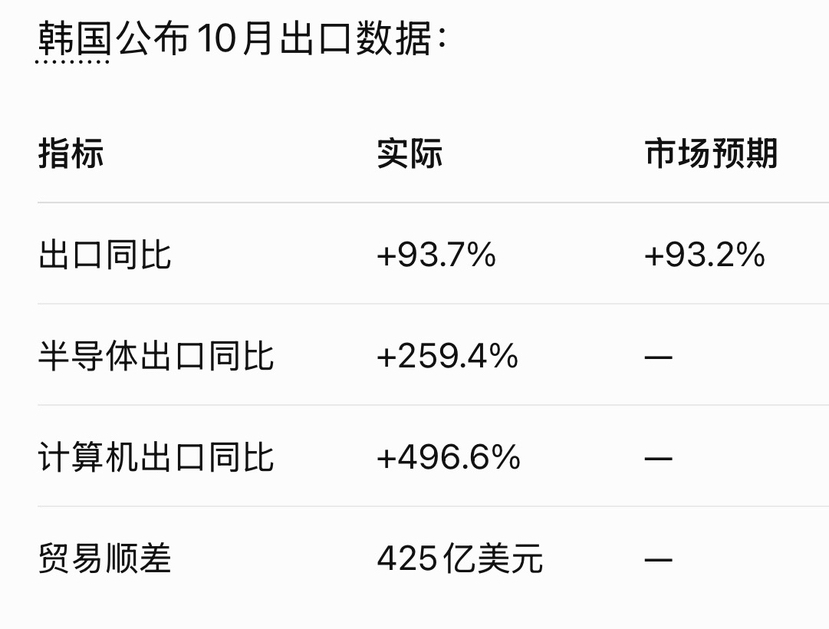
Export growth reached its highest level since 1974, partly due to the number of working days and a low base of comparison.
Market read: This stands in sharp contrast to the October 30 plunge in U.S. semiconductor stocks. The data supports the view that actual demand for AI servers and memory chips remains strong, but does not prove that all AI capital spending will generate good returns.
For the memory supply chain, this is positive fundamental evidence. For optical communications stocks such as COHR, LITE, and FN, it is an indirect demand signal that still needs to be assessed alongside orders, gross margins, and customer capital spending.
2. China’s Manufacturing PMI Falls Short of Expectations
Facts | October 31, 09:30
The National Bureau of Statistics' October PMI release showed that the manufacturing PMI fell from 50.1 to 49.3, below the 50.0 forecast in a Reuters poll; the non-manufacturing PMI fell to 49.7.
Surprise: Negative. This reflects a slowdown in overall demand and production activity. However, the high-tech manufacturing PMI remained at 51.3, indicating significant divergence across industries.
3. Middle East Talks Continue, but Energy Risks Remain
Facts | October 31
Iranian representatives continued talks with Qatari mediators. The U.S. Secretary of State said Trump had not yet decided whether to resume military strikes, with diplomacy remaining the priority.
Meanwhile, Iran's supreme leader called on the military to prepare for a counterattack.
Key distinction: Diplomatic engagement does not mean an agreement has been reached. There is still no formal confirmation that normal transit through the Strait of Hormuz has resumed.
4. OPEC+ Leans Toward Maintaining December Production Targets
Reuters reported on October 31 that OPEC+ members had agreed in principle to keep December production targets unchanged, in line with expectations.
However, the formal meeting outcome has not yet been announced. With actual production still constrained by regional conflict, maintaining quotas does not mean supply pressures will ease immediately.
5. Binance Has Covered 90% of the Assets
Binance said on October 31 that it had used its own funds to cover about 90% of the approximately $6.3 billion in stolen assets, with the remainder mainly involving less liquid tokens.
The exchange still plans to resume withdrawals on November 1. The FBI attributed the attack to the North Korea-linked hacking group TraderTraitor.
Market read: Covering the assets helps ease solvency concerns, but it does not mean the assets have been recovered or that withdrawals have resumed. For BNB, the actual resumption of withdrawals is more important than a compensation pledge alone.
II. Interest Rates, the Dollar, and Global Liquidity
The following are the latest verifiable trading-day and policy data, not new developments from the past 24 hours.
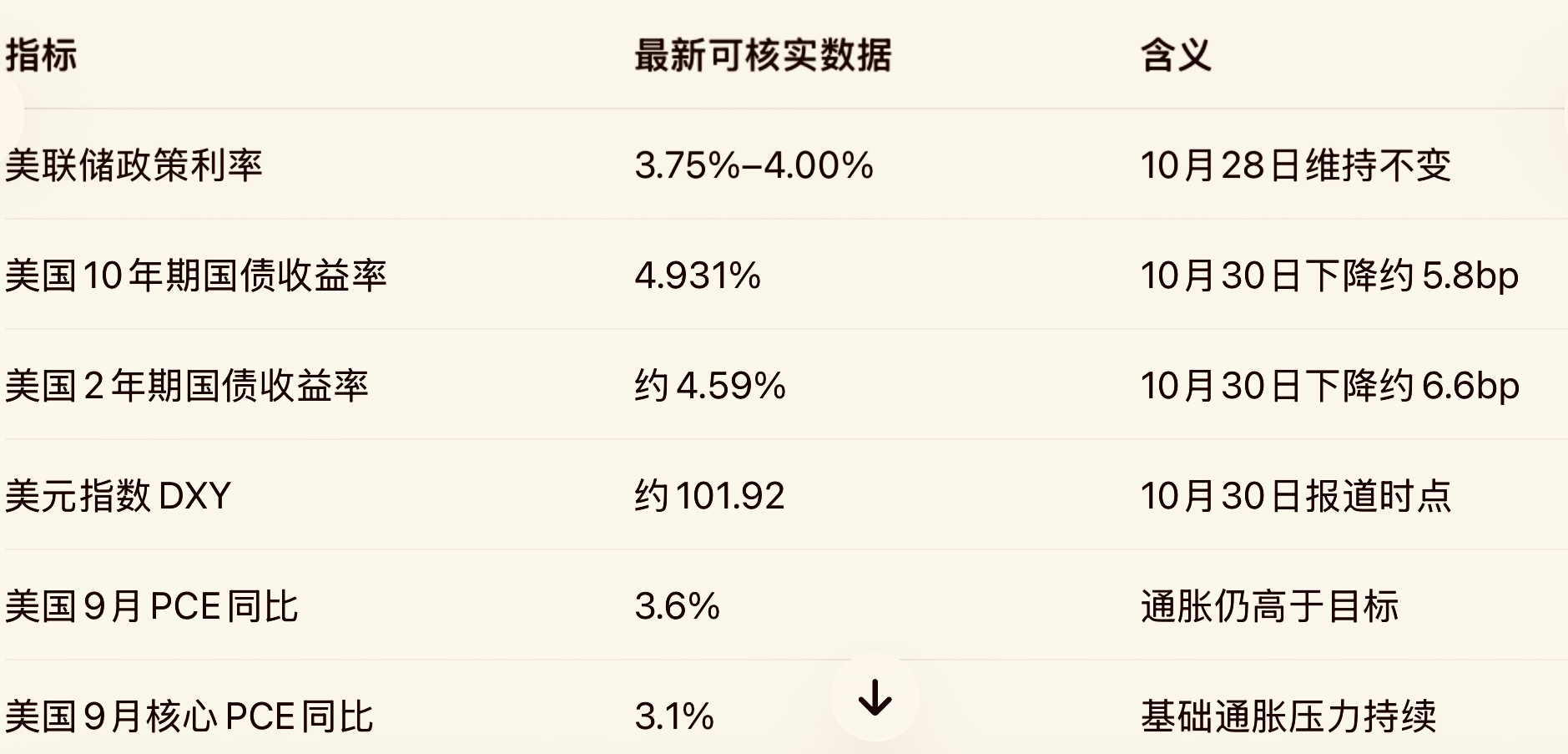
Sources: Federal Reserve decision on October 28, U.S. Bureau of Economic Analysis PCE report on October 29, and Reuters market roundup on October 30.
The Fed held rates steady as expected, but two policymakers supported a rate hike. The European Central Bank held rates unchanged on October 29, while the Bank of Japan kept its policy rate at 1.25% on October 30 and raised its inflation forecast.
Liquidity assessment: The decline in Treasury yields came primarily alongside a sell-off in tech stocks and safe-haven demand; it should not be interpreted simply as an improvement in global liquidity. There is also insufficient new data to show significant changes in bank reserves, dollar funding conditions, or market leverage.
III. BTC, BNB, and AI Tech Stocks
Crypto Market
At the time of Reuters' report on October 30, BTC was around $76,877. This is not the live price on November 1. We have not obtained reliable, up-to-date synchronized price and liquidation data for BTC and BNB, so we are not estimating their actual weekend price moves.
The key focus is whether platform trust risks continue to spread. A smooth resumption of withdrawals could ease BNB's risk premium; another delay could affect confidence across the crypto market.
AI, Chips, Optical Communications, and Memory
At the close of U.S. trading on October 30, the Nasdaq fell 2.86%, the Philadelphia Semiconductor Index dropped about 7.2%, Intel fell 28.6%, AMD fell 10.9%, and Nvidia fell 4.2%.
Market attention has shifted from the growth in AI investment to whether capital spending can generate sufficient cash flow and profits.
Two questions need to be distinguished:
Is demand for AI infrastructure continuing to grow? South Korea's export data provides positive evidence.
Are current valuations of AI-related stocks reasonable? That still depends on earnings delivery, returns on capital spending, and valuation levels; export growth alone cannot prove it.
IV. Key Events on the Calendar for the Next 48 Hours
All times are Beijing time.
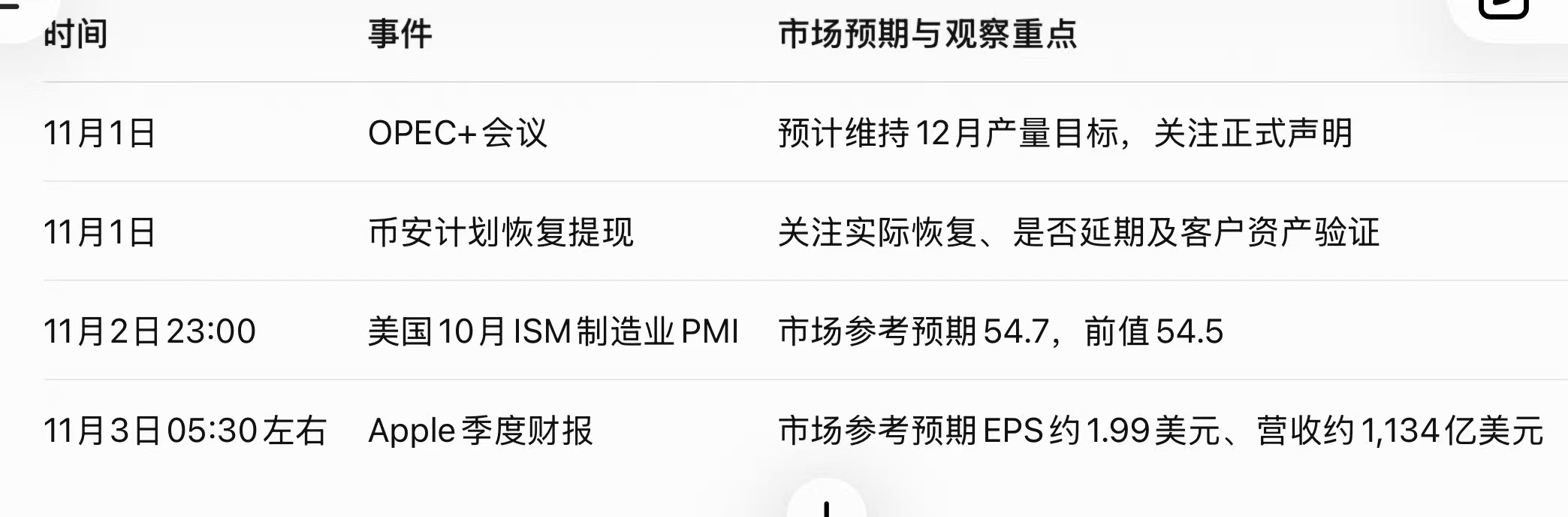
The ISM consensus comes from the November 2 economic calendar, while Apple's consensus comes from late-October market estimates; these figures may change with statistical methodology and institutional updates.
Important events beyond the 48-hour window: the U.S. midterm elections on November 3, and U.S. September JOLTS job openings data, due at 23:00 Beijing time on November 3.
V. Overall Outlook
It is too early to conclude that global risk assets have entered a new one-way trend.
Base case: Diplomatic engagement in the Middle East continues without a breakthrough, OPEC+ maintains its production targets, and crypto platforms gradually restore services. Markets continue to reprice around inflation pressures, returns on AI capital spending, and corporate earnings.
Upside scenario: Verifiable improvements in transit through the Strait of Hormuz, a smooth resumption of Binance withdrawals, and continued strength in AI hardware orders. This could reduce some risk premiums, but does not guarantee that tech stocks and crypto assets will rise in tandem.
Downside scenario: Military conflict in the Middle East escalates again, energy supplies are further disrupted, or Binance fails to restore services. The first could affect tech stock valuations through oil prices, inflation expectations, and interest rates; the latter could affect BTC and BNB through trust in trading platforms and liquidity.
The three variables most worth tracking today are actual transit through the Strait of Hormuz, the resumption of Binance withdrawals, and whether South Korea's strong semiconductor exports translate into sustained earnings growth for companies.
This briefing is current as of 08:54 Beijing time on November 1, 2026, and is based on verified announcements and reports. U.S. markets are closed for the weekend, so some market data reflect October 30 closing levels.