

Data as of: 2026-11-21 08:14 Beijing time (36-hour window)
This article is a snapshot as of the stated time and does not include information that emerged afterward. It is not investment advice.
▍My take
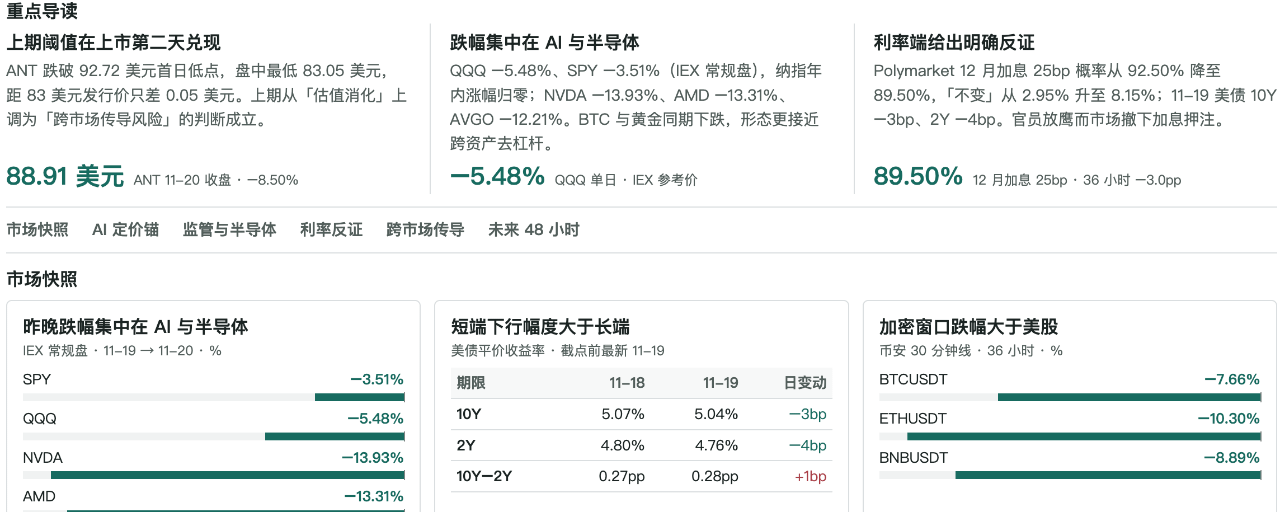
Why did the market suddenly plunge last night? Many people’s first instinct is to look for a piece of bad news. Here are three clues that make things clear: First, Anthropic fell below its first-day low on its second day of trading, coming within just 5 cents of its $83 offering price intraday, while stabilization positions were exited at the same time. Second, the SEC accounting review, California subpoenas, and congressional inquiries involving Nvidia are all advancing on multiple fronts, making semiconductors a focal point of the sell-off. Third—and the easiest to misread—odds of a December rate hike fell rather than rose, while Treasury yields also declined. So this wasn’t a rate shock, but a repricing of the AI financing chain, compounded by cross-market contagion from leveraged liquidations.

[Key reading]
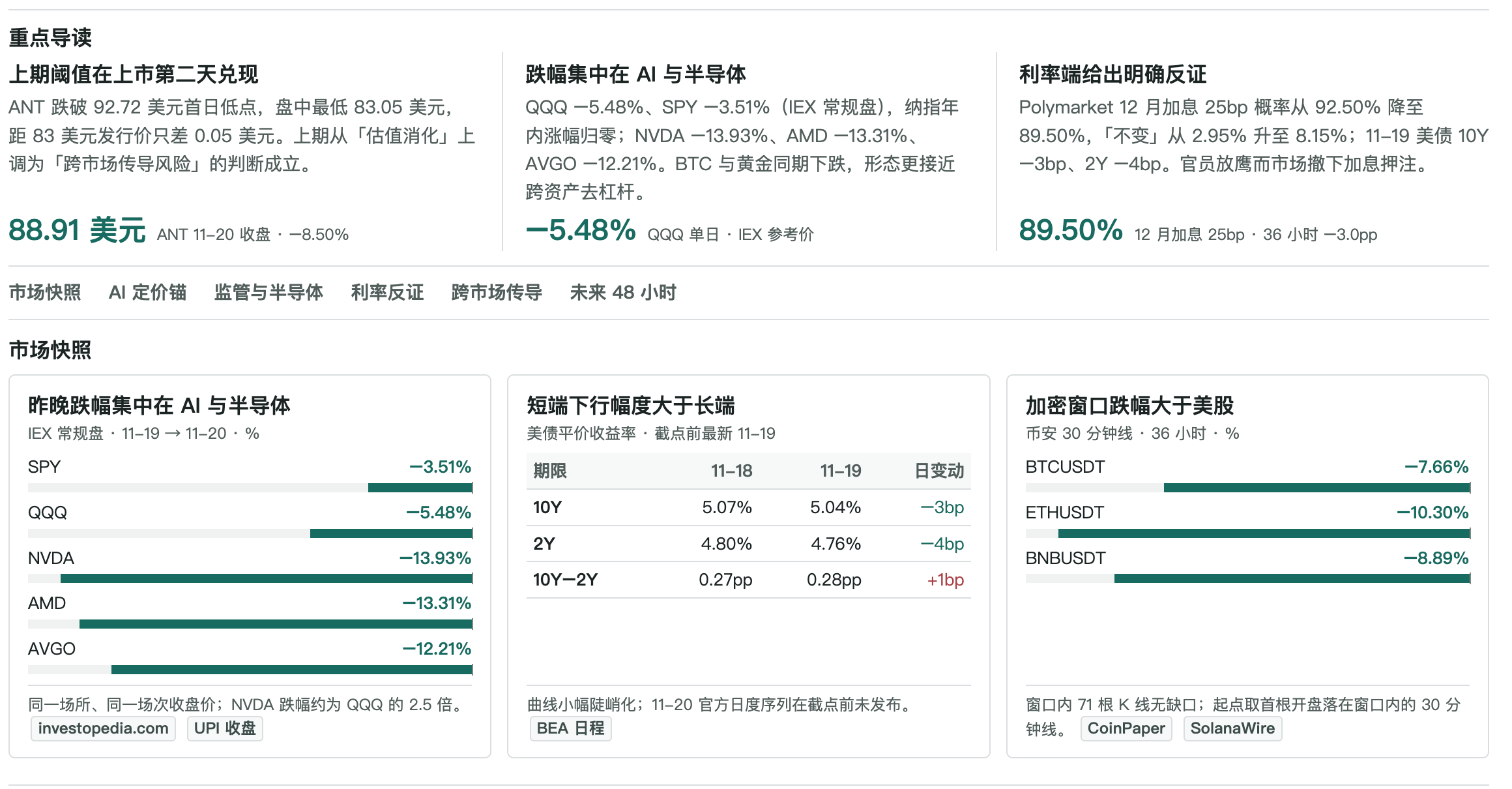
· The reassessment threshold set last period was met on the second day after listing: ANT broke below the first-day low of 92.72 dollars, intraday low 83.05 dollars, just 5 cents above the issue price. Last period’s upgrade from “valuation digestion” to “cross-market transmission risk” was correct.
· Gold and silver both fell, showing that funds were reducing leverage overall: stocks, crypto, gold, and silver all weakened in the same direction last night, so a single safe-haven explanation does not hold.
· The rates side provided clear counterevidence: the probability of a December hike fell, while U.S. Treasury yields also declined. Officials kept sounding hawkish, but the market was in fact pulling back from hike bets.
[Market snapshot]
▍U.S. stock declines: it was chips that fell, not the whole market (IEX regular session · 11-20)
NVDA -13.93% █████████
AMD -13.31% █████████
AVGO -12.21% ████████░
QQQ -5.48% ████░░░░░
SPY -3.51% ██░░░░░░░
On the same day, AAPL fell 1.63% and MSFT 2.63%; losses were concentrated in AI and semiconductors rather than across broad indices.
▍Crypto spot: 36-hour window decline (Binance 30-minute candles, 71 candles without gaps)
ETH -10.30% █████████
BNB -8.89% ████████░
BTC -7.66% ███████░░
BTC first broke below 60,000 dollars intraday on 11-20, the lowest since July; the close timestamp was 11-21 07:00 Beijing time.
▍U.S. Treasuries: on 11-19, the par yield was 10Y 5.04% (-3bp), 2Y 4.76% (-4bp), with the short end falling more. Readings for 11-20 were not released by the cutoff.
[Main line 1: Anthropic’s second trading day came close to the issue price, and last period’s cross-market transmission scenario came true]
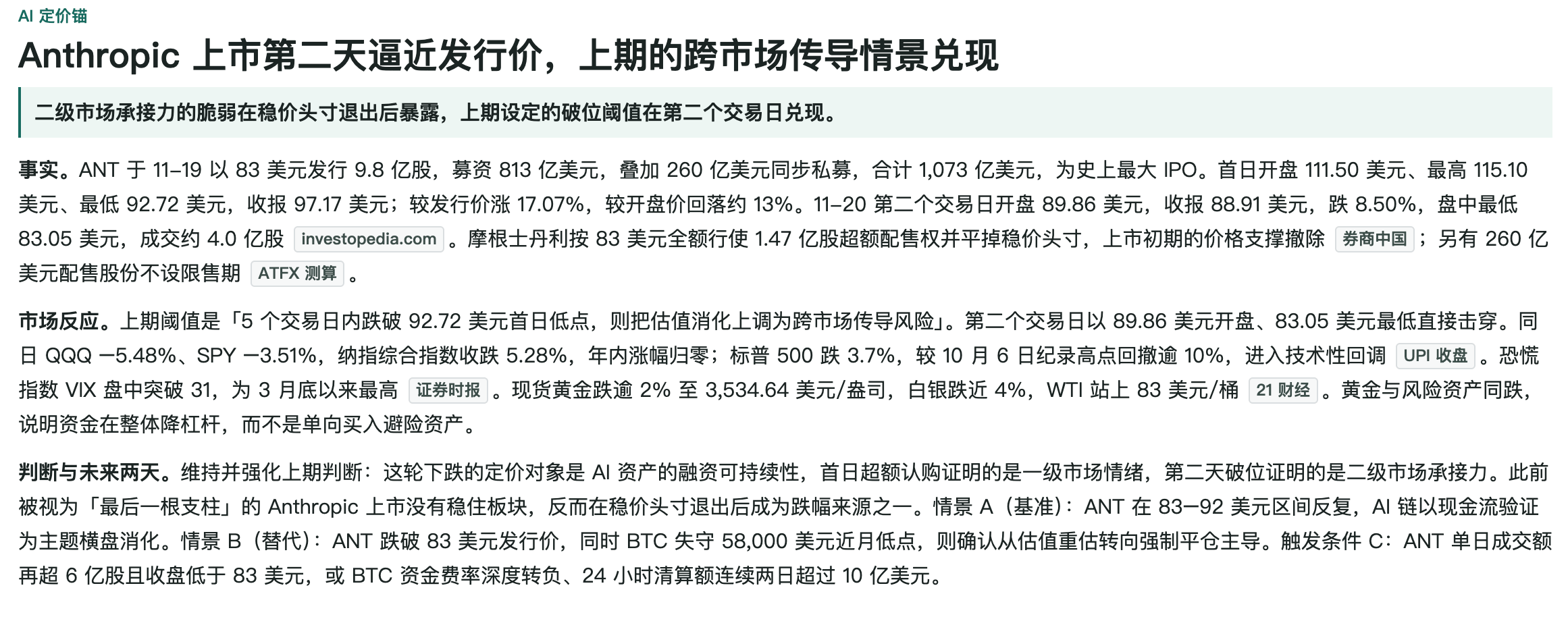
Facts. ANT was issued on 11-19 at 83 dollars for 980 million shares, raising 81.3 billion dollars, plus 26 billion dollars in concurrent private placement, for a total of 107.3 billion dollars, making it the largest IPO in history. On day one, it opened at 111.50 dollars, hit an intraday high of 115.10 dollars and a low of 92.72 dollars, and closed at 97.17 dollars, up 17.07% from the issue price and about 13% below the open. On the second trading day, 11-20, it opened at 89.86 dollars and closed at 88.91 dollars, down 8.50%, with an intraday low of 83.05 dollars and about 400 million shares traded. Morgan Stanley fully exercised 147 million shares of the over-allotment option at the 83 dollar issue price and closed out the stabilizing position, meaning the price support in the early listing phase was removed. There were also 26 billion dollars of placement shares without a lock-up period.
Market reaction. The trigger condition set last period was: “If the first-day low of 92.72 dollars is broken within 5 trading days, then upgrade from valuation digestion to cross-market transmission risk.” On the second trading day, it opened at 89.86 dollars and directly broke through to an intraday low of 83.05 dollars. On the same day, QQQ fell 5.48%, SPY 3.51%, the Nasdaq Composite closed down 5.28%, erasing its year-to-date gains; the S&P 500 fell 3.7%, more than 10% below its October 6 record high, entering technical correction territory. The VIX broke above 31 intraday, the highest since late March. Spot gold fell more than 2% to 3,534.64 dollars per ounce, silver fell nearly 4%, and WTI crude rose above 83 dollars per barrel. Gold and risk assets falling together shows that funds were reducing leverage exposure overall, rather than moving one-way into safe havens.
Judgment and the next two days. Maintain and reinforce last period’s view: the asset being priced in this round of declines is the financing sustainability of AI assets. The first-day oversubscription proves primary-market sentiment, while the second-day break below support proves secondary-market absorption. Anthropic’s IPO, previously seen as the “last pillar,” not only failed to stabilize the sector, but after stabilizing positions were unwound it became one of the sources of the decline. Scenario A (base case): ANT repeatedly trades in the 83−92 dollar range, and the AI chain enters a sideways digestion phase centered on cash-flow validation, with no further expansion of cross-market contagion. Scenario B (alternative): if ANT falls below the 83 dollar issue price, while BTC loses the near-month low of 58,000 dollars, then it confirms a shift from valuation re-pricing to forced liquidation dominance. Trigger condition C: if ANT daily turnover again exceeds 600 million shares and closes below 83 dollars, or BTC funding rates turn deeply negative and 24-hour liquidation volume exceeds 1 billion dollars for two consecutive days, then shift from A to B.
[Main line 2: Nvidia faces multiple regulatory pressures plus AMD short-selling allegations, with losses concentrated in semiconductors]
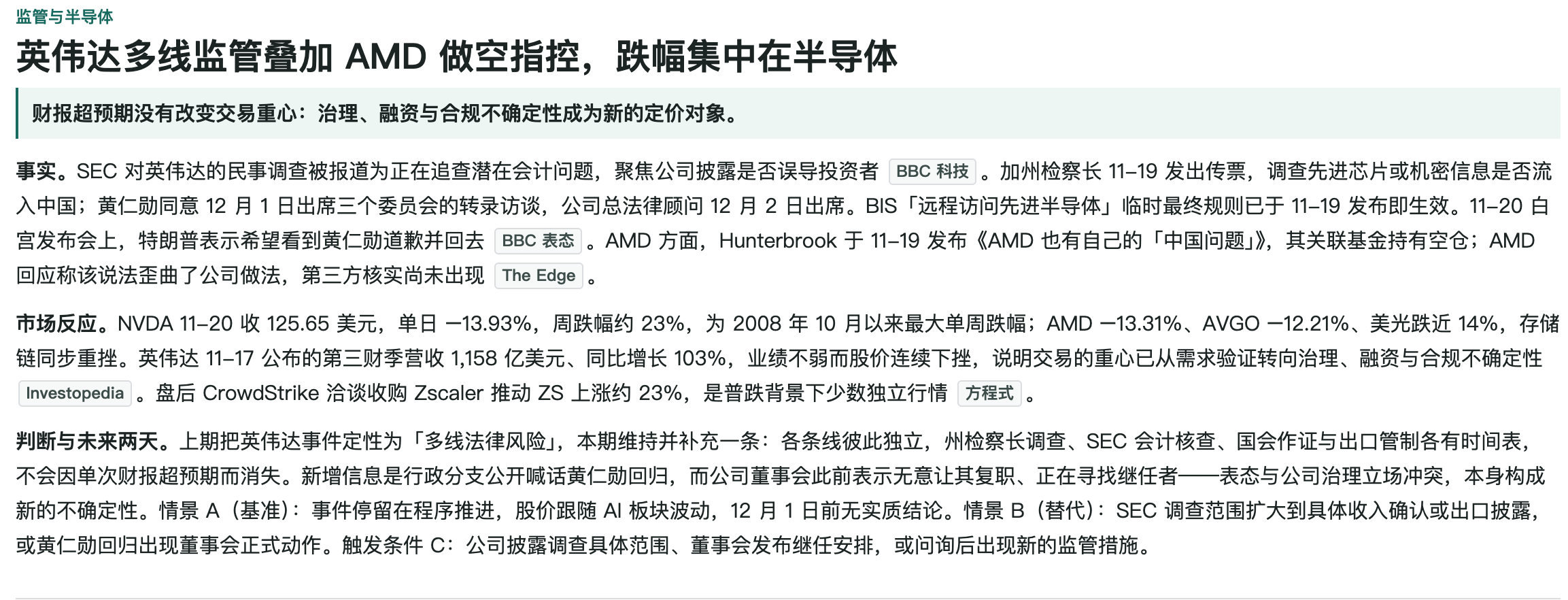
Facts. The SEC’s civil investigation into Nvidia was reported to be pursuing potential accounting issues, focusing on whether the company’s disclosures misled investors. California’s attorney general issued a subpoena on 11-19 to investigate whether advanced chips or confidential information flowed into China; Jensen Huang has agreed to appear on December 1 for a transcribed interview before three committees, and the company’s general counsel will appear on December 2. The BIS interim final rule on “remote access to advanced semiconductors” was released on 11-19 and took effect immediately. At the 11-20 White House briefing, Trump said he hoped to see Huang apologize and go back. On AMD, short-seller Hunterbrook published on 11-19 that AMD also has its own “China problem,” claiming an affiliated fund held a short position; AMD replied that the claim distorted the company’s practices, and third-party verification has not yet appeared.
Market reaction. NVDA closed at 125.65 dollars on 11-20, down 13.93% on the day and about 23% for the week, the biggest weekly drop since October 2008; AMD fell 13.31%, AVGO 12.21%, Micron nearly 14%, and the Philadelphia Semiconductor Index and memory chain slumped in sync. Nvidia’s third-quarter revenue announced on 11-17 was 115.8 billion dollars, up 103% year over year; the results were not weak, yet the stock kept falling, showing that trading focus has shifted from demand validation to governance, financing, and compliance uncertainty. After hours, news that CrowdStrike was in talks to acquire Zscaler pushed ZS up about 23%, one of the few independent moves amid broad weakness.
Judgment and the next two days. Last period framed the Nvidia event as “multiple legal risks”; this period maintains that view and adds one point: the risk lines are independent of each other. The state attorney general probe, SEC accounting review, congressional testimony, and export controls each have their own timelines, and none will disappear because of a single earnings beat. The new information is that the executive branch publicly called for Huang to return, while the board had previously said it had no intention of restoring him and was searching for a successor—this conflict between statements and governance position is itself a new source of uncertainty, not a bullish factor. Scenario A (base case): the matter remains in procedural motion, the stock trades with the AI sector, and there is no substantive conclusion before the December 1 questioning. Scenario B (alternative): if the SEC probe expands into specific revenue recognition or export disclosure issues, or if Huang’s return leads to formal board action, then the direction of the risk premium may change. Trigger condition C: the company discloses the probe’s specific scope, the board releases a succession plan, or new regulatory measures emerge after the questioning.
[Main line 3: Officials sound hawkish while the market pulls back from rate-hike bets; rates are not the cause of this decline]
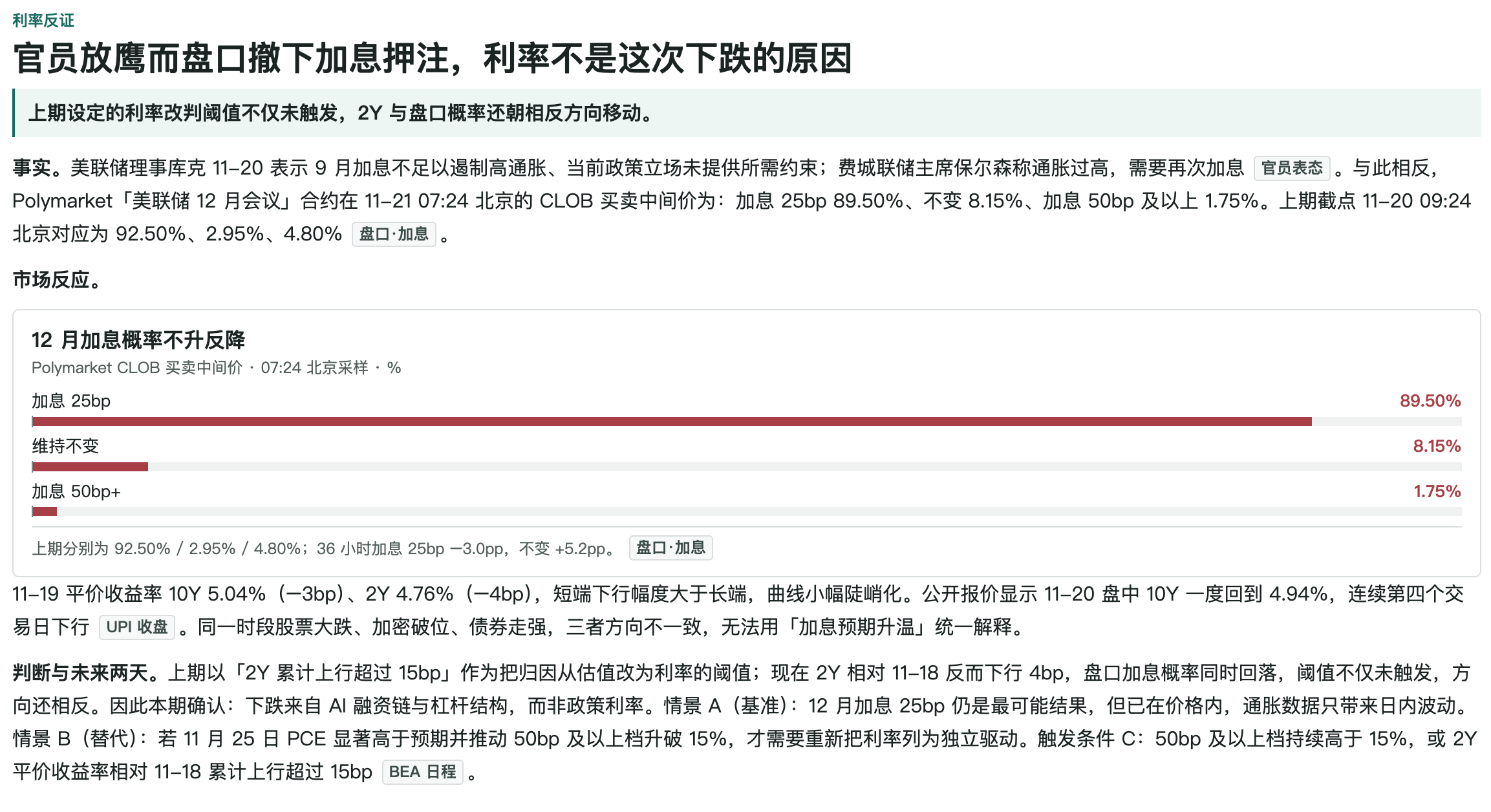
Facts. Federal Reserve Governor Cook said on 11-20 that the September rate hike was insufficient to curb high inflation and that the current policy stance is not providing the needed restraint; Philadelphia Fed President Paulson said inflation is too high and rates need to rise again. In contrast, Polymarket’s “Federal Reserve December meeting” contract at 11-21 07:24 Beijing time showed the CLOB midpoint as: 25bp hike 89.50%, unchanged 8.15%, 50bp hike or more 1.75%. The prior snapshot at 11-20 09:24 Beijing time was 92.50%, 2.95%, and 4.80% respectively. Over 36 hours, the 25bp hike probability fell by 3.0 percentage points, unchanged rose by 5.2 points, and 50bp+ fell by 3.05 points.
25bp hike 89.50% █████████ -3.0pp
Unchanged 8.15% █░░░░░░░░ +5.2pp
50bp+ hike 1.75% ░░░░░░░░░ -3.05pp
Market reaction. On 11-19, the 10Y par yield was 5.04% (-3bp) and the 2Y was 4.76% (-4bp), with the short end falling more than the long end and the curve modestly steepening. Open-market quotes showed the 10Y briefly returned to 4.94% intraday on 11-20, falling for a fourth straight session. In the same period, equities sold off sharply, crypto broke down, and bonds strengthened; the three moves were not aligned, so the decline cannot be explained uniformly by “rising rate-hike expectations.”
Judgment and the next two days. Last period used “2Y cumulative rise above 15bp” as the threshold for shifting attribution from valuation to rates; now the 2Y has instead fallen 4bp versus 11-18, and the market’s hike probability has also eased. The threshold was not only unmet, the direction moved the opposite way. Therefore this period confirms: the decline comes from the AI financing chain and leverage structure, not policy rates. Scenario A (base case): a 25bp hike in December remains the most likely outcome, but it is already priced in, and inflation data only causes intraday volatility. Scenario B (alternative): if the November 25 PCE comes in materially above expectations and pushes the 50bp+ bucket above 15%, then rates would need to be reconsidered as an independent driver. Trigger condition C: the 50bp+ bucket stays above 15%, or the 2Y par yield cumulatively rises more than 15bp versus 11-18. The next verifiable node is the October PCE and personal income and spending report at 20:30 Beijing time on November 25.
[Main line 4: Crypto’s decline was amplified by leverage liquidation, not a standalone negative catalyst]
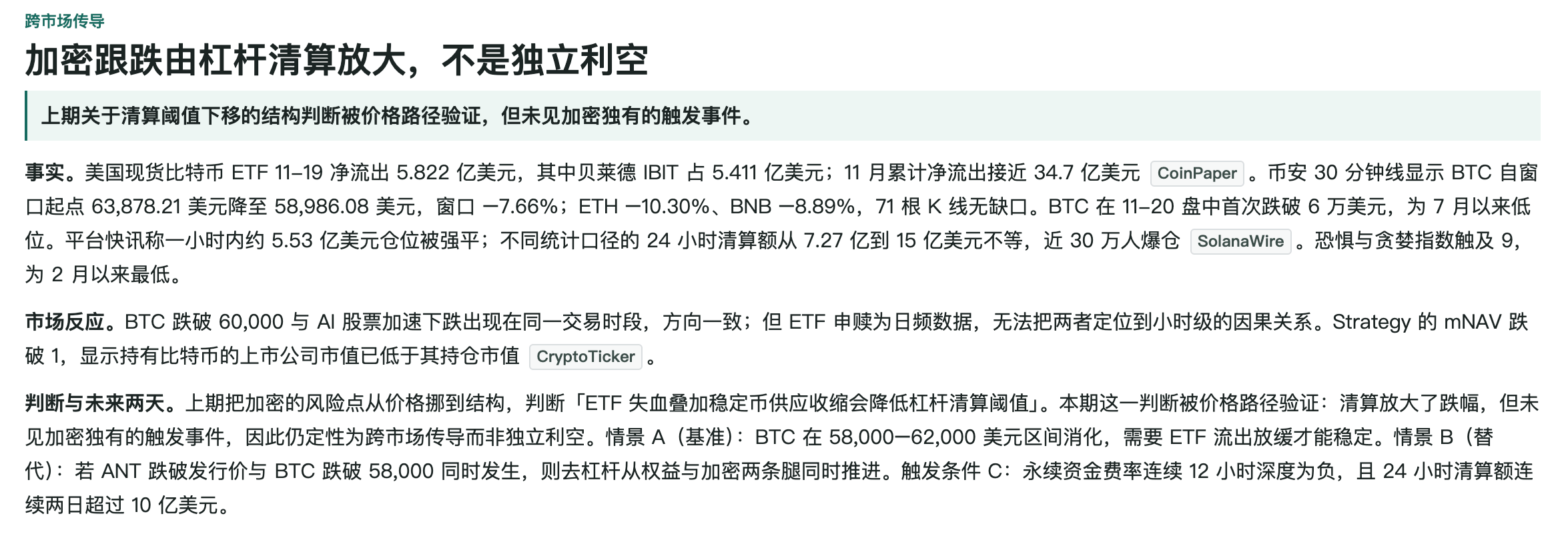
Facts. U.S. spot Bitcoin ETFs saw net outflows of 582.2 million dollars on 11-19, with BlackRock’s IBIT accounting for 541.1 million dollars; November cumulative net outflows were close to 3.47 billion dollars. Binance 30-minute candles show BTC falling from 63,878.21 dollars at the start of the window to 58,986.08 dollars, a -7.66% window move; ETH fell 10.30%, BNB 8.89%, and there were no gaps across 71 candles. BTC first broke below 60,000 dollars intraday on 11-20, the lowest level since July. Platform news said about 553 million dollars of positions were liquidated within one hour; different statistical methods put 24-hour liquidation volume between 727 million and 1.5 billion dollars, with nearly 300,000 people liquidated. The Fear and Greed Index reached 9, the lowest since February.
Market reaction. BTC dropping below 60,000 dollars and AI stocks accelerating their decline happened in the same trading session, moving in the same direction; however, ETF subscriptions/redemptions are daily data and cannot pin the two to an hourly causal relationship. Strategy’s mNAV fell below 1, showing that the market value of listed companies holding bitcoin is now below the value of their bitcoin holdings.
Judgment and the next two days. Last period shifted crypto risk from price to structure, judging that “ETF bleeding plus stablecoin supply contraction lowers the leverage liquidation threshold.” This period’s price path validates that view: liquidation amplified the decline, but no crypto-specific trigger was seen, so it remains classified as cross-market transmission rather than a standalone negative catalyst. Scenario A (base case): BTC digests in the 58,000−62,000 dollar range, and stability requires ETF outflows to slow. Scenario B (alternative): if ANT falls below its issue price and BTC breaks below 58,000 at the same time, then de-risking proceeds on both equities and crypto legs simultaneously. Trigger condition C: perpetual funding rates remain deeply negative for 12 consecutive hours, and 24-hour liquidation volume exceeds 1 billion dollars for two consecutive days.
[Next 48 hours]
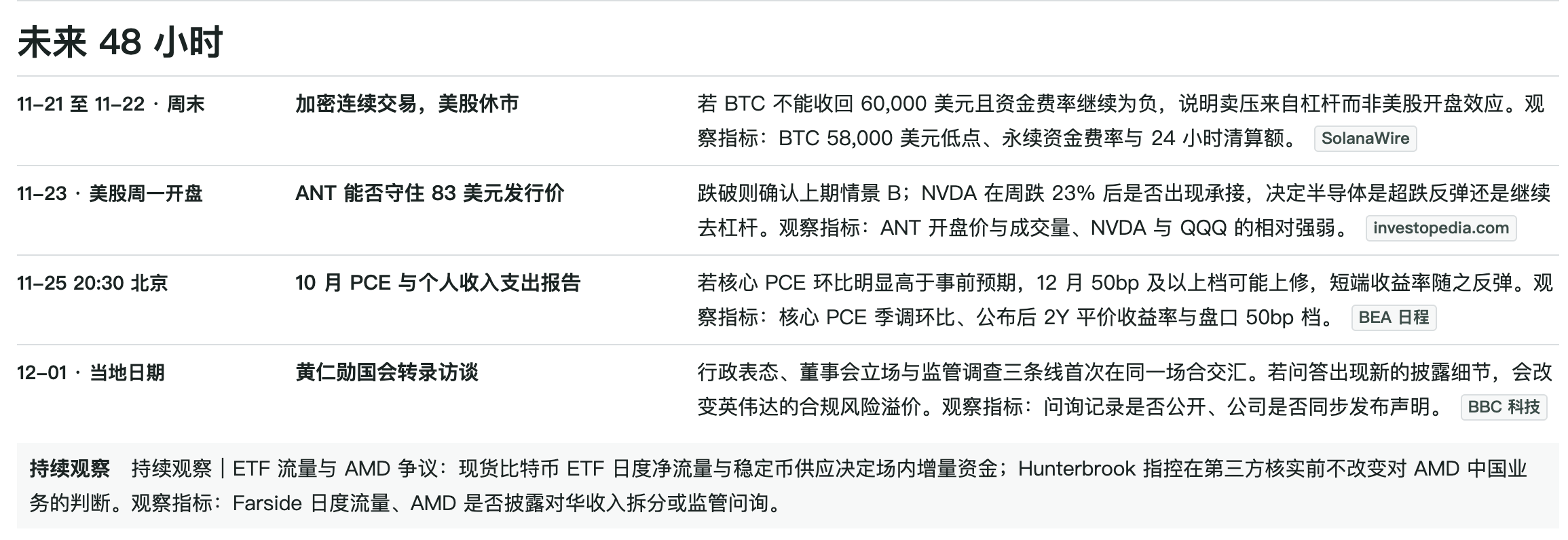
· 11-21 to 11-22 | Weekend crypto continuous trading: U.S. stocks are closed, so crypto is the only market still being priced continuously. If BTC cannot reclaim 60,000 dollars and funding rates remain negative, it shows selling pressure is coming from leverage rather than the U.S. stock market open effect. Indicators to watch: BTC’s 58,000 dollar low, perpetual funding rates, and 24-hour liquidation volume.
· 11-23 | U.S. stock market Monday open: whether ANT can hold the 83 dollar issue price is the first observation point; a break below confirms last period’s Scenario B. After a 23% weekly drop, whether NVDA finds support will determine whether semiconductors are oversold and rebounding or continuing to de-lever. Indicators to watch: ANT opening price and volume, relative strength of NVDA versus QQQ.
· 11-25 20:30 Beijing | October PCE and personal income/spending report: if core PCE month-over-month is clearly above prior expectations, the 50bp+ bucket for December may be revised higher, and short-end yields may rebound accordingly. Indicators to watch: seasonally adjusted core PCE month-over-month, 2Y par yield after release, and the 50bp bucket in the market.
· 12-01 | Huang’s congressional transcribed interview: this is the first time the executive branch’s statement, the board’s position, and the regulatory probe intersect in the same setting. If new disclosure details emerge during the Q&A, Nvidia’s compliance risk premium will change. Indicators to watch: whether the questioning record is made public, and whether the company issues a statement at the same time.
· Ongoing monitoring | ETF flows and AMD dispute: daily net flows of spot Bitcoin ETFs and stablecoin supply determine incremental capital in the market; the Hunterbrook allegation does not change the view on AMD’s China business before third-party verification. Indicators to watch: Farside daily flows, and whether AMD discloses a breakdown of China revenue or receives regulatory inquiries.
Sources: ANT market action, green shoe exercise, valuation estimates, U.S. close, intraday review, cross-asset review, SEC probe, Trump comments, AMD dispute, weekly summary, after-hours move, officials’ statements, etc.
Do you think ANT can hold the 83 dollar issue price, or is this de-leveraging cycle only just beginning? Leave your view below.
#Macro #Bitcoin
The above is a summary of public information and personal judgment, not investment advice. Digital assets are highly volatile; please verify independently and make your own decisions.