
JOSEPH DESOZE
17.1k Posts

JOSEPH DESOZE
 Square Verified
Report
Block User
Crypto Enthusiast, Market Analyst; Gem Hunter Blockchain Believer.
Open Trade

BTC Holder
Frequent Trader
2.2 Years
238 Following
30.6K+ Followers
19.0K+ Liked
Posts
Portfolio
All
Quotes
Videos
Live
PINNED
#sxt $SXT @SpaceandTimeDB
One thing I find interesting about Space and Time is that the data doesn't actually need to be stored on a blockchain for its integrity to be verified.
That might sound like a small detail, but I think it's an important part of how the whole system works.
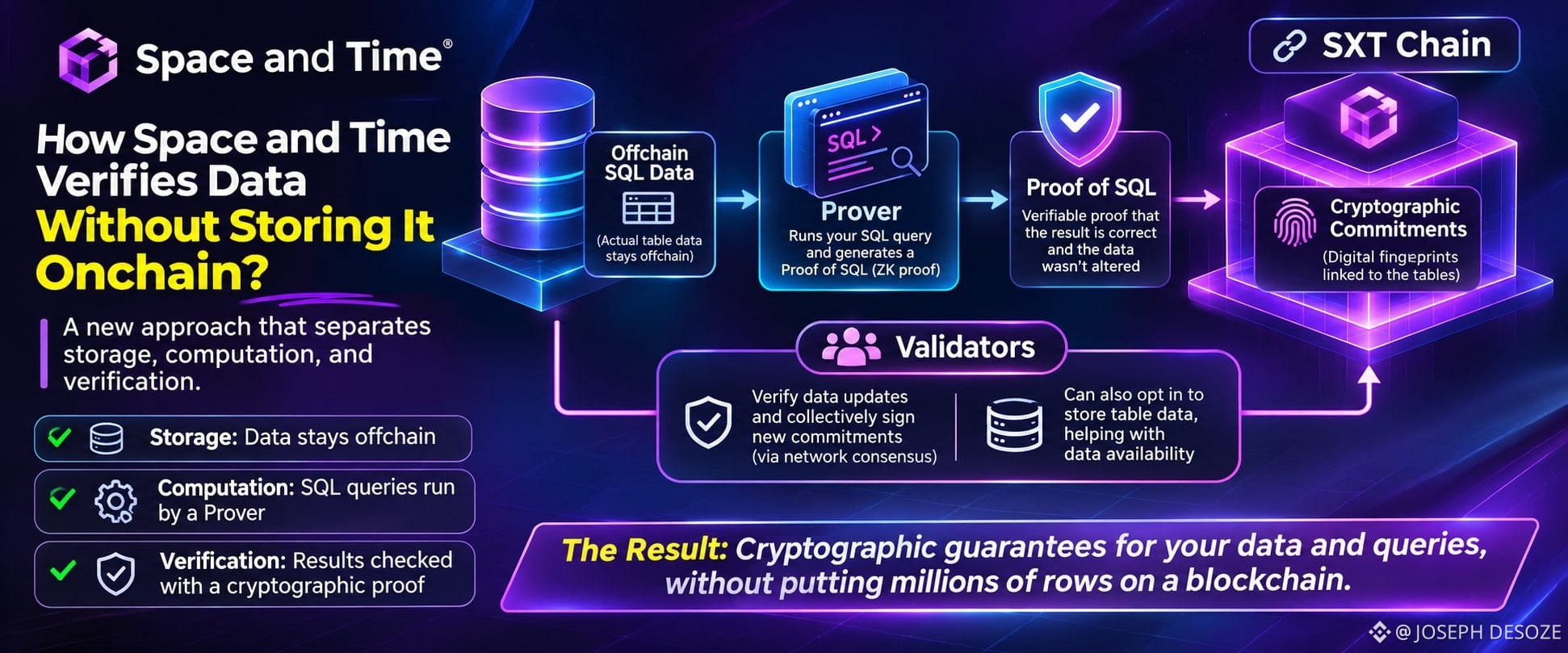
The actual SQL table data stays offchain, while SXT Chain stores cryptographic commitments linked to those tables. Think of a commitment as a digital fingerprint. It gives the network a way to detect changes without having to put the entire dataset onchain.
There's also an interesting role for validators here. They verify data updates and collectively sign new commitments through network consensus. Validators can also opt in to storing table data, helping support the network's data availability.
When someone runs a SQL query, a Prover executes it against the underlying data and generates a Proof of SQL. This proof allows the result to be checked against the committed data, confirming both that the computation was performed correctly and that the data wasn't secretly altered.
What I like about this approach is the separation between storage, computation, and verification.
The blockchain doesn't need to carry millions of rows of data, yet applications can still get cryptographic guarantees about the information behind their queries.
Of course, cryptographic verification is only one part of the bigger picture. Data also needs to remain accessible when applications actually need it.
That's something I'll be keeping an eye on as the Space and Time network develops further.
#sxt $SXT @SpaceandTime
One thing I find interesting about Space and Time is that the data doesn't actually need to be stored on a blockchain for its integrity to be verified.
That might sound like a small detail, but I think it's an important part of how the whole system works.
The actual SQL table data stays offchain, while SXT Chain stores cryptographic commitments linked to those tables. Think of a commitment as a digital fingerprint. It gives the network a way to detect changes without having to put the entire dataset onchain.
There's also an interesting role for validators here. They verify data updates and collectively sign new commitments through network consensus. Validators can also opt in to storing table data, helping support the network's data availability.
When someone runs a SQL query, a Prover executes it against the underlying data and generates a Proof of SQL. This proof allows the result to be checked against the committed data, confirming both that the computation was performed correctly and that the data wasn't secretly altered.
What I like about this approach is the separation between storage, computation, and verification.
The blockchain doesn't need to carry millions of rows of data, yet applications can still get cryptographic guarantees about the information behind their queries.
Of course, cryptographic verification is only one part of the bigger picture. Data also needs to remain accessible when applications actually need it.
That's something I'll be keeping an eye on as the Space and Time network develops further.
4
1
8
194
Article
JENSEN HUANG'S COMEBACK ADDED $2.3 BILLION TO A CHARITABLE FOUNDATION IN ONE DAY.There's a detail behind Nvidia's latest market drama that deserves more attention.
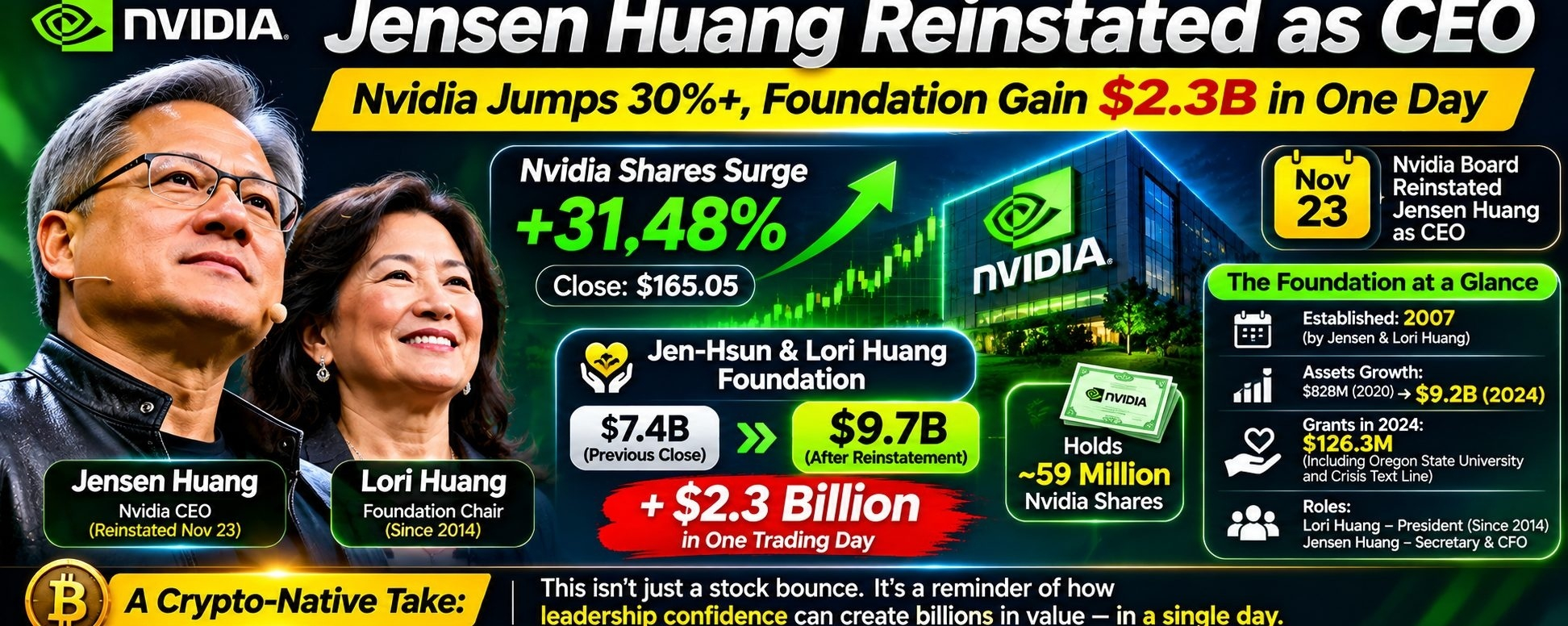
On November 23, Nvidia's board reinstated Jensen Huang as CEO after his 11-day absence.
The market reacted immediately.
NVDA surged 31.48%, closing at $165.05. That's one of the stock's biggest single-day gains in more than two decades.
But here's where the story gets interesting.
The Jen-Hsun & Lori Huang Foundation, chaired by Jensen's wife Lori Huang, holds approximately 58.7 million Nvidia shares.
At Monday's closing price, that position was worth roughly $9.7 BILLION.
Compared with Friday's close, its market value increased by approximately $2.3 billion in just one session.
And this foundation has quite a history.
• Established in 2007 by Jensen and Lori Huang.
• Started with 370,000 Nvidia shares worth approximately $12.6 million.
• Assets grew from $828 million in 2020 to $9.2 billion by the end of 2024.
• Lori has served as president since 2014.
• Jensen serves as secretary and CFO.
There's another detail worth noticing.
The foundation distributed approximately $126.3 million in grants during 2024, including support for Oregon State University and Crisis Text Line.
Now, from a crypto-native perspective, I see something bigger here.
Markets don't just price earnings. They price confidence in the people running the infrastructure behind those earnings.
Nvidia's rebound showed how quickly leadership uncertainty can affect an asset's valuation.
And there's an important distinction: the foundation's $2.3 billion increase was a paper gain, not a cash payout. Its shares are foundation assets, not automatically Jensen and Lori's personal spending money.
In crypto, we constantly discuss whale wallets, concentrated holdings and unrealized profits.
Traditional markets have their own version of the same story.
Sometimes the biggest market movement isn't about a new product or a new technology.
It's about one person's return changing how millions of investors see the future.
#NVIDIA #JensenHuang #NVDA #AI #Crypto
JENSEN HUANG'S COMEBACK ADDED $2.3 BILLION TO A CHARITABLE FOUNDATION IN ONE DAY.
There's a detail behind Nvidia's latest market drama that deserves more attention.
On November 23, Nvidia's board reinstated Jensen Huang as CEO after his 11-day absence.
The market reacted immediately.
NVDA surged 31.48%, closing at $165.05. That's one of the stock's biggest single-day gains in more than two decades.
But here's where the story gets interesting.
The Jen-Hsun & Lori Huang Foundation, chaired by Jensen's wife Lori Huang, holds approximately 58.7 million Nvidia shares.
At Monday's closing price, that position was worth roughly $9.7 BILLION.
Compared with Friday's close, its market value increased by approximately $2.3 billion in just one session.
And this foundation has quite a history.
• Established in 2007 by Jensen and Lori Huang.
• Started with 370,000 Nvidia shares worth approximately $12.6 million.
• Assets grew from $828 million in 2020 to $9.2 billion by the end of 2024.
• Lori has served as president since 2014.
• Jensen serves as secretary and CFO.
There's another detail worth noticing.
The foundation distributed approximately $126.3 million in grants during 2024, including support for Oregon State University and Crisis Text Line.
Now, from a crypto-native perspective, I see something bigger here.
Markets don't just price earnings. They price confidence in the people running the infrastructure behind those earnings.
Nvidia's rebound showed how quickly leadership uncertainty can affect an asset's valuation.
And there's an important distinction: the foundation's $2.3 billion increase was a paper gain, not a cash payout. Its shares are foundation assets, not automatically Jensen and Lori's personal spending money.
In crypto, we constantly discuss whale wallets, concentrated holdings and unrealized profits.
Traditional markets have their own version of the same story.
Sometimes the biggest market movement isn't about a new product or a new technology.
It's about one person's return changing how millions of investors see the future.
#NVIDIA #JensenHuang #NVDA #AI #Crypto
183
#CanMarketsReboundAfterThanksgiving?
I've been watching the recovery attempts across Bitcoin and traditional markets, and something doesn't quite add up yet.
Wall Street's latest session recovered from sharp intraday losses. Asian markets followed with gains, and Bitcoin managed to reclaim $60,000, briefly approaching $61,000.
On the surface, that's encouraging.
But look underneath.
Here's what stands out:
• Bitcoin: Recovered above $60K, but the buying pressure still looks fragile.
• ETF flows: Bitcoin investment funds recorded another $453.1 million in outflows, marking seven consecutive days of withdrawals, according to Saxo's market update.
• Liquidity: Talos reported $4.2 billion in Bitcoin ETF outflows over 30 days and a $6.2 billion weekly contraction in stablecoin supply.
• Traditional markets: Falling Treasury yields and a weaker dollar are offering some breathing room for risk assets.
• Thanksgiving effect: US stock markets are closed today. Crypto keeps trading, but thinner liquidity can make price movements misleading.
Here's my favorite detail: Bitcoin's recent recovery hasn't been matched by convincing spot-market demand. Talos observed that derivatives short-covering contributed to the bounce, while spot buying remained weak.
That distinction matters.
A short squeeze can push prices higher quickly. Real accumulation is a different story.
So, can markets rebound after Thanksgiving?
Absolutely possible. A sustained recovery would need stronger spot buying, improving ETF flows, renewed liquidity and stability in equities.
I'm watching Friday's shortened US trading session closely. Not just for the direction of the candles, but for whether buyers finally show up with conviction.
Sometimes the market tells you more through the money that refuses to come back than through the price that temporarily bounces.
#Bitcoin #CryptoMarket #Thanksgiving #BinanceSquare
225
#ZcashDevelopersUrgeZECMoveToIronwood
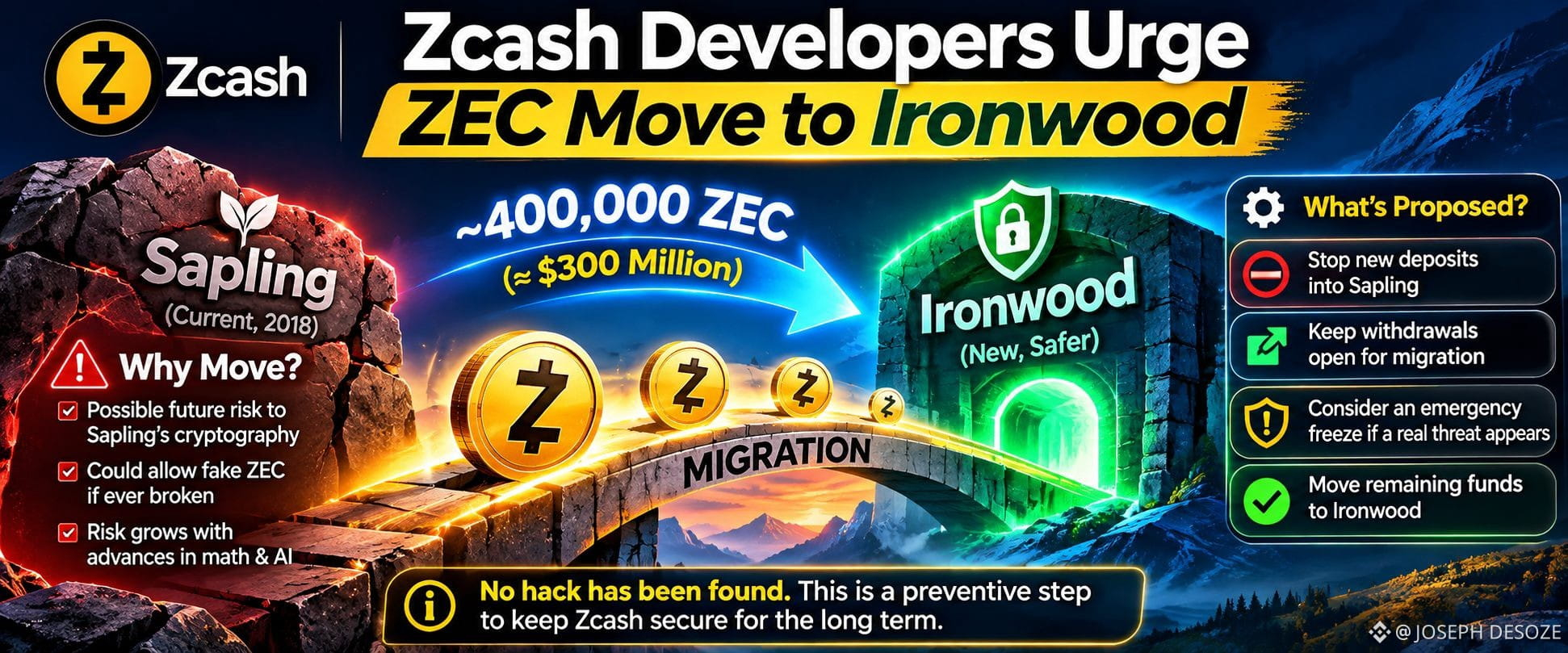
Zcash developers are asking holders to move roughly 400,000 ZEC — nearly $300 million — from Sapling to Ironwood. And the interesting part isn't the migration itself. It's what they're trying to prevent.
Zakura, led by Zcash co-founder Sean Bowe and Dev Ojha, is raising concerns about the long-term security of Sapling's pairing-based cryptography.
Here's the detail worth watching:
Sapling has protected private ZEC transactions since 2018. But future mathematical breakthroughs, potentially accelerated by AI-assisted research, could challenge the assumptions behind its cryptography.
If attackers ever forged valid proofs, they could potentially create counterfeit ZEC without immediately being detected.
Ironwood takes a different cryptographic approach, using Halo 2 rather than the pairing-based system.
The proposed response is serious:
• Stop new deposits into Sapling.
• Keep withdrawals available so holders can migrate.
• Consider an emergency freeze if credible evidence of an attack emerges.
• Move remaining funds toward Ironwood.
But let's keep the facts straight: No working attack on Sapling has been publicly demonstrated. This is preventive security, not confirmation that funds have been compromised.
What caught my attention is the timing. Developers aren't waiting for a vulnerability to become an exploit before discussing the exit strategy.
In privacy infrastructure, the hardest risk to manage may be the one nobody can see until it's too late.
And sometimes, protecting a network means retiring technology that once made it successful.
#Zcash #ZEC #Ironwood #Privacy #crypto
2
620
$2.3 Trillion Meets Solana. But How Much Will Actually Go On-Chain?
Japan has just shown $SOL tremendous trust! 👀 SBI Holdings and Sumitomo Mitsui Financial Group have partnered with the Solana Foundation to launch SBI Solana Global. These numbers are impressive:
🏦 Total assets of $2.3 trillion
👥 Over 80 million customers
The company plans to develop stablecoin payments, cross-border transfers, and tokenized financial assets. But that $2.3 trillion won’t be transferred onto the blockchain overnight. This is what I want to focus on. SBI Solana Global has already begun operations, but the real question is how many customers and how much trading volume it will ultimately bring to Solana
I believe this partnership may be more significant for the long-term adoption of the product than for short-term price gains. 📊 Market sentiment toward BTC remains influenced by various factors; before getting too optimistic, I’ll monitor the performance of SOL/BTC and actual on-chain activity. If SOL begins to outperform $BTC as on-chain usage grows, that would be a stronger signal. Major partnerships do not guarantee massive capital inflows
{spot}(BTCUSDT)
{spot}(SOLUSDT)
$2.3 Trillion Meets Solana. But How Much Will Actually Go On-Chain?
Japan has just shown $SOL tremendous trust! 👀 SBI Holdings and Sumitomo Mitsui Financial Group have partnered with the Solana Foundation to launch SBI Solana Global. These numbers are impressive:
🏦 Total assets of $2.3 trillion
👥 Over 80 million customers
The company plans to develop stablecoin payments, cross-border transfers, and tokenized financial assets. But that $2.3 trillion won’t be transferred onto the blockchain overnight. This is what I want to focus on. SBI Solana Global has already begun operations, but the real question is how many customers and how much trading volume it will ultimately bring to Solana
I believe this partnership may be more significant for the long-term adoption of the product than for short-term price gains. 📊 Market sentiment toward BTC remains influenced by various factors; before getting too optimistic, I’ll monitor the performance of SOL/BTC and actual on-chain activity. If SOL begins to outperform $BTC as on-chain usage grows, that would be a stronger signal. Major partnerships do not guarantee massive capital inflows
1
272
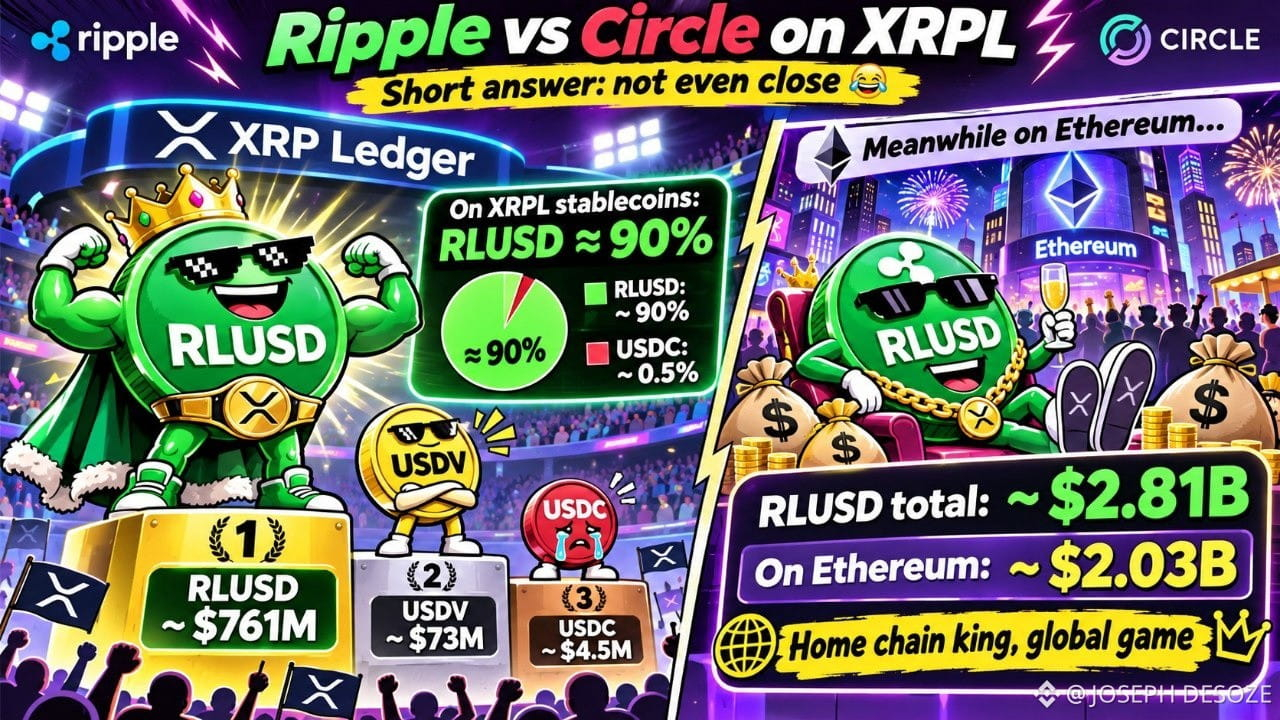
Ripple vs. Circle: Who Will Win the Stablecoin Battle on the $XRP Ledger?
In a nutshell: It’s a landslide 😂 Here are the scores as of November 25 👇
🟢 RLUSD → Approximately $761 million, accounting for nearly 90% of all stablecoins on the XRP Ledger.
🟡 USDV → About $73 million, far behind the leader.
🔴 USDC → Only $4.5 million, accounting for just about 0.5% of the market share, even though Circle launched USDC natively on the XRPL as early as June 2025.
Most RLUSD doesn’t even exist on the XRP Ledger. Of the approximately $2.81 billion in RLUSD, roughly $2.03 billion resides on Ethereum 🤯 So, while Ripple’s stablecoin dominates its main chain, it has quietly been doing most of its business elsewhere. $BTC
1
163
Holding $BTC 32.2 USDT
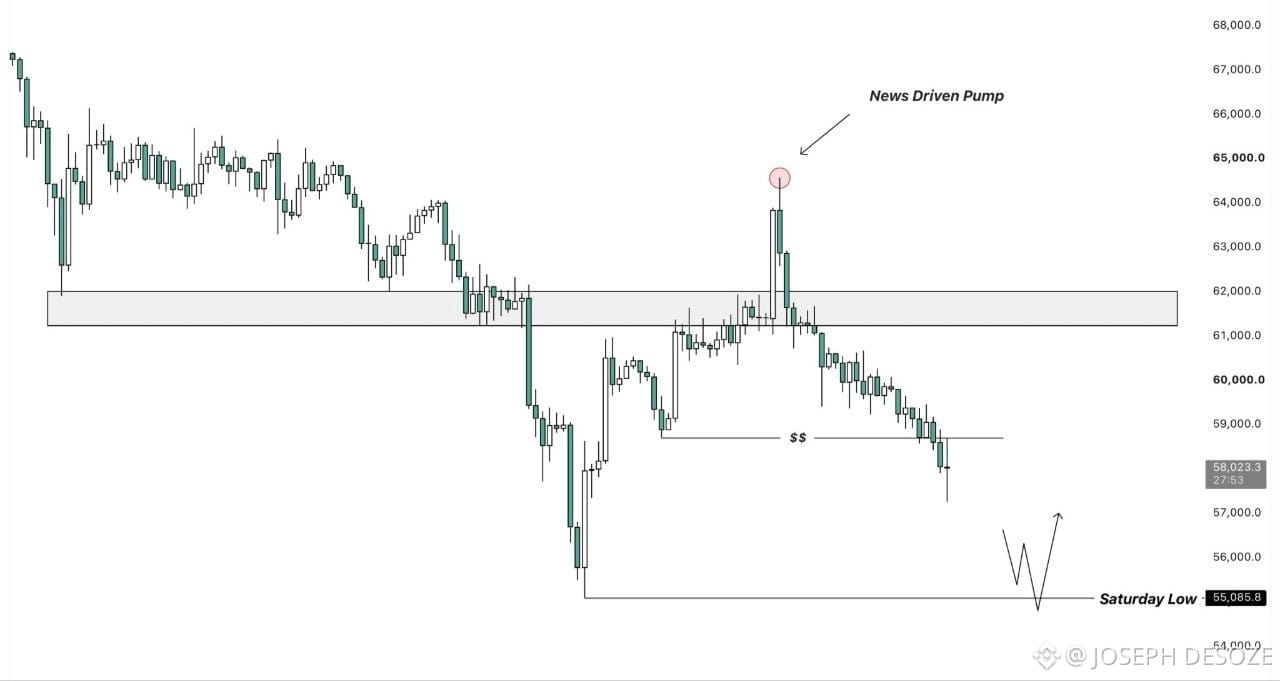
$BTC ’s last line of defense has collapsed.
In yesterday’s market update, I predicted that the price would break below the previous low of $58,700, and that low has now been breached. However, following the buying frenzy, buyers did not rush in, and the price appears to have instead settled at a level below that low. We’ve seen the price confirm a break below that level, followed by a retest where it was once again rejected.
With few support levels below, I expect the price to soon retest Saturday’s low. If the price pulls back from that low and immediately rebounds above it, it could present an excellent short-term long opportunity, which I’ll be watching closely. Other than that, I’m not currently interested in going long on Bitcoin, as it must return to $67,000 before I’d consider it having any meaningful upside potential
{spot}(BTCUSDT)
$BTC ’s last line of defense has collapsed.
In yesterday’s market update, I predicted that the price would break below the previous low of $58,700, and that low has now been breached. However, following the buying frenzy, buyers did not rush in, and the price appears to have instead settled at a level below that low. We’ve seen the price confirm a break below that level, followed by a retest where it was once again rejected.
With few support levels below, I expect the price to soon retest Saturday’s low. If the price pulls back from that low and immediately rebounds above it, it could present an excellent short-term long opportunity, which I’ll be watching closely. Other than that, I’m not currently interested in going long on Bitcoin, as it must return to $67,000 before I’d consider it having any meaningful upside potential
1
104
#EvolveAtBinanceBlockchainWeek
Blockchain is moving beyond hype, and events like Binance Blockchain Week 2026 show why that matters.
On November 28–29, Bangkok will bring together builders, industry leaders, and crypto communities from around the world under one powerful theme: Evolve.
What interests me most is the shift in conversation. The real question is no longer just how blockchain works, but how it can solve practical problems, create real-world value, and become part of everyday life.
Innovation means little if it never reaches people. The next chapter of crypto will be shaped by those who turn ideas into useful solutions.
The industry is evolving. The real question is: are we ready to evolve with it?
#BBW2026 #Evolve #Blockchain #Crypto

1
199
#BitcoinAndStocksSlipAgainAmidTrump’sTariffPlans
📉 Bitcoin and Stocks Slip Again as Trump's Tariff Plans Shake Markets!
Global markets are facing renewed pressure as fresh US tariff plans raise fears of another trade conflict.
Bitcoin has slipped below $60,000, while major stock indexes and technology shares face heavy selling pressure.
Investors are becoming cautious as uncertainty grows around inflation, interest rates, and global trade.
My take: Market volatility creates challenges, but smart investors focus on risk management instead of panic selling.
👀 Will Bitcoin recover, or is more downside ahead?
What’s your view?
#CryptoMarket #StockMarket #TrumpTariffs #BinanceSquare
2
207
#UkraineParliamentPassesVirtualAssetLegalizationBil
🔰 *Ukraine attacked an Iranian oil tanker that had violated the Strait of Hormuz blockade. This action was carried out with US support. The attack took place in the Libya region.*
#Gold #oil
#UkraineParliamentPassesVirtualAssetLegalizationBil
🔰 *Ukraine attacked an Iranian oil tanker that had violated the Strait of Hormuz blockade. This action was carried out with US support. The attack took place in the Libya region.*
#Gold #oil
🔰 *Ukraine attacked an Iranian oil tanker that had violated the Strait of Hormuz blockade. This action was carried out with US support. The attack took place in the Libya region.*
#Gold #oil
3
595
·
--
Bullish
$CHR /USDT 📈 BUY
🛫Entry zone: 0.01240
💰TP1 0.01463
✖️SL 0.00971
〽Leverage: 10x
{future}(CHRUSDT)
$CHR /USDT 📈 BUY
🛫Entry zone: 0.01240
💰TP1 0.01463
✖️SL 0.00971
〽Leverage: 10x
🛫Entry zone: 0.01240
💰TP1 0.01463
✖️SL 0.00971
〽Leverage: 10x
1
90
·
--
Bullish
$LTC /USDT 📈 BUY
🛫Entry zone: 41.4
💰TP1 43.57
✖️SL 36.69
〽Leverage: 10x
{spot}(LTCUSDT)
$LTC /USDT 📈 BUY
🛫Entry zone: 41.4
💰TP1 43.57
✖️SL 36.69
〽Leverage: 10x
🛫Entry zone: 41.4
💰TP1 43.57
✖️SL 36.69
〽Leverage: 10x
2
290
The surprising thing about Midnight isn't just how NIGHT generates DUST. It's what happens when you move your NIGHT.
I looked into Midnight's official DUST documentation and found a detail that changes how I think about its fee model.
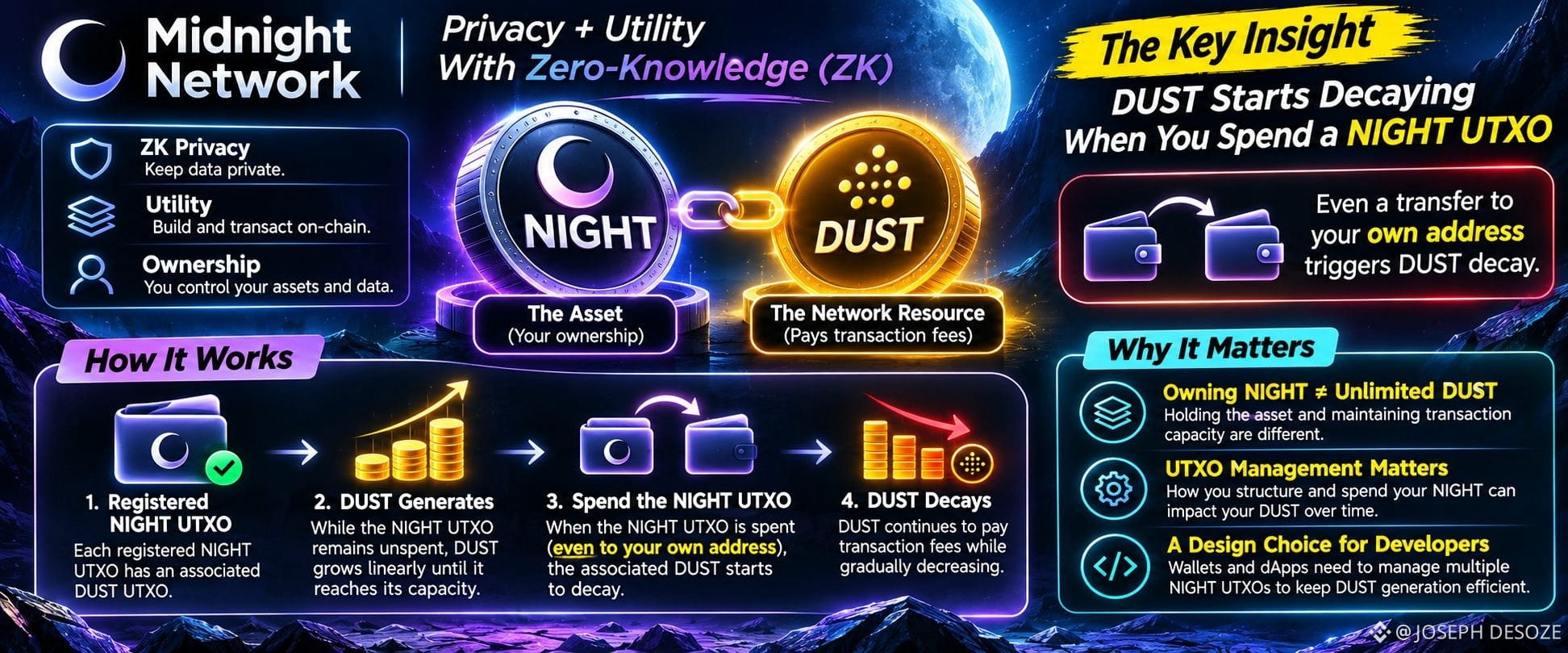
NIGHT is the asset. DUST is the network resource used to pay transaction fees. They serve different purposes, and NIGHT itself isn't consumed when making transactions.
Here's where it gets interesting.
Each registered NIGHT UTXO has an associated DUST UTXO. While the backing NIGHT remains unspent, DUST grows linearly until it reaches its capacity.
But spending that NIGHT UTXO starts DUST decay.
And the detail most people could miss: even transferring NIGHT to your own address triggers this process.
Your total NIGHT balance might remain unchanged, yet your available DUST can decrease.
Why does that matter?
Because Midnight's resource model isn't simply about holding tokens. It also depends on how those tokens are structured and whether their underlying UTXOs remain unspent.
There is an important distinction between owning NIGHT and maintaining the DUST capacity it generates.
I find this design interesting because it separates capital ownership from transaction consumption rather than charging users by selling their underlying asset.
For developers building applications on Midnight, wallet management becomes part of the infrastructure design.
The detail I'll be watching is how wallets and DApps manage multiple NIGHT UTXOs without unintentionally disrupting their DUST generation.
@Midnight_Network $NIGHT #Midnight #ZK #Privacy
{future}(NIGHTUSDT)
The surprising thing about Midnight isn't just how NIGHT generates DUST. It's what happens when you move your NIGHT.
I looked into Midnight's official DUST documentation and found a detail that changes how I think about its fee model.
NIGHT is the asset. DUST is the network resource used to pay transaction fees. They serve different purposes, and NIGHT itself isn't consumed when making transactions.
Here's where it gets interesting.
Each registered NIGHT UTXO has an associated DUST UTXO. While the backing NIGHT remains unspent, DUST grows linearly until it reaches its capacity.
But spending that NIGHT UTXO starts DUST decay.
And the detail most people could miss: even transferring NIGHT to your own address triggers this process.
Your total NIGHT balance might remain unchanged, yet your available DUST can decrease.
Why does that matter?
Because Midnight's resource model isn't simply about holding tokens. It also depends on how those tokens are structured and whether their underlying UTXOs remain unspent.
There is an important distinction between owning NIGHT and maintaining the DUST capacity it generates.
I find this design interesting because it separates capital ownership from transaction consumption rather than charging users by selling their underlying asset.
For developers building applications on Midnight, wallet management becomes part of the infrastructure design.
The detail I'll be watching is how wallets and DApps manage multiple NIGHT UTXOs without unintentionally disrupting their DUST generation.
@Midnight Network $NIGHT #Midnight #ZK #Privacy
1
249
Verified
Article
Lorenzo Protocol: The Interesting Part Is What Happens Behind the Vault.Lorenzo Protocol: The Interesting Part Is What Happens Behind the Vault.
Most people look at Lorenzo and see tokenized funds.
I look at the architecture underneath them.
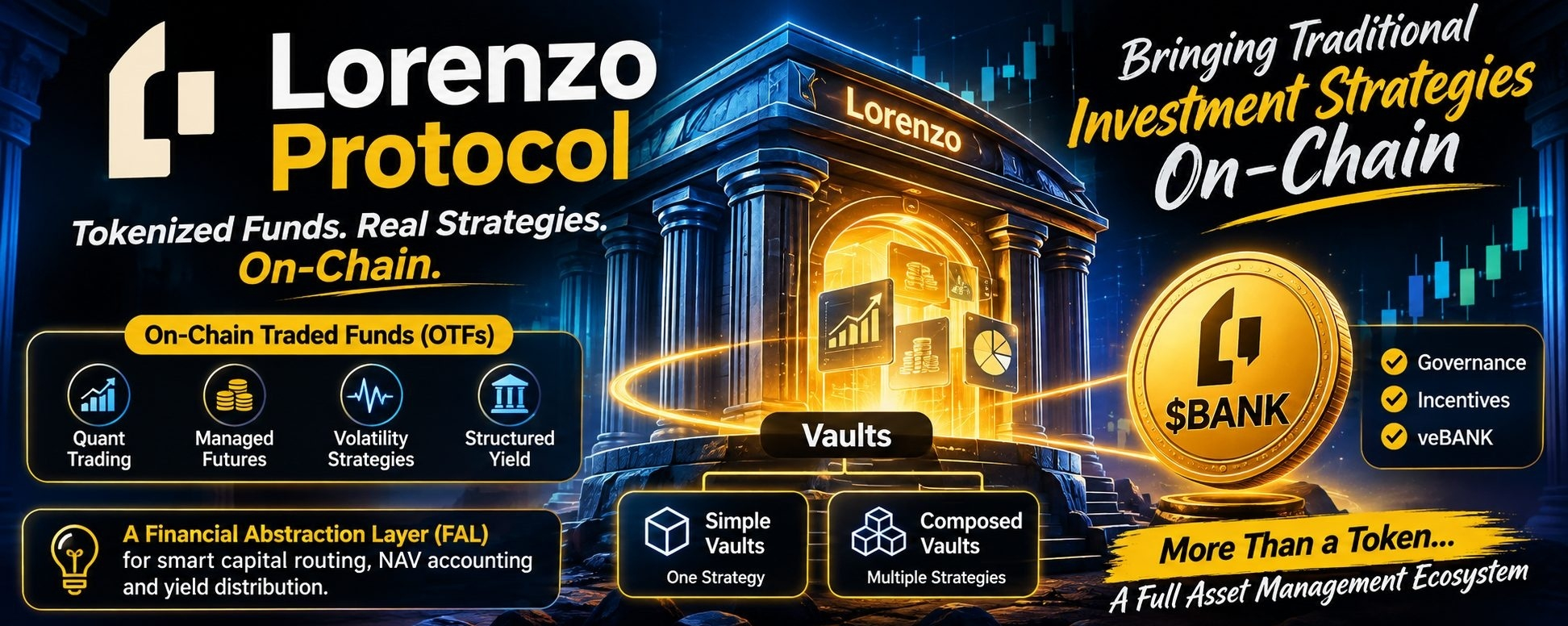
Lorenzo is building around On-Chain Traded Funds (OTFs), bringing traditional investment strategies into tokenized structures that can interact with DeFi.
But the interesting part isn't just turning a fund into a token.
It's how capital moves after someone deposits.
The Financial Abstraction Layer (FAL) handles capital routing, NAV accounting, and yield distribution. Its OTF structure can package strategies like quantitative trading, delta-neutral arbitrage, covered calls, volatility harvesting, managed futures, funding-rate optimization, risk-parity portfolios, and structured lending or RWA income.
Then there's the vault architecture.
A simple vault focuses on one strategy.
A composed vault can combine several simple vaults into a larger portfolio, with a delegated manager able to rebalance allocations.
That distinction matters. It gives users different levels of strategy exposure without forcing every investor to manage individual positions.
One detail I find particularly interesting is the LP token accounting.
Depositors receive LP tokens representing their share of a vault. The Unit NAV measures the value of each share by dividing the vault's net asset value by its outstanding LP tokens.
In other words, the important number isn't just how many tokens you hold. It's what each share is actually worth as the underlying portfolio changes.
And here's the part worth watching closely:
Not every strategy executes on-chain.
Lorenzo's architecture also accommodates approved managers, custody wallets and exchange sub-accounts. Strategy results are reported back on-chain, where NAV and user positions can be updated. Withdrawals involving off-chain strategies also depend on settlement through custody partners.
That's an important distinction.
On-chain accounting can make ownership and reporting more transparent. It does not automatically remove execution, counterparty, custody or liquidity risk.
Then comes $BANK.
BANK is the ecosystem's native utility and governance token, with a maximum supply of 2.1 billion. It supports staking-related privileges, governance participation, and community incentives.
veBANK adds another layer: locking BANK creates a non-transferable, time-weighted position designed to reward longer-term commitment through governance and incentive-gauge participation.
I see an important separation here: OTF shares represent exposure to a product, while BANK coordinates participation in the protocol. They are not the same economic claim.
What makes Lorenzo worth following isn't simply the number of strategies it can tokenize.
It's whether its NAV accounting, manager controls, settlement process and redemption experience can remain reliable as those strategies become more complex.
Because in asset management, the token is only the visible part.
The real story is everything that has to work correctly behind it.
@LorenzoProtocol $BANK #lorenzoprotocol #defi
Lorenzo Protocol: The Interesting Part Is What Happens Behind the Vault.
Lorenzo Protocol: The Interesting Part Is What Happens Behind the Vault.
Most people look at Lorenzo and see tokenized funds.
I look at the architecture underneath them.
Lorenzo is building around On-Chain Traded Funds (OTFs), bringing traditional investment strategies into tokenized structures that can interact with DeFi.
But the interesting part isn't just turning a fund into a token.
It's how capital moves after someone deposits.
The Financial Abstraction Layer (FAL) handles capital routing, NAV accounting, and yield distribution. Its OTF structure can package strategies like quantitative trading, delta-neutral arbitrage, covered calls, volatility harvesting, managed futures, funding-rate optimization, risk-parity portfolios, and structured lending or RWA income.
Then there's the vault architecture.
A simple vault focuses on one strategy.
A composed vault can combine several simple vaults into a larger portfolio, with a delegated manager able to rebalance allocations.
That distinction matters. It gives users different levels of strategy exposure without forcing every investor to manage individual positions.
One detail I find particularly interesting is the LP token accounting.
Depositors receive LP tokens representing their share of a vault. The Unit NAV measures the value of each share by dividing the vault's net asset value by its outstanding LP tokens.
In other words, the important number isn't just how many tokens you hold. It's what each share is actually worth as the underlying portfolio changes.
And here's the part worth watching closely:
Not every strategy executes on-chain.
Lorenzo's architecture also accommodates approved managers, custody wallets and exchange sub-accounts. Strategy results are reported back on-chain, where NAV and user positions can be updated. Withdrawals involving off-chain strategies also depend on settlement through custody partners.
That's an important distinction.
On-chain accounting can make ownership and reporting more transparent. It does not automatically remove execution, counterparty, custody or liquidity risk.
Then comes $BANK .
BANK is the ecosystem's native utility and governance token, with a maximum supply of 2.1 billion. It supports staking-related privileges, governance participation, and community incentives.
veBANK adds another layer: locking BANK creates a non-transferable, time-weighted position designed to reward longer-term commitment through governance and incentive-gauge participation.
I see an important separation here: OTF shares represent exposure to a product, while BANK coordinates participation in the protocol. They are not the same economic claim.
What makes Lorenzo worth following isn't simply the number of strategies it can tokenize.
It's whether its NAV accounting, manager controls, settlement process and redemption experience can remain reliable as those strategies become more complex.
Because in asset management, the token is only the visible part.
The real story is everything that has to work correctly behind it.
@Lorenzo Protocol $BANK #lorenzoprotocol #defi
2
696
#EvolveAtBinanceBlockchainWeek
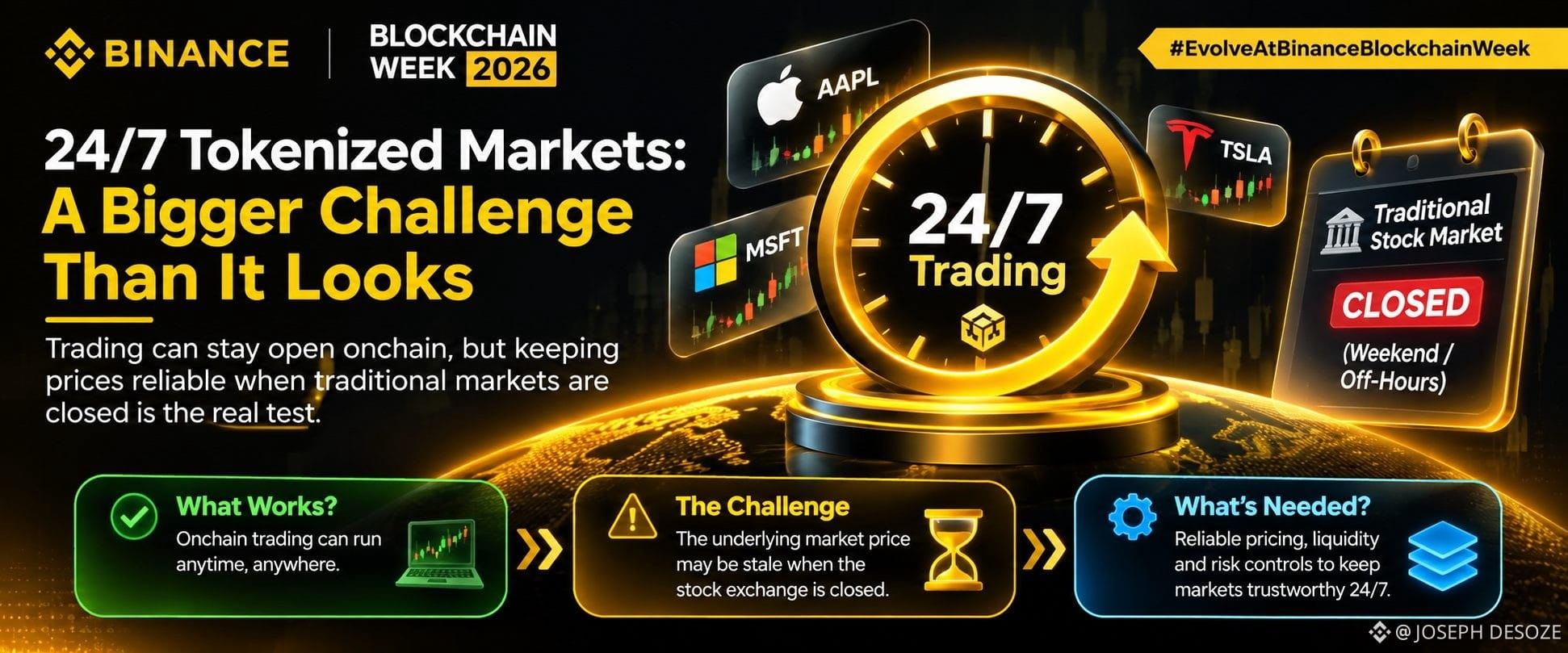
There's something about 24/7 trading that people don't talk about enough.
A blockchain doesn't need the weekend off. Traditional stock markets do.
And that's where things get interesting.
Imagine someone trading a tokenized US stock on a Saturday. The transaction can happen instantly, but the actual stock market is closed. That means the latest official share price might already be several hours old.
So what is the token actually worth at that moment?
Buyers and sellers can still agree on a price, but that doesn't automatically mean the price reflects a fresh market valuation. It could also reflect expectations, available liquidity and how much risk traders are willing to take.
This is a detail I find particularly interesting when looking at the future of tokenized assets.
BNB Chain's Tokenized Stocks Hackathon has highlighted challenges around stale price references, weekend trading and liquidity.
It shows that bringing traditional assets onchain involves much more than making them tradable around the clock.
The technology needs to keep up with the financial reality behind those assets.
For me, the bigger question isn't whether tokenized markets can stay open 24/7. It's whether their pricing and liquidity infrastructure can remain trustworthy when the traditional markets are closed.
That's where the real evolution will be measured.
VERIFY BEFORE POSTING:
* Confirm the BNB Chain hackathon's official documentation still describes these specific challenges.
* Confirm the latest Binance Blockchain Week campaign hashtag and requirements.
1
327
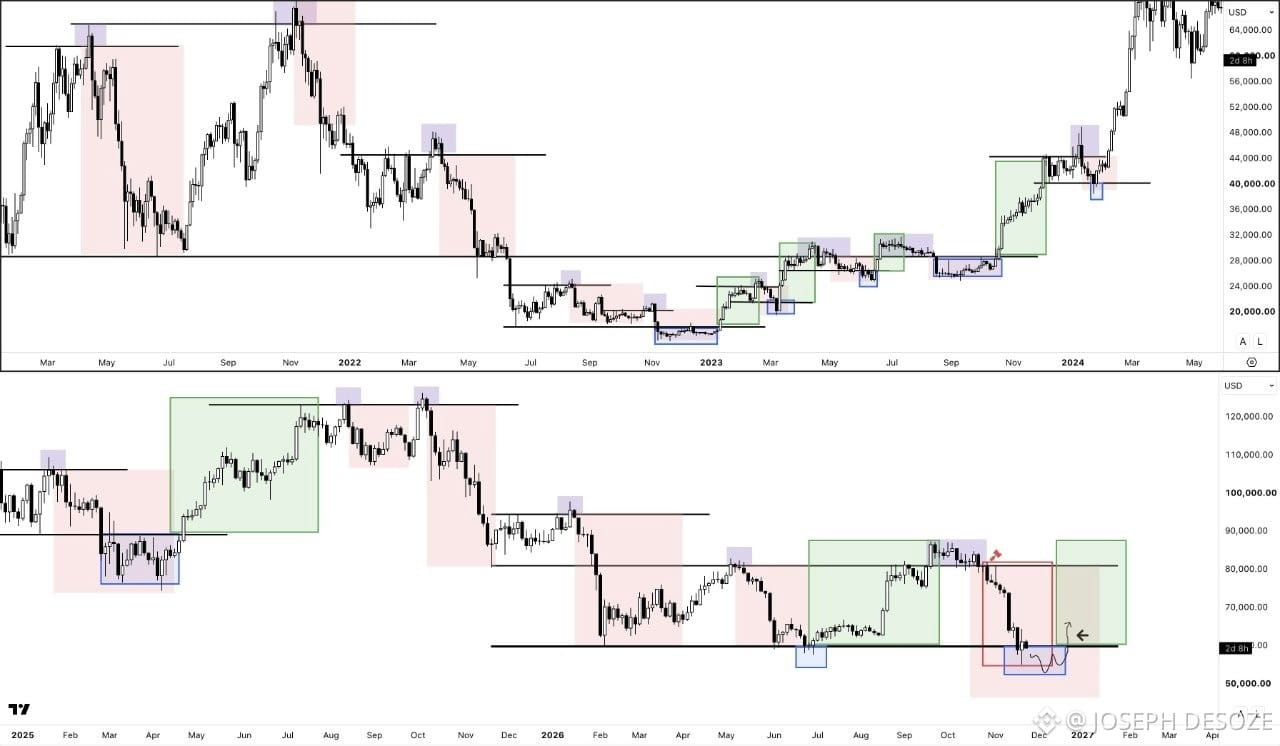
$BTC : Some people warned that price volatility was high and a decline might occur. But no one believed them because everyone was bullish at the time. → Now everyone is bearish on the lower end of the range. A pullback to within the range is possible.
Personally, I’m still a bit hesitant because I believe, from a macro perspective, there’s still room for the price to fall. But even if this is just a local bottom, I expect it to take longer. I’ll keep a close eye on potential collaboration opportunities and remain patient for now.
The bottom line is: I don’t think there’s any rush to buy right now. However, we may currently be forming a solid buying setup near the lows, with the potential for a bottoming-out and rebound. Let the bottoming pattern form, and wait for the price to rise back above the lower boundary of the range. Although it’s tedious, better safe than sorry. The key is to hold out for a better opportunity—when market conditions become very clear—so we can make an informed investment rather than gambling on the idea that “we’ve fallen a lot, so this might be the bottom.”
After hitting a new low of 55.2k, $BTC surged sharply, closing back above the previous low and leaving a massive wick. Whenever we see this happen, the price typically pulls back to at least the 50% retracement level before rising again. It’s very likely that once we fill the wick (57.3k), the price will catch up.
#BTC
1
213
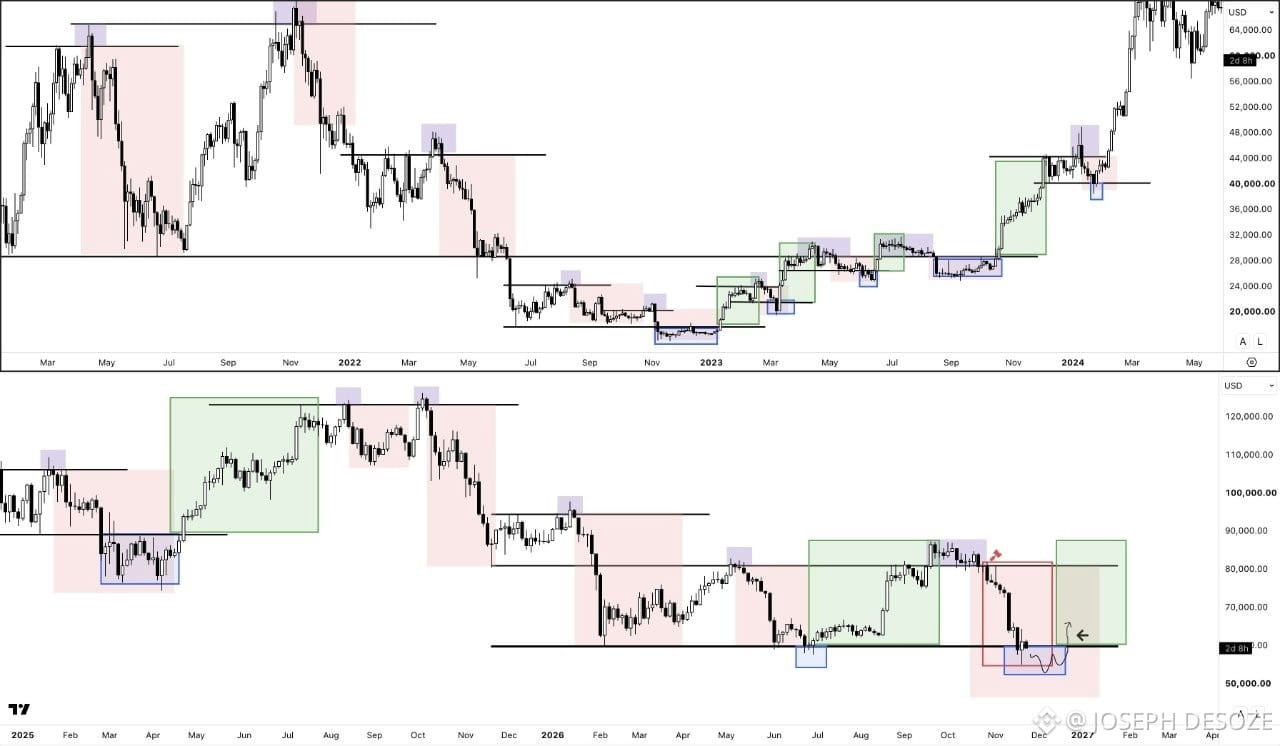
$BTC : Some people warned that price volatility was high and a decline might occur. But no one believed them because everyone was bullish at the time. → Now everyone is bearish on the lower end of the range. A pullback to within the range is possible.
Personally, I’m still a bit hesitant because I believe, from a macro perspective, there’s still room for the price to fall. But even if this is just a local bottom, I expect it to take longer. I’ll keep a close eye on potential collaboration opportunities and remain patient for now.
The bottom line is: I don’t think there’s any rush to buy right now. However, we may currently be forming a solid buying setup near the lows, with the potential for a bottoming-out and rebound. Let the bottoming pattern form, and wait for the price to rise back above the lower boundary of the range. Although it’s tedious, better safe than sorry. The key is to hold out for a better opportunity—when market conditions become very clear—so we can make an informed investment rather than gambling on the idea that “we’ve fallen a lot, so this might be the bottom.”
After hitting a new low of 55.2k, $BTC surged sharply, closing back above the previous low and leaving a massive wick. Whenever we see this happen, the price typically pulls back to at least the 50% retracement level before rising again. It’s very likely that once we fill the wick (57.3k), the price will catch up.
#BTC
1
123
Bitcoin vs. Gold. In November, both assets took a hit as traders anticipated another interest rate hike by the Federal Reserve, but 👇
🟠 Bitcoin
🟠 $BTC fell to $55,130 on November 21—its lowest level since September 2024—and is currently trading around $61,270.
🟠 It remains about 51% below its peak of nearly $126,000 in October 2025, with continued outflows from spot ETFs.
🟠 However, when measured against gold, $BTC has hit a new low for the fourth time this year: 12.1 ounces in February, 13.7 ounces in June, 14.4 ounces in August, and now 16.9 ounces.
🟠 Today’s key price levels for gold are: the first at approximately $64,900 (17.9 ounces), the second at approximately $73,600 (20.3 ounces), and the third at approximately $78,000 (21.5 ounces).
🟡 Gold
🟡 The price of gold is currently near $3,628 per ounce, having climbed above $5,300 per ounce earlier this year; it has thus fallen by about one-third from its peak.
🟡 It is facing the same headwinds as cryptocurrencies, with the 10-year U.S. Treasury yield at 4.9% and global money supply growth slowing from 12.1% to 8.5%.
🟡 Major banks still expect gold prices to range between $4,640 and $6,300 per ounce by the end of 2027.
Historically, when liquidity returns, gold tends to rise first, while Bitcoin usually follows after gold prices have cooled off. In dollar terms, both charts look bleak, but in a direct comparison… $BTC Bitcoin is coming out on top, as one Bitcoin can now buy about 40% more gold than it could in February.
#BTC走势分析 #BTCGoldenCross #GOLD_UPDATE

1
308
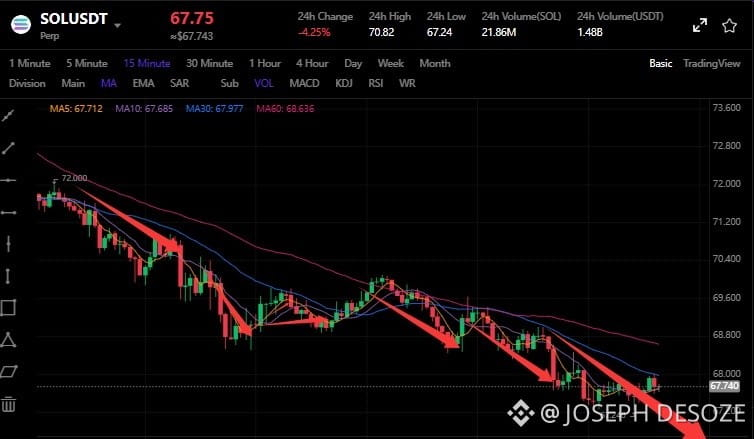
📣📣Short-Term Contract Trading
❗Trading Pair: $SOL /USDT
📌Leverage: 60X
Trading Price: Spot Price
Financing Rate: 10%
Market Direction: Short📉📉
{future}(SOLUSDT)
#sol
📣📣Short-Term Contract Trading
❗Trading Pair: $SOL /USDT
📌Leverage: 60X
Trading Price: Spot Price
Financing Rate: 10%
Market Direction: Short📉📉
#sol
❗Trading Pair: $SOL /USDT
📌Leverage: 60X
Trading Price: Spot Price
Financing Rate: 10%
Market Direction: Short📉📉
#sol
1
146
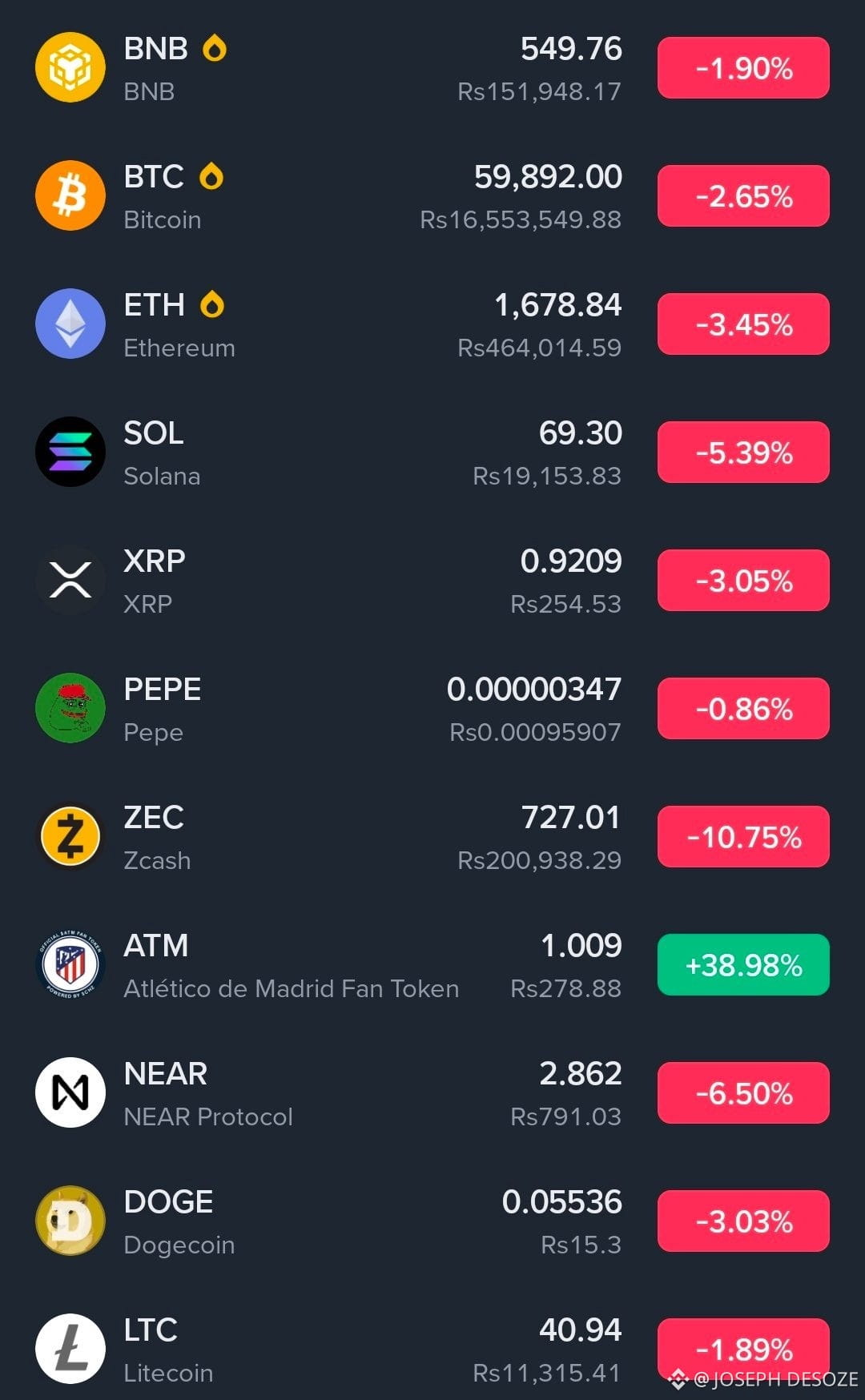
🚨 CRYPTO MARKET UPDATE 🚨
The crypto market is facing strong selling pressure! 🔴
📉 $BNB: -1.90%
📉 $BTC: -2.65%
📉$ ETH: -3.45%
📉 $SOL: -5.39%
📉 $XRP: -3.05%
📉 $PEPE: -0.86%
📉 $ZEC: -10.75%
🟢 $ATM: +38.98%
📉 $NEAR: -6.50%
📉 $DOGE: -3.03%
📉 $LTC: -1.89%
⚠️ Most major coins are trading in the red, while ATM is showing a strong gain.
💡 Stay calm, manage your risk, and DYOR before making any trade.
What do you think? More downside or a market reversal? 👇
#Binance #Bitcoin #BTC #Ethereum #ETH #CryptoMarket #Altcoins #CryptoTrading #BNB #solana
1
172
Log in to explore more content
Join global crypto users on Binance Square
⚡️ Get latest and useful information about crypto.
💬 Trusted by the world’s largest crypto exchange.
👍 Discover real insights from verified creators.
Email / Phone number
Trending Topics
CanMarketsReboundAfterThanksgiving?
221,734 views
2,111 Discussing
Rate-Hike Bets Linger as US Markets Head Into Thanksgiving Closure
Binance News
·7 Likes
·5.9k views
EvolveAtBinanceBlockchainWeek
870,607 views
10,819 Discussing
CouldSpaceX’sOrbitalDataCentersBoostAIChipDemand?
109,524 views
1,259 Discussing