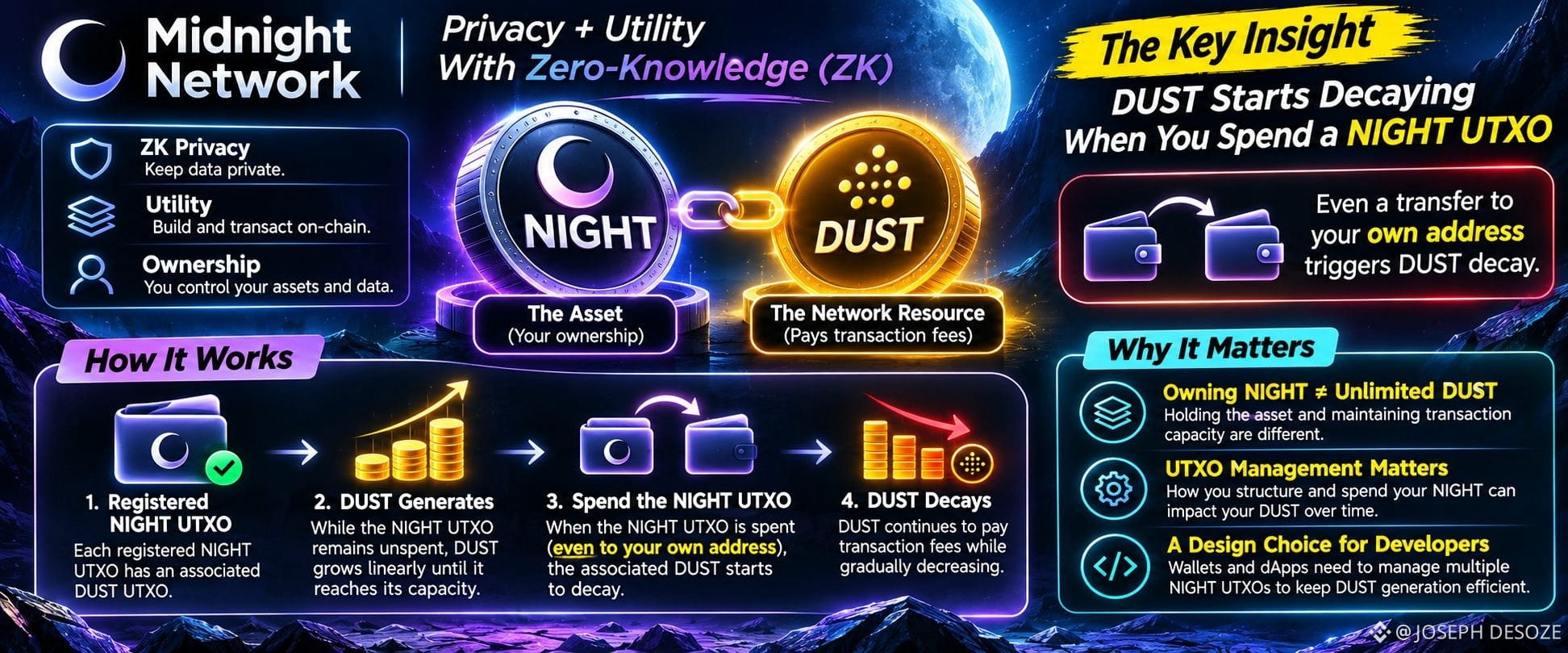

The surprising thing about Midnight isn't just how NIGHT generates DUST. It's what happens when you move your NIGHT.
I looked into Midnight's official DUST documentation and found a detail that changes how I think about its fee model.
NIGHT is the asset. DUST is the network resource used to pay transaction fees. They serve different purposes, and NIGHT itself isn't consumed when making transactions.
Here's where it gets interesting.
Each registered NIGHT UTXO has an associated DUST UTXO. While the backing NIGHT remains unspent, DUST grows linearly until it reaches its capacity.
But spending that NIGHT UTXO starts DUST decay.
And the detail most people could miss: even transferring NIGHT to your own address triggers this process.
Your total NIGHT balance might remain unchanged, yet your available DUST can decrease.
Why does that matter?
Because Midnight's resource model isn't simply about holding tokens. It also depends on how those tokens are structured and whether their underlying UTXOs remain unspent.
There is an important distinction between owning NIGHT and maintaining the DUST capacity it generates.
I find this design interesting because it separates capital ownership from transaction consumption rather than charging users by selling their underlying asset.
For developers building applications on Midnight, wallet management becomes part of the infrastructure design.
The detail I'll be watching is how wallets and DApps manage multiple NIGHT UTXOs without unintentionally disrupting their DUST generation.
@Midnight Network $NIGHT #Midnight #ZK #Privacy