
Are cryptocurrencies truly decentralized?
Ranking the largest cryptocurrencies from least to most centralized
Decentralization is often touted as the most important feature of cryptocurrencies, but the truth is that decentralization is not an absolute attribute; rather, it exists on a spectrum. Each cryptocurrency differs in its degree of decentralization based on four criteria: who controls the code, who secures the network, who owns the coins, and where the nodes operate.
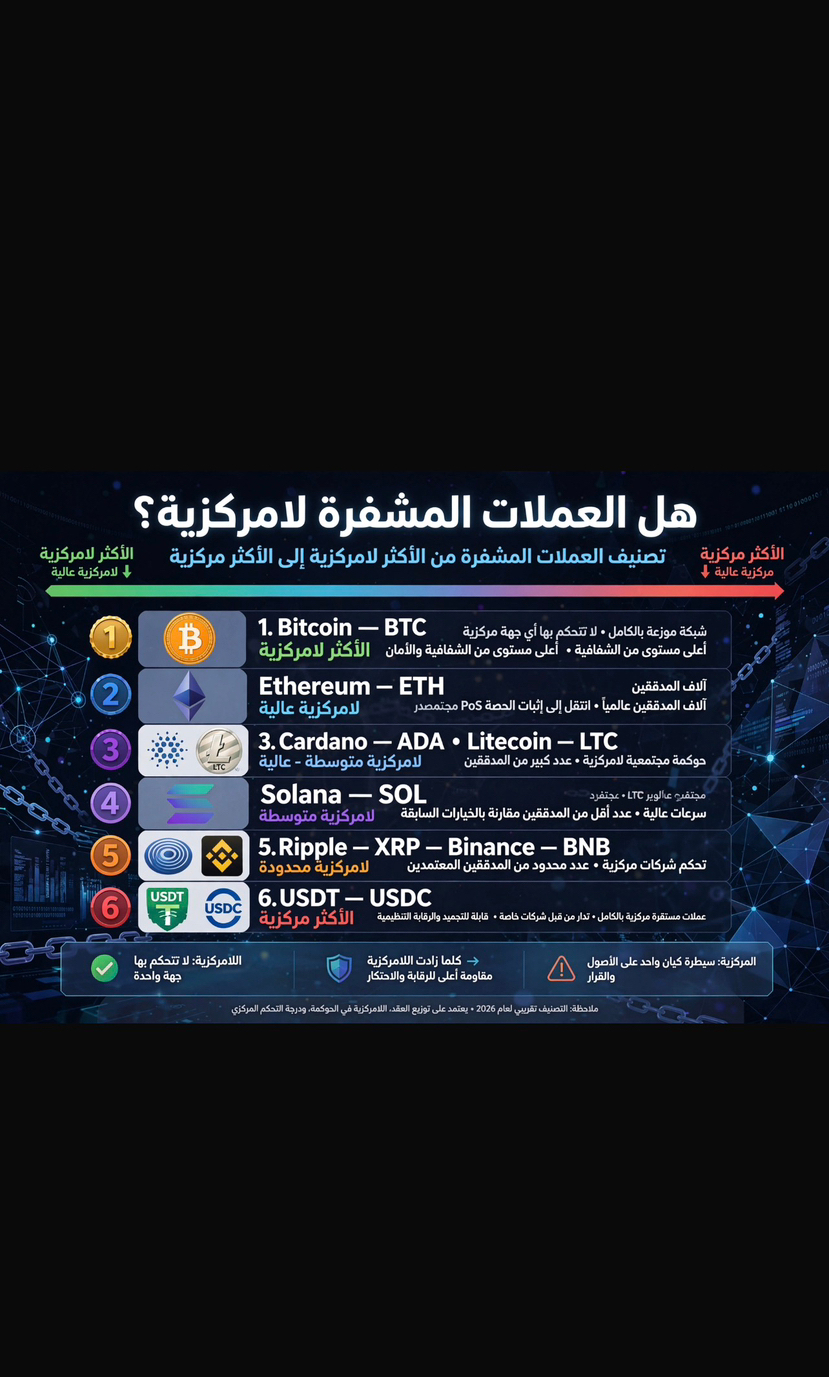
Here is the true ranking of the biggest cryptocurrencies on the market, from the most decentralized to the most centralized:
1. Bitcoin BTC - The most decentralized
Bitcoin is the gold standard of decentralization. No one owns it, its founder is missing, and no organization controls its upgrades. It has more than 20,000 nodes distributed around the world, and its development is open, slow, and deliberate. Its only weakness is the concentration of mining, with four mining pools controlling most of the network's hash power. Even so, it remains the most secure and decentralized.
2. Ethereum ETH - Decentralized, but with clear leadership
Ethereum is decentralized at the network level, with more than 6,000 validators, but centralized when it comes to decision-making. The Ethereum Foundation and Vitalik Buterin's team have enormous influence over the network's future, as seen when it switched from mining to staking. In addition, more than 60% of Ethereum nodes run on centralized servers such as Amazon AWS and Google Cloud.
3. Cardano ADA and Litecoin LTC - Theoretically quite decentralized
Cardano has a large number of pools, but its development is managed entirely by IOHK. Litecoin is almost identical to Bitcoin and is therefore technically decentralized, but it suffers from limited development and a low number of nodes, making it less secure.
4. Solana SOL - Somewhere in the middle, leaning toward centralization
Solana is fast and cheap, but the trade-off is centralization. The network requires extremely powerful hardware to run a node, so there are few validators and the cost of entry is high. The network has gone down more than seven times, and the team had to restart it manually by making a centralized decision—something that could never happen with Bitcoin.
5. Ripple XRP and Binance Coin BNB - Clearly centralized
Ripple: The company owns more than 40% of the total coins and has an approved list of validators. It is more of a fintech company than a cryptocurrency.
As for BNB, it is the official coin of the Binance platform. The platform controls its issuance and burning, and it runs on the BSC network, which has only 21 validators, all selected by Binance itself.
6. Tether USDT and USDC - The most centralized of all
These are not cryptocurrencies in the true sense. They are digital dollars issued by private companies. Tether and Circle can freeze any wallet, block any transaction, and print billions at the push of a button, at the direction of the U.S. government. They have zero decentralization.
The takeaway is that the market is selling the illusion of absolute decentralization. All coins use blockchain, but only a few achieve true decentralization. The faster and cheaper a coin is, the more centralized it tends to be.
#Binance #bnb #bitcoin #CryptoTrading.