

小恐龙说趋势
402 Posts
 LIVE
LIVE小恐龙说趋势
Report
Block User
6 Following
2.0K+ Followers
2.2K+ Liked
Posts
All
Live
·
--
Privacy blockchain Zano rebuilt an entire month of its ledger from scratch 🦖 The trigger was just a $553 “entry ticket”—someone used 100 ZANO to register an address, and it somehow created 36.9 million tokens out of thin air.
[🤔 有想法进群聊](https://app.binance.com/uni-qr/JpwCPfBj)
This week the team confirmed: due to a vulnerability in the Gateway Address feature, about 36.9 million unauthorized ZANO tokens were inserted on-chain, along with a forged on-chain USD stablecoin, Freedom Dollar (fUSD). To clear out this batch of “fake coins,” Zano has rolled back the chain by about a month, restarting at block height 3,833,000—that is, before the hard fork (Hard Fork 6) that introduced this functionality. ⚠️
The attack method wasn’t sophisticated. On August 28, the attacker registered a Gateway Address and paid a 100 ZANO registration fee (then worth about $553) to test-mint a fake asset. The next day (August 29), they minted about 18.4 million ZANO out of thin air in a single transaction. The most striking part is that these coins were “identical to the real ones” and could be spent normally—nearly a month passed with no one noticing 😨 until September 25, when the attacker repeated the trick: minted another ~18.4 million ZANO and copied out fUSD. Only then did the internal team raise the alarm.
According to the team, none of their safeguards caught the bug in advance—AI-assisted testing, internal audits, and vulnerability bounties all failed.
The cost is also laid bare: what was invalidated by the rollback wasn’t just the illegally minted tokens, but also an entire month of legitimate transfers. Transactions from that period effectively “didn’t happen” on the new chain, and payments that had already settled on other chains can’t be recovered 💥 The compensation plan includes a developers’ fund plus team members’ personal funds and pledged donations. It will mainly go through exchanges and payment services: exchanges will replay the withdrawals invalidated by the rollback, the team will create credit records for affected top-ups, and later they will publish the compensation and appeals process.
My take: the core of this debate isn’t really “whether they’ll compensate.” It’s “how much is the four words ‘decentralization’ worth” ⚖️ The team’s argument is firm: if they don’t act, there will be unlimited minting that dilutes all token holders—basically telling future attackers that the stolen coins will still hold their value. But the other side is also true: the ledger can be torn down for a month to put out the fire, and the slogan that “on-chain settlement is immutable” gets chipped away. Going forward, every additional rollback of this kind will make institutions ask one more question when allocating on-chain assets: what is finality—exactly how final is it?
Chat in the comments: Should the chain roll back for a month to plug a vulnerability? Or would you rather take the hard line and never touch history?
Click the avatar to watch the live stream—every day I’ll help you follow the crypto security hot spots. Not just what happened in the news, but also help you understand the logic and opportunities behind it 👀🚀
Privacy blockchain Zano rebuilt an entire month of its ledger from scratch 🦖 The trigger was just a $553 “entry ticket”—someone used 100 ZANO to register an address, and it somehow created 36.9 million tokens out of thin air.
🤔 有想法进群聊
This week the team confirmed: due to a vulnerability in the Gateway Address feature, about 36.9 million unauthorized ZANO tokens were inserted on-chain, along with a forged on-chain USD stablecoin, Freedom Dollar (fUSD). To clear out this batch of “fake coins,” Zano has rolled back the chain by about a month, restarting at block height 3,833,000—that is, before the hard fork (Hard Fork 6) that introduced this functionality. ⚠️
The attack method wasn’t sophisticated. On August 28, the attacker registered a Gateway Address and paid a 100 ZANO registration fee (then worth about $553) to test-mint a fake asset. The next day (August 29), they minted about 18.4 million ZANO out of thin air in a single transaction. The most striking part is that these coins were “identical to the real ones” and could be spent normally—nearly a month passed with no one noticing 😨 until September 25, when the attacker repeated the trick: minted another ~18.4 million ZANO and copied out fUSD. Only then did the internal team raise the alarm.
According to the team, none of their safeguards caught the bug in advance—AI-assisted testing, internal audits, and vulnerability bounties all failed.
The cost is also laid bare: what was invalidated by the rollback wasn’t just the illegally minted tokens, but also an entire month of legitimate transfers. Transactions from that period effectively “didn’t happen” on the new chain, and payments that had already settled on other chains can’t be recovered 💥 The compensation plan includes a developers’ fund plus team members’ personal funds and pledged donations. It will mainly go through exchanges and payment services: exchanges will replay the withdrawals invalidated by the rollback, the team will create credit records for affected top-ups, and later they will publish the compensation and appeals process.
My take: the core of this debate isn’t really “whether they’ll compensate.” It’s “how much is the four words ‘decentralization’ worth” ⚖️ The team’s argument is firm: if they don’t act, there will be unlimited minting that dilutes all token holders—basically telling future attackers that the stolen coins will still hold their value. But the other side is also true: the ledger can be torn down for a month to put out the fire, and the slogan that “on-chain settlement is immutable” gets chipped away. Going forward, every additional rollback of this kind will make institutions ask one more question when allocating on-chain assets: what is finality—exactly how final is it?
Chat in the comments: Should the chain roll back for a month to plug a vulnerability? Or would you rather take the hard line and never touch history?
Click the avatar to watch the live stream—every day I’ll help you follow the crypto security hot spots. Not just what happened in the news, but also help you understand the logic and opportunities behind it 👀🚀
🤔 有想法进群聊
This week the team confirmed: due to a vulnerability in the Gateway Address feature, about 36.9 million unauthorized ZANO tokens were inserted on-chain, along with a forged on-chain USD stablecoin, Freedom Dollar (fUSD). To clear out this batch of “fake coins,” Zano has rolled back the chain by about a month, restarting at block height 3,833,000—that is, before the hard fork (Hard Fork 6) that introduced this functionality. ⚠️
The attack method wasn’t sophisticated. On August 28, the attacker registered a Gateway Address and paid a 100 ZANO registration fee (then worth about $553) to test-mint a fake asset. The next day (August 29), they minted about 18.4 million ZANO out of thin air in a single transaction. The most striking part is that these coins were “identical to the real ones” and could be spent normally—nearly a month passed with no one noticing 😨 until September 25, when the attacker repeated the trick: minted another ~18.4 million ZANO and copied out fUSD. Only then did the internal team raise the alarm.
According to the team, none of their safeguards caught the bug in advance—AI-assisted testing, internal audits, and vulnerability bounties all failed.
The cost is also laid bare: what was invalidated by the rollback wasn’t just the illegally minted tokens, but also an entire month of legitimate transfers. Transactions from that period effectively “didn’t happen” on the new chain, and payments that had already settled on other chains can’t be recovered 💥 The compensation plan includes a developers’ fund plus team members’ personal funds and pledged donations. It will mainly go through exchanges and payment services: exchanges will replay the withdrawals invalidated by the rollback, the team will create credit records for affected top-ups, and later they will publish the compensation and appeals process.
My take: the core of this debate isn’t really “whether they’ll compensate.” It’s “how much is the four words ‘decentralization’ worth” ⚖️ The team’s argument is firm: if they don’t act, there will be unlimited minting that dilutes all token holders—basically telling future attackers that the stolen coins will still hold their value. But the other side is also true: the ledger can be torn down for a month to put out the fire, and the slogan that “on-chain settlement is immutable” gets chipped away. Going forward, every additional rollback of this kind will make institutions ask one more question when allocating on-chain assets: what is finality—exactly how final is it?
Chat in the comments: Should the chain roll back for a month to plug a vulnerability? Or would you rather take the hard line and never touch history?
Click the avatar to watch the live stream—every day I’ll help you follow the crypto security hot spots. Not just what happened in the news, but also help you understand the logic and opportunities behind it 👀🚀

6
·
--
Bitcoin Lightning Network Urgent Upgrade ⚠️ Someone is attacking nodes that haven’t been patched, and the entire industry has already had $1.26 billion stolen in Q3 🦖
[👥 一起来群里抬杠](https://app.binance.com/uni-qr/JpwCPfBj)
Core Lightning—the open-source node software for the Bitcoin Lightning Network—said on Friday: If you’re still running version 26.06.7 or earlier, upgrade immediately. The team said they received reports that “attackers are targeting unpatched nodes,” but they didn’t disclose which specific vulnerability it is or how big the impact is.
Even more chilling is the timeline. On September 16, they only then discovered a potential issue that could affect users’ funds, involving an experimental feature; they waited a full 6 days, and only on September 22 released the patched 26.06.8 version. The changelog is written quite plainly: fixes include a flaw that can directly crash the sending node, requests that can exhaust memory in the REST interface, and a “channel shutdown bug that could cause users to lose coins due to penalties.” The team even intentionally hid some testing details so that attackers would find it harder to reverse-engineer an exploit.
This isn’t an isolated case. CertiK data shows that in Q3 2026, the crypto industry as a whole lost $1.26 billion to theft 💥—a jump of 53.9% from Q2’s $819 million. Security incidents rose from 219 to 247. One exchange lost $387.5 million, accounting for 31% of that quarter—by far the biggest single incident of the quarter. Liquid Network took $319 million, Tectonic $120 million, and Coldcard $112.7 million followed closely.
Just in September there were 99 incidents with losses of about $769 million; fortunately, $273 million was frozen or recovered.
My translation: The target of this wave of hacking is shifting from “exchange vaults” to “infrastructure” ⚖️. Previously everyone focused on hot wallets and private keys; now even node software, cross-chain bridges, and third-party security products are becoming attack vectors. That $387.5 million theft from one exchange—was a third-party security product vulnerability being compromised, internal credentials being stolen, and then withdrawal instructions being forged.
For node operators, don’t complain about the hassle: restart when you need to, and upgrade when you need to. For ordinary users, there’s limited you can do—but don’t keep your wallet and apps on old versions. Don’t skip updates just to save time ⚠️.
Let’s chat in the comments: Do you run your own Bitcoin node? Or do you leave everything to exchange custodians?
Click the avatar to watch the live stream—every day I’ll help you follow Bitcoin hotspots. Not just what happens in the news, but also how to understand the logic and opportunities behind it 👀🚀
Bitcoin Lightning Network Urgent Upgrade ⚠️ Someone is attacking nodes that haven’t been patched, and the entire industry has already had $1.26 billion stolen in Q3 🦖
👥 一起来群里抬杠
Core Lightning—the open-source node software for the Bitcoin Lightning Network—said on Friday: If you’re still running version 26.06.7 or earlier, upgrade immediately. The team said they received reports that “attackers are targeting unpatched nodes,” but they didn’t disclose which specific vulnerability it is or how big the impact is.
Even more chilling is the timeline. On September 16, they only then discovered a potential issue that could affect users’ funds, involving an experimental feature; they waited a full 6 days, and only on September 22 released the patched 26.06.8 version. The changelog is written quite plainly: fixes include a flaw that can directly crash the sending node, requests that can exhaust memory in the REST interface, and a “channel shutdown bug that could cause users to lose coins due to penalties.” The team even intentionally hid some testing details so that attackers would find it harder to reverse-engineer an exploit.
This isn’t an isolated case. CertiK data shows that in Q3 2026, the crypto industry as a whole lost $1.26 billion to theft 💥—a jump of 53.9% from Q2’s $819 million. Security incidents rose from 219 to 247. One exchange lost $387.5 million, accounting for 31% of that quarter—by far the biggest single incident of the quarter. Liquid Network took $319 million, Tectonic $120 million, and Coldcard $112.7 million followed closely.
Just in September there were 99 incidents with losses of about $769 million; fortunately, $273 million was frozen or recovered.
My translation: The target of this wave of hacking is shifting from “exchange vaults” to “infrastructure” ⚖️. Previously everyone focused on hot wallets and private keys; now even node software, cross-chain bridges, and third-party security products are becoming attack vectors. That $387.5 million theft from one exchange—was a third-party security product vulnerability being compromised, internal credentials being stolen, and then withdrawal instructions being forged.
For node operators, don’t complain about the hassle: restart when you need to, and upgrade when you need to. For ordinary users, there’s limited you can do—but don’t keep your wallet and apps on old versions. Don’t skip updates just to save time ⚠️.
Let’s chat in the comments: Do you run your own Bitcoin node? Or do you leave everything to exchange custodians?
Click the avatar to watch the live stream—every day I’ll help you follow Bitcoin hotspots. Not just what happens in the news, but also how to understand the logic and opportunities behind it 👀🚀
👥 一起来群里抬杠
Core Lightning—the open-source node software for the Bitcoin Lightning Network—said on Friday: If you’re still running version 26.06.7 or earlier, upgrade immediately. The team said they received reports that “attackers are targeting unpatched nodes,” but they didn’t disclose which specific vulnerability it is or how big the impact is.
Even more chilling is the timeline. On September 16, they only then discovered a potential issue that could affect users’ funds, involving an experimental feature; they waited a full 6 days, and only on September 22 released the patched 26.06.8 version. The changelog is written quite plainly: fixes include a flaw that can directly crash the sending node, requests that can exhaust memory in the REST interface, and a “channel shutdown bug that could cause users to lose coins due to penalties.” The team even intentionally hid some testing details so that attackers would find it harder to reverse-engineer an exploit.
This isn’t an isolated case. CertiK data shows that in Q3 2026, the crypto industry as a whole lost $1.26 billion to theft 💥—a jump of 53.9% from Q2’s $819 million. Security incidents rose from 219 to 247. One exchange lost $387.5 million, accounting for 31% of that quarter—by far the biggest single incident of the quarter. Liquid Network took $319 million, Tectonic $120 million, and Coldcard $112.7 million followed closely.
Just in September there were 99 incidents with losses of about $769 million; fortunately, $273 million was frozen or recovered.
My translation: The target of this wave of hacking is shifting from “exchange vaults” to “infrastructure” ⚖️. Previously everyone focused on hot wallets and private keys; now even node software, cross-chain bridges, and third-party security products are becoming attack vectors. That $387.5 million theft from one exchange—was a third-party security product vulnerability being compromised, internal credentials being stolen, and then withdrawal instructions being forged.
For node operators, don’t complain about the hassle: restart when you need to, and upgrade when you need to. For ordinary users, there’s limited you can do—but don’t keep your wallet and apps on old versions. Don’t skip updates just to save time ⚠️.
Let’s chat in the comments: Do you run your own Bitcoin node? Or do you leave everything to exchange custodians?
Click the avatar to watch the live stream—every day I’ll help you follow Bitcoin hotspots. Not just what happens in the news, but also how to understand the logic and opportunities behind it 👀🚀

1
·
--
#imf批准向萨尔瓦多拨款1.39亿美元
$139 million deposited: A country that treats Bitcoin as legal tender, crossed the IMF’s red line—yet the IMF still granted it a waiver 🦖
[📣 盘面异动群里喊](https://app.binance.com/uni-qr/JpwCPfBj)
The International Monetary Fund (IMF) has just approved a $139 million disbursement to El Salvador, along with a “waiver”—waiving El Salvador’s violation of a clause in its loan agreement that restricts the country from continuing to accumulate Bitcoin.
The situation itself isn’t complicated: the IMF’s Executive Board completed the second and third reviews of El Salvador’s $1.4 billion Extended Fund Facility (EFF), confirming that funds can be released immediately. However, the reviews found that El Salvador’s Bitcoin holdings surpassed the limit set in the agreement. In normal circumstances, breaching the condition would allow the IMF to hold up the payout.
Instead, the IMF chose to “waive”—acknowledging that you’ve gone past the line, but not considering it serious enough to stop this payment.
This “Bitcoin holdings limit” is itself extremely rare. The IMF’s logic is that when a sovereign state uses Bitcoin as reserves, it introduces additional volatility risks to its public finances—so the country’s stockpiling behavior must be capped.
If we lay out the timeline, it becomes clearer:
In 2021, El Salvador became the first country in the world to list Bitcoin as legal tender. After that, the government repeatedly made public purchases, driving national reserves higher and higher. The problem is that it is both hoarding coins and also taking IMF money—two things that naturally clash.
On September 4, 2026, the IMF also confirmed a key point: all of El Salvador’s official Bitcoin holdings added since June 2025 came entirely from private donations, with no use of public funds. This finding greatly eased concerns about “using taxpayers’ money to buy Bitcoin,” and paved the way for this disbursement.
Let me translate my take: the IMF’s stance is actually quite nuanced—it didn’t slam the door on El Salvador’s Bitcoin strategy, but it is tightening the country’s freedom step by step with “conditionality” clauses. A waiver doesn’t mean the clause is deleted: the cap is still there, and every future disbursement will have to be re-evaluated to see whether it’s gone over the line. In other words, every time El Salvador buys another Bitcoin, it directly ties to whether it can keep receiving international financing. In the history of sovereign lending, this is almost unprecedented.
⚠️ A reminder for people who hold Bitcoin: this is both an endorsement of sovereign holders and also a cap. The rules for a “national team” buying Bitcoin are shifting from “no rules” to “there are rules”—and the rules are ones that can be tightened at any time.
Do you think more countries will follow El Salvador’s path of “state-backed coin hoarding”? Or is this route only one El Salvador can take? Let’s discuss in the comments 🐋
Click your avatar to watch the live stream—every day I’ll take you to follow crypto highlights. Not just what happens in the news, but also help you understand the logic and opportunities behind it 👀🚀
#imf批准向萨尔瓦多拨款1.39亿美元
$139 million deposited: A country that treats Bitcoin as legal tender, crossed the IMF’s red line—yet the IMF still granted it a waiver 🦖
📣 盘面异动群里喊
The International Monetary Fund (IMF) has just approved a $139 million disbursement to El Salvador, along with a “waiver”—waiving El Salvador’s violation of a clause in its loan agreement that restricts the country from continuing to accumulate Bitcoin.
The situation itself isn’t complicated: the IMF’s Executive Board completed the second and third reviews of El Salvador’s $1.4 billion Extended Fund Facility (EFF), confirming that funds can be released immediately. However, the reviews found that El Salvador’s Bitcoin holdings surpassed the limit set in the agreement. In normal circumstances, breaching the condition would allow the IMF to hold up the payout.
Instead, the IMF chose to “waive”—acknowledging that you’ve gone past the line, but not considering it serious enough to stop this payment.
This “Bitcoin holdings limit” is itself extremely rare. The IMF’s logic is that when a sovereign state uses Bitcoin as reserves, it introduces additional volatility risks to its public finances—so the country’s stockpiling behavior must be capped.
If we lay out the timeline, it becomes clearer:
In 2021, El Salvador became the first country in the world to list Bitcoin as legal tender. After that, the government repeatedly made public purchases, driving national reserves higher and higher. The problem is that it is both hoarding coins and also taking IMF money—two things that naturally clash.
On September 4, 2026, the IMF also confirmed a key point: all of El Salvador’s official Bitcoin holdings added since June 2025 came entirely from private donations, with no use of public funds. This finding greatly eased concerns about “using taxpayers’ money to buy Bitcoin,” and paved the way for this disbursement.
Let me translate my take: the IMF’s stance is actually quite nuanced—it didn’t slam the door on El Salvador’s Bitcoin strategy, but it is tightening the country’s freedom step by step with “conditionality” clauses. A waiver doesn’t mean the clause is deleted: the cap is still there, and every future disbursement will have to be re-evaluated to see whether it’s gone over the line. In other words, every time El Salvador buys another Bitcoin, it directly ties to whether it can keep receiving international financing. In the history of sovereign lending, this is almost unprecedented.
⚠️ A reminder for people who hold Bitcoin: this is both an endorsement of sovereign holders and also a cap. The rules for a “national team” buying Bitcoin are shifting from “no rules” to “there are rules”—and the rules are ones that can be tightened at any time.
Do you think more countries will follow El Salvador’s path of “state-backed coin hoarding”? Or is this route only one El Salvador can take? Let’s discuss in the comments 🐋
Click your avatar to watch the live stream—every day I’ll take you to follow crypto highlights. Not just what happens in the news, but also help you understand the logic and opportunities behind it 👀🚀
$139 million deposited: A country that treats Bitcoin as legal tender, crossed the IMF’s red line—yet the IMF still granted it a waiver 🦖
📣 盘面异动群里喊
The International Monetary Fund (IMF) has just approved a $139 million disbursement to El Salvador, along with a “waiver”—waiving El Salvador’s violation of a clause in its loan agreement that restricts the country from continuing to accumulate Bitcoin.
The situation itself isn’t complicated: the IMF’s Executive Board completed the second and third reviews of El Salvador’s $1.4 billion Extended Fund Facility (EFF), confirming that funds can be released immediately. However, the reviews found that El Salvador’s Bitcoin holdings surpassed the limit set in the agreement. In normal circumstances, breaching the condition would allow the IMF to hold up the payout.
Instead, the IMF chose to “waive”—acknowledging that you’ve gone past the line, but not considering it serious enough to stop this payment.
This “Bitcoin holdings limit” is itself extremely rare. The IMF’s logic is that when a sovereign state uses Bitcoin as reserves, it introduces additional volatility risks to its public finances—so the country’s stockpiling behavior must be capped.
If we lay out the timeline, it becomes clearer:
In 2021, El Salvador became the first country in the world to list Bitcoin as legal tender. After that, the government repeatedly made public purchases, driving national reserves higher and higher. The problem is that it is both hoarding coins and also taking IMF money—two things that naturally clash.
On September 4, 2026, the IMF also confirmed a key point: all of El Salvador’s official Bitcoin holdings added since June 2025 came entirely from private donations, with no use of public funds. This finding greatly eased concerns about “using taxpayers’ money to buy Bitcoin,” and paved the way for this disbursement.
Let me translate my take: the IMF’s stance is actually quite nuanced—it didn’t slam the door on El Salvador’s Bitcoin strategy, but it is tightening the country’s freedom step by step with “conditionality” clauses. A waiver doesn’t mean the clause is deleted: the cap is still there, and every future disbursement will have to be re-evaluated to see whether it’s gone over the line. In other words, every time El Salvador buys another Bitcoin, it directly ties to whether it can keep receiving international financing. In the history of sovereign lending, this is almost unprecedented.
⚠️ A reminder for people who hold Bitcoin: this is both an endorsement of sovereign holders and also a cap. The rules for a “national team” buying Bitcoin are shifting from “no rules” to “there are rules”—and the rules are ones that can be tightened at any time.
Do you think more countries will follow El Salvador’s path of “state-backed coin hoarding”? Or is this route only one El Salvador can take? Let’s discuss in the comments 🐋
Click your avatar to watch the live stream—every day I’ll take you to follow crypto highlights. Not just what happens in the news, but also help you understand the logic and opportunities behind it 👀🚀

265
·
--
#sec拟放宽投顾加密托管规则
760-page filing drops at once: US SEC wants investment advisers to hold clients' crypto assets themselves 🦖
[⚖️ ⏰ 消息群里第一时间说](https://app.binance.com/uni-qr/JpwCPfBj)
On Thursday, the U.S. Securities and Exchange Commission (SEC) unveiled a new proposal for crypto custody. The core idea is to carve out a compliant path for registered investment advisers and regulated funds: under certain conditions, they could hold clients’ crypto assets themselves, without having to wait for a qualified custodian; it would also allow state-chartered trust companies to serve as crypto custodians. The rules would sit under the 1940 Investment Advisers Act and the Investment Company Act, with a正文 of 760 pages.
Why did this roadblock take years to resolve? Because the “qualified custodian” threshold was never clearly defined. Advisers are required to hand over client assets to an institution that meets strict custody standards, but regulators never provided an answer on which crypto firms qualify. The result: many institutions simply wouldn’t touch crypto—and some even had the project team hold the assets first.
As early as May 2025, the Digital Commerce Chamber raised the issue with the SEC: some advisers outright rejected token allocations.
But this “self-custody” isn’t something you can do casually with a private key. The conditions are stringent: you must first prove that for each asset, no qualified custodian can be found, and you must re-verify that every quarter. Once a qualified custodian becomes available, the assets must be transferred out as quickly as possible. You need to meet standards for private key management, network security, and segregation of client assets. And for every transfer, at least two authorized people must approve. Funds using this approach also have to have their board oversighted.
Chair Atkins put it bluntly: the market has grown from the “niche curiosity” of 2008 into a multi-trillion-dollar asset class, yet the rules haven’t kept up. She wants to replace “the gray uncertainty caused by custody rules designed for a bygone era.” Commissioner Peirce compared the wait to regulatory “rollercoaster rides,” saying advisers have been “clenching their teeth and refusing to let go”—and she is set to depart this Friday, leaving only two commissioners. Another commissioner, Ueda, acknowledged that custody by advisers inherently involves conflicts of interest, and fiduciary duties still remain.
⚠️ Translation: This is a piece the SEC has put together itself—after the CLARITY Act failed in the Senate by a 49-to-50 vote—by checking off its crypto agenda item by item. Earlier, there were innovative exemption for tokenized stocks and a Regulation Crypto Assets fundraising framework; now custody is added too. But note: it’s still only a proposal. After it’s published in the Federal Register, there will be 60 days for public comment, and then a vote.
🦕 My take: What’s truly valuable in this rule isn’t that funds will store coins themselves—it’s that, for the first time, it clearly spells out a “compliant path.” Institutions previously didn’t have the courage to do it, and what they often lacked wasn’t guts but process. Once the threshold is clear, it will unlock a tranche of capital that compliance departments would otherwise have blocked. But don’t expect a pump tomorrow—there are still several months between proposal and implementation.
Do you think the biggest winners this time are custody service providers, or those fund managers stuck outside the door? Chat in the comments 👇
Click the avatar to watch the live stream
Every day, I’ll help you follow key developments in crypto regulation—not just what happens in the news, but also the logic and opportunities behind it 👀🚀
#sec拟放宽投顾加密托管规则
760-page filing drops at once: US SEC wants investment advisers to hold clients' crypto assets themselves 🦖
⚖️ ⏰ 消息群里第一时间说
On Thursday, the U.S. Securities and Exchange Commission (SEC) unveiled a new proposal for crypto custody. The core idea is to carve out a compliant path for registered investment advisers and regulated funds: under certain conditions, they could hold clients’ crypto assets themselves, without having to wait for a qualified custodian; it would also allow state-chartered trust companies to serve as crypto custodians. The rules would sit under the 1940 Investment Advisers Act and the Investment Company Act, with a正文 of 760 pages.
Why did this roadblock take years to resolve? Because the “qualified custodian” threshold was never clearly defined. Advisers are required to hand over client assets to an institution that meets strict custody standards, but regulators never provided an answer on which crypto firms qualify. The result: many institutions simply wouldn’t touch crypto—and some even had the project team hold the assets first.
As early as May 2025, the Digital Commerce Chamber raised the issue with the SEC: some advisers outright rejected token allocations.
But this “self-custody” isn’t something you can do casually with a private key. The conditions are stringent: you must first prove that for each asset, no qualified custodian can be found, and you must re-verify that every quarter. Once a qualified custodian becomes available, the assets must be transferred out as quickly as possible. You need to meet standards for private key management, network security, and segregation of client assets. And for every transfer, at least two authorized people must approve. Funds using this approach also have to have their board oversighted.
Chair Atkins put it bluntly: the market has grown from the “niche curiosity” of 2008 into a multi-trillion-dollar asset class, yet the rules haven’t kept up. She wants to replace “the gray uncertainty caused by custody rules designed for a bygone era.” Commissioner Peirce compared the wait to regulatory “rollercoaster rides,” saying advisers have been “clenching their teeth and refusing to let go”—and she is set to depart this Friday, leaving only two commissioners. Another commissioner, Ueda, acknowledged that custody by advisers inherently involves conflicts of interest, and fiduciary duties still remain.
⚠️ Translation: This is a piece the SEC has put together itself—after the CLARITY Act failed in the Senate by a 49-to-50 vote—by checking off its crypto agenda item by item. Earlier, there were innovative exemption for tokenized stocks and a Regulation Crypto Assets fundraising framework; now custody is added too. But note: it’s still only a proposal. After it’s published in the Federal Register, there will be 60 days for public comment, and then a vote.
🦕 My take: What’s truly valuable in this rule isn’t that funds will store coins themselves—it’s that, for the first time, it clearly spells out a “compliant path.” Institutions previously didn’t have the courage to do it, and what they often lacked wasn’t guts but process. Once the threshold is clear, it will unlock a tranche of capital that compliance departments would otherwise have blocked. But don’t expect a pump tomorrow—there are still several months between proposal and implementation.
Do you think the biggest winners this time are custody service providers, or those fund managers stuck outside the door? Chat in the comments 👇
Click the avatar to watch the live stream
Every day, I’ll help you follow key developments in crypto regulation—not just what happens in the news, but also the logic and opportunities behind it 👀🚀
760-page filing drops at once: US SEC wants investment advisers to hold clients' crypto assets themselves 🦖
⚖️ ⏰ 消息群里第一时间说
On Thursday, the U.S. Securities and Exchange Commission (SEC) unveiled a new proposal for crypto custody. The core idea is to carve out a compliant path for registered investment advisers and regulated funds: under certain conditions, they could hold clients’ crypto assets themselves, without having to wait for a qualified custodian; it would also allow state-chartered trust companies to serve as crypto custodians. The rules would sit under the 1940 Investment Advisers Act and the Investment Company Act, with a正文 of 760 pages.
Why did this roadblock take years to resolve? Because the “qualified custodian” threshold was never clearly defined. Advisers are required to hand over client assets to an institution that meets strict custody standards, but regulators never provided an answer on which crypto firms qualify. The result: many institutions simply wouldn’t touch crypto—and some even had the project team hold the assets first.
As early as May 2025, the Digital Commerce Chamber raised the issue with the SEC: some advisers outright rejected token allocations.
But this “self-custody” isn’t something you can do casually with a private key. The conditions are stringent: you must first prove that for each asset, no qualified custodian can be found, and you must re-verify that every quarter. Once a qualified custodian becomes available, the assets must be transferred out as quickly as possible. You need to meet standards for private key management, network security, and segregation of client assets. And for every transfer, at least two authorized people must approve. Funds using this approach also have to have their board oversighted.
Chair Atkins put it bluntly: the market has grown from the “niche curiosity” of 2008 into a multi-trillion-dollar asset class, yet the rules haven’t kept up. She wants to replace “the gray uncertainty caused by custody rules designed for a bygone era.” Commissioner Peirce compared the wait to regulatory “rollercoaster rides,” saying advisers have been “clenching their teeth and refusing to let go”—and she is set to depart this Friday, leaving only two commissioners. Another commissioner, Ueda, acknowledged that custody by advisers inherently involves conflicts of interest, and fiduciary duties still remain.
⚠️ Translation: This is a piece the SEC has put together itself—after the CLARITY Act failed in the Senate by a 49-to-50 vote—by checking off its crypto agenda item by item. Earlier, there were innovative exemption for tokenized stocks and a Regulation Crypto Assets fundraising framework; now custody is added too. But note: it’s still only a proposal. After it’s published in the Federal Register, there will be 60 days for public comment, and then a vote.
🦕 My take: What’s truly valuable in this rule isn’t that funds will store coins themselves—it’s that, for the first time, it clearly spells out a “compliant path.” Institutions previously didn’t have the courage to do it, and what they often lacked wasn’t guts but process. Once the threshold is clear, it will unlock a tranche of capital that compliance departments would otherwise have blocked. But don’t expect a pump tomorrow—there are still several months between proposal and implementation.
Do you think the biggest winners this time are custody service providers, or those fund managers stuck outside the door? Chat in the comments 👇
Click the avatar to watch the live stream
Every day, I’ll help you follow key developments in crypto regulation—not just what happens in the news, but also the logic and opportunities behind it 👀🚀

1
99
·
--
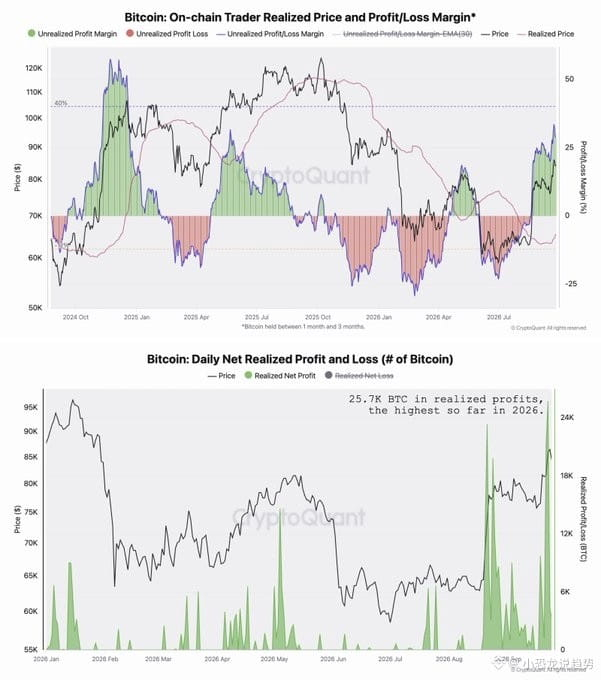
On a single day, 25,700 Bitcoin were sold off for cash—setting the most intense record of 2026 💥
[🚨 行情变了群里说](https://app.binance.com/uni-qr/JpwCPfBj)
The figures come from a report released by an exchange research institute on October 2: on September 22, on-chain holders realized profits of 25,700 BTC in one day, the highest single-day level this year; at the same time, the unrealized profit rate for short-term traders rose to 33%, a new high since December 2024.
What’s even more important is the demand side. Over the past 30 days, Bitcoin’s “apparent spot demand” fell by about 170,000 BTC; meanwhile, the speculative incremental in the futures market also dropped from 164,000 BTC on September 14 to 16,000 BTC on September 29—shrinking by roughly 90% in ten days.
On one side, profit-taking volumes are getting more aggressive; on the other, there’s less and less demand to buy the dip. Analyst Julio Moreno from CryptoQuant pointed out last week: the simultaneous rise of unrealized profits and profit-taking is a signal that upside momentum is weakening ⚠️
So why hasn’t the price collapsed? Because the people selling have made money and are cashing out, not cutting losses after being underwater. In Q3, Bitcoin rose by about 40%, and Ethereum even climbed 70.9% in the quarter. With strong floating gains, the urge to realize profits naturally stays high. Looking back at history, true distribution at high levels is often accompanied by leveraged players getting liquidated in a chain reaction; what we’re seeing now is more like a mild “sell as it goes” pattern.
My take is that these data reflect a real market condition: it’s not a lack of confidence—it's that no one is willing to chase at this level. The area above $85,000 keeps getting pressed back repeatedly; to genuinely break through, you need spot buying to bring in fresh volume—not a hard push from short-covering. For everyday players, this kind of churn—“profit-taking heating up + demand cooling down”—is the easiest environment to get hit from both sides: you chase and end up trapped in losses, then you get cut at the lows.
Do you plan to keep holding the coins you’ve got, or cash out some first? Let’s discuss in the comments 🦖
Click the profile picture to watch the livestream and share your thinking on your positions.
Every day, I’ll help you track Bitcoin hotspots—not just what happens in the news, but also how to understand the logic and opportunities behind it 👀🚀
On a single day, 25,700 Bitcoin were sold off for cash—setting the most intense record of 2026 💥
🚨 行情变了群里说
The figures come from a report released by an exchange research institute on October 2: on September 22, on-chain holders realized profits of 25,700 BTC in one day, the highest single-day level this year; at the same time, the unrealized profit rate for short-term traders rose to 33%, a new high since December 2024.
What’s even more important is the demand side. Over the past 30 days, Bitcoin’s “apparent spot demand” fell by about 170,000 BTC; meanwhile, the speculative incremental in the futures market also dropped from 164,000 BTC on September 14 to 16,000 BTC on September 29—shrinking by roughly 90% in ten days.
On one side, profit-taking volumes are getting more aggressive; on the other, there’s less and less demand to buy the dip. Analyst Julio Moreno from CryptoQuant pointed out last week: the simultaneous rise of unrealized profits and profit-taking is a signal that upside momentum is weakening ⚠️
So why hasn’t the price collapsed? Because the people selling have made money and are cashing out, not cutting losses after being underwater. In Q3, Bitcoin rose by about 40%, and Ethereum even climbed 70.9% in the quarter. With strong floating gains, the urge to realize profits naturally stays high. Looking back at history, true distribution at high levels is often accompanied by leveraged players getting liquidated in a chain reaction; what we’re seeing now is more like a mild “sell as it goes” pattern.
My take is that these data reflect a real market condition: it’s not a lack of confidence—it's that no one is willing to chase at this level. The area above $85,000 keeps getting pressed back repeatedly; to genuinely break through, you need spot buying to bring in fresh volume—not a hard push from short-covering. For everyday players, this kind of churn—“profit-taking heating up + demand cooling down”—is the easiest environment to get hit from both sides: you chase and end up trapped in losses, then you get cut at the lows.
Do you plan to keep holding the coins you’ve got, or cash out some first? Let’s discuss in the comments 🦖
Click the profile picture to watch the livestream and share your thinking on your positions.
Every day, I’ll help you track Bitcoin hotspots—not just what happens in the news, but also how to understand the logic and opportunities behind it 👀🚀
🚨 行情变了群里说
The figures come from a report released by an exchange research institute on October 2: on September 22, on-chain holders realized profits of 25,700 BTC in one day, the highest single-day level this year; at the same time, the unrealized profit rate for short-term traders rose to 33%, a new high since December 2024.
What’s even more important is the demand side. Over the past 30 days, Bitcoin’s “apparent spot demand” fell by about 170,000 BTC; meanwhile, the speculative incremental in the futures market also dropped from 164,000 BTC on September 14 to 16,000 BTC on September 29—shrinking by roughly 90% in ten days.
On one side, profit-taking volumes are getting more aggressive; on the other, there’s less and less demand to buy the dip. Analyst Julio Moreno from CryptoQuant pointed out last week: the simultaneous rise of unrealized profits and profit-taking is a signal that upside momentum is weakening ⚠️
So why hasn’t the price collapsed? Because the people selling have made money and are cashing out, not cutting losses after being underwater. In Q3, Bitcoin rose by about 40%, and Ethereum even climbed 70.9% in the quarter. With strong floating gains, the urge to realize profits naturally stays high. Looking back at history, true distribution at high levels is often accompanied by leveraged players getting liquidated in a chain reaction; what we’re seeing now is more like a mild “sell as it goes” pattern.
My take is that these data reflect a real market condition: it’s not a lack of confidence—it's that no one is willing to chase at this level. The area above $85,000 keeps getting pressed back repeatedly; to genuinely break through, you need spot buying to bring in fresh volume—not a hard push from short-covering. For everyday players, this kind of churn—“profit-taking heating up + demand cooling down”—is the easiest environment to get hit from both sides: you chase and end up trapped in losses, then you get cut at the lows.
Do you plan to keep holding the coins you’ve got, or cash out some first? Let’s discuss in the comments 🦖
Click the profile picture to watch the livestream and share your thinking on your positions.
Every day, I’ll help you track Bitcoin hotspots—not just what happens in the news, but also how to understand the logic and opportunities behind it 👀🚀
58
·
--
In 10 days, they swept up 41,025 Bitcoin—yet the price is stuck right at the 85,000 threshold for an entire week 🦖
[📊 进群看每日策略](https://app.binance.com/uni-qr/JpwCPfBj)
On-chain data firm Santiment’s latest disclosure: addresses holding between 10 and 10,000 BTC have net added 41,025 Bitcoin in just 10 days. The combined holdings of these whale wallets have already reached 13.64 million BTC, accounting for 67.93% of the total supply worldwide. But meanwhile, Bitcoin’s price on September 30 was still hovering around $83,300. The supply wall between $84,000 and $85,000 has never been chewed through 🐋
First, let’s look at the price position. On September 21, Bitcoin briefly surged to $87,363 during the intraday session, then gave it all back along the way down. On September 28, it closed at $83,503, and even dipped to as low as $82,571 that day. The first line of defense below is $82,000 to $82,800. The first gate above is $84,000 to $85,200. Only higher up do we see the September high around $87,400. That means over the past few trading days, Bitcoin has been grinding back and forth in the middle of this range ⚠️
Now, consider the two legs of the money flow. First, coins are moving out of exchanges: on September 25, a major exchange saw daily outflows of more than 13,800 BTC— the largest single-day outflow since early 2023. Over four days, the exchange’s reported Bitcoin reserves fell from 705,000 BTC to 685,000 BTC, down roughly 20,000 BTC. Second, institutions are buying in: from September 21 to 25, U.S. spot Bitcoin ETFs saw total net inflows of about $2.39 billion, the strongest weekly inflows since 2026 📈
Analyst Ali Martinez’s script is even more direct: he believes Bitcoin has already formed a double-bottom pattern, and as long as the $82,000 neckline holds, the pattern target points to $100,000. But he also emphasizes that this is a conditional target—not a result that has already been realized. Conversely, if $82,000 breaks, deeper support to watch would be $72,000 to $73,000.
My take: whale accumulation, declining exchange reserves, and ongoing ETF buying—all three signals lean bullish. Yet the price simply won’t move up, and that in itself is the most valuable information—it shows that the sell pressure around $84,000 to $85,000 is real. Whales buy faster than the chart reacts, but price only respects traded volume. Reading “accumulation” as “pull up immediately” is the easiest trap to fall into this round.
Do you think this whale accumulation is a trap set up before a breakout, or will it just get pushed back again by that $85,000 wall? Let’s discuss in the comments.
Click the profile picture to watch the livestream
Every day, I’ll help you track crypto hot topics—not just what happens in the news, but how to understand the logic and opportunities behind it 👀🚀
In 10 days, they swept up 41,025 Bitcoin—yet the price is stuck right at the 85,000 threshold for an entire week 🦖
📊 进群看每日策略
On-chain data firm Santiment’s latest disclosure: addresses holding between 10 and 10,000 BTC have net added 41,025 Bitcoin in just 10 days. The combined holdings of these whale wallets have already reached 13.64 million BTC, accounting for 67.93% of the total supply worldwide. But meanwhile, Bitcoin’s price on September 30 was still hovering around $83,300. The supply wall between $84,000 and $85,000 has never been chewed through 🐋
First, let’s look at the price position. On September 21, Bitcoin briefly surged to $87,363 during the intraday session, then gave it all back along the way down. On September 28, it closed at $83,503, and even dipped to as low as $82,571 that day. The first line of defense below is $82,000 to $82,800. The first gate above is $84,000 to $85,200. Only higher up do we see the September high around $87,400. That means over the past few trading days, Bitcoin has been grinding back and forth in the middle of this range ⚠️
Now, consider the two legs of the money flow. First, coins are moving out of exchanges: on September 25, a major exchange saw daily outflows of more than 13,800 BTC— the largest single-day outflow since early 2023. Over four days, the exchange’s reported Bitcoin reserves fell from 705,000 BTC to 685,000 BTC, down roughly 20,000 BTC. Second, institutions are buying in: from September 21 to 25, U.S. spot Bitcoin ETFs saw total net inflows of about $2.39 billion, the strongest weekly inflows since 2026 📈
Analyst Ali Martinez’s script is even more direct: he believes Bitcoin has already formed a double-bottom pattern, and as long as the $82,000 neckline holds, the pattern target points to $100,000. But he also emphasizes that this is a conditional target—not a result that has already been realized. Conversely, if $82,000 breaks, deeper support to watch would be $72,000 to $73,000.
My take: whale accumulation, declining exchange reserves, and ongoing ETF buying—all three signals lean bullish. Yet the price simply won’t move up, and that in itself is the most valuable information—it shows that the sell pressure around $84,000 to $85,000 is real. Whales buy faster than the chart reacts, but price only respects traded volume. Reading “accumulation” as “pull up immediately” is the easiest trap to fall into this round.
Do you think this whale accumulation is a trap set up before a breakout, or will it just get pushed back again by that $85,000 wall? Let’s discuss in the comments.
Click the profile picture to watch the livestream
Every day, I’ll help you track crypto hot topics—not just what happens in the news, but how to understand the logic and opportunities behind it 👀🚀
📊 进群看每日策略
On-chain data firm Santiment’s latest disclosure: addresses holding between 10 and 10,000 BTC have net added 41,025 Bitcoin in just 10 days. The combined holdings of these whale wallets have already reached 13.64 million BTC, accounting for 67.93% of the total supply worldwide. But meanwhile, Bitcoin’s price on September 30 was still hovering around $83,300. The supply wall between $84,000 and $85,000 has never been chewed through 🐋
First, let’s look at the price position. On September 21, Bitcoin briefly surged to $87,363 during the intraday session, then gave it all back along the way down. On September 28, it closed at $83,503, and even dipped to as low as $82,571 that day. The first line of defense below is $82,000 to $82,800. The first gate above is $84,000 to $85,200. Only higher up do we see the September high around $87,400. That means over the past few trading days, Bitcoin has been grinding back and forth in the middle of this range ⚠️
Now, consider the two legs of the money flow. First, coins are moving out of exchanges: on September 25, a major exchange saw daily outflows of more than 13,800 BTC— the largest single-day outflow since early 2023. Over four days, the exchange’s reported Bitcoin reserves fell from 705,000 BTC to 685,000 BTC, down roughly 20,000 BTC. Second, institutions are buying in: from September 21 to 25, U.S. spot Bitcoin ETFs saw total net inflows of about $2.39 billion, the strongest weekly inflows since 2026 📈
Analyst Ali Martinez’s script is even more direct: he believes Bitcoin has already formed a double-bottom pattern, and as long as the $82,000 neckline holds, the pattern target points to $100,000. But he also emphasizes that this is a conditional target—not a result that has already been realized. Conversely, if $82,000 breaks, deeper support to watch would be $72,000 to $73,000.
My take: whale accumulation, declining exchange reserves, and ongoing ETF buying—all three signals lean bullish. Yet the price simply won’t move up, and that in itself is the most valuable information—it shows that the sell pressure around $84,000 to $85,000 is real. Whales buy faster than the chart reacts, but price only respects traded volume. Reading “accumulation” as “pull up immediately” is the easiest trap to fall into this round.
Do you think this whale accumulation is a trap set up before a breakout, or will it just get pushed back again by that $85,000 wall? Let’s discuss in the comments.
Click the profile picture to watch the livestream
Every day, I’ll help you track crypto hot topics—not just what happens in the news, but how to understand the logic and opportunities behind it 👀🚀

163
·
--
#以太坊三季度涨70.9% #比特币etf三季度净流入63.4亿美元
A quarter saw $1.26 billion stolen—while Bitcoin in the same period rose by 40% 🦖
[📈 进群一起分析行情](https://app.binance.com/uni-qr/JpwCPfBj)
The third quarter has just wrapped up: CertiK’s latest data shows that in Q3 2026, the crypto industry suffered $1.26 billion in losses from security incidents, up 53.9% from the $819.4 million in Q2; the number of incidents rose from 219 to 247. The single largest theft was $387.5 million from a major exchange on September 24—accounting for 31% of the quarter’s total losses in one incident 💥
But in the very same quarter, Bitcoin rose by about 40% and Ethereum surged 70.9%. Bitcoin ETFs saw net inflows of $6.34 billion. On one side, a hackers’ harvest season; on the other, a bulls’ celebration season—this is the most unflattering side of a bull market ⚠️
First, let’s lay out the hackers’ scoreboard. September was the worst-hit month: $769 million lost in a single month, with 99 incidents—96% of which came from exploits. Besides that exchange’s $387.5 million, Liquid Network was hit for $319 million, Tectonic lost $120 million, and Coldcard was stolen for $112.7 million. Fortunately, about $273 million was frozen or recovered, bringing September’s net loss down to $495.3 million. The bigger trouble is money laundering pathways: the stolen funds are being transferred through privacy pools, making on-chain tracking increasingly difficult.
Now, let’s look at the bulls’ performance report. Bitcoin is back above $84,000, with $82,500 as the key support level. Citigroup has just raised its 12-month target price from $82,000 to $113,000, bullish on ETF fund returning; Ethereum’s quarterly gain is 70.9%, and the target price is set at $3,028 📈
My take: this cold and hot swing is actually two sides of the same thing. Institutional money is pouring in at scale through ETFs, inflating the total size of crypto assets—and pushing the amount stolen per incident into the hundreds-of-millions. Paper gains in a bull market can be very tempting, but the risk that “the assets are in someone else’s hands” is also being amplified at the same time. For everyday people, the biggest lesson of this quarter isn’t chasing pumps—it’s figuring out whose pocket your coins are really in.
Do you think this wave of hacks will slow down institutions’ pace of entry? Or do you think ETF buyers simply don’t care about these events? Let’s discuss in the comments.
Click the profile picture to watch the live stream
Every day, I’ll help you track crypto hotspots—not just what happened in the news, but also the logic and opportunities behind it 👀🚀
#以太坊三季度涨70.9% #比特币etf三季度净流入63.4亿美元
A quarter saw $1.26 billion stolen—while Bitcoin in the same period rose by 40% 🦖
📈 进群一起分析行情
The third quarter has just wrapped up: CertiK’s latest data shows that in Q3 2026, the crypto industry suffered $1.26 billion in losses from security incidents, up 53.9% from the $819.4 million in Q2; the number of incidents rose from 219 to 247. The single largest theft was $387.5 million from a major exchange on September 24—accounting for 31% of the quarter’s total losses in one incident 💥
But in the very same quarter, Bitcoin rose by about 40% and Ethereum surged 70.9%. Bitcoin ETFs saw net inflows of $6.34 billion. On one side, a hackers’ harvest season; on the other, a bulls’ celebration season—this is the most unflattering side of a bull market ⚠️
First, let’s lay out the hackers’ scoreboard. September was the worst-hit month: $769 million lost in a single month, with 99 incidents—96% of which came from exploits. Besides that exchange’s $387.5 million, Liquid Network was hit for $319 million, Tectonic lost $120 million, and Coldcard was stolen for $112.7 million. Fortunately, about $273 million was frozen or recovered, bringing September’s net loss down to $495.3 million. The bigger trouble is money laundering pathways: the stolen funds are being transferred through privacy pools, making on-chain tracking increasingly difficult.
Now, let’s look at the bulls’ performance report. Bitcoin is back above $84,000, with $82,500 as the key support level. Citigroup has just raised its 12-month target price from $82,000 to $113,000, bullish on ETF fund returning; Ethereum’s quarterly gain is 70.9%, and the target price is set at $3,028 📈
My take: this cold and hot swing is actually two sides of the same thing. Institutional money is pouring in at scale through ETFs, inflating the total size of crypto assets—and pushing the amount stolen per incident into the hundreds-of-millions. Paper gains in a bull market can be very tempting, but the risk that “the assets are in someone else’s hands” is also being amplified at the same time. For everyday people, the biggest lesson of this quarter isn’t chasing pumps—it’s figuring out whose pocket your coins are really in.
Do you think this wave of hacks will slow down institutions’ pace of entry? Or do you think ETF buyers simply don’t care about these events? Let’s discuss in the comments.
Click the profile picture to watch the live stream
Every day, I’ll help you track crypto hotspots—not just what happened in the news, but also the logic and opportunities behind it 👀🚀
A quarter saw $1.26 billion stolen—while Bitcoin in the same period rose by 40% 🦖
📈 进群一起分析行情
The third quarter has just wrapped up: CertiK’s latest data shows that in Q3 2026, the crypto industry suffered $1.26 billion in losses from security incidents, up 53.9% from the $819.4 million in Q2; the number of incidents rose from 219 to 247. The single largest theft was $387.5 million from a major exchange on September 24—accounting for 31% of the quarter’s total losses in one incident 💥
But in the very same quarter, Bitcoin rose by about 40% and Ethereum surged 70.9%. Bitcoin ETFs saw net inflows of $6.34 billion. On one side, a hackers’ harvest season; on the other, a bulls’ celebration season—this is the most unflattering side of a bull market ⚠️
First, let’s lay out the hackers’ scoreboard. September was the worst-hit month: $769 million lost in a single month, with 99 incidents—96% of which came from exploits. Besides that exchange’s $387.5 million, Liquid Network was hit for $319 million, Tectonic lost $120 million, and Coldcard was stolen for $112.7 million. Fortunately, about $273 million was frozen or recovered, bringing September’s net loss down to $495.3 million. The bigger trouble is money laundering pathways: the stolen funds are being transferred through privacy pools, making on-chain tracking increasingly difficult.
Now, let’s look at the bulls’ performance report. Bitcoin is back above $84,000, with $82,500 as the key support level. Citigroup has just raised its 12-month target price from $82,000 to $113,000, bullish on ETF fund returning; Ethereum’s quarterly gain is 70.9%, and the target price is set at $3,028 📈
My take: this cold and hot swing is actually two sides of the same thing. Institutional money is pouring in at scale through ETFs, inflating the total size of crypto assets—and pushing the amount stolen per incident into the hundreds-of-millions. Paper gains in a bull market can be very tempting, but the risk that “the assets are in someone else’s hands” is also being amplified at the same time. For everyday people, the biggest lesson of this quarter isn’t chasing pumps—it’s figuring out whose pocket your coins are really in.
Do you think this wave of hacks will slow down institutions’ pace of entry? Or do you think ETF buyers simply don’t care about these events? Let’s discuss in the comments.
Click the profile picture to watch the live stream
Every day, I’ll help you track crypto hotspots—not just what happened in the news, but also the logic and opportunities behind it 👀🚀

501
·
--
Verified
A privacy coin that surged 253% in one year—dropped 21% from its high in a single day 🦖
[🔎 进群看完整分析](https://app.binance.com/uni-qr/JpwCPfBj)
Zcash (ZEC) is currently trading at $1,333.50, down 7.29% on the day. Compared with the September-end peak of about $1,698, that’s roughly a 21% decline. In this rally, it rocketed from a bottom of $480.72 to its peak—up about 253%. The larger the gain, the scarier the pullback looks. That’s normal. But behind this drop, there are three forces working at the same time.
First, the most direct: ETF money is starting to flow in reverse. Grayscale’s Zcash ETF (ticker: ZCSH) saw net outflows of $30.25 million on September 30—its first clearly noticeable “bleeding” since it listed on August 25. Cumulative net inflows have fallen from the earlier high to about $268 million. The same morning, its 3-for-1 share split had just taken effect. It raised $260 million more than a month after listing, and then—on the day of the split—recorded its first large outflow. That timing alone is worth pondering.
Second, the mood across the whole market. On Wednesday, Bitcoin initially surged to $85,600 on the back of PCE inflation data coming in below expectations, but then quickly gave back all the gains. The 10-year U.S. Treasury yield closed at 5.29%. Meanwhile, the CME FedWatch showed the market’s probability for an October rate hike has already dropped from 70% to below 50%. When the broader market isn’t supportive, high-volatility small coins typically fall faster.
Third, and the easiest to overlook: the shielded pool. On-chain sleuth ZachXBT flagged 2,746 ZEC, worth about $3.9 million, flowing into Zcash’s privacy pool from addresses related to a $387 million theft involving a certain exchange. The amount isn’t large, and it’s not necessarily the direct trigger for today’s drop—but it brings an uncomfortable fact into the spotlight: among the most loyal privacy-coin users, there’s a group that happens to be hackers. ⚠️
My view comes in two layers.
First layer: from a technical standpoint, what it’s showing right now looks like a pullback—not a breakdown. RSI is 50.2, which is completely neutral—neither overbought nor smashed. ADX at 52.0 suggests the trend is strong, but ADX is lagging. The 50-day moving average is still above the 200-day moving average, and the structure hasn’t been broken. The real levels to watch are two prices: if the daily candle closes below $1,233, the “golden zone” should start to kick in; only if it reclaims $1,410.72 can this move genuinely be said to be back on track.
Second layer—and this is what I want to emphasize more: back in June, it already performed the same kind of play. At that time, a serious vulnerability in the shielded pool was exposed. ZEC then crashed from $635 all the way to an intraday low of $309—a decline of 38%. What happened afterward? It still went on to break above $1,600. For a narrative-driven coin, the “hole” created by bad news is often the starting point of the next leg of the cycle. The condition, though, is that it must also withstand the dual pressure from both ETF capital and regulatory attention.
Put simply: a 21% retracement versus a 253% rally is, for now, just profit-taking—not a trend reversal. The real issue is that privacy coins’ “narrative premium” and “regulatory discount” are always tangled together. The stronger they run, the higher the probability they’ll be watched.
Let’s talk in the comments: do you think this is a buy-the-dip opportunity, or a signal that the trend has topped?
Click the avatar to watch the livestream
Every day, I’ll help you track hot spots in privacy coins and ETF fund flows—not just what happens in the news, but also how to understand the underlying logic and opportunities 👀🚀
A privacy coin that surged 253% in one year—dropped 21% from its high in a single day 🦖
🔎 进群看完整分析
Zcash (ZEC) is currently trading at $1,333.50, down 7.29% on the day. Compared with the September-end peak of about $1,698, that’s roughly a 21% decline. In this rally, it rocketed from a bottom of $480.72 to its peak—up about 253%. The larger the gain, the scarier the pullback looks. That’s normal. But behind this drop, there are three forces working at the same time.
First, the most direct: ETF money is starting to flow in reverse. Grayscale’s Zcash ETF (ticker: ZCSH) saw net outflows of $30.25 million on September 30—its first clearly noticeable “bleeding” since it listed on August 25. Cumulative net inflows have fallen from the earlier high to about $268 million. The same morning, its 3-for-1 share split had just taken effect. It raised $260 million more than a month after listing, and then—on the day of the split—recorded its first large outflow. That timing alone is worth pondering.
Second, the mood across the whole market. On Wednesday, Bitcoin initially surged to $85,600 on the back of PCE inflation data coming in below expectations, but then quickly gave back all the gains. The 10-year U.S. Treasury yield closed at 5.29%. Meanwhile, the CME FedWatch showed the market’s probability for an October rate hike has already dropped from 70% to below 50%. When the broader market isn’t supportive, high-volatility small coins typically fall faster.
Third, and the easiest to overlook: the shielded pool. On-chain sleuth ZachXBT flagged 2,746 ZEC, worth about $3.9 million, flowing into Zcash’s privacy pool from addresses related to a $387 million theft involving a certain exchange. The amount isn’t large, and it’s not necessarily the direct trigger for today’s drop—but it brings an uncomfortable fact into the spotlight: among the most loyal privacy-coin users, there’s a group that happens to be hackers. ⚠️
My view comes in two layers.
First layer: from a technical standpoint, what it’s showing right now looks like a pullback—not a breakdown. RSI is 50.2, which is completely neutral—neither overbought nor smashed. ADX at 52.0 suggests the trend is strong, but ADX is lagging. The 50-day moving average is still above the 200-day moving average, and the structure hasn’t been broken. The real levels to watch are two prices: if the daily candle closes below $1,233, the “golden zone” should start to kick in; only if it reclaims $1,410.72 can this move genuinely be said to be back on track.
Second layer—and this is what I want to emphasize more: back in June, it already performed the same kind of play. At that time, a serious vulnerability in the shielded pool was exposed. ZEC then crashed from $635 all the way to an intraday low of $309—a decline of 38%. What happened afterward? It still went on to break above $1,600. For a narrative-driven coin, the “hole” created by bad news is often the starting point of the next leg of the cycle. The condition, though, is that it must also withstand the dual pressure from both ETF capital and regulatory attention.
Put simply: a 21% retracement versus a 253% rally is, for now, just profit-taking—not a trend reversal. The real issue is that privacy coins’ “narrative premium” and “regulatory discount” are always tangled together. The stronger they run, the higher the probability they’ll be watched.
Let’s talk in the comments: do you think this is a buy-the-dip opportunity, or a signal that the trend has topped?
Click the avatar to watch the livestream
Every day, I’ll help you track hot spots in privacy coins and ETF fund flows—not just what happens in the news, but also how to understand the underlying logic and opportunities 👀🚀
🔎 进群看完整分析
Zcash (ZEC) is currently trading at $1,333.50, down 7.29% on the day. Compared with the September-end peak of about $1,698, that’s roughly a 21% decline. In this rally, it rocketed from a bottom of $480.72 to its peak—up about 253%. The larger the gain, the scarier the pullback looks. That’s normal. But behind this drop, there are three forces working at the same time.
First, the most direct: ETF money is starting to flow in reverse. Grayscale’s Zcash ETF (ticker: ZCSH) saw net outflows of $30.25 million on September 30—its first clearly noticeable “bleeding” since it listed on August 25. Cumulative net inflows have fallen from the earlier high to about $268 million. The same morning, its 3-for-1 share split had just taken effect. It raised $260 million more than a month after listing, and then—on the day of the split—recorded its first large outflow. That timing alone is worth pondering.
Second, the mood across the whole market. On Wednesday, Bitcoin initially surged to $85,600 on the back of PCE inflation data coming in below expectations, but then quickly gave back all the gains. The 10-year U.S. Treasury yield closed at 5.29%. Meanwhile, the CME FedWatch showed the market’s probability for an October rate hike has already dropped from 70% to below 50%. When the broader market isn’t supportive, high-volatility small coins typically fall faster.
Third, and the easiest to overlook: the shielded pool. On-chain sleuth ZachXBT flagged 2,746 ZEC, worth about $3.9 million, flowing into Zcash’s privacy pool from addresses related to a $387 million theft involving a certain exchange. The amount isn’t large, and it’s not necessarily the direct trigger for today’s drop—but it brings an uncomfortable fact into the spotlight: among the most loyal privacy-coin users, there’s a group that happens to be hackers. ⚠️
My view comes in two layers.
First layer: from a technical standpoint, what it’s showing right now looks like a pullback—not a breakdown. RSI is 50.2, which is completely neutral—neither overbought nor smashed. ADX at 52.0 suggests the trend is strong, but ADX is lagging. The 50-day moving average is still above the 200-day moving average, and the structure hasn’t been broken. The real levels to watch are two prices: if the daily candle closes below $1,233, the “golden zone” should start to kick in; only if it reclaims $1,410.72 can this move genuinely be said to be back on track.
Second layer—and this is what I want to emphasize more: back in June, it already performed the same kind of play. At that time, a serious vulnerability in the shielded pool was exposed. ZEC then crashed from $635 all the way to an intraday low of $309—a decline of 38%. What happened afterward? It still went on to break above $1,600. For a narrative-driven coin, the “hole” created by bad news is often the starting point of the next leg of the cycle. The condition, though, is that it must also withstand the dual pressure from both ETF capital and regulatory attention.
Put simply: a 21% retracement versus a 253% rally is, for now, just profit-taking—not a trend reversal. The real issue is that privacy coins’ “narrative premium” and “regulatory discount” are always tangled together. The stronger they run, the higher the probability they’ll be watched.
Let’s talk in the comments: do you think this is a buy-the-dip opportunity, or a signal that the trend has topped?
Click the avatar to watch the livestream
Every day, I’ll help you track hot spots in privacy coins and ETF fund flows—not just what happens in the news, but also how to understand the underlying logic and opportunities 👀🚀

410
·
--
Verified
#美国10年期美债收益率逼近5.3%
US Treasury yields surge to 5.342%, the highest since 2002; yet Bitcoin stays above $84,000 and refuses to back down 🦖
[🕐 最新解读群里更新](https://app.binance.com/uni-qr/JpwCPfBj)
On Thursday, US stocks opened; at one point, the yield on the US 10-year Treasury touched 5.342%, the last time this level appeared was in April 2002. The 30-year yield also refreshed multi-year highs. At the same time, Bitcoin climbed above $84,000, up slightly on the day. Faced with the world’s most expensive cost of borrowing, it has stubbornly held its ground.
First, translate the numbers into plain language: 5.342% means the US government’s cost of borrowing has returned to levels from 24 years ago. As market concerns about government debt grow, Mahmood Pradhan, former Deputy Director of the IMF’s Europe department, told the media that global investors are now “very tense.” As yields keep rising, interest payments that countries have to make rise along with them.
Bitcoin’s reaction, in fact, has been more restrained than many people might expect. In August, the year-over-year PCE price index came in at 3.4%, below expectations, and the market barely got excited—analysts generally believe that a large part of this decline is due to changes in statistical measurement. Crypto analyst Benjamin Cowen put it more bluntly: “The bond market has revolted. Until the Fed truly gets inflation under control, this situation will likely keep going.”
On the technical side, the key levels indicated by liquidation data are $84,500 and $82,900. Over the past 24 hours, total net liquidations across the entire market were only about $25 million. Both bulls and bears are holding back, and price is being ground back and forth within a range. Rekt Capital reminds that Bitcoin will likely retest support around $82,500. “This pullback could get messy”—but he also says that as long as it’s defended, there’s still a chance to continue moving higher.
Let’s translate the key signal ⚖️: When the yield on the US 10-year Treasury gets close to 5.3%, pricing power is no longer in the crypto market—it’s in the bond market. With each step up in yields, the valuation pressure on risk assets increases. This week’s relatively soft PCE gives the bulls a chance to catch their breath, so what we’re seeing isn’t a crash, but “high-level consolidation—nobody dares to make the first move.” What truly matters now are two things: whether the 10-year yield can hold near 5.3% without surging higher again, and whether the $82,500 line can be defended. ⚠️
Do you think this move is rates weighing on Bitcoin, or Bitcoin waiting for rates to turn? Let us know your take in the comments.📈
Click the profile picture to watch the live stream
Every day, I’ll keep you on top of crypto macro hotspots—more than just reporting what happens in the news, I’ll help you understand the logic and opportunities behind it 👀🚀
#美国10年期美债收益率逼近5.3%
US Treasury yields surge to 5.342%, the highest since 2002; yet Bitcoin stays above $84,000 and refuses to back down 🦖
🕐 最新解读群里更新
On Thursday, US stocks opened; at one point, the yield on the US 10-year Treasury touched 5.342%, the last time this level appeared was in April 2002. The 30-year yield also refreshed multi-year highs. At the same time, Bitcoin climbed above $84,000, up slightly on the day. Faced with the world’s most expensive cost of borrowing, it has stubbornly held its ground.
First, translate the numbers into plain language: 5.342% means the US government’s cost of borrowing has returned to levels from 24 years ago. As market concerns about government debt grow, Mahmood Pradhan, former Deputy Director of the IMF’s Europe department, told the media that global investors are now “very tense.” As yields keep rising, interest payments that countries have to make rise along with them.
Bitcoin’s reaction, in fact, has been more restrained than many people might expect. In August, the year-over-year PCE price index came in at 3.4%, below expectations, and the market barely got excited—analysts generally believe that a large part of this decline is due to changes in statistical measurement. Crypto analyst Benjamin Cowen put it more bluntly: “The bond market has revolted. Until the Fed truly gets inflation under control, this situation will likely keep going.”
On the technical side, the key levels indicated by liquidation data are $84,500 and $82,900. Over the past 24 hours, total net liquidations across the entire market were only about $25 million. Both bulls and bears are holding back, and price is being ground back and forth within a range. Rekt Capital reminds that Bitcoin will likely retest support around $82,500. “This pullback could get messy”—but he also says that as long as it’s defended, there’s still a chance to continue moving higher.
Let’s translate the key signal ⚖️: When the yield on the US 10-year Treasury gets close to 5.3%, pricing power is no longer in the crypto market—it’s in the bond market. With each step up in yields, the valuation pressure on risk assets increases. This week’s relatively soft PCE gives the bulls a chance to catch their breath, so what we’re seeing isn’t a crash, but “high-level consolidation—nobody dares to make the first move.” What truly matters now are two things: whether the 10-year yield can hold near 5.3% without surging higher again, and whether the $82,500 line can be defended. ⚠️
Do you think this move is rates weighing on Bitcoin, or Bitcoin waiting for rates to turn? Let us know your take in the comments.📈
Click the profile picture to watch the live stream
Every day, I’ll keep you on top of crypto macro hotspots—more than just reporting what happens in the news, I’ll help you understand the logic and opportunities behind it 👀🚀
US Treasury yields surge to 5.342%, the highest since 2002; yet Bitcoin stays above $84,000 and refuses to back down 🦖
🕐 最新解读群里更新
On Thursday, US stocks opened; at one point, the yield on the US 10-year Treasury touched 5.342%, the last time this level appeared was in April 2002. The 30-year yield also refreshed multi-year highs. At the same time, Bitcoin climbed above $84,000, up slightly on the day. Faced with the world’s most expensive cost of borrowing, it has stubbornly held its ground.
First, translate the numbers into plain language: 5.342% means the US government’s cost of borrowing has returned to levels from 24 years ago. As market concerns about government debt grow, Mahmood Pradhan, former Deputy Director of the IMF’s Europe department, told the media that global investors are now “very tense.” As yields keep rising, interest payments that countries have to make rise along with them.
Bitcoin’s reaction, in fact, has been more restrained than many people might expect. In August, the year-over-year PCE price index came in at 3.4%, below expectations, and the market barely got excited—analysts generally believe that a large part of this decline is due to changes in statistical measurement. Crypto analyst Benjamin Cowen put it more bluntly: “The bond market has revolted. Until the Fed truly gets inflation under control, this situation will likely keep going.”
On the technical side, the key levels indicated by liquidation data are $84,500 and $82,900. Over the past 24 hours, total net liquidations across the entire market were only about $25 million. Both bulls and bears are holding back, and price is being ground back and forth within a range. Rekt Capital reminds that Bitcoin will likely retest support around $82,500. “This pullback could get messy”—but he also says that as long as it’s defended, there’s still a chance to continue moving higher.
Let’s translate the key signal ⚖️: When the yield on the US 10-year Treasury gets close to 5.3%, pricing power is no longer in the crypto market—it’s in the bond market. With each step up in yields, the valuation pressure on risk assets increases. This week’s relatively soft PCE gives the bulls a chance to catch their breath, so what we’re seeing isn’t a crash, but “high-level consolidation—nobody dares to make the first move.” What truly matters now are two things: whether the 10-year yield can hold near 5.3% without surging higher again, and whether the $82,500 line can be defended. ⚠️
Do you think this move is rates weighing on Bitcoin, or Bitcoin waiting for rates to turn? Let us know your take in the comments.📈
Click the profile picture to watch the live stream
Every day, I’ll keep you on top of crypto macro hotspots—more than just reporting what happens in the news, I’ll help you understand the logic and opportunities behind it 👀🚀

652
·
--
🦖 After rejecting a hacker’s $50 million exchange request, the platform was breached itself within 24 hours
[🚨 行情变了群里说](https://app.binance.com/uni-qr/JpwCPfBj)
The cross-chain exchange protocol NEAR Intents was attacked today, with losses of about $3.8 million. The official team has paused services, freezing deposits and withdrawals across 11 chains at once, and promising to fully reimburse the affected funds.
The most heartbreaking part is the timeline: last week it loudly announced that its own risk-control system SHIELD had blocked an exchange request of over $50 million related to a $387 million stolen-asset case—freezing $503,000 and letting only $166,000 slip through. As a result, it turned into the next target.💥
According to the official explanation, the issue lies in the interaction logic between the Omni deposit/withdrawal system and the smart contracts; the contract-side vulnerability has already been patched. On-chain sleuth ZachXBT noted that the earliest abnormal withdrawals came from a BNB Chain hot wallet; the stolen funds were then transferred to an exchange, and subsequently cross-chained to become Bitcoin. NEAR tokens dropped by about 6% in 24 hours.⚠️
Numbers better show the scale: the platform claims it has processed transactions totaling over $30 billion and covered 35 chains. This time, 11 chains were affected: BNB Chain, Polygon, TON, Optimism, Avalanche, Stellar, Monad, X Layer, Scroll, ADI, and Plasma.🔗
Look at the whole year—this is just a slice. In DefiLlama’s statistics, the first major cases so far this year are, in order: a certain exchange at about $387 million, Liquid Network at about $320 million, Drift at about $295 million, and Kelp at about $293 million. Total crypto theft across the third quarter reached $1.26 billion across 247 incidents; September alone accounted for about $769 million. In that pile of figures, $3.8 million is almost negligible.
But what I care about isn’t the amount—it’s the switch. A protocol that can identify and stop hacker funds shows that the routing behind it is actually supported by centralized risk control. This time it got hit itself, too, which also indicates that code-level exposure won’t disappear just because it’s “on the right side.” Permissionless has always come with conditions.
Translation: cross-chain protocols are becoming the battlefield with the best hacker cost-effectiveness—one vulnerability, and multiple chains opened up at once. For users, what really matters isn’t “will it reimburse,” but “will it dare to reject hackers next time?”
If cross-chain protocols get into trouble like this, should the platform fully cover the losses? Discuss it in the comments.
Click the avatar to watch the live stream
Every day, I’ll keep you updated on key crypto security hotspots—not just what happened, but also help you understand the logic and opportunities behind it 👀🚀
🦖 After rejecting a hacker’s $50 million exchange request, the platform was breached itself within 24 hours
🚨 行情变了群里说
The cross-chain exchange protocol NEAR Intents was attacked today, with losses of about $3.8 million. The official team has paused services, freezing deposits and withdrawals across 11 chains at once, and promising to fully reimburse the affected funds.
The most heartbreaking part is the timeline: last week it loudly announced that its own risk-control system SHIELD had blocked an exchange request of over $50 million related to a $387 million stolen-asset case—freezing $503,000 and letting only $166,000 slip through. As a result, it turned into the next target.💥
According to the official explanation, the issue lies in the interaction logic between the Omni deposit/withdrawal system and the smart contracts; the contract-side vulnerability has already been patched. On-chain sleuth ZachXBT noted that the earliest abnormal withdrawals came from a BNB Chain hot wallet; the stolen funds were then transferred to an exchange, and subsequently cross-chained to become Bitcoin. NEAR tokens dropped by about 6% in 24 hours.⚠️
Numbers better show the scale: the platform claims it has processed transactions totaling over $30 billion and covered 35 chains. This time, 11 chains were affected: BNB Chain, Polygon, TON, Optimism, Avalanche, Stellar, Monad, X Layer, Scroll, ADI, and Plasma.🔗
Look at the whole year—this is just a slice. In DefiLlama’s statistics, the first major cases so far this year are, in order: a certain exchange at about $387 million, Liquid Network at about $320 million, Drift at about $295 million, and Kelp at about $293 million. Total crypto theft across the third quarter reached $1.26 billion across 247 incidents; September alone accounted for about $769 million. In that pile of figures, $3.8 million is almost negligible.
But what I care about isn’t the amount—it’s the switch. A protocol that can identify and stop hacker funds shows that the routing behind it is actually supported by centralized risk control. This time it got hit itself, too, which also indicates that code-level exposure won’t disappear just because it’s “on the right side.” Permissionless has always come with conditions.
Translation: cross-chain protocols are becoming the battlefield with the best hacker cost-effectiveness—one vulnerability, and multiple chains opened up at once. For users, what really matters isn’t “will it reimburse,” but “will it dare to reject hackers next time?”
If cross-chain protocols get into trouble like this, should the platform fully cover the losses? Discuss it in the comments.
Click the avatar to watch the live stream
Every day, I’ll keep you updated on key crypto security hotspots—not just what happened, but also help you understand the logic and opportunities behind it 👀🚀
🚨 行情变了群里说
The cross-chain exchange protocol NEAR Intents was attacked today, with losses of about $3.8 million. The official team has paused services, freezing deposits and withdrawals across 11 chains at once, and promising to fully reimburse the affected funds.
The most heartbreaking part is the timeline: last week it loudly announced that its own risk-control system SHIELD had blocked an exchange request of over $50 million related to a $387 million stolen-asset case—freezing $503,000 and letting only $166,000 slip through. As a result, it turned into the next target.💥
According to the official explanation, the issue lies in the interaction logic between the Omni deposit/withdrawal system and the smart contracts; the contract-side vulnerability has already been patched. On-chain sleuth ZachXBT noted that the earliest abnormal withdrawals came from a BNB Chain hot wallet; the stolen funds were then transferred to an exchange, and subsequently cross-chained to become Bitcoin. NEAR tokens dropped by about 6% in 24 hours.⚠️
Numbers better show the scale: the platform claims it has processed transactions totaling over $30 billion and covered 35 chains. This time, 11 chains were affected: BNB Chain, Polygon, TON, Optimism, Avalanche, Stellar, Monad, X Layer, Scroll, ADI, and Plasma.🔗
Look at the whole year—this is just a slice. In DefiLlama’s statistics, the first major cases so far this year are, in order: a certain exchange at about $387 million, Liquid Network at about $320 million, Drift at about $295 million, and Kelp at about $293 million. Total crypto theft across the third quarter reached $1.26 billion across 247 incidents; September alone accounted for about $769 million. In that pile of figures, $3.8 million is almost negligible.
But what I care about isn’t the amount—it’s the switch. A protocol that can identify and stop hacker funds shows that the routing behind it is actually supported by centralized risk control. This time it got hit itself, too, which also indicates that code-level exposure won’t disappear just because it’s “on the right side.” Permissionless has always come with conditions.
Translation: cross-chain protocols are becoming the battlefield with the best hacker cost-effectiveness—one vulnerability, and multiple chains opened up at once. For users, what really matters isn’t “will it reimburse,” but “will it dare to reject hackers next time?”
If cross-chain protocols get into trouble like this, should the platform fully cover the losses? Discuss it in the comments.
Click the avatar to watch the live stream
Every day, I’ll keep you updated on key crypto security hotspots—not just what happened, but also help you understand the logic and opportunities behind it 👀🚀

289
·
--
#美国10年期美债收益率逼近5.3%
The 10-year U.S. Treasury yield surged to 5.33%, the highest since April 2002— the last time I saw this number was April 2002. Global bond markets are collectively being dumped. 🦖
[📈 进群看今日思路](https://app.binance.com/uni-qr/JpwCPfBj)
On October 1 (Thursday), the yield on U.S. 10-year Treasuries rose by 4 basis points to 5.3338%, breaking above the level of April 2002; the yield on 30-year Treasuries rose by 3 basis points to 5.6702%, the highest since July 2002; and the yield on 2-year Treasuries also climbed by 2 basis points to 4.91%. On the same day, Brent crude oil moved back above $100. This isn’t a problem specific to one country—global government borrowing costs rose in sync on Thursday, driven by a triple squeeze: unmanaged fiscal deficits, sticky inflation that won’t come down, and interest rates still heading higher.
Why does this relate to crypto? Because the long-end U.S. Treasury yield is the “discount-rate anchor” for global assets. The higher it is, the lower the present value of future cash flows becomes, and the valuation ceiling for long-duration risk assets—stocks and crypto included—is pushed down. This is exactly the macro reason why Bitcoin, despite rising about 40% in Q3 (its strongest quarter since 2024), still couldn’t break out in the opening of Q4 and remained stuck in the $82,000 to $85,000 range.
But there’s also a suspenseful flip side. Nomi Prins, founder of Prinsights Global, said on CNBC that when yields reach this level, it would normally attract bargain hunters to step in and push yields back down. But sovereign wealth funds and other long-term holders in various countries likely won’t do that. Her view is that only a significant drop in oil prices, along with a concrete easing of the situation in the Middle East, could bring long-end yields down for real—in other words, what may “save” risk assets next could be geopolitics, not the Fed. ⚖️
Now look at the tug-of-war on both sides. On one side, fiscal deficits and high oil prices are propping up the long end; on the other, the U.S. Dollar Index has also hit a new high since May 2025. That combination— a strong dollar plus higher rates—has historically been a headwind for emerging markets and risk assets. ⚠️ But the market’s pricing logic is also quite nuanced: the simple relationship over the past two years—“the higher rates, the more Bitcoin falls”—has repeatedly failed. What truly pulled Bitcoin from $75,000 to above $80,000 wasn’t rates themselves, but ETF inflows and short-covering.
My view is that a 5.3% figure doesn’t call for panic, but it is a clear constraint. It determines how high institutions are willing to value risk assets, and it determines whether Bitcoin can push the $85,000 door open. In the coming week, just watch three things: whether the 10-year yield can hold above 5.3%, whether Brent crude keeps surging, and whether U.S. stocks and crypto show “rate dulling”—that is, yields rise again but assets stop falling in tandem. 📉
Let’s chat in the comments: do you think this spike in long-end rates is a roadblock for the crypto bull market, or has the market already priced it in?
Click the profile picture to watch the live stream
Every day, I’ll help you track macro and rate hotspots— not only what’s happening in the news, but also how to understand the logic and opportunities behind it 👀🚀
#美国10年期美债收益率逼近5.3%
The 10-year U.S. Treasury yield surged to 5.33%, the highest since April 2002— the last time I saw this number was April 2002. Global bond markets are collectively being dumped. 🦖
📈 进群看今日思路
On October 1 (Thursday), the yield on U.S. 10-year Treasuries rose by 4 basis points to 5.3338%, breaking above the level of April 2002; the yield on 30-year Treasuries rose by 3 basis points to 5.6702%, the highest since July 2002; and the yield on 2-year Treasuries also climbed by 2 basis points to 4.91%. On the same day, Brent crude oil moved back above $100. This isn’t a problem specific to one country—global government borrowing costs rose in sync on Thursday, driven by a triple squeeze: unmanaged fiscal deficits, sticky inflation that won’t come down, and interest rates still heading higher.
Why does this relate to crypto? Because the long-end U.S. Treasury yield is the “discount-rate anchor” for global assets. The higher it is, the lower the present value of future cash flows becomes, and the valuation ceiling for long-duration risk assets—stocks and crypto included—is pushed down. This is exactly the macro reason why Bitcoin, despite rising about 40% in Q3 (its strongest quarter since 2024), still couldn’t break out in the opening of Q4 and remained stuck in the $82,000 to $85,000 range.
But there’s also a suspenseful flip side. Nomi Prins, founder of Prinsights Global, said on CNBC that when yields reach this level, it would normally attract bargain hunters to step in and push yields back down. But sovereign wealth funds and other long-term holders in various countries likely won’t do that. Her view is that only a significant drop in oil prices, along with a concrete easing of the situation in the Middle East, could bring long-end yields down for real—in other words, what may “save” risk assets next could be geopolitics, not the Fed. ⚖️
Now look at the tug-of-war on both sides. On one side, fiscal deficits and high oil prices are propping up the long end; on the other, the U.S. Dollar Index has also hit a new high since May 2025. That combination— a strong dollar plus higher rates—has historically been a headwind for emerging markets and risk assets. ⚠️ But the market’s pricing logic is also quite nuanced: the simple relationship over the past two years—“the higher rates, the more Bitcoin falls”—has repeatedly failed. What truly pulled Bitcoin from $75,000 to above $80,000 wasn’t rates themselves, but ETF inflows and short-covering.
My view is that a 5.3% figure doesn’t call for panic, but it is a clear constraint. It determines how high institutions are willing to value risk assets, and it determines whether Bitcoin can push the $85,000 door open. In the coming week, just watch three things: whether the 10-year yield can hold above 5.3%, whether Brent crude keeps surging, and whether U.S. stocks and crypto show “rate dulling”—that is, yields rise again but assets stop falling in tandem. 📉
Let’s chat in the comments: do you think this spike in long-end rates is a roadblock for the crypto bull market, or has the market already priced it in?
Click the profile picture to watch the live stream
Every day, I’ll help you track macro and rate hotspots— not only what’s happening in the news, but also how to understand the logic and opportunities behind it 👀🚀
The 10-year U.S. Treasury yield surged to 5.33%, the highest since April 2002— the last time I saw this number was April 2002. Global bond markets are collectively being dumped. 🦖
📈 进群看今日思路
On October 1 (Thursday), the yield on U.S. 10-year Treasuries rose by 4 basis points to 5.3338%, breaking above the level of April 2002; the yield on 30-year Treasuries rose by 3 basis points to 5.6702%, the highest since July 2002; and the yield on 2-year Treasuries also climbed by 2 basis points to 4.91%. On the same day, Brent crude oil moved back above $100. This isn’t a problem specific to one country—global government borrowing costs rose in sync on Thursday, driven by a triple squeeze: unmanaged fiscal deficits, sticky inflation that won’t come down, and interest rates still heading higher.
Why does this relate to crypto? Because the long-end U.S. Treasury yield is the “discount-rate anchor” for global assets. The higher it is, the lower the present value of future cash flows becomes, and the valuation ceiling for long-duration risk assets—stocks and crypto included—is pushed down. This is exactly the macro reason why Bitcoin, despite rising about 40% in Q3 (its strongest quarter since 2024), still couldn’t break out in the opening of Q4 and remained stuck in the $82,000 to $85,000 range.
But there’s also a suspenseful flip side. Nomi Prins, founder of Prinsights Global, said on CNBC that when yields reach this level, it would normally attract bargain hunters to step in and push yields back down. But sovereign wealth funds and other long-term holders in various countries likely won’t do that. Her view is that only a significant drop in oil prices, along with a concrete easing of the situation in the Middle East, could bring long-end yields down for real—in other words, what may “save” risk assets next could be geopolitics, not the Fed. ⚖️
Now look at the tug-of-war on both sides. On one side, fiscal deficits and high oil prices are propping up the long end; on the other, the U.S. Dollar Index has also hit a new high since May 2025. That combination— a strong dollar plus higher rates—has historically been a headwind for emerging markets and risk assets. ⚠️ But the market’s pricing logic is also quite nuanced: the simple relationship over the past two years—“the higher rates, the more Bitcoin falls”—has repeatedly failed. What truly pulled Bitcoin from $75,000 to above $80,000 wasn’t rates themselves, but ETF inflows and short-covering.
My view is that a 5.3% figure doesn’t call for panic, but it is a clear constraint. It determines how high institutions are willing to value risk assets, and it determines whether Bitcoin can push the $85,000 door open. In the coming week, just watch three things: whether the 10-year yield can hold above 5.3%, whether Brent crude keeps surging, and whether U.S. stocks and crypto show “rate dulling”—that is, yields rise again but assets stop falling in tandem. 📉
Let’s chat in the comments: do you think this spike in long-end rates is a roadblock for the crypto bull market, or has the market already priced it in?
Click the profile picture to watch the live stream
Every day, I’ll help you track macro and rate hotspots— not only what’s happening in the news, but also how to understand the logic and opportunities behind it 👀🚀

575
·
--
#山寨季指数连续五日守稳60上方
Over the past quarter, Ethereum is up 71%, leaving Bitcoin’s 42.71% gain trailing by a full 28 percentage points 🦖
[🔍 进群聊行情](https://app.binance.com/uni-qr/JpwCPfBj)
With the third quarter now wrapped up, the results are in: Bitcoin is up 42.71%, marking the largest single-quarter gain since the fourth quarter of 2024 and the strongest third quarter since 2017; but the real protagonist has shifted to altcoins. In the same period, Ethereum is up about 71%, clearly outperforming.
The difference isn’t just in price. U.S. spot ETFs were very clear about where the money went in Q3: Bitcoin ETFs saw net inflows of about $6.34 billion, reversing roughly $5 billion of net outflows from Q2; Ethereum ETFs saw net inflows of about $3.05 billion, while Q2 was still a net outflow of about $714 million. Altcoin share is also rising: XRP-related ETFs pulled in about $308 million in Q3, pushing cumulative net inflows to about $1.79 billion; in September alone, SOL and ZEC ETFs had net inflows of about $272 million and $246 million, respectively.
Lights are on on both the on-chain and index fronts 📈. The altcoin season index has held above 60 for five straight days; Glassnode’s “altcoin cycle signal” turned bullish last week. Bitcoin’s market-cap share has been stuck between 58% and 60.4% since May 27, failing to break above 60%. On September 27, altcoins outside the top ten already accounted for about 9% of the entire market—the highest since February of this year.
But don’t rush to shout “altcoin season is here” ⚠️. CryptoQuant’s weekly report provided a set of opposite signals: on September 28, the seven-day total number of altcoin deposit transactions jumped to 78,000—the highest since October last year, about 160% higher than September 14. The number of addresses participating in deposits rose from about 17,600 to about 51,600—nearly three times. Its wording is very blunt: “Holders moving coins to exchanges usually means they’re preparing to sell.”
This is the most real contradiction right now: prices are outperforming and capital is rotating out, yet a large amount of old coins are simultaneously being moved to exchanges.
My view: don’t take “the index standing above 60” as a clarion call for altcoin season. 60 is just a passing grade. A true altcoin season usually starts above 75. Right now it looks more like a rotation cycle than a full-blown celebration; and when deposits suddenly surge, it often happens in the latter half of the rotation, not at the beginning. What we really need to watch next is this: are the coins moved into exchanges being absorbed by spot buy orders, or are they immediately dumped into a big red candle—healthy turnover in the first case, and the same top-forming script replayed in the second. 💥
Chat in the comments: do you think this round of altcoin outperformance is a prelude to altcoin season, or just bait—“pumping” for someone?
Click the profile icon to watch the live stream
Every day, I’ll help you track crypto market highlights—more than just news; I’ll help you understand the logic and opportunities behind it 👀🚀
#山寨季指数连续五日守稳60上方
Over the past quarter, Ethereum is up 71%, leaving Bitcoin’s 42.71% gain trailing by a full 28 percentage points 🦖
🔍 进群聊行情
With the third quarter now wrapped up, the results are in: Bitcoin is up 42.71%, marking the largest single-quarter gain since the fourth quarter of 2024 and the strongest third quarter since 2017; but the real protagonist has shifted to altcoins. In the same period, Ethereum is up about 71%, clearly outperforming.
The difference isn’t just in price. U.S. spot ETFs were very clear about where the money went in Q3: Bitcoin ETFs saw net inflows of about $6.34 billion, reversing roughly $5 billion of net outflows from Q2; Ethereum ETFs saw net inflows of about $3.05 billion, while Q2 was still a net outflow of about $714 million. Altcoin share is also rising: XRP-related ETFs pulled in about $308 million in Q3, pushing cumulative net inflows to about $1.79 billion; in September alone, SOL and ZEC ETFs had net inflows of about $272 million and $246 million, respectively.
Lights are on on both the on-chain and index fronts 📈. The altcoin season index has held above 60 for five straight days; Glassnode’s “altcoin cycle signal” turned bullish last week. Bitcoin’s market-cap share has been stuck between 58% and 60.4% since May 27, failing to break above 60%. On September 27, altcoins outside the top ten already accounted for about 9% of the entire market—the highest since February of this year.
But don’t rush to shout “altcoin season is here” ⚠️. CryptoQuant’s weekly report provided a set of opposite signals: on September 28, the seven-day total number of altcoin deposit transactions jumped to 78,000—the highest since October last year, about 160% higher than September 14. The number of addresses participating in deposits rose from about 17,600 to about 51,600—nearly three times. Its wording is very blunt: “Holders moving coins to exchanges usually means they’re preparing to sell.”
This is the most real contradiction right now: prices are outperforming and capital is rotating out, yet a large amount of old coins are simultaneously being moved to exchanges.
My view: don’t take “the index standing above 60” as a clarion call for altcoin season. 60 is just a passing grade. A true altcoin season usually starts above 75. Right now it looks more like a rotation cycle than a full-blown celebration; and when deposits suddenly surge, it often happens in the latter half of the rotation, not at the beginning. What we really need to watch next is this: are the coins moved into exchanges being absorbed by spot buy orders, or are they immediately dumped into a big red candle—healthy turnover in the first case, and the same top-forming script replayed in the second. 💥
Chat in the comments: do you think this round of altcoin outperformance is a prelude to altcoin season, or just bait—“pumping” for someone?
Click the profile icon to watch the live stream
Every day, I’ll help you track crypto market highlights—more than just news; I’ll help you understand the logic and opportunities behind it 👀🚀
Over the past quarter, Ethereum is up 71%, leaving Bitcoin’s 42.71% gain trailing by a full 28 percentage points 🦖
🔍 进群聊行情
With the third quarter now wrapped up, the results are in: Bitcoin is up 42.71%, marking the largest single-quarter gain since the fourth quarter of 2024 and the strongest third quarter since 2017; but the real protagonist has shifted to altcoins. In the same period, Ethereum is up about 71%, clearly outperforming.
The difference isn’t just in price. U.S. spot ETFs were very clear about where the money went in Q3: Bitcoin ETFs saw net inflows of about $6.34 billion, reversing roughly $5 billion of net outflows from Q2; Ethereum ETFs saw net inflows of about $3.05 billion, while Q2 was still a net outflow of about $714 million. Altcoin share is also rising: XRP-related ETFs pulled in about $308 million in Q3, pushing cumulative net inflows to about $1.79 billion; in September alone, SOL and ZEC ETFs had net inflows of about $272 million and $246 million, respectively.
Lights are on on both the on-chain and index fronts 📈. The altcoin season index has held above 60 for five straight days; Glassnode’s “altcoin cycle signal” turned bullish last week. Bitcoin’s market-cap share has been stuck between 58% and 60.4% since May 27, failing to break above 60%. On September 27, altcoins outside the top ten already accounted for about 9% of the entire market—the highest since February of this year.
But don’t rush to shout “altcoin season is here” ⚠️. CryptoQuant’s weekly report provided a set of opposite signals: on September 28, the seven-day total number of altcoin deposit transactions jumped to 78,000—the highest since October last year, about 160% higher than September 14. The number of addresses participating in deposits rose from about 17,600 to about 51,600—nearly three times. Its wording is very blunt: “Holders moving coins to exchanges usually means they’re preparing to sell.”
This is the most real contradiction right now: prices are outperforming and capital is rotating out, yet a large amount of old coins are simultaneously being moved to exchanges.
My view: don’t take “the index standing above 60” as a clarion call for altcoin season. 60 is just a passing grade. A true altcoin season usually starts above 75. Right now it looks more like a rotation cycle than a full-blown celebration; and when deposits suddenly surge, it often happens in the latter half of the rotation, not at the beginning. What we really need to watch next is this: are the coins moved into exchanges being absorbed by spot buy orders, or are they immediately dumped into a big red candle—healthy turnover in the first case, and the same top-forming script replayed in the second. 💥
Chat in the comments: do you think this round of altcoin outperformance is a prelude to altcoin season, or just bait—“pumping” for someone?
Click the profile icon to watch the live stream
Every day, I’ll help you track crypto market highlights—more than just news; I’ll help you understand the logic and opportunities behind it 👀🚀

2
767
·
--
#metamask安全事件后撤出lido验证节点
In 19 verification nodes, 18 sent block rewards to an unfamiliar address; 520,000 ETH queued up to exit overnight 🦖⚠️
[📣 盘面异动群里喊](https://app.binance.com/uni-qr/JpwCPfBj)
On October 1, wallet giant MetaMask confirmed that some of its Ethereum staking services experienced a security incident (first disclosed on Wednesday). It said it has proactively taken the affected validator nodes offline and exited them. On X, blockchain security researcher Kaden broke down the details: among the 19 MetaMask validator nodes that actually produced blocks and collected fees, 18 directed their rewards to an “unexpected” address, totaling about 0.36 ETH transferred out. At the same time, Lookonchain monitoring found that a wallet associated with Ethereum co-founder Joseph Lubin—marked as such—sent out 133,298 ETH in one go, worth about $356 million.
Don’t rush to call it “stolen.” MetaMask’s exact wording was: “At this time, no immediate threat to users’ wallets has been found.” The key is that “wallet” and “staking” are two separate systems: the address used by validator nodes to collect fees, and where the user’s principal can ultimately be withdrawn, are configured separately at the Ethereum layer. In other words, what was changed this time is only the “fee-collection entry,” while the principal withdrawal path still remains in the hands of the users themselves—so wallet risk has temporarily been kept outside the loop.
But there’s still a cost. In a Wednesday announcement, Lido said the validator nodes operated by MetaMask have started exiting its staking pool, with the last batch expected to stop producing blocks by October 7. The trouble is the “exit and re-enter” route: the Ethereum staking queue for entering and exiting can take up to about 45 days. During the time the node is offline, no rewards are earned; if it disconnects before completing the process, it may also incur penalties. The researcher’s estimates look even more striking—this time, the withdrawn validator nodes could be as many as 17,000, holding about 523,000 ETH in total, which at current prices amounts to nearly $1.4 billion 💥. MetaMask, however, has not confirmed these figures to date, nor has it publicly explained how the system was bypassed.
Chain reactions have already come into view: stablecoin issuer Ethena urgently withdrew roughly $75 million (the RLUSD treasury) and $60 million (the PYUSD treasury) from the Morpho lending protocol. Later, it said this was a precautionary action, and once things became clear it re-deposited the funds.
🐋 My take: this hasn’t yet reached the level of “a hacker stole the money and ran.” It looks more like a trust incident where “credentials were touched.” A single transfer of 0.36 ETH is too small to resemble an outright heist. But among 19 nodes, 18 were simultaneously misdirected—suggesting the vulnerability is in the key management involved in batch operations, not that users’ wallets were pried open. There are two real points to watch: whether MetaMask will publish a full root-cause report; and after 520,000 ETH exits, whether it could cause structural loosening of Ethereum’s staking ratio before October 7.
Do you think this is a big splash or just a false alarm? Let’s discuss in the comments 🔒
Click the avatar to watch the livestream
Every day, I’ll help you follow crypto-asset hot topics—not only what happened in the news, but also how to understand the underlying logic and opportunities 👀🚀
#metamask安全事件后撤出lido验证节点
In 19 verification nodes, 18 sent block rewards to an unfamiliar address; 520,000 ETH queued up to exit overnight 🦖⚠️
📣 盘面异动群里喊
On October 1, wallet giant MetaMask confirmed that some of its Ethereum staking services experienced a security incident (first disclosed on Wednesday). It said it has proactively taken the affected validator nodes offline and exited them. On X, blockchain security researcher Kaden broke down the details: among the 19 MetaMask validator nodes that actually produced blocks and collected fees, 18 directed their rewards to an “unexpected” address, totaling about 0.36 ETH transferred out. At the same time, Lookonchain monitoring found that a wallet associated with Ethereum co-founder Joseph Lubin—marked as such—sent out 133,298 ETH in one go, worth about $356 million.
Don’t rush to call it “stolen.” MetaMask’s exact wording was: “At this time, no immediate threat to users’ wallets has been found.” The key is that “wallet” and “staking” are two separate systems: the address used by validator nodes to collect fees, and where the user’s principal can ultimately be withdrawn, are configured separately at the Ethereum layer. In other words, what was changed this time is only the “fee-collection entry,” while the principal withdrawal path still remains in the hands of the users themselves—so wallet risk has temporarily been kept outside the loop.
But there’s still a cost. In a Wednesday announcement, Lido said the validator nodes operated by MetaMask have started exiting its staking pool, with the last batch expected to stop producing blocks by October 7. The trouble is the “exit and re-enter” route: the Ethereum staking queue for entering and exiting can take up to about 45 days. During the time the node is offline, no rewards are earned; if it disconnects before completing the process, it may also incur penalties. The researcher’s estimates look even more striking—this time, the withdrawn validator nodes could be as many as 17,000, holding about 523,000 ETH in total, which at current prices amounts to nearly $1.4 billion 💥. MetaMask, however, has not confirmed these figures to date, nor has it publicly explained how the system was bypassed.
Chain reactions have already come into view: stablecoin issuer Ethena urgently withdrew roughly $75 million (the RLUSD treasury) and $60 million (the PYUSD treasury) from the Morpho lending protocol. Later, it said this was a precautionary action, and once things became clear it re-deposited the funds.
🐋 My take: this hasn’t yet reached the level of “a hacker stole the money and ran.” It looks more like a trust incident where “credentials were touched.” A single transfer of 0.36 ETH is too small to resemble an outright heist. But among 19 nodes, 18 were simultaneously misdirected—suggesting the vulnerability is in the key management involved in batch operations, not that users’ wallets were pried open. There are two real points to watch: whether MetaMask will publish a full root-cause report; and after 520,000 ETH exits, whether it could cause structural loosening of Ethereum’s staking ratio before October 7.
Do you think this is a big splash or just a false alarm? Let’s discuss in the comments 🔒
Click the avatar to watch the livestream
Every day, I’ll help you follow crypto-asset hot topics—not only what happened in the news, but also how to understand the underlying logic and opportunities 👀🚀
In 19 verification nodes, 18 sent block rewards to an unfamiliar address; 520,000 ETH queued up to exit overnight 🦖⚠️
📣 盘面异动群里喊
On October 1, wallet giant MetaMask confirmed that some of its Ethereum staking services experienced a security incident (first disclosed on Wednesday). It said it has proactively taken the affected validator nodes offline and exited them. On X, blockchain security researcher Kaden broke down the details: among the 19 MetaMask validator nodes that actually produced blocks and collected fees, 18 directed their rewards to an “unexpected” address, totaling about 0.36 ETH transferred out. At the same time, Lookonchain monitoring found that a wallet associated with Ethereum co-founder Joseph Lubin—marked as such—sent out 133,298 ETH in one go, worth about $356 million.
Don’t rush to call it “stolen.” MetaMask’s exact wording was: “At this time, no immediate threat to users’ wallets has been found.” The key is that “wallet” and “staking” are two separate systems: the address used by validator nodes to collect fees, and where the user’s principal can ultimately be withdrawn, are configured separately at the Ethereum layer. In other words, what was changed this time is only the “fee-collection entry,” while the principal withdrawal path still remains in the hands of the users themselves—so wallet risk has temporarily been kept outside the loop.
But there’s still a cost. In a Wednesday announcement, Lido said the validator nodes operated by MetaMask have started exiting its staking pool, with the last batch expected to stop producing blocks by October 7. The trouble is the “exit and re-enter” route: the Ethereum staking queue for entering and exiting can take up to about 45 days. During the time the node is offline, no rewards are earned; if it disconnects before completing the process, it may also incur penalties. The researcher’s estimates look even more striking—this time, the withdrawn validator nodes could be as many as 17,000, holding about 523,000 ETH in total, which at current prices amounts to nearly $1.4 billion 💥. MetaMask, however, has not confirmed these figures to date, nor has it publicly explained how the system was bypassed.
Chain reactions have already come into view: stablecoin issuer Ethena urgently withdrew roughly $75 million (the RLUSD treasury) and $60 million (the PYUSD treasury) from the Morpho lending protocol. Later, it said this was a precautionary action, and once things became clear it re-deposited the funds.
🐋 My take: this hasn’t yet reached the level of “a hacker stole the money and ran.” It looks more like a trust incident where “credentials were touched.” A single transfer of 0.36 ETH is too small to resemble an outright heist. But among 19 nodes, 18 were simultaneously misdirected—suggesting the vulnerability is in the key management involved in batch operations, not that users’ wallets were pried open. There are two real points to watch: whether MetaMask will publish a full root-cause report; and after 520,000 ETH exits, whether it could cause structural loosening of Ethereum’s staking ratio before October 7.
Do you think this is a big splash or just a false alarm? Let’s discuss in the comments 🔒
Click the avatar to watch the livestream
Every day, I’ll help you follow crypto-asset hot topics—not only what happened in the news, but also how to understand the underlying logic and opportunities 👀🚀

1
335
·
--
#metamask安全事件后撤出lido验证节点
🦖 This year, North Korea-related thefts have just broken the $1 billion mark ⚖️ The world’s largest self-custody wallet promptly pulled out its own Ethereum validator nodes
[🙋 想聊的进群](https://app.binance.com/uni-qr/JpwCPfBj)
On September 30, MetaMask announced it is handling a security incident affecting part of its infrastructure. As a precaution, it began exiting the Ethereum validator nodes it operates under the Lido protocol. Lido subsequently confirmed: the affected validator nodes are expected to be fully exited by October 7. As for what the incident actually was, MetaMask did not say a word—only emphasizing that it has not found any direct threat to the wallet itself for now.
First, let’s lay out the facts. This time, MetaMask is moving its non-custodial staking business—users hand their ETH to it to run validator nodes, while the private keys always remain in the users’ possession. This exit is not a sell-off; the ETH will be returned to the protocol through the normal process. But Lido developer Will Shannon said that because the Ethereum queue to enter is so long, completing the full sequence—exit, withdrawal, and then restaking—could take up to about 45 days. The money is there; it’s just stuck on the road.
Zoom out and you’ll see why this move is worth scrutinizing. Just a few days ago, a major exchange had $387.5 million moved. The attacker then stuffed about 2,700 ZEC (about $3.8 million) into Zcash’s privacy pool. On-chain sleuth ZachXBT has publicly named the parties involved. Elliptic, a blockchain analytics firm, assessed that North Korea is “highly likely” to be behind it, and said this is the largest suspected North Korea theft incident of 2026—pushing this year’s losses from such activity past the $1 billion threshold. Security incidents are no longer occasional; they’ve become the norm.
The market reaction was straightforward: Ethereum’s current price is about $2,686, up only 0.4% in 24 hours—nothing special. But Lido’s native token LDO fell 7.16% in a day ⚠️. With the same news, tokens dropped while ETH didn’t move much, suggesting the market believes what’s been hit is trust in the staking business—not Ethereum itself.
My take: MetaMask’s move is the right call, but it doesn’t look good. It’s better to pull all validator nodes than to explain what happened—but that silence is itself a signal. It isn’t afraid of assets being stolen; it’s afraid of being questioned about its qualifications. For ordinary users, 🔒 your coins in the wallet are most likely fine. But the question of “who you hand your coins to in order to earn yield” will need to be re-accounted for in 2026. The boundaries of self-custody are expanding—from “who holds the private key” to “who runs the node on your behalf.”
Will you keep putting your ETH into staking built into your wallet? Or would you rather hold it yourself and leave it untouched? Let’s talk in the comments.
Every day, I’ll take you to follow the crypto security hot spots—not just to see what happened in the news, but to help you understand the logic and opportunities behind it 👀🚀
Click the profile photo to watch the live stream
#metamask安全事件后撤出lido验证节点
🦖 This year, North Korea-related thefts have just broken the $1 billion mark ⚖️ The world’s largest self-custody wallet promptly pulled out its own Ethereum validator nodes
🙋 想聊的进群
On September 30, MetaMask announced it is handling a security incident affecting part of its infrastructure. As a precaution, it began exiting the Ethereum validator nodes it operates under the Lido protocol. Lido subsequently confirmed: the affected validator nodes are expected to be fully exited by October 7. As for what the incident actually was, MetaMask did not say a word—only emphasizing that it has not found any direct threat to the wallet itself for now.
First, let’s lay out the facts. This time, MetaMask is moving its non-custodial staking business—users hand their ETH to it to run validator nodes, while the private keys always remain in the users’ possession. This exit is not a sell-off; the ETH will be returned to the protocol through the normal process. But Lido developer Will Shannon said that because the Ethereum queue to enter is so long, completing the full sequence—exit, withdrawal, and then restaking—could take up to about 45 days. The money is there; it’s just stuck on the road.
Zoom out and you’ll see why this move is worth scrutinizing. Just a few days ago, a major exchange had $387.5 million moved. The attacker then stuffed about 2,700 ZEC (about $3.8 million) into Zcash’s privacy pool. On-chain sleuth ZachXBT has publicly named the parties involved. Elliptic, a blockchain analytics firm, assessed that North Korea is “highly likely” to be behind it, and said this is the largest suspected North Korea theft incident of 2026—pushing this year’s losses from such activity past the $1 billion threshold. Security incidents are no longer occasional; they’ve become the norm.
The market reaction was straightforward: Ethereum’s current price is about $2,686, up only 0.4% in 24 hours—nothing special. But Lido’s native token LDO fell 7.16% in a day ⚠️. With the same news, tokens dropped while ETH didn’t move much, suggesting the market believes what’s been hit is trust in the staking business—not Ethereum itself.
My take: MetaMask’s move is the right call, but it doesn’t look good. It’s better to pull all validator nodes than to explain what happened—but that silence is itself a signal. It isn’t afraid of assets being stolen; it’s afraid of being questioned about its qualifications. For ordinary users, 🔒 your coins in the wallet are most likely fine. But the question of “who you hand your coins to in order to earn yield” will need to be re-accounted for in 2026. The boundaries of self-custody are expanding—from “who holds the private key” to “who runs the node on your behalf.”
Will you keep putting your ETH into staking built into your wallet? Or would you rather hold it yourself and leave it untouched? Let’s talk in the comments.
Every day, I’ll take you to follow the crypto security hot spots—not just to see what happened in the news, but to help you understand the logic and opportunities behind it 👀🚀
Click the profile photo to watch the live stream
🦖 This year, North Korea-related thefts have just broken the $1 billion mark ⚖️ The world’s largest self-custody wallet promptly pulled out its own Ethereum validator nodes
🙋 想聊的进群
On September 30, MetaMask announced it is handling a security incident affecting part of its infrastructure. As a precaution, it began exiting the Ethereum validator nodes it operates under the Lido protocol. Lido subsequently confirmed: the affected validator nodes are expected to be fully exited by October 7. As for what the incident actually was, MetaMask did not say a word—only emphasizing that it has not found any direct threat to the wallet itself for now.
First, let’s lay out the facts. This time, MetaMask is moving its non-custodial staking business—users hand their ETH to it to run validator nodes, while the private keys always remain in the users’ possession. This exit is not a sell-off; the ETH will be returned to the protocol through the normal process. But Lido developer Will Shannon said that because the Ethereum queue to enter is so long, completing the full sequence—exit, withdrawal, and then restaking—could take up to about 45 days. The money is there; it’s just stuck on the road.
Zoom out and you’ll see why this move is worth scrutinizing. Just a few days ago, a major exchange had $387.5 million moved. The attacker then stuffed about 2,700 ZEC (about $3.8 million) into Zcash’s privacy pool. On-chain sleuth ZachXBT has publicly named the parties involved. Elliptic, a blockchain analytics firm, assessed that North Korea is “highly likely” to be behind it, and said this is the largest suspected North Korea theft incident of 2026—pushing this year’s losses from such activity past the $1 billion threshold. Security incidents are no longer occasional; they’ve become the norm.
The market reaction was straightforward: Ethereum’s current price is about $2,686, up only 0.4% in 24 hours—nothing special. But Lido’s native token LDO fell 7.16% in a day ⚠️. With the same news, tokens dropped while ETH didn’t move much, suggesting the market believes what’s been hit is trust in the staking business—not Ethereum itself.
My take: MetaMask’s move is the right call, but it doesn’t look good. It’s better to pull all validator nodes than to explain what happened—but that silence is itself a signal. It isn’t afraid of assets being stolen; it’s afraid of being questioned about its qualifications. For ordinary users, 🔒 your coins in the wallet are most likely fine. But the question of “who you hand your coins to in order to earn yield” will need to be re-accounted for in 2026. The boundaries of self-custody are expanding—from “who holds the private key” to “who runs the node on your behalf.”
Will you keep putting your ETH into staking built into your wallet? Or would you rather hold it yourself and leave it untouched? Let’s talk in the comments.
Every day, I’ll take you to follow the crypto security hot spots—not just to see what happened in the news, but to help you understand the logic and opportunities behind it 👀🚀
Click the profile photo to watch the live stream

660
·
--
53 token issuances on a single chain were siphoned off by the same group—about $18.43 million in total.
[💬 加入行情讨论群](https://app.binance.com/uni-qr/EXpjD4Vi)
On-chain analyst Wazz traced at least 53 new-coin launches on the Robinhood Chain, all of which ultimately flowed to the same “rug-pull syndicate,” totaling about $18.43 million extracted. Averaged out, each token was siphoned for roughly $350,000.
First, let’s spell out the playbook.
To prevent bots from “front-running,” these new-token subscription platforms charge a punitive “sniper tax” on buyers at the exact moment of opening. But the rules leave a loophole: whitelisted addresses are exempt from tax.
Wazz found that the creators of this batch of projects put their own string of wallets into the tax-free whitelist. Then they used those addresses to sweep at the lowest price at opening. After retail investors see the price rising and follow in, pushing the price higher, they then concentrate their sell-off, withdraw liquidity, and leave.
The same template was copied 53 times. At least 10 of the problematic projects came from the V2 version of the same new-token subscription platform.
Even more worth watching is the chain reaction.
The platform’s own token, PONS, also couldn’t hold up. Recently, over a 24-hour period it fell by about 10%. A whale converted 5.34 million PONS in batches into 1,315 ETH (about $3.6 million), exiting at a loss of about $578,000. Platform fee revenue dropped from a peak of about $11.24 million at the beginning of September to about $2.37 million—shrinking about 5x in 19 days. In the past day, only 440,000 PONS were burned, just 0.044% of the total; compared with the more than 1 million burned the day before, this is clearly lower volume.
Technically, PONS is trading right along the $0.55 support line. Resistance is around $0.95 above. If $0.55 breaks, downside opens up toward roughly $0.37.
My take: the real risk of new-token subscriptions has never been whether “this coin will pump,” but rather “who sets the rules.”
The whitelist that exempts the anti-sniper tax, the permission to remove liquidity at opening, the on/off switch for the tax rate… the authority to interpret these tools is entirely in the hands of the project team. The platform tries to stop bots, but the same mechanism ends up becoming a legitimate “early boarding right” for insiders.
The $18.43 million is what accumulated across 53 issuances. For a platform whose daily fee income is still on the order of millions of dollars, this loss isn’t even that big. That’s the most alarming part—retail money in the system is treated as fuel, not as participants.
Will you still go on-chain to participate in new-token subscriptions? Chat in the comments.
Click the avatar to watch the live stream
Every day, I’ll bring you attention to the crypto market’s hot topics—not just what happens, but help you understand the logic and opportunities behind it 👀🚀
53 token issuances on a single chain were siphoned off by the same group—about $18.43 million in total.
💬 加入行情讨论群
On-chain analyst Wazz traced at least 53 new-coin launches on the Robinhood Chain, all of which ultimately flowed to the same “rug-pull syndicate,” totaling about $18.43 million extracted. Averaged out, each token was siphoned for roughly $350,000.
First, let’s spell out the playbook.
To prevent bots from “front-running,” these new-token subscription platforms charge a punitive “sniper tax” on buyers at the exact moment of opening. But the rules leave a loophole: whitelisted addresses are exempt from tax.
Wazz found that the creators of this batch of projects put their own string of wallets into the tax-free whitelist. Then they used those addresses to sweep at the lowest price at opening. After retail investors see the price rising and follow in, pushing the price higher, they then concentrate their sell-off, withdraw liquidity, and leave.
The same template was copied 53 times. At least 10 of the problematic projects came from the V2 version of the same new-token subscription platform.
Even more worth watching is the chain reaction.
The platform’s own token, PONS, also couldn’t hold up. Recently, over a 24-hour period it fell by about 10%. A whale converted 5.34 million PONS in batches into 1,315 ETH (about $3.6 million), exiting at a loss of about $578,000. Platform fee revenue dropped from a peak of about $11.24 million at the beginning of September to about $2.37 million—shrinking about 5x in 19 days. In the past day, only 440,000 PONS were burned, just 0.044% of the total; compared with the more than 1 million burned the day before, this is clearly lower volume.
Technically, PONS is trading right along the $0.55 support line. Resistance is around $0.95 above. If $0.55 breaks, downside opens up toward roughly $0.37.
My take: the real risk of new-token subscriptions has never been whether “this coin will pump,” but rather “who sets the rules.”
The whitelist that exempts the anti-sniper tax, the permission to remove liquidity at opening, the on/off switch for the tax rate… the authority to interpret these tools is entirely in the hands of the project team. The platform tries to stop bots, but the same mechanism ends up becoming a legitimate “early boarding right” for insiders.
The $18.43 million is what accumulated across 53 issuances. For a platform whose daily fee income is still on the order of millions of dollars, this loss isn’t even that big. That’s the most alarming part—retail money in the system is treated as fuel, not as participants.
Will you still go on-chain to participate in new-token subscriptions? Chat in the comments.
Click the avatar to watch the live stream
Every day, I’ll bring you attention to the crypto market’s hot topics—not just what happens, but help you understand the logic and opportunities behind it 👀🚀
💬 加入行情讨论群
On-chain analyst Wazz traced at least 53 new-coin launches on the Robinhood Chain, all of which ultimately flowed to the same “rug-pull syndicate,” totaling about $18.43 million extracted. Averaged out, each token was siphoned for roughly $350,000.
First, let’s spell out the playbook.
To prevent bots from “front-running,” these new-token subscription platforms charge a punitive “sniper tax” on buyers at the exact moment of opening. But the rules leave a loophole: whitelisted addresses are exempt from tax.
Wazz found that the creators of this batch of projects put their own string of wallets into the tax-free whitelist. Then they used those addresses to sweep at the lowest price at opening. After retail investors see the price rising and follow in, pushing the price higher, they then concentrate their sell-off, withdraw liquidity, and leave.
The same template was copied 53 times. At least 10 of the problematic projects came from the V2 version of the same new-token subscription platform.
Even more worth watching is the chain reaction.
The platform’s own token, PONS, also couldn’t hold up. Recently, over a 24-hour period it fell by about 10%. A whale converted 5.34 million PONS in batches into 1,315 ETH (about $3.6 million), exiting at a loss of about $578,000. Platform fee revenue dropped from a peak of about $11.24 million at the beginning of September to about $2.37 million—shrinking about 5x in 19 days. In the past day, only 440,000 PONS were burned, just 0.044% of the total; compared with the more than 1 million burned the day before, this is clearly lower volume.
Technically, PONS is trading right along the $0.55 support line. Resistance is around $0.95 above. If $0.55 breaks, downside opens up toward roughly $0.37.
My take: the real risk of new-token subscriptions has never been whether “this coin will pump,” but rather “who sets the rules.”
The whitelist that exempts the anti-sniper tax, the permission to remove liquidity at opening, the on/off switch for the tax rate… the authority to interpret these tools is entirely in the hands of the project team. The platform tries to stop bots, but the same mechanism ends up becoming a legitimate “early boarding right” for insiders.
The $18.43 million is what accumulated across 53 issuances. For a platform whose daily fee income is still on the order of millions of dollars, this loss isn’t even that big. That’s the most alarming part—retail money in the system is treated as fuel, not as participants.
Will you still go on-chain to participate in new-token subscriptions? Chat in the comments.
Click the avatar to watch the live stream
Every day, I’ll bring you attention to the crypto market’s hot topics—not just what happens, but help you understand the logic and opportunities behind it 👀🚀

2
1.5k
·
--
Verified
#bitwise提交near现货etf最终招股书
The NEAR spot ETF hasn’t officially started trading yet, but the coin price has already jumped 26% in two days: NEAR surged to a one-year high, leaving Bitcoin in the dust.
[🔄 加入行情讨论群](https://app.binance.com/uni-qr/EXpjD4Vi)
Bitwise’s NEAR spot ETF (ticker: NRR) has already obtained approval to be listed and traded on NYSE Arca, and the final registration statement (424B3) has also been posted on the SEC website. On social media, Bitwise only posted one line: “The future is near. 09/29/2026,” hinting that trading could begin as early as September 29. The same day the news broke, NEAR was lifted straight out of the pullback: up 17% on the day, another 9% over the next 24 hours, and roughly 26% cumulatively over two days—setting a one-year high. At the same time, Bitcoin rose by less than 1% over 24 hours.
What’s driving the gains isn’t only the ETF. The amount locked in Near Intents in the ecosystem has just refreshed to a new high of $249 million. Since February of this year, the protocol has used all of its revenue to conduct buybacks of NEAR in the open market—effectively pulling the circulating supply back every day. On top of that, the underlying protocol burns 70% of gas fees. And then there’s the custody setup: the ETF’s custodian is a U.S.-listed exchange, which in its terms will take NEAR to stake it, with roughly 67% of the staking rewards going to the custodian. So you get three pressures tightening at once: fresh money coming in while supply gets squeezed.
But the real question worth pondering is how big the disagreement is. In the prospectus Bitwise itself filed, the benchmark price for NEAR by 2030 is $155, with a bullish scenario of $562; the worst-case scenario is only $1.63. In the same document, the range differs by a factor of 344. And the reality right now is: NEAR’s current price is around $5.44. It gets pushed back once it hits $5.21; in the spot order book, about 760,000 coins were sold off, and the RSI also slipped from 66 down to 61.
My take: after SOL and Dogecoin, this batch of altcoin ETFs is really selling expectations of “the next asset to be added to mainstream portfolios.” Money comes first, and the product goes live later. That’s why this kind of momentum often arrives fast and also tends to be choppy and repeatable. What truly determines whether it can go the distance is whether there are sustained subscriptions after it lists—not just the approval.
Chat in the comments: Do you think this NEAR move is a real turnaround brought by the ETF, or is it once again “buy the expectation, sell the fact”? Do you still have any altcoins?
Click the profile picture to watch the live stream.
Every day, I’ll help you track the biggest crypto headlines and—more than just what happened—show you the logic and the opportunities behind it 👀🚀
#bitwise提交near现货etf最终招股书
The NEAR spot ETF hasn’t officially started trading yet, but the coin price has already jumped 26% in two days: NEAR surged to a one-year high, leaving Bitcoin in the dust.
🔄 加入行情讨论群
Bitwise’s NEAR spot ETF (ticker: NRR) has already obtained approval to be listed and traded on NYSE Arca, and the final registration statement (424B3) has also been posted on the SEC website. On social media, Bitwise only posted one line: “The future is near. 09/29/2026,” hinting that trading could begin as early as September 29. The same day the news broke, NEAR was lifted straight out of the pullback: up 17% on the day, another 9% over the next 24 hours, and roughly 26% cumulatively over two days—setting a one-year high. At the same time, Bitcoin rose by less than 1% over 24 hours.
What’s driving the gains isn’t only the ETF. The amount locked in Near Intents in the ecosystem has just refreshed to a new high of $249 million. Since February of this year, the protocol has used all of its revenue to conduct buybacks of NEAR in the open market—effectively pulling the circulating supply back every day. On top of that, the underlying protocol burns 70% of gas fees. And then there’s the custody setup: the ETF’s custodian is a U.S.-listed exchange, which in its terms will take NEAR to stake it, with roughly 67% of the staking rewards going to the custodian. So you get three pressures tightening at once: fresh money coming in while supply gets squeezed.
But the real question worth pondering is how big the disagreement is. In the prospectus Bitwise itself filed, the benchmark price for NEAR by 2030 is $155, with a bullish scenario of $562; the worst-case scenario is only $1.63. In the same document, the range differs by a factor of 344. And the reality right now is: NEAR’s current price is around $5.44. It gets pushed back once it hits $5.21; in the spot order book, about 760,000 coins were sold off, and the RSI also slipped from 66 down to 61.
My take: after SOL and Dogecoin, this batch of altcoin ETFs is really selling expectations of “the next asset to be added to mainstream portfolios.” Money comes first, and the product goes live later. That’s why this kind of momentum often arrives fast and also tends to be choppy and repeatable. What truly determines whether it can go the distance is whether there are sustained subscriptions after it lists—not just the approval.
Chat in the comments: Do you think this NEAR move is a real turnaround brought by the ETF, or is it once again “buy the expectation, sell the fact”? Do you still have any altcoins?
Click the profile picture to watch the live stream.
Every day, I’ll help you track the biggest crypto headlines and—more than just what happened—show you the logic and the opportunities behind it 👀🚀
The NEAR spot ETF hasn’t officially started trading yet, but the coin price has already jumped 26% in two days: NEAR surged to a one-year high, leaving Bitcoin in the dust.
🔄 加入行情讨论群
Bitwise’s NEAR spot ETF (ticker: NRR) has already obtained approval to be listed and traded on NYSE Arca, and the final registration statement (424B3) has also been posted on the SEC website. On social media, Bitwise only posted one line: “The future is near. 09/29/2026,” hinting that trading could begin as early as September 29. The same day the news broke, NEAR was lifted straight out of the pullback: up 17% on the day, another 9% over the next 24 hours, and roughly 26% cumulatively over two days—setting a one-year high. At the same time, Bitcoin rose by less than 1% over 24 hours.
What’s driving the gains isn’t only the ETF. The amount locked in Near Intents in the ecosystem has just refreshed to a new high of $249 million. Since February of this year, the protocol has used all of its revenue to conduct buybacks of NEAR in the open market—effectively pulling the circulating supply back every day. On top of that, the underlying protocol burns 70% of gas fees. And then there’s the custody setup: the ETF’s custodian is a U.S.-listed exchange, which in its terms will take NEAR to stake it, with roughly 67% of the staking rewards going to the custodian. So you get three pressures tightening at once: fresh money coming in while supply gets squeezed.
But the real question worth pondering is how big the disagreement is. In the prospectus Bitwise itself filed, the benchmark price for NEAR by 2030 is $155, with a bullish scenario of $562; the worst-case scenario is only $1.63. In the same document, the range differs by a factor of 344. And the reality right now is: NEAR’s current price is around $5.44. It gets pushed back once it hits $5.21; in the spot order book, about 760,000 coins were sold off, and the RSI also slipped from 66 down to 61.
My take: after SOL and Dogecoin, this batch of altcoin ETFs is really selling expectations of “the next asset to be added to mainstream portfolios.” Money comes first, and the product goes live later. That’s why this kind of momentum often arrives fast and also tends to be choppy and repeatable. What truly determines whether it can go the distance is whether there are sustained subscriptions after it lists—not just the approval.
Chat in the comments: Do you think this NEAR move is a real turnaround brought by the ETF, or is it once again “buy the expectation, sell the fact”? Do you still have any altcoins?
Click the profile picture to watch the live stream.
Every day, I’ll help you track the biggest crypto headlines and—more than just what happened—show you the logic and the opportunities behind it 👀🚀

2
778
·
--
#本周strategy与strive增持2305枚btc
Two weeks ago they burst out the door, seven days later they swept back $2.98 billion: institutions have filled the Bitcoin pothole.
[💰 一起进群看行情](https://app.binance.com/uni-qr/EXpjD4Vi)
U.S. spot Bitcoin ETFs have been experiencing net inflows for seven straight trading days, totaling about $2.98 billion. But on September 15 and 16—just two days ago—they were hit with a combined net outflow of $746 million right after the CLARITY Act failed in the Senate. In the same week, Bitcoin-accumulating firms Strategy and Strive continued to add to their positions, and Strive’s CEO also hinted in the latest remarks that they would keep buying.
First, let’s look at the ETF line—this reversal is the most straightforward. The strongest day within the seven days was September 21, when the single-day net inflow was close to $1 billion, the best day since October 2025. Just this one green candle pushed Bitcoin above the ETF average cost basis line of $81,722—an estimate provided by Bloomberg analyst James Seyffart. That means that from January of this year to now, ordinary investors buying the ETF are back in profit for the first time.
The yearly ledger is also flipping pages. On July 13, Bitcoin ETF net inflows for the year still needed another $5.69 billion to return to positive. By last Thursday, it had turned into net inflows of $886.8 million. Over a little more than two months, the swing exceeded $6.6 billion. Since their launch, cumulative net inflows reached $58 billion, with total net assets of about $108.4 billion. At the current Bitcoin price, that corresponds to roughly $84,000.
Now, let’s look at the accumulators. This week, Strategy and Strive together added another 2,305 Bitcoins. While the numbers aren’t earth-shattering, the direction is clear: ETFs are buying, and the listed companies are also buying—two legs moving together. The backdrop is that in mid-September, the Federal Reserve raised rates to 3.75%–4.00%, the first rate hike since July 2023. In theory, that should be a headwind for risk assets, yet the institutional bid hasn’t stopped.
My view is that this round’s real signal isn’t in the candlestick chart—it’s in who’s buying. Two weeks ago, the market feared a regulatory vacuum. CLARITY Act 49 to 50 didn’t pass, and in the days that followed the SEC and CFTC moved to write the rules on their own. The panic of “nobody is regulating” turned into a scramble to step in and manage it. Institutional action was fast; retail sentiment was still stuck in the decline from two weeks ago. That time lag is often the process of swapping hands and rotating positions.
Also, let’s pour some cold water: $2.98 billion sounds big, but total net inflows into ETFs for the full year of 2025 are $21.35 billion. To catch up, it would mean entering about $300 million per day at year-end. The current pace is workable, but there isn’t much room for error.
Do you think this is institutions putting real money in at the bottom, or is it a fake move ahead of another rebound before the next wave of rate-hike headwinds? Let’s discuss in the comments.
Click the profile photo to watch the live stream.
Every day, I’ll help you track crypto hot topics—not just what’s happening in the news, but also the logic and opportunities behind it 👀🚀
#本周strategy与strive增持2305枚btc
Two weeks ago they burst out the door, seven days later they swept back $2.98 billion: institutions have filled the Bitcoin pothole.
💰 一起进群看行情
U.S. spot Bitcoin ETFs have been experiencing net inflows for seven straight trading days, totaling about $2.98 billion. But on September 15 and 16—just two days ago—they were hit with a combined net outflow of $746 million right after the CLARITY Act failed in the Senate. In the same week, Bitcoin-accumulating firms Strategy and Strive continued to add to their positions, and Strive’s CEO also hinted in the latest remarks that they would keep buying.
First, let’s look at the ETF line—this reversal is the most straightforward. The strongest day within the seven days was September 21, when the single-day net inflow was close to $1 billion, the best day since October 2025. Just this one green candle pushed Bitcoin above the ETF average cost basis line of $81,722—an estimate provided by Bloomberg analyst James Seyffart. That means that from January of this year to now, ordinary investors buying the ETF are back in profit for the first time.
The yearly ledger is also flipping pages. On July 13, Bitcoin ETF net inflows for the year still needed another $5.69 billion to return to positive. By last Thursday, it had turned into net inflows of $886.8 million. Over a little more than two months, the swing exceeded $6.6 billion. Since their launch, cumulative net inflows reached $58 billion, with total net assets of about $108.4 billion. At the current Bitcoin price, that corresponds to roughly $84,000.
Now, let’s look at the accumulators. This week, Strategy and Strive together added another 2,305 Bitcoins. While the numbers aren’t earth-shattering, the direction is clear: ETFs are buying, and the listed companies are also buying—two legs moving together. The backdrop is that in mid-September, the Federal Reserve raised rates to 3.75%–4.00%, the first rate hike since July 2023. In theory, that should be a headwind for risk assets, yet the institutional bid hasn’t stopped.
My view is that this round’s real signal isn’t in the candlestick chart—it’s in who’s buying. Two weeks ago, the market feared a regulatory vacuum. CLARITY Act 49 to 50 didn’t pass, and in the days that followed the SEC and CFTC moved to write the rules on their own. The panic of “nobody is regulating” turned into a scramble to step in and manage it. Institutional action was fast; retail sentiment was still stuck in the decline from two weeks ago. That time lag is often the process of swapping hands and rotating positions.
Also, let’s pour some cold water: $2.98 billion sounds big, but total net inflows into ETFs for the full year of 2025 are $21.35 billion. To catch up, it would mean entering about $300 million per day at year-end. The current pace is workable, but there isn’t much room for error.
Do you think this is institutions putting real money in at the bottom, or is it a fake move ahead of another rebound before the next wave of rate-hike headwinds? Let’s discuss in the comments.
Click the profile photo to watch the live stream.
Every day, I’ll help you track crypto hot topics—not just what’s happening in the news, but also the logic and opportunities behind it 👀🚀
Two weeks ago they burst out the door, seven days later they swept back $2.98 billion: institutions have filled the Bitcoin pothole.
💰 一起进群看行情
U.S. spot Bitcoin ETFs have been experiencing net inflows for seven straight trading days, totaling about $2.98 billion. But on September 15 and 16—just two days ago—they were hit with a combined net outflow of $746 million right after the CLARITY Act failed in the Senate. In the same week, Bitcoin-accumulating firms Strategy and Strive continued to add to their positions, and Strive’s CEO also hinted in the latest remarks that they would keep buying.
First, let’s look at the ETF line—this reversal is the most straightforward. The strongest day within the seven days was September 21, when the single-day net inflow was close to $1 billion, the best day since October 2025. Just this one green candle pushed Bitcoin above the ETF average cost basis line of $81,722—an estimate provided by Bloomberg analyst James Seyffart. That means that from January of this year to now, ordinary investors buying the ETF are back in profit for the first time.
The yearly ledger is also flipping pages. On July 13, Bitcoin ETF net inflows for the year still needed another $5.69 billion to return to positive. By last Thursday, it had turned into net inflows of $886.8 million. Over a little more than two months, the swing exceeded $6.6 billion. Since their launch, cumulative net inflows reached $58 billion, with total net assets of about $108.4 billion. At the current Bitcoin price, that corresponds to roughly $84,000.
Now, let’s look at the accumulators. This week, Strategy and Strive together added another 2,305 Bitcoins. While the numbers aren’t earth-shattering, the direction is clear: ETFs are buying, and the listed companies are also buying—two legs moving together. The backdrop is that in mid-September, the Federal Reserve raised rates to 3.75%–4.00%, the first rate hike since July 2023. In theory, that should be a headwind for risk assets, yet the institutional bid hasn’t stopped.
My view is that this round’s real signal isn’t in the candlestick chart—it’s in who’s buying. Two weeks ago, the market feared a regulatory vacuum. CLARITY Act 49 to 50 didn’t pass, and in the days that followed the SEC and CFTC moved to write the rules on their own. The panic of “nobody is regulating” turned into a scramble to step in and manage it. Institutional action was fast; retail sentiment was still stuck in the decline from two weeks ago. That time lag is often the process of swapping hands and rotating positions.
Also, let’s pour some cold water: $2.98 billion sounds big, but total net inflows into ETFs for the full year of 2025 are $21.35 billion. To catch up, it would mean entering about $300 million per day at year-end. The current pace is workable, but there isn’t much room for error.
Do you think this is institutions putting real money in at the bottom, or is it a fake move ahead of another rebound before the next wave of rate-hike headwinds? Let’s discuss in the comments.
Click the profile photo to watch the live stream.
Every day, I’ll help you track crypto hot topics—not just what’s happening in the news, but also the logic and opportunities behind it 👀🚀

729
·
--
Verified
V God drew a line for Ethereum stretching to the year 2030: by then, it will probably still be called a blockchain, but the core kernel behind “everyone re-executes” will be completely replaced—reducing the final settlement time of a transfer to 8 to 32 seconds.
[📢 进群一起盯盘](https://app.binance.com/uni-qr/EXpjD4Vi)
On Sunday, Ethereum co-founder Vitalik Buterin published a long post titled “The cryptographic world computer,” outlining a technical path to 2030: transform Ethereum from a machine where “all nodes redundantly run the same batch of computations” into an architecture where “a small number of machines execute and produce mathematical proofs, while other machines verify them quickly.”
Where is it stuck today? Right now, every full verification node must redo the computations behind every transaction—for example, checking whether the sender has enough balance, and whether contracts execute according to the rules. This does prevent cheating, but the trade-off is: adding more machines won’t automatically increase throughput, because everyone is busy repeatedly checking the same set of things.
V God’s solution is cryptographic proofs. The executing machines do the work and attach a very short mathematical proof; other machines only need to verify that proof to confirm the rules were followed—far faster than re-computing everything themselves. He said developers had already thought about this idea a decade ago, but it couldn’t be made back then for one reason: the missing “verification” piece.
The privacy part is even more worth pondering. To check a wallet balance, you typically have to ask an external server about an address; the operator can then know which accounts you’re paying attention to, even if the transfer itself is privacy-preserving. The new proposal aims to hide these query requests, together with payment details and the account authorization rules.
The roadmap is also very clear: the Hegotá upgrade planned to go live next year will be the last “normal” fork—built with technologies that people who have been working on the network since 2015 can understand. After Hegotá, mathematical proofs, code-error checking tools, and post-quantum security will become Ethereum’s “main storyline.”
This isn’t an isolated case. Zcash has been doing something similar for a while: on Friday, about 4.9 million ZEC sat in its shield pool; on Sunday, the coin price was about $1,660, up roughly 15% over the week. Another team’s Shielded Bitcoin paper released on Thursday also plans to port this privacy design to Bitcoin. The contrast is that Bitcoin’s route today still emphasizes stability, while Ethereum has chosen to reconstruct the foundation itself.
My view: this isn’t a routine upgrade announcement—it’s a turning point in route selection. Ethereum is choosing the path of “verifiable computation”—if it can be made to work, throughput, costs, and privacy all improve; if it can’t, then hard problems first have to be solved, like proving being too expensive and parallel tasks getting in each other’s way. At present, Ethereum (ETH) is trading around $2,685, with a market cap of roughly $328.1 billion, and it’s basically flat over the past 24 hours. Bitcoin (BTC) is around $84,495, with a market cap of roughly $1.698 trillion. The market hasn’t priced in a premium for the 2030 story yet—it’s buying the present, not the vision.
Do you think Ethereum’s “proofs instead of re-execution” route is a real technological leap, or just another story told for 2030? Let’s discuss in the comments.
Click the avatar to watch the live stream
Every day, I’ll help you follow Ethereum and crypto tech hotspots—not just what’s happening in the news, but also the logic and opportunities behind it 👀🚀
V God drew a line for Ethereum stretching to the year 2030: by then, it will probably still be called a blockchain, but the core kernel behind “everyone re-executes” will be completely replaced—reducing the final settlement time of a transfer to 8 to 32 seconds.
📢 进群一起盯盘
On Sunday, Ethereum co-founder Vitalik Buterin published a long post titled “The cryptographic world computer,” outlining a technical path to 2030: transform Ethereum from a machine where “all nodes redundantly run the same batch of computations” into an architecture where “a small number of machines execute and produce mathematical proofs, while other machines verify them quickly.”
Where is it stuck today? Right now, every full verification node must redo the computations behind every transaction—for example, checking whether the sender has enough balance, and whether contracts execute according to the rules. This does prevent cheating, but the trade-off is: adding more machines won’t automatically increase throughput, because everyone is busy repeatedly checking the same set of things.
V God’s solution is cryptographic proofs. The executing machines do the work and attach a very short mathematical proof; other machines only need to verify that proof to confirm the rules were followed—far faster than re-computing everything themselves. He said developers had already thought about this idea a decade ago, but it couldn’t be made back then for one reason: the missing “verification” piece.
The privacy part is even more worth pondering. To check a wallet balance, you typically have to ask an external server about an address; the operator can then know which accounts you’re paying attention to, even if the transfer itself is privacy-preserving. The new proposal aims to hide these query requests, together with payment details and the account authorization rules.
The roadmap is also very clear: the Hegotá upgrade planned to go live next year will be the last “normal” fork—built with technologies that people who have been working on the network since 2015 can understand. After Hegotá, mathematical proofs, code-error checking tools, and post-quantum security will become Ethereum’s “main storyline.”
This isn’t an isolated case. Zcash has been doing something similar for a while: on Friday, about 4.9 million ZEC sat in its shield pool; on Sunday, the coin price was about $1,660, up roughly 15% over the week. Another team’s Shielded Bitcoin paper released on Thursday also plans to port this privacy design to Bitcoin. The contrast is that Bitcoin’s route today still emphasizes stability, while Ethereum has chosen to reconstruct the foundation itself.
My view: this isn’t a routine upgrade announcement—it’s a turning point in route selection. Ethereum is choosing the path of “verifiable computation”—if it can be made to work, throughput, costs, and privacy all improve; if it can’t, then hard problems first have to be solved, like proving being too expensive and parallel tasks getting in each other’s way. At present, Ethereum (ETH) is trading around $2,685, with a market cap of roughly $328.1 billion, and it’s basically flat over the past 24 hours. Bitcoin (BTC) is around $84,495, with a market cap of roughly $1.698 trillion. The market hasn’t priced in a premium for the 2030 story yet—it’s buying the present, not the vision.
Do you think Ethereum’s “proofs instead of re-execution” route is a real technological leap, or just another story told for 2030? Let’s discuss in the comments.
Click the avatar to watch the live stream
Every day, I’ll help you follow Ethereum and crypto tech hotspots—not just what’s happening in the news, but also the logic and opportunities behind it 👀🚀
📢 进群一起盯盘
On Sunday, Ethereum co-founder Vitalik Buterin published a long post titled “The cryptographic world computer,” outlining a technical path to 2030: transform Ethereum from a machine where “all nodes redundantly run the same batch of computations” into an architecture where “a small number of machines execute and produce mathematical proofs, while other machines verify them quickly.”
Where is it stuck today? Right now, every full verification node must redo the computations behind every transaction—for example, checking whether the sender has enough balance, and whether contracts execute according to the rules. This does prevent cheating, but the trade-off is: adding more machines won’t automatically increase throughput, because everyone is busy repeatedly checking the same set of things.
V God’s solution is cryptographic proofs. The executing machines do the work and attach a very short mathematical proof; other machines only need to verify that proof to confirm the rules were followed—far faster than re-computing everything themselves. He said developers had already thought about this idea a decade ago, but it couldn’t be made back then for one reason: the missing “verification” piece.
The privacy part is even more worth pondering. To check a wallet balance, you typically have to ask an external server about an address; the operator can then know which accounts you’re paying attention to, even if the transfer itself is privacy-preserving. The new proposal aims to hide these query requests, together with payment details and the account authorization rules.
The roadmap is also very clear: the Hegotá upgrade planned to go live next year will be the last “normal” fork—built with technologies that people who have been working on the network since 2015 can understand. After Hegotá, mathematical proofs, code-error checking tools, and post-quantum security will become Ethereum’s “main storyline.”
This isn’t an isolated case. Zcash has been doing something similar for a while: on Friday, about 4.9 million ZEC sat in its shield pool; on Sunday, the coin price was about $1,660, up roughly 15% over the week. Another team’s Shielded Bitcoin paper released on Thursday also plans to port this privacy design to Bitcoin. The contrast is that Bitcoin’s route today still emphasizes stability, while Ethereum has chosen to reconstruct the foundation itself.
My view: this isn’t a routine upgrade announcement—it’s a turning point in route selection. Ethereum is choosing the path of “verifiable computation”—if it can be made to work, throughput, costs, and privacy all improve; if it can’t, then hard problems first have to be solved, like proving being too expensive and parallel tasks getting in each other’s way. At present, Ethereum (ETH) is trading around $2,685, with a market cap of roughly $328.1 billion, and it’s basically flat over the past 24 hours. Bitcoin (BTC) is around $84,495, with a market cap of roughly $1.698 trillion. The market hasn’t priced in a premium for the 2030 story yet—it’s buying the present, not the vision.
Do you think Ethereum’s “proofs instead of re-execution” route is a real technological leap, or just another story told for 2030? Let’s discuss in the comments.
Click the avatar to watch the live stream
Every day, I’ll help you follow Ethereum and crypto tech hotspots—not just what’s happening in the news, but also the logic and opportunities behind it 👀🚀

962
·
--
#circle与tether冻结bitget黑客钱包
3.87 billion yuan stolen; in the end, only about $318,000 was frozen.
[💬 群里一起聊行情](https://app.binance.com/uni-qr/EXpjD4Vi)
On September 24, a large crypto exchange’s wallet system was breached, and about $387 million was transferred to an address controlled by the attacker. Circle and Tether later put the hacker’s wallet on a blacklist—yet only about $318,000 ended up being locked. What really sparked a controversy was something else: a decentralized protocol publicly refused to "freeze addresses".
First, let’s算清楚 the numbers.
Circle moved on Friday at 05:00 UTC, using the built-in freeze switch in the USDC contract to block 99,990 USDC. About seven hours later, Tether used a multisig to add the same address to the USDT blacklist, locking 218,023 USDT—totaling roughly $318,000, or only about 0.08% of the $387 million. The same wallet also still held about 170 ETH, untouched. On-chain tracking shows that other addresses related to the attacker hold more than 63,000 ETH, and no issuer has the authority to touch them.
The reason isn’t complicated: issuers can only freeze the tokens they themselves issued; they can’t freeze Ethereum itself. The hacker was faster—within minutes, they swapped the stablecoins for ETH and dispersed the funds into new wallets, turning the "freezable part" into the "part nobody can freeze".
Now for the online spat. THORChain claims it is "as decentralized and permissionless as Bitcoin and Ethereum," but publicly refused to provide exchange and cross-chain services for addresses where stolen funds would land. The CEO of the hacked exchange directly called out: "Decentralization is a design principle, not a shield to help known stolen funds run away." Another exchange founder questioned in return: THORChain’s assets are co-controlled by a TSS treasury run by selected validator nodes—once enough signatures are collected, they can move the funds. "Distributing the intermediary doesn’t mean there’s no intermediary." He also dug up old history: in May, THORChain’s treasury was stolen of about $10.7 million; it then directly hit the pause button, with the network down for roughly five weeks, before restarting on June 22. On-chain tracking platform MistTrack also delivered a jab: decentralization shouldn’t be used as a catch-all excuse.
My take: so-called "freezing" has never been a blockchain capability—it’s a switch that issuers embed in their contracts in advance. The assets that can be frozen are naturally limited. Once funds are moved into ETH or into a cross-chain protocol, they basically enter unowned territory. Conversely, if a decentralized protocol is asked to freeze addresses, it only has two options: either prove "we can actually centralize operations too," or carry the reputation of "opening the door for thieves." The hacked exchange has already offered a 5% bounty, and a user protection fund of over $464 million is standing by as backup.
So here’s the question: do you think a decentralized protocol should cooperate in freezing the addresses that received stolen funds? Let’s discuss in the comments.
Every day, follow me as we cover crypto security hotspots—not just what happens in the news, but also the logic and opportunities behind it 👀🚀
Click the profile picture to watch the livestream.
#circle与tether冻结bitget黑客钱包
3.87 billion yuan stolen; in the end, only about $318,000 was frozen.
💬 群里一起聊行情
On September 24, a large crypto exchange’s wallet system was breached, and about $387 million was transferred to an address controlled by the attacker. Circle and Tether later put the hacker’s wallet on a blacklist—yet only about $318,000 ended up being locked. What really sparked a controversy was something else: a decentralized protocol publicly refused to "freeze addresses".
First, let’s算清楚 the numbers.
Circle moved on Friday at 05:00 UTC, using the built-in freeze switch in the USDC contract to block 99,990 USDC. About seven hours later, Tether used a multisig to add the same address to the USDT blacklist, locking 218,023 USDT—totaling roughly $318,000, or only about 0.08% of the $387 million. The same wallet also still held about 170 ETH, untouched. On-chain tracking shows that other addresses related to the attacker hold more than 63,000 ETH, and no issuer has the authority to touch them.
The reason isn’t complicated: issuers can only freeze the tokens they themselves issued; they can’t freeze Ethereum itself. The hacker was faster—within minutes, they swapped the stablecoins for ETH and dispersed the funds into new wallets, turning the "freezable part" into the "part nobody can freeze".
Now for the online spat. THORChain claims it is "as decentralized and permissionless as Bitcoin and Ethereum," but publicly refused to provide exchange and cross-chain services for addresses where stolen funds would land. The CEO of the hacked exchange directly called out: "Decentralization is a design principle, not a shield to help known stolen funds run away." Another exchange founder questioned in return: THORChain’s assets are co-controlled by a TSS treasury run by selected validator nodes—once enough signatures are collected, they can move the funds. "Distributing the intermediary doesn’t mean there’s no intermediary." He also dug up old history: in May, THORChain’s treasury was stolen of about $10.7 million; it then directly hit the pause button, with the network down for roughly five weeks, before restarting on June 22. On-chain tracking platform MistTrack also delivered a jab: decentralization shouldn’t be used as a catch-all excuse.
My take: so-called "freezing" has never been a blockchain capability—it’s a switch that issuers embed in their contracts in advance. The assets that can be frozen are naturally limited. Once funds are moved into ETH or into a cross-chain protocol, they basically enter unowned territory. Conversely, if a decentralized protocol is asked to freeze addresses, it only has two options: either prove "we can actually centralize operations too," or carry the reputation of "opening the door for thieves." The hacked exchange has already offered a 5% bounty, and a user protection fund of over $464 million is standing by as backup.
So here’s the question: do you think a decentralized protocol should cooperate in freezing the addresses that received stolen funds? Let’s discuss in the comments.
Every day, follow me as we cover crypto security hotspots—not just what happens in the news, but also the logic and opportunities behind it 👀🚀
Click the profile picture to watch the livestream.
3.87 billion yuan stolen; in the end, only about $318,000 was frozen.
💬 群里一起聊行情
On September 24, a large crypto exchange’s wallet system was breached, and about $387 million was transferred to an address controlled by the attacker. Circle and Tether later put the hacker’s wallet on a blacklist—yet only about $318,000 ended up being locked. What really sparked a controversy was something else: a decentralized protocol publicly refused to "freeze addresses".
First, let’s算清楚 the numbers.
Circle moved on Friday at 05:00 UTC, using the built-in freeze switch in the USDC contract to block 99,990 USDC. About seven hours later, Tether used a multisig to add the same address to the USDT blacklist, locking 218,023 USDT—totaling roughly $318,000, or only about 0.08% of the $387 million. The same wallet also still held about 170 ETH, untouched. On-chain tracking shows that other addresses related to the attacker hold more than 63,000 ETH, and no issuer has the authority to touch them.
The reason isn’t complicated: issuers can only freeze the tokens they themselves issued; they can’t freeze Ethereum itself. The hacker was faster—within minutes, they swapped the stablecoins for ETH and dispersed the funds into new wallets, turning the "freezable part" into the "part nobody can freeze".
Now for the online spat. THORChain claims it is "as decentralized and permissionless as Bitcoin and Ethereum," but publicly refused to provide exchange and cross-chain services for addresses where stolen funds would land. The CEO of the hacked exchange directly called out: "Decentralization is a design principle, not a shield to help known stolen funds run away." Another exchange founder questioned in return: THORChain’s assets are co-controlled by a TSS treasury run by selected validator nodes—once enough signatures are collected, they can move the funds. "Distributing the intermediary doesn’t mean there’s no intermediary." He also dug up old history: in May, THORChain’s treasury was stolen of about $10.7 million; it then directly hit the pause button, with the network down for roughly five weeks, before restarting on June 22. On-chain tracking platform MistTrack also delivered a jab: decentralization shouldn’t be used as a catch-all excuse.
My take: so-called "freezing" has never been a blockchain capability—it’s a switch that issuers embed in their contracts in advance. The assets that can be frozen are naturally limited. Once funds are moved into ETH or into a cross-chain protocol, they basically enter unowned territory. Conversely, if a decentralized protocol is asked to freeze addresses, it only has two options: either prove "we can actually centralize operations too," or carry the reputation of "opening the door for thieves." The hacked exchange has already offered a 5% bounty, and a user protection fund of over $464 million is standing by as backup.
So here’s the question: do you think a decentralized protocol should cooperate in freezing the addresses that received stolen funds? Let’s discuss in the comments.
Every day, follow me as we cover crypto security hotspots—not just what happens in the news, but also the logic and opportunities behind it 👀🚀
Click the profile picture to watch the livestream.

2
636
Log in to explore more content
Join global crypto users on Binance Square
⚡️ Get latest and useful information about crypto.
💬 Trusted by the world’s largest crypto exchange.
👍 Discover real insights from verified creators.
Email / Phone number