

#robinhood
robinhood
782,510 views
4,449 Discussing
Hot
Latest

·
--
Bullish
*BREAKING 🚨*
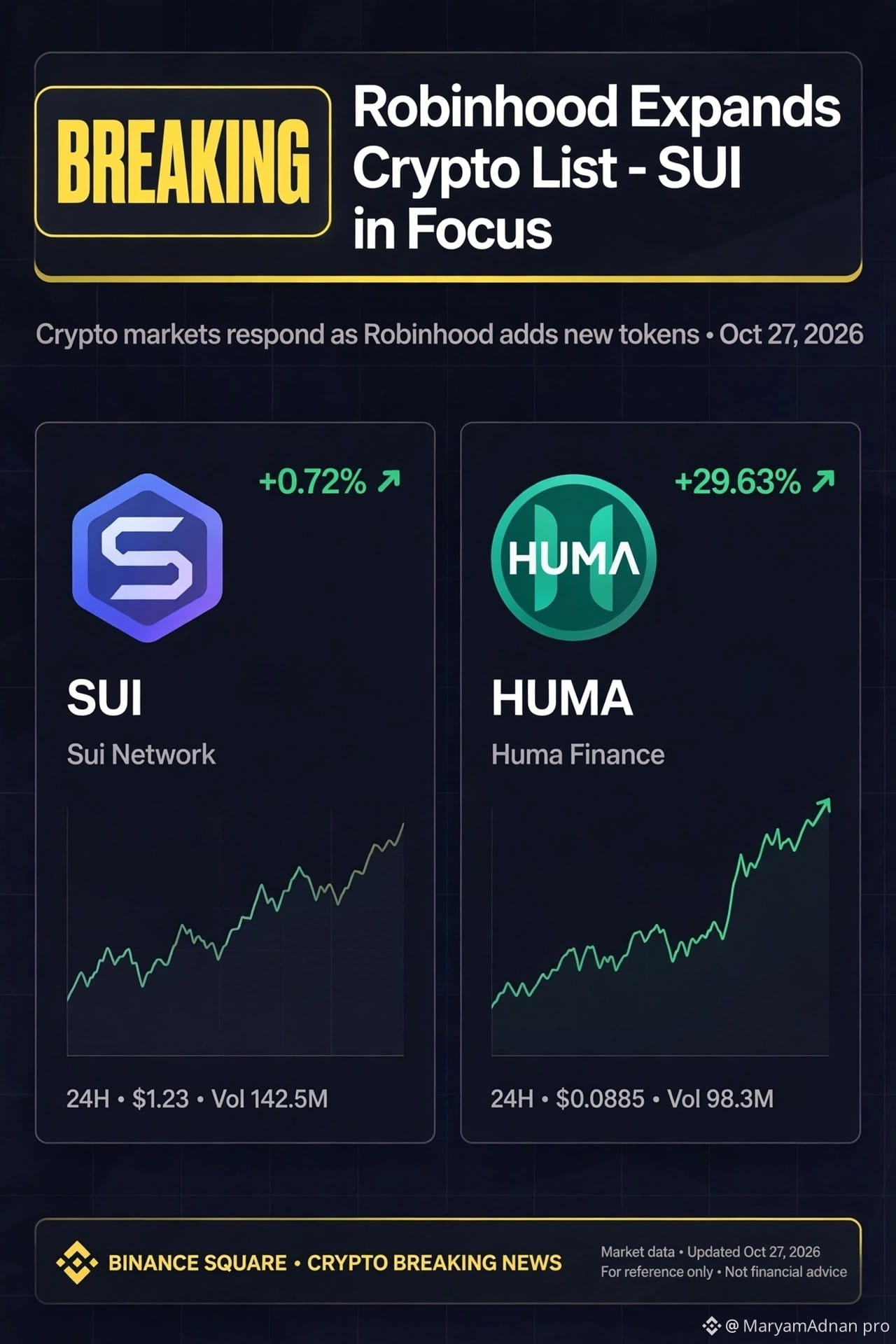
*Robinhood Expands Crypto List - SUI in Focus*
Robinhood has started a 4-week pilot listing 7 new cryptocurrencies, with *SUI leading the pack* 🚀.
Bulls say this could bring massive retail adoption and push SUI ecosystem higher 📈, while bears think too many listings at once could cause short-term volatility and liquidity split.
What do you think? Will this news fuel SUI's next rally or trigger a healthy pullback? Drop your vote below ⚡.
$HUMA $SYN $SUI
#SUİ #Robinhood #CryptonewswithJack #SYN #AIN
*Disclaimer: This is not financial advice. For informational purposes only. DYOR.*
{spot}(SUIUSDT)
{spot}(HUMAUSDT)
{spot}(SYNUSDT)
*BREAKING 🚨*
*Robinhood Expands Crypto List - SUI in Focus*
Robinhood has started a 4-week pilot listing 7 new cryptocurrencies, with *SUI leading the pack* 🚀.
Bulls say this could bring massive retail adoption and push SUI ecosystem higher 📈, while bears think too many listings at once could cause short-term volatility and liquidity split.
What do you think? Will this news fuel SUI's next rally or trigger a healthy pullback? Drop your vote below ⚡.
$HUMA $SYN $SUI
#SUİ #Robinhood #CryptonewswithJack #SYN #AIN
*Disclaimer: This is not financial advice. For informational purposes only. DYOR.*
*Robinhood Expands Crypto List - SUI in Focus*
Robinhood has started a 4-week pilot listing 7 new cryptocurrencies, with *SUI leading the pack* 🚀.
Bulls say this could bring massive retail adoption and push SUI ecosystem higher 📈, while bears think too many listings at once could cause short-term volatility and liquidity split.
What do you think? Will this news fuel SUI's next rally or trigger a healthy pullback? Drop your vote below ⚡.
$HUMA $SYN $SUI
#SUİ #Robinhood #CryptonewswithJack #SYN #AIN
*Disclaimer: This is not financial advice. For informational purposes only. DYOR.*
231


·
--
🚨 JUST IN: XRP × ROBINHOOD! 🔥
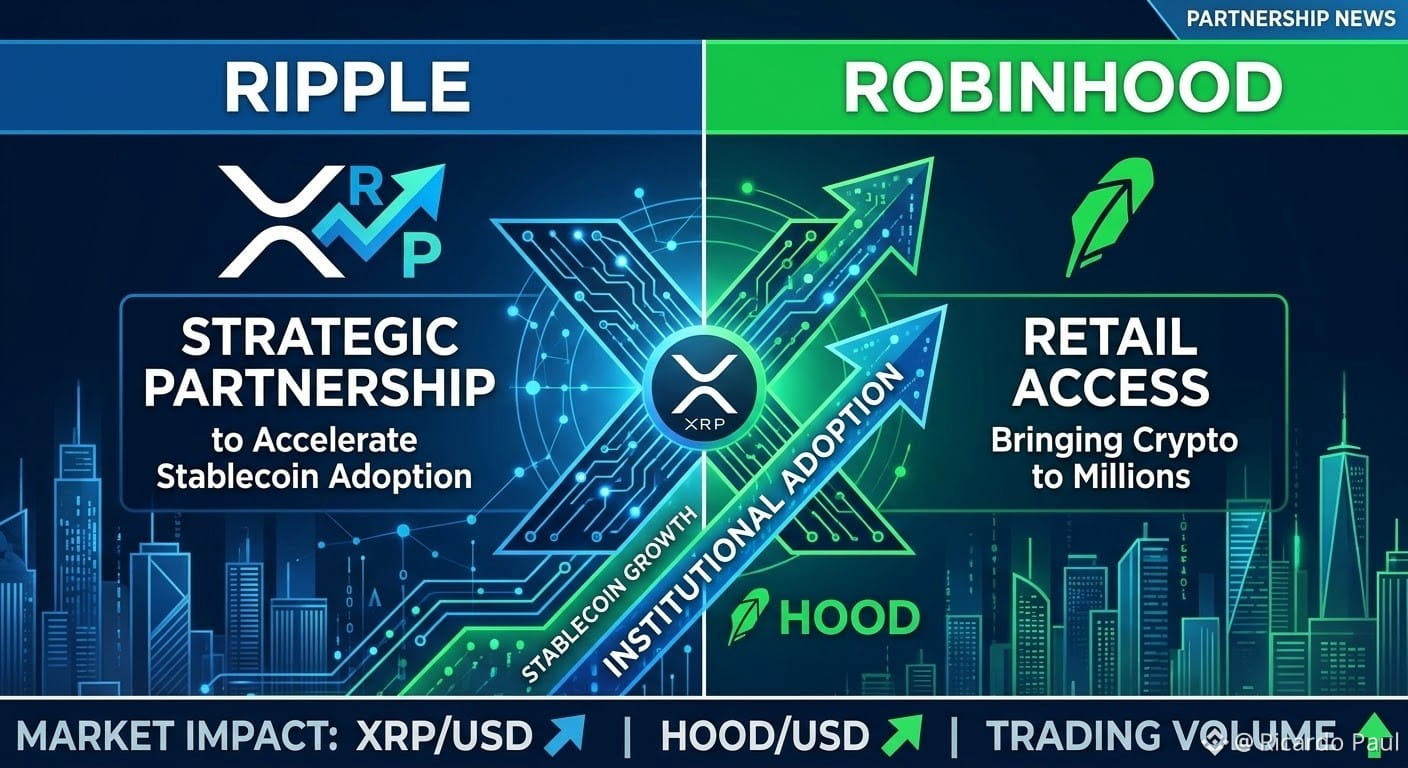
💥 Ripple ($XRP) and Robinhood ($HOOD) reportedly announce a strategic partnership to accelerate stablecoin adoption!
🌐 Why it matters:
⚡ Potential growth in stablecoin payments
🏦 Stronger crypto-finance integration
🚀 Increased visibility for Ripple’s ecosystem
💎 A potential boost for institutional adoption
Could this be another major step toward mainstream crypto adoption? 👀
📈 Bullish for the ecosystem — but will XRP price react?
$XRP $HOOD
#xrp #Ripple #Robinhood #RLUSD #CryptoNews
🚨 JUST IN: XRP × ROBINHOOD! 🔥
💥 Ripple ($XRP ) and Robinhood ($HOOD ) reportedly announce a strategic partnership to accelerate stablecoin adoption!
🌐 Why it matters:
⚡ Potential growth in stablecoin payments
🏦 Stronger crypto-finance integration
🚀 Increased visibility for Ripple’s ecosystem
💎 A potential boost for institutional adoption
Could this be another major step toward mainstream crypto adoption? 👀
📈 Bullish for the ecosystem — but will XRP price react?
$XRP $HOOD
#xrp #Ripple #Robinhood #RLUSD #CryptoNews
💥 Ripple ($XRP ) and Robinhood ($HOOD ) reportedly announce a strategic partnership to accelerate stablecoin adoption!
🌐 Why it matters:
⚡ Potential growth in stablecoin payments
🏦 Stronger crypto-finance integration
🚀 Increased visibility for Ripple’s ecosystem
💎 A potential boost for institutional adoption
Could this be another major step toward mainstream crypto adoption? 👀
📈 Bullish for the ecosystem — but will XRP price react?
$XRP $HOOD
#xrp #Ripple #Robinhood #RLUSD #CryptoNews
1
300

Ripple unveils a partnership with Robinhood
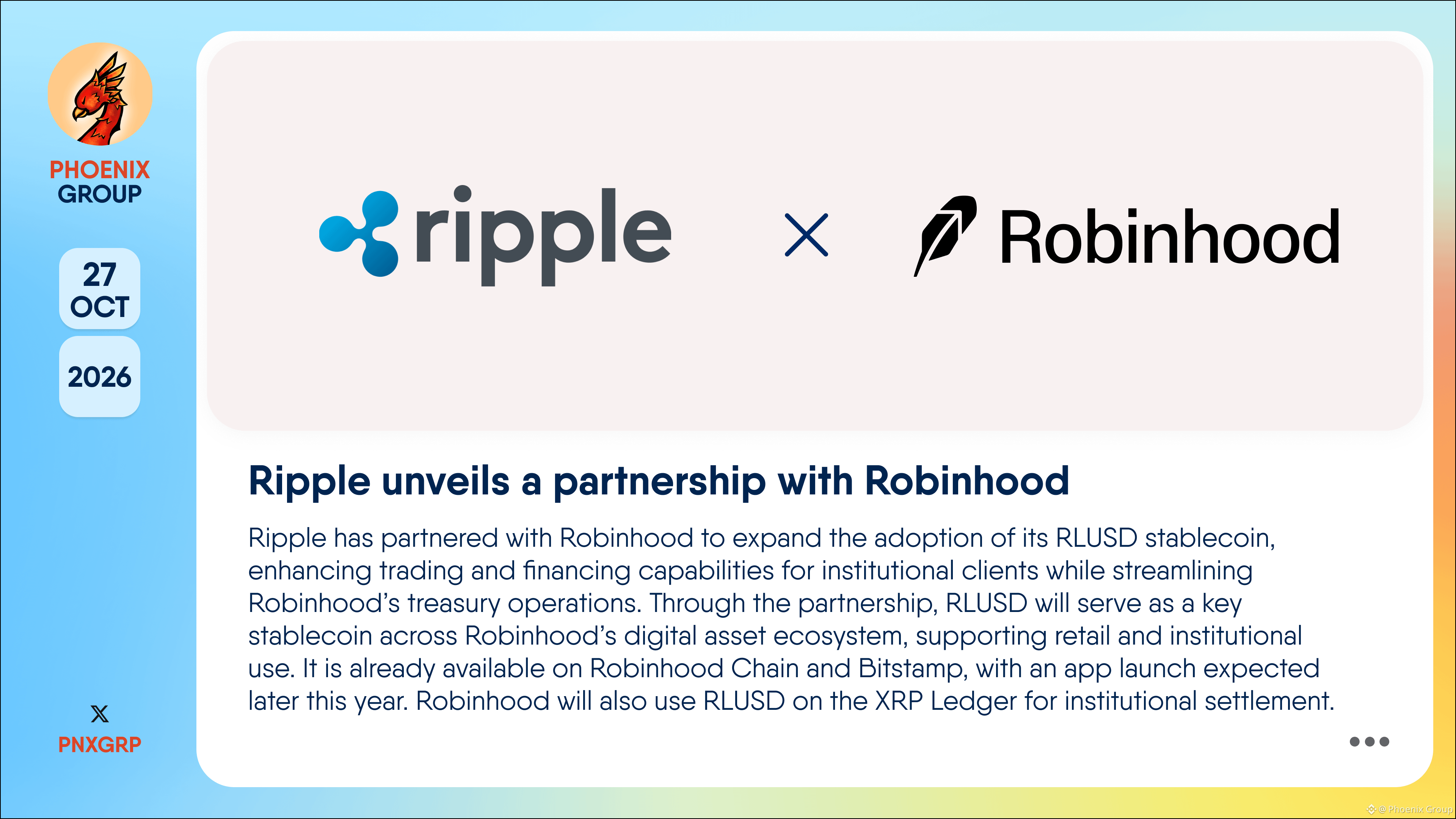
#Ripple has partnered with #Robinhood to expand the adoption of its RLUSD stablecoin, enhancing trading and financing capabilities for institutional clients while streamlining Robinhood’s treasury operations. Through the partnership, RLUSD will serve as a key stablecoin across Robinhood’s digital asset ecosystem, supporting retail and institutional use. It is already available on Robinhood Chain and #Bitstamp, with an app launch expected later this year. Robinhood will also use RLUSD on the #XRPLedger for institutional settlement.
The partnership also expands institutional collaboration through Ripple Prime, building on an existing relationship spanning financing, liquidity and market access. Ripple Prime provides Bitstamp by Robinhood with lending and margin financing for around 20 digital assets and gives Ripple Prime clients access to trade spot on Bitstamp.
👉 x.com/Ripple/status/2115074012250296682
Ripple unveils a partnership with Robinhood
#Ripple has partnered with #Robinhood to expand the adoption of its RLUSD stablecoin, enhancing trading and financing capabilities for institutional clients while streamlining Robinhood’s treasury operations. Through the partnership, RLUSD will serve as a key stablecoin across Robinhood’s digital asset ecosystem, supporting retail and institutional use. It is already available on Robinhood Chain and #Bitstamp, with an app launch expected later this year. Robinhood will also use RLUSD on the #XRPLedger for institutional settlement.
The partnership also expands institutional collaboration through Ripple Prime, building on an existing relationship spanning financing, liquidity and market access. Ripple Prime provides Bitstamp by Robinhood with lending and margin financing for around 20 digital assets and gives Ripple Prime clients access to trade spot on Bitstamp.
👉 x.com/Ripple/status/2115074012250296682
#Ripple has partnered with #Robinhood to expand the adoption of its RLUSD stablecoin, enhancing trading and financing capabilities for institutional clients while streamlining Robinhood’s treasury operations. Through the partnership, RLUSD will serve as a key stablecoin across Robinhood’s digital asset ecosystem, supporting retail and institutional use. It is already available on Robinhood Chain and #Bitstamp, with an app launch expected later this year. Robinhood will also use RLUSD on the #XRPLedger for institutional settlement.
The partnership also expands institutional collaboration through Ripple Prime, building on an existing relationship spanning financing, liquidity and market access. Ripple Prime provides Bitstamp by Robinhood with lending and margin financing for around 20 digital assets and gives Ripple Prime clients access to trade spot on Bitstamp.
👉 x.com/Ripple/status/2115074012250296682
4

·
--
Verified
📉 Robinhood Chain DEX Volume Drops 23.1% — Is Momentum Fading?
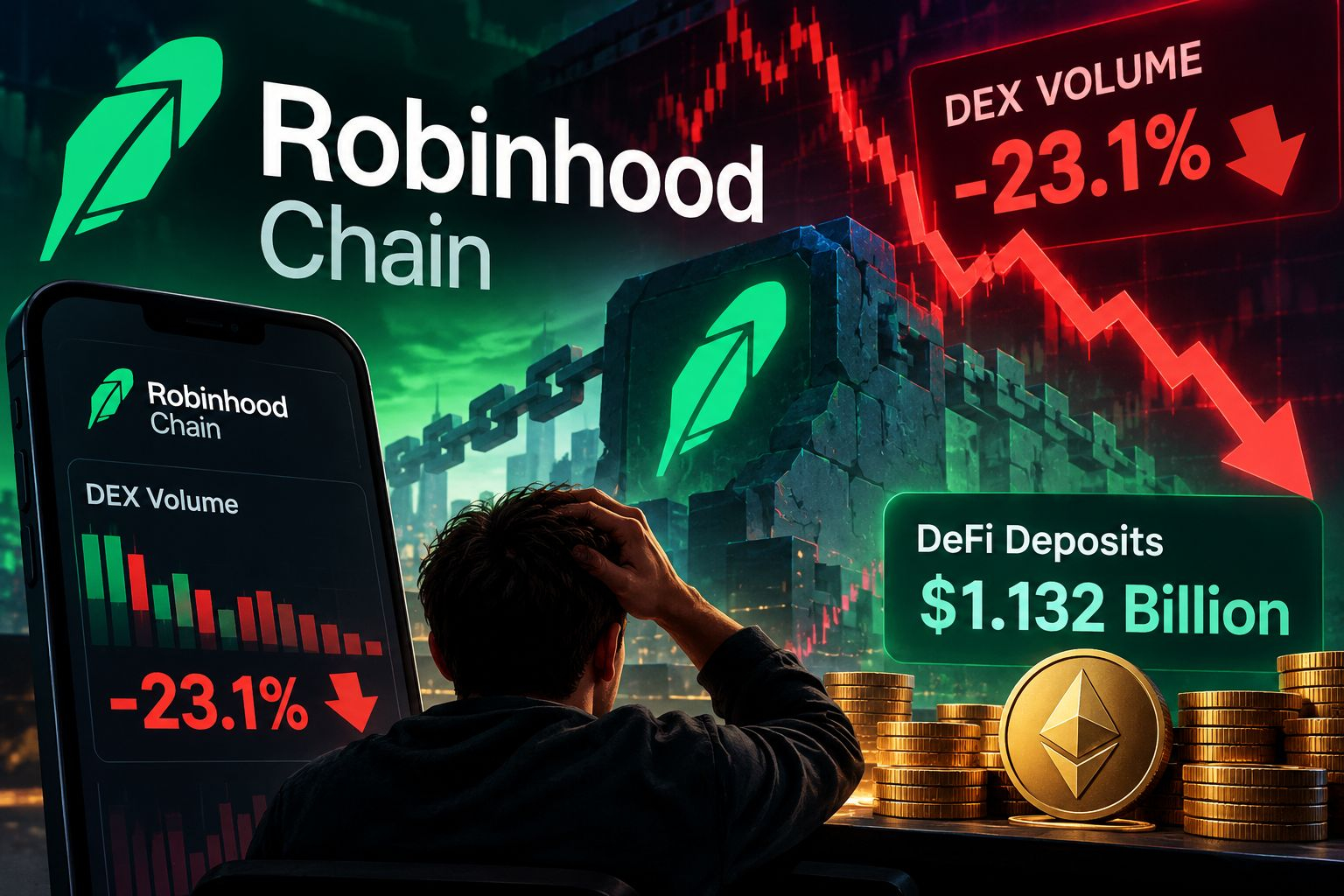
Robinhood Chain is facing a key test as its decentralized exchange (DEX) volume falls 23.1% over the past week. Despite the slowdown, the network still holds approximately $1.132 billion in DeFi deposits.
This creates an interesting contrast: capital remains in the ecosystem, but trading activity is losing momentum. Does this reflect a normal cooling period after launch, or are traders becoming less interested?
I believe volume trends deserve close attention. Deposits show how much capital is committed to DeFi, while DEX volume reveals how actively that capital is being used. Neither metric alone tells the full story.
The next thing to watch is whether trading activity recovers, liquidity remains stable, and users continue engaging with the ecosystem.
What do you think? Is this just a post-launch slowdown, or an early warning sign? 👇
$HOODB
{spot}(HOODBUSDT)
$QNT
{future}(QNTUSDT)
$BABY
{future}(BABYUSDT)
#Robinhood
#defi
#DEX
#crypto
#robinhoodchain
📉 Robinhood Chain DEX Volume Drops 23.1% — Is Momentum Fading?
Robinhood Chain is facing a key test as its decentralized exchange (DEX) volume falls 23.1% over the past week. Despite the slowdown, the network still holds approximately $1.132 billion in DeFi deposits.
This creates an interesting contrast: capital remains in the ecosystem, but trading activity is losing momentum. Does this reflect a normal cooling period after launch, or are traders becoming less interested?
I believe volume trends deserve close attention. Deposits show how much capital is committed to DeFi, while DEX volume reveals how actively that capital is being used. Neither metric alone tells the full story.
The next thing to watch is whether trading activity recovers, liquidity remains stable, and users continue engaging with the ecosystem.
What do you think? Is this just a post-launch slowdown, or an early warning sign? 👇
$HOODB
$QNT
$BABY
#Robinhood
#defi
#DEX
#crypto
#robinhoodchain
Robinhood Chain is facing a key test as its decentralized exchange (DEX) volume falls 23.1% over the past week. Despite the slowdown, the network still holds approximately $1.132 billion in DeFi deposits.
This creates an interesting contrast: capital remains in the ecosystem, but trading activity is losing momentum. Does this reflect a normal cooling period after launch, or are traders becoming less interested?
I believe volume trends deserve close attention. Deposits show how much capital is committed to DeFi, while DEX volume reveals how actively that capital is being used. Neither metric alone tells the full story.
The next thing to watch is whether trading activity recovers, liquidity remains stable, and users continue engaging with the ecosystem.
What do you think? Is this just a post-launch slowdown, or an early warning sign? 👇
$HOODB
$QNT
$BABY
#Robinhood
#defi
#DEX
#crypto
#robinhoodchain
1
585

·
--
Bernstein: Robinhood prediction markets to hit .7B by 2028, surpassing crypto revenue
Prediction markets could drive ~18% of Robinhood's projected .4B total revenue in 2028, outpacing the .6B expected from crypto.
Will prediction markets become the next major revenue pillar for retail trading platforms?
#Robinhood #PredictionMarkets
Bernstein: Robinhood prediction markets to hit .7B by 2028, surpassing crypto revenue
Prediction markets could drive ~18% of Robinhood's projected .4B total revenue in 2028, outpacing the .6B expected from crypto.
Will prediction markets become the next major revenue pillar for retail trading platforms?
#Robinhood #PredictionMarkets
Prediction markets could drive ~18% of Robinhood's projected .4B total revenue in 2028, outpacing the .6B expected from crypto.
Will prediction markets become the next major revenue pillar for retail trading platforms?
#Robinhood #PredictionMarkets
22

·
--
Trade for a chance to win: Robinhood offers $700,000 to promote 7 coins, including $SUIBrokerages are starting to use giveaways to drive crypto trading volume.
Robinhood’s official account announced on October 26 that it’s holding a crypto trading giveaway over the next 4 weeks, with a total prize pool of $700,000 and 6,001 winners: one grand prize of $100,000 and 6,000 smaller prizes of $100 each, all paid in crypto assets.
It’s simple to participate: Trade any of 7 designated coins on Robinhood Crypto, including $SUI, $ONDO, $INJ , and others, for a chance to qualify for the giveaway. According to rules compiled by the community, you must first sign up in the app. Each eligible trade counts as one entry, with a maximum of 6 entries per week and 24 total. The promotion runs through November 22, with winners expected to be drawn around December 7. Open only to certain U.S. users.
Trade for a chance to win: Robinhood offers $700,000 to promote 7 coins, including $SUI
Brokerages are starting to use giveaways to drive crypto trading volume.
Robinhood’s official account announced on October 26 that it’s holding a crypto trading giveaway over the next 4 weeks, with a total prize pool of $700,000 and 6,001 winners: one grand prize of $100,000 and 6,000 smaller prizes of $100 each, all paid in crypto assets.
It’s simple to participate: Trade any of 7 designated coins on Robinhood Crypto, including $SUI , $ONDO , $INJ , and others, for a chance to qualify for the giveaway. According to rules compiled by the community, you must first sign up in the app. Each eligible trade counts as one entry, with a maximum of 6 entries per week and 24 total. The promotion runs through November 22, with winners expected to be drawn around December 7. Open only to certain U.S. users.
Robinhood’s official account announced on October 26 that it’s holding a crypto trading giveaway over the next 4 weeks, with a total prize pool of $700,000 and 6,001 winners: one grand prize of $100,000 and 6,000 smaller prizes of $100 each, all paid in crypto assets.
It’s simple to participate: Trade any of 7 designated coins on Robinhood Crypto, including $SUI , $ONDO , $INJ , and others, for a chance to qualify for the giveaway. According to rules compiled by the community, you must first sign up in the app. Each eligible trade counts as one entry, with a maximum of 6 entries per week and 24 total. The promotion runs through November 22, with winners expected to be drawn around December 7. Open only to certain U.S. users.
865

·
--
Partly True
A single Robinhood teaser racked up nearly 350,000 views. Nearly 20 hours later, almost nobody has moved on the seven coins it called out.
At 00:00 Beijing time on 10/26, Robinhood’s official account posted just one line: “The stars are aligning. Tomorrow.” It paired the message with a video of its logo orbiting, but didn’t name any coins. CoinGecko identified seven from the visuals: CHIP, GRAM, XPL, $ONDO, $SUI, $INJ, and HBAR, alongside the caption “7 assets, 4 weeks.”
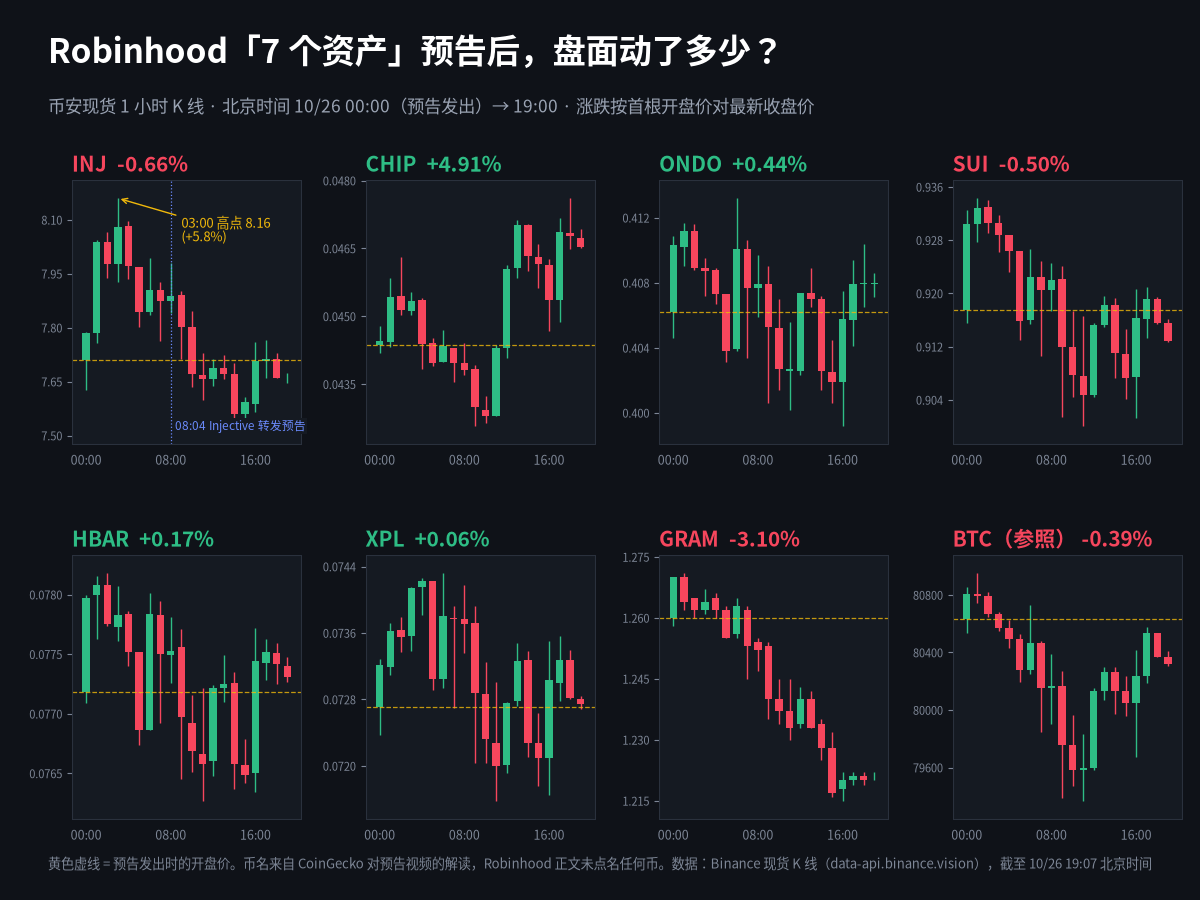
Looking at Binance spot 1-hour candles, measured from the opening price when the teaser went live through 19:00: CHIP was up 4.9%; ONDO, HBAR, and XPL were basically flat; SUI was down 0.5%; and GRAM was down 3.1%. BTC fell 0.4% over the same period.
INJ was the most interesting: it surged to 8.16 (+5.8%) at 3 a.m., but is now at 7.66, below its pre-teaser price. After Injective’s official account reposted “$INJ Spotted” at 8 a.m., the price actually slid steadily.
The market is treating it like a guessing game; nobody wants to pay up in advance for an animation. But “tomorrow,” in Eastern Time, means today—and from tonight through tomorrow morning in Beijing, there’s still no reveal as of this post. If it turns out to be a listing or a new feature, the one singled out could be best positioned for a catch-up rally. If it’s just brand promotion, these muted candles don’t exactly leave much to give back.
Which of the seven do you think will be singled out first?
#Robinhood $INJ
{future}(INJUSDT)
A single Robinhood teaser racked up nearly 350,000 views. Nearly 20 hours later, almost nobody has moved on the seven coins it called out.
At 00:00 Beijing time on 10/26, Robinhood’s official account posted just one line: “The stars are aligning. Tomorrow.” It paired the message with a video of its logo orbiting, but didn’t name any coins. CoinGecko identified seven from the visuals: CHIP, GRAM, XPL, $ONDO, $SUI, $INJ , and HBAR, alongside the caption “7 assets, 4 weeks.”
Looking at Binance spot 1-hour candles, measured from the opening price when the teaser went live through 19:00: CHIP was up 4.9%; ONDO, HBAR, and XPL were basically flat; SUI was down 0.5%; and GRAM was down 3.1%. BTC fell 0.4% over the same period.
INJ was the most interesting: it surged to 8.16 (+5.8%) at 3 a.m., but is now at 7.66, below its pre-teaser price. After Injective’s official account reposted “$INJ Spotted” at 8 a.m., the price actually slid steadily.
The market is treating it like a guessing game; nobody wants to pay up in advance for an animation. But “tomorrow,” in Eastern Time, means today—and from tonight through tomorrow morning in Beijing, there’s still no reveal as of this post. If it turns out to be a listing or a new feature, the one singled out could be best positioned for a catch-up rally. If it’s just brand promotion, these muted candles don’t exactly leave much to give back.
Which of the seven do you think will be singled out first?
#Robinhood $INJ
At 00:00 Beijing time on 10/26, Robinhood’s official account posted just one line: “The stars are aligning. Tomorrow.” It paired the message with a video of its logo orbiting, but didn’t name any coins. CoinGecko identified seven from the visuals: CHIP, GRAM, XPL, $ONDO, $SUI, $INJ , and HBAR, alongside the caption “7 assets, 4 weeks.”
Looking at Binance spot 1-hour candles, measured from the opening price when the teaser went live through 19:00: CHIP was up 4.9%; ONDO, HBAR, and XPL were basically flat; SUI was down 0.5%; and GRAM was down 3.1%. BTC fell 0.4% over the same period.
INJ was the most interesting: it surged to 8.16 (+5.8%) at 3 a.m., but is now at 7.66, below its pre-teaser price. After Injective’s official account reposted “$INJ Spotted” at 8 a.m., the price actually slid steadily.
The market is treating it like a guessing game; nobody wants to pay up in advance for an animation. But “tomorrow,” in Eastern Time, means today—and from tonight through tomorrow morning in Beijing, there’s still no reveal as of this post. If it turns out to be a listing or a new feature, the one singled out could be best positioned for a catch-up rally. If it’s just brand promotion, these muted candles don’t exactly leave much to give back.
Which of the seven do you think will be singled out first?
#Robinhood $INJ
2
974
·
--
Ripple Moves Into Robinhood’s Back Office: $RLUSD Goes On-Chain First, Coming to the App This YearStablecoins are vying for shelf space, and the most valuable thing isn’t issuance volume—it’s distribution. Tonight, Ripple landed a major shelf: Robinhood.
According to Ripple’s official October 27 press release (Business Wire, also reported by CNBC), the two companies have expanded their partnership across three layers:
1) Front end: $RLUSD launched today on Robinhood Chain and Bitstamp by Robinhood, and is expected to be available in the Robinhood App later this year. Bitstamp’s institutional business will use $RLUSD on the XRPL for settlement.
2) Back end: Robinhood’s own treasury is adopting Ripple Treasury, moving cash and liquidity management, cash flow forecasting, payments, risk management, and internal netting onto the platform. This is the most interesting part—it’s not for users; Robinhood itself is using it.
Ripple Moves Into Robinhood’s Back Office: $RLUSD Goes On-Chain First, Coming to the App This Year
Stablecoins are vying for shelf space, and the most valuable thing isn’t issuance volume—it’s distribution. Tonight, Ripple landed a major shelf: Robinhood.
According to Ripple’s official October 27 press release (Business Wire, also reported by CNBC), the two companies have expanded their partnership across three layers:
1) Front end: $RLUSD launched today on Robinhood Chain and Bitstamp by Robinhood, and is expected to be available in the Robinhood App later this year. Bitstamp’s institutional business will use $RLUSD on the XRPL for settlement.
2) Back end: Robinhood’s own treasury is adopting Ripple Treasury, moving cash and liquidity management, cash flow forecasting, payments, risk management, and internal netting onto the platform. This is the most interesting part—it’s not for users; Robinhood itself is using it.
According to Ripple’s official October 27 press release (Business Wire, also reported by CNBC), the two companies have expanded their partnership across three layers:
1) Front end: $RLUSD launched today on Robinhood Chain and Bitstamp by Robinhood, and is expected to be available in the Robinhood App later this year. Bitstamp’s institutional business will use $RLUSD on the XRPL for settlement.
2) Back end: Robinhood’s own treasury is adopting Ripple Treasury, moving cash and liquidity management, cash flow forecasting, payments, risk management, and internal netting onto the platform. This is the most interesting part—it’s not for users; Robinhood itself is using it.
37

·
--
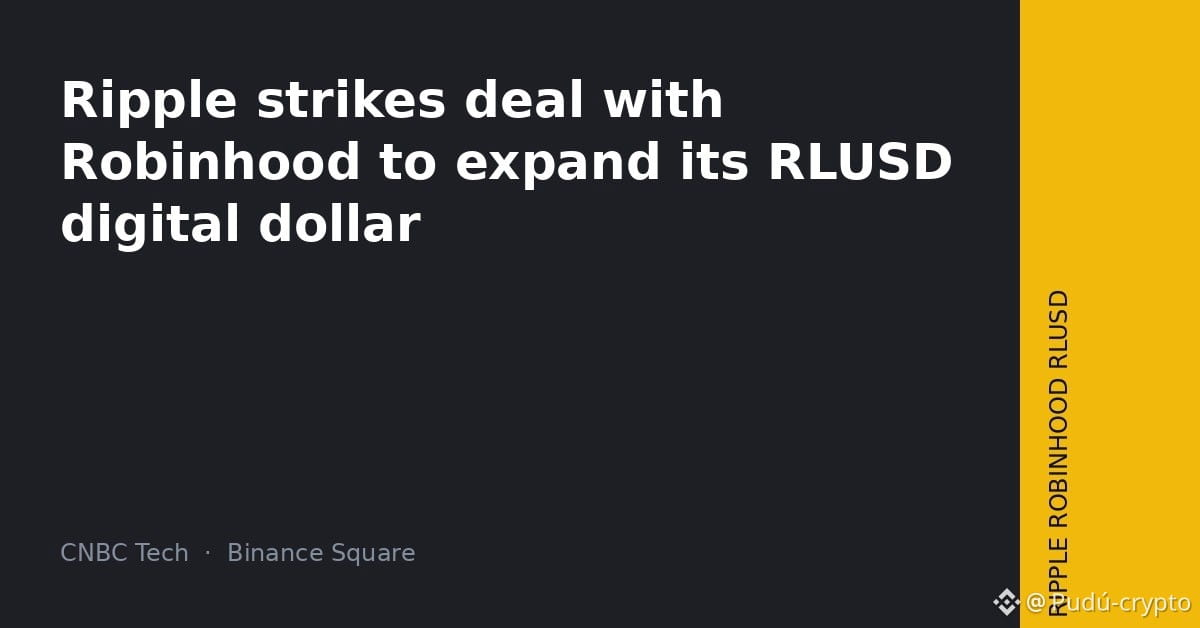
Ripple has just closed a deal with $HOOD to expand its RLUSD stablecoin.
The idea is simple.
They want to leverage Robinhood’s infrastructure to give this digital dollar greater reach.
It’s interesting to see how stablecoins are becoming more than just trading tools.
They’re now positioning themselves as a fundamental part of the financial system.
24/7 liquidity seems to be the market’s new goal.
What do you think of this move by Ripple?
#Ripple #Robinhood #Stablecoins
Ripple has just closed a deal with $HOOD to expand its RLUSD stablecoin.
The idea is simple.
They want to leverage Robinhood’s infrastructure to give this digital dollar greater reach.
It’s interesting to see how stablecoins are becoming more than just trading tools.
They’re now positioning themselves as a fundamental part of the financial system.
24/7 liquidity seems to be the market’s new goal.
What do you think of this move by Ripple?
#Ripple #Robinhood #Stablecoins
The idea is simple.
They want to leverage Robinhood’s infrastructure to give this digital dollar greater reach.
It’s interesting to see how stablecoins are becoming more than just trading tools.
They’re now positioning themselves as a fundamental part of the financial system.
24/7 liquidity seems to be the market’s new goal.
What do you think of this move by Ripple?
#Ripple #Robinhood #Stablecoins
41

·
--
In the stablecoin narrative, distribution channels are often worth more than slogans.
According to reports by PANews, good.box, and others, Ripple and Robinhood have entered into a strategic partnership. RLUSD is now available on Robinhood Chain and Bitstamp by Robinhood, and is expected to launch on the Robinhood App later this year, serving both retail and institutional users.
How to read this: It expands access to payment and trading channels. It does not mean RLUSD will immediately become a mainstream settlement currency, nor that its short-term price thesis will automatically play out. What’s more worth watching is the official App launch timeline, whether minting and redemption run smoothly, and the scale of real trading and holdings. For ordinary users, the more practical takeaway is to track this “high-traffic brokerage access point” as infrastructure progress—not to treat a partnership headline as a signal to take a leveraged position.
#RLUSD #Ripple #Robinhood #Stablecoin
In the stablecoin narrative, distribution channels are often worth more than slogans.
According to reports by PANews, good.box, and others, Ripple and Robinhood have entered into a strategic partnership. RLUSD is now available on Robinhood Chain and Bitstamp by Robinhood, and is expected to launch on the Robinhood App later this year, serving both retail and institutional users.
How to read this: It expands access to payment and trading channels. It does not mean RLUSD will immediately become a mainstream settlement currency, nor that its short-term price thesis will automatically play out. What’s more worth watching is the official App launch timeline, whether minting and redemption run smoothly, and the scale of real trading and holdings. For ordinary users, the more practical takeaway is to track this “high-traffic brokerage access point” as infrastructure progress—not to treat a partnership headline as a signal to take a leveraged position.
#RLUSD #Ripple #Robinhood #Stablecoin
According to reports by PANews, good.box, and others, Ripple and Robinhood have entered into a strategic partnership. RLUSD is now available on Robinhood Chain and Bitstamp by Robinhood, and is expected to launch on the Robinhood App later this year, serving both retail and institutional users.
How to read this: It expands access to payment and trading channels. It does not mean RLUSD will immediately become a mainstream settlement currency, nor that its short-term price thesis will automatically play out. What’s more worth watching is the official App launch timeline, whether minting and redemption run smoothly, and the scale of real trading and holdings. For ordinary users, the more practical takeaway is to track this “high-traffic brokerage access point” as infrastructure progress—not to treat a partnership headline as a signal to take a leveraged position.
#RLUSD #Ripple #Robinhood #Stablecoin
4

·
--
[Market News] Robinhood secures Dubai license: trading and custody for 10 asset classes, including Bitcoin, stocks, and ETFs, fully approved, with a Middle East debut in 2027.
Authorized by the Dubai Financial Services Authority (DFSA), it will use the Dubai International Financial Centre as its Middle East and North Africa headquarters, with MENA President Kaddoura leading the team formation.
Will the Middle East become the next main battleground for crypto growth? Share your thoughts in the comments.
$BTC $ETH $SOL
#Robinhood #迪拜 #Bitcoin
(Source: Crowdfund Insider)
⚠️Risk reminder: The above is market information sharing and does not constitute investment advice; investing carries risks, so please be cautious when entering the market.
[Market News] Robinhood secures Dubai license: trading and custody for 10 asset classes, including Bitcoin, stocks, and ETFs, fully approved, with a Middle East debut in 2027.
Authorized by the Dubai Financial Services Authority (DFSA), it will use the Dubai International Financial Centre as its Middle East and North Africa headquarters, with MENA President Kaddoura leading the team formation.
Will the Middle East become the next main battleground for crypto growth? Share your thoughts in the comments.
$BTC $ETH $SOL
#Robinhood #迪拜 #Bitcoin
(Source: Crowdfund Insider)
⚠️Risk reminder: The above is market information sharing and does not constitute investment advice; investing carries risks, so please be cautious when entering the market.
Authorized by the Dubai Financial Services Authority (DFSA), it will use the Dubai International Financial Centre as its Middle East and North Africa headquarters, with MENA President Kaddoura leading the team formation.
Will the Middle East become the next main battleground for crypto growth? Share your thoughts in the comments.
$BTC $ETH $SOL
#Robinhood #迪拜 #Bitcoin
(Source: Crowdfund Insider)
⚠️Risk reminder: The above is market information sharing and does not constitute investment advice; investing carries risks, so please be cautious when entering the market.

210

·
--
Robinhood CEO Interview: AI Wealth Distribution and Financial Democratization
Robinhood CEO Vlad Tenev discusses wealth distribution in the AI era, how Robinhood enables ordinary people to participate, and how it advances financial democratization.#Robinhood #FinancialDemocratization
Robinhood CEO Interview: AI Wealth Distribution and Financial Democratization
Robinhood CEO Vlad Tenev discusses wealth distribution in the AI era, how Robinhood enables ordinary people to participate, and how it advances financial democratization.#Robinhood #FinancialDemocratization
Robinhood CEO Vlad Tenev discusses wealth distribution in the AI era, how Robinhood enables ordinary people to participate, and how it advances financial democratization.#Robinhood #FinancialDemocratization
103

·
--
🎯 Public-chain TVL rankings reshuffled: Robinhood breaks into the top 10
📰 In DefiLlama’s latest rankings, $1.13 billion is locked on its chain, putting it ahead of Arbitrum and Polygon. Base has also climbed to #2.
💬 A brokerage has moved its stock users directly onchain—and it’s moving faster than a bunch of airdrop-focused public chains. Traditional finance has slipped in through the back door this time.
🏷️ #Robinhood #Base #DeFi #TVL
🎯 Public-chain TVL rankings reshuffled: Robinhood breaks into the top 10
📰 In DefiLlama’s latest rankings, $1.13 billion is locked on its chain, putting it ahead of Arbitrum and Polygon. Base has also climbed to #2.
💬 A brokerage has moved its stock users directly onchain—and it’s moving faster than a bunch of airdrop-focused public chains. Traditional finance has slipped in through the back door this time.
🏷️ #Robinhood #Base #DeFi #TVL
📰 In DefiLlama’s latest rankings, $1.13 billion is locked on its chain, putting it ahead of Arbitrum and Polygon. Base has also climbed to #2.
💬 A brokerage has moved its stock users directly onchain—and it’s moving faster than a bunch of airdrop-focused public chains. Traditional finance has slipped in through the back door this time.
🏷️ #Robinhood #Base #DeFi #TVL
5

·
--
🎁 Robinhood puts $700,000 into a trading giveaway, with $SUI $INJ all on the list, but the community is up in arms
▪️ The campaign runs from 10/26–11/22. Trade SUI, GRAM, HBAR, ONDO, XPL, INJ, or CHIP for a chance to enter the draw; the grand prize is $100,000
▪️ $SUI 0.9127 USDT (24h -0.47%), with a trading volume of about 28.8 million U
▪️ $INJ 7.835 USDT (24h +1.60%), one of the few on the list to buck the trend and turn green
▪️ ONDO -0.54%, HBAR -2.11%, while the broader market’s BTC is still grinding below $80,000
The Robinhood Chain community is unhappy that its own native token wasn’t selected—and the timing is just ahead of today’s Q3 earnings report.
Personally, I’m more bullish on $INJ: it was also named, and it’s the only one on today’s list that’s clearly in the green, suggesting real buyers are stepping in. Since the prize pool will be paid out in the listed tokens, trading activity for these coins is likely to get support over the next month.
Do you think brokerages’ trading giveaways can boost on-chain tokens?
#Robinhood #SUI #INJ #币安广场
🎁 Robinhood puts $700,000 into a trading giveaway, with $SUI $INJ all on the list, but the community is up in arms
▪️ The campaign runs from 10/26–11/22. Trade SUI, GRAM, HBAR, ONDO, XPL, INJ, or CHIP for a chance to enter the draw; the grand prize is $100,000
▪️ $SUI 0.9127 USDT (24h -0.47%), with a trading volume of about 28.8 million U
▪️ $INJ 7.835 USDT (24h +1.60%), one of the few on the list to buck the trend and turn green
▪️ ONDO -0.54%, HBAR -2.11%, while the broader market’s BTC is still grinding below $80,000
The Robinhood Chain community is unhappy that its own native token wasn’t selected—and the timing is just ahead of today’s Q3 earnings report.
Personally, I’m more bullish on $INJ : it was also named, and it’s the only one on today’s list that’s clearly in the green, suggesting real buyers are stepping in. Since the prize pool will be paid out in the listed tokens, trading activity for these coins is likely to get support over the next month.
Do you think brokerages’ trading giveaways can boost on-chain tokens?
#Robinhood #SUI #INJ #币安广场
▪️ The campaign runs from 10/26–11/22. Trade SUI, GRAM, HBAR, ONDO, XPL, INJ, or CHIP for a chance to enter the draw; the grand prize is $100,000
▪️ $SUI 0.9127 USDT (24h -0.47%), with a trading volume of about 28.8 million U
▪️ $INJ 7.835 USDT (24h +1.60%), one of the few on the list to buck the trend and turn green
▪️ ONDO -0.54%, HBAR -2.11%, while the broader market’s BTC is still grinding below $80,000
The Robinhood Chain community is unhappy that its own native token wasn’t selected—and the timing is just ahead of today’s Q3 earnings report.
Personally, I’m more bullish on $INJ : it was also named, and it’s the only one on today’s list that’s clearly in the green, suggesting real buyers are stepping in. Since the prize pool will be paid out in the listed tokens, trading activity for these coins is likely to get support over the next month.
Do you think brokerages’ trading giveaways can boost on-chain tokens?
#Robinhood #SUI #INJ #币安广场
352

·
--
Robinhood will report Q3 after the market closes tonight, and options have already priced in a 10.2% move
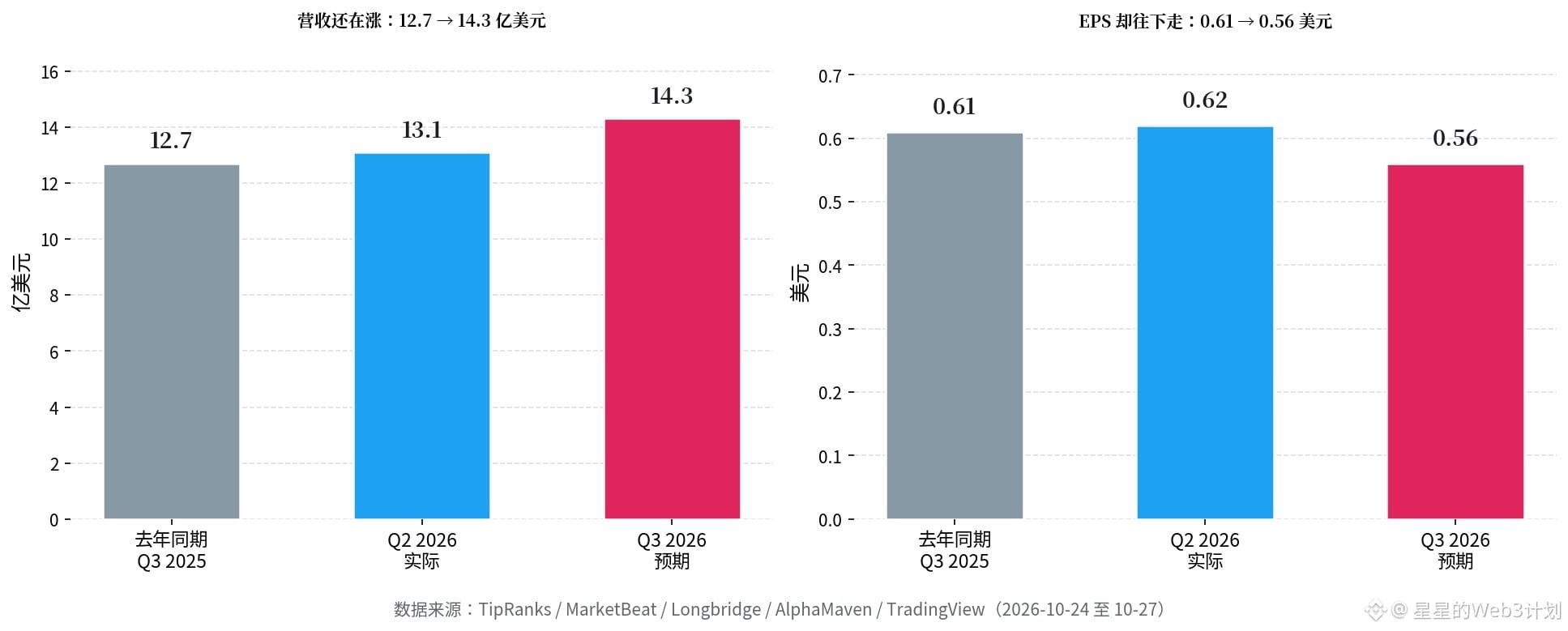
Wall Street expects EPS of $0.56, lower than $0.61 in the same period last year, with revenue of $1.43 billion, up 13% year over year
In the past 6 earnings reports, it beat estimates 5 times, yet the stock fell every single time, with drops ranging from 2.9% to 13.2%
In July, it posted EPS of $0.62, $0.18 above expectations, and still fell 3.61%
Crypto trading revenue has declined for 3 straight quarters, with Q2 down to just $100 million, 38% lower year over year
Prediction markets, on the other hand, grew 10x, bringing in $156 million in Q2 and becoming the new pillar
The stock is at $95.07, down 18.4% over the past month and 16% year to date, now sitting on trendline support at $95.11
I think tonight's test is not whether it beats expectations, but whether crypto revenue can stop falling. The script of beating estimates and still dropping has already played out 6 times; the invalidation level is a post-earnings close above $103.32, or a quarter-over-quarter rebound in crypto trading revenue
Do you think tonight will be the 7th time of "beat and still drop," or will it finally be time to rise once?
$HOOD $COIN $BTC
#Robinhood #earnings
This does not constitute investment advice. DYOR. Trading involves risk.
Robinhood will report Q3 after the market closes tonight, and options have already priced in a 10.2% move
Wall Street expects EPS of $0.56, lower than $0.61 in the same period last year, with revenue of $1.43 billion, up 13% year over year
In the past 6 earnings reports, it beat estimates 5 times, yet the stock fell every single time, with drops ranging from 2.9% to 13.2%
In July, it posted EPS of $0.62, $0.18 above expectations, and still fell 3.61%
Crypto trading revenue has declined for 3 straight quarters, with Q2 down to just $100 million, 38% lower year over year
Prediction markets, on the other hand, grew 10x, bringing in $156 million in Q2 and becoming the new pillar
The stock is at $95.07, down 18.4% over the past month and 16% year to date, now sitting on trendline support at $95.11
I think tonight's test is not whether it beats expectations, but whether crypto revenue can stop falling. The script of beating estimates and still dropping has already played out 6 times; the invalidation level is a post-earnings close above $103.32, or a quarter-over-quarter rebound in crypto trading revenue
Do you think tonight will be the 7th time of "beat and still drop," or will it finally be time to rise once?
$HOOD $COIN $BTC
#Robinhood #earnings
This does not constitute investment advice. DYOR. Trading involves risk.
Wall Street expects EPS of $0.56, lower than $0.61 in the same period last year, with revenue of $1.43 billion, up 13% year over year
In the past 6 earnings reports, it beat estimates 5 times, yet the stock fell every single time, with drops ranging from 2.9% to 13.2%
In July, it posted EPS of $0.62, $0.18 above expectations, and still fell 3.61%
Crypto trading revenue has declined for 3 straight quarters, with Q2 down to just $100 million, 38% lower year over year
Prediction markets, on the other hand, grew 10x, bringing in $156 million in Q2 and becoming the new pillar
The stock is at $95.07, down 18.4% over the past month and 16% year to date, now sitting on trendline support at $95.11
I think tonight's test is not whether it beats expectations, but whether crypto revenue can stop falling. The script of beating estimates and still dropping has already played out 6 times; the invalidation level is a post-earnings close above $103.32, or a quarter-over-quarter rebound in crypto trading revenue
Do you think tonight will be the 7th time of "beat and still drop," or will it finally be time to rise once?
$HOOD $COIN $BTC
#Robinhood #earnings
This does not constitute investment advice. DYOR. Trading involves risk.
117

·
--
Partly True

Article
Robinhood, a prediction-market leader, gets a prediction of its own!JPMorgan raised its estimates ahead of Robinhood’s (HOOD.US) third-quarter earnings report: its quarterly EPS forecast went from $0.46 to $0.57, a one-time increase of 24%. The reason wasn’t a new story, but three familiar factors improving at once: trading activity, prediction markets, and interest-rate assumptions.
① 24%: increase in the quarterly earnings forecast
② 15.8 billion contracts: estimated prediction-market volume, with its own platform accounting for about 23%
③ $2.82 billion: full-year adjusted operating expenses, at the upper end of guidance
Stock and options trading volumes both set quarterly records, with trading revenue modeled at $914 million. Prediction-market volume also held up after the World Cup ended: of the 15.8 billion contracts, Robinhood’s own Rothera channel accounted for about 23%—one platform captured nearly a quarter of the volume.
Robinhood, a prediction-market leader, gets a prediction of its own!
JPMorgan raised its estimates ahead of Robinhood’s (HOOD.US) third-quarter earnings report: its quarterly EPS forecast went from $0.46 to $0.57, a one-time increase of 24%. The reason wasn’t a new story, but three familiar factors improving at once: trading activity, prediction markets, and interest-rate assumptions.
① 24%: increase in the quarterly earnings forecast
② 15.8 billion contracts: estimated prediction-market volume, with its own platform accounting for about 23%
③ $2.82 billion: full-year adjusted operating expenses, at the upper end of guidance
Stock and options trading volumes both set quarterly records, with trading revenue modeled at $914 million. Prediction-market volume also held up after the World Cup ended: of the 15.8 billion contracts, Robinhood’s own Rothera channel accounted for about 23%—one platform captured nearly a quarter of the volume.
① 24%: increase in the quarterly earnings forecast
② 15.8 billion contracts: estimated prediction-market volume, with its own platform accounting for about 23%
③ $2.82 billion: full-year adjusted operating expenses, at the upper end of guidance
Stock and options trading volumes both set quarterly records, with trading revenue modeled at $914 million. Prediction-market volume also held up after the World Cup ended: of the 15.8 billion contracts, Robinhood’s own Rothera channel accounted for about 23%—one platform captured nearly a quarter of the volume.
2
109

·
--
🏹 Robinhood reports tonight: down from $124 to $93—can prediction markets still support its valuation?Tonight after the U.S. market closes (October 27 Eastern Time; around 4 a.m. Wednesday, October 28, Malaysia time), Robinhood (HOOD) reports its Q3 earnings. The earnings call is at 5:00 p.m. Eastern Time (5:00 a.m. on October 28, Malaysia time). The stock has fallen from $124.72 on September 3 to close at $92.84 on October 26, a drop of about 26%. This earnings report needs to answer one question: Is Robinhood a “retail brokerage,” or a financial super app where you can trade just about anything?
🏦 How it makes money (Q2 2026, SEC 10-Q data)
• Trading revenue: $776 million, up 44% year over year: options $342 million; prediction markets (event contracts) $156 million (just $10 million in the same period last year); equities $129 million; cryptocurrency $100 million
🏹 Robinhood reports tonight: down from $124 to $93—can prediction markets still support its valuation?
Tonight after the U.S. market closes (October 27 Eastern Time; around 4 a.m. Wednesday, October 28, Malaysia time), Robinhood (HOOD) reports its Q3 earnings. The earnings call is at 5:00 p.m. Eastern Time (5:00 a.m. on October 28, Malaysia time). The stock has fallen from $124.72 on September 3 to close at $92.84 on October 26, a drop of about 26%. This earnings report needs to answer one question: Is Robinhood a “retail brokerage,” or a financial super app where you can trade just about anything?
🏦 How it makes money (Q2 2026, SEC 10-Q data)
• Trading revenue: $776 million, up 44% year over year: options $342 million; prediction markets (event contracts) $156 million (just $10 million in the same period last year); equities $129 million; cryptocurrency $100 million
🏦 How it makes money (Q2 2026, SEC 10-Q data)
• Trading revenue: $776 million, up 44% year over year: options $342 million; prediction markets (event contracts) $156 million (just $10 million in the same period last year); equities $129 million; cryptocurrency $100 million
187

·
--
#Robinhood Can trading business growth continue?
Traditional stock and options trading provide stability, prediction markets are emerging as a new growth engine, while crypto trading remains the biggest source of volatility. Whether growth can truly continue depends on whether new businesses can take over from the high-volatility contribution of crypto assets.
Traditional trading foundation: Stocks and options remain supportive
Stocks and options are relatively predictable pillars. The market expects options trading revenue of about $399.8 million in the third quarter of 2026 (+31.5% year over year) and stock trading revenue of about $133 million (+54.7% year over year). Bernstein also noted that growth in notional stock trading volume and options trading volume has been an important driver of recent sequential revenue increases. As long as market activity does not contract sharply, this foundation is unlikely to crumble.
New engine: High hopes for prediction markets
Prediction markets are currently the most closely watched structural bright spot. In the second quarter of 2026, Robinhood's prediction market revenue ($156 million) exceeded crypto trading revenue ($100 million) and stock trading revenue ($129 million) for the first time. Bernstein expects revenue from this business to grow from about $649 million in 2026 to about $1.688 billion in 2028, when it would account for roughly 18% of the company's total revenue, even surpassing the contribution from crypto. If this business delivers on expectations, it could partially offset the downside risk of crypto cycles.
Biggest variable: Crypto trading is highly dependent on market conditions
Uncertainty is most pronounced in the crypto business. Crypto revenue surged 300% year over year in the third quarter of 2025 amid a market boom; however, in the third quarter of 2026, the market expects crypto trading revenue could plunge 55.7% year over year to about $118.7 million. In addition, on-chain trading volume on Robinhood Chain has also fallen significantly, with average daily volume in early October 2026 down 42% from mid-September. Crypto-related revenue is difficult to regard as a foundation for “steady, sustained growth.”
Conclusion: Growth can continue, but its shape has changed—not driven by crypto alone, but shifting to a mix of “stocks and options as the base + incremental growth from prediction markets + flexibility from crypto.” If prediction markets scale up as expected, overall trading revenue will be more sustainable than when it depended excessively on crypto. But if crypto markets remain weak and prediction market growth falls short of expectations, year-over-year pressure on trading revenue will be substantial.
#Robinhood Can trading business growth continue?
Traditional stock and options trading provide stability, prediction markets are emerging as a new growth engine, while crypto trading remains the biggest source of volatility. Whether growth can truly continue depends on whether new businesses can take over from the high-volatility contribution of crypto assets.
Traditional trading foundation: Stocks and options remain supportive
Stocks and options are relatively predictable pillars. The market expects options trading revenue of about $399.8 million in the third quarter of 2026 (+31.5% year over year) and stock trading revenue of about $133 million (+54.7% year over year). Bernstein also noted that growth in notional stock trading volume and options trading volume has been an important driver of recent sequential revenue increases. As long as market activity does not contract sharply, this foundation is unlikely to crumble.
New engine: High hopes for prediction markets
Prediction markets are currently the most closely watched structural bright spot. In the second quarter of 2026, Robinhood's prediction market revenue ($156 million) exceeded crypto trading revenue ($100 million) and stock trading revenue ($129 million) for the first time. Bernstein expects revenue from this business to grow from about $649 million in 2026 to about $1.688 billion in 2028, when it would account for roughly 18% of the company's total revenue, even surpassing the contribution from crypto. If this business delivers on expectations, it could partially offset the downside risk of crypto cycles.
Biggest variable: Crypto trading is highly dependent on market conditions
Uncertainty is most pronounced in the crypto business. Crypto revenue surged 300% year over year in the third quarter of 2025 amid a market boom; however, in the third quarter of 2026, the market expects crypto trading revenue could plunge 55.7% year over year to about $118.7 million. In addition, on-chain trading volume on Robinhood Chain has also fallen significantly, with average daily volume in early October 2026 down 42% from mid-September. Crypto-related revenue is difficult to regard as a foundation for “steady, sustained growth.”
Conclusion: Growth can continue, but its shape has changed—not driven by crypto alone, but shifting to a mix of “stocks and options as the base + incremental growth from prediction markets + flexibility from crypto.” If prediction markets scale up as expected, overall trading revenue will be more sustainable than when it depended excessively on crypto. But if crypto markets remain weak and prediction market growth falls short of expectations, year-over-year pressure on trading revenue will be substantial.
Traditional stock and options trading provide stability, prediction markets are emerging as a new growth engine, while crypto trading remains the biggest source of volatility. Whether growth can truly continue depends on whether new businesses can take over from the high-volatility contribution of crypto assets.
Traditional trading foundation: Stocks and options remain supportive
Stocks and options are relatively predictable pillars. The market expects options trading revenue of about $399.8 million in the third quarter of 2026 (+31.5% year over year) and stock trading revenue of about $133 million (+54.7% year over year). Bernstein also noted that growth in notional stock trading volume and options trading volume has been an important driver of recent sequential revenue increases. As long as market activity does not contract sharply, this foundation is unlikely to crumble.
New engine: High hopes for prediction markets
Prediction markets are currently the most closely watched structural bright spot. In the second quarter of 2026, Robinhood's prediction market revenue ($156 million) exceeded crypto trading revenue ($100 million) and stock trading revenue ($129 million) for the first time. Bernstein expects revenue from this business to grow from about $649 million in 2026 to about $1.688 billion in 2028, when it would account for roughly 18% of the company's total revenue, even surpassing the contribution from crypto. If this business delivers on expectations, it could partially offset the downside risk of crypto cycles.
Biggest variable: Crypto trading is highly dependent on market conditions
Uncertainty is most pronounced in the crypto business. Crypto revenue surged 300% year over year in the third quarter of 2025 amid a market boom; however, in the third quarter of 2026, the market expects crypto trading revenue could plunge 55.7% year over year to about $118.7 million. In addition, on-chain trading volume on Robinhood Chain has also fallen significantly, with average daily volume in early October 2026 down 42% from mid-September. Crypto-related revenue is difficult to regard as a foundation for “steady, sustained growth.”
Conclusion: Growth can continue, but its shape has changed—not driven by crypto alone, but shifting to a mix of “stocks and options as the base + incremental growth from prediction markets + flexibility from crypto.” If prediction markets scale up as expected, overall trading revenue will be more sustainable than when it depended excessively on crypto. But if crypto markets remain weak and prediction market growth falls short of expectations, year-over-year pressure on trading revenue will be substantial.
82

·
--
Robinhood earnings tonight: Will prediction markets continue to outperform crypto?
TipRanks: Q3 consensus revenue is about $1.44 billion, up 13% year over year, with EPS around $0.56 (versus $0.61 in the same period last year). Options imply volatility of about 10.2% (roughly ±$9.70); based on the 10/23 close of about $95.07, that implies a range of roughly $85–$105. Q2 event contract revenue of $156 million already exceeded crypto trading revenue of $100 million (crypto down 38% year over year). The stock has fallen after each of the past four earnings reports, with an average move of about 9.1%. Results will be announced after the U.S. market close, around early morning on 10/28 in Beijing, right around the FOMC decision. (TipRanks/company calendar)
【View】What the market is really watching isn't whether the company made money, but whether retail risk appetite has shifted from crypto to event contracts. If prediction markets continue to dominate while crypto revenue shrinks further, that suggests trading activity is still there, just in different assets; otherwise, it points to broad deleveraging.
【Opportunities/Risks】Watch event contract growth, crypto notional volume, net deposits, and guidance. Options are already pricing in a move of around 10%, and there is also a risk of “selling the news” for a fifth straight quarter. Galaxy is also reporting before the market opens today among crypto-related stocks.
Which metric matters most to you tonight: event contracts, crypto volume, or net deposits?
#Robinhood #财报 #加密股 $BTC $ETH
For informational purposes only; this is not investment advice.
Robinhood earnings tonight: Will prediction markets continue to outperform crypto?
TipRanks: Q3 consensus revenue is about $1.44 billion, up 13% year over year, with EPS around $0.56 (versus $0.61 in the same period last year). Options imply volatility of about 10.2% (roughly ±$9.70); based on the 10/23 close of about $95.07, that implies a range of roughly $85–$105. Q2 event contract revenue of $156 million already exceeded crypto trading revenue of $100 million (crypto down 38% year over year). The stock has fallen after each of the past four earnings reports, with an average move of about 9.1%. Results will be announced after the U.S. market close, around early morning on 10/28 in Beijing, right around the FOMC decision. (TipRanks/company calendar)
【View】What the market is really watching isn't whether the company made money, but whether retail risk appetite has shifted from crypto to event contracts. If prediction markets continue to dominate while crypto revenue shrinks further, that suggests trading activity is still there, just in different assets; otherwise, it points to broad deleveraging.
【Opportunities/Risks】Watch event contract growth, crypto notional volume, net deposits, and guidance. Options are already pricing in a move of around 10%, and there is also a risk of “selling the news” for a fifth straight quarter. Galaxy is also reporting before the market opens today among crypto-related stocks.
Which metric matters most to you tonight: event contracts, crypto volume, or net deposits?
#Robinhood #财报 #加密股 $BTC $ETH
For informational purposes only; this is not investment advice.
TipRanks: Q3 consensus revenue is about $1.44 billion, up 13% year over year, with EPS around $0.56 (versus $0.61 in the same period last year). Options imply volatility of about 10.2% (roughly ±$9.70); based on the 10/23 close of about $95.07, that implies a range of roughly $85–$105. Q2 event contract revenue of $156 million already exceeded crypto trading revenue of $100 million (crypto down 38% year over year). The stock has fallen after each of the past four earnings reports, with an average move of about 9.1%. Results will be announced after the U.S. market close, around early morning on 10/28 in Beijing, right around the FOMC decision. (TipRanks/company calendar)
【View】What the market is really watching isn't whether the company made money, but whether retail risk appetite has shifted from crypto to event contracts. If prediction markets continue to dominate while crypto revenue shrinks further, that suggests trading activity is still there, just in different assets; otherwise, it points to broad deleveraging.
【Opportunities/Risks】Watch event contract growth, crypto notional volume, net deposits, and guidance. Options are already pricing in a move of around 10%, and there is also a risk of “selling the news” for a fifth straight quarter. Galaxy is also reporting before the market opens today among crypto-related stocks.
Which metric matters most to you tonight: event contracts, crypto volume, or net deposits?
#Robinhood #财报 #加密股 $BTC $ETH
For informational purposes only; this is not investment advice.
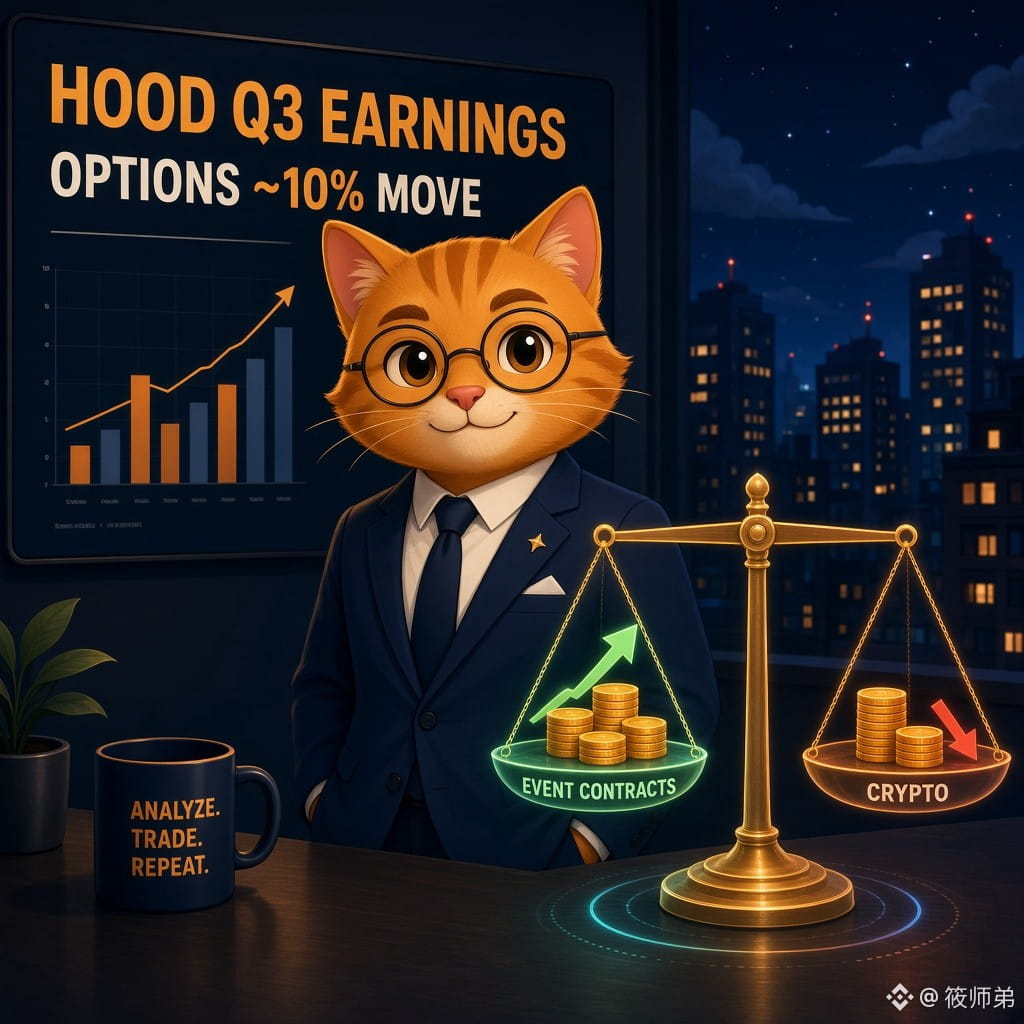
228

Just checked the calendar: Robinhood reports Q3 earnings after the U.S. market closes tonight. The market expects earnings of about $0.56 per share and revenue of $1.41 billion, versus $0.61 per share in the same quarter last year. The weird thing is, this stock has dropped after all of its last six earnings reports—even though it beat expectations five times. In July, it still fell 3.6% after a beat. It’s already down 16% this year, and it took another 5% and 1.5% hit last Thursday and Friday ahead of the report. This time, there’s a new card to play: Robinhood Chain, launched in July, reportedly brought in more revenue in its first quarter than Ethereum. Place your bets: will it be a seventh straight post-earnings drop, or will the new story break the curse? Pick a side in the comments: A, down as usual; B, this time is different.
$BTC $ETH $SOL #Robinhood #财报 #U.S.Stocks
Just checked the calendar: Robinhood reports Q3 earnings after the U.S. market closes tonight. The market expects earnings of about $0.56 per share and revenue of $1.41 billion, versus $0.61 per share in the same quarter last year. The weird thing is, this stock has dropped after all of its last six earnings reports—even though it beat expectations five times. In July, it still fell 3.6% after a beat. It’s already down 16% this year, and it took another 5% and 1.5% hit last Thursday and Friday ahead of the report. This time, there’s a new card to play: Robinhood Chain, launched in July, reportedly brought in more revenue in its first quarter than Ethereum. Place your bets: will it be a seventh straight post-earnings drop, or will the new story break the curse? Pick a side in the comments: A, down as usual; B, this time is different.
$BTC $ETH $SOL #Robinhood #财报 #U.S.Stocks
$BTC $ETH $SOL #Robinhood #财报 #U.S.Stocks
2
Log in to explore more content
Join global crypto users on Binance Square
⚡️ Get latest and useful information about crypto.
💬 Trusted by the world’s largest crypto exchange.
👍 Discover real insights from verified creators.
Email / Phone number
Trending Topics
1
#CanMicrosoftDeliverOnAI
598 views
43 Discussing
2
#CanGoogleDefindItsCore
378 views
34 Discussing
3
#FOMCWatch
9M views
27,189 Discussing
4
#EthereumDropsBelow$2300
5,229 views
113 Discussing
5
#BitcoinSlipsBelow$80KAgain
17,719 views
82 Discussing
6
#ThailandLaunchesWORPTStablecoinToQRPaymentApp
28,094 views
484 Discussing
7
#StrategySkipsBitcoinPurchasesSpends$205MOnSTRCBuybacks
7,885 views
84 Discussing
8
#BitmineAdds10452ETH
66,418 views
892 Discussing
9
#SouthKoreaConsidersEducationTaxOnCryptoExchanges
36,324 views
645 Discussing
10
#OCCUrgesCommunityBanksToEnterStablecoinPayments
28,430 views
461 Discussing