
#microsoft
microsoft
736,266 views
1,430 Discussing
Hot
Latest

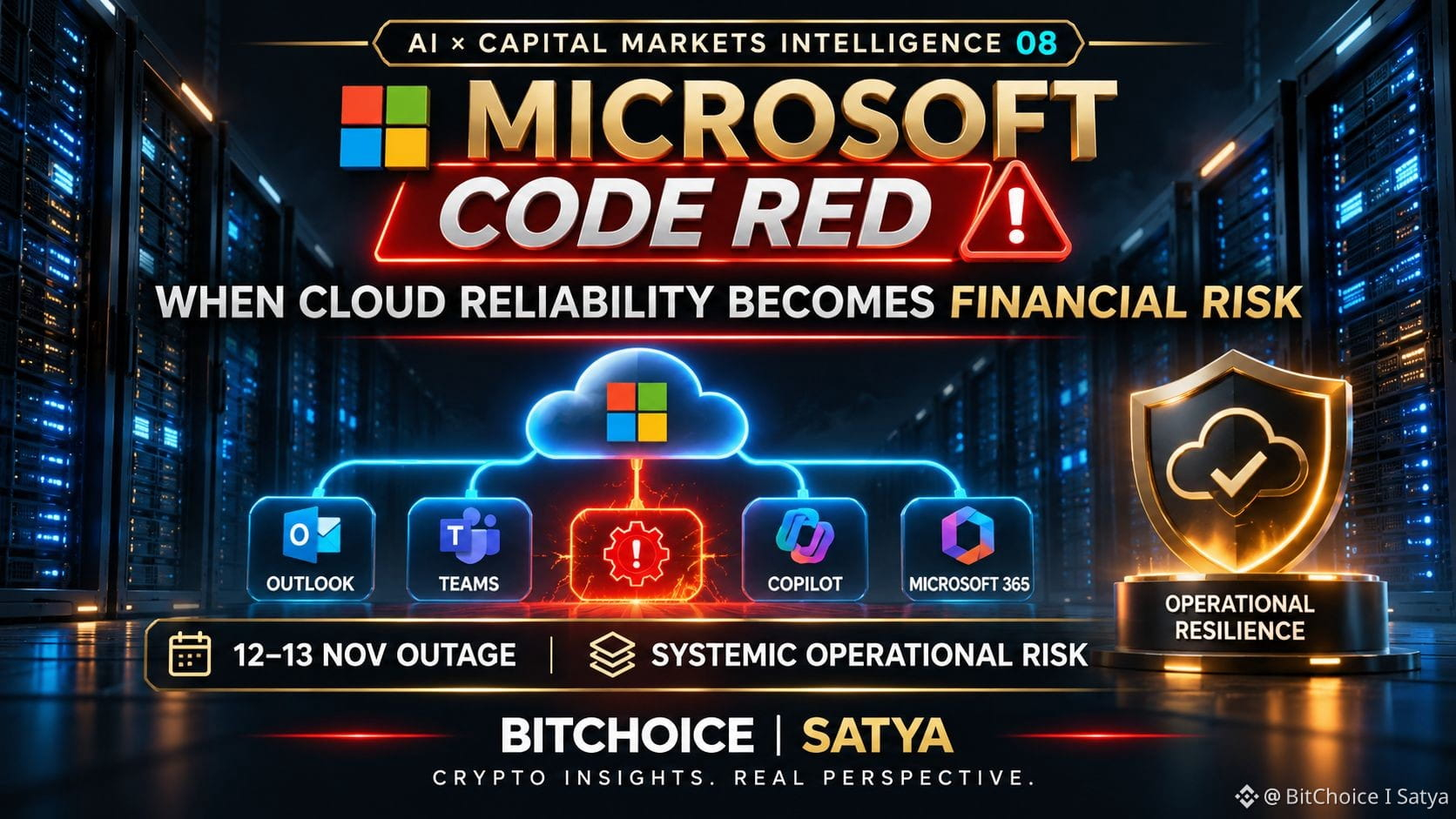
🚨AI × CAPITAL MARKETS INTELLIGENCE 08
MICROSOFT CODE RED: THE HIDDEN COST OF CLOUD DEPENDENCE
A November 12–13 Microsoft 365 outage disrupted Exchange Online, Outlook and features across Teams, Copilot and other enterprise services.
On November 24, Reuters reported that internal memos described a Code Red effort to overhaul major-incident prevention and response.
WHAT FAILED?
Microsoft's post-incident report identifies a latent Windows defect exposed by peak traffic, reduced gateway capacity and a Teams traffic shift. As unhealthy servers dropped out, automatic traffic redistribution helped spread the failure globally.
Microsoft says the outage was not a cyberattack or caused by AI tools.
THE CAPITAL-MARKETS QUESTION
Investors often reward cloud platforms for scale. But concentration creates correlated operational risk.
Watch three measures:
1. Recovery time and failure isolation.
2. Reliability spending versus cloud margins.
3. Customer retention and tougher service commitments.
BITCHOICE PERSPECTIVE
AI adoption and cloud revenue growth remain important. So does the cost of keeping critical infrastructure available.
Reliability is not a side issue: it is part of the economic value customers buy.
CRYPTO INSIGHTS. REAL PERSPECTIVE.
#Microsoft #MSFT #Cloud #Aİ $MSFT
{future}(MSFTUSDT)
🚨AI × CAPITAL MARKETS INTELLIGENCE 08
MICROSOFT CODE RED: THE HIDDEN COST OF CLOUD DEPENDENCE
A November 12–13 Microsoft 365 outage disrupted Exchange Online, Outlook and features across Teams, Copilot and other enterprise services.
On November 24, Reuters reported that internal memos described a Code Red effort to overhaul major-incident prevention and response.
WHAT FAILED?
Microsoft's post-incident report identifies a latent Windows defect exposed by peak traffic, reduced gateway capacity and a Teams traffic shift. As unhealthy servers dropped out, automatic traffic redistribution helped spread the failure globally.
Microsoft says the outage was not a cyberattack or caused by AI tools.
THE CAPITAL-MARKETS QUESTION
Investors often reward cloud platforms for scale. But concentration creates correlated operational risk.
Watch three measures:
1. Recovery time and failure isolation.
2. Reliability spending versus cloud margins.
3. Customer retention and tougher service commitments.
BITCHOICE PERSPECTIVE
AI adoption and cloud revenue growth remain important. So does the cost of keeping critical infrastructure available.
Reliability is not a side issue: it is part of the economic value customers buy.
CRYPTO INSIGHTS. REAL PERSPECTIVE.
#Microsoft #MSFT #Cloud #Aİ $MSFT
101

$MSFT 🚀– Microsoft: Building the Future of Technology!
Microsoft continues to shape the digital world through innovation, artificial intelligence, cloud computing, and advanced technology.
💡 Why Microsoft Matters:
🔹 AI Innovation: Microsoft is investing heavily in artificial intelligence and next-generation technology.
🔹 Cloud Computing: Azure remains a major part of Microsoft's cloud ecosystem.
🔹 Global Influence: Microsoft products and services are used by millions of people and businesses worldwide.
🔹 Future Growth: AI, cloud services, and digital transformation create exciting opportunities for the technology sector.
📈 My Outlook on $MSFTB :
Microsoft is one of the most influential technology companies in the world. Its continued focus on innovation makes $MSFT an interesting asset to watch.
🔥 Technology keeps evolving, and Microsoft is playing a major role in shaping its future!
💬 What do you think about Microsoft Are you bullish on Microsoft's future?
#MSFT #Microsoft #CryptoCommunity #Binance #Technology
86

🌍#PositiveMindsGlobalResults | Binance Square | November 23, 2026
⚠️ MICROSOFT WARNS: MORE TECH OUTAGES COULD BE COMING
Microsoft’s president has warned that the technology industry could face more service disruptions in the coming months as companies rapidly upgrade infrastructure, deploy AI, and patch increasingly complex systems.
Recent outages affecting Outlook, Teams, and other critical digital services have raised serious concerns about reliability. As AI accelerates software development and security updates, the speed of deployment may create new risks if testing and safeguards cannot keep pace.
The warning highlights a growing reality: the faster technology evolves, the more critical stability, cybersecurity, and infrastructure resilience become.
Investors are watching closely. Repeated outages could impact business confidence, cloud adoption, operational costs, and the broader technology sector.
The AI revolution is moving fast—but reliability must keep up.
#Microsoft #AI #Cybersecurity #Technology #CloudComputing #technews
{spot}(BNBUSDT)
{spot}(BTCUSDT)
🌍#PositiveMindsGlobalResults | Binance Square | November 23, 2026
⚠️ MICROSOFT WARNS: MORE TECH OUTAGES COULD BE COMING
Microsoft’s president has warned that the technology industry could face more service disruptions in the coming months as companies rapidly upgrade infrastructure, deploy AI, and patch increasingly complex systems.
Recent outages affecting Outlook, Teams, and other critical digital services have raised serious concerns about reliability. As AI accelerates software development and security updates, the speed of deployment may create new risks if testing and safeguards cannot keep pace.
The warning highlights a growing reality: the faster technology evolves, the more critical stability, cybersecurity, and infrastructure resilience become.
Investors are watching closely. Repeated outages could impact business confidence, cloud adoption, operational costs, and the broader technology sector.
The AI revolution is moving fast—but reliability must keep up.
#Microsoft #AI #Cybersecurity #Technology #CloudComputing #technews
73

·
--
Article
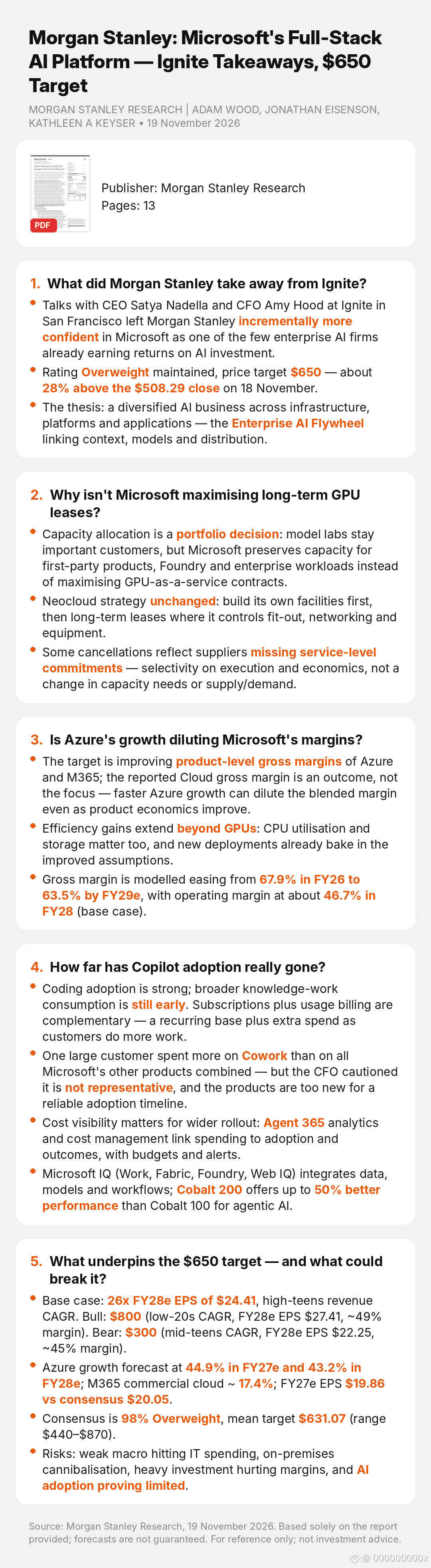
Morgan Stanley: Microsoft's Full-Stack AI Platform — Ignite Takeaways, $650 TargetMorgan Stanley: Microsoft's Full-Stack AI Platform — Ignite Takeaways, $650 Target
$MSFT
MORGAN STANLEY RESEARCH | ADAM WOOD, JONATHAN EISENSON, KATHLEEN A KEYSER • 19 November 2026
1. What did Morgan Stanley take away from Ignite?
• Talks with CEO Satya Nadella and CFO Amy Hood at Ignite in San Francisco left Morgan Stanley incrementally more confident in Microsoft as one of the few enterprise AI firms already earning returns on AI investment.
• Rating Overweight maintained, price target $650 — about 28% above the $508.29 close on 18 November.
• The thesis: a diversified AI business across infrastructure, platforms and applications — the Enterprise AI Flywheel linking context, models and distribution.
2. Why isn't Microsoft maximising long-term GPU leases?
• Capacity allocation is a portfolio decision: model labs stay important customers, but Microsoft preserves capacity for first-party products, Foundry and enterprise workloads instead of maximising GPU-as-a-service contracts.
• Neocloud strategy unchanged: build its own facilities first, then long-term leases where it controls fit-out, networking and equipment.
• Some cancellations reflect suppliers missing service-level commitments — selectivity on execution and economics, not a change in capacity needs or supply/demand.
3. Is Azure's growth diluting Microsoft's margins?
• The target is improving product-level gross margins of Azure and M365; the reported Cloud gross margin is an outcome, not the focus — faster Azure growth can dilute the blended margin even as product economics improve.
• Efficiency gains extend beyond GPUs: CPU utilisation and storage matter too, and new deployments already bake in the improved assumptions.
• Gross margin is modelled easing from 67.9% in FY26 to 63.5% by FY29e, with operating margin at about 46.7% in FY28 (base case).
4. How far has Copilot adoption really gone?
• Coding adoption is strong; broader knowledge-work consumption is still early. Subscriptions plus usage billing are complementary — a recurring base plus extra spend as customers do more work.
• One large customer spent more on Cowork than on all Microsoft's other products combined — but the CFO cautioned it is not representative, and the products are too new for a reliable adoption timeline.
• Cost visibility matters for wider rollout: Agent 365 analytics and cost management link spending to adoption and outcomes, with budgets and alerts.
• Microsoft IQ (Work, Fabric, Foundry, Web IQ) integrates data, models and workflows; Cobalt 200 offers up to 50% better performance than Cobalt 100 for agentic AI.
5. What underpins the $650 target — and what could break it?
• Base case: 26x FY28e EPS of $24.41, high-teens revenue CAGR. Bull: $800 (low-20s CAGR, FY28e EPS $27.41, ~49% margin). Bear: $300 (mid-teens CAGR, FY28e EPS $22.25, ~45% margin).
• Azure growth forecast at 44.9% in FY27e and 43.2% in FY28e; M365 commercial cloud ~17.4%; FY27e EPS $19.86 vs consensus $20.05.
• Consensus is 98% Overweight, mean target $631.07 (range $440–$870).
• Risks: weak macro hitting IT spending, on-premises cannibalisation, heavy investment hurting margins, and AI adoption proving limited.
Since the report: MSFT fell 2.8% on Fri 20 Nov as the Nasdaq slid 5.3% in a brutal week for AI stocks. (Longbridge, 23 Nov.)
#Microsoft #AI #Copilot #Azure #EnterpriseAI
Source: Morgan Stanley Research, 19 November 2026. Based solely on the report provided; forecasts are not guaranteed. For reference only; not investment advice.
Read the full breakdown on Unhidea: https://unhidea.com/en/articles/research-95c750a66a564d6ca6ab096e72d511fd-en
Visit unhidea.com for more of the latest sell-side research interpretations.
Morgan Stanley: Microsoft's Full-Stack AI Platform — Ignite Takeaways, $650 Target
Morgan Stanley: Microsoft's Full-Stack AI Platform — Ignite Takeaways, $650 Target
$MSFT
MORGAN STANLEY RESEARCH | ADAM WOOD, JONATHAN EISENSON, KATHLEEN A KEYSER • 19 November 2026
1. What did Morgan Stanley take away from Ignite?
• Talks with CEO Satya Nadella and CFO Amy Hood at Ignite in San Francisco left Morgan Stanley incrementally more confident in Microsoft as one of the few enterprise AI firms already earning returns on AI investment.
• Rating Overweight maintained, price target $650 — about 28% above the $508.29 close on 18 November.
• The thesis: a diversified AI business across infrastructure, platforms and applications — the Enterprise AI Flywheel linking context, models and distribution.
2. Why isn't Microsoft maximising long-term GPU leases?
• Capacity allocation is a portfolio decision: model labs stay important customers, but Microsoft preserves capacity for first-party products, Foundry and enterprise workloads instead of maximising GPU-as-a-service contracts.
• Neocloud strategy unchanged: build its own facilities first, then long-term leases where it controls fit-out, networking and equipment.
• Some cancellations reflect suppliers missing service-level commitments — selectivity on execution and economics, not a change in capacity needs or supply/demand.
3. Is Azure's growth diluting Microsoft's margins?
• The target is improving product-level gross margins of Azure and M365; the reported Cloud gross margin is an outcome, not the focus — faster Azure growth can dilute the blended margin even as product economics improve.
• Efficiency gains extend beyond GPUs: CPU utilisation and storage matter too, and new deployments already bake in the improved assumptions.
• Gross margin is modelled easing from 67.9% in FY26 to 63.5% by FY29e, with operating margin at about 46.7% in FY28 (base case).
4. How far has Copilot adoption really gone?
• Coding adoption is strong; broader knowledge-work consumption is still early. Subscriptions plus usage billing are complementary — a recurring base plus extra spend as customers do more work.
• One large customer spent more on Cowork than on all Microsoft's other products combined — but the CFO cautioned it is not representative, and the products are too new for a reliable adoption timeline.
• Cost visibility matters for wider rollout: Agent 365 analytics and cost management link spending to adoption and outcomes, with budgets and alerts.
• Microsoft IQ (Work, Fabric, Foundry, Web IQ) integrates data, models and workflows; Cobalt 200 offers up to 50% better performance than Cobalt 100 for agentic AI.
5. What underpins the $650 target — and what could break it?
• Base case: 26x FY28e EPS of $24.41, high-teens revenue CAGR. Bull: $800 (low-20s CAGR, FY28e EPS $27.41, ~49% margin). Bear: $300 (mid-teens CAGR, FY28e EPS $22.25, ~45% margin).
• Azure growth forecast at 44.9% in FY27e and 43.2% in FY28e; M365 commercial cloud ~17.4%; FY27e EPS $19.86 vs consensus $20.05.
• Consensus is 98% Overweight, mean target $631.07 (range $440–$870).
• Risks: weak macro hitting IT spending, on-premises cannibalisation, heavy investment hurting margins, and AI adoption proving limited.
Since the report: MSFT fell 2.8% on Fri 20 Nov as the Nasdaq slid 5.3% in a brutal week for AI stocks. (Longbridge, 23 Nov.)
#Microsoft #AI #Copilot #Azure #EnterpriseAI
Source: Morgan Stanley Research, 19 November 2026. Based solely on the report provided; forecasts are not guaranteed. For reference only; not investment advice.
Read the full breakdown on Unhidea: https://unhidea.com/en/articles/research-95c750a66a564d6ca6ab096e72d511fd-en
Visit unhidea.com for more of the latest sell-side research interpretations.
80

·
--
Microsoft’s “Code Red” Exposes the Flaws in Crypto’s Cloud Infrastructure
Microsoft recently declared its highest state of emergency, “Code Red,” following a global system outage. The disruption, which lasted about 24 hours, exposed the cryptocurrency industry’s heavy reliance on cloud service provider AWS. Coinbase had previously experienced a system outage traced to a failure in an AWS data center’s cooling system: five trading nodes were concentrated in the same building, causing three to go offline and interrupting trading, deposits, and withdrawals for eight hours. The Microsoft incident shows that cryptocurrency “security” does not depend solely on exchanges themselves, but is tied to the stability of infrastructure providers like AWS. Removing exchange-related risks does not eliminate underlying dependencies.
Why does this news matter?
As one of the world’s largest cloud service providers, Microsoft’s system outage could have a “double-whammy” cascading effect on cryptocurrency platforms that rely on AWS. The root of the problem is that the industry has yet to develop an alternative based on “decentralized infrastructure.” Even when assets are moved off exchanges, the underlying trading and settlement systems still depend on third parties. The lesson from Coinbase is that the “five-five principle” failed: distributing nodes across locations should improve fault tolerance, but the industry broadly faces the risk of “concentrated deployment.” The Microsoft incident signals that: 1) infrastructure security is no longer merely a technical issue, but a systemic risk; 2) regulators will begin to focus on cryptocurrency access to critical infrastructure providers like AWS.
Market impact
In the short term, the Microsoft incident could heighten concerns about infrastructure security in the cryptocurrency market, prompting some capital to flow toward projects that build their own infrastructure. In the long term, it could accelerate the industry’s exploration of “decentralized custody” solutions, such as combining IPFS with Ethereum storage. A similar historical event occurred in 2015, when an AWS outage at Bank of New York Mellon sparked panic in the Bitcoin market, though its impact was limited. The Microsoft incident is different: it is directly linked to the world’s largest cloud service providers and exposes the “monopoly risk of centralized infrastructure” in cryptocurrency.
💡 From a data perspective, this incident did not directly trigger significant volatility in BTC or ETH, but it suggests that infrastructure security risks could become a “hidden variable” in future market sentiment. If AWS suffers a more serious outage in the future and the cryptocurrency industry cannot quickly switch to backup solutions, the market reaction could be more than 10 times greater than that of the 2018 Coinbase incident.
This article was not sponsored by any project, and the author does not hold any of the assets mentioned.
⚠️ This is not investment advice. Predictions are for reference only.
#Microsoft’s‘CodeRed’ExposesCrypto’sOwnCloudProblem
$BTC $ETH $BNB



560

·
--
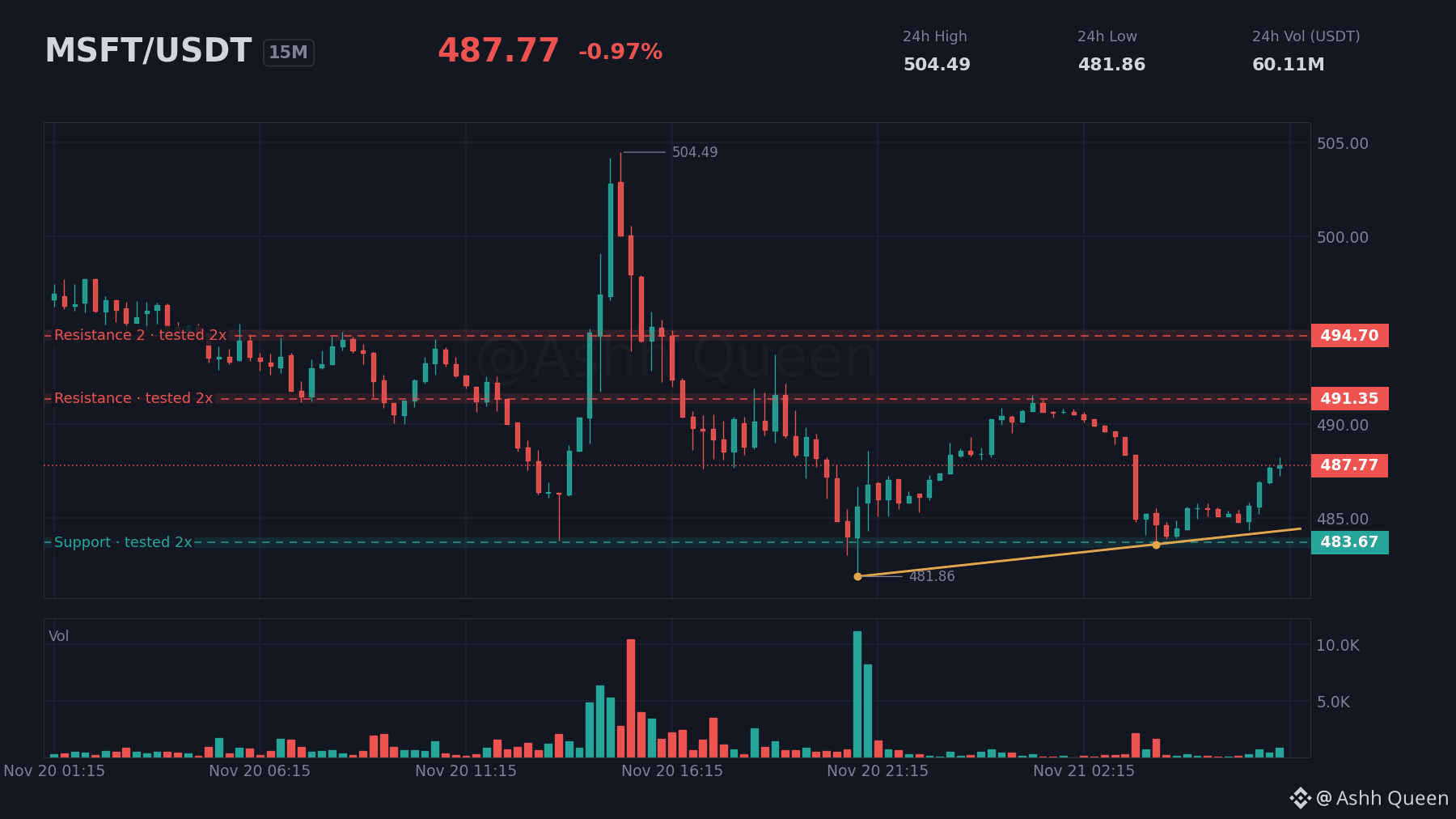
Most see weakness in $MSFT, but the data tells a different story. 📊
Trend: Neutral consolidation
Momentum: Moderate buying interest
Key levels: Support at 483.67, resistance at 491.35
Opportunity: Clearing resistance at 491.35
Risk: Falling below support at 483.67
This perpetual contract is holding above its average cost for the day, which suggests buyers aren't finished yet. 📈
I'm watching the price action closely to see if the recent lows hold. Which level are you watching on the chart and why?
#MSFT #Microsoft #TradFiForBeginners
⚠️ Perpetual contracts are leveraged derivatives, not the stock or commodity itself.
Personal market view, not advice. Always do your own research before any trade.
Most see weakness in $MSFT , but the data tells a different story. 📊
Trend: Neutral consolidation
Momentum: Moderate buying interest
Key levels: Support at 483.67, resistance at 491.35
Opportunity: Clearing resistance at 491.35
Risk: Falling below support at 483.67
This perpetual contract is holding above its average cost for the day, which suggests buyers aren't finished yet. 📈
I'm watching the price action closely to see if the recent lows hold. Which level are you watching on the chart and why?
#MSFT #Microsoft #TradFiForBeginners
⚠️ Perpetual contracts are leveraged derivatives, not the stock or commodity itself.
Personal market view, not advice. Always do your own research before any trade.
15

·
--
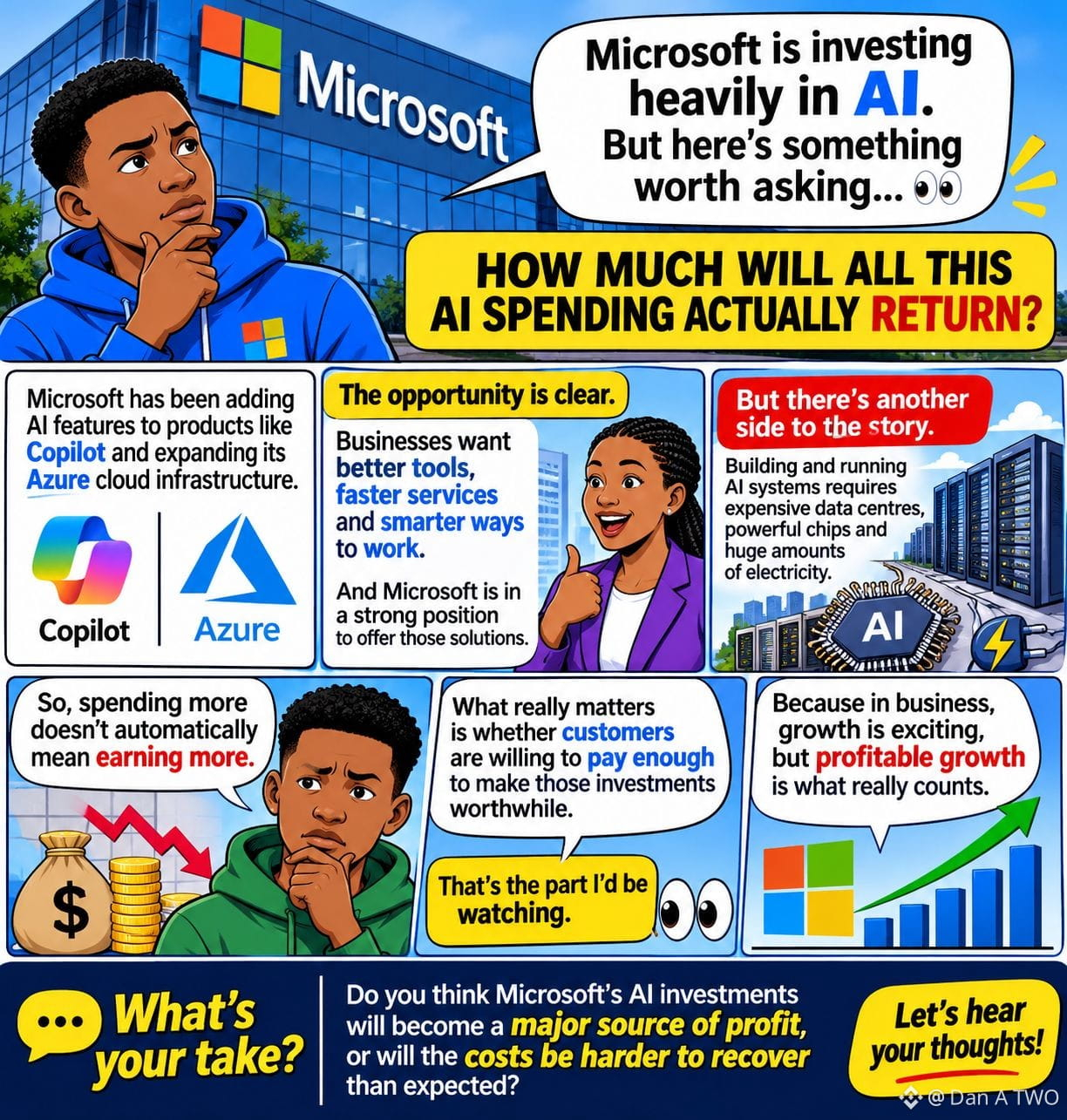
Microsoft is investing heavily in AI. But here's something worth asking… 👀
HOW MUCH WILL ALL THIS AI SPENDING ACTUALLY RETURN?
Microsoft has been adding AI features to products like Copilot and expanding its Azure cloud infrastructure.
The opportunity is clear.
Businesses want better tools, faster services and smarter ways to work.
And Microsoft is in a strong position to offer those solutions.
But there's another side to the story.
Building and running AI systems requires expensive data centres, powerful chips and huge amounts of electricity.
So, spending more doesn't automatically mean earning more.
What really matters is whether customers are willing to pay enough to make those investments worthwhile.
That's the part I'd be watching.
Because in business, growth is exciting, but profitable growth is what really counts.
👇 What's your take?
Do you think Microsoft's AI investments will become a major source of profit, or will the costs be harder to recover than expected?
#Microsoft #DanATWO #AI #stockmarket #Investing $MSFTB
2
103

Microsoft is shifting the AI narrative away from massive, expensive general-purpose models toward hyper-focused, cost-effective solutions. By prioritizing domain-specific excellence in coding and security over raw size, they are proving that efficiency often trumps sheer scale. This pragmatic approach could soon redefine enterprise adoption standards across the tech sector. #Microsoft #ArtificialIntelligence #TechTrends
Microsoft is shifting the AI narrative away from massive, expensive general-purpose models toward hyper-focused, cost-effective solutions. By prioritizing domain-specific excellence in coding and security over raw size, they are proving that efficiency often trumps sheer scale. This pragmatic approach could soon redefine enterprise adoption standards across the tech sector. #Microsoft #ArtificialIntelligence #TechTrends
20

📉 Is $MSFTB falling? Maybe it’s time to pay attention.
November could become an interesting month for investors looking for opportunities.
Microsoft remains one of the most important technology companies in the world. Price drops can represent opportunities for those with a long-term strategy who know how to manage risk.
💡 My strategy: gradual buying, patience, and a long-term outlook. It’s not about buying impulsively, but about intelligently taking advantage of market movements.
📊 Are you accumulating $MSFTB o, or do you prefer to wait for a bigger correction?
#Microsoft #Binance e #Inversione #crypto #BuyTheDipOrTheForest
104

Microsoft has just dealt a critical blow in the AI race! The company claims that small, specialized AI models can achieve performance close to that of leading frontier models, but at MUCH LOWER operating costs. This is a major turning point.
A case in point is its MAI Code 2: it delivers 96% of Claude Opus 5.5’s coding performance at just 5% of the cost! Or 98% of GPT-6.1 Sol’s performance for 40% of the price. These figures are incredibly impressive and show enormous potential for savings.
This strategy focuses on specialization and token efficiency, challenging the mindset that “bigger is better.” Microsoft is betting on combining small, smart models with automatic routing to optimize costs without sacrificing quality.
This isn’t just a technology war—it’s also a battle for CASH FLOW and PROFITABILITY. A sharp drop in AI costs will open the door to a host of new applications, driving the entire AI and tech industry forward. This will force other major players to adjust.
Could this be the beginning of an era of AI that is both powerful and affordable? And which crypto AI projects stand to benefit most from this shift?
#AI #Microsoft
5

The AI race is heating up! Microsoft has just launched 6 low-cost artificial intelligence models, breathing down the necks of giants like OpenAI and Anthropic. Could this move completely change the tech game?
#Microsoft #AI #OpenAI #TechNews
The AI race is heating up! Microsoft has just launched 6 low-cost artificial intelligence models, breathing down the necks of giants like OpenAI and Anthropic. Could this move completely change the tech game?
#Microsoft #AI #OpenAI #TechNews
#Microsoft #AI #OpenAI #TechNews
24

·
--
Bullish
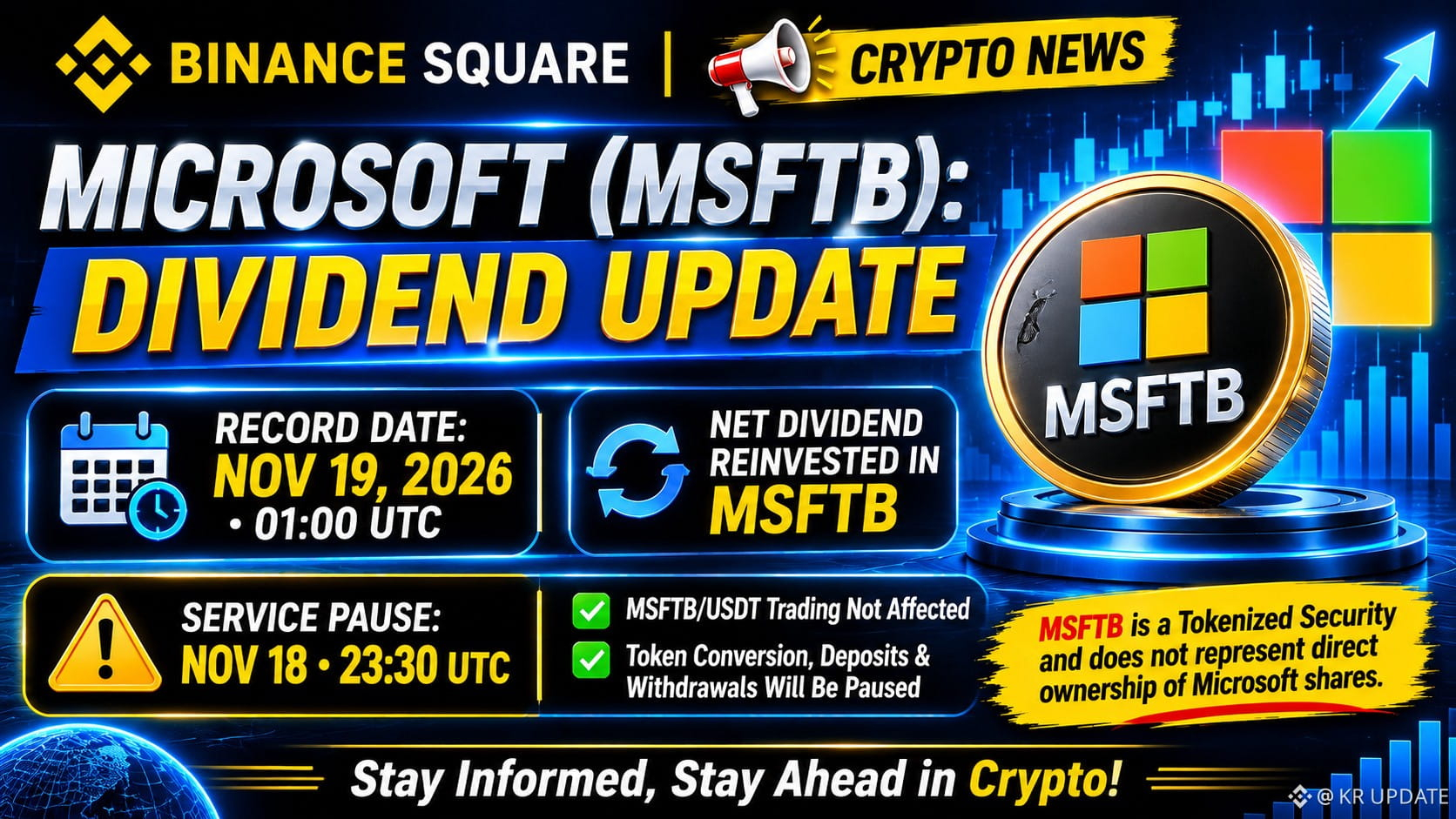
🚨 MICROSOFT ($MSFTB ): BINANCE ANNOUNCES UPCOMING DIVIDEND DISTRIBUTION!
Microsoft's tokenized stock, $MSFTB, is gaining attention following Binance's latest dividend distribution announcement on November 16, 2026.
Binance will support Microsoft's cash dividend distribution for eligible MSFTB holders. After applicable taxes, fees, and deductions, the net dividend will be reinvested into additional MSFTB tokens.
📅 Important Dates:
• Record Date: November 19, 2026, at 01:00 UTC
• Service Suspension: November 18, 2026, at 23:30 UTC
• MSFTB/USDT trading will remain unaffected.
During the temporary suspension, token conversion, deposits, and withdrawals will be paused until the distribution is completed.
This development highlights the growing connection between traditional financial markets and blockchain-based tokenized securities.
Could tokenized stocks become a major part of the future of digital finance?
#Microsoft #Binance #RWA #CryptoNews #blockchain
🚨 MICROSOFT ($MSFTB ): BINANCE ANNOUNCES UPCOMING DIVIDEND DISTRIBUTION!
Microsoft's tokenized stock, $MSFTB , is gaining attention following Binance's latest dividend distribution announcement on November 16, 2026.
Binance will support Microsoft's cash dividend distribution for eligible MSFTB holders. After applicable taxes, fees, and deductions, the net dividend will be reinvested into additional MSFTB tokens.
📅 Important Dates:
• Record Date: November 19, 2026, at 01:00 UTC
• Service Suspension: November 18, 2026, at 23:30 UTC
• MSFTB/USDT trading will remain unaffected.
During the temporary suspension, token conversion, deposits, and withdrawals will be paused until the distribution is completed.
This development highlights the growing connection between traditional financial markets and blockchain-based tokenized securities.
Could tokenized stocks become a major part of the future of digital finance?
#Microsoft #Binance #RWA #CryptoNews #blockchain
97

·
--
Article
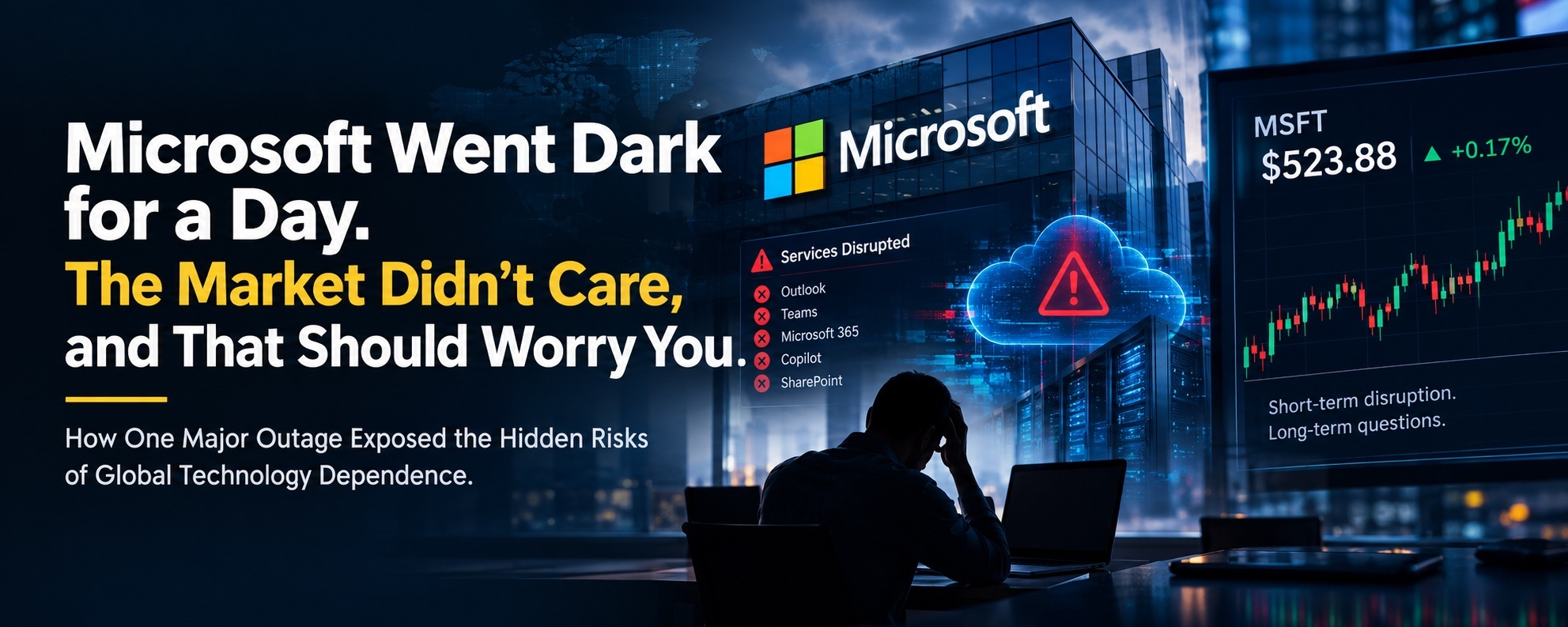
Microsoft Went Dark for a Day. The Market Didn’t Care, and That Should Worry You.A 24-Hour Technology Disruption Exposed a Much Bigger Problem: The World’s Growing Dependence on a Few Technology Giants.
On November 12, 2026, Microsoft experienced one of its most disruptive service outages in recent years. Outlook, Microsoft Teams, Copilot and several Microsoft 365 services became inaccessible or unreliable for users across more than 70 countries.
Businesses struggled to communicate. Financial institutions faced operational delays. Government departments experienced interruptions, and some organizations were forced to return to traditional communication methods, including phone calls and fax machines.
The disruption continued into November 13, lasting more than 24 hours for affected services.
Yet something particularly interesting happened in financial markets.
Despite the scale of the disruption, Microsoft shares recovered and closed Friday at approximately $523.88, up around 0.17%.
In other words, a major technology infrastructure failure barely left a lasting impression on the stock price.
But should investors interpret that as confidence in Microsoft, or is the market overlooking a much larger structural risk?
Let’s break it down.
1. What Actually Happened?
The disruption primarily affected Exchange Online, Microsoft’s cloud-based email and calendar infrastructure.
Because several Microsoft 365 products depend on Exchange Online, the problem extended beyond email.
Affected services included:
▪ Outlook and email connectivity
▪ Microsoft Teams and collaboration features
▪ SharePoint Online integrations
▪ Microsoft 365 Copilot functionality
▪ Calendar synchronization and scheduling
▪ Certain connected enterprise services
Microsoft initially reported infrastructure load problems and servers failing automated health checks.
Its subsequent explanation identified an issue associated with an earlier network-capacity upgrade that surfaced following a more recent network change.
Importantly, Microsoft clarified that the incident was not caused by a cyberattack or AI agents.
The company gradually restored services while validating infrastructure stability.
The bigger lesson: Modern technology platforms are interconnected. A failure in one critical component can affect multiple applications that appear completely independent to their users.
2. Why Didn’t the Stock Market React More Aggressively?
This is arguably the most interesting part of the entire incident.
Investors generally evaluate companies based on their expected future earnings, cash flows, competitive position and business sustainability.
A temporary service disruption does not automatically change those long-term expectations.
There are several reasons why Microsoft’s shares remained relatively resilient.
A. Microsoft’s Financial Scale
Microsoft is not dependent on a single product or revenue stream.
Its business includes:
▪ Azure cloud infrastructure
▪ Microsoft 365 subscriptions
▪ Windows and enterprise software
▪ LinkedIn
▪ Gaming and Xbox
▪ AI-related products and services
According to Microsoft’s FY2026 annual report, the company generated approximately $331.8 billion in annual revenue, representing 18% year-over-year growth.
A temporary disruption affecting one part of its ecosystem is unlikely to immediately undermine the entire company’s financial outlook.
B. Enterprise Switching Costs
Microsoft products are deeply integrated into corporate environments.
Organizations use Outlook, Teams, SharePoint, Azure and other services across departments.
Moving an entire organization to another technology provider requires:
▪ Data migration
▪ Employee training
▪ Software integration
▪ Security reviews
▪ Compliance adjustments
▪ Additional operational expenditure
Consequently, even a serious outage does not automatically result in customers abandoning Microsoft.
C. Investors Focus on Long-Term Cash Flows
Stock markets are forward-looking.
Investors are more concerned about whether an incident changes future revenue, profitability, customer retention or growth expectations.
A temporary interruption may generate operational costs without fundamentally changing those expectations.
That explains why the stock reaction was relatively limited.
However, limited immediate price movement does not mean the incident was financially insignificant.
3. The Hidden Risk: Technology Concentration
Here is where the story becomes much more important.
The problem is not simply that Microsoft experienced an outage.
The problem is how many organizations depend on a relatively small number of technology providers.
Consider the modern business environment:
A company may use Microsoft for email, Google for cloud applications, Amazon for infrastructure, and other technology providers for payments, cybersecurity and communication.
But these services frequently connect through shared infrastructure and dependencies.
When a major provider experiences a disruption, the impact can spread across industries.
This creates what financial analysts and technology risk professionals describe as concentration risk.
Imagine thousands of companies depending on the same critical infrastructure.
Even if every individual company operates efficiently, a failure at the infrastructure provider can disrupt all of them simultaneously.
This is a systemic technology risk.
It is similar to financial markets where excessive dependence on one institution or counterparty can create vulnerabilities throughout the system.
4. The Financial Impact Goes Beyond Microsoft’s Stock Price
A common mistake is measuring the cost of an outage only through the affected company’s share price.
That approach ignores the broader economic impact.
Consider the following categories:
Direct Financial Costs
▪ Potential service credits for affected customers.
▪ Additional engineering and infrastructure expenses.
▪ Incident investigation and recovery costs.
▪ Potential insurance claims.
Indirect Business Costs
▪ Lost employee productivity.
▪ Delayed transactions and business decisions.
▪ Disrupted customer support.
▪ Delayed financial announcements.
▪ Operational and administrative inefficiencies.
Morningstar DBRS estimated insured losses associated with the incident at approximately $300 million to $500 million.
That figure represents estimated insured losses, not Microsoft’s own financial loss or the total economic cost of the outage.
The distinction matters.
The wider economic impact can extend far beyond the financial consequences recorded on Microsoft’s balance sheet.
5. Why Investors Should Watch the Next Few Months
The immediate stock reaction is only one part of the story.
The more important question is whether this incident changes Microsoft’s long-term business fundamentals.
There are four areas worth monitoring.
1. Customer Retention
Will enterprise customers continue expanding their Microsoft 365 subscriptions?
Or will some organizations begin diversifying their technology providers?
2. Infrastructure Reliability
Will Microsoft identify and eliminate the underlying weaknesses?
Repeated disruptions could gradually affect customer confidence.
3. Financial Performance
Will additional infrastructure expenditure, service credits or customer concessions affect operating margins?
4. AI Adoption
Microsoft is positioning Copilot and AI-powered services as important components of its future growth.
Enterprise customers must trust the underlying infrastructure before relying on these tools for critical business operations.
Reliability is therefore not just a technical requirement. It is part of the commercial value proposition.
6. The Bigger Market Lesson: Price Action and Fundamental Risk Are Different Things
This incident offers an important lesson for investors and traders.
A stock can remain stable even when its underlying business experiences a serious operational problem.
That does not necessarily mean the market is wrong.
Markets evaluate probabilities, expected financial consequences and future business performance rather than simply reacting to the number of people affected by an incident.
However, investors should avoid assuming that a limited immediate price reaction means there is no long-term risk.
There is a difference between:
▪ A temporary operational disruption.
▪ A recurring reliability problem.
▪ A structural weakness affecting customer confidence.
▪ A fundamental deterioration in future earnings.
These are four different scenarios, and they should not be treated equally.
For traders, the lesson is equally important: headlines alone are not trading signals. Price reaction, trading volume, broader market conditions and subsequent fundamental developments all matter.
The market measures financial damage. Businesses experience operational damage. And those two things are not always visible on the same day.
7. Final Takeaway: Convenience Has Created a New Kind of Vulnerability
Microsoft’s November outage demonstrated something that goes beyond one company’s technical problems.
The global economy has become increasingly dependent on a relatively small group of technology infrastructure providers.
These platforms have made businesses faster, more connected and more efficient.
But efficiency through centralization also creates concentration risk.
The market’s relatively calm response tells us that investors did not immediately see the outage as a threat to Microsoft’s long-term earnings power.
That may be understandable from a financial perspective.
However, businesses, investors and governments should look beyond the stock chart.
Because when a single technology provider becomes an essential part of the global business infrastructure, its reliability becomes an economic issue, not merely a technical one.
The real question is no longer whether another major technology outage will happen. It is whether the global economy is sufficiently prepared when it does.
#Microsoft #TechnologyRisk #ArifAlpha
Microsoft Went Dark for a Day. The Market Didn’t Care, and That Should Worry You.
A 24-Hour Technology Disruption Exposed a Much Bigger Problem: The World’s Growing Dependence on a Few Technology Giants.
On November 12, 2026, Microsoft experienced one of its most disruptive service outages in recent years. Outlook, Microsoft Teams, Copilot and several Microsoft 365 services became inaccessible or unreliable for users across more than 70 countries.
Businesses struggled to communicate. Financial institutions faced operational delays. Government departments experienced interruptions, and some organizations were forced to return to traditional communication methods, including phone calls and fax machines.
The disruption continued into November 13, lasting more than 24 hours for affected services.
Yet something particularly interesting happened in financial markets.
Despite the scale of the disruption, Microsoft shares recovered and closed Friday at approximately $523.88, up around 0.17%.
In other words, a major technology infrastructure failure barely left a lasting impression on the stock price.
But should investors interpret that as confidence in Microsoft, or is the market overlooking a much larger structural risk?
Let’s break it down.
1. What Actually Happened?
The disruption primarily affected Exchange Online, Microsoft’s cloud-based email and calendar infrastructure.
Because several Microsoft 365 products depend on Exchange Online, the problem extended beyond email.
Affected services included:
▪ Outlook and email connectivity
▪ Microsoft Teams and collaboration features
▪ SharePoint Online integrations
▪ Microsoft 365 Copilot functionality
▪ Calendar synchronization and scheduling
▪ Certain connected enterprise services
Microsoft initially reported infrastructure load problems and servers failing automated health checks.
Its subsequent explanation identified an issue associated with an earlier network-capacity upgrade that surfaced following a more recent network change.
Importantly, Microsoft clarified that the incident was not caused by a cyberattack or AI agents.
The company gradually restored services while validating infrastructure stability.
The bigger lesson: Modern technology platforms are interconnected. A failure in one critical component can affect multiple applications that appear completely independent to their users.
2. Why Didn’t the Stock Market React More Aggressively?
This is arguably the most interesting part of the entire incident.
Investors generally evaluate companies based on their expected future earnings, cash flows, competitive position and business sustainability.
A temporary service disruption does not automatically change those long-term expectations.
There are several reasons why Microsoft’s shares remained relatively resilient.
A. Microsoft’s Financial Scale
Microsoft is not dependent on a single product or revenue stream.
Its business includes:
▪ Azure cloud infrastructure
▪ Microsoft 365 subscriptions
▪ Windows and enterprise software
▪ LinkedIn
▪ Gaming and Xbox
▪ AI-related products and services
According to Microsoft’s FY2026 annual report, the company generated approximately $331.8 billion in annual revenue, representing 18% year-over-year growth.
A temporary disruption affecting one part of its ecosystem is unlikely to immediately undermine the entire company’s financial outlook.
B. Enterprise Switching Costs
Microsoft products are deeply integrated into corporate environments.
Organizations use Outlook, Teams, SharePoint, Azure and other services across departments.
Moving an entire organization to another technology provider requires:
▪ Data migration
▪ Employee training
▪ Software integration
▪ Security reviews
▪ Compliance adjustments
▪ Additional operational expenditure
Consequently, even a serious outage does not automatically result in customers abandoning Microsoft.
C. Investors Focus on Long-Term Cash Flows
Stock markets are forward-looking.
Investors are more concerned about whether an incident changes future revenue, profitability, customer retention or growth expectations.
A temporary interruption may generate operational costs without fundamentally changing those expectations.
That explains why the stock reaction was relatively limited.
However, limited immediate price movement does not mean the incident was financially insignificant.
3. The Hidden Risk: Technology Concentration
Here is where the story becomes much more important.
The problem is not simply that Microsoft experienced an outage.
The problem is how many organizations depend on a relatively small number of technology providers.
Consider the modern business environment:
A company may use Microsoft for email, Google for cloud applications, Amazon for infrastructure, and other technology providers for payments, cybersecurity and communication.
But these services frequently connect through shared infrastructure and dependencies.
When a major provider experiences a disruption, the impact can spread across industries.
This creates what financial analysts and technology risk professionals describe as concentration risk.
Imagine thousands of companies depending on the same critical infrastructure.
Even if every individual company operates efficiently, a failure at the infrastructure provider can disrupt all of them simultaneously.
This is a systemic technology risk.
It is similar to financial markets where excessive dependence on one institution or counterparty can create vulnerabilities throughout the system.
4. The Financial Impact Goes Beyond Microsoft’s Stock Price
A common mistake is measuring the cost of an outage only through the affected company’s share price.
That approach ignores the broader economic impact.
Consider the following categories:
Direct Financial Costs
▪ Potential service credits for affected customers.
▪ Additional engineering and infrastructure expenses.
▪ Incident investigation and recovery costs.
▪ Potential insurance claims.
Indirect Business Costs
▪ Lost employee productivity.
▪ Delayed transactions and business decisions.
▪ Disrupted customer support.
▪ Delayed financial announcements.
▪ Operational and administrative inefficiencies.
Morningstar DBRS estimated insured losses associated with the incident at approximately $300 million to $500 million.
That figure represents estimated insured losses, not Microsoft’s own financial loss or the total economic cost of the outage.
The distinction matters.
The wider economic impact can extend far beyond the financial consequences recorded on Microsoft’s balance sheet.
5. Why Investors Should Watch the Next Few Months
The immediate stock reaction is only one part of the story.
The more important question is whether this incident changes Microsoft’s long-term business fundamentals.
There are four areas worth monitoring.
1. Customer Retention
Will enterprise customers continue expanding their Microsoft 365 subscriptions?
Or will some organizations begin diversifying their technology providers?
2. Infrastructure Reliability
Will Microsoft identify and eliminate the underlying weaknesses?
Repeated disruptions could gradually affect customer confidence.
3. Financial Performance
Will additional infrastructure expenditure, service credits or customer concessions affect operating margins?
4. AI Adoption
Microsoft is positioning Copilot and AI-powered services as important components of its future growth.
Enterprise customers must trust the underlying infrastructure before relying on these tools for critical business operations.
Reliability is therefore not just a technical requirement. It is part of the commercial value proposition.
6. The Bigger Market Lesson: Price Action and Fundamental Risk Are Different Things
This incident offers an important lesson for investors and traders.
A stock can remain stable even when its underlying business experiences a serious operational problem.
That does not necessarily mean the market is wrong.
Markets evaluate probabilities, expected financial consequences and future business performance rather than simply reacting to the number of people affected by an incident.
However, investors should avoid assuming that a limited immediate price reaction means there is no long-term risk.
There is a difference between:
▪ A temporary operational disruption.
▪ A recurring reliability problem.
▪ A structural weakness affecting customer confidence.
▪ A fundamental deterioration in future earnings.
These are four different scenarios, and they should not be treated equally.
For traders, the lesson is equally important: headlines alone are not trading signals. Price reaction, trading volume, broader market conditions and subsequent fundamental developments all matter.
The market measures financial damage. Businesses experience operational damage. And those two things are not always visible on the same day.
7. Final Takeaway: Convenience Has Created a New Kind of Vulnerability
Microsoft’s November outage demonstrated something that goes beyond one company’s technical problems.
The global economy has become increasingly dependent on a relatively small group of technology infrastructure providers.
These platforms have made businesses faster, more connected and more efficient.
But efficiency through centralization also creates concentration risk.
The market’s relatively calm response tells us that investors did not immediately see the outage as a threat to Microsoft’s long-term earnings power.
That may be understandable from a financial perspective.
However, businesses, investors and governments should look beyond the stock chart.
Because when a single technology provider becomes an essential part of the global business infrastructure, its reliability becomes an economic issue, not merely a technical one.
The real question is no longer whether another major technology outage will happen. It is whether the global economy is sufficiently prepared when it does.
#Microsoft #TechnologyRisk #ArifAlpha
On November 12, 2026, Microsoft experienced one of its most disruptive service outages in recent years. Outlook, Microsoft Teams, Copilot and several Microsoft 365 services became inaccessible or unreliable for users across more than 70 countries.
Businesses struggled to communicate. Financial institutions faced operational delays. Government departments experienced interruptions, and some organizations were forced to return to traditional communication methods, including phone calls and fax machines.
The disruption continued into November 13, lasting more than 24 hours for affected services.
Yet something particularly interesting happened in financial markets.
Despite the scale of the disruption, Microsoft shares recovered and closed Friday at approximately $523.88, up around 0.17%.
In other words, a major technology infrastructure failure barely left a lasting impression on the stock price.
But should investors interpret that as confidence in Microsoft, or is the market overlooking a much larger structural risk?
Let’s break it down.
1. What Actually Happened?
The disruption primarily affected Exchange Online, Microsoft’s cloud-based email and calendar infrastructure.
Because several Microsoft 365 products depend on Exchange Online, the problem extended beyond email.
Affected services included:
▪ Outlook and email connectivity
▪ Microsoft Teams and collaboration features
▪ SharePoint Online integrations
▪ Microsoft 365 Copilot functionality
▪ Calendar synchronization and scheduling
▪ Certain connected enterprise services
Microsoft initially reported infrastructure load problems and servers failing automated health checks.
Its subsequent explanation identified an issue associated with an earlier network-capacity upgrade that surfaced following a more recent network change.
Importantly, Microsoft clarified that the incident was not caused by a cyberattack or AI agents.
The company gradually restored services while validating infrastructure stability.
The bigger lesson: Modern technology platforms are interconnected. A failure in one critical component can affect multiple applications that appear completely independent to their users.
2. Why Didn’t the Stock Market React More Aggressively?
This is arguably the most interesting part of the entire incident.
Investors generally evaluate companies based on their expected future earnings, cash flows, competitive position and business sustainability.
A temporary service disruption does not automatically change those long-term expectations.
There are several reasons why Microsoft’s shares remained relatively resilient.
A. Microsoft’s Financial Scale
Microsoft is not dependent on a single product or revenue stream.
Its business includes:
▪ Azure cloud infrastructure
▪ Microsoft 365 subscriptions
▪ Windows and enterprise software
▪ Gaming and Xbox
▪ AI-related products and services
According to Microsoft’s FY2026 annual report, the company generated approximately $331.8 billion in annual revenue, representing 18% year-over-year growth.
A temporary disruption affecting one part of its ecosystem is unlikely to immediately undermine the entire company’s financial outlook.
B. Enterprise Switching Costs
Microsoft products are deeply integrated into corporate environments.
Organizations use Outlook, Teams, SharePoint, Azure and other services across departments.
Moving an entire organization to another technology provider requires:
▪ Data migration
▪ Employee training
▪ Software integration
▪ Security reviews
▪ Compliance adjustments
▪ Additional operational expenditure
Consequently, even a serious outage does not automatically result in customers abandoning Microsoft.
C. Investors Focus on Long-Term Cash Flows
Stock markets are forward-looking.
Investors are more concerned about whether an incident changes future revenue, profitability, customer retention or growth expectations.
A temporary interruption may generate operational costs without fundamentally changing those expectations.
That explains why the stock reaction was relatively limited.
However, limited immediate price movement does not mean the incident was financially insignificant.
3. The Hidden Risk: Technology Concentration
Here is where the story becomes much more important.
The problem is not simply that Microsoft experienced an outage.
The problem is how many organizations depend on a relatively small number of technology providers.
Consider the modern business environment:
A company may use Microsoft for email, Google for cloud applications, Amazon for infrastructure, and other technology providers for payments, cybersecurity and communication.
But these services frequently connect through shared infrastructure and dependencies.
When a major provider experiences a disruption, the impact can spread across industries.
This creates what financial analysts and technology risk professionals describe as concentration risk.
Imagine thousands of companies depending on the same critical infrastructure.
Even if every individual company operates efficiently, a failure at the infrastructure provider can disrupt all of them simultaneously.
This is a systemic technology risk.
It is similar to financial markets where excessive dependence on one institution or counterparty can create vulnerabilities throughout the system.
4. The Financial Impact Goes Beyond Microsoft’s Stock Price
A common mistake is measuring the cost of an outage only through the affected company’s share price.
That approach ignores the broader economic impact.
Consider the following categories:
Direct Financial Costs
▪ Potential service credits for affected customers.
▪ Additional engineering and infrastructure expenses.
▪ Incident investigation and recovery costs.
▪ Potential insurance claims.
Indirect Business Costs
▪ Lost employee productivity.
▪ Delayed transactions and business decisions.
▪ Disrupted customer support.
▪ Delayed financial announcements.
▪ Operational and administrative inefficiencies.
Morningstar DBRS estimated insured losses associated with the incident at approximately $300 million to $500 million.
That figure represents estimated insured losses, not Microsoft’s own financial loss or the total economic cost of the outage.
The distinction matters.
The wider economic impact can extend far beyond the financial consequences recorded on Microsoft’s balance sheet.
5. Why Investors Should Watch the Next Few Months
The immediate stock reaction is only one part of the story.
The more important question is whether this incident changes Microsoft’s long-term business fundamentals.
There are four areas worth monitoring.
1. Customer Retention
Will enterprise customers continue expanding their Microsoft 365 subscriptions?
Or will some organizations begin diversifying their technology providers?
2. Infrastructure Reliability
Will Microsoft identify and eliminate the underlying weaknesses?
Repeated disruptions could gradually affect customer confidence.
3. Financial Performance
Will additional infrastructure expenditure, service credits or customer concessions affect operating margins?
4. AI Adoption
Microsoft is positioning Copilot and AI-powered services as important components of its future growth.
Enterprise customers must trust the underlying infrastructure before relying on these tools for critical business operations.
Reliability is therefore not just a technical requirement. It is part of the commercial value proposition.
6. The Bigger Market Lesson: Price Action and Fundamental Risk Are Different Things
This incident offers an important lesson for investors and traders.
A stock can remain stable even when its underlying business experiences a serious operational problem.
That does not necessarily mean the market is wrong.
Markets evaluate probabilities, expected financial consequences and future business performance rather than simply reacting to the number of people affected by an incident.
However, investors should avoid assuming that a limited immediate price reaction means there is no long-term risk.
There is a difference between:
▪ A temporary operational disruption.
▪ A recurring reliability problem.
▪ A structural weakness affecting customer confidence.
▪ A fundamental deterioration in future earnings.
These are four different scenarios, and they should not be treated equally.
For traders, the lesson is equally important: headlines alone are not trading signals. Price reaction, trading volume, broader market conditions and subsequent fundamental developments all matter.
The market measures financial damage. Businesses experience operational damage. And those two things are not always visible on the same day.
7. Final Takeaway: Convenience Has Created a New Kind of Vulnerability
Microsoft’s November outage demonstrated something that goes beyond one company’s technical problems.
The global economy has become increasingly dependent on a relatively small group of technology infrastructure providers.
These platforms have made businesses faster, more connected and more efficient.
But efficiency through centralization also creates concentration risk.
The market’s relatively calm response tells us that investors did not immediately see the outage as a threat to Microsoft’s long-term earnings power.
That may be understandable from a financial perspective.
However, businesses, investors and governments should look beyond the stock chart.
Because when a single technology provider becomes an essential part of the global business infrastructure, its reliability becomes an economic issue, not merely a technical one.
The real question is no longer whether another major technology outage will happen. It is whether the global economy is sufficiently prepared when it does.
#Microsoft #TechnologyRisk #ArifAlpha
170

·
--
Microsoft Restores 365 Services After Global Outage
Microsoft says its services are fully restored after a multi-hour outage disrupted Outlook, Teams and Copilot and affected organizations worldwide. The company traced the incident to an issue during an earlier network-capacity upgrade that surfaced after a later network change; it said there was no indication of malicious activity.
The disruption is a reminder that essential work can depend on a single cloud provider. Keep fallback channels for critical communications. What service would your team need to keep running if its cloud provider went offline?
Source: Associated Press: https://apnews.com/article/microsoft-outage-outlook-email-365-recover-ca395c0f1e51af784b6d70afb6554f6a
Market watch:
#Microsoft #CloudComputing #CyberResilience
21


·
--
🚨 MICROSOFT IS DOWN, WHO MAKES A STRIKING APPEAL!
An outage affecting Microsoft services made headlines. The World Health Organization reminded people to step away from their screens. 🌍
💡 Technology makes our lives easier, but it shouldn’t become our whole lives.
📵 Step away from your screens for a while and make time for real life!
Do you think we’ve become too dependent on technology? 👇
#Microsoft
4
235

Centralized infrastructure remains a single point of failure for the AI economy. Microsoft confirmed its global outage was caused by a network upgrade error, not a cyberattack, but it still disrupted Copilot and connectors for OpenAI and Anthropic. This serves as a reminder of the systemic risks inherent in relying on few cloud providers 🌐 #Microsoft #Copilot $MSFT #AI #ArtificialIntelligence #CryptoverseNews
Full story: https://cryptoversenews.eu/ai/microsoft-confirms-global-outage-resolved-rules-out-cyberatt/?utm_source=binance_square&utm_medium=social&utm_campaign=autopost
Full story: https://cryptoversenews.eu/ai/microsoft-confirms-global-outage-resolved-rules-out-cyberatt/?utm_source=binance_square&utm_medium=social&utm_campaign=autopost
171

·
--
BREAKING: MICROSOFT GLOBAL OUTAGE RESOLVED!
Microsoft has confirmed that its global service disruption has been resolved.
💻 Outlook Teams and other Microsoft 365 services are back online.
🔍 What caused it?
Microsoft says the outage was linked to a technical issue following a network capacity upgrade — NOT a cyberattack.
⚠️ The incident highlights how dependent the digital world is on centralized technology infrastructure.
Could this be a wake-up call for stronger digital security and decentralization?
#Bitcoin #Crypto #blockchain #Web3 #Microsoft
30

Attackers target Microsoft SQL servers with Monero miners and remote access malware
FortiGuard Labs has identified an active campaign targeting Microsoft SQL servers exposed to the Internet, deploying Monero cryptocurrency mining software alongside remote access malware designed to steal data and give attackers full control over compromised machines.
Detailed in a Nov. 12 report, the operation involves Gh0st RAT, a well-known remote access tool used in combination with Monero mining payloads. The attack vector relies on publicly accessible, exposed SQL Server instances, which are compromised to run the malicious software without requiring any further user interaction.
The dual-payload approach is notable: the mining software generates revenue for the attackers, while Gh0st RAT enables persistent access, data exfiltration, and ongoing system control. Organizations running Internet-facing SQL Server deployments are advised to audit their exposure and access controls.
#Microsoft #mineriacripto #Monero #attack #crypto $MSFT $XMR

46

·
--
🚨 ONE MICROSOFT OUTAGE. A GLOBAL BUSINESS PROBLEM.
A single technical failure at Microsoft exposed just how dependent the world has become on Big Tech.
On November 12–13, a massive outage disrupted Microsoft 365 services for more than 12 hours, affecting:
🔴 Outlook & Teams – businesses and governments lost access to essential communication tools.
🔴 OpenAI & Anthropic – some AI integrations relying on Microsoft connectors experienced disruptions.
🔴 Financial markets – trading firms faced communication problems. One Taiwanese financial company reportedly had to confirm trades by fax.
🔴 Airlines – IndiGo, Air India and Akasa Air reported disruptions to email support.
🔴 Global businesses – Euronext, Aviva and Maersk also reported operational difficulties.
WHAT HAPPENED TO THE STOCKS?
Microsoft ($MSFT) shares dropped around 2–3% in pre-market trading on Friday, temporarily putting more than $100 billion in market value at risk.
But the bigger story isn’t one day’s stock movement.
It’s investor confidence.
If one infrastructure failure can disrupt businesses across dozens of countries, investors may start questioning the risks of relying so heavily on a handful of cloud providers.
THE BIGGER OPPORTUNITY?
This could strengthen the case for cloud diversification, cybersecurity, backup infrastructure and competing enterprise platforms.
The outage wasn’t caused by a confirmed cyberattack. Microsoft pointed to server-related issues.
But it exposed something arguably more important:
The world’s digital economy has a single point of failure problem.
And markets may not have fully priced in that risk yet.
A like and a follow may mean very little to you, but they mean a lot to me! 🤝
#Microsoft

2
239

Microsoft confirms global network outage has been fixed
- Microsoft confirms the global network outage has been fixed.
- Cause: an issue with a network capacity upgrade.
- Unrelated to cyberattacks or AI agents.
#BinanceSquare #CryptoNews #Microsoft
$btc $eth
#vlikevn #Titanbot
Source: CoinTelegraph
- Microsoft confirms the global network outage has been fixed.
- Cause: an issue with a network capacity upgrade.
- Unrelated to cyberattacks or AI agents.
#BinanceSquare #CryptoNews #Microsoft
$btc $eth
#vlikevn #Titanbot
Source: CoinTelegraph
18
Log in to explore more content
Join global crypto users on Binance Square
⚡️ Get latest and useful information about crypto.
💬 Trusted by the world’s largest crypto exchange.
👍 Discover real insights from verified creators.
Email / Phone number
Trending Topics
1
#CanMarketsReboundAfterThanksgiving?
6,971 views
202 Discussing
2
#CouldSpaceX’sOrbitalDataCentersBoostAIChipDemand?
5,481 views
140 Discussing
3
#EvolveAtBinanceBlockchainWeek
640,705 views
6,658 Discussing
4
#CorePCEBeatLiftsFedHikeOdds
150,242 views
1,213 Discussing
5
#BitcoinAndStocksSlipAgainAmidTrump’sTariffPlans
205,563 views
2,007 Discussing
6
#JensenHuangSaysNvidiaDoesn’tNeedASuccessionPlan
98,217 views
1,214 Discussing
7
#NasdaqFuturesSlideMoreThan3%
39,152 views
361 Discussing
8
#USOctoberPCEPriceIndexAt0.3%MoM
45,013 views
368 Discussing
9
#BitcoinETFsPostRecord$4.94BNovemberOutflows
8,381 views
48 Discussing
10
#TetherInvestsInArgentinasLemon
17,067 views
208 Discussing