

#positivemindsglobalresults
positivemindsglobalresults
33,275 views
127 Discussing
Hot
Latest


Article
GLOBAL MARKETS WEEKLY BRIEF: WALL STREET, ASIA, AI STOCKS & CRYPTO OUTLOOK🌍#PositiveMindsGlobalResults | Binance Square | October 11, 2026
Global markets are balancing corporate earnings optimism against elevated Treasury yields, oil-price uncertainty and renewed questions about the profitability of artificial intelligence investments. Meanwhile, Asian markets are responding to post-holiday trading conditions, regional economic expectations and currency pressures.
1. 🇺🇸 U.S. Market Summary, Wall Street and ETFs
S&P 500: Closed at 7,811.54, up 0.6% on Friday.Dow Jones Industrial Average: Closed at 51,654.95, up 0.8%.Nasdaq Composite: Closed at 27,366.17, up 0.6%.Weekly performance: The S&P 500 gained 1.2%, the Dow advanced 0.9%, and the Nasdaq rose 0.6%.ETF and fund flows: U.S. equity funds experienced approximately $5.11 billion in net outflows during the week ending October 7, the first weekly withdrawal since September 16. Technology-focused sector funds nevertheless attracted $4.53 billion, while U.S. bond funds recorded a weekly record of $19.78 billion in inflows.2. 🇪🇺 European Shares Rebound as Oil and Bond-Yield Pressures EaseEuropean equities rebounded on Friday, October 9, as lower oil prices and easing bond yields helped restore investor confidence.The STOXX Europe 600 rose approximately 1%, recovering its earlier weekly losses.European automakers gained around 1.5%, supported by developments in EU-China trade discussions.Telecommunications shares underperformed after news of SpaceX's acquisition of a U.S. low-band spectrum portfolio intensified competition concerns. Deutsche Telekom fell 7.9%.Market outlook: Lower oil prices could ease inflation concerns and support equities. However, geopolitical uncertainty, fiscal risks and the direction of European bond yields remain important risks. Investors will also monitor third-quarter corporate earnings for evidence that company profits can justify current valuations.3. 🇨🇳 Mainland China Resumes Trading After Golden Week
Mainland China's stock market returned to regular trading after the National Day Golden Week holiday. The reopening brings Chinese equities back into focus after a period when mainland exchanges were closed.
Key issues to monitor:
Economic recovery: Investors will assess whether domestic consumption and business activity can strengthen.Property-sector concerns: Continued weakness in the property market and subdued consumer demand remain important risks to sentiment.Policy support: Investors will watch for new measures aimed at supporting growth, private businesses and financial-market confidence.Global trade: U.S.-China relations, export conditions and technology restrictions could influence Chinese shares.October 9 analysis highlighted China's persistent property-market weakness, debt concerns and soft retail spending, while also identifying potential support from policy changes and shareholder-friendly reforms.Important accuracy note: I could not independently confirm a specific post-holiday mainland index closing figure from the sources retrieved. Avoid publishing an exact percentage gain or loss without checking the Shanghai Composite and CSI 300 closing data.4. 🇭🇰 Hong Kong Stocks and Regional Asian MarketsHong Kong's market is influenced by mainland Chinese economic expectations, international capital flows and global technology sentiment. Holiday-related closures elsewhere in Asia can also reduce regional trading participation and affect liquidity.
During the earlier holiday-thinned session on October 5, the Hang Seng Index opened at 23,963, down 0.04%, while the Hang Seng Tech Index declined 0.47%.
What matters next:
The direction of mainland Chinese shares following their reopening.Investor demand for Hong Kong-listed technology and internet companies.U.S. Treasury yields and global risk appetite.Trading volume and foreign investment flows as regional markets return to normal activity.
Outlook: A regional rebound may support Hong Kong equities, but investors should distinguish a temporary recovery from a sustained trend. I could not independently verify the specific claim that Hong Kong led regional gains in the latest session, so that wording should be confirmed against the relevant closing data before publication.
5. 🇲🇾 Bursa Malaysia Rises Ahead of Budget 2027
Bursa Malaysia traded higher at midday on Friday, October 9, as investors bought selected heavyweight shares ahead of the tabling of Malaysia's Budget 2027.
FBM KLCI: 1,607.09 at 12:30 p.m. MYT, up 6.08 points or 0.38%.Previous close: 1,601.01.Morning trading range: 1,600.55–1,609.94.Market breadth: 478 counters advanced, compared with 469 decliners.Trading activity: Approximately 2.03 billion units changed hands, with a value of RM1.34 billion.Among the contributors, 99 Speed Mart Retail rose to RM3.27, CelcomDigi reached RM2.52, and Press Metal Aluminium climbed to RM7.19. Together, the three stocks contributed 4.32 points to the benchmark's advance.Market outlook: Investors will assess Budget 2027 for measures affecting household spending, consumer businesses, strategic industries and economic growth. However, the October 9 figures are midday data, not the final closing results or October 11 live prices.
6. 🇮🇳 Indian IT Earnings Support Mumbai's Market Benchmark
Indian equities staged a strong rebound on Friday, October 9, supported by gains in information technology stocks and improving sentiment following recent market weakness.
BSE Sensex: Closed at 72,472.33, up 879.09 points or 1.23%.Nifty 50: Closed at 22,520.45, up 288.65 points or 1.30%.Nifty IT Index: Advanced 3.02%.TCS: Rose 4.71%, while ITC gained 5.08%.Tata Consultancy Services reported a better-than-expected quarter-on-quarter rise in net profit to ₹13,884 crore, helping support optimism across the IT sector. Nevertheless, the Indian rupee remained under pressure, and foreign portfolio investor selling continued to present a challenge.
Market outlook: Investors will monitor upcoming IT earnings, management guidance, new AI-related contracts and evidence that clients are increasing technology spending. A weaker rupee can benefit exporters when foreign revenues are converted into rupees, but it can also increase import costs and contribute to inflationary pressure.
A single strong session does not establish a lasting recovery. Earnings quality, currency movements and foreign capital flows remain important indicators.
7. 💻 S&P 500 Falls as OpenAI Reports Trigger a Sell-Off in Chipmakers
A technology-led sell-off hit Wall Street on Thursday, October 8, after reports raised questions about OpenAI's projected revenue and the sustainability of AI-related spending.
The S&P 500 fell approximately 0.7%.The Nasdaq Composite declined around 1.4%.A gauge of major semiconductor stocks dropped 3.4%.Technology shares were among the biggest sources of selling pressure. Reports suggested that OpenAI's annualized revenue could be around $50 billion, below some earlier expectations of nearly $70 billion. These figures were reported estimates, not independently audited confirmation of OpenAI's financial performance.On Friday, October 9, U.S. stocks recovered, with the S&P 500, Dow and Nasdaq all closing higher. This suggests the sell-off did not immediately turn into a broader weekly market reversal.Why this matters: AI chipmakers and infrastructure companies depend partly on expectations that massive investments in data centers, processors and computing capacity will generate sustainable profits.If AI revenue grows more slowly than expected, investors may reassess company valuations. However, one report about one private AI company is not sufficient evidence that overall AI demand is collapsing.What to watch: Upcoming earnings, AI infrastructure spending, chipmaker guidance, revenue growth and evidence of actual AI monetization.8. ₿ Cryptocurrency Forecast: Bitcoin (BTC), BNB and Ethereum (ETH)Cryptocurrency markets remain sensitive to global liquidity, Treasury yields, investor risk appetite and developments in the technology sector.The following figures are indicative historical market readings for October 11, 2026, not guaranteed execution prices. Prices vary across exchanges.Bitcoin (BTC) $82,900Approximate October 11 reference priceBitcoin was trading around $82,900 in the retrieved market data, following a recovery from the October 8 decline.Support to watch: $82,000, then $81,000–$81,500.Resistance to watch: $83,500–$84,000, followed by $85,000.Bullish scenario: A sustained move above $84,000 could open the way to a retest of $85,000.Bearish scenario: A break below $82,000 could expose the $81,000–$81,500 area.These are technical monitoring levels, not confirmed future price targets. BNB $750Approximate October 11 reference priceBNB's retrieved historical data placed it near $750 after recovering from the sharp October 8 decline.Support to watch: $740, then $730.Resistance to watch: $755, then $770–$780.Bullish scenario: A convincing break above $780 could improve momentum toward $800.Bearish scenario: Losing $740 could expose $730 and potentially the $720 region.BNB's direction will also depend on broader crypto sentiment and demand for the BNB ecosystem.Ethereum (ETH) $2,505Approximate October 11 reference priceEthereum was trading around $2,504–$2,508 in the retrieved historical data, showing a modest recovery after earlier losses.Support to watch: $2,470–$2,480, then $2,400.Resistance to watch: $2,520–$2,550, followed by $2,600.Bullish scenario: Holding support and breaking above $2,550 could support a recovery toward $2,600.Bearish scenario: A decisive break below $2,470 could put $2,400 back in focus.Confirmation from price action and trading volume is important before interpreting a rebound as a trend reversal.
Overall crypto outlook: BTC, BNB and ETH could benefit if risk appetite improves and buying volume strengthens. Conversely, persistent inflation concerns, elevated bond yields or another technology-led equity sell-off could weigh on speculative assets.
The levels above are illustrative technical scenarios based on recent price areas, not a verified exchange-generated forecast. They should be checked against a live chart before publication.
9. 🤖 AI Stocks: Opportunity, Valuation Risk and the Next Market Catalyst
Artificial intelligence remains a major investment theme, but recent volatility highlights the growing gap between enthusiasm for AI technology and the need to demonstrate sustainable commercial returns.
Three factors are shaping the market:
Earnings growth: Investors are looking for evidence that AI-related revenue and profits justify elevated valuations.Infrastructure spending: Demand for GPUs, advanced chips, data centers and networking equipment remains central to the investment case.Financing costs: Rising Treasury yields can increase the cost of funding large infrastructure projects and reduce the present value of future corporate earnings.
A Financial Times report published in October also highlighted a slowdown in AI-related debt issuance during September, suggesting that investors are becoming more selective about financing the AI expansion.
Bullish scenario
AI stocks could regain momentum if upcoming earnings demonstrate strong demand, rising margins and measurable returns on AI investment. Companies with durable revenue, strong cash flow and defensible technology may be better positioned to withstand volatility.
Bearish scenario
AI shares could face further pressure if earnings disappoint, infrastructure costs rise faster than revenue, financing becomes more expensive or valuations prove too optimistic.
Investor takeaway: The key question is no longer simply how much a company invests in AI. It is whether that investment produces profitable, sustainable growth. Investors should assess individual companies rather than assuming that every AI-related stock will benefit equally.
Final outlook: What matters for the week ahead?
The week beginning Monday, October 12, brings several competing forces into focus: corporate earnings, Treasury yields, oil prices, currency movements and the durability of AI-driven investment.
Bullish catalysts: Strong earnings, easing yields, stable oil prices and sustained demand for AI infrastructure.Bearish risks: Renewed inflation concerns, higher borrowing costs, disappointing earnings and further valuation pressure on technology stocks.Crypto catalysts: Bitcoin's ability to hold support, improving market breadth and renewed buying interest across major digital assets.
The most important signal will be whether markets can sustain their recoveries while bond yields remain elevated.
Publication note: The U.S. and regional equity figures above refer to their specified trading sessions, mainly October 8–9, rather than live prices on Sunday, October 11. Mainland China and Hong Kong closing data, as well as current crypto prices and technical levels, should be rechecked before posting. This avoids presenting unverified figures as confirmed facts.
⚠️ Disclaimer: This content is for informational and educational purposes only and does not constitute financial or investment advice. Market forecasts and technical levels are estimates, not guarantees. Cryptocurrency and stock investments carry risk. Always conduct your own research (DYOR) before making investment decisions.
#BinanceSquare #SP500 #USStockMarket #StockMarket #MacroEconomics #EarningsSeason #AIStocks #TreasuryYields #OilPrices #Investing #CryptoMarket #Bitcoin #BNB #Ethereum #ThinkPositiveGlobal #PositiveMindsGlobalResults
{spot}(BNBUSDT)
{spot}(BTCUSDT)
{spot}(ETHUSDT)
GLOBAL MARKETS WEEKLY BRIEF: WALL STREET, ASIA, AI STOCKS & CRYPTO OUTLOOK
🌍#PositiveMindsGlobalResults | Binance Square | October 11, 2026
Global markets are balancing corporate earnings optimism against elevated Treasury yields, oil-price uncertainty and renewed questions about the profitability of artificial intelligence investments. Meanwhile, Asian markets are responding to post-holiday trading conditions, regional economic expectations and currency pressures.
1. 🇺🇸 U.S. Market Summary, Wall Street and ETFs
S&P 500: Closed at 7,811.54, up 0.6% on Friday.Dow Jones Industrial Average: Closed at 51,654.95, up 0.8%.Nasdaq Composite: Closed at 27,366.17, up 0.6%.Weekly performance: The S&P 500 gained 1.2%, the Dow advanced 0.9%, and the Nasdaq rose 0.6%.ETF and fund flows: U.S. equity funds experienced approximately $5.11 billion in net outflows during the week ending October 7, the first weekly withdrawal since September 16. Technology-focused sector funds nevertheless attracted $4.53 billion, while U.S. bond funds recorded a weekly record of $19.78 billion in inflows.2. 🇪🇺 European Shares Rebound as Oil and Bond-Yield Pressures EaseEuropean equities rebounded on Friday, October 9, as lower oil prices and easing bond yields helped restore investor confidence.The STOXX Europe 600 rose approximately 1%, recovering its earlier weekly losses.European automakers gained around 1.5%, supported by developments in EU-China trade discussions.Telecommunications shares underperformed after news of SpaceX's acquisition of a U.S. low-band spectrum portfolio intensified competition concerns. Deutsche Telekom fell 7.9%.Market outlook: Lower oil prices could ease inflation concerns and support equities. However, geopolitical uncertainty, fiscal risks and the direction of European bond yields remain important risks. Investors will also monitor third-quarter corporate earnings for evidence that company profits can justify current valuations.3. 🇨🇳 Mainland China Resumes Trading After Golden Week
Mainland China's stock market returned to regular trading after the National Day Golden Week holiday. The reopening brings Chinese equities back into focus after a period when mainland exchanges were closed.
Key issues to monitor:
Economic recovery: Investors will assess whether domestic consumption and business activity can strengthen.Property-sector concerns: Continued weakness in the property market and subdued consumer demand remain important risks to sentiment.Policy support: Investors will watch for new measures aimed at supporting growth, private businesses and financial-market confidence.Global trade: U.S.-China relations, export conditions and technology restrictions could influence Chinese shares.October 9 analysis highlighted China's persistent property-market weakness, debt concerns and soft retail spending, while also identifying potential support from policy changes and shareholder-friendly reforms.Important accuracy note: I could not independently confirm a specific post-holiday mainland index closing figure from the sources retrieved. Avoid publishing an exact percentage gain or loss without checking the Shanghai Composite and CSI 300 closing data.4. 🇭🇰 Hong Kong Stocks and Regional Asian MarketsHong Kong's market is influenced by mainland Chinese economic expectations, international capital flows and global technology sentiment. Holiday-related closures elsewhere in Asia can also reduce regional trading participation and affect liquidity.
During the earlier holiday-thinned session on October 5, the Hang Seng Index opened at 23,963, down 0.04%, while the Hang Seng Tech Index declined 0.47%.
What matters next:
The direction of mainland Chinese shares following their reopening.Investor demand for Hong Kong-listed technology and internet companies.U.S. Treasury yields and global risk appetite.Trading volume and foreign investment flows as regional markets return to normal activity.
Outlook: A regional rebound may support Hong Kong equities, but investors should distinguish a temporary recovery from a sustained trend. I could not independently verify the specific claim that Hong Kong led regional gains in the latest session, so that wording should be confirmed against the relevant closing data before publication.
5. 🇲🇾 Bursa Malaysia Rises Ahead of Budget 2027
Bursa Malaysia traded higher at midday on Friday, October 9, as investors bought selected heavyweight shares ahead of the tabling of Malaysia's Budget 2027.
FBM KLCI: 1,607.09 at 12:30 p.m. MYT, up 6.08 points or 0.38%.Previous close: 1,601.01.Morning trading range: 1,600.55–1,609.94.Market breadth: 478 counters advanced, compared with 469 decliners.Trading activity: Approximately 2.03 billion units changed hands, with a value of RM1.34 billion.Among the contributors, 99 Speed Mart Retail rose to RM3.27, CelcomDigi reached RM2.52, and Press Metal Aluminium climbed to RM7.19. Together, the three stocks contributed 4.32 points to the benchmark's advance.Market outlook: Investors will assess Budget 2027 for measures affecting household spending, consumer businesses, strategic industries and economic growth. However, the October 9 figures are midday data, not the final closing results or October 11 live prices.
6. 🇮🇳 Indian IT Earnings Support Mumbai's Market Benchmark
Indian equities staged a strong rebound on Friday, October 9, supported by gains in information technology stocks and improving sentiment following recent market weakness.
BSE Sensex: Closed at 72,472.33, up 879.09 points or 1.23%.Nifty 50: Closed at 22,520.45, up 288.65 points or 1.30%.Nifty IT Index: Advanced 3.02%.TCS: Rose 4.71%, while ITC gained 5.08%.Tata Consultancy Services reported a better-than-expected quarter-on-quarter rise in net profit to ₹13,884 crore, helping support optimism across the IT sector. Nevertheless, the Indian rupee remained under pressure, and foreign portfolio investor selling continued to present a challenge.
Market outlook: Investors will monitor upcoming IT earnings, management guidance, new AI-related contracts and evidence that clients are increasing technology spending. A weaker rupee can benefit exporters when foreign revenues are converted into rupees, but it can also increase import costs and contribute to inflationary pressure.
A single strong session does not establish a lasting recovery. Earnings quality, currency movements and foreign capital flows remain important indicators.
7. 💻 S&P 500 Falls as OpenAI Reports Trigger a Sell-Off in Chipmakers
A technology-led sell-off hit Wall Street on Thursday, October 8, after reports raised questions about OpenAI's projected revenue and the sustainability of AI-related spending.
The S&P 500 fell approximately 0.7%.The Nasdaq Composite declined around 1.4%.A gauge of major semiconductor stocks dropped 3.4%.Technology shares were among the biggest sources of selling pressure. Reports suggested that OpenAI's annualized revenue could be around $50 billion, below some earlier expectations of nearly $70 billion. These figures were reported estimates, not independently audited confirmation of OpenAI's financial performance.On Friday, October 9, U.S. stocks recovered, with the S&P 500, Dow and Nasdaq all closing higher. This suggests the sell-off did not immediately turn into a broader weekly market reversal.Why this matters: AI chipmakers and infrastructure companies depend partly on expectations that massive investments in data centers, processors and computing capacity will generate sustainable profits.If AI revenue grows more slowly than expected, investors may reassess company valuations. However, one report about one private AI company is not sufficient evidence that overall AI demand is collapsing.What to watch: Upcoming earnings, AI infrastructure spending, chipmaker guidance, revenue growth and evidence of actual AI monetization.8. ₿ Cryptocurrency Forecast: Bitcoin (BTC), BNB and Ethereum (ETH)Cryptocurrency markets remain sensitive to global liquidity, Treasury yields, investor risk appetite and developments in the technology sector.The following figures are indicative historical market readings for October 11, 2026, not guaranteed execution prices. Prices vary across exchanges.Bitcoin (BTC) $82,900Approximate October 11 reference priceBitcoin was trading around $82,900 in the retrieved market data, following a recovery from the October 8 decline.Support to watch: $82,000, then $81,000–$81,500.Resistance to watch: $83,500–$84,000, followed by $85,000.Bullish scenario: A sustained move above $84,000 could open the way to a retest of $85,000.Bearish scenario: A break below $82,000 could expose the $81,000–$81,500 area.These are technical monitoring levels, not confirmed future price targets. BNB $750Approximate October 11 reference priceBNB's retrieved historical data placed it near $750 after recovering from the sharp October 8 decline.Support to watch: $740, then $730.Resistance to watch: $755, then $770–$780.Bullish scenario: A convincing break above $780 could improve momentum toward $800.Bearish scenario: Losing $740 could expose $730 and potentially the $720 region.BNB's direction will also depend on broader crypto sentiment and demand for the BNB ecosystem.Ethereum (ETH) $2,505Approximate October 11 reference priceEthereum was trading around $2,504–$2,508 in the retrieved historical data, showing a modest recovery after earlier losses.Support to watch: $2,470–$2,480, then $2,400.Resistance to watch: $2,520–$2,550, followed by $2,600.Bullish scenario: Holding support and breaking above $2,550 could support a recovery toward $2,600.Bearish scenario: A decisive break below $2,470 could put $2,400 back in focus.Confirmation from price action and trading volume is important before interpreting a rebound as a trend reversal.
Overall crypto outlook: BTC, BNB and ETH could benefit if risk appetite improves and buying volume strengthens. Conversely, persistent inflation concerns, elevated bond yields or another technology-led equity sell-off could weigh on speculative assets.
The levels above are illustrative technical scenarios based on recent price areas, not a verified exchange-generated forecast. They should be checked against a live chart before publication.
9. 🤖 AI Stocks: Opportunity, Valuation Risk and the Next Market Catalyst
Artificial intelligence remains a major investment theme, but recent volatility highlights the growing gap between enthusiasm for AI technology and the need to demonstrate sustainable commercial returns.
Three factors are shaping the market:
Earnings growth: Investors are looking for evidence that AI-related revenue and profits justify elevated valuations.Infrastructure spending: Demand for GPUs, advanced chips, data centers and networking equipment remains central to the investment case.Financing costs: Rising Treasury yields can increase the cost of funding large infrastructure projects and reduce the present value of future corporate earnings.
A Financial Times report published in October also highlighted a slowdown in AI-related debt issuance during September, suggesting that investors are becoming more selective about financing the AI expansion.
Bullish scenario
AI stocks could regain momentum if upcoming earnings demonstrate strong demand, rising margins and measurable returns on AI investment. Companies with durable revenue, strong cash flow and defensible technology may be better positioned to withstand volatility.
Bearish scenario
AI shares could face further pressure if earnings disappoint, infrastructure costs rise faster than revenue, financing becomes more expensive or valuations prove too optimistic.
Investor takeaway: The key question is no longer simply how much a company invests in AI. It is whether that investment produces profitable, sustainable growth. Investors should assess individual companies rather than assuming that every AI-related stock will benefit equally.
Final outlook: What matters for the week ahead?
The week beginning Monday, October 12, brings several competing forces into focus: corporate earnings, Treasury yields, oil prices, currency movements and the durability of AI-driven investment.
Bullish catalysts: Strong earnings, easing yields, stable oil prices and sustained demand for AI infrastructure.Bearish risks: Renewed inflation concerns, higher borrowing costs, disappointing earnings and further valuation pressure on technology stocks.Crypto catalysts: Bitcoin's ability to hold support, improving market breadth and renewed buying interest across major digital assets.
The most important signal will be whether markets can sustain their recoveries while bond yields remain elevated.
Publication note: The U.S. and regional equity figures above refer to their specified trading sessions, mainly October 8–9, rather than live prices on Sunday, October 11. Mainland China and Hong Kong closing data, as well as current crypto prices and technical levels, should be rechecked before posting. This avoids presenting unverified figures as confirmed facts.
⚠️ Disclaimer: This content is for informational and educational purposes only and does not constitute financial or investment advice. Market forecasts and technical levels are estimates, not guarantees. Cryptocurrency and stock investments carry risk. Always conduct your own research (DYOR) before making investment decisions.
#BinanceSquare #SP500 #USStockMarket #StockMarket #MacroEconomics #EarningsSeason #AIStocks #TreasuryYields #OilPrices #Investing #CryptoMarket #Bitcoin #BNB #Ethereum #ThinkPositiveGlobal #PositiveMindsGlobalResults
265
Verified

Article
GLOBAL MARKETS TODAY: BOND YIELDS, AI OPTIMISM & OIL VOLATILITY 🌍 PositiveMindsGlobalResults | Binance Square | September 30, 2026
Global markets are navigating a complex mix of rising bond yields, AI-driven optimism, shifting oil prices, and geopolitical uncertainty. Here are the key developments investors should monitor across the United States, Europe, Asia, and the energy sector.
🇺🇸 1. US Market Summary: Treasury Yields Pressure Wall Street
U.S. stocks closed lower on Tuesday, September 29, as rising Treasury yields and economic uncertainty weighed on investor sentiment.
S&P 500: fell 0.17% to 7,670.84. Dow Jones: declined 0.26% to 51,349.92. Nasdaq Composite: slipped 0.10% to 26,797.54. 10-year Treasury yield: reached approximately 5.25%, its highest level in decades.
Market impact: Higher yields can increase borrowing costs and reduce the relative appeal of equities. Investors are watching inflation data, Federal Reserve policy expectations, and geopolitical developments.
🤖 2. AI Optimism Supports Technology Stocks
Despite pressure on the broader market, artificial intelligence remains a major focus for investors.
AI infrastructure demand continues to attract attention. Semiconductor and selected technology shares showed resilience. Anthropic's reported IPO ambitions added to market discussion around AI valuations. However, elevated interest rates may put pressure on highly valued growth stocks.
Key takeaway: AI-related optimism can support selected technology shares, but strong investment spending does not automatically guarantee future profits. Valuations, earnings growth, and funding costs remain important.
🛢️ 3. Oil Prices Retreat Amid Geopolitical Uncertainty
Oil prices declined on Tuesday after recent volatility linked to Middle East tensions.
Brent crude settled around $96.16 per barrel, down approximately 1.7%. Changing expectations for oil exports and supply conditions influenced trading. Geopolitical uncertainty continues to create risks for global energy markets. Any emergency-reserve release may affect supply expectations, but its impact depends on the quantity released and the timing.
What to watch: Oil prices can influence inflation, transportation expenses, corporate costs, and expectations for central-bank interest rates. A temporary decline does not necessarily mean that supply risks have disappeared.
📦 4. International Paper (IP): Stock Performance Under Pressure
International Paper operates in the paper, packaging, and pulp industries. Its share price performance can be affected by packaging demand, production costs, restructuring, and broader economic conditions.
Investors are monitoring the company's performance against packaging-sector competitors. Changes in industrial demand and operating costs can influence margins. Sector comparisons should consider both daily share-price movements and longer-term financial results.
Important note: I could not independently confirm the specific claim that International Paper underperformed its competitors on Tuesday, September 29. Verify the official closing price and peer performance before publishing that statement.
🇪🇺 5. European Market Summary: Bond Yields Weigh on Equities
European shares closed slightly lower on Tuesday as rising bond yields offset gains in technology stocks.
STOXX Europe 600: declined approximately 0.1%. Technology shares gained around 2.5%, supported by AI-related optimism. Higher borrowing costs and energy-price uncertainty weighed on investor sentiment. Inflation concerns remain an important consideration for European Central Bank policy.
Market outlook: Investors are monitoring bond yields, corporate earnings, energy costs, and central-bank signals. European markets may remain sensitive to developments affecting economic growth and imported energy prices.
🌏 6. Asian Market Summary: Mixed Performance Across Regional Markets
Asian equities showed mixed performance amid global bond-market pressure and geopolitical uncertainty.
Japanese, South Korean, and Hong Kong markets faced selling pressure. Chinese equities recorded gains, highlighting differences in regional market sentiment. Global interest rates, currency movements, and energy prices remain important influences. Technology, export-oriented companies, and energy-sensitive industries may respond differently to changing market conditions.
What to watch: Investors should monitor regional economic data, currency movements, central-bank decisions, and developments in U.S. markets for potential spillover effects.
🔎 Final Market Outlook: What Comes Next?
Global markets are balancing three major forces:
Potential support
AI investment, technology-sector growth, and resilient corporate earnings.
Major pressures
Rising Treasury yields, persistent inflation risks, and geopolitical uncertainty.
Key developments to monitor
U.S. inflation data, Federal Reserve signals, oil supply developments, and upcoming corporate earnings.
The key question is whether AI-driven investment and economic resilience can offset the pressure from rising borrowing costs and geopolitical risks.
For cryptocurrency investors, movements in Treasury yields, the U.S. dollar, and global risk appetite are also worth monitoring. However, crypto prices can respond to their own market-specific catalysts and do not necessarily follow equities.
💬 What is your view? Will rising bond yields continue to pressure global equities, or can AI optimism support another technology-led recovery?
Disclaimer: This article is for informational and educational purposes only, not financial advice. Market conditions can change rapidly. Always conduct your own research (DYOR).
#PositiveMindsGlobalResults #ThinkPositiveGlobal #BinanceSquare #GlobalMarkets #USMarkets #EuropeanMarkets #AsianMarkets #AIStocks #TreasuryYields #OilPrices #StockMarket #CryptoMarket
{spot}(BNBUSDT)
{spot}(BTCUSDT)
GLOBAL MARKETS TODAY: BOND YIELDS, AI OPTIMISM & OIL VOLATILITY
🌍 PositiveMindsGlobalResults | Binance Square | September 30, 2026
Global markets are navigating a complex mix of rising bond yields, AI-driven optimism, shifting oil prices, and geopolitical uncertainty. Here are the key developments investors should monitor across the United States, Europe, Asia, and the energy sector.
🇺🇸 1. US Market Summary: Treasury Yields Pressure Wall Street
U.S. stocks closed lower on Tuesday, September 29, as rising Treasury yields and economic uncertainty weighed on investor sentiment.
S&P 500: fell 0.17% to 7,670.84. Dow Jones: declined 0.26% to 51,349.92. Nasdaq Composite: slipped 0.10% to 26,797.54. 10-year Treasury yield: reached approximately 5.25%, its highest level in decades.
Market impact: Higher yields can increase borrowing costs and reduce the relative appeal of equities. Investors are watching inflation data, Federal Reserve policy expectations, and geopolitical developments.
🤖 2. AI Optimism Supports Technology Stocks
Despite pressure on the broader market, artificial intelligence remains a major focus for investors.
AI infrastructure demand continues to attract attention. Semiconductor and selected technology shares showed resilience. Anthropic's reported IPO ambitions added to market discussion around AI valuations. However, elevated interest rates may put pressure on highly valued growth stocks.
Key takeaway: AI-related optimism can support selected technology shares, but strong investment spending does not automatically guarantee future profits. Valuations, earnings growth, and funding costs remain important.
🛢️ 3. Oil Prices Retreat Amid Geopolitical Uncertainty
Oil prices declined on Tuesday after recent volatility linked to Middle East tensions.
Brent crude settled around $96.16 per barrel, down approximately 1.7%. Changing expectations for oil exports and supply conditions influenced trading. Geopolitical uncertainty continues to create risks for global energy markets. Any emergency-reserve release may affect supply expectations, but its impact depends on the quantity released and the timing.
What to watch: Oil prices can influence inflation, transportation expenses, corporate costs, and expectations for central-bank interest rates. A temporary decline does not necessarily mean that supply risks have disappeared.
📦 4. International Paper (IP): Stock Performance Under Pressure
International Paper operates in the paper, packaging, and pulp industries. Its share price performance can be affected by packaging demand, production costs, restructuring, and broader economic conditions.
Investors are monitoring the company's performance against packaging-sector competitors. Changes in industrial demand and operating costs can influence margins. Sector comparisons should consider both daily share-price movements and longer-term financial results.
Important note: I could not independently confirm the specific claim that International Paper underperformed its competitors on Tuesday, September 29. Verify the official closing price and peer performance before publishing that statement.
🇪🇺 5. European Market Summary: Bond Yields Weigh on Equities
European shares closed slightly lower on Tuesday as rising bond yields offset gains in technology stocks.
STOXX Europe 600: declined approximately 0.1%. Technology shares gained around 2.5%, supported by AI-related optimism. Higher borrowing costs and energy-price uncertainty weighed on investor sentiment. Inflation concerns remain an important consideration for European Central Bank policy.
Market outlook: Investors are monitoring bond yields, corporate earnings, energy costs, and central-bank signals. European markets may remain sensitive to developments affecting economic growth and imported energy prices.
🌏 6. Asian Market Summary: Mixed Performance Across Regional Markets
Asian equities showed mixed performance amid global bond-market pressure and geopolitical uncertainty.
Japanese, South Korean, and Hong Kong markets faced selling pressure. Chinese equities recorded gains, highlighting differences in regional market sentiment. Global interest rates, currency movements, and energy prices remain important influences. Technology, export-oriented companies, and energy-sensitive industries may respond differently to changing market conditions.
What to watch: Investors should monitor regional economic data, currency movements, central-bank decisions, and developments in U.S. markets for potential spillover effects.
🔎 Final Market Outlook: What Comes Next?
Global markets are balancing three major forces:
Potential support
AI investment, technology-sector growth, and resilient corporate earnings.
Major pressures
Rising Treasury yields, persistent inflation risks, and geopolitical uncertainty.
Key developments to monitor
U.S. inflation data, Federal Reserve signals, oil supply developments, and upcoming corporate earnings.
The key question is whether AI-driven investment and economic resilience can offset the pressure from rising borrowing costs and geopolitical risks.
For cryptocurrency investors, movements in Treasury yields, the U.S. dollar, and global risk appetite are also worth monitoring. However, crypto prices can respond to their own market-specific catalysts and do not necessarily follow equities.
💬 What is your view? Will rising bond yields continue to pressure global equities, or can AI optimism support another technology-led recovery?
Disclaimer: This article is for informational and educational purposes only, not financial advice. Market conditions can change rapidly. Always conduct your own research (DYOR).
#PositiveMindsGlobalResults #ThinkPositiveGlobal #BinanceSquare #GlobalMarkets #USMarkets #EuropeanMarkets #AsianMarkets #AIStocks #TreasuryYields #OilPrices #StockMarket #CryptoMarket
1
242
Verified

Article
WDC STOCK IS FALLING — BUT IS THE AI STORY REALLY OVER?#WDC #AIStocksWhatNext -
🌏 @PositiveMindsGlobalResults | Binance Square | September 26, 2026
Western Digital (NASDAQ: WDC) exploded to nearly $799.87 before dropping to around $457.84 by September 24.
That’s a massive reset.
But the bigger question is:
Is WDC breaking down — or is the market repricing an AI-storage winner after an extraordinary run? 👇
💾 1️⃣ AI NEEDS STORAGE — A LOT OF IT
AI isn't just a GPU story.
Every model generates massive amounts of data that must be stored, accessed and processed.
Hyperscalers need high-capacity storage for:
🤖 AI training data
☁️ Cloud workloads
📦 Model checkpoints
🏢 Enterprise data
More AI → more data → more storage demand.
📊 2️⃣ FUNDAMENTALS ARE STILL POWERFUL
Western Digital reported $3.75B Q4 FY2026 revenue, up 44% YoY.
Non-GAAP EPS reached $3.56, while non-GAAP gross margin reached approximately 54.4%.
Those numbers show how dramatically storage economics have improved.
🚨 3️⃣ BUT THE STOCK RAN TOO FAR, TOO FAST
WDC reached roughly $799.87 over the past 52 weeks.
At around $457.84, the stock is now approximately 43% below that high.
The market is now balancing two forces:
🚀 AI-driven storage demand
⚠️ Profit-taking + valuation pressure
🏗️ 4️⃣ AI CAPEX IS THE BIG TEST
The next phase depends heavily on hyperscaler spending.
If AI infrastructure investment stays aggressive, storage demand could remain strong.
But any slowdown in data-center capex could pressure high-growth storage valuations.
💰 5️⃣ WATCH THE MARGINS
This may be one of the most important signals.
Q4 gross margin improved dramatically versus the prior year:
GAAP: 41.0% → 54.1%
Non-GAAP: 41.3% → 54.4%
That is a major improvement in profitability.
🔎 6️⃣ NEXT GUIDANCE COULD MOVE WDC
Western Digital guided FY2027 Q1 toward:
💵 Revenue: ~$4.1B ± $100M
📈 Non-GAAP EPS: $4.00 ± $0.15
The next earnings update could therefore be critical.
⚡ THE REAL WDC QUESTION
The market isn't simply asking whether AI needs storage anymore.
It is asking:
Can Western Digital turn AI-driven demand into sustainable revenue, margins and cash flow?
That answer could determine whether this pullback becomes consolidation—or another period of major volatility.
👀 WATCH: AI capex • HDD pricing • margins • enterprise demand • earnings guidance
DYOR. Market information only — not financial advice.
#PositiveMindsGlobalResults #ThinkPositiveGlobal #BinanceSquare #WDC #WesternDigital #AI #AIStocks #TechStocks #DataCenter #DataStorage #HDD #StockMarket
{spot}(BNBUSDT)
{spot}(BTCUSDT)
WDC STOCK IS FALLING — BUT IS THE AI STORY REALLY OVER?
#WDC #AIStocksWhatNext -
🌏 @PositiveMindsGlobalResults | Binance Square | September 26, 2026
Western Digital (NASDAQ: WDC) exploded to nearly $799.87 before dropping to around $457.84 by September 24.
That’s a massive reset.
But the bigger question is:
Is WDC breaking down — or is the market repricing an AI-storage winner after an extraordinary run? 👇
💾 1️⃣ AI NEEDS STORAGE — A LOT OF IT
AI isn't just a GPU story.
Every model generates massive amounts of data that must be stored, accessed and processed.
Hyperscalers need high-capacity storage for:
🤖 AI training data
☁️ Cloud workloads
📦 Model checkpoints
🏢 Enterprise data
More AI → more data → more storage demand.
📊 2️⃣ FUNDAMENTALS ARE STILL POWERFUL
Western Digital reported $3.75B Q4 FY2026 revenue, up 44% YoY.
Non-GAAP EPS reached $3.56, while non-GAAP gross margin reached approximately 54.4%.
Those numbers show how dramatically storage economics have improved.
🚨 3️⃣ BUT THE STOCK RAN TOO FAR, TOO FAST
WDC reached roughly $799.87 over the past 52 weeks.
At around $457.84, the stock is now approximately 43% below that high.
The market is now balancing two forces:
🚀 AI-driven storage demand
⚠️ Profit-taking + valuation pressure
🏗️ 4️⃣ AI CAPEX IS THE BIG TEST
The next phase depends heavily on hyperscaler spending.
If AI infrastructure investment stays aggressive, storage demand could remain strong.
But any slowdown in data-center capex could pressure high-growth storage valuations.
💰 5️⃣ WATCH THE MARGINS
This may be one of the most important signals.
Q4 gross margin improved dramatically versus the prior year:
GAAP: 41.0% → 54.1%
Non-GAAP: 41.3% → 54.4%
That is a major improvement in profitability.
🔎 6️⃣ NEXT GUIDANCE COULD MOVE WDC
Western Digital guided FY2027 Q1 toward:
💵 Revenue: ~$4.1B ± $100M
📈 Non-GAAP EPS: $4.00 ± $0.15
The next earnings update could therefore be critical.
⚡ THE REAL WDC QUESTION
The market isn't simply asking whether AI needs storage anymore.
It is asking:
Can Western Digital turn AI-driven demand into sustainable revenue, margins and cash flow?
That answer could determine whether this pullback becomes consolidation—or another period of major volatility.
👀 WATCH: AI capex • HDD pricing • margins • enterprise demand • earnings guidance
DYOR. Market information only — not financial advice.
#PositiveMindsGlobalResults #ThinkPositiveGlobal #BinanceSquare #WDC #WesternDigital #AI #AIStocks #TechStocks #DataCenter #DataStorage #HDD #StockMarket
2
501

Article
Alphabet Stock Crash: AI Boom Meets a $9 Billion Cash-Flow Shock#cangoogledefinditscore 🌍#PositiveMindsGlobalResults | Positivity Without Borders
Binance Square | October 29, 2026
INVEST, LEARN, GROW, TOGETHER
Alphabet Stock Crash: AI Boom Meets a $9 Billion Cash-Flow Shock
Can Google Turn Record AI Demand Into Sustainable Profits?
Alphabet Inc. (NASDAQ: GOOG, GOOGL) has delivered a powerful warning to Wall Street: even 25% revenue growth may not be enough when profits disappoint and artificial intelligence investments consume billions in cash.
Following its Q3 2026 earnings release on October 28, Alphabet shares plunged more than 10% in after-hours trading. Revenue reached $127.6 billion, up 25% year over year, but earnings disappointed and free cash flow turned sharply negative.
The Numbers Behind the Sell-Off
Revenue: $127.6 billion, up 25% year over year.
Reported diluted EPS: $2.12, versus approximately $3.01 expected.
Free cash flow: Negative $9.07 billion, compared with negative $5.9 billion in the previous quarter.
Google Cloud revenue: $30.7 billion, up 103%.
Search and other advertising revenue: Approximately $63.3 billion, up 12%.
YouTube advertising revenue: Approximately $11.2 billion, up 9%.
The message is clear: Alphabet's AI expansion is generating substantial demand, but investors are questioning how much capital the company must spend before the returns justify the investment.
1. The AI Investment Dilemma
Alphabet is investing aggressively in data centers, computing infrastructure, AI models and cloud capacity.
These investments could strengthen its competitive position against Microsoft, Amazon and other AI leaders. However, the immediate financial burden is significant.
Negative free cash flow means capital expenditures and other investment-related cash requirements are outpacing the cash generated after operating expenses. It does not automatically mean the company is financially distressed, but repeated negative quarters deserve attention.
Management has also indicated that capital expenditure will increase significantly in 2027, keeping pressure on investors to evaluate the future return on these investments.
2. Why the Profit Miss Matters
Alphabet's reported diluted EPS of $2.12 fell well short of expectations. An approximately $8.7 billion loss on equity investments significantly affected earnings.
This investment loss is important because it should not be confused with a direct operating loss from Google's core search or cloud businesses.
Nevertheless, the result highlights a crucial distinction: strong operating performance does not guarantee equally strong net earnings when investment valuations and other non-operating items move against the company.
3. Google Cloud: The Hidden Opportunity
The strongest part of the report was Google Cloud, whose revenue more than doubled to approximately $30.7 billion.
Growth was driven by enterprise demand for AI infrastructure, cloud computing services, AI solutions and Google's own tensor processing unit systems.
Cloud operating income also increased, demonstrating that this expansion is producing more than revenue alone.
The opportunity is substantial: if AI demand continues and Alphabet converts infrastructure investments into recurring, profitable cloud services, today's spending could support future earnings growth.
The risk is equally important. Building capacity ahead of demand can create pressure on cash flow and margins, particularly if customer demand or AI monetization disappoints.
4. Is Google's Advertising Business Losing Momentum?
Search advertising increased 12%, while YouTube advertising rose 9%. Both businesses continued to grow, but investors were concerned that advertising performance did not meet expectations.
The bigger question is whether AI-powered search will strengthen Google's business model or gradually change how users discover information and interact with advertisements.
AI could create new commercial opportunities, improve search relevance and support new advertising formats. However, it could also increase computing costs or change the economics of traditional search.
For now, the figures indicate continued growth, not the collapse of Google's advertising business. The challenge is sustaining that growth while funding an expensive technological transition.
Bullish vs. Bearish Scenarios
The Bull Case
Google Cloud continues expanding through enterprise AI demand.AI products generate sustainable revenue and improve productivity.Search advertising remains resilient despite changing user behavior.Infrastructure investments eventually produce stronger free cash flow.
If these conditions materialize, the recent sell-off could create a longer-term opportunity for investors who believe in Alphabet's ability to monetize AI.
The Bear Case
Capital expenditure continues rising faster than cash generation.AI competition increases operating costs and threatens search economics.Advertising growth disappoints for several consecutive quarters.Cloud expansion produces weaker margins or lower returns than expected.
If these risks intensify, investors could continue demanding a lower valuation despite strong headline revenue growth.
What Investors Should Watch Next
The most important indicators are free cash flow, capital expenditure guidance, Google Cloud profitability, search advertising growth and evidence that AI products are generating returns on investment.
A single earnings report cannot establish whether Alphabet has reached a long-term turning point. Future results will reveal whether today's spending creates durable competitive advantages or becomes a prolonged financial burden.
Final Takeaway
Alphabet's Q3 report is not simply a story of a technology giant missing earnings expectations. It is a test of the economics of the AI revolution.
Google Cloud demonstrates the scale of the opportunity, while negative free cash flow and a substantial earnings shortfall reveal the cost of pursuing it.
The key question for 2027 is straightforward: Can Alphabet turn extraordinary AI demand into sustainable cash generation without weakening its advertising business?
That answer may matter more to long-term investors than revenue growth alone.
Disclaimer: This article is for educational and informational purposes only. It is not financial or investment advice. Market outcomes are uncertain, and investors should conduct their own research before making financial decisions.
#Alphabet #Google #ArtificialIntelligence #GoogleCloud #TechStocks #StockMarket #AIInvesting #AIBoom #CashFlowShock #AlphabetEarnings #BigTech #AIInfrastructure #PositiveMindsGlobalResults #BinanceSquare
Alphabet Stock Crash: AI Boom Meets a $9 Billion Cash-Flow Shock
#cangoogledefinditscore 🌍#PositiveMindsGlobalResults | Positivity Without Borders
Binance Square | October 29, 2026
INVEST, LEARN, GROW, TOGETHER
Alphabet Stock Crash: AI Boom Meets a $9 Billion Cash-Flow Shock
Can Google Turn Record AI Demand Into Sustainable Profits?
Alphabet Inc. (NASDAQ: GOOG, GOOGL) has delivered a powerful warning to Wall Street: even 25% revenue growth may not be enough when profits disappoint and artificial intelligence investments consume billions in cash.
Following its Q3 2026 earnings release on October 28, Alphabet shares plunged more than 10% in after-hours trading. Revenue reached $127.6 billion, up 25% year over year, but earnings disappointed and free cash flow turned sharply negative.
The Numbers Behind the Sell-Off
Revenue: $127.6 billion, up 25% year over year.
Reported diluted EPS: $2.12, versus approximately $3.01 expected.
Free cash flow: Negative $9.07 billion, compared with negative $5.9 billion in the previous quarter.
Google Cloud revenue: $30.7 billion, up 103%.
Search and other advertising revenue: Approximately $63.3 billion, up 12%.
YouTube advertising revenue: Approximately $11.2 billion, up 9%.
The message is clear: Alphabet's AI expansion is generating substantial demand, but investors are questioning how much capital the company must spend before the returns justify the investment.
1. The AI Investment Dilemma
Alphabet is investing aggressively in data centers, computing infrastructure, AI models and cloud capacity.
These investments could strengthen its competitive position against Microsoft, Amazon and other AI leaders. However, the immediate financial burden is significant.
Negative free cash flow means capital expenditures and other investment-related cash requirements are outpacing the cash generated after operating expenses. It does not automatically mean the company is financially distressed, but repeated negative quarters deserve attention.
Management has also indicated that capital expenditure will increase significantly in 2027, keeping pressure on investors to evaluate the future return on these investments.
2. Why the Profit Miss Matters
Alphabet's reported diluted EPS of $2.12 fell well short of expectations. An approximately $8.7 billion loss on equity investments significantly affected earnings.
This investment loss is important because it should not be confused with a direct operating loss from Google's core search or cloud businesses.
Nevertheless, the result highlights a crucial distinction: strong operating performance does not guarantee equally strong net earnings when investment valuations and other non-operating items move against the company.
3. Google Cloud: The Hidden Opportunity
The strongest part of the report was Google Cloud, whose revenue more than doubled to approximately $30.7 billion.
Growth was driven by enterprise demand for AI infrastructure, cloud computing services, AI solutions and Google's own tensor processing unit systems.
Cloud operating income also increased, demonstrating that this expansion is producing more than revenue alone.
The opportunity is substantial: if AI demand continues and Alphabet converts infrastructure investments into recurring, profitable cloud services, today's spending could support future earnings growth.
The risk is equally important. Building capacity ahead of demand can create pressure on cash flow and margins, particularly if customer demand or AI monetization disappoints.
4. Is Google's Advertising Business Losing Momentum?
Search advertising increased 12%, while YouTube advertising rose 9%. Both businesses continued to grow, but investors were concerned that advertising performance did not meet expectations.
The bigger question is whether AI-powered search will strengthen Google's business model or gradually change how users discover information and interact with advertisements.
AI could create new commercial opportunities, improve search relevance and support new advertising formats. However, it could also increase computing costs or change the economics of traditional search.
For now, the figures indicate continued growth, not the collapse of Google's advertising business. The challenge is sustaining that growth while funding an expensive technological transition.
Bullish vs. Bearish Scenarios
The Bull Case
Google Cloud continues expanding through enterprise AI demand.AI products generate sustainable revenue and improve productivity.Search advertising remains resilient despite changing user behavior.Infrastructure investments eventually produce stronger free cash flow.
If these conditions materialize, the recent sell-off could create a longer-term opportunity for investors who believe in Alphabet's ability to monetize AI.
The Bear Case
Capital expenditure continues rising faster than cash generation.AI competition increases operating costs and threatens search economics.Advertising growth disappoints for several consecutive quarters.Cloud expansion produces weaker margins or lower returns than expected.
If these risks intensify, investors could continue demanding a lower valuation despite strong headline revenue growth.
What Investors Should Watch Next
The most important indicators are free cash flow, capital expenditure guidance, Google Cloud profitability, search advertising growth and evidence that AI products are generating returns on investment.
A single earnings report cannot establish whether Alphabet has reached a long-term turning point. Future results will reveal whether today's spending creates durable competitive advantages or becomes a prolonged financial burden.
Final Takeaway
Alphabet's Q3 report is not simply a story of a technology giant missing earnings expectations. It is a test of the economics of the AI revolution.
Google Cloud demonstrates the scale of the opportunity, while negative free cash flow and a substantial earnings shortfall reveal the cost of pursuing it.
The key question for 2027 is straightforward: Can Alphabet turn extraordinary AI demand into sustainable cash generation without weakening its advertising business?
That answer may matter more to long-term investors than revenue growth alone.
Disclaimer: This article is for educational and informational purposes only. It is not financial or investment advice. Market outcomes are uncertain, and investors should conduct their own research before making financial decisions.
#Alphabet #Google #ArtificialIntelligence #GoogleCloud #TechStocks #StockMarket #AIInvesting #AIBoom #CashFlowShock #AlphabetEarnings #BigTech #AIInfrastructure #PositiveMindsGlobalResults #BinanceSquare
GOOGUS-10.85%
GOOGLB-10.03%
152
Article
Breaking News: Fed Holds Rates Steady, December Hike Risk Changes Market Opportunities#fomcwatch 🌍#PositiveMindsGlobalResults [ ](https://www.binance.com/en/square/hashtag/PositiveMindsGlobalResults)Binance Square | October 29, 2026
The Federal Reserve holding interest rates steady does not automatically mean markets will rise or fall. The key question is whether investors expected a pause or were surprised by the possibility of another rate hike in December.
If the Fed signals that another hike remains possible, markets may reassess inflation risks, Treasury yields, the US dollar, equities, gold, and cryptocurrencies.
For traders, this creates potential opportunities in both directions. The strongest approach is to watch how markets react to the Fed's message rather than trade on the headline alone.
1. What happened? The key facts
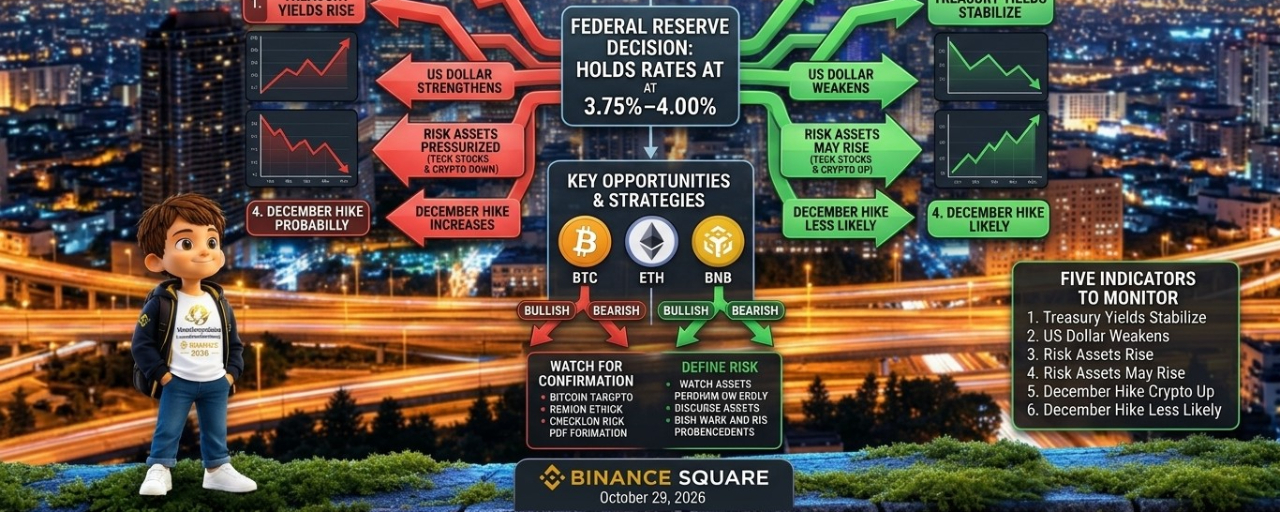
The Federal Reserve kept its federal funds target range at 3.75%–4.00% on October 28, 2026. The decision passed by a 10–2 vote, with two officials preferring a 0.25 percentage-point increase. The Fed said inflation remained elevated and left its next steps dependent on incoming information.
The decision matters for three reasons:
Inflation risk: Persistent inflation could keep interest rates higher for longer or encourage another increase.Treasury yields and the dollar: Rising yields and a stronger dollar can put pressure on risk assets, including technology stocks and cryptocurrencies.Market expectations: If a December rate hike is already priced in, markets may react less negatively than expected. If the Fed sounds more hawkish than investors anticipated, volatility could increase.
Important: A December hike is a possibility, not a confirmed decision. The Fed's official statement leaves the future policy path dependent on incoming data.
2. Where are the market opportunities?
Market opportunity overview
These are conditional scenarios, not guaranteed market outcomes. The dollar depends on relative interest rates and global risk sentiment, while gold can also rise during geopolitical stress—even when yields are high.
3. Bitcoin, Ethereum and BNB: Trading opportunities
For crypto traders, the central question is whether the Fed's message will encourage investors to take more risk or make them more defensive.
Recent reporting shows that the dollar and Treasury yields remained firm around the decision, while Bitcoin and Ether posted modest gains ahead of the announcement. This highlights why traders should watch actual price action instead of assuming that a rate pause automatically benefits crypto.
Bitcoin (BTC)
Bullish scenario
Treasury yields retreat and the dollar weakens.Bitcoin breaks above its recent resistance with strong trading volume.Buyers maintain control after a successful retest of the breakout level.
Bearish scenario
The market increasingly expects a December rate hike.The dollar and Treasury yields rise further.Bitcoin loses support, triggering stop-loss orders and potentially leveraged liquidations.
Opportunity: Wait for a confirmed breakout or breakdown. Avoid chasing a sudden price spike immediately after a Fed announcement.
Ethereum (ETH)
Bullish scenario: A broader crypto recovery, stronger ETH/BTC performance and improving risk appetite could support an Ethereum rebound.
Bearish scenario: If Bitcoin weakens and investors reduce exposure to riskier assets, ETH could face additional selling pressure.
Opportunity: Watch ETH/BTC alongside Ethereum's own support and resistance. A recovery in ETH/BTC can indicate improving relative strength, but it does not guarantee a price increase.
BNB
Bullish scenario: A Bitcoin-led recovery and stronger demand across major cryptocurrencies could help BNB rise.
Bearish scenario: A broad crypto sell-off could drag BNB lower, particularly if leveraged positions are unwound.
Opportunity: Look for confirmation from BNB's own price structure and trading volume rather than assuming it will follow Bitcoin point for point.
Important: I have not verified live BTC, ETH or BNB prices and technical levels in this analysis, so I would not treat any specific entry price or price target as confirmed.
4. Three scenarios to watch through December
The third scenario deserves particular attention. If inflation remains elevated while economic growth weakens, markets could struggle to price in the Fed's next move. Stocks, crypto and commodities might react in different directions.
Five indicators worth monitoring
US inflation: Does the next CPI report show that inflation is cooling or accelerating?Treasury yields: Do the 2-year and 10-year yields continue rising after the Fed decision?US dollar: Is the dollar strengthening against other major currencies?Bitcoin price structure: Are buyers defending support, or are rallies being sold?Technology earnings: Are major technology companies demonstrating that their AI investments are generating sustainable revenue?
These indicators help distinguish a temporary news-driven move from a broader market trend.
5. What is the best strategy right now?
My assessment is that capital preservation and confirmation are more attractive than making an aggressive directional bet before the market settles.
Consider three approaches:
Conservative: Keep sufficient cash available and wait for clearer price action. Cash is not risk-free, because inflation reduces purchasing power.Moderate: Consider staged entries only after confirming support, trend direction and a manageable risk-to-reward ratio.Active trading: Define your entry, invalidation level and maximum acceptable loss before entering. Avoid excessive leverage around major economic announcements.
For investors considering gold, short-term Treasuries or equities, compare expected returns with the relevant risks rather than assuming one asset will automatically outperform.
No strategy can guarantee a profit, and a widely anticipated rate hike can sometimes produce a market rally if the outcome is less hawkish than investors feared.
THE OPPORTUNITY
Watch Treasury yields, the US dollar, inflation data, technology earnings and key crypto support and resistance levels. Avoid chasing sudden price movements. Wait for confirmation and define your risk before entering a trade.
My outlook: The market faces two-way risk. The next major opportunity may come from the difference between what investors expect from the Fed and what incoming economic data actually reveals.
Disclaimer: This article is for educational and informational purposes only. Market scenarios are estimates, not guarantees or financial advice. Always conduct your own research and manage your risk.
#FederalReserve #Bitcoin #Ethereum #BNB #CryptoMarket #GlobalMarkets #MarketOutlook #Inflation #TreasuryYields #PositiveMindsGlobalResults #BinanceSquare
Positive Minds Global Results - Positivity without borders
INVEST, LEARN, GROW, TOGETHER
BINANCE SQUARE
Breaking News: Fed Holds Rates Steady, December Hike Risk Changes Market Opportunities
#fomcwatch 🌍#PositiveMindsGlobalResults Binance Square | October 29, 2026
The Federal Reserve holding interest rates steady does not automatically mean markets will rise or fall. The key question is whether investors expected a pause or were surprised by the possibility of another rate hike in December.
If the Fed signals that another hike remains possible, markets may reassess inflation risks, Treasury yields, the US dollar, equities, gold, and cryptocurrencies.
For traders, this creates potential opportunities in both directions. The strongest approach is to watch how markets react to the Fed's message rather than trade on the headline alone.
1. What happened? The key facts
The Federal Reserve kept its federal funds target range at 3.75%–4.00% on October 28, 2026. The decision passed by a 10–2 vote, with two officials preferring a 0.25 percentage-point increase. The Fed said inflation remained elevated and left its next steps dependent on incoming information.
The decision matters for three reasons:
Inflation risk: Persistent inflation could keep interest rates higher for longer or encourage another increase.Treasury yields and the dollar: Rising yields and a stronger dollar can put pressure on risk assets, including technology stocks and cryptocurrencies.Market expectations: If a December rate hike is already priced in, markets may react less negatively than expected. If the Fed sounds more hawkish than investors anticipated, volatility could increase.
Important: A December hike is a possibility, not a confirmed decision. The Fed's official statement leaves the future policy path dependent on incoming data.
2. Where are the market opportunities?
Market opportunity overview
These are conditional scenarios, not guaranteed market outcomes. The dollar depends on relative interest rates and global risk sentiment, while gold can also rise during geopolitical stress—even when yields are high.
3. Bitcoin, Ethereum and BNB: Trading opportunities
For crypto traders, the central question is whether the Fed's message will encourage investors to take more risk or make them more defensive.
Recent reporting shows that the dollar and Treasury yields remained firm around the decision, while Bitcoin and Ether posted modest gains ahead of the announcement. This highlights why traders should watch actual price action instead of assuming that a rate pause automatically benefits crypto.
Bitcoin (BTC)
Bullish scenario
Treasury yields retreat and the dollar weakens.Bitcoin breaks above its recent resistance with strong trading volume.Buyers maintain control after a successful retest of the breakout level.
Bearish scenario
The market increasingly expects a December rate hike.The dollar and Treasury yields rise further.Bitcoin loses support, triggering stop-loss orders and potentially leveraged liquidations.
Opportunity: Wait for a confirmed breakout or breakdown. Avoid chasing a sudden price spike immediately after a Fed announcement.
Ethereum (ETH)
Bullish scenario: A broader crypto recovery, stronger ETH/BTC performance and improving risk appetite could support an Ethereum rebound.
Bearish scenario: If Bitcoin weakens and investors reduce exposure to riskier assets, ETH could face additional selling pressure.
Opportunity: Watch ETH/BTC alongside Ethereum's own support and resistance. A recovery in ETH/BTC can indicate improving relative strength, but it does not guarantee a price increase.
BNB
Bullish scenario: A Bitcoin-led recovery and stronger demand across major cryptocurrencies could help BNB rise.
Bearish scenario: A broad crypto sell-off could drag BNB lower, particularly if leveraged positions are unwound.
Opportunity: Look for confirmation from BNB's own price structure and trading volume rather than assuming it will follow Bitcoin point for point.
Important: I have not verified live BTC, ETH or BNB prices and technical levels in this analysis, so I would not treat any specific entry price or price target as confirmed.
4. Three scenarios to watch through December
The third scenario deserves particular attention. If inflation remains elevated while economic growth weakens, markets could struggle to price in the Fed's next move. Stocks, crypto and commodities might react in different directions.
Five indicators worth monitoring
US inflation: Does the next CPI report show that inflation is cooling or accelerating?Treasury yields: Do the 2-year and 10-year yields continue rising after the Fed decision?US dollar: Is the dollar strengthening against other major currencies?Bitcoin price structure: Are buyers defending support, or are rallies being sold?Technology earnings: Are major technology companies demonstrating that their AI investments are generating sustainable revenue?
These indicators help distinguish a temporary news-driven move from a broader market trend.
5. What is the best strategy right now?
My assessment is that capital preservation and confirmation are more attractive than making an aggressive directional bet before the market settles.
Consider three approaches:
Conservative: Keep sufficient cash available and wait for clearer price action. Cash is not risk-free, because inflation reduces purchasing power.Moderate: Consider staged entries only after confirming support, trend direction and a manageable risk-to-reward ratio.Active trading: Define your entry, invalidation level and maximum acceptable loss before entering. Avoid excessive leverage around major economic announcements.
For investors considering gold, short-term Treasuries or equities, compare expected returns with the relevant risks rather than assuming one asset will automatically outperform.
No strategy can guarantee a profit, and a widely anticipated rate hike can sometimes produce a market rally if the outcome is less hawkish than investors feared.
THE OPPORTUNITY
Watch Treasury yields, the US dollar, inflation data, technology earnings and key crypto support and resistance levels. Avoid chasing sudden price movements. Wait for confirmation and define your risk before entering a trade.
My outlook: The market faces two-way risk. The next major opportunity may come from the difference between what investors expect from the Fed and what incoming economic data actually reveals.
Disclaimer: This article is for educational and informational purposes only. Market scenarios are estimates, not guarantees or financial advice. Always conduct your own research and manage your risk.
#FederalReserve #Bitcoin #Ethereum #BNB #CryptoMarket #GlobalMarkets #MarketOutlook #Inflation #TreasuryYields #PositiveMindsGlobalResults #BinanceSquare
Positive Minds Global Results - Positivity without borders
INVEST, LEARN, GROW, TOGETHER
BINANCE SQUARE
677
Article
Federal Reserve Emergency Rate Cut Before 2027: What Are the Chances?#fomcwatch 🌍 #PositiveMindsGlobalResults Binance Square | October 28, 2026
📊 97.8% ODDS AGAINST AN EMERGENCY FED RATE CUT BEFORE 2027?
Financial markets are focused on the US Federal Reserve's October 27–28 policy meeting, with investors watching for clues about inflation, borrowing costs, economic growth and the direction of global financial markets.
Based on the supplied market indicators, prediction markets assign approximately 97.8% probability to no emergency rate cut before 2027. This is a market-implied estimate, not a guarantee or an official Fed forecast.
1. Understanding the current indicators
Federal funds target range 3.75%–4.00%
Effective federal funds rate (EFFR) 3.88%
Market-implied chance of no emergency cut before 202797.8%
These are the figures in your supplied information, not independently verified live market readings.
A hawkish pause means the Fed leaves interest rates unchanged but signals that inflation remains a concern and that rate cuts may not happen soon.
A 97.8% probability of no emergency cut suggests markets see such a move as highly unlikely. However, prediction-market probabilities are not guarantees, and the result depends on the specific contract and its settlement rules.
2. How does an interest-rate pause impact the stock market?
A rate pause can support stock prices when investors expect future rate cuts. However, a hawkish pause can pressure stocks if markets fear interest rates will stay high for longer.
Market factor Potential impact
Technology and AI stocks Higher borrowing costs and discount rates can pressure
valuations.
Banks Lending margins may benefit, but credit risks can rise.
Bonds and Treasury yields Yields may rise if investors expect further tightening.
US dollar May strengthen if US rates remain relatively attractive.
Bitcoin and crypto May face pressure if liquidity tightens and investors reduce risk
exposure.
The actual reaction depends on whether the Fed's decision is more hawkish or dovish than markets have already priced in.
3. When is the next Federal Reserve meeting?
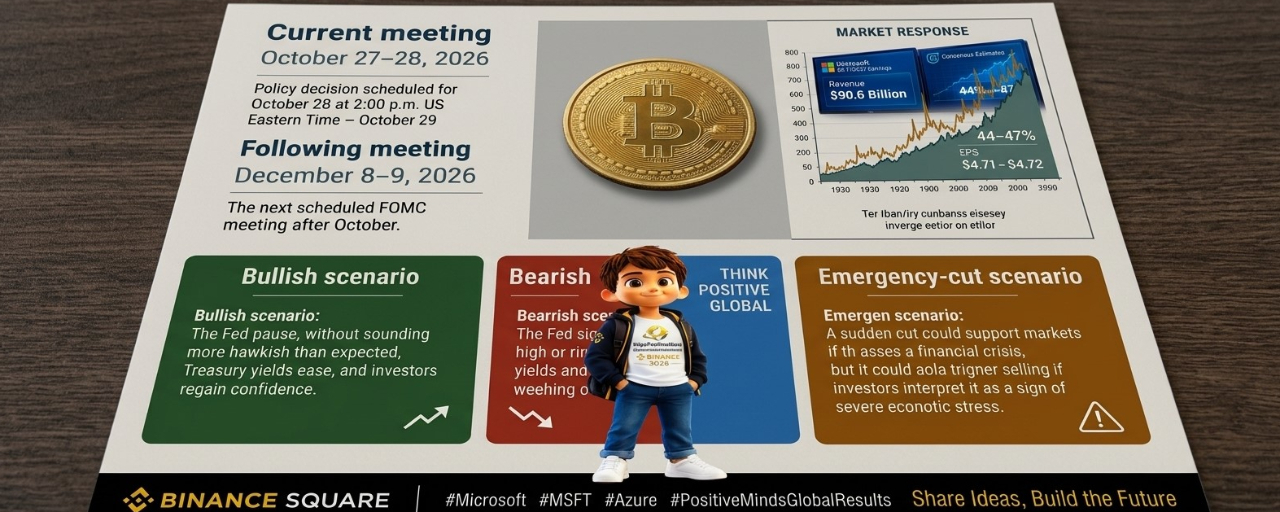
Current meeting
October 27–28, 2026
Policy decision scheduled for October 28 at 2:00 p.m. US Eastern Time — October 29
Following meeting
December 8–9, 2026
The next scheduled FOMC meeting after October.
4. What does this mean for Bitcoin and the wider market?
Bullish scenario: The Fed pauses without sounding more hawkish than expected, Treasury yields ease, and investors regain confidence.Bearish scenario: The Fed signals rates may stay high or rise again, pushing yields and the dollar higher and weighing on risk assets.Emergency-cut scenario: A sudden cut could support markets if it eases a financial crisis, but it could also trigger selling if investors interpret it as a sign of severe economic stress.
My conclusion: The supplied 97.8% figure indicates that an emergency rate cut is considered highly unlikely under that prediction-market contract. A regular policy decision, however, is not the same as an emergency cut. Current market data also indicate expectations of a rate hold at the October meeting, with a possible rate increase in December.
Based on the supplied market indicators, prediction markets assign approximately 97.8% probability to no emergency rate cut before 2027. This is a market-implied estimate, not a guarantee or an official Fed forecast.
The current federal funds target range is reported at 3.75%–4.00%, with the effective federal funds rate at 3.88%.
🇺🇸 5. WHAT SHOULD INVESTORS WATCH?
Markets widely expect the Fed to hold interest rates steady at this meeting. However, the bigger question is whether policymakers will signal that borrowing costs must remain elevated for longer or indicate that future rate adjustments remain possible.
A hawkish pause could mean:
Higher borrowing costs for longer.Continued pressure on expensive technology and growth-stock valuations.Support for the US dollar if Treasury yields rise.Tighter financial conditions that could weigh on speculative investments.
A more dovish message could ease bond yields, improve investor confidence and encourage renewed demand for risk assets.
The key is not simply whether the Fed holds rates. It is whether its decision and guidance are more hawkish or dovish than markets expect.
📈 6. US STOCKS & GLOBAL MARKETS
US stocks closed higher on October 27, with the S&P 500 rising 0.60%, the Nasdaq gaining 1.18%, and the Dow Jones Industrial Average advancing 0.03%, according to Reuters.
Technology shares and renewed enthusiasm around artificial intelligence supported the market ahead of the Fed announcement. Nevertheless, uncertainty surrounding borrowing costs, corporate earnings and AI investment spending remains important.
Across global markets, investors are also monitoring:
US Treasury yields and dollar strength.Inflation trends and central-bank policy.Oil prices and geopolitical risks.Corporate earnings and AI-related capital expenditure.Global liquidity and appetite for risk.
A hawkish surprise could trigger renewed volatility across stocks, bonds and cryptocurrencies. Conversely, a reassuring policy message could support a broader relief rally.
₿ 7. BITCOIN (BTC): LIQUIDITY REMAINS CRUCIAL
Bitcoin's near-term direction may depend on the relationship between Treasury yields, the US dollar, investor positioning and institutional demand.
Bullish scenario: The Fed holds rates and avoids stronger-than-expected hawkish guidance. If yields ease and risk appetite improves, Bitcoin could benefit from renewed buying pressure.
Bearish scenario: The Fed signals that rates may remain high or that further tightening could be necessary. A stronger dollar, rising yields and reduced risk appetite could put Bitcoin under pressure.
What to watch: Spot-market demand, ETF flows, trading volume, liquidation levels and whether Bitcoin breaks important technical resistance or support zones.
A rate pause alone does not guarantee a Bitcoin rally. Market expectations may already reflect the anticipated decision.
⟠ 8. ETHEREUM (ETH): WATCH RISK APPETITE
Ethereum may respond to the same macroeconomic pressures affecting Bitcoin, while also reflecting network activity, capital flows and demand for digital-asset applications.
A dovish surprise and improving liquidity could help ETH recover if buyers return. A hawkish policy signal could increase downside risks, especially if leveraged positions unwind.
Investors should monitor ETH's relative performance against BTC, spot demand and key technical levels rather than relying exclusively on the Fed announcement.
🟡9. BNB: SENTIMENT AND MARKET STRUCTURE MATTER
BNB could benefit from a broad cryptocurrency recovery if Bitcoin strengthens and investors become more comfortable taking risks.
However, if the Fed's guidance pushes yields and the dollar higher, BNB could face selling pressure alongside other crypto assets.
BNB's own ecosystem developments, token demand and market liquidity will also influence its performance.
Important: BTC, ETH and BNB may move in different directions over short periods. No single macroeconomic indicator determines their prices.
🔮 10. WHAT COULD HAPPEN NEXT?
Scenario A — Relief rally: The Fed holds rates, its guidance is less hawkish than feared, and Treasury yields decline. Stocks and cryptocurrencies could benefit.
Scenario B — Cautious consolidation: The decision matches expectations, leaving markets to react to the Fed's comments, economic data and earnings. BTC, ETH and BNB could trade unevenly.
Scenario C — Renewed selling pressure: Policymakers signal that inflation remains a serious concern and rates may need to stay high or rise further. Stocks and cryptocurrencies could face additional volatility.
These are conditional scenarios, not guaranteed predictions or precise price targets.
🌐 FINAL THOUGHTS: STAY INFORMED, NOT EMOTIONAL
The Federal Reserve's October decision could influence global markets, but the market reaction will depend on the difference between expectations and actual policy guidance.
A hawkish pause is not automatically bearish, and a dovish signal is not automatically bullish. Investors should assess Treasury yields, the dollar, market liquidity, institutional flows and technical conditions together.
For Bitcoin, Ethereum and BNB, disciplined risk management matters more than attempting to predict every short-term move.
🔎 COMMUNITY DISCUSSION
Do you expect the Fed to maintain a hawkish stance through the end of 2026, or could weakening economic data change the outlook?
Will Bitcoin, Ethereum and BNB benefit from the October decision, or will uncertainty about December policy keep pressure on crypto markets?
Share your analysis respectfully and support your views with evidence.
⚠️ DISCLAIMER
This article is for educational and informational purposes only and does not constitute financial or investment advice. Market probabilities, forecasts and scenarios are estimates that can change rapidly. No outcome or price target is guaranteed. Always conduct your own research (DYOR) and manage your risk responsibly.
#PositiveMindsGlobalResults #BinanceSquare #FederalReserve #FedRateDecision #MarketSentimentToday #Bitcoin #Ethereum #BNB #CryptoMarketAnalysis #USStockMarket #GlobalMarkets #Inflation #TreasuryYields #InterestRates #AIStocks #CryptoForecast #DYOR
Federal Reserve Emergency Rate Cut Before 2027: What Are the Chances?
#fomcwatch 🌍 #PositiveMindsGlobalResults Binance Square | October 28, 2026
📊 97.8% ODDS AGAINST AN EMERGENCY FED RATE CUT BEFORE 2027?
Financial markets are focused on the US Federal Reserve's October 27–28 policy meeting, with investors watching for clues about inflation, borrowing costs, economic growth and the direction of global financial markets.
Based on the supplied market indicators, prediction markets assign approximately 97.8% probability to no emergency rate cut before 2027. This is a market-implied estimate, not a guarantee or an official Fed forecast.
1. Understanding the current indicators
Federal funds target range 3.75%–4.00%
Effective federal funds rate (EFFR) 3.88%
Market-implied chance of no emergency cut before 202797.8%
These are the figures in your supplied information, not independently verified live market readings.
A hawkish pause means the Fed leaves interest rates unchanged but signals that inflation remains a concern and that rate cuts may not happen soon.
A 97.8% probability of no emergency cut suggests markets see such a move as highly unlikely. However, prediction-market probabilities are not guarantees, and the result depends on the specific contract and its settlement rules.
2. How does an interest-rate pause impact the stock market?
A rate pause can support stock prices when investors expect future rate cuts. However, a hawkish pause can pressure stocks if markets fear interest rates will stay high for longer.
Market factor Potential impact
Technology and AI stocks Higher borrowing costs and discount rates can pressure
valuations.
Banks Lending margins may benefit, but credit risks can rise.
Bonds and Treasury yields Yields may rise if investors expect further tightening.
US dollar May strengthen if US rates remain relatively attractive.
Bitcoin and crypto May face pressure if liquidity tightens and investors reduce risk
exposure.
The actual reaction depends on whether the Fed's decision is more hawkish or dovish than markets have already priced in.
3. When is the next Federal Reserve meeting?
Current meeting
October 27–28, 2026
Policy decision scheduled for October 28 at 2:00 p.m. US Eastern Time — October 29
Following meeting
December 8–9, 2026
The next scheduled FOMC meeting after October.
4. What does this mean for Bitcoin and the wider market?
Bullish scenario: The Fed pauses without sounding more hawkish than expected, Treasury yields ease, and investors regain confidence.Bearish scenario: The Fed signals rates may stay high or rise again, pushing yields and the dollar higher and weighing on risk assets.Emergency-cut scenario: A sudden cut could support markets if it eases a financial crisis, but it could also trigger selling if investors interpret it as a sign of severe economic stress.
My conclusion: The supplied 97.8% figure indicates that an emergency rate cut is considered highly unlikely under that prediction-market contract. A regular policy decision, however, is not the same as an emergency cut. Current market data also indicate expectations of a rate hold at the October meeting, with a possible rate increase in December.
Based on the supplied market indicators, prediction markets assign approximately 97.8% probability to no emergency rate cut before 2027. This is a market-implied estimate, not a guarantee or an official Fed forecast.
The current federal funds target range is reported at 3.75%–4.00%, with the effective federal funds rate at 3.88%.
🇺🇸 5. WHAT SHOULD INVESTORS WATCH?
Markets widely expect the Fed to hold interest rates steady at this meeting. However, the bigger question is whether policymakers will signal that borrowing costs must remain elevated for longer or indicate that future rate adjustments remain possible.
A hawkish pause could mean:
Higher borrowing costs for longer.Continued pressure on expensive technology and growth-stock valuations.Support for the US dollar if Treasury yields rise.Tighter financial conditions that could weigh on speculative investments.
A more dovish message could ease bond yields, improve investor confidence and encourage renewed demand for risk assets.
The key is not simply whether the Fed holds rates. It is whether its decision and guidance are more hawkish or dovish than markets expect.
📈 6. US STOCKS & GLOBAL MARKETS
US stocks closed higher on October 27, with the S&P 500 rising 0.60%, the Nasdaq gaining 1.18%, and the Dow Jones Industrial Average advancing 0.03%, according to Reuters.
Technology shares and renewed enthusiasm around artificial intelligence supported the market ahead of the Fed announcement. Nevertheless, uncertainty surrounding borrowing costs, corporate earnings and AI investment spending remains important.
Across global markets, investors are also monitoring:
US Treasury yields and dollar strength.Inflation trends and central-bank policy.Oil prices and geopolitical risks.Corporate earnings and AI-related capital expenditure.Global liquidity and appetite for risk.
A hawkish surprise could trigger renewed volatility across stocks, bonds and cryptocurrencies. Conversely, a reassuring policy message could support a broader relief rally.
₿ 7. BITCOIN (BTC): LIQUIDITY REMAINS CRUCIAL
Bitcoin's near-term direction may depend on the relationship between Treasury yields, the US dollar, investor positioning and institutional demand.
Bullish scenario: The Fed holds rates and avoids stronger-than-expected hawkish guidance. If yields ease and risk appetite improves, Bitcoin could benefit from renewed buying pressure.
Bearish scenario: The Fed signals that rates may remain high or that further tightening could be necessary. A stronger dollar, rising yields and reduced risk appetite could put Bitcoin under pressure.
What to watch: Spot-market demand, ETF flows, trading volume, liquidation levels and whether Bitcoin breaks important technical resistance or support zones.
A rate pause alone does not guarantee a Bitcoin rally. Market expectations may already reflect the anticipated decision.
⟠ 8. ETHEREUM (ETH): WATCH RISK APPETITE
Ethereum may respond to the same macroeconomic pressures affecting Bitcoin, while also reflecting network activity, capital flows and demand for digital-asset applications.
A dovish surprise and improving liquidity could help ETH recover if buyers return. A hawkish policy signal could increase downside risks, especially if leveraged positions unwind.
Investors should monitor ETH's relative performance against BTC, spot demand and key technical levels rather than relying exclusively on the Fed announcement.
🟡9. BNB: SENTIMENT AND MARKET STRUCTURE MATTER
BNB could benefit from a broad cryptocurrency recovery if Bitcoin strengthens and investors become more comfortable taking risks.
However, if the Fed's guidance pushes yields and the dollar higher, BNB could face selling pressure alongside other crypto assets.
BNB's own ecosystem developments, token demand and market liquidity will also influence its performance.
Important: BTC, ETH and BNB may move in different directions over short periods. No single macroeconomic indicator determines their prices.
🔮 10. WHAT COULD HAPPEN NEXT?
Scenario A — Relief rally: The Fed holds rates, its guidance is less hawkish than feared, and Treasury yields decline. Stocks and cryptocurrencies could benefit.
Scenario B — Cautious consolidation: The decision matches expectations, leaving markets to react to the Fed's comments, economic data and earnings. BTC, ETH and BNB could trade unevenly.
Scenario C — Renewed selling pressure: Policymakers signal that inflation remains a serious concern and rates may need to stay high or rise further. Stocks and cryptocurrencies could face additional volatility.
These are conditional scenarios, not guaranteed predictions or precise price targets.
🌐 FINAL THOUGHTS: STAY INFORMED, NOT EMOTIONAL
The Federal Reserve's October decision could influence global markets, but the market reaction will depend on the difference between expectations and actual policy guidance.
A hawkish pause is not automatically bearish, and a dovish signal is not automatically bullish. Investors should assess Treasury yields, the dollar, market liquidity, institutional flows and technical conditions together.
For Bitcoin, Ethereum and BNB, disciplined risk management matters more than attempting to predict every short-term move.
🔎 COMMUNITY DISCUSSION
Do you expect the Fed to maintain a hawkish stance through the end of 2026, or could weakening economic data change the outlook?
Will Bitcoin, Ethereum and BNB benefit from the October decision, or will uncertainty about December policy keep pressure on crypto markets?
Share your analysis respectfully and support your views with evidence.
⚠️ DISCLAIMER
This article is for educational and informational purposes only and does not constitute financial or investment advice. Market probabilities, forecasts and scenarios are estimates that can change rapidly. No outcome or price target is guaranteed. Always conduct your own research (DYOR) and manage your risk responsibly.
#PositiveMindsGlobalResults #BinanceSquare #FederalReserve #FedRateDecision #MarketSentimentToday #Bitcoin #Ethereum #BNB #CryptoMarketAnalysis #USStockMarket #GlobalMarkets #Inflation #TreasuryYields #InterestRates #AIStocks #CryptoForecast #DYOR
Strongverine:
Good framing question, but the 'emergency cut' angle is a distraction from the real debate. The question isn't whether the Fed cuts in an emergency — it's whether it hikes in December. Reuters polled 100 economists: 94 expect a hold tonight and all 100 expect a December hike, with market odds for December around ~80%. That's the repricing risk for BTC, not a cut nobody is pricing. Not financial advice.
1
2
3.5k

Article
BTC, BNB and ETH Forecast for the Next 24 Hours#BTCBNBETHNext24Hours |🌍#PositiveMindsGlobalResults [ ](https://www.binance.com/en/square/hashtag/PositiveMindsGlobalResults) Binance Square | October 28, 2026
BTC, BNB and ETH Bullish vs Bearish Scenarios Fed Decision in Focus
The cryptocurrency market is attempting to recover as investors await the Federal Reserve's latest policy decision. Bitcoin is trading around the $81,000 area, BNB is showing stronger short-term momentum, and Ethereum is trying to extend its recovery.
However, persistent inflation, elevated Treasury yields, geopolitical uncertainty and the possibility of a hawkish Federal Reserve outlook could limit further gains.
This forecast examines the potential direction of BTC, BNB and ETH over the next 24 hours, using current market observations, technical levels and macroeconomic scenarios.
BTC
Reference price: Approximately $81,300
Bitcoin has recovered from its recent decline toward $79,000, but its short-term recovery has not yet confirmed a sustained bullish reversal. The market is approaching an important resistance zone while traders monitor the Federal Reserve's decision and guidance.
Key technical levels:
Support: $80,400, $79,700 and $79,250
Resistance: $81,960, $82,380 and $82,800
Bullish Scenario:
If BTC maintains support above $80,400 and breaks through $81,960 with convincing buying volume, the next potential targets are $82,380 and $82,800.
A sustained move above $82,800 could strengthen recovery momentum and improve sentiment across the broader cryptocurrency market. However, a short-lived breakout without strong volume may reverse quickly.
Bearish Scenario:
If BTC loses $80,400, selling pressure could push the price toward $79,700 and $79,250.
A decisive breakdown below $79,250 would weaken the immediate recovery structure and increase the risk of a deeper correction. A sustained move back above $82,000 would be needed to improve the short-term technical picture.
24-hour outlook: Neutral to cautiously bullish while BTC holds above $80,400, but confirmation above $81,960 remains important.
BNB
Reference price: Approximately $751
BNB is demonstrating comparatively stronger technical momentum, with recent indicators showing positive momentum across several timeframes. Nevertheless, resistance near $755 to $767 could attract profit-taking.
Key technical levels:
Support: $739, $731 and $722
Resistance: $749, $756 and $767
Bullish Scenario:
If BNB holds above $739 and establishes sustained buying pressure above $749, the next potential targets are $756 and $767.
A convincing breakout above $767 could open the way for further recovery, provided trading volume and overall market sentiment remain supportive.
Continued strength in Bitcoin and a positive shift in broader risk appetite would improve the bullish case.
Bearish Scenario:
If BNB falls below $739, the price could retest $731 and then $722.
A breakdown below $722 would weaken the short-term structure and increase downside risk, particularly if Bitcoin also loses its support zone.
Traders should watch whether BNB continues to outperform BTC or begins to lose relative strength during market volatility.
24-hour outlook: Cautiously bullish above $739, with $756 and $767 as potential resistance targets. A break below $739 would weaken the outlook.
ETH
Reference price: Approximately $2,379
Ethereum is attempting to recover, but its technical signals remain mixed. Short-term buying interest has improved, while momentum indicators and resistance levels suggest that the broader recovery still requires confirmation.
Key technical levels:
Support: $2,326, $2,292 and $2,251
Resistance: $2,400, $2,466 and $2,537
Bullish Scenario:
If ETH holds above $2,326 and breaks through $2,400, the next potential resistance zone is around $2,466.
A sustained move above $2,466 could improve momentum and bring $2,537 into focus, provided Bitcoin remains stable and market liquidity supports further gains.
Stronger buying volume and improving market sentiment would help confirm that Ethereum's recovery is gaining traction.
Bearish Scenario:
If ETH fails to break above $2,400 and falls below $2,326, the next potential support levels are $2,292 and $2,251.
A sustained breakdown below $2,251 would indicate renewed selling pressure and could undermine the recovery attempt.
Ethereum's ability to maintain support while Bitcoin consolidates will be important in determining whether ETH can outperform the broader market.
24-hour outlook: Neutral to cautiously bullish above $2,326, but a sustained break above $2,400 is needed to strengthen the upside scenario.
FEDERAL RESERVE AND GLOBAL MARKET FACTORS
The Federal Reserve's October 28 policy decision is the most important scheduled macroeconomic catalyst for this forecast period. In Malaysia, the announcement is expected early on October 29.
Markets broadly anticipate unchanged interest rates, making the accompanying statement and the chair's comments especially important.
Potential bullish catalysts:
A less restrictive policy outlook could weaken the US dollar, ease Treasury yield pressure and improve appetite for risk-sensitive assets.
Continued strength in technology stocks, positive institutional crypto flows and stronger spot buying could also support BTC, BNB and ETH.
Potential bearish catalysts:
A hawkish policy message, renewed expectations of a December rate hike, persistent inflation or rising energy prices could strengthen the dollar and keep Treasury yields elevated.
Geopolitical tensions and higher oil prices could add to inflation concerns, potentially limiting the Federal Reserve's ability to ease monetary policy.
A stronger dollar and higher yields would create additional headwinds for cryptocurrencies, particularly if leveraged traders begin reducing their exposure.
WHAT TRADERS SHOULD WATCH
Bitcoin: Can BTC break above $81,960 and sustain momentum toward $82,800?
BNB: Can buyers defend $739 and establish a convincing breakout above $756?
Ethereum: Can ETH clear $2,400 and advance toward $2,466?
Macro conditions: Will the Federal Reserve communicate a more restrictive outlook, and how will the dollar and Treasury yields react?
Market confirmation: Are spot buying volume and institutional flows supporting the recovery, or is the market experiencing a temporary rebound?
FINAL MARKET OUTLOOK
BTC: Neutral to cautiously bullish above $80,400, with resistance between $81,960 and $82,800.
BNB: Cautiously bullish above $739, with potential upside targets at $756 and $767.
ETH: Neutral to cautiously bullish above $2,326, with resistance at $2,400 and $2,466.
The overall market bias is cautiously optimistic, but confidence remains limited ahead of the Federal Reserve's decision. BNB currently has the more constructive technical picture, while Bitcoin remains the key market benchmark and Ethereum needs a clearer breakout to confirm improving momentum.
These are conditional scenarios, not guaranteed price predictions. A hawkish Fed surprise or an unexpected geopolitical development could invalidate the bullish outlook for all three assets.
Disclaimer: This article is for informational and educational purposes only. Price levels are estimates based on market observations available on October 28, 2026, and may change rapidly. This is not financial advice or a guarantee of future performance. Always conduct your own research, manage risk carefully and never trade more than you can afford to lose.
#PositiveMindsGlobalResults #PositiveMindsGlobalResults #BitcoinForecast #CryptoMarket #BullishVsBearish #MarketSentimentToday #EstimatesNotAdviceButHope
{spot}(BNBUSDT)
BTC, BNB and ETH Forecast for the Next 24 Hours
#BTCBNBETHNext24Hours |🌍#PositiveMindsGlobalResults Binance Square | October 28, 2026
BTC, BNB and ETH Bullish vs Bearish Scenarios Fed Decision in Focus
The cryptocurrency market is attempting to recover as investors await the Federal Reserve's latest policy decision. Bitcoin is trading around the $81,000 area, BNB is showing stronger short-term momentum, and Ethereum is trying to extend its recovery.
However, persistent inflation, elevated Treasury yields, geopolitical uncertainty and the possibility of a hawkish Federal Reserve outlook could limit further gains.
This forecast examines the potential direction of BTC, BNB and ETH over the next 24 hours, using current market observations, technical levels and macroeconomic scenarios.
BTC
Reference price: Approximately $81,300
Bitcoin has recovered from its recent decline toward $79,000, but its short-term recovery has not yet confirmed a sustained bullish reversal. The market is approaching an important resistance zone while traders monitor the Federal Reserve's decision and guidance.
Key technical levels:
Support: $80,400, $79,700 and $79,250
Resistance: $81,960, $82,380 and $82,800
Bullish Scenario:
If BTC maintains support above $80,400 and breaks through $81,960 with convincing buying volume, the next potential targets are $82,380 and $82,800.
A sustained move above $82,800 could strengthen recovery momentum and improve sentiment across the broader cryptocurrency market. However, a short-lived breakout without strong volume may reverse quickly.
Bearish Scenario:
If BTC loses $80,400, selling pressure could push the price toward $79,700 and $79,250.
A decisive breakdown below $79,250 would weaken the immediate recovery structure and increase the risk of a deeper correction. A sustained move back above $82,000 would be needed to improve the short-term technical picture.
24-hour outlook: Neutral to cautiously bullish while BTC holds above $80,400, but confirmation above $81,960 remains important.
BNB
Reference price: Approximately $751
BNB is demonstrating comparatively stronger technical momentum, with recent indicators showing positive momentum across several timeframes. Nevertheless, resistance near $755 to $767 could attract profit-taking.
Key technical levels:
Support: $739, $731 and $722
Resistance: $749, $756 and $767
Bullish Scenario:
If BNB holds above $739 and establishes sustained buying pressure above $749, the next potential targets are $756 and $767.
A convincing breakout above $767 could open the way for further recovery, provided trading volume and overall market sentiment remain supportive.
Continued strength in Bitcoin and a positive shift in broader risk appetite would improve the bullish case.
Bearish Scenario:
If BNB falls below $739, the price could retest $731 and then $722.
A breakdown below $722 would weaken the short-term structure and increase downside risk, particularly if Bitcoin also loses its support zone.
Traders should watch whether BNB continues to outperform BTC or begins to lose relative strength during market volatility.
24-hour outlook: Cautiously bullish above $739, with $756 and $767 as potential resistance targets. A break below $739 would weaken the outlook.
ETH
Reference price: Approximately $2,379
Ethereum is attempting to recover, but its technical signals remain mixed. Short-term buying interest has improved, while momentum indicators and resistance levels suggest that the broader recovery still requires confirmation.
Key technical levels:
Support: $2,326, $2,292 and $2,251
Resistance: $2,400, $2,466 and $2,537
Bullish Scenario:
If ETH holds above $2,326 and breaks through $2,400, the next potential resistance zone is around $2,466.
A sustained move above $2,466 could improve momentum and bring $2,537 into focus, provided Bitcoin remains stable and market liquidity supports further gains.
Stronger buying volume and improving market sentiment would help confirm that Ethereum's recovery is gaining traction.
Bearish Scenario:
If ETH fails to break above $2,400 and falls below $2,326, the next potential support levels are $2,292 and $2,251.
A sustained breakdown below $2,251 would indicate renewed selling pressure and could undermine the recovery attempt.
Ethereum's ability to maintain support while Bitcoin consolidates will be important in determining whether ETH can outperform the broader market.
24-hour outlook: Neutral to cautiously bullish above $2,326, but a sustained break above $2,400 is needed to strengthen the upside scenario.
FEDERAL RESERVE AND GLOBAL MARKET FACTORS
The Federal Reserve's October 28 policy decision is the most important scheduled macroeconomic catalyst for this forecast period. In Malaysia, the announcement is expected early on October 29.
Markets broadly anticipate unchanged interest rates, making the accompanying statement and the chair's comments especially important.
Potential bullish catalysts:
A less restrictive policy outlook could weaken the US dollar, ease Treasury yield pressure and improve appetite for risk-sensitive assets.
Continued strength in technology stocks, positive institutional crypto flows and stronger spot buying could also support BTC, BNB and ETH.
Potential bearish catalysts:
A hawkish policy message, renewed expectations of a December rate hike, persistent inflation or rising energy prices could strengthen the dollar and keep Treasury yields elevated.
Geopolitical tensions and higher oil prices could add to inflation concerns, potentially limiting the Federal Reserve's ability to ease monetary policy.
A stronger dollar and higher yields would create additional headwinds for cryptocurrencies, particularly if leveraged traders begin reducing their exposure.
WHAT TRADERS SHOULD WATCH
Bitcoin: Can BTC break above $81,960 and sustain momentum toward $82,800?
BNB: Can buyers defend $739 and establish a convincing breakout above $756?
Ethereum: Can ETH clear $2,400 and advance toward $2,466?
Macro conditions: Will the Federal Reserve communicate a more restrictive outlook, and how will the dollar and Treasury yields react?
Market confirmation: Are spot buying volume and institutional flows supporting the recovery, or is the market experiencing a temporary rebound?
FINAL MARKET OUTLOOK
BTC: Neutral to cautiously bullish above $80,400, with resistance between $81,960 and $82,800.
BNB: Cautiously bullish above $739, with potential upside targets at $756 and $767.
ETH: Neutral to cautiously bullish above $2,326, with resistance at $2,400 and $2,466.
The overall market bias is cautiously optimistic, but confidence remains limited ahead of the Federal Reserve's decision. BNB currently has the more constructive technical picture, while Bitcoin remains the key market benchmark and Ethereum needs a clearer breakout to confirm improving momentum.
These are conditional scenarios, not guaranteed price predictions. A hawkish Fed surprise or an unexpected geopolitical development could invalidate the bullish outlook for all three assets.
Disclaimer: This article is for informational and educational purposes only. Price levels are estimates based on market observations available on October 28, 2026, and may change rapidly. This is not financial advice or a guarantee of future performance. Always conduct your own research, manage risk carefully and never trade more than you can afford to lose.
#PositiveMindsGlobalResults #PositiveMindsGlobalResults #BitcoinForecast #CryptoMarket #BullishVsBearish #MarketSentimentToday #EstimatesNotAdviceButHope
59
#OilMarket 🌍#PositiveMindsGlobalResults [ ](https://www.binance.com/en/square/hashtag/PositiveMindsGlobalResults)Binance Square | October 28, 2026
Oil Above $115: A New Risk for Global Markets and Crypto
Middle East tensions and reported Houthi attacks involving Saudi Arabia have heightened concerns about oil supply security. Brent crude rising above $115 per barrel could intensify inflation fears and increase market volatility.
Bullish Scenario for Oil: Prolonged supply disruptions could push crude prices higher, benefiting some energy producers.
Bearish Scenario for Global Markets: Expensive oil could raise business and consumer costs, complicate Federal Reserve rate decisions, and pressure stocks and cryptocurrencies.
Impact on BTC, BNB and ETH: Rising inflation concerns and higher Treasury yields could weaken risk appetite, adding short-term pressure to Bitcoin, BNB, and Ethereum. However, price direction also depends on Fed guidance, ETF flows, liquidity, and geopolitical developments.
Key Signals: Oil prices, Middle East developments, US Treasury yields, the US dollar, Fed policy, and crypto ETF flows.
Outlook: Expect potential volatility over the next 24 hours as markets assess geopolitical and inflation risks. No direction is guaranteed.
Disclaimer: Educational content only. Scenarios are estimates, not financial advice or guaranteed predictions. DYOR.
#PositiveMindsGlobalResults #BinanceSquare #OilShock #InflationWatch #GlobalMarkets #FederalReserve #Bitcoin #BNB #Ethereum #CryptoMarketOutlook
#OilMarket 🌍#PositiveMindsGlobalResults Binance Square | October 28, 2026
Oil Above $115: A New Risk for Global Markets and Crypto
Middle East tensions and reported Houthi attacks involving Saudi Arabia have heightened concerns about oil supply security. Brent crude rising above $115 per barrel could intensify inflation fears and increase market volatility.
Bullish Scenario for Oil: Prolonged supply disruptions could push crude prices higher, benefiting some energy producers.
Bearish Scenario for Global Markets: Expensive oil could raise business and consumer costs, complicate Federal Reserve rate decisions, and pressure stocks and cryptocurrencies.
Impact on BTC, BNB and ETH: Rising inflation concerns and higher Treasury yields could weaken risk appetite, adding short-term pressure to Bitcoin, BNB, and Ethereum. However, price direction also depends on Fed guidance, ETF flows, liquidity, and geopolitical developments.
Key Signals: Oil prices, Middle East developments, US Treasury yields, the US dollar, Fed policy, and crypto ETF flows.
Outlook: Expect potential volatility over the next 24 hours as markets assess geopolitical and inflation risks. No direction is guaranteed.
Disclaimer: Educational content only. Scenarios are estimates, not financial advice or guaranteed predictions. DYOR.
#PositiveMindsGlobalResults #BinanceSquare #OilShock #InflationWatch #GlobalMarkets #FederalReserve #Bitcoin #BNB #Ethereum #CryptoMarketOutlook

77

Article
Microsoft Beats Earnings Expectations, but the AI Spending Challenge Is Far From Over#canmicrosoftdeliveronai 🌍#PositiveMindsGlobalResults Binance Square | October 29, 2026
Azure Surges 48% as Microsoft Faces a Critical Question: Can AI Growth Deliver Long-Term Profits?
October 29, 2026 | Technology, AI and Global Markets
Microsoft has delivered a powerful message to global markets: demand for artificial intelligence is accelerating, and its cloud business is benefiting. But beneath the impressive earnings numbers lies a much bigger investment question. How much must Microsoft spend to maintain its AI leadership, and how quickly can those investments generate sustainable returns?
1. Microsoft's Latest Earnings: The Numbers That Matter
Microsoft reported its fiscal first-quarter 2027 results for the three months ended September 30, 2026, delivering strong year-over-year growth.
Key financial highlights:
Total revenue reached $92.28 billion, up 19% year over year.Operating income climbed 21% to $45.92 billion.GAAP net income increased 32% to $36.63 billion.GAAP diluted earnings per share reached $4.92, while adjusted non-GAAP EPS was $4.89.Microsoft Cloud revenue rose 30% to $63.9 billion.Azure revenue increased 48%, demonstrating substantial demand for cloud and AI infrastructure.
Revenue exceeded the approximately $90.74 billion consensus estimate cited in preliminary market data. However, investors should distinguish between GAAP and adjusted earnings rather than relying on incomplete early data.
2. Azure's 48% Growth: The Real AI Story
Azure is becoming one of Microsoft's most important growth engines.
The company also reported $677 billion in commercial remaining performance obligations, up 73% year over year. This represents contracted revenue that has not yet been recognized, providing visibility into future business demand.
However, contracted revenue is not the same as immediate cash flow. The timing of customer usage, contract delivery and revenue recognition still matters.
For investors, the key question is whether Azure can maintain strong growth while Microsoft expands its data centers, computing capacity and AI services.
If demand remains strong and infrastructure utilization improves, Microsoft could strengthen its competitive position. If capacity costs rise faster than customer revenue, profitability could come under pressure.
3. The $50 Billion Question: Can AI Pay for Itself?
Microsoft's AI ambitions require enormous investment in computing infrastructure, data centers, networking equipment and specialized chips.
Management had indicated that quarterly capital expenditure would exceed $50 billion. The scale of this spending makes capital efficiency a central issue for investors.
The bullish argument is straightforward: today's infrastructure investment could support years of cloud growth, enterprise AI adoption and recurring software revenue.
The bearish argument is equally important: infrastructure must generate sufficient revenue and cash flow to justify its cost. Rapid technological change, depreciation, energy requirements and competition could weaken returns.
Strong AI demand is encouraging, but demand alone does not guarantee attractive investment returns.
Investors should monitor capital expenditure, free cash flow, operating margins and evidence that customers are paying for AI products at a sustainable scale.
4. Microsoft's Workforce Strategy: Efficiency Under Pressure
Microsoft has also introduced a voluntary buyout program for approximately 60,000 eligible employees as it seeks to manage costs while expanding its AI capabilities.
This is a voluntary buyout initiative, not confirmation that all eligible employees will leave the company.
The broader issue is how Microsoft allocates resources between its existing workforce, traditional software operations and emerging AI opportunities.
Successful restructuring could improve efficiency. However, cost reductions must be balanced against employee expertise, product development and the ability to compete in a rapidly changing technology market.
5. A New Reporting Structure Changes the Investment Picture
Microsoft has introduced a revised financial reporting structure, including its new Agents and Infra and Devices and Consumer segments.
The change comes as AI becomes increasingly important across the company's business.
More detailed reporting can help investors understand how Microsoft's infrastructure and AI-related operations are developing. However, changes in segment definitions can make historical comparisons more complicated.
Investors should compare equivalent reporting categories and pay attention to how management explains growth across Azure, Microsoft 365 and other AI-related services.
6. Bullish vs. Bearish Scenarios for Microsoft
The Bullish Scenario
Azure maintains strong growth, enterprise customers increase AI spending, and Microsoft converts infrastructure investments into recurring revenue. Improving utilization and disciplined spending could support stronger long-term cash generation.
The Bearish Scenario
Capital expenditure continues rising, AI monetization disappoints, and competition pressures margins. If infrastructure spending grows faster than revenue and cash flow, investors could question whether Microsoft's AI expansion is generating sufficient returns.
The Key Indicator
Watch the relationship between Azure growth, capital expenditure and free cash flow. Strong revenue growth combined with improving cash generation would provide more convincing evidence of sustainable AI economics.
7. What This Means for Global Technology Markets
Microsoft's results matter beyond its own share price.
Cloud infrastructure providers, semiconductor manufacturers, data-center operators and enterprise software companies are all connected to the AI investment cycle.
Strong Azure growth could reinforce confidence in enterprise AI demand and infrastructure spending. Conversely, concerns about capital efficiency could increase scrutiny of technology companies investing heavily in AI.
The market's next major test is whether strong AI demand can translate into durable earnings and cash flow across the industry.
Final Verdict: AI Growth Is Real, but Returns Still Matter
Microsoft's latest results demonstrate strong revenue growth, accelerating Azure demand and substantial commercial commitments.
Yet the next stage of the AI boom will require more than impressive growth rates. Investors will increasingly evaluate how efficiently companies turn computing capacity and AI adoption into profits and cash flow.
Microsoft's opportunity is significant, but execution remains critical.
The big question for 2027 is not simply who spends the most on AI. It is who generates the strongest sustainable returns from that spending.
This distinction could become one of the defining investment themes for global technology markets.
Disclaimer: This article is for educational and informational purposes only. It is not financial or investment advice. Market outcomes are uncertain, and past performance does not guarantee future results. Always conduct your own research before making investment decisions.
#Microsoft #MSFT #Azure #ArtificialIntelligence #AIInfrastructure #TechStocks #CloudComputing #GlobalMarkets #EarningsSeason #PositiveMindsGlobalResults #BinanceSquare
Positive Minds Global Results - Positivity without borders
INVEST, LEARN, GROW, TOGETHER
BINANCE SQUARE
Microsoft Beats Earnings Expectations, but the AI Spending Challenge Is Far From Over
#canmicrosoftdeliveronai 🌍#PositiveMindsGlobalResults Binance Square | October 29, 2026
Azure Surges 48% as Microsoft Faces a Critical Question: Can AI Growth Deliver Long-Term Profits?
October 29, 2026 | Technology, AI and Global Markets
Microsoft has delivered a powerful message to global markets: demand for artificial intelligence is accelerating, and its cloud business is benefiting. But beneath the impressive earnings numbers lies a much bigger investment question. How much must Microsoft spend to maintain its AI leadership, and how quickly can those investments generate sustainable returns?
1. Microsoft's Latest Earnings: The Numbers That Matter
Microsoft reported its fiscal first-quarter 2027 results for the three months ended September 30, 2026, delivering strong year-over-year growth.
Key financial highlights:
Total revenue reached $92.28 billion, up 19% year over year.Operating income climbed 21% to $45.92 billion.GAAP net income increased 32% to $36.63 billion.GAAP diluted earnings per share reached $4.92, while adjusted non-GAAP EPS was $4.89.Microsoft Cloud revenue rose 30% to $63.9 billion.Azure revenue increased 48%, demonstrating substantial demand for cloud and AI infrastructure.
Revenue exceeded the approximately $90.74 billion consensus estimate cited in preliminary market data. However, investors should distinguish between GAAP and adjusted earnings rather than relying on incomplete early data.
2. Azure's 48% Growth: The Real AI Story
Azure is becoming one of Microsoft's most important growth engines.
The company also reported $677 billion in commercial remaining performance obligations, up 73% year over year. This represents contracted revenue that has not yet been recognized, providing visibility into future business demand.
However, contracted revenue is not the same as immediate cash flow. The timing of customer usage, contract delivery and revenue recognition still matters.
For investors, the key question is whether Azure can maintain strong growth while Microsoft expands its data centers, computing capacity and AI services.
If demand remains strong and infrastructure utilization improves, Microsoft could strengthen its competitive position. If capacity costs rise faster than customer revenue, profitability could come under pressure.
3. The $50 Billion Question: Can AI Pay for Itself?
Microsoft's AI ambitions require enormous investment in computing infrastructure, data centers, networking equipment and specialized chips.
Management had indicated that quarterly capital expenditure would exceed $50 billion. The scale of this spending makes capital efficiency a central issue for investors.
The bullish argument is straightforward: today's infrastructure investment could support years of cloud growth, enterprise AI adoption and recurring software revenue.
The bearish argument is equally important: infrastructure must generate sufficient revenue and cash flow to justify its cost. Rapid technological change, depreciation, energy requirements and competition could weaken returns.
Strong AI demand is encouraging, but demand alone does not guarantee attractive investment returns.
Investors should monitor capital expenditure, free cash flow, operating margins and evidence that customers are paying for AI products at a sustainable scale.
4. Microsoft's Workforce Strategy: Efficiency Under Pressure
Microsoft has also introduced a voluntary buyout program for approximately 60,000 eligible employees as it seeks to manage costs while expanding its AI capabilities.
This is a voluntary buyout initiative, not confirmation that all eligible employees will leave the company.
The broader issue is how Microsoft allocates resources between its existing workforce, traditional software operations and emerging AI opportunities.
Successful restructuring could improve efficiency. However, cost reductions must be balanced against employee expertise, product development and the ability to compete in a rapidly changing technology market.
5. A New Reporting Structure Changes the Investment Picture
Microsoft has introduced a revised financial reporting structure, including its new Agents and Infra and Devices and Consumer segments.
The change comes as AI becomes increasingly important across the company's business.
More detailed reporting can help investors understand how Microsoft's infrastructure and AI-related operations are developing. However, changes in segment definitions can make historical comparisons more complicated.
Investors should compare equivalent reporting categories and pay attention to how management explains growth across Azure, Microsoft 365 and other AI-related services.
6. Bullish vs. Bearish Scenarios for Microsoft
The Bullish Scenario
Azure maintains strong growth, enterprise customers increase AI spending, and Microsoft converts infrastructure investments into recurring revenue. Improving utilization and disciplined spending could support stronger long-term cash generation.
The Bearish Scenario
Capital expenditure continues rising, AI monetization disappoints, and competition pressures margins. If infrastructure spending grows faster than revenue and cash flow, investors could question whether Microsoft's AI expansion is generating sufficient returns.
The Key Indicator
Watch the relationship between Azure growth, capital expenditure and free cash flow. Strong revenue growth combined with improving cash generation would provide more convincing evidence of sustainable AI economics.
7. What This Means for Global Technology Markets
Microsoft's results matter beyond its own share price.
Cloud infrastructure providers, semiconductor manufacturers, data-center operators and enterprise software companies are all connected to the AI investment cycle.
Strong Azure growth could reinforce confidence in enterprise AI demand and infrastructure spending. Conversely, concerns about capital efficiency could increase scrutiny of technology companies investing heavily in AI.
The market's next major test is whether strong AI demand can translate into durable earnings and cash flow across the industry.
Final Verdict: AI Growth Is Real, but Returns Still Matter
Microsoft's latest results demonstrate strong revenue growth, accelerating Azure demand and substantial commercial commitments.
Yet the next stage of the AI boom will require more than impressive growth rates. Investors will increasingly evaluate how efficiently companies turn computing capacity and AI adoption into profits and cash flow.
Microsoft's opportunity is significant, but execution remains critical.
The big question for 2027 is not simply who spends the most on AI. It is who generates the strongest sustainable returns from that spending.
This distinction could become one of the defining investment themes for global technology markets.
Disclaimer: This article is for educational and informational purposes only. It is not financial or investment advice. Market outcomes are uncertain, and past performance does not guarantee future results. Always conduct your own research before making investment decisions.
#Microsoft #MSFT #Azure #ArtificialIntelligence #AIInfrastructure #TechStocks #CloudComputing #GlobalMarkets #EarningsSeason #PositiveMindsGlobalResults #BinanceSquare
Positive Minds Global Results - Positivity without borders
INVEST, LEARN, GROW, TOGETHER
BINANCE SQUARE
Khushbakht786:
Love your content! Always learn something new from your posts. Keep it up! 🔥
Very insightful! What do you think about $BNB next move?
This is why I follow you - simple and clear explanation!
Totally agree with you! $BTC movement is key for all altcoins.
1
10
32.7k

Article
Google Q3 Earnings: AI Growth vs. Meta’s Muse Challenge.#cangoogledefinditscore 🌍#PositiveMindsGlobalResults Binance Square | October 28, 2026
🚀 The AI Race Faces a Critical Earnings Test
Investors are preparing for Alphabet’s third-quarter 2026 earnings report as attention shifts toward artificial intelligence (AI), cloud computing, advertising growth, and the enormous cost of building next-generation AI infrastructure.
Google’s results could offer important clues about whether AI investments are generating sustainable revenue—or whether rising spending is beginning to pressure profitability and cash flow.
Competition is also intensifying. Meta’s new Muse AI assistant is emerging as a potential long-term challenger to Google’s traditional search and digital advertising businesses.
According to analyst estimates reported by Yahoo Finance ahead of the announcement, Alphabet is expected to deliver approximately $127.8 billion in quarterly revenue and $3.01 in earnings per share (EPS). Google Cloud revenue is projected to reach approximately $28.9 billion, although these figures are forecasts, not confirmed results.
📊 Four Major Factors Investors Should Watch
1. Google Cloud: The AI Growth Engine
Google Cloud is one of Alphabet’s most important opportunities to monetize AI. Businesses increasingly need cloud infrastructure, AI models, data-processing capacity, and specialized computing chips.
Investors will look for strong cloud growth, improving profitability, and evidence that AI-related demand can support long-term returns.
2. Gemini and AI-Powered Search
Google faces a strategic challenge: it must develop conversational AI and AI agents without undermining the profitable search advertising model that supports much of its business.
The critical question is whether Gemini and AI-powered search can attract users, improve engagement, and generate additional revenue while protecting Google's existing advertising income.
3. Meta’s Muse AI: A Competitive Warning
Meta is expanding its AI ambitions through Muse and other AI products. Its strategy could eventually influence how consumers discover products, interact with businesses, and make purchasing decisions.
If users increasingly rely on AI assistants instead of traditional search engines, advertising budgets and digital commerce could shift. However, a growing Muse user base does not yet prove that Google’s market position is weakening.
4. AI Spending, Cash Flow, and Returns
Building AI infrastructure requires substantial investment in data centers, advanced chips, electricity, and computing capacity.
Investors are looking beyond revenue growth to determine whether these investments can generate sufficient returns. Meta’s recently announced capital-spending outlook of $135 billion–$145 billion for 2026 illustrates the scale of the AI investment race.
The challenge for Alphabet is to expand AI capabilities while maintaining financial discipline.
📈 Bullish vs. Bearish Scenarios
🟢 Bullish scenario: Alphabet could gain investor confidence if revenue exceeds expectations, Google Cloud accelerates, AI products demonstrate stronger monetization, and management provides a credible return-on-investment outlook.
🔴 Bearish scenario: Shares could face pressure if cloud growth disappoints, search advertising weakens, AI spending rises faster than revenue, or management signals that meaningful returns will take longer than expected.
⚠️ Important: Even a strong earnings report does not guarantee a share-price increase. Investors may sell after positive results if expectations were already too high.
🌎 Why This Matters for Global Markets
Alphabet’s earnings arrive during a critical period for the technology sector. Investors are assessing whether massive AI infrastructure investments can deliver sufficient revenue and profits to justify current valuations. Microsoft and Amazon results will provide additional evidence about demand for cloud computing and the economics of AI.
The results could influence sentiment across technology stocks, semiconductor companies, data-center infrastructure providers, and other AI-related investments.
For cryptocurrency markets, the relationship is indirect. Strong technology earnings may improve risk appetite, while disappointing results or concerns about excessive AI spending could increase volatility. Bitcoin and other cryptocurrencies will also remain sensitive to Federal Reserve policy, inflation, Treasury yields, liquidity, and geopolitical developments.
🎯 The Three Questions That Matter Most
Can Google turn AI adoption into sustainable revenue growth?Can Google Cloud and custom AI chips deliver attractive returns on investment?Can Alphabet defend its search and advertising business as AI assistants become more capable?
The answers may matter more to long-term investors than whether Alphabet beats a single quarterly earnings estimate.
Community Discussion
Is Google’s AI ecosystem strong enough to defend its search dominance against Meta’s Muse and other AI agents?
Will rising AI investment create a new era of sustainable growth—or increase the risk of an AI valuation bubble?
Share your analysis and explain which indicators you are watching.
Disclaimer: This article is for educational and informational purposes only, not financial or investment advice. Analyst estimates are not confirmed results, and market scenarios are not guaranteed. Conduct your own research and assess your risk tolerance before making investment decisions.
#Google #Alphabet #GOOGL #GoogleEarnings #Q3Earnings #ArtificialIntelligence #GoogleCloud #GeminiAI #MetaMuse #AICompetition #BigTech #StockMarket #GlobalMarkets #TechStocks #BinanceSquare
Google Q3 Earnings: AI Growth vs. Meta’s Muse Challenge.
#cangoogledefinditscore 🌍#PositiveMindsGlobalResults Binance Square | October 28, 2026
🚀 The AI Race Faces a Critical Earnings Test
Investors are preparing for Alphabet’s third-quarter 2026 earnings report as attention shifts toward artificial intelligence (AI), cloud computing, advertising growth, and the enormous cost of building next-generation AI infrastructure.
Google’s results could offer important clues about whether AI investments are generating sustainable revenue—or whether rising spending is beginning to pressure profitability and cash flow.
Competition is also intensifying. Meta’s new Muse AI assistant is emerging as a potential long-term challenger to Google’s traditional search and digital advertising businesses.
According to analyst estimates reported by Yahoo Finance ahead of the announcement, Alphabet is expected to deliver approximately $127.8 billion in quarterly revenue and $3.01 in earnings per share (EPS). Google Cloud revenue is projected to reach approximately $28.9 billion, although these figures are forecasts, not confirmed results.
📊 Four Major Factors Investors Should Watch
1. Google Cloud: The AI Growth Engine
Google Cloud is one of Alphabet’s most important opportunities to monetize AI. Businesses increasingly need cloud infrastructure, AI models, data-processing capacity, and specialized computing chips.
Investors will look for strong cloud growth, improving profitability, and evidence that AI-related demand can support long-term returns.
2. Gemini and AI-Powered Search
Google faces a strategic challenge: it must develop conversational AI and AI agents without undermining the profitable search advertising model that supports much of its business.
The critical question is whether Gemini and AI-powered search can attract users, improve engagement, and generate additional revenue while protecting Google's existing advertising income.
3. Meta’s Muse AI: A Competitive Warning
Meta is expanding its AI ambitions through Muse and other AI products. Its strategy could eventually influence how consumers discover products, interact with businesses, and make purchasing decisions.
If users increasingly rely on AI assistants instead of traditional search engines, advertising budgets and digital commerce could shift. However, a growing Muse user base does not yet prove that Google’s market position is weakening.
4. AI Spending, Cash Flow, and Returns
Building AI infrastructure requires substantial investment in data centers, advanced chips, electricity, and computing capacity.
Investors are looking beyond revenue growth to determine whether these investments can generate sufficient returns. Meta’s recently announced capital-spending outlook of $135 billion–$145 billion for 2026 illustrates the scale of the AI investment race.
The challenge for Alphabet is to expand AI capabilities while maintaining financial discipline.
📈 Bullish vs. Bearish Scenarios
🟢 Bullish scenario: Alphabet could gain investor confidence if revenue exceeds expectations, Google Cloud accelerates, AI products demonstrate stronger monetization, and management provides a credible return-on-investment outlook.
🔴 Bearish scenario: Shares could face pressure if cloud growth disappoints, search advertising weakens, AI spending rises faster than revenue, or management signals that meaningful returns will take longer than expected.
⚠️ Important: Even a strong earnings report does not guarantee a share-price increase. Investors may sell after positive results if expectations were already too high.
🌎 Why This Matters for Global Markets
Alphabet’s earnings arrive during a critical period for the technology sector. Investors are assessing whether massive AI infrastructure investments can deliver sufficient revenue and profits to justify current valuations. Microsoft and Amazon results will provide additional evidence about demand for cloud computing and the economics of AI.
The results could influence sentiment across technology stocks, semiconductor companies, data-center infrastructure providers, and other AI-related investments.
For cryptocurrency markets, the relationship is indirect. Strong technology earnings may improve risk appetite, while disappointing results or concerns about excessive AI spending could increase volatility. Bitcoin and other cryptocurrencies will also remain sensitive to Federal Reserve policy, inflation, Treasury yields, liquidity, and geopolitical developments.
🎯 The Three Questions That Matter Most
Can Google turn AI adoption into sustainable revenue growth?Can Google Cloud and custom AI chips deliver attractive returns on investment?Can Alphabet defend its search and advertising business as AI assistants become more capable?
The answers may matter more to long-term investors than whether Alphabet beats a single quarterly earnings estimate.
Community Discussion
Is Google’s AI ecosystem strong enough to defend its search dominance against Meta’s Muse and other AI agents?
Will rising AI investment create a new era of sustainable growth—or increase the risk of an AI valuation bubble?
Share your analysis and explain which indicators you are watching.
Disclaimer: This article is for educational and informational purposes only, not financial or investment advice. Analyst estimates are not confirmed results, and market scenarios are not guaranteed. Conduct your own research and assess your risk tolerance before making investment decisions.
#Google #Alphabet #GOOGL #GoogleEarnings #Q3Earnings #ArtificialIntelligence #GoogleCloud #GeminiAI #MetaMuse #AICompetition #BigTech #StockMarket #GlobalMarkets #TechStocks #BinanceSquare
1
79
Verified

Article
Can Microsoft turn its AI ambition into sustainable profits#canmicrosoftdeliveronai 🌍#PositiveMindsGlobalResults Binance Square | October 28, 2026
Microsoft is approaching a critical earnings test. Investors are watching Azure cloud growth, Copilot adoption, and the cost of expanding AI infrastructure. Management previously guided for approximately 45 percent Azure growth in constant currency for the September quarter.
The Bull Case
Strong Azure demand, growing AI adoption, and rising enterprise spending could strengthen Microsoft's long-term growth story.
The Bear Case
Massive data center investment, rising operating costs, and slower than expected AI monetization could pressure profit margins and investor confidence.
Single Stock Futures Watch
Microsoft (MSFT) earnings could trigger significant price movements. The key question is whether its results and forward guidance exceed expectations. Strong growth may support bullish sentiment, while disappointing guidance could increase selling pressure.
My Take
The AI race is no longer just about who builds the smartest technology. It is about who can turn that technology into lasting profits.
Can Microsoft deliver? The numbers must speak.
Disclaimer: This is market commentary, not financial advice. Forecasts are uncertain, and losses are possible. Always do your own research before trading.
#Microsoft #MSFT #ArtificialIntelligence #Azure #Copilot #TechStocks #EarningsSeason #SingleStockFutures #PositiveMindsGlobalResults #BinanceSquare
Positive Minds Global Results - Positivity without borders
INVEST, LEARN, GROW, TOGETHER
BINANCE SQUARE
Can Microsoft turn its AI ambition into sustainable profits
#canmicrosoftdeliveronai 🌍#PositiveMindsGlobalResults Binance Square | October 28, 2026
Microsoft is approaching a critical earnings test. Investors are watching Azure cloud growth, Copilot adoption, and the cost of expanding AI infrastructure. Management previously guided for approximately 45 percent Azure growth in constant currency for the September quarter.
The Bull Case
Strong Azure demand, growing AI adoption, and rising enterprise spending could strengthen Microsoft's long-term growth story.
The Bear Case
Massive data center investment, rising operating costs, and slower than expected AI monetization could pressure profit margins and investor confidence.
Single Stock Futures Watch
Microsoft (MSFT) earnings could trigger significant price movements. The key question is whether its results and forward guidance exceed expectations. Strong growth may support bullish sentiment, while disappointing guidance could increase selling pressure.
My Take
The AI race is no longer just about who builds the smartest technology. It is about who can turn that technology into lasting profits.
Can Microsoft deliver? The numbers must speak.
Disclaimer: This is market commentary, not financial advice. Forecasts are uncertain, and losses are possible. Always do your own research before trading.
#Microsoft #MSFT #ArtificialIntelligence #Azure #Copilot #TechStocks #EarningsSeason #SingleStockFutures #PositiveMindsGlobalResults #BinanceSquare
Positive Minds Global Results - Positivity without borders
INVEST, LEARN, GROW, TOGETHER
BINANCE SQUARE
1
1
7
10.4k

Article
Microsoft Azure Growth Expectations for Q1 FY2027#canmicrosoftdeliveronai 🌍 #PositiveMindsGlobalResults Binance Square | October 28, 2026
Microsoft Azure Growth Expectations for Q1 FY2027
For Microsoft's earnings report scheduled for October 28, 2026, Azure's year-over-year revenue growth is one of the most important indicators investors will watch. The key question is whether Microsoft's cloud business can sustain strong growth while meeting rising demand for artificial intelligence (AI) infrastructure.
The figures you provided indicate Wall Street expects approximately $4.71–$4.72 in adjusted earnings per share (EPS) and $90.6 billion in quarterly revenue. These are consensus estimates ahead of the earnings announcement, not reported results.
What investors will watch for in Azure
Azure revenue growth: Investors will compare the reported growth rate with Microsoft's previous quarter and management's latest guidance.AI demand and monetization: Strong demand for AI services is positive, but investors also want evidence that AI infrastructure investments are translating into revenue.Cloud capacity: Data-center expansion, computing capacity, and access to advanced AI chips can affect how quickly Microsoft meets customer demand.Capital expenditure: Heavy spending on AI infrastructure may support future growth but can also pressure free cash flow and raise questions about returns on investment.Forward guidance: Microsoft's outlook for the next quarter may matter as much as, or more than, the headline earnings figures.
Expected Azure growth: 44%–47%
Analyst forecasts vary, but the main benchmark is clear:
Indicator Q1 FY2027 expectation
Azure growth guidance Approximately 44%–45% year over year, in
constant currency
Bank of America Azure forecast 44.8%
Morgan Stanley's expectation Approximately 47%
Bank of America Azure revenue estimate $32.3 billion
Microsoft adjusted EPS consensus $4.71–$4.72
Total Microsoft revenue consensus Approximately $90.6 billion
These are pre-earnings forecasts, not actual results. The Azure estimates from Bank of America and Morgan Stanley are reported in their respective earnings previews.
Why does this matter? Microsoft's previous quarter delivered 43% Azure growth. Management's subsequent guidance raised the bar to approximately 45% growth in constant currency. A result approaching 47% could strengthen the bullish case, while growth below guidance could disappoint investors even if Microsoft beats its overall earnings estimates.
Three possible market reactions
Bullish scenario: Azure growth exceeds expectations, AI services generate stronger revenue, and management provides an encouraging outlook. Microsoft shares could benefit.Neutral scenario: Azure meets guidance, but rising AI infrastructure costs limit enthusiasm. The stock reaction could depend on future guidance and cash flow.Bearish scenario: Azure misses expectations or management signals capacity constraints, slower demand, or weaker returns on AI spending. Shares could face selling pressure.
These are conditional scenarios, not guaranteed price predictions.
My assessment
The central question is no longer simply whether businesses want AI. Investors want evidence that Microsoft can turn that demand into sustainable revenue and profits.
Watch three figures particularly closely: Azure's actual growth rate, capital expenditure, and management's forward guidance. A strong Azure result accompanied by disciplined spending would provide a more convincing bullish signal than an earnings beat alone.
For the official announcement, consult Microsoft Investor Relations.
Important: Because the earnings announcement is scheduled for after the US market closes on October 28, these figures should be treated as expectations until Microsoft publishes its results.
⚠️ Disclaimer: This content is for informational and educational purposes only and does not constitute financial or investment advice. Market forecasts and analyst estimates are subject to change. Always conduct your own research (DYOR) and assess the risks before making investment decisions.
#Microsoft #MSFT #Azure #MicrosoftEarnings #EarningsSeason #AI #CloudComputing #WallStreet #StockMarket #TechStocks #Mag7 #InvestmentInsights #MarketOutlook #PositiveMindsGlobalResults #BinanceSquare
{spot}(BNBUSDT)
Microsoft Azure Growth Expectations for Q1 FY2027
#canmicrosoftdeliveronai 🌍 #PositiveMindsGlobalResults Binance Square | October 28, 2026
Microsoft Azure Growth Expectations for Q1 FY2027
For Microsoft's earnings report scheduled for October 28, 2026, Azure's year-over-year revenue growth is one of the most important indicators investors will watch. The key question is whether Microsoft's cloud business can sustain strong growth while meeting rising demand for artificial intelligence (AI) infrastructure.
The figures you provided indicate Wall Street expects approximately $4.71–$4.72 in adjusted earnings per share (EPS) and $90.6 billion in quarterly revenue. These are consensus estimates ahead of the earnings announcement, not reported results.
What investors will watch for in Azure
Azure revenue growth: Investors will compare the reported growth rate with Microsoft's previous quarter and management's latest guidance.AI demand and monetization: Strong demand for AI services is positive, but investors also want evidence that AI infrastructure investments are translating into revenue.Cloud capacity: Data-center expansion, computing capacity, and access to advanced AI chips can affect how quickly Microsoft meets customer demand.Capital expenditure: Heavy spending on AI infrastructure may support future growth but can also pressure free cash flow and raise questions about returns on investment.Forward guidance: Microsoft's outlook for the next quarter may matter as much as, or more than, the headline earnings figures.
Expected Azure growth: 44%–47%
Analyst forecasts vary, but the main benchmark is clear:
Indicator Q1 FY2027 expectation
Azure growth guidance Approximately 44%–45% year over year, in
constant currency
Bank of America Azure forecast 44.8%
Morgan Stanley's expectation Approximately 47%
Bank of America Azure revenue estimate $32.3 billion
Microsoft adjusted EPS consensus $4.71–$4.72
Total Microsoft revenue consensus Approximately $90.6 billion
These are pre-earnings forecasts, not actual results. The Azure estimates from Bank of America and Morgan Stanley are reported in their respective earnings previews.
Why does this matter? Microsoft's previous quarter delivered 43% Azure growth. Management's subsequent guidance raised the bar to approximately 45% growth in constant currency. A result approaching 47% could strengthen the bullish case, while growth below guidance could disappoint investors even if Microsoft beats its overall earnings estimates.
Three possible market reactions
Bullish scenario: Azure growth exceeds expectations, AI services generate stronger revenue, and management provides an encouraging outlook. Microsoft shares could benefit.Neutral scenario: Azure meets guidance, but rising AI infrastructure costs limit enthusiasm. The stock reaction could depend on future guidance and cash flow.Bearish scenario: Azure misses expectations or management signals capacity constraints, slower demand, or weaker returns on AI spending. Shares could face selling pressure.
These are conditional scenarios, not guaranteed price predictions.
My assessment
The central question is no longer simply whether businesses want AI. Investors want evidence that Microsoft can turn that demand into sustainable revenue and profits.
Watch three figures particularly closely: Azure's actual growth rate, capital expenditure, and management's forward guidance. A strong Azure result accompanied by disciplined spending would provide a more convincing bullish signal than an earnings beat alone.
For the official announcement, consult Microsoft Investor Relations.
Important: Because the earnings announcement is scheduled for after the US market closes on October 28, these figures should be treated as expectations until Microsoft publishes its results.
⚠️ Disclaimer: This content is for informational and educational purposes only and does not constitute financial or investment advice. Market forecasts and analyst estimates are subject to change. Always conduct your own research (DYOR) and assess the risks before making investment decisions.
#Microsoft #MSFT #Azure #MicrosoftEarnings #EarningsSeason #AI #CloudComputing #WallStreet #StockMarket #TechStocks #Mag7 #InvestmentInsights #MarketOutlook #PositiveMindsGlobalResults #BinanceSquare
1
653

Article
Bitcoin Under Pressure Ahead of the Fed Decision: ETF Flows Reveal a Volatile October#BitcoinETFShockwaveFedWatch 🌍 #PositiveMindsGlobalResults | Binance Square | October 28, 2026
The cryptocurrency market faces short-term uncertainty as Bitcoin struggles below key resistance levels. Macroeconomic concerns, volatile institutional investment flows, and cautious sentiment are keeping traders focused on the Federal Reserve’s October 28 policy decision.
Bitcoin ETF Flows: What Happened in October?
U.S. spot Bitcoin ETFs experienced a dramatic shift in investor activity during October 2026.
October 19–21: Approximately $1.07 billion in cumulative net inflows over three consecutive trading sessions.October 21: Daily net inflows reached approximately $524.8 million.October 22: Net outflows surged to approximately $635.5 million, reversing the positive momentum.October 23: Another $137.9 million flowed out of the funds.October 26: ETFs recovered with approximately $110.34 million in net inflows, reportedly driven entirely by BlackRock’s iShares Bitcoin Trust (IBIT).
Understanding October’s Net-Flow Calculation
Based on the figures provided, the combined net flow for these reported periods was:
$1,070M − $635.5M − $137.9M + $110.34M = +$406.94 million
However, this is only a subtotal for the specified dates, not the complete October result.
The reported October month-to-date net outflow of approximately $202–203 million would require combined net outflows of roughly $609–610 million across the other trading days included in the reporting period.
Important: This remaining amount is mathematically implied by the supplied figures, not independently verified historical data. The full daily ETF records should be checked before publishing the month-to-date total.
Despite October’s volatility, reported 2026 year-to-date net inflows remain positive at approximately $17.5 billion, suggesting that cumulative institutional demand has not disappeared.
Federal Reserve Decision: The Next Major Catalyst
The Federal Open Market Committee (FOMC) concludes its October 27–28 meeting with a policy announcement scheduled for October 28 at 2:00 PM Eastern Time. The outcome, accompanying statement, and guidance on future interest rates could influence the U.S. dollar, Treasury yields, equities, and cryptocurrency prices.
The next scheduled FOMC meeting is December 8–9, 2026.
What Could Happen Next?
Bullish scenario: A more supportive policy outlook, improving ETF inflows, and easing bond yields could help Bitcoin challenge resistance and improve sentiment toward Ethereum and BNB.
Bearish scenario: A more hawkish Fed message, renewed ETF outflows, or rising Treasury yields could intensify selling pressure and expose lower support levels.
Neutral scenario: If the Fed largely meets expectations, Bitcoin could remain range-bound while traders assess incoming economic data and institutional flows.
Final Market Perspective
Bitcoin’s short-term direction depends on several interacting factors, including Federal Reserve guidance, ETF demand, liquidity, and broader risk sentiment. October’s sharp flow reversals highlight how quickly institutional positioning can change.
Positive year-to-date ETF inflows provide important context, but they do not guarantee further price appreciation. Traders should watch confirmed daily fund flows, key technical levels, and the Fed’s actual policy guidance rather than relying on headlines alone.
⚠️ Disclaimer: This article provides market commentary and scenario-based analysis, not financial advice. Forecasts are uncertain, and no price movement is guaranteed. Always conduct your own research (DYOR) and manage risk carefully.
#Bitcoin #BTC #Ethereum #ETH #BNB #BitcoinETF #IBIT #FederalReserve #FOMC #CryptoMarket #MarketSentimentToday #PositiveMindsGlobalResults #BinanceSquare
{spot}(BNBUSDT)
Bitcoin Under Pressure Ahead of the Fed Decision: ETF Flows Reveal a Volatile October
#BitcoinETFShockwaveFedWatch 🌍 #PositiveMindsGlobalResults | Binance Square | October 28, 2026
The cryptocurrency market faces short-term uncertainty as Bitcoin struggles below key resistance levels. Macroeconomic concerns, volatile institutional investment flows, and cautious sentiment are keeping traders focused on the Federal Reserve’s October 28 policy decision.
Bitcoin ETF Flows: What Happened in October?
U.S. spot Bitcoin ETFs experienced a dramatic shift in investor activity during October 2026.
October 19–21: Approximately $1.07 billion in cumulative net inflows over three consecutive trading sessions.October 21: Daily net inflows reached approximately $524.8 million.October 22: Net outflows surged to approximately $635.5 million, reversing the positive momentum.October 23: Another $137.9 million flowed out of the funds.October 26: ETFs recovered with approximately $110.34 million in net inflows, reportedly driven entirely by BlackRock’s iShares Bitcoin Trust (IBIT).
Understanding October’s Net-Flow Calculation
Based on the figures provided, the combined net flow for these reported periods was:
$1,070M − $635.5M − $137.9M + $110.34M = +$406.94 million
However, this is only a subtotal for the specified dates, not the complete October result.
The reported October month-to-date net outflow of approximately $202–203 million would require combined net outflows of roughly $609–610 million across the other trading days included in the reporting period.
Important: This remaining amount is mathematically implied by the supplied figures, not independently verified historical data. The full daily ETF records should be checked before publishing the month-to-date total.
Despite October’s volatility, reported 2026 year-to-date net inflows remain positive at approximately $17.5 billion, suggesting that cumulative institutional demand has not disappeared.
Federal Reserve Decision: The Next Major Catalyst
The Federal Open Market Committee (FOMC) concludes its October 27–28 meeting with a policy announcement scheduled for October 28 at 2:00 PM Eastern Time. The outcome, accompanying statement, and guidance on future interest rates could influence the U.S. dollar, Treasury yields, equities, and cryptocurrency prices.
The next scheduled FOMC meeting is December 8–9, 2026.
What Could Happen Next?
Bullish scenario: A more supportive policy outlook, improving ETF inflows, and easing bond yields could help Bitcoin challenge resistance and improve sentiment toward Ethereum and BNB.
Bearish scenario: A more hawkish Fed message, renewed ETF outflows, or rising Treasury yields could intensify selling pressure and expose lower support levels.
Neutral scenario: If the Fed largely meets expectations, Bitcoin could remain range-bound while traders assess incoming economic data and institutional flows.
Final Market Perspective
Bitcoin’s short-term direction depends on several interacting factors, including Federal Reserve guidance, ETF demand, liquidity, and broader risk sentiment. October’s sharp flow reversals highlight how quickly institutional positioning can change.
Positive year-to-date ETF inflows provide important context, but they do not guarantee further price appreciation. Traders should watch confirmed daily fund flows, key technical levels, and the Fed’s actual policy guidance rather than relying on headlines alone.
⚠️ Disclaimer: This article provides market commentary and scenario-based analysis, not financial advice. Forecasts are uncertain, and no price movement is guaranteed. Always conduct your own research (DYOR) and manage risk carefully.
#Bitcoin #BTC #Ethereum #ETH #BNB #BitcoinETF #IBIT #FederalReserve #FOMC #CryptoMarket #MarketSentimentToday #PositiveMindsGlobalResults #BinanceSquare
92
#binancepick Bitcoin at a Critical Crossroads: Will BTC Hold $77,000 or Test Lower Support?
🌍 PositiveMindsGlobalResults | Binance Square | October 27, 2026
Bitcoin faces selling pressure, with key support at the 100-day EMA near $77,677 and the 200-day EMA around $76,300. A deeper correction could bring the $74,755 demand zone into focus. Bulls need a daily close above the 50-day EMA near $80,787 to improve short-term momentum, with $85,000 as the next major resistance.
Futures positioning shows asset managers’ net long exposure has fallen sharply from last year’s peak, while spot Bitcoin ETFs have accumulated approximately 87,000 BTC since June’s low, potentially helping absorb selling pressure.
Technical Outlook: RSI near 41 and a negative MACD suggest bearish momentum remains dominant. A recovery is possible, but buyers need to reclaim key resistance levels to strengthen the bullish case.
#Bitcoin #BTC #BTCUSD #CryptoAnalysis #BitcoinForecast #TechnicalAnalysis #CryptoMarket #ETFFlows #MarketOutlook #PositiveMindsGlobalResults #BinanceSquare
Disclaimer: This analysis is for informational purposes only, not financial advice. Price levels are scenario-based and can change with market conditions. Always conduct your own research (DYOR).
{spot}(BNBUSDT)
#binancepick Bitcoin at a Critical Crossroads: Will BTC Hold $77,000 or Test Lower Support?
🌍 PositiveMindsGlobalResults | Binance Square | October 27, 2026
Bitcoin faces selling pressure, with key support at the 100-day EMA near $77,677 and the 200-day EMA around $76,300. A deeper correction could bring the $74,755 demand zone into focus. Bulls need a daily close above the 50-day EMA near $80,787 to improve short-term momentum, with $85,000 as the next major resistance.
Futures positioning shows asset managers’ net long exposure has fallen sharply from last year’s peak, while spot Bitcoin ETFs have accumulated approximately 87,000 BTC since June’s low, potentially helping absorb selling pressure.
Technical Outlook: RSI near 41 and a negative MACD suggest bearish momentum remains dominant. A recovery is possible, but buyers need to reclaim key resistance levels to strengthen the bullish case.
#Bitcoin #BTC #BTCUSD #CryptoAnalysis #BitcoinForecast #TechnicalAnalysis #CryptoMarket #ETFFlows #MarketOutlook #PositiveMindsGlobalResults #BinanceSquare
Disclaimer: This analysis is for informational purposes only, not financial advice. Price levels are scenario-based and can change with market conditions. Always conduct your own research (DYOR).
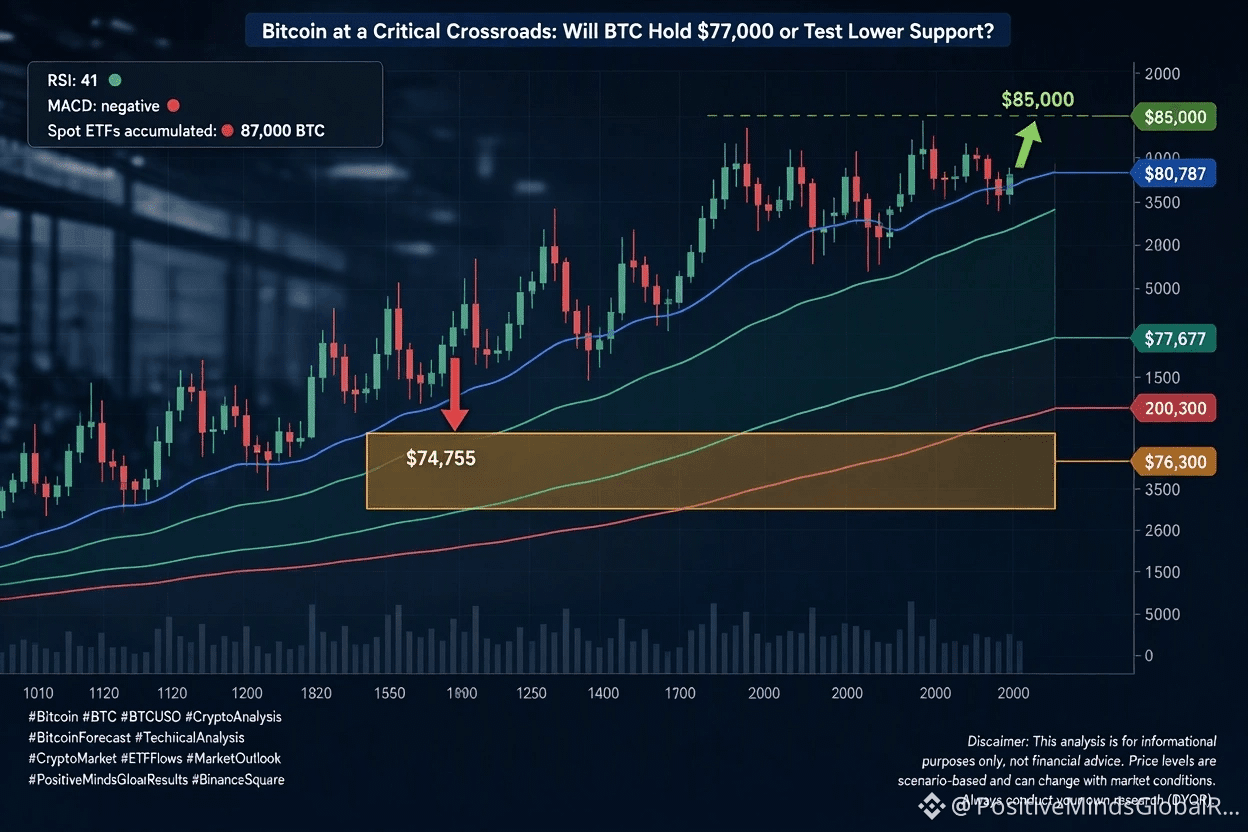
2
58
#binancepick 🌍 Wall Street Mixed: Apollo Rises as Bitcoin and Financial Stocks Diverge
🌍 PositiveMindsGlobalResults | Binance Square | October 27, 2026
U.S. financial stocks showed mixed performance Monday, while Bitcoin slipped 0.2% to $79,925 and the 10-year Treasury yield edged lower to 4.986%. Apollo Global Management gained as it agreed to take a minority stake in Mubadala Capital, strengthening their strategic partnership and expanding ties between U.S. and Abu Dhabi investment firms.
#WallStreet #ApolloGlobalManagement #MubadalaCapital #Bitcoin #BTC #FinancialMarkets #TreasuryYields #GlobalInvesting #MarketUpdate #PositiveMindsGlobalResults #BinanceSquare
{spot}(BNBUSDT)
#binancepick 🌍 Wall Street Mixed: Apollo Rises as Bitcoin and Financial Stocks Diverge
🌍 PositiveMindsGlobalResults | Binance Square | October 27, 2026
U.S. financial stocks showed mixed performance Monday, while Bitcoin slipped 0.2% to $79,925 and the 10-year Treasury yield edged lower to 4.986%. Apollo Global Management gained as it agreed to take a minority stake in Mubadala Capital, strengthening their strategic partnership and expanding ties between U.S. and Abu Dhabi investment firms.
#WallStreet #ApolloGlobalManagement #MubadalaCapital #Bitcoin #BTC #FinancialMarkets #TreasuryYields #GlobalInvesting #MarketUpdate #PositiveMindsGlobalResults #BinanceSquare

19

Article
Wall Street’s Next Move: AI Giants, Nvidia’s Value & Amazon’s Profit Power#binancepick 🌍 #PositiveMindsGlobalResults | Binance Square | October 27, 2026
1. Anthropic’s AI Empire: Why Its Biggest Partnerships Matter
Anthropic’s growing network of business relationships highlights the intensifying competition to build and deploy advanced AI. Although SpaceX is among the companies associated with Anthropic’s broader ecosystem, its other partnerships may play a more significant role in its growth, computing capacity, and commercial expansion.
2. Nvidia: A Potential Valuation Opportunity Amid Record Profit Expectations
Nvidia remains at the center of the AI revolution. Despite strong profit expectations, reports suggest its valuation is below the average S&P 500 stock on a particular valuation measure. However, investors should examine future earnings growth, competition, and AI infrastructure spending before deciding whether the stock is undervalued.
3. Beyond AI: Is the S&P 500 Entering a New Market Phase?
Investors are increasingly looking beyond major technology companies as stocks outside the AI sector gain ground. Broader participation could strengthen the market’s foundations, although sustained gains will depend on corporate earnings, economic conditions, and investor confidence.
4. Amazon AWS: The Profit Margins That Could Change Wall Street Forecasts
UBS sees Amazon Web Services’ margins as a potential driver of higher earnings forecasts. As businesses continue investing in cloud computing and AI infrastructure, AWS profitability could become an important factor in Amazon’s financial performance. However, infrastructure costs and competitive pressures remain key risks.
🌍 The Bigger Picture
Wall Street’s next move may depend on more than AI excitement. Partnership strength, realistic valuations, expanding market participation, and cloud profitability could determine which companies lead the next phase of growth.
Investors should monitor upcoming earnings reports and economic developments while remembering that optimistic forecasts do not guarantee future returns.
Disclaimer: This article is for informational and educational purposes only and does not constitute financial or investment advice. Market analysis and forecasts are based on available information and may change as market conditions evolve. All investments involve risks, and past performance does not guarantee future results. Always conduct your own research (DYOR) and consult a qualified financial adviser before making investment decisions.
#WallStreet #Nvidia #Anthropic #SpaceX #AmazonAWS #ArtificialIntelligence #AIStocks #SP500 #CloudComputing #TechEarnings #StockMarket #GlobalMarkets #InvestorSentiment #PositiveMindsGlobalResults #BinanceSquare
Wall Street’s Next Move: AI Giants, Nvidia’s Value & Amazon’s Profit Power
#binancepick 🌍 #PositiveMindsGlobalResults | Binance Square | October 27, 2026
1. Anthropic’s AI Empire: Why Its Biggest Partnerships Matter
Anthropic’s growing network of business relationships highlights the intensifying competition to build and deploy advanced AI. Although SpaceX is among the companies associated with Anthropic’s broader ecosystem, its other partnerships may play a more significant role in its growth, computing capacity, and commercial expansion.
2. Nvidia: A Potential Valuation Opportunity Amid Record Profit Expectations
Nvidia remains at the center of the AI revolution. Despite strong profit expectations, reports suggest its valuation is below the average S&P 500 stock on a particular valuation measure. However, investors should examine future earnings growth, competition, and AI infrastructure spending before deciding whether the stock is undervalued.
3. Beyond AI: Is the S&P 500 Entering a New Market Phase?
Investors are increasingly looking beyond major technology companies as stocks outside the AI sector gain ground. Broader participation could strengthen the market’s foundations, although sustained gains will depend on corporate earnings, economic conditions, and investor confidence.
4. Amazon AWS: The Profit Margins That Could Change Wall Street Forecasts
UBS sees Amazon Web Services’ margins as a potential driver of higher earnings forecasts. As businesses continue investing in cloud computing and AI infrastructure, AWS profitability could become an important factor in Amazon’s financial performance. However, infrastructure costs and competitive pressures remain key risks.
🌍 The Bigger Picture
Wall Street’s next move may depend on more than AI excitement. Partnership strength, realistic valuations, expanding market participation, and cloud profitability could determine which companies lead the next phase of growth.
Investors should monitor upcoming earnings reports and economic developments while remembering that optimistic forecasts do not guarantee future returns.
Disclaimer: This article is for informational and educational purposes only and does not constitute financial or investment advice. Market analysis and forecasts are based on available information and may change as market conditions evolve. All investments involve risks, and past performance does not guarantee future results. Always conduct your own research (DYOR) and consult a qualified financial adviser before making investment decisions.
#WallStreet #Nvidia #Anthropic #SpaceX #AmazonAWS #ArtificialIntelligence #AIStocks #SP500 #CloudComputing #TechEarnings #StockMarket #GlobalMarkets #InvestorSentiment #PositiveMindsGlobalResults #BinanceSquare
319
#binancepick 🌍 Strategy Pauses Bitcoin Buying, Repurchases $205M in STRC
Strategy has reportedly paused Bitcoin purchases while buying back $205 million in its STRC preferred stock. The move highlights the company’s evolving capital strategy and raises questions about its short-term Bitcoin accumulation plans and funding priorities.
#Strategy #Bitcoin #BTC #STRC #CryptoNews #MichaelSaylor #CryptoMarket #BitcoinHoldings #DigitalAssets #MarketSentiment #PositiveMindsGlobalResults #BinanceSquare
🌍 PositiveMindsGlobalResults | Binance Square | October 26, 2026
{spot}(BNBUSDT)
#binancepick 🌍 Strategy Pauses Bitcoin Buying, Repurchases $205M in STRC
Strategy has reportedly paused Bitcoin purchases while buying back $205 million in its STRC preferred stock. The move highlights the company’s evolving capital strategy and raises questions about its short-term Bitcoin accumulation plans and funding priorities.
#Strategy #Bitcoin #BTC #STRC #CryptoNews #MichaelSaylor #CryptoMarket #BitcoinHoldings #DigitalAssets #MarketSentiment #PositiveMindsGlobalResults #BinanceSquare
🌍 PositiveMindsGlobalResults | Binance Square | October 26, 2026

1
2
Verified
#binancepick 🌍 Wall Street Futures Rise as Oil Prices Fall
U.S. stock futures are climbing as oil prices ease, with investors watching the upcoming Federal Reserve decision and major technology earnings. The Dow Jones, S&P 500, and Nasdaq could react sharply to interest-rate signals, corporate results, and changing energy prices.
#WallStreet #DowJones #SP500 #Nasdaq #OilPrices #FederalReserve #TechEarnings #StockMarket #GlobalMarkets #MarketOutlook #PositiveMindsGlobalResults #BinanceSquare
🌍 PositiveMindsGlobalResults | Binance Square | October 26, 2026
{spot}(BNBUSDT)
#binancepick 🌍 Wall Street Futures Rise as Oil Prices Fall
U.S. stock futures are climbing as oil prices ease, with investors watching the upcoming Federal Reserve decision and major technology earnings. The Dow Jones, S&P 500, and Nasdaq could react sharply to interest-rate signals, corporate results, and changing energy prices.
#WallStreet #DowJones #SP500 #Nasdaq #OilPrices #FederalReserve #TechEarnings #StockMarket #GlobalMarkets #MarketOutlook #PositiveMindsGlobalResults #BinanceSquare
🌍 PositiveMindsGlobalResults | Binance Square | October 26, 2026
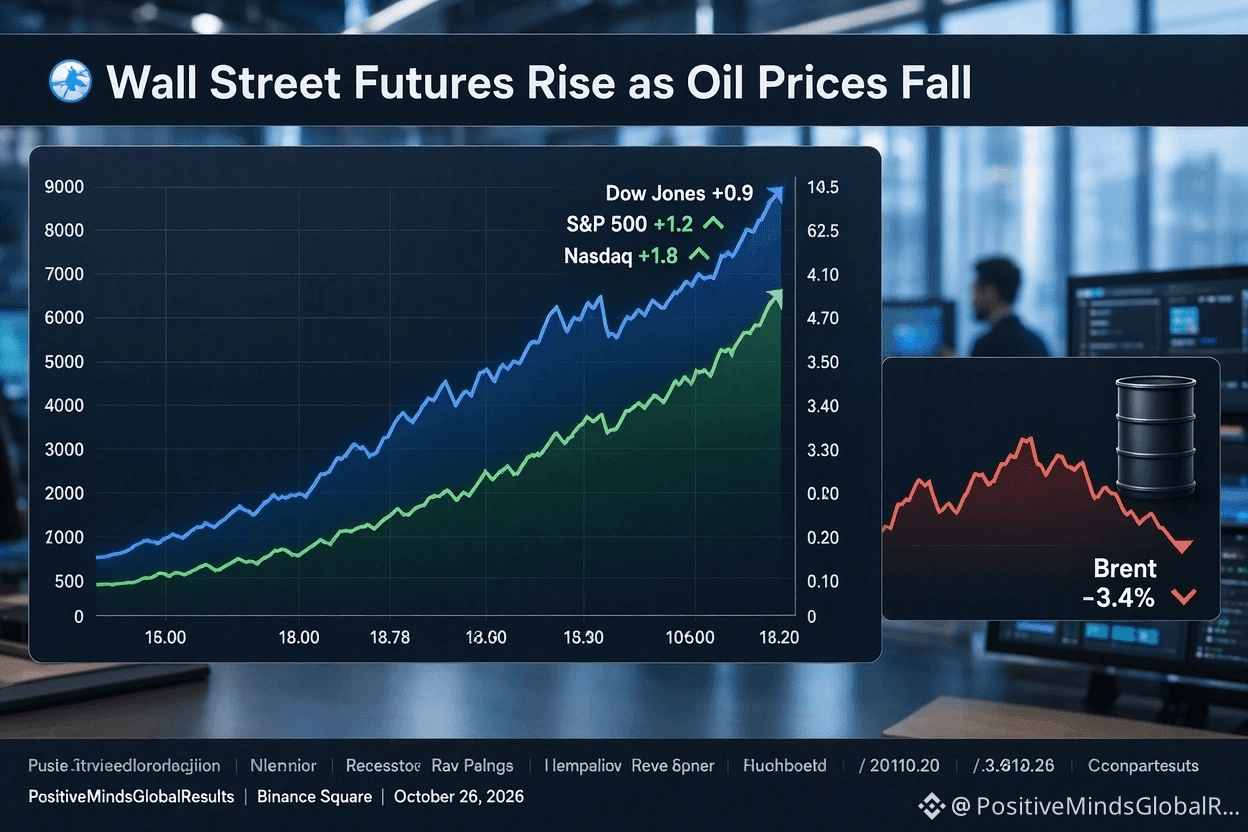
1
604
#binancepick 🌍 S&P 500 Braces for a Storm
Investor anxiety is rising ahead of major corporate earnings reports and the upcoming Federal Reserve meeting. Heavy reliance on a small group of mega-cap companies adds risk, making market direction sensitive to earnings surprises, Fed signals, and interest-rate expectations.
#SP500 #StockMarket #WallStreet #MarketVolatility #EarningsSeason #FederalReserve #FedMeeting #MegaCapStocks #GlobalMarkets #InvestorSentiment #EconomicOutlook #FinancialMarkets #PositiveMindsGlobalResults #BinanceSquare
🌍 PositiveMindsGlobalResults | Binance Square | October 26, 2026
{spot}(BNBUSDT)
#binancepick 🌍 S&P 500 Braces for a Storm
Investor anxiety is rising ahead of major corporate earnings reports and the upcoming Federal Reserve meeting. Heavy reliance on a small group of mega-cap companies adds risk, making market direction sensitive to earnings surprises, Fed signals, and interest-rate expectations.
#SP500 #StockMarket #WallStreet #MarketVolatility #EarningsSeason #FederalReserve #FedMeeting #MegaCapStocks #GlobalMarkets #InvestorSentiment #EconomicOutlook #FinancialMarkets #PositiveMindsGlobalResults #BinanceSquare
🌍 PositiveMindsGlobalResults | Binance Square | October 26, 2026

36
#earningsseason Saudi Aramco in Talks for $10 Billion Loan
Saudi Aramco is reportedly in discussions with global banks to secure a $10 billion loan, according to Bloomberg. The potential financing highlights the energy giant’s capital needs amid evolving global energy markets. The deal’s final terms and purpose remain subject to confirmation.
#SaudiAramco #OilMarket #GlobalFinance #EnergyNews #PositiveMindsGlobalResults #BinanceSquare
🌍PositiveMindsGlobalResults | Binance Square | October 26, 2026
{spot}(BNBUSDT)
#earningsseason Saudi Aramco in Talks for $10 Billion Loan
Saudi Aramco is reportedly in discussions with global banks to secure a $10 billion loan, according to Bloomberg. The potential financing highlights the energy giant’s capital needs amid evolving global energy markets. The deal’s final terms and purpose remain subject to confirmation.
#SaudiAramco #OilMarket #GlobalFinance #EnergyNews #PositiveMindsGlobalResults #BinanceSquare
🌍PositiveMindsGlobalResults | Binance Square | October 26, 2026

92
Log in to explore more content
Join global crypto users on Binance Square
⚡️ Get latest and useful information about crypto.
💬 Trusted by the world’s largest crypto exchange.
👍 Discover real insights from verified creators.
Email / Phone number
Trending Topics
1
#CanMicrosoftDeliverOnAI
635,798 views
4,208 Discussing
2
#CanGoogleDefindItsCore
393,507 views
2,972 Discussing
3
#FedWatch
16.1M views
37,286 Discussing
4
#BitcoinCore32.1RaisesPeerConnectionLimit
4,164 views
135 Discussing
5
#RussiaPlansStandardizedTestForCryptoInvestors
42 views
23 Discussing
6
#EarningsSeason
6.1M views
30,374 Discussing
7
#BitcoinCoreIdentifiesThreeVulnerabilities
14,088 views
305 Discussing
8
#RippleExpects$900MAnnualizedProductRevenueRunRate
1,587 views
10 Discussing
9
#GoogleToPreviewCryptoCustodySecuritySystem
4,344 views
110 Discussing
10
#FedToBeginShrinkingRateSettingCalendarIn2027
5,110 views
67 Discussing