
#cryptoliquidationsreach
cryptoliquidationsreach
3,307 views
37 Discussing
Hot
Latest


·
--
#CryptoLiquidationsReach $1.16BIn24Hours
Over $1.16B in crypto leverage was completely wiped out in 24 hours as long positions took the brunt of the hit.
Key metrics:
• Longs Flushed: Over $1B in long bets liquidated.
• Risk Flashpoint: Aggressive over-leverage caught off-guard as support broke.
Watch tight risk rules; market volatility remains extreme!
$INIT
{spot}(INITUSDT)
#CryptoLiquidationsReach $1.16BIn24Hours
Over $1.16B in crypto leverage was completely wiped out in 24 hours as long positions took the brunt of the hit.
Key metrics:
• Longs Flushed: Over $1B in long bets liquidated.
• Risk Flashpoint: Aggressive over-leverage caught off-guard as support broke.
Watch tight risk rules; market volatility remains extreme!
$INIT
141

·
--
Leverage got flushed — $1.19B liquidated in 24h, $1.04B of it longs, after the hot-CPI slide. $BTC near $73,866, -1.3%. Hold $73K and the flush could clear room for a bounce; lose it and $70K is next. Buying the flush or waiting? #CryptoLiquidationsReach$1.16BIn24Hours #CryptoMarket #Write2Earn
Leverage got flushed — $1.19B liquidated in 24h, $1.04B of it longs, after the hot-CPI slide. $BTC near $73,866, -1.3%. Hold $73K and the flush could clear room for a bounce; lose it and $70K is next. Buying the flush or waiting? #CryptoLiquidationsReach$1.16BIn24Hours #CryptoMarket #Write2Earn
2

·
--
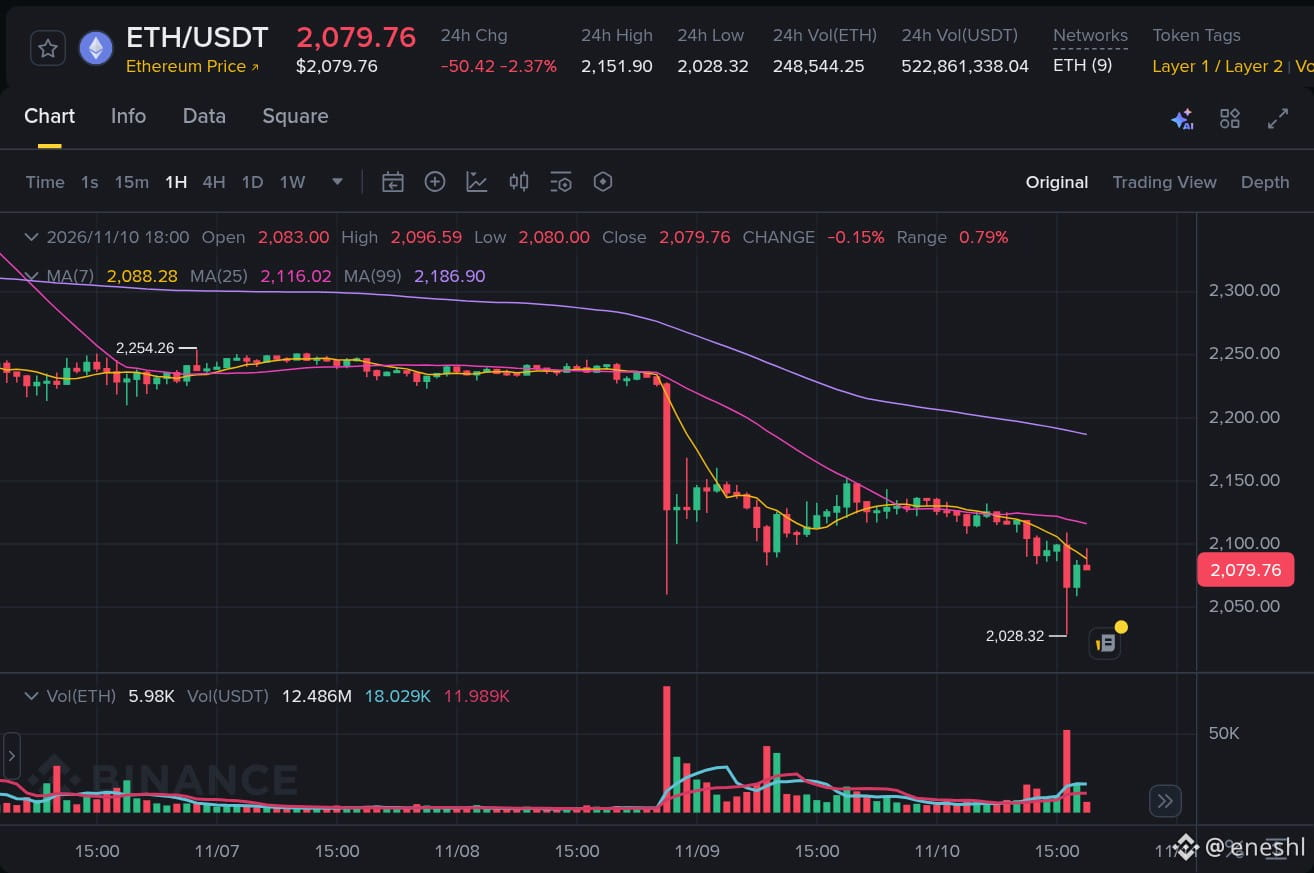
most of this weeks liquidation wipeout wasnt bitcoin, it was eth longs
#CryptoLiquidationsReach$1.16BIn24Hours
longs got hit way harder than shorts, and $ETH took the bigger share while $BTC held up better
my read, it cuts both ways. a lot of forced sellers are already gone, so the next leg down needs real spot selling. but cleaned out leverage doesnt mean buyers show up. if open interest rebuilds fast on the bounce, its the same crowd leaning long again and it can flush twice
im watching eth back above 2,100 with open interest flat. that means spot is doing the lifting. a bounce on rising oi and i stay patient
does eth reclaim that level on spot bids this week, or does leverage pile back in first ?
1
669

·
--
#CryptoLiquidationsReach$1.16BIn24Hours
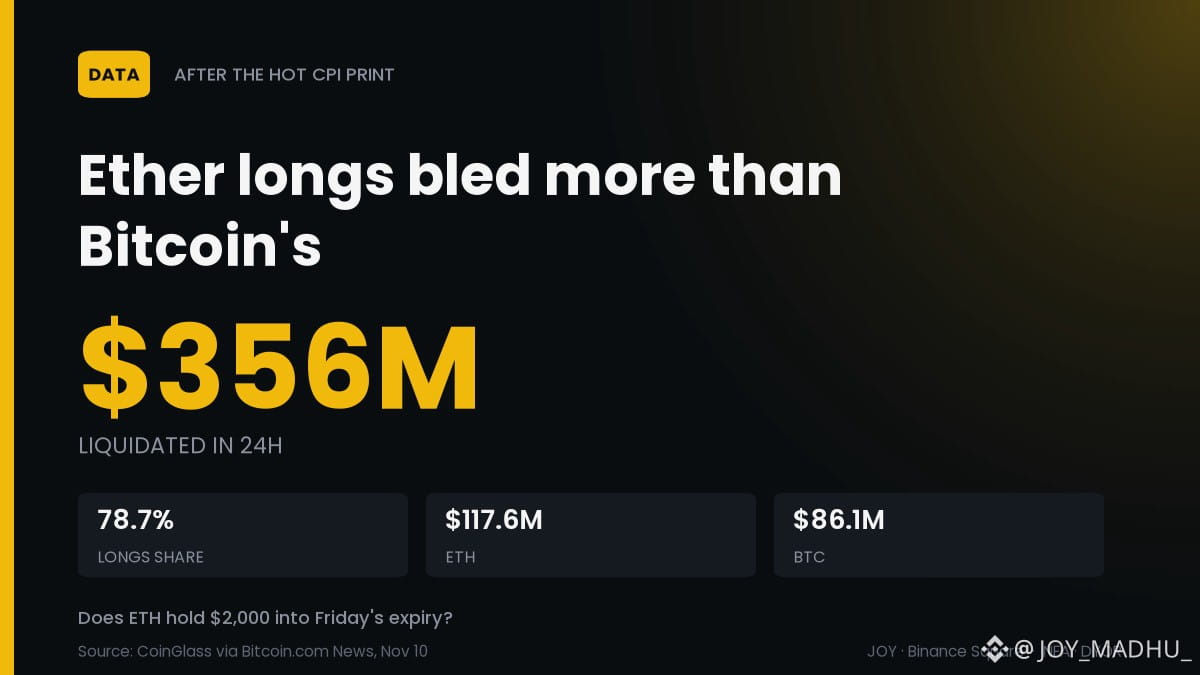
💥 Ether Longs Bled More Than Bitcoin's After Hot CPI
The hot October CPI print flushed leveraged longs, and ETH, not BTC, took the biggest hit.
📊 $356.16M liquidated in 24h across 80,898 traders (CoinGlass)
📉 Longs took $280.40M, or 78.7% of the total
⚠️ ETH $117.61M vs BTC $86.14M; 88.4% of ETH losses were longs
🏦 Largest single wipe: a $14.31M BTC long on Hyperliquid
Zoom out: much of this leverage got cleared fast; the real test is whether spot buyers step in.
Does ETH hold $2,000 through Friday's options expiry, or lose it? 👇
$ETH $BTC
#CryptoLiquidationsReach$1.16BIn24Hours #CPI #Ethereum

·
--
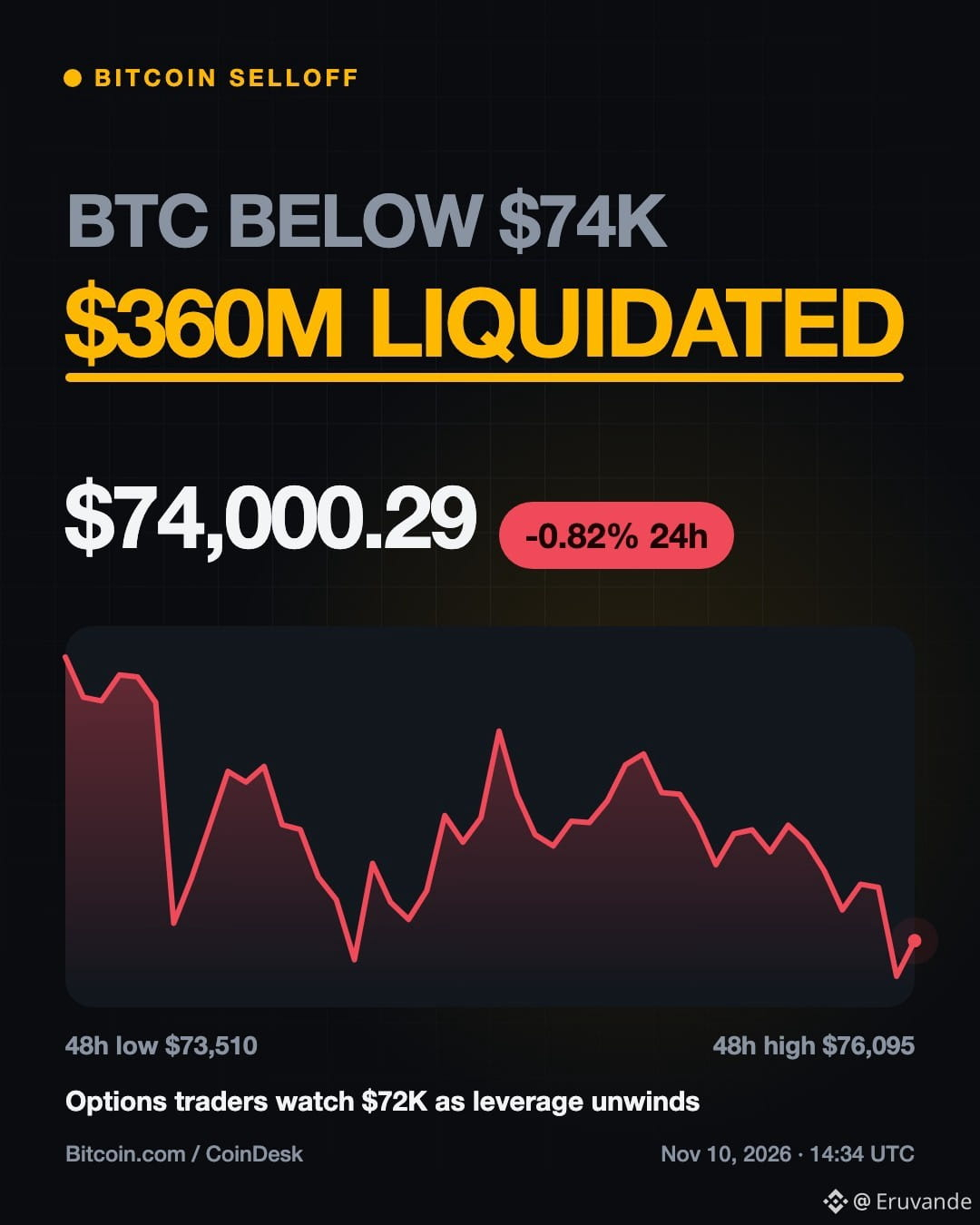
🚨 BREAKING: BITCOIN FALLS BELOW $74K AS LIQUIDATIONS MOUNT
$BTC traded at $73,703 as nearly $360M in crypto positions were liquidated over 24 hours.
Options traders are watching $72K, while Fed tightening fears add pressure ahead of U.S. inflation data.
Is $72K the next big test? 👀
#CryptoLiquidationsReach$1.16BIn24Hours #Bitcoin
$BTC traded at $73,703 as nearly $360M in crypto positions were liquidated over 24 hours.
Options traders are watching $72K, while Fed tightening fears add pressure ahead of U.S. inflation data.
Is $72K the next big test? 👀
#CryptoLiquidationsReach$1.16BIn24Hours #Bitcoin
46
·
--
#CryptoLiquidationsReach$1.16BIn24Hours
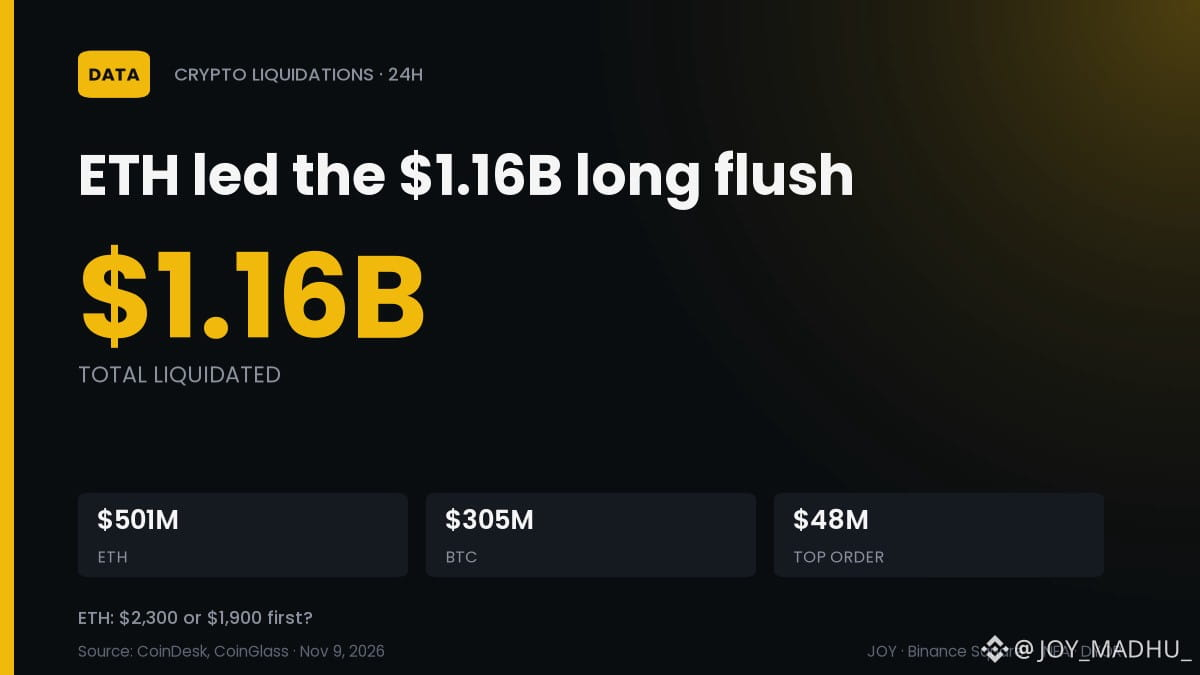
⚖️ Half the Open Interest, Bigger Losses: ETH Led the $1.16B Flush
Ether, with about half of bitcoin's futures open interest, took the biggest share of Monday's liquidations.
📊 $1.16B liquidated in 24h, mostly longs (CoinDesk, CoinGlass)
📉 ETH about $501M vs BTC about $305M
⚠️ Largest single order: a $48M ETH long on Binance
📈 ETH 1-week implied vol jumped to ~60% from ~46%
Zoom out: ETH funding flipped negative, so shorts now pay longs. ETH is near $2,124.
Does ETH reclaim $2,300 before December, or retest $1,900 first? 👇
$ETH $BTC
#CryptoLiquidationsReach$1.16BIn24Hours #Ethereum #CryptoMarket
60

·
--
A staggering $1.16 billion in cryptocurrency positions were liquidated within the last 24 hours, signaling intense volatility across the market. This significant liquidation volume suggests a sharp price movement, likely a downturn, that forced leveraged traders out of their positions. Such events often precede periods of consolidation or further price discovery as the market digests the forced selling. Traders should remain vigilant and reassess risk management strategies in light of this heightened market activity.
Disclaimer: This is not financial advice.
#CryptoLiquidationsReach$1.16BIn24Hours
Disclaimer: This is not financial advice.
#CryptoLiquidationsReach$1.16BIn24Hours
49
·
--
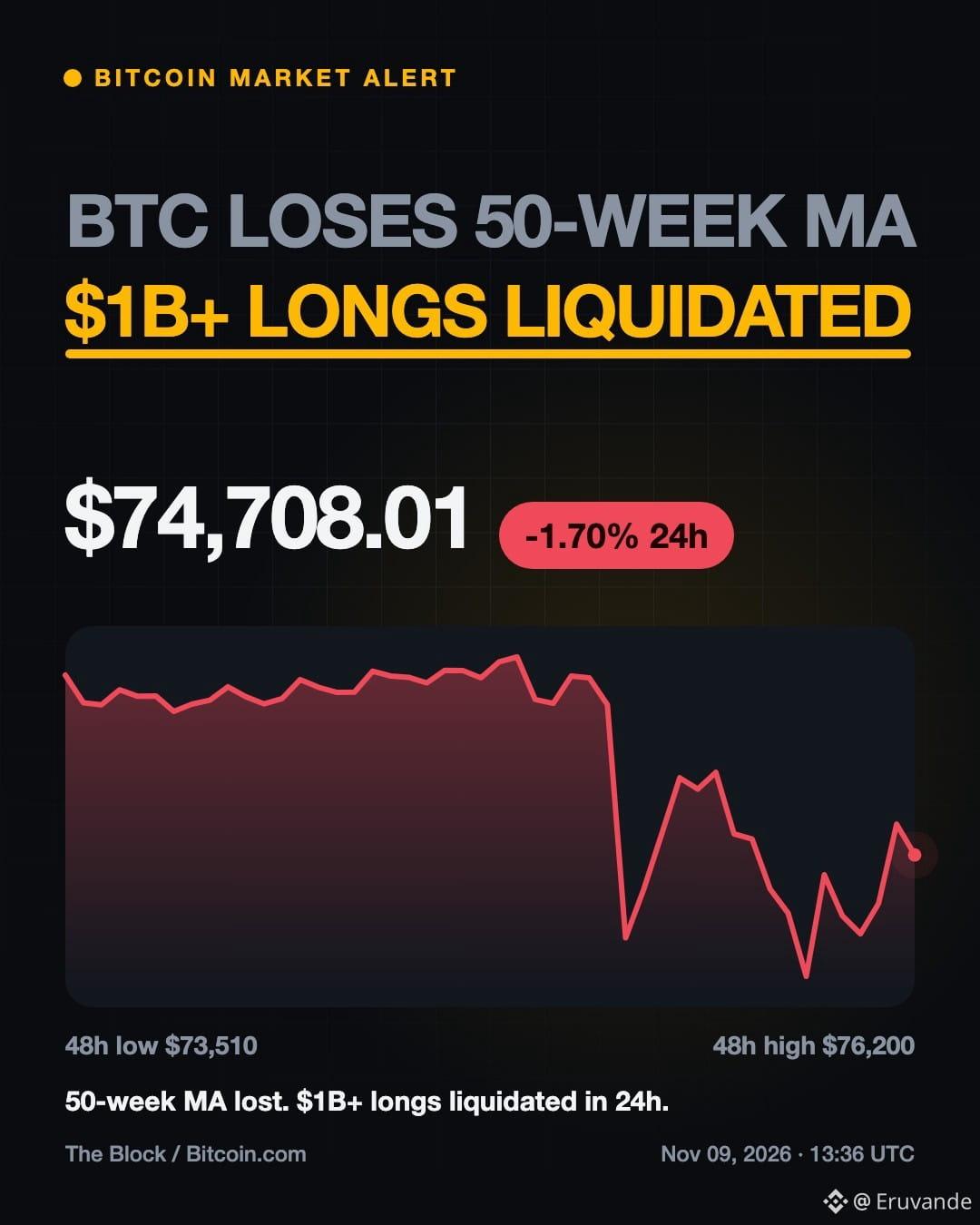
Bitcoin just lost its 50-week moving average as crypto long liquidations topped $1 BILLION in 24 hours.
$BTC also plunged from $75,690 to $73,477 in just 15 minutes on Sunday.
A major technical level is gone, and leveraged traders are feeling it.
👀 Is this a final flush or the start of something bigger?
#Bitcoin #CryptoLiquidationsReach$1.16BIn24Hours
$BTC also plunged from $75,690 to $73,477 in just 15 minutes on Sunday.
A major technical level is gone, and leveraged traders are feeling it.
👀 Is this a final flush or the start of something bigger?
#Bitcoin #CryptoLiquidationsReach$1.16BIn24Hours
127

·
--
$ETH en 2,067 USD: -2.5% in 24h and -9.3% in 7 days, twice as much as $BTC.
Leverage drove it: USD 448M liquidated in ETH, nearly 2x the amount for BTC.
It closed below its 200-day average for the first time since 18/08.
Longs being flushed out or a trend reversal? ⛵
#CryptoLiquidationsReach$1.16BIn24Hours
$ETH en 2,067 USD: -2.5% in 24h and -9.3% in 7 days, twice as much as $BTC .
Leverage drove it: USD 448M liquidated in ETH, nearly 2x the amount for BTC.
It closed below its 200-day average for the first time since 18/08.
Longs being flushed out or a trend reversal? ⛵
#CryptoLiquidationsReach$1.16BIn24Hours
Leverage drove it: USD 448M liquidated in ETH, nearly 2x the amount for BTC.
It closed below its 200-day average for the first time since 18/08.
Longs being flushed out or a trend reversal? ⛵
#CryptoLiquidationsReach$1.16BIn24Hours

83

·
--
Article
After the liquidation wave, the first thing to watch for in a BTC rebound is whether deleveraging is over—not the first green candleAfter the liquidation wave, the first thing to watch for in a BTC rebound is whether deleveraging is over—not the first green candle
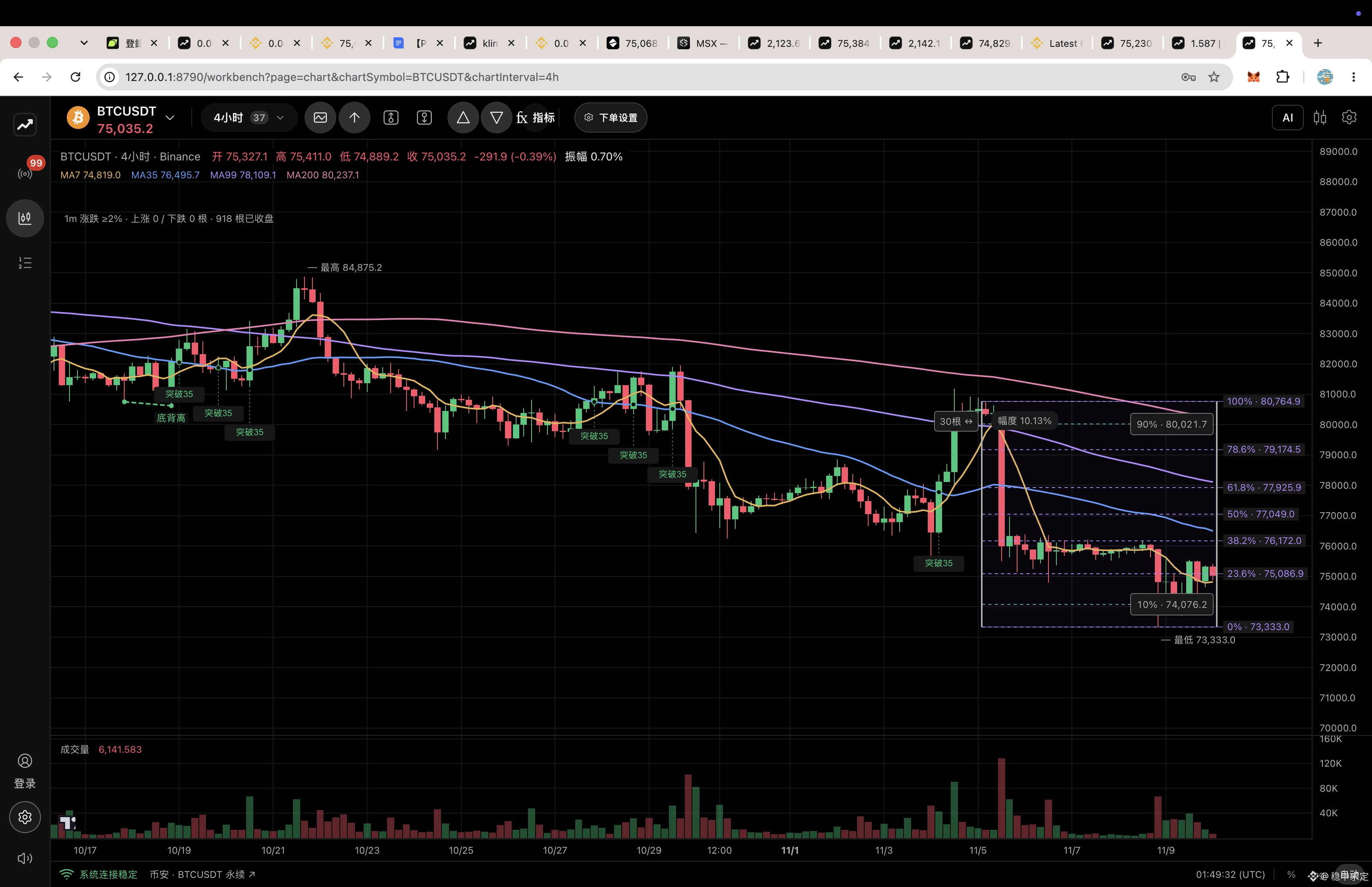
The hashtag `#CryptoLiquidationsReach$1.16BIn24Hours` ranks seventh on Binance Square’s current trends list, with the page showing 45 people discussing it. Its topic page has about 704 views, 13 people discussing it, and a Hot label. When I checked at 09:49 Beijing time on November 10, 2026, what interested me wasn’t the headline “how much was liquidated,” but this: has this flush-out genuinely reduced leverage?
Multiple market reports put total liquidations across the market at around $1.16–1.2 billion over the rolling 24-hour period from November 9 to 10, with longs accounting for the bulk. The Block reported that BTC briefly fell below $74,000, triggering more than $1 billion in long liquidations; KuCoin, citing Coinglass data, put the total above $1.2 billion, including about $1.04 billion in long liquidations. Sampling methods and cutoff times vary across platforms, so I wouldn’t treat the exact headcounts or individual liquidation amounts in viral posts as definitive facts. Sources:
After the liquidation wave, the first thing to watch for in a BTC rebound is whether deleveraging is over—not the first green candle
After the liquidation wave, the first thing to watch for in a BTC rebound is whether deleveraging is over—not the first green candle
The hashtag `#CryptoLiquidationsReach$1.16BIn24Hours` ranks seventh on Binance Square’s current trends list, with the page showing 45 people discussing it. Its topic page has about 704 views, 13 people discussing it, and a Hot label. When I checked at 09:49 Beijing time on November 10, 2026, what interested me wasn’t the headline “how much was liquidated,” but this: has this flush-out genuinely reduced leverage?
Multiple market reports put total liquidations across the market at around $1.16–1.2 billion over the rolling 24-hour period from November 9 to 10, with longs accounting for the bulk. The Block reported that BTC briefly fell below $74,000, triggering more than $1 billion in long liquidations; KuCoin, citing Coinglass data, put the total above $1.2 billion, including about $1.04 billion in long liquidations. Sampling methods and cutoff times vary across platforms, so I wouldn’t treat the exact headcounts or individual liquidation amounts in viral posts as definitive facts. Sources:
144

·
--
According to the latest data, the cryptocurrency market recorded $11.6 billion in liquidations within 24 hours, reaching a recent high. This was mainly driven by increased market volatility, especially the sharp declines in major cryptocurrencies such as Bitcoin and Ethereum, which caused leveraged traders to be liquidated. In fact, rising expectations of further Federal Reserve rate hikes have recently intensified risk aversion, tightening liquidity. In my view, the risks in the current crypto market far outweigh the opportunities, and investors should proceed with caution and avoid excessive leverage. In the short term, the market may continue to fluctuate and trend downward. #CryptoLiquidationsReach$1.16BIn24Hours
$BTC $ETH
$BTC $ETH
185

·
--
ETH liquidation pressure persists | Support near $2,126 needs confirmation | I won't take the first cut of a leveraged sell-off
My stance is to defend first. The current hot topic on Binance Square, #CryptoLiquidationsReach$1.16BIn24Hours, focuses on market-wide liquidations. Binance News reported on November 9 that liquidations totaled about $1.16 billion over 24 hours, including about $500 million in ETH, mostly long positions. At another point in time, CoinGlass's ETH futures page showed about $509 million in ETH liquidations, roughly 90% of them longs. The rolling time windows and platform coverage differ, so I treat the similar figures only as a cross-check of scale, not as precise settlements at the same moment. The decline in tech stocks is also part of the market narrative, but it does not prove the cause of every ETH sell order.
When leveraged longs fall below maintenance margin, forced selling can accelerate the decline and trigger the next wave of liquidations. This can push short-term prices away from fundamentals. But the end of liquidations does not mean an automatic rebound: without enough spot buying, a bounce may be no more than short covering. CoinGlass shows a decline in futures open interest, but that alone cannot distinguish between voluntary position closures, forced liquidations, or transfers across platforms. I'm more concerned with whether spot demand supports any rebound.
Checking the Binance ETH/USDT quote, the latest price is about $2,126.14, with a 24-hour open of about $2,226.08, a high of $2,237.35, and a low of $2,060, down about 4.49%. This is consistent with leveraged pressure, but does not establish a single cause. Farside's breakdown of U.S. ETH spot funds for November 9 was still blank at the time; the 0.0 in the total column should not be treated as confirmation of zero inflows. On the macro front, U.S. inflation data and the Federal Reserve's future policy path will continue to affect discount rates for risk assets, but unpublished data cannot be prematurely characterized as bullish or bearish. Nor does a price decline mean that the Ethereum network itself has suffered a protocol failure.
In the short term, I'll first watch whether the recent low of $2,060 is tested again, then the rebound resistance near $2,160 and the 24-hour high of $2,237. If price breaks below $2,060 and cannot reclaim it on a rebound, that would suggest the deleveraging shock could still spread. Only if it closes above $2,160 for a full hour and holds on a retest would a short-term recovery be worth discussing. If it breaks above $2,160 but immediately falls back below, the rebound thesis is invalidated. If ETFs later disclose sustained outflows, or a new security incident occurs, I'll be less willing to participate; I won't assume funds have already flowed back in based on the currently blank fund data.
If I were trading this myself, I would not participate for now. The only direction I would consider is a conditional long in ETH spot, using no more than 1% of total capital and no leverage. I would enter in two tranches only after two consecutive one-hour candles close above $2,160, followed by a retest of the $2,150–$2,160 range that holds. The first target is $2,200, where I would halve the position; I would target $2,235 for the remainder and tighten the take-profit proactively as price nears the high. After entry, I would stop out if price falls below $2,110; I would also exit early if it closes below $2,150 on the one-hour chart and does not quickly recover. If price first loses $2,060, I would cancel this long setup and stay out of the market. This is a watch plan with conditions that have not been triggered, not a trade that has already been filled or made a profit.
Sources: Binance Square trending topics, Binance News report dated November 9, CoinGlass ETH futures data, live Binance ETH/USDT quotes, and Farside's ETH fund table. Rolling liquidation and price data change; verify them again before acting.
#CryptoLiquidationsReach$1.16BIn24Hours #ETH
The above is solely my personal market observation and does not constitute investment advice.

2

#CryptoLiquidationsReach
💸 $330 million was squandered within 24 hours, and ETH leads the fire of nothingness with $110 million! 🐋 This is just another day delivering fresh liquidity to big fish and whales on a silver platter.
For those using a 150x leverage on ETH: are you trading, or are you just gambling on ultra-fast poverty? 🏎️💀 Stop funding luxury yachts for billionaires!
What should traders do? Use sensible leverage, manage your risk, and keep your bags.
Not financial advice. Do what’s necessary to verify (DYOR)!
Please follow up
#CryptoLiquidations #Ethereum #LeverageTrading
$ETH
{future}(ETHUSDT)
#CryptoLiquidationsReach
💸 $330 million was squandered within 24 hours, and ETH leads the fire of nothingness with $110 million! 🐋 This is just another day delivering fresh liquidity to big fish and whales on a silver platter.
For those using a 150x leverage on ETH: are you trading, or are you just gambling on ultra-fast poverty? 🏎️💀 Stop funding luxury yachts for billionaires!
What should traders do? Use sensible leverage, manage your risk, and keep your bags.
Not financial advice. Do what’s necessary to verify (DYOR)!
Please follow up
#CryptoLiquidations #Ethereum #LeverageTrading
$ETH

2
88
·
--
Square discusses $1.16B in liquidations over 24 hours|XMR moves against the trend, nearing 588|I’m waiting for spot confirmation
My stance is cautious: I’m not treating a rebound as confirmation that the trend has changed. The current hot topic on Binance Square is #CryptoLiquidationsReach$1.16BIn24Hours, with the figure taken from the topic title. When I checked CoinGlass’s public liquidation page, its real-time aggregate section still did not show an amount that could be independently verified. So I’m not treating “$1.16 billion” as a fact I’ve confirmed, nor using it to estimate how much XMR was liquidated. What I can confirm is the market data itself: Kraken’s XMR/USD price is around $585.21, with an opening price of about $562.64, a high of $587.57, and a low of $545.25 for the day; Binance BTC/USDT is around 73,713, down about 0.65% over 24 hours. Their directions diverged during this observation window, but that only indicates that XMR is relatively strong in the short term; it does not prove that it has escaped broader market risk.
Why should XMR traders care about liquidation chatter? Forced closures of leveraged positions can amplify order-book volatility, and spot prices can also be affected by short-lived liquidity gaps. XMR’s market depth and available trading venues differ from BTC’s, so after a sharp rise, it’s especially important to watch slippage, spreads, and price discrepancies across platforms. Liquidation figures cover rolling windows; they do not represent net inflows of new capital, and a single trending topic is not enough to conclude that “all shorts have been cleared out.” I checked the Monero project blog and official code release page, but found no announcement of a new protocol taking effect that day that could explain this short-term rise. For now, it’s better to treat the price action as market behavior to observe rather than inventing a project catalyst. The U.S. October CPI data and the Federal Reserve’s October 28 decision to hold interest rates have already been announced. Macroeconomic risks can still affect overall appetite for crypto assets, and XMR is not immune to those shocks.
First, watch the intraday upper range of 587.57 to 590; below that, look at 562–565 near the opening price, and then the intraday low of 545. I’d only upgrade “relatively strong” to an actionable signal if price breaks above 590, holds on a retest, and quotes across different trading venues show no significant divergence. If it falls back below 562 and stays there, the short-term strength thesis is invalidated. If BTC approaches its 24-hour low of 72,727 again, I’d reduce my planned position size even if XMR initially holds up better. These levels are conditions, not predictions that the price will necessarily reach them.
If I were trading this myself, I’d sit out for now and keep only a conditional spot long setup in mind; I would absolutely avoid high leverage. I’d only take a position worth 0.25% of my total capital if XMR closes a one-hour candle above 590, holds 587 on a retest, and BTC stays above 72,727. Otherwise, I’d remain flat. The first target is 604, where I’d sell half; the second is 618, where I’d close the remainder in stages. I’d set a stop at 579. If price quickly falls back below 587 after entry and cannot recover within an hour, I’d close the entire position early. Based on an entry near 590, the maximum loss on the account for a single trade would be about 0.005%. If the spread widens enough to interfere with stop execution, I’d rather skip the trade. All of this is an untriggered plan, not a record of executed trades or profits.
#CryptoLiquidationsReach$1.16BIn24Hours #XMR
This is solely my personal market observation and does not constitute investment advice.

10
·
--
$ZEC fell 16% in less than two hours: from $1,197 to $1,003, its lowest since September.
No specific news: it was purely leverage-driven. On OKX, a fifth of open contracts vanished right in the middle of CPI day.
Healthy cleanup or a sign of weakness?
#CryptoLiquidationsReach$1.16BIn24Hours #CPITestsDecemberRateOutlook
No specific news: it was purely leverage-driven. On OKX, a fifth of open contracts vanished right in the middle of CPI day.
Healthy cleanup or a sign of weakness?
#CryptoLiquidationsReach$1.16BIn24Hours #CPITestsDecemberRateOutlook

141

·
--
At 11:05 p.m., I pulled up today’s trading history and counted everything: I made 9 moves in total. 7 were canceling orders and adjusting stop-losses, and only 2 were actual trades… and both of those were losses.
What about the winning trade? I got out at +1.2%, and after I sold, it went up another 3%.
This is what my three years of crypto trading have really looked like: I can’t hold onto gains, but I stubbornly cling to losses. It’s not a technical problem. It’s that I refuse to admit I’m just an ordinary person—ordinary people can’t handle floating profits, let alone floating losses. So I use “just a little longer” to turn every small win into a big loss.
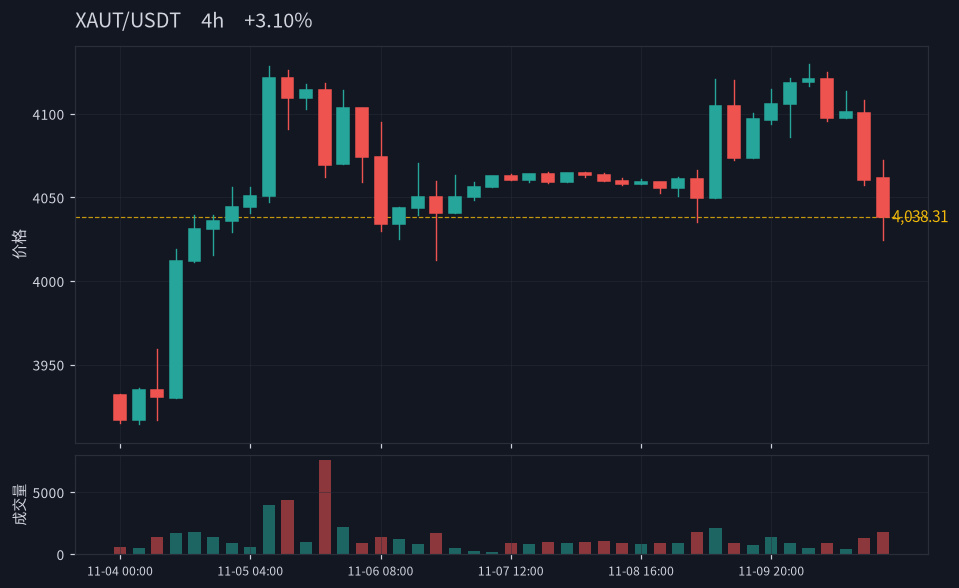
Honestly, the whole crypto market saw $1.16 billion in liquidations over the past 24 hours tonight (#CryptoLiquidationsReach$1.16BIn24Hours). ₿ BTC is at 74,758, down just 0.1% in 24 hours—it looks calm on the surface. Ξ ETH is at 2,090, down 1.7%, and it’s been ranging over the past 4 hours too. The market may look still, but there are people inside it.
Then I did something really simple: I set the grid parameters for XAUT (4,041, -1.5%), turned it on, and took my hands off the keyboard. In a choppy market, it moves a little over one point a day, and the grid picks up a few swings for me. My account didn’t explode with gains, but for the first time, my mood didn’t jump around with the candlesticks.
Honestly, when was the last time you held onto a trade for more than 3 days? Tell me in the comments—I’ll read every one.
🚨 Want to see how I keep my hands tied tomorrow? Follow me, and I’ll post the grid trade details at 11 p.m.…
You know what—follow me. I post live trading updates every day. If you want to see my trade reviews, give me a follow.
#XAUT #BTC $XAUT $BTC
460

#CryptoLiquidationsReach$330MInADay
$330M liquidated in a day. So what actually happens after you buy a coin whose 4h RSI has crossed 80?
I measured it. 24 liquid coins, last ~166 days, every 4h RSI cross above 80. 31 episodes:
- 48h later: median -2.37%
- Higher after 48h: 9 of 31 (29%)
- Median BEST case inside 48h: +0.95%
- Median WORST case inside 48h: -4.10%
Risking about 4 to make about 1. That is what buying the green candle pays, and why long liquidations pile up on days the market looks strong.
The shape matters: 12 of 31 went nowhere, 13 fell over 3%, only 6 rose over 3%. Overbought rarely means crash. It means stall.
Tonight's live case: $ADA
+9.2% at $0.1894 on $45.5M, the most liquid gainer on the board. 4h RSI peaked 82.7, reads 80.5 now.
Logged hourly tonight: $0.1893 at 21:00, $0.1902 at 22:16, $0.1894 now. Three hours of stretched RSI, zero progress.
Then I went looking for the news. There isn't any.
The story circulating is "ETF eligibility 9 Aug". That date comes from CME's ADA futures launch on 9 Feb plus SEC listing standards from Sep 2025. Nothing new was announced in 72 hours. A move without fresh information is positioning, and positioning reverses.
Fair to ADA: no unlock cliff (emission is continuous), SEC suits withdrawn in 2025, Van Rossem hard fork live since 18 Jul. Cleanest fundamentals on the board.
Against it: OI/spot 2.5x, funding +0.01%, analyst resistance $0.20 is 5.6% up while cited support $0.154 is 19% down.
NO TRADE CALL ON ADA TONIGHT. Watchlist only:
- Interest zone $0.1700-0.1745 (4h EMA50 $0.1709, daily EMA50 $0.1740)
- Invalidation under $0.1533 = 1.84x daily ATR below the zone, not a round number
- Upside reference $0.2000, R:R 1.46
Unverified: a Binance spot trading tournament has run since ~23 Jul; I could not confirm whether ADA pairs are included.
$HOME leads spot +48.3%, $BLESS leads Alpha +85.0%. Neither is a recommendation. Alpha volume is farmed for points, not demand.
Not financial advice. Targets are targets, never certainties. Size to survive being wrong.
184

·
--
{future}(LYNUSDT)
Liquidation Headlines Need a Methodology Check
$LYN
Binance Square's trending list is surfacing a headline that cites $1.16 billion in crypto liquidations over 24 hours. Treat that as a timestamped data claim, not a universal measure of market losses.
$KORU
Liquidation totals can differ by vendor, exchange coverage, contract type and the exact 24-hour window. They also measure forced position closures, not the amount investors collectively lost. A liquidated long may lose its margin; the notional value of the position is not the same as the loss.
$CSOPSAMSUNG2L
When volatility spikes, check the timestamp, long/short split and venues covered before drawing conclusions.
Source: Binance Square Trending Topics, observed Nov. 11, 2026.
Risk note: Leverage can magnify losses and execution risk.
#CryptoLiquidationsReach #Liquidations #Leverage #RiskManagement #CryptoEducation

2
752

·
--
Bullish
🚨 BREAKING: TRUMP FAMILY'S CRYPTO BUSINESS FACES RENEWED SENATE SCRUTINY! 🇺🇸
The pressure is mounting on Donald Trump’s crypto empire.
U.S. Senator Richard Blumenthal is pushing forward with inquiries into cryptocurrency businesses connected to Trump and his family.
🔎 Four major companies are in the spotlight:
• World Liberty Financial
• Fight Fight Fight LLC ($TRUMP)
• Binance
• Tether
📄 The companies have been asked to provide financial records, business communications, and other relevant documents.
📅 January 4, 2027, is the deadline for submitting the requested records.
⚠️ The investigation is examining potential conflicts of interest, foreign investments, financial connections, and possible benefits linked to the Trump family's crypto ventures.
The big question: How much influence and financial involvement exists between political power and the crypto industry?
This story could become a major development for the crypto market. 👀
Source: U.S. Senator Richard Blumenthal
$TRUMP $BNB $BTC
#NvidiaInvestigatesAfterHuang’sAffairApology #BitcoinFiveWeeklyLosses #AIChipSlumpNasdaq #CryptoLiquidationsReach $1.16BIn24Hours
🚨 BREAKING: TRUMP FAMILY'S CRYPTO BUSINESS FACES RENEWED SENATE SCRUTINY! 🇺🇸
The pressure is mounting on Donald Trump’s crypto empire.
U.S. Senator Richard Blumenthal is pushing forward with inquiries into cryptocurrency businesses connected to Trump and his family.
🔎 Four major companies are in the spotlight:
• World Liberty Financial
• Fight Fight Fight LLC ($TRUMP )
• Binance
• Tether
📄 The companies have been asked to provide financial records, business communications, and other relevant documents.
📅 January 4, 2027, is the deadline for submitting the requested records.
⚠️ The investigation is examining potential conflicts of interest, foreign investments, financial connections, and possible benefits linked to the Trump family's crypto ventures.
The big question: How much influence and financial involvement exists between political power and the crypto industry?
This story could become a major development for the crypto market. 👀
Source: U.S. Senator Richard Blumenthal
$TRUMP $BNB $BTC
#NvidiaInvestigatesAfterHuang’sAffairApology #BitcoinFiveWeeklyLosses #AIChipSlumpNasdaq #CryptoLiquidationsReach $1.16BIn24Hours

239
·
--
PNC Bank adopts USDC—is the stablecoin about to replace traditional payment systems?
PNC Bank allows business clients to receive USDC stablecoin payments and convert them directly into dollars.
Major U.S. bank PNC has launched a new service that lets business clients receive USDC and convert it directly into dollars without waiting for a withdrawal. This shows stablecoins have moved one step closer to real-world payments. Until now, individuals mostly used USDC to buy coffee; now businesses are using it to receive payments, too. PNC is looking to see whether stablecoins can stand alongside older methods like wire transfers and checks.
Market impact
- Short term: Positive for sentiment around stablecoins, but not enough to directly drive prices higher.
- Medium term: Tests whether stablecoins can gain a foothold in the B2B space, raising a new challenge for regulators.
💎 My take: This is an exploratory step toward bringing stablecoins into the traditional financial system. It won’t change the broader trend in the short term, but over the medium to long term, it could accelerate crypto adoption in compliant use cases. PNC’s move is more of a watchpoint than a direct market catalyst.
⚠️ Not investment advice
#CryptoLiquidationsReach$1.16BIn24Hours
$BTC #General Analysis


19
Log in to explore more content
Join global crypto users on Binance Square
⚡️ Get latest and useful information about crypto.
💬 Trusted by the world’s largest crypto exchange.
👍 Discover real insights from verified creators.
Email / Phone number
Trending Topics
1
#StrategyFaces$2.8BSelloffRiskFromMSCIRemoval
30,983 views
193 Discussing
2
#ZcashFallsBelow$1000ForFirstTimeSinceSeptember
17,970 views
113 Discussing
3
#AnthropicRejectsIPODelayValuationinQuestion
402,863 views
3,414 Discussing
4
#HotCPIDecemberHikePriced
408,835 views
3,513 Discussing
5
#TradFiForBeginners
472,050 views
3,103 Discussing
6
#BitcoinETFsLose$1.6BInNovember
14,463 views
71 Discussing
7
#AnthropicDisclosesOver$10BNewComputeDeals
2,891 views
39 Discussing
8
#CoreWeaveJumps10%On168%RevenueGrowth
36,002 views
579 Discussing
9
#CanNvidiaEarningsEaseMarketConcerns?
131,504 views
1,499 Discussing
10
#BarclaysRaisesBlackRockBitcoinETFStake48%
29,858 views
418 Discussing