
#cpi
cpi
5M views
7,548 Discussing
Hot
Latest

·
--
everyone thinks a stable cpi print is bullish for $btc but actually these events often dump the market instead.
ngl getting wrecked on fomo buys after inflation data is a classic way to lose money. you ape in thinking the news is good then watch it reverse.
the august cpi report just dropped with headline inflation holding steady at 3.4% yoy. following the release $btc saw a brief dip from the 77,200 area down toward 76,063.
$eth got hit similarly and even $sol traders felt the squeeze in this real example. it shows why you gotta be careful not to overtrade these prints.
anyone else seeing this pattern? where do you think this goes from here?
#cpi #bitcoin #macro
everyone thinks a stable cpi print is bullish for $btc but actually these events often dump the market instead.
ngl getting wrecked on fomo buys after inflation data is a classic way to lose money. you ape in thinking the news is good then watch it reverse.
the august cpi report just dropped with headline inflation holding steady at 3.4% yoy. following the release $btc saw a brief dip from the 77,200 area down toward 76,063.
$eth got hit similarly and even $sol traders felt the squeeze in this real example. it shows why you gotta be careful not to overtrade these prints.
anyone else seeing this pattern? where do you think this goes from here?
#cpi #bitcoin #macro
ngl getting wrecked on fomo buys after inflation data is a classic way to lose money. you ape in thinking the news is good then watch it reverse.
the august cpi report just dropped with headline inflation holding steady at 3.4% yoy. following the release $btc saw a brief dip from the 77,200 area down toward 76,063.
$eth got hit similarly and even $sol traders felt the squeeze in this real example. it shows why you gotta be careful not to overtrade these prints.
anyone else seeing this pattern? where do you think this goes from here?
#cpi #bitcoin #macro

32

If you're still panic dumping $BTC on every CPI print, stop now.
This kind of headline reaction has traders losing money on FOMO entries and panic exits. You buy the first dip only to see it drop more, or sell too early and miss the recovery.
The August CPI report just printed 3.4% year over year, holding steady. $BTC immediately moved down from the $77,200 area to around $76,063.
Bears argue this shows inflation remaining sticky, which delays rate cuts and could pressure prices lower. Bulls say it was in line so the dip is overdone and a bounce is likely.
I think the bulls have it right this time. Similar setups have seen $ETH and $SOL lead the rebound once the dust settles.
Where do you think this goes from here?
#Bitcoin #CPI #Crypto
If you're still panic dumping $BTC on every CPI print, stop now.
This kind of headline reaction has traders losing money on FOMO entries and panic exits. You buy the first dip only to see it drop more, or sell too early and miss the recovery.
The August CPI report just printed 3.4% year over year, holding steady. $BTC immediately moved down from the $77,200 area to around $76,063.
Bears argue this shows inflation remaining sticky, which delays rate cuts and could pressure prices lower. Bulls say it was in line so the dip is overdone and a bounce is likely.
I think the bulls have it right this time. Similar setups have seen $ETH and $SOL lead the rebound once the dust settles.
Where do you think this goes from here?
#Bitcoin #CPI #Crypto
This kind of headline reaction has traders losing money on FOMO entries and panic exits. You buy the first dip only to see it drop more, or sell too early and miss the recovery.
The August CPI report just printed 3.4% year over year, holding steady. $BTC immediately moved down from the $77,200 area to around $76,063.
Bears argue this shows inflation remaining sticky, which delays rate cuts and could pressure prices lower. Bulls say it was in line so the dip is overdone and a bounce is likely.
I think the bulls have it right this time. Similar setups have seen $ETH and $SOL lead the rebound once the dust settles.
Where do you think this goes from here?
#Bitcoin #CPI #Crypto
31

Here's what happened when macro data collided with crypto liquidity earlier today.
Most traders see a flat inflation print and assume stability, only to get chopped up by sudden downside wicks within minutes. It is the classic trap of trading the headline before the order book actually settles.
The August CPI report landed with headline inflation holding steady at 3.4% YoY. While many expected a quiet reaction to an on-consensus print, $BTC slipped rapidly from the $77,200 area down toward $76,063. The dip was not massive in percentage terms, but it was sharp enough to sweep late longs who assumed flat macro meant instant upside.
The real risk here is underestimating liquidity gaps during high-impact releases. When $USDT pairs thin out right around the data drop, even a seemingly neutral print can trigger cascading liquidations before $ETH and the broader market find their footing.
Where do you think this goes from here?
#Bitcoin #CPI #CryptoTrading
Here's what happened when macro data collided with crypto liquidity earlier today.
Most traders see a flat inflation print and assume stability, only to get chopped up by sudden downside wicks within minutes. It is the classic trap of trading the headline before the order book actually settles.
The August CPI report landed with headline inflation holding steady at 3.4% YoY. While many expected a quiet reaction to an on-consensus print, $BTC slipped rapidly from the $77,200 area down toward $76,063. The dip was not massive in percentage terms, but it was sharp enough to sweep late longs who assumed flat macro meant instant upside.
The real risk here is underestimating liquidity gaps during high-impact releases. When $USDT pairs thin out right around the data drop, even a seemingly neutral print can trigger cascading liquidations before $ETH and the broader market find their footing.
Where do you think this goes from here?
#Bitcoin #CPI #CryptoTrading
Most traders see a flat inflation print and assume stability, only to get chopped up by sudden downside wicks within minutes. It is the classic trap of trading the headline before the order book actually settles.
The August CPI report landed with headline inflation holding steady at 3.4% YoY. While many expected a quiet reaction to an on-consensus print, $BTC slipped rapidly from the $77,200 area down toward $76,063. The dip was not massive in percentage terms, but it was sharp enough to sweep late longs who assumed flat macro meant instant upside.
The real risk here is underestimating liquidity gaps during high-impact releases. When $USDT pairs thin out right around the data drop, even a seemingly neutral print can trigger cascading liquidations before $ETH and the broader market find their footing.
Where do you think this goes from here?
#Bitcoin #CPI #CryptoTrading

23

·
--
Picture this: the August CPI numbers just crossed the wire holding steady at 3.4% YoY, and within minutes, traders were dumping positions into thin order books.
Most retail traders get completely chopped up trying to scalp macro headlines, usually panic-selling the local wick right into liquidity traps.
When the report landed, $BTC swiftly slid from the $77,200 area down toward $76,063. We saw almost the exact same reaction during previous quarterly prints, where a quick 1.5% drop liquidated overeager longs before buyers stepped back in. Even correlated assets like $ETH experienced momentary sweeps across Binance books as trading bots reacted to the headline number before human participants could process the nuance.
The takeaway here is straightforward. Isolated macro prints like steady CPI figures usually create short-term liquidity events rather than structural trend shifts, clearing out leverage on majors and $SOL while long-term positioning remains intact.
Where do you see price heading once the dust from this report settles?
#Bitcoin #CryptoTrading #CPI
Picture this: the August CPI numbers just crossed the wire holding steady at 3.4% YoY, and within minutes, traders were dumping positions into thin order books.
Most retail traders get completely chopped up trying to scalp macro headlines, usually panic-selling the local wick right into liquidity traps.
When the report landed, $BTC swiftly slid from the $77,200 area down toward $76,063. We saw almost the exact same reaction during previous quarterly prints, where a quick 1.5% drop liquidated overeager longs before buyers stepped back in. Even correlated assets like $ETH experienced momentary sweeps across Binance books as trading bots reacted to the headline number before human participants could process the nuance.
The takeaway here is straightforward. Isolated macro prints like steady CPI figures usually create short-term liquidity events rather than structural trend shifts, clearing out leverage on majors and $SOL while long-term positioning remains intact.
Where do you see price heading once the dust from this report settles?
#Bitcoin #CryptoTrading #CPI
Most retail traders get completely chopped up trying to scalp macro headlines, usually panic-selling the local wick right into liquidity traps.
When the report landed, $BTC swiftly slid from the $77,200 area down toward $76,063. We saw almost the exact same reaction during previous quarterly prints, where a quick 1.5% drop liquidated overeager longs before buyers stepped back in. Even correlated assets like $ETH experienced momentary sweeps across Binance books as trading bots reacted to the headline number before human participants could process the nuance.
The takeaway here is straightforward. Isolated macro prints like steady CPI figures usually create short-term liquidity events rather than structural trend shifts, clearing out leverage on majors and $SOL while long-term positioning remains intact.
Where do you see price heading once the dust from this report settles?
#Bitcoin #CryptoTrading #CPI
27

·
--
Most retail traders lose the bulk of their capital not during deep bear markets, but within sixty seconds of a scheduled data release.
Watching your screen flash red as stop-losses trigger on a sudden wick is painful, especially when you convinced yourself you could outsmart the headline. It is the classic trap of mistaking immediate liquidity sweeps for structural trend changes.
The August CPI came in holding steady at 3.4% YoY, and almost on cue, algorithms flushed $BTC from the $77,200 range down toward $76,063. We have seen this exact playbook play out across multiple cycles since 2020. Market makers hunt leverage on both sides of scheduled prints, often pulling correlated assets like $ETH along for the ride before the real directional move even begins.
Institutional desks treat steady inflation numbers as baseline macro context rather than an emergency exit. When volatility spikes on anticipated data, the order book is usually just clearing out impatient hands before finding fair value.
How do you usually manage your risk when high-impact macro prints hit the tape?
#Bitcoin #CryptoTrading #CPI
Most retail traders lose the bulk of their capital not during deep bear markets, but within sixty seconds of a scheduled data release.
Watching your screen flash red as stop-losses trigger on a sudden wick is painful, especially when you convinced yourself you could outsmart the headline. It is the classic trap of mistaking immediate liquidity sweeps for structural trend changes.
The August CPI came in holding steady at 3.4% YoY, and almost on cue, algorithms flushed $BTC from the $77,200 range down toward $76,063. We have seen this exact playbook play out across multiple cycles since 2020. Market makers hunt leverage on both sides of scheduled prints, often pulling correlated assets like $ETH along for the ride before the real directional move even begins.
Institutional desks treat steady inflation numbers as baseline macro context rather than an emergency exit. When volatility spikes on anticipated data, the order book is usually just clearing out impatient hands before finding fair value.
How do you usually manage your risk when high-impact macro prints hit the tape?
#Bitcoin #CryptoTrading #CPI
Watching your screen flash red as stop-losses trigger on a sudden wick is painful, especially when you convinced yourself you could outsmart the headline. It is the classic trap of mistaking immediate liquidity sweeps for structural trend changes.
The August CPI came in holding steady at 3.4% YoY, and almost on cue, algorithms flushed $BTC from the $77,200 range down toward $76,063. We have seen this exact playbook play out across multiple cycles since 2020. Market makers hunt leverage on both sides of scheduled prints, often pulling correlated assets like $ETH along for the ride before the real directional move even begins.
Institutional desks treat steady inflation numbers as baseline macro context rather than an emergency exit. When volatility spikes on anticipated data, the order book is usually just clearing out impatient hands before finding fair value.
How do you usually manage your risk when high-impact macro prints hit the tape?
#Bitcoin #CryptoTrading #CPI
22
everyone thinks macro data prints mean immediate moon missions, but actually it is where most retail liquidity gets swallowed whole.
getting chopped up trying to scalp high-volatility news drops is how accounts get wiped before the real trend even starts. most traders panic-sell the sudden red wick only to watch price recover ten minutes later.
look at the august cpi print coming in flat at 3.4% yoy. the immediate reaction was classic stop-hunting behavior, dumping $BTC from around the $77,200 area straight down to $76,063 in a flash.
if you rushed in with high leverage expecting a clean breakout, market makers just swept your stops ser. even $ETH caught collateral chop while the books reset. ngl, jumping into instant headline volatility without waiting for the dust to settle is pure pain.
did you get wicked out on that dip or are you waiting for the range to settle before bidding?
#Bitcoin #CPI #CryptoTrading
everyone thinks macro data prints mean immediate moon missions, but actually it is where most retail liquidity gets swallowed whole.
getting chopped up trying to scalp high-volatility news drops is how accounts get wiped before the real trend even starts. most traders panic-sell the sudden red wick only to watch price recover ten minutes later.
look at the august cpi print coming in flat at 3.4% yoy. the immediate reaction was classic stop-hunting behavior, dumping $BTC from around the $77,200 area straight down to $76,063 in a flash.
if you rushed in with high leverage expecting a clean breakout, market makers just swept your stops ser. even $ETH caught collateral chop while the books reset. ngl, jumping into instant headline volatility without waiting for the dust to settle is pure pain.
did you get wicked out on that dip or are you waiting for the range to settle before bidding?
#Bitcoin #CPI #CryptoTrading
getting chopped up trying to scalp high-volatility news drops is how accounts get wiped before the real trend even starts. most traders panic-sell the sudden red wick only to watch price recover ten minutes later.
look at the august cpi print coming in flat at 3.4% yoy. the immediate reaction was classic stop-hunting behavior, dumping $BTC from around the $77,200 area straight down to $76,063 in a flash.
if you rushed in with high leverage expecting a clean breakout, market makers just swept your stops ser. even $ETH caught collateral chop while the books reset. ngl, jumping into instant headline volatility without waiting for the dust to settle is pure pain.
did you get wicked out on that dip or are you waiting for the range to settle before bidding?
#Bitcoin #CPI #CryptoTrading
9
If you are still panic selling the moment macroeconomic headlines drop, stop now.
Traders lose thousands trying to front-run five-minute volatility spikes, only to get chopped up and dumped right out of their positions.
The August CPI report just came in with headline inflation holding steady at 3.4% YoY. Right on cue, $BTC saw a quick pullback, dropping from the $77,200 area down toward $76,063 as short-term liquidity was swept.
Bears will argue that sticky inflation limits rate cuts and puts pressure on risk assets like $ETH. On the other hand, absorbing this kind of data without breaking major market structure shows underlying spot demand is much stronger than people think.
Where do you think this goes from here?
#Bitcoin #Crypto #CPI
If you are still panic selling the moment macroeconomic headlines drop, stop now.
Traders lose thousands trying to front-run five-minute volatility spikes, only to get chopped up and dumped right out of their positions.
The August CPI report just came in with headline inflation holding steady at 3.4% YoY. Right on cue, $BTC saw a quick pullback, dropping from the $77,200 area down toward $76,063 as short-term liquidity was swept.
Bears will argue that sticky inflation limits rate cuts and puts pressure on risk assets like $ETH . On the other hand, absorbing this kind of data without breaking major market structure shows underlying spot demand is much stronger than people think.
Where do you think this goes from here?
#Bitcoin #Crypto #CPI
Traders lose thousands trying to front-run five-minute volatility spikes, only to get chopped up and dumped right out of their positions.
The August CPI report just came in with headline inflation holding steady at 3.4% YoY. Right on cue, $BTC saw a quick pullback, dropping from the $77,200 area down toward $76,063 as short-term liquidity was swept.
Bears will argue that sticky inflation limits rate cuts and puts pressure on risk assets like $ETH . On the other hand, absorbing this kind of data without breaking major market structure shows underlying spot demand is much stronger than people think.
Where do you think this goes from here?
#Bitcoin #Crypto #CPI

6
·
--
If you are still panic-selling every time macro data drops, you are just funding someone else's liquidity.
Getting chopped up on knee-jerk reactions to routine economic releases is how most traders bleed their portfolios dry before the real trend even starts.
The August CPI just hit at a steady 3.4% YoY, and predictably, $BTC took a sudden slide from the $77,200 area down toward $76,063 within minutes. It is the exact same playbook we saw during last year's mid-cycle prints, where brief panic wiped out overleveraged positions before spot buyers stepped in to absorb the dip.
Meanwhile, assets like $ETH and $SOL barely flinched through the initial noise, showing how fragmented market reactions get during these releases. The market loves treating steady inflation numbers like an unexpected shock, but watching price action scramble over tenths of a percentage point never gets old.
Are we looking at standard post-data chop before continuation, or is the macro backdrop starting to weigh heavier on this range?
#Bitcoin #CryptoTrading #CPI
If you are still panic-selling every time macro data drops, you are just funding someone else's liquidity.
Getting chopped up on knee-jerk reactions to routine economic releases is how most traders bleed their portfolios dry before the real trend even starts.
The August CPI just hit at a steady 3.4% YoY, and predictably, $BTC took a sudden slide from the $77,200 area down toward $76,063 within minutes. It is the exact same playbook we saw during last year's mid-cycle prints, where brief panic wiped out overleveraged positions before spot buyers stepped in to absorb the dip.
Meanwhile, assets like $ETH and $SOL barely flinched through the initial noise, showing how fragmented market reactions get during these releases. The market loves treating steady inflation numbers like an unexpected shock, but watching price action scramble over tenths of a percentage point never gets old.
Are we looking at standard post-data chop before continuation, or is the macro backdrop starting to weigh heavier on this range?
#Bitcoin #CryptoTrading #CPI
Getting chopped up on knee-jerk reactions to routine economic releases is how most traders bleed their portfolios dry before the real trend even starts.
The August CPI just hit at a steady 3.4% YoY, and predictably, $BTC took a sudden slide from the $77,200 area down toward $76,063 within minutes. It is the exact same playbook we saw during last year's mid-cycle prints, where brief panic wiped out overleveraged positions before spot buyers stepped in to absorb the dip.
Meanwhile, assets like $ETH and $SOL barely flinched through the initial noise, showing how fragmented market reactions get during these releases. The market loves treating steady inflation numbers like an unexpected shock, but watching price action scramble over tenths of a percentage point never gets old.
Are we looking at standard post-data chop before continuation, or is the macro backdrop starting to weigh heavier on this range?
#Bitcoin #CryptoTrading #CPI

35
·
--
Picture this: the latest CPI numbers hit the wire, inflation sits unchanged at 3.4% year-over-year, and your screen immediately flashes red.
Most traders panic-sell the moment macro data lands, only to watch the market reverse minutes after dumping their positions at the local bottom. Getting chopped up by high-frequency algorithms on headline releases is one of the most frustrating ways to bleed capital.
When August inflation held steady at 3.4%, $BTC took an immediate hit, sliding from the $77,200 zone down to $76,063 within minutes. It is a familiar setup. Just like previous sticky inflation prints earlier this cycle, the initial knee-jerk reaction flushed out over-leveraged longs before spot buyers stepped in to absorb the selling pressure.
We saw similar localized volatility across major assets like $ETH, where initial downward wicks served more as liquidity sweeps than signals of a sustained macro trend reversal. When looking back at similar historical prints, these post-announcement dips often established higher lows once the initial reaction settled.
Where do you think $BTC heads once the market fully digests this inflation data?
#Bitcoin #CPI #CryptoTrading
Picture this: the latest CPI numbers hit the wire, inflation sits unchanged at 3.4% year-over-year, and your screen immediately flashes red.
Most traders panic-sell the moment macro data lands, only to watch the market reverse minutes after dumping their positions at the local bottom. Getting chopped up by high-frequency algorithms on headline releases is one of the most frustrating ways to bleed capital.
When August inflation held steady at 3.4%, $BTC took an immediate hit, sliding from the $77,200 zone down to $76,063 within minutes. It is a familiar setup. Just like previous sticky inflation prints earlier this cycle, the initial knee-jerk reaction flushed out over-leveraged longs before spot buyers stepped in to absorb the selling pressure.
We saw similar localized volatility across major assets like $ETH , where initial downward wicks served more as liquidity sweeps than signals of a sustained macro trend reversal. When looking back at similar historical prints, these post-announcement dips often established higher lows once the initial reaction settled.
Where do you think $BTC heads once the market fully digests this inflation data?
#Bitcoin #CPI #CryptoTrading
Most traders panic-sell the moment macro data lands, only to watch the market reverse minutes after dumping their positions at the local bottom. Getting chopped up by high-frequency algorithms on headline releases is one of the most frustrating ways to bleed capital.
When August inflation held steady at 3.4%, $BTC took an immediate hit, sliding from the $77,200 zone down to $76,063 within minutes. It is a familiar setup. Just like previous sticky inflation prints earlier this cycle, the initial knee-jerk reaction flushed out over-leveraged longs before spot buyers stepped in to absorb the selling pressure.
We saw similar localized volatility across major assets like $ETH , where initial downward wicks served more as liquidity sweeps than signals of a sustained macro trend reversal. When looking back at similar historical prints, these post-announcement dips often established higher lows once the initial reaction settled.
Where do you think $BTC heads once the market fully digests this inflation data?
#Bitcoin #CPI #CryptoTrading

9
·
--
The August CPI report holding at 3.4% triggered an instant thousand-dollar drop in Bitcoin, yet this exact pattern has preceded every major rally in the last two cycles.
Most traders still treat these inflation prints like the end of the world. They dump their $BTC at the first sign of red and then watch from the sidelines as it recovers, repeating the same mistake I made back in 2022.
Headline inflation staying put at 3.4% year over year signals the Fed could keep rates higher for longer, which immediately spooked risk assets. $BTC slid from the $77,200 area toward $76,063 while $ETH and $BNB followed lower as liquidity thinned out.
I remember the identical setup in 2023 when a sticky CPI print created a similar wick. The crowd screamed crash, but those who bought that fear captured the next 80% move higher.
These short-term reactions are just noise. Bitcoin has a long history of shrugging off inflation data once the initial panic fades.
How are you positioning around this $BTC reaction to the CPI numbers?
#Bitcoin #CPI #CryptoMarkets
The August CPI report holding at 3.4% triggered an instant thousand-dollar drop in Bitcoin, yet this exact pattern has preceded every major rally in the last two cycles.
Most traders still treat these inflation prints like the end of the world. They dump their $BTC at the first sign of red and then watch from the sidelines as it recovers, repeating the same mistake I made back in 2022.
Headline inflation staying put at 3.4% year over year signals the Fed could keep rates higher for longer, which immediately spooked risk assets. $BTC slid from the $77,200 area toward $76,063 while $ETH and $BNB followed lower as liquidity thinned out.
I remember the identical setup in 2023 when a sticky CPI print created a similar wick. The crowd screamed crash, but those who bought that fear captured the next 80% move higher.
These short-term reactions are just noise. Bitcoin has a long history of shrugging off inflation data once the initial panic fades.
How are you positioning around this $BTC reaction to the CPI numbers?
#Bitcoin #CPI #CryptoMarkets
Most traders still treat these inflation prints like the end of the world. They dump their $BTC at the first sign of red and then watch from the sidelines as it recovers, repeating the same mistake I made back in 2022.
Headline inflation staying put at 3.4% year over year signals the Fed could keep rates higher for longer, which immediately spooked risk assets. $BTC slid from the $77,200 area toward $76,063 while $ETH and $BNB followed lower as liquidity thinned out.
I remember the identical setup in 2023 when a sticky CPI print created a similar wick. The crowd screamed crash, but those who bought that fear captured the next 80% move higher.
These short-term reactions are just noise. Bitcoin has a long history of shrugging off inflation data once the initial panic fades.
How are you positioning around this $BTC reaction to the CPI numbers?
#Bitcoin #CPI #CryptoMarkets
17
everyone thinks macro prints immediately nuke or pump the market for good, but actually you are just getting liquidity farmed on the 5m chart.
most traders panic sell the second inflation data hits the wire, only to watch price wick their stop loss and instantly reverse while they sit on realized losses.
take today's august cpi print as a textbook case. headline inflation came in flat at 3.4% yoy, which isn't even catastrophic, yet leverage junkies instantly dumped $BTC from the $77,200 range straight down to around $76,063 within minutes.
ser, that quick flush was literally just market makers sweeping cheap spot liquidity before the real trend continuation. if you opened a high leverage short on $ETH or $SOL during that initial red candle, you probably got chopped up in the chop that followed. patience pays more than rushing the opening reaction.
did you get caught in that initial wick or did you bid the dip?
#CPI #Bitcoin #CryptoTrading
everyone thinks macro prints immediately nuke or pump the market for good, but actually you are just getting liquidity farmed on the 5m chart.
most traders panic sell the second inflation data hits the wire, only to watch price wick their stop loss and instantly reverse while they sit on realized losses.
take today's august cpi print as a textbook case. headline inflation came in flat at 3.4% yoy, which isn't even catastrophic, yet leverage junkies instantly dumped $BTC from the $77,200 range straight down to around $76,063 within minutes.
ser, that quick flush was literally just market makers sweeping cheap spot liquidity before the real trend continuation. if you opened a high leverage short on $ETH or $SOL during that initial red candle, you probably got chopped up in the chop that followed. patience pays more than rushing the opening reaction.
did you get caught in that initial wick or did you bid the dip?
#CPI #Bitcoin #CryptoTrading
most traders panic sell the second inflation data hits the wire, only to watch price wick their stop loss and instantly reverse while they sit on realized losses.
take today's august cpi print as a textbook case. headline inflation came in flat at 3.4% yoy, which isn't even catastrophic, yet leverage junkies instantly dumped $BTC from the $77,200 range straight down to around $76,063 within minutes.
ser, that quick flush was literally just market makers sweeping cheap spot liquidity before the real trend continuation. if you opened a high leverage short on $ETH or $SOL during that initial red candle, you probably got chopped up in the chop that followed. patience pays more than rushing the opening reaction.
did you get caught in that initial wick or did you bid the dip?
#CPI #Bitcoin #CryptoTrading

26

·
--
Article
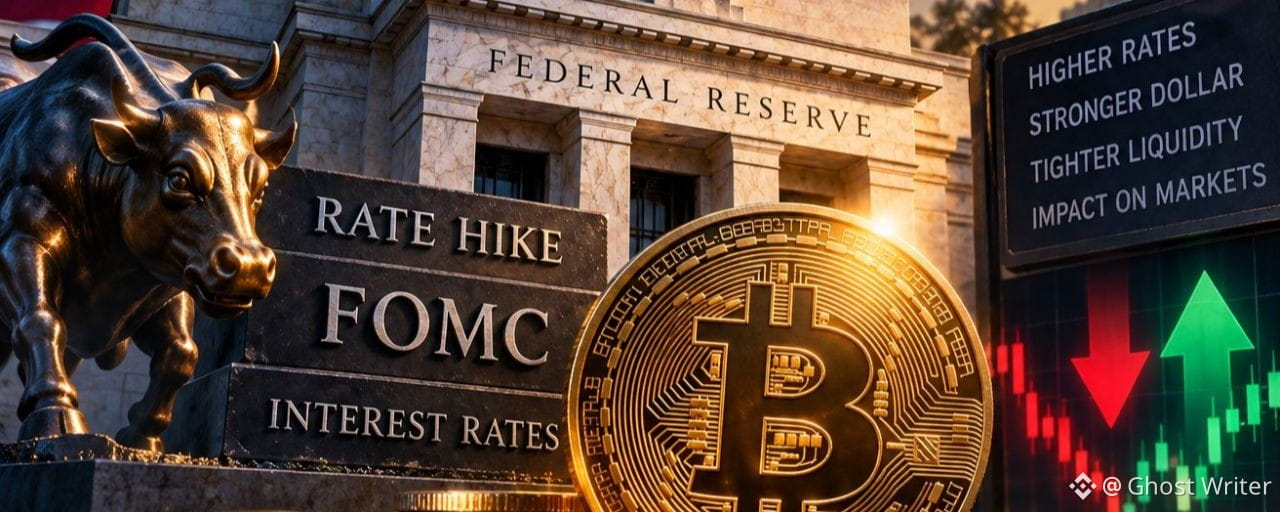
The Fed Is About to Hike a Number the Market Already Paid For. The Real Risk Is DecemberAlmost nobody is arguing about 25 basis points anymore 🤔
Look at the probability chart. A month ago, holding at 3.50–3.75% was the popular bet. A week ago it was a fight. Now the 3.75–4.00% bucket is a wall, close to 94%. That means Wednesday’s decision is not the event. The event is whether the statement treats August inflation as a messy month, or as the first brick of a new tightening cycle.
That distinction is where most posts go flat. They ask “hike or hold?” The market already answered. The tradeable question is: one insurance hike, or the start of a bill that keeps arriving?
The print that looks soft and hard at the same time
August #CPI did something awkward.
Headline rose 0.4% on the month and 3.4% over the year. Core CPI includes food and energy stripped out, rose 0.3% month-over-month versus a 0.2% consensus. The annual core rate still eased to 2.4%, the slowest since 2021.
So you can write two honest headlines from the same release:
“Underlying inflation is the coolest in five years.”“The monthly core run-rate just accelerated.”
The Fed lives in the second sentence. Year-over-year core is a rear-view mirror still digesting older, hotter prints. Officials vote on whether the latest month looks like progress or like a pause that failed. Energy did the loud part: +2.1% on the month, +16.3% over the year. That is not the same animal as 2022 demand-overheating. It is a supply bruise sitting on a labor market that still printed firm payrolls.
A 25bp hike can be rational as insurance. It is a much weaker case as the opening of a multi-meeting campaign — unless the press conference pretends energy is “just inflation” and ignores the source.
Why a fully priced hike still moves risk
If 90% is already in the price, why would Bitcoin, Nasdaq, or gold $XAU care?
Because assets do not reprice the 25bp. They reprice the path.
Tech is duration. A hike that sounds like “we are done after this” is a shrug. A hike that keeps December alive is a valuation haircut. Long-duration names feel language before they feel the funds rate.Gold splits in two. If the story is sticky inflation and messy geopolitics, gold keeps a bid. If the story is higher real rates and a stronger dollar, gold pays the rate tax like everything else.Bitcoin is the awkward guest. Some weeks it still tags along with Nasdaq beta. Other stretches this year it has spent more time walking next to gold. Into a priced hike, the first hour is usually a liquidity squeeze. The second hour is a referendum on whether the Fed sounded finished.
That is why “BTC dumps on hikes” is a lazy rule. BTC dumped in 2022 because the path was many hikes from zero. A single, widely advertised 25bp from 3.50–3.75% is a different machine. The damage lives in the adjective: “ongoing,” “further,” “restrictive for longer.”
One-off versus cycle: A simple test
A cycle needs the Fed to believe demand is the problem.
Watch three things Wednesday, not the vote itself:
Do they call energy a temporary shock or a reason to keep tightening?Does the statement keep “further firming” on the table, or does it go back to data-dependence without a threat?Do the dots show one move, or a staircase?
If it is one-and-done language, the 90% odds were the whole show. Risk can even bid the fact that uncertainty just collapsed. If the dots lean hawkish, the market has to price a second invoice it has only half-written.
What I am doing with Bitcoin
I am not using FOMC as an entry trigger.
I hold $BTC as a multi-year position. The plan is boring on purpose. If the statement is hotter than a fully priced hike and spot gives a cleaner level than the coins I already own, I add on a fixed DCA size. Same rules as any other dip I did not cause. No leverage into the announcement. No “I knew they’d hike” after the fact.
{spot}(BTCUSDT)
The edge this week is not prediction. It is refusing to confuse a 25bp that everyone sees with a cycle that nobody has proven.
Most feeds will celebrate or panic at 2:00 p.m. Eastern. The useful work starts in the paragraph after the decision, the one that tells you whether September was an insurance premium, or the first line of a longer tab.
#FedRateWatch #TrendingTopic
Educational only. Not financial advice. Size for both paths.
The Fed Is About to Hike a Number the Market Already Paid For. The Real Risk Is December
Almost nobody is arguing about 25 basis points anymore 🤔
Look at the probability chart. A month ago, holding at 3.50–3.75% was the popular bet. A week ago it was a fight. Now the 3.75–4.00% bucket is a wall, close to 94%. That means Wednesday’s decision is not the event. The event is whether the statement treats August inflation as a messy month, or as the first brick of a new tightening cycle.
That distinction is where most posts go flat. They ask “hike or hold?” The market already answered. The tradeable question is: one insurance hike, or the start of a bill that keeps arriving?
The print that looks soft and hard at the same time
August #CPI did something awkward.
Headline rose 0.4% on the month and 3.4% over the year. Core CPI includes food and energy stripped out, rose 0.3% month-over-month versus a 0.2% consensus. The annual core rate still eased to 2.4%, the slowest since 2021.
So you can write two honest headlines from the same release:
“Underlying inflation is the coolest in five years.”“The monthly core run-rate just accelerated.”
The Fed lives in the second sentence. Year-over-year core is a rear-view mirror still digesting older, hotter prints. Officials vote on whether the latest month looks like progress or like a pause that failed. Energy did the loud part: +2.1% on the month, +16.3% over the year. That is not the same animal as 2022 demand-overheating. It is a supply bruise sitting on a labor market that still printed firm payrolls.
A 25bp hike can be rational as insurance. It is a much weaker case as the opening of a multi-meeting campaign — unless the press conference pretends energy is “just inflation” and ignores the source.
Why a fully priced hike still moves risk
If 90% is already in the price, why would Bitcoin, Nasdaq, or gold $XAU care?
Because assets do not reprice the 25bp. They reprice the path.
Tech is duration. A hike that sounds like “we are done after this” is a shrug. A hike that keeps December alive is a valuation haircut. Long-duration names feel language before they feel the funds rate.Gold splits in two. If the story is sticky inflation and messy geopolitics, gold keeps a bid. If the story is higher real rates and a stronger dollar, gold pays the rate tax like everything else.Bitcoin is the awkward guest. Some weeks it still tags along with Nasdaq beta. Other stretches this year it has spent more time walking next to gold. Into a priced hike, the first hour is usually a liquidity squeeze. The second hour is a referendum on whether the Fed sounded finished.
That is why “BTC dumps on hikes” is a lazy rule. BTC dumped in 2022 because the path was many hikes from zero. A single, widely advertised 25bp from 3.50–3.75% is a different machine. The damage lives in the adjective: “ongoing,” “further,” “restrictive for longer.”
One-off versus cycle: A simple test
A cycle needs the Fed to believe demand is the problem.
Watch three things Wednesday, not the vote itself:
Do they call energy a temporary shock or a reason to keep tightening?Does the statement keep “further firming” on the table, or does it go back to data-dependence without a threat?Do the dots show one move, or a staircase?
If it is one-and-done language, the 90% odds were the whole show. Risk can even bid the fact that uncertainty just collapsed. If the dots lean hawkish, the market has to price a second invoice it has only half-written.
What I am doing with Bitcoin
I am not using FOMC as an entry trigger.
I hold $BTC as a multi-year position. The plan is boring on purpose. If the statement is hotter than a fully priced hike and spot gives a cleaner level than the coins I already own, I add on a fixed DCA size. Same rules as any other dip I did not cause. No leverage into the announcement. No “I knew they’d hike” after the fact.
The edge this week is not prediction. It is refusing to confuse a 25bp that everyone sees with a cycle that nobody has proven.
Most feeds will celebrate or panic at 2:00 p.m. Eastern. The useful work starts in the paragraph after the decision, the one that tells you whether September was an insurance premium, or the first line of a longer tab.
#FedRateWatch #TrendingTopic
Educational only. Not financial advice. Size for both paths.
Look at the probability chart. A month ago, holding at 3.50–3.75% was the popular bet. A week ago it was a fight. Now the 3.75–4.00% bucket is a wall, close to 94%. That means Wednesday’s decision is not the event. The event is whether the statement treats August inflation as a messy month, or as the first brick of a new tightening cycle.
That distinction is where most posts go flat. They ask “hike or hold?” The market already answered. The tradeable question is: one insurance hike, or the start of a bill that keeps arriving?
The print that looks soft and hard at the same time
August #CPI did something awkward.
Headline rose 0.4% on the month and 3.4% over the year. Core CPI includes food and energy stripped out, rose 0.3% month-over-month versus a 0.2% consensus. The annual core rate still eased to 2.4%, the slowest since 2021.
So you can write two honest headlines from the same release:
“Underlying inflation is the coolest in five years.”“The monthly core run-rate just accelerated.”
The Fed lives in the second sentence. Year-over-year core is a rear-view mirror still digesting older, hotter prints. Officials vote on whether the latest month looks like progress or like a pause that failed. Energy did the loud part: +2.1% on the month, +16.3% over the year. That is not the same animal as 2022 demand-overheating. It is a supply bruise sitting on a labor market that still printed firm payrolls.
A 25bp hike can be rational as insurance. It is a much weaker case as the opening of a multi-meeting campaign — unless the press conference pretends energy is “just inflation” and ignores the source.
Why a fully priced hike still moves risk
If 90% is already in the price, why would Bitcoin, Nasdaq, or gold $XAU care?
Because assets do not reprice the 25bp. They reprice the path.
Tech is duration. A hike that sounds like “we are done after this” is a shrug. A hike that keeps December alive is a valuation haircut. Long-duration names feel language before they feel the funds rate.Gold splits in two. If the story is sticky inflation and messy geopolitics, gold keeps a bid. If the story is higher real rates and a stronger dollar, gold pays the rate tax like everything else.Bitcoin is the awkward guest. Some weeks it still tags along with Nasdaq beta. Other stretches this year it has spent more time walking next to gold. Into a priced hike, the first hour is usually a liquidity squeeze. The second hour is a referendum on whether the Fed sounded finished.
That is why “BTC dumps on hikes” is a lazy rule. BTC dumped in 2022 because the path was many hikes from zero. A single, widely advertised 25bp from 3.50–3.75% is a different machine. The damage lives in the adjective: “ongoing,” “further,” “restrictive for longer.”
One-off versus cycle: A simple test
A cycle needs the Fed to believe demand is the problem.
Watch three things Wednesday, not the vote itself:
Do they call energy a temporary shock or a reason to keep tightening?Does the statement keep “further firming” on the table, or does it go back to data-dependence without a threat?Do the dots show one move, or a staircase?
If it is one-and-done language, the 90% odds were the whole show. Risk can even bid the fact that uncertainty just collapsed. If the dots lean hawkish, the market has to price a second invoice it has only half-written.
What I am doing with Bitcoin
I am not using FOMC as an entry trigger.
I hold $BTC as a multi-year position. The plan is boring on purpose. If the statement is hotter than a fully priced hike and spot gives a cleaner level than the coins I already own, I add on a fixed DCA size. Same rules as any other dip I did not cause. No leverage into the announcement. No “I knew they’d hike” after the fact.
The edge this week is not prediction. It is refusing to confuse a 25bp that everyone sees with a cycle that nobody has proven.
Most feeds will celebrate or panic at 2:00 p.m. Eastern. The useful work starts in the paragraph after the decision, the one that tells you whether September was an insurance premium, or the first line of a longer tab.
#FedRateWatch #TrendingTopic
Educational only. Not financial advice. Size for both paths.
2
239

·
--

Article
$100 Oil, Priced-In Hike: Why Crypto Is Deleveraging Ahead of CPICrypto markets are entering an important macro week.
The September rate hike is now largely priced in, but the bigger question for risk assets is no longer simply what the Fed does.
The bigger question is:
Can oil stay above $100?
Brent crude moving above $100 has pushed inflation expectations and long-term bond yields higher. At the same time, crypto flows have weakened, leverage has declined, and options are showing a more defensive market structure.
This does not necessarily mean a major bearish trend has started.
It looks more like defensive consolidation with volatility gradually increasing.
■ 1. Oil Has Become the Bigger Macro Variable
Strong payroll data pushed expectations for tighter monetary policy higher, while geopolitical tensions around the Strait of Hormuz pushed Brent above $100.
That combination matters because expensive energy can keep inflation elevated.
The US 10Y yield moving above 4.8% adds another layer of pressure. Higher yields generally make risk assets less attractive because investors can earn better returns from relatively safer assets.
But there is an important distinction:
The September rate hike is already largely priced in.
So another hike itself may not create a major shock.
The bigger risk is oil remaining above $100 for an extended period.
If Brent pulls back, inflation expectations could ease and pressure on yields could decline.
That would create a much more supportive environment for BTC and other risk assets.
■ 2. Crypto Flows Are Losing Momentum
One of the most interesting developments this week is the simultaneous weakness in two important liquidity channels:
• Spot ETF flows turned negative.
• Stablecoin net issuance also moved negative.
The combined outflow was relatively small, below $500M, but the direction is important.
For several weeks, ETF demand had been providing a marginal bid to Bitcoin.
When that bid disappears, price has to rely more heavily on existing positioning.
This helps explain why BTC has struggled to establish a strong upside move.
■ 3. Leverage Is Coming Out of the Market
Open interest also declined.
BTC market capitalization was down around 2.2% from the previous Friday, while USD-denominated OI fell roughly 3.2%.
The OI/market-cap ratio moved toward 0.034, below the mid-August level around 0.038.
In simple terms:
Traders are reducing leverage.
This is not automatically bearish.
Actually, there can be a positive side to deleveraging.
When excessive leverage leaves the market, the probability of another large liquidation cascade can decrease.
The problem is that leverage leaving the market also means there is currently less aggressive capital pushing prices higher.
So the market becomes quieter, but also more sensitive to the next macro catalyst.
■ 4. Options Are Saying “Be Careful”
Bitcoin volatility has started to increase.
DVOL moved from around 38 to approximately 40.2 while BTC remained relatively range-bound.
That combination is worth watching.
Normally, a stable price with rising implied volatility suggests that traders are paying more for protection against a larger future move.
The put side of the options market has also repriced faster than the call side.
However, 25D risk reversals remain close to neutral.
So this is not strong evidence of an imminent crash.
It is better interpreted as:
The market is becoming more defensive and preparing for larger movement.
■ 5. Why BTC Has Not Collapsed
Despite the macro pressure, BTC has not experienced an additional major discount.
BTC’s two-week decline has broadly tracked equities.
That is important.
If BTC were collapsing significantly faster than traditional risk assets, it would suggest crypto-specific stress.
Instead, the current behavior looks more like a macro-driven risk-off environment.
The marginal buyer has stepped back.
Leverage has already been reduced.
Forced selling appears relatively limited.
And there is not enough fresh demand to create a strong upside breakout.
That is why I would describe the current structure as:
Defensive consolidation, not yet a confirmed trend reversal.
■ 6. The Interesting Part: Alts Are Outperforming BTC
One unusual development is happening underneath the BTC weakness.
BTC was down around 1.7% over the week, while TOTAL3 gained approximately 1.3%.
BTC dominance also declined around 0.7 percentage points.
This means capital has been rotating toward altcoins even while Bitcoin was under pressure.
The sequencing is particularly interesting.
During BTC’s weakness, TOTAL3 continued showing relative strength.
That tells us the alt market has not completely lost risk appetite.
But there is an important condition.
BTC must hold its consolidation structure.
If BTC remains stable, BTC dominance could continue moving toward support around 58, potentially giving alts more room to outperform.
■ 7. CPI Is the Next Major Gate
This is where everything comes together.
A softer-than-expected CPI could reduce pressure on Treasury yields and rate expectations.
That could support BTC, weaken BTC dominance and allow the current altcoin resilience to continue.
But a hotter CPI creates the opposite setup.
Higher inflation expectations could push yields higher again.
If BTC simultaneously loses its key consolidation support, the current altcoin resilience could disappear quickly.
So I would watch the reaction rather than simply the CPI number itself.
Soft CPI + BTC holds support = constructive
Hot CPI + BTC breaks support = defensive/risk-off
■ My Market Take
The current market does not look like a clean bullish breakout environment.
But it also does not yet look like a confirmed major bearish reversal.
The key variables are:
■ Oil: Does Brent remain above $100?
■ Yields: Does the US 10Y continue climbing above 4.8%?
■ Flows: Do ETF and stablecoin outflows continue?
■ Leverage: Does OI keep falling?
■ BTC: Can price hold its consolidation range?
■ BTC.D: Can dominance continue declining?
■ CPI: Does inflation provide relief or add another layer of pressure?
For me, oil is currently the macro variable to watch first, while CPI is the immediate catalyst.
If oil retreats and CPI comes in soft, the market could quickly shift from defensive consolidation toward risk-on positioning.
If oil stays above $100 and CPI is hot, the pressure on yields and crypto could increase.
Until that confirmation arrives, the cleaner approach is to respect the range, avoid excessive leverage and let price action confirm the next direction.
#Bitcoin #CryptoMarket #CPI #ArifAlpha
{spot}(BTCUSDT)
{future}(BZUSDT)
$100 Oil, Priced-In Hike: Why Crypto Is Deleveraging Ahead of CPI
Crypto markets are entering an important macro week.
The September rate hike is now largely priced in, but the bigger question for risk assets is no longer simply what the Fed does.
The bigger question is:
Can oil stay above $100?
Brent crude moving above $100 has pushed inflation expectations and long-term bond yields higher. At the same time, crypto flows have weakened, leverage has declined, and options are showing a more defensive market structure.
This does not necessarily mean a major bearish trend has started.
It looks more like defensive consolidation with volatility gradually increasing.
■ 1. Oil Has Become the Bigger Macro Variable
Strong payroll data pushed expectations for tighter monetary policy higher, while geopolitical tensions around the Strait of Hormuz pushed Brent above $100.
That combination matters because expensive energy can keep inflation elevated.
The US 10Y yield moving above 4.8% adds another layer of pressure. Higher yields generally make risk assets less attractive because investors can earn better returns from relatively safer assets.
But there is an important distinction:
The September rate hike is already largely priced in.
So another hike itself may not create a major shock.
The bigger risk is oil remaining above $100 for an extended period.
If Brent pulls back, inflation expectations could ease and pressure on yields could decline.
That would create a much more supportive environment for BTC and other risk assets.
■ 2. Crypto Flows Are Losing Momentum
One of the most interesting developments this week is the simultaneous weakness in two important liquidity channels:
• Spot ETF flows turned negative.
• Stablecoin net issuance also moved negative.
The combined outflow was relatively small, below $500M, but the direction is important.
For several weeks, ETF demand had been providing a marginal bid to Bitcoin.
When that bid disappears, price has to rely more heavily on existing positioning.
This helps explain why BTC has struggled to establish a strong upside move.
■ 3. Leverage Is Coming Out of the Market
Open interest also declined.
BTC market capitalization was down around 2.2% from the previous Friday, while USD-denominated OI fell roughly 3.2%.
The OI/market-cap ratio moved toward 0.034, below the mid-August level around 0.038.
In simple terms:
Traders are reducing leverage.
This is not automatically bearish.
Actually, there can be a positive side to deleveraging.
When excessive leverage leaves the market, the probability of another large liquidation cascade can decrease.
The problem is that leverage leaving the market also means there is currently less aggressive capital pushing prices higher.
So the market becomes quieter, but also more sensitive to the next macro catalyst.
■ 4. Options Are Saying “Be Careful”
Bitcoin volatility has started to increase.
DVOL moved from around 38 to approximately 40.2 while BTC remained relatively range-bound.
That combination is worth watching.
Normally, a stable price with rising implied volatility suggests that traders are paying more for protection against a larger future move.
The put side of the options market has also repriced faster than the call side.
However, 25D risk reversals remain close to neutral.
So this is not strong evidence of an imminent crash.
It is better interpreted as:
The market is becoming more defensive and preparing for larger movement.
■ 5. Why BTC Has Not Collapsed
Despite the macro pressure, BTC has not experienced an additional major discount.
BTC’s two-week decline has broadly tracked equities.
That is important.
If BTC were collapsing significantly faster than traditional risk assets, it would suggest crypto-specific stress.
Instead, the current behavior looks more like a macro-driven risk-off environment.
The marginal buyer has stepped back.
Leverage has already been reduced.
Forced selling appears relatively limited.
And there is not enough fresh demand to create a strong upside breakout.
That is why I would describe the current structure as:
Defensive consolidation, not yet a confirmed trend reversal.
■ 6. The Interesting Part: Alts Are Outperforming BTC
One unusual development is happening underneath the BTC weakness.
BTC was down around 1.7% over the week, while TOTAL3 gained approximately 1.3%.
BTC dominance also declined around 0.7 percentage points.
This means capital has been rotating toward altcoins even while Bitcoin was under pressure.
The sequencing is particularly interesting.
During BTC’s weakness, TOTAL3 continued showing relative strength.
That tells us the alt market has not completely lost risk appetite.
But there is an important condition.
BTC must hold its consolidation structure.
If BTC remains stable, BTC dominance could continue moving toward support around 58, potentially giving alts more room to outperform.
■ 7. CPI Is the Next Major Gate
This is where everything comes together.
A softer-than-expected CPI could reduce pressure on Treasury yields and rate expectations.
That could support BTC, weaken BTC dominance and allow the current altcoin resilience to continue.
But a hotter CPI creates the opposite setup.
Higher inflation expectations could push yields higher again.
If BTC simultaneously loses its key consolidation support, the current altcoin resilience could disappear quickly.
So I would watch the reaction rather than simply the CPI number itself.
Soft CPI + BTC holds support = constructive
Hot CPI + BTC breaks support = defensive/risk-off
■ My Market Take
The current market does not look like a clean bullish breakout environment.
But it also does not yet look like a confirmed major bearish reversal.
The key variables are:
■ Oil: Does Brent remain above $100?
■ Yields: Does the US 10Y continue climbing above 4.8%?
■ Flows: Do ETF and stablecoin outflows continue?
■ Leverage: Does OI keep falling?
■ BTC: Can price hold its consolidation range?
■ BTC.D: Can dominance continue declining?
■ CPI: Does inflation provide relief or add another layer of pressure?
For me, oil is currently the macro variable to watch first, while CPI is the immediate catalyst.
If oil retreats and CPI comes in soft, the market could quickly shift from defensive consolidation toward risk-on positioning.
If oil stays above $100 and CPI is hot, the pressure on yields and crypto could increase.
Until that confirmation arrives, the cleaner approach is to respect the range, avoid excessive leverage and let price action confirm the next direction.
#Bitcoin #CryptoMarket #CPI #ArifAlpha
The September rate hike is now largely priced in, but the bigger question for risk assets is no longer simply what the Fed does.
The bigger question is:
Can oil stay above $100?
Brent crude moving above $100 has pushed inflation expectations and long-term bond yields higher. At the same time, crypto flows have weakened, leverage has declined, and options are showing a more defensive market structure.
This does not necessarily mean a major bearish trend has started.
It looks more like defensive consolidation with volatility gradually increasing.
■ 1. Oil Has Become the Bigger Macro Variable
Strong payroll data pushed expectations for tighter monetary policy higher, while geopolitical tensions around the Strait of Hormuz pushed Brent above $100.
That combination matters because expensive energy can keep inflation elevated.
The US 10Y yield moving above 4.8% adds another layer of pressure. Higher yields generally make risk assets less attractive because investors can earn better returns from relatively safer assets.
But there is an important distinction:
The September rate hike is already largely priced in.
So another hike itself may not create a major shock.
The bigger risk is oil remaining above $100 for an extended period.
If Brent pulls back, inflation expectations could ease and pressure on yields could decline.
That would create a much more supportive environment for BTC and other risk assets.
■ 2. Crypto Flows Are Losing Momentum
One of the most interesting developments this week is the simultaneous weakness in two important liquidity channels:
• Spot ETF flows turned negative.
• Stablecoin net issuance also moved negative.
The combined outflow was relatively small, below $500M, but the direction is important.
For several weeks, ETF demand had been providing a marginal bid to Bitcoin.
When that bid disappears, price has to rely more heavily on existing positioning.
This helps explain why BTC has struggled to establish a strong upside move.
■ 3. Leverage Is Coming Out of the Market
Open interest also declined.
BTC market capitalization was down around 2.2% from the previous Friday, while USD-denominated OI fell roughly 3.2%.
The OI/market-cap ratio moved toward 0.034, below the mid-August level around 0.038.
In simple terms:
Traders are reducing leverage.
This is not automatically bearish.
Actually, there can be a positive side to deleveraging.
When excessive leverage leaves the market, the probability of another large liquidation cascade can decrease.
The problem is that leverage leaving the market also means there is currently less aggressive capital pushing prices higher.
So the market becomes quieter, but also more sensitive to the next macro catalyst.
■ 4. Options Are Saying “Be Careful”
Bitcoin volatility has started to increase.
DVOL moved from around 38 to approximately 40.2 while BTC remained relatively range-bound.
That combination is worth watching.
Normally, a stable price with rising implied volatility suggests that traders are paying more for protection against a larger future move.
The put side of the options market has also repriced faster than the call side.
However, 25D risk reversals remain close to neutral.
So this is not strong evidence of an imminent crash.
It is better interpreted as:
The market is becoming more defensive and preparing for larger movement.
■ 5. Why BTC Has Not Collapsed
Despite the macro pressure, BTC has not experienced an additional major discount.
BTC’s two-week decline has broadly tracked equities.
That is important.
If BTC were collapsing significantly faster than traditional risk assets, it would suggest crypto-specific stress.
Instead, the current behavior looks more like a macro-driven risk-off environment.
The marginal buyer has stepped back.
Leverage has already been reduced.
Forced selling appears relatively limited.
And there is not enough fresh demand to create a strong upside breakout.
That is why I would describe the current structure as:
Defensive consolidation, not yet a confirmed trend reversal.
■ 6. The Interesting Part: Alts Are Outperforming BTC
One unusual development is happening underneath the BTC weakness.
BTC was down around 1.7% over the week, while TOTAL3 gained approximately 1.3%.
BTC dominance also declined around 0.7 percentage points.
This means capital has been rotating toward altcoins even while Bitcoin was under pressure.
The sequencing is particularly interesting.
During BTC’s weakness, TOTAL3 continued showing relative strength.
That tells us the alt market has not completely lost risk appetite.
But there is an important condition.
BTC must hold its consolidation structure.
If BTC remains stable, BTC dominance could continue moving toward support around 58, potentially giving alts more room to outperform.
■ 7. CPI Is the Next Major Gate
This is where everything comes together.
A softer-than-expected CPI could reduce pressure on Treasury yields and rate expectations.
That could support BTC, weaken BTC dominance and allow the current altcoin resilience to continue.
But a hotter CPI creates the opposite setup.
Higher inflation expectations could push yields higher again.
If BTC simultaneously loses its key consolidation support, the current altcoin resilience could disappear quickly.
So I would watch the reaction rather than simply the CPI number itself.
Soft CPI + BTC holds support = constructive
Hot CPI + BTC breaks support = defensive/risk-off
■ My Market Take
The current market does not look like a clean bullish breakout environment.
But it also does not yet look like a confirmed major bearish reversal.
The key variables are:
■ Oil: Does Brent remain above $100?
■ Yields: Does the US 10Y continue climbing above 4.8%?
■ Flows: Do ETF and stablecoin outflows continue?
■ Leverage: Does OI keep falling?
■ BTC: Can price hold its consolidation range?
■ BTC.D: Can dominance continue declining?
■ CPI: Does inflation provide relief or add another layer of pressure?
For me, oil is currently the macro variable to watch first, while CPI is the immediate catalyst.
If oil retreats and CPI comes in soft, the market could quickly shift from defensive consolidation toward risk-on positioning.
If oil stays above $100 and CPI is hot, the pressure on yields and crypto could increase.
Until that confirmation arrives, the cleaner approach is to respect the range, avoid excessive leverage and let price action confirm the next direction.
#Bitcoin #CryptoMarket #CPI #ArifAlpha
153

·
--
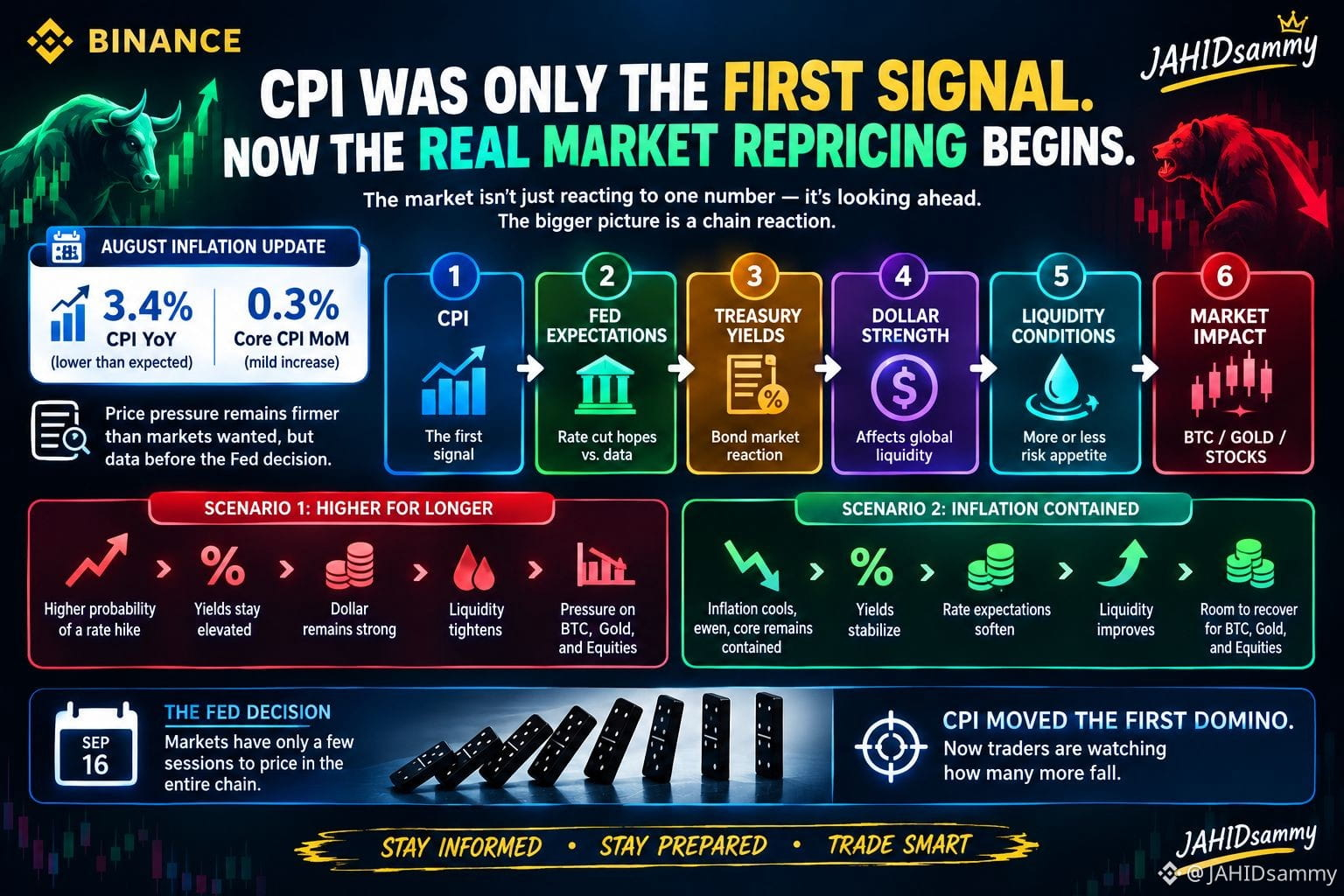
🔥 CPI was only the first signal — now the real market repricing begins.
Inflation → Fed expectations → Treasury yields → Dollar strength → Liquidity → BTC, Gold & Stocks 📊
Which scenario do you think comes next: Higher for Longer or Inflation Contained? 👇
#Bitcoin #BTC #Crypto #CPI #Fed #Inflation #MarketAnalysis #FedHikeOddsRiseTo89% inance #JAHIDsammy
🔥 CPI was only the first signal — now the real market repricing begins.
Inflation → Fed expectations → Treasury yields → Dollar strength → Liquidity → BTC, Gold & Stocks 📊
Which scenario do you think comes next: Higher for Longer or Inflation Contained? 👇
#Bitcoin #BTC #Crypto #CPI #Fed #Inflation #MarketAnalysis #FedHikeOddsRiseTo89% inance #JAHIDsammy
Inflation → Fed expectations → Treasury yields → Dollar strength → Liquidity → BTC, Gold & Stocks 📊
Which scenario do you think comes next: Higher for Longer or Inflation Contained? 👇
#Bitcoin #BTC #Crypto #CPI #Fed #Inflation #MarketAnalysis #FedHikeOddsRiseTo89% inance #JAHIDsammy
211

·
--
Bearish
🌡️ CPI — the good news and the hidden warning
The headline numbers looked reassuring. CPI came in at 3.4% YoY — exactly as expected, unchanged from July. Core CPI dropped to 2.4% YoY — the lowest level since February 2026. Inflation excluding food and energy is genuinely approaching the Fed's 2% target. That is real progress and the market noticed — $BTC initially dumped then recovered back above $77,000 within the same hour. 👀
But here is what most posts won't tell you. The monthly core CPI came in at 0.3% — above the 0.2% consensus. Every single analyst forecast was between 0.16% and 0.24%. The actual came in at 0.29% — beating the entire forecast range. At an annualised pace that is 3.5% — well above the Fed's target. Shelter, airfares, education and used cars led the acceleration. The annual number looks good. The monthly number does not. 🧠
✅ CPI YoY: 3.4% — in line with forecast
✅ Core CPI YoY: 2.4% — lowest since February, approaching 2% target
⚠️ Core CPI MoM: 0.3% — above 0.2% consensus, beat entire forecast range
⚠️ Annualised monthly pace: 3.5% — not consistent with 2% target
🏠 Shelter, airfares, education: all accelerating this month
#cpi #dyor #inflation #corecpi
{future}(BTCUSDT)
{future}(ETHUSDT)
{future}(BNBUSDT)
🌡️ CPI — the good news and the hidden warning
The headline numbers looked reassuring. CPI came in at 3.4% YoY — exactly as expected, unchanged from July. Core CPI dropped to 2.4% YoY — the lowest level since February 2026. Inflation excluding food and energy is genuinely approaching the Fed's 2% target. That is real progress and the market noticed — $BTC initially dumped then recovered back above $77,000 within the same hour. 👀
But here is what most posts won't tell you. The monthly core CPI came in at 0.3% — above the 0.2% consensus. Every single analyst forecast was between 0.16% and 0.24%. The actual came in at 0.29% — beating the entire forecast range. At an annualised pace that is 3.5% — well above the Fed's target. Shelter, airfares, education and used cars led the acceleration. The annual number looks good. The monthly number does not. 🧠
✅ CPI YoY: 3.4% — in line with forecast
✅ Core CPI YoY: 2.4% — lowest since February, approaching 2% target
⚠️ Core CPI MoM: 0.3% — above 0.2% consensus, beat entire forecast range
⚠️ Annualised monthly pace: 3.5% — not consistent with 2% target
🏠 Shelter, airfares, education: all accelerating this month
#cpi #dyor #inflation #corecpi
The headline numbers looked reassuring. CPI came in at 3.4% YoY — exactly as expected, unchanged from July. Core CPI dropped to 2.4% YoY — the lowest level since February 2026. Inflation excluding food and energy is genuinely approaching the Fed's 2% target. That is real progress and the market noticed — $BTC initially dumped then recovered back above $77,000 within the same hour. 👀
But here is what most posts won't tell you. The monthly core CPI came in at 0.3% — above the 0.2% consensus. Every single analyst forecast was between 0.16% and 0.24%. The actual came in at 0.29% — beating the entire forecast range. At an annualised pace that is 3.5% — well above the Fed's target. Shelter, airfares, education and used cars led the acceleration. The annual number looks good. The monthly number does not. 🧠
✅ CPI YoY: 3.4% — in line with forecast
✅ Core CPI YoY: 2.4% — lowest since February, approaching 2% target
⚠️ Core CPI MoM: 0.3% — above 0.2% consensus, beat entire forecast range
⚠️ Annualised monthly pace: 3.5% — not consistent with 2% target
🏠 Shelter, airfares, education: all accelerating this month
#cpi #dyor #inflation #corecpi
42
·
--
Bearish
🔑 week in short
$BTC 📉 $79,200 → $76,300 — controlled consolidation after +22% 😮💨
✅ Core CPI YoY: 2.4% — real progress toward 2% target
⚠️ Core CPI MoM: 0.3% — beat entire forecast range, too hot
🚨 PPI YoY: 5.4% — pipeline hot, more inflation coming
🛢️ Brent: $111 — Houthis attacking Saudi infrastructure again
🚨 Rate hike probability: 85% — September 15-16 FOMC
📅 Next: FOMC September 15-16 — most important Fed decision of 2026
The good news is real — core CPI at 2.4% is the best reading since the war started. The bad news is also real — the monthly acceleration and PPI pipeline mean that improvement may not last. $BTC absorbed both messages and closed at $76,300 — still 20% above where it was three weeks ago. FOMC September 15-16 is now 4 days away. With rate hike probability at 85% — the market is not pricing a hold. It is pricing a hike. If Warsh surprises and holds — $BTC could explode toward $85K. If he hikes — $BTC tests $70K support. The most binary Fed decision of
2026 is days away. 🎯
#CPI #PPI #FOMC #DYOR
{future}(BTCUSDT)
{future}(XAGUSDT)
{future}(XAUUSDT)
🔑 week in short
$BTC 📉 $79,200 → $76,300 — controlled consolidation after +22% 😮💨
✅ Core CPI YoY: 2.4% — real progress toward 2% target
⚠️ Core CPI MoM: 0.3% — beat entire forecast range, too hot
🚨 PPI YoY: 5.4% — pipeline hot, more inflation coming
🛢️ Brent: $111 — Houthis attacking Saudi infrastructure again
🚨 Rate hike probability: 85% — September 15-16 FOMC
📅 Next: FOMC September 15-16 — most important Fed decision of 2026
The good news is real — core CPI at 2.4% is the best reading since the war started. The bad news is also real — the monthly acceleration and PPI pipeline mean that improvement may not last. $BTC absorbed both messages and closed at $76,300 — still 20% above where it was three weeks ago. FOMC September 15-16 is now 4 days away. With rate hike probability at 85% — the market is not pricing a hold. It is pricing a hike. If Warsh surprises and holds — $BTC could explode toward $85K. If he hikes — $BTC tests $70K support. The most binary Fed decision of
2026 is days away. 🎯
#CPI #PPI #FOMC #DYOR
$BTC 📉 $79,200 → $76,300 — controlled consolidation after +22% 😮💨
✅ Core CPI YoY: 2.4% — real progress toward 2% target
⚠️ Core CPI MoM: 0.3% — beat entire forecast range, too hot
🚨 PPI YoY: 5.4% — pipeline hot, more inflation coming
🛢️ Brent: $111 — Houthis attacking Saudi infrastructure again
🚨 Rate hike probability: 85% — September 15-16 FOMC
📅 Next: FOMC September 15-16 — most important Fed decision of 2026
The good news is real — core CPI at 2.4% is the best reading since the war started. The bad news is also real — the monthly acceleration and PPI pipeline mean that improvement may not last. $BTC absorbed both messages and closed at $76,300 — still 20% above where it was three weeks ago. FOMC September 15-16 is now 4 days away. With rate hike probability at 85% — the market is not pricing a hold. It is pricing a hike. If Warsh surprises and holds — $BTC could explode toward $85K. If he hikes — $BTC tests $70K support. The most binary Fed decision of
2026 is days away. 🎯
#CPI #PPI #FOMC #DYOR
257
·
--
#FedRateWatch The markets enter one of the most sensitive moments of the week with the Federal Reserve meeting and the interest-rate decision
Recent U.S. inflation data gave markets an important signal: the CPI rose in August by 0.4% month-on-month, while Core CPI rose by 0.3%, and annual inflation reached 3.4%. This means price pressures are still above the Fed’s 2% target �
Reuters
Therefore, market expectations increased for a 25-basis-point rate hike, and the most important question is no longer only whether the Fed will raise rates, but what it will say about the next steps
For BTC, stocks, and gold, higher rates may mean tighter liquidity conditions and higher bond yields, so we may see strong volatility in high-risk assets
But if the rate hike is already priced in the market, then the real reaction could be tied to the Fed’s tone and its expectations for future decisions
I will monitor BTC, the dollar, and bond yields before making any trading decision, and I won’t chase the first move after the news
Do you expect the Fed’s decision to be the start of a longer rate-hike cycle, or just a single hike?
#FedRateWatch #Bitcoin #CPI #crypto
#FedRateWatch The markets enter one of the most sensitive moments of the week with the Federal Reserve meeting and the interest-rate decision
Recent U.S. inflation data gave markets an important signal: the CPI rose in August by 0.4% month-on-month, while Core CPI rose by 0.3%, and annual inflation reached 3.4%. This means price pressures are still above the Fed’s 2% target �
Reuters
Therefore, market expectations increased for a 25-basis-point rate hike, and the most important question is no longer only whether the Fed will raise rates, but what it will say about the next steps
For BTC, stocks, and gold, higher rates may mean tighter liquidity conditions and higher bond yields, so we may see strong volatility in high-risk assets
But if the rate hike is already priced in the market, then the real reaction could be tied to the Fed’s tone and its expectations for future decisions
I will monitor BTC, the dollar, and bond yields before making any trading decision, and I won’t chase the first move after the news
Do you expect the Fed’s decision to be the start of a longer rate-hike cycle, or just a single hike?
#FedRateWatch #Bitcoin #CPI #crypto
Recent U.S. inflation data gave markets an important signal: the CPI rose in August by 0.4% month-on-month, while Core CPI rose by 0.3%, and annual inflation reached 3.4%. This means price pressures are still above the Fed’s 2% target �
Reuters
Therefore, market expectations increased for a 25-basis-point rate hike, and the most important question is no longer only whether the Fed will raise rates, but what it will say about the next steps
For BTC, stocks, and gold, higher rates may mean tighter liquidity conditions and higher bond yields, so we may see strong volatility in high-risk assets
But if the rate hike is already priced in the market, then the real reaction could be tied to the Fed’s tone and its expectations for future decisions
I will monitor BTC, the dollar, and bond yields before making any trading decision, and I won’t chase the first move after the news
Do you expect the Fed’s decision to be the start of a longer rate-hike cycle, or just a single hike?
#FedRateWatch #Bitcoin #CPI #crypto
1
83

·
--
📊 August CPI year-on-year 3.4% and month-on-month 0.4%, beating expectations🔥. Inflation is like a kid who won’t get up—no matter how you call, it won’t budge. The old craftsman can only pull out a feather duster🪶 → Inflation’s stickiness means higher rates for longer, and the “liquidity-flood bull market script” for big pie has had a page torn out📜; the stash of copycat coins is already starting to tremble🥶.#cpi
📊 August CPI year-on-year 3.4% and month-on-month 0.4%, beating expectations🔥. Inflation is like a kid who won’t get up—no matter how you call, it won’t budge. The old craftsman can only pull out a feather duster🪶 → Inflation’s stickiness means higher rates for longer, and the “liquidity-flood bull market script” for big pie has had a page torn out📜; the stash of copycat coins is already starting to tremble🥶.#cpi
1
68



🇺🇸 What is the CPI?
CPI are the initials for Consumer Price Index — Consumer Price Index.
🛒 What does it measure? The average change in the prices of the basket of goods and services that a typical consumer buys: groceries, clothing, rent, transportation, services… a bit of everything.
📊 How does it work? The U.S. government compares how much that basket costs today versus a year ago. If it went up by 3.4%, then the annual inflation rate was 3.4%.
👉 Why does it matter? It’s THE inflation thermometer — the number everyone watches (including the Fed) to decide what to do with interest rates
⚠️ This does not constitute financial advice. Cryptocurrencies are volatile. DYOR
#CPI #Inflación #Cripto
🇺🇸 What is the CPI?
CPI are the initials for Consumer Price Index — Consumer Price Index.
🛒 What does it measure? The average change in the prices of the basket of goods and services that a typical consumer buys: groceries, clothing, rent, transportation, services… a bit of everything.
📊 How does it work? The U.S. government compares how much that basket costs today versus a year ago. If it went up by 3.4%, then the annual inflation rate was 3.4%.
👉 Why does it matter? It’s THE inflation thermometer — the number everyone watches (including the Fed) to decide what to do with interest rates
⚠️ This does not constitute financial advice. Cryptocurrencies are volatile. DYOR
#CPI #Inflación #Cripto
CPI are the initials for Consumer Price Index — Consumer Price Index.
🛒 What does it measure? The average change in the prices of the basket of goods and services that a typical consumer buys: groceries, clothing, rent, transportation, services… a bit of everything.
📊 How does it work? The U.S. government compares how much that basket costs today versus a year ago. If it went up by 3.4%, then the annual inflation rate was 3.4%.
👉 Why does it matter? It’s THE inflation thermometer — the number everyone watches (including the Fed) to decide what to do with interest rates
⚠️ This does not constitute financial advice. Cryptocurrencies are volatile. DYOR
#CPI #Inflación #Cripto
1
277
Log in to explore more content
Join global crypto users on Binance Square
⚡️ Get latest and useful information about crypto.
💬 Trusted by the world’s largest crypto exchange.
👍 Discover real insights from verified creators.
Email / Phone number
Trending Topics
1
#BitcoinSurpasses$77000
10,818 views
165 Discussing
2
#ParadigmDisclosesZECHolding
41,714 views
796 Discussing
3
#BitcoinETFsShed$450M
20,835 views
187 Discussing
4
#USWeeklyJoblessClaimsFallTo196K
21,998 views
469 Discussing
5
#ArkhamSaysBlackRockBuys$1.5BInETH
3,991 views
51 Discussing
6
#ElSalvadorBTCHoldingsRiseTo7777
48,194 views
773 Discussing
7
#MemeLaunchpads82%OfArcDayOneVolume
52,250 views
959 Discussing
8
#OstiumLoanDisputeHearingSetInNYFederalCourt
42,423 views
685 Discussing
9
#HyperliquidUSDCSupplyOvertakesSolana
18,804 views
339 Discussing
10
#SKPoliceRefer18PolymarketUsersToProsecutors
24,339 views
501 Discussing