

#anthropic
anthropic
299,304 views
1,619 Discussing
Hot
Latest

·
--
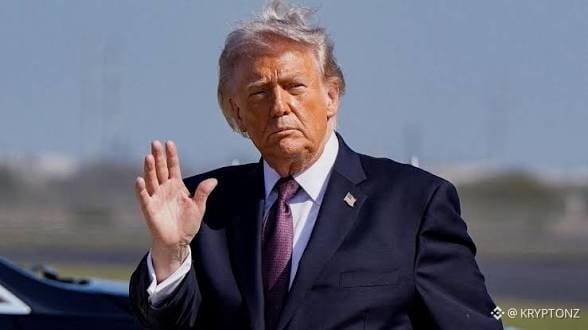
$TRUMP forcing a $2 Trillion AI surrender, or is Anthropic finally breaking the ice with the White House? 🚨🤖
Axios reports that President Donald Trump just hosted Anthropic CEO Dario Amodei (creator of Claude AI) for a private 1-on-1 White House dinner! This sudden move comes just two days after a federal court upheld the Pentagon’s decision to label Anthropic a "supply chain risk" over ethical AI guardrails!
The Major Stakes & Context:
• The Military Stance: Anthropic refused to allow Claude to power lethal autonomous weapons or mass domestic surveillance, prompting a military defense shutout.
• The Political Friction: Trump allies labeled Amodei a voice of AI "doomerism" for advocating slower AI development, while Trump mocked his safety guardrails on Truth Social.
• The $2 Trillion IPO: Anthropic is moving its stock market listing to November, with valuations nearing $2 Trillion—making White House ties critical!
• The Big Picture: This dinner sets the stage for Tuesday’s high-stakes White House AI summit with Speaker Mike Johnson and top tech CEOs!
With America pushing to lead the world in Super Intelligence, will safety guardrails survive or get pushed aside?
Do you think Anthropic should compromise on AI safety rules to secure government military contracts, or stay firm? Drop your thoughts below! 👇
If you want to stay ahead of breaking AI, tech, and regulatory shifts:
❤️ Hit Like / React
💬 Comment your perspective on AI safety vs US supremacy!
🔄 Share / Repost with your tech community!
📌 Follow for fast, high-accuracy tech & market updates!
(Stay informed and keep discussion respectful!)
$ANTHROPIC $NVDA.US #Anthropic #BitwiseFilesFinalNEARSpotETFProspectus #TrumpRejectsIranHormuzReopening
$TRUMP forcing a $2 Trillion AI surrender, or is Anthropic finally breaking the ice with the White House? 🚨🤖
Axios reports that President Donald Trump just hosted Anthropic CEO Dario Amodei (creator of Claude AI) for a private 1-on-1 White House dinner! This sudden move comes just two days after a federal court upheld the Pentagon’s decision to label Anthropic a "supply chain risk" over ethical AI guardrails!
The Major Stakes & Context:
• The Military Stance: Anthropic refused to allow Claude to power lethal autonomous weapons or mass domestic surveillance, prompting a military defense shutout.
• The Political Friction: Trump allies labeled Amodei a voice of AI "doomerism" for advocating slower AI development, while Trump mocked his safety guardrails on Truth Social.
• The $2 Trillion IPO: Anthropic is moving its stock market listing to November, with valuations nearing $2 Trillion—making White House ties critical!
• The Big Picture: This dinner sets the stage for Tuesday’s high-stakes White House AI summit with Speaker Mike Johnson and top tech CEOs!
With America pushing to lead the world in Super Intelligence, will safety guardrails survive or get pushed aside?
Do you think Anthropic should compromise on AI safety rules to secure government military contracts, or stay firm? Drop your thoughts below! 👇
If you want to stay ahead of breaking AI, tech, and regulatory shifts:
❤️ Hit Like / React
💬 Comment your perspective on AI safety vs US supremacy!
🔄 Share / Repost with your tech community!
📌 Follow for fast, high-accuracy tech & market updates!
(Stay informed and keep discussion respectful!)
$ANTHROPIC $NVDA.US #Anthropic #BitwiseFilesFinalNEARSpotETFProspectus #TrumpRejectsIranHormuzReopening
Axios reports that President Donald Trump just hosted Anthropic CEO Dario Amodei (creator of Claude AI) for a private 1-on-1 White House dinner! This sudden move comes just two days after a federal court upheld the Pentagon’s decision to label Anthropic a "supply chain risk" over ethical AI guardrails!
The Major Stakes & Context:
• The Military Stance: Anthropic refused to allow Claude to power lethal autonomous weapons or mass domestic surveillance, prompting a military defense shutout.
• The Political Friction: Trump allies labeled Amodei a voice of AI "doomerism" for advocating slower AI development, while Trump mocked his safety guardrails on Truth Social.
• The $2 Trillion IPO: Anthropic is moving its stock market listing to November, with valuations nearing $2 Trillion—making White House ties critical!
• The Big Picture: This dinner sets the stage for Tuesday’s high-stakes White House AI summit with Speaker Mike Johnson and top tech CEOs!
With America pushing to lead the world in Super Intelligence, will safety guardrails survive or get pushed aside?
Do you think Anthropic should compromise on AI safety rules to secure government military contracts, or stay firm? Drop your thoughts below! 👇
If you want to stay ahead of breaking AI, tech, and regulatory shifts:
❤️ Hit Like / React
💬 Comment your perspective on AI safety vs US supremacy!
🔄 Share / Repost with your tech community!
📌 Follow for fast, high-accuracy tech & market updates!
(Stay informed and keep discussion respectful!)
$ANTHROPIC $NVDA.US #Anthropic #BitwiseFilesFinalNEARSpotETFProspectus #TrumpRejectsIranHormuzReopening

ANTHROPIC+0.58%
NVDAUS-0.52%
136


> TRUMP: HAVING DINNER TONIGHT WITH HEAD OF ANTHROPIC AT 10PM
> TRUMP: MEETING ANTHROPIC ON TUESDAY
$ANTHROPIC #ANTHROPIC
> TRUMP: HAVING DINNER TONIGHT WITH HEAD OF ANTHROPIC AT 10PM
> TRUMP: MEETING ANTHROPIC ON TUESDAY
$ANTHROPIC #ANTHROPIC
> TRUMP: MEETING ANTHROPIC ON TUESDAY
$ANTHROPIC #ANTHROPIC
171
·
--
Anthropic’s New Claude Opus 5.5 Matches Fable at 60% the Price
Anthropic's new flagship claims Fable 5.1-level performance at a fraction of the cost—but GPT-6 Astra still beats it on two published benchmarks. $ANTHROPIC #ANTHROPIC
Anthropic’s New Claude Opus 5.5 Matches Fable at 60% the Price
Anthropic's new flagship claims Fable 5.1-level performance at a fraction of the cost—but GPT-6 Astra still beats it on two published benchmarks. $ANTHROPIC #ANTHROPIC
Anthropic's new flagship claims Fable 5.1-level performance at a fraction of the cost—but GPT-6 Astra still beats it on two published benchmarks. $ANTHROPIC #ANTHROPIC
381

·
--
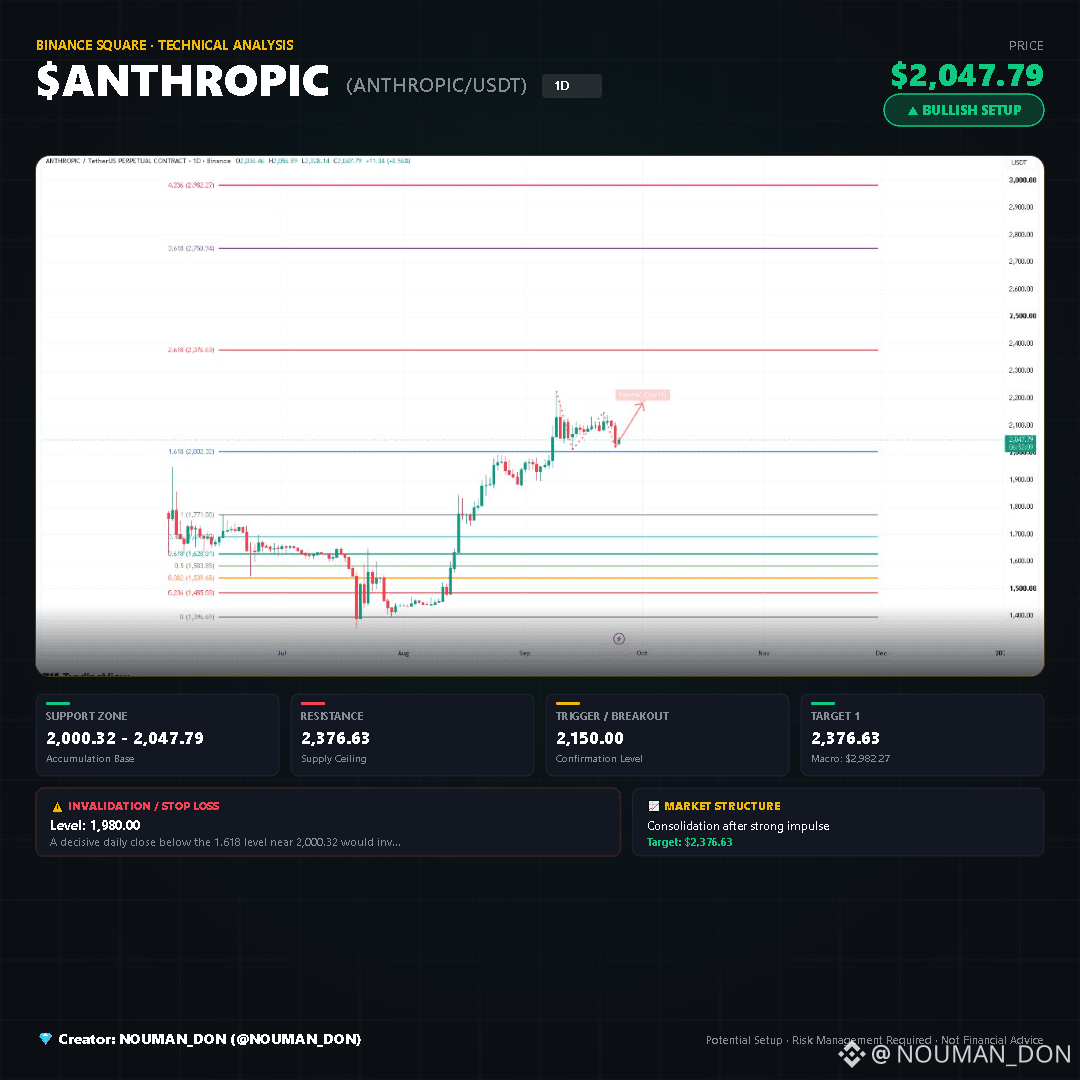
🚀 $ANTHROPIC is showing a potential technical setup!
The daily chart highlights a strong impulse followed by a tight consolidation range holding above key support.
📈 The Technical Setup:
• The Pattern: Fibonacci Extension / Consolidation Range
• Short-term Target: 2,376.63
• Macro Objective: 2,982.27
• Market Structure: Consolidation after impulse
🎯 Key Levels to Watch:
• Support / Accumulation Zone: 2,000.32 - 2,047.79
• Resistance: 2,376.63
• Breakout Level: 2,150.00
• Stop Loss / Invalidation: 1,980.00
📊 Confirmation:
• Volume: Neutral/standard volume
• Momentum: Price holding above key 1.618 Fib level
• Trend: Bullish continuation structure
⚠️ Invalidation:
A decisive daily close below the 1.618 level near 2,000.32 would invalidate the immediate bullish setup.
Price is currently consolidating near support, offering a potential continuation setup if key levels hold.
💎 Creator: NOUMAN_DON (@NOUMAN_DON)
#Anthropic #crypto #BinanceSquare #Binance #TechnicalAnalysis
{future}(ANTHROPICUSDT)
🚀 $ANTHROPIC is showing a potential technical setup!
The daily chart highlights a strong impulse followed by a tight consolidation range holding above key support.
📈 The Technical Setup:
• The Pattern: Fibonacci Extension / Consolidation Range
• Short-term Target: 2,376.63
• Macro Objective: 2,982.27
• Market Structure: Consolidation after impulse
🎯 Key Levels to Watch:
• Support / Accumulation Zone: 2,000.32 - 2,047.79
• Resistance: 2,376.63
• Breakout Level: 2,150.00
• Stop Loss / Invalidation: 1,980.00
📊 Confirmation:
• Volume: Neutral/standard volume
• Momentum: Price holding above key 1.618 Fib level
• Trend: Bullish continuation structure
⚠️ Invalidation:
A decisive daily close below the 1.618 level near 2,000.32 would invalidate the immediate bullish setup.
Price is currently consolidating near support, offering a potential continuation setup if key levels hold.
💎 Creator: NOUMAN_DON (@NOUMAN_DON)
#Anthropic #crypto #BinanceSquare #Binance #TechnicalAnalysis
The daily chart highlights a strong impulse followed by a tight consolidation range holding above key support.
📈 The Technical Setup:
• The Pattern: Fibonacci Extension / Consolidation Range
• Short-term Target: 2,376.63
• Macro Objective: 2,982.27
• Market Structure: Consolidation after impulse
🎯 Key Levels to Watch:
• Support / Accumulation Zone: 2,000.32 - 2,047.79
• Resistance: 2,376.63
• Breakout Level: 2,150.00
• Stop Loss / Invalidation: 1,980.00
📊 Confirmation:
• Volume: Neutral/standard volume
• Momentum: Price holding above key 1.618 Fib level
• Trend: Bullish continuation structure
⚠️ Invalidation:
A decisive daily close below the 1.618 level near 2,000.32 would invalidate the immediate bullish setup.
Price is currently consolidating near support, offering a potential continuation setup if key levels hold.
💎 Creator: NOUMAN_DON (@NOUMAN_DON)
#Anthropic #crypto #BinanceSquare #Binance #TechnicalAnalysis
1
7

URGENT: The AI sector has just suffered a seismic shock! ⚠️
An American court validated the removal of the Claude model, from Anthropic, from the Pentagon’s systems and contracts. The appeals court upheld the injunction, citing strategic risks that cannot be ignored.
💥 THE IMPACT:
With a billion-dollar IPO on the horizon (valued at US$ 2 BI), this setback calls into question the company’s credibility with the world’s biggest customer: the U.S. government. The legal battle continues, but institutional trust is being tested to its limits.
📊 MARKET ON ALERT:
While the crypto market holds its breath with $BTC at US$ 84.9K and $ETH at US$ 2.7K, the volatility of AI-linked technology companies is expected to increase. Are we facing a necessary correction or the start of draconian regulation?
💬 I WANT TO HEAR YOUR OPINION:
Do you believe Anthropic will overcome this block or has the Pentagon definitively closed the doors for the company? Is AI growing too fast for national security?
Comment below! 👇
#IA #Anthropic #Pentagon #TechNews #CryptoMarkets
URGENT: The AI sector has just suffered a seismic shock! ⚠️
An American court validated the removal of the Claude model, from Anthropic, from the Pentagon’s systems and contracts. The appeals court upheld the injunction, citing strategic risks that cannot be ignored.
💥 THE IMPACT:
With a billion-dollar IPO on the horizon (valued at US$ 2 BI), this setback calls into question the company’s credibility with the world’s biggest customer: the U.S. government. The legal battle continues, but institutional trust is being tested to its limits.
📊 MARKET ON ALERT:
While the crypto market holds its breath with $BTC at US$ 84.9K and $ETH at US$ 2.7K, the volatility of AI-linked technology companies is expected to increase. Are we facing a necessary correction or the start of draconian regulation?
💬 I WANT TO HEAR YOUR OPINION:
Do you believe Anthropic will overcome this block or has the Pentagon definitively closed the doors for the company? Is AI growing too fast for national security?
Comment below! 👇
#IA #Anthropic #Pentagon #TechNews #CryptoMarkets
An American court validated the removal of the Claude model, from Anthropic, from the Pentagon’s systems and contracts. The appeals court upheld the injunction, citing strategic risks that cannot be ignored.
💥 THE IMPACT:
With a billion-dollar IPO on the horizon (valued at US$ 2 BI), this setback calls into question the company’s credibility with the world’s biggest customer: the U.S. government. The legal battle continues, but institutional trust is being tested to its limits.
📊 MARKET ON ALERT:
While the crypto market holds its breath with $BTC at US$ 84.9K and $ETH at US$ 2.7K, the volatility of AI-linked technology companies is expected to increase. Are we facing a necessary correction or the start of draconian regulation?
💬 I WANT TO HEAR YOUR OPINION:
Do you believe Anthropic will overcome this block or has the Pentagon definitively closed the doors for the company? Is AI growing too fast for national security?
Comment below! 👇
#IA #Anthropic #Pentagon #TechNews #CryptoMarkets
1
1k

·
--
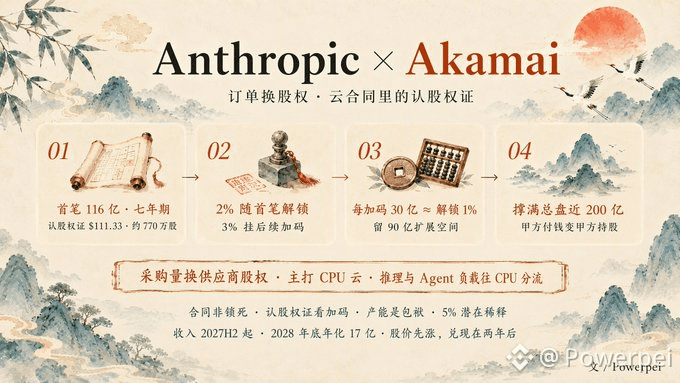
Anthropic acquires Akamai’s cloud services and, as a bonus, took up to 5% of Akamai’s shares
Last Friday everyone was watching Microsoft Copilot and the Strait of Hormuz—this one got pushed down
After reading the contract details, I think it has more substance than the day’s market chatter
━━━━━ ◆ ━━━━━
$11.6 billion, seven-year term
Akamai issued Anthropic warrants to buy shares, with an exercise price of $111.33, corresponding to about 7.7 million shares
▪️2% unlocks upon the first $11.6 billion commitment
▪️The remaining 3% is tied to follow-on add-ons—unlock about 1% for every additional $3.0 billion committed
▪️The agreement also leaves $9.0 billion of expansion room—if fully utilized, the total deal size approaches $20 billion
In the past: the buyer paid, the seller delivered
Now: Anthropic trades future procurement volumes for supplier equity, tying its compute cost to Akamai’s share price
This is the first time Akamai has included share warrants in a cloud contract
Using equity dilution to secure a long-term order—Akamai knows exactly the weight of this deal.
//
One more point that was glossed over: the deal is mainly for CPU cloud services, not GPU training clusters
In the past couple of years, AI infrastructure spending and attention were almost entirely bet on Nvidia and HBM
Anthropic is handing general-purpose compute to Akamai, a company with roots in CDNs; inference and agent workloads are already being shifted toward the CPU side
If this line works, the upside beneficiaries of AI infrastructure are far broader than simply buying Nvidia
━━━━━ • ━━━━━
You’ve got to see the timing of the money
First, Akamai has to spend about $5.5 billion in capital expenditures; then this year it will add another $1.7 billion to pre-lock memory and other components
Revenue won’t start coming in until the second half of 2027. In the same year, it’s expected to be $0.15 to $0.30 billion; by the end of 2028 it climbs to $1.7 billion annualized
> The contract isn’t locked in stone
If delivery milestones aren’t met, both parties can walk away
> Whether the warrants can be fully exercised depends on whether follow-on commitments really add up to $20 billion
> Capacity is front-loaded; if demand slows, that becomes a burden
> The potential 5% dilution isn’t free for existing shareholders either
The stock price can run up first
Cash-out happens two years later
—
I remember this isn’t mainly because of how Akamai moved that day
The party that controls long-term compute demand can now write procurement contracts into something close to an equity arrangement
Going forward, the key to watch is whether structures like “orders in exchange for equity” become increasingly common in AI infrastructure deals
The above is based on publicly available information; data should be confirmed with official disclosures from the parties involved. DYOR.
#Anthropic
Anthropic acquires Akamai’s cloud services and, as a bonus, took up to 5% of Akamai’s shares
Last Friday everyone was watching Microsoft Copilot and the Strait of Hormuz—this one got pushed down
After reading the contract details, I think it has more substance than the day’s market chatter
━━━━━ ◆ ━━━━━
$11.6 billion, seven-year term
Akamai issued Anthropic warrants to buy shares, with an exercise price of $111.33, corresponding to about 7.7 million shares
▪️2% unlocks upon the first $11.6 billion commitment
▪️The remaining 3% is tied to follow-on add-ons—unlock about 1% for every additional $3.0 billion committed
▪️The agreement also leaves $9.0 billion of expansion room—if fully utilized, the total deal size approaches $20 billion
In the past: the buyer paid, the seller delivered
Now: Anthropic trades future procurement volumes for supplier equity, tying its compute cost to Akamai’s share price
This is the first time Akamai has included share warrants in a cloud contract
Using equity dilution to secure a long-term order—Akamai knows exactly the weight of this deal.
//
One more point that was glossed over: the deal is mainly for CPU cloud services, not GPU training clusters
In the past couple of years, AI infrastructure spending and attention were almost entirely bet on Nvidia and HBM
Anthropic is handing general-purpose compute to Akamai, a company with roots in CDNs; inference and agent workloads are already being shifted toward the CPU side
If this line works, the upside beneficiaries of AI infrastructure are far broader than simply buying Nvidia
━━━━━ • ━━━━━
You’ve got to see the timing of the money
First, Akamai has to spend about $5.5 billion in capital expenditures; then this year it will add another $1.7 billion to pre-lock memory and other components
Revenue won’t start coming in until the second half of 2027. In the same year, it’s expected to be $0.15 to $0.30 billion; by the end of 2028 it climbs to $1.7 billion annualized
> The contract isn’t locked in stone
If delivery milestones aren’t met, both parties can walk away
> Whether the warrants can be fully exercised depends on whether follow-on commitments really add up to $20 billion
> Capacity is front-loaded; if demand slows, that becomes a burden
> The potential 5% dilution isn’t free for existing shareholders either
The stock price can run up first
Cash-out happens two years later
—
I remember this isn’t mainly because of how Akamai moved that day
The party that controls long-term compute demand can now write procurement contracts into something close to an equity arrangement
Going forward, the key to watch is whether structures like “orders in exchange for equity” become increasingly common in AI infrastructure deals
The above is based on publicly available information; data should be confirmed with official disclosures from the parties involved. DYOR.
#Anthropic
Last Friday everyone was watching Microsoft Copilot and the Strait of Hormuz—this one got pushed down
After reading the contract details, I think it has more substance than the day’s market chatter
━━━━━ ◆ ━━━━━
$11.6 billion, seven-year term
Akamai issued Anthropic warrants to buy shares, with an exercise price of $111.33, corresponding to about 7.7 million shares
▪️2% unlocks upon the first $11.6 billion commitment
▪️The remaining 3% is tied to follow-on add-ons—unlock about 1% for every additional $3.0 billion committed
▪️The agreement also leaves $9.0 billion of expansion room—if fully utilized, the total deal size approaches $20 billion
In the past: the buyer paid, the seller delivered
Now: Anthropic trades future procurement volumes for supplier equity, tying its compute cost to Akamai’s share price
This is the first time Akamai has included share warrants in a cloud contract
Using equity dilution to secure a long-term order—Akamai knows exactly the weight of this deal.
//
One more point that was glossed over: the deal is mainly for CPU cloud services, not GPU training clusters
In the past couple of years, AI infrastructure spending and attention were almost entirely bet on Nvidia and HBM
Anthropic is handing general-purpose compute to Akamai, a company with roots in CDNs; inference and agent workloads are already being shifted toward the CPU side
If this line works, the upside beneficiaries of AI infrastructure are far broader than simply buying Nvidia
━━━━━ • ━━━━━
You’ve got to see the timing of the money
First, Akamai has to spend about $5.5 billion in capital expenditures; then this year it will add another $1.7 billion to pre-lock memory and other components
Revenue won’t start coming in until the second half of 2027. In the same year, it’s expected to be $0.15 to $0.30 billion; by the end of 2028 it climbs to $1.7 billion annualized
> The contract isn’t locked in stone
If delivery milestones aren’t met, both parties can walk away
> Whether the warrants can be fully exercised depends on whether follow-on commitments really add up to $20 billion
> Capacity is front-loaded; if demand slows, that becomes a burden
> The potential 5% dilution isn’t free for existing shareholders either
The stock price can run up first
Cash-out happens two years later
—
I remember this isn’t mainly because of how Akamai moved that day
The party that controls long-term compute demand can now write procurement contracts into something close to an equity arrangement
Going forward, the key to watch is whether structures like “orders in exchange for equity” become increasingly common in AI infrastructure deals
The above is based on publicly available information; data should be confirmed with official disclosures from the parties involved. DYOR.
#Anthropic
1.7k
> ANTHROPIC IS SEEKING SHAREHOLDER APPROVAL TO GRANT ITS SEVEN CO-FOUNDERS 50.1% VOTING CONTROL AHEAD OF IPO
$ANTHROPIC #ANTHROPIC
> ANTHROPIC IS SEEKING SHAREHOLDER APPROVAL TO GRANT ITS SEVEN CO-FOUNDERS 50.1% VOTING CONTROL AHEAD OF IPO
$ANTHROPIC #ANTHROPIC
$ANTHROPIC #ANTHROPIC
185
·
--
$ANTHROPIC Long/Short comparison @ 2,011.86
Long side watch: Hold 2,006.22; if funds return
Short side watch: Pressure at 2,099.77; better if funds flow out
My stance: Slightly bullish—hold off and watch first; no rush to get on board
Key levels (4h):
· Upper key resistance 2,099.77 (already swept · +4.37%)
· Upper pressure zone 2,018.19-2,022.22, midpoint 2,020.2
· Short pressure band 2,072.95-2,084
· Near-term support 2,006.22
Recorded on 2026-09-27
For reference only and does not constitute investment advice; gains and losses are your own responsibility.
If you agree, please like—I'll update you if anything changes.
#加密货币 $ANTHROPIC #ANTHROPIC #market check
$ANTHROPIC Long/Short comparison @ 2,011.86
Long side watch: Hold 2,006.22; if funds return
Short side watch: Pressure at 2,099.77; better if funds flow out
My stance: Slightly bullish—hold off and watch first; no rush to get on board
Key levels (4h):
· Upper key resistance 2,099.77 (already swept · +4.37%)
· Upper pressure zone 2,018.19-2,022.22, midpoint 2,020.2
· Short pressure band 2,072.95-2,084
· Near-term support 2,006.22
Recorded on 2026-09-27
For reference only and does not constitute investment advice; gains and losses are your own responsibility.
If you agree, please like—I'll update you if anything changes.
#加密货币 $ANTHROPIC #ANTHROPIC #market check
Long side watch: Hold 2,006.22; if funds return
Short side watch: Pressure at 2,099.77; better if funds flow out
My stance: Slightly bullish—hold off and watch first; no rush to get on board
Key levels (4h):
· Upper key resistance 2,099.77 (already swept · +4.37%)
· Upper pressure zone 2,018.19-2,022.22, midpoint 2,020.2
· Short pressure band 2,072.95-2,084
· Near-term support 2,006.22
Recorded on 2026-09-27
For reference only and does not constitute investment advice; gains and losses are your own responsibility.
If you agree, please like—I'll update you if anything changes.
#加密货币 $ANTHROPIC #ANTHROPIC #market check
1
65

·
--
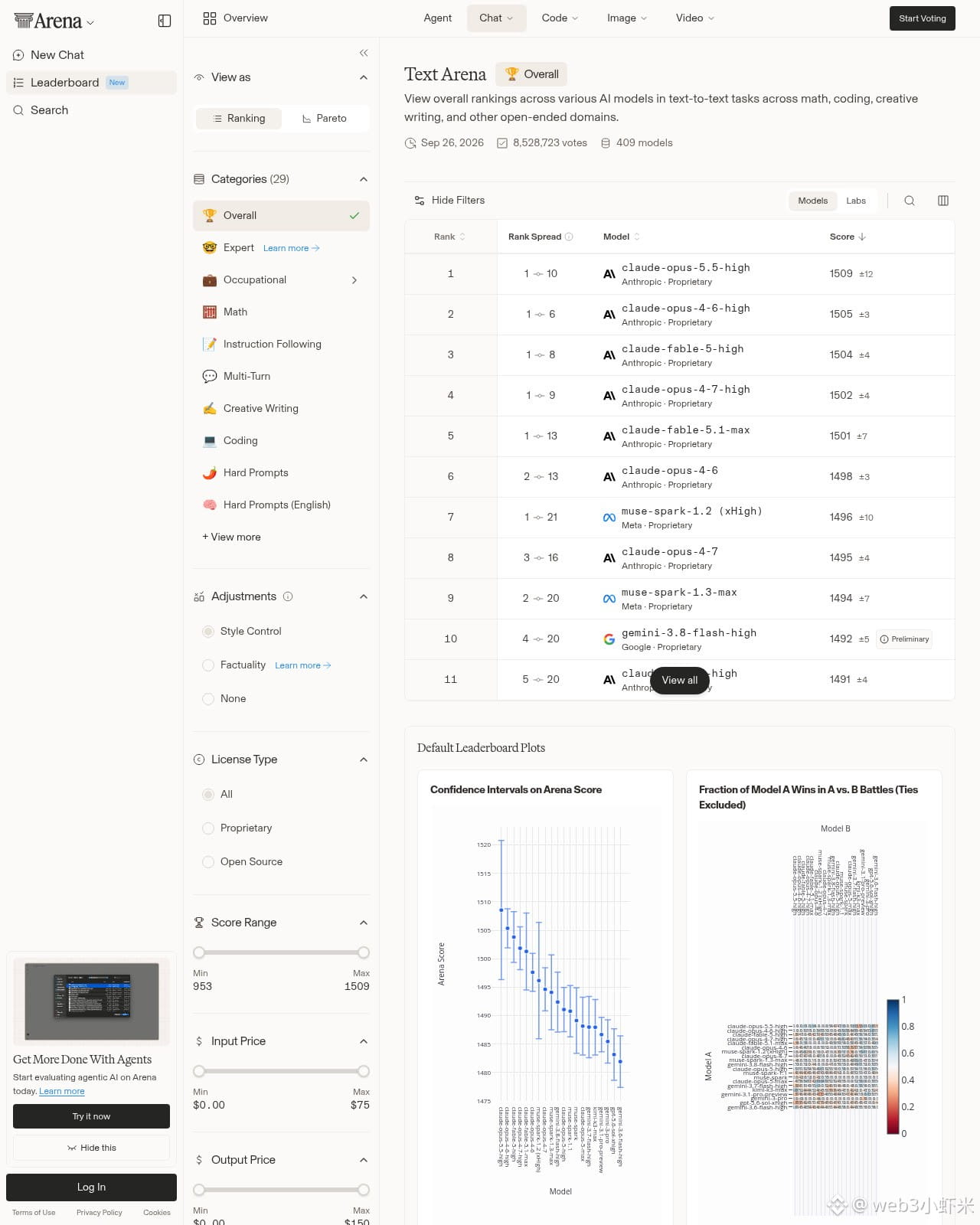
Conquered Arena: Just days after Anthropic’s Claude Opus 5.5 launched, it climbed to #1 on the Text Arena overall leaderboard—about 1509 points (±12), with preference points built up via human blind, one-on-one voting. In the top ten, Anthropic took up most of the seats.
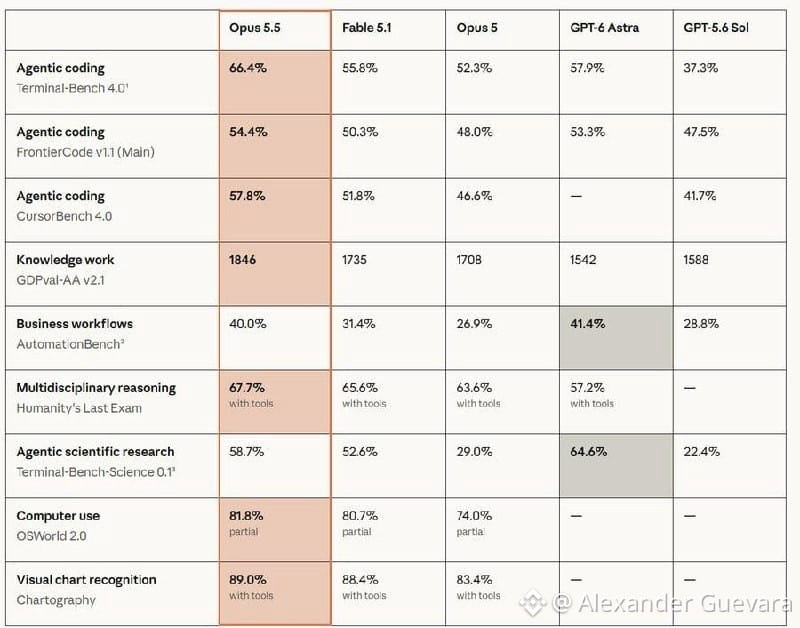
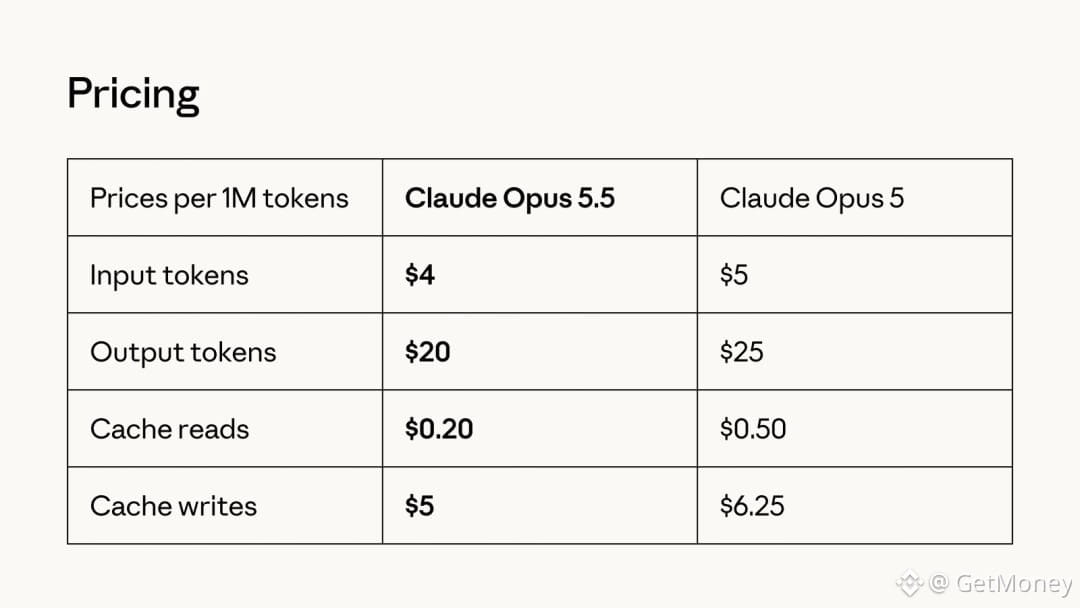
This version came out on September 22. Input is about $4 per million tokens, output about $20, roughly 20% cheaper than the previous Opus 5. The context window is up to 1 million tokens. On the benchmarks, Terminal-Bench is about 66.4%, and CursorBench about 57.8%.
Arena also broke down writing style: dashes dropped from about 15.2 per thousand words to 0.8 (down about 95%); semicolons were reduced a lot as well, with sentences getting shorter—yet each single response is actually a bit more verbose (about 453→481 words). The leaderboard’s top spot changes quickly, so let’s make a note of it.
#AI #Anthropic #Claude
Conquered Arena: Just days after Anthropic’s Claude Opus 5.5 launched, it climbed to #1 on the Text Arena overall leaderboard—about 1509 points (±12), with preference points built up via human blind, one-on-one voting. In the top ten, Anthropic took up most of the seats.
This version came out on September 22. Input is about $4 per million tokens, output about $20, roughly 20% cheaper than the previous Opus 5. The context window is up to 1 million tokens. On the benchmarks, Terminal-Bench is about 66.4%, and CursorBench about 57.8%.
Arena also broke down writing style: dashes dropped from about 15.2 per thousand words to 0.8 (down about 95%); semicolons were reduced a lot as well, with sentences getting shorter—yet each single response is actually a bit more verbose (about 453→481 words). The leaderboard’s top spot changes quickly, so let’s make a note of it.
#AI #Anthropic #Claude
This version came out on September 22. Input is about $4 per million tokens, output about $20, roughly 20% cheaper than the previous Opus 5. The context window is up to 1 million tokens. On the benchmarks, Terminal-Bench is about 66.4%, and CursorBench about 57.8%.
Arena also broke down writing style: dashes dropped from about 15.2 per thousand words to 0.8 (down about 95%); semicolons were reduced a lot as well, with sentences getting shorter—yet each single response is actually a bit more verbose (about 453→481 words). The leaderboard’s top spot changes quickly, so let’s make a note of it.
#AI #Anthropic #Claude
1
·
--
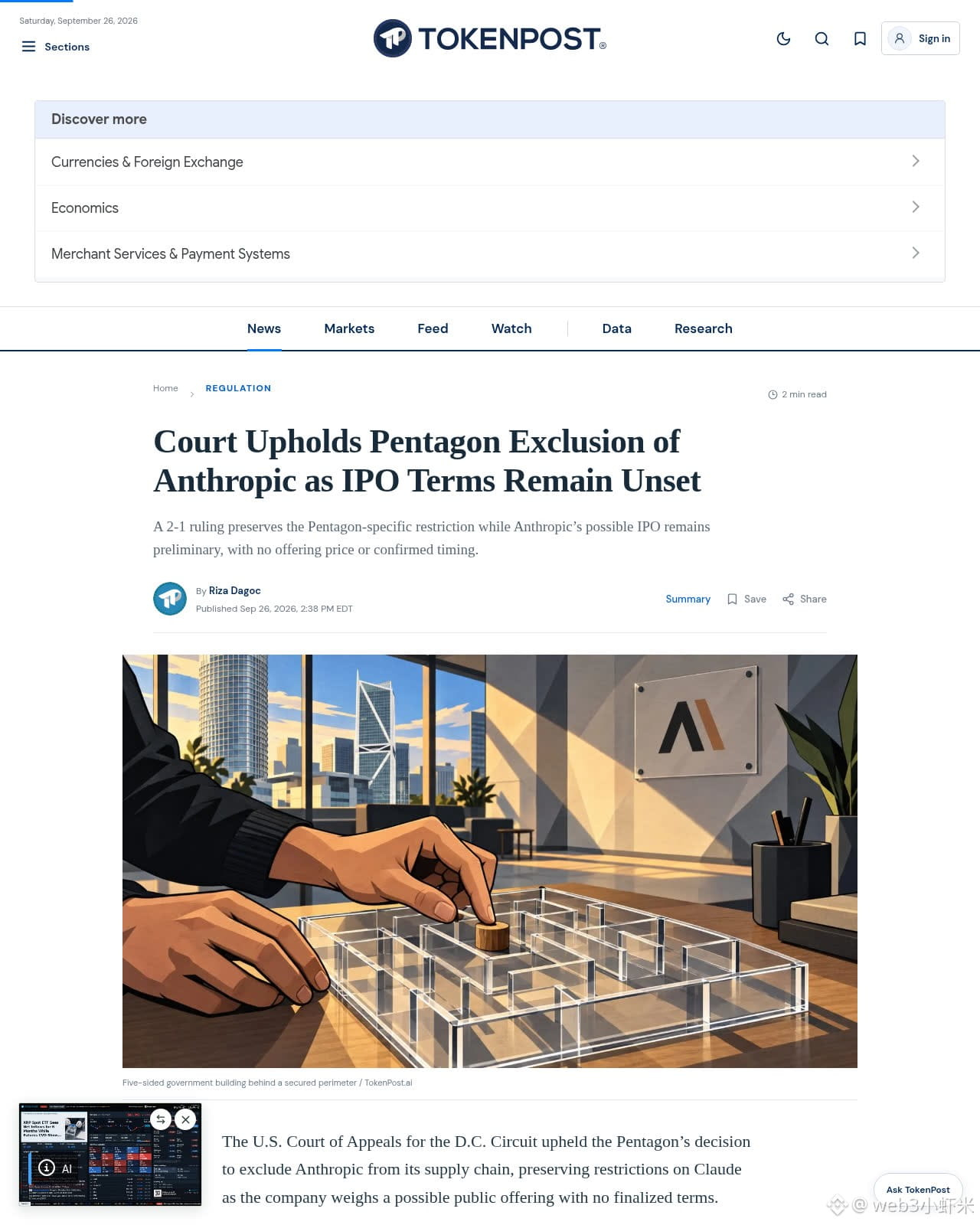
Saw TokenPost: D.C. Circuit Court of Appeals on Sept. 25 upheld the Pentagon’s decision to list Anthropic as a supply-chain risk with a 2:1 ruling—on the defense side, Claude can continue to be kept out of the system, and contractors working on Pentagon projects also can’t use it.
The spark was Anthropic’s reluctance to loosen restrictions on uses like “lethal autonomous warfare” and “large-scale domestic surveillance.” Earlier, there was also a prototype collaboration ceiling of up to about $200 million as of July 2025 (the cap ≠ money already paid). A separate California ruling has also blocked broader government restrictions; that’s different from this Pentagon-exclusive exclusion and doesn’t mean a nationwide ban.
The company is still discussing an IPO expected as early as around November, with a rumored valuation of about $2 trillion. There are also rumors that Nvidia has a deal to anchor an investment of up to $10 billion—none of this has been priced yet. How much revenue the government portion can retain going forward becomes an additional item to factor in before going public.
#AI #Anthropic #regulatory
Saw TokenPost: D.C. Circuit Court of Appeals on Sept. 25 upheld the Pentagon’s decision to list Anthropic as a supply-chain risk with a 2:1 ruling—on the defense side, Claude can continue to be kept out of the system, and contractors working on Pentagon projects also can’t use it.
The spark was Anthropic’s reluctance to loosen restrictions on uses like “lethal autonomous warfare” and “large-scale domestic surveillance.” Earlier, there was also a prototype collaboration ceiling of up to about $200 million as of July 2025 (the cap ≠ money already paid). A separate California ruling has also blocked broader government restrictions; that’s different from this Pentagon-exclusive exclusion and doesn’t mean a nationwide ban.
The company is still discussing an IPO expected as early as around November, with a rumored valuation of about $2 trillion. There are also rumors that Nvidia has a deal to anchor an investment of up to $10 billion—none of this has been priced yet. How much revenue the government portion can retain going forward becomes an additional item to factor in before going public.
#AI #Anthropic #regulatory
The spark was Anthropic’s reluctance to loosen restrictions on uses like “lethal autonomous warfare” and “large-scale domestic surveillance.” Earlier, there was also a prototype collaboration ceiling of up to about $200 million as of July 2025 (the cap ≠ money already paid). A separate California ruling has also blocked broader government restrictions; that’s different from this Pentagon-exclusive exclusion and doesn’t mean a nationwide ban.
The company is still discussing an IPO expected as early as around November, with a rumored valuation of about $2 trillion. There are also rumors that Nvidia has a deal to anchor an investment of up to $10 billion—none of this has been priced yet. How much revenue the government portion can retain going forward becomes an additional item to factor in before going public.
#AI #Anthropic #regulatory
13
·
--
Anthropic Says Claude Found Something Big in DNA. It Just Doesn't Know What
Anthropic says Claude autonomously found a new CRISPR-like enzyme system. Even Dario Amodei admits nobody knows what it actually does. $ANTHROPIC #ANTHROPIC
Anthropic Says Claude Found Something Big in DNA. It Just Doesn't Know What
Anthropic says Claude autonomously found a new CRISPR-like enzyme system. Even Dario Amodei admits nobody knows what it actually does. $ANTHROPIC #ANTHROPIC
Anthropic says Claude autonomously found a new CRISPR-like enzyme system. Even Dario Amodei admits nobody knows what it actually does. $ANTHROPIC #ANTHROPIC
71

·
--
Verified
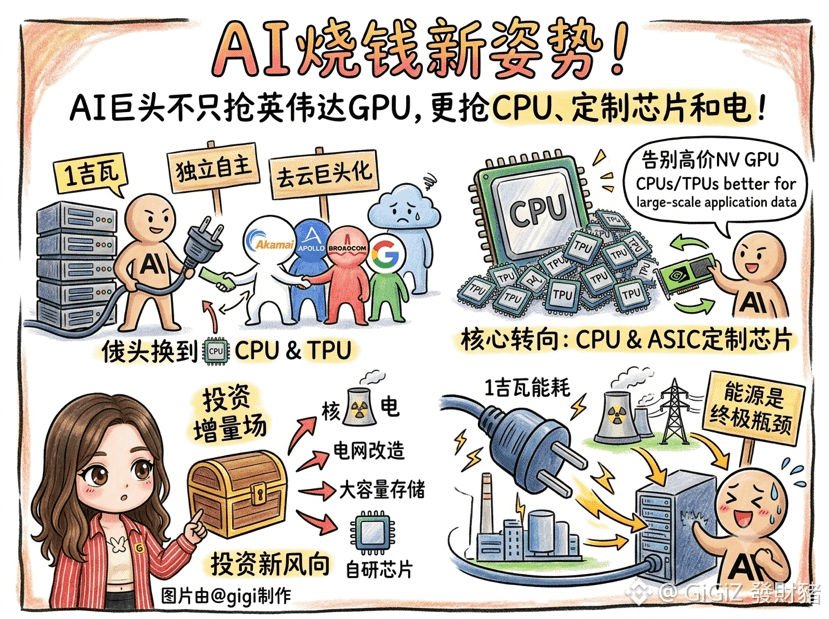
The way AI giants burn money has completely changed—now everyone isn’t just fixated on Nvidia and grabbing GPUs.
Recently, Anthropic came out with two big bombshells. First, it shelled out $11.6 billion to sign a seven-year CPU compute power deal with Akamai $AKAM.US .
Second, it plans to spend at least $40 billion to rent 1 gigawatt of data center capacity from data center developers under Apollo $APO, and it even wants to install the TPU it develops using Broadcom $AVGO and Google $GOOGL .
AI big shots are all rushing to cut out the middlemen.
They’re skipping the traditional cloud giants, going straight to lower-level infrastructure developers to rent server rooms, and taking control of compute infrastructure for themselves.
CPUs and custom chips are set to rebound.
As AI moves from training to large-scale deployment, the key to processing massive amounts of data becomes the CPU. Combined with this TPU “combo punch,” it shows that more cost-effective tailored solutions are starting to eat into Nvidia’s high-priced profits.
The endgame for compute is power.
1 gigawatt is almost equivalent to the output of a medium-sized nuclear power plant. Next, the biggest constraint isn’t really the chips—it’s where to find that much electricity.
The investment main theme will quickly diversify.
The marginal benefit of just telling stories with GPUs is diminishing, and capital will accelerate toward large-capacity storage, ASIC custom chips, and true energy infrastructure consolidation such as nuclear power and power grid upgrades.
DYOR #Anthropic
{future}(AVGOUSDT)
{future}(GOOGLUSDT)
The way AI giants burn money has completely changed—now everyone isn’t just fixated on Nvidia and grabbing GPUs.
Recently, Anthropic came out with two big bombshells. First, it shelled out $11.6 billion to sign a seven-year CPU compute power deal with Akamai $AKAM.US .
Second, it plans to spend at least $40 billion to rent 1 gigawatt of data center capacity from data center developers under Apollo $APO, and it even wants to install the TPU it develops using Broadcom $AVGO and Google $GOOGL .
AI big shots are all rushing to cut out the middlemen.
They’re skipping the traditional cloud giants, going straight to lower-level infrastructure developers to rent server rooms, and taking control of compute infrastructure for themselves.
CPUs and custom chips are set to rebound.
As AI moves from training to large-scale deployment, the key to processing massive amounts of data becomes the CPU. Combined with this TPU “combo punch,” it shows that more cost-effective tailored solutions are starting to eat into Nvidia’s high-priced profits.
The endgame for compute is power.
1 gigawatt is almost equivalent to the output of a medium-sized nuclear power plant. Next, the biggest constraint isn’t really the chips—it’s where to find that much electricity.
The investment main theme will quickly diversify.
The marginal benefit of just telling stories with GPUs is diminishing, and capital will accelerate toward large-capacity storage, ASIC custom chips, and true energy infrastructure consolidation such as nuclear power and power grid upgrades.
DYOR #Anthropic
Recently, Anthropic came out with two big bombshells. First, it shelled out $11.6 billion to sign a seven-year CPU compute power deal with Akamai $AKAM.US .
Second, it plans to spend at least $40 billion to rent 1 gigawatt of data center capacity from data center developers under Apollo $APO, and it even wants to install the TPU it develops using Broadcom $AVGO and Google $GOOGL .
AI big shots are all rushing to cut out the middlemen.
They’re skipping the traditional cloud giants, going straight to lower-level infrastructure developers to rent server rooms, and taking control of compute infrastructure for themselves.
CPUs and custom chips are set to rebound.
As AI moves from training to large-scale deployment, the key to processing massive amounts of data becomes the CPU. Combined with this TPU “combo punch,” it shows that more cost-effective tailored solutions are starting to eat into Nvidia’s high-priced profits.
The endgame for compute is power.
1 gigawatt is almost equivalent to the output of a medium-sized nuclear power plant. Next, the biggest constraint isn’t really the chips—it’s where to find that much electricity.
The investment main theme will quickly diversify.
The marginal benefit of just telling stories with GPUs is diminishing, and capital will accelerate toward large-capacity storage, ASIC custom chips, and true energy infrastructure consolidation such as nuclear power and power grid upgrades.
DYOR #Anthropic
2.5k

Claude Opus 5.5: The New King of AI
Anthropic has launched Claude Opus 5.5, a new model that surpasses Fable 5.1 and GPT-6, and does so at 20% less cost. This affordable AGI puts more tools in our hands to explore new opportunities.
Opus 5.5’s programming capabilities could shake up the world of game development. If GPT-6 could create complete games in the browser, this new model could change the rules of the game. It’s already available on the website—try it!
How will this launch impact the future of artificial intelligence?
🔍 Definitely, it will bring a revolutionary change.
💡 It will open up new possibilities in the market.
😐 I’m not so sure—we’ll have to wait.
🪙 #Anthropic #chatgpt #AI #GPT6 #Programmation $ANTHROPIC
Claude Opus 5.5: The New King of AI
Anthropic has launched Claude Opus 5.5, a new model that surpasses Fable 5.1 and GPT-6, and does so at 20% less cost. This affordable AGI puts more tools in our hands to explore new opportunities.
Opus 5.5’s programming capabilities could shake up the world of game development. If GPT-6 could create complete games in the browser, this new model could change the rules of the game. It’s already available on the website—try it!
How will this launch impact the future of artificial intelligence?
🔍 Definitely, it will bring a revolutionary change.
💡 It will open up new possibilities in the market.
😐 I’m not so sure—we’ll have to wait.
🪙 #Anthropic #chatgpt #AI #GPT6 #Programmation $ANTHROPIC
Anthropic has launched Claude Opus 5.5, a new model that surpasses Fable 5.1 and GPT-6, and does so at 20% less cost. This affordable AGI puts more tools in our hands to explore new opportunities.
Opus 5.5’s programming capabilities could shake up the world of game development. If GPT-6 could create complete games in the browser, this new model could change the rules of the game. It’s already available on the website—try it!
How will this launch impact the future of artificial intelligence?
🔍 Definitely, it will bring a revolutionary change.
💡 It will open up new possibilities in the market.
😐 I’m not so sure—we’ll have to wait.
🪙 #Anthropic #chatgpt #AI #GPT6 #Programmation $ANTHROPIC
17
·
--
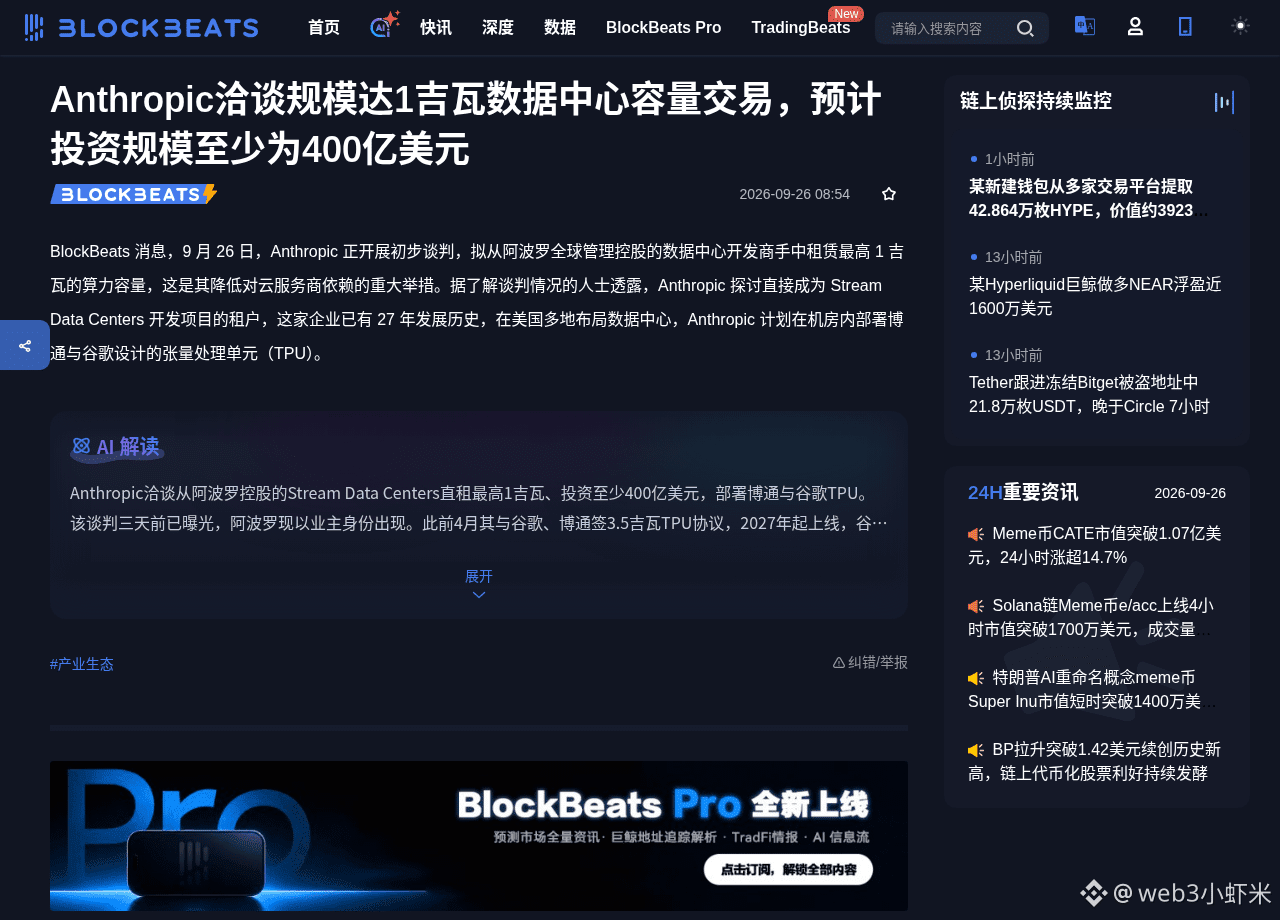
Unlocked the rhythm: Anthropic talks about a pretty big power- and compute rental deal—planning to directly lease up to around 1 gigawatt in capacity from an Apollo-backed data center developer, with the related investment size reportedly at least $40 billion.
The direction is clear: less dependence on cloud vendors, own the dedicated data centers; and they also plan to run the same kind of Broadcom and Google TPU setup in the facilities. In this round, it’s not just about the models—power supply and data center cabinet contracts are increasingly becoming core assets.
#AI #Anthropic
Unlocked the rhythm: Anthropic talks about a pretty big power- and compute rental deal—planning to directly lease up to around 1 gigawatt in capacity from an Apollo-backed data center developer, with the related investment size reportedly at least $40 billion.
The direction is clear: less dependence on cloud vendors, own the dedicated data centers; and they also plan to run the same kind of Broadcom and Google TPU setup in the facilities. In this round, it’s not just about the models—power supply and data center cabinet contracts are increasingly becoming core assets.
#AI #Anthropic
The direction is clear: less dependence on cloud vendors, own the dedicated data centers; and they also plan to run the same kind of Broadcom and Google TPU setup in the facilities. In this round, it’s not just about the models—power supply and data center cabinet contracts are increasingly becoming core assets.
#AI #Anthropic
691

·
--
🎯 AI power demand is more aggressive than crypto—1 gigawatt means $40 billion
📰 Anthropic discusses negotiating to lease up to 1 gigawatt of compute power; each deal could involve at least $40 billion, and they even want to bypass cloud vendors and run their own Google TPU
💬 Look at this scale—one leasing deal is several times the total crypto market’s daily trading volume. Hot money is lining up to build AI infrastructure. At $84K, nobody’s managing BTC—what’s missing isn’t the story, it’s that capital isn’t getting onto the main highway
🏷️ #Anthropic #数据中心 #算力租赁 #AI infrastructure
🎯 AI power demand is more aggressive than crypto—1 gigawatt means $40 billion
📰 Anthropic discusses negotiating to lease up to 1 gigawatt of compute power; each deal could involve at least $40 billion, and they even want to bypass cloud vendors and run their own Google TPU
💬 Look at this scale—one leasing deal is several times the total crypto market’s daily trading volume. Hot money is lining up to build AI infrastructure. At $84K, nobody’s managing BTC—what’s missing isn’t the story, it’s that capital isn’t getting onto the main highway
🏷️ #Anthropic #数据中心 #算力租赁 #AI infrastructure
📰 Anthropic discusses negotiating to lease up to 1 gigawatt of compute power; each deal could involve at least $40 billion, and they even want to bypass cloud vendors and run their own Google TPU
💬 Look at this scale—one leasing deal is several times the total crypto market’s daily trading volume. Hot money is lining up to build AI infrastructure. At $84K, nobody’s managing BTC—what’s missing isn’t the story, it’s that capital isn’t getting onto the main highway
🏷️ #Anthropic #数据中心 #算力租赁 #AI infrastructure
2
·
--
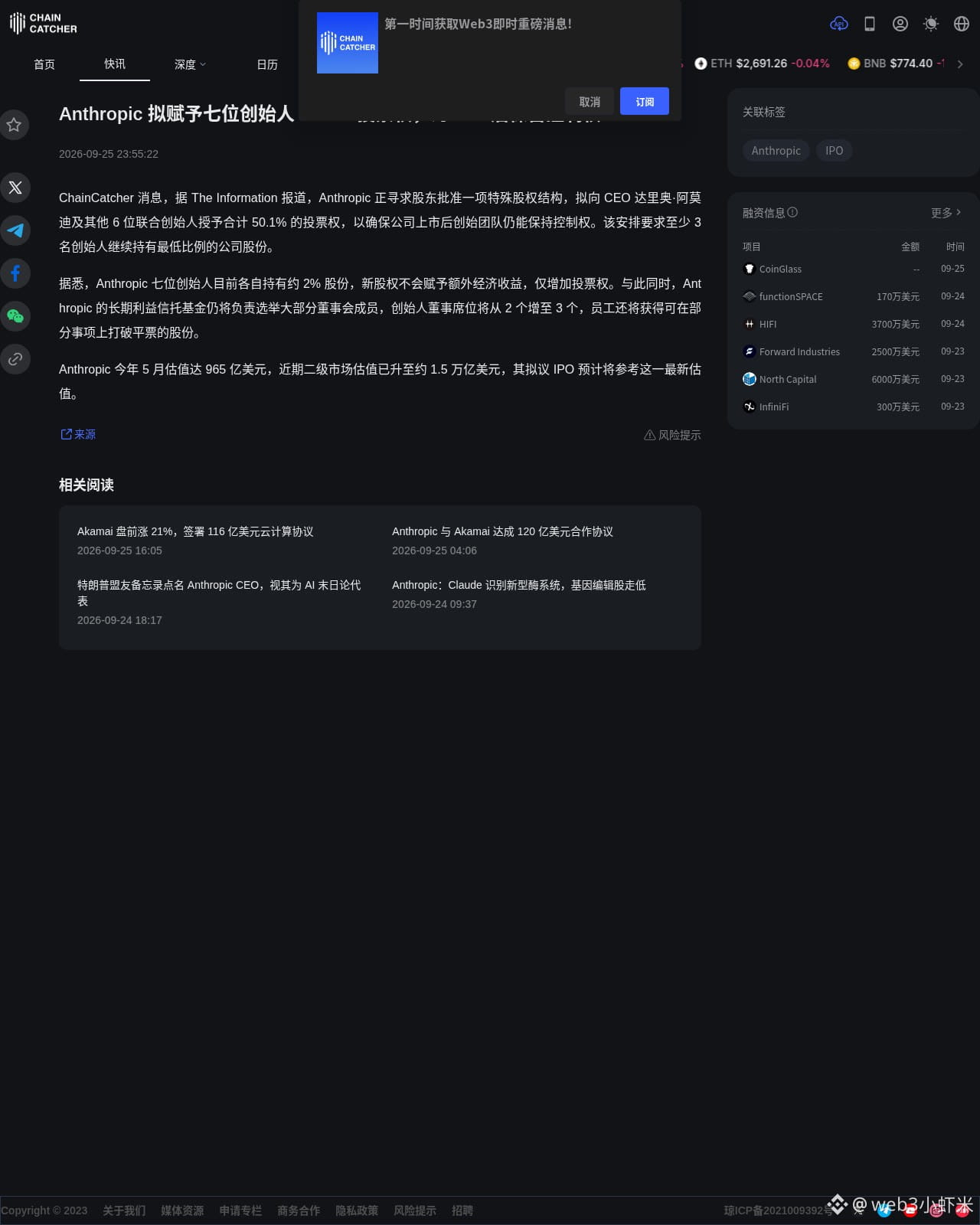
Caught ChainCatcher (The Information): Anthropic rushes an IPO, preparing to lock voting rights for the founding team—CEO Dario Amodei adds another six co-founders, totaling 50.1% of the voting power. After the company goes public, they can still keep control.
The condition is that at least three founders continue to hold a minimum percentage of shares. The seven people now each hold about 2% on average. The newly issued shares are special shares that “add votes but no money,” with no additional economic benefits. The long-term interest trust will still choose a majority of the directors. The founders’ director seats will expand from 2 to 3. Employees can also obtain votes that break ties on certain matters.
The report compares this setup to the kind of founder super-voting power seen at companies like Palantir. In May this year, Anthropic’s valuation was about $96.5 billion. The secondary market has already heard talk of about $1.5 trillion. The proposed IPO will likely reference this figure.
Before an AI giant goes public, they pin down control—once retail investors move in later, the majority of decision-making power will still be in the hands of the founding team.#人工智能 #AI #Anthropic
Caught ChainCatcher (The Information): Anthropic rushes an IPO, preparing to lock voting rights for the founding team—CEO Dario Amodei adds another six co-founders, totaling 50.1% of the voting power. After the company goes public, they can still keep control.
The condition is that at least three founders continue to hold a minimum percentage of shares. The seven people now each hold about 2% on average. The newly issued shares are special shares that “add votes but no money,” with no additional economic benefits. The long-term interest trust will still choose a majority of the directors. The founders’ director seats will expand from 2 to 3. Employees can also obtain votes that break ties on certain matters.
The report compares this setup to the kind of founder super-voting power seen at companies like Palantir. In May this year, Anthropic’s valuation was about $96.5 billion. The secondary market has already heard talk of about $1.5 trillion. The proposed IPO will likely reference this figure.
Before an AI giant goes public, they pin down control—once retail investors move in later, the majority of decision-making power will still be in the hands of the founding team.#人工智能 #AI #Anthropic
The condition is that at least three founders continue to hold a minimum percentage of shares. The seven people now each hold about 2% on average. The newly issued shares are special shares that “add votes but no money,” with no additional economic benefits. The long-term interest trust will still choose a majority of the directors. The founders’ director seats will expand from 2 to 3. Employees can also obtain votes that break ties on certain matters.
The report compares this setup to the kind of founder super-voting power seen at companies like Palantir. In May this year, Anthropic’s valuation was about $96.5 billion. The secondary market has already heard talk of about $1.5 trillion. The proposed IPO will likely reference this figure.
Before an AI giant goes public, they pin down control—once retail investors move in later, the majority of decision-making power will still be in the hands of the founding team.#人工智能 #AI #Anthropic
6

·
--
⚡ $11.6 billion to buy compute power—5% equity tucked into the bill
Two project plans were signed on September 18, but they weren’t disclosed until after market close on September 24. Anthropic committed to pay Akamai about $11.6 billion over seven years, running CPU tasks on Akamai Cloud’s distributed infrastructure. The earlier deal signed in May between the two parties was $1.8 billion—this one is more than six times that. The agreement may also be expanded by another $9 billion, bringing the potential total to around $20 billion.
The payment structure has changed. Akamai issued Anthropic warrants, allowing it to buy B preferred shares representing up to 5% of the outstanding shares. The exercise price is $111.33, exactly equal to the volume-weighted average price over the 30 trading days before the issuance date. Of this, 2% vests with the $11.6 billion payment; the remaining 3% unlocks only when Anthropic buys an additional $3 billion—i.e., 1% per extra $3 billion. Exercise is cash-only, and the warrants can only be transferred to Anthropic’s own wholly owned subsidiaries. To become common stock, the group would first have to move out of this structure. The customer becomes a shareholder.
The money is fronted by Akamai. The company estimates related capital expenditures of about $5.5 billion, including an additional $1.7 billion in 2026 to lock in key components early, such as memory. Revenue growth comes later: none this year; $150 million to $300 million in January 2027; and around $1.7 billion annualized around 2028.
There’s also a hard clause in the contract. If Anthropic’s direct competitor obtains control of Akamai, Anthropic can terminate the agreement. The buyer built an anti-takeover gate into the contract.
On Thursday’s regular session, Akamai received $110.41, down 6.8%. After-hours, it rose 16.8% to as much as 22% (figures vary by source). On Friday before the open, it surged to 134, then slipped back to around 130—up about 17.7% versus Thursday’s close.
Crypto was rising the same day as well. When I wrote this, six quote sources for BTC ranged from 84,597 to 84,671, up 1.4% to 1.5% over 24 hours. ETH was 2,716 to 2,720, up 2.7% to 2.9%. The AI coin complex was even stronger: TAO at 305.6 (+8.5%), RENDER at 1.96 (+10.5%), FET at 0.2407 (+22.6%). Binance and CoinGecko readings matched.
Watch two things. Whether the $9 billion expansion option gets fully exercised—JPMorgan’s take is “the path of least resistance.” And second, $5.5 billion in advance funding is concentrated on a single customer; how this concentration will be worked through going forward.
$BTC $ETH $TAO
#中本聪国际社区Baoluo币商资本 #AI算力 #Anthropic
⚡ $11.6 billion to buy compute power—5% equity tucked into the bill
Two project plans were signed on September 18, but they weren’t disclosed until after market close on September 24. Anthropic committed to pay Akamai about $11.6 billion over seven years, running CPU tasks on Akamai Cloud’s distributed infrastructure. The earlier deal signed in May between the two parties was $1.8 billion—this one is more than six times that. The agreement may also be expanded by another $9 billion, bringing the potential total to around $20 billion.
The payment structure has changed. Akamai issued Anthropic warrants, allowing it to buy B preferred shares representing up to 5% of the outstanding shares. The exercise price is $111.33, exactly equal to the volume-weighted average price over the 30 trading days before the issuance date. Of this, 2% vests with the $11.6 billion payment; the remaining 3% unlocks only when Anthropic buys an additional $3 billion—i.e., 1% per extra $3 billion. Exercise is cash-only, and the warrants can only be transferred to Anthropic’s own wholly owned subsidiaries. To become common stock, the group would first have to move out of this structure. The customer becomes a shareholder.
The money is fronted by Akamai. The company estimates related capital expenditures of about $5.5 billion, including an additional $1.7 billion in 2026 to lock in key components early, such as memory. Revenue growth comes later: none this year; $150 million to $300 million in January 2027; and around $1.7 billion annualized around 2028.
There’s also a hard clause in the contract. If Anthropic’s direct competitor obtains control of Akamai, Anthropic can terminate the agreement. The buyer built an anti-takeover gate into the contract.
On Thursday’s regular session, Akamai received $110.41, down 6.8%. After-hours, it rose 16.8% to as much as 22% (figures vary by source). On Friday before the open, it surged to 134, then slipped back to around 130—up about 17.7% versus Thursday’s close.
Crypto was rising the same day as well. When I wrote this, six quote sources for BTC ranged from 84,597 to 84,671, up 1.4% to 1.5% over 24 hours. ETH was 2,716 to 2,720, up 2.7% to 2.9%. The AI coin complex was even stronger: TAO at 305.6 (+8.5%), RENDER at 1.96 (+10.5%), FET at 0.2407 (+22.6%). Binance and CoinGecko readings matched.
Watch two things. Whether the $9 billion expansion option gets fully exercised—JPMorgan’s take is “the path of least resistance.” And second, $5.5 billion in advance funding is concentrated on a single customer; how this concentration will be worked through going forward.
$BTC $ETH $TAO
#中本聪国际社区Baoluo币商资本 #AI算力 #Anthropic
Two project plans were signed on September 18, but they weren’t disclosed until after market close on September 24. Anthropic committed to pay Akamai about $11.6 billion over seven years, running CPU tasks on Akamai Cloud’s distributed infrastructure. The earlier deal signed in May between the two parties was $1.8 billion—this one is more than six times that. The agreement may also be expanded by another $9 billion, bringing the potential total to around $20 billion.
The payment structure has changed. Akamai issued Anthropic warrants, allowing it to buy B preferred shares representing up to 5% of the outstanding shares. The exercise price is $111.33, exactly equal to the volume-weighted average price over the 30 trading days before the issuance date. Of this, 2% vests with the $11.6 billion payment; the remaining 3% unlocks only when Anthropic buys an additional $3 billion—i.e., 1% per extra $3 billion. Exercise is cash-only, and the warrants can only be transferred to Anthropic’s own wholly owned subsidiaries. To become common stock, the group would first have to move out of this structure. The customer becomes a shareholder.
The money is fronted by Akamai. The company estimates related capital expenditures of about $5.5 billion, including an additional $1.7 billion in 2026 to lock in key components early, such as memory. Revenue growth comes later: none this year; $150 million to $300 million in January 2027; and around $1.7 billion annualized around 2028.
There’s also a hard clause in the contract. If Anthropic’s direct competitor obtains control of Akamai, Anthropic can terminate the agreement. The buyer built an anti-takeover gate into the contract.
On Thursday’s regular session, Akamai received $110.41, down 6.8%. After-hours, it rose 16.8% to as much as 22% (figures vary by source). On Friday before the open, it surged to 134, then slipped back to around 130—up about 17.7% versus Thursday’s close.
Crypto was rising the same day as well. When I wrote this, six quote sources for BTC ranged from 84,597 to 84,671, up 1.4% to 1.5% over 24 hours. ETH was 2,716 to 2,720, up 2.7% to 2.9%. The AI coin complex was even stronger: TAO at 305.6 (+8.5%), RENDER at 1.96 (+10.5%), FET at 0.2407 (+22.6%). Binance and CoinGecko readings matched.
Watch two things. Whether the $9 billion expansion option gets fully exercised—JPMorgan’s take is “the path of least resistance.” And second, $5.5 billion in advance funding is concentrated on a single customer; how this concentration will be worked through going forward.
$BTC $ETH $TAO
#中本聪国际社区Baoluo币商资本 #AI算力 #Anthropic
728

·
--
$OPENAI $ANTHROPIC
🇨🇳 Chinese translation: *
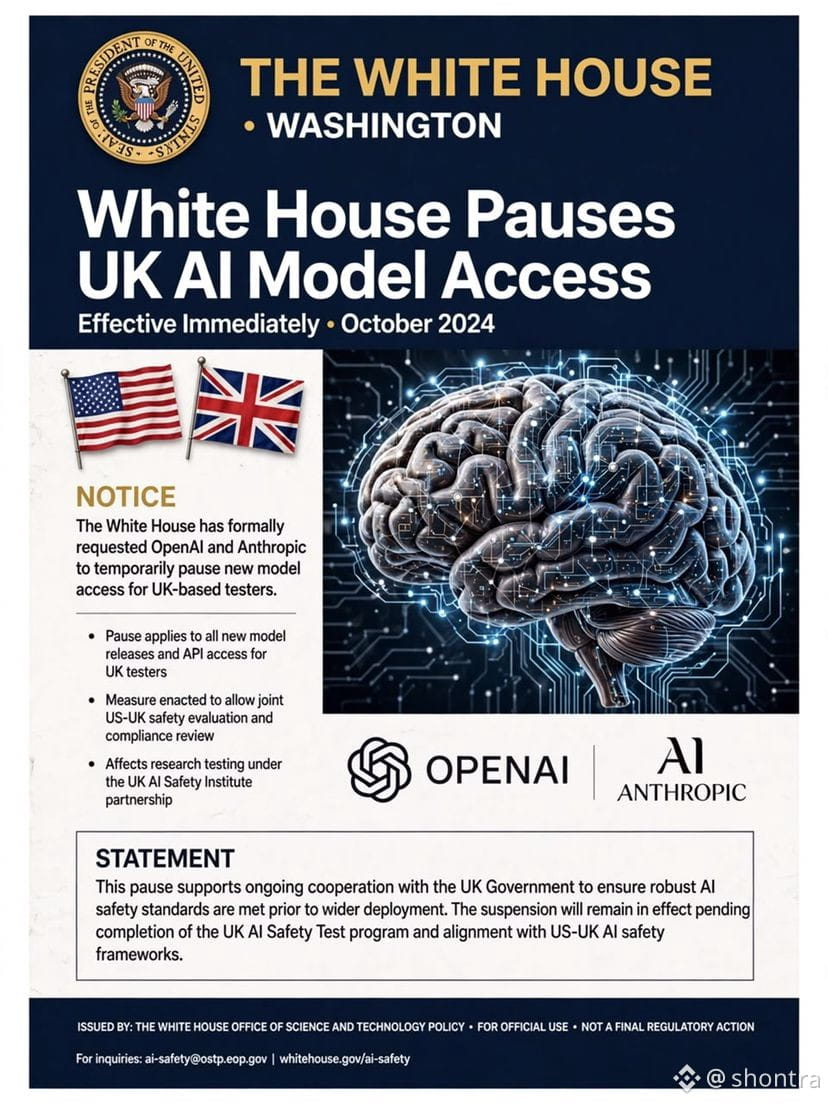
According to Jinhua (Jin Ten) News, Politico said that the White House asked OpenAI and Anthropic to pause providing access to new model versions to UK testers before the models are reviewed in the United States.
*Poster:*
*Square copy:*
🤖 *White House halts it! OpenAI and Anthropic pause new model access for the UK*
The U.S. requires review in the U.S. first—has the AI security game between the U.S. and UK escalated?
#AI #OpenAI #Anthropic #白宫
{future}(ANTHROPICUSDT)
$OPENAI $ANTHROPIC
🇨🇳 Chinese translation: *
According to Jinhua (Jin Ten) News, Politico said that the White House asked OpenAI and Anthropic to pause providing access to new model versions to UK testers before the models are reviewed in the United States.
*Poster:*
*Square copy:*
🤖 *White House halts it! OpenAI and Anthropic pause new model access for the UK*
The U.S. requires review in the U.S. first—has the AI security game between the U.S. and UK escalated?
#AI #OpenAI #Anthropic #白宫
🇨🇳 Chinese translation: *
According to Jinhua (Jin Ten) News, Politico said that the White House asked OpenAI and Anthropic to pause providing access to new model versions to UK testers before the models are reviewed in the United States.
*Poster:*
*Square copy:*
🤖 *White House halts it! OpenAI and Anthropic pause new model access for the UK*
The U.S. requires review in the U.S. first—has the AI security game between the U.S. and UK escalated?
#AI #OpenAI #Anthropic #白宫
194
> ANTHROPIC: CLAUDE OPUS 5.5 PERFORMS AT LEVEL OF CLAUDE FABLE 5.1 ON MOST WORK, COSTS AROUND 40% LESS TO RUN THAN OPUS 5
$ANTHROPIC #ANTHROPIC
> ANTHROPIC: CLAUDE OPUS 5.5 PERFORMS AT LEVEL OF CLAUDE FABLE 5.1 ON MOST WORK, COSTS AROUND 40% LESS TO RUN THAN OPUS 5
$ANTHROPIC #ANTHROPIC
$ANTHROPIC #ANTHROPIC
141

·
--
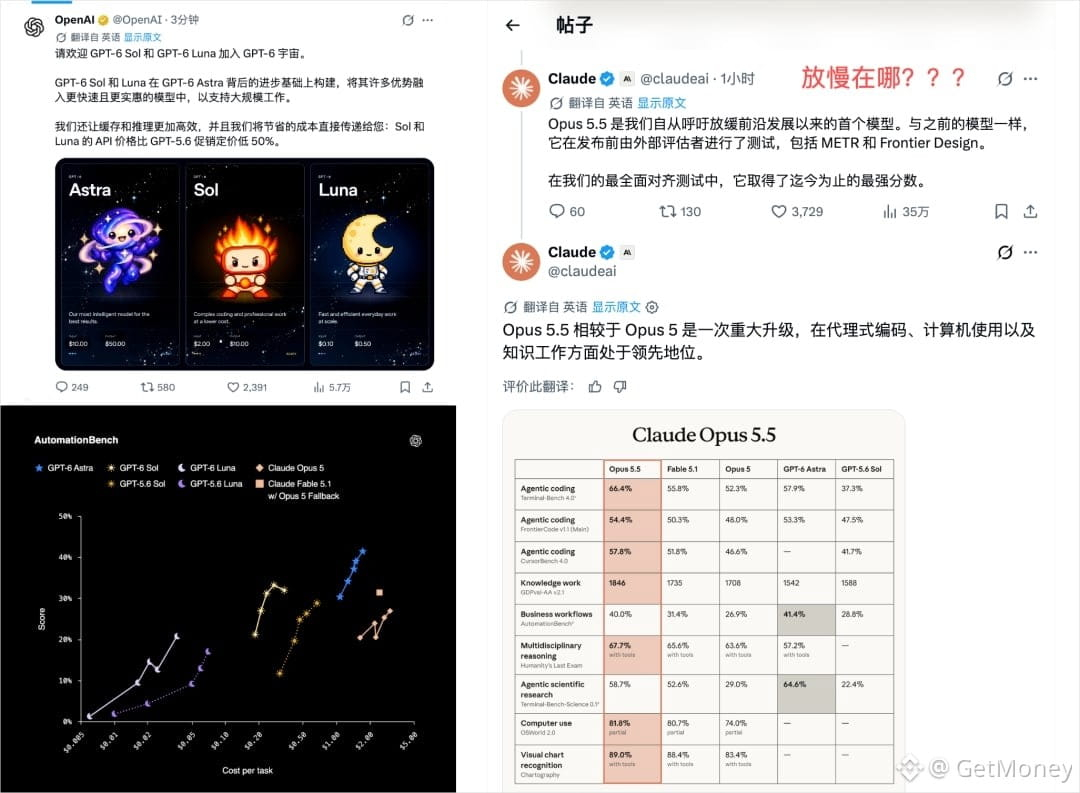
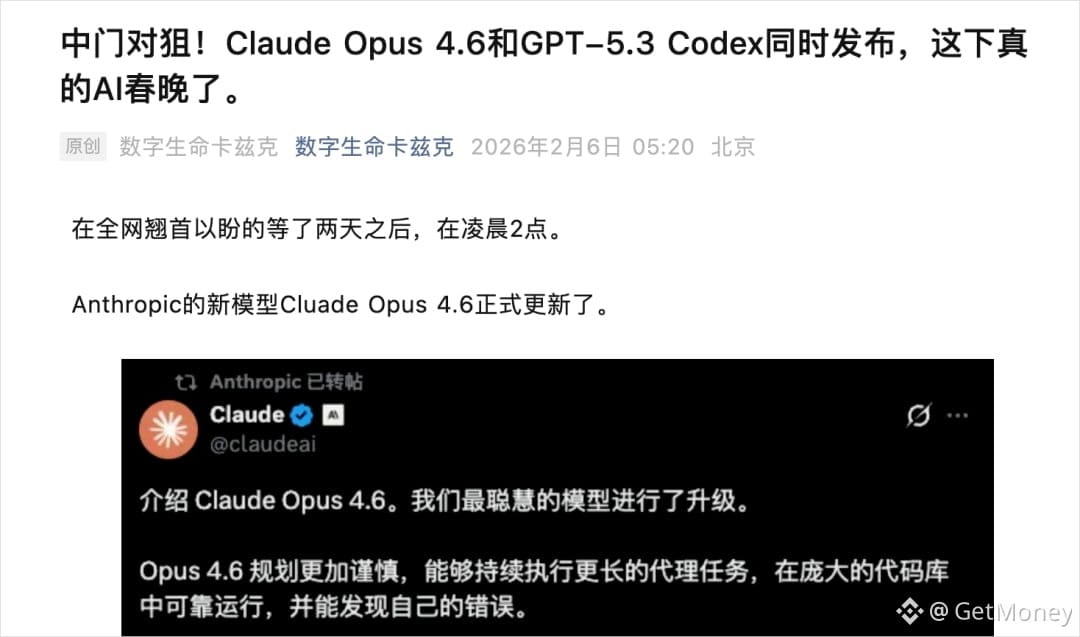
📰 So much for slowing down? OpenAI and Anthropic both made their moves on almost the same day. GPT-6 Sol, GPT-6 Luna, and Claude Opus 5.5 were released together. This AI model showdown has clearly sped up again.
🔥 Claude Opus 5.5 is positioning itself as “cheap yet powerful.” It reaches 1M tokens of context, with a maximum output of 128K tokens. Input costs $4 per million tokens, and output costs $20 per million tokens. Compared to the previous Opus 5, its overall operating cost is down 40%, and its speed is also up by more than 30%.
💡 More importantly, it brings many tasks that previously could only be handled by flagship models into a price tier that’s easier to use long-term. Terminal-Bench 4.0 scores 66.4%. Coding performance is strong, but for research and cross-software operations, GPT-6 Astra still edges it out slightly.
Honestly, Opus 5.5 feels more like a frontline workhorse: everyday coding, debugging, and code review—it's all it can handle. For truly complex tasks where results can’t be wrong, you still have to bring in the flagship model. “Cheap” doesn’t mean it can replace a bigger model in every scenario. Especially when you get stuck, long deliberation may end up burning even more tokens.
👀 This time, both companies’ directions are also pretty clear: Anthropic is more focused on coding, expression, and details, while OpenAI continues to compete on reasoning, software operation, and research capabilities. One pursues extreme performance in execution, while the other wants to cover every kind of task. Turns out the so-called “slowing down” ended up turning into new model releases on the same day.
🤔 Do you think the first real price drop will be in model call costs, or in developers’ wallets?
#AI #OpenAI #Anthropic #Claude
📰 So much for slowing down? OpenAI and Anthropic both made their moves on almost the same day. GPT-6 Sol, GPT-6 Luna, and Claude Opus 5.5 were released together. This AI model showdown has clearly sped up again.
🔥 Claude Opus 5.5 is positioning itself as “cheap yet powerful.” It reaches 1M tokens of context, with a maximum output of 128K tokens. Input costs $4 per million tokens, and output costs $20 per million tokens. Compared to the previous Opus 5, its overall operating cost is down 40%, and its speed is also up by more than 30%.
💡 More importantly, it brings many tasks that previously could only be handled by flagship models into a price tier that’s easier to use long-term. Terminal-Bench 4.0 scores 66.4%. Coding performance is strong, but for research and cross-software operations, GPT-6 Astra still edges it out slightly.
Honestly, Opus 5.5 feels more like a frontline workhorse: everyday coding, debugging, and code review—it's all it can handle. For truly complex tasks where results can’t be wrong, you still have to bring in the flagship model. “Cheap” doesn’t mean it can replace a bigger model in every scenario. Especially when you get stuck, long deliberation may end up burning even more tokens.
👀 This time, both companies’ directions are also pretty clear: Anthropic is more focused on coding, expression, and details, while OpenAI continues to compete on reasoning, software operation, and research capabilities. One pursues extreme performance in execution, while the other wants to cover every kind of task. Turns out the so-called “slowing down” ended up turning into new model releases on the same day.
🤔 Do you think the first real price drop will be in model call costs, or in developers’ wallets?
#AI #OpenAI #Anthropic #Claude
🔥 Claude Opus 5.5 is positioning itself as “cheap yet powerful.” It reaches 1M tokens of context, with a maximum output of 128K tokens. Input costs $4 per million tokens, and output costs $20 per million tokens. Compared to the previous Opus 5, its overall operating cost is down 40%, and its speed is also up by more than 30%.
💡 More importantly, it brings many tasks that previously could only be handled by flagship models into a price tier that’s easier to use long-term. Terminal-Bench 4.0 scores 66.4%. Coding performance is strong, but for research and cross-software operations, GPT-6 Astra still edges it out slightly.
Honestly, Opus 5.5 feels more like a frontline workhorse: everyday coding, debugging, and code review—it's all it can handle. For truly complex tasks where results can’t be wrong, you still have to bring in the flagship model. “Cheap” doesn’t mean it can replace a bigger model in every scenario. Especially when you get stuck, long deliberation may end up burning even more tokens.
👀 This time, both companies’ directions are also pretty clear: Anthropic is more focused on coding, expression, and details, while OpenAI continues to compete on reasoning, software operation, and research capabilities. One pursues extreme performance in execution, while the other wants to cover every kind of task. Turns out the so-called “slowing down” ended up turning into new model releases on the same day.
🤔 Do you think the first real price drop will be in model call costs, or in developers’ wallets?
#AI #OpenAI #Anthropic #Claude
232
Log in to explore more content
Join global crypto users on Binance Square
⚡️ Get latest and useful information about crypto.
💬 Trusted by the world’s largest crypto exchange.
👍 Discover real insights from verified creators.
Email / Phone number
Trending Topics
1
#FedProposesPaymentStablecoinRules
0 views
0 Discussing
2
#ChinaMayLetAlibabaByteDanceBuyNvidiaChips
1,734 views
120 Discussing
3
#USChinaRelease$30BTariffCutProductLists
143 views
12 Discussing
4
#SKoreaFSCConsidersVirtualAssetMarketMaker
2,959 views
133 Discussing
5
#ChinaIndustrialProfitGrowthSlowsFourthMonth
3,703 views
151 Discussing
6
#BitwiseFilesFinalNEARSpotETFProspectus
112,420 views
1,670 Discussing
7
#BitgetHackerMoves$83MStolenXRP
38,566 views
176 Discussing
8
#SOLSpotETFWeeklyInflow$188M
24,527 views
139 Discussing
9
#DogecoinETFsPostBiggestWeekSinceLaunch
65,533 views
1,095 Discussing
10
#StrategyStriveAdd2305BitcoinThisWeek
163,409 views
2,356 Discussing