

GiGiZ 發財豬
1.1k Posts

GiGiZ 發財豬
 Square Verified
Report
Block User
🤍Founder of G Club🤍 我是爱美食但更爱学习的💰 元宇宙探险家GiGi吉吉 分享与交流web3和元宇宙资讯 💗 🤍
79 Following
1.5K+ Followers
1.7K+ Liked
Posts
All
Quotes
Videos
Live
·
--
Bullish
Partly True
#美光业绩超预期并上调指引
Can the storage industry’s super cycle truly last forever?
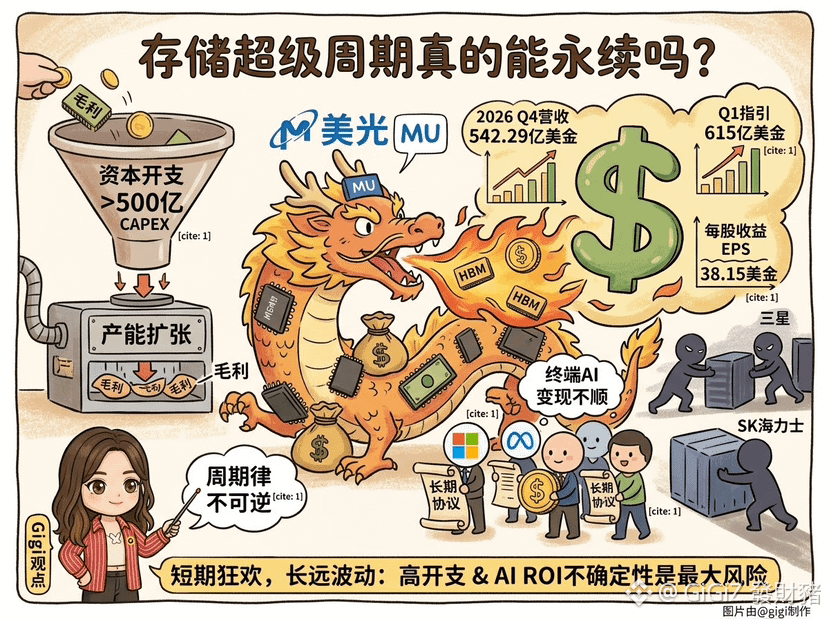
Micron’s latest earnings report is quite impressive. In the fourth fiscal quarter, revenue reached $54.229 billion. Next-quarter guidance was raised directly to $61.5 billion, and quarterly earnings per share came in at $38.15 $MU
The company also secured 26 long-term supply agreements, locking in $150 billion worth of orders, and stated that supply-demand shortages in 2027 and 2028 will be even more severe than this year
Three variables are worth watching
First, customer affordability
Micron has locked in short-term profits via long-term contracts. But the premise that tech giants will continuously cover storage costs is that terminal AI can keep monetizing. If downstream ROI falls short of expectations, this buyer-buys model could quickly stall
Second, capital expenditure erodes margins
Micron’s future capital spending is expected to exceed $50 billion. The massive depreciation costs from capacity expansion mean that if price increases slow down, realizing the commitment to recover gross margin at the low point will be extremely difficult
Third, the cycle has never disappeared
HBM and high-end DRAM are currently in extreme shortage. But once Samsung and SK hynix’s new capacity ramps up, the supply-demand balance could tip out of alignment faster than expected $SKHY
Micron’s near-term cash flow is expected to remain unmatched, and the stock price will likely stay elevated. However, the market’s focus has shifted from how great the results are to how long valuations at the top can be sustained. The combination of massive capital expenditure and uncertainty around terminal AI monetization will be the biggest source of future volatility
DYOR
{future}(SKHYUSDT)
{future}(MUUSDT)
#美光业绩超预期并上调指引
Can the storage industry’s super cycle truly last forever?
Micron’s latest earnings report is quite impressive. In the fourth fiscal quarter, revenue reached $54.229 billion. Next-quarter guidance was raised directly to $61.5 billion, and quarterly earnings per share came in at $38.15 $MU
The company also secured 26 long-term supply agreements, locking in $150 billion worth of orders, and stated that supply-demand shortages in 2027 and 2028 will be even more severe than this year
Three variables are worth watching
First, customer affordability
Micron has locked in short-term profits via long-term contracts. But the premise that tech giants will continuously cover storage costs is that terminal AI can keep monetizing. If downstream ROI falls short of expectations, this buyer-buys model could quickly stall
Second, capital expenditure erodes margins
Micron’s future capital spending is expected to exceed $50 billion. The massive depreciation costs from capacity expansion mean that if price increases slow down, realizing the commitment to recover gross margin at the low point will be extremely difficult
Third, the cycle has never disappeared
HBM and high-end DRAM are currently in extreme shortage. But once Samsung and SK hynix’s new capacity ramps up, the supply-demand balance could tip out of alignment faster than expected $SKHY
Micron’s near-term cash flow is expected to remain unmatched, and the stock price will likely stay elevated. However, the market’s focus has shifted from how great the results are to how long valuations at the top can be sustained. The combination of massive capital expenditure and uncertainty around terminal AI monetization will be the biggest source of future volatility
DYOR
Can the storage industry’s super cycle truly last forever?
Micron’s latest earnings report is quite impressive. In the fourth fiscal quarter, revenue reached $54.229 billion. Next-quarter guidance was raised directly to $61.5 billion, and quarterly earnings per share came in at $38.15 $MU
The company also secured 26 long-term supply agreements, locking in $150 billion worth of orders, and stated that supply-demand shortages in 2027 and 2028 will be even more severe than this year
Three variables are worth watching
First, customer affordability
Micron has locked in short-term profits via long-term contracts. But the premise that tech giants will continuously cover storage costs is that terminal AI can keep monetizing. If downstream ROI falls short of expectations, this buyer-buys model could quickly stall
Second, capital expenditure erodes margins
Micron’s future capital spending is expected to exceed $50 billion. The massive depreciation costs from capacity expansion mean that if price increases slow down, realizing the commitment to recover gross margin at the low point will be extremely difficult
Third, the cycle has never disappeared
HBM and high-end DRAM are currently in extreme shortage. But once Samsung and SK hynix’s new capacity ramps up, the supply-demand balance could tip out of alignment faster than expected $SKHY
Micron’s near-term cash flow is expected to remain unmatched, and the stock price will likely stay elevated. However, the market’s focus has shifted from how great the results are to how long valuations at the top can be sustained. The combination of massive capital expenditure and uncertainty around terminal AI monetization will be the biggest source of future volatility
DYOR
1
3.5k
·
--
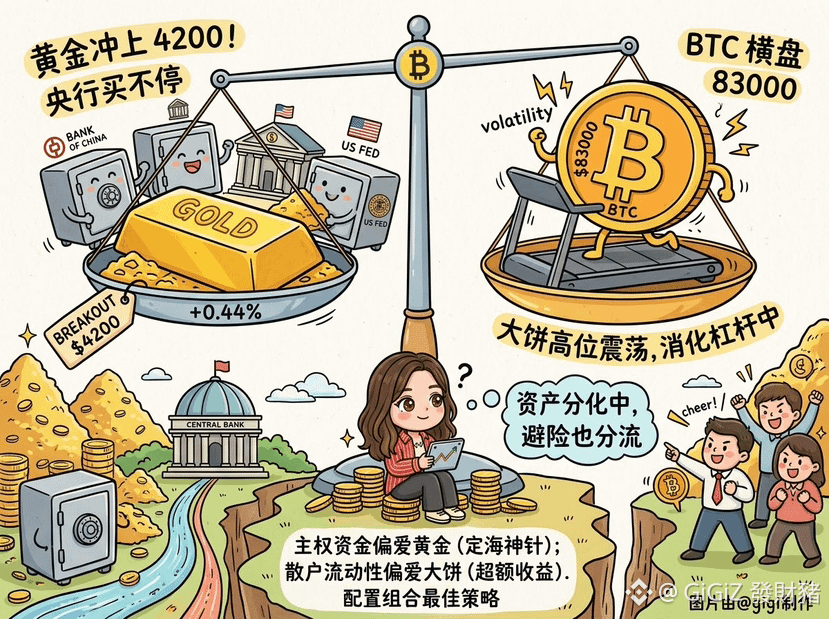
Just as gold surged to $4,200, BTC (large coin) is stuck near $83,000, hovering and wavering—showing that traditional safe-haven and digital anti-inflation assets are following completely different divergence paths
$XAU $XAUT $BTC
Many people think gold’s rally is due to geopolitical risk hedging, but in fact, recent central-bank structural buying and the repricing of rate-cut expectations are the main drivers. In the face of debt expansion and credit-money depreciation, traditional capital still prefers gold
After BTC breaks above $80,000, it fell into high-level consolidation. The flat, slightly down 0.11% intraday “chop” market is actually digesting earlier leveraged positions, waiting for new macro catalysts
Gold and Bitcoin are not simply competing with each other now; they’re diverting two types of safe-haven capital
Sovereign-level funds and traditional compliant institutions
Prefer gold as the balance-sheet core holding to push up gold prices
High risk appetite and retail liquidity
Treat BTC as a high-elasticity anti-inflation tool. The strong support forming around $83,000 reflects the deepening of the digitization/“assetization” of gold
Next, in the short term gold above $4,200 may face profit-taking pullbacks, but as long as the overall direction of rate cuts remains unchanged, the long-term top is still hard to predict
If BTC successfully forms a base between $82,000 and $83,000, along with a release of liquidity from U.S. stocks, it’s very likely to see a new round of explosive upside
In terms of allocation: gold plays the stabilizing “anchor,” while BTC is responsible for seeking excess returns—this remains the most cost-effective combination strategy right now
DYOR
{future}(BTCUSDT)
{future}(XAUTUSDT)
{future}(XAUUSDT)
Just as gold surged to $4,200, BTC (large coin) is stuck near $83,000, hovering and wavering—showing that traditional safe-haven and digital anti-inflation assets are following completely different divergence paths
$XAU $XAUT $BTC
Many people think gold’s rally is due to geopolitical risk hedging, but in fact, recent central-bank structural buying and the repricing of rate-cut expectations are the main drivers. In the face of debt expansion and credit-money depreciation, traditional capital still prefers gold
After BTC breaks above $80,000, it fell into high-level consolidation. The flat, slightly down 0.11% intraday “chop” market is actually digesting earlier leveraged positions, waiting for new macro catalysts
Gold and Bitcoin are not simply competing with each other now; they’re diverting two types of safe-haven capital
Sovereign-level funds and traditional compliant institutions
Prefer gold as the balance-sheet core holding to push up gold prices
High risk appetite and retail liquidity
Treat BTC as a high-elasticity anti-inflation tool. The strong support forming around $83,000 reflects the deepening of the digitization/“assetization” of gold
Next, in the short term gold above $4,200 may face profit-taking pullbacks, but as long as the overall direction of rate cuts remains unchanged, the long-term top is still hard to predict
If BTC successfully forms a base between $82,000 and $83,000, along with a release of liquidity from U.S. stocks, it’s very likely to see a new round of explosive upside
In terms of allocation: gold plays the stabilizing “anchor,” while BTC is responsible for seeking excess returns—this remains the most cost-effective combination strategy right now
DYOR
$XAU $XAUT $BTC
Many people think gold’s rally is due to geopolitical risk hedging, but in fact, recent central-bank structural buying and the repricing of rate-cut expectations are the main drivers. In the face of debt expansion and credit-money depreciation, traditional capital still prefers gold
After BTC breaks above $80,000, it fell into high-level consolidation. The flat, slightly down 0.11% intraday “chop” market is actually digesting earlier leveraged positions, waiting for new macro catalysts
Gold and Bitcoin are not simply competing with each other now; they’re diverting two types of safe-haven capital
Sovereign-level funds and traditional compliant institutions
Prefer gold as the balance-sheet core holding to push up gold prices
High risk appetite and retail liquidity
Treat BTC as a high-elasticity anti-inflation tool. The strong support forming around $83,000 reflects the deepening of the digitization/“assetization” of gold
Next, in the short term gold above $4,200 may face profit-taking pullbacks, but as long as the overall direction of rate cuts remains unchanged, the long-term top is still hard to predict
If BTC successfully forms a base between $82,000 and $83,000, along with a release of liquidity from U.S. stocks, it’s very likely to see a new round of explosive upside
In terms of allocation: gold plays the stabilizing “anchor,” while BTC is responsible for seeking excess returns—this remains the most cost-effective combination strategy right now
DYOR
448
·
--
Verified
U.S. Treasury yields surge wildly—how can the U.S. stock market still trade sideways, or even hit new highs?
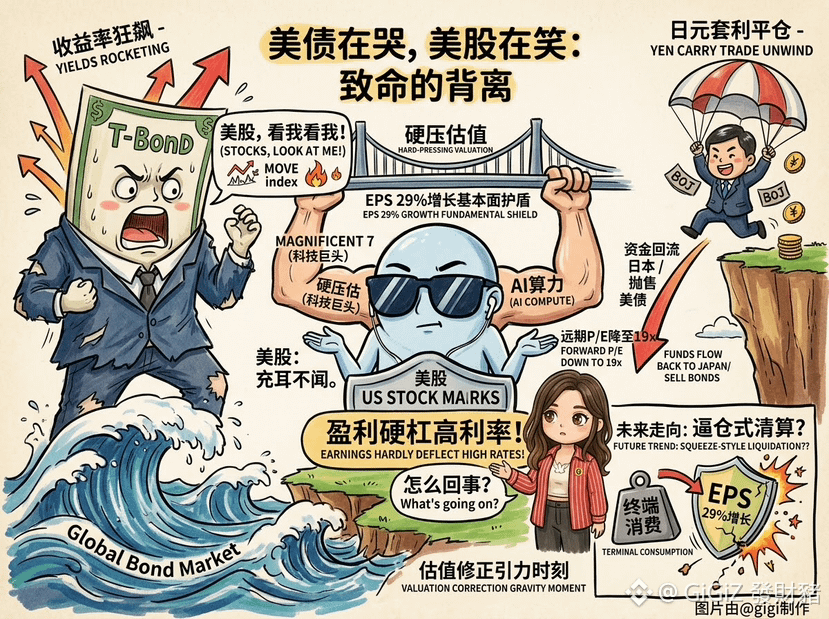
In traditional finance, interest rates are the anchor for asset pricing. When bond market yields skyrocket, it should inevitably drain liquidity from the stock market. This divergence seems irrational at first glance. But earnings have been forcing valuation down, and the market is essentially staging an aggressive options showdown.
Take a look at how the forward P/E ratio has fallen to 19. People think it’s because EPS has jumped 29%, building a solid foundation. But U.S. stocks have already had their nature reshaped by tech giants.
These cash-rich behemoths are almost immune to high interest rates, and can even profit from interest income themselves. They capture the vast majority of the EPS growth, propping up the broader index on their own—masking the truth that small- and mid-cap stocks are being tortured by high rates.
The unwind of the yen carry trade is like an implicit transmission chain that could detonate at any moment. The Bank of Japan’s rate hikes pull funds back into Japan; selling U.S. Treasuries certainly pushes yields higher. But those international funds coming out of the bond market haven’t fled risk assets—instead, they conveniently pour into the most certain AI compute core holdings in U.S. equities. The U.S. stock market has become the last safe harbor amid the global liquidity contraction wave.
However, this calm cannot last forever. Next, the market will most likely face a forced short-covering-style liquidation. When the 10-year U.S. Treasury yield breaks through a critical threshold, borrowing costs will accelerate their transmission into real-economy companies.
Once terminal consumption comes under pressure, the EPS growth outlook will develop cracks. And once the earnings “foundation” loosens, the suppressed “rate gravity” will instantly surge—U.S. stocks will most likely experience a rapid valuation reset.
DYOR
#股票财报季
U.S. Treasury yields surge wildly—how can the U.S. stock market still trade sideways, or even hit new highs?
In traditional finance, interest rates are the anchor for asset pricing. When bond market yields skyrocket, it should inevitably drain liquidity from the stock market. This divergence seems irrational at first glance. But earnings have been forcing valuation down, and the market is essentially staging an aggressive options showdown.
Take a look at how the forward P/E ratio has fallen to 19. People think it’s because EPS has jumped 29%, building a solid foundation. But U.S. stocks have already had their nature reshaped by tech giants.
These cash-rich behemoths are almost immune to high interest rates, and can even profit from interest income themselves. They capture the vast majority of the EPS growth, propping up the broader index on their own—masking the truth that small- and mid-cap stocks are being tortured by high rates.
The unwind of the yen carry trade is like an implicit transmission chain that could detonate at any moment. The Bank of Japan’s rate hikes pull funds back into Japan; selling U.S. Treasuries certainly pushes yields higher. But those international funds coming out of the bond market haven’t fled risk assets—instead, they conveniently pour into the most certain AI compute core holdings in U.S. equities. The U.S. stock market has become the last safe harbor amid the global liquidity contraction wave.
However, this calm cannot last forever. Next, the market will most likely face a forced short-covering-style liquidation. When the 10-year U.S. Treasury yield breaks through a critical threshold, borrowing costs will accelerate their transmission into real-economy companies.
Once terminal consumption comes under pressure, the EPS growth outlook will develop cracks. And once the earnings “foundation” loosens, the suppressed “rate gravity” will instantly surge—U.S. stocks will most likely experience a rapid valuation reset.
DYOR
#股票财报季
In traditional finance, interest rates are the anchor for asset pricing. When bond market yields skyrocket, it should inevitably drain liquidity from the stock market. This divergence seems irrational at first glance. But earnings have been forcing valuation down, and the market is essentially staging an aggressive options showdown.
Take a look at how the forward P/E ratio has fallen to 19. People think it’s because EPS has jumped 29%, building a solid foundation. But U.S. stocks have already had their nature reshaped by tech giants.
These cash-rich behemoths are almost immune to high interest rates, and can even profit from interest income themselves. They capture the vast majority of the EPS growth, propping up the broader index on their own—masking the truth that small- and mid-cap stocks are being tortured by high rates.
The unwind of the yen carry trade is like an implicit transmission chain that could detonate at any moment. The Bank of Japan’s rate hikes pull funds back into Japan; selling U.S. Treasuries certainly pushes yields higher. But those international funds coming out of the bond market haven’t fled risk assets—instead, they conveniently pour into the most certain AI compute core holdings in U.S. equities. The U.S. stock market has become the last safe harbor amid the global liquidity contraction wave.
However, this calm cannot last forever. Next, the market will most likely face a forced short-covering-style liquidation. When the 10-year U.S. Treasury yield breaks through a critical threshold, borrowing costs will accelerate their transmission into real-economy companies.
Once terminal consumption comes under pressure, the EPS growth outlook will develop cracks. And once the earnings “foundation” loosens, the suppressed “rate gravity” will instantly surge—U.S. stocks will most likely experience a rapid valuation reset.
DYOR
#股票财报季
2
3
1.3k
·
--
#amd82亿美元收购worldlabs
When hardware giants start wildly buying the most cutting-edge AI “brains,” what exactly happens to the underlying logic of the chip industry?
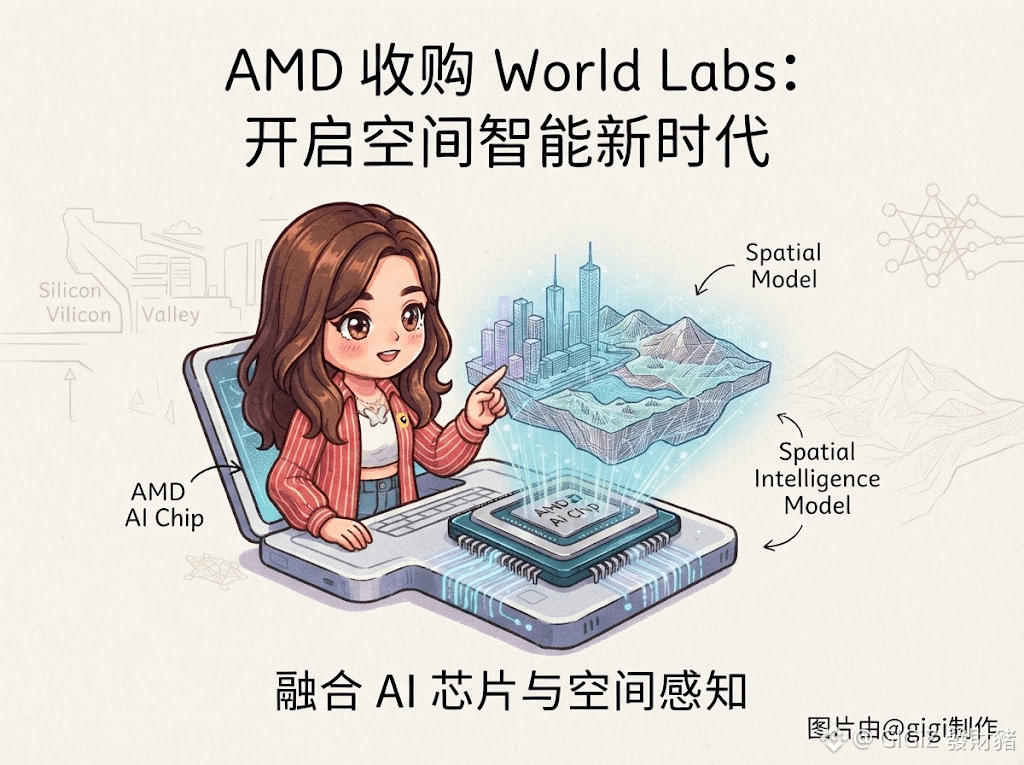
This time, AMD uses an $8.2 billion all-stock deal to swallow World Labs—founded by Li Fei-Fei. On the surface, it looks like an over-the-top acquisition, but in reality it’s a scramble among giants for the right to survive in the future compute ecosystem $AMD $AMD.US
{stock_us}(AMD.US)
{future}(AMDUSDT)
In the past, chipmakers only had to build cards and sell shovels. But as spatial intelligence and physical-world models explode, the authority of algorithms over hardware design grows heavier. Lisa Su knows it’s not enough to just compete on transistors anymore. They must attach the “brain” that understands the future applications best directly to their own chips—deciding how the chips should be designed right at the source.
Next, the arms race across the tech industry will undergo a qualitative change. The competition between giants won’t be just a matter of parameter benchmarks anymore, but an ecosystem battle driven by deep integration between chips and frontier large models.
The era of making quick money purely by selling hardware is coming to an end. Whoever can buy the key that defines the next generation of computing form factors first will be the one who can stay firmly seated in the second half of the AI era.
DYOR
#amd82亿美元收购worldlabs
When hardware giants start wildly buying the most cutting-edge AI “brains,” what exactly happens to the underlying logic of the chip industry?
This time, AMD uses an $8.2 billion all-stock deal to swallow World Labs—founded by Li Fei-Fei. On the surface, it looks like an over-the-top acquisition, but in reality it’s a scramble among giants for the right to survive in the future compute ecosystem $AMD $AMD.US
In the past, chipmakers only had to build cards and sell shovels. But as spatial intelligence and physical-world models explode, the authority of algorithms over hardware design grows heavier. Lisa Su knows it’s not enough to just compete on transistors anymore. They must attach the “brain” that understands the future applications best directly to their own chips—deciding how the chips should be designed right at the source.
Next, the arms race across the tech industry will undergo a qualitative change. The competition between giants won’t be just a matter of parameter benchmarks anymore, but an ecosystem battle driven by deep integration between chips and frontier large models.
The era of making quick money purely by selling hardware is coming to an end. Whoever can buy the key that defines the next generation of computing form factors first will be the one who can stay firmly seated in the second half of the AI era.
DYOR
When hardware giants start wildly buying the most cutting-edge AI “brains,” what exactly happens to the underlying logic of the chip industry?
This time, AMD uses an $8.2 billion all-stock deal to swallow World Labs—founded by Li Fei-Fei. On the surface, it looks like an over-the-top acquisition, but in reality it’s a scramble among giants for the right to survive in the future compute ecosystem $AMD $AMD.US
In the past, chipmakers only had to build cards and sell shovels. But as spatial intelligence and physical-world models explode, the authority of algorithms over hardware design grows heavier. Lisa Su knows it’s not enough to just compete on transistors anymore. They must attach the “brain” that understands the future applications best directly to their own chips—deciding how the chips should be designed right at the source.
Next, the arms race across the tech industry will undergo a qualitative change. The competition between giants won’t be just a matter of parameter benchmarks anymore, but an ecosystem battle driven by deep integration between chips and frontier large models.
The era of making quick money purely by selling hardware is coming to an end. Whoever can buy the key that defines the next generation of computing form factors first will be the one who can stay firmly seated in the second half of the AI era.
DYOR
AMDUS+1.38%
1
1
1.5k
·
--
Bullish
Verified
Did you see Nvidia pull off another big move? $NVDA
The board has dramatically increased the share repurchase authorization by 150 billion, bringing the total directly to $235 billion—stretched all the way through fiscal year 2028. This move has outright reset the record for the biggest single add-on in U.S. stock market history.
Many people think this is just propping up the stock price, but I see three deeper logics $NVDAB $NVDA.US
First, there’s so much cash flow there’s nowhere to spend it.
Nvidia follows an asset-light approach: the chips rely on contract manufacturing. After investing in R&D, it holds massive cash. Share repurchases are the most efficient way to deploy that capital.
Second, an extremely hardcore confidence booster.
The market has been questioning whether AI compute buildout might be nearing a peak, and whether competitors will take a share of the pie. Huang directly puts up $100 billion to lock in shares—using real money to demonstrate absolute confidence in long-term orders.
Third, a share-structure defense strategy.
By tightening the float to raise earnings per share (EPS), it can effectively fend off potential future market volatility or cyclical adjustments.
In the short term, this will undoubtedly form strong support and provide a backstop for the share price. Over the long run, though, it still depends on whether downstream customers can truly make money through AI.
If end-use applications can’t run a profitable business loop and customers cut back on capital expenditures, repurchases alone will be hard-pressed to sustain an extreme valuation.
So what do you think—do you like the massive repurchase from Huang this time, and how long do you believe the AI boom can keep burning? #英伟达
DYOR
{future}(NVDAUSDT)
Did you see Nvidia pull off another big move? $NVDA
The board has dramatically increased the share repurchase authorization by 150 billion, bringing the total directly to $235 billion—stretched all the way through fiscal year 2028. This move has outright reset the record for the biggest single add-on in U.S. stock market history.
Many people think this is just propping up the stock price, but I see three deeper logics $NVDAB $NVDA.US
First, there’s so much cash flow there’s nowhere to spend it.
Nvidia follows an asset-light approach: the chips rely on contract manufacturing. After investing in R&D, it holds massive cash. Share repurchases are the most efficient way to deploy that capital.
Second, an extremely hardcore confidence booster.
The market has been questioning whether AI compute buildout might be nearing a peak, and whether competitors will take a share of the pie. Huang directly puts up $100 billion to lock in shares—using real money to demonstrate absolute confidence in long-term orders.
Third, a share-structure defense strategy.
By tightening the float to raise earnings per share (EPS), it can effectively fend off potential future market volatility or cyclical adjustments.
In the short term, this will undoubtedly form strong support and provide a backstop for the share price. Over the long run, though, it still depends on whether downstream customers can truly make money through AI.
If end-use applications can’t run a profitable business loop and customers cut back on capital expenditures, repurchases alone will be hard-pressed to sustain an extreme valuation.
So what do you think—do you like the massive repurchase from Huang this time, and how long do you believe the AI boom can keep burning? #英伟达
DYOR
The board has dramatically increased the share repurchase authorization by 150 billion, bringing the total directly to $235 billion—stretched all the way through fiscal year 2028. This move has outright reset the record for the biggest single add-on in U.S. stock market history.
Many people think this is just propping up the stock price, but I see three deeper logics $NVDAB $NVDA.US
First, there’s so much cash flow there’s nowhere to spend it.
Nvidia follows an asset-light approach: the chips rely on contract manufacturing. After investing in R&D, it holds massive cash. Share repurchases are the most efficient way to deploy that capital.
Second, an extremely hardcore confidence booster.
The market has been questioning whether AI compute buildout might be nearing a peak, and whether competitors will take a share of the pie. Huang directly puts up $100 billion to lock in shares—using real money to demonstrate absolute confidence in long-term orders.
Third, a share-structure defense strategy.
By tightening the float to raise earnings per share (EPS), it can effectively fend off potential future market volatility or cyclical adjustments.
In the short term, this will undoubtedly form strong support and provide a backstop for the share price. Over the long run, though, it still depends on whether downstream customers can truly make money through AI.
If end-use applications can’t run a profitable business loop and customers cut back on capital expenditures, repurchases alone will be hard-pressed to sustain an extreme valuation.
So what do you think—do you like the massive repurchase from Huang this time, and how long do you believe the AI boom can keep burning? #英伟达
DYOR

NVDAB+0.59%
NVDAUS+0.54%
731
·
--
Bearish
The moment US stocks open, it’s green all over again—three major indices all open lower. Isn’t the first reaction that it’s going to crash again?
I don’t think there’s any need to be that panicked. On the surface, it looks like the Fed rate-cut logic is in tug-of-war with Middle East geopolitical tensions. Oil prices jumped, lifting inflation expectations, and that pushed up US Treasury yields as well, giving the stock market a sudden chill. But I feel this is more like big money using the moment to carry out a precise “washout” and repositioning.
The market logic is undergoing a subtle shift. Earlier on, everyone was fixated on tech stocks and AI themes, but when overvaluation meets rising yields, capital naturally wants to lock in gains first.
However, if you look closely, you’ll find that after the lower open, the buy-the-dip funds are extremely active—especially in defensive sectors and some high-dividend “leaders.” Capital hasn’t chosen to flee US stocks; instead, they’re rotating sectors within the same pool.
Going forward, I don’t think we’re heading into any one-way, sharp plunge. More likely, the market will see wider-ranging, choppy consolidation: tech stocks continue digesting high valuations, while cyclical and consumer sectors will pick up some of that capital.
This kind of pullback is actually a good opportunity to observe the market’s real positioning. Don’t blindly chase bottom-fishing on high-priced targets. Focus more on quality stocks with stable cash flow and valuations that are relatively low. Slow down, and only take action after you’ve clearly seen the direction of the rotation.
DYOR
The moment US stocks open, it’s green all over again—three major indices all open lower. Isn’t the first reaction that it’s going to crash again?
I don’t think there’s any need to be that panicked. On the surface, it looks like the Fed rate-cut logic is in tug-of-war with Middle East geopolitical tensions. Oil prices jumped, lifting inflation expectations, and that pushed up US Treasury yields as well, giving the stock market a sudden chill. But I feel this is more like big money using the moment to carry out a precise “washout” and repositioning.
The market logic is undergoing a subtle shift. Earlier on, everyone was fixated on tech stocks and AI themes, but when overvaluation meets rising yields, capital naturally wants to lock in gains first.
However, if you look closely, you’ll find that after the lower open, the buy-the-dip funds are extremely active—especially in defensive sectors and some high-dividend “leaders.” Capital hasn’t chosen to flee US stocks; instead, they’re rotating sectors within the same pool.
Going forward, I don’t think we’re heading into any one-way, sharp plunge. More likely, the market will see wider-ranging, choppy consolidation: tech stocks continue digesting high valuations, while cyclical and consumer sectors will pick up some of that capital.
This kind of pullback is actually a good opportunity to observe the market’s real positioning. Don’t blindly chase bottom-fishing on high-priced targets. Focus more on quality stocks with stable cash flow and valuations that are relatively low. Slow down, and only take action after you’ve clearly seen the direction of the rotation.
DYOR
I don’t think there’s any need to be that panicked. On the surface, it looks like the Fed rate-cut logic is in tug-of-war with Middle East geopolitical tensions. Oil prices jumped, lifting inflation expectations, and that pushed up US Treasury yields as well, giving the stock market a sudden chill. But I feel this is more like big money using the moment to carry out a precise “washout” and repositioning.
The market logic is undergoing a subtle shift. Earlier on, everyone was fixated on tech stocks and AI themes, but when overvaluation meets rising yields, capital naturally wants to lock in gains first.
However, if you look closely, you’ll find that after the lower open, the buy-the-dip funds are extremely active—especially in defensive sectors and some high-dividend “leaders.” Capital hasn’t chosen to flee US stocks; instead, they’re rotating sectors within the same pool.
Going forward, I don’t think we’re heading into any one-way, sharp plunge. More likely, the market will see wider-ranging, choppy consolidation: tech stocks continue digesting high valuations, while cyclical and consumer sectors will pick up some of that capital.
This kind of pullback is actually a good opportunity to observe the market’s real positioning. Don’t blindly chase bottom-fishing on high-priced targets. Focus more on quality stocks with stable cash flow and valuations that are relatively low. Slow down, and only take action after you’ve clearly seen the direction of the rotation.
DYOR

1
3.8k
·
--
#中国或允许阿里字节买英伟达芯片
When domestic chips have already accounted for most of the market share, why is there now news from Beijing that they may allow Alibaba and ByteDance to purchase Nvidia’s new chips? $NVDA
{spot}(NVDABUSDT)
{future}(NVDAUSDT)
Recently, the biggest tech “leak” in the industry is that China’s Ministry of Industry and Information Technology has reportedly required major players such as Alibaba and ByteDance to submit plans for purchasing Nvidia’s newly released RTX Pro 5500 professional GPUs—and has also sent signals that approval is likely. When this news came out, many people said they couldn’t make sense of it, wondering: weren’t they pushing comprehensive domestic substitution a few years ago? Why are they loosening now?
This definitely doesn’t mean domestic chips aren’t good enough. It’s just that technological competition has entered a more precise, deep-water phase. In this year’s domestic AI server market, the share of domestic chips has indeed been rising sharply, and local manufacturers have also stepped up to carry the load.
But on the actual business front, the computational power “hunger” of large-model training and inference is an endless pit. For internet giants the size of Alibaba and ByteDance, adding another source of compute is also an additional layer of confidence for survival and momentum.
This new Nvidia chip can help bypass some of the stricter U.S. export restrictions. For large companies that urgently need a high-efficiency balance of cost and performance, it’s a highly attractive and practical option.
At the same time, the sense is that this kind of loosening will absolutely not be a blanket, full release. Instead, it will be a precise, structural opening. Regulators will keep firmly in control of the “steering wheel”: on one hand, they will continue to push local chip industries toward self-reliance and strength; on the other hand, they will also provide flexible policy space based on the real pain points of leading enterprises.
After all, in this AI marathon, it’s speed and efficiency that matter. Running on dual tracks is the only way for Chinese companies to stay both safe and fast in the midst of fierce global competition.
DYOR
#中国或允许阿里字节买英伟达芯片
When domestic chips have already accounted for most of the market share, why is there now news from Beijing that they may allow Alibaba and ByteDance to purchase Nvidia’s new chips? $NVDA
Recently, the biggest tech “leak” in the industry is that China’s Ministry of Industry and Information Technology has reportedly required major players such as Alibaba and ByteDance to submit plans for purchasing Nvidia’s newly released RTX Pro 5500 professional GPUs—and has also sent signals that approval is likely. When this news came out, many people said they couldn’t make sense of it, wondering: weren’t they pushing comprehensive domestic substitution a few years ago? Why are they loosening now?
This definitely doesn’t mean domestic chips aren’t good enough. It’s just that technological competition has entered a more precise, deep-water phase. In this year’s domestic AI server market, the share of domestic chips has indeed been rising sharply, and local manufacturers have also stepped up to carry the load.
But on the actual business front, the computational power “hunger” of large-model training and inference is an endless pit. For internet giants the size of Alibaba and ByteDance, adding another source of compute is also an additional layer of confidence for survival and momentum.
This new Nvidia chip can help bypass some of the stricter U.S. export restrictions. For large companies that urgently need a high-efficiency balance of cost and performance, it’s a highly attractive and practical option.
At the same time, the sense is that this kind of loosening will absolutely not be a blanket, full release. Instead, it will be a precise, structural opening. Regulators will keep firmly in control of the “steering wheel”: on one hand, they will continue to push local chip industries toward self-reliance and strength; on the other hand, they will also provide flexible policy space based on the real pain points of leading enterprises.
After all, in this AI marathon, it’s speed and efficiency that matter. Running on dual tracks is the only way for Chinese companies to stay both safe and fast in the midst of fierce global competition.
DYOR
When domestic chips have already accounted for most of the market share, why is there now news from Beijing that they may allow Alibaba and ByteDance to purchase Nvidia’s new chips? $NVDA
Recently, the biggest tech “leak” in the industry is that China’s Ministry of Industry and Information Technology has reportedly required major players such as Alibaba and ByteDance to submit plans for purchasing Nvidia’s newly released RTX Pro 5500 professional GPUs—and has also sent signals that approval is likely. When this news came out, many people said they couldn’t make sense of it, wondering: weren’t they pushing comprehensive domestic substitution a few years ago? Why are they loosening now?
This definitely doesn’t mean domestic chips aren’t good enough. It’s just that technological competition has entered a more precise, deep-water phase. In this year’s domestic AI server market, the share of domestic chips has indeed been rising sharply, and local manufacturers have also stepped up to carry the load.
But on the actual business front, the computational power “hunger” of large-model training and inference is an endless pit. For internet giants the size of Alibaba and ByteDance, adding another source of compute is also an additional layer of confidence for survival and momentum.
This new Nvidia chip can help bypass some of the stricter U.S. export restrictions. For large companies that urgently need a high-efficiency balance of cost and performance, it’s a highly attractive and practical option.
At the same time, the sense is that this kind of loosening will absolutely not be a blanket, full release. Instead, it will be a precise, structural opening. Regulators will keep firmly in control of the “steering wheel”: on one hand, they will continue to push local chip industries toward self-reliance and strength; on the other hand, they will also provide flexible policy space based on the real pain points of leading enterprises.
After all, in this AI marathon, it’s speed and efficiency that matter. Running on dual tracks is the only way for Chinese companies to stay both safe and fast in the midst of fierce global competition.
DYOR

2
1
5.2k
·
--
Verified
#中美公布300亿美元关税减免清单
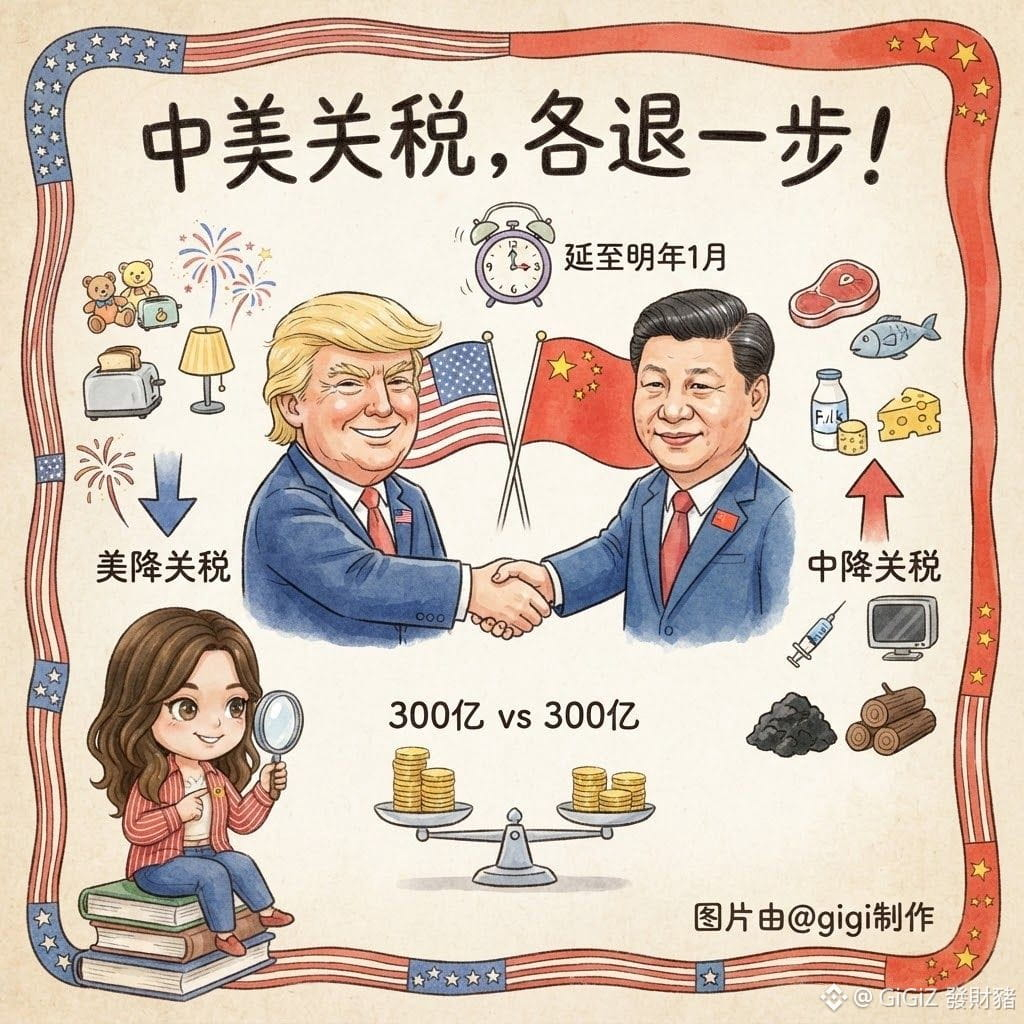
China and the U.S. have announced a list of $30 billion in tariff exemptions, and they’ve extended the trade truce to next January. Do you think this move has injected a strong dose of confidence into the market?
In terms of the actual scale, the $30 billion is indeed small compared with the bilateral trade total, which runs into the thousands of billions. Over 90% of the products have their tariffs lowered directly to the MFN rate. More than anything, this is about easing political tensions and emotions.
The U.S. has offered exemptions for toys, home appliances, and holiday goods, while China has correspondingly loosened rules for agricultural products, coal, and medical devices. It’s essentially each side matching measures to its own domestic inflation and industrial needs—targeted and precise.
To me, this suggests both sides are starting to accept the reality of a long-term game of fighting while negotiating. Nobody wants to flip the table completely, but structural contradictions won’t be resolved entirely by one or two summits.
Looking ahead in the short term, this truce gives businesses a chance to catch their breath and push shipments during the window. But in the long run, friction and clashes are absolutely going to remain the main theme. Do you think there will be any unexpected developments afterward? Let’s chat in the comments section below⬇
#中美公布300亿美元关税减免清单
China and the U.S. have announced a list of $30 billion in tariff exemptions, and they’ve extended the trade truce to next January. Do you think this move has injected a strong dose of confidence into the market?
In terms of the actual scale, the $30 billion is indeed small compared with the bilateral trade total, which runs into the thousands of billions. Over 90% of the products have their tariffs lowered directly to the MFN rate. More than anything, this is about easing political tensions and emotions.
The U.S. has offered exemptions for toys, home appliances, and holiday goods, while China has correspondingly loosened rules for agricultural products, coal, and medical devices. It’s essentially each side matching measures to its own domestic inflation and industrial needs—targeted and precise.
To me, this suggests both sides are starting to accept the reality of a long-term game of fighting while negotiating. Nobody wants to flip the table completely, but structural contradictions won’t be resolved entirely by one or two summits.
Looking ahead in the short term, this truce gives businesses a chance to catch their breath and push shipments during the window. But in the long run, friction and clashes are absolutely going to remain the main theme. Do you think there will be any unexpected developments afterward? Let’s chat in the comments section below⬇
China and the U.S. have announced a list of $30 billion in tariff exemptions, and they’ve extended the trade truce to next January. Do you think this move has injected a strong dose of confidence into the market?
In terms of the actual scale, the $30 billion is indeed small compared with the bilateral trade total, which runs into the thousands of billions. Over 90% of the products have their tariffs lowered directly to the MFN rate. More than anything, this is about easing political tensions and emotions.
The U.S. has offered exemptions for toys, home appliances, and holiday goods, while China has correspondingly loosened rules for agricultural products, coal, and medical devices. It’s essentially each side matching measures to its own domestic inflation and industrial needs—targeted and precise.
To me, this suggests both sides are starting to accept the reality of a long-term game of fighting while negotiating. Nobody wants to flip the table completely, but structural contradictions won’t be resolved entirely by one or two summits.
Looking ahead in the short term, this truce gives businesses a chance to catch their breath and push shipments during the window. But in the long run, friction and clashes are absolutely going to remain the main theme. Do you think there will be any unexpected developments afterward? Let’s chat in the comments section below⬇
2
11.6k
·
--
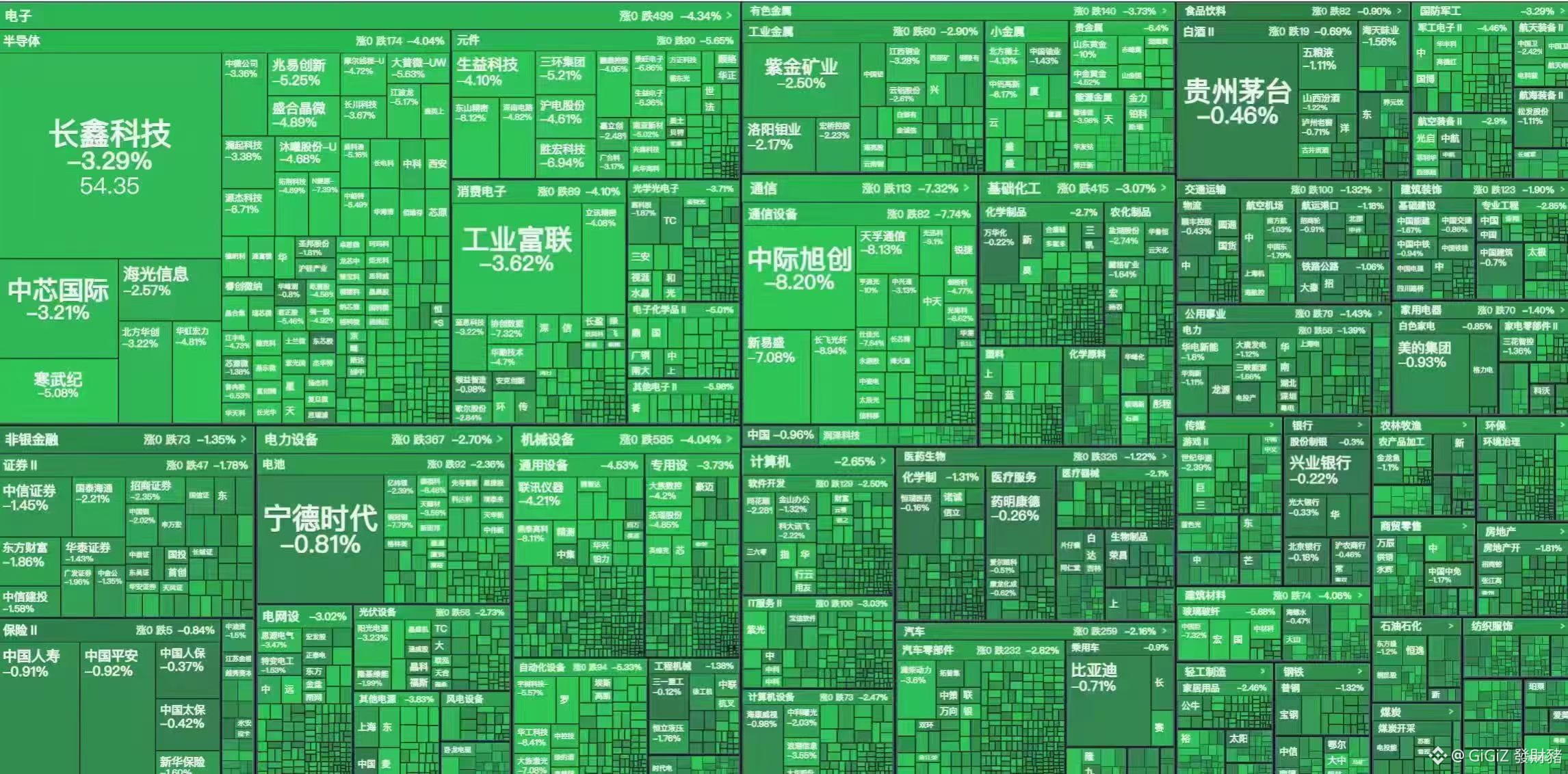
Love is a beam of light, turning you green and panicked~ The Big A’s recent market pullback—can we really enjoy the National Day holiday properly?
But I think this is just normal bubble-squeezing. In the first half of the year, the chip and AI themes pushed stock prices too high. But the market can’t be “celebrating New Year” every day. When we get into the second half, as the Shanghai Composite Index retraces in late September to around the 3,880-point mark, funds are retreating broadly, trading volume is shrinking, and the market is going into a crazy selloff.
I expect this kind of choppy adjustment to continue for a while, because trading volume has clearly been declining. Capital is shifting from mindlessly chasing concepts to looking at real, tangible earnings performance.
I feel it’s hard for the market to go back to the old days when you could buy tech stocks without thinking and they’d still soar. Next will be a strict earnings-validation period, and “fake tech” that relies purely on storytelling will be steadily weeded out.
And the real target for capital to regroup around will be hard-tech companies with core technology and earnings that can be realized—along with high-quality sectors that benefit from a rebound in policy-driven domestic demand. A short period of pain is for a long bull run. At a time like this, keeping a stable mindset is the most important thing.
DYOR
Love is a beam of light, turning you green and panicked~ The Big A’s recent market pullback—can we really enjoy the National Day holiday properly?
But I think this is just normal bubble-squeezing. In the first half of the year, the chip and AI themes pushed stock prices too high. But the market can’t be “celebrating New Year” every day. When we get into the second half, as the Shanghai Composite Index retraces in late September to around the 3,880-point mark, funds are retreating broadly, trading volume is shrinking, and the market is going into a crazy selloff.
I expect this kind of choppy adjustment to continue for a while, because trading volume has clearly been declining. Capital is shifting from mindlessly chasing concepts to looking at real, tangible earnings performance.
I feel it’s hard for the market to go back to the old days when you could buy tech stocks without thinking and they’d still soar. Next will be a strict earnings-validation period, and “fake tech” that relies purely on storytelling will be steadily weeded out.
And the real target for capital to regroup around will be hard-tech companies with core technology and earnings that can be realized—along with high-quality sectors that benefit from a rebound in policy-driven domestic demand. A short period of pain is for a long bull run. At a time like this, keeping a stable mindset is the most important thing.
DYOR
But I think this is just normal bubble-squeezing. In the first half of the year, the chip and AI themes pushed stock prices too high. But the market can’t be “celebrating New Year” every day. When we get into the second half, as the Shanghai Composite Index retraces in late September to around the 3,880-point mark, funds are retreating broadly, trading volume is shrinking, and the market is going into a crazy selloff.
I expect this kind of choppy adjustment to continue for a while, because trading volume has clearly been declining. Capital is shifting from mindlessly chasing concepts to looking at real, tangible earnings performance.
I feel it’s hard for the market to go back to the old days when you could buy tech stocks without thinking and they’d still soar. Next will be a strict earnings-validation period, and “fake tech” that relies purely on storytelling will be steadily weeded out.
And the real target for capital to regroup around will be hard-tech companies with core technology and earnings that can be realized—along with high-quality sectors that benefit from a rebound in policy-driven domestic demand. A short period of pain is for a long bull run. At a time like this, keeping a stable mindset is the most important thing.
DYOR
1
2.5k
·
--
Can you feel the undercurrents this week? The market looks calm on the surface, but underneath it’s all about a tense battle for capital
Everyone is watching the PCE on September 30 and the nonfarm payrolls on October 2. The Fed just raised rates by 25 bps, pushing the policy rate to the 3.75%–4.00% range, breaking the long period of stagnation. It’s also a clear hawkish signal after the new chair took office
The market originally expected rate cuts this year, but the dot plot poured cold water—going even so far as to suggest another potential hike later within the year
First, there’s a subtle window of opportunity
Right after the Fed’s rate hike, it scheduled a burst of comments from multiple senior officials. In essence, it’s a one-two punch using both data and verbal guidance to test how much strain the market can endure
Second, there’s a restructuring of liquidity
The AI infrastructure boom has pulled in a large amount of capital, and combined with high interest rates, it’s weighing on valuations of risk assets. That’s also why <0>$BTC </0> and the US stock market saw pullbacks—funds are concentrating toward “risk-free hard assets” with higher yields
Next, if PCE stays stubborn and nonfarm payrolls come in strong, the Fed will likely take the opportunity to extend the period of higher rates
If the data is weak, the market may pivot directly toward recession-trade panic
Volatility over the next few weeks may increase. Chasing highs blindly can leave you getting hit from both sides. Managing your position size matters far more than trying to bet on a one-way move. How are you planning to rebalance right now?
DYOR
{future}(BTCUSDT)
{future}(ETHUSDT)
Can you feel the undercurrents this week? The market looks calm on the surface, but underneath it’s all about a tense battle for capital
Everyone is watching the PCE on September 30 and the nonfarm payrolls on October 2. The Fed just raised rates by 25 bps, pushing the policy rate to the 3.75%–4.00% range, breaking the long period of stagnation. It’s also a clear hawkish signal after the new chair took office
The market originally expected rate cuts this year, but the dot plot poured cold water—going even so far as to suggest another potential hike later within the year
First, there’s a subtle window of opportunity
Right after the Fed’s rate hike, it scheduled a burst of comments from multiple senior officials. In essence, it’s a one-two punch using both data and verbal guidance to test how much strain the market can endure
Second, there’s a restructuring of liquidity
The AI infrastructure boom has pulled in a large amount of capital, and combined with high interest rates, it’s weighing on valuations of risk assets. That’s also why <0>$BTC </0> and the US stock market saw pullbacks—funds are concentrating toward “risk-free hard assets” with higher yields
Next, if PCE stays stubborn and nonfarm payrolls come in strong, the Fed will likely take the opportunity to extend the period of higher rates
If the data is weak, the market may pivot directly toward recession-trade panic
Volatility over the next few weeks may increase. Chasing highs blindly can leave you getting hit from both sides. Managing your position size matters far more than trying to bet on a one-way move. How are you planning to rebalance right now?
DYOR
Everyone is watching the PCE on September 30 and the nonfarm payrolls on October 2. The Fed just raised rates by 25 bps, pushing the policy rate to the 3.75%–4.00% range, breaking the long period of stagnation. It’s also a clear hawkish signal after the new chair took office
The market originally expected rate cuts this year, but the dot plot poured cold water—going even so far as to suggest another potential hike later within the year
First, there’s a subtle window of opportunity
Right after the Fed’s rate hike, it scheduled a burst of comments from multiple senior officials. In essence, it’s a one-two punch using both data and verbal guidance to test how much strain the market can endure
Second, there’s a restructuring of liquidity
The AI infrastructure boom has pulled in a large amount of capital, and combined with high interest rates, it’s weighing on valuations of risk assets. That’s also why <0>$BTC </0> and the US stock market saw pullbacks—funds are concentrating toward “risk-free hard assets” with higher yields
Next, if PCE stays stubborn and nonfarm payrolls come in strong, the Fed will likely take the opportunity to extend the period of higher rates
If the data is weak, the market may pivot directly toward recession-trade panic
Volatility over the next few weeks may increase. Chasing highs blindly can leave you getting hit from both sides. Managing your position size matters far more than trying to bet on a one-way move. How are you planning to rebalance right now?
DYOR

3.4k
·
--

Article
Top Ten Hidden Meanings in Chinese EtiquetteTop Ten Hidden Meanings in Chinese Etiquette
👀Stay for a meal.
🤔It’s time to send them off.
When you visit someone’s home, after you’ve talked business, the host says, “Stay for a meal.” If you truly stay, the host’s mind is probably already cursing you. The meaning of this sentence isn’t an invitation—it’s an expulsion. The correct response is, “No, no, I still have something to do; I’ll be going.” Then the host will say, “Alright, definitely next time” (though “next time” probably isn’t for sure). In Chinese polite talk, you listen to the tone, not the literal meaning.
👀Let me go back and think about it.
🤔This basically has no chance.
This phrase is commonly used after a job interview, after confessing your feelings, or when you ask someone to do you a favor. When they say “let me think about it,” it doesn’t really mean they want to think—it’s a polite refusal. If they truly want it, you’ll get feedback on the spot. Wait a week; if there’s no response, don’t wait anymore. In the adult world, not clearly agreeing is rejection. Not a straightforward yes is hesitation. Hesitation means no.
Top Ten Hidden Meanings in Chinese Etiquette
Top Ten Hidden Meanings in Chinese Etiquette
👀Stay for a meal.
🤔It’s time to send them off.
When you visit someone’s home, after you’ve talked business, the host says, “Stay for a meal.” If you truly stay, the host’s mind is probably already cursing you. The meaning of this sentence isn’t an invitation—it’s an expulsion. The correct response is, “No, no, I still have something to do; I’ll be going.” Then the host will say, “Alright, definitely next time” (though “next time” probably isn’t for sure). In Chinese polite talk, you listen to the tone, not the literal meaning.
👀Let me go back and think about it.
🤔This basically has no chance.
This phrase is commonly used after a job interview, after confessing your feelings, or when you ask someone to do you a favor. When they say “let me think about it,” it doesn’t really mean they want to think—it’s a polite refusal. If they truly want it, you’ll get feedback on the spot. Wait a week; if there’s no response, don’t wait anymore. In the adult world, not clearly agreeing is rejection. Not a straightforward yes is hesitation. Hesitation means no.
👀Stay for a meal.
🤔It’s time to send them off.
When you visit someone’s home, after you’ve talked business, the host says, “Stay for a meal.” If you truly stay, the host’s mind is probably already cursing you. The meaning of this sentence isn’t an invitation—it’s an expulsion. The correct response is, “No, no, I still have something to do; I’ll be going.” Then the host will say, “Alright, definitely next time” (though “next time” probably isn’t for sure). In Chinese polite talk, you listen to the tone, not the literal meaning.
👀Let me go back and think about it.
🤔This basically has no chance.
This phrase is commonly used after a job interview, after confessing your feelings, or when you ask someone to do you a favor. When they say “let me think about it,” it doesn’t really mean they want to think—it’s a polite refusal. If they truly want it, you’ll get feedback on the spot. Wait a week; if there’s no response, don’t wait anymore. In the adult world, not clearly agreeing is rejection. Not a straightforward yes is hesitation. Hesitation means no.
1
6
6.5k
·
--
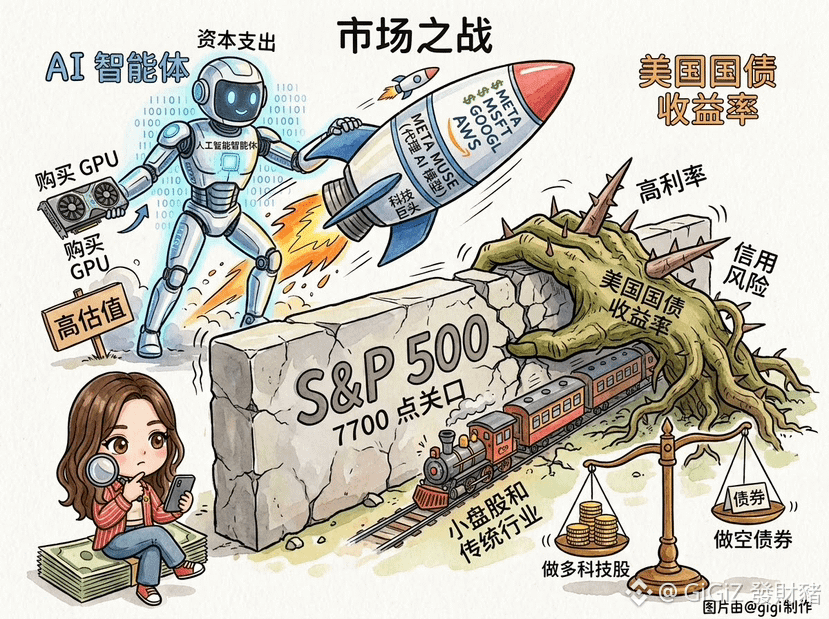
US stocks at high levels tear apart—who is the true destined ruler that will lead the future?
U.S. equities are currently showing extreme divergence: on one side, the AI Agent deployment boom sparked by Meta Muse is lifting technology giants to lead the rally. On the other, rising U.S. Treasury yields are pressuring valuations across the entire market.
I believe that in the short term, U.S. Treasury rates govern the market’s upper ceiling; in the long term, AI Agents are the ultimate force determining the direction of capital toward core assets.
Three angles worth paying attention to
▶️ AI capital expenditure colliding with the bond market
Tech giants are issuing large amounts of debt to build AI compute infrastructure, competing with U.S. Treasuries for liquidity and pushing yields higher. The more feverish the AI investment, the harder it is for rates to fall.
▶️ Credit spreads vs. stock prices diverge
Credit spreads for mega-scale cloud providers have widened, indicating that the bond market has already started pricing risks tied to heavy assets and cash-flow strains. Meanwhile, the stock market still appears trapped in an overly optimistic forward-looking narrative. Such divergence often signals that volatility is approaching.
▶️ The end of diffusion-style trading and survival of the fittest
Capital is unwilling to move into mid- and small-cap companies or traditional industries. Instead, money is fully consolidating around top-tier tech stocks with strong cash flow and proven AI deployment capabilities.
Expect that, in the short term, the S&P 500 will most likely trade in a range near 7700. If the 10-year U.S. Treasury yield breaks above the recent high, it will trigger a pullback in tech stock valuations. But as long as the Agent products’ monetization capability is proven, the pullback will be an opportunity for funds to buy the leaders on the dip.
Goldman Sachs’ suggestion to hold a long position in tech while shorting Treasuries for hedging is extremely solid. With market divergence intensifying, it’s better to pick core names than to buy the broad index.
$META $MSFT $GOOGL $AWS
DYOR
{future}(METAUSDT)
{future}(GOOGLUSDT)
{future}(MSFTUSDT)
US stocks at high levels tear apart—who is the true destined ruler that will lead the future?
U.S. equities are currently showing extreme divergence: on one side, the AI Agent deployment boom sparked by Meta Muse is lifting technology giants to lead the rally. On the other, rising U.S. Treasury yields are pressuring valuations across the entire market.
I believe that in the short term, U.S. Treasury rates govern the market’s upper ceiling; in the long term, AI Agents are the ultimate force determining the direction of capital toward core assets.
Three angles worth paying attention to
▶️ AI capital expenditure colliding with the bond market
Tech giants are issuing large amounts of debt to build AI compute infrastructure, competing with U.S. Treasuries for liquidity and pushing yields higher. The more feverish the AI investment, the harder it is for rates to fall.
▶️ Credit spreads vs. stock prices diverge
Credit spreads for mega-scale cloud providers have widened, indicating that the bond market has already started pricing risks tied to heavy assets and cash-flow strains. Meanwhile, the stock market still appears trapped in an overly optimistic forward-looking narrative. Such divergence often signals that volatility is approaching.
▶️ The end of diffusion-style trading and survival of the fittest
Capital is unwilling to move into mid- and small-cap companies or traditional industries. Instead, money is fully consolidating around top-tier tech stocks with strong cash flow and proven AI deployment capabilities.
Expect that, in the short term, the S&P 500 will most likely trade in a range near 7700. If the 10-year U.S. Treasury yield breaks above the recent high, it will trigger a pullback in tech stock valuations. But as long as the Agent products’ monetization capability is proven, the pullback will be an opportunity for funds to buy the leaders on the dip.
Goldman Sachs’ suggestion to hold a long position in tech while shorting Treasuries for hedging is extremely solid. With market divergence intensifying, it’s better to pick core names than to buy the broad index.
$META $MSFT $GOOGL $AWS
DYOR
U.S. equities are currently showing extreme divergence: on one side, the AI Agent deployment boom sparked by Meta Muse is lifting technology giants to lead the rally. On the other, rising U.S. Treasury yields are pressuring valuations across the entire market.
I believe that in the short term, U.S. Treasury rates govern the market’s upper ceiling; in the long term, AI Agents are the ultimate force determining the direction of capital toward core assets.
Three angles worth paying attention to
▶️ AI capital expenditure colliding with the bond market
Tech giants are issuing large amounts of debt to build AI compute infrastructure, competing with U.S. Treasuries for liquidity and pushing yields higher. The more feverish the AI investment, the harder it is for rates to fall.
▶️ Credit spreads vs. stock prices diverge
Credit spreads for mega-scale cloud providers have widened, indicating that the bond market has already started pricing risks tied to heavy assets and cash-flow strains. Meanwhile, the stock market still appears trapped in an overly optimistic forward-looking narrative. Such divergence often signals that volatility is approaching.
▶️ The end of diffusion-style trading and survival of the fittest
Capital is unwilling to move into mid- and small-cap companies or traditional industries. Instead, money is fully consolidating around top-tier tech stocks with strong cash flow and proven AI deployment capabilities.
Expect that, in the short term, the S&P 500 will most likely trade in a range near 7700. If the 10-year U.S. Treasury yield breaks above the recent high, it will trigger a pullback in tech stock valuations. But as long as the Agent products’ monetization capability is proven, the pullback will be an opportunity for funds to buy the leaders on the dip.
Goldman Sachs’ suggestion to hold a long position in tech while shorting Treasuries for hedging is extremely solid. With market divergence intensifying, it’s better to pick core names than to buy the broad index.
$META $MSFT $GOOGL $AWS
DYOR
1
9
6.5k
·
--

Article
The iPhone encryption that gives the FBI headaches has become a talisman for people in gray industries.Why do nine out of ten people involved in gray industries use iPhones?
Here’s a painfully honest question: if you lost your phone, what would you fear most?
What ordinary people fear are photos and chat logs, while some people fear their entire life. This leads to an interesting phenomenon: those who operate in the gray areas almost all use iPhones—not as a show of status, but to save their lives.
First, the data will self-destruct.
In iPhone settings there’s a “erase data” feature: if you enter the wrong password ten times in a row, all data is wiped with a single click. If your phone ends up in someone else’s hands, you only get ten attempts—guess wrong and everything is gone.
Want to open it up and read the chip? No chance. The iPhone’s encryption key and chip are locked together; if you pry them out and connect them to another device, what you read will just be gibberish.
The iPhone encryption that gives the FBI headaches has become a talisman for people in gray industries.
Why do nine out of ten people involved in gray industries use iPhones?
Here’s a painfully honest question: if you lost your phone, what would you fear most?
What ordinary people fear are photos and chat logs, while some people fear their entire life. This leads to an interesting phenomenon: those who operate in the gray areas almost all use iPhones—not as a show of status, but to save their lives.
First, the data will self-destruct.
In iPhone settings there’s a “erase data” feature: if you enter the wrong password ten times in a row, all data is wiped with a single click. If your phone ends up in someone else’s hands, you only get ten attempts—guess wrong and everything is gone.
Want to open it up and read the chip? No chance. The iPhone’s encryption key and chip are locked together; if you pry them out and connect them to another device, what you read will just be gibberish.
Here’s a painfully honest question: if you lost your phone, what would you fear most?
What ordinary people fear are photos and chat logs, while some people fear their entire life. This leads to an interesting phenomenon: those who operate in the gray areas almost all use iPhones—not as a show of status, but to save their lives.
First, the data will self-destruct.
In iPhone settings there’s a “erase data” feature: if you enter the wrong password ten times in a row, all data is wiped with a single click. If your phone ends up in someone else’s hands, you only get ten attempts—guess wrong and everything is gone.
Want to open it up and read the chip? No chance. The iPhone’s encryption key and chip are locked together; if you pry them out and connect them to another device, what you read will just be gibberish.
1
5
22.7k
·
--
Verified
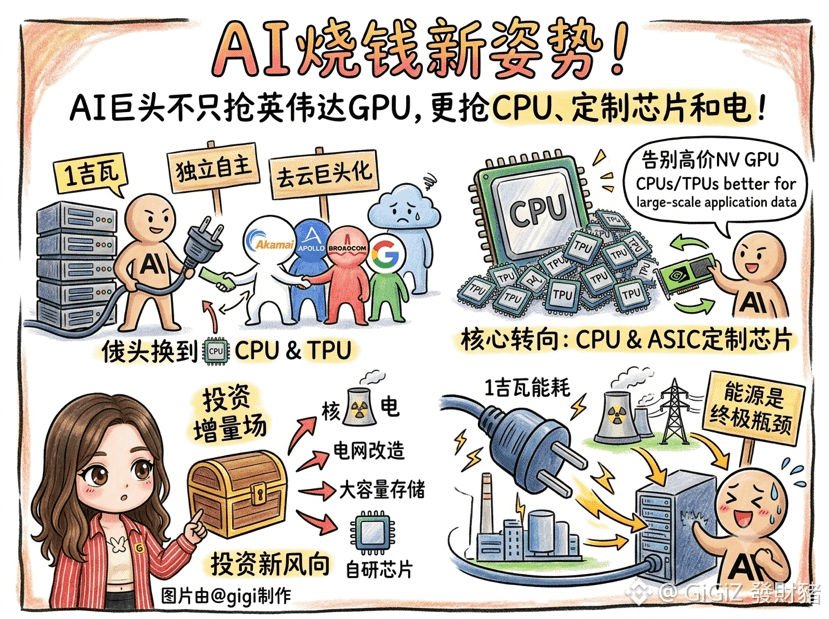
The way AI giants burn money has completely changed—now everyone isn’t just fixated on Nvidia and grabbing GPUs.
Recently, Anthropic came out with two big bombshells. First, it shelled out $11.6 billion to sign a seven-year CPU compute power deal with Akamai $AKAM.US .
Second, it plans to spend at least $40 billion to rent 1 gigawatt of data center capacity from data center developers under Apollo $APO, and it even wants to install the TPU it develops using Broadcom $AVGO and Google $GOOGL .
AI big shots are all rushing to cut out the middlemen.
They’re skipping the traditional cloud giants, going straight to lower-level infrastructure developers to rent server rooms, and taking control of compute infrastructure for themselves.
CPUs and custom chips are set to rebound.
As AI moves from training to large-scale deployment, the key to processing massive amounts of data becomes the CPU. Combined with this TPU “combo punch,” it shows that more cost-effective tailored solutions are starting to eat into Nvidia’s high-priced profits.
The endgame for compute is power.
1 gigawatt is almost equivalent to the output of a medium-sized nuclear power plant. Next, the biggest constraint isn’t really the chips—it’s where to find that much electricity.
The investment main theme will quickly diversify.
The marginal benefit of just telling stories with GPUs is diminishing, and capital will accelerate toward large-capacity storage, ASIC custom chips, and true energy infrastructure consolidation such as nuclear power and power grid upgrades.
DYOR #Anthropic
{future}(AVGOUSDT)
{future}(GOOGLUSDT)
The way AI giants burn money has completely changed—now everyone isn’t just fixated on Nvidia and grabbing GPUs.
Recently, Anthropic came out with two big bombshells. First, it shelled out $11.6 billion to sign a seven-year CPU compute power deal with Akamai $AKAM.US .
Second, it plans to spend at least $40 billion to rent 1 gigawatt of data center capacity from data center developers under Apollo $APO, and it even wants to install the TPU it develops using Broadcom $AVGO and Google $GOOGL .
AI big shots are all rushing to cut out the middlemen.
They’re skipping the traditional cloud giants, going straight to lower-level infrastructure developers to rent server rooms, and taking control of compute infrastructure for themselves.
CPUs and custom chips are set to rebound.
As AI moves from training to large-scale deployment, the key to processing massive amounts of data becomes the CPU. Combined with this TPU “combo punch,” it shows that more cost-effective tailored solutions are starting to eat into Nvidia’s high-priced profits.
The endgame for compute is power.
1 gigawatt is almost equivalent to the output of a medium-sized nuclear power plant. Next, the biggest constraint isn’t really the chips—it’s where to find that much electricity.
The investment main theme will quickly diversify.
The marginal benefit of just telling stories with GPUs is diminishing, and capital will accelerate toward large-capacity storage, ASIC custom chips, and true energy infrastructure consolidation such as nuclear power and power grid upgrades.
DYOR #Anthropic
Recently, Anthropic came out with two big bombshells. First, it shelled out $11.6 billion to sign a seven-year CPU compute power deal with Akamai $AKAM.US .
Second, it plans to spend at least $40 billion to rent 1 gigawatt of data center capacity from data center developers under Apollo $APO, and it even wants to install the TPU it develops using Broadcom $AVGO and Google $GOOGL .
AI big shots are all rushing to cut out the middlemen.
They’re skipping the traditional cloud giants, going straight to lower-level infrastructure developers to rent server rooms, and taking control of compute infrastructure for themselves.
CPUs and custom chips are set to rebound.
As AI moves from training to large-scale deployment, the key to processing massive amounts of data becomes the CPU. Combined with this TPU “combo punch,” it shows that more cost-effective tailored solutions are starting to eat into Nvidia’s high-priced profits.
The endgame for compute is power.
1 gigawatt is almost equivalent to the output of a medium-sized nuclear power plant. Next, the biggest constraint isn’t really the chips—it’s where to find that much electricity.
The investment main theme will quickly diversify.
The marginal benefit of just telling stories with GPUs is diminishing, and capital will accelerate toward large-capacity storage, ASIC custom chips, and true energy infrastructure consolidation such as nuclear power and power grid upgrades.
DYOR #Anthropic
2.6k
·
--
Verified
Robinhood CEO trims more than $32.54 million worth of company stock ($HOOD )
The CEO sold off more than 90% of his own shares—was this cashing out at a high point, or has he lost confidence in the company?
A close look at the latest SEC filings and data shows there’s a key misunderstanding here. This time, CEO Vladimir Tenev did indeed sell 259,000 Class A shares, raising roughly $32.54 million. His direct holdings also do appear to be down to just a little over 6,000 shares.
The crucial point is that his real stake is in Class B voting shares. Even after the transaction, he still holds more than 48 million Class B shares, so his control is essentially unaffected.
Also, this share sale was part of a 10b5-1 automated trading plan set more than a year in advance. As the stock price rose to a high level, the system executed the trades automatically—this wasn’t a sudden, panicked exit.
I think executives trimming their holdings when prices are high is pretty normal, since stock is also part of their compensation. But in the short term, the market often gets spooked by sensational headlines like “shares cut by 90%,” triggering an emotional stampede.
Going forward, retail sentiment may be led astray in the near term by panic, causing a modest pullback in the stock price. But in the medium to long term, as long as Robinhood’s earnings and business data remain resilient, the market will quickly absorb this bearish development from routine executive selling. Blindly cutting losses or chasing after price spikes isn’t wise—understanding the executive’s actual control and the company’s fundamentals is the real takeaway.
DYOR
Robinhood CEO trims more than $32.54 million worth of company stock ($HOOD )
The CEO sold off more than 90% of his own shares—was this cashing out at a high point, or has he lost confidence in the company?
A close look at the latest SEC filings and data shows there’s a key misunderstanding here. This time, CEO Vladimir Tenev did indeed sell 259,000 Class A shares, raising roughly $32.54 million. His direct holdings also do appear to be down to just a little over 6,000 shares.
The crucial point is that his real stake is in Class B voting shares. Even after the transaction, he still holds more than 48 million Class B shares, so his control is essentially unaffected.
Also, this share sale was part of a 10b5-1 automated trading plan set more than a year in advance. As the stock price rose to a high level, the system executed the trades automatically—this wasn’t a sudden, panicked exit.
I think executives trimming their holdings when prices are high is pretty normal, since stock is also part of their compensation. But in the short term, the market often gets spooked by sensational headlines like “shares cut by 90%,” triggering an emotional stampede.
Going forward, retail sentiment may be led astray in the near term by panic, causing a modest pullback in the stock price. But in the medium to long term, as long as Robinhood’s earnings and business data remain resilient, the market will quickly absorb this bearish development from routine executive selling. Blindly cutting losses or chasing after price spikes isn’t wise—understanding the executive’s actual control and the company’s fundamentals is the real takeaway.
DYOR
The CEO sold off more than 90% of his own shares—was this cashing out at a high point, or has he lost confidence in the company?
A close look at the latest SEC filings and data shows there’s a key misunderstanding here. This time, CEO Vladimir Tenev did indeed sell 259,000 Class A shares, raising roughly $32.54 million. His direct holdings also do appear to be down to just a little over 6,000 shares.
The crucial point is that his real stake is in Class B voting shares. Even after the transaction, he still holds more than 48 million Class B shares, so his control is essentially unaffected.
Also, this share sale was part of a 10b5-1 automated trading plan set more than a year in advance. As the stock price rose to a high level, the system executed the trades automatically—this wasn’t a sudden, panicked exit.
I think executives trimming their holdings when prices are high is pretty normal, since stock is also part of their compensation. But in the short term, the market often gets spooked by sensational headlines like “shares cut by 90%,” triggering an emotional stampede.
Going forward, retail sentiment may be led astray in the near term by panic, causing a modest pullback in the stock price. But in the medium to long term, as long as Robinhood’s earnings and business data remain resilient, the market will quickly absorb this bearish development from routine executive selling. Blindly cutting losses or chasing after price spikes isn’t wise—understanding the executive’s actual control and the company’s fundamentals is the real takeaway.
DYOR

1
4
2.6k
·
--
Chip production capacity is getting snatched up like crazy. TSMC has already set a price increase for 2027 a full year early—what exactly gives them the confidence to be so霸气?
TSMC announced that starting in 2027, wafer fabrication (foundry) prices will be raised by 3% to 6%, with leading advanced nodes like 2nm and 3nm driving the increase. But it’s not just because AI chips are in short supply. Instead, the AI industry chain is experiencing a serious “supply-chain spillover” effect.
Previously, everyone only focused on compute-power chips. Now, as compute centers are疯狂 expanding, orders for mature-node chips—power management, optical communication, MCUs—are all exploding along with it.
TSMC’s 8-inch fabs are operating at capacity utilization so tightly that they’re basically packed beyond 100%. Orders for 45nm and below have even been booked until 2030. And with the expensive cost of building the plant in Arizona needing to be shared, they naturally have the confidence to lock in pricing early.
The toughest commercial barrier is ecosystem lock-in. Switching foundries isn’t just about redesigning circuits again—it also takes three to five years to validate. Even companies like NVIDIA and Apple, if they grit their teeth, still have to swallow this price-increase cost.
Next trends
▶️ Cost pass-through
Chipmakers that can push the price increase onto downstream B2B giants will keep making big money, but design companies in consumer electronics and mobile phone chips will see their profits squeezed severely.
▶️ Spillover benefits
Second-tier foundries like Samsung and UMC, as well as packaging and substrate (encapsulation/board) companies, will capture this spillover demand for mature nodes and fully follow through with their own price hikes.
TSMC: $TSM
Chip design leaders: $NVDA, $AAPL, $AMD , $AVGO
Second-tier foundry and packaging spillover beneficiaries: $UMC, $INTC, $ASX
DYOR
{future}(AMDUSDT)
{future}(AVGOUSDT)
{future}(TSMUSDT)
Chip production capacity is getting snatched up like crazy. TSMC has already set a price increase for 2027 a full year early—what exactly gives them the confidence to be so霸气?
TSMC announced that starting in 2027, wafer fabrication (foundry) prices will be raised by 3% to 6%, with leading advanced nodes like 2nm and 3nm driving the increase. But it’s not just because AI chips are in short supply. Instead, the AI industry chain is experiencing a serious “supply-chain spillover” effect.
Previously, everyone only focused on compute-power chips. Now, as compute centers are疯狂 expanding, orders for mature-node chips—power management, optical communication, MCUs—are all exploding along with it.
TSMC’s 8-inch fabs are operating at capacity utilization so tightly that they’re basically packed beyond 100%. Orders for 45nm and below have even been booked until 2030. And with the expensive cost of building the plant in Arizona needing to be shared, they naturally have the confidence to lock in pricing early.
The toughest commercial barrier is ecosystem lock-in. Switching foundries isn’t just about redesigning circuits again—it also takes three to five years to validate. Even companies like NVIDIA and Apple, if they grit their teeth, still have to swallow this price-increase cost.
Next trends
▶️ Cost pass-through
Chipmakers that can push the price increase onto downstream B2B giants will keep making big money, but design companies in consumer electronics and mobile phone chips will see their profits squeezed severely.
▶️ Spillover benefits
Second-tier foundries like Samsung and UMC, as well as packaging and substrate (encapsulation/board) companies, will capture this spillover demand for mature nodes and fully follow through with their own price hikes.
TSMC: $TSM
Chip design leaders: $NVDA, $AAPL, $AMD , $AVGO
Second-tier foundry and packaging spillover beneficiaries: $UMC, $INTC, $ASX
DYOR
TSMC announced that starting in 2027, wafer fabrication (foundry) prices will be raised by 3% to 6%, with leading advanced nodes like 2nm and 3nm driving the increase. But it’s not just because AI chips are in short supply. Instead, the AI industry chain is experiencing a serious “supply-chain spillover” effect.
Previously, everyone only focused on compute-power chips. Now, as compute centers are疯狂 expanding, orders for mature-node chips—power management, optical communication, MCUs—are all exploding along with it.
TSMC’s 8-inch fabs are operating at capacity utilization so tightly that they’re basically packed beyond 100%. Orders for 45nm and below have even been booked until 2030. And with the expensive cost of building the plant in Arizona needing to be shared, they naturally have the confidence to lock in pricing early.
The toughest commercial barrier is ecosystem lock-in. Switching foundries isn’t just about redesigning circuits again—it also takes three to five years to validate. Even companies like NVIDIA and Apple, if they grit their teeth, still have to swallow this price-increase cost.
Next trends
▶️ Cost pass-through
Chipmakers that can push the price increase onto downstream B2B giants will keep making big money, but design companies in consumer electronics and mobile phone chips will see their profits squeezed severely.
▶️ Spillover benefits
Second-tier foundries like Samsung and UMC, as well as packaging and substrate (encapsulation/board) companies, will capture this spillover demand for mature nodes and fully follow through with their own price hikes.
TSMC: $TSM
Chip design leaders: $NVDA, $AAPL, $AMD , $AVGO
Second-tier foundry and packaging spillover beneficiaries: $UMC, $INTC, $ASX
DYOR
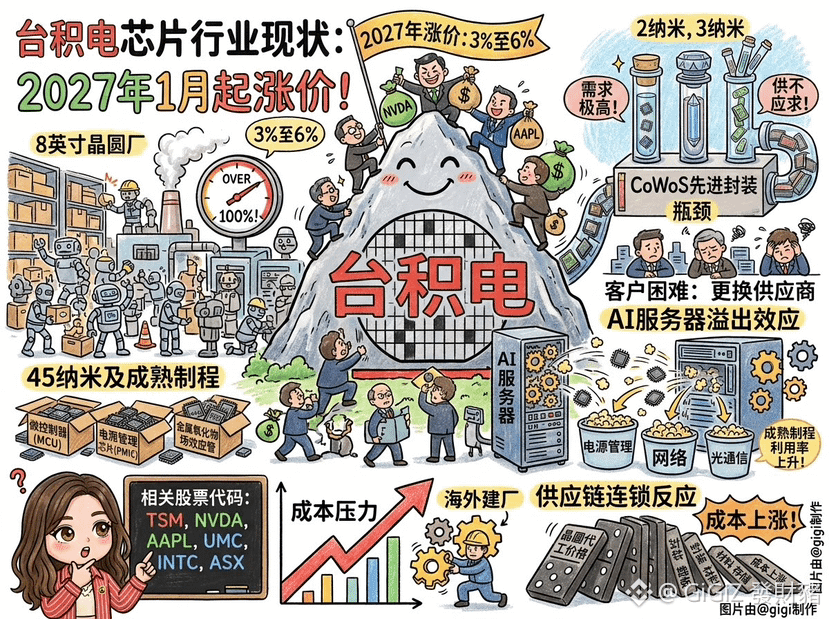
828
·
--
Verified
A giant is actually trying to defend a computing-power project by citing force majeure— is this legal risk-avoidance, or the first warning bell for an AI infrastructure bubble? $CRCL
Oracle has sent a force majeure notice to developers. On the surface, it’s to evade liability for breach of contract due to environmental concerns and delays in pipeline approvals. In reality, it’s a hedge against a highly leveraged financing structure
Project Jupiter uses SPV off-balance-sheet financing, tightly tying Oracle’s OpenAI Blue Owl and debt exposure together. If everything goes smoothly, leverage can amplify returns. But if construction is delayed, the extended timeline and hefty interest can quickly wipe out profits, even triggering a chain reaction of debt
This reveals a hard clash between giant AI infrastructure and local power, water, and regulatory constraints. The financial market’s reaction—loan demand for the project collapsing—shows that capital’s credit assessment of the super–data center model has already shifted
Next, it will most likely move toward debt restructuring or renegotiating leases, and may even push OpenAI to pivot to a distributed computing-power approach. Oracle’s defensive move signals that the era of explosive growth in AI compute is officially entering a rational pain period of bubble deflation
How long do you think this highly leveraged, mega–data center model can last?
DYOR
{future}(CRCLUSDT)
A giant is actually trying to defend a computing-power project by citing force majeure— is this legal risk-avoidance, or the first warning bell for an AI infrastructure bubble? $CRCL
Oracle has sent a force majeure notice to developers. On the surface, it’s to evade liability for breach of contract due to environmental concerns and delays in pipeline approvals. In reality, it’s a hedge against a highly leveraged financing structure
Project Jupiter uses SPV off-balance-sheet financing, tightly tying Oracle’s OpenAI Blue Owl and debt exposure together. If everything goes smoothly, leverage can amplify returns. But if construction is delayed, the extended timeline and hefty interest can quickly wipe out profits, even triggering a chain reaction of debt
This reveals a hard clash between giant AI infrastructure and local power, water, and regulatory constraints. The financial market’s reaction—loan demand for the project collapsing—shows that capital’s credit assessment of the super–data center model has already shifted
Next, it will most likely move toward debt restructuring or renegotiating leases, and may even push OpenAI to pivot to a distributed computing-power approach. Oracle’s defensive move signals that the era of explosive growth in AI compute is officially entering a rational pain period of bubble deflation
How long do you think this highly leveraged, mega–data center model can last?
DYOR
Oracle has sent a force majeure notice to developers. On the surface, it’s to evade liability for breach of contract due to environmental concerns and delays in pipeline approvals. In reality, it’s a hedge against a highly leveraged financing structure
Project Jupiter uses SPV off-balance-sheet financing, tightly tying Oracle’s OpenAI Blue Owl and debt exposure together. If everything goes smoothly, leverage can amplify returns. But if construction is delayed, the extended timeline and hefty interest can quickly wipe out profits, even triggering a chain reaction of debt
This reveals a hard clash between giant AI infrastructure and local power, water, and regulatory constraints. The financial market’s reaction—loan demand for the project collapsing—shows that capital’s credit assessment of the super–data center model has already shifted
Next, it will most likely move toward debt restructuring or renegotiating leases, and may even push OpenAI to pivot to a distributed computing-power approach. Oracle’s defensive move signals that the era of explosive growth in AI compute is officially entering a rational pain period of bubble deflation
How long do you think this highly leveraged, mega–data center model can last?
DYOR

806
·
--
Binance never fails to impress us with every set of community goodies
They care about us even more than our own parents
Everything we need for daily life is considered
So that when holidays come around, we can feel especially warm
Thoughtful to the core 💕
Thank you, Binance @CZ @heyi
Binance has it all 🫰🏻
#binance #Binance Mid-Autumn Festival goodies
Binance never fails to impress us with every set of community goodies
They care about us even more than our own parents
Everything we need for daily life is considered
So that when holidays come around, we can feel especially warm
Thoughtful to the core 💕
Thank you, Binance @CZ @Yi He
Binance has it all 🫰🏻
#binance #Binance Mid-Autumn Festival goodies
They care about us even more than our own parents
Everything we need for daily life is considered
So that when holidays come around, we can feel especially warm
Thoughtful to the core 💕
Thank you, Binance @CZ @Yi He
Binance has it all 🫰🏻
#binance #Binance Mid-Autumn Festival goodies


2
3
1.7k
·
--
From answering questions to directly handling tasks—will AI applications really shake things up this time?
Meta’s Muse has gone viral, and the key is turning “answers” into “actions.” It doesn’t just search information—it can also open webpages in the background, fill out forms, book flights, and even list a car for sale. It’s a direct dimensionality strike against traditional chat boxes. This momentum has also driven Meta’s parent company stock price—$META —steadily upward.
Compute form has changed
Instead of just running apps on user devices, users are provisioned with cloud-based virtual machines. Even when you shut down, the system can keep running tasks in the background 24/7. What matters is backend execution power.
Business model disruption
Once AI takes over reservations and online shopping, it locks up the transaction entry points. In the future, take-rates may become more profitable than selling subscription fees.
Trust and game-theory pitfalls
There’s very little tolerance for error when paying on a user’s behalf via email. One mistake can collapse trust. And platforms will inevitably roll out anti-bot protocols to clamp down.
After the hype fades, Agents will face tests of reliability and cross-platform barriers. If they can’t solve security and anti-blocking issues, the price surge could easily fade once traffic peaks. Whether they can become “super intelligent” ultimately depends on whether they can cross the trust hurdle.
$META is consolidating in the short term near a high level; in the medium to long term, it’s still promising, supported by the advertising core business and AI Agent commercialization.
For trading, it’s not recommended to chase the rally. You can wait for a pullback to the $680–$700 support zone and build positions in batches. For current holders, consider raising the stop-loss level and continue holding.
DYOR
#Muse超越ChatGPT成iOS免费榜首
{future}(METAUSDT)
From answering questions to directly handling tasks—will AI applications really shake things up this time?
Meta’s Muse has gone viral, and the key is turning “answers” into “actions.” It doesn’t just search information—it can also open webpages in the background, fill out forms, book flights, and even list a car for sale. It’s a direct dimensionality strike against traditional chat boxes. This momentum has also driven Meta’s parent company stock price—$META —steadily upward.
Compute form has changed
Instead of just running apps on user devices, users are provisioned with cloud-based virtual machines. Even when you shut down, the system can keep running tasks in the background 24/7. What matters is backend execution power.
Business model disruption
Once AI takes over reservations and online shopping, it locks up the transaction entry points. In the future, take-rates may become more profitable than selling subscription fees.
Trust and game-theory pitfalls
There’s very little tolerance for error when paying on a user’s behalf via email. One mistake can collapse trust. And platforms will inevitably roll out anti-bot protocols to clamp down.
After the hype fades, Agents will face tests of reliability and cross-platform barriers. If they can’t solve security and anti-blocking issues, the price surge could easily fade once traffic peaks. Whether they can become “super intelligent” ultimately depends on whether they can cross the trust hurdle.
$META is consolidating in the short term near a high level; in the medium to long term, it’s still promising, supported by the advertising core business and AI Agent commercialization.
For trading, it’s not recommended to chase the rally. You can wait for a pullback to the $680–$700 support zone and build positions in batches. For current holders, consider raising the stop-loss level and continue holding.
DYOR
#Muse超越ChatGPT成iOS免费榜首
Meta’s Muse has gone viral, and the key is turning “answers” into “actions.” It doesn’t just search information—it can also open webpages in the background, fill out forms, book flights, and even list a car for sale. It’s a direct dimensionality strike against traditional chat boxes. This momentum has also driven Meta’s parent company stock price—$META —steadily upward.
Compute form has changed
Instead of just running apps on user devices, users are provisioned with cloud-based virtual machines. Even when you shut down, the system can keep running tasks in the background 24/7. What matters is backend execution power.
Business model disruption
Once AI takes over reservations and online shopping, it locks up the transaction entry points. In the future, take-rates may become more profitable than selling subscription fees.
Trust and game-theory pitfalls
There’s very little tolerance for error when paying on a user’s behalf via email. One mistake can collapse trust. And platforms will inevitably roll out anti-bot protocols to clamp down.
After the hype fades, Agents will face tests of reliability and cross-platform barriers. If they can’t solve security and anti-blocking issues, the price surge could easily fade once traffic peaks. Whether they can become “super intelligent” ultimately depends on whether they can cross the trust hurdle.
$META is consolidating in the short term near a high level; in the medium to long term, it’s still promising, supported by the advertising core business and AI Agent commercialization.
For trading, it’s not recommended to chase the rally. You can wait for a pullback to the $680–$700 support zone and build positions in batches. For current holders, consider raising the stop-loss level and continue holding.
DYOR
#Muse超越ChatGPT成iOS免费榜首

1
1
474
Log in to explore more content
Join global crypto users on Binance Square
⚡️ Get latest and useful information about crypto.
💬 Trusted by the world’s largest crypto exchange.
👍 Discover real insights from verified creators.
Email / Phone number
Trending Topics
MetaMaskExitsLidoValidatorsAfterSecurityIncident
39,534 views
698 Discussing
🚨 METAMASK JUST STARTED EXITING ETH VALIDATORS AFTER A SECURITY INCIDENT.
MetaMask says an ongoing security incident hit part of its infrastructure, forcing it to proactively exit affected validators from its non-custodial staking operations. The company says it has found no immediate threat to MetaMask wallets so far.
The key detail?
These validators are tied to Lido staking, and the exit process may temporarily remove ETH from staking while the investigation continues. Lido-related reports say the full exit, withdrawal and re-entry cycle could take up to roughly 45 days.
That means the market should separate two things:
Wallet users are not currently being told they’re at immediate risk.
But validator infrastructure clearly was serious enough to trigger an emergency exit.
And when one of Ethereum’s biggest wallet brands starts pulling validators as a precaution, traders pay attention.
Security incidents don’t need stolen funds to become market-moving.
Sometimes the reaction itself is the signal. 👀
$ETH $LDO
#metamaskexitslidovalidatorsaftersecurityincident
KimHotbae
·1 Likes
·2.6k views
MicronBeatsEarningsLiftsGuidance
25,391 views
555 Discussing
CFTCSubmitsTwoEventContractRulesToWhiteHouse
19,697 views
490 Discussing