
#usmidterms
usmidterms
14,634 views
57 Discussing
Hot
Latest

🚀US Midterm Elections Could Shake Up Financial Markets
Americans head to the polls today in elections that could reshape control of Congress.
Investors are watching closely for possible changes in tax policy, government spending, AI regulation, and the future of crypto legislation.
The election outcome could influence market sentiment, but the reaction will depend on more than politics alone.
What matters most to you: Crypto regulation, AI stocks, or interest rates?
#USMidterms #Bitcoin #Crypto #Markets #USMidtermElections
This is for educational purposes only, not financial advice (NFA). Always do your own research (DYOR).
$TRX $RUNE $SOXS
3

Article
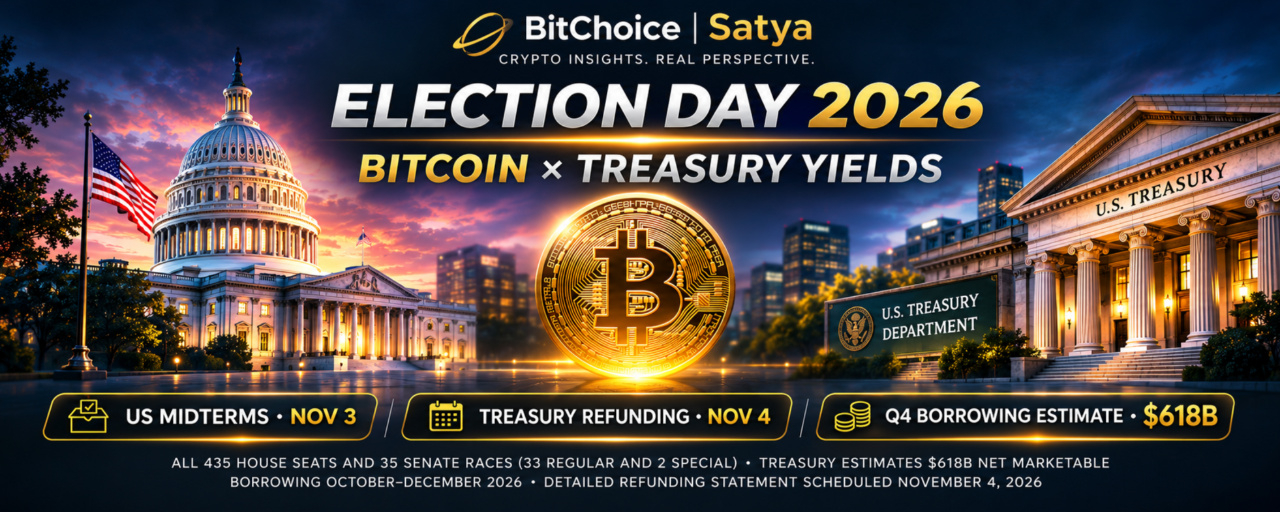
ELECTION DAY 2026: BITCOIN, TREASURY YIELDS AND THE NEXT MACRO MARKET TESTWhen Washington Votes, Global Markets Reassess Risk
BitChoice | Satya — Macro, TradFi & Crypto Market Intelligence
November 3, 2026
America Votes. The Financial Markets Are Watching.
Today, Americans head to the polls for the 2026 midterm elections.
All 435 seats in the House of Representatives are being contested, alongside 33 regularly scheduled Senate elections and two special Senate elections.
The outcome will help determine the balance of power in Congress and influence expectations for US fiscal policy, regulation and government spending.
But this is not the only event financial markets must navigate.
The US Treasury has just published its latest borrowing estimates, and a detailed quarterly refunding announcement is scheduled for November 4.
Meanwhile, derivatives markets are preparing for heightened uncertainty.
For Bitcoin investors, the central issue is not simply which political party gains seats.
It is how changing policy expectations, bond yields, liquidity and institutional positioning interact.
Bitcoin faces a macroeconomic test that extends well beyond election headlines.
1. The Election Factor: Policy Expectations, Not Instant Outcomes
Congress influences legislation, taxation, federal spending and the broader regulatory environment.
Changes in congressional control may affect expectations for future policy.
But financial-market reactions depend on what investors have already priced in.
An election outcome that appears surprising to the general public may have a limited market impact if traders already anticipated it.
Conversely, unexpected results or prolonged uncertainty could generate volatility across equities, bonds, currencies and cryptoassets.
Three factors deserve attention:
Policy expectations: How might congressional control affect fiscal and regulatory priorities?
Market expectations: What outcomes are already reflected in asset prices?
Implementation constraints: Which proposed policies could realistically become law, and how quickly?
Congressional election results do not immediately rewrite economic policy.
They shape expectations about what may happen next.
That distinction is crucial when evaluating short-term cryptocurrency volatility.
2. The $618 Billion Treasury Borrowing Estimate
On November 2, the US Treasury estimated privately held net marketable borrowing of $618 billion for October–December 2026.
The figure was $10 billion below its previous estimate.
However, the reduction reflected a higher-than-expected starting cash balance, partly offsetting less favorable projected cash flows.
The Treasury also projected $800 billion in borrowing for January–March 2027.
These figures are forecasts for their respective quarters, not amounts scheduled to enter the bond market in one day.
Another important detail:
The October–December estimate assumes a Treasury cash balance of approximately $850 billion at year-end.
Changes in government cash management can influence the amount and timing of debt issuance.
The headline borrowing figure matters — but its composition and financing schedule matter just as much.
3. Why November 4 Matters
Tomorrow, November 4, the Treasury is scheduled to publish its quarterly refunding details.
Investors will examine the planned composition of debt issuance, including auction sizes and maturities.
Different maturities affect different parts of the bond market.
Treasury bills represent shorter-term financing.
Intermediate-term notes and longer-dated bonds influence financing conditions over longer horizons.
Changes in expected issuance can affect supply-demand balances and term premiums.
But yields are not determined by issuance alone.
Inflation expectations, Federal Reserve policy, economic growth, investor demand and global capital flows also matter.
The market will therefore examine not only the borrowing total, but how the Treasury intends to finance it.
4. How Treasury Yields Can Influence Bitcoin
There is no permanent one-directional relationship between Bitcoin and Treasury yields.
Nevertheless, several economic transmission channels can matter.
Financing Conditions
Higher yields can raise the opportunity cost of holding assets that do not generate contractual interest income.
They can also influence borrowing costs and financial conditions.
The US Dollar
Changes in yield differentials and monetary-policy expectations may influence the dollar.
Dollar strength can sometimes coincide with pressure on globally traded risk assets, though the relationship is not consistent.
Equity Valuations
Higher discount rates may reduce the present value investors assign to future corporate earnings.
Technology and other growth-oriented equities can be especially sensitive to changes in rate expectations.
Risk Appetite
When investors become more cautious, they may reduce leveraged or volatile positions across several markets.
Bitcoin can be affected through these channels, even though it trades continuously and operates outside conventional securities markets.
These are potential mechanisms, not guarantees that higher yields will make BTC fall.
5. Why CME Is Watching Equity Options
In its October 30 analysis, CME Group highlighted elevated expected volatility in E-mini S&P 500 options ahead of the midterm elections.
Options can provide information about the market's assessment of potential future price fluctuations.
But implied volatility is not a directional forecast.
Higher implied volatility does not, by itself, predict whether the S&P 500 will rise or fall.
It reflects option pricing and the market's demand for exposure to uncertainty, among other factors.
For crypto investors, the significance lies in potential cross-market volatility.
When equity markets experience abrupt repricing, leveraged cryptocurrency positions may face additional pressure.
However, a correlation between equity-option activity and Bitcoin volatility should be treated as an analytical hypothesis, not as an established causal relationship for this specific election.
6. The Hidden Risk: Leverage and Market Liquidity
Bitcoin trades around the clock.
US equity and bond markets operate through defined trading sessions.
This creates an important timing difference.
Election-related information may emerge while conventional markets are closed or operating with reduced liquidity.
Crypto derivatives may respond immediately.
Rapid price movements can trigger stop orders, margin calls and forced liquidations.
These mechanisms may amplify short-term volatility.
But the direction is not predetermined.
A short squeeze can accelerate an upward move.
Long-position liquidations can intensify a decline.
The relevant factors include:
Derivatives open interestFunding ratesLiquidation concentrationsOrder-book depthSpot-market participationThe timing of major announcements
A large derivatives position is not the same as a confirmed future liquidation.
Understanding market structure is more useful than predicting a dramatic move from headlines alone.
7. Three Possible Market Scenarios
Rather than predicting election results or Bitcoin's next price target, consider three conditional scenarios.
Scenario A — Lower Uncertainty, Stable Yields
If election-related uncertainty decreases and Treasury yields remain relatively stable, risk markets may gain room to focus on earnings, liquidity and economic fundamentals.
Bitcoin could benefit from improving sentiment.
But other factors, including ETF flows and derivatives positioning, would still matter.
Scenario B — Bond-Market Pressure
If Treasury issuance expectations or other economic developments contribute to a sharp rise in yields, broader financial conditions could tighten.
Highly valued equities and leveraged cryptocurrency positions may become more sensitive to risk reduction.
That would not guarantee a Bitcoin decline, but it could create additional pressure.
Scenario C — Conflicting Signals
Election developments could improve confidence while Treasury-market conditions deteriorate — or the reverse.
In that environment, correlations may change and Bitcoin could experience volatile, directionless trading.
This is why following only one macro indicator is insufficient.
The scenarios describe possible market mechanisms, not forecasts of election results or guaranteed trading outcomes.
8. Why Spot Bitcoin ETF Flows Still Matter
Since US spot Bitcoin ETFs provide another channel for market participation, institutional flows remain relevant.
Changes in net subscriptions and redemptions may influence market sentiment and demand for the underlying asset.
But daily ETF flows should be interpreted carefully.
A positive trading day for an ETF does not necessarily imply net inflows.
Trading volume does not equal new capital.
And the relationship between ETF flows and Bitcoin's spot price can be influenced by market timing and other participants.
ETF data should be monitored alongside macroeconomic conditions rather than treated as an independent prediction engine.
9. What Should Market Observers Watch?
For this election-and-refunding window, five indicators deserve attention.
1. Election outcomes and uncertainty
Focus on verified results rather than premature projections or unconfirmed social-media claims.
2. Treasury refunding details
Monitor auction sizes, maturity composition and changes from prior financing plans.
3. Treasury yields
Observe whether rates change meaningfully across the short, intermediate and long ends of the curve.
4. Equity volatility
Use options pricing and actual market movements to understand changes in risk expectations.
5. Bitcoin liquidity and positioning
Follow spot participation, ETF flows, funding rates, open interest and order-book conditions.
No single metric can reliably predict the next market move.
Together, they provide a more complete picture.
10. Why This Matters Beyond Election Day
The relationship between Bitcoin and traditional finance continues to evolve.
Crypto markets are increasingly connected to institutional capital, regulated investment products and global risk management.
That makes Treasury-market developments relevant even for investors who primarily follow blockchain technology.
At the same time, the distinctive structure of crypto markets — including 24/7 trading, global participation and leveraged derivatives — can produce different short-term responses.
Bitcoin is neither completely isolated from macroeconomic conditions nor a simple proxy for the stock market.
It must be analyzed as an asset operating across both crypto-native and traditional financial systems.
Final Perspective: Two Events, One Market Test
November 3 brings an important democratic election in the United States.
November 4 brings new information about how the US government plans to finance its borrowing requirements.
The two events are different, but both may influence investor expectations.
Political developments can affect perceptions of future economic policy.
Treasury issuance and yields can affect financing conditions.
Together with equity volatility, institutional flows and crypto derivatives positioning, these forces create a complex environment for Bitcoin.
The most useful approach is not to predict every election headline or react to every market fluctuation.
It is to separate verified information from speculation and evaluate how financial conditions are actually changing.
The outcome of an election matters for governance. The reaction of the bond market matters for financial conditions. Bitcoin investors need to understand both — without confusing either with a guaranteed trading signal.
Discussion
What will influence Bitcoin more over the coming days: the US election results, Treasury yields or institutional capital flows?
Sources
CME Group — Election Volatility and Treasury Refunding Set the Tone, October 30, 2026.
US Department of the Treasury — Financing Estimates: 2026 Fourth Quarter, November 2, 2026.
US Department of the Treasury — Quarterly Refunding Schedule, November 4, 2026.
Reuters — US Treasury Borrowing Outlook, November 2, 2026.
Editorial disclosure: This article was prepared before the completion of November 3 voting and before the scheduled November 4 refunding announcement. Election outcomes, future auction details and possible market reactions are not presented as established results.
Educational and informational content only. Not financial or investment advice.
#Bitcoin #USMidterms #TreasuryYields #MacroEconomics #CryptoMarkets $BTC $ETH
{spot}(ETHUSDT)
ELECTION DAY 2026: BITCOIN, TREASURY YIELDS AND THE NEXT MACRO MARKET TEST
When Washington Votes, Global Markets Reassess Risk
BitChoice | Satya — Macro, TradFi & Crypto Market Intelligence
November 3, 2026
America Votes. The Financial Markets Are Watching.
Today, Americans head to the polls for the 2026 midterm elections.
All 435 seats in the House of Representatives are being contested, alongside 33 regularly scheduled Senate elections and two special Senate elections.
The outcome will help determine the balance of power in Congress and influence expectations for US fiscal policy, regulation and government spending.
But this is not the only event financial markets must navigate.
The US Treasury has just published its latest borrowing estimates, and a detailed quarterly refunding announcement is scheduled for November 4.
Meanwhile, derivatives markets are preparing for heightened uncertainty.
For Bitcoin investors, the central issue is not simply which political party gains seats.
It is how changing policy expectations, bond yields, liquidity and institutional positioning interact.
Bitcoin faces a macroeconomic test that extends well beyond election headlines.
1. The Election Factor: Policy Expectations, Not Instant Outcomes
Congress influences legislation, taxation, federal spending and the broader regulatory environment.
Changes in congressional control may affect expectations for future policy.
But financial-market reactions depend on what investors have already priced in.
An election outcome that appears surprising to the general public may have a limited market impact if traders already anticipated it.
Conversely, unexpected results or prolonged uncertainty could generate volatility across equities, bonds, currencies and cryptoassets.
Three factors deserve attention:
Policy expectations: How might congressional control affect fiscal and regulatory priorities?
Market expectations: What outcomes are already reflected in asset prices?
Implementation constraints: Which proposed policies could realistically become law, and how quickly?
Congressional election results do not immediately rewrite economic policy.
They shape expectations about what may happen next.
That distinction is crucial when evaluating short-term cryptocurrency volatility.
2. The $618 Billion Treasury Borrowing Estimate
On November 2, the US Treasury estimated privately held net marketable borrowing of $618 billion for October–December 2026.
The figure was $10 billion below its previous estimate.
However, the reduction reflected a higher-than-expected starting cash balance, partly offsetting less favorable projected cash flows.
The Treasury also projected $800 billion in borrowing for January–March 2027.
These figures are forecasts for their respective quarters, not amounts scheduled to enter the bond market in one day.
Another important detail:
The October–December estimate assumes a Treasury cash balance of approximately $850 billion at year-end.
Changes in government cash management can influence the amount and timing of debt issuance.
The headline borrowing figure matters — but its composition and financing schedule matter just as much.
3. Why November 4 Matters
Tomorrow, November 4, the Treasury is scheduled to publish its quarterly refunding details.
Investors will examine the planned composition of debt issuance, including auction sizes and maturities.
Different maturities affect different parts of the bond market.
Treasury bills represent shorter-term financing.
Intermediate-term notes and longer-dated bonds influence financing conditions over longer horizons.
Changes in expected issuance can affect supply-demand balances and term premiums.
But yields are not determined by issuance alone.
Inflation expectations, Federal Reserve policy, economic growth, investor demand and global capital flows also matter.
The market will therefore examine not only the borrowing total, but how the Treasury intends to finance it.
4. How Treasury Yields Can Influence Bitcoin
There is no permanent one-directional relationship between Bitcoin and Treasury yields.
Nevertheless, several economic transmission channels can matter.
Financing Conditions
Higher yields can raise the opportunity cost of holding assets that do not generate contractual interest income.
They can also influence borrowing costs and financial conditions.
The US Dollar
Changes in yield differentials and monetary-policy expectations may influence the dollar.
Dollar strength can sometimes coincide with pressure on globally traded risk assets, though the relationship is not consistent.
Equity Valuations
Higher discount rates may reduce the present value investors assign to future corporate earnings.
Technology and other growth-oriented equities can be especially sensitive to changes in rate expectations.
Risk Appetite
When investors become more cautious, they may reduce leveraged or volatile positions across several markets.
Bitcoin can be affected through these channels, even though it trades continuously and operates outside conventional securities markets.
These are potential mechanisms, not guarantees that higher yields will make BTC fall.
5. Why CME Is Watching Equity Options
In its October 30 analysis, CME Group highlighted elevated expected volatility in E-mini S&P 500 options ahead of the midterm elections.
Options can provide information about the market's assessment of potential future price fluctuations.
But implied volatility is not a directional forecast.
Higher implied volatility does not, by itself, predict whether the S&P 500 will rise or fall.
It reflects option pricing and the market's demand for exposure to uncertainty, among other factors.
For crypto investors, the significance lies in potential cross-market volatility.
When equity markets experience abrupt repricing, leveraged cryptocurrency positions may face additional pressure.
However, a correlation between equity-option activity and Bitcoin volatility should be treated as an analytical hypothesis, not as an established causal relationship for this specific election.
6. The Hidden Risk: Leverage and Market Liquidity
Bitcoin trades around the clock.
US equity and bond markets operate through defined trading sessions.
This creates an important timing difference.
Election-related information may emerge while conventional markets are closed or operating with reduced liquidity.
Crypto derivatives may respond immediately.
Rapid price movements can trigger stop orders, margin calls and forced liquidations.
These mechanisms may amplify short-term volatility.
But the direction is not predetermined.
A short squeeze can accelerate an upward move.
Long-position liquidations can intensify a decline.
The relevant factors include:
Derivatives open interestFunding ratesLiquidation concentrationsOrder-book depthSpot-market participationThe timing of major announcements
A large derivatives position is not the same as a confirmed future liquidation.
Understanding market structure is more useful than predicting a dramatic move from headlines alone.
7. Three Possible Market Scenarios
Rather than predicting election results or Bitcoin's next price target, consider three conditional scenarios.
Scenario A — Lower Uncertainty, Stable Yields
If election-related uncertainty decreases and Treasury yields remain relatively stable, risk markets may gain room to focus on earnings, liquidity and economic fundamentals.
Bitcoin could benefit from improving sentiment.
But other factors, including ETF flows and derivatives positioning, would still matter.
Scenario B — Bond-Market Pressure
If Treasury issuance expectations or other economic developments contribute to a sharp rise in yields, broader financial conditions could tighten.
Highly valued equities and leveraged cryptocurrency positions may become more sensitive to risk reduction.
That would not guarantee a Bitcoin decline, but it could create additional pressure.
Scenario C — Conflicting Signals
Election developments could improve confidence while Treasury-market conditions deteriorate — or the reverse.
In that environment, correlations may change and Bitcoin could experience volatile, directionless trading.
This is why following only one macro indicator is insufficient.
The scenarios describe possible market mechanisms, not forecasts of election results or guaranteed trading outcomes.
8. Why Spot Bitcoin ETF Flows Still Matter
Since US spot Bitcoin ETFs provide another channel for market participation, institutional flows remain relevant.
Changes in net subscriptions and redemptions may influence market sentiment and demand for the underlying asset.
But daily ETF flows should be interpreted carefully.
A positive trading day for an ETF does not necessarily imply net inflows.
Trading volume does not equal new capital.
And the relationship between ETF flows and Bitcoin's spot price can be influenced by market timing and other participants.
ETF data should be monitored alongside macroeconomic conditions rather than treated as an independent prediction engine.
9. What Should Market Observers Watch?
For this election-and-refunding window, five indicators deserve attention.
1. Election outcomes and uncertainty
Focus on verified results rather than premature projections or unconfirmed social-media claims.
2. Treasury refunding details
Monitor auction sizes, maturity composition and changes from prior financing plans.
3. Treasury yields
Observe whether rates change meaningfully across the short, intermediate and long ends of the curve.
4. Equity volatility
Use options pricing and actual market movements to understand changes in risk expectations.
5. Bitcoin liquidity and positioning
Follow spot participation, ETF flows, funding rates, open interest and order-book conditions.
No single metric can reliably predict the next market move.
Together, they provide a more complete picture.
10. Why This Matters Beyond Election Day
The relationship between Bitcoin and traditional finance continues to evolve.
Crypto markets are increasingly connected to institutional capital, regulated investment products and global risk management.
That makes Treasury-market developments relevant even for investors who primarily follow blockchain technology.
At the same time, the distinctive structure of crypto markets — including 24/7 trading, global participation and leveraged derivatives — can produce different short-term responses.
Bitcoin is neither completely isolated from macroeconomic conditions nor a simple proxy for the stock market.
It must be analyzed as an asset operating across both crypto-native and traditional financial systems.
Final Perspective: Two Events, One Market Test
November 3 brings an important democratic election in the United States.
November 4 brings new information about how the US government plans to finance its borrowing requirements.
The two events are different, but both may influence investor expectations.
Political developments can affect perceptions of future economic policy.
Treasury issuance and yields can affect financing conditions.
Together with equity volatility, institutional flows and crypto derivatives positioning, these forces create a complex environment for Bitcoin.
The most useful approach is not to predict every election headline or react to every market fluctuation.
It is to separate verified information from speculation and evaluate how financial conditions are actually changing.
The outcome of an election matters for governance. The reaction of the bond market matters for financial conditions. Bitcoin investors need to understand both — without confusing either with a guaranteed trading signal.
Discussion
What will influence Bitcoin more over the coming days: the US election results, Treasury yields or institutional capital flows?
Sources
CME Group — Election Volatility and Treasury Refunding Set the Tone, October 30, 2026.
US Department of the Treasury — Financing Estimates: 2026 Fourth Quarter, November 2, 2026.
US Department of the Treasury — Quarterly Refunding Schedule, November 4, 2026.
Reuters — US Treasury Borrowing Outlook, November 2, 2026.
Editorial disclosure: This article was prepared before the completion of November 3 voting and before the scheduled November 4 refunding announcement. Election outcomes, future auction details and possible market reactions are not presented as established results.
Educational and informational content only. Not financial or investment advice.
#Bitcoin #USMidterms #TreasuryYields #MacroEconomics #CryptoMarkets $BTC $ETH
1
26

🚨 BREAKING: US MIDTERMS COULD TRIGGER A STOCK MARKET RALLY! 📈
Investors are watching the November 3 US midterm elections closely.
📊 Political Outlook:
Prediction markets are giving Democrats roughly a 70–73% chance of winning both chambers of Congress.
If Democrats secure control of the House and Senate, a divided political landscape could reshape investor expectations and reduce some policy uncertainties.
🔥 Potential Market Impact:
Renewed investor confidence.
Possible rotation into growth stocks.
Increased market volatility around election results.
Potential opportunities across technology and semiconductor sectors.
⚡ What to Watch:
The S&P 500, semiconductor stocks and broader market liquidity.
👀 Watchlist:
$BMT | $SOXSB | $AGT
📈 Could the post-election period trigger the next major market rally?
Stay alert, but wait for market confirmation before entering trades.
#SP500 #USMidterms #StockMarket #Semiconductor #Trading #CryptoMarket
120

·
--
🇺🇸 US MIDTERM ELECTIONS NOVEMBER 3 TODAY
The US Midterm Elections are in focus today Political uncertainty could bring volatility across financial markets including crypto stocks and the US dollar.
👀 Traders stay alert and watch the market reaction!
#USMidterms #CryptoMarket #trading #bitcoin #MarketVolatility
The US Midterm Elections are in focus today Political uncertainty could bring volatility across financial markets including crypto stocks and the US dollar.
👀 Traders stay alert and watch the market reaction!
#USMidterms #CryptoMarket #trading #bitcoin #MarketVolatility
64


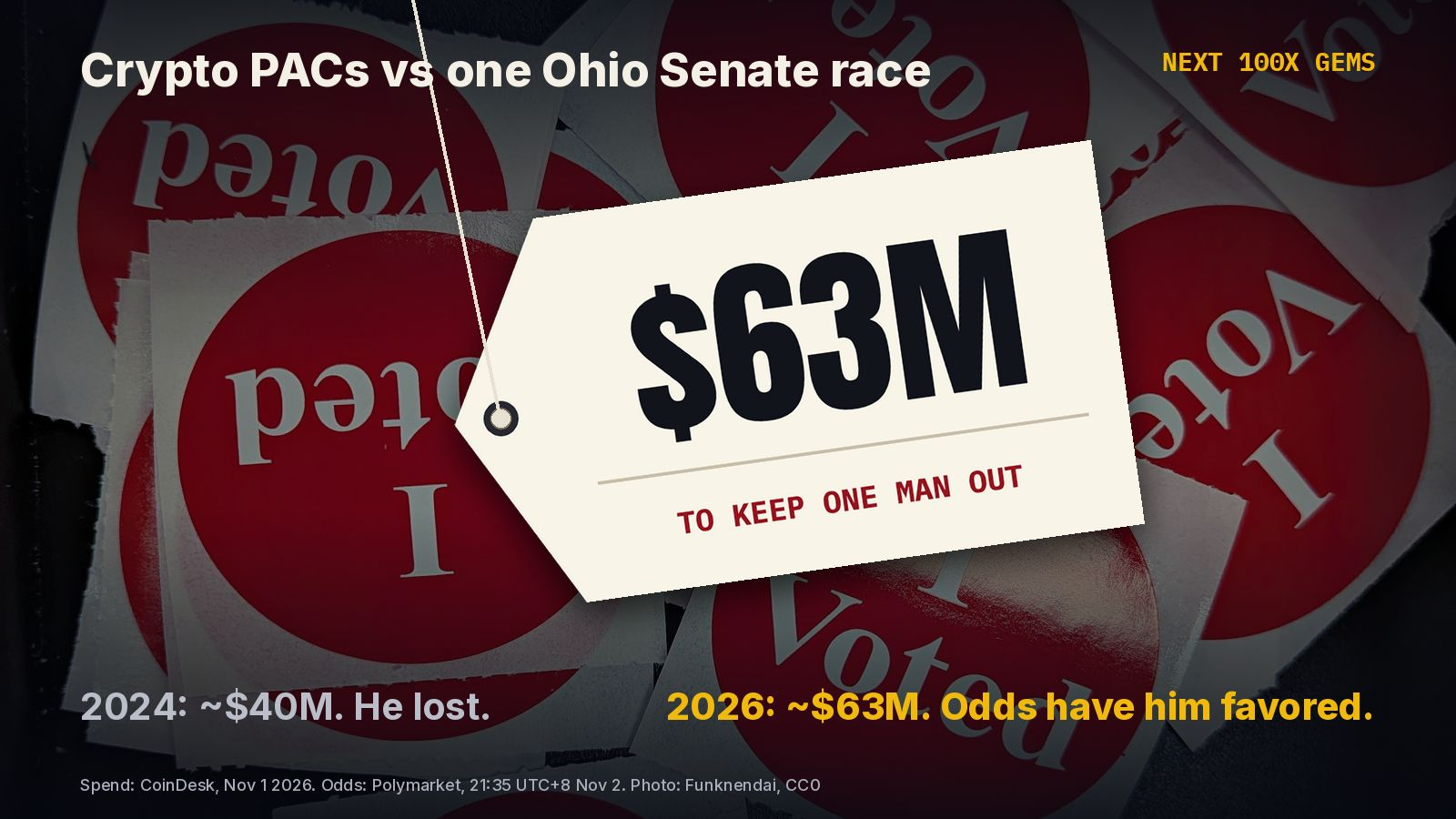
In 2024 the crypto industry spent about $40M to get Sherrod Brown out of the Senate. It worked.
This year it's spending around $63M to keep him out, and $XRP holders get the best footnote: Ripple is one of the main backers of the PAC doing most of that spending, while Ripple's executive chairman Chris Larsen personally gave $18,500 to a fundraising committee backing Brown.
Back then, Brown was the senator crypto blamed for keeping crypto bills stuck in committee. Fairshake took the victory lap when he lost. Now he's running again for the other Ohio seat, and CoinDesk counts more than $100M across two elections aimed at one man.
The odds haven't followed the money. Polymarket had Democrats at 72.5% to win the Ohio Senate race at 21:35 UTC+8 tonight. Polls still call it a toss-up, so nothing is settled until Ohio polls close at 08:30 UTC+8 on Wednesday.
2024: $40M, and he lost. 2026: $63M, and the market has him favored.
#USMidterms #CryptoPolicy
NFA. DYOR.
1.4k

·
--
Bearish
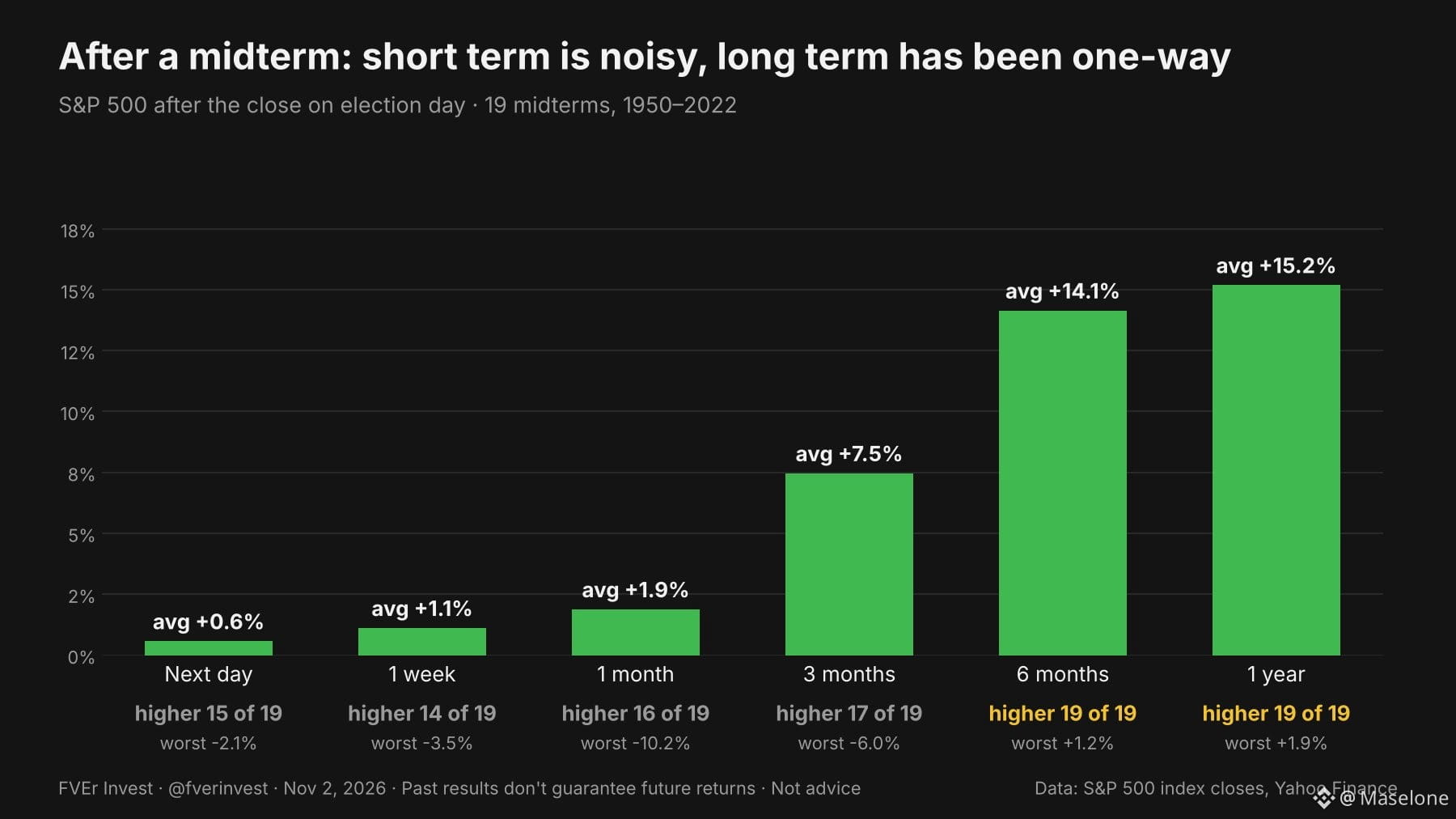
JUST IN: #JPMorgan warns stocks could plunge after the midterms if US-Iran tensions escalate #USMidterms
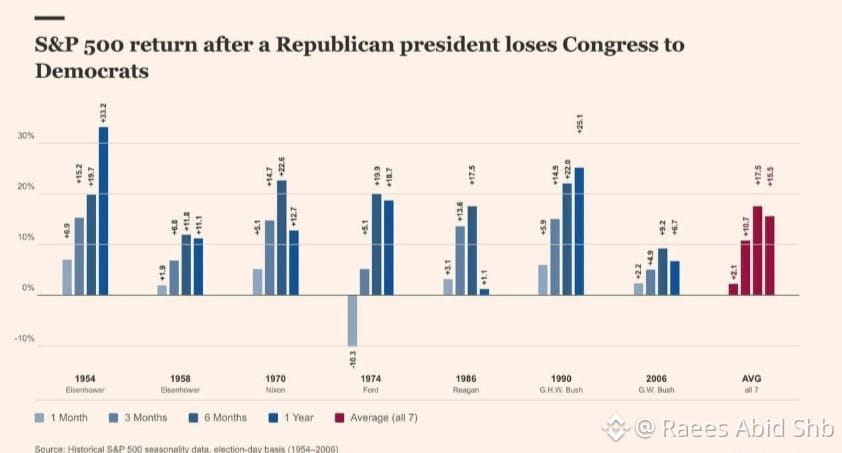
NOTE: For context, history has leaned the other way: the S&P 500 was higher 6 months after all 19 midterms since 1950. The catch this time is the starting point. $SPY
{future}(SPYUSDT)
sits ~5% above our fair value estimate.
JUST IN: #JPMorgan warns stocks could plunge after the midterms if US-Iran tensions escalate #USMidterms
NOTE: For context, history has leaned the other way: the S&P 500 was higher 6 months after all 19 midterms since 1950. The catch this time is the starting point. $SPY
sits ~5% above our fair value estimate.
NOTE: For context, history has leaned the other way: the S&P 500 was higher 6 months after all 19 midterms since 1950. The catch this time is the starting point. $SPY
sits ~5% above our fair value estimate.

1
15

·
--
Bullish
Prediction markets lean toward Democrats ahead of the US midterms
🗳️ Ahead of the November 3 election, Polymarket and Kalshi price Democrats’ chances of winning House control at around 93–95%. Late-October snapshots showed gains of roughly 2.4–3 percentage points over a week.
📊 The probability of Democrats controlling both chambers stands near 70%. A Democratic House with a Republican Senate still accounts for about a quarter, leaving Senate control a key uncertainty.
🏛️ If Democrats win either or both chambers, major White House tax and budget proposals could require more compromise. Financial market reactions would depend on specific policies and how far the results differ from expectations.
⚖️ These figures reflect prediction contract prices, rather than vote shares or guaranteed outcomes. Polling errors and turnout patterns could still shift expectations.
#USMidterms $POL

82

·
--
🇺🇸 TRUMP, MIDTERM ELECTIONS & THE FUTURE OF US POLITICS!
With just five days remaining before the US midterm elections, political tensions and uncertainty are attracting growing attention. Donald Trump remains a major figure in American politics, and the upcoming elections could play an important role in shaping the country's political direction.
A longtime Democratic operative has reportedly raised concerns about the Senate race, highlighting how competitive the political environment could become. The results may influence congressional leadership, future policy decisions, economic priorities, and the direction of the Trump administration.
But the impact could extend beyond politics. Financial markets, including stocks and cryptocurrencies, often react to election uncertainty, government policy expectations, and changing investor sentiment.
For the crypto community, the big question is whether the election results could bring a more supportive environment for digital assets. Investors will be watching closely for potential developments involving crypto regulations, Bitcoin adoption, stablecoins, and broader financial policies.
However, political predictions are never guaranteed, and market reactions can be unpredictable. Traders should avoid making decisions based only on headlines or social media speculation.
👀 All eyes are on Washington! The coming days could bring important political developments and new opportunities across financial markets.
What do you think? Could Trump's political position strengthen after the midterms?
Share your thoughts below!
#TRUMP #USMidterms #CryptoMarket #Bitcoin #Binance
292

·
--
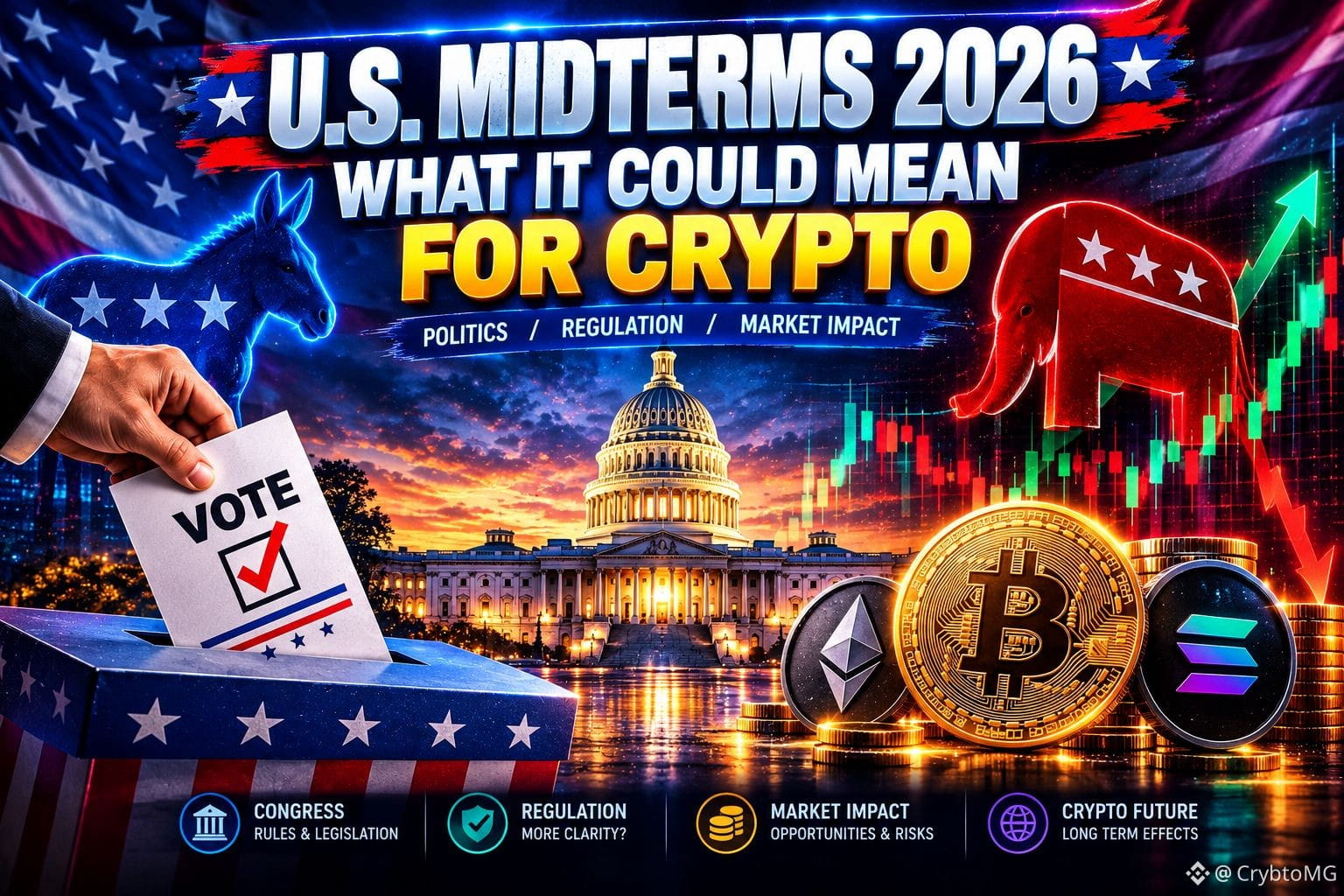
🇺🇸 Why the 2026 US midterms matter for crypto
The November 3 elections could reshape control of the US Congress, and that may have important implications for the digital asset industry.
Democrats need a net gain of three House seats to take control, while Republicans are working to defend their narrow majority.
Why should crypto investors pay attention?
Congressional committees influence key discussions around:
Crypto market structure
Stablecoin legislation
Regulatory oversight
Tax rules for digital assets
But the real story goes beyond which party wins. Committee leadership, legislative priorities, and cooperation between Congress and regulators will matter too.
What matters more for crypto: a change in congressional control or clearer rules for the industry?
#USMidterms #CryptoRegulation #DigitalAssets $IDOL
$SOPH
$BEAMX
1
628

·
--
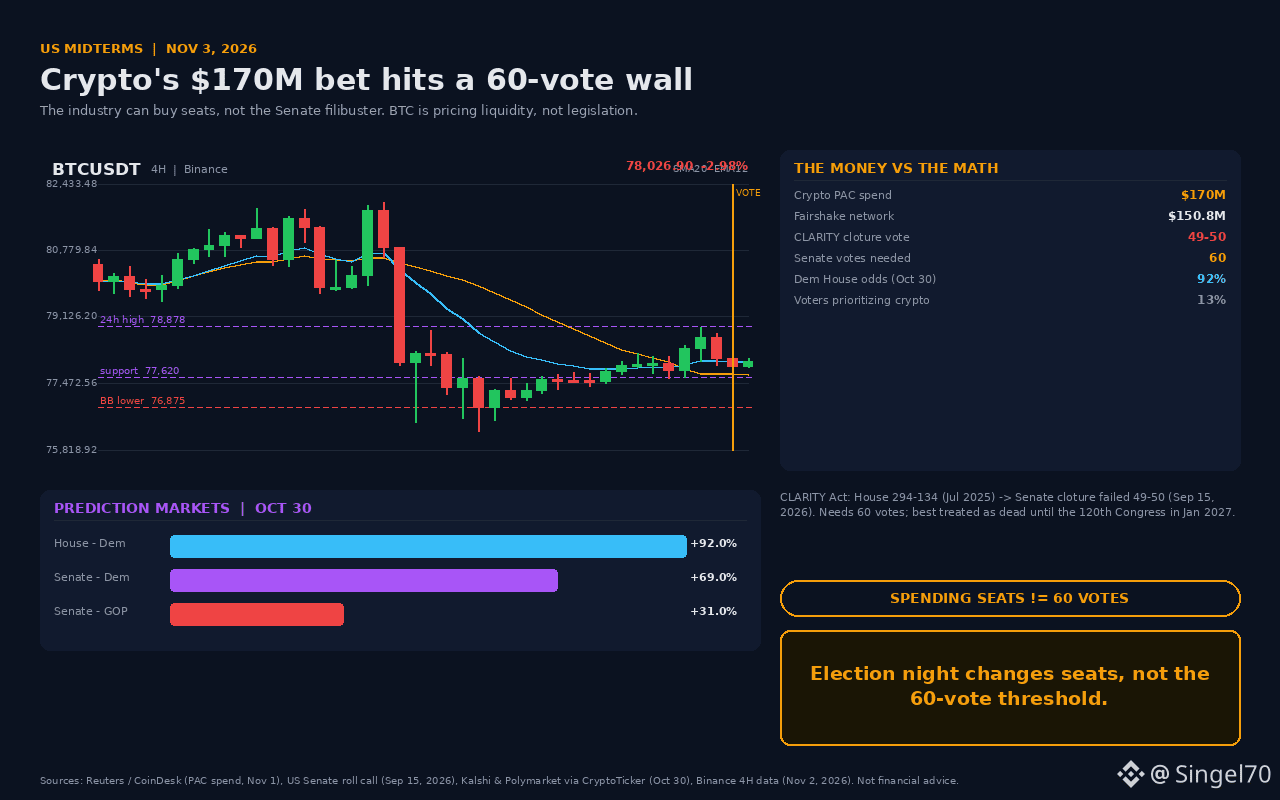
#USMidterms Crypto spent $170 million; the thing it couldn't buy was the 60th vote.
📌 The real numbers (source + date)
- Crypto PACs spent ~$170M in 100+ races (CoinDesk, November 1, 2026). The Fairshake network had spent $150.8M by October 20 (Reuters).
- Fairshake helped elect 53 of the 58 candidates it supported in primaries.
- CLARITY Act: House 294-134 (July 2025) -> Senate cloture vote 49-50 (September 15, 2026). Required: 60 votes.
- Prediction markets (October 30): Democrats have a 92-94% chance of winning the House and 69% for the Senate (Kalshi/Polymarket).
- Only 13% of voters say a candidate's stance on crypto is very important (Reuters/Ipsos, 1,545 people).
📉 $BTC $78,045 (+0.29%, Binance, November 2), 24h range 77,620-78,878. Just below the SMA20 at 77,705, RSI 63.8, MACD flat. The squeeze is clear: a 4h close above 78,900 opens the way to 80,000-81,300; below 77,600, there's a risk of 76,875 (lower BB).
🐋 Reading the flows and news: An election changes who holds office, not the Senate's 60-vote threshold. CLARITY is effectively dead until the 120th Congress in January 2027. So November 3 is not a "regulation rally" catalyst, but a liquidity/volatility event. The widely shared statistic that markets rise 54% after midterms covers 12 months and is confounded by the halving cycle; it's not evidence of a 30-day move.
🎯 Plan: My stance is neutral-to-positive, with no leverage. Go long on a 4h close above 78,900; targets 80,000 / 81,300, stop at 77,600. If 77,600 breaks, don't short—stay in cash; there's gap risk down to 76,875. Cut position size in half on election night. The upside looks more solid because price is holding above the SMA20 and selling volume is weak.
📌 What do you think will drive BTC after November 3: Congress or liquidity? Share your thoughts in the comments.
#CLARITYAct #Bitcoin #CryptoRegulation #BTC
This is not financial advice; manage your own risk.
91

·
--
Article
**2026 US MIDTERM ELECTIONS: A MAJOR POLITICAL TEST FOR TRUMP!**🇺🇸
Americans head to the polls on November 3, and the battle for control of Congress is heating up.
Current forecasts favor Democrats, with more than a 90% chance of winning the House. The Senate race is much tighter, making a few key states crucial.
**Why does this matter for crypto?**
The election outcome could influence crypto regulations, including the CLARITY Act, stablecoin policies and the future of the US digital asset industry.
📊 **Four possible outcomes:**
🔵 Democrats win both chambers
🔵 Democratic House, Republican Senate
🔴 Republicans keep both chambers
🔴 Republican House, Democratic Senate
A Democratic victory could create regulatory uncertainty, while a Republican sweep may offer a clearer path for crypto-friendly legislation.
**What’s your prediction? Who will control Congress after November 3?**
Drop your prediction below! 👇
#USMidterms #Trump #CryptoRegulation #Bitcoin #BTC #C
ryptoMarket #CLARITYAct
**2026 US MIDTERM ELECTIONS: A MAJOR POLITICAL TEST FOR TRUMP!**
🇺🇸
Americans head to the polls on November 3, and the battle for control of Congress is heating up.
Current forecasts favor Democrats, with more than a 90% chance of winning the House. The Senate race is much tighter, making a few key states crucial.
**Why does this matter for crypto?**
The election outcome could influence crypto regulations, including the CLARITY Act, stablecoin policies and the future of the US digital asset industry.
📊 **Four possible outcomes:**
🔵 Democrats win both chambers
🔵 Democratic House, Republican Senate
🔴 Republicans keep both chambers
🔴 Republican House, Democratic Senate
A Democratic victory could create regulatory uncertainty, while a Republican sweep may offer a clearer path for crypto-friendly legislation.
**What’s your prediction? Who will control Congress after November 3?**
Drop your prediction below! 👇
#USMidterms #Trump #CryptoRegulation #Bitcoin #BTC #C
ryptoMarket #CLARITYAct
51

·
--
#USMidtermElections
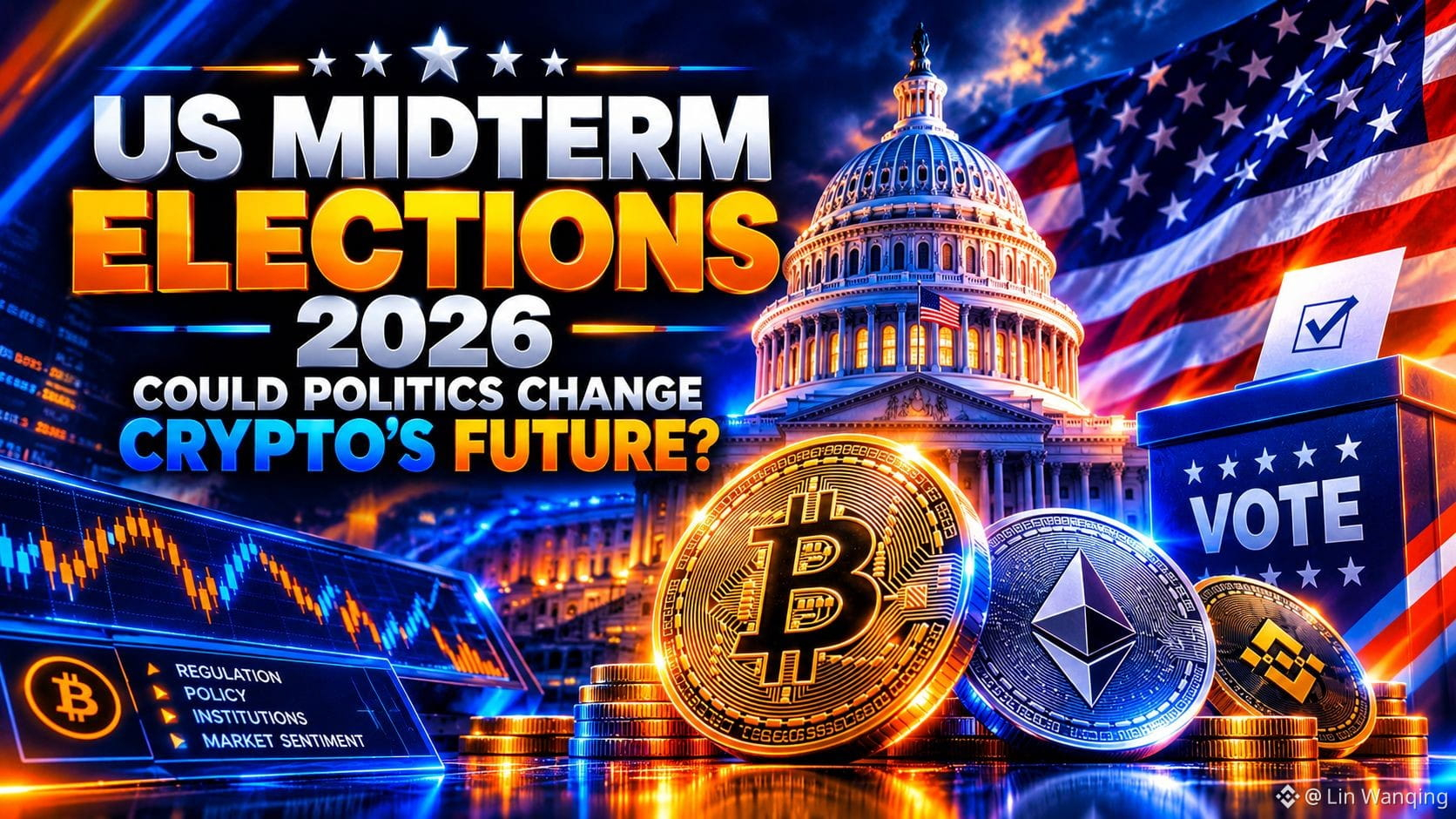
🇺🇸 US MIDTERM ELECTIONS 2026: COULD POLITICS CHANGE CRYPTO'S FUTURE?
The US midterm elections on November 3 could influence the direction of crypto regulation and investor sentiment.
🔎 Why It Matters
Election results may affect political priorities, crypto legislation, regulatory discussions, and institutional confidence. However, a change in political balance does not automatically mean Bitcoin or the broader crypto market will move higher.
📊 Market Perspective
For crypto traders, the important question is not simply who wins, but what happens afterward.
• Regulatory clarity could improve confidence among institutional investors. • Political uncertainty could increase short-term volatility. • Bitcoin's direction will also depend on liquidity, interest rates, ETF flows, and broader market conditions.
⚠️ What Traders Should Watch
Avoid making decisions based only on election headlines. Watch how Bitcoin reacts to key support and resistance levels, trading volume, and broader market sentiment.
My Take: The election could become an important catalyst for crypto sentiment, but its actual impact will depend on policy decisions rather than political promises.
The market may react quickly, but meaningful regulatory changes usually take time.
💬 Do you think the US midterm elections will create a bullish opportunity for crypto, or increase market uncertainty?
#USMidterms #CryptoMarket #BinanceSquare
$ZEC
{future}(ZECUSDT)
$XRP
{future}(XRPUSDT)
$INIT
{future}(INITUSDT)
#USMidtermElections
🇺🇸 US MIDTERM ELECTIONS 2026: COULD POLITICS CHANGE CRYPTO'S FUTURE?
The US midterm elections on November 3 could influence the direction of crypto regulation and investor sentiment.
🔎 Why It Matters
Election results may affect political priorities, crypto legislation, regulatory discussions, and institutional confidence. However, a change in political balance does not automatically mean Bitcoin or the broader crypto market will move higher.
📊 Market Perspective
For crypto traders, the important question is not simply who wins, but what happens afterward.
• Regulatory clarity could improve confidence among institutional investors. • Political uncertainty could increase short-term volatility. • Bitcoin's direction will also depend on liquidity, interest rates, ETF flows, and broader market conditions.
⚠️ What Traders Should Watch
Avoid making decisions based only on election headlines. Watch how Bitcoin reacts to key support and resistance levels, trading volume, and broader market sentiment.
My Take: The election could become an important catalyst for crypto sentiment, but its actual impact will depend on policy decisions rather than political promises.
The market may react quickly, but meaningful regulatory changes usually take time.
💬 Do you think the US midterm elections will create a bullish opportunity for crypto, or increase market uncertainty?
#USMidterms #CryptoMarket #BinanceSquare
$ZEC
$XRP
$INIT
75

·
--
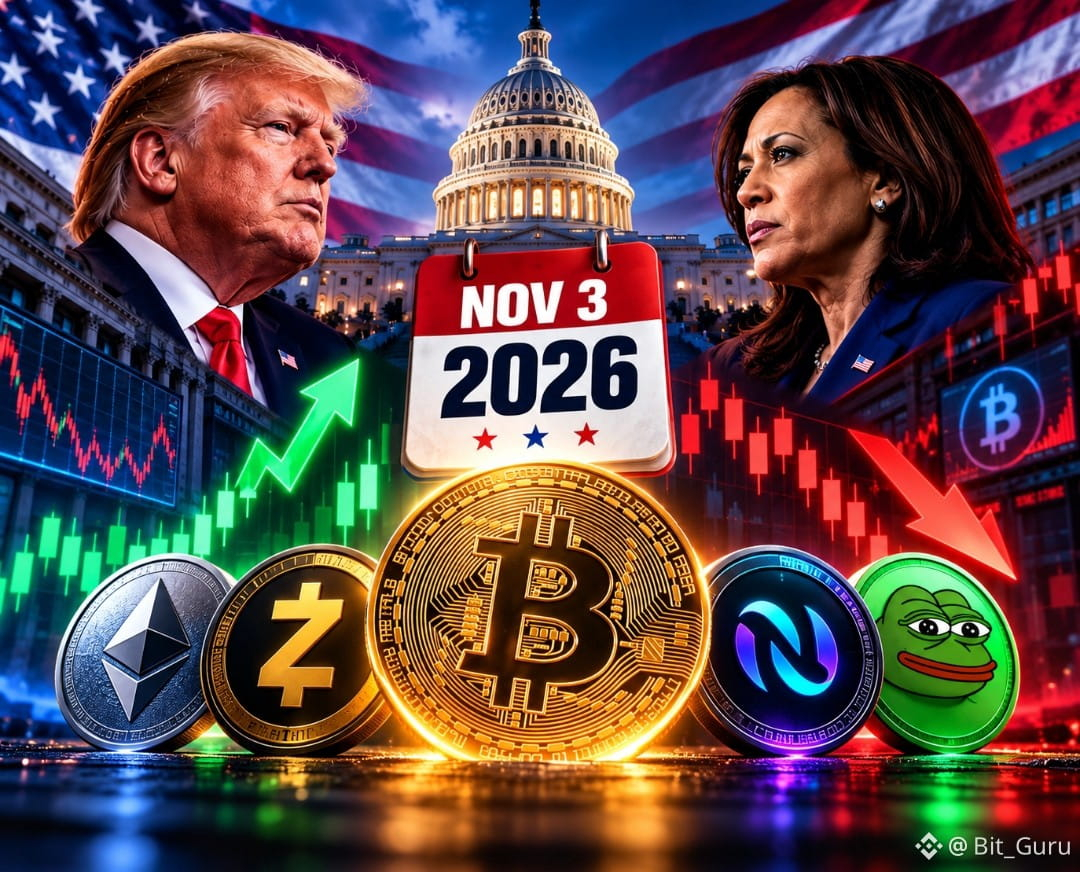
🚨 US MIDTERM ELECTIONS 2026: CRYPTO MARKETS FACE A MAJOR TURNING POINT! 🇺🇸
The countdown to November 3 is on, and investors are closely watching how the US midterm elections could reshape the financial and cryptocurrency markets.
📉 CURRENT CRYPTO MARKET SITUATION
Crypto is facing significant selling pressure. Bitcoin has dropped toward $77,600, Ethereum is trading near $2,239, and market sentiment has shifted into Fear territory. Recent exchange security concerns have added further uncertainty.
🏛️ WHY THESE ELECTIONS MATTER
The outcome could influence:
US crypto regulation and digital asset legislation.
SEC and CFTC oversight.
Technology stocks and institutional investment.
Tax policies, trade tariffs and government spending.
🔥 TOP CRYPTO TOKENS TO WATCH
🔹 $BTC – Overall market direction
🔹 $ETH – Institutional and ecosystem strength
🔹 $ZEC – Privacy-focused crypto narrative
🔹 $INIT – DeFi and infrastructure potential
🔹 $PEPE – Meme coin market sentiment
⚠️ MY MARKET OUTLOOK
With Bitcoin under pressure and fear increasing, volatility could remain elevated ahead of the elections. A recovery in BTC could support an altcoin rebound, while further selling may trigger another market-wide correction.
🎯 TRADING STRATEGY
Avoid excessive leverage, watch Bitcoin's key support and resistance levels, and wait for confirmed breakouts before entering trades. Protecting capital is more important than chasing short-term moves.
💬 WHAT'S YOUR PREDICTION?
Will the November 3 elections trigger a major crypto rally, or are we heading toward another correction?
Follow me for more crypto updates and market opportunities!
#Bitcoin #Crypto #USMidterms #Altcoins #Trading
{spot}(ZECUSDT)
🚨 US MIDTERM ELECTIONS 2026: CRYPTO MARKETS FACE A MAJOR TURNING POINT! 🇺🇸
The countdown to November 3 is on, and investors are closely watching how the US midterm elections could reshape the financial and cryptocurrency markets.
📉 CURRENT CRYPTO MARKET SITUATION
Crypto is facing significant selling pressure. Bitcoin has dropped toward $77,600, Ethereum is trading near $2,239, and market sentiment has shifted into Fear territory. Recent exchange security concerns have added further uncertainty.
🏛️ WHY THESE ELECTIONS MATTER
The outcome could influence:
US crypto regulation and digital asset legislation.
SEC and CFTC oversight.
Technology stocks and institutional investment.
Tax policies, trade tariffs and government spending.
🔥 TOP CRYPTO TOKENS TO WATCH
🔹 $BTC – Overall market direction
🔹 $ETH – Institutional and ecosystem strength
🔹 $ZEC – Privacy-focused crypto narrative
🔹 $INIT – DeFi and infrastructure potential
🔹 $PEPE – Meme coin market sentiment
⚠️ MY MARKET OUTLOOK
With Bitcoin under pressure and fear increasing, volatility could remain elevated ahead of the elections. A recovery in BTC could support an altcoin rebound, while further selling may trigger another market-wide correction.
🎯 TRADING STRATEGY
Avoid excessive leverage, watch Bitcoin's key support and resistance levels, and wait for confirmed breakouts before entering trades. Protecting capital is more important than chasing short-term moves.
💬 WHAT'S YOUR PREDICTION?
Will the November 3 elections trigger a major crypto rally, or are we heading toward another correction?
Follow me for more crypto updates and market opportunities!
#Bitcoin #Crypto #USMidterms #Altcoins #Trading
3
999

·
--
🔍 Data from civic organizations shows that the crypto sector has spent over $200 million in this U.S. election cycle, aiming to influence the 2026 midterm elections and advance digital asset regulatory legislation. ⚖️ Two interpretations:
- If these donations do translate into legislative support, they could accelerate follow-up legislation to the Clarity Act, giving the industry clearer regulation;
- If they are merely an election campaign tool, legislative progress will remain constrained by disagreements within Congress, especially with the Clarity Act stalled in the Senate.
Key evidence for distinguishing between these scenarios includes candidates’ voting records on relevant bills after taking office, the actual progress of legislative drafts, and the timing of donations in relation to policy changes. 🤔
What remains uncertain is whether the new Congress will restart market structure legislation, and whether its final text will meet the core demands of both parties (Democrats and Republicans).
This is not investment advice.
#CryptoPolitics #USMidterms #Regulation #CryptoCommunity

28
·
--
Bullish
#USMidtermElections
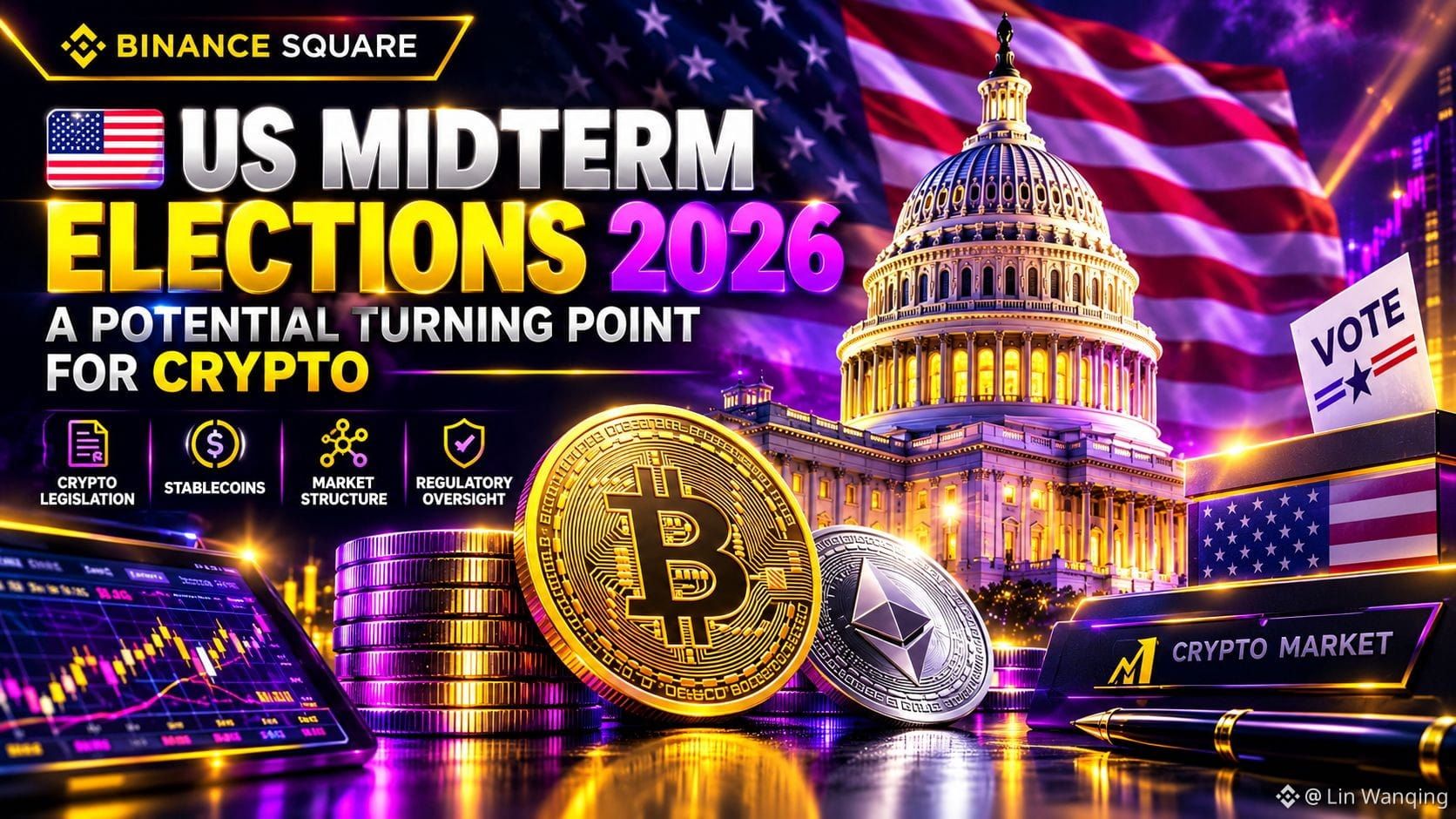
🇺🇸 US Midterm Elections 2026: A Potential Turning Point for Crypto
The US midterm elections on November 3 could influence the future of cryptocurrency regulation and digital asset legislation. The outcome will shape the balance of power in Congress, potentially affecting discussions around stablecoins, market structure, and regulatory oversight.
Why It Matters for Crypto 📊
A Congress more supportive of digital assets could help advance crypto-related legislation, while a change in political priorities could create uncertainty for the industry. However, election results alone will not guarantee new regulations or an immediate market rally.
Trader’s Perspective
Traders should watch Bitcoin’s price action, trading volume, liquidity, and broader market sentiment as election day approaches. Political headlines may create short-term volatility, but interest rates, institutional flows, and overall risk appetite will remain important factors.
My Take: The US midterms could become an important catalyst for crypto sentiment, but the real impact will depend on what policymakers do after the election. Focus on confirmed developments rather than trading solely on political expectations.
#Bitcoin #CryptoNews #USMidterms
$BTC $APR $ZEC
{future}(ZECUSDT)
{future}(APRUSDT)
{future}(BTCUSDT)
#USMidtermElections
🇺🇸 US Midterm Elections 2026: A Potential Turning Point for Crypto
The US midterm elections on November 3 could influence the future of cryptocurrency regulation and digital asset legislation. The outcome will shape the balance of power in Congress, potentially affecting discussions around stablecoins, market structure, and regulatory oversight.
Why It Matters for Crypto 📊
A Congress more supportive of digital assets could help advance crypto-related legislation, while a change in political priorities could create uncertainty for the industry. However, election results alone will not guarantee new regulations or an immediate market rally.
Trader’s Perspective
Traders should watch Bitcoin’s price action, trading volume, liquidity, and broader market sentiment as election day approaches. Political headlines may create short-term volatility, but interest rates, institutional flows, and overall risk appetite will remain important factors.
My Take: The US midterms could become an important catalyst for crypto sentiment, but the real impact will depend on what policymakers do after the election. Focus on confirmed developments rather than trading solely on political expectations.
#Bitcoin #CryptoNews #USMidterms
$BTC $APR $ZEC
46

#usmidtermelections
The next major catalyst for the crypto market isn’t on the blockchain. It’s at the ballot box.
On November 3, the United States will decide who controls the House and the Senate. The presidency isn’t at stake, but the power to set the rules of the economic game is.
The U.S. Congress sets budgets, oversees enforcement, and passes financial legislation. For the digital asset sector, that means everything. Decisions about stablecoins, exchanges, and institutional access are in the hands of whoever controls Capitol Hill.
The big question isn’t just who wins. It’s what the new balance of power means for regulatory predictability.
Markets hate uncertainty. Volatility ahead of the vote and clarity afterward will be the real drivers of prices.
Are you positioned for the shift in power in Washington?
Disclaimer: Educational content only. This is not financial advice.
$PARTI $BTC $ALPINE
#USMidterms #CryptoRegulation #GrowWithSAC #USMidtermElections
{spot}(BTCUSDT)
{spot}(PARTIUSDT)
{spot}(ALPINEUSDT)
#usmidtermelections
The next major catalyst for the crypto market isn’t on the blockchain. It’s at the ballot box.
On November 3, the United States will decide who controls the House and the Senate. The presidency isn’t at stake, but the power to set the rules of the economic game is.
The U.S. Congress sets budgets, oversees enforcement, and passes financial legislation. For the digital asset sector, that means everything. Decisions about stablecoins, exchanges, and institutional access are in the hands of whoever controls Capitol Hill.
The big question isn’t just who wins. It’s what the new balance of power means for regulatory predictability.
Markets hate uncertainty. Volatility ahead of the vote and clarity afterward will be the real drivers of prices.
Are you positioned for the shift in power in Washington?
Disclaimer: Educational content only. This is not financial advice.
$PARTI $BTC $ALPINE
#USMidterms #CryptoRegulation #GrowWithSAC #USMidtermElections
1
218

·
--
According to Reuters, the crypto industry spent about $176 million across more than 100 midterm election races to win bipartisan support in Congress.
Pouring $176 million into over 100 races may or may not buy regulatory certainty. This looks less like buying support and more like offering regulators a pledge of allegiance. If all they get in the end is empty promises, retail investors could get fleeced again. 🤡
$POLITICS #USMidterms #CryptoRegulation

7

🟥 BREAKING: TRUMP EASES TARIFFS ON NINE CATEGORIES OF CANADIAN PRODUCTS AHEAD OF US MIDTERM ELECTIONS! 🇺🇸🇨🇦
US President Donald Trump has signed a new order removing the additional 50% tariffs on selected Canadian products, offering relief to businesses and agricultural producers in northern US states, particularly Maine.
According to Reuters and the White House, October 23, 2026, the changes will take effect on October 30, just days before the November 3 US midterm elections.
🔴 Key Developments:
- 📦 Nine categories of Canadian products will receive tariff exemptions.
- 🏭 Covered goods include certain paper products, plywood, packaging materials, machinery and refrigeration equipment.
- 🚜 The changes could help farmers and businesses that rely on Canadian supplies.
- 💰 The move comes amid growing concerns about inflation, consumer prices and the cost of doing business.
- ⚖️ The administration is also adding certain other Canadian products to the 50% tariff list, meaning this is a targeted adjustment—not a complete end to the trade dispute.
🇺🇸 THE POLITICAL ANGLE:
The timing is significant. With the November 3 midterm elections approaching, tariff costs have become a major issue for businesses, consumers and candidates in states economically connected to Canada.
However, the administration presents the changes as an effort to address trade disputes and protect American commerce.
🌎 What do you think? Is this a practical step to ease pressure on American businesses, or a sign that the economic impact of tariffs is becoming a political challenge?
$QNT $BEAMX $KAT
#Trump #Canada #Tariffs #USMidterms #TradeWar #Economy

1
209


Article
2026 Elon Musk Pours $267 Million Into Republican Midterm Campaigns🌍 #PositiveMindsGlobalResults | Binance Square | October 14, 2026
Political megadonor backs GOP as crucial U.S. congressional elections approach
Billionaire Elon Musk has reportedly contributed $267 million to groups supporting Republican candidates ahead of the November 3, 2026, U.S. midterm elections, according to U.S. media reports. His spending makes him one of the most influential financial backers in this election cycle.
💰 Where Is the Money Going?
Musk’s largest reported contribution was $158 million to the Senate Leadership Fund, a major political organization supporting Republican Senate candidates. The group is working to help Republicans maintain their narrow Senate majority.
Reported $276 million is the total since July 2026, not a single donation. Reports published on October 12 provide the following breakdown.
Recipient Reported amount
Senate Leadership Fund $158 million
America PAC $76 million
Congressional Leadership Fund $20 million
Lone Star Liberty PAC $10 million
Republican Governors Association $10 million
Republican Attorneys General Association $2 million
Total $276 million
🤝 Musk and Trump Rebuild Their Relationship
Musk spent approximately $290 million supporting Donald Trump and Republican causes during the 2024 election cycle, helping Trump secure a second presidential term.
He later stepped down from his role leading the Department of Government Efficiency following disagreements with Trump. However, relations between the two have since improved. Last week, Trump reportedly honored Musk with the National Medal of Science.
🏛️ Why the November Midterms Matter
The November 3 elections will determine the balance of power in Congress, influencing legislation, government spending, taxation, technology regulation, and economic policy.
Musk’s financial backing could strengthen Republican campaign efforts, but substantial donations do not guarantee victory. Voter sentiment, economic conditions, and candidate performance will also play important roles.
📊 Potential Impact on Financial Markets
Investors will be watching the election closely because its outcome could influence:
Technology stocks: Potential changes in technology regulation and government policy.Energy markets: Possible shifts in energy policy and investment priorities.U.S. equities: Market reactions to changes in taxation, spending, and the legislative outlook.Cryptocurrency: Possible effects from regulatory expectations and broader investor sentiment.
These are potential scenarios, not guaranteed market outcomes. The actual impact will depend on election results and subsequent policy decisions.
🔎 Final Takeaway
Elon Musk’s reported $267 million political investment highlights the growing influence of major donors in U.S. elections. With control of Congress at stake, the November midterms could shape America's political and economic direction.
Stay informed. Follow the facts. Watch the policy signals.
Disclaimer: This article is for informational purposes only and does not constitute financial or investment advice. Reported figures should be checked against official campaign finance disclosures. Conduct your own research (DYOR).
#PositiveMindsGlobalResults #ThinkPositiveGlobal #BinanceSquare #ElonMusk #DonaldTrump #USMidterms #USPolitics #Republicans #StockMarket #GlobalMarkets
2026 Elon Musk Pours $267 Million Into Republican Midterm Campaigns
🌍 #PositiveMindsGlobalResults | Binance Square | October 14, 2026
Political megadonor backs GOP as crucial U.S. congressional elections approach
Billionaire Elon Musk has reportedly contributed $267 million to groups supporting Republican candidates ahead of the November 3, 2026, U.S. midterm elections, according to U.S. media reports. His spending makes him one of the most influential financial backers in this election cycle.
💰 Where Is the Money Going?
Musk’s largest reported contribution was $158 million to the Senate Leadership Fund, a major political organization supporting Republican Senate candidates. The group is working to help Republicans maintain their narrow Senate majority.
Reported $276 million is the total since July 2026, not a single donation. Reports published on October 12 provide the following breakdown.
Recipient Reported amount
Senate Leadership Fund $158 million
America PAC $76 million
Congressional Leadership Fund $20 million
Lone Star Liberty PAC $10 million
Republican Governors Association $10 million
Republican Attorneys General Association $2 million
Total $276 million
🤝 Musk and Trump Rebuild Their Relationship
Musk spent approximately $290 million supporting Donald Trump and Republican causes during the 2024 election cycle, helping Trump secure a second presidential term.
He later stepped down from his role leading the Department of Government Efficiency following disagreements with Trump. However, relations between the two have since improved. Last week, Trump reportedly honored Musk with the National Medal of Science.
🏛️ Why the November Midterms Matter
The November 3 elections will determine the balance of power in Congress, influencing legislation, government spending, taxation, technology regulation, and economic policy.
Musk’s financial backing could strengthen Republican campaign efforts, but substantial donations do not guarantee victory. Voter sentiment, economic conditions, and candidate performance will also play important roles.
📊 Potential Impact on Financial Markets
Investors will be watching the election closely because its outcome could influence:
Technology stocks: Potential changes in technology regulation and government policy.Energy markets: Possible shifts in energy policy and investment priorities.U.S. equities: Market reactions to changes in taxation, spending, and the legislative outlook.Cryptocurrency: Possible effects from regulatory expectations and broader investor sentiment.
These are potential scenarios, not guaranteed market outcomes. The actual impact will depend on election results and subsequent policy decisions.
🔎 Final Takeaway
Elon Musk’s reported $267 million political investment highlights the growing influence of major donors in U.S. elections. With control of Congress at stake, the November midterms could shape America's political and economic direction.
Stay informed. Follow the facts. Watch the policy signals.
Disclaimer: This article is for informational purposes only and does not constitute financial or investment advice. Reported figures should be checked against official campaign finance disclosures. Conduct your own research (DYOR).
#PositiveMindsGlobalResults #ThinkPositiveGlobal #BinanceSquare #ElonMusk #DonaldTrump #USMidterms #USPolitics #Republicans #StockMarket #GlobalMarkets
52

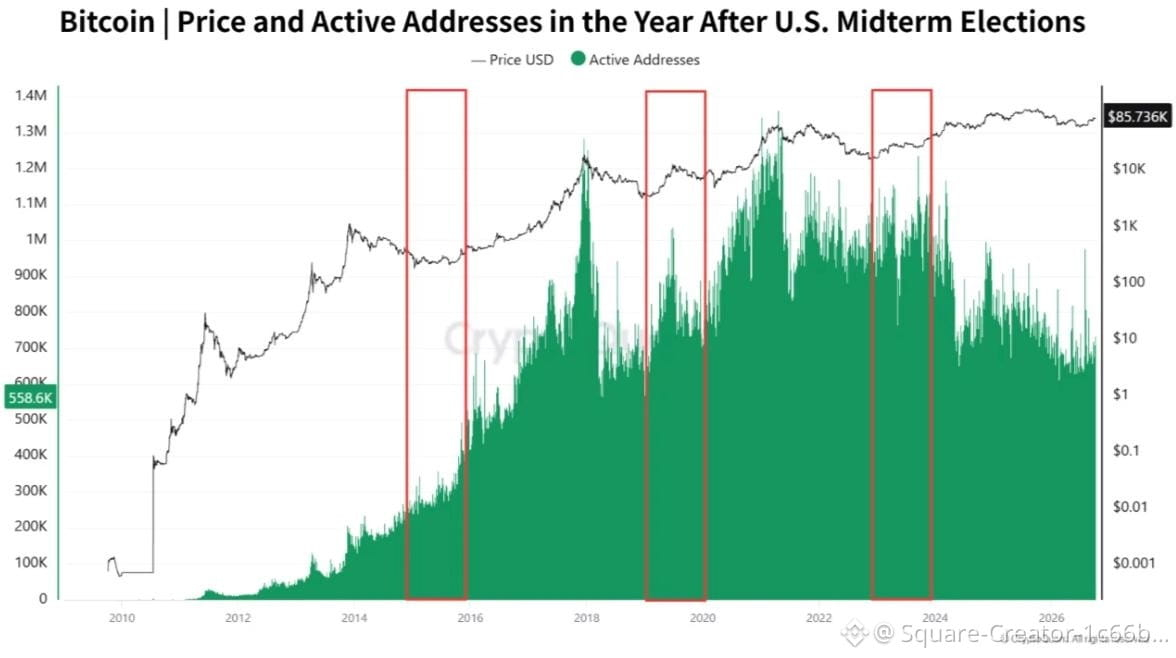
🐂 The 12 strong months following U.S. midterm elections: Does Bitcoin benefit?
Bitcoin (Bitcoin) posted notable gains during the twelve months following midterm elections in the United States:
📈 2014 election: up 24.5%
📈 2018 election: up 44.9%
📈 2022 election: up 92.3%
#BinanceSquareTalks $BTC
{future}(BTCUSDT)
#Bitcoin #BTC #Crypto #العملات_الرقمية #Trading #U.S._Elections #Market_Analysis #Bitcoin #Crypto #USMidterms
🐂 The 12 strong months following U.S. midterm elections: Does Bitcoin benefit?
Bitcoin (Bitcoin) posted notable gains during the twelve months following midterm elections in the United States:
📈 2014 election: up 24.5%
📈 2018 election: up 44.9%
📈 2022 election: up 92.3%
#BinanceSquareTalks $BTC
#Bitcoin #BTC #Crypto #العملات_الرقمية #Trading #U.S._Elections #Market_Analysis #Bitcoin #Crypto #USMidterms
79
Log in to explore more content
Join global crypto users on Binance Square
⚡️ Get latest and useful information about crypto.
💬 Trusted by the world’s largest crypto exchange.
👍 Discover real insights from verified creators.
Email / Phone number
Trending Topics
1
#BinanceReopensWithdrawalsForMoreAssets
5,365 views
291 Discussing
2
#AppleReportsMixedResults
4,286 views
253 Discussing
3
#BinanceWithdrawalScamWarning
85,967 views
1,078 Discussing
4
#USMidtermElections
675,794 views
3,663 Discussing
5
#USOctoberNFP-AreRateCutsStillPossible
87,254 views
813 Discussing
6
#Verify1to1BinanceReserves
77,409 views
585 Discussing
7
#NEARVoteApprovesCutInMaxAnnualIssuanceTo1.6%
37 views
5 Discussing
8
#KOSPIDrops3.76%LedByChipHeavyweights
0 views
0 Discussing
9
#SouthKoreaFinanceMinistryDeniesOverseasPerpetualsTaxReport
0 views
0 Discussing
10
#BinanceRestores28FiatWithdrawals
219,707 views
1,268 Discussing