

#redcoin
redcoin
104,664 views
144 Discussing
Hot
Latest

·
--
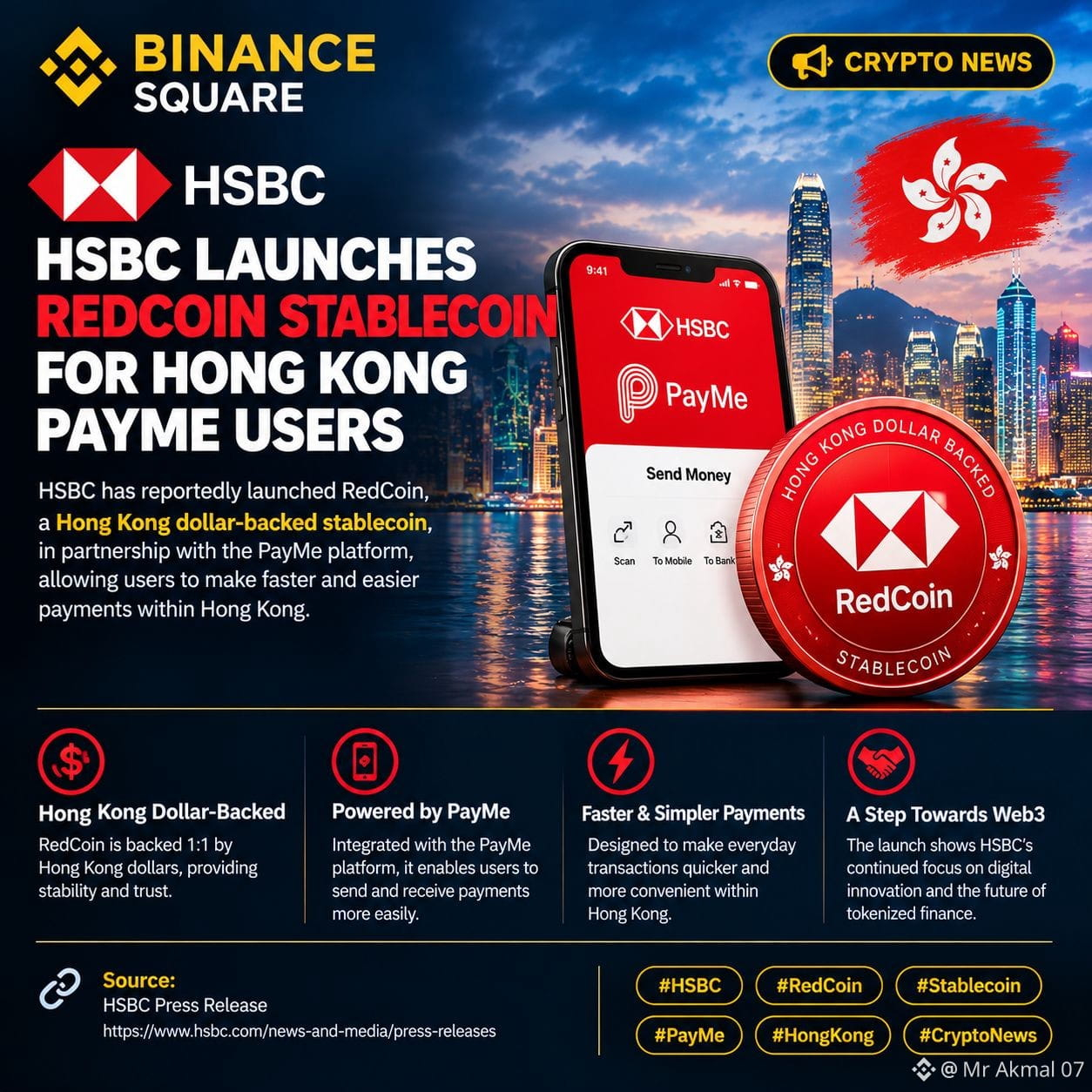
$HSBC.US 🚨 HSBC LAUNCHES REDCOIN STABLECOIN IN HONG KONG
HSBC has launched RedCoin (RCHKD), its first Hong Kong dollar-denominated stablecoin, through its PayMe payment platform.
🔹 What’s new?
• Designed to be redeemable 1:1 for Hong Kong dollars
• Supports person-to-person transfers and payments to merchants
• More than 3.3 million PayMe users will be able to activate wallets in phases
• HSBC plans to expand into tokenised investment products
🌐 Why it matters: A major traditional bank is bringing regulated stablecoin technology closer to everyday payments.
📌 Important: The 3.3 million figure refers to potential PayMe users, not confirmed active RedCoin wallets.
🔗 Official source: https://www.about.hsbc.com.hk/news-and-media/hsbc-redcoin-launches-today
What impact could bank-issued stablecoins have on digital payments? 👇
#redcoin #stablecoin #blockchain #CryptoNews
{stock_us}(HSBC.US)
$HSBC.US 🚨 HSBC LAUNCHES REDCOIN STABLECOIN IN HONG KONG
HSBC has launched RedCoin (RCHKD), its first Hong Kong dollar-denominated stablecoin, through its PayMe payment platform.
🔹 What’s new?
• Designed to be redeemable 1:1 for Hong Kong dollars
• Supports person-to-person transfers and payments to merchants
• More than 3.3 million PayMe users will be able to activate wallets in phases
• HSBC plans to expand into tokenised investment products
🌐 Why it matters: A major traditional bank is bringing regulated stablecoin technology closer to everyday payments.
📌 Important: The 3.3 million figure refers to potential PayMe users, not confirmed active RedCoin wallets.
🔗 Official source: https://www.about.hsbc.com.hk/news-and-media/hsbc-redcoin-launches-today
What impact could bank-issued stablecoins have on digital payments? 👇
#redcoin #stablecoin #blockchain #CryptoNews
HSBCUS+0.61%
52

·
--
BANKING GIANT LAUNCHES ITS OWN STABLECOIN: CRYPTO INCHES CLOSER TO TRADITIONAL FINANCE
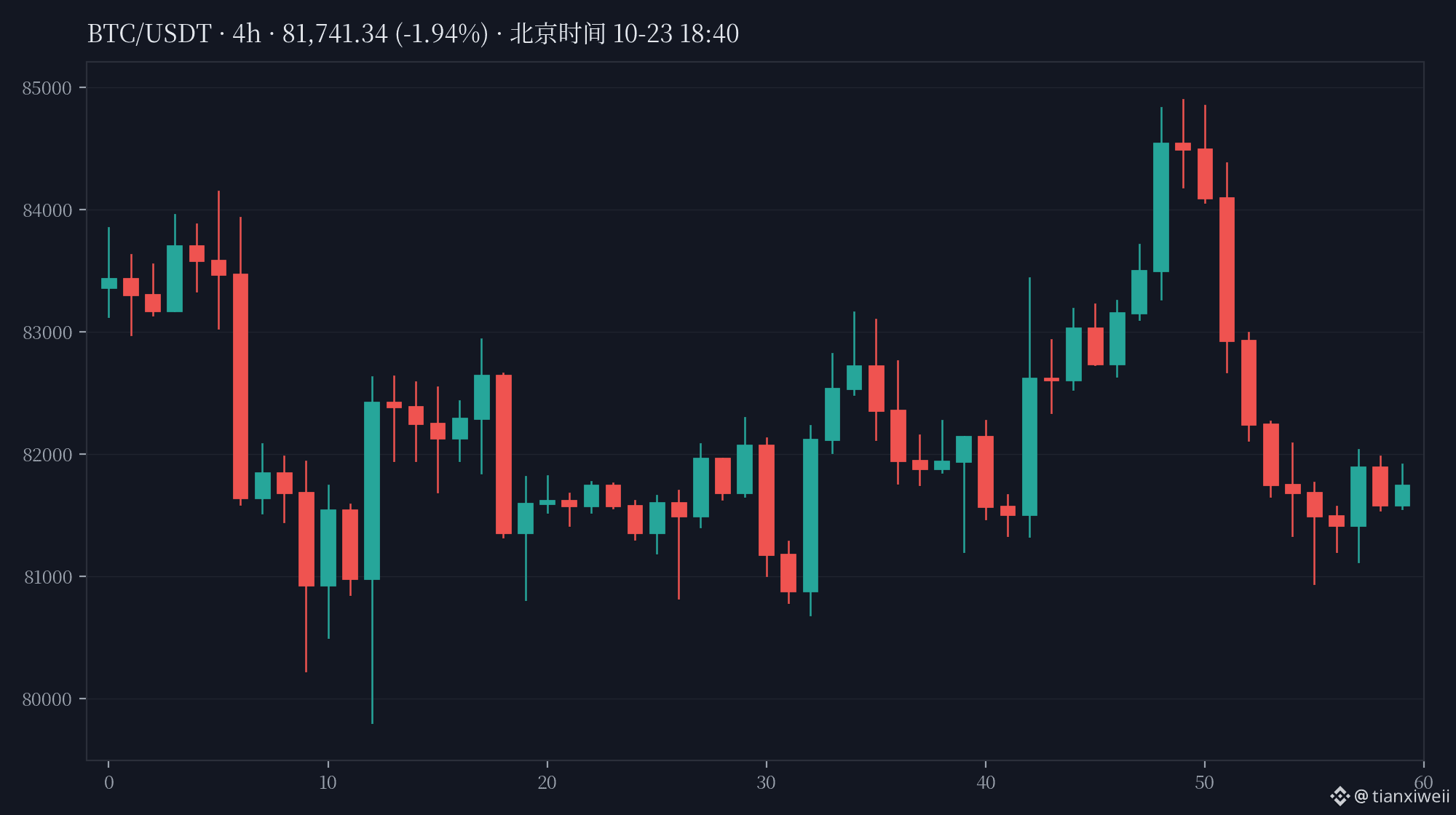
While $BTC struggles to hold the 80,000 USD level, an equally compelling development is unfolding within the banking sector.
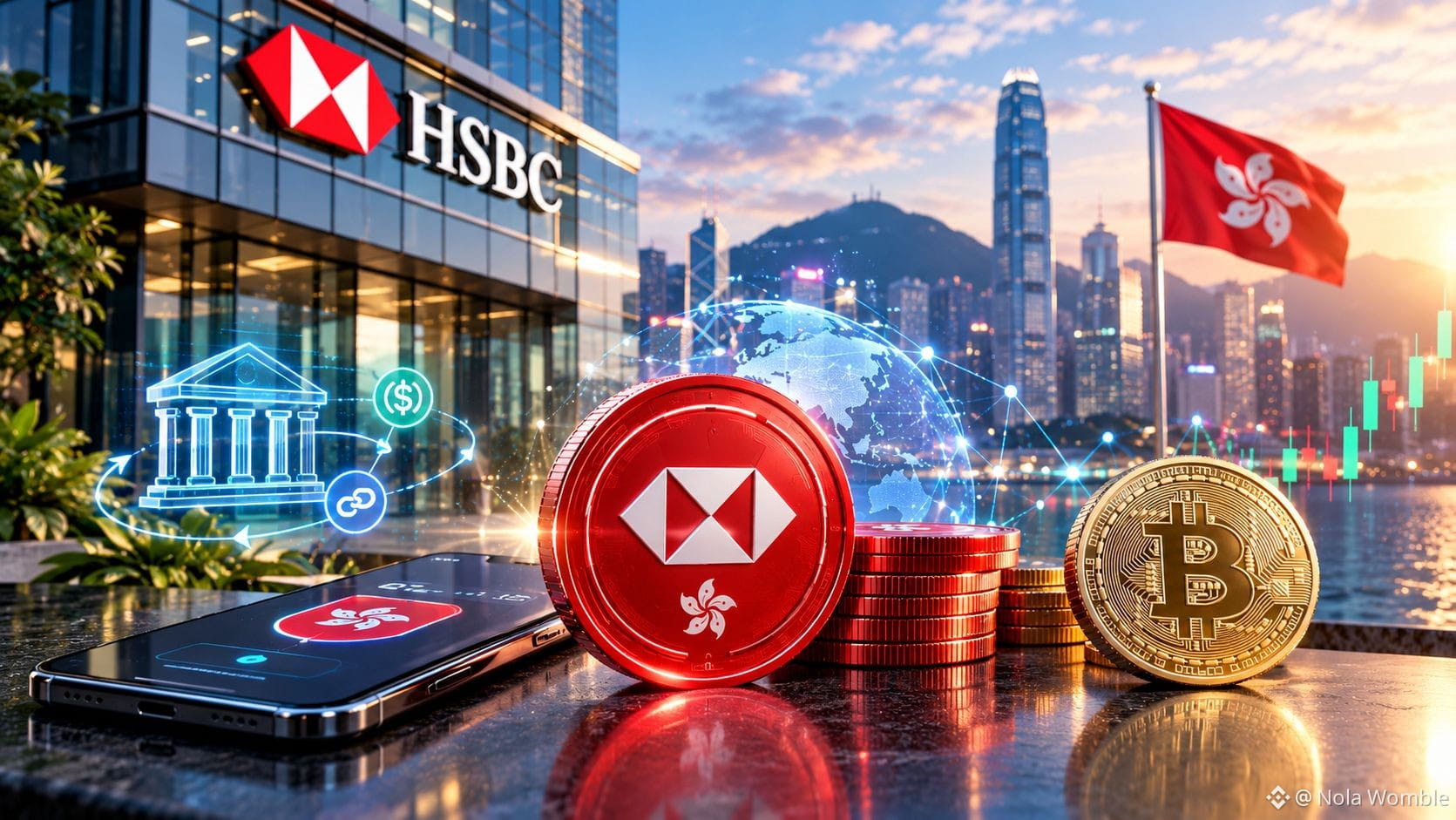
HSBC has launched RedCoin - a regulated stablecoin pegged to the Hong Kong dollar. Designed for retail users, this release underscores how major financial institutions are increasingly integrating digital currency solutions.
Why This Matters for the Crypto Market:
Stablecoins act as a structural bridge between traditional finance (TradFi) and blockchain infrastructure.
Commercial banks can leverage digital assets to facilitate faster payments and settlement procedures.
The expansion of regulated stablecoins has the potential to accelerate broader blockchain adoption beyond speculative crypto trading.
Despite these developments, market sentiment remains fragile: on October 24, $BTC dipped below 80,000 USD amid heightened geopolitical tension. This creates a notable divergence - while asset prices experience near-term weakness, underlying financial infrastructure continues to advance.
Market participants should monitor not only $BTC price action but also developments across the stablecoin and real-world asset (RWA) tokenization sectors, where long-term institutional opportunities are likely to take shape.
Will commercial banks ultimately become the dominant players in the crypto market, or will decentralized protocols maintain their structural advantage?
#news #redcoin #Stablecoins
73

·
--
Bank-issued stablecoins are moving into everyday payment apps—a more concrete path to “stablecoin adoption” than slogans.
According to reports, HSBC has launched the Hong Kong dollar stablecoin RedCoin (RCHKD) in its PayMe app. Users can activate a wallet in the app to transfer funds and pay at more than 100,000 merchants. The potential reach is around 3.3 million PayMe users. As of around October 25, the reported circulation was approximately HK$80.81 million, with cash reserves slightly exceeding the amount in circulation.
How to read this: It looks more like a regulated bank integrating a stablecoin into an existing payment network than creating an entirely new trading segment. Key things to watch are activation rates, merchant acceptance in practice, the pace of reserve disclosures and audits, and whether the stablecoin later appears in the main banking app and tokenized investment scenarios. Before it scales, first see whether the payment loop actually works.
#汇丰 #RedCoin #稳定币 #Hong Kong
12
·
--
Traditional banks putting stablecoins directly into everyday wallets is more compelling than asking people to “open another crypto account.”
HSBC has launched the RedCoin stablecoin in its PayMe app, saying it could reach the wallets of more than 3.3 million users in the coming days. Users can send it to friends or pay at more than 100,000 PayMe merchants. The use cases are shopping and transfers between people who know each other—not a gateway to on-chain speculation.
How to read this: If the rollout goes smoothly, it effectively embeds a regulated stablecoin into existing user habits. For crypto-native projects, the competitive focus will shift from “who has the most tokens” to “who can plug into a bank-grade payment network.” Watch the rollout pace, whether users can withdraw it on-chain, and what disclosure requirements regulators impose on banks’ own stablecoins.
#汇丰 #RedCoin #稳定币 #PayMe
10

Verified
HSBC today rolled out its HKD stablecoin RedCoin (RCHKD) to 3.3 million PayMe users, with access being enabled in batches. P2P transfers and payments at 100,000+ merchants are available first, along with 1:1 HKD redemption. The HKMA-issued FRS02 license was granted on April 10. First-day circulation was about HKD 80.6 million—just HKD 24 per user on average. By year-end, it will also be integrated into the HSBC Hong Kong app, where users can buy tokenized money market funds with just HKD 100. The bank isn’t doing this as a gimmick; it’s competing for the on-chain distribution gateway. The blockchain hasn’t been announced, and RedCoin itself pays no interest, so don’t buy it as an investment. #RedCoin #港币稳定币 #Tokenization
HSBC today rolled out its HKD stablecoin RedCoin (RCHKD) to 3.3 million PayMe users, with access being enabled in batches. P2P transfers and payments at 100,000+ merchants are available first, along with 1:1 HKD redemption. The HKMA-issued FRS02 license was granted on April 10. First-day circulation was about HKD 80.6 million—just HKD 24 per user on average. By year-end, it will also be integrated into the HSBC Hong Kong app, where users can buy tokenized money market funds with just HKD 100. The bank isn’t doing this as a gimmick; it’s competing for the on-chain distribution gateway. The blockchain hasn’t been announced, and RedCoin itself pays no interest, so don’t buy it as an investment. #RedCoin #港币稳定币 #Tokenization

1
11.9k

Just checked my phone—HSBC really has brought stablecoins to PayMe today. It’s called RedCoin (RCHKD), pegged 1:1 to the Hong Kong dollar. Over the next few days, PayMe’s 3.3 million users will gradually be able to open a wallet. No need to open a separate account, no minimum balance, and you can spend it at 100,000+ merchants and redeem it back to Hong Kong dollars 1:1.
By the end of the year, it’ll also be added to the HSBC Hong Kong app: you’ll be able to buy tokenised money market funds with just HK$100, with instant settlement—no waiting for T+1. The first licences issued by the HKMA in April require segregated reserves, with compliance covered from every angle.
But what’s the most striking part? It’s not even competing with $USDT for the dollar business. 3.3 million everyday users can use stablecoins with just a phone. They haven’t even announced which chain it’s on, because it’s not operating on a blockchain at all—it’s just being transferred within the bank’s own app. While the crypto world is still teaching newcomers how to sign up for exchanges, they’ve gone straight around the exchanges.
Let’s get the debate going in the comments: A) Banks are taking over stablecoins; exchanges should be worried. B) It’s all happening behind closed doors in their own app—this doesn’t count as real crypto. Pick a side.
#汇丰 #稳定币 #RedCoin
$BTC $ETH
3

·
--
HSBC is putting “digital Hong Kong dollars” in the hands of 3.3 million Hongkongers today: stablecoins have finally made it into convenience stores
Hong Kong dollar stablecoins have officially entered retail payments today. HSBC announced that its Hong Kong dollar stablecoin, RedCoin (RCHKD), is rolling out in PayMe from today. PayMe’s 3.3 million-plus users will be able to open a stablecoin wallet directly in the app over the next few days, send money to friends, and scan to pay at more than 100,000 merchants. One Hong Kong dollar is redeemable for one RedCoin.
Here are a few key points:
First, it’s licensed. HSBC was one of the first two institutions to receive a stablecoin license from the Hong Kong Monetary Authority this April. The other was Anchorpoint, led by Standard Chartered, which launched its institutional version, HKDAP, in August. RedCoin is fully backed by highly liquid assets held in segregated custody—so a “national team” player has entered the game.
Second, this is the first time a major bank has put a stablecoin into a payment app that ordinary people use every day. Anchorpoint’s HKDAP is only for institutions and professional investors, while RedCoin will be available to more than 3.3 million users and 100,000-plus merchants, covering everyday spending like meals and shopping.
Third, HSBC has outlined what’s next: it plans to add the wallet to its mobile banking app before the end of the year, where users will also be able to subscribe to tokenized money market fund units. Wholesale and institutional use cases will follow.
My take: the stablecoin race has officially moved from on-chain markets into retail banking. Stablecoin discussions used to focus on on-chain TVL and fiat on-ramps. This time, it’s the other way around: a bank is putting a compliant stablecoin into an existing payment network. Hong Kong’s Stablecoins Ordinance only took effect last August, and in just over a year the journey has gone from licensing to reaching 3.3 million users. That’s fast. On Wall Street, JPMorgan just moved its deposit token onto Solana this week. Bank-backed stablecoins are beginning to flourish on both fronts. In the long run, this will help educate users across the crypto market, and it’s also a tailwind for the “breaking into the mainstream” narrative around core assets like $BTC .
A quick risk reminder: RedCoin is a payment tool pegged 1:1 to the Hong Kong dollar, not an investment. Its price won’t rise, so don’t expect to profit from price differences.
What do you think: will a major mainland Chinese bank be next to follow, or will a US dollar stablecoin reach Hongkongers’ wallets first? Pick a side in the comments.
#稳定币 #香港 #RedCoin
87

🧧 HSBC’s Hong Kong Dollar Stablecoin RedCoin Lands in PayMe Today: 3.3 Million Wallets Get a New Kind of “Coin”
Starting October 23, HSBC is rolling out HSBC RedCoin to PayMe users in phases. It is a Hong Kong dollar stablecoin issued under a Hong Kong Monetary Authority license.
Here’s what we know so far:
🔹 Rolling out in phases to PayMe’s more than 3.3 million users
🔹 Initially for person-to-person transfers and merchant payments; news roundups say it will be accepted at more than 100,000 merchants
🔹 Wallets can be activated instantly, with no minimum balance, and exchanged for Hong Kong dollars at a 1:1 rate
🔹 Planned integration into the main HSBC HK app by the end of the year; news roundups say it may later be used to subscribe to tokenized money market funds, with a minimum investment of HK$100
But not everyone in the comments is cheering.
One columnist said bluntly that RedCoin just adds another step to PayMe transfers. The genuinely novel feature of stablecoins, they argued, is “permissionless composability”—precisely what Hong Kong’s licensing rules rule out.
Others brought up a cautionary tale: a post from early October claimed that HKDAP, the Hong Kong dollar stablecoin previously issued by Anchorpoint, had only about 1 million tokens in circulation, with less than 100,000 in trading volume over 30 days—in other words, almost nobody was using it.
My take:
The biggest difference between this and HKDAP is distribution. HKDAP started with institutions, while RedCoin is being built directly into a payments app used daily by 3.3 million people. That gives it a completely different starting point.
But user numbers don’t equal usage. If sending money in PayMe feels exactly the same as before, ordinary users have no reason to switch. The two things worth watching are whether RedCoin can be transferred out of PayMe and used by other apps on public blockchains, and whether people actually use tokenized funds and other “buy on-chain assets directly with Hong Kong dollars” features after it joins the main app at the end of the year.
The competition between bank stablecoins isn’t about technology—it’s about use cases.
Do you think bank-issued stablecoins will be better suited than USDT or USDC for everyday payments? Or are they just e-wallets with a different name?
#稳定币 #香港 #汇丰 #RedCoin
8

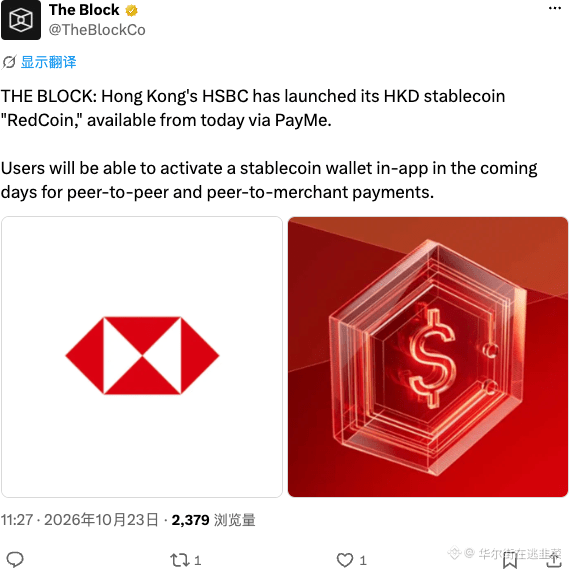
HSBC launches RedCoin HKD stablecoin for retail
- HSBC launches RedCoin HKD stablecoin.
- Retail users will receive it.
- PayMe users can activate a stablecoin wallet in-app.
- Coming days.
- P2P, P2M payments.
- The RSS description provides no further details.
#BinanceSquare #CryptoNews #RedCoin #Stablecoin #HKD
$red
vlikevn Titanbot
Source: The Block
23

·
--
HSBC just dropped RedCoin, a Hong Kong dollar stablecoin—the real Plan B for RWA is here 🏦. A major bank getting involved means the regulatory shackles are finally off, and fiat on-ramps and off-ramps should be rock-solid from now on. But this thing is all about payments, so if you’re looking to farm airdrops, check whether PayMe has any tricks up its sleeve first. Don’t blindly ape in.
$HKD $RWA #RedCoin
$HKD $RWA #RedCoin
46

·
--
Saw this on the South China Morning Post / Odaily: HSBC’s Hong Kong dollar stablecoin, RedCoin, begins rolling out in phases today—starting with PayMe’s more than 3.3 million users, who can use it for P2P transfers and payments at around 100,000 merchants.
Key details: It will only be issued through PayMe and the HSBC HK mobile banking app. There’s no minimum balance to open a wallet, and no need to open a separate account. The interface will look much like the existing PayMe app. It is licensed under the HKMA’s stablecoin issuer regime (license FRS02), and backed 1:1 by highly liquid, segregated Hong Kong dollar assets. HSBC also says it will add a stablecoin wallet to its Hong Kong wealth management app later this year, with RedCoin available to subscribe to tokenized products, including Hong Kong dollar money market funds (minimum investment around HK$100). Around 100 employees took part in an earlier pilot covering the full process, from minting to transfers.
At the start of October, RedCoin had only been named and had not yet been issued. Today, it’s actually open to retail users. Hong Kong is bringing bank-issued stablecoins into everyday payments—this is a more concrete step than a white paper.
#汇丰 #RedCoin #稳定币 #Hong Kong

HSBCUS+0.61%
38
HSBC names HKD stablecoin as RedCoin, launching in H2/2026
- Official name: RedCoin
- Pegged 1:1 to HKD
- Launch via PayMe and the HSBC HK Mobile App
- Timeline: H2 2026, announced on 30/9/2026
#BinanceSquare #CryptoNews #RedCoin #Stablecoin
$btc $eth
#vlikevn Titanbot
Source: CoinGape
HSBC names HKD stablecoin as RedCoin, launching in H2/2026
- Official name: RedCoin
- Pegged 1:1 to HKD
- Launch via PayMe and the HSBC HK Mobile App
- Timeline: H2 2026, announced on 30/9/2026
#BinanceSquare #CryptoNews #RedCoin #Stablecoin
$btc $eth
#vlikevn Titanbot
Source: CoinGape
- Official name: RedCoin
- Pegged 1:1 to HKD
- Launch via PayMe and the HSBC HK Mobile App
- Timeline: H2 2026, announced on 30/9/2026
#BinanceSquare #CryptoNews #RedCoin #Stablecoin
$btc $eth
#vlikevn Titanbot
Source: CoinGape
127

🔴 RedStone ($RED ) is gaining attention as demand for fast, modular oracle solutions continues to grow, with new ecosystem integrations strengthening its long-term narrative. If DeFi and RWA adoption keep accelerating, I believe $RED D could trade around $8–$12 by the end of 2027, while a strong bull cycle could push it above $15.
My prediction? RED has the potential to become one of the standout oracle projects. Would you buy now or wait for the next dip? 🚀
#RED #RED #redcoin #BinanceSquareTalks #BinancePizzaVN
{future}(REDUSDT)
🔴 RedStone ($RED ) is gaining attention as demand for fast, modular oracle solutions continues to grow, with new ecosystem integrations strengthening its long-term narrative. If DeFi and RWA adoption keep accelerating, I believe $RED D could trade around $8–$12 by the end of 2027, while a strong bull cycle could push it above $15.
My prediction? RED has the potential to become one of the standout oracle projects. Would you buy now or wait for the next dip? 🚀
#RED #RED #redcoin #BinanceSquareTalks #BinancePizzaVN
My prediction? RED has the potential to become one of the standout oracle projects. Would you buy now or wait for the next dip? 🚀
#RED #RED #redcoin #BinanceSquareTalks #BinancePizzaVN
87

$RED
Price: ~$0.140
24h Change: +7.1%
24h Range: ~$0.130–$0.141
Trend: Bullish momentum
Resistance: $0.145–$0.150
Support: $0.130–$0.132
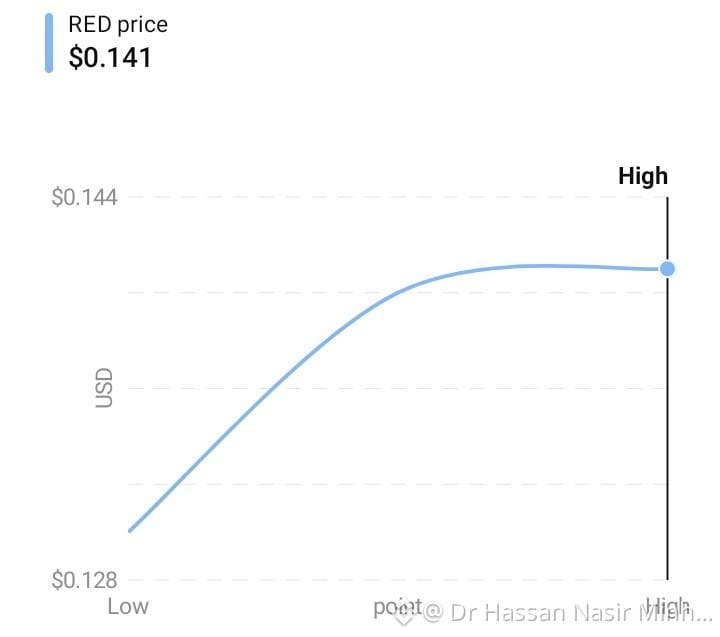
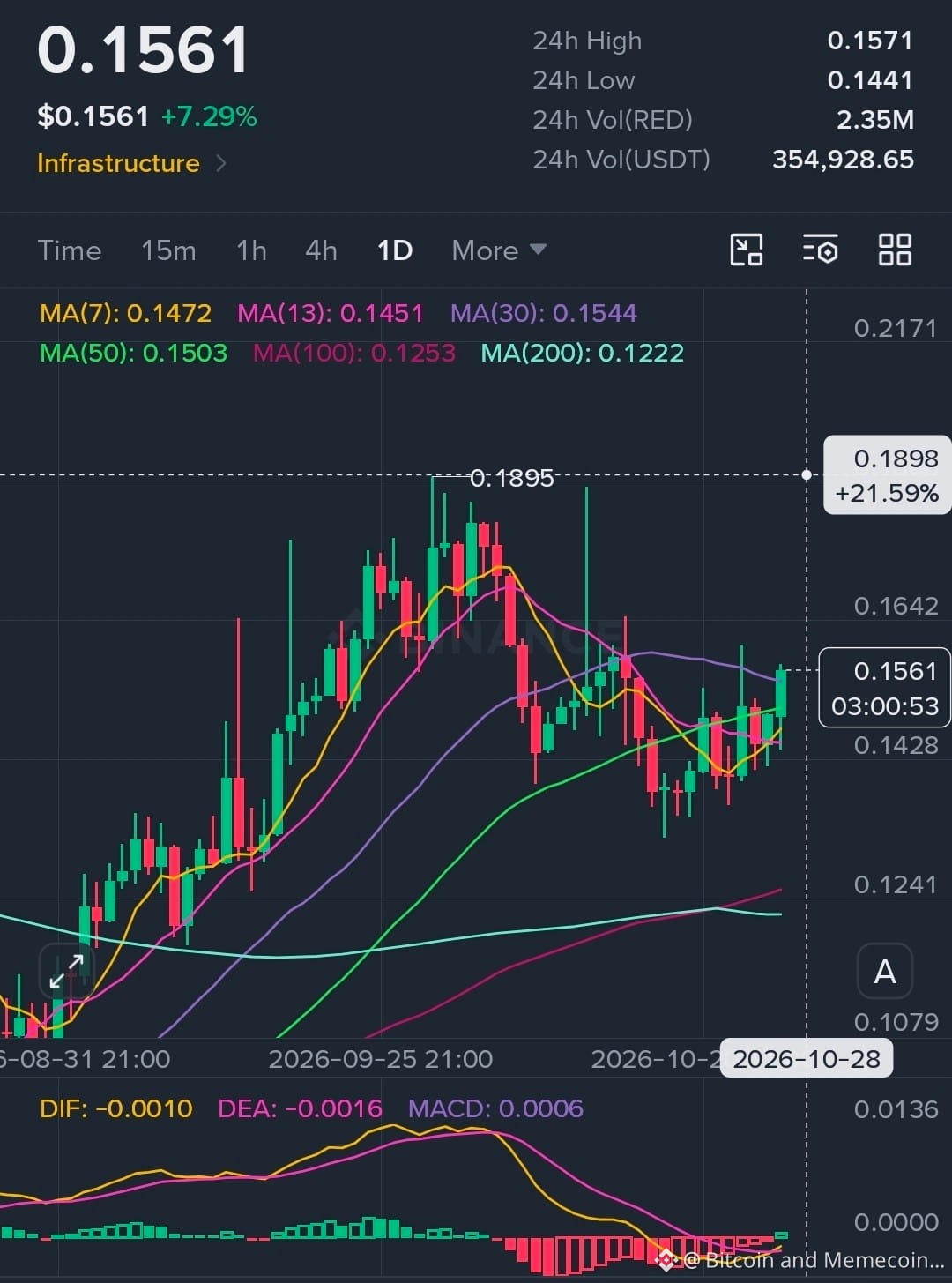
$RED is showing strong upside momentum today. A break above $0.145 could open the way toward $0.150+, while losing $0.130 may trigger a pullback.#FedHikeOddsRiseTo89% #AvalancheIntegratesIntoUAEPassDigitalVault #UKSeeksViewsOnTokenizingGold #AnthropicCEOCallsForAISlowdown #redcoin
{spot}(REDUSDT)
$RED
Price: ~$0.140
24h Change: +7.1%
24h Range: ~$0.130–$0.141
Trend: Bullish momentum
Resistance: $0.145–$0.150
Support: $0.130–$0.132
$RED is showing strong upside momentum today. A break above $0.145 could open the way toward $0.150+, while losing $0.130 may trigger a pullback.#FedHikeOddsRiseTo89% #AvalancheIntegratesIntoUAEPassDigitalVault #UKSeeksViewsOnTokenizingGold #AnthropicCEOCallsForAISlowdown #redcoin
73

My Spot Portfolio
2 / 300
Minimum 10USDT
Public
7D PNL
(USDT)
250.09
7D ROI
+14.90%
AUM
$1464.32
Win Rate
100.00%
1
309

·
--
🏦 Imagine your bank issuing its own digital currency!
Not Bitcoin, not a meme coin, but a stablecoin pegged to your country’s currency.
That’s the direction traditional banks are heading. And with the latest news from Hong Kong, HSBC has entered the picture through RedCoin, a stablecoin pegged to the Hong Kong dollar.
But why would a bank need a digital currency if it already has a money transfer system?
💡 Imagine the difference:
Today, you send money from one bank account to another, and the transaction may pass through several systems and intermediaries.
Stablecoins, on the other hand, make it possible to transfer value over programmable digital infrastructure, and may facilitate settlements and transfers when the appropriate regulatory framework is in place.
The most important thing here isn’t the name of the new currency...
It’s that banks are starting to view blockchain technology as a potential part of the future of financial services—not just a competitor.
But be careful!
Stablecoins are not risk-free. Their value depends on the issuer, reserves, redemption mechanism, and regulatory oversight.
🎯 My question for you:
If your bank issued a stablecoin pegged to your local currency, would you prefer to use it, or stick with USDT and USDC?
#HSBC #RedCoin #Stablecoins #HongKong
⚠️ Educational content, not financial advice.

3
127

Orca (ORCA) is riding a bullish momentum surge as order blocks reveal robust buying pressure 🚀. Liquidity pool expansion and a partnership with a leading DeFi protocol signal strong adoption. Investors are bullish on its staking rewards. Red (RED) faces a bearish trend 📉; volume contraction and declining order book depth warn of potential liquidation. Omni (OMNI) shows steady growth, with ecosystem updates boosting trading activity and investor sentiment 🔄. #OrcaToken #RedCoin #OmniToken
Orca (ORCA) is riding a bullish momentum surge as order blocks reveal robust buying pressure 🚀. Liquidity pool expansion and a partnership with a leading DeFi protocol signal strong adoption. Investors are bullish on its staking rewards. Red (RED) faces a bearish trend 📉; volume contraction and declining order book depth warn of potential liquidation. Omni (OMNI) shows steady growth, with ecosystem updates boosting trading activity and investor sentiment 🔄. #OrcaToken #RedCoin #OmniToken
235

·
--
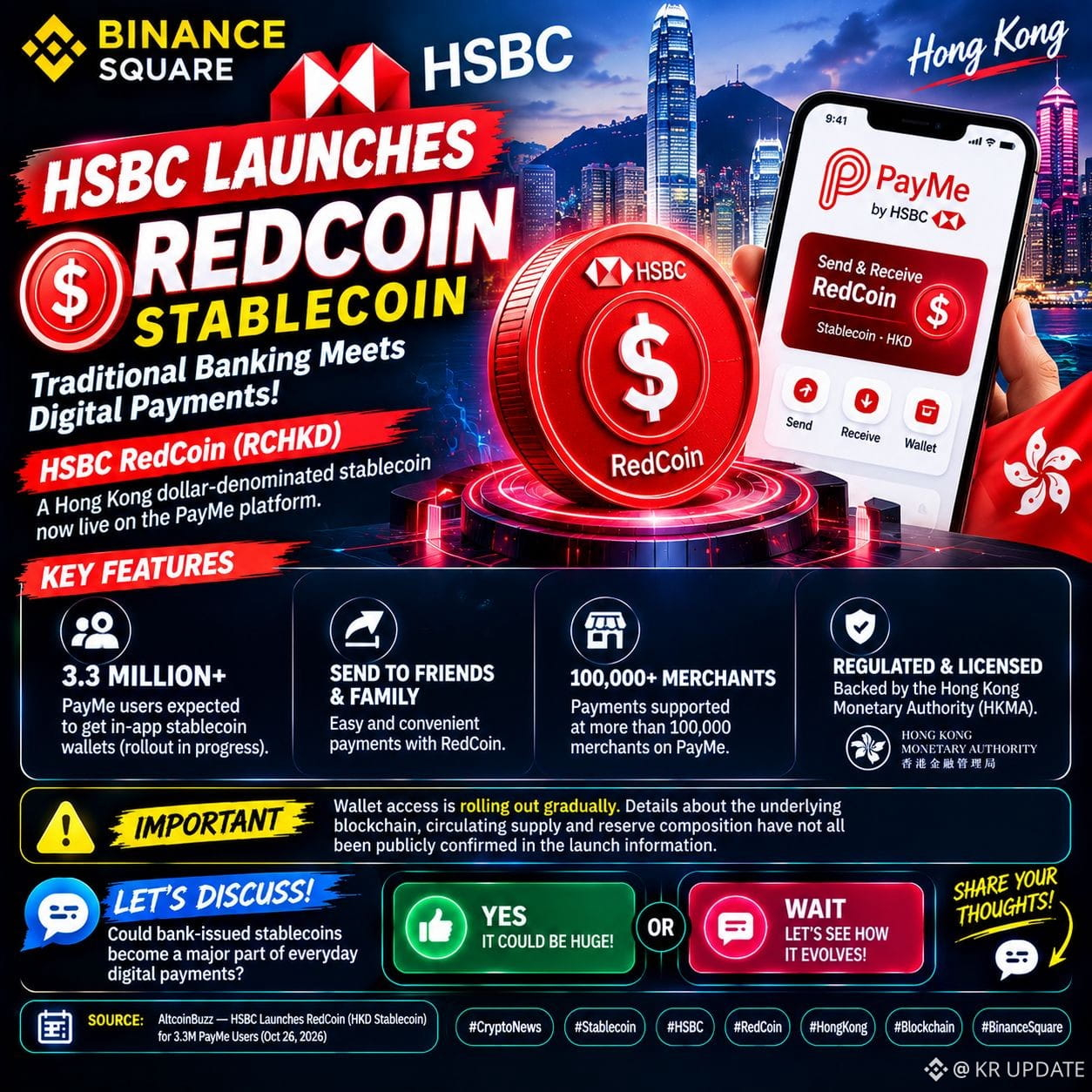
🚨 $HSBC.US JUST ENTERED THE STABLECOIN SPOTLIGHT! 🌏
🏦 HSBC RedCoin: Traditional Banking Meets Digital Payments!
HSBC has launched RedCoin ($RCHKD), a Hong Kong dollar-denominated stablecoin, on its PayMe platform.
🔥 Why is this news important?
🔹 More than 3.3 million PayMe users are expected to gain access to in-app stablecoin wallets as the rollout progresses.
🔹 Users will be able to send RedCoin to friends and family.
🔹 HSBC says payments will be supported at more than 100,000 merchants on PayMe.
🔹 The stablecoin is licensed and regulated by the Hong Kong Monetary Authority.
⚠️ Important: Wallet access is rolling out gradually. Details about the underlying blockchain, circulating supply and reserve composition have not all been publicly confirmed in the launch information.
💬 DISCUSSION: Could bank-issued stablecoins become a major part of everyday digital payments?
Share your thoughts below! 👇
#CryptoNews #stablecoin #redcoin #HongKongFinance #BinanceSquare
HSBCUS+0.61%
73

🏦 HSBC is bringing a Hong Kong dollar stablecoin to 3.3 million users—is stablecoin payment really becoming part of everyday life?
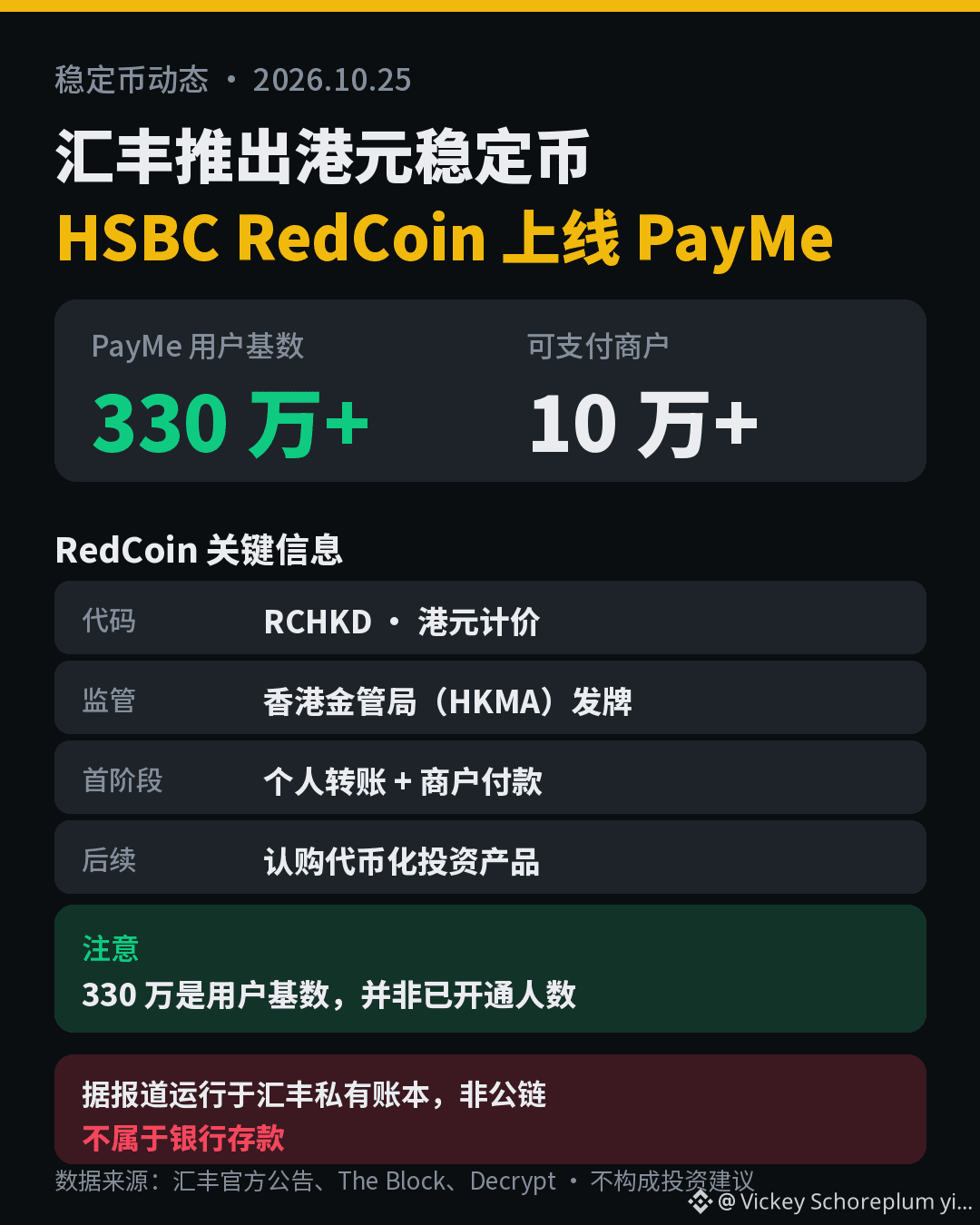
On October 23, HSBC’s first stablecoin, HSBC RedCoin (ticker: RCHKD), launched on PayMe. It’s a Hong Kong dollar-denominated stablecoin licensed and regulated by the Hong Kong Monetary Authority (HKMA), and designed to be redeemable 1:1 for Hong Kong dollars.
📋 Key points
• PayMe has over 3.3 million users, who will be able to activate a stablecoin wallet themselves in the coming days. (Note: 3.3 million is PayMe’s user base, not the number of people who have already activated a wallet.)
• Initial features: transfers between individuals and payments with RedCoin at 100,000+ merchants
• Future plans: subscriptions to tokenized investment products in the HSBC Hong Kong mobile banking app, and expansion into corporate and institutional use cases
• According to Decrypt, RedCoin runs on HSBC’s own private ledger, not a public blockchain like Ethereum. It is also not a bank deposit.
🤔 What do we make of this?
A major traditional bank integrating a stablecoin directly into an everyday payment app is a sign that regulated stablecoins are moving into the mainstream. But it’s a closed system, so its direct impact on public-chain stablecoins like USDT and USDC is limited in the short term. The bigger positive is the sentiment that the sector is gaining recognition. What really matters is how many people activate wallets and how much actual transaction volume they generate.
📍 Market reference: BTC’s 24-hour range is approximately $79,220–$81,030, and it’s currently around $80,400. Volatility tends to be higher over the weekend, so manage your position size carefully.
Do you think bank-issued stablecoins will take market share from USDT and USDC, or will they help grow the market together? Share your thoughts in the comments 👇
👉 Trade BTC: https://www.binance.com/zh-CN/trade/BTC_USDT
#HSBC #RedCoin #稳定币 #港元稳定币 #BTC
⚠️ This is not investment advice. Please be aware of the risks.
26

·
--
HSBC just gave a stablecoin something most launches spend years chasing: distribution on day one.
#redcoin (RCHKD) launched today inside PayMe, giving more than 3.3 million users access to person-to-person transfers and payments at over 100,000 merchants.
The interesting part isn’t that a bank issued an HKD stablecoin. It’s that #HSBC skipped the usual cold-start problem by placing it inside an app people already use.
But this is still a controlled test. HSBC’s launch release does not specify the underlying blockchain or support for transfers to outside wallets. The metric that matters next is repeat payment use and whether RCHKD eventually becomes portable beyond HSBC’s own rails.
That would be the real bridge from bank money to on-chain money.

31
Log in to explore more content
Join global crypto users on Binance Square
⚡️ Get latest and useful information about crypto.
💬 Trusted by the world’s largest crypto exchange.
👍 Discover real insights from verified creators.
Email / Phone number
Trending Topics
1
#CanMicrosoftDeliverOnAI
579,903 views
3,782 Discussing
2
#CanGoogleDefindItsCore
355,085 views
2,679 Discussing
3
#FedWatch
16.1M views
36,956 Discussing
4
#EarningsSeason
6.1M views
30,045 Discussing
5
#BitcoinCoreIdentifiesThreeVulnerabilities
6,354 views
140 Discussing
6
#RippleExpects$900MAnnualizedProductRevenueRunRate
274 views
3 Discussing
7
#GoogleToPreviewCryptoCustodySecuritySystem
1,414 views
59 Discussing
8
#FedToBeginShrinkingRateSettingCalendarIn2027
2,304 views
37 Discussing
9
#StrategyShareholdersApproveDailyDividends
2,723 views
63 Discussing
10
#FedLowerBoundRateDecisionAt3.75%
2,405 views
36 Discussing