
#p2pscam
p2pscam
12.3M views
2,532 Discussing
Hot
Latest

·
--
Article
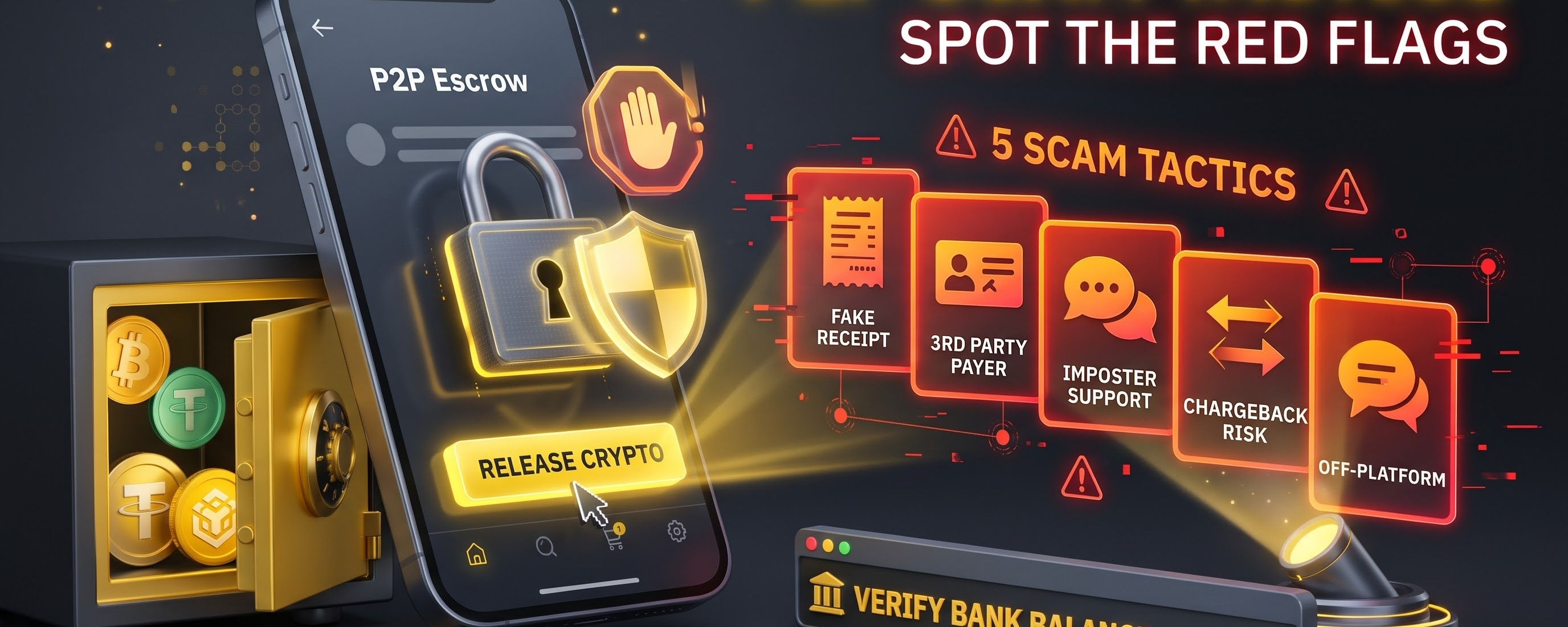
5 P2P Scam Tactics to Spot Before You Ever Release CryptoPeer-to-peer (P2P) trading gives you direct control over how you buy and sell digital assets using your preferred local payment methods. Yet for many sellers, that moment right before tapping the release button brings a familiar spike of hesitation—especially when a buyer claims they have already paid and urges you to hurry.
Understanding how P2P fraud actually operates removes that guesswork. When you know what red flags to look for and how platform safeguards work behind the scenes, you can spot social engineering tricks early and keep your crypto protected on every trade.
The Common Misconception: Does Escrow Protect You After You Hit Release?
A widespread misunderstanding among newer P2P traders is that escrow acts like an insurance policy that can reverse a crypto transfer if a buyer turns out to be dishonest. Another common belief is that receiving a payment screenshot or a text notification from a counterparty is reliable proof that fiat funds have arrived.
In reality, escrow protection only works while your digital assets remain locked inside the order. Once you manually confirm receipt of payment and release the crypto, ownership transfers permanently to the buyer, and blockchain transactions cannot simply be undone by customer support. Scammers know this, which is why almost every P2P fraud tactic focuses on tricking you into clicking that release button prematurely.
How It Actually Works: Inside Binance P2P Escrow
When you open a sell order on Binance P2P, the platform's escrow service automatically places your cryptocurrency in temporary custody while the trade is pending. Think of it like a neutral safety deposit box at a bank: the buyer can see that your crypto is secured and ready, while you remain in full control of when the box unlocks.
During this window, the fiat payment happens externally through your chosen bank transfer or payment app, completely separate from the blockchain. Because Binance cannot directly view your private bank balance, the system relies on you to independently confirm that cleared funds have landed in your account before unlocking escrow. If a dispute arises while the funds are still held in escrow, Binance's support team can review the official order evidence and step in to resolve the case fairly.
Practical Walkthrough: 5 P2P Scam Tactics to Watch Out For
Fraudsters rarely try to hack escrow smart contracts; instead, they rely on psychological pressure and deceptive paperwork. Recognizing the five patterns below will help you stop most attempts before any harm is done.
1. Fake Proof-of-Payment Screenshots and Spoofed Alerts
In a fake receipt scam, a buyer marks the order as paid and uploads a digitally altered bank transfer slip or sends a spoofed SMS alert claiming the money is on the way. Look closely at these images and you will often notice subtle inconsistencies, such as mismatched fonts, misaligned text, or spelling errors. Rather than inspecting the screenshot for clues, treat every receipt as unverified until you log directly into your own banking app and see the updated balance.
2. Third-Party Payments and Triangle Scams
Sometimes money actually appears in your bank account, but the sender's legal name does not match the buyer's verified name on Binance. This often signals a third-party payment or a "triangle" scam, where a fraudster tricks an unrelated victim into wiring money to your bank account while collecting your released crypto for themselves. Accepting third-party transfers exposes you to bank account freezes and fraud investigations, so you should never release crypto if the payer's identity does not match the order profile.
3. Fake Customer Support and Impersonation Messages
Scammers frequently pose as Binance customer service agents—either through deceptive text inside the order chat, fake emails, or unsolicited phone calls—claiming that your crypto will be released automatically once the buyer's payment clears a fictional security check. Legitimate Binance support staff will never call your personal phone or message you inside a trade chat demanding that you release your assets. Always ignore urgent instructions from unverified accounts and verify your order status strictly through official Binance interface prompts.
4. Overpayment and Chargeback Reversal Traps
In this scenario, a counterparty sends more than the agreed fiat amount—or uses a reversible payment method—and asks you to either release the crypto quickly or refund the extra money to a different account. Shortly after you release the cryptocurrency, the scammer contacts their bank to report unauthorized account access or an erroneous transfer, triggering a chargeback that pulls the original deposit back out of your account. If an unexpected overpayment arrives, pause the trade immediately and open an official appeal rather than issuing manual refunds.
5. Off-Platform Chat Invites and Artificial Urgency
A counterparty may ask you to move the conversation to WhatsApp, Telegram, or text messaging, often dangling a slightly better exchange rate or claiming they have trouble uploading screenshots in the app. Moving off-platform strips away the verifiable chat log that Binance relies on during dispute reviews, making it far easier for a bad actor to deny what was agreed upon. Pair that with artificial urgency—such as claiming a medical emergency or an expiring banking window—and the goal becomes clear: rushing you past your normal verification routine.
Best Practices & Risk Awareness Before Every Release
Building a consistent verification routine is the strongest defense against P2P fraud. Before every trade, review the counterparty's completion rate, total order history, and user feedback, and treat offers priced dramatically above or below market value with healthy skepticism.
Once a buyer marks an order as paid, open your bank or payment wallet independently—never via links sent in chat—and verify both the exact settled amount and the sender's full name. Keep every message and payment record inside the official Binance P2P chat window, and take screenshots of your completed transactions so you have clear documentation ready if a dispute ever arises. If anything feels off or a buyer pressures you to cancel after you have already paid, do not cave in; instead, select Appeal so Binance Customer Support can review the evidence while escrow keeps the funds secure.
Trade With Confidence: Verification Always Comes First
P2P trading remains one of the most flexible ways to enter and exit crypto markets, provided you treat your release button with the same care as a physical vault key. By relying on your own banking app rather than screenshots, matching sender identities, and keeping all communication inside Binance P2P, you neutralize the vast majority of social engineering tactics before they can succeed.
Take a moment before your next trade to review the safety guidelines and appeal rules available on Binance Academy and the Binance Support Center. Staying patient and verifying every detail ensures you remain in complete control of your digital assets from start to finish.
{spot}(BTCUSDT)
{spot}(BNBUSDT)
#TradingStrategies💼💰 #P2PScam #P2PScamAwareness
5 P2P Scam Tactics to Spot Before You Ever Release Crypto
Peer-to-peer (P2P) trading gives you direct control over how you buy and sell digital assets using your preferred local payment methods. Yet for many sellers, that moment right before tapping the release button brings a familiar spike of hesitation—especially when a buyer claims they have already paid and urges you to hurry.
Understanding how P2P fraud actually operates removes that guesswork. When you know what red flags to look for and how platform safeguards work behind the scenes, you can spot social engineering tricks early and keep your crypto protected on every trade.
The Common Misconception: Does Escrow Protect You After You Hit Release?
A widespread misunderstanding among newer P2P traders is that escrow acts like an insurance policy that can reverse a crypto transfer if a buyer turns out to be dishonest. Another common belief is that receiving a payment screenshot or a text notification from a counterparty is reliable proof that fiat funds have arrived.
In reality, escrow protection only works while your digital assets remain locked inside the order. Once you manually confirm receipt of payment and release the crypto, ownership transfers permanently to the buyer, and blockchain transactions cannot simply be undone by customer support. Scammers know this, which is why almost every P2P fraud tactic focuses on tricking you into clicking that release button prematurely.
How It Actually Works: Inside Binance P2P Escrow
When you open a sell order on Binance P2P, the platform's escrow service automatically places your cryptocurrency in temporary custody while the trade is pending. Think of it like a neutral safety deposit box at a bank: the buyer can see that your crypto is secured and ready, while you remain in full control of when the box unlocks.
During this window, the fiat payment happens externally through your chosen bank transfer or payment app, completely separate from the blockchain. Because Binance cannot directly view your private bank balance, the system relies on you to independently confirm that cleared funds have landed in your account before unlocking escrow. If a dispute arises while the funds are still held in escrow, Binance's support team can review the official order evidence and step in to resolve the case fairly.
Practical Walkthrough: 5 P2P Scam Tactics to Watch Out For
Fraudsters rarely try to hack escrow smart contracts; instead, they rely on psychological pressure and deceptive paperwork. Recognizing the five patterns below will help you stop most attempts before any harm is done.
1. Fake Proof-of-Payment Screenshots and Spoofed Alerts
In a fake receipt scam, a buyer marks the order as paid and uploads a digitally altered bank transfer slip or sends a spoofed SMS alert claiming the money is on the way. Look closely at these images and you will often notice subtle inconsistencies, such as mismatched fonts, misaligned text, or spelling errors. Rather than inspecting the screenshot for clues, treat every receipt as unverified until you log directly into your own banking app and see the updated balance.
2. Third-Party Payments and Triangle Scams
Sometimes money actually appears in your bank account, but the sender's legal name does not match the buyer's verified name on Binance. This often signals a third-party payment or a "triangle" scam, where a fraudster tricks an unrelated victim into wiring money to your bank account while collecting your released crypto for themselves. Accepting third-party transfers exposes you to bank account freezes and fraud investigations, so you should never release crypto if the payer's identity does not match the order profile.
3. Fake Customer Support and Impersonation Messages
Scammers frequently pose as Binance customer service agents—either through deceptive text inside the order chat, fake emails, or unsolicited phone calls—claiming that your crypto will be released automatically once the buyer's payment clears a fictional security check. Legitimate Binance support staff will never call your personal phone or message you inside a trade chat demanding that you release your assets. Always ignore urgent instructions from unverified accounts and verify your order status strictly through official Binance interface prompts.
4. Overpayment and Chargeback Reversal Traps
In this scenario, a counterparty sends more than the agreed fiat amount—or uses a reversible payment method—and asks you to either release the crypto quickly or refund the extra money to a different account. Shortly after you release the cryptocurrency, the scammer contacts their bank to report unauthorized account access or an erroneous transfer, triggering a chargeback that pulls the original deposit back out of your account. If an unexpected overpayment arrives, pause the trade immediately and open an official appeal rather than issuing manual refunds.
5. Off-Platform Chat Invites and Artificial Urgency
A counterparty may ask you to move the conversation to WhatsApp, Telegram, or text messaging, often dangling a slightly better exchange rate or claiming they have trouble uploading screenshots in the app. Moving off-platform strips away the verifiable chat log that Binance relies on during dispute reviews, making it far easier for a bad actor to deny what was agreed upon. Pair that with artificial urgency—such as claiming a medical emergency or an expiring banking window—and the goal becomes clear: rushing you past your normal verification routine.
Best Practices & Risk Awareness Before Every Release
Building a consistent verification routine is the strongest defense against P2P fraud. Before every trade, review the counterparty's completion rate, total order history, and user feedback, and treat offers priced dramatically above or below market value with healthy skepticism.
Once a buyer marks an order as paid, open your bank or payment wallet independently—never via links sent in chat—and verify both the exact settled amount and the sender's full name. Keep every message and payment record inside the official Binance P2P chat window, and take screenshots of your completed transactions so you have clear documentation ready if a dispute ever arises. If anything feels off or a buyer pressures you to cancel after you have already paid, do not cave in; instead, select Appeal so Binance Customer Support can review the evidence while escrow keeps the funds secure.
Trade With Confidence: Verification Always Comes First
P2P trading remains one of the most flexible ways to enter and exit crypto markets, provided you treat your release button with the same care as a physical vault key. By relying on your own banking app rather than screenshots, matching sender identities, and keeping all communication inside Binance P2P, you neutralize the vast majority of social engineering tactics before they can succeed.
Take a moment before your next trade to review the safety guidelines and appeal rules available on Binance Academy and the Binance Support Center. Staying patient and verifying every detail ensures you remain in complete control of your digital assets from start to finish.
#TradingStrategies💼💰 #P2PScam #P2PScamAwareness
75

·
--
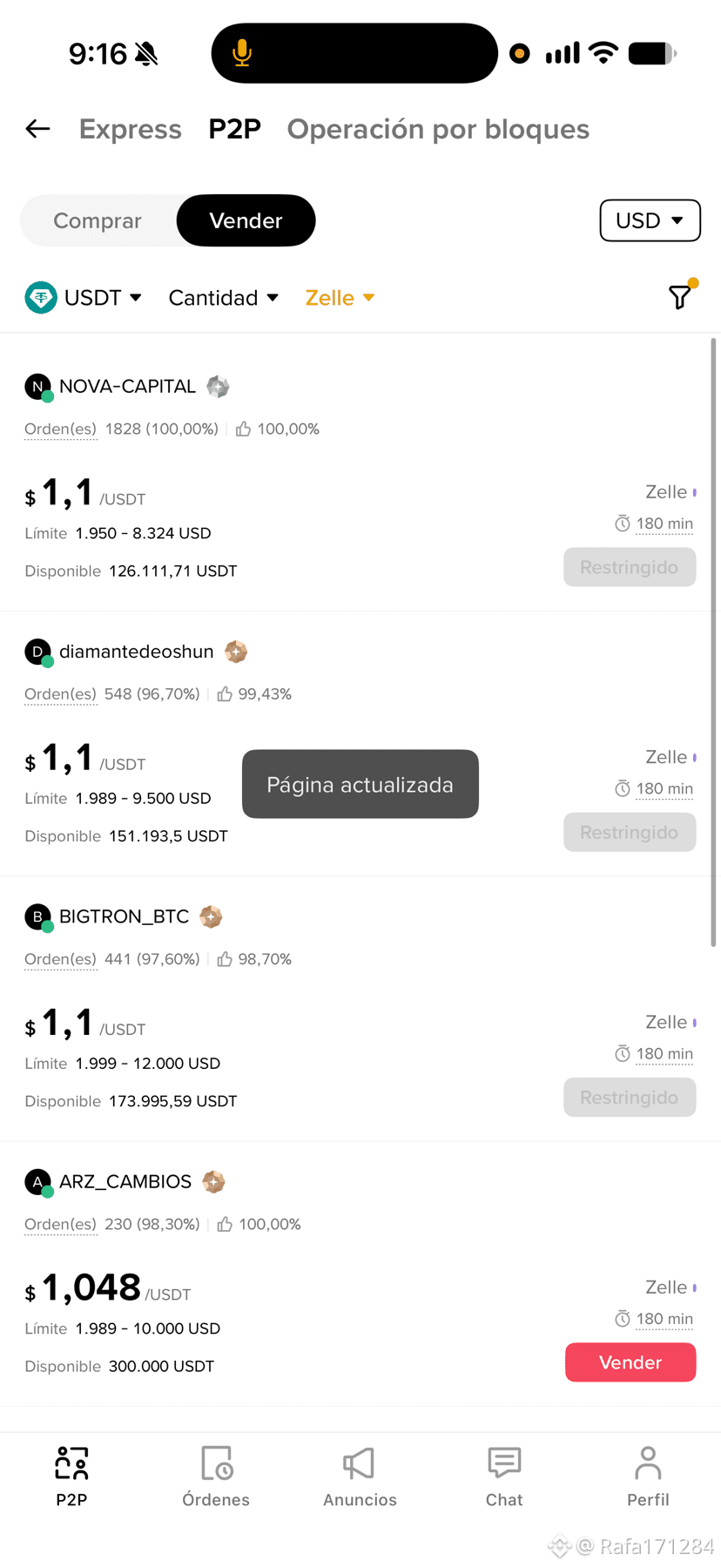
To everyone selling their USDT in exchange for Zelle: there are several traders offering very attractive prices, but it’s a scam. The order is for 180 minutes, but that’s not all: they send you the money in installments because, during that time, they call people to make fraudulent promises or carry out some other kind of scam. Then the person who was scammed reports the fraud, and the Zelle account gets blocked, while they already have the USDT.
@Binance_Labs should investigate why this is happening so often. It happened to several people I know, and it happened to me too.
#P2PScam #P2PVenezuela
Be careful with those prices because they’re scams.
To everyone selling their USDT in exchange for Zelle: there are several traders offering very attractive prices, but it’s a scam. The order is for 180 minutes, but that’s not all: they send you the money in installments because, during that time, they call people to make fraudulent promises or carry out some other kind of scam. Then the person who was scammed reports the fraud, and the Zelle account gets blocked, while they already have the USDT.
@Binance Labs should investigate why this is happening so often. It happened to several people I know, and it happened to me too.
#P2PScam #P2PVenezuela
Be careful with those prices because they’re scams.
@Binance Labs should investigate why this is happening so often. It happened to several people I know, and it happened to me too.
#P2PScam #P2PVenezuela
Be careful with those prices because they’re scams.
1.6k

·
--
#сериал_p2p
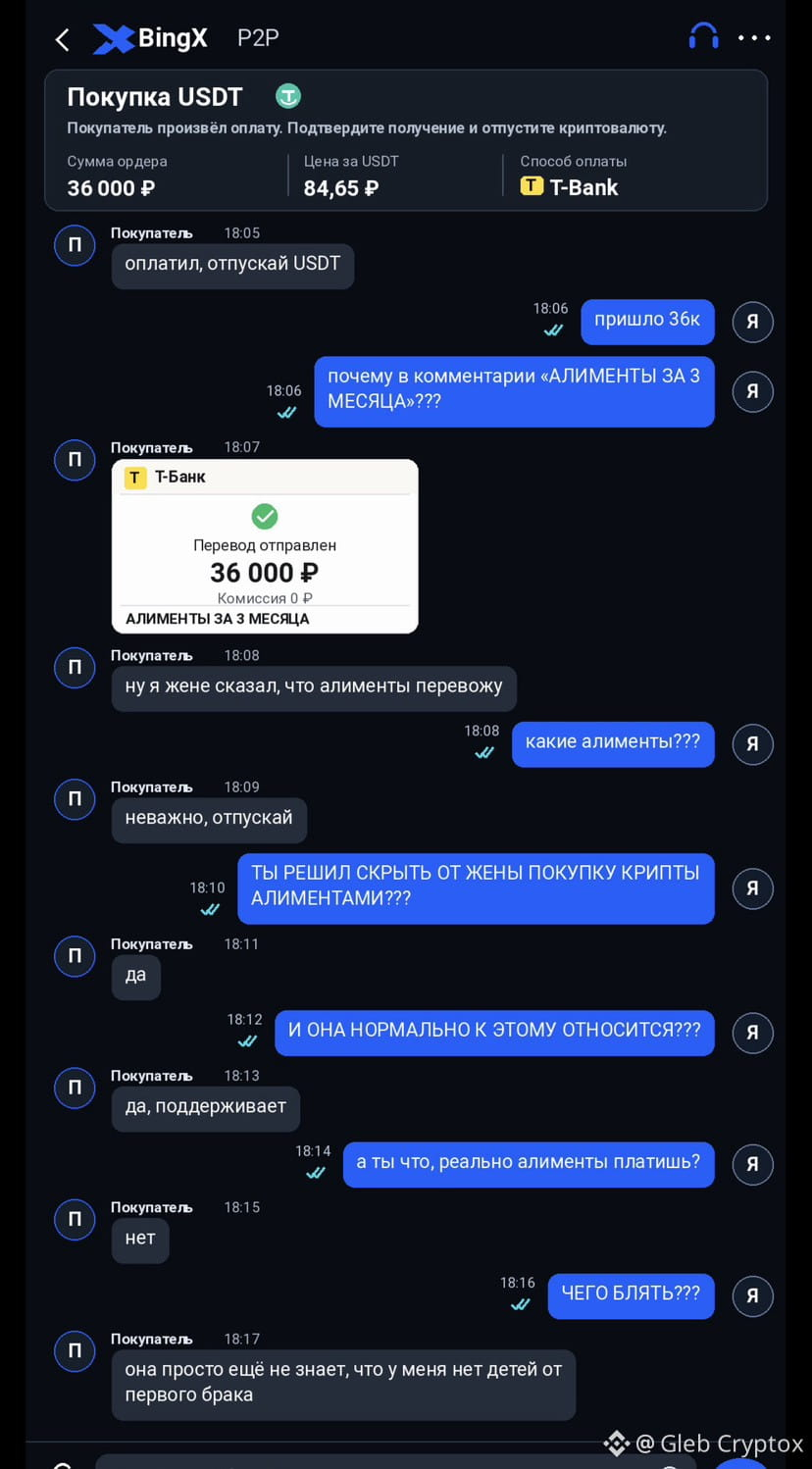
Well, here's another masterpiece from the world of P2P trading 🤣
Making up alimony payments and kids who don't even exist just so your wife won't find out you bought crypto—that's next-level stuff! 🤣🤣🤣
Listen, I'm just endlessly amazed by these people's creativity! Either they all love smoking weed, or they have such powerful protectors at the banks that their survival instincts switched off a long time ago 😂
[Смотреть предыдущую серию](https://app.binance.com/uni-qr/cpos/383711048192101?r=HRAFZ05X&l=ru&uco=kK_QGp22sACFDSuX7zSV7Q&uc=app_square_share_link&us=copylink)
If you have any funny moments, send them to me in a DM and I'll post them.
Thanks for this masterpiece, Igor 🤝
#P2P #P2PScam
#сериал_p2p
Well, here's another masterpiece from the world of P2P trading 🤣
Making up alimony payments and kids who don't even exist just so your wife won't find out you bought crypto—that's next-level stuff! 🤣🤣🤣
Listen, I'm just endlessly amazed by these people's creativity! Either they all love smoking weed, or they have such powerful protectors at the banks that their survival instincts switched off a long time ago 😂
Смотреть предыдущую серию
If you have any funny moments, send them to me in a DM and I'll post them.
Thanks for this masterpiece, Igor 🤝
#P2P #P2PScam
10
33
29.8k

·
--
Article
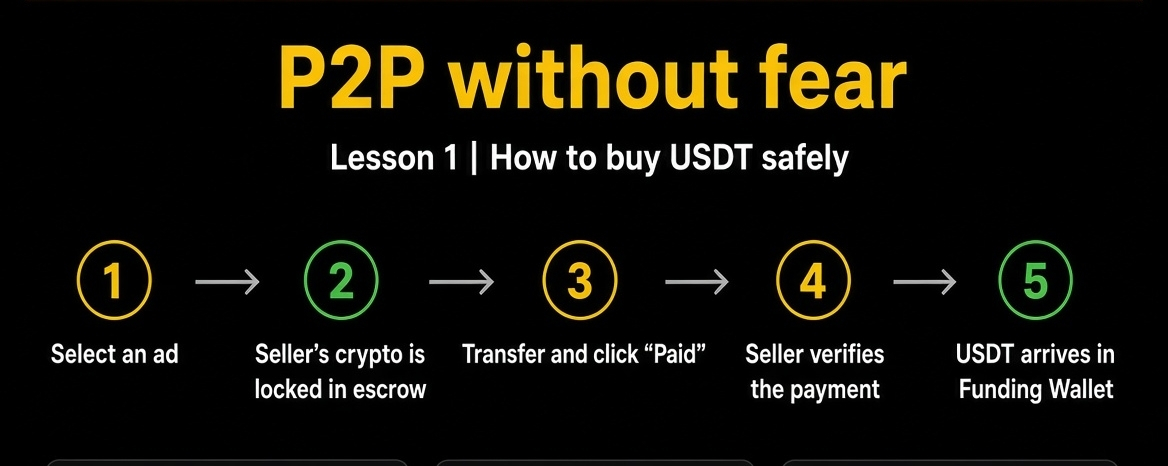
P2P Without Fear: Lesson 1 🛡️Many people worry: “What if I transfer the money and the seller doesn’t release the crypto?” Here’s how it works:
1️⃣ Buy Crypto → P2P → “Buy” → choose a coin and currency
2️⃣ Choose an ad, enter the amount → an order is created
3️⃣ The seller’s crypto is locked in Binance escrow until you pay
4️⃣ Transfer the money using the payment details in the order → tap “Paid” (only after making the transfer)
P2P Without Fear: Lesson 1 🛡️
Many people worry: “What if I transfer the money and the seller doesn’t release the crypto?” Here’s how it works:
1️⃣ Buy Crypto → P2P → “Buy” → choose a coin and currency
2️⃣ Choose an ad, enter the amount → an order is created
3️⃣ The seller’s crypto is locked in Binance escrow until you pay
4️⃣ Transfer the money using the payment details in the order → tap “Paid” (only after making the transfer)
1️⃣ Buy Crypto → P2P → “Buy” → choose a coin and currency
2️⃣ Choose an ad, enter the amount → an order is created
3️⃣ The seller’s crypto is locked in Binance escrow until you pay
4️⃣ Transfer the money using the payment details in the order → tap “Paid” (only after making the transfer)
1
2.9k

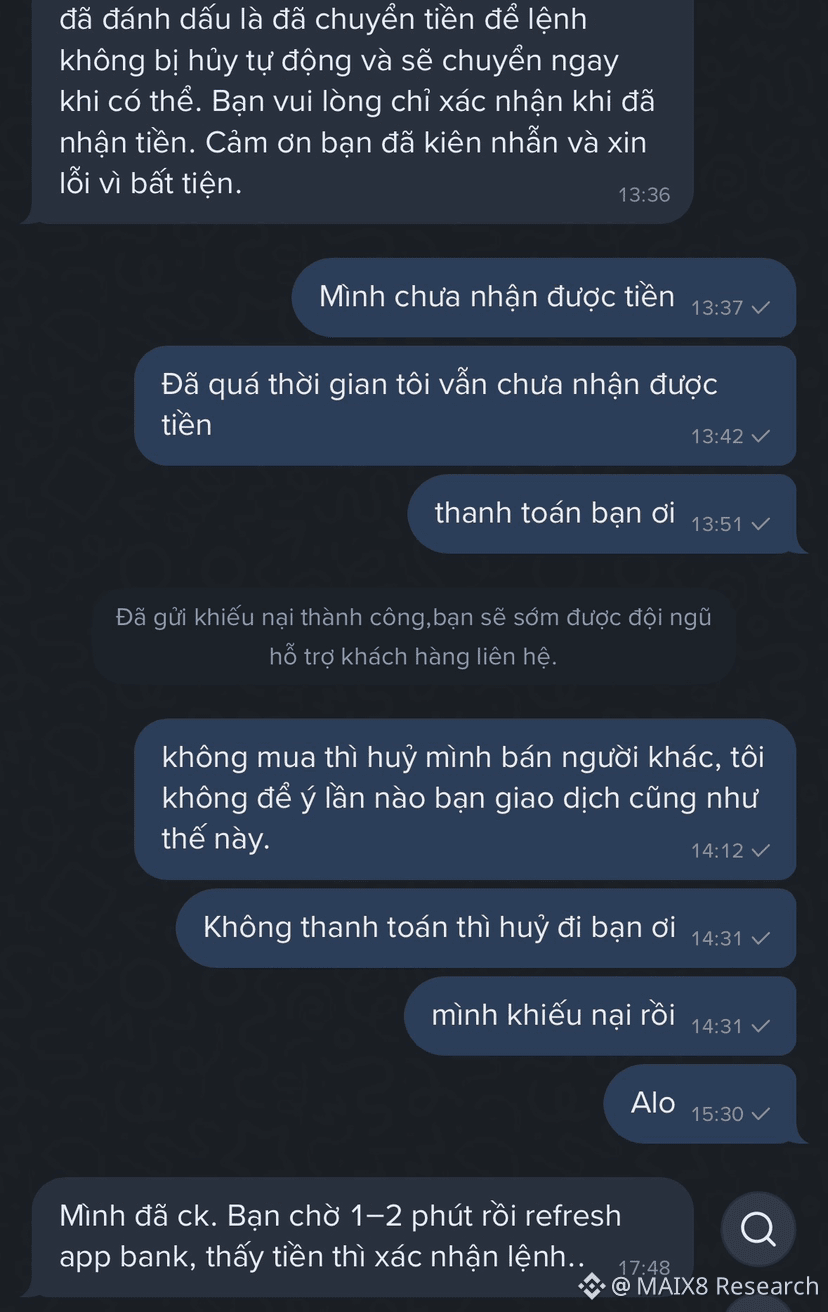
I am victim #P2PScam
I used to be a victim of a P2P order.
After transferring the money, the other side kept messaging “processing,” “wait a little longer.” It went on and on. Only when I submitted a complaint did the other side start changing their attitude.
At that time, I was both angry and on edge, because the money had already left my account but the coins hadn’t come back yet.
Luckily, I didn’t send the transaction out of the app and I kept all the evidence, so in the end I was still able to get it back.
After that, I was never careless again.
Now before every order, I check carefully:
• Number of completed transactions
• Success rate
• Advertisement conditions
And absolutely do not handle anything outside the system.
P2P isn’t always smooth, but if you know how to protect yourself, the risk will be reduced by a lot.
If anyone has been through a similar case, leave a comment nhé.
@Binance_Vietnam
#BinanceP2PAnToan
I am victim #P2PScam
I used to be a victim of a P2P order.
After transferring the money, the other side kept messaging “processing,” “wait a little longer.” It went on and on. Only when I submitted a complaint did the other side start changing their attitude.
At that time, I was both angry and on edge, because the money had already left my account but the coins hadn’t come back yet.
Luckily, I didn’t send the transaction out of the app and I kept all the evidence, so in the end I was still able to get it back.
After that, I was never careless again.
Now before every order, I check carefully:
• Number of completed transactions
• Success rate
• Advertisement conditions
And absolutely do not handle anything outside the system.
P2P isn’t always smooth, but if you know how to protect yourself, the risk will be reduced by a lot.
If anyone has been through a similar case, leave a comment nhé.
@Binance Vietnam #BinanceP2PAnToan
51

·
--
Bullish
🔍 BEFORE BUYING ON P2P, CHECK THESE 3 THINGS!
1️⃣ Completion rate – the higher, the more basis you have for evaluation.
2️⃣ Number of transactions – review the counterparty’s transaction history.
3️⃣ Payment account name – always cross-check with the order information.
⚠️ Anything unusual? Stop and check carefully before paying.
Safe P2P starts with one small verification. 🔐
@Binance_Vietnam
#BinanceP2PAnToan #BinanceP2P $BTC $ETH $BNB #P2PScam
🔍 BEFORE BUYING ON P2P, CHECK THESE 3 THINGS!
1️⃣ Completion rate – the higher, the more basis you have for evaluation.
2️⃣ Number of transactions – review the counterparty’s transaction history.
3️⃣ Payment account name – always cross-check with the order information.
⚠️ Anything unusual? Stop and check carefully before paying.
Safe P2P starts with one small verification. 🔐
@Binance Vietnam
#BinanceP2PAnToan #BinanceP2P $BTC $ETH $BNB #P2PScam
1
357

·
--
How to Avoid P2P Scams on Binance 🔒
Peer-to-Peer (P2P) trading is incredibly convenient, but scammers are always looking for ways to exploit traders. Here are the golden rules to stay safe:
Never Release Crypto Early: Scammers will send fake SMS alerts or altered payment screenshots. Always log in directly to your bank or wallet app to manually verify that the cash has cleared before releasing assets.
Keep Chats on Binance: Never move communication to external chat apps.
Match Names: Only accept payments where the sender's bank account name perfectly matches their verified Binance name.
Stay vigilant and trade safe! 👇
#P2PScam #BinanceSquareFamily
1
173

·
--
Bullish
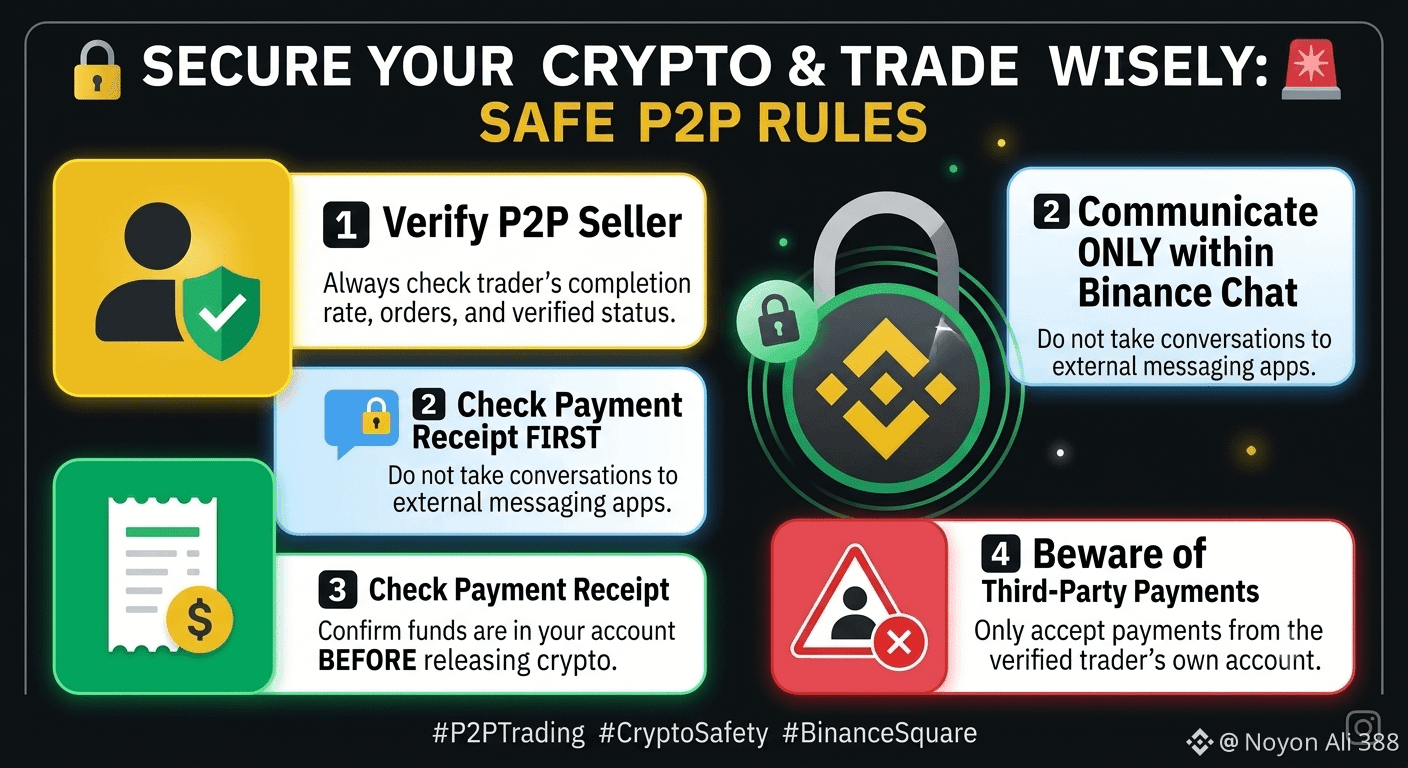
$BTC 🔒 P2P Trading Safety: 4 Golden Rules to Prevent Scams! 🚨
Peer-to-Peer (P2P) trading is convenient, but it's crucial to stay vigilant against scammers. Always prioritize your security with these essential rules:
📌 4 Crucial Security Rules:
1️⃣ Verify P2P Seller: Before initiating a trade, check the seller's completion rate and reputation. Trade with verified and established merchants.
2️⃣ Communicate ONLY within Binance Chat: Avoid taking conversations off-platform to external messaging apps. Scammers often use this tactic.
3️⃣ Check Payment Receipt FIRST: Ensure funds have actually landed in your account before releasing the crypto. Scammers might send fake receipts.
4️⃣ Beware of Third-Party Payments: Never accept payments from accounts with a name different from the verified trader's on the platform.
💡 Remember, your security is your own responsibility. If something feels off, cancel the trade and report suspicious activity. Trade smart and keep your crypto safe!
#P2PTrading #CryptoSafety #BinanceP2P #TradingSecurity #PreventScams #DYOR #CryptoEducation #P2PScam
{spot}(BTCUSDT)
$BTC 🔒 P2P Trading Safety: 4 Golden Rules to Prevent Scams! 🚨
Peer-to-Peer (P2P) trading is convenient, but it's crucial to stay vigilant against scammers. Always prioritize your security with these essential rules:
📌 4 Crucial Security Rules:
1️⃣ Verify P2P Seller: Before initiating a trade, check the seller's completion rate and reputation. Trade with verified and established merchants.
2️⃣ Communicate ONLY within Binance Chat: Avoid taking conversations off-platform to external messaging apps. Scammers often use this tactic.
3️⃣ Check Payment Receipt FIRST: Ensure funds have actually landed in your account before releasing the crypto. Scammers might send fake receipts.
4️⃣ Beware of Third-Party Payments: Never accept payments from accounts with a name different from the verified trader's on the platform.
💡 Remember, your security is your own responsibility. If something feels off, cancel the trade and report suspicious activity. Trade smart and keep your crypto safe!
#P2PTrading #CryptoSafety #BinanceP2P #TradingSecurity #PreventScams #DYOR #CryptoEducation #P2PScam
82

#P2PScam I have buy usdt from red rose seller in Pakistan i have sent payment from upaisa bank app but seller is lying he has not received payment and he has Go for appeal now upaisa only offers one time transaction screen shot sellir knows it and binance cs wants it also pdf file is not going in appeal platform what should I do ?
#P2PScam I have buy usdt from red rose seller in Pakistan i have sent payment from upaisa bank app but seller is lying he has not received payment and he has Go for appeal now upaisa only offers one time transaction screen shot sellir knows it and binance cs wants it also pdf file is not going in appeal platform what should I do ?
109
·
--
Today I Was Scammed During a Crypto P2P Trade 😭Today I experienced a scam while trying to complete a crypto P2P transaction. I trusted the other party and expected the trade to be completed honestly, but unfortunately that did not happen.
As shown in the screenshot, I asked the seller to send the dollars after payment. However, the order timer expired, and Binance displayed the message that the order had been canceled. The notification also stated that if payment had already been made, I should contact the counterparty for a refund or reach out to customer support.
This incident is a reminder that online transactions require extreme caution. Before sending any payment, always make sure there is enough time left on the order, verify the seller's reputation, and never send money outside the platform's secure process. If any issue arises, immediately contact the platform's customer support and provide screenshots and payment proof.
Although losing money is frustrating, this experience taught me an important lesson: never rush into online financial transactions, always follow the platform's official guidelines, and keep complete records of every payment.
I hope that by sharing my experience, others will be more careful and avoid becoming victims of similar scams. Always stay alert, trade only with trusted users, and use the platform's dispute or appeal system whenever something seems suspicious.
#P2PScam #Crypto
Today I Was Scammed During a Crypto P2P Trade 😭
Today I experienced a scam while trying to complete a crypto P2P transaction. I trusted the other party and expected the trade to be completed honestly, but unfortunately that did not happen.
As shown in the screenshot, I asked the seller to send the dollars after payment. However, the order timer expired, and Binance displayed the message that the order had been canceled. The notification also stated that if payment had already been made, I should contact the counterparty for a refund or reach out to customer support.
This incident is a reminder that online transactions require extreme caution. Before sending any payment, always make sure there is enough time left on the order, verify the seller's reputation, and never send money outside the platform's secure process. If any issue arises, immediately contact the platform's customer support and provide screenshots and payment proof.
Although losing money is frustrating, this experience taught me an important lesson: never rush into online financial transactions, always follow the platform's official guidelines, and keep complete records of every payment.
I hope that by sharing my experience, others will be more careful and avoid becoming victims of similar scams. Always stay alert, trade only with trusted users, and use the platform's dispute or appeal system whenever something seems suspicious.
#P2PScam #Crypto
96
·
--
A new scam is spreading across Binance P2P – stay vigilant!
How it works:
🛒 The scammer places a buy order and sends a fake payment.
💸 You receive an SMS or email — it looks legitimate.
🔄 After you release the cryptocurrency, the scammer cancels the bank transfer.
❌ Result: You lose both your money and your cryptocurrency.
Fake trading profiles ⚠️🎭
👤 They create fake accounts with fake reviews to earn your trust.
💬 Persuasive chats, quick deals, polite tone — it’s all a trap.
🕳️ Once you transfer the money, they disappear without sending the cryptocurrency.
Protect yourself 🔐:
1. 💬 Don’t chat outside Binance P2P — scammers avoid Binance monitoring.
2. ✔️ Trade only with verified users — look for the blue checkmark.
3. 🏦 Verify the payment only in your banking app — ignore SMS or email notifications.
4. ⛔️ If something seems suspicious — DO NOT release the cryptocurrency!
Press the “Appeal” button immediately.
Be smart. Stay safe.
Share this to help others avoid the trap!
#P2PScam #P2P #P2PTrading $BTC
1
1
3
497
🚨 P2P ALERT, fam before they flip the cake on you 🚨
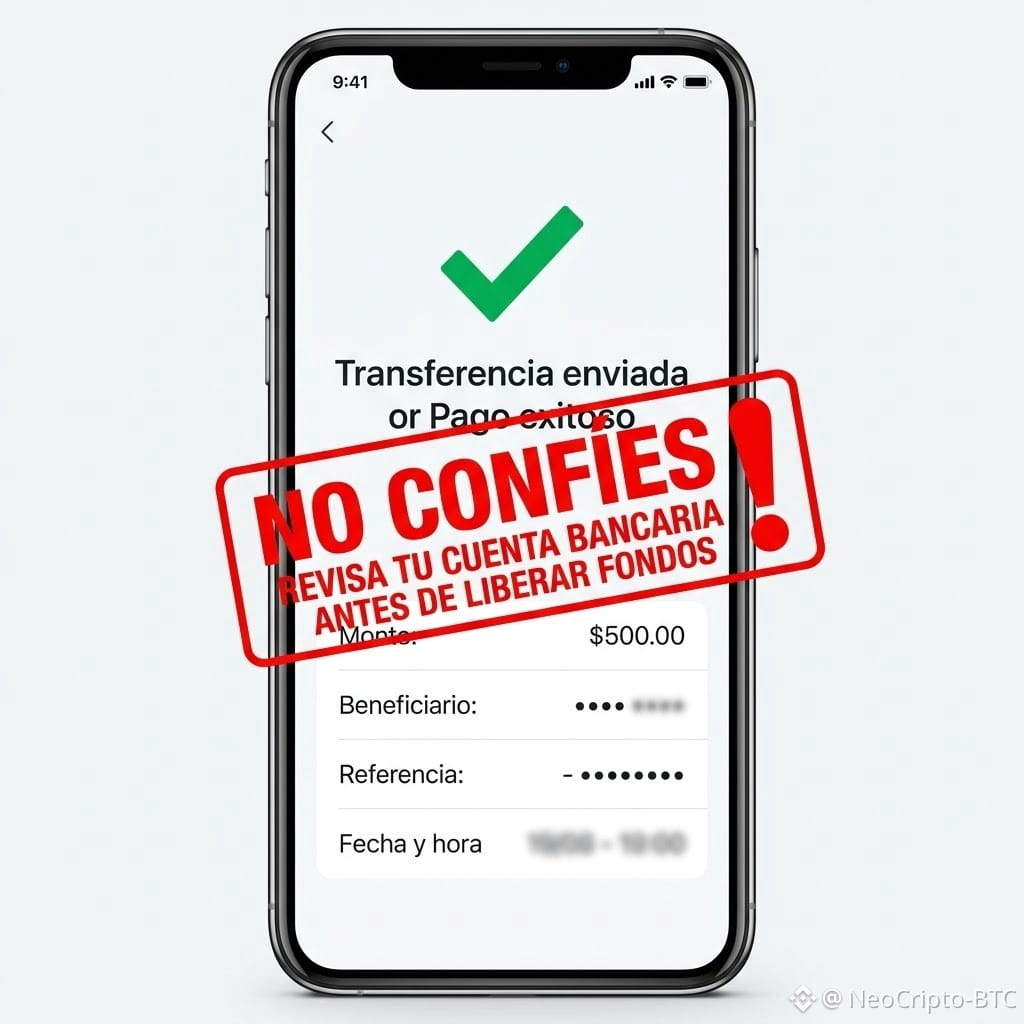
Look at what I received and it’s a textbook case of how NOT to operate in P2P 👇
A buyer sends a “confirmation” via chat, says they already paid, posts a screenshot of a transfer to Banesco... and the seller, all confident, releases the coins. Classic. This is how people get scammed in P2P every day.
What the seller did wrong (and you should not repeat):
🔴 Releasing crypto because “the message arrived” — a chat, an audio, or a “don’t worry bro” is NOT a confirmed payment.
🔴 Trusting a screenshot— it can be edited in 2 minutes with any app.
🔴 Not going directly into the bank app to verify the real deposit, with the exact amount and the reference.
🔴 Accepting pressure (“I’m waiting,” “okay, I’m in a rush”)— that’s a scammer tactic; they rush you so you don’t check properly.
🔴 Not trading only with verified merchants — the platform itself warns you, and many still ignore it.
What YOU SHOULD do:
✅ Verify the payment directly in your bank or wallet— never via screenshot or what they “tell” you.
✅ Confirm that the account holder’s name and the amount match exactly.
✅ Trade only with verified merchants / those with a good reputation and volume.
✅ If they rush you or pressure you, that’s a red flag— take your time.
✅ When in doubt, open a dispute with the platform before releasing the funds.$USDC
In P2P, the golden rule is still the same as always: don’t release anything until YOU personally see the money in your account. Not via chat, not via a screenshot, not based on trust.
#P2PScam
$BTC
{future}(BTCUSDT)
$ETH
{future}(ETHUSDT)
{future}(USDCUSDT)
🚨 P2P ALERT, fam before they flip the cake on you 🚨
Look at what I received and it’s a textbook case of how NOT to operate in P2P 👇
A buyer sends a “confirmation” via chat, says they already paid, posts a screenshot of a transfer to Banesco... and the seller, all confident, releases the coins. Classic. This is how people get scammed in P2P every day.
What the seller did wrong (and you should not repeat):
🔴 Releasing crypto because “the message arrived” — a chat, an audio, or a “don’t worry bro” is NOT a confirmed payment.
🔴 Trusting a screenshot— it can be edited in 2 minutes with any app.
🔴 Not going directly into the bank app to verify the real deposit, with the exact amount and the reference.
🔴 Accepting pressure (“I’m waiting,” “okay, I’m in a rush”)— that’s a scammer tactic; they rush you so you don’t check properly.
🔴 Not trading only with verified merchants — the platform itself warns you, and many still ignore it.
What YOU SHOULD do:
✅ Verify the payment directly in your bank or wallet— never via screenshot or what they “tell” you.
✅ Confirm that the account holder’s name and the amount match exactly.
✅ Trade only with verified merchants / those with a good reputation and volume.
✅ If they rush you or pressure you, that’s a red flag— take your time.
✅ When in doubt, open a dispute with the platform before releasing the funds.$USDC
In P2P, the golden rule is still the same as always: don’t release anything until YOU personally see the money in your account. Not via chat, not via a screenshot, not based on trust.
#P2PScam
$BTC
$ETH
5
1
8
3.3k


·
--
🔺🔺P2P Scam: My bank account freezed🔺🔺
Hi readers
today i would tell you how my Bank account got
freeze and How can u avoid it and safeguard your funds
So actually in Feb this year I was casually eating something and tried to pay through UPI but got error i took it normally then tried again but to no avail Sensing something wrong I contacted with my bank and they informed me that they have recieved orders to freeze my bank account due to non legal funds.
Then i got to know that somebody Who has paid me on P2P commited fraud and every account he transacted with was blocked
So never ever transact with anyone having less then 50% trades and less then 95% completion rate
And always pay on the same bank A/C holder name as name in binance account
#P2PScam #Safety
(PS: That bank ac is still blocked 😢)

7
2
5
5.3k

Article
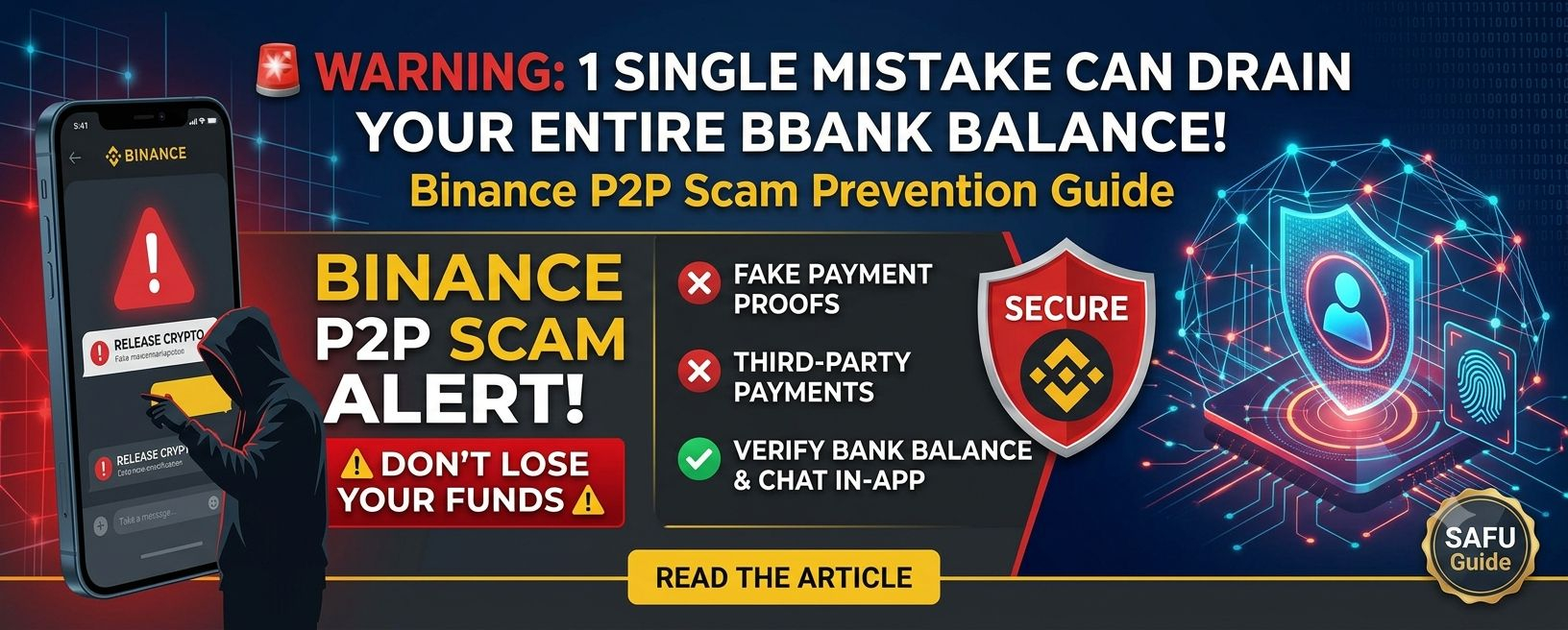
🚨 Warning: 1 Single Mistake Can Drain Your Entire Bank Balance! Binance P2P Scam Prevention Guide👇Peer-to-Peer (P2P) trading is the most popular method for buying and selling cryptocurrency. However, due to chargebacks, payment frauds, and fake transfer proofs, thousands of traders risk losing their hard-earned money every day.
This article outlines the most dangerous scams on Binance P2P and provides proven security rules to keep your funds safe.
1. Common Scams on P2P & Web3
Scammers constantly invent new tactics. Here are 4 major scams currently operating:
Fake Payment Screenshots & SMS: Scammers send realistic-looking fake bank transfer screenshots or fake SMS notifications without actually transferring any funds.
Third-Party Payment Scam: The buyer pays you from a bank account belonging to a third party. Later, the original account holder reports the unauthorized transaction to the bank, triggering a chargeback that freezes your bank account.
High-Pressure Release Tactics: The buyer insists they have sent the money and demands that you release the crypto immediately, even though the funds have not hit your bank balance.
Fake Binance Support Agents: Scammers impersonate customer support staff on Telegram or external chat apps to request your OTPs, passwords, or personal details.
2. P2P Security Checklist: Rules to Follow
Follow these strict rules to protect your bank account and digital assets:
Verify Your Bank Balance Directly: Never rely solely on SMS notifications or buyer screenshots. Always log into your official mobile banking app to verify that the funds are cleared and available.
Reject Third-Party Payments: The buyer’s Binance verified name must match the bank account holder's name exactly. If the names differ, refund the payment immediately and cancel the trade.
Never Release Crypto Early: Do not click "Payment Received" until the funds are fully reflected in your bank account, regardless of how much pressure the counterparty applies.
Keep All Communications On-Platform: Communicate strictly within the Binance P2P internal chat window. Never shift conversations to WhatsApp, Telegram, or external channels.
3. What to Do If You Encounter a Scam
If you suspect fraudulent activity during a trade:
File an Appeal Immediately: Click the "Appeal" button on the order page to prompt the Binance escrow team to freeze the trade assets.
Submit Clear Evidence: Upload your official bank statements, chat logs, and screen recordings as proof.
Contact Official Support: Reach out directly via the in-app Binance Live Support Center.
💬 What Has Your Experience Been?
Have you ever encountered a suspicious buyer or seller on P2P? Share your safety tips in the comments below to help keep our community safe!
$ONG $BTR
#P2PScam #Write2Earn #P2PScamAwareness
🚨 Warning: 1 Single Mistake Can Drain Your Entire Bank Balance! Binance P2P Scam Prevention Guide👇
Peer-to-Peer (P2P) trading is the most popular method for buying and selling cryptocurrency. However, due to chargebacks, payment frauds, and fake transfer proofs, thousands of traders risk losing their hard-earned money every day.
This article outlines the most dangerous scams on Binance P2P and provides proven security rules to keep your funds safe.
1. Common Scams on P2P & Web3
Scammers constantly invent new tactics. Here are 4 major scams currently operating:
Fake Payment Screenshots & SMS: Scammers send realistic-looking fake bank transfer screenshots or fake SMS notifications without actually transferring any funds.
Third-Party Payment Scam: The buyer pays you from a bank account belonging to a third party. Later, the original account holder reports the unauthorized transaction to the bank, triggering a chargeback that freezes your bank account.
High-Pressure Release Tactics: The buyer insists they have sent the money and demands that you release the crypto immediately, even though the funds have not hit your bank balance.
Fake Binance Support Agents: Scammers impersonate customer support staff on Telegram or external chat apps to request your OTPs, passwords, or personal details.
2. P2P Security Checklist: Rules to Follow
Follow these strict rules to protect your bank account and digital assets:
Verify Your Bank Balance Directly: Never rely solely on SMS notifications or buyer screenshots. Always log into your official mobile banking app to verify that the funds are cleared and available.
Reject Third-Party Payments: The buyer’s Binance verified name must match the bank account holder's name exactly. If the names differ, refund the payment immediately and cancel the trade.
Never Release Crypto Early: Do not click "Payment Received" until the funds are fully reflected in your bank account, regardless of how much pressure the counterparty applies.
Keep All Communications On-Platform: Communicate strictly within the Binance P2P internal chat window. Never shift conversations to WhatsApp, Telegram, or external channels.
3. What to Do If You Encounter a Scam
If you suspect fraudulent activity during a trade:
File an Appeal Immediately: Click the "Appeal" button on the order page to prompt the Binance escrow team to freeze the trade assets.
Submit Clear Evidence: Upload your official bank statements, chat logs, and screen recordings as proof.
Contact Official Support: Reach out directly via the in-app Binance Live Support Center.
💬 What Has Your Experience Been?
Have you ever encountered a suspicious buyer or seller on P2P? Share your safety tips in the comments below to help keep our community safe!
$ONG $BTR
#P2PScam #Write2Earn #P2PScamAwareness
459

·
--
Bearish
There are a lot of scams happening in P2P these days. My buddy got hit with a scam of 235,000, and we're currently trying to recover that amount.
I urge you all to be super cautious with P2P trading. Always deal with verified traders who have good ranks/reputation. Don't trust unknown or suspicious individuals.
Stay safe from scammers and spread the word to others, so no one else falls victim. Always prioritize safety and verification.
$USDC $BTC $LAB
{future}(LABUSDT)
#P2PScam #Scam? #CryptoMarket #Pakistan #Binance
There are a lot of scams happening in P2P these days. My buddy got hit with a scam of 235,000, and we're currently trying to recover that amount.
I urge you all to be super cautious with P2P trading. Always deal with verified traders who have good ranks/reputation. Don't trust unknown or suspicious individuals.
Stay safe from scammers and spread the word to others, so no one else falls victim. Always prioritize safety and verification.
$USDC $BTC $LAB
#P2PScam #Scam? #CryptoMarket #Pakistan #Binance
1
156

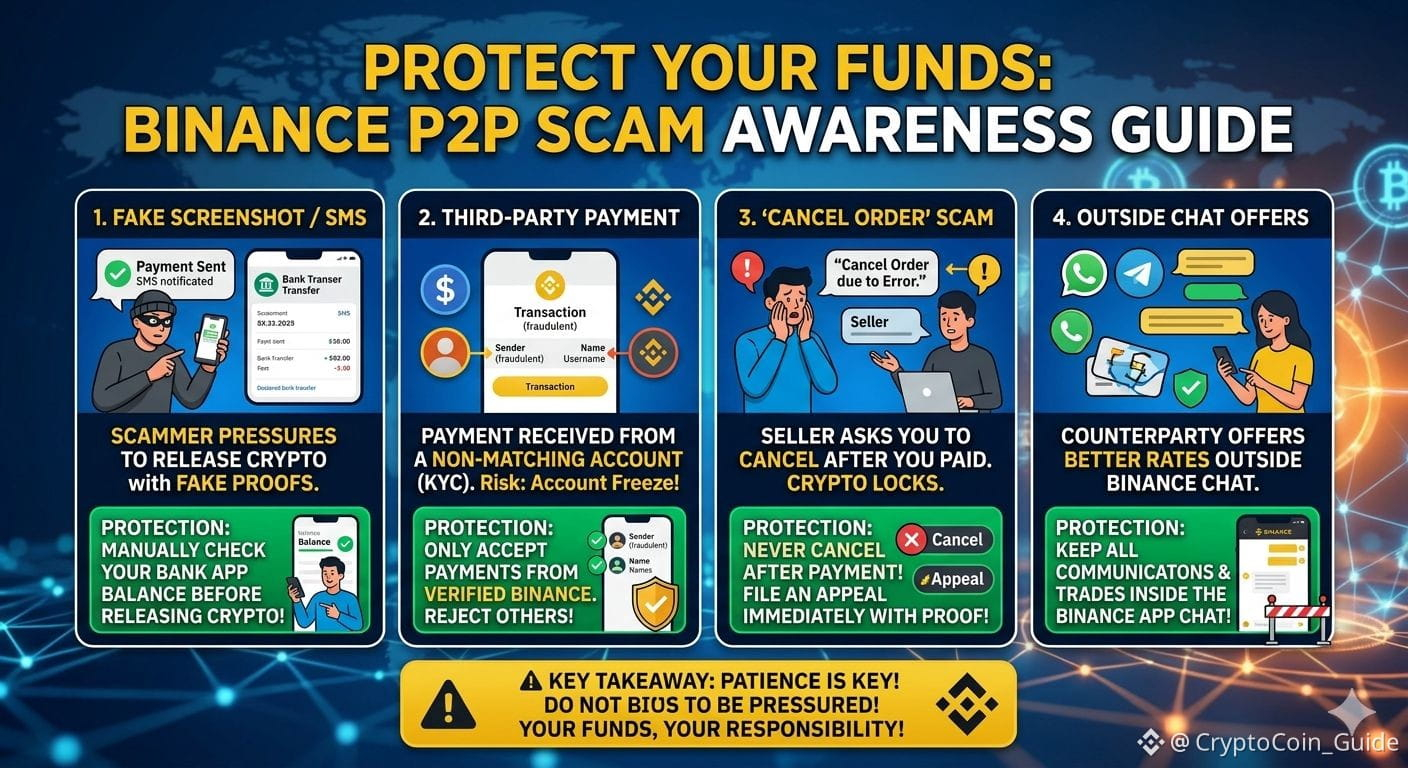
NEW SCAM ALERT 🔥
In P2P trading, rushing can lead to major losses. Protect yourself from these 4 common scams:
Fake Screenshot / SMS: The scammer sends a fake payment proof and pressures you to release the crypto.
Protection: Never release crypto until you manually open your bank or e-wallet app and verify the funds are in your Available Balance. Never trust screenshots.
Third-Party Payment: You receive money from an account that doesn't match the sender's Binance name. This can get your bank account frozen due to fraudulent funds.
Protection: Only accept payments where the bank account name exactly matches the verified Binance KYC name.
"Cancel Order" Scam: After you send the money, the seller claims a banking error occurred and asks you to cancel the order so they can refund you.
Protection: If you have already paid, never cancel the order. If you do, the crypto goes back to the seller. File an Appeal immediately.
Outside Chat (WhatsApp/Telegram): The counterparty asks to move the conversation off-platform for "better rates."
Protection: Keep all communications and transactions strictly inside the official Binance app to stay protected by the escrow system.
⚠️ Takeaway: Patience is key in P2P trading. Do not let anyone pressure you into acting quickly!
#P2PScamAwareness #P2PScam #ScamAwareness
413
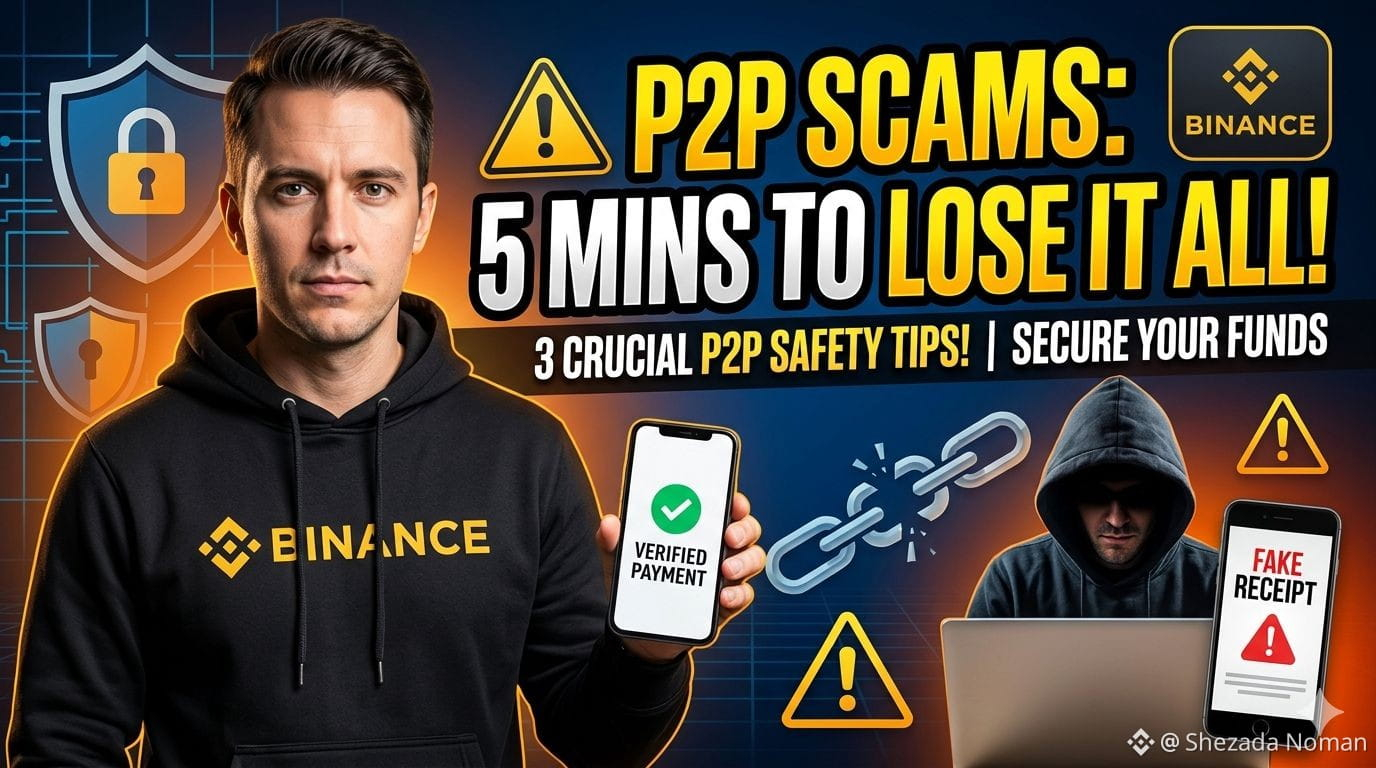
🛑 Don’t Let a 5-Minute Trade Cost You Your Entire Portfolio
The convenience of P2P (Peer-to-Peer) trading is undeniable, but it has also become a playground for sophisticated scammers. Every day, hundreds of traders lose funds not because the platform failed, but because they missed a red flag.
If you are trading on Binance P2P, here are the 3 Non-Negotiable Rules to keep your assets safe:
1. Trust Your Bank, Not a Screenshot 📸
Scammers are experts at creating pixel-perfect fake payment receipts. Never release your crypto just because a buyer sent a photo of a transfer. Always log in to your bank app and verify that the "Available Balance" has actually increased.
2. Beware of Third-Party Payments 👤
Only accept payments from an account that matches the verified name on the buyer's Binance profile. If User A is buying but User B sends the money, cancel the trade and report it. This is often a sign of a Triangular Scam or money laundering.
3. Stay Inside the Chat 💬
Never move your conversation to WhatsApp, Telegram, or Discord. If a dispute arises, Binance Support can only use the official P2P chat as evidence. If it’s not in the chat, it didn't happen.
💡 Pro Tip: If a buyer pressures you to Release Fast because of a "system glitch" or emergency, stay calm. That pressure is a psychological tactic. Take your time, verify the funds, and stay in control.
Security starts with you. Don't trade your safety for a slightly better exchange rate.
Watch closely $AGT $NEAR $GRASS
{future}(GRASSUSDT)
{future}(NEARUSDT)
{future}(AGTUSDT)
#P2PScam #P2PScamAwareness #P2PScamWarning
🛑 Don’t Let a 5-Minute Trade Cost You Your Entire Portfolio
The convenience of P2P (Peer-to-Peer) trading is undeniable, but it has also become a playground for sophisticated scammers. Every day, hundreds of traders lose funds not because the platform failed, but because they missed a red flag.
If you are trading on Binance P2P, here are the 3 Non-Negotiable Rules to keep your assets safe:
1. Trust Your Bank, Not a Screenshot 📸
Scammers are experts at creating pixel-perfect fake payment receipts. Never release your crypto just because a buyer sent a photo of a transfer. Always log in to your bank app and verify that the "Available Balance" has actually increased.
2. Beware of Third-Party Payments 👤
Only accept payments from an account that matches the verified name on the buyer's Binance profile. If User A is buying but User B sends the money, cancel the trade and report it. This is often a sign of a Triangular Scam or money laundering.
3. Stay Inside the Chat 💬
Never move your conversation to WhatsApp, Telegram, or Discord. If a dispute arises, Binance Support can only use the official P2P chat as evidence. If it’s not in the chat, it didn't happen.
💡 Pro Tip: If a buyer pressures you to Release Fast because of a "system glitch" or emergency, stay calm. That pressure is a psychological tactic. Take your time, verify the funds, and stay in control.
Security starts with you. Don't trade your safety for a slightly better exchange rate.
Watch closely $AGT $NEAR $GRASS
#P2PScam #P2PScamAwareness #P2PScamWarning
283

Article
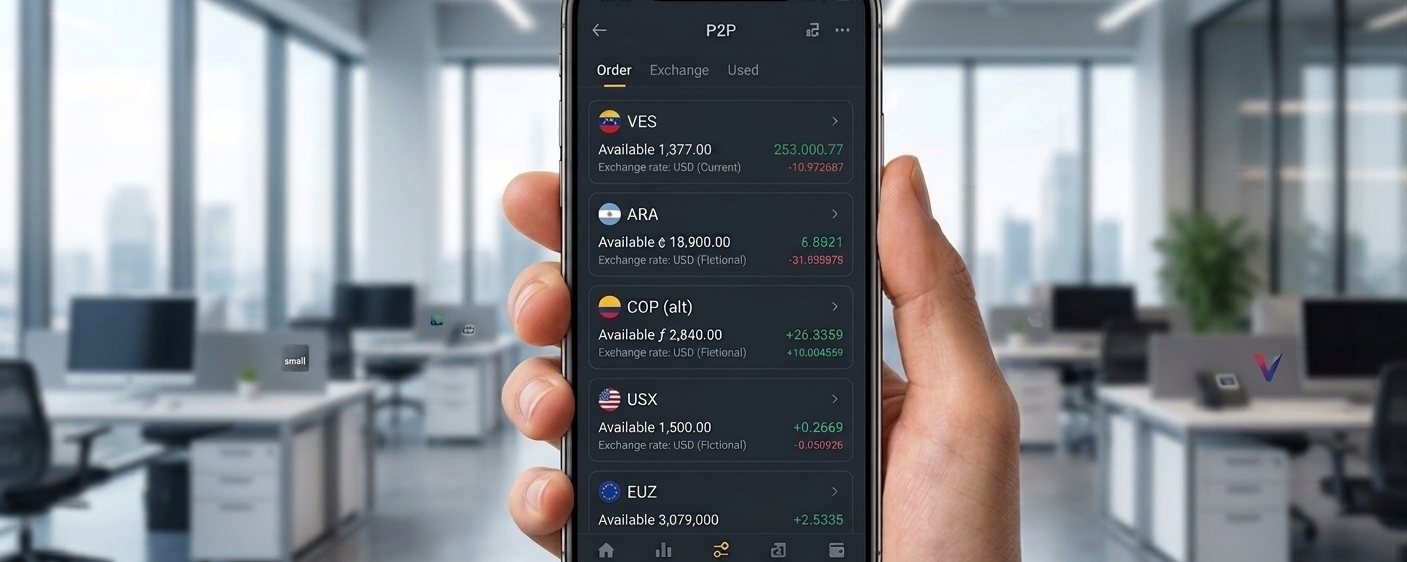
WHY BINANCE ALLOWS SCAMS IN P2PThe Binance Peer-to-Peer (P2P) market is the largest peer-to-peer trading platform in the world. It allows users to buy and sell cryptocurrencies directly with each other using their local currency.
On a global scale, the platform handles key numbers and structural features:
Figures and Global Reach
* **Fiat Currencies:** Supports over **100 local currencies** from around the world (including USD, EUR, VES, COP, ARS, etc.).
* **Payment Methods:** Offers over **800 to 1,000 active payment methods** globally, ranging from local bank transfers to international digital wallets (like Wise, Zinli, Revolut, or Zelle).
WHY BINANCE ALLOWS SCAMS IN P2P
The Binance Peer-to-Peer (P2P) market is the largest peer-to-peer trading platform in the world. It allows users to buy and sell cryptocurrencies directly with each other using their local currency.
On a global scale, the platform handles key numbers and structural features:
Figures and Global Reach
* **Fiat Currencies:** Supports over **100 local currencies** from around the world (including USD, EUR, VES, COP, ARS, etc.).
* **Payment Methods:** Offers over **800 to 1,000 active payment methods** globally, ranging from local bank transfers to international digital wallets (like Wise, Zinli, Revolut, or Zelle).
3
183
·
--
Bullish
#binancep2pantoan @Binance_Vietnam “Cancel the order first, and then I’ll unlock USDC for you.”
This is the most dangerous sentence I’ve ever seen in a P2P trade.
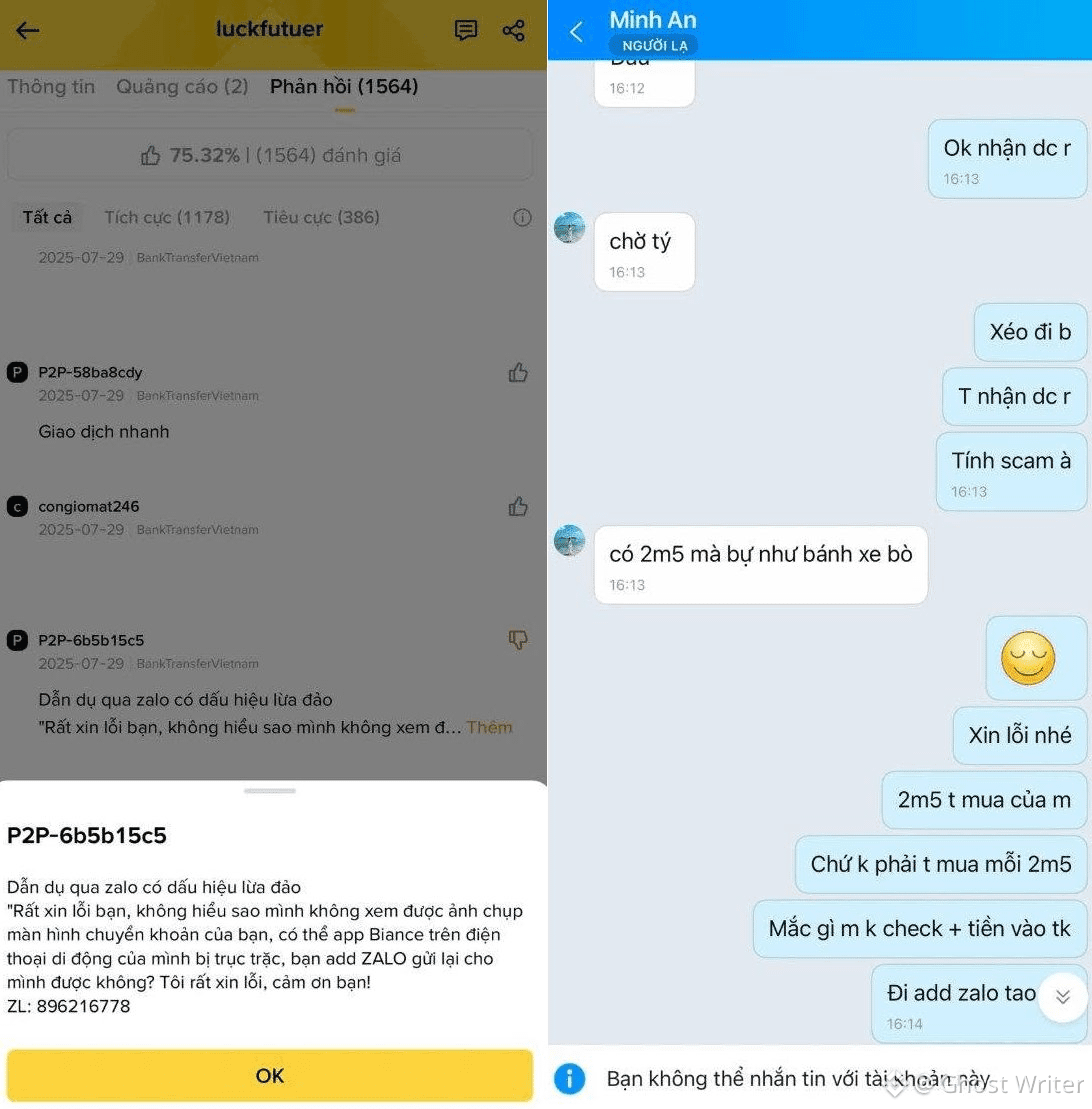
It happened to me yesterday. He bought about 2.5 million VND worth of USDC (nearly 100 USDC). After the bank transfer was completed, the counterparty didn’t release right away and instead messaged: “add Zalo to talk more nhé”. As soon as I added Zalo, I was asked to cancel the order first, and only then did they let the coins go.
Or there’s an even more sophisticated scam: they require the trade to be moved outside the platform to get a better exchange rate. It targets the new users’ greed for a bargain.
Luckily, I was alert enough not to click “cancel order.”
Because once you cancel the order, all transaction evidence on the platform disappears. The money has already been transferred, and Binance is also harder to intervene since the order no longer exists. This is exactly the point where many newcomers easily fall into scammers’ traps.
From that situation, I drew a few very clear rules:
⭐ If you’ve transferred money, absolutely never cancel the order—no matter what the counterparty says.
⭐ Never move the conversation to Zalo, Telegram, or any other channel.
⭐ All communication must stay within the order’s chat.
⭐ If there are any unusual signs, open an Appeal immediately, and at the same time keep the transfer receipt and the Order ID.
A legitimate trader will never ask you to cancel the order just so they can release it. Binance P2P has escrow and a complaint process specifically for situations like this—> the protection layer only works if you don’t dismantle it yourself.
Small trades of 100 USD or bigger ones—the rules are the same. Safety doesn’t come from luck; it comes from following the correct process.
What would you do if someone asks you to “cancel the order right away”? I would take screenshots and file a complaint.
#creatorpad #P2PScam $BTC $BNB
#binancep2pantoan @Binance Vietnam “Cancel the order first, and then I’ll unlock USDC for you.”
This is the most dangerous sentence I’ve ever seen in a P2P trade.
It happened to me yesterday. He bought about 2.5 million VND worth of USDC (nearly 100 USDC). After the bank transfer was completed, the counterparty didn’t release right away and instead messaged: “add Zalo to talk more nhé”. As soon as I added Zalo, I was asked to cancel the order first, and only then did they let the coins go.
Or there’s an even more sophisticated scam: they require the trade to be moved outside the platform to get a better exchange rate. It targets the new users’ greed for a bargain.
Luckily, I was alert enough not to click “cancel order.”
Because once you cancel the order, all transaction evidence on the platform disappears. The money has already been transferred, and Binance is also harder to intervene since the order no longer exists. This is exactly the point where many newcomers easily fall into scammers’ traps.
From that situation, I drew a few very clear rules:
⭐ If you’ve transferred money, absolutely never cancel the order—no matter what the counterparty says.
⭐ Never move the conversation to Zalo, Telegram, or any other channel.
⭐ All communication must stay within the order’s chat.
⭐ If there are any unusual signs, open an Appeal immediately, and at the same time keep the transfer receipt and the Order ID.
A legitimate trader will never ask you to cancel the order just so they can release it. Binance P2P has escrow and a complaint process specifically for situations like this—> the protection layer only works if you don’t dismantle it yourself.
Small trades of 100 USD or bigger ones—the rules are the same. Safety doesn’t come from luck; it comes from following the correct process.
What would you do if someone asks you to “cancel the order right away”? I would take screenshots and file a complaint.
#creatorpad #P2PScam $BTC $BNB
18
18
15.8k

·
--
Common P2P mistakes usually happen before you click Buy.
Before every transaction, I usually spend 1 minute checking a few things:
1. Counterparty profile: Merchant, completion rate, transaction history.
2. The payment account name matches the information on the order.
3. Any important discussion is kept in the order chat.
During the transaction, remember one rule:
If the money has not been received, do not Release.
A screenshot is not money.
A message saying “sent” is also not money.
Open your bank/app payment application yourself to check.
If the other party pressures you, changes the account mid-way, tries to pull the transaction outside Binance, or has any abnormal transfer content—pause and verify again.
If there’s any issue, keep the Order ID, receipts, and chat history to use when you need to Appeal to Support.
P2P has escrow and a support mechanism.
But the best protection is still: don’t skip the process.
@Binance_Vietnam #BinanceP2PAnToan #P2PScam
Common P2P mistakes usually happen before you click Buy.
Before every transaction, I usually spend 1 minute checking a few things:
1. Counterparty profile: Merchant, completion rate, transaction history.
2. The payment account name matches the information on the order.
3. Any important discussion is kept in the order chat.
During the transaction, remember one rule:
If the money has not been received, do not Release.
A screenshot is not money.
A message saying “sent” is also not money.
Open your bank/app payment application yourself to check.
If the other party pressures you, changes the account mid-way, tries to pull the transaction outside Binance, or has any abnormal transfer content—pause and verify again.
If there’s any issue, keep the Order ID, receipts, and chat history to use when you need to Appeal to Support.
P2P has escrow and a support mechanism.
But the best protection is still: don’t skip the process.
@Binance Vietnam #BinanceP2PAnToan #P2PScam
1
63
Log in to explore more content
Join global crypto users on Binance Square
⚡️ Get latest and useful information about crypto.
💬 Trusted by the world’s largest crypto exchange.
👍 Discover real insights from verified creators.
Email / Phone number
Trending Topics
1
#BitcoinAndStocksSlipAgainAmidTrump’sTariffPlans
47,339 views
633 Discussing
2
#WillOctCorePCEShiftFedHikeExpectations?
345,146 views
2,277 Discussing
3
#JensenHuangSaysNvidiaDoesn’tNeedASuccessionPlan
30,625 views
405 Discussing
4
#AnthropicBreaksBelowIPOPriceAmidAISlump
131,809 views
1,193 Discussing
5
#SouthKoreaPlansToRequireCryptoReferralMarketersToRegister
0 views
2 Discussing
6
#SBISolanaGlobalLaunchesInJapanOnChainFinanceMarket
16 views
11 Discussing
7
#HKMALaunchesCMUDigitalAssetPlatformForBondTokenization
267 views
8 Discussing
8
#HongKongPlansToRequireBanksToRegisterWithSFC
2,700 views
39 Discussing
9
#FidelityCryptoAddsAAVELINKAndUNITrading
11,886 views
168 Discussing
10
#UKToBanExchangesMakingMarketsOnOwnPlatforms
6,973 views
115 Discussing