
#cryptocustody
cryptocustody
27,583 views
247 Discussing
Hot
Latest

Deutsche Bank has gone live with its digital asset custody service for institutional and corporate clients in Europe. The offering covers Bitcoin, Ethereum, and stablecoins including USDC, with the bank managing wallets and private keys under MiCA rules. It also signed an MoU with its asset management arm to explore tokenized products.
$BTC $ETH $USDC #CoinVahini #DeutscheBank #CryptoCustody #InstitutionalCrypto
$BTC $ETH $USDC #CoinVahini #DeutscheBank #CryptoCustody #InstitutionalCrypto
1
107

·
--
Deutsche Bank debuts crypto custody on Nov. 11. It now holds BTC, ETH, and regulated stablecoins in its banking infrastructure, marking a major TradFi‑crypto integration step across Europe.
#CryptoCustody
Deutsche Bank debuts crypto custody on Nov. 11. It now holds BTC, ETH, and regulated stablecoins in its banking infrastructure, marking a major TradFi‑crypto integration step across Europe.
#CryptoCustody
#CryptoCustody
77


Article
Deutsche Bank Launches Institutional Crypto CustodyDeutsche Bank has completed its 5 year buildup to launch a specialized crypto custody service for its institutional and corporate client base across Europe. This move signals a significant shift as one of the largest global financial institutions moves beyond exploration into live deployment of digital asset infrastructure.
The offering currently supports Bitcoin, Ethereum, and 3 stablecoins. For institutional allocators this removes a major hurdle in the adoption of digital assets by providing the regulatory and security rigor expected of a tier 1 global bank.
This development validates the growing demand for institutional grade custody solutions and bridges the gap between traditional finance and decentralized asset markets.
#DeutscheBank #CryptoCustody
Deutsche Bank Launches Institutional Crypto Custody
Deutsche Bank has completed its 5 year buildup to launch a specialized crypto custody service for its institutional and corporate client base across Europe. This move signals a significant shift as one of the largest global financial institutions moves beyond exploration into live deployment of digital asset infrastructure.
The offering currently supports Bitcoin, Ethereum, and 3 stablecoins. For institutional allocators this removes a major hurdle in the adoption of digital assets by providing the regulatory and security rigor expected of a tier 1 global bank.
This development validates the growing demand for institutional grade custody solutions and bridges the gap between traditional finance and decentralized asset markets.
#DeutscheBank #CryptoCustody
5

🔐 WHAT IS CRYPTO CUSTODY?
Have you ever wondered how banks keep digital assets safe?
Crypto custody is the process of securely storing and managing digital assets such as Bitcoin and Ethereum.
Why is it important?
🔹 Protects digital assets
🔹 Helps institutions manage crypto securely
🔹 Reduces the risk of losing access to funds
🔹 Builds trust in the digital asset industry
Why does it matter?
As traditional banks enter the crypto market, secure custody services are becoming increasingly important.
The future of finance may be digital, but security will always matter.
💬 Question: Would you trust a traditional bank to protect your Bitcoin?
#Crypto #Bitcoin❗ #CryptoCustody #blockchain #DeutscheBank #BinanceSquare #
78

·
--
Germany's largest lender now holds bitcoin, ether and stablecoins for paying corporate and institutional clients.
• The custody service is live for paying clients, two months after the September announcement
• Supported assets: BTC, ETH, USDC, EURC and EURAU; the bank manages wallets and private keys
Why it matters: A top European bank holding crypto keys itself lowers the barrier for institutions that need a regulated custodian.
Source: Deutsche Bank, Reuters, The Block
Not financial advice.
💬 Will bank-run custody pull institutions away from crypto-native custodians? Share your view below.
$BTC $ETH #DeutscheBank #CryptoCustody
14
Crypto Custodians Target US Derivatives Settlement Market
Crypto custodians are targeting the $B daily US derivatives settlement market. This strategic shift depends on regulatory relief and upcoming changes in US congressional control.
#CryptoCustody #Derivatives
Crypto Custodians Target US Derivatives Settlement Market
Crypto custodians are targeting the $B daily US derivatives settlement market. This strategic shift depends on regulatory relief and upcoming changes in US congressional control.
#CryptoCustody #Derivatives
Crypto custodians are targeting the $B daily US derivatives settlement market. This strategic shift depends on regulatory relief and upcoming changes in US congressional control.
#CryptoCustody #Derivatives
61
#Coinbase has received final approval from the OCC for a national trust bank charter, placing its institutional crypto custody business under full federal oversight. The move upgrades an earlier conditional green light and puts Coinbase alongside firms like Circle and Ripple in the regulated trust space.
$COINB $COIN $COIN.US #CoinVahini #OCC #CryptoCustody
$COINB $COIN $COIN.US #CoinVahini #OCC #CryptoCustody
COINUS+1.46%
COINB+1.71%
47

·
--
Coinbase said on Nov. 9 that the U.S. Office of the Comptroller of the Currency gave final approval to charter Coinbase National Trust Company. The regulator signed off on Nov. 6, following conditional approval in April.
The charter gives Coinbase a federally regulated entity through which it can offer digital asset custody to institutions. For those clients, the change is in who safeguards the assets and which regulator oversees that service.
Source: https://www.coinbase.com/en-gb/blog/coinbase-launches-national-trust-company-with-federally-regulated-institutional-grade-custody-offering
#Coinbase #CryptoCustody #DigitalAssets


·
--
Deutsche Bank’s crypto custody service goes live, opening the door to European institutions after five years of development
The channels connecting traditional finance to crypto are gradually opening up, and this time the key player is a heavyweight in European banking. According to reports by Decrypt and Cointelegraph, Deutsche Bank has officially launched a cryptocurrency custody service, offering institutional and corporate clients storage, transfers, and wallet management for Bitcoin, Ethereum, and three stablecoins.
This service did not come together overnight. According to the two sources, Deutsche Bank built its custody platform from the ground up over five years before officially bringing it to market. Launching at this point, with BTC and ETH named among the first supported assets alongside stablecoin use cases, suggests this is more than a tentative move: the bank is incorporating crypto assets into its standard service framework for institutional clients.
From a capital-flow and macro perspective, the real significance lies in the “gateway.” European institutions seeking crypto exposure have often had to use third-party custodians or exchanges, resulting in long chains and high trust costs. As a systemically important European bank, Deutsche Bank could provide a more familiar entry point for European pension funds, family offices, and corporate treasuries once its custody licensing and compliance systems are in place. BTC’s inclusion among the first supported assets reflects its status as a likely priority for this kind of conservative capital. Broadening institutional access is a positive longer-term development for Bitcoin.
However, the scale and pace should be viewed cautiously. Based on the information available, Deutsche Bank has not disclosed the actual assets under custody, so it remains uncertain how much additional capital the launch will attract initially. Five years of development has delivered infrastructure, not an immediate influx of funds. The launch means assets “can now be held” in custody—not that large sums have already been deposited—so its near-term impact on prices may be limited.
The counterarguments are also clear. First, custody is not the same as allocation. Whether clients will actually increase their holdings because the service has launched depends on the custody volumes reported going forward. Second, European institutions remain constrained by macro liquidity, interest-rate trajectories, and risk appetite. Expanding a single channel is unlikely to reverse the overall pace of capital flows.
What to watch next: The more important indicators are whether Deutsche Bank discloses its custody volumes, adds more asset classes, and whether there are observable signs of inflows from European institutions. From a trading perspective, rather than treating the custody launch as a price catalyst, it may be better to wait for confirmation from actual capital flows and the market. In the short term, BTC’s trading volume and funding rates are more worth watching than chasing a single headline.
$BTC #DeutscheBank #CryptoCustody
The above is a summary of information and personal analysis, and does not constitute investment advice.
Follow me for ongoing coverage of key market developments and data.
86

·
--
🚀 Deutsche Bank launches crypto custody for corporate clients
On November 11, Deutsche Bank announced that its digital asset custody service is now live for fee-paying clients. Reuters confirmed the launch. The bank had previously announced a solution for corporate and institutional clients in Europe; now, it is no longer just a plan but an active service.
According to the bank’s previously published description, the initial list of assets includes Bitcoin, Ethereum, and certain stablecoins, including USDC, EURC, and EURAU. The bank manages the wallets and private keys. The service is intended for professional clients, not retail investors.
Sources: Reuters, November 11, 2026; Deutsche Bank, September 16, 2026.
#DeutscheBankLaunchesDigitalAssetCustodyForBTCETH #CryptoCustody
9

·
--
How "SAFU" was deployed in a major exchange breach — what we know
A large exchange reported a hot‑wallet breach and said it has replenished most affected assets using corporate treasury, a dedicated user‑protection fund (SAFU) and insurance reserves. The company claims roughly 90% recovery and says law enforcement and partners have frozen a portion of stolen funds.
Key points:
- SAFU functions as a backstop: a reserve meant to cover user losses when hot‑wallets are compromised.
- Coverage reported to come from three sources: corporate funds, the SAFU pool, and futures insurance—illustrating scale can matter when exchanges self‑insure.
- Operational impact: deposits remained operational per the company; withdrawals were subject to security checks.
Counterpoint:
- Company figures and timelines are company statements; some asset recoveries and the fate of less‑liquid tokens remain unverified.
Takeaway:
SAFU‑style reserves can mitigate consumer losses but don’t replace independent transparency, third‑party audits, and clearer industry standards for custody and insurance.
#SAFU #ExchangeSecurity #CryptoCustody #CryptoInsurance

97

TECH TITANS ARE LAYING THE RAILS FOR TRILLION-DOLLAR $BTC INSTITUTIONAL CAPITAL FLOWS 🦈 🏦
Google is quietly engineering enterprise custody rails with distributed Multi-Party Compute, clearing the path for commercial banks to secure and transfer $BTC . 🏦 By partitioning signing authority across multiple cloud environments, institutions eliminate the catastrophic single point of failure that previously kept big balance sheets sidelined. 💡
Smart money requires strict governance rules and multi-party sign-offs before deploying capital at scale. 🌊 With commercial rollout targeted for 2027, the infrastructure pipeline being built behind the scenes reveals long-term positioning for the next structural wave of adoption. 🔍
💬 Will enterprise banking infrastructure spark a bigger institutional cycle for $BTC than spot ETFs did? 👇
⚠️ Not financial advice. Always manage your risk. 🛡️
🏷️ #BTC #InstitutionalAdoption #CryptoCustody #Bitcoin
🎯 🦈

BTC+0.78%
GOOGUS+2.32%
9

·
--
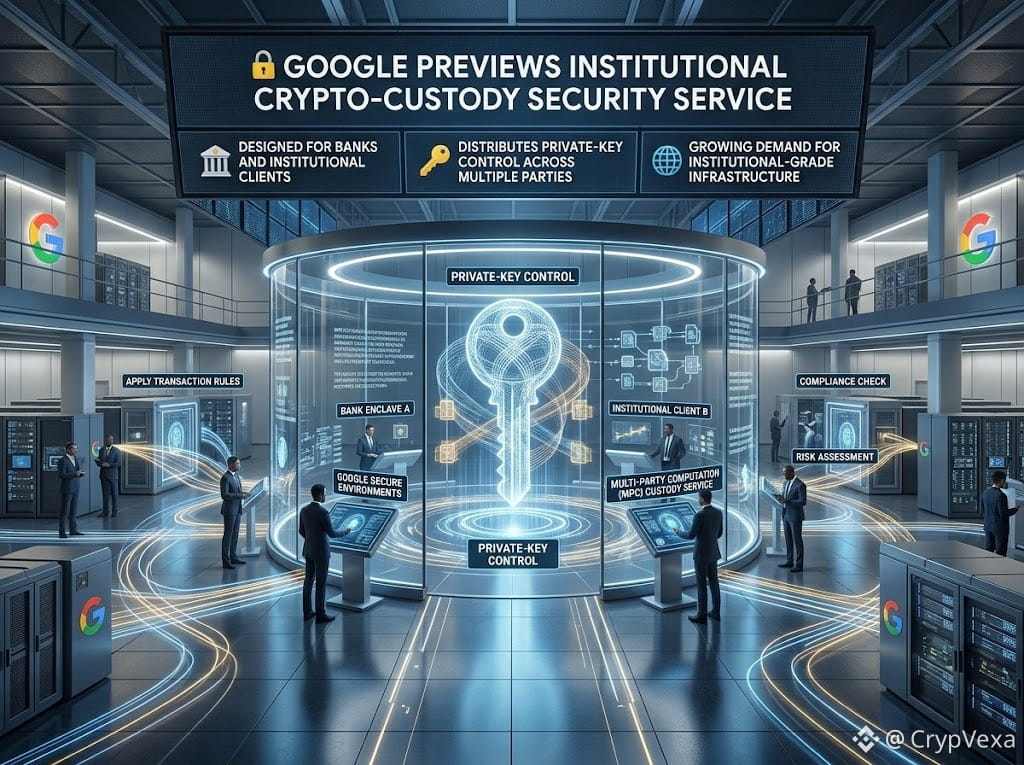
🔐 Google Previews Institutional Crypto-Custody Security Service
🏦 Google is set to showcase a multi-party computation (MPC) custody service designed for banks and institutional clients.
🔑 The model distributes private-key control across multiple parties and applies transaction rules across different environments.
🌐 The move highlights growing demand for institutional-grade crypto custody and security infrastructure.
👀 Could Google’s entry strengthen institutional confidence in crypto custody?
#Google #CryptoCustody #MPC #CryptoNews
GOOGUS+2.32%
GOOGLB+1.50%
2
290

·
--
Google just put institutional crypto custody into private preview — MPC key-splitting for banks, with a commercial window aimed at early 2027.
On October 28, 2026, Google Cloud showcased Google Multi-Party Compute at its digital-assets symposium in New York. The service keeps private-key shares across separate environments, runs transaction-policy checks inside Confidential Space, and never stores a full key in one place. Alphabet is already using it to secure digital assets on Ethereum and Solana, while design partners and major financial institutions are testing it for crypto and tokenized assets.
Google has not named the banks in the preview or disclosed pricing. Commercial availability is planned for early 2027. For institutions moving onto chain, this packages MPC signing, policy gates, and key recovery as one product rather than a DIY stack — still preview, still unproven at scale, but a clear signal that big tech wants a seat in regulated digital-asset custody.
#GoogleCloud #MPC #CryptoCustody $ETH $SOL
DYOR. Not financial advice.
{spot}(GOOGLBUSDT)
{spot}(SOLUSDT)
{spot}(ETHUSDT)
Google just put institutional crypto custody into private preview — MPC key-splitting for banks, with a commercial window aimed at early 2027.
On October 28, 2026, Google Cloud showcased Google Multi-Party Compute at its digital-assets symposium in New York. The service keeps private-key shares across separate environments, runs transaction-policy checks inside Confidential Space, and never stores a full key in one place. Alphabet is already using it to secure digital assets on Ethereum and Solana, while design partners and major financial institutions are testing it for crypto and tokenized assets.
Google has not named the banks in the preview or disclosed pricing. Commercial availability is planned for early 2027. For institutions moving onto chain, this packages MPC signing, policy gates, and key recovery as one product rather than a DIY stack — still preview, still unproven at scale, but a clear signal that big tech wants a seat in regulated digital-asset custody.
#GoogleCloud #MPC #CryptoCustody $ETH $SOL
DYOR. Not financial advice.

89

·
--
Bullish
Verified
Google is entering institutional crypto custody and that matters for Bitcoin.
Google has begun private testing of Google Multi-Party Compute(MCP), a custody security system designed for banks, asset managers and other institutions. A commercial rollout is targeted for early 2027.
Instead of one private key controlling assets, MCP splits signing authority across multiple secure environments. A transaction can require approvals from several parties before it is authorized reducing the risk that one compromised device, employee or key exposes the entire treasury.
For institutions this tackles a major barrier to holding crypto: secure custody and controlled transfers at a scale.
i). Bitcoin can technically fit the model
Google's planned support for ECDSA signing is releant because Bitcoin relies on ECDSA based signatures. That does not mean Google has announced a Bitcoin custody product or disclosed $BTC holdings but it means the underlying signing infrastructure can be compatible with Bitcoin.
ii). Why the market is watching
This is not a "Google is buying Bitcoin" headline. It is a signal that enterprise grade crypto infrastructure is becoming more familiar to traditional finance. Better custody tooling can make it easier for institutions to evaluate Bitcoin, tokenized assets and blockchain based payments within existing risk control frameworks.
iii). The bigger takeaway
Crypto adoption is increasingly becoming an infrastructure story not just a price story. Custody, compliance controls, key security and transaction governance may determine how quickly large institutions can participate.
Google's move is still in private preview, with unnamed testing partners and no public pricing. But the direction is clear: institutional crypto rails are continuing to mature.
#cryptocustody
#cangoogledefinditscore
$GOOGL
1
4
603

·
--
Google’s Multi-Party Compute (MPC): A New Era for Crypto Custody?
Google ($GOOGL ) is stepping up security with its new private preview product: Google Multi-Party Compute (MPC). Designed to counter advanced machine-learning exploits, automated threats, and adversarial attacks, Alphabet has already deployed it to secure its own $ETH and $SOL assets.
With commercial availability slated for early 2027, this hardware-isolated, multi-layered cloud security system could reshape institutional crypto adoption.
👇 How will Google's MPC impact the broader crypto market? Or Will it boost Google stocks? Let us know below!
#cryptocustody #Google #Write2Earn
#security #InstitutionalAdoption
181

A major shift is coming to institutional crypto custody. 🚨
Google is entering the space with Multi-Party Computation (MPC) technology, aiming to redefine digital asset security. This move arrives at a critical time, as a recent vulnerability in Fireblocks highlights the ongoing risks facing current custody frameworks.
As tech giants step into Web3, institutional security standards are set to reach new heights.
#CryptoCustody #Web3 #Google
5

Verified
#datavaultaicantwithdrawbitcoinfrombiconomy
🚨 THE CUSTODY EQUATION: DATAVAULT AI LOSES ACCESS 🚨
A massive treasury crisis is unfolding for a publicly traded firm! Let’s break down the Datavault Bitcoin disaster using pure math 🧮👇
(Off-Chain Transfers) + (Frozen Withdrawals) = 50% Stock Crash 📉
Here is the exact formula driving today's market panic:
The Catalyst Input:
(The Lockup) = Datavault AI (Nasdaq: $DVLT) officially filed with the SEC that it has been completely unable to withdraw its Bitcoin from the Biconomy exchange since June 2026.
The Key Metric:
(The Restatement) ➔ Because the 1,309 BTC (originating from a $150M deal with Scilex) was credited via internal "off-chain" transfers rather than on the native Bitcoin network, Datavault is now forced to restate $92 million in financials.
The Breakdown:
This is the ultimate "Not your keys, not your coins" lesson playing out on Wall Street. As a result of the frozen Biconomy wallet, DVLT stock plummeted nearly 49.55% to close at $0.067, with a staggering 244 million shares dumped in a single trading session. This catastrophe raises serious red flags about how publicly traded treasuries are auditing their off-chain exchange balances versus relying on secure, on-chain self-custody solutions.
Are corporate treasuries trusting centralized exchanges too much? Let's debate! 👇💬
$BTC
{future}(BTCUSDT)
$EVAA
{future}(EVAAUSDT)
$XAN
{future}(XANUSDT)
#Bitcoin #CryptoCustody #Biconomy
#datavaultaicantwithdrawbitcoinfrombiconomy
🚨 THE CUSTODY EQUATION: DATAVAULT AI LOSES ACCESS 🚨
A massive treasury crisis is unfolding for a publicly traded firm! Let’s break down the Datavault Bitcoin disaster using pure math 🧮👇
(Off-Chain Transfers) + (Frozen Withdrawals) = 50% Stock Crash 📉
Here is the exact formula driving today's market panic:
The Catalyst Input:
(The Lockup) = Datavault AI (Nasdaq: $DVLT) officially filed with the SEC that it has been completely unable to withdraw its Bitcoin from the Biconomy exchange since June 2026.
The Key Metric:
(The Restatement) ➔ Because the 1,309 BTC (originating from a $150M deal with Scilex) was credited via internal "off-chain" transfers rather than on the native Bitcoin network, Datavault is now forced to restate $92 million in financials.
The Breakdown:
This is the ultimate "Not your keys, not your coins" lesson playing out on Wall Street. As a result of the frozen Biconomy wallet, DVLT stock plummeted nearly 49.55% to close at $0.067, with a staggering 244 million shares dumped in a single trading session. This catastrophe raises serious red flags about how publicly traded treasuries are auditing their off-chain exchange balances versus relying on secure, on-chain self-custody solutions.
Are corporate treasuries trusting centralized exchanges too much? Let's debate! 👇💬
$BTC
$EVAA
$XAN
#Bitcoin #CryptoCustody #Biconomy

2
1.3k

·
--
Holding $BTC but unable to withdraw it? That makes me wince. 😬🔒
Bitcoin treasury firm Datavault AI plunged 50% after saying it couldn’t access bitcoin held on Biconomy.
The company says an accounting correction will cut its reported year-end 2025 assets by $92.2 million.
For me, the unsettling part isn’t just the plunge. It’s the gap between reporting crypto holdings and actually being able to move them.
What proof of withdrawal access would you want from a crypto treasury company?
#Bitcoin #CryptoCustody

76

#DatavaultAICantWithdrawBitcoinFromBiconomy
A publicly traded company can’t withdraw its own Bitcoin from an exchange. The result: a 49.55% drop in its stock and a $92 million accounting restatement.
The Datavault AI (DVLT) case began with a $150 million deal with Scilex Holding, paid in Bitcoin. Approximately 1,309 BTC were credited to Datavault’s wallet at Biconomy via an off-chain transfer. No on-chain transaction, no proof on the blockchain.
In June 2026, Datavault requested a withdrawal. So far, nothing. Biconomy has not publicly explained the hold-up.
The market reacted in the harshest way possible. The stock closed at $0.067, with 244 million shares traded. The company, which counted on this Bitcoin as a liquidity reserve, now has to reassess whether it can continue operating.
The question that remains: how many other corporate treasuries are relying on off-chain balances without an on-chain audit?
If you don’t control the keys, you don’t control the coins. And if you can’t see the transaction on the blockchain, you have no proof of anything.
$BTC
$EVAA
$XAN
#Bitcoin #CryptoCustody #Biconomy
{spot}(BTCUSDT)
{future}(XANUSDT)
{future}(EVAAUSDT)
#DatavaultAICantWithdrawBitcoinFromBiconomy
A publicly traded company can’t withdraw its own Bitcoin from an exchange. The result: a 49.55% drop in its stock and a $92 million accounting restatement.
The Datavault AI (DVLT) case began with a $150 million deal with Scilex Holding, paid in Bitcoin. Approximately 1,309 BTC were credited to Datavault’s wallet at Biconomy via an off-chain transfer. No on-chain transaction, no proof on the blockchain.
In June 2026, Datavault requested a withdrawal. So far, nothing. Biconomy has not publicly explained the hold-up.
The market reacted in the harshest way possible. The stock closed at $0.067, with 244 million shares traded. The company, which counted on this Bitcoin as a liquidity reserve, now has to reassess whether it can continue operating.
The question that remains: how many other corporate treasuries are relying on off-chain balances without an on-chain audit?
If you don’t control the keys, you don’t control the coins. And if you can’t see the transaction on the blockchain, you have no proof of anything.
$BTC
$EVAA
$XAN
#Bitcoin #CryptoCustody #Biconomy

1
130
Log in to explore more content
Join global crypto users on Binance Square
⚡️ Get latest and useful information about crypto.
💬 Trusted by the world’s largest crypto exchange.
👍 Discover real insights from verified creators.
Email / Phone number
Trending Topics
1
#AnthropicRejectsIPODelayValuationinQuestion
411,878 views
3,525 Discussing
2
#CoreWeaveJumps10%On168%RevenueGrowth
39,356 views
628 Discussing
3
#ZcashFallsBelow$1000ForFirstTimeSinceSeptember
19,370 views
125 Discussing
4
#CanNvidiaEarningsEaseMarketConcerns?
138,236 views
1,563 Discussing
5
#tZEROWinsCFTCApprovalForRegulatedDerivativesExchange
2 views
1 Discussing
6
#HotCPIDecemberHikePriced
429,422 views
3,591 Discussing
7
#StablecoinSupplyDrops$14.2BIn30Days
74 views
6 Discussing
8
#TradFiForBeginners
473,984 views
3,163 Discussing
9
#BitcoinETFsLose$1.6BInNovember
15,567 views
82 Discussing
10
#AnthropicDisclosesOver$10BNewComputeDeals
3,179 views
44 Discussing