
#coldcard
coldcard
167,956 views
563 Discussing
Hot
Latest

·
--
Your hardware wallet's seed phrase was supposed to be unguessable. For five years, Coldcard's wasn't — and that flaw cost users $100 million in $BTC.
On November 23, Coinkite published an 18-page postmortem on the Coldcard seed-generation flaw. A firmware change in March 2021 disabled the hardware random number generator: the code checked whether a config flag was defined, not whether it was enabled. Seeds fell back to a weak software generator, leaving Mk2 and Mk3 devices with roughly 40 bits of effective entropy.
Galaxy Research tracked at least 1,778.84 BTC stolen from more than 8,600 addresses, worth about $107 million — the first sweep alone drained 1,082.65 BTC from 1,196 addresses in 41 minutes on July 30. The flaw survived at least 15 independent security reviews over five years. Coinkite patched it on July 31, but updating firmware does not fix seeds already generated — affected users must create a fresh seed and move their coins.
The open question is liability: around 300 loss tickets filed, no compensation decision announced.
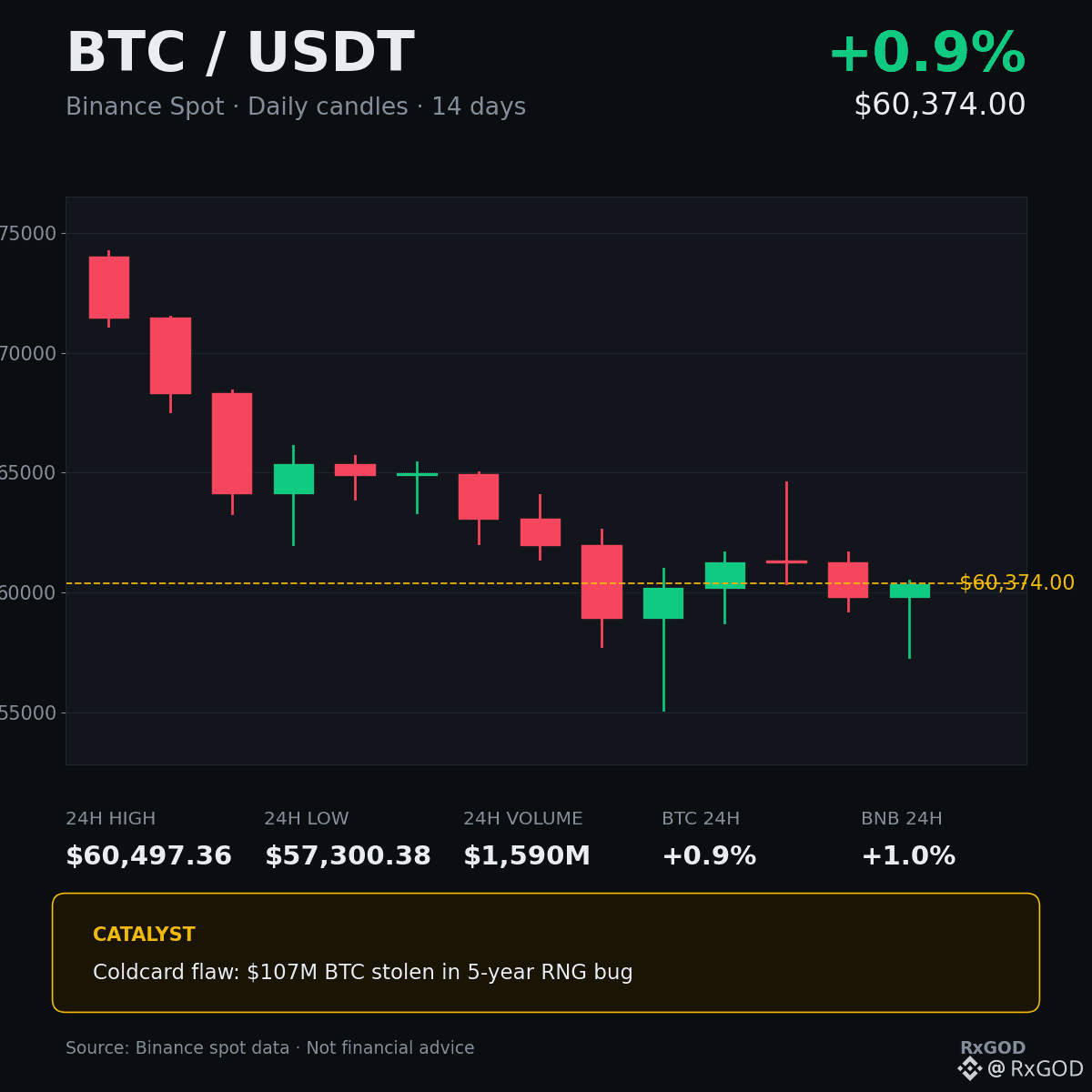
$BTC trades at $60,374, up 0.93% in 24 hours and near the top of its $57,300–$60,497 range, though down 15.5% over 14 days with Fear & Greed at 9 — Extreme Fear.
Coldcard owners: check your firmware version today. Would you move your coins immediately if your seed came from affected firmware — or trust the patch and stay put? And should the maker pay when its own bug costs users $107 million?
Not financial advice — DYOR.
#Coldcard #Bitcoin #CryptoNews #ExtremeFear
Your hardware wallet's seed phrase was supposed to be unguessable. For five years, Coldcard's wasn't — and that flaw cost users $100 million in $BTC .
On November 23, Coinkite published an 18-page postmortem on the Coldcard seed-generation flaw. A firmware change in March 2021 disabled the hardware random number generator: the code checked whether a config flag was defined, not whether it was enabled. Seeds fell back to a weak software generator, leaving Mk2 and Mk3 devices with roughly 40 bits of effective entropy.
Galaxy Research tracked at least 1,778.84 BTC stolen from more than 8,600 addresses, worth about $107 million — the first sweep alone drained 1,082.65 BTC from 1,196 addresses in 41 minutes on July 30. The flaw survived at least 15 independent security reviews over five years. Coinkite patched it on July 31, but updating firmware does not fix seeds already generated — affected users must create a fresh seed and move their coins.
The open question is liability: around 300 loss tickets filed, no compensation decision announced.
$BTC trades at $60,374, up 0.93% in 24 hours and near the top of its $57,300–$60,497 range, though down 15.5% over 14 days with Fear & Greed at 9 — Extreme Fear.
Coldcard owners: check your firmware version today. Would you move your coins immediately if your seed came from affected firmware — or trust the patch and stay put? And should the maker pay when its own bug costs users $107 million?
Not financial advice — DYOR.
#Coldcard #Bitcoin #CryptoNews #ExtremeFear
1
·
--
The wallet that was supposed to be unhackable just admitted it wasn't.
Coinkite, maker of the Coldcard hardware wallet, published a postmortem on November 23 explaining how a seed-phrase flaw went undetected for more than five years — despite at least 15 independent security reviews. The checks confirmed the wallet had the right system for generating recovery phrases. They never verified the device was actually using it. A software bug fell back to a weaker system, making phrases easier to guess.
Galaxy Research reported in August that attackers stole at least 1,789 $BTC — around $114.7 million at the time. As of November 18, Coinkite had received about 300 loss-related support tickets tied to 242 accounts, and says the real victim count is likely higher. The flaw was patched on July 31, but a firmware update cannot fix phrases already generated — affected users must create new phrases and move their funds. No compensation plan has been decided, and investigators don't know who did it.
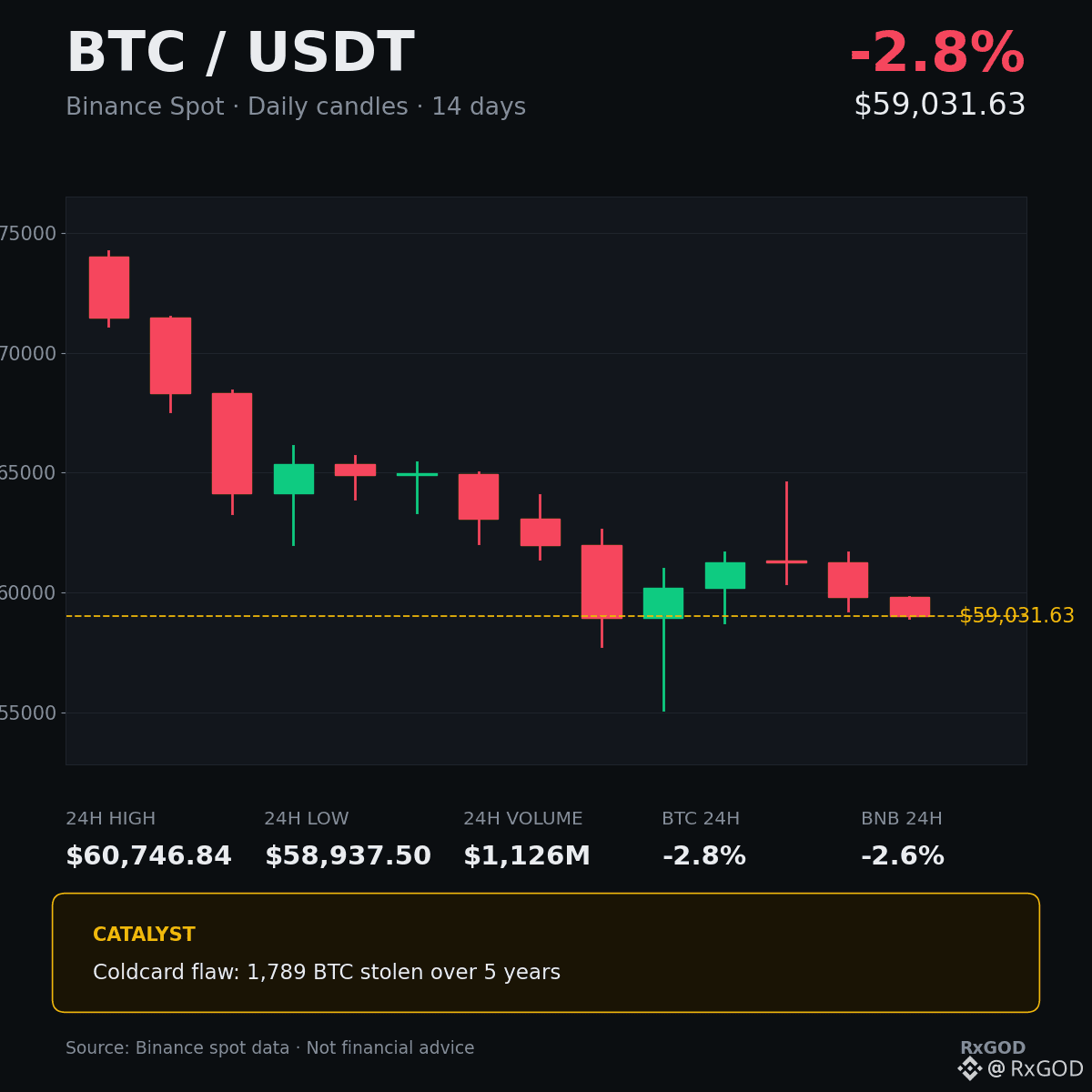
The timing stings. $BTC trades at $59,032, down 2.8% in 24 hours and 17.4% over 14 days, in the bottom fifth of its $55,130–$74,217 range, with Fear & Greed at 8 (Extreme Fear). A self-custody scandal is the last thing this market needed.
The uncomfortable question: if 15 audits couldn't catch this, is cold storage still the gold standard? Would you still trust a hardware wallet with your life savings — or has this changed how you store your crypto?
Not financial advice — DYOR.
#ExtremeFear #CryptoNews #Bitcoin #Coldcard
3

·
--
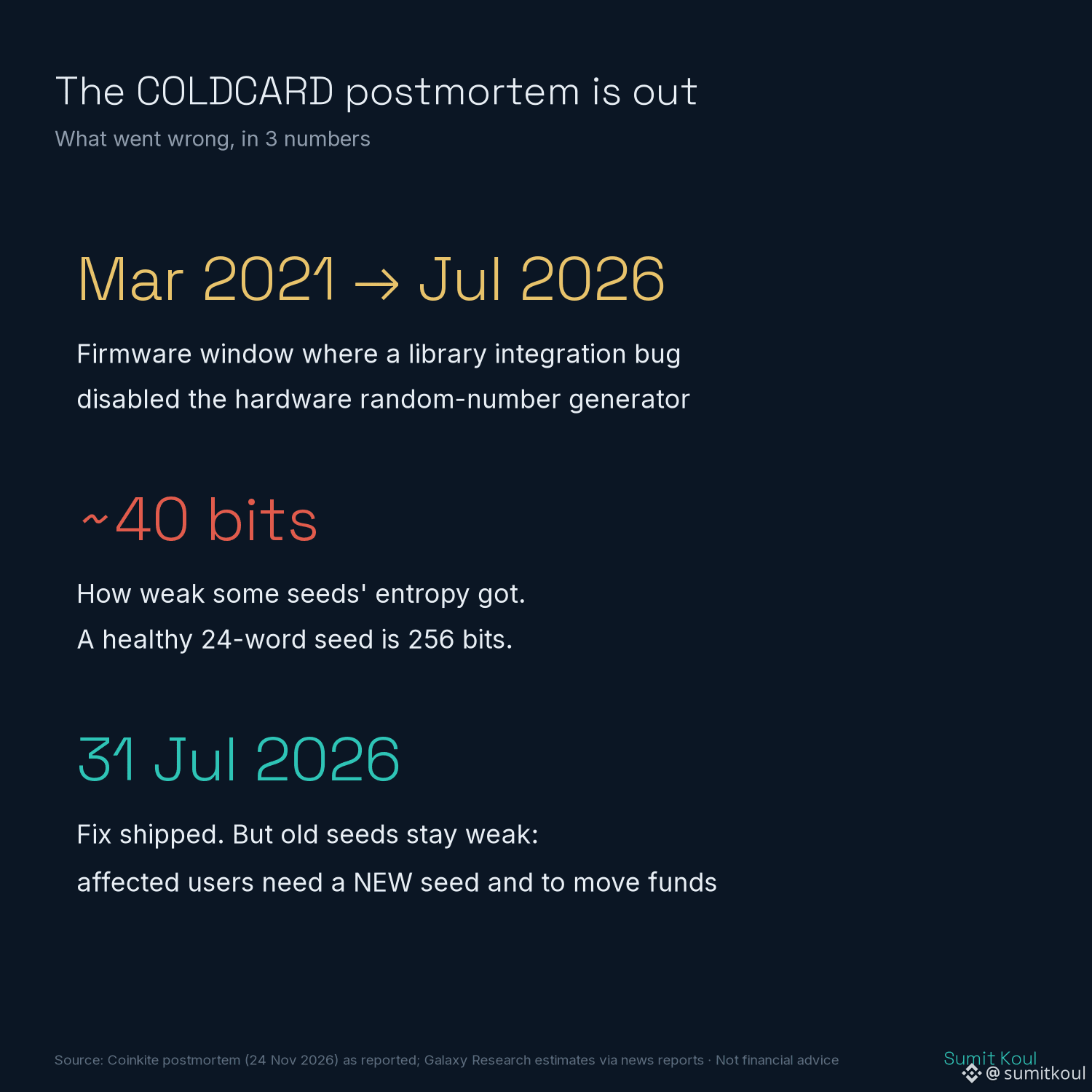
If you set up a COLDCARD between March 2021 and July 2026, read this today. 🔐
Coinkite has published its postmortem on the seed flaw:
• A library integration bug disabled the hardware random-number generator
• Some seeds ended up with as little as ~40 bits of entropy. A healthy 24-word seed has 256
• That made affected seeds crackable offline, without anyone touching the device
• A fix shipped on 31 July 2026
The part people miss: updating firmware does NOT fix an old seed.
If your seed was generated on affected firmware:
1. Update to current official firmware
2. Generate a brand-new seed (dice rolls help add your own entropy)
3. Move funds to the new wallet
4. Never type a seed into a website or "recovery service"
Know someone who uses a COLDCARD? Tag them or share this. It could save their stack. 👇
Follow me for security alerts that actually matter.
#COLDCARD #CryptoSecurity #Bitcoin
Not financial advice.

·
--
🔐 Coldcard Postmortem: 5-Year Seed Flaw Behind $107M Bitcoin Theft
📌 What happened
Coinkite published an 18-page postmortem on Nov 23 on the Coldcard seed-generation flaw that let thieves drain Bitcoin from customer wallets starting in July. A firmware setting switched off the hardware random number generator, so seeds fell back to a predictable software generator — and the defect survived at least 15 security reviews over five years.
📊 Key numbers
• 1,778.84 BTC stolen from 8,600+ addresses — ~$107M at current prices
• Flaw shipped in firmware from Mar 29, 2021 to Jul 30, 2026
• Effective seed entropy: ~40 bits (Mk2/Mk3) and ~72 bits (Mk4/Mk5/Q) vs 128 intended
• Thefts began Jul 29; fixed firmware shipped Jul 31
• ~300 loss tickets from 242 accounts as of Nov 18
• Compensation: "open; no decision" — Coinkite has not committed to reimburse victims
🔍 Why it matters
Coldcard is one of the most trusted names in Bitcoin self-custody, and this is a trust shock for the whole hardware-wallet sector: a single config error — a check that tested whether a setting was defined rather than enabled — silently weakened seeds for five years while reviewers confirmed the secure component existed without testing whether the code path reached it. It lands as BTC trades below $60,000, and the unanswered compensation question plus a September class-action filing keep the fallout live.
👀 What to watch
• Whether Coinkite announces a compensation plan
• The class-action case in Ontario and any further legal moves
• Whether other wallet makers publish RNG audits in response
• Any movement of the stolen 1,778.84 BTC
Not financial advice. Source: Coinkite postmortem / Bitcoin Magazine / CoinStats, Nov 24.
$BTC #Bitcoin #Coldcard #Security
81


·
--
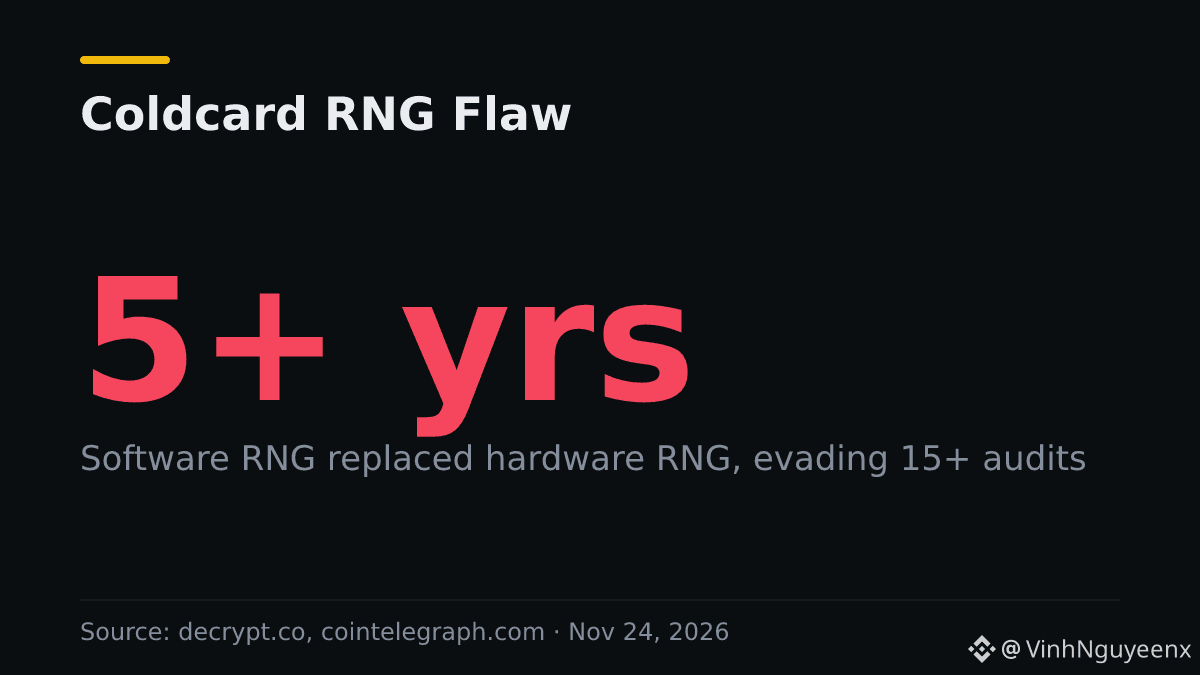
A hidden RNG flaw let Coldcard wallets evade detection for more than five years.
• Coinkite’s post‑mortem shows a software RNG replaced the hardware one for over five years (decrypt.co)
• Cointelegraph reports the flaw survived at least 15 security reviews before being disclosed (cointelegraph.com)
The incident highlights how even rigorous audits can miss subtle software swaps, urging hardware wallet makers to tighten supply‑chain checks.
What’s your top priority after this reveal?
A) Strengthen hardware audits
B) Rely on multi‑signature wallets
C) Switch to alternative wallets
$BTC #Coldcard #Security 🔐
⚠️ Not financial advice. DYOR.
49

·
--
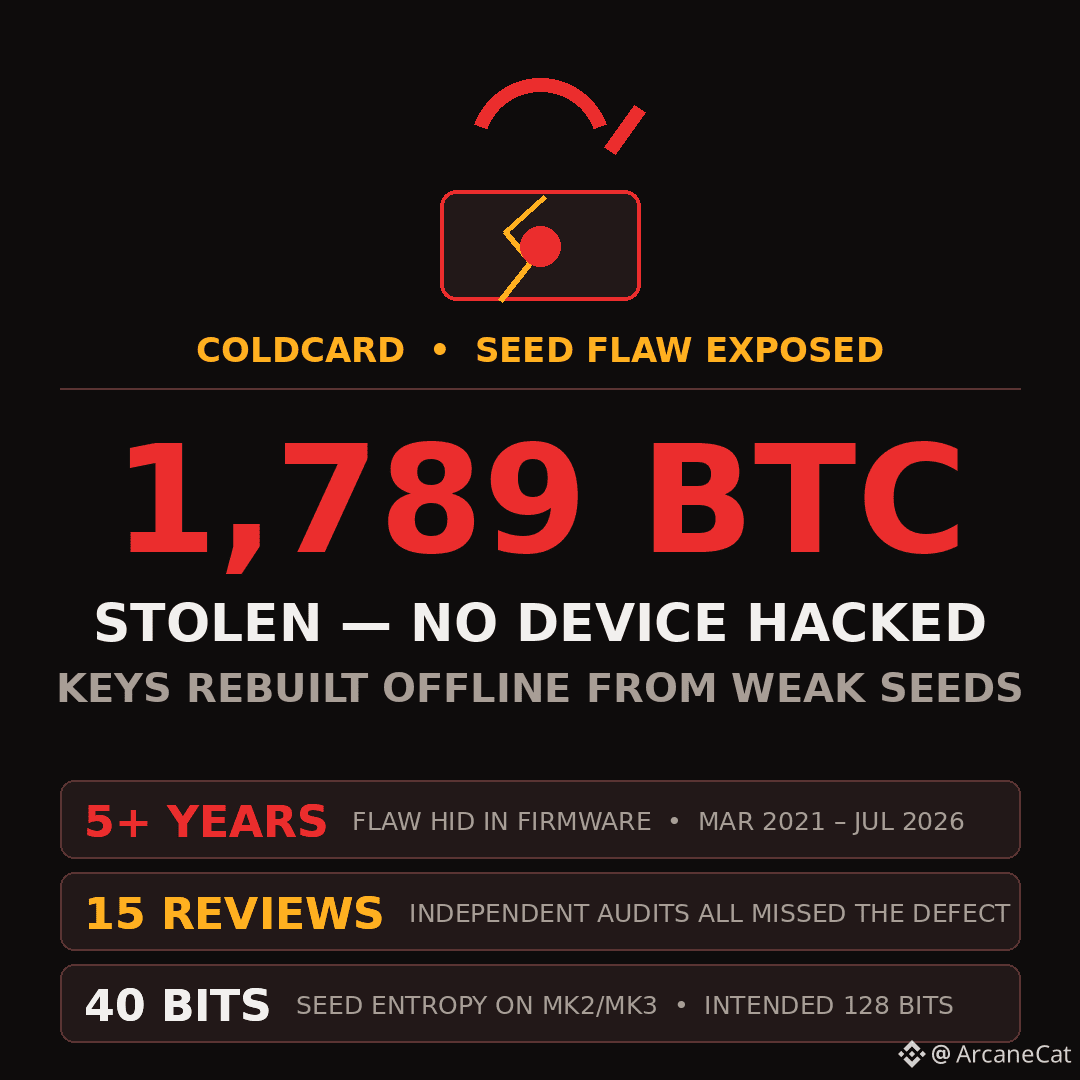
🚨 1,789 BTC STOLEN — 15 SECURITY AUDITS MISSED THE FLAW
Coinkite's Nov 23 postmortem is out: a Coldcard firmware bug ran undetected for 5+ years (Mar 2021–Jul 2026), silently swapping the hardware random-number generator for a predictable software one.
Seeds carried just 40–72 bits of entropy instead of 128 — attackers rebuilt private keys offline and drained 1,778.84 BTC from 8,600+ addresses, ~$107M. No device was hacked.
Thefts began Jul 29. Fixed Jul 31. The thief is still unknown.
Coldcard owners: update to the fixed firmware now.
#Bitcoin #BTC #Coldcard #Security
Not financial advice.
13


·
--
🔓 Coldcard explains how a Bitcoin wallet flaw went unnoticed for 5+ years
In a Nov. 23 postmortem, Coldcard maker Coinkite said its security checks confirmed the devices had a proper system for generating recovery phrases but never verified they were actually using it. A software bug made the wallets fall back to a weaker method, leaving seed phrases easier to guess.
At least 15 independent reviews missed the issue, and attackers drained at least 1,789 BTC, worth about $114.7 million at the time. As of Nov. 18, Coinkite had about 300 loss-related tickets tied to 242 accounts and has not yet decided on compensation.
⭐ Even hardware wallets can fail silently: affected users are urged to create new recovery phrases and move funds to new wallets.
#Bitcoin #Security #HardwareWallet #Coldcard
36

·
--
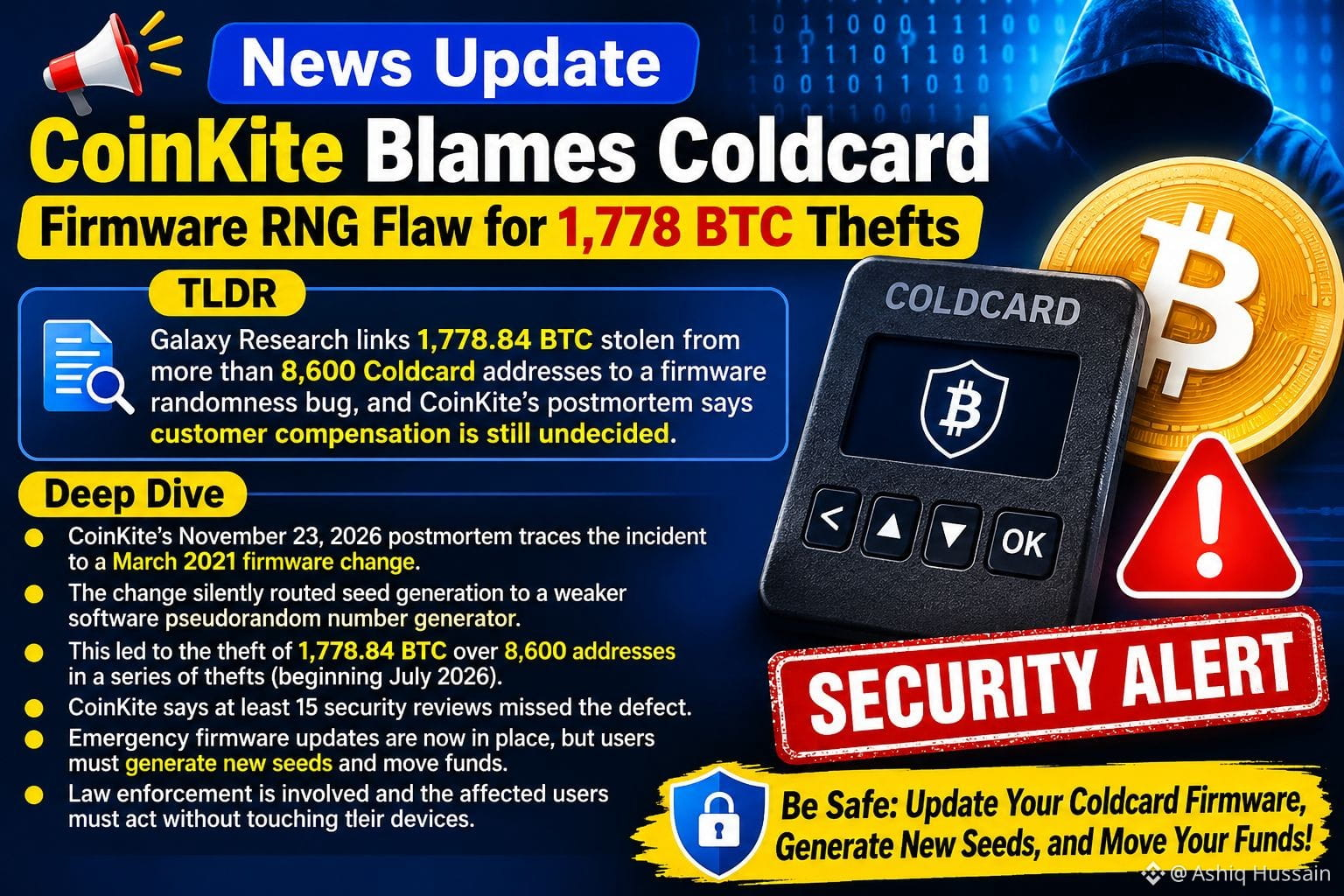
$BTC 🚨 MASSIVE BITCOIN SECURITY BREACH!
A major security incident has reportedly exposed a serious vulnerability in Coldcard hardware wallets.
According to the report:
🔴 1,778.84 BTC reportedly stolen
🔴 More than 8,600 Bitcoin addresses affected
🔴 A firmware randomness flaw weakened wallet seed generation
🔴 Attackers allegedly reconstructed private keys offline
🔴 Customer compensation remains undecided
The reported vulnerability was linked to a firmware change dating back to March 2021. Emergency firmware updates have been released, but affected users may need to generate entirely new seed phrases and move their funds.
⚠️ IMPORTANT SECURITY REMINDER:
Never share your recovery phrase with anyone. Keep your wallet software updated and follow official security guidance.
💬 Could this incident change the way people trust hardware wallets?
$BTC
{spot}(BTCUSDT)
#BTC #CryptoSecurity #Coldcard #Blockchain #CryptoNews
$BTC 🚨 MASSIVE BITCOIN SECURITY BREACH!
A major security incident has reportedly exposed a serious vulnerability in Coldcard hardware wallets.
According to the report:
🔴 1,778.84 BTC reportedly stolen
🔴 More than 8,600 Bitcoin addresses affected
🔴 A firmware randomness flaw weakened wallet seed generation
🔴 Attackers allegedly reconstructed private keys offline
🔴 Customer compensation remains undecided
The reported vulnerability was linked to a firmware change dating back to March 2021. Emergency firmware updates have been released, but affected users may need to generate entirely new seed phrases and move their funds.
⚠️ IMPORTANT SECURITY REMINDER:
Never share your recovery phrase with anyone. Keep your wallet software updated and follow official security guidance.
💬 Could this incident change the way people trust hardware wallets?
$BTC
#BTC #CryptoSecurity #Coldcard #Blockchain #CryptoNews
65

·
--
1,780 BTC stolen: Coldcard postmortem reveals “fake randomness” missed by 15 auditsA random number that “looked random” turned a hardware wallet into an ATM.
On November 23, Coinkite published an 18-page postmortem: from March 2021 to July 2026, Coldcard did not call the hardware random number generator when generating seed phrases, causing seeds to fall back to software pseudorandom numbers. Of the 128 bits of entropy, Mk2/Mk3 had only about 40 bits, while newer models had about 72 bits.
Attackers don’t need to touch the device: they can brute-force seeds offline, compare them against on-chain addresses, and get the private key if they find a match. Galaxy Research estimates that around 1,778 $BTC were transferred from more than 8,600 addresses between late July and early August, worth approximately $107 million.
1,780 BTC stolen: Coldcard postmortem reveals “fake randomness” missed by 15 audits
A random number that “looked random” turned a hardware wallet into an ATM.
On November 23, Coinkite published an 18-page postmortem: from March 2021 to July 2026, Coldcard did not call the hardware random number generator when generating seed phrases, causing seeds to fall back to software pseudorandom numbers. Of the 128 bits of entropy, Mk2/Mk3 had only about 40 bits, while newer models had about 72 bits.
Attackers don’t need to touch the device: they can brute-force seeds offline, compare them against on-chain addresses, and get the private key if they find a match. Galaxy Research estimates that around 1,778 $BTC were transferred from more than 8,600 addresses between late July and early August, worth approximately $107 million.
1.4k

·
--
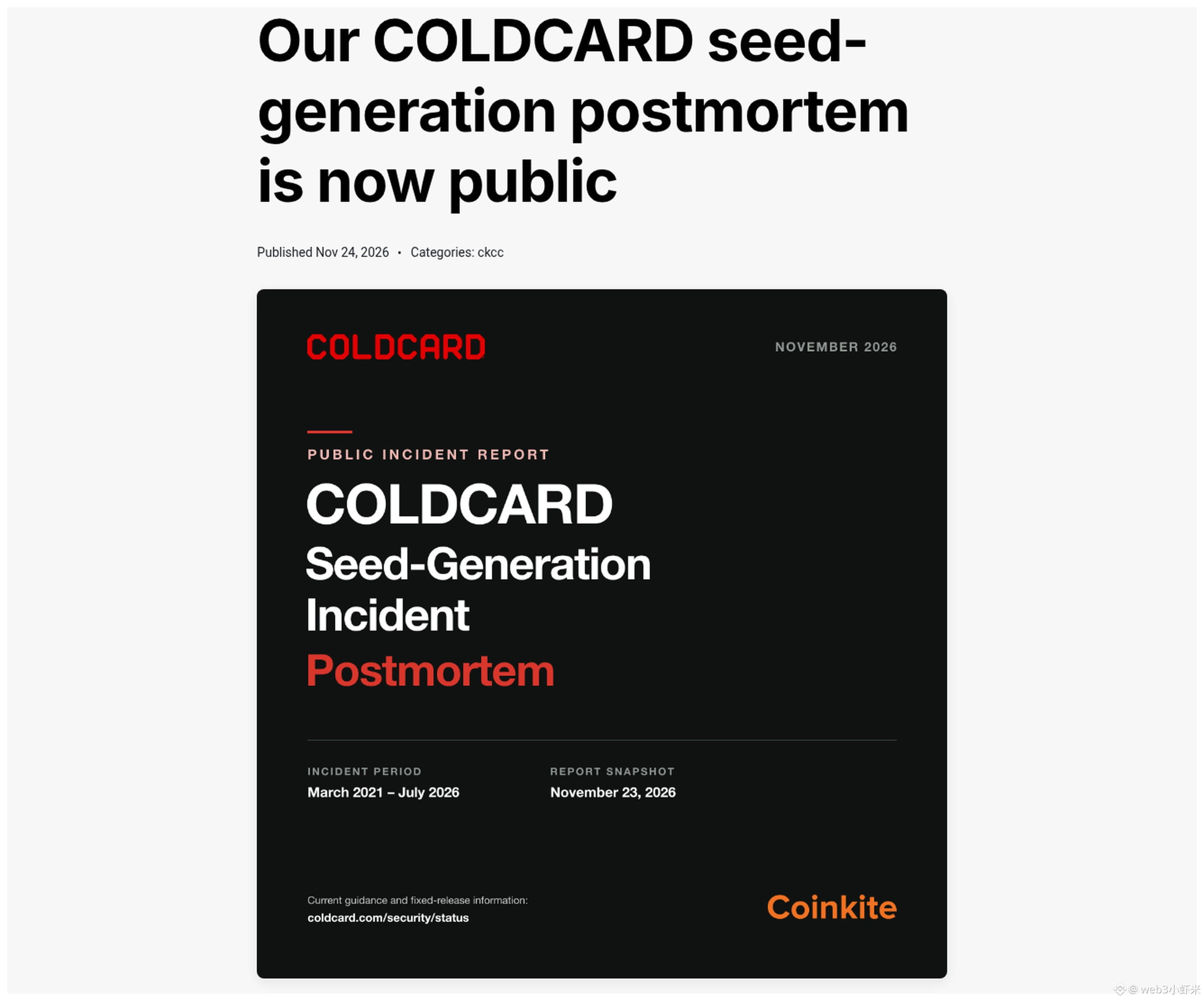
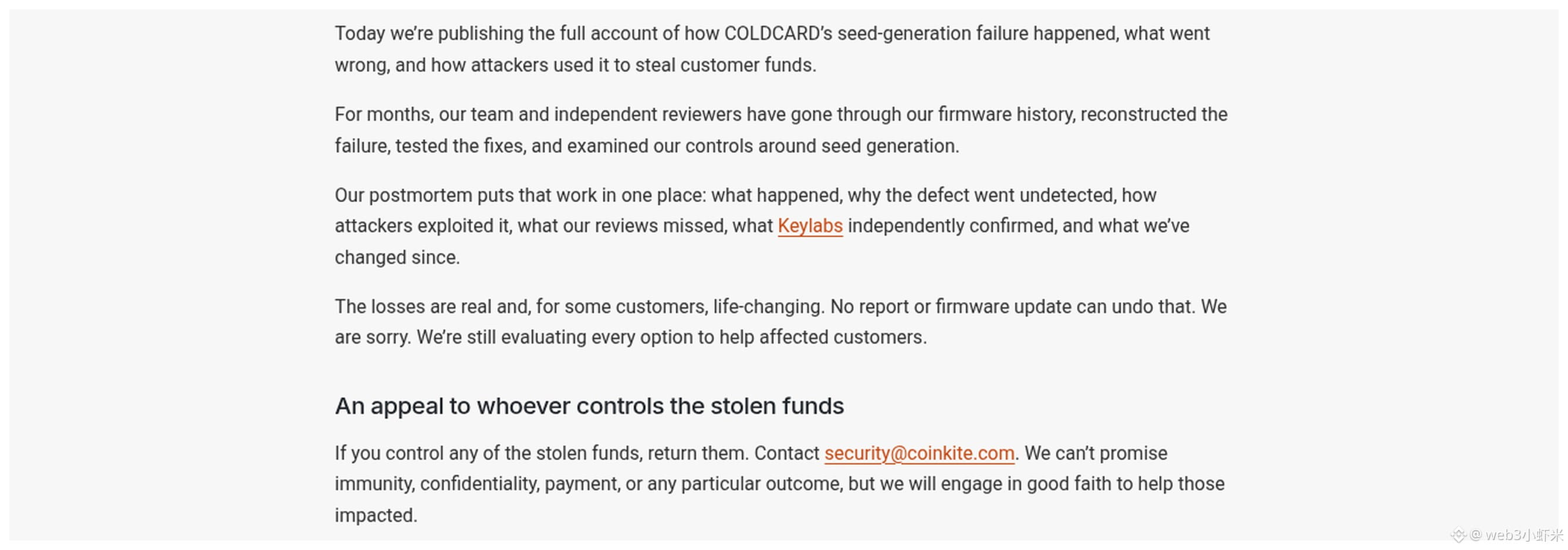
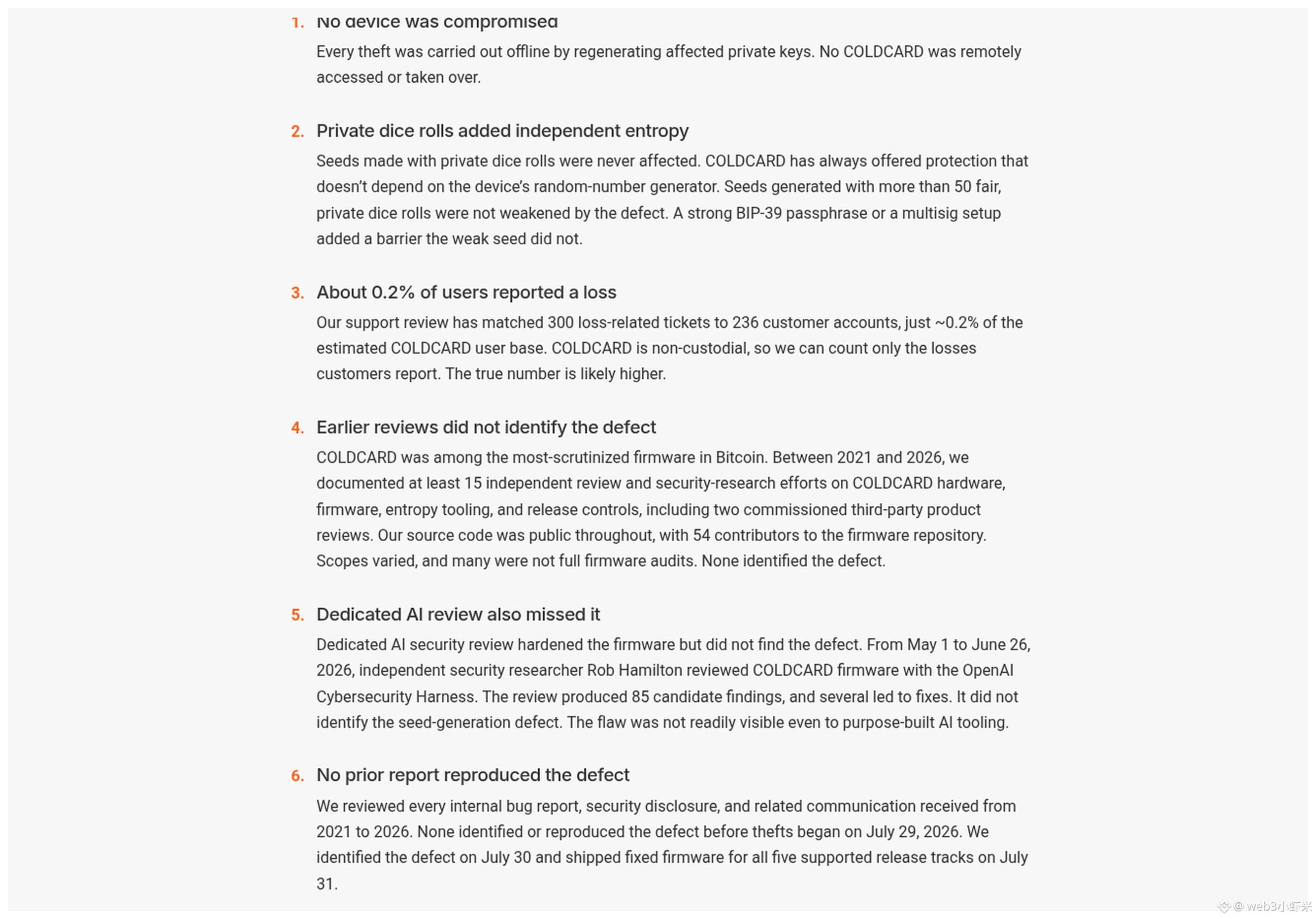
I just saw that Coinkite published a full postmortem on November 24 about the COLDCARD seed-generation issue. The company says that from March 2021 through this July, the firmware used software-based pseudorandom numbers to generate seeds instead of the device’s hardware random number generator. An attacker could calculate the affected private keys offline and move the funds; the device itself was not remotely compromised.
They identified about 300 loss-related support tickets associated with 236 customer accounts, roughly 0.2% of estimated users, and said the actual number may be higher. The company located the issue on July 30 and released patched firmware for all five supported version lines on July 31. But they made it very clear: upgrading the firmware will not fix seeds generated on affected versions.
Seeds generated with entropy from more than 50 independent, private dice rolls are not affected. If you have this hardware wallet, check the report and security status page directly on the official website. Don’t send your recovery phrase, private keys, or backups to anyone.
#COLDCARD #Security

35

·
--
Coldcard vulnerability lay dormant for 5 years: 1,789 BTC stolen—can $58,600 cover it?Coinkite has published a postmortem on the Coldcard security incident: a seed-generation vulnerability remained undetected for more than five years. At least 15 independent security reviews and research efforts failed to uncover it, because the recovery phrase looked normal and could pass partial checks. The vulnerability allowed hackers to steal at least 1,789 BTC, worth about $114.7 million at the time (Cointelegraph, November 25).
The company said the vulnerability was fixed on July 31, with additional security measures added in August. As of November 18, it had received about 300 loss reports related to 242 accounts; the actual number of victims may be higher. A compensation plan has yet to be determined, and law enforcement agencies are investigating. Old recovery phrases do not become safe automatically after a software update.
Coldcard vulnerability lay dormant for 5 years: 1,789 BTC stolen—can $58,600 cover it?
Coinkite has published a postmortem on the Coldcard security incident: a seed-generation vulnerability remained undetected for more than five years. At least 15 independent security reviews and research efforts failed to uncover it, because the recovery phrase looked normal and could pass partial checks. The vulnerability allowed hackers to steal at least 1,789 BTC, worth about $114.7 million at the time (Cointelegraph, November 25).
The company said the vulnerability was fixed on July 31, with additional security measures added in August. As of November 18, it had received about 300 loss reports related to 242 accounts; the actual number of victims may be higher. A compensation plan has yet to be determined, and law enforcement agencies are investigating. Old recovery phrases do not become safe automatically after a software update.
The company said the vulnerability was fixed on July 31, with additional security measures added in August. As of November 18, it had received about 300 loss reports related to 242 accounts; the actual number of victims may be higher. A compensation plan has yet to be determined, and law enforcement agencies are investigating. Old recovery phrases do not become safe automatically after a software update.
58

·
--
Article
The hardware wallet isn’t broken, but its seed phrase can still be calculatedThe hardware wallet isn’t broken, but its seed phrase can still be calculated
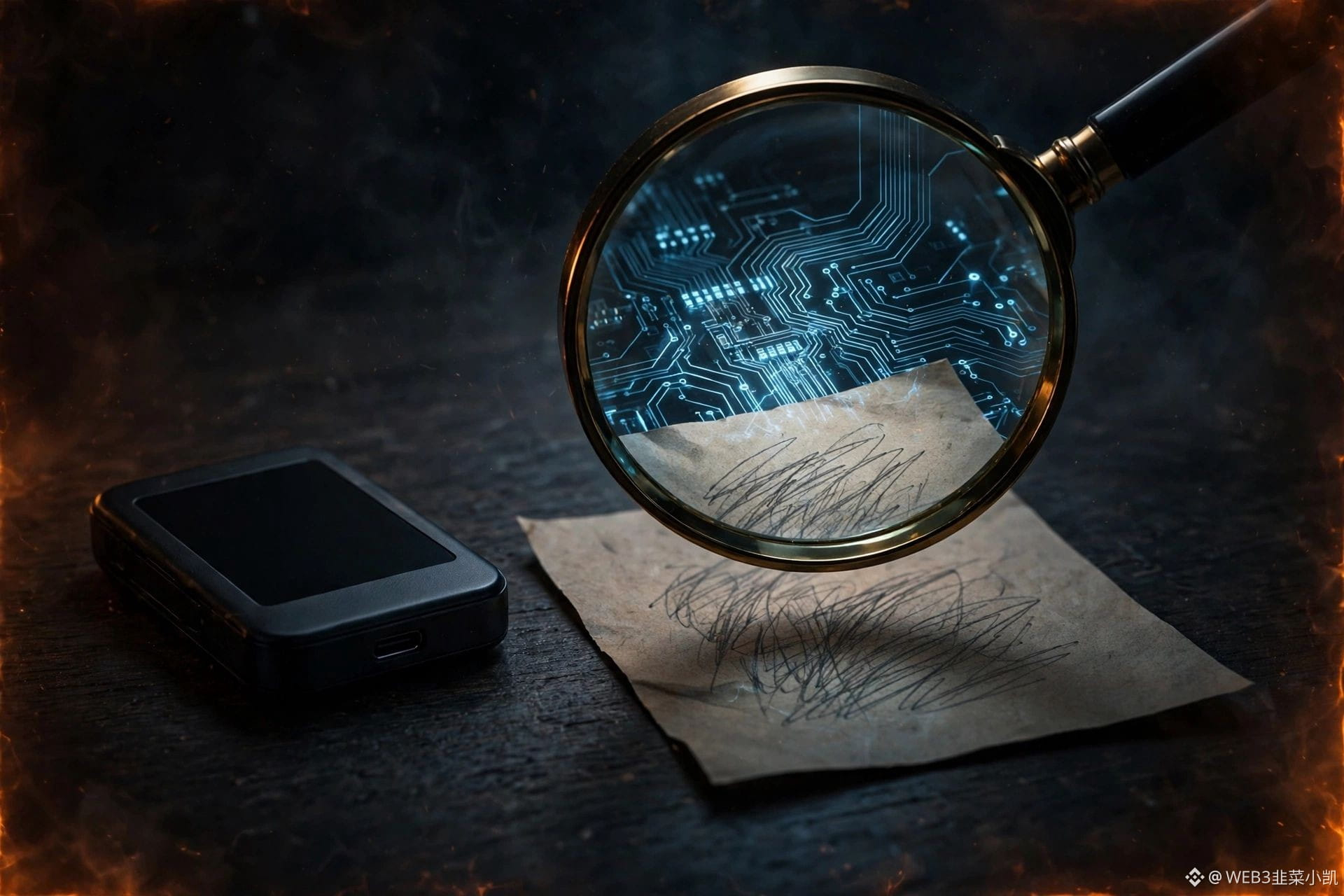
On November 23, Coinkite published an 18-page incident report about a flaw in its Coldcard hardware wallet that had gone unnoticed for more than five years. Seed phrases generated during the 1,949 days from March 29, 2021, to July 30, 2026, relied on a generic software pseudorandom number generator. The chip’s hardware random number generator was always there, but it wasn’t being used. A configuration setting had disabled the hardware random number generator, and the check meant to catch this only checked whether the setting existed—not whether it was enabled.
The seed phrase looks completely normal: all 24 words are there, and the device has never been damaged. The only problem is insufficient randomness. Seed phrases generated by older Mk2 and Mk3 models had only about 40 bits of effective entropy; newer Mk4, Mk5, and Q models had about 72 bits, when they should have had 128. With insufficient entropy, the private key can be calculated offline—without touching your device or asking you to click any links.
The hardware wallet isn’t broken, but its seed phrase can still be calculated
The hardware wallet isn’t broken, but its seed phrase can still be calculated
On November 23, Coinkite published an 18-page incident report about a flaw in its Coldcard hardware wallet that had gone unnoticed for more than five years. Seed phrases generated during the 1,949 days from March 29, 2021, to July 30, 2026, relied on a generic software pseudorandom number generator. The chip’s hardware random number generator was always there, but it wasn’t being used. A configuration setting had disabled the hardware random number generator, and the check meant to catch this only checked whether the setting existed—not whether it was enabled.
The seed phrase looks completely normal: all 24 words are there, and the device has never been damaged. The only problem is insufficient randomness. Seed phrases generated by older Mk2 and Mk3 models had only about 40 bits of effective entropy; newer Mk4, Mk5, and Q models had about 72 bits, when they should have had 128. With insufficient entropy, the private key can be calculated offline—without touching your device or asking you to click any links.
6

·
--
1,789 BTC STOLEN: ARE COLD WALLETS REALLY COMPLETELY SAFE?
Many people buy hardware wallets because they believe that moving their private keys offline will keep their assets safe.
But an incident involving Coldcard has just reminded us that wallet security isn’t that simple.
1. Notable figures
According to the market report dated 25/11/2026:
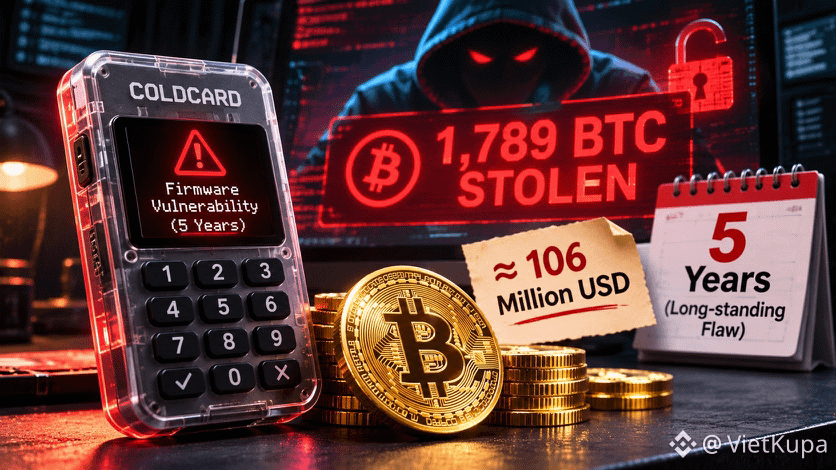
- A firmware vulnerability in Coldcard is believed to have existed for 5 years.
- 1,789 BTC were stolen.
- The estimated value was around $106 million.
What’s concerning isn’t just the amount of Bitcoin lost, but also how long the vulnerability went undetected.
2. Why are cold wallets still at risk?
Cold wallets help reduce the risk of private keys being stolen in online attacks.
But hardware devices still depend on firmware, transaction-signing processes, and how users safeguard their devices.
Put simply: cold wallets provide greater protection, but they don’t create an absolute shield.
3. My perspective
In Web3, we often spend a lot of time looking for the best wallet, but sometimes forget to check how we use it.
An expensive wallet can’t replace good security habits.
I think users should:
- Only download firmware from official channels.
- Check for security notices and updates from the manufacturer.
- Never enter your seed phrase on websites or apps from unknown sources.
- Never sign a transaction without understanding what it does.
Taking custody of your own assets means taking responsibility for their security.
Do you use a hot wallet or a cold wallet to store your assets long term? And when was the last time you checked your firmware?
#bitcoin #Coldcard
JMH_CRYPTO:
great info
1
1
379

·
--
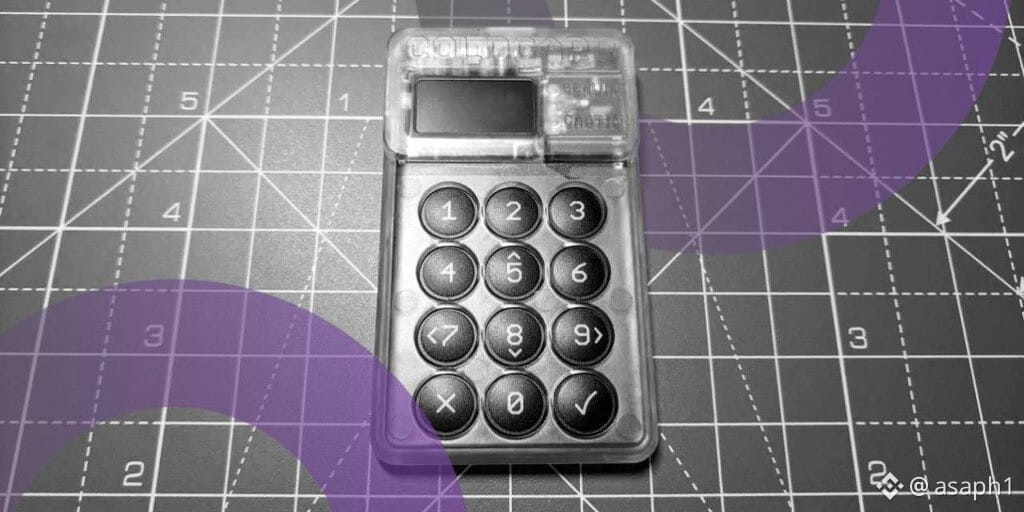
🚨 $BTC BETRAYAL IN THE SAFEST VAULT
Coinkite published the postmortem on the Coldcard theft: a firmware bug generated seeds with a weak generator for more than 5 years, and the thieves emptied wallets without ever touching a device. To me, this is the most serious part: it wasn’t an exchange hack—the vault itself handed over the keys.
Look at the detail no one is noticing:
→ The seeds had only 40 bits of security on the Mk2 and Mk3 (and 72 on the Mk4, Mk5, and Q), compared with the 128 bits they should have had: an attacker could regenerate the keys on their own.
→ The bug survived more than 15 security reviews, including 2 paid audits and an AI review that produced 85 findings... and none of them caught it.
→ Galaxy Research counted 1,778.84 BTC stolen from more than 8,600 addresses, about $107 million, and Coinkite received ~300 claims from 242 accounts.
Do you still trust hardware wallets to store your BTC, yes or no? 👇
$BTC
#Bitcoin #Coldcard #Cybersecurity
3
11.2k

·
--
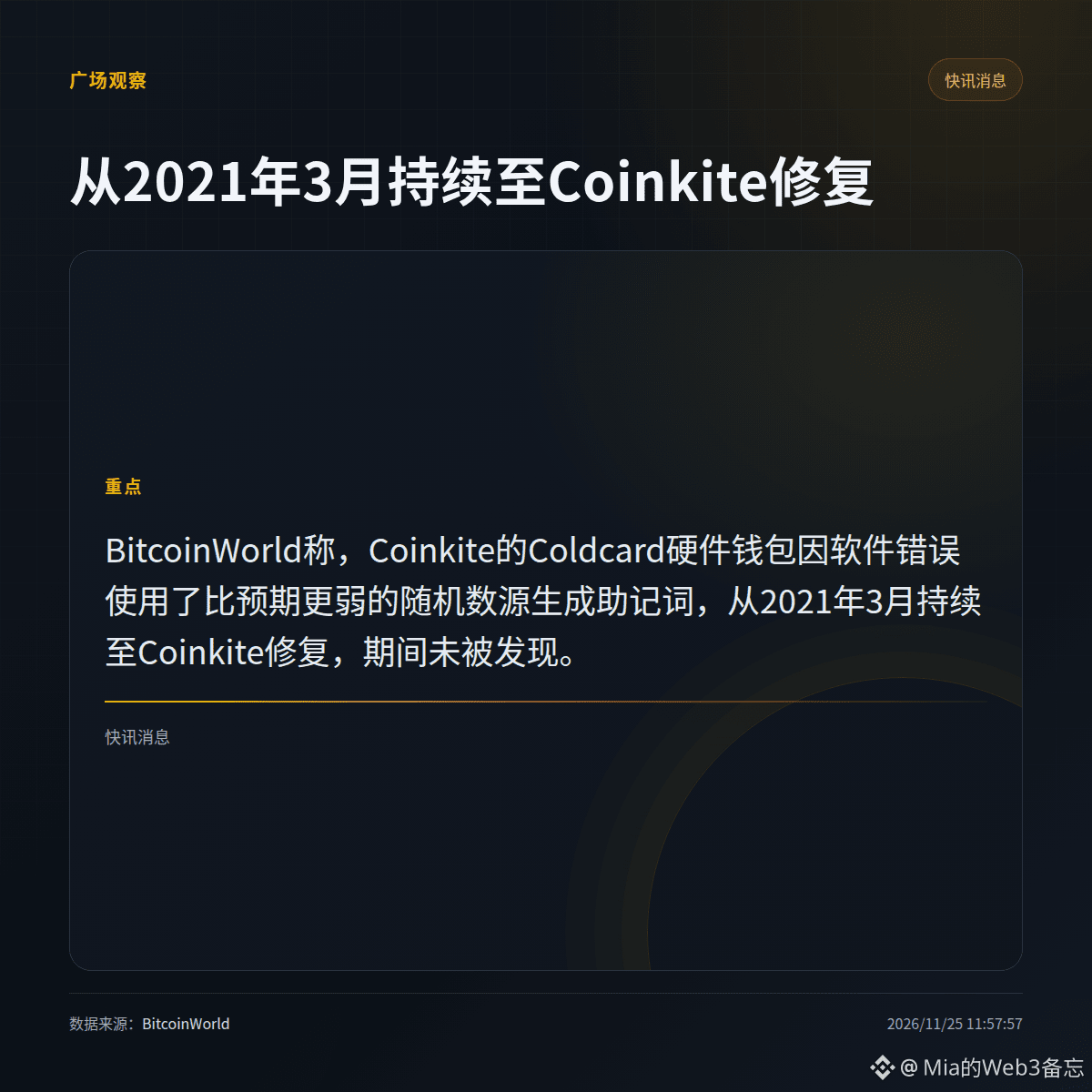
Coldcard had a software bug that caused the hardware wallet to use a weaker-than-designed source of randomness when generating recovery phrases. The issue persisted from March 2021 until Coinkite patched it. The key term here is “source of randomness”: the unpredictability of a mnemonic phrase depends entirely on it, so a weaker source changes everything. What has been confirmed is that the bug existed and persisted for years; it has also been reported that it evaded 15 audits, though that claim comes from BitcoinWorld. For ordinary users, the main concern isn’t market trends, but whether their device’s firmware is patched and whether their recovery phrase was generated under weak randomness. $BTC #Coldcard. For short-term moves, don’t focus on a single statement—trading volume and price ranges tell you more.
Coldcard had a software bug that caused the hardware wallet to use a weaker-than-designed source of randomness when generating recovery phrases. The issue persisted from March 2021 until Coinkite patched it. The key term here is “source of randomness”: the unpredictability of a mnemonic phrase depends entirely on it, so a weaker source changes everything. What has been confirmed is that the bug existed and persisted for years; it has also been reported that it evaded 15 audits, though that claim comes from BitcoinWorld. For ordinary users, the main concern isn’t market trends, but whether their device’s firmware is patched and whether their recovery phrase was generated under weak randomness. $BTC #Coldcard. For short-term moves, don’t focus on a single statement—trading volume and price ranges tell you more.
7

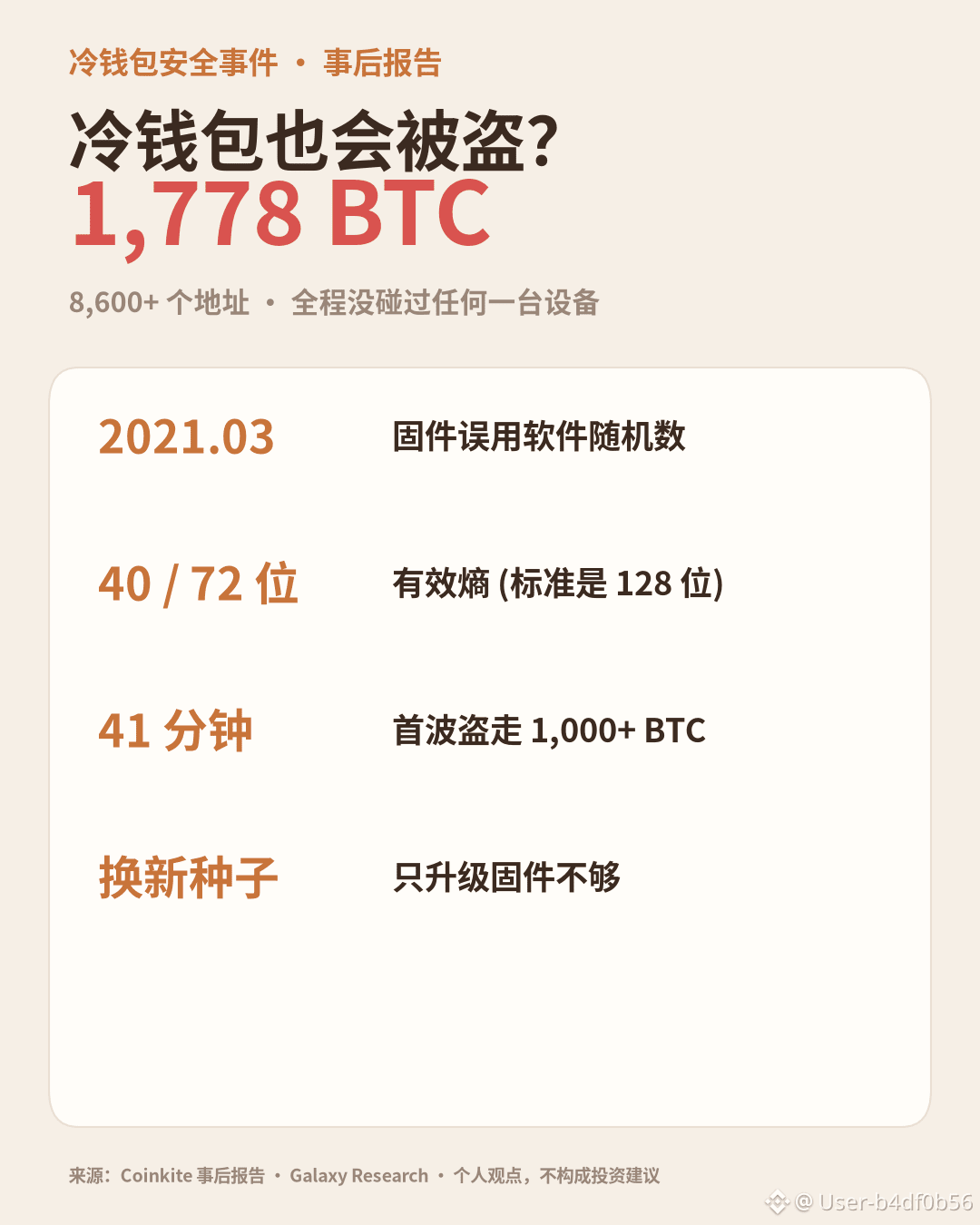
Can cold wallets get stolen too? I finished reading Coldcard’s 18-page postmortem, and the most unsettling part is: nobody hacked the device.
1️⃣ Since March 2021, the firmware had mistakenly used software-generated random numbers, leaving the seed with only about 40–72 bits of effective entropy (the standard is 128 bits)
2️⃣ Attackers brute-forced the keys offline to recover the private keys. More than 8,600 addresses were emptied, totaling at least 1,778 BTC. The first wave took 1,000+ BTC in just 41 minutes
3️⃣ A firmware upgrade alone won’t help—the old seeds are still weak. You need to create a new seed and transfer your coins
My take: $BTC was already being held below 60,000 by ETF outflows. This kind of “storage-layer” trust event won’t directly trigger a sell-off, but it will prompt many people to check their wallets again. What I do is check the device model and how the seed was generated; if I’m not sure, I switch. If a compensation plan is slow to emerge, confidence will be low; if there’s clear compensation, sentiment may actually improve. The same goes for $ETH holders.
How do you mainly store your coins?
A. Cold wallet B. Exchange (Leave a letter in the comments; I’ll pick a few to discuss.)
Follow me: I’ll keep tracking the PCE data over the next few days and go over the answers with you on Thursday morning.
#比特币 #Coldcard #钱包安全 #PCE数据
Personal opinion only; not investment advice. This post may earn creator rewards on the platform.
33

15 rounds of audits over 5 years, and not one found that the wallet wasn’t using true random numbers.
Coldcard officially admitted it: the firmware disabled true random number generation back in March 2021, leaving older models with seed strength of just 40 bits, compared with the 128-bit standard. In July, 1,789 $BTC were stolen, worth about $115 million. 242 accounts reported losses, and whether they’ll be compensated is still undecided.
They checked whether “the system exists,” not whether it was actually used. What’s the point of an audit like that? $BTC is still grinding below 60,000. Do you still dare to hold your coins yourself? Reply 1 for an exchange, 2 to hold them yourself.
$BTC #Coldcard #Hardware Wallet
Log in to explore more content
Join global crypto users on Binance Square
⚡️ Get latest and useful information about crypto.
💬 Trusted by the world’s largest crypto exchange.
👍 Discover real insights from verified creators.
Email / Phone number
Trending Topics
1
#CanMarketsReboundAfterThanksgiving?
13,698 views
347 Discussing
2
#CouldSpaceX’sOrbitalDataCentersBoostAIChipDemand?
8,874 views
216 Discussing
3
#EvolveAtBinanceBlockchainWeek
653,650 views
6,950 Discussing
4
#CorePCEBeatLiftsFedHikeOdds
161,203 views
1,274 Discussing
5
#BitcoinAndStocksSlipAgainAmidTrump’sTariffPlans
213,516 views
2,043 Discussing
6
#JensenHuangSaysNvidiaDoesn’tNeedASuccessionPlan
102,085 views
1,240 Discussing
7
#NasdaqFuturesSlideMoreThan3%
41,928 views
372 Discussing
8
#USOctoberPCEPriceIndexAt0.3%MoM
47,818 views
379 Discussing
9
#BitcoinETFsPostRecord$4.94BNovemberOutflows
9,255 views
49 Discussing
10
#TetherInvestsInArgentinasLemon
18,134 views
211 Discussing