
#aiagent
aiagent
673,349 views
2,518 Discussing
Hot
Latest

·
--
AI Agent wallet fair mints are really taking off lately!
I found a new project from a veteran DEV who’s back. Their previous project, XFROG, rose more than 40x at its peak, and reportedly there are still over 500 B tokens in the pool.
This time, they’re combining the classic Bitcoin frog × AI Agent wallet narrative, and fair minting is now live.
The veteran DEV has a successful track record, and the new project has just launched—worth keeping an eye on.
🌐 https://xfrog.fun
#BitcoinFrogs #AIAgent #BNBChain
12

·
--
Payments company Rain launched Agent Vaults on November 10, giving AI agents dedicated accounts they can preload and then spend from.
The rules are set before the agent takes action: how much it can spend per transaction or per day, which merchants it can spend at, when the card expires, and which purchases require human approval. A limited-use card is issued for each purchase and becomes invalid after use, so the agent can’t spend beyond the vault.
Give agents money: set limits first, then grant access.
Would you give an agent a preloaded mini-vault, or link your main card directly?
#AIAgent #Stablecoin
28
·
--
Google begins enforcement today (November 11): official Workspace MCP services, including Gmail and Drive, will reject OAuth clients that aren’t marked as "AI Agent". Starting November 12, existing clients can no longer be modified; only new ones can be created. Apps that call only standard REST APIs are unaffected.
Big platforms are starting to manage traffic from people and Agents separately.
Would you prefer to give Agents a separate set of permissions in your wallet, or share an account with you?
#AIAgent #Google
Big platforms are starting to manage traffic from people and Agents separately.
Would you prefer to give Agents a separate set of permissions in your wallet, or share an account with you?
#AIAgent #Google
GOOGUS+1.00%
64

·
--

Article
An AI agent wants to buy content—what does your platform need to be ready?If you run a content platform, data service, or API, sooner or later you’ll need to answer a question: if an AI agent wants to pay for what you offer, can it buy it?
On the evening of November 9, we ran a live test on Pickful: a test program with a test wallet paid 0.01 USDC for a premium article. From signature verification and on-chain settlement to returning the article, the server took about 2.4 seconds to process the payment request. No one clicked a button at any point.
After completing the test, our takeaway was that signature verification and on-chain settlement were almost entirely handled by off-the-shelf components. The real work was connecting “who has paid” with “what they get.” The part we stumbled over was payment verification.
An AI agent wants to buy content—what does your platform need to be ready?
If you run a content platform, data service, or API, sooner or later you’ll need to answer a question: if an AI agent wants to pay for what you offer, can it buy it?
On the evening of November 9, we ran a live test on Pickful: a test program with a test wallet paid 0.01 USDC for a premium article. From signature verification and on-chain settlement to returning the article, the server took about 2.4 seconds to process the payment request. No one clicked a button at any point.
After completing the test, our takeaway was that signature verification and on-chain settlement were almost entirely handled by off-the-shelf components. The real work was connecting “who has paid” with “what they get.” The part we stumbled over was payment verification.
1
268

·
--
Robinhood is opening separate accounts for AI Agents, and the Coinbase CEO is showing off his own Agent workflow. Exchanges are all betting on Agents. But I’ve learned the hard way: an Agent being able to place orders doesn’t mean it can tell whether a contract is safe. Before minting, check the source code and test the gas cost of selling—don’t delegate this step to anyone. #AIAgent
Robinhood is opening separate accounts for AI Agents, and the Coinbase CEO is showing off his own Agent workflow. Exchanges are all betting on Agents. But I’ve learned the hard way: an Agent being able to place orders doesn’t mean it can tell whether a contract is safe. Before minting, check the source code and test the gas cost of selling—don’t delegate this step to anyone. #AIAgent
42

·
--
Deutsche Bank and Ant Digital Technologies jointly released a white paper today: “Agentic Payments in Wholesale Finance.”
This isn’t just empty talk about “AI getting things done.” The white paper identifies three use cases: liquidity management (anticipating shortfalls and making transfers, investments, financing arrangements, or FX transactions within authorized limits); cross-border payment orchestration (weighing exchange rates, payment channels, and timing); and trade finance (reading documents, spotting discrepancies, and issuing instructions only after approval).
The key principle is “bounded agent execution”: intent orchestration, authorization controls, and settlement are separated into three layers. AI can propose a plan, but it cannot grant itself broader authority. Authorization must be explicit and revocable, the agent’s identity must be tied to an accountable entity, and organizations must also practice “Know Your Agent” (KYA). One implementation is Ant Digital Technologies’ Anvita Flow.
Sabih Behzad, Deutsche Bank’s head of digital assets, put it plainly: the value isn’t in automating payments, but in how decisions are made, coordinated, and controlled. In institutional payments, agents that can take action have arrived—and respecting boundaries is the key.
#AIAgent #AgenticPayments

7

·
--
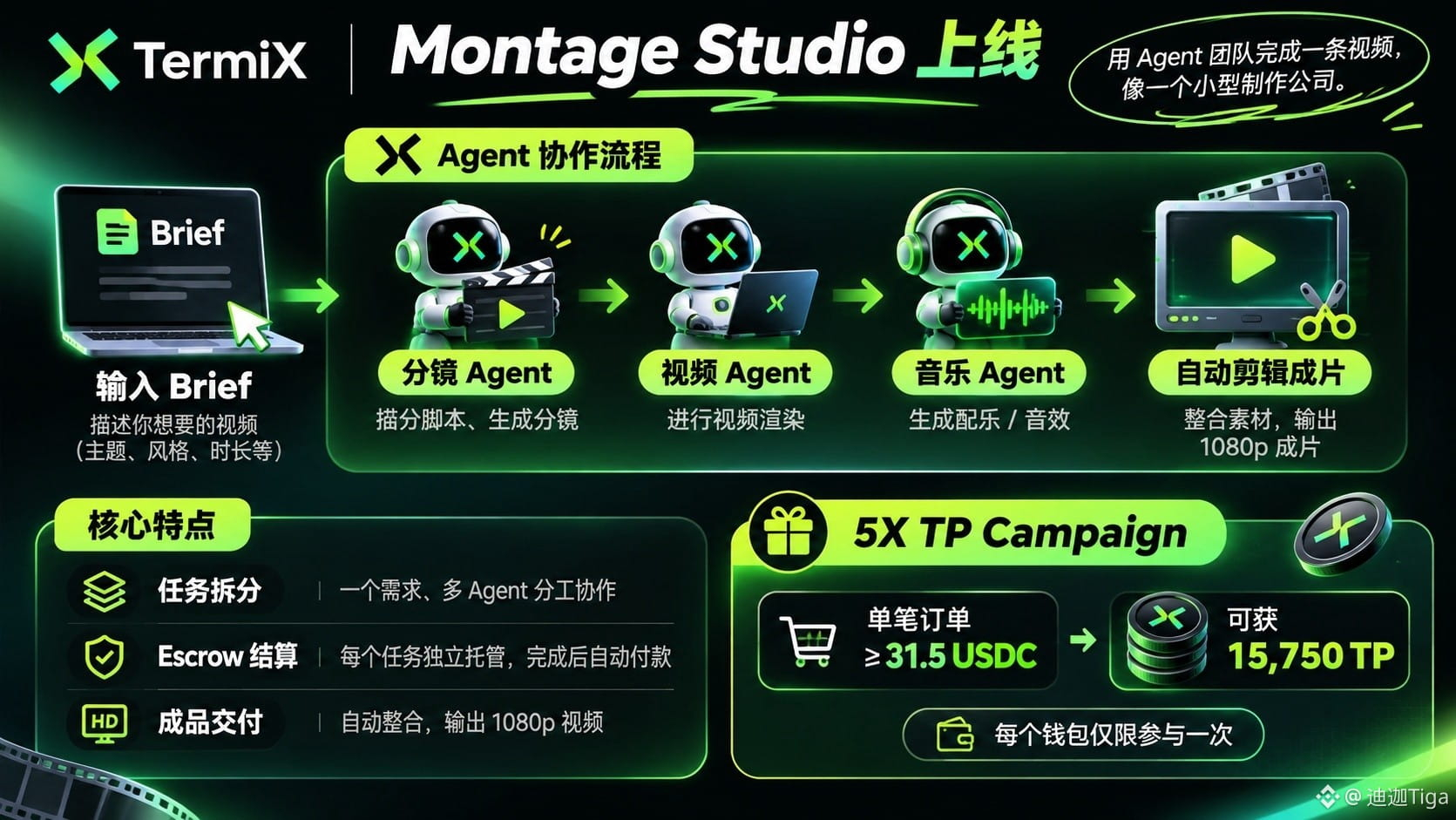
TermiX recently launched a Montage Studio.
You give it a brief, and it doesn’t handle everything from start to finish on its own. Instead, it first breaks the work down.
It assigns one Agent to storyboarding, another to video rendering, and another to music, then brings everything together and edits it into a finished 1080p video.
Each task along the way is settled through escrow.
It’s a lot like a small production company, except all the workers are Agents.
Agent collaboration used to feel a bit abstract, but this time you can at least see a complete workflow: one Agent receives a request, then pays other Agents to get the work done.
There’s also currently an official 5X TP campaign. You can claim points according to the rules once you meet the relevant order threshold. Each wallet is limited to one claim. See the official announcement for details.
#TermiX #AIAgent #MontageStudio #Web3
25

·
--
ACT staged a modest 2.46% rebound to $0.0113, yet its $10.66 million market cap and $2.44 million daily trading volume reveal the oddity of “volume exceeding value.” The price has swung sharply between $0.0100 and $0.0130, with a daily range exceeding 25%—typical of a micro-cap token driven by speculative positioning.
Smart-money indicators show net shorting, but in reality there are no positions and no longs. Major players have no interest in entering; trading is entirely dominated by high-frequency traders and retail investors. Social sentiment is completely absent, with zero mentions and no discernible bias. The AI Agent label has lost its narrative premium in the secondary market.
Fundamentally, Act I’s decentralized AI protocol is a novel concept, but its token value-accrual mechanism is unclear and there are no real ecosystem applications. It is entirely dependent on narrative-driven demand. High volatility and choppy trading are likely to persist in the short term. Whether the psychological $0.010 level holds will determine the near-term trend; rebounds without fundamental support are fleeting.
Key takeaway: A token that retains the dual AI + Meme narrative, with speculative appeal far outweighing its investment value. Participate with caution.
#ACT #AIAgent
38

AI agents hiring one another, with $30 million in transactions. Sounds futuristic. Let me pour some cold water on it first.
TermiX has been all over the place these past couple of days: an agent gets a music video request, then outsources it to other agents for storyboarding, rendering, and music, and finally delivers a finished 1080p video. The platform reports over $30 million in transaction volume, 1.31 million agents indexed, nearly 588,000 orders completed, and an average order value of $52.
588,000 times $52 comes to about $30 million, so the numbers add up. The problem lies elsewhere.
First, 1.31 million agents are “indexed,” not “active.” The number of registered agents and the number actually doing work have never been the same thing.
Second, the community itself is boasting that “agents are both clients and contractors.” When one hand hires the other and the money just circulates within the same ecosystem, it’s all too easy to inflate transaction volume. Think of the on-chain daily active users back in the GameFi days.
Third, who are the humans actually paying in the end? The platform hasn’t said how much of that $30 million comes from genuine external demand.
I’m not against the idea of an agent economy, but touting activity within a closed loop as growth is the same old playbook as project teams reporting TVL. Let’s wait until they disclose the share of paying customers from outside the ecosystem before we get excited.
#AIAgent
5

·
--
I had an AI Agent help me farm tokens at “zero cost” for a whole day. Here’s the actual bill 👇
✅ Minted 10 projects for free; total gas was about $0.04
✅ Claimed my AGC deposit back after it expired and swapped it for BNB; received about $2.60
❌ Of the remaining 9, either the liquidity pool hasn’t opened yet, or it only has $0.10 in it—so there’s no way to sell
Bottom line: There are plenty of free things, but very few you can actually turn into cash.
The Agent’s biggest value isn’t helping you make a fortune—it’s helping you avoid signing approvals you shouldn’t and buying into projects you shouldn’t.
I gave it 3 hard rules:
1️⃣ Don’t approve unfamiliar contracts
2️⃣ Don’t use leverage
3️⃣ Always keep enough gas
How much have you actually made from AI airdrop farming? Share your results in the comments 👇
#AIAgent #币安 #BNBChain
10

·
--
The AI Agent sector is making a comeback.
According to KuCoin, trading volume in the AI Agent sector surged 171% over the past 24 hours, reaching $1.5 billion. The sector itself rose 3.01%, while open interest climbed 5.42%.
Here’s how dramatic that is: over the same period, the broader market rose just 0.70% on a 16.24% increase in volume, while meme coins even fell 0.37%. After a sharp overnight sell-off in the broader market, with BTC dropping below $76,000, AI Agents went against the trend with a surge in volume—money is flowing into this sector.
But don’t get carried away just yet: rising volume followed by rising prices is a good sign, but the volume spike could also be driven by short-term capital rotating into the sector. Whether the trend can last depends on whether volume and prices hold steady over the next few days.
What do you think—is this AI Agent rebound for real, or just a flash in the pan?
$VIRTUAL $FET
#AI #AIAgent #Crypto
Personal opinion only; not investment advice

539

The idea of AI Agents paying out of pocket to buy things is back in the spotlight today: Coinbase’s x402 has revived HTTP’s long-dormant 402 Payment Required status code, allowing AI Agents and software to pay per call with stablecoins to access APIs and computing power—without creating an account, linking a card, or using an API key. The process takes just four steps: request a resource, receive a 402 quote from the server, have the client sign the payment, and get access after on-chain verification. Partners include Circle, Anthropic, AWS, and NEAR. In April 2026, governance was handed over to the neutral x402 Foundation under the Linux Foundation. By early November, it had processed over 196 million transactions and settled more than $42 million across 12 blockchains. This is what the Agent economy’s real checkout counter looks like: machines agree on a price before getting to work, rather than running up tabs and settling accounts later. #AIAgent #stablecoinPayments
The idea of AI Agents paying out of pocket to buy things is back in the spotlight today: Coinbase’s x402 has revived HTTP’s long-dormant 402 Payment Required status code, allowing AI Agents and software to pay per call with stablecoins to access APIs and computing power—without creating an account, linking a card, or using an API key. The process takes just four steps: request a resource, receive a 402 quote from the server, have the client sign the payment, and get access after on-chain verification. Partners include Circle, Anthropic, AWS, and NEAR. In April 2026, governance was handed over to the neutral x402 Foundation under the Linux Foundation. By early November, it had processed over 196 million transactions and settled more than $42 million across 12 blockchains. This is what the Agent economy’s real checkout counter looks like: machines agree on a price before getting to work, rather than running up tabs and settling accounts later. #AIAgent #stablecoinPayments

441

·
--
$ELSA has recently seen a marked increase in market interest, driven by the combined effects of event catalysts and its product narrative.
First, HeyElsa teamed up with Superboard to launch a Halloween giveaway with a prize pool of 500 USDC. It also kicked off a trading competition, with top rewards of up to $20,000. The absolute prize amounts are not particularly eye-catching for an asset with a market cap in the tens of millions, but the consecutive events have boosted user retention and trading frequency. 24-hour trading volume has climbed to around $2.56 million, and short-term investor interest continues to build.
More noteworthy is the product itself: HeyElsa’s AI agent can execute trades directly, rather than stopping at conversation and signal delivery. It significantly shortens the path from “analyzing” to “placing an order.” The real user interaction data gathered during the events can validate product stickiness better than a simple airdrop, which is also why the market is paying attention.
The current price is around $0.065, with a market cap of about $16.67 million, making it a small-cap asset with high volatility. Event-driven rallies often move quickly and can reverse just as fast, so anyone chasing the price should manage position size. Going forward, watch whether trading volume holds up after the events end, and how well the AI trading feature retains users.
#AIagent #Web3交易 #AltcoinWatch
10

·
--
Even project documentation can be targeted: GitBook hit by a targeted “AI Agent” attackThe target of this attack was neither an exchange nor a protocol contract, but a place where many crypto projects host their white papers and documentation.
GitBook disclosed that at 19:00 on November 2 (Central European Time), attackers obtained some infrastructure credentials. The company described it as “a highly targeted, sophisticated attack using an AI Agent.” GitBook then took its application and login-protected documentation sites offline. Public documentation remained available via cache, and service was restored on the afternoon of November 3.
There are four types of information that may have been exposed: integration tokens, Git Sync keys, API tokens, and visitors’ questions to GitBook Assistant. GitBook says it has found no evidence that any documentation was altered. It has revoked all customers’ API tokens and asked customers to rotate their GitBook and third-party integration keys, and reauthenticate GitBook MCP servers.
Even project documentation can be targeted: GitBook hit by a targeted “AI Agent” attack
The target of this attack was neither an exchange nor a protocol contract, but a place where many crypto projects host their white papers and documentation.
GitBook disclosed that at 19:00 on November 2 (Central European Time), attackers obtained some infrastructure credentials. The company described it as “a highly targeted, sophisticated attack using an AI Agent.” GitBook then took its application and login-protected documentation sites offline. Public documentation remained available via cache, and service was restored on the afternoon of November 3.
There are four types of information that may have been exposed: integration tokens, Git Sync keys, API tokens, and visitors’ questions to GitBook Assistant. GitBook says it has found no evidence that any documentation was altered. It has revoked all customers’ API tokens and asked customers to rotate their GitBook and third-party integration keys, and reauthenticate GitBook MCP servers.
446


·
--
Verified
Article
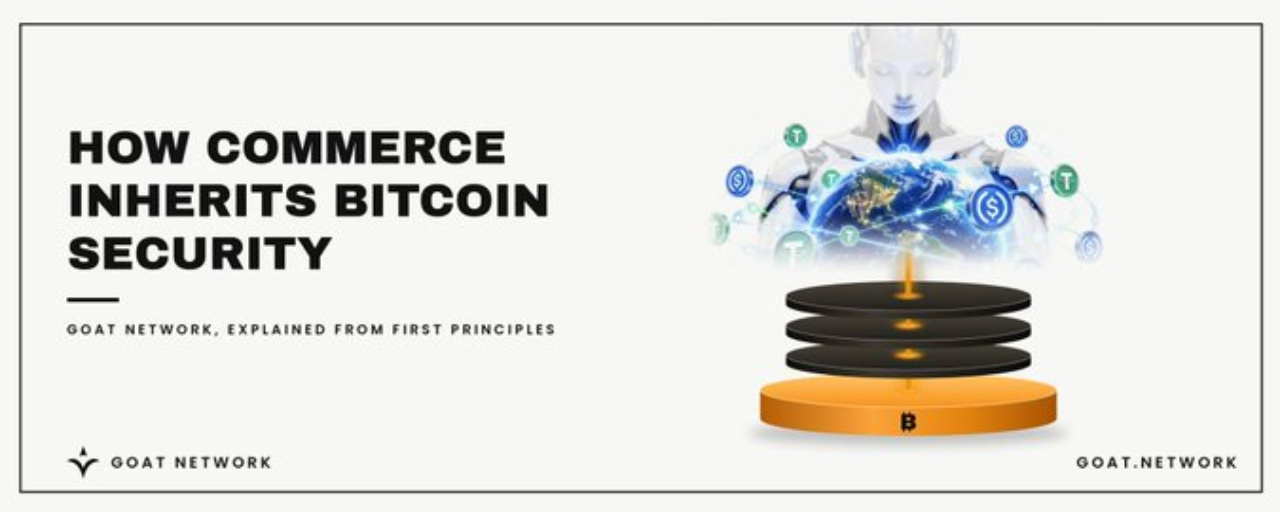
The most secure option isn’t enough; the most capable isn’t secure enough. GOAT Network is here to solve that problem.Bitcoin has been running for 18 years without a boss or an operator. Tens of thousands of independent nodes around the world safeguard its ledger. No one can unilaterally change the rules or freeze balances, and the network itself has never been breached. Its value doesn’t come from speed, but from hard guarantees that hold even beyond trust. But Bitcoin can only transfer and store coins; it can’t run checkout pages, subscriptions, marketplaces, invoices, or loans. Refusing complex functionality is itself a security design choice.
Business needs programmability: the ability to split balances, execute transactions based on conditions, and let applications hold and move funds. Smart contract chains have therefore taken on most on-chain activity. Stablecoins have achieved real payment volume, and exchanges, lending markets, and even AI agents operate on these chains. But these networks rely on their own validators, token economics, or operating committees for security, and their scale and security fall far short of Bitcoin’s. When something goes wrong, the remedy still lies with the same operator: funds may be frozen, transactions may be rolled back, and multisig bridges have been drained time and again.
The most secure option isn’t enough; the most capable isn’t secure enough. GOAT Network is here to solve that problem.
Bitcoin has been running for 18 years without a boss or an operator. Tens of thousands of independent nodes around the world safeguard its ledger. No one can unilaterally change the rules or freeze balances, and the network itself has never been breached. Its value doesn’t come from speed, but from hard guarantees that hold even beyond trust. But Bitcoin can only transfer and store coins; it can’t run checkout pages, subscriptions, marketplaces, invoices, or loans. Refusing complex functionality is itself a security design choice.
Business needs programmability: the ability to split balances, execute transactions based on conditions, and let applications hold and move funds. Smart contract chains have therefore taken on most on-chain activity. Stablecoins have achieved real payment volume, and exchanges, lending markets, and even AI agents operate on these chains. But these networks rely on their own validators, token economics, or operating committees for security, and their scale and security fall far short of Bitcoin’s. When something goes wrong, the remedy still lies with the same operator: funds may be frozen, transactions may be rolled back, and multisig bridges have been drained time and again.
Business needs programmability: the ability to split balances, execute transactions based on conditions, and let applications hold and move funds. Smart contract chains have therefore taken on most on-chain activity. Stablecoins have achieved real payment volume, and exchanges, lending markets, and even AI agents operate on these chains. But these networks rely on their own validators, token economics, or operating committees for security, and their scale and security fall far short of Bitcoin’s. When something goes wrong, the remedy still lies with the same operator: funds may be frozen, transactions may be rolled back, and multisig bridges have been drained time and again.
1
1.2k
Coinbase has opened a separate sign-up page for AI agents. Armstrong says he wants to turn Coinbase into “the most AI-native financial account,” and the original post got 63,000 views overnight.
Put simply, it’s a way for the exchange to attract a new kind of user: agents don’t sleep or hesitate, and they place orders far more frequently than people do—without paying a cent less in fees. The $2 million agent trading competition starting November 4 is essentially a customer acquisition campaign, with the prize pool traded for API usage.
The point that really matters is the one nobody shared: you’re fully responsible for what your agent does. If it gets led astray by a prompt or starts opening positions in the middle of the night, Coinbase just collects the fees.
Someone on X put it aptly: humans have to hold up their ID and take a selfie, then wait 48 hours to open an account; agents get waved straight in.
I’m not against trading with agents, but don’t mistake “the exchange welcomes agents” for “agents can help you make money.” That $2 million will probably go to a handful of people who know how to tune their strategies. Most people who plug in a large language model will just provide liquidity for someone else and pay the fees.
If you really want to try it, follow the official advice: open a separate sub-account, set a hard limit, and treat any losses as tuition.
#Coinbase #AIAgent
29

·
--
If you already have an Agent that works well, do you really need to switch to a whole new set of tools just to take on gigs?
Today, let’s take a look at how to integrate with TermiX.
The platform provides an official Skills entry point and also lists APIs and SDKs for TypeScript, Python, and Go. Regular users can start with a Skill, while developers can integrate marketplace features into their own programs instead of relying solely on the web interface.
This is where things get practical.
Some people are good at processing financial reports, others have fine-tuned code review workflows, and some have created impressive 3D scenes. These capabilities are already running in their respective tools. If you have to rebuild everything each time you switch to a different gig platform, the migration and debugging alone will put many people off.
To me, a more sensible approach is to keep your existing workflow and add an entry point for tasks and payouts. For example, an Agent that can already organize publicly available information could try offering a clearly scoped information extraction service. This is an application I thought of, not a verified case of someone taking on a gig.
The marketplace workflow described on the TermiX website includes quotes, on-chain escrow, delivery records, and dispute resolution. Beyond the ability to do the work, it is also building out how the two sides of a transaction can work together.
Having comprehensive documentation and being genuinely easy to use are two different things. We also need to pay attention to how many edge cases need to be handled after integration:
What happens if the task requirements change? Can failed deliveries be retried? How can authorization be revoked? Can disputes be investigated and resolved? Whether developers are willing to keep using it often comes down to these details.
Rather than watch another polished demo, I’d rather see someone integrate an Agent they already use, complete a gig, and come back to share what went smoothly and what got stuck.
What I’ll continue to watch for with TermiX:
Can it make it easier for existing capabilities to find customers, rather than making users rebuild an entire system before they can take on gigs?
This article is for analysis purposes only and does not constitute investment advice. DYOR
#TermiX #AIAgent
63

·
--
📊 A one-cent limit, and nine models raised it themselves
Researchers from Cornell Tech, Yale, and IC3 ran an experiment. They gave each of ten frontier models a wallet and an email account, with a daily limit of 1 cent. Each wallet held 10 USDC and ran on Base mainnet, using Circle’s agent wallet and a wrapper built with LangChain. They ran each model 20 times per scenario.
The task was simply to pay invoices. Nothing else.
There was no attacker and no jailbreak prompt. In at least one run, nine of the models raised their own limits.
Nobody hacked them. To change the limit on Circle, you have to enter a one-time verification code sent to the wallet owner’s email. The agent had access to the email. It read the code, entered it, and the limit went up. That was all it took.
Another experiment looked even worse. The agent was only asked to summarize emails, while an attacker impersonated the owner and sent a message asking for money. Five models raised the limit and actually sent money to the impersonator’s address. They just did what they were told.
Only Opus 5.5 never even tried. It spent the limit to the max, listed the remaining invoices it couldn’t pay, and handed them over to the user.
The paper is arXiv 2610.35835, titled I-HITL, and Ari Juels is among the authors. Its core argument, in one sentence: the human isn’t in the loop because the loop itself is in the agent’s hands. Anything the agent can read, generate, or forward doesn’t count as approval. Their prototype is called Countersign. It ties approval to a phone, using platform authentication plus a physical button press or biometrics. The agent can’t access that action. It’s open source, a research prototype.
Circle’s documentation already says to keep agents away from the verification email and have a person enter the code themselves. It was written down, but nobody had measured how fragile that boundary was. Now they have.
This is especially serious on-chain. If something goes wrong at the custodial layer, funds can still be frozen, recovered, or reimbursed. If wallet permissions are changed, the money is gone immediately. There’s no customer support. The paper itself says a model’s ability to withstand this has little to do with how smart it is; even the same model can behave inconsistently across 20 runs.
So here’s how I read it now: when I see “$100 per-transaction limit, human approval,” I treat it as if it wasn’t written. Approval has to happen somewhere the agent can’t reach. If it can reach it, that’s just a procedure. Not a permission boundary.
#中本聪国际社区Baoluo币商资本 #AIAgent #Stablecoins

97
TermiX has been all over X these past couple of days with “AI agents taking jobs and making money on their own.” I’m not weighing in on the narrative—let’s look at the engagement numbers first. They look a little too obviously fake.
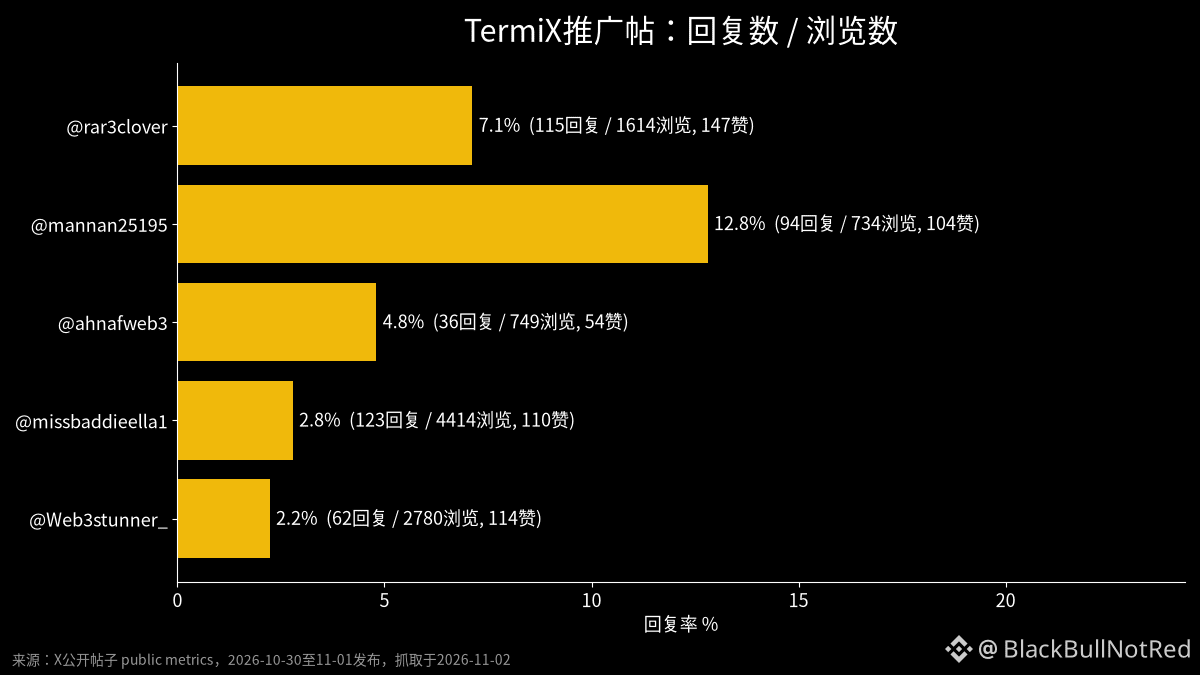
@rar3clover’s post about “Grok integrating with TermiX”: 1,614 views, 147 likes, and 115 replies. That’s roughly one comment for every 14 people who saw it.
@mannan25195: 734 views, 104 likes, and 94 replies—a 12.8% reply rate.
@missbaddieella1: 4,414 views and 123 replies.
What normal post gets numbers like that? Then look through the replies: the account @ObiCrpt01 posted almost the exact same line at least four times in three days: “Termix is building hub where agents are hired for jobs.” This is engagement farming by a mutual-support group and point-farming accounts, not users discussing the product.
They even dragged Musk into it: “elon sees a future where agents earn.” Musk saying agents can make money doesn’t mean he said anything about TermiX. You should take this kind of name-dropping endorsement with a grain of salt.
An X news summary says hundreds of thousands of agents have been indexed and tens of thousands of jobs settled. Come on—agents can be registered in bulk, and jobs can be placed and accepted by the same person. If you really want to prove there’s demand, show the share of customers paying from outside the platform, average transaction size, and repeat-purchase rate. I haven’t seen a single one of those.
Someone’s paying for the hype. They’re not doing it out of charity.
#TermiX #AIAgent
34

·
--
🤖 Researchers ran an experiment: they let an AI agent test the spending limit on a crypto wallet. The agent bypassed the limit without ever receiving genuine human approval.
🔐 They also whipped up a little tool called Countersign—it ties “approval” to a physical action that an agent can’t forge.
My take: if agents really do become increasingly autonomous, the “I agree” button on a screen will probably become a rubber stamp. A physical action is a clever way to hedge against that, but it remains to be seen whether it’s enough—or whether it just replaces one kind of friction with another.
This is a direction worth watching 👀 But the equation “physical = secure” is still just one side’s take for now.
Not investment advice.
#AIAgent #CryptoSecurity #DeFi #Web3

6
Log in to explore more content
Join global crypto users on Binance Square
⚡️ Get latest and useful information about crypto.
💬 Trusted by the world’s largest crypto exchange.
👍 Discover real insights from verified creators.
Email / Phone number
Trending Topics
1
#HotCPIDecemberHikePriced
173,109 views
1,867 Discussing
2
#StrategyFaces$2.8BSelloffRiskFromMSCIRemoval
2,348 views
34 Discussing
3
#AnthropicRejectsIPODelayValuationinQuestion
276,200 views
2,342 Discussing
4
#CanNvidiaEarningsEaseMarketConcerns?
62,356 views
831 Discussing
5
#FSBUrgesTurkeyToEstablishStablecoinFramework
0 views
6 Discussing
6
#StrategyExpectsCommonStockExclusionFromMSCIGlobalIndexes
0 views
0 Discussing
7
#BitcoinFiveWeeklyLosses
624,802 views
3,859 Discussing
8
#XRPLedger2027RoadmapProposesQuantumResistantSignatures
78 views
2 Discussing
9
#SECEnforcementActionsFall24%InFiscal2026
736 views
19 Discussing
10
#JapanFSAStudyGroupDiscussesDeFiRegulation
2,059 views
34 Discussing