
Mr_Crypt0o
52 Posts
Mr_Crypt0o
Report
Block User
Creador de contenido y trader 😎
2 Following
55 Followers
68 Liked
Posts
·
--
Article
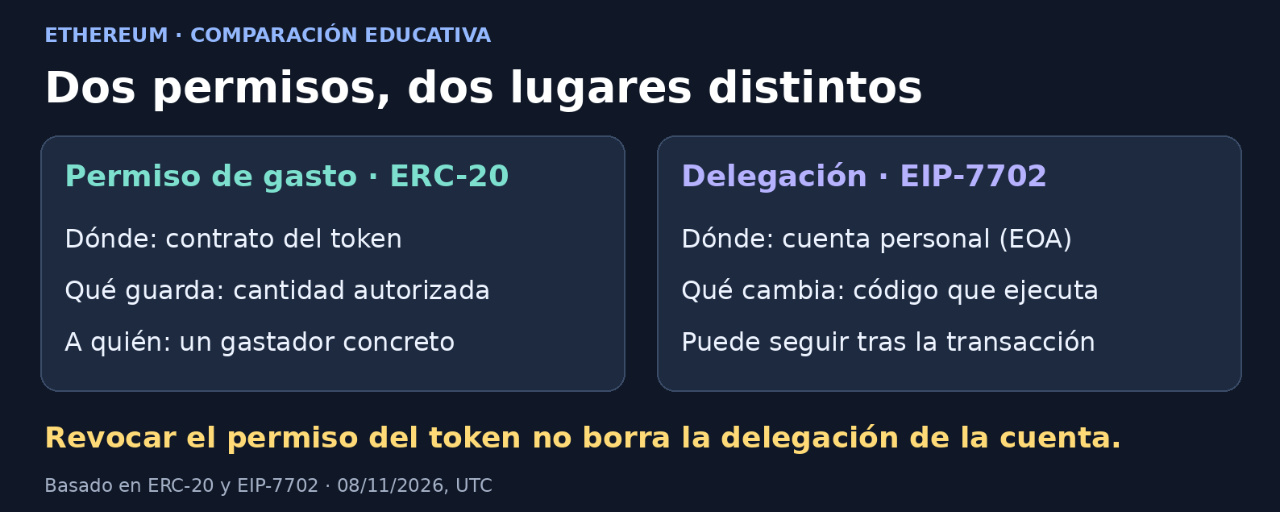
Ethereum: Does revoking a token permission erase a delegation?Your wallet may show a revoked permission and still use delegated code. There’s no contradiction: these are changes recorded in different places. Understanding this helps you know which capability is still active.
The spending permission lives in the token
In ERC-20, an approval indicates how much of an account’s tokens a third party can spend. This authorized amount, called the allowance, is recorded in the token contract. Reducing it to zero changes that specific permission; it does not, by itself, change the account’s logic.
Ethereum: Does revoking a token permission erase a delegation?
Your wallet may show a revoked permission and still use delegated code. There’s no contradiction: these are changes recorded in different places. Understanding this helps you know which capability is still active.
The spending permission lives in the token
In ERC-20, an approval indicates how much of an account’s tokens a third party can spend. This authorized amount, called the allowance, is recorded in the token contract. Reducing it to zero changes that specific permission; it does not, by itself, change the account’s logic.
30
·
--
🔎 Uniswap: can its app use liquidity from another DEX?
📍 $UNI was trading at US$7.00: −2.05% over 24 hours.
⬆️ 24-hour high: US$7.22
⬇️ 24-hour low: US$6.94
Data for [Binance](https://www.binance.com/en/price/uniswap): 08/11/2026, 19:29 UTC. Figures rounded.
On 22/10/2026, Uniswap Labs launched Aggregator Hooks: they present external liquidity sources as v4 pools.
👀 My take:
🟢 Frequent use of external routes would indicate adoption; enabling the feature does not prove it is being used.
🔴 If almost no routes take advantage of those sources, their contribution to the protocol would be limited.
↔️ Staying within the range would not prove new deposits: accessing external liquidity is different. Its endpoints do not prove support levels.
🛡️ Allowing a hook for the routes is not the same as auditing its security.
Technical sources: Uniswap Labs — Aggregator Hooks and Routing for hooked pools.
The author may receive rewards from Binance.
#uniswap #defi
🔎 Uniswap: can its app use liquidity from another DEX?
📍 $UNI was trading at US$7.00: −2.05% over 24 hours.
⬆️ 24-hour high: US$7.22
⬇️ 24-hour low: US$6.94
Data for Binance: 08/11/2026, 19:29 UTC. Figures rounded.
On 22/10/2026, Uniswap Labs launched Aggregator Hooks: they present external liquidity sources as v4 pools.
👀 My take:
🟢 Frequent use of external routes would indicate adoption; enabling the feature does not prove it is being used.
🔴 If almost no routes take advantage of those sources, their contribution to the protocol would be limited.
↔️ Staying within the range would not prove new deposits: accessing external liquidity is different. Its endpoints do not prove support levels.
🛡️ Allowing a hook for the routes is not the same as auditing its security.
Technical sources: Uniswap Labs — Aggregator Hooks and Routing for hooked pools.
The author may receive rewards from Binance.
#uniswap #defi
42
·
--
🧊 Can your USDC be frozen even if you have the keys?
Keeping your keys does not eliminate the issuer’s controls.
The issuer may prevent an address from sending or receiving $USDC in limited circumstances, such as complying with legal orders or responding to security threats.
🧩 Hypothetical example: Ana keeps her keys, but her address is blocked. Having the keys isn’t enough to move those USDC while the restriction remains in place.
Freezing also doesn’t mean “undoing” a transfer: the issuer clarifies that it cannot reverse a completed transfer.
🛡️ My take: controlling the key lets you authorize transactions; token rules can still prevent them.
Sources: [Binance Academy](https://www.binance.com/en/academy/articles/what-is-usdc) (20/05/2026); Issuer Help Center — Blocklisting. Accessed: 08/11/2026, UTC.
The author may receive rewards from Binance.
#USDC #Seguridad
🧊 Can your USDC be frozen even if you have the keys?
Keeping your keys does not eliminate the issuer’s controls.
The issuer may prevent an address from sending or receiving $USDC in limited circumstances, such as complying with legal orders or responding to security threats.
🧩 Hypothetical example: Ana keeps her keys, but her address is blocked. Having the keys isn’t enough to move those USDC while the restriction remains in place.
Freezing also doesn’t mean “undoing” a transfer: the issuer clarifies that it cannot reverse a completed transfer.
🛡️ My take: controlling the key lets you authorize transactions; token rules can still prevent them.
Sources: Binance Academy (20/05/2026); Issuer Help Center — Blocklisting. Accessed: 08/11/2026, UTC.
The author may receive rewards from Binance.
#USDC #Seguridad
164
·
--
Partly True
🔎 Cardano: could another node software reduce failures?
📍 $ADA was trading at US$0.1805: −1.33% in 24 hours.
⬆️ 24-hour high: US$0.1833
⬇️ 24-hour low: US$0.1790
Data from [Binance](https://www.binance.com/en/price/cardano): 08/11/2026, 11:36 UTC. Figures rounded.
Amaru 10.11.20261105, released on 05/11, makes it possible to produce blocks outside test networks.
👀 My take:
🟢 More operators using different software would reduce dependence on a single one. This technical improvement does not guarantee demand for ADA.
🔴 Errors that cause validation disagreements would undermine this improvement.
↔️ Within this range, the price does not demonstrate adoption of Amaru. Its extremes do not prove support levels.
🛡️ It is still in beta: enabling block production does not demonstrate sustained operation.
Technical source: PRAGMA — Amaru notes (GitHub).
The author may receive rewards from Binance.
#Cardano #blockchain
🔎 Cardano: could another node software reduce failures?
📍 $ADA was trading at US$0.1805: −1.33% in 24 hours.
⬆️ 24-hour high: US$0.1833
⬇️ 24-hour low: US$0.1790
Data from Binance: 08/11/2026, 11:36 UTC. Figures rounded.
Amaru 10.11.20261105, released on 05/11, makes it possible to produce blocks outside test networks.
👀 My take:
🟢 More operators using different software would reduce dependence on a single one. This technical improvement does not guarantee demand for ADA.
🔴 Errors that cause validation disagreements would undermine this improvement.
↔️ Within this range, the price does not demonstrate adoption of Amaru. Its extremes do not prove support levels.
🛡️ It is still in beta: enabling block production does not demonstrate sustained operation.
Technical source: PRAGMA — Amaru notes (GitHub).
The author may receive rewards from Binance.
#Cardano #blockchain
752
·
--
Bitcoin: Does a Merkle proof prove that a payment is valid?Your wallet can check that a transaction is included in a block without downloading the entire block. But that proof does not, by itself, check all of Bitcoin’s rules. Understanding the difference helps clarify what “verified” means.
What is being compared
In $BTC , transaction identifiers are combined in pairs using hash functions. The results are combined again until a single summary is obtained: the Merkle root, which is included in the block header.
A proof provides the hashes needed to reconstruct the path of a transaction to that root. If the result matches the reference header’s root, it demonstrates its inclusion in that set, under the security assumptions of the hash.
Bitcoin: Does a Merkle proof prove that a payment is valid?
Your wallet can check that a transaction is included in a block without downloading the entire block. But that proof does not, by itself, check all of Bitcoin’s rules. Understanding the difference helps clarify what “verified” means.
What is being compared
In $BTC , transaction identifiers are combined in pairs using hash functions. The results are combined again until a single summary is obtained: the Merkle root, which is included in the block header.
A proof provides the hashes needed to reconstruct the path of a transaction to that root. If the result matches the reference header’s root, it demonstrates its inclusion in that set, under the security assumptions of the hash.
80
·
--
Verified
🔎 NEAR: Does “gasless” mean nobody pays?
📍 $NEAR was trading at US$3.66: −1.44% in 24 hours.
⬆️ 24-hour high: US$3.77
⬇️ 24-hour low: US$3.64
Data from [Binance](https://www.binance.com/en/price/near-protocol): 07/11/2026, 19:35 UTC. Figures are rounded.
On 04/11, NEAR Mobile announced that version 4.0.0 sponsors fees for eligible transactions. The NEAR network still charges gas in NEAR.
👀 My take:
🟢 More recurring activity and network fees would support token demand; downloading an app isn’t enough.
🔴 Usage that disappears when incentives end would weaken that thesis.
↔️ Staying within the range wouldn’t prove that the wallet is moving the price. Its boundaries don’t prove support levels.
🛡️ The sponsorship covers eligible transactions: it doesn’t mean every transfer is covered.
Technical sources: NEAR Mobile announcement (Chainwire, 04/11/2026); NEAR Docs — Gas.
The author may receive rewards from Binance.
#Near #Web3
🔎 NEAR: Does “gasless” mean nobody pays?
📍 $NEAR was trading at US$3.66: −1.44% in 24 hours.
⬆️ 24-hour high: US$3.77
⬇️ 24-hour low: US$3.64
Data from Binance: 07/11/2026, 19:35 UTC. Figures are rounded.
On 04/11, NEAR Mobile announced that version 4.0.0 sponsors fees for eligible transactions. The NEAR network still charges gas in NEAR.
👀 My take:
🟢 More recurring activity and network fees would support token demand; downloading an app isn’t enough.
🔴 Usage that disappears when incentives end would weaken that thesis.
↔️ Staying within the range wouldn’t prove that the wallet is moving the price. Its boundaries don’t prove support levels.
🛡️ The sponsorship covers eligible transactions: it doesn’t mean every transfer is covered.
Technical sources: NEAR Mobile announcement (Chainwire, 04/11/2026); NEAR Docs — Gas.
The author may receive rewards from Binance.
#Near #Web3
1
669
·
--
🔎 Avalanche: can a node update change the price?
📍 $AVAX was trading at US$8.27: −1.17% in 24 hours.
⬆️ 24-hour high: US$8.45
⬇️ 24-hour low: US$8.26
Data from [Binance](https://www.binance.com/en/price/avalanche): 07/11/2026, 11:33 UTC. Figures rounded.
AvalancheGo v1.15.3, released on 05/11, fixes log queries and transaction ordering. It is optional.
👀 My take:
🟢 Fewer failures and persistent demand for AVAX would support a recovery; releasing software isn’t enough.
🔴 Problems that persist after updating would undermine that operational improvement.
↔️ Given the observed range, I wouldn’t attribute the price to this version. Its highs and lows don’t prove support levels.
🛡️ An outdated node may fail when querying logs, even if transactions continue on the chain.
Technical source: Ava Labs — AvalancheGo v1.15.3 (GitHub).
The author may receive rewards from Binance.
#AVAX #blockchain
🔎 Avalanche: can a node update change the price?
📍 $AVAX was trading at US$8.27: −1.17% in 24 hours.
⬆️ 24-hour high: US$8.45
⬇️ 24-hour low: US$8.26
Data from Binance: 07/11/2026, 11:33 UTC. Figures rounded.
AvalancheGo v1.15.3, released on 05/11, fixes log queries and transaction ordering. It is optional.
👀 My take:
🟢 Fewer failures and persistent demand for AVAX would support a recovery; releasing software isn’t enough.
🔴 Problems that persist after updating would undermine that operational improvement.
↔️ Given the observed range, I wouldn’t attribute the price to this version. Its highs and lows don’t prove support levels.
🛡️ An outdated node may fail when querying logs, even if transactions continue on the chain.
Technical source: Ava Labs — AvalancheGo v1.15.3 (GitHub).
The author may receive rewards from Binance.
#AVAX #blockchain
495
·
--
Bitcoin: Does a time lock send the payment for you?A Bitcoin transaction can be signed and have a future date without the recipient having received anything. Understanding what’s missing helps avoid confusing a prepared payment with money that has already been sent.
What locktime really limits
In $BTC the nLockTime field, when active, prevents that transaction from being included in a block until a time-based condition is met. It can specify a block height or a time reference.
Here we’re talking about that transaction field. Other mechanisms can prevent an output from being spent through conditions built into the contract itself; not all timelocks work the same way.
Bitcoin: Does a time lock send the payment for you?
A Bitcoin transaction can be signed and have a future date without the recipient having received anything. Understanding what’s missing helps avoid confusing a prepared payment with money that has already been sent.
What locktime really limits
In $BTC the nLockTime field, when active, prevents that transaction from being included in a block until a time-based condition is met. It can specify a block height or a time reference.
Here we’re talking about that transaction field. Other mechanisms can prevent an output from being spent through conditions built into the contract itself; not all timelocks work the same way.
82
·
--
Verified
🔎 Sui: Can an AI spend without accessing your entire wallet?
📍 $SUI was trading at US$0.8714: +2.19% in 24 hours.
⬆️ 24-hour high: US$0.8782
⬇️ 24-hour low: US$0.8330
Data from [Binance](https://www.binance.com/en/price/sui): 11/06/2026, 19:33 UTC. Figures rounded.
On 10/28/2026, Sui explained budgets for agents with limits and expiration dates. Agent Payments is still on testnet; the agent doesn't need to hold SUI.
👀 My take:
🟢 Real-world use of these permissions and demand for SUI to pay fees would lend more support to this progress.
🔴 Errors in the limits or low adoption would weaken this usage thesis.
↔️ Within the range, I wouldn't confuse testing with commercial demand.
🛡️ Limiting how much an AI can spend doesn't guarantee it will buy something useful.
Technical source: Sui Foundation — Agent Payments and “Give Agents Authority While Keeping Control.”
#sui #AI
The author may receive rewards from Binance.
🔎 Sui: Can an AI spend without accessing your entire wallet?
📍 $SUI was trading at US$0.8714: +2.19% in 24 hours.
⬆️ 24-hour high: US$0.8782
⬇️ 24-hour low: US$0.8330
Data from Binance: 11/06/2026, 19:33 UTC. Figures rounded.
On 10/28/2026, Sui explained budgets for agents with limits and expiration dates. Agent Payments is still on testnet; the agent doesn't need to hold SUI.
👀 My take:
🟢 Real-world use of these permissions and demand for SUI to pay fees would lend more support to this progress.
🔴 Errors in the limits or low adoption would weaken this usage thesis.
↔️ Within the range, I wouldn't confuse testing with commercial demand.
🛡️ Limiting how much an AI can spend doesn't guarantee it will buy something useful.
Technical source: Sui Foundation — Agent Payments and “Give Agents Authority While Keeping Control.”
#sui #AI
The author may receive rewards from Binance.
1
741
·
--
🧾 Did the transaction fail and you still get charged for gas?
Paying the fee on Ethereum does not guarantee that the contract will complete what you asked it to do.
Gas measures execution work and is paid as a fee of $ETH . If a transaction is included in a block and reverts, the contract changes are undone, but the gas consumed still costs money.
🧩 Hypothetical example: Ana tries to transfer a token. The contract rejects the transfer during execution. The token never reaches the recipient, even though Ana pays for the work performed.
🛡️ Reverting with REVERT can leave some gas unconsumed: failing does not always mean using up the entire limit.
Sources: [Binance Academy — Gas](https://www.binance.com/en/academy/articles/how-do-gas-fees-work-on-ethereum) (06/07/2026); Ethereum.org — Gas and fees and EIP-140. Accessed: 06/11/2026, UTC.
#Ethereum #blockchain
The author may receive rewards from Binance.
🧾 Did the transaction fail and you still get charged for gas?
Paying the fee on Ethereum does not guarantee that the contract will complete what you asked it to do.
Gas measures execution work and is paid as a fee of $ETH . If a transaction is included in a block and reverts, the contract changes are undone, but the gas consumed still costs money.
🧩 Hypothetical example: Ana tries to transfer a token. The contract rejects the transfer during execution. The token never reaches the recipient, even though Ana pays for the work performed.
🛡️ Reverting with REVERT can leave some gas unconsumed: failing does not always mean using up the entire limit.
Sources: Binance Academy — Gas (06/07/2026); Ethereum.org — Gas and fees and EIP-140. Accessed: 06/11/2026, UTC.
#Ethereum #blockchain
The author may receive rewards from Binance.
100
·
--
Verified
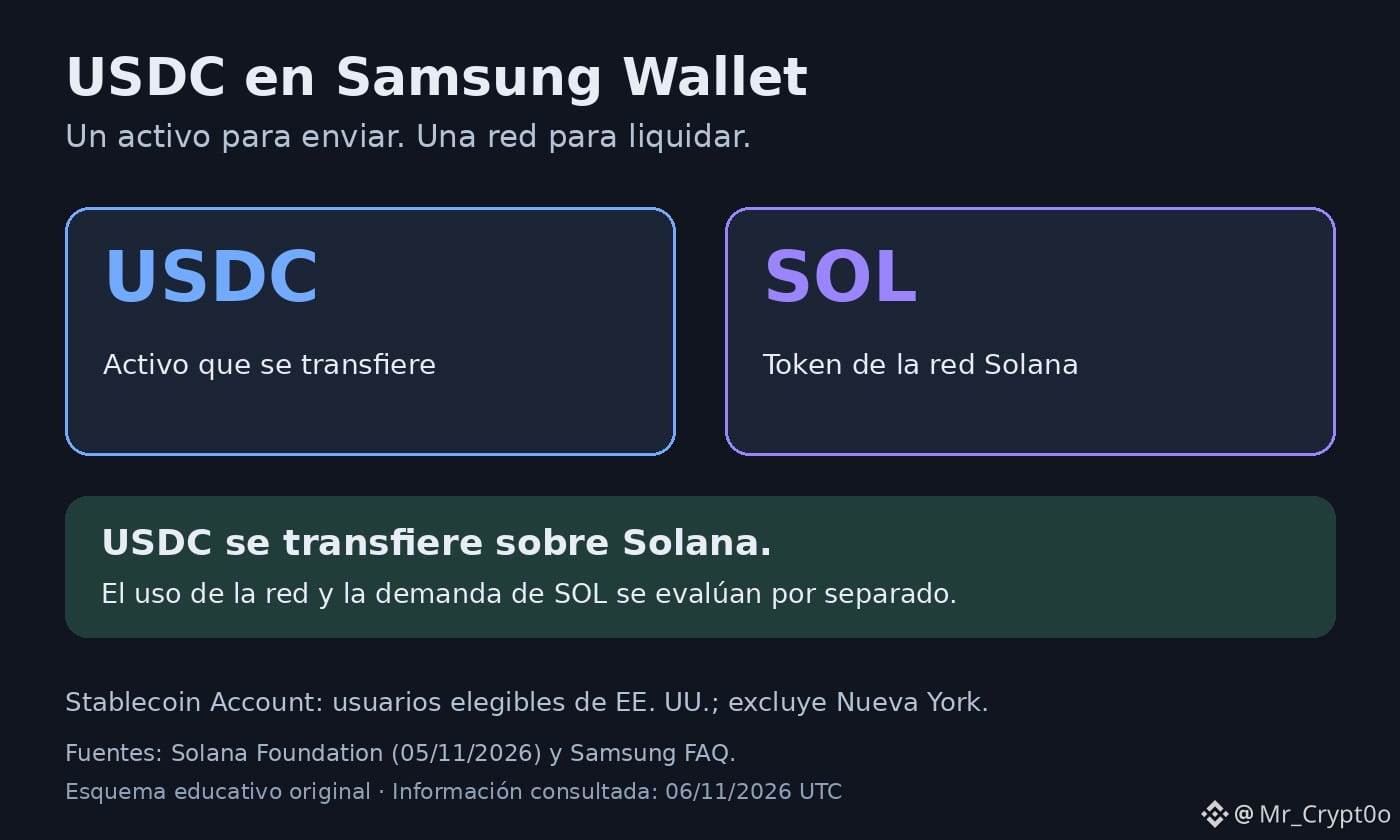
🔎 Solana: Does USDC on Samsung Wallet mean more demand for SOL?
📍$SOL was trading at US$90.28: −6.46% in 24 hours.
⬆️ 24-hour high: US$96.42
⬇️ 24-hour low: US$88.48
Data from [Binance](https://www.binance.com/en/price/solana): 06/11/2026, 11:36 UTC. Figures rounded.
USDC arrived on Samsung Wallet on 02/11/2026 for eligible users in the US; Solana announced it on 05/11.
👀 My take:
🟢 Repeated transfers, together with demand for SOL, would lend more weight to adoption.
🔴 Many inactive accounts would weaken that view, even if SOL rebounds.
↔️ Within the range, price alone would not prove a Samsung effect.
🛡️ Bastion holds the USDC in custody through Coinbase: you depend on third parties to access the funds.
Sources: Solana Foundation (05/11/2026) and Samsung FAQ.
#solana #USDC
The author may receive rewards from Binance.
🔎 Solana: Does USDC on Samsung Wallet mean more demand for SOL?
📍$SOL was trading at US$90.28: −6.46% in 24 hours.
⬆️ 24-hour high: US$96.42
⬇️ 24-hour low: US$88.48
Data from Binance: 06/11/2026, 11:36 UTC. Figures rounded.
USDC arrived on Samsung Wallet on 02/11/2026 for eligible users in the US; Solana announced it on 05/11.
👀 My take:
🟢 Repeated transfers, together with demand for SOL, would lend more weight to adoption.
🔴 Many inactive accounts would weaken that view, even if SOL rebounds.
↔️ Within the range, price alone would not prove a Samsung effect.
🛡️ Bastion holds the USDC in custody through Coinbase: you depend on third parties to access the funds.
Sources: Solana Foundation (05/11/2026) and Samsung FAQ.
#solana #USDC
The author may receive rewards from Binance.
1
677
·
--
🔎 Uniswap: Do more apps using TJAR mean more UNI burned?
📍 $UNI was trading at US$7.64: +5.6% in 24 hours.
⬆️ 24-hour high: US$7.76
⬇️ 24-hour low: US$6.97
Data from [Binance](https://www.binance.com/en/price/uniswap): 11/04/2026, 19:12 UTC. Figures are rounded.
Uniswap Labs opened TJAR to other apps on 10/29/2026. It converts fees into the token chosen by each app. For example, Robinhood receives stablecoins.
👀 My take:
🟢 More conversions that actually result in UNI burns would lend weight to that thesis.
🔴 If TJAR grows but nearly all apps choose other tokens, the link to UNI weakens.
↔️ If the price stays in range, I’d look at recorded burns to assess the effect on supply.
🛡️ If the configuration remains open, the admin can change where the fees go.
Technical source: Uniswap Labs, “How TJAR Works” (10/30/2026).
#uniswap #defi
The author may receive rewards from Binance.
🔎 Uniswap: Do more apps using TJAR mean more UNI burned?
📍 $UNI was trading at US$7.64: +5.6% in 24 hours.
⬆️ 24-hour high: US$7.76
⬇️ 24-hour low: US$6.97
Data from Binance: 11/04/2026, 19:12 UTC. Figures are rounded.
Uniswap Labs opened TJAR to other apps on 10/29/2026. It converts fees into the token chosen by each app. For example, Robinhood receives stablecoins.
👀 My take:
🟢 More conversions that actually result in UNI burns would lend weight to that thesis.
🔴 If TJAR grows but nearly all apps choose other tokens, the link to UNI weakens.
↔️ If the price stays in range, I’d look at recorded burns to assess the effect on supply.
🛡️ If the configuration remains open, the admin can change where the fees go.
Technical source: Uniswap Labs, “How TJAR Works” (10/30/2026).
#uniswap #defi
The author may receive rewards from Binance.
429
·
--
🧾 Why can a single Bitcoin payment show two destinations?
The second output may be change returned to your own wallet.
In $BTC , the wallet spends the full value of the outputs it selects as inputs. If there is value left over after the payment and fee, it may create a change output.
🧩 Hypothetical example: from an output of 100,000 satoshis, 30,000 go to the recipient, 69,000 return to the wallet, and 1,000 are the fee. The change may appear at a different address that is also controlled by the wallet.
Seeing two outputs in the explorer does not prove that you paid two people. Nor is looking at the amount alone enough to identify the change.
Sources: [Binance Academy — UTXO](https://www.binance.com/es/academy/glossary/unspent-transaction-output-utxo) and Bitcoin documentation, “Transaction Fees and Change.”
The author may receive rewards from Binance.
#bitcoin #blockchain
🧾 Why can a single Bitcoin payment show two destinations?
The second output may be change returned to your own wallet.
In $BTC , the wallet spends the full value of the outputs it selects as inputs. If there is value left over after the payment and fee, it may create a change output.
🧩 Hypothetical example: from an output of 100,000 satoshis, 30,000 go to the recipient, 69,000 return to the wallet, and 1,000 are the fee. The change may appear at a different address that is also controlled by the wallet.
Seeing two outputs in the explorer does not prove that you paid two people. Nor is looking at the amount alone enough to identify the change.
Sources: Binance Academy — UTXO and Bitcoin documentation, “Transaction Fees and Change.”
The author may receive rewards from Binance.
#bitcoin #blockchain
135
·
--
🔎 Chainlink: does a partnership already mean real-world use?
📍 $LINK was trading at US$11.77: +2% in 24 hours.
⬆️ 24-hour high: US$11.91
⬇️ 24-hour low: US$11.48
Data for [Binance](https://www.binance.com/en/price/chainlink): 01/11/2026, 11:36 UTC. Figures rounded.
Hanwha Investment & Securities announced on 29/10/2026 that it would adopt Chainlink data and CCIP for its tokenized asset platform. CCIP connects networks.
👀 My take:
🟢 A sustained rise and Hanwha products in use would provide more support than the announcement alone.
🔴 Persistent declines and delays in those products would weaken the case for progress.
↔️ In this range, I wouldn't assume Hanwha is already generating demand for LINK.
🛡️ Using CCIP does not eliminate risks related to the application's code and configuration.
Technical sources: Chainlink — Partnership with Hanwha (29/10/2026); CCIP Overview.
#Chainlink #RWA
The author may receive rewards from Binance.
🔎 Chainlink: does a partnership already mean real-world use?
📍 $LINK was trading at US$11.77: +2% in 24 hours.
⬆️ 24-hour high: US$11.91
⬇️ 24-hour low: US$11.48
Data for Binance: 01/11/2026, 11:36 UTC. Figures rounded.
Hanwha Investment & Securities announced on 29/10/2026 that it would adopt Chainlink data and CCIP for its tokenized asset platform. CCIP connects networks.
👀 My take:
🟢 A sustained rise and Hanwha products in use would provide more support than the announcement alone.
🔴 Persistent declines and delays in those products would weaken the case for progress.
↔️ In this range, I wouldn't assume Hanwha is already generating demand for LINK.
🛡️ Using CCIP does not eliminate risks related to the application's code and configuration.
Technical sources: Chainlink — Partnership with Hanwha (29/10/2026); CCIP Overview.
#Chainlink #RWA
The author may receive rewards from Binance.
140
·
--
🔍 Why can one explorer see your Bitcoin transaction while another cannot?
A pending transaction $BTC does not automatically appear on every node. Each one keeps its own mempool: unconfirmed transactions it has received and accepted.
🧩 Fictional example: node A has already received a transaction; node B has not yet. Their explorers may disagree even though they follow the same chain.
In addition to the time of receipt, each node’s local rules and resources play a role.
🛡️ Seeing “pending” does not guarantee inclusion in a block or a timeframe. Nor does an explorer failing to find it, by itself, prove that it has been canceled.
Sources: [Binance Academy — Mempool](https://www.binance.com/en/academy/glossary/mempool); Bitcoin Core — Transaction Relay Policy. Accessed: 31/10/2026, UTC.
#bitcoin #blockchain
The author may receive rewards from Binance.
🔍 Why can one explorer see your Bitcoin transaction while another cannot?
A pending transaction $BTC does not automatically appear on every node. Each one keeps its own mempool: unconfirmed transactions it has received and accepted.
🧩 Fictional example: node A has already received a transaction; node B has not yet. Their explorers may disagree even though they follow the same chain.
In addition to the time of receipt, each node’s local rules and resources play a role.
🛡️ Seeing “pending” does not guarantee inclusion in a block or a timeframe. Nor does an explorer failing to find it, by itself, prove that it has been canceled.
Sources: Binance Academy — Mempool; Bitcoin Core — Transaction Relay Policy. Accessed: 31/10/2026, UTC.
#bitcoin #blockchain
The author may receive rewards from Binance.
23
·
--
Can an NFT have multiple units of the same ID?You see “edition of five,” and two wallets show the same identifier (ID). Is there a duplication? Understanding how tokens are counted helps distinguish an edition of multiple tokens from several unique tokens.
An ID doesn’t mean the same thing across all standards
In ERC-721, each issued identifier corresponds to a distinct token, with one owner at a time. A collection can bring many IDs together in one contract; it doesn’t need a separate contract for each item.
In ERC-1155, each address has a quantity for each ID. A single contract can group token types with many units alongside others with just one.
Can an NFT have multiple units of the same ID?
You see “edition of five,” and two wallets show the same identifier (ID). Is there a duplication? Understanding how tokens are counted helps distinguish an edition of multiple tokens from several unique tokens.
An ID doesn’t mean the same thing across all standards
In ERC-721, each issued identifier corresponds to a distinct token, with one owner at a time. A collection can bring many IDs together in one contract; it doesn’t need a separate contract for each item.
In ERC-1155, each address has a quantity for each ID. A single contract can group token types with many units alongside others with just one.
65
·
--
🔎 Bitcoin: does an anniversary explain the price rise?
📍 $BTC was trading at US$77,447: +1.24% in 24 hours.
⬆️ 24-hour high: US$77,630
⬇️ 24-hour low: US$76,493
Data from [Binance](https://www.binance.com/es/price/bitcoin): 31/10/2026, 19:29 UTC. Figures rounded.
Satoshi announced the paper on 31/10/2008: today marks 18 years.
👀 My take:
🟢 With the price near the top of the range, demand that persists after the anniversary would support the rally.
🔴 If attention fades and BTC selling returns, the rally could lose steam.
↔️ Staying in the range would not confirm a new trend or increased use as money.
🛡️ Satoshi assumed an honest majority of computing power; an attacking majority can put the payment history at risk.
Historical source: Satoshi, “Bitcoin P2P e-cash paper.”
#bitcoin #blockchain
The author may receive rewards from Binance.
🔎 Bitcoin: does an anniversary explain the price rise?
📍 $BTC was trading at US$77,447: +1.24% in 24 hours.
⬆️ 24-hour high: US$77,630
⬇️ 24-hour low: US$76,493
Data from Binance: 31/10/2026, 19:29 UTC. Figures rounded.
Satoshi announced the paper on 31/10/2008: today marks 18 years.
👀 My take:
🟢 With the price near the top of the range, demand that persists after the anniversary would support the rally.
🔴 If attention fades and BTC selling returns, the rally could lose steam.
↔️ Staying in the range would not confirm a new trend or increased use as money.
🛡️ Satoshi assumed an honest majority of computing power; an attacking majority can put the payment history at risk.
Historical source: Satoshi, “Bitcoin P2P e-cash paper.”
#bitcoin #blockchain
The author may receive rewards from Binance.
141
·
--
📬 Is the USDT contract address your deposit address?
Confusing the two can leave tokens locked.
🧩 Fictional example: Ana wants to deposit USDT on Ethereum. She copies the token contract address instead of the deposit address provided by the service.
The contract records token balances; the deposit address indicates where that service expects to receive them. They are not interchangeable.
🛡️ On Ethereum, paying gas with $ETH does not guarantee recovery. ERC-20 does not ensure that the receiving contract knows how to return the tokens; they can remain trapped even after the transfer is confirmed.
Sources: [Binance — Depósitos](https://www.binance.com/es/academy/articles/your-guide-to-binance-deposit-withdrawal); Ethereum.org, “ERC-20 Token Standard” and “Gas and fees”; MetaMask, “Sending tokens to a contract.” Consulted: 31/10/2026, UTC.
#USDT #Seguridad
The author may receive rewards from Binance.
📬 Is the USDT contract address your deposit address?
Confusing the two can leave tokens locked.
🧩 Fictional example: Ana wants to deposit USDT on Ethereum. She copies the token contract address instead of the deposit address provided by the service.
The contract records token balances; the deposit address indicates where that service expects to receive them. They are not interchangeable.
🛡️ On Ethereum, paying gas with $ETH does not guarantee recovery. ERC-20 does not ensure that the receiving contract knows how to return the tokens; they can remain trapped even after the transfer is confirmed.
Sources: Binance — Depósitos; Ethereum.org, “ERC-20 Token Standard” and “Gas and fees”; MetaMask, “Sending tokens to a contract.” Consulted: 31/10/2026, UTC.
#USDT #Seguridad
The author may receive rewards from Binance.
158
·
--
Your .eth name expired: can someone else register it now?A name no longer pointing to your address doesn’t mean it’s available. Understanding that difference helps avoid confusing a service interruption with losing the name.
The name and the token are not the same thing
ENS lets you associate human-readable names with addresses. The token $ENS participates in governance; holding it does not automatically extend a name’s registration. Here we’re talking about second-level .eth names, not subnames.
What happens during the grace period
According to the current ENS documentation, an ENSv2 name has a 28-day grace period after it expires. During that period, it stops resolving: the service no longer returns the associated address when queried.
Your .eth name expired: can someone else register it now?
A name no longer pointing to your address doesn’t mean it’s available. Understanding that difference helps avoid confusing a service interruption with losing the name.
The name and the token are not the same thing
ENS lets you associate human-readable names with addresses. The token $ENS participates in governance; holding it does not automatically extend a name’s registration. Here we’re talking about second-level .eth names, not subnames.
What happens during the grace period
According to the current ENS documentation, an ENSv2 name has a 28-day grace period after it expires. During that period, it stops resolving: the service no longer returns the associated address when queried.
129
·
--
Lightning: Why can you send bitcoins but not receive them?Your wallet can have a balance and still be unable to receive a payment over Lightning. The difference lies in how the money is distributed across its channels, not just how much you have.
Sending and receiving use different sides
On Lightning, $BTC payments update channel balances without recording every payment on the main chain. Within a channel, each participant owns a portion of the balance.
From your perspective, the local balance provides capacity to send; the remote balance provides capacity to receive. Having bitcoins at an on-chain address also does not automatically create receiving capacity in a channel.
Lightning: Why can you send bitcoins but not receive them?
Your wallet can have a balance and still be unable to receive a payment over Lightning. The difference lies in how the money is distributed across its channels, not just how much you have.
Sending and receiving use different sides
On Lightning, $BTC payments update channel balances without recording every payment on the main chain. Within a channel, each participant owns a portion of the balance.
From your perspective, the local balance provides capacity to send; the remote balance provides capacity to receive. Having bitcoins at an on-chain address also does not automatically create receiving capacity in a channel.
47
Log in to explore more content
Join global crypto users on Binance Square
⚡️ Get latest and useful information about crypto.
💬 Trusted by the world’s largest crypto exchange.
👍 Discover real insights from verified creators.
Email / Phone number