
#smartcontract
smartcontract
90,443 views
185 Discussing
Hot
Latest

🚨 $WEMIX UNDER SIEGE — $6.25M EXPLOIT SHAKES THE SMART CONTRACT! 💥
No Trade Signal — Alert Only
🔴 The exploit hit like a flash loan nightmare: an attacker minted and transferred WEMIX tokens directly from the smart contract. 📊 Initial reaction suggests liquidity pools are bleeding, but the team's swift response could act as a firewall. 📌 This isn't a full-blown collapse yet — it's a test of their incident response muscle. 💡 History shows fast-recovering projects often trap late sellers. 🛡️
💬 Will the WEMIX team freeze the exploited contract and claw back funds, or are we watching a slow bleed into support levels? 👇
⚠️ Not financial advice. Always manage your risk. 🛡️
🏷️ #WEMIX #Exploit #CryptoAlert #SmartContract
💥 🦈
🚨 $WEMIX UNDER SIEGE — $6.25M EXPLOIT SHAKES THE SMART CONTRACT! 💥
No Trade Signal — Alert Only
🔴 The exploit hit like a flash loan nightmare: an attacker minted and transferred WEMIX tokens directly from the smart contract. 📊 Initial reaction suggests liquidity pools are bleeding, but the team's swift response could act as a firewall. 📌 This isn't a full-blown collapse yet — it's a test of their incident response muscle. 💡 History shows fast-recovering projects often trap late sellers. 🛡️
💬 Will the WEMIX team freeze the exploited contract and claw back funds, or are we watching a slow bleed into support levels? 👇
⚠️ Not financial advice. Always manage your risk. 🛡️
🏷️ #WEMIX #Exploit #CryptoAlert #SmartContract
💥 🦈
No Trade Signal — Alert Only
🔴 The exploit hit like a flash loan nightmare: an attacker minted and transferred WEMIX tokens directly from the smart contract. 📊 Initial reaction suggests liquidity pools are bleeding, but the team's swift response could act as a firewall. 📌 This isn't a full-blown collapse yet — it's a test of their incident response muscle. 💡 History shows fast-recovering projects often trap late sellers. 🛡️
💬 Will the WEMIX team freeze the exploited contract and claw back funds, or are we watching a slow bleed into support levels? 👇
⚠️ Not financial advice. Always manage your risk. 🛡️
🏷️ #WEMIX #Exploit #CryptoAlert #SmartContract
💥 🦈


43

🚨 BREAKING !!!
AI FRONTIER CAN SPOT DEFI VULNERABILITIES — ANTHROPIC DROPS CLAUDE FABLE 5 🔥🟡📉
Anthropic has officially launched Claude Fable 5 — the first publicly announced Mythos-class AI model, marking a major leap in frontier AI capabilities 🛠
The model integrates an automatic safety mechanism: queries related to cyber attacks, bioweapons, or model replication will be redirected to the less dangerous Claude Opus 4.8 💰
Noteworthy point: Opus 4.8 previously helped uncover a serious vulnerability in the Orchard protocol of Zcash 📊
Major concern: next-gen frontier AIs could accelerate the discovery — or even creation — of vulnerabilities in smart contracts, privacy coins, and unaudited DeFi protocols 🎯
A double-edged sword: it enables auditing firms to work faster, but poses real risks with unvetted code. This is not investment advice.
#DeFiSecurity #AIRisk #SmartContract
$ZEC $ETH $VELVET
🚨 BREAKING !!!
AI FRONTIER CAN SPOT DEFI VULNERABILITIES — ANTHROPIC DROPS CLAUDE FABLE 5 🔥🟡📉
Anthropic has officially launched Claude Fable 5 — the first publicly announced Mythos-class AI model, marking a major leap in frontier AI capabilities 🛠
The model integrates an automatic safety mechanism: queries related to cyber attacks, bioweapons, or model replication will be redirected to the less dangerous Claude Opus 4.8 💰
Noteworthy point: Opus 4.8 previously helped uncover a serious vulnerability in the Orchard protocol of Zcash 📊
Major concern: next-gen frontier AIs could accelerate the discovery — or even creation — of vulnerabilities in smart contracts, privacy coins, and unaudited DeFi protocols 🎯
A double-edged sword: it enables auditing firms to work faster, but poses real risks with unvetted code. This is not investment advice.
#DeFiSecurity #AIRisk #SmartContract
$ZEC $ETH $VELVET
AI FRONTIER CAN SPOT DEFI VULNERABILITIES — ANTHROPIC DROPS CLAUDE FABLE 5 🔥🟡📉
Anthropic has officially launched Claude Fable 5 — the first publicly announced Mythos-class AI model, marking a major leap in frontier AI capabilities 🛠
The model integrates an automatic safety mechanism: queries related to cyber attacks, bioweapons, or model replication will be redirected to the less dangerous Claude Opus 4.8 💰
Noteworthy point: Opus 4.8 previously helped uncover a serious vulnerability in the Orchard protocol of Zcash 📊
Major concern: next-gen frontier AIs could accelerate the discovery — or even creation — of vulnerabilities in smart contracts, privacy coins, and unaudited DeFi protocols 🎯
A double-edged sword: it enables auditing firms to work faster, but poses real risks with unvetted code. This is not investment advice.
#DeFiSecurity #AIRisk #SmartContract
$ZEC $ETH $VELVET
242

·
--
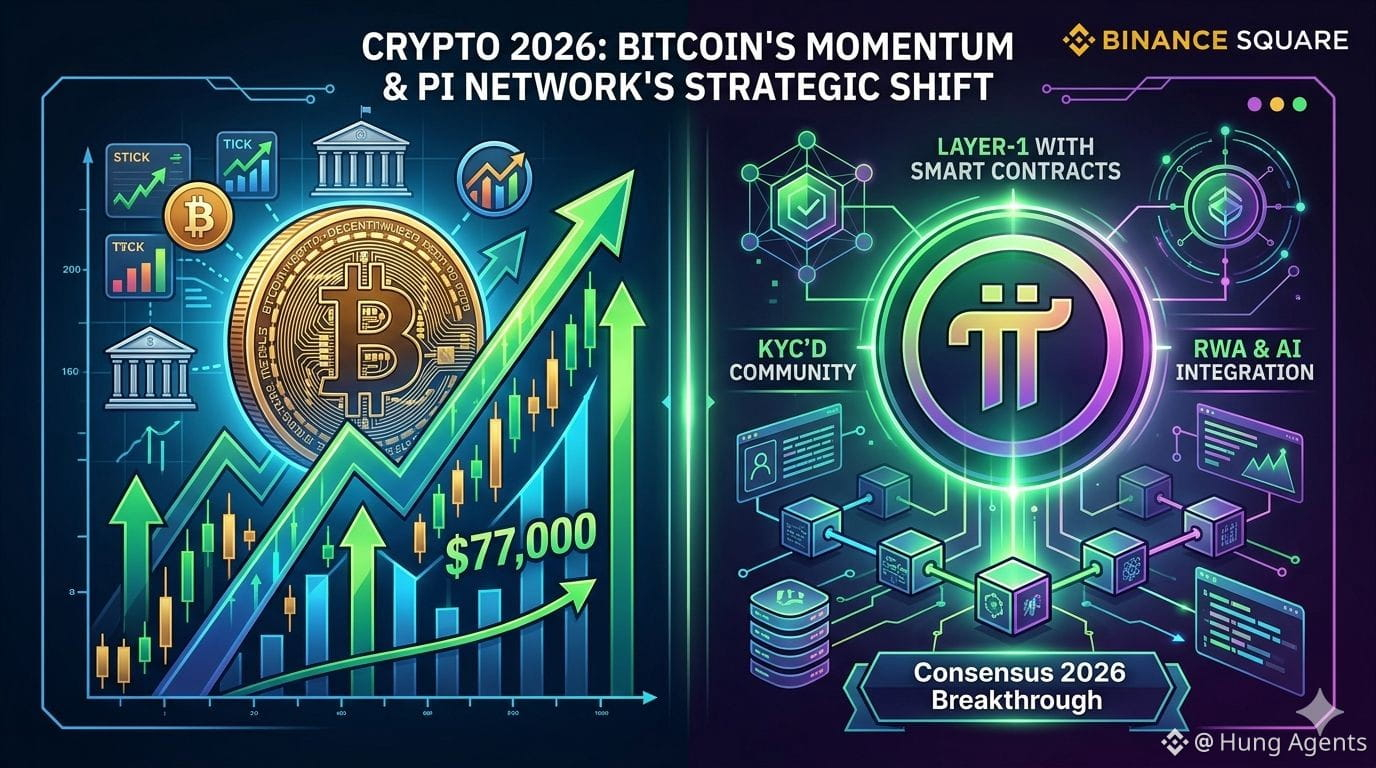
⚡ The overall market: Bitcoin is coiling tightly around the $77,000 region.
In this unpredictable market, smart money is sharply shifting towards ecosystems with real value (AI, Identity, Utility).
{spot}(BTCUSDT)
Highlight on Pi Network:
After the hype at the Consensus 2026 event in Miami by the two founders, Pi is solidifying its unique position. The completion of the technical upgrade is turning Pi into a Layer-1 with comprehensive Smart Contracts, ready for dApps and RWA to explode.
Core: In the AI era flooded with bots, the network of tens of millions of users who have completed KYC for Pi is the "gold mine" of identity that the Web3 world is craving.
The game in 2026 is no longer about short-term speculation, but a race of real technology and real communities!
$BNB
#Crypto2026 #Bitcoin #PiNetwork #Web3 #SmartContract
⚡ The overall market: Bitcoin is coiling tightly around the $77,000 region.
In this unpredictable market, smart money is sharply shifting towards ecosystems with real value (AI, Identity, Utility).
Highlight on Pi Network:
After the hype at the Consensus 2026 event in Miami by the two founders, Pi is solidifying its unique position. The completion of the technical upgrade is turning Pi into a Layer-1 with comprehensive Smart Contracts, ready for dApps and RWA to explode.
Core: In the AI era flooded with bots, the network of tens of millions of users who have completed KYC for Pi is the "gold mine" of identity that the Web3 world is craving.
The game in 2026 is no longer about short-term speculation, but a race of real technology and real communities!
$BNB
#Crypto2026 #Bitcoin #PiNetwork #Web3 #SmartContract
In this unpredictable market, smart money is sharply shifting towards ecosystems with real value (AI, Identity, Utility).
Highlight on Pi Network:
After the hype at the Consensus 2026 event in Miami by the two founders, Pi is solidifying its unique position. The completion of the technical upgrade is turning Pi into a Layer-1 with comprehensive Smart Contracts, ready for dApps and RWA to explode.
Core: In the AI era flooded with bots, the network of tens of millions of users who have completed KYC for Pi is the "gold mine" of identity that the Web3 world is craving.
The game in 2026 is no longer about short-term speculation, but a race of real technology and real communities!
$BNB
#Crypto2026 #Bitcoin #PiNetwork #Web3 #SmartContract
303

SMART SCAM: HOW THEY STRIP YOU OF YOUR CASH THROUGH UPGRADABLE SMART CONTRACTS (PROXY) 💻🕸️
You checked the token with code scanners, audit passed, no Honeypot functions (sell restrictions). You buy in, the coin pumps, you hit the Sell button — and the transaction gets rejected. You're stuck. How is this possible if the audit was clean?
• Proxy Trap: Scammers use upgradable smart contracts. On day one, the code is perfectly clean. But as soon as enough USDT is pumped into the pool, the admin can change the contract logic to a scam with a single transaction.
• Remember: If the token contract has a function `upgradeTo()`, this project can turn into a pumpkin at any second.
👇 Open the BNB widget. Are you trading blind based on TikTok tips or checking the contract structures?
#DeFi #SmartContract $BNB
{spot}(BNBUSDT)
#CryptoFREEMEN
SMART SCAM: HOW THEY STRIP YOU OF YOUR CASH THROUGH UPGRADABLE SMART CONTRACTS (PROXY) 💻🕸️
You checked the token with code scanners, audit passed, no Honeypot functions (sell restrictions). You buy in, the coin pumps, you hit the Sell button — and the transaction gets rejected. You're stuck. How is this possible if the audit was clean?
• Proxy Trap: Scammers use upgradable smart contracts. On day one, the code is perfectly clean. But as soon as enough USDT is pumped into the pool, the admin can change the contract logic to a scam with a single transaction.
• Remember: If the token contract has a function `upgradeTo()`, this project can turn into a pumpkin at any second.
👇 Open the BNB widget. Are you trading blind based on TikTok tips or checking the contract structures?
#DeFi #SmartContract $BNB
#CryptoFREEMEN
You checked the token with code scanners, audit passed, no Honeypot functions (sell restrictions). You buy in, the coin pumps, you hit the Sell button — and the transaction gets rejected. You're stuck. How is this possible if the audit was clean?
• Proxy Trap: Scammers use upgradable smart contracts. On day one, the code is perfectly clean. But as soon as enough USDT is pumped into the pool, the admin can change the contract logic to a scam with a single transaction.
• Remember: If the token contract has a function `upgradeTo()`, this project can turn into a pumpkin at any second.
👇 Open the BNB widget. Are you trading blind based on TikTok tips or checking the contract structures?
#DeFi #SmartContract $BNB
#CryptoFREEMEN
1
125

·
--
Smart contracts are self-executing programs on blockchains. But, like any code, they can contain errors or security vulnerabilities. That's why code auditing is essential to ensure the security and reliability of decentralized applications. #SmartContract # Security #Blockchain
Smart contracts are self-executing programs on blockchains. But, like any code, they can contain errors or security vulnerabilities. That's why code auditing is essential to ensure the security and reliability of decentralized applications. #SmartContract # Security #Blockchain
93

·
--
Most traders are fixated on price action, but savvy investors know that real catalysts often lie beneath the surface.
THE SIGNAL: #Cardano has activated the van Rossem hard fork, slashing smart contract execution costs by up to 60%. This crucial upgrade paves the way for the highly anticipated Ouroboros Leios scalability boost due later this year. #smartcontract #scalability
THE INTERPRETATION: As Cardano's usability and efficiency improve, ADA's adoption potential just skyrocketed. This could be the wake-up call for bulls, hinting at explosive growth down the line.
THE WATCH LIST: Keep a close eye on ADA's gas fee trends as we head into Q3. Falling costs will unlock an avalanche of DApps and DeFi projects.
THE THOUGHT CLOSER: Will Cardano's infrastructure overhauls be the trigger that finally catapults ADA into the top tiers of the crypto universe?
Most traders are fixated on price action, but savvy investors know that real catalysts often lie beneath the surface.
THE SIGNAL: #Cardano has activated the van Rossem hard fork, slashing smart contract execution costs by up to 60%. This crucial upgrade paves the way for the highly anticipated Ouroboros Leios scalability boost due later this year. #smartcontract #scalability
THE INTERPRETATION: As Cardano's usability and efficiency improve, ADA's adoption potential just skyrocketed. This could be the wake-up call for bulls, hinting at explosive growth down the line.
THE WATCH LIST: Keep a close eye on ADA's gas fee trends as we head into Q3. Falling costs will unlock an avalanche of DApps and DeFi projects.
THE THOUGHT CLOSER: Will Cardano's infrastructure overhauls be the trigger that finally catapults ADA into the top tiers of the crypto universe?
THE SIGNAL: #Cardano has activated the van Rossem hard fork, slashing smart contract execution costs by up to 60%. This crucial upgrade paves the way for the highly anticipated Ouroboros Leios scalability boost due later this year. #smartcontract #scalability
THE INTERPRETATION: As Cardano's usability and efficiency improve, ADA's adoption potential just skyrocketed. This could be the wake-up call for bulls, hinting at explosive growth down the line.
THE WATCH LIST: Keep a close eye on ADA's gas fee trends as we head into Q3. Falling costs will unlock an avalanche of DApps and DeFi projects.
THE THOUGHT CLOSER: Will Cardano's infrastructure overhauls be the trigger that finally catapults ADA into the top tiers of the crypto universe?
40

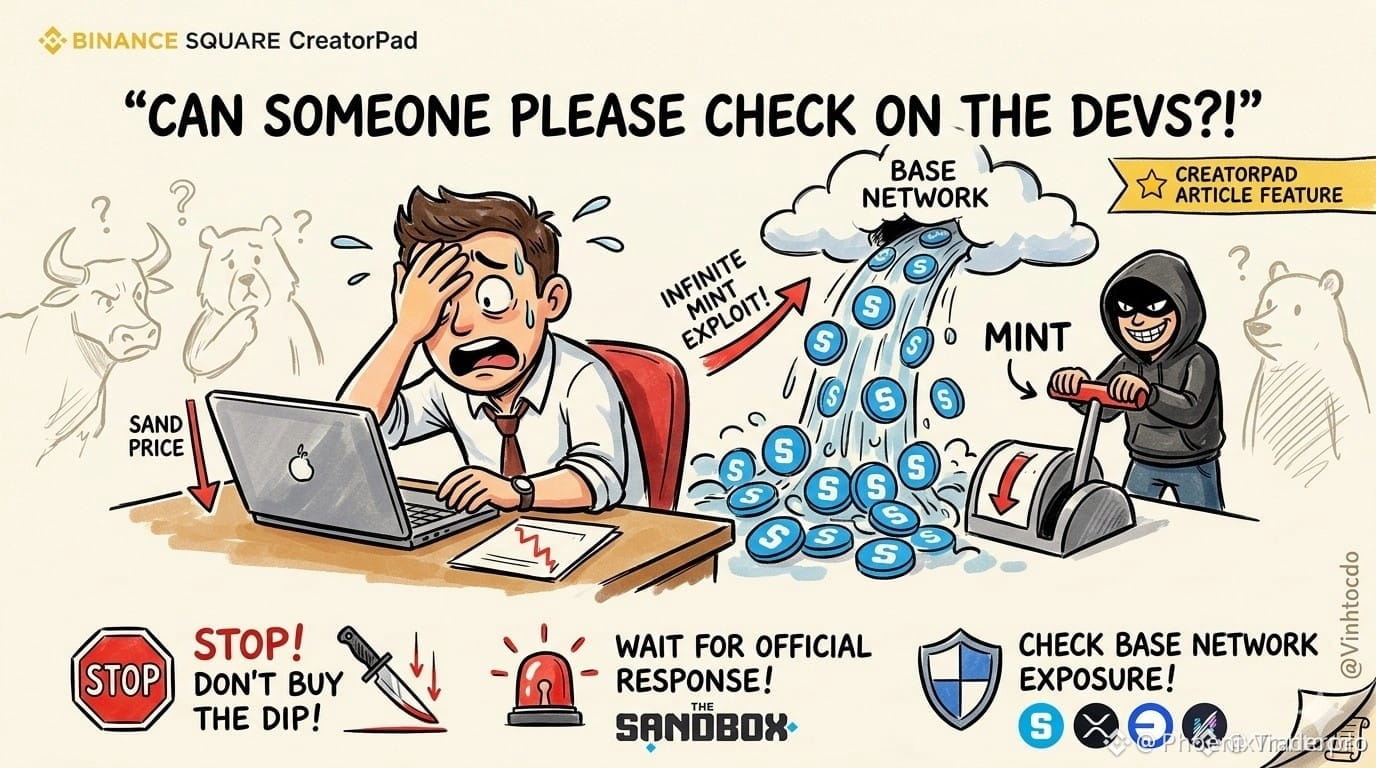
📚 Important lesson on $SAND today as 500M tokens unexpectedly enter circulation! 🎯
There's a lot of noise in the market after a contract flaw on Base printed over 500M $SAND out of thin air. 🔍 Think of it like flooding a market with extra supply—when supply inflates instantly, the traditional demand zones break down until the market recalibrates to find true equilibrium.
Trying to long this high-volatility event right now isn't trading; it's gambling. Remember team: risk first, always. Slow is smooth when navigating heavy token dilution. The best move is to step aside, monitor the official protocol response, do your homework, and protect your capital before touching the price action.
💬 Are you keeping your capital safe on the sidelines, or waiting for solid confirmation before re-evaluating structural support? 👍
⚠️ Not financial advice. Always manage your risk. 🛡️
#SAND #SmartContract #Crypto #RiskManagement
Learn it. Trade it. Repeat.
📚 Important lesson on $SAND today as 500M tokens unexpectedly enter circulation! 🎯
There's a lot of noise in the market after a contract flaw on Base printed over 500M $SAND out of thin air. 🔍 Think of it like flooding a market with extra supply—when supply inflates instantly, the traditional demand zones break down until the market recalibrates to find true equilibrium.
Trying to long this high-volatility event right now isn't trading; it's gambling. Remember team: risk first, always. Slow is smooth when navigating heavy token dilution. The best move is to step aside, monitor the official protocol response, do your homework, and protect your capital before touching the price action.
💬 Are you keeping your capital safe on the sidelines, or waiting for solid confirmation before re-evaluating structural support? 👍
⚠️ Not financial advice. Always manage your risk. 🛡️
#SAND #SmartContract #Crypto #RiskManagement
Learn it. Trade it. Repeat.
There's a lot of noise in the market after a contract flaw on Base printed over 500M $SAND out of thin air. 🔍 Think of it like flooding a market with extra supply—when supply inflates instantly, the traditional demand zones break down until the market recalibrates to find true equilibrium.
Trying to long this high-volatility event right now isn't trading; it's gambling. Remember team: risk first, always. Slow is smooth when navigating heavy token dilution. The best move is to step aside, monitor the official protocol response, do your homework, and protect your capital before touching the price action.
💬 Are you keeping your capital safe on the sidelines, or waiting for solid confirmation before re-evaluating structural support? 👍
⚠️ Not financial advice. Always manage your risk. 🛡️
#SAND #SmartContract #Crypto #RiskManagement
Learn it. Trade it. Repeat.
45

$KAS IS TESTING CRITICAL SUPPORT THAT COULD DICTATE Q3 🚀
KAS has been grinding lower since January — from $0.053 down to $0.0302 — but the bleeding has stalled. The Toccata hard fork just went live, turning Kaspa into a programmable smart contract platform, and the Kasplex EVM Layer 2 launch is scheduled for August. That's two catalysts in a tight window.
What matters now is whether Bitcoin can lift itself back toward $80K. If risk appetite returns, Kaspa historically catches a bid fast. With 95% of supply already mined, any demand spike hits harder than early days.
The range is $0.025-$0.04 for now. Where do you see KAS trading by October?
Not financial advice. Always manage your risk.
#KAS #AltcoinSeason #SmartContract #CryptoAnalysis
🚀
$KAS IS TESTING CRITICAL SUPPORT THAT COULD DICTATE Q3 🚀
KAS has been grinding lower since January — from $0.053 down to $0.0302 — but the bleeding has stalled. The Toccata hard fork just went live, turning Kaspa into a programmable smart contract platform, and the Kasplex EVM Layer 2 launch is scheduled for August. That's two catalysts in a tight window.
What matters now is whether Bitcoin can lift itself back toward $80K. If risk appetite returns, Kaspa historically catches a bid fast. With 95% of supply already mined, any demand spike hits harder than early days.
The range is $0.025-$0.04 for now. Where do you see KAS trading by October?
Not financial advice. Always manage your risk.
#KAS #AltcoinSeason #SmartContract #CryptoAnalysis
🚀
KAS has been grinding lower since January — from $0.053 down to $0.0302 — but the bleeding has stalled. The Toccata hard fork just went live, turning Kaspa into a programmable smart contract platform, and the Kasplex EVM Layer 2 launch is scheduled for August. That's two catalysts in a tight window.
What matters now is whether Bitcoin can lift itself back toward $80K. If risk appetite returns, Kaspa historically catches a bid fast. With 95% of supply already mined, any demand spike hits harder than early days.
The range is $0.025-$0.04 for now. Where do you see KAS trading by October?
Not financial advice. Always manage your risk.
#KAS #AltcoinSeason #SmartContract #CryptoAnalysis
🚀
58

·
--
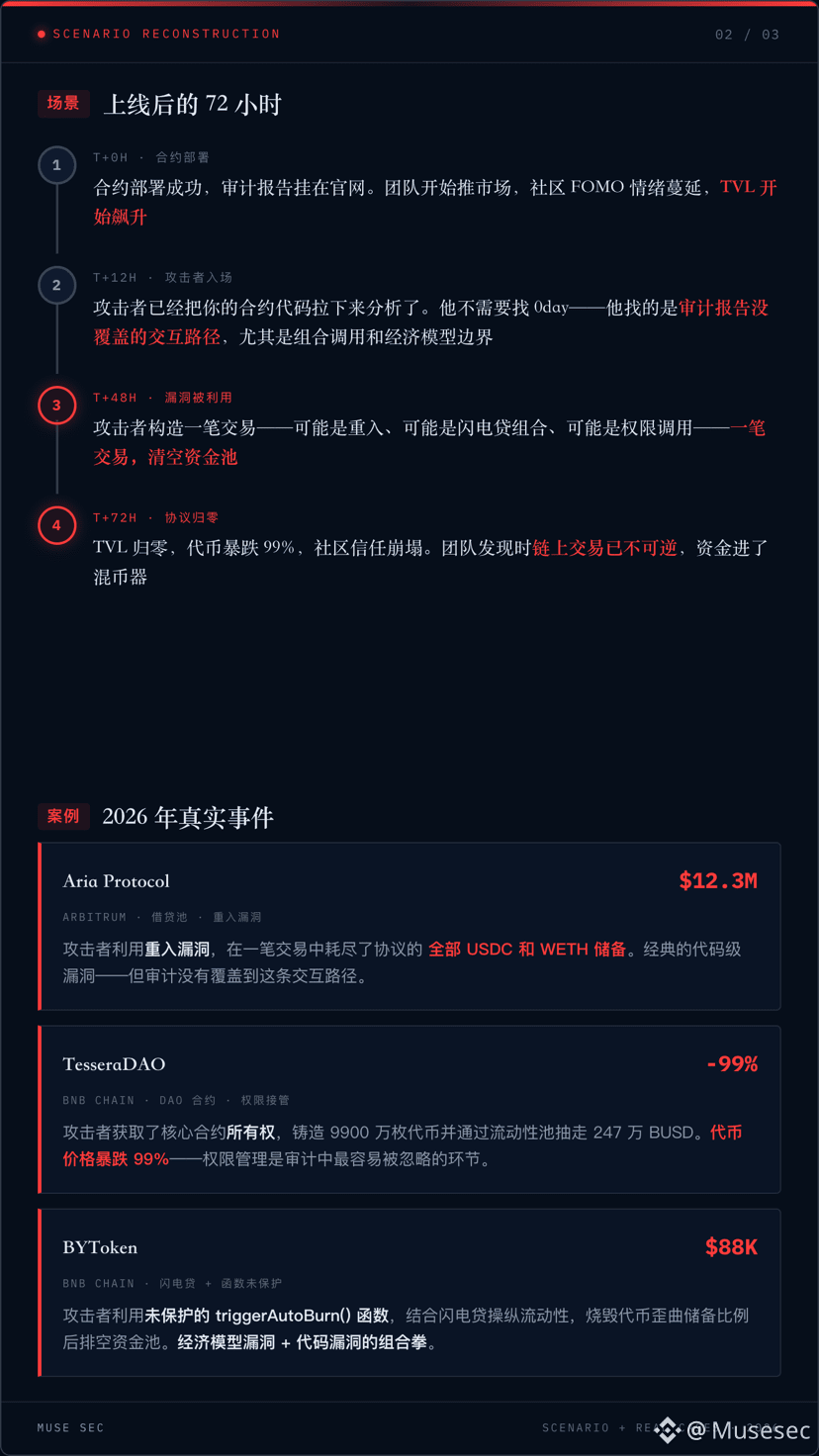
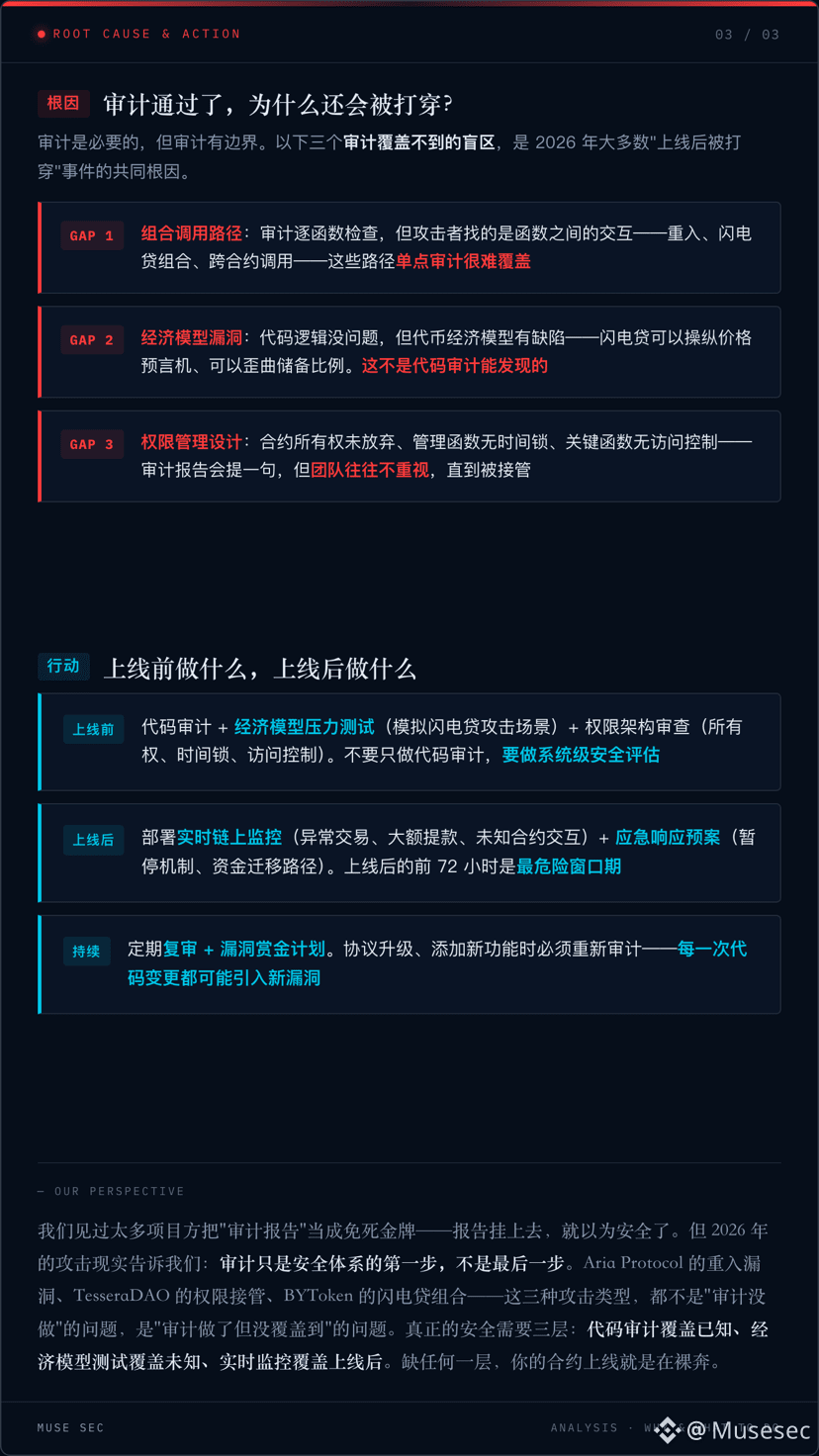
Audits passed ≠ it is safe.
Within 72h of going live: Aria was emptied of $12.3M, TesseraDAO tokens crashed 99%, and BYToken suffered a flash-loan combination attack. An audit is just the first step, not the last step.
#Web3Security #defi #SmartContract
Audits passed ≠ it is safe.
Within 72h of going live: Aria was emptied of $12.3M, TesseraDAO tokens crashed 99%, and BYToken suffered a flash-loan combination attack. An audit is just the first step, not the last step.
#Web3Security #defi #SmartContract
Within 72h of going live: Aria was emptied of $12.3M, TesseraDAO tokens crashed 99%, and BYToken suffered a flash-loan combination attack. An audit is just the first step, not the last step.
#Web3Security #defi #SmartContract

270

·
--
𝗪𝗵𝗶𝗹𝗲 𝗼𝘁𝗵𝗲𝗿𝘀 𝘀𝗹𝗲𝗽𝘁, $𝗣𝗔𝗥𝗧𝗜 𝗾𝘂𝗶𝗲𝘁𝗹𝘆 𝗽𝗿𝗶𝗻𝘁𝗲𝗱 +𝟳.𝟮𝟲% 𝘁𝗼𝗱𝗮𝘆 𝘄𝗵𝘆 𝗻𝗼𝘄?
SmartContract season + Chain Abstraction narrative is waking buyers up 👀
Undervalued sleeper gem with real UX direction from @ParticleNtwrk timing usually beats hype ⚡ #SmartContract
𝗪𝗵𝗶𝗹𝗲 𝗼𝘁𝗵𝗲𝗿𝘀 𝘀𝗹𝗲𝗽𝘁, $𝗣𝗔𝗥𝗧𝗜 𝗾𝘂𝗶𝗲𝘁𝗹𝘆 𝗽𝗿𝗶𝗻𝘁𝗲𝗱 +𝟳.𝟮𝟲% 𝘁𝗼𝗱𝗮𝘆 𝘄𝗵𝘆 𝗻𝗼𝘄?
SmartContract season + Chain Abstraction narrative is waking buyers up 👀
Undervalued sleeper gem with real UX direction from @ParticleNtwrk timing usually beats hype ⚡ #SmartContract
SmartContract season + Chain Abstraction narrative is waking buyers up 👀
Undervalued sleeper gem with real UX direction from @ParticleNtwrk timing usually beats hype ⚡ #SmartContract
50

·
--
$TAIKO VULNERABILITY IDENTIFIED AND REMEDIATION PLAN IN PROGRESS 🔍
The recent exploit of the $TAIKO ERC20 Vault on Ethereum, resulting in a loss exceeding $1 million, has been traced to a specific root cause. The development team has confirmed that a remediation plan is currently in motion to restore blockchain operations within the coming days.
Market participants should monitor the protocol for stability updates as the team collaborates with the DAO Council to address user impact. Given the sensitivity of smart contract exploits, maintaining caution until the network is fully restored is the prudent approach. How do you evaluate the protocol's recovery speed in this situation?
Not financial advice. Always manage your risk.
#TAIKO #SmartContract #CryptoSecurity #Blockchain
⚡
$TAIKO VULNERABILITY IDENTIFIED AND REMEDIATION PLAN IN PROGRESS 🔍
The recent exploit of the $TAIKO ERC20 Vault on Ethereum, resulting in a loss exceeding $1 million, has been traced to a specific root cause. The development team has confirmed that a remediation plan is currently in motion to restore blockchain operations within the coming days.
Market participants should monitor the protocol for stability updates as the team collaborates with the DAO Council to address user impact. Given the sensitivity of smart contract exploits, maintaining caution until the network is fully restored is the prudent approach. How do you evaluate the protocol's recovery speed in this situation?
Not financial advice. Always manage your risk.
#TAIKO #SmartContract #CryptoSecurity #Blockchain
⚡
The recent exploit of the $TAIKO ERC20 Vault on Ethereum, resulting in a loss exceeding $1 million, has been traced to a specific root cause. The development team has confirmed that a remediation plan is currently in motion to restore blockchain operations within the coming days.
Market participants should monitor the protocol for stability updates as the team collaborates with the DAO Council to address user impact. Given the sensitivity of smart contract exploits, maintaining caution until the network is fully restored is the prudent approach. How do you evaluate the protocol's recovery speed in this situation?
Not financial advice. Always manage your risk.
#TAIKO #SmartContract #CryptoSecurity #Blockchain
⚡
70

Odos Protocol will cease operations on July 30. Users have exactly 7 days to withdraw.
The team suddenly goes silent. Legal pressure is tightening, or operating costs exceed revenue, forcing the project to shut down. The DeFi market loses an optimal gas-fee routing tool.
Impact: Trading transaction flows will shift to competing DEX aggregator platforms. Local network congestion risks may occur.
Emergency action: Connect your personal wallet. Withdraw all liquidity before the July 30 deadline. After that point, the web interface will be closed. Direct smart contract interactions require a high level of technical expertise. Beware of scam links impersonating support.
Lesson: DeFi models always carry the risk of sudden collapse. Self-custody your private keys. Diversify trading wallets to reduce systemic risk. DYOR.
#DeFi #Altcoin #DEX #SmartContract
Odos Protocol will cease operations on July 30. Users have exactly 7 days to withdraw.
The team suddenly goes silent. Legal pressure is tightening, or operating costs exceed revenue, forcing the project to shut down. The DeFi market loses an optimal gas-fee routing tool.
Impact: Trading transaction flows will shift to competing DEX aggregator platforms. Local network congestion risks may occur.
Emergency action: Connect your personal wallet. Withdraw all liquidity before the July 30 deadline. After that point, the web interface will be closed. Direct smart contract interactions require a high level of technical expertise. Beware of scam links impersonating support.
Lesson: DeFi models always carry the risk of sudden collapse. Self-custody your private keys. Diversify trading wallets to reduce systemic risk. DYOR.
#DeFi #Altcoin #DEX #SmartContract
The team suddenly goes silent. Legal pressure is tightening, or operating costs exceed revenue, forcing the project to shut down. The DeFi market loses an optimal gas-fee routing tool.
Impact: Trading transaction flows will shift to competing DEX aggregator platforms. Local network congestion risks may occur.
Emergency action: Connect your personal wallet. Withdraw all liquidity before the July 30 deadline. After that point, the web interface will be closed. Direct smart contract interactions require a high level of technical expertise. Beware of scam links impersonating support.
Lesson: DeFi models always carry the risk of sudden collapse. Self-custody your private keys. Diversify trading wallets to reduce systemic risk. DYOR.
#DeFi #Altcoin #DEX #SmartContract
67

·
--
$ETH
A single long upper wick wiped out all bullish fantasies.
On the 4-hour timeframe, starting from 1855 it rallied in a straight line up to 1982. Then, a massive long upper-wick candle with a trading volume of 1.6 million tokens directly pushed the price back to 1917. After that, all rebounds failed. Twice, 1928 was met with resistance, and the price slid all the way down to 1903.
The bulls made a big move. A single bearish candle took back everything.
Ethereum, the king of public chains, the ancestor of smart contracts. Now the price is at this level—no more talk, just look at the chart.
Chart signals—1982 is a clear near-term iron ceiling. After touching it, three consecutive 4h candles closed lower, with each high lower than the last. 1928 has turned into a pressure level; both attempts to push up were knocked back. Price has already fallen below the short-term moving-average cluster, and the 1900 psychological level is in danger. If it can’t hold, then you should look at 1865.
Market sentiment—funding rate is 0.0027%, extremely low, with almost no directional bias. Bulls don’t have the confidence to add aggressively, and bears also aren’t making large-scale short positions. This kind of calm usually precedes a breakout. During the rally from 1855 to 1982, retail chased the price aggressively, sending sentiment to the max—then it was taken away with one move. The market is now quiet; the people who chased are trapped, and those considering cutting losses haven’t acted yet.
Whale activity—those 1.6 million tokens of the top candle were not done by retail. Around 1982, whales concentrated distribution, with clean and decisive tactics. After that, every rebound came with reduced positioning: 1928, 1910, 1903—each bounce was sold into. Total 4h trading volume is $9.1 billion, but the bulk is concentrated in the top area. Smart money has already left; what remains is standing guard.
Volume-price structure—when price was pushed from 1855 to 1982, volume expanded. But as it fell from 1982, volume also expanded. A drop on rising volume isn’t a good sign—it suggests that at each layer, people are急着赶紧跑 (eagerly fleeing). In the rebound range from 1919 to 1928, the volume and momentum clearly shrank—this is a low-volume rebound and isn’t sustainable. Support lies around 1865 to 1870, which is the launch point and the final line of defense.
Candlestick details—on the top candle, the highest point was 1982; the close was 1926; the upper wick was 56 USD. The body is a bearish candle, and bears controlled the field from the open. The next two candles both surged then failed, with upper wicks getting longer each time. Every attempt by the bulls to counterattack was pressed back by the bears. In the most recent candles, the bodies have been getting smaller and volatility has narrowed—quiet before the storm.
My view—slightly bearish. The top structure is clear, distribution is complete, and rebounds lack strength. The probability that 1900 cannot be held is high.
Nini’s plan—current price: 1903. Don’t catch falling knives on the short term. If it breaks below 1890, short with light size; stop-loss at 1928; target 1865. If 1900 can hold, wait for a second pullback that doesn’t break before considering a short-term long. No rush.
#ETH #Layer1 #SmartContract
$ETH
A single long upper wick wiped out all bullish fantasies.
On the 4-hour timeframe, starting from 1855 it rallied in a straight line up to 1982. Then, a massive long upper-wick candle with a trading volume of 1.6 million tokens directly pushed the price back to 1917. After that, all rebounds failed. Twice, 1928 was met with resistance, and the price slid all the way down to 1903.
The bulls made a big move. A single bearish candle took back everything.
Ethereum, the king of public chains, the ancestor of smart contracts. Now the price is at this level—no more talk, just look at the chart.
Chart signals—1982 is a clear near-term iron ceiling. After touching it, three consecutive 4h candles closed lower, with each high lower than the last. 1928 has turned into a pressure level; both attempts to push up were knocked back. Price has already fallen below the short-term moving-average cluster, and the 1900 psychological level is in danger. If it can’t hold, then you should look at 1865.
Market sentiment—funding rate is 0.0027%, extremely low, with almost no directional bias. Bulls don’t have the confidence to add aggressively, and bears also aren’t making large-scale short positions. This kind of calm usually precedes a breakout. During the rally from 1855 to 1982, retail chased the price aggressively, sending sentiment to the max—then it was taken away with one move. The market is now quiet; the people who chased are trapped, and those considering cutting losses haven’t acted yet.
Whale activity—those 1.6 million tokens of the top candle were not done by retail. Around 1982, whales concentrated distribution, with clean and decisive tactics. After that, every rebound came with reduced positioning: 1928, 1910, 1903—each bounce was sold into. Total 4h trading volume is $9.1 billion, but the bulk is concentrated in the top area. Smart money has already left; what remains is standing guard.
Volume-price structure—when price was pushed from 1855 to 1982, volume expanded. But as it fell from 1982, volume also expanded. A drop on rising volume isn’t a good sign—it suggests that at each layer, people are急着赶紧跑 (eagerly fleeing). In the rebound range from 1919 to 1928, the volume and momentum clearly shrank—this is a low-volume rebound and isn’t sustainable. Support lies around 1865 to 1870, which is the launch point and the final line of defense.
Candlestick details—on the top candle, the highest point was 1982; the close was 1926; the upper wick was 56 USD. The body is a bearish candle, and bears controlled the field from the open. The next two candles both surged then failed, with upper wicks getting longer each time. Every attempt by the bulls to counterattack was pressed back by the bears. In the most recent candles, the bodies have been getting smaller and volatility has narrowed—quiet before the storm.
My view—slightly bearish. The top structure is clear, distribution is complete, and rebounds lack strength. The probability that 1900 cannot be held is high.
Nini’s plan—current price: 1903. Don’t catch falling knives on the short term. If it breaks below 1890, short with light size; stop-loss at 1928; target 1865. If 1900 can hold, wait for a second pullback that doesn’t break before considering a short-term long. No rush.
#ETH #Layer1 #SmartContract
A single long upper wick wiped out all bullish fantasies.
On the 4-hour timeframe, starting from 1855 it rallied in a straight line up to 1982. Then, a massive long upper-wick candle with a trading volume of 1.6 million tokens directly pushed the price back to 1917. After that, all rebounds failed. Twice, 1928 was met with resistance, and the price slid all the way down to 1903.
The bulls made a big move. A single bearish candle took back everything.
Ethereum, the king of public chains, the ancestor of smart contracts. Now the price is at this level—no more talk, just look at the chart.
Chart signals—1982 is a clear near-term iron ceiling. After touching it, three consecutive 4h candles closed lower, with each high lower than the last. 1928 has turned into a pressure level; both attempts to push up were knocked back. Price has already fallen below the short-term moving-average cluster, and the 1900 psychological level is in danger. If it can’t hold, then you should look at 1865.
Market sentiment—funding rate is 0.0027%, extremely low, with almost no directional bias. Bulls don’t have the confidence to add aggressively, and bears also aren’t making large-scale short positions. This kind of calm usually precedes a breakout. During the rally from 1855 to 1982, retail chased the price aggressively, sending sentiment to the max—then it was taken away with one move. The market is now quiet; the people who chased are trapped, and those considering cutting losses haven’t acted yet.
Whale activity—those 1.6 million tokens of the top candle were not done by retail. Around 1982, whales concentrated distribution, with clean and decisive tactics. After that, every rebound came with reduced positioning: 1928, 1910, 1903—each bounce was sold into. Total 4h trading volume is $9.1 billion, but the bulk is concentrated in the top area. Smart money has already left; what remains is standing guard.
Volume-price structure—when price was pushed from 1855 to 1982, volume expanded. But as it fell from 1982, volume also expanded. A drop on rising volume isn’t a good sign—it suggests that at each layer, people are急着赶紧跑 (eagerly fleeing). In the rebound range from 1919 to 1928, the volume and momentum clearly shrank—this is a low-volume rebound and isn’t sustainable. Support lies around 1865 to 1870, which is the launch point and the final line of defense.
Candlestick details—on the top candle, the highest point was 1982; the close was 1926; the upper wick was 56 USD. The body is a bearish candle, and bears controlled the field from the open. The next two candles both surged then failed, with upper wicks getting longer each time. Every attempt by the bulls to counterattack was pressed back by the bears. In the most recent candles, the bodies have been getting smaller and volatility has narrowed—quiet before the storm.
My view—slightly bearish. The top structure is clear, distribution is complete, and rebounds lack strength. The probability that 1900 cannot be held is high.
Nini’s plan—current price: 1903. Don’t catch falling knives on the short term. If it breaks below 1890, short with light size; stop-loss at 1928; target 1865. If 1900 can hold, wait for a second pullback that doesn’t break before considering a short-term long. No rush.
#ETH #Layer1 #SmartContract
353
·
--
$NEAR fell from 1.748 to 1.574, five straight days of declines, with not even a decent bounce. Today it barely managed to close as a small bullish candle back to 1.623—nowhere near enough to fill even a fraction of the drop.
The signals on the board are very clean. The bears are in control. On the 4-hour timeframe, it has been slipping from 1.748 all the way down; every rebound gets pushed back again. 1.734, 1.729, 1.700, 1.692, 1.672, 1.642, 1.612, 1.589—each 4-hour closing price is below the previous one. This is not consolidation; it’s a trend-driven drop. Today’s small bullish candle has a high of 1.629 and a low of 1.610, with an amplitude of only 1.2%. Volume is 2.85 million coins, one of the smallest among the last 30 candlesticks. The market isn’t even giving volatility—this isn’t ranging, because nobody wants to take the bag.
Sentiment is already cold. A 24-hour turnover of 45 million for an asset of NEAR’s size is relatively low. Volume at 27.81 million, weighted average price 1.6211, is almost the same as the current price, indicating there’s no directional buying/selling power throughout the day. Retail isn’t looking at this anymore. Funding rate is 0.01%, positive—meaning there are still some longs opening on the derivatives side, but the weak bullish willingness can’t support the spot. Mark price is 1.6234, index price is 1.6250; the mark is slightly below the index, which suggests the futures side is pressing down.
The actions of the big players are even more straightforward. The 4-hour candle at 1.586 had 10.5 million coins of volume—panic selling came out, and someone absorbed it. But after absorbing it, they didn’t lift price; it continued to be driven down to 1.574. Then came another 4-hour candle with 11.87 million in volume, and it still didn’t stop the fall. This suggests the main players are accumulating at lower levels, but the volume isn’t large enough, so they’re absorbing slowly. They’re waiting for a better price—or waiting for the overall market to give direction. This isn’t the time for the main players to do their work.
The volume-price structure tells the whole story: falling on expanding volume, rebounding on shrinking volume. In the move down from 1.693 to 1.650, the candlestick volume ranged from 8 million to 11 million—heavy volume with downward movement. What about the rebound phase? Volume dropped to 3 million to 5 million. That’s a classic volume-price divergence. Without volume support, any rebound is nothing but a paper tiger in front of overhead resistance. The 24-hour high is 1.637, the low is 1.605, amplitude only 2%—there isn’t even enough room to reliably do T.
The candlestick details are worth watching. In the last 30 4-hour candles, bullish closes are fewer than a third. The bullish bodies are generally smaller than 0.02. Upper wicks appear frequently, indicating heavy sell pressure overhead. 1.637 is the recent peak—hit three times and failed to break through. Below, 1.583 is the final line of defense, tested three times repeatedly; each time it gets yanked back with a long lower wick, but the rebounds are getting weaker each time. This kind of price action is called “a slow blade cutting—” not fatal, but it drains you.
NEAR’s blockchain and its sharding-based expansion tech are solid, and the ecosystem is being built out. But right now the market isn’t pricing in technology—it’s pricing in liquidity. Liquidity isn’t here. Big money is playing elsewhere.
Nini’s plan: slightly bearish. Current price is 1.6230 USDT. Don’t chase longs on a rebound into the 1.635–1.637 area—that’s prior high resistance; if it can’t break through, it gets sold/hammered down. If it breaks below 1.583 with volume, then look for 1.55 below. If you want to go long, wait for a bullish candle with volume to hold above 1.65—this isn’t the time. Keep position size within 20%. Place a stop loss below 1.57. Don’t fight the trend—wait until the trend turns before acting.
#NEAR #Layer1 #SmartContract
$NEAR fell from 1.748 to 1.574, five straight days of declines, with not even a decent bounce. Today it barely managed to close as a small bullish candle back to 1.623—nowhere near enough to fill even a fraction of the drop.
The signals on the board are very clean. The bears are in control. On the 4-hour timeframe, it has been slipping from 1.748 all the way down; every rebound gets pushed back again. 1.734, 1.729, 1.700, 1.692, 1.672, 1.642, 1.612, 1.589—each 4-hour closing price is below the previous one. This is not consolidation; it’s a trend-driven drop. Today’s small bullish candle has a high of 1.629 and a low of 1.610, with an amplitude of only 1.2%. Volume is 2.85 million coins, one of the smallest among the last 30 candlesticks. The market isn’t even giving volatility—this isn’t ranging, because nobody wants to take the bag.
Sentiment is already cold. A 24-hour turnover of 45 million for an asset of NEAR’s size is relatively low. Volume at 27.81 million, weighted average price 1.6211, is almost the same as the current price, indicating there’s no directional buying/selling power throughout the day. Retail isn’t looking at this anymore. Funding rate is 0.01%, positive—meaning there are still some longs opening on the derivatives side, but the weak bullish willingness can’t support the spot. Mark price is 1.6234, index price is 1.6250; the mark is slightly below the index, which suggests the futures side is pressing down.
The actions of the big players are even more straightforward. The 4-hour candle at 1.586 had 10.5 million coins of volume—panic selling came out, and someone absorbed it. But after absorbing it, they didn’t lift price; it continued to be driven down to 1.574. Then came another 4-hour candle with 11.87 million in volume, and it still didn’t stop the fall. This suggests the main players are accumulating at lower levels, but the volume isn’t large enough, so they’re absorbing slowly. They’re waiting for a better price—or waiting for the overall market to give direction. This isn’t the time for the main players to do their work.
The volume-price structure tells the whole story: falling on expanding volume, rebounding on shrinking volume. In the move down from 1.693 to 1.650, the candlestick volume ranged from 8 million to 11 million—heavy volume with downward movement. What about the rebound phase? Volume dropped to 3 million to 5 million. That’s a classic volume-price divergence. Without volume support, any rebound is nothing but a paper tiger in front of overhead resistance. The 24-hour high is 1.637, the low is 1.605, amplitude only 2%—there isn’t even enough room to reliably do T.
The candlestick details are worth watching. In the last 30 4-hour candles, bullish closes are fewer than a third. The bullish bodies are generally smaller than 0.02. Upper wicks appear frequently, indicating heavy sell pressure overhead. 1.637 is the recent peak—hit three times and failed to break through. Below, 1.583 is the final line of defense, tested three times repeatedly; each time it gets yanked back with a long lower wick, but the rebounds are getting weaker each time. This kind of price action is called “a slow blade cutting—” not fatal, but it drains you.
NEAR’s blockchain and its sharding-based expansion tech are solid, and the ecosystem is being built out. But right now the market isn’t pricing in technology—it’s pricing in liquidity. Liquidity isn’t here. Big money is playing elsewhere.
Nini’s plan: slightly bearish. Current price is 1.6230 USDT. Don’t chase longs on a rebound into the 1.635–1.637 area—that’s prior high resistance; if it can’t break through, it gets sold/hammered down. If it breaks below 1.583 with volume, then look for 1.55 below. If you want to go long, wait for a bullish candle with volume to hold above 1.65—this isn’t the time. Keep position size within 20%. Place a stop loss below 1.57. Don’t fight the trend—wait until the trend turns before acting.
#NEAR #Layer1 #SmartContract
The signals on the board are very clean. The bears are in control. On the 4-hour timeframe, it has been slipping from 1.748 all the way down; every rebound gets pushed back again. 1.734, 1.729, 1.700, 1.692, 1.672, 1.642, 1.612, 1.589—each 4-hour closing price is below the previous one. This is not consolidation; it’s a trend-driven drop. Today’s small bullish candle has a high of 1.629 and a low of 1.610, with an amplitude of only 1.2%. Volume is 2.85 million coins, one of the smallest among the last 30 candlesticks. The market isn’t even giving volatility—this isn’t ranging, because nobody wants to take the bag.
Sentiment is already cold. A 24-hour turnover of 45 million for an asset of NEAR’s size is relatively low. Volume at 27.81 million, weighted average price 1.6211, is almost the same as the current price, indicating there’s no directional buying/selling power throughout the day. Retail isn’t looking at this anymore. Funding rate is 0.01%, positive—meaning there are still some longs opening on the derivatives side, but the weak bullish willingness can’t support the spot. Mark price is 1.6234, index price is 1.6250; the mark is slightly below the index, which suggests the futures side is pressing down.
The actions of the big players are even more straightforward. The 4-hour candle at 1.586 had 10.5 million coins of volume—panic selling came out, and someone absorbed it. But after absorbing it, they didn’t lift price; it continued to be driven down to 1.574. Then came another 4-hour candle with 11.87 million in volume, and it still didn’t stop the fall. This suggests the main players are accumulating at lower levels, but the volume isn’t large enough, so they’re absorbing slowly. They’re waiting for a better price—or waiting for the overall market to give direction. This isn’t the time for the main players to do their work.
The volume-price structure tells the whole story: falling on expanding volume, rebounding on shrinking volume. In the move down from 1.693 to 1.650, the candlestick volume ranged from 8 million to 11 million—heavy volume with downward movement. What about the rebound phase? Volume dropped to 3 million to 5 million. That’s a classic volume-price divergence. Without volume support, any rebound is nothing but a paper tiger in front of overhead resistance. The 24-hour high is 1.637, the low is 1.605, amplitude only 2%—there isn’t even enough room to reliably do T.
The candlestick details are worth watching. In the last 30 4-hour candles, bullish closes are fewer than a third. The bullish bodies are generally smaller than 0.02. Upper wicks appear frequently, indicating heavy sell pressure overhead. 1.637 is the recent peak—hit three times and failed to break through. Below, 1.583 is the final line of defense, tested three times repeatedly; each time it gets yanked back with a long lower wick, but the rebounds are getting weaker each time. This kind of price action is called “a slow blade cutting—” not fatal, but it drains you.
NEAR’s blockchain and its sharding-based expansion tech are solid, and the ecosystem is being built out. But right now the market isn’t pricing in technology—it’s pricing in liquidity. Liquidity isn’t here. Big money is playing elsewhere.
Nini’s plan: slightly bearish. Current price is 1.6230 USDT. Don’t chase longs on a rebound into the 1.635–1.637 area—that’s prior high resistance; if it can’t break through, it gets sold/hammered down. If it breaks below 1.583 with volume, then look for 1.55 below. If you want to go long, wait for a bullish candle with volume to hold above 1.65—this isn’t the time. Keep position size within 20%. Place a stop loss below 1.57. Don’t fight the trend—wait until the trend turns before acting.
#NEAR #Layer1 #SmartContract
83
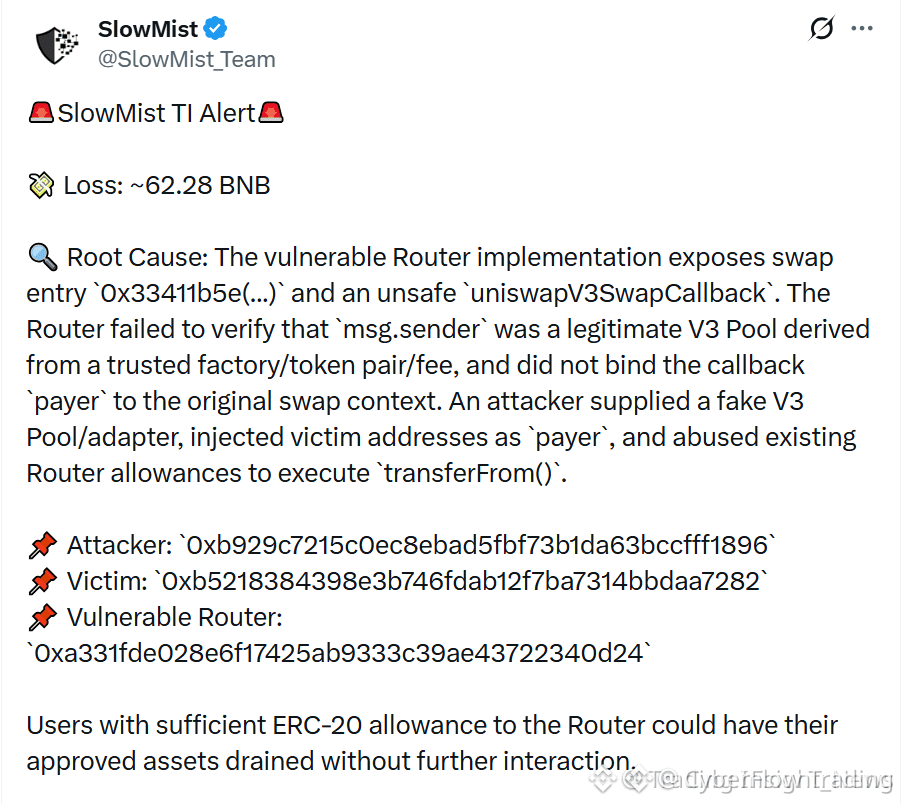
🚨 $BNB ROUTER EXPLOIT EXPOSES 62 BNB LOSS – ACT NOW! 🛡️
The BNB Chain router got caught in a callback blind spot, letting an attacker siphon 62.28 BNB in a single sweep. 🦈 The exploit rode on unchecked V3 factory calls, injecting the victim as payer and cashing out via pre‑approved token allowances.
If you’ve ever signed off a router without a second glance, you’re now sitting on a hot ticket. 📊 Revoke any lingering approvals, audit your allowance list, and keep the smart‑contract gate locked. ⚡️ This isn’t a market move – it’s a security reminder that every unchecked callback is a potential liquidity drain.
💬 How do you stay on top of token approvals before they become a breach?
⚠️ Not financial advice. Always manage your risk. 🛡️
🏷️ #BNB #Security #SmartContract #ApprovalRevoke #Crypto
🔥 💎
🚨 $BNB ROUTER EXPLOIT EXPOSES 62 BNB LOSS – ACT NOW! 🛡️
The BNB Chain router got caught in a callback blind spot, letting an attacker siphon 62.28 BNB in a single sweep. 🦈 The exploit rode on unchecked V3 factory calls, injecting the victim as payer and cashing out via pre‑approved token allowances.
If you’ve ever signed off a router without a second glance, you’re now sitting on a hot ticket. 📊 Revoke any lingering approvals, audit your allowance list, and keep the smart‑contract gate locked. ⚡️ This isn’t a market move – it’s a security reminder that every unchecked callback is a potential liquidity drain.
💬 How do you stay on top of token approvals before they become a breach?
⚠️ Not financial advice. Always manage your risk. 🛡️
🏷️ #BNB #Security #SmartContract #ApprovalRevoke #Crypto
🔥 💎
The BNB Chain router got caught in a callback blind spot, letting an attacker siphon 62.28 BNB in a single sweep. 🦈 The exploit rode on unchecked V3 factory calls, injecting the victim as payer and cashing out via pre‑approved token allowances.
If you’ve ever signed off a router without a second glance, you’re now sitting on a hot ticket. 📊 Revoke any lingering approvals, audit your allowance list, and keep the smart‑contract gate locked. ⚡️ This isn’t a market move – it’s a security reminder that every unchecked callback is a potential liquidity drain.
💬 How do you stay on top of token approvals before they become a breach?
⚠️ Not financial advice. Always manage your risk. 🛡️
🏷️ #BNB #Security #SmartContract #ApprovalRevoke #Crypto
🔥 💎
19

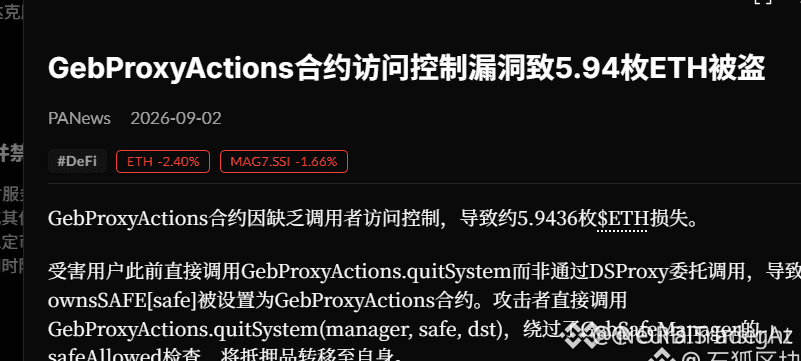
🚨 $ETH GEBPROXYACTIONS CONTRACT EXPLOITED VIA ACCESS CONTROL EXPOSING USER ALLOWANCES ⚠️
Smart contract risk directly impacts structural stability when protocol vulnerabilities are exploited. The GebProxyActions contract recently suffered a breach, resulting in an unauthorized drain of 5.94 $ETH .
🔍 While the direct capital drain remains localized, active approvals leave interacting wallets vulnerable to secondary exploitation vectors. 🛡️ Capital preservation requires strict permission hygiene alongside precise technical execution.
📌 Revoke your token allowances for this proxy contract immediately to secure your underlying balances. 💬 Have you audited your active smart contract approvals recently, or is your wallet structure exposed? 👇
⚠️ Not financial advice. Always manage your risk. 🛡️
🏷️ #ETH #SmartContract #Security #Ethereum #DeFi
🛡️ 🔍
🚨 $ETH GEBPROXYACTIONS CONTRACT EXPLOITED VIA ACCESS CONTROL EXPOSING USER ALLOWANCES ⚠️
Smart contract risk directly impacts structural stability when protocol vulnerabilities are exploited. The GebProxyActions contract recently suffered a breach, resulting in an unauthorized drain of 5.94 $ETH .
🔍 While the direct capital drain remains localized, active approvals leave interacting wallets vulnerable to secondary exploitation vectors. 🛡️ Capital preservation requires strict permission hygiene alongside precise technical execution.
📌 Revoke your token allowances for this proxy contract immediately to secure your underlying balances. 💬 Have you audited your active smart contract approvals recently, or is your wallet structure exposed? 👇
⚠️ Not financial advice. Always manage your risk. 🛡️
🏷️ #ETH #SmartContract #Security #Ethereum #DeFi
🛡️ 🔍
Smart contract risk directly impacts structural stability when protocol vulnerabilities are exploited. The GebProxyActions contract recently suffered a breach, resulting in an unauthorized drain of 5.94 $ETH .
🔍 While the direct capital drain remains localized, active approvals leave interacting wallets vulnerable to secondary exploitation vectors. 🛡️ Capital preservation requires strict permission hygiene alongside precise technical execution.
📌 Revoke your token allowances for this proxy contract immediately to secure your underlying balances. 💬 Have you audited your active smart contract approvals recently, or is your wallet structure exposed? 👇
⚠️ Not financial advice. Always manage your risk. 🛡️
🏷️ #ETH #SmartContract #Security #Ethereum #DeFi
🛡️ 🔍
2
Another infinite mint panic on $SAND , or are traders just realizing smart contract risk exists? 🤨
Reports of a suspected infinite mint vulnerability in $SAND on Base are making the rounds. When protocol mechanics break, order books dissolve in minutes—and late traders quickly turn into exit liquidity as seller momentum cascades across related DeFi pairs.
Capital is already tightening up in high-beta names like $EIGEN and $ENA while the crowd suddenly re-evaluates risk. Everyone loves a narrative play until the code breaks. Are you doing your own digging on contract audits before bidding these speculative DeFi dips, or just hoping for the best? 🤔
Not financial advice. Always manage your risk.
#SAND #DeFi #Crypto #SmartContract #RiskManagement
When everyone agrees, I double-check.
Another infinite mint panic on $SAND , or are traders just realizing smart contract risk exists? 🤨
Reports of a suspected infinite mint vulnerability in $SAND on Base are making the rounds. When protocol mechanics break, order books dissolve in minutes—and late traders quickly turn into exit liquidity as seller momentum cascades across related DeFi pairs.
Capital is already tightening up in high-beta names like $EIGEN and $ENA while the crowd suddenly re-evaluates risk. Everyone loves a narrative play until the code breaks. Are you doing your own digging on contract audits before bidding these speculative DeFi dips, or just hoping for the best? 🤔
Not financial advice. Always manage your risk.
#SAND #DeFi #Crypto #SmartContract #RiskManagement
When everyone agrees, I double-check.
Reports of a suspected infinite mint vulnerability in $SAND on Base are making the rounds. When protocol mechanics break, order books dissolve in minutes—and late traders quickly turn into exit liquidity as seller momentum cascades across related DeFi pairs.
Capital is already tightening up in high-beta names like $EIGEN and $ENA while the crowd suddenly re-evaluates risk. Everyone loves a narrative play until the code breaks. Are you doing your own digging on contract audits before bidding these speculative DeFi dips, or just hoping for the best? 🤔
Not financial advice. Always manage your risk.
#SAND #DeFi #Crypto #SmartContract #RiskManagement
When everyone agrees, I double-check.
119

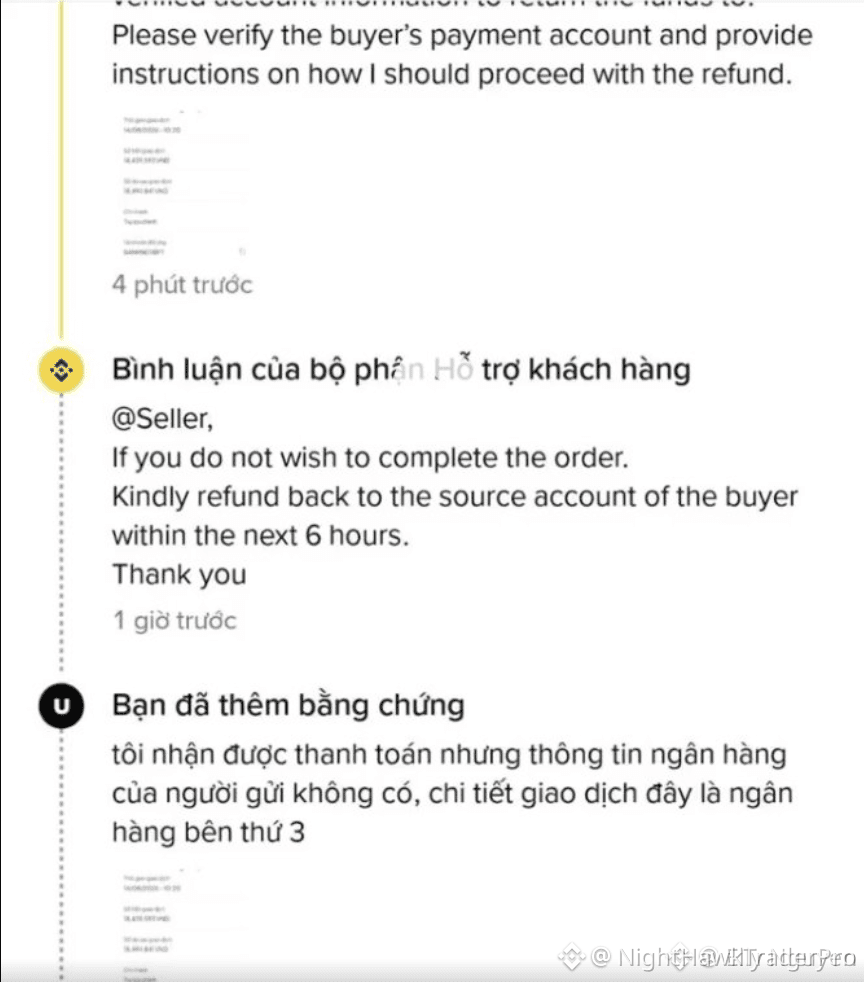
💰 $BNB P2P THIRD-PARTY P2P TRANSFER – MONEY LAUNDERING TRAP OR JUST A MINOR INCONVENIENCE? 🚨
When your P2P order is caught between a rock and a hard place: Funds have been credited to your account, but the name of the sender doesn’t match the buyer’s information. This isn’t the time to guess or reassure yourself with, “They probably know each other.”
🚨 Irrevocable rule from an experienced trader: YOU HAVE THE RIGHT TO REFUSE. No one can force you to release the order when there are any abnormal signs. Your account’s safety is always more valuable than a fee that gets stuck for a few hours.
⚠️ My advice: While waiting for the exchange to respond, keep the order status unchanged—do not release it, and do not interact any further with the counterparty. And if you run into this situation again, cancel the transaction as soon as you notice it—safety is always our top priority when we deal with real money. 💡
💬 Has anyone in the community ever encountered a case where a third party transferred funds in a P2P order? How did everyone handle it to ensure absolute safety?
⚠️ Not financial advice. Always manage your risks. 🛡️
🏷️ #P2P #SmartContract #AnToanGiaoDich #BinanceRisk
🦈 🛡️
💰 $BNB P2P THIRD-PARTY P2P TRANSFER – MONEY LAUNDERING TRAP OR JUST A MINOR INCONVENIENCE? 🚨
When your P2P order is caught between a rock and a hard place: Funds have been credited to your account, but the name of the sender doesn’t match the buyer’s information. This isn’t the time to guess or reassure yourself with, “They probably know each other.”
🚨 Irrevocable rule from an experienced trader: YOU HAVE THE RIGHT TO REFUSE. No one can force you to release the order when there are any abnormal signs. Your account’s safety is always more valuable than a fee that gets stuck for a few hours.
⚠️ My advice: While waiting for the exchange to respond, keep the order status unchanged—do not release it, and do not interact any further with the counterparty. And if you run into this situation again, cancel the transaction as soon as you notice it—safety is always our top priority when we deal with real money. 💡
💬 Has anyone in the community ever encountered a case where a third party transferred funds in a P2P order? How did everyone handle it to ensure absolute safety?
⚠️ Not financial advice. Always manage your risks. 🛡️
🏷️ #P2P #SmartContract #AnToanGiaoDich #BinanceRisk
🦈 🛡️
When your P2P order is caught between a rock and a hard place: Funds have been credited to your account, but the name of the sender doesn’t match the buyer’s information. This isn’t the time to guess or reassure yourself with, “They probably know each other.”
🚨 Irrevocable rule from an experienced trader: YOU HAVE THE RIGHT TO REFUSE. No one can force you to release the order when there are any abnormal signs. Your account’s safety is always more valuable than a fee that gets stuck for a few hours.
⚠️ My advice: While waiting for the exchange to respond, keep the order status unchanged—do not release it, and do not interact any further with the counterparty. And if you run into this situation again, cancel the transaction as soon as you notice it—safety is always our top priority when we deal with real money. 💡
💬 Has anyone in the community ever encountered a case where a third party transferred funds in a P2P order? How did everyone handle it to ensure absolute safety?
⚠️ Not financial advice. Always manage your risks. 🛡️
🏷️ #P2P #SmartContract #AnToanGiaoDich #BinanceRisk
🦈 🛡️
33

·
--
$ETH CONFIDENT BID AT 1887 – IS THE 2K MOVE ALREADY DECIDED? 🎯
Entry: 1887.87 ✅
TP1: 1982.45 🎯
TP2: 2076.86 🚀
Stop Loss: 1831.41 🛑
The market waits for no one, plain and simple. Ethereum remains the undisputed backbone of the smart contract economy, with DeFi and NFT ecosystems wholly reliant on its execution layer. The EIP burn mechanism continues its quiet supply contraction—a structural tailwind that hasn't shifted one bit. Price tapping 1888 is nothing more than a brief station, not a destination.
Smart money has been building positions through this range, and the path toward 2k looks far more like a formality than a gamble. Hesitation here only forfeits premium entries before the next liquidity sweep. The order block at current levels is holding its ground, and the momentum is aligning with the institutional footprint we track.
Are you positioned for the run, or waiting for a deeper discount that may never come? 📊
⚠️ Not financial advice. Always manage your risk. 🛡️
🏷️ #ETH #Ethereum #DeFi #SmartContract #TechnicalAnalysis
📈🔥
$ETH CONFIDENT BID AT 1887 – IS THE 2K MOVE ALREADY DECIDED? 🎯
Entry: 1887.87 ✅
TP1: 1982.45 🎯
TP2: 2076.86 🚀
Stop Loss: 1831.41 🛑
The market waits for no one, plain and simple. Ethereum remains the undisputed backbone of the smart contract economy, with DeFi and NFT ecosystems wholly reliant on its execution layer. The EIP burn mechanism continues its quiet supply contraction—a structural tailwind that hasn't shifted one bit. Price tapping 1888 is nothing more than a brief station, not a destination.
Smart money has been building positions through this range, and the path toward 2k looks far more like a formality than a gamble. Hesitation here only forfeits premium entries before the next liquidity sweep. The order block at current levels is holding its ground, and the momentum is aligning with the institutional footprint we track.
Are you positioned for the run, or waiting for a deeper discount that may never come? 📊
⚠️ Not financial advice. Always manage your risk. 🛡️
🏷️ #ETH #Ethereum #DeFi #SmartContract #TechnicalAnalysis
📈🔥
Entry: 1887.87 ✅
TP1: 1982.45 🎯
TP2: 2076.86 🚀
Stop Loss: 1831.41 🛑
The market waits for no one, plain and simple. Ethereum remains the undisputed backbone of the smart contract economy, with DeFi and NFT ecosystems wholly reliant on its execution layer. The EIP burn mechanism continues its quiet supply contraction—a structural tailwind that hasn't shifted one bit. Price tapping 1888 is nothing more than a brief station, not a destination.
Smart money has been building positions through this range, and the path toward 2k looks far more like a formality than a gamble. Hesitation here only forfeits premium entries before the next liquidity sweep. The order block at current levels is holding its ground, and the momentum is aligning with the institutional footprint we track.
Are you positioned for the run, or waiting for a deeper discount that may never come? 📊
⚠️ Not financial advice. Always manage your risk. 🛡️
🏷️ #ETH #Ethereum #DeFi #SmartContract #TechnicalAnalysis
📈🔥

13
·
--
$ADA dropped from 0.20 to 0.18; five consecutive 4h large bearish candles, with almost no meaningful bounce in between.
Market signals: Over the past 120 hours, ADA slipped steadily from 0.2003 to 0.1816, a drop of nearly 10%. There were two notable times when selling volume surged—at the 17th 4h candle, volume jumped to 202 million coins, and the price was smashed directly from 0.1885 down to 0.1835, with a single-candle drop of over 2.8%; the 23rd candle was even harsher, with 185 million coins traded, the low briefly dipping to 0.1817 before it barely managed to close back up. After these two waves of heavy selling pressure, the chart didn’t show a genuine bullish counterattack—only low-volume sideways consolidation. The sell-side keeps consuming the buy-side. This isn’t panic selling and fleeing; it’s orderly withdrawal. The pace is uncomfortable—like boiling a frog in warm water, grinding away the longs’ patience little by little.
Market sentiment: The 24h decline is -0.82%, which doesn’t look big, but it’s the outcome after ten straight days of falling. The market has gone numb. The funding rate is only 0.0069%, so low it’s basically negligible. The longs don’t even feel like betting on a rebound. Mark price is 0.1817, almost the same as the current price—both sides are watching and no one wants to take the initiative. Retail traders are waiting to catch the bottom, while large players are reducing positions. The supporting buy power in the middle is getting thinner. The 24h trading value is $87.65 million; compared with earlier periods when it was often over $100 million, participation has clearly dropped. With these old-chain tickets from veteran players, this is what it feels like when they drop—no bottom signal, only a dull blade slicing losses.
Whale activity: Judging from volume-price rhythm, both selloffs were accompanied by abnormal surges in volume. The first time was 202 million coins, the second time 185 million coins—far above normal levels. This kind of sell pressure can’t be created by retail traders. What’s interesting is that after the selloff, there was no continued chase to short; trading volume quickly fell back into a normal range, hovering around 50 million to 80 million coins. The whales are distributing their holdings in batches—not rushing to clear everything, but slowly withdrawing. Every time a rebound pushes up to around 0.185, it gets hammered back, suggesting someone is sitting with sell orders overhead. The chips are transferring from strong holders to hesitant retail traders, and this process hasn’t finished yet.
Volume-price structure: During the decline, it shows the classic distribution pattern of expanding volume on the way down, followed by contracting-volume sideways movement. The recent highs step down: 0.200 → 0.198 → 0.194 → 0.191 → 0.187. The lows also keep moving lower: 0.195 → 0.192 → 0.186 → 0.181. Each rebound’s high is lower than the last, and each new low is deeper than the previous one—an obvious descending channel. The 4h support is around the 0.180 whole-number level; the current price is already pressing near it. If the close breaks below it, the next support to watch is around 0.172. If 0.180 holds, it’s only a continuation of the downtrend—not a reversal. Weak rebounds mean weak conditions.
Candlestick details: In the most recent 10 4h candles, 7 closed bearish. The third-to-last candle closed with a big long upper wick on increased volume—its high spiked to 0.1863, but it closed only at 0.1817. The length of the upper wick is three times the length of the body. The longs’ attempt to counterattack was pushed back. The following three candles are small-bodied consolidation candles, with volatility shrinking between 0.181 and 0.186, while volume shrank from 180 million to 65 million. The Bollinger Bands are also tightening—right before a potential breakout.
Nini’s plan: Bearish bias. Current price: 0.18160. If the 4h candle closes below 0.180, look down at 0.172. Don’t chase—wait for a rebound into the 0.185 to 0.187 area before shorting. Place the stop loss above 0.190. With ADA being an established old public chain with an ecosystem foundation and community consensus, there’s still a base. But a trend is a trend—we don’t fight against it.
#ADA #Layer1 #SmartContract
$ADA dropped from 0.20 to 0.18; five consecutive 4h large bearish candles, with almost no meaningful bounce in between.
Market signals: Over the past 120 hours, ADA slipped steadily from 0.2003 to 0.1816, a drop of nearly 10%. There were two notable times when selling volume surged—at the 17th 4h candle, volume jumped to 202 million coins, and the price was smashed directly from 0.1885 down to 0.1835, with a single-candle drop of over 2.8%; the 23rd candle was even harsher, with 185 million coins traded, the low briefly dipping to 0.1817 before it barely managed to close back up. After these two waves of heavy selling pressure, the chart didn’t show a genuine bullish counterattack—only low-volume sideways consolidation. The sell-side keeps consuming the buy-side. This isn’t panic selling and fleeing; it’s orderly withdrawal. The pace is uncomfortable—like boiling a frog in warm water, grinding away the longs’ patience little by little.
Market sentiment: The 24h decline is -0.82%, which doesn’t look big, but it’s the outcome after ten straight days of falling. The market has gone numb. The funding rate is only 0.0069%, so low it’s basically negligible. The longs don’t even feel like betting on a rebound. Mark price is 0.1817, almost the same as the current price—both sides are watching and no one wants to take the initiative. Retail traders are waiting to catch the bottom, while large players are reducing positions. The supporting buy power in the middle is getting thinner. The 24h trading value is $87.65 million; compared with earlier periods when it was often over $100 million, participation has clearly dropped. With these old-chain tickets from veteran players, this is what it feels like when they drop—no bottom signal, only a dull blade slicing losses.
Whale activity: Judging from volume-price rhythm, both selloffs were accompanied by abnormal surges in volume. The first time was 202 million coins, the second time 185 million coins—far above normal levels. This kind of sell pressure can’t be created by retail traders. What’s interesting is that after the selloff, there was no continued chase to short; trading volume quickly fell back into a normal range, hovering around 50 million to 80 million coins. The whales are distributing their holdings in batches—not rushing to clear everything, but slowly withdrawing. Every time a rebound pushes up to around 0.185, it gets hammered back, suggesting someone is sitting with sell orders overhead. The chips are transferring from strong holders to hesitant retail traders, and this process hasn’t finished yet.
Volume-price structure: During the decline, it shows the classic distribution pattern of expanding volume on the way down, followed by contracting-volume sideways movement. The recent highs step down: 0.200 → 0.198 → 0.194 → 0.191 → 0.187. The lows also keep moving lower: 0.195 → 0.192 → 0.186 → 0.181. Each rebound’s high is lower than the last, and each new low is deeper than the previous one—an obvious descending channel. The 4h support is around the 0.180 whole-number level; the current price is already pressing near it. If the close breaks below it, the next support to watch is around 0.172. If 0.180 holds, it’s only a continuation of the downtrend—not a reversal. Weak rebounds mean weak conditions.
Candlestick details: In the most recent 10 4h candles, 7 closed bearish. The third-to-last candle closed with a big long upper wick on increased volume—its high spiked to 0.1863, but it closed only at 0.1817. The length of the upper wick is three times the length of the body. The longs’ attempt to counterattack was pushed back. The following three candles are small-bodied consolidation candles, with volatility shrinking between 0.181 and 0.186, while volume shrank from 180 million to 65 million. The Bollinger Bands are also tightening—right before a potential breakout.
Nini’s plan: Bearish bias. Current price: 0.18160. If the 4h candle closes below 0.180, look down at 0.172. Don’t chase—wait for a rebound into the 0.185 to 0.187 area before shorting. Place the stop loss above 0.190. With ADA being an established old public chain with an ecosystem foundation and community consensus, there’s still a base. But a trend is a trend—we don’t fight against it.
#ADA #Layer1 #SmartContract
Market signals: Over the past 120 hours, ADA slipped steadily from 0.2003 to 0.1816, a drop of nearly 10%. There were two notable times when selling volume surged—at the 17th 4h candle, volume jumped to 202 million coins, and the price was smashed directly from 0.1885 down to 0.1835, with a single-candle drop of over 2.8%; the 23rd candle was even harsher, with 185 million coins traded, the low briefly dipping to 0.1817 before it barely managed to close back up. After these two waves of heavy selling pressure, the chart didn’t show a genuine bullish counterattack—only low-volume sideways consolidation. The sell-side keeps consuming the buy-side. This isn’t panic selling and fleeing; it’s orderly withdrawal. The pace is uncomfortable—like boiling a frog in warm water, grinding away the longs’ patience little by little.
Market sentiment: The 24h decline is -0.82%, which doesn’t look big, but it’s the outcome after ten straight days of falling. The market has gone numb. The funding rate is only 0.0069%, so low it’s basically negligible. The longs don’t even feel like betting on a rebound. Mark price is 0.1817, almost the same as the current price—both sides are watching and no one wants to take the initiative. Retail traders are waiting to catch the bottom, while large players are reducing positions. The supporting buy power in the middle is getting thinner. The 24h trading value is $87.65 million; compared with earlier periods when it was often over $100 million, participation has clearly dropped. With these old-chain tickets from veteran players, this is what it feels like when they drop—no bottom signal, only a dull blade slicing losses.
Whale activity: Judging from volume-price rhythm, both selloffs were accompanied by abnormal surges in volume. The first time was 202 million coins, the second time 185 million coins—far above normal levels. This kind of sell pressure can’t be created by retail traders. What’s interesting is that after the selloff, there was no continued chase to short; trading volume quickly fell back into a normal range, hovering around 50 million to 80 million coins. The whales are distributing their holdings in batches—not rushing to clear everything, but slowly withdrawing. Every time a rebound pushes up to around 0.185, it gets hammered back, suggesting someone is sitting with sell orders overhead. The chips are transferring from strong holders to hesitant retail traders, and this process hasn’t finished yet.
Volume-price structure: During the decline, it shows the classic distribution pattern of expanding volume on the way down, followed by contracting-volume sideways movement. The recent highs step down: 0.200 → 0.198 → 0.194 → 0.191 → 0.187. The lows also keep moving lower: 0.195 → 0.192 → 0.186 → 0.181. Each rebound’s high is lower than the last, and each new low is deeper than the previous one—an obvious descending channel. The 4h support is around the 0.180 whole-number level; the current price is already pressing near it. If the close breaks below it, the next support to watch is around 0.172. If 0.180 holds, it’s only a continuation of the downtrend—not a reversal. Weak rebounds mean weak conditions.
Candlestick details: In the most recent 10 4h candles, 7 closed bearish. The third-to-last candle closed with a big long upper wick on increased volume—its high spiked to 0.1863, but it closed only at 0.1817. The length of the upper wick is three times the length of the body. The longs’ attempt to counterattack was pushed back. The following three candles are small-bodied consolidation candles, with volatility shrinking between 0.181 and 0.186, while volume shrank from 180 million to 65 million. The Bollinger Bands are also tightening—right before a potential breakout.
Nini’s plan: Bearish bias. Current price: 0.18160. If the 4h candle closes below 0.180, look down at 0.172. Don’t chase—wait for a rebound into the 0.185 to 0.187 area before shorting. Place the stop loss above 0.190. With ADA being an established old public chain with an ecosystem foundation and community consensus, there’s still a base. But a trend is a trend—we don’t fight against it.
#ADA #Layer1 #SmartContract
113
Log in to explore more content
Join global crypto users on Binance Square
⚡️ Get latest and useful information about crypto.
💬 Trusted by the world’s largest crypto exchange.
👍 Discover real insights from verified creators.
Email / Phone number
Trending Topics
1
#SECReceivesGrayscaleLitecoinTrustETFFiling
33,725 views
717 Discussing
2
#ClarityActFacesProceduralVoteSept15
144,793 views
1,682 Discussing
3
#US10YearTreasuryYieldNears5%
49,333 views
910 Discussing
4
#CryptoLiquidations$674MIn24H
10,396 views
145 Discussing
5
#TokenizedStockHoldersUp619.1%
48,917 views
797 Discussing
6
#RevolutConfirmsFakeGovEmailDataBreach
77,248 views
1,082 Discussing
7
#CanadaOSFISaysTokenizedDepositsEqualTraditionalDeposits
4,596 views
91 Discussing
8
#USBankCompletesCrossBorderPaymentPilotOnStellar
67,163 views
1,100 Discussing
9
#NvidiaInTalksToInvestUpTo$10BInAnthropicIPO
4,695 views
81 Discussing
10
#EtherRalliesAsBearishBetsLiquidate
101,815 views
1,369 Discussing