

#modularblockchain
modularblockchain
394,494 views
2,621 Discussing
Hot
Latest

Verified
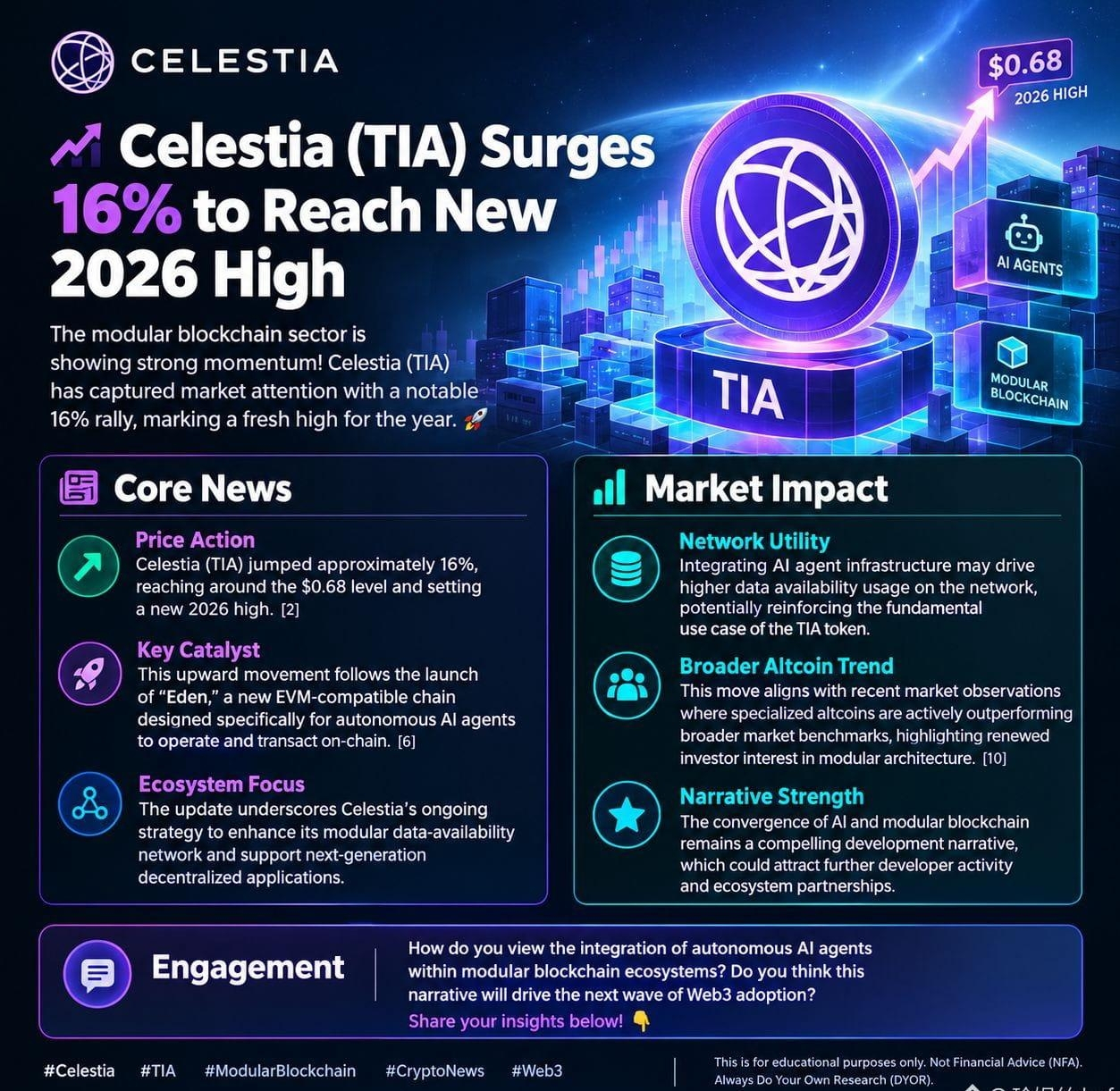
📈 #CelestiaRises 16% as $TIAHits a New 2026 High!
Celestia ($TIA) is gaining attention after a reported 16% surge, pushing its price toward $0.68 and marking a new yearly high.
🚀 What’s Driving the Momentum?
The rally comes amid news surrounding Eden, an EVM-compatible chain built for autonomous AI agents to operate and transact on-chain.
🔍 Why It Matters
- AI Meets Blockchain: Autonomous agents could open new possibilities for on-chain applications.
- Modular Infrastructure: Celestia continues focusing on scalable data availability for decentralized ecosystems.
- Market Momentum: The combination of AI and modular blockchain technology is attracting growing attention across Web3.
💬 Your Take: Could AI agents become a major driver of adoption for modular blockchains? Is preparing for another move, or is a correction possible after this rally?
Share your thoughts below! 👇
#Celestia #TIA #CryptoNews #ModularBlockchain #Web3
$TIA $EPIC $SAND
{future}(TIAUSDT)
{future}(SANDUSDT)
{future}(EPICUSDT)
📈 #CelestiaRises 16% as $TIAHits a New 2026 High!
Celestia ($TIA ) is gaining attention after a reported 16% surge, pushing its price toward $0.68 and marking a new yearly high.
🚀 What’s Driving the Momentum?
The rally comes amid news surrounding Eden, an EVM-compatible chain built for autonomous AI agents to operate and transact on-chain.
🔍 Why It Matters
- AI Meets Blockchain: Autonomous agents could open new possibilities for on-chain applications.
- Modular Infrastructure: Celestia continues focusing on scalable data availability for decentralized ecosystems.
- Market Momentum: The combination of AI and modular blockchain technology is attracting growing attention across Web3.
💬 Your Take: Could AI agents become a major driver of adoption for modular blockchains? Is preparing for another move, or is a correction possible after this rally?
Share your thoughts below! 👇
#Celestia #TIA #CryptoNews #ModularBlockchain #Web3
$TIA $EPIC $SAND
Celestia ($TIA ) is gaining attention after a reported 16% surge, pushing its price toward $0.68 and marking a new yearly high.
🚀 What’s Driving the Momentum?
The rally comes amid news surrounding Eden, an EVM-compatible chain built for autonomous AI agents to operate and transact on-chain.
🔍 Why It Matters
- AI Meets Blockchain: Autonomous agents could open new possibilities for on-chain applications.
- Modular Infrastructure: Celestia continues focusing on scalable data availability for decentralized ecosystems.
- Market Momentum: The combination of AI and modular blockchain technology is attracting growing attention across Web3.
💬 Your Take: Could AI agents become a major driver of adoption for modular blockchains? Is preparing for another move, or is a correction possible after this rally?
Share your thoughts below! 👇
#Celestia #TIA #CryptoNews #ModularBlockchain #Web3
$TIA $EPIC $SAND
1
615

·
--
Celestia ($TIA ) — Visualizing the Modular Tech Surge
Driven by the massive market momentum and the trending hashtag #CelestiaRises16%To2026High, this creative project explores Celestia’s modular architecture and its ecosystem token, $TIA . Inspired by the explosive 23% single-day rally following the groundbreaking launch of "Eden"—a high-performance, EVM-compatible network built specifically for on-chain AI agent commerce and automated transactions—the designs translate digital financial innovation into high-end crypto aesthetics.
The visual identity centers on data availability, high throughput, and modular synergy. Incorporating the energetic pink and neon hues inspired by trending digital assets, the layouts reflect the bullish market sentiment as $TIA tests key resistance levels near $0.80 on its current trajectory toward a yearly peak. Every visual asset is meticulously crafted to capture the intersection of decentralized infrastructure and autonomous, AI-driven economies.
Feel free to share your thoughts and opinions below
.
#Celestia #ModularBlockchain #EDENTrading #BehanceTrending
#CelestiaRises16%To2026High
{future}(TIAUSDT)
{future}(ADAUSDT)
{future}(BNBUSDT)
Celestia ($TIA ) — Visualizing the Modular Tech Surge
Driven by the massive market momentum and the trending hashtag #CelestiaRises16%To2026High, this creative project explores Celestia’s modular architecture and its ecosystem token, $TIA . Inspired by the explosive 23% single-day rally following the groundbreaking launch of "Eden"—a high-performance, EVM-compatible network built specifically for on-chain AI agent commerce and automated transactions—the designs translate digital financial innovation into high-end crypto aesthetics.
The visual identity centers on data availability, high throughput, and modular synergy. Incorporating the energetic pink and neon hues inspired by trending digital assets, the layouts reflect the bullish market sentiment as $TIA tests key resistance levels near $0.80 on its current trajectory toward a yearly peak. Every visual asset is meticulously crafted to capture the intersection of decentralized infrastructure and autonomous, AI-driven economies.
Feel free to share your thoughts and opinions below
.
#Celestia #ModularBlockchain #EDENTrading #BehanceTrending
#CelestiaRises16%To2026High
Driven by the massive market momentum and the trending hashtag #CelestiaRises16%To2026High, this creative project explores Celestia’s modular architecture and its ecosystem token, $TIA . Inspired by the explosive 23% single-day rally following the groundbreaking launch of "Eden"—a high-performance, EVM-compatible network built specifically for on-chain AI agent commerce and automated transactions—the designs translate digital financial innovation into high-end crypto aesthetics.
The visual identity centers on data availability, high throughput, and modular synergy. Incorporating the energetic pink and neon hues inspired by trending digital assets, the layouts reflect the bullish market sentiment as $TIA tests key resistance levels near $0.80 on its current trajectory toward a yearly peak. Every visual asset is meticulously crafted to capture the intersection of decentralized infrastructure and autonomous, AI-driven economies.
Feel free to share your thoughts and opinions below
.
#Celestia #ModularBlockchain #EDENTrading #BehanceTrending
#CelestiaRises16%To2026High
207

Smart money is aggressively rotating back into modular infrastructure while retail is still distracted chasing lagging majors like $BTC and $ETH. $TIA just ripped +15.95% on a heavy 272.5M USDT volume surge, carving a clean range between the 0.5828 USDT swing low and the 0.7201 USDT intraday ceiling.
Current price is holding firm at 0.6858 USDT, showing textbook spot-led absorption rather than a speculative leverage flush. If orderbooks can clear that 0.7201 USDT resistance with sustained bid support, the path opens toward a much broader expansion phase. Lose the mid-range pivot near 0.64 USDT, however, and this entire impulsive push invalidates, risking a sweep back toward the lows.
Are you fading this momentum breakout or chasing the continuation above the high?
$TIA $BTC $ETH
#Celestia #AltcoinSeasons #ModularBlockchain #CryptoTradingDesk
Smart money is aggressively rotating back into modular infrastructure while retail is still distracted chasing lagging majors like $BTC and $ETH . $TIA just ripped +15.95% on a heavy 272.5M USDT volume surge, carving a clean range between the 0.5828 USDT swing low and the 0.7201 USDT intraday ceiling.
Current price is holding firm at 0.6858 USDT, showing textbook spot-led absorption rather than a speculative leverage flush. If orderbooks can clear that 0.7201 USDT resistance with sustained bid support, the path opens toward a much broader expansion phase. Lose the mid-range pivot near 0.64 USDT, however, and this entire impulsive push invalidates, risking a sweep back toward the lows.
Are you fading this momentum breakout or chasing the continuation above the high?
$TIA $BTC $ETH
#Celestia #AltcoinSeasons #ModularBlockchain #CryptoTradingDesk
Current price is holding firm at 0.6858 USDT, showing textbook spot-led absorption rather than a speculative leverage flush. If orderbooks can clear that 0.7201 USDT resistance with sustained bid support, the path opens toward a much broader expansion phase. Lose the mid-range pivot near 0.64 USDT, however, and this entire impulsive push invalidates, risking a sweep back toward the lows.
Are you fading this momentum breakout or chasing the continuation above the high?
$TIA $BTC $ETH
#Celestia #AltcoinSeasons #ModularBlockchain #CryptoTradingDesk
141

Modular Blockchain — The Next Opportunity
$TIA | $DYM | $ALT
TIA, DYM, and ALT are connected to modular infrastructure and rollup development across Web3.
Key Takeaway: Infrastructure growth deserves attention, not blind conviction.
#TIA #DYM #ALT #ModularBlockchain #Web3
{future}(TIAUSDT)
{future}(DYMUSDT)
{future}(ALTUSDT)
Modular Blockchain — The Next Opportunity
$TIA | $DYM | $ALT
TIA, DYM, and ALT are connected to modular infrastructure and rollup development across Web3.
Key Takeaway: Infrastructure growth deserves attention, not blind conviction.
#TIA #DYM #ALT #ModularBlockchain #Web3
$TIA | $DYM | $ALT
TIA, DYM, and ALT are connected to modular infrastructure and rollup development across Web3.
Key Takeaway: Infrastructure growth deserves attention, not blind conviction.
#TIA #DYM #ALT #ModularBlockchain #Web3
1
30

·
--
Bullish
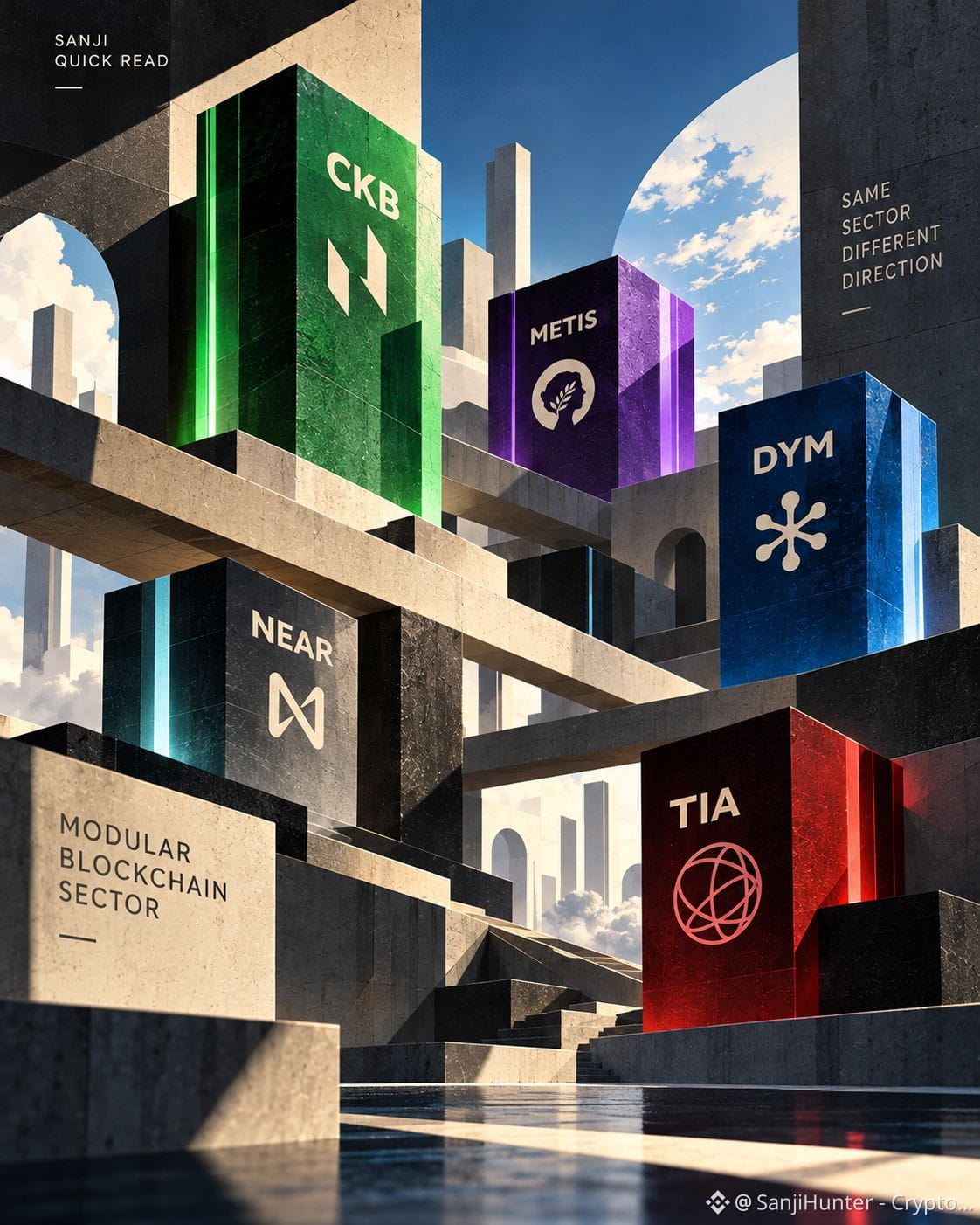
🎢 The modular token rally looked strong this morning — tonight tells a different story
Earlier today, $CKB was showing a 29% gain on its 24H reading
Now it's back in the red
$STRK is down more than 14%, while $ZK has also turned negative
{future}(CKBUSDT)
📉 But not every token has given up its gains
$METIS is still up around 10%, $DYM around 7% and $NEAR roughly 5%
That changes how I'm reading this move
This morning, it looked like money was rotating into a broader group of modular and infrastructure tokens
Now buyers are becoming much more selective
{future}(DYMUSDT)
👀 The next signal isn't another big green candle
It's whether the remaining strong names can hold up while the earlier leaders keep fading
If METIS and DYM lose momentum too, the rotation thesis gets weaker
{future}(NEARUSDT)
⚠️ If they hold while the rest stabilize, there's still a case for selective strength
The first pump gets attention
What survives the pullback tells you more
#ModularBlockchain #altcoins
🎢 The modular token rally looked strong this morning — tonight tells a different story
Earlier today, $CKB was showing a 29% gain on its 24H reading
Now it's back in the red
$STRK is down more than 14%, while $ZK has also turned negative
📉 But not every token has given up its gains
$METIS is still up around 10%, $DYM around 7% and $NEAR roughly 5%
That changes how I'm reading this move
This morning, it looked like money was rotating into a broader group of modular and infrastructure tokens
Now buyers are becoming much more selective
👀 The next signal isn't another big green candle
It's whether the remaining strong names can hold up while the earlier leaders keep fading
If METIS and DYM lose momentum too, the rotation thesis gets weaker
⚠️ If they hold while the rest stabilize, there's still a case for selective strength
The first pump gets attention
What survives the pullback tells you more
#ModularBlockchain #altcoins
Earlier today, $CKB was showing a 29% gain on its 24H reading
Now it's back in the red
$STRK is down more than 14%, while $ZK has also turned negative
📉 But not every token has given up its gains
$METIS is still up around 10%, $DYM around 7% and $NEAR roughly 5%
That changes how I'm reading this move
This morning, it looked like money was rotating into a broader group of modular and infrastructure tokens
Now buyers are becoming much more selective
👀 The next signal isn't another big green candle
It's whether the remaining strong names can hold up while the earlier leaders keep fading
If METIS and DYM lose momentum too, the rotation thesis gets weaker
⚠️ If they hold while the rest stabilize, there's still a case for selective strength
The first pump gets attention
What survives the pullback tells you more
#ModularBlockchain #altcoins
704

Modular Chains Revolution: Why can’t future networks do without $TIA ? 🧱
Traditional monolithic networks have become slow and expensive. $TIA changed the rules of the game by introducing the first Modular Data Availability network. Simply put: it lets any project launch a Layer 2 (L2) network in minutes at near-zero fee cost, shifting the burden of complex data storage away from the main chains.
Why buy now?
The more the Layer 2 networks (Rollups) explode, the more inevitable the demand grows to burn and consume TIA. It’s the invisible infrastructure of the future of Web 3.
⚠️ Share your take: Have you staked TIA to get future airdrops? Follow the account for more!
#celestia #ModularBlockchain #Web3
Modular Chains Revolution: Why can’t future networks do without $TIA ? 🧱
Traditional monolithic networks have become slow and expensive. $TIA changed the rules of the game by introducing the first Modular Data Availability network. Simply put: it lets any project launch a Layer 2 (L2) network in minutes at near-zero fee cost, shifting the burden of complex data storage away from the main chains.
Why buy now?
The more the Layer 2 networks (Rollups) explode, the more inevitable the demand grows to burn and consume TIA. It’s the invisible infrastructure of the future of Web 3.
⚠️ Share your take: Have you staked TIA to get future airdrops? Follow the account for more!
#celestia #ModularBlockchain #Web3
Traditional monolithic networks have become slow and expensive. $TIA changed the rules of the game by introducing the first Modular Data Availability network. Simply put: it lets any project launch a Layer 2 (L2) network in minutes at near-zero fee cost, shifting the burden of complex data storage away from the main chains.
Why buy now?
The more the Layer 2 networks (Rollups) explode, the more inevitable the demand grows to burn and consume TIA. It’s the invisible infrastructure of the future of Web 3.
⚠️ Share your take: Have you staked TIA to get future airdrops? Follow the account for more!
#celestia #ModularBlockchain #Web3
1
322
Modular Momentum — Structure Before Acceleration
$TIA | $DYM | $ALT
TIA, DYM, and ALT remain connected to modular blockchain and scaling narratives. These sectors can experience rapid changes in liquidity as new ecosystem opportunities emerge.
Key Takeaway: Consolidation can become the foundation for the next expansion.
#TIA #DYM #ALT #ModularBlockchain #MarketWatch
{future}(TIAUSDT)
{future}(DYMUSDT)
{future}(ALTUSDT)
Modular Momentum — Structure Before Acceleration
$TIA | $DYM | $ALT
TIA, DYM, and ALT remain connected to modular blockchain and scaling narratives. These sectors can experience rapid changes in liquidity as new ecosystem opportunities emerge.
Key Takeaway: Consolidation can become the foundation for the next expansion.
#TIA #DYM #ALT #ModularBlockchain #MarketWatch
$TIA | $DYM | $ALT
TIA, DYM, and ALT remain connected to modular blockchain and scaling narratives. These sectors can experience rapid changes in liquidity as new ecosystem opportunities emerge.
Key Takeaway: Consolidation can become the foundation for the next expansion.
#TIA #DYM #ALT #ModularBlockchain #MarketWatch
1
381
Modular Ecosystem — Structure Before Expansion
$TIA | $DYM | $ALT
TIA, DYM, and ALT remain associated with modular blockchain and scaling narratives. These ecosystems can experience sharp changes in market attention as infrastructure narratives rotate.
Key Takeaway: Strong bases deserve attention before momentum expands.
#TIA #DYM #ALT #ModularBlockchain #StrategicEntry
{future}(TIAUSDT)
{future}(DYMUSDT)
{future}(ALTUSDT)
Modular Ecosystem — Structure Before Expansion
$TIA | $DYM | $ALT
TIA, DYM, and ALT remain associated with modular blockchain and scaling narratives. These ecosystems can experience sharp changes in market attention as infrastructure narratives rotate.
Key Takeaway: Strong bases deserve attention before momentum expands.
#TIA #DYM #ALT #ModularBlockchain #StrategicEntry
$TIA | $DYM | $ALT
TIA, DYM, and ALT remain associated with modular blockchain and scaling narratives. These ecosystems can experience sharp changes in market attention as infrastructure narratives rotate.
Key Takeaway: Strong bases deserve attention before momentum expands.
#TIA #DYM #ALT #ModularBlockchain #StrategicEntry
1
584

#Celestia In the quiet expansion of modular blockchain design, data availability layers continue enabling independent roll ups with greater efficiency and sovereignty. As developer integrations deepen amid ecosystem maturation, the infrastructure narrative gains measured conviction. Echoing the 2021 multi-chain experiments that unlocked scalable architecture, this evolution carries a 63% probability of steady adoption through the season if usage metrics and cross-ecosystem flows keep compounding.
{spot}(TIAUSDT)
$TIA #CoinVahini #ModularBlockchain
#Celestia In the quiet expansion of modular blockchain design, data availability layers continue enabling independent roll ups with greater efficiency and sovereignty. As developer integrations deepen amid ecosystem maturation, the infrastructure narrative gains measured conviction. Echoing the 2021 multi-chain experiments that unlocked scalable architecture, this evolution carries a 63% probability of steady adoption through the season if usage metrics and cross-ecosystem flows keep compounding.
$TIA #CoinVahini #ModularBlockchain
$TIA #CoinVahini #ModularBlockchain
255

·
--
One Token, All the FeesSolana's market cap is roughly $45B. Celestia — the token built specifically to power the "modular" alternative to Solana's approach — sits at $366M, trading 98% below its all-time high. If modular architecture is supposed to be the technically superior design, why hasn't the market rewarded it that way? The answer teaches you something most explainers skip.
The core idea: every blockchain does three jobs — execution (running transactions), settlement (finalizing disputes and state), and data availability, or DA (making sure the data behind every transaction is published so anyone can verify it). A monolithic chain like Solana does all three itself, in one client, optimized to move together. A modular stack splits them across specialized layers: Ethereum handles settlement, a rollup like Arbitrum handles execution, and a dedicated layer — Celestia or EigenDA — handles DA.
Why split it at all: specialization. A chain that only does DA can scale that one function harder than a chain trying to do everything at once. EigenDA takes a different approach than Celestia — it borrows Ethereum's existing security through restaking rather than bootstrapping a brand-new validator set, a hybrid model that trades some independence for faster trust.
Here's the mistake people make with this thesis: assuming architectural elegance translates directly into token value. It doesn't automatically. Rollups pay Celestia or EigenDA in small, competitive fees for blobspace — a commodity market where DA providers compete on price. Compare that to Solana, where execution, settlement, and DA all live under one token that captures the full economic activity of the chain. Modularity can produce a technically superior system for developers while spreading the economic value so thin across layers that no single modular token captures what a monolithic L1 does. That gap — real usage growing, token value not following at the same pace — is exactly what's playing out in Celestia's chart right now.
The comparative takeaway: modular wins on flexibility and specialization — a rollup can inherit security without building its own validator set from scratch. Monolithic wins on value capture — one token, one chain, all the fees. Neither is strictly "better." They're different bets on where value accrues in a stack, and 2026's price action is the live experiment showing that architecture and token economics don't always move together.
#ModularBlockchain
$SOL $TIA
One Token, All the Fees
Solana's market cap is roughly $45B. Celestia — the token built specifically to power the "modular" alternative to Solana's approach — sits at $366M, trading 98% below its all-time high. If modular architecture is supposed to be the technically superior design, why hasn't the market rewarded it that way? The answer teaches you something most explainers skip.
The core idea: every blockchain does three jobs — execution (running transactions), settlement (finalizing disputes and state), and data availability, or DA (making sure the data behind every transaction is published so anyone can verify it). A monolithic chain like Solana does all three itself, in one client, optimized to move together. A modular stack splits them across specialized layers: Ethereum handles settlement, a rollup like Arbitrum handles execution, and a dedicated layer — Celestia or EigenDA — handles DA.
Why split it at all: specialization. A chain that only does DA can scale that one function harder than a chain trying to do everything at once. EigenDA takes a different approach than Celestia — it borrows Ethereum's existing security through restaking rather than bootstrapping a brand-new validator set, a hybrid model that trades some independence for faster trust.
Here's the mistake people make with this thesis: assuming architectural elegance translates directly into token value. It doesn't automatically. Rollups pay Celestia or EigenDA in small, competitive fees for blobspace — a commodity market where DA providers compete on price. Compare that to Solana, where execution, settlement, and DA all live under one token that captures the full economic activity of the chain. Modularity can produce a technically superior system for developers while spreading the economic value so thin across layers that no single modular token captures what a monolithic L1 does. That gap — real usage growing, token value not following at the same pace — is exactly what's playing out in Celestia's chart right now.
The comparative takeaway: modular wins on flexibility and specialization — a rollup can inherit security without building its own validator set from scratch. Monolithic wins on value capture — one token, one chain, all the fees. Neither is strictly "better." They're different bets on where value accrues in a stack, and 2026's price action is the live experiment showing that architecture and token economics don't always move together.
#ModularBlockchain
$SOL $TIA
The core idea: every blockchain does three jobs — execution (running transactions), settlement (finalizing disputes and state), and data availability, or DA (making sure the data behind every transaction is published so anyone can verify it). A monolithic chain like Solana does all three itself, in one client, optimized to move together. A modular stack splits them across specialized layers: Ethereum handles settlement, a rollup like Arbitrum handles execution, and a dedicated layer — Celestia or EigenDA — handles DA.
Why split it at all: specialization. A chain that only does DA can scale that one function harder than a chain trying to do everything at once. EigenDA takes a different approach than Celestia — it borrows Ethereum's existing security through restaking rather than bootstrapping a brand-new validator set, a hybrid model that trades some independence for faster trust.
Here's the mistake people make with this thesis: assuming architectural elegance translates directly into token value. It doesn't automatically. Rollups pay Celestia or EigenDA in small, competitive fees for blobspace — a commodity market where DA providers compete on price. Compare that to Solana, where execution, settlement, and DA all live under one token that captures the full economic activity of the chain. Modularity can produce a technically superior system for developers while spreading the economic value so thin across layers that no single modular token captures what a monolithic L1 does. That gap — real usage growing, token value not following at the same pace — is exactly what's playing out in Celestia's chart right now.
The comparative takeaway: modular wins on flexibility and specialization — a rollup can inherit security without building its own validator set from scratch. Monolithic wins on value capture — one token, one chain, all the fees. Neither is strictly "better." They're different bets on where value accrues in a stack, and 2026's price action is the live experiment showing that architecture and token economics don't always move together.
#ModularBlockchain
$SOL $TIA
1
1
160

·
--
Modular Blockchains Are Quietly Rewriting the Layer 1 Playbook
For years, the debate was simple: which monolithic L1 wins? But the next chapter of crypto architecture is modular — and it changes the competitive dynamics entirely.
Here's the core thesis: monolithic chains try to do everything (execution, consensus, data availability, settlement) in one layer. Modular chains decompose these functions and optimize each independently. The result is a system where chains can scale without sacrificing decentralization by offloading data availability to specialized layers.
Why does this matter for investors?
$ETH is positioning itself as the dominant settlement and DA layer through EIP-4844 and Danksharding. Rollup fees dropped over 90% after blobs went live — a direct proof that modular scaling works. $AVAX takes a different approach: subnets let enterprises deploy isolated execution environments sharing the same validator set, offering customizability without fragmentation. $DOT's Plaza upgrade unifies its parachain ecosystem into a single coherent execution hub, making Polkadot more modular and composable at the same time.
The pattern: every major L1 is moving toward some version of modularity. The chains that nail data availability plus cheap execution plus developer tooling will attract the next generation of applications.
Monolithic vs. modular is not an either/or debate anymore — it's a spectrum, and the market is figuring out where each chain lands.
#Crypto #Web3 #ModularBlockchain #CryptoInvesting #Blockchain
Modular Blockchains Are Quietly Rewriting the Layer 1 Playbook
For years, the debate was simple: which monolithic L1 wins? But the next chapter of crypto architecture is modular — and it changes the competitive dynamics entirely.
Here's the core thesis: monolithic chains try to do everything (execution, consensus, data availability, settlement) in one layer. Modular chains decompose these functions and optimize each independently. The result is a system where chains can scale without sacrificing decentralization by offloading data availability to specialized layers.
Why does this matter for investors?
$ETH is positioning itself as the dominant settlement and DA layer through EIP-4844 and Danksharding. Rollup fees dropped over 90% after blobs went live — a direct proof that modular scaling works. $AVAX takes a different approach: subnets let enterprises deploy isolated execution environments sharing the same validator set, offering customizability without fragmentation. $DOT 's Plaza upgrade unifies its parachain ecosystem into a single coherent execution hub, making Polkadot more modular and composable at the same time.
The pattern: every major L1 is moving toward some version of modularity. The chains that nail data availability plus cheap execution plus developer tooling will attract the next generation of applications.
Monolithic vs. modular is not an either/or debate anymore — it's a spectrum, and the market is figuring out where each chain lands.
#Crypto #Web3 #ModularBlockchain #CryptoInvesting #Blockchain
For years, the debate was simple: which monolithic L1 wins? But the next chapter of crypto architecture is modular — and it changes the competitive dynamics entirely.
Here's the core thesis: monolithic chains try to do everything (execution, consensus, data availability, settlement) in one layer. Modular chains decompose these functions and optimize each independently. The result is a system where chains can scale without sacrificing decentralization by offloading data availability to specialized layers.
Why does this matter for investors?
$ETH is positioning itself as the dominant settlement and DA layer through EIP-4844 and Danksharding. Rollup fees dropped over 90% after blobs went live — a direct proof that modular scaling works. $AVAX takes a different approach: subnets let enterprises deploy isolated execution environments sharing the same validator set, offering customizability without fragmentation. $DOT 's Plaza upgrade unifies its parachain ecosystem into a single coherent execution hub, making Polkadot more modular and composable at the same time.
The pattern: every major L1 is moving toward some version of modularity. The chains that nail data availability plus cheap execution plus developer tooling will attract the next generation of applications.
Monolithic vs. modular is not an either/or debate anymore — it's a spectrum, and the market is figuring out where each chain lands.
#Crypto #Web3 #ModularBlockchain #CryptoInvesting #Blockchain
104
Title: The Next Revolution in Blockchain.. Whales Lay the Foundation Stone! 🧱💎
:Have you heard about Modular Blockchain? $TIA (Celestia) is reinventing how digital networks are built. The project makes it easy to launch any new blockchain at virtually zero cost. The whales know that new projects will need TIA to operate. Are we at the very bottom? Yes, the last correction sifted out weak hands, and only whales and patient investors remain in the market.
💡 Whale Tip: The coin is ready for an explosion as soon as the market moves. Hold strong and make sure your patience pays off.
#celestia #tia #ModularBlockchain $BTC
🔶 Don’t forget to press the (Like) button and follow to get more.
Title: The Next Revolution in Blockchain.. Whales Lay the Foundation Stone! 🧱💎
:Have you heard about Modular Blockchain? $TIA (Celestia) is reinventing how digital networks are built. The project makes it easy to launch any new blockchain at virtually zero cost. The whales know that new projects will need TIA to operate. Are we at the very bottom? Yes, the last correction sifted out weak hands, and only whales and patient investors remain in the market.
💡 Whale Tip: The coin is ready for an explosion as soon as the market moves. Hold strong and make sure your patience pays off.
#celestia #tia #ModularBlockchain $BTC
🔶 Don’t forget to press the (Like) button and follow to get more.
:Have you heard about Modular Blockchain? $TIA (Celestia) is reinventing how digital networks are built. The project makes it easy to launch any new blockchain at virtually zero cost. The whales know that new projects will need TIA to operate. Are we at the very bottom? Yes, the last correction sifted out weak hands, and only whales and patient investors remain in the market.
💡 Whale Tip: The coin is ready for an explosion as soon as the market moves. Hold strong and make sure your patience pays off.
#celestia #tia #ModularBlockchain $BTC
🔶 Don’t forget to press the (Like) button and follow to get more.
1
128

·
--
Caldera just dropped 17% today, but the tech behind it is building the future of Ethereum scaling.
Think of Ethereum as a busy highway. Caldera builds dedicated express lanes (called Rollups) so apps don't get stuck in traffic. It is a "Rollups-as-a-Service" platform that lets developers launch custom Layer 2 or Layer 3 chains in minutes without running complex infrastructure themselves. Projects like Manta Network and ApeChain use it to offer users near-zero fees and instant transactions.
With a market cap around $15M but huge 24h volume over $63M, ERA token activity is intense right now. The token secures the network and aligns incentives across these interconnected chains. It’s a bet on the "modular" thesis: breaking blockchain jobs into specialized pieces for maximum speed.
Modular infrastructure is the hidden engine of the next bull run.
#Caldera #ModularBlockchain
Which matters more for a Rollup token: securing the chain or capturing transaction fees?
Caldera just dropped 17% today, but the tech behind it is building the future of Ethereum scaling.
Think of Ethereum as a busy highway. Caldera builds dedicated express lanes (called Rollups) so apps don't get stuck in traffic. It is a "Rollups-as-a-Service" platform that lets developers launch custom Layer 2 or Layer 3 chains in minutes without running complex infrastructure themselves. Projects like Manta Network and ApeChain use it to offer users near-zero fees and instant transactions.
With a market cap around $15M but huge 24h volume over $63M, ERA token activity is intense right now. The token secures the network and aligns incentives across these interconnected chains. It’s a bet on the "modular" thesis: breaking blockchain jobs into specialized pieces for maximum speed.
Modular infrastructure is the hidden engine of the next bull run.
#Caldera #ModularBlockchain
Which matters more for a Rollup token: securing the chain or capturing transaction fees?
Think of Ethereum as a busy highway. Caldera builds dedicated express lanes (called Rollups) so apps don't get stuck in traffic. It is a "Rollups-as-a-Service" platform that lets developers launch custom Layer 2 or Layer 3 chains in minutes without running complex infrastructure themselves. Projects like Manta Network and ApeChain use it to offer users near-zero fees and instant transactions.
With a market cap around $15M but huge 24h volume over $63M, ERA token activity is intense right now. The token secures the network and aligns incentives across these interconnected chains. It’s a bet on the "modular" thesis: breaking blockchain jobs into specialized pieces for maximum speed.
Modular infrastructure is the hidden engine of the next bull run.
#Caldera #ModularBlockchain
Which matters more for a Rollup token: securing the chain or capturing transaction fees?
122

·
--
⚡ SAGA +19.4% with volume 9x its average — the modular L2 narrative is alive and well.
Trading at $0.0162, SAGA has cleared its SMA25 ($0.0132) and is now testing the SMA99 ($0.0158) from above. 4H RSI at 62.3 shows room to run before overbought. MACD is positive on both 4H and daily timeframes — momentum is confirmed.
📊 Why This Trade?
The modular blockchain thesis keeps gaining traction. SAGA's 8.98x volume ratio tells you this isn't random noise — smart money is positioning. The $15.5M volume for a coin this size is a strong signal.
🎯 Trade Plan:
• Entry Zone: $0.015 – $0.017 (wait for pullback to SMA99 retest)
• Stop Loss: $0.013
• TP1: $0.022 | TP2: $0.025
R/R ratio at 2.0x — one of the better setups in today's altcoin action.
💬 Do you think modular L2s are the next big narrative? Yes or no 👇
#SAGA #ModularBlockchain #DYOR
⚠️ Disclaimer: This is not financial advice. Always do your own research (DYOR) before making any investment decisions. Past performance does not guarantee future results. Trade responsibly.
⚡ SAGA +19.4% with volume 9x its average — the modular L2 narrative is alive and well.
Trading at $0.0162, SAGA has cleared its SMA25 ($0.0132) and is now testing the SMA99 ($0.0158) from above. 4H RSI at 62.3 shows room to run before overbought. MACD is positive on both 4H and daily timeframes — momentum is confirmed.
📊 Why This Trade?
The modular blockchain thesis keeps gaining traction. SAGA's 8.98x volume ratio tells you this isn't random noise — smart money is positioning. The $15.5M volume for a coin this size is a strong signal.
🎯 Trade Plan:
• Entry Zone: $0.015 – $0.017 (wait for pullback to SMA99 retest)
• Stop Loss: $0.013
• TP1: $0.022 | TP2: $0.025
R/R ratio at 2.0x — one of the better setups in today's altcoin action.
💬 Do you think modular L2s are the next big narrative? Yes or no 👇
#SAGA #ModularBlockchain #DYOR
⚠️ Disclaimer: This is not financial advice. Always do your own research (DYOR) before making any investment decisions. Past performance does not guarantee future results. Trade responsibly.
Trading at $0.0162, SAGA has cleared its SMA25 ($0.0132) and is now testing the SMA99 ($0.0158) from above. 4H RSI at 62.3 shows room to run before overbought. MACD is positive on both 4H and daily timeframes — momentum is confirmed.
📊 Why This Trade?
The modular blockchain thesis keeps gaining traction. SAGA's 8.98x volume ratio tells you this isn't random noise — smart money is positioning. The $15.5M volume for a coin this size is a strong signal.
🎯 Trade Plan:
• Entry Zone: $0.015 – $0.017 (wait for pullback to SMA99 retest)
• Stop Loss: $0.013
• TP1: $0.022 | TP2: $0.025
R/R ratio at 2.0x — one of the better setups in today's altcoin action.
💬 Do you think modular L2s are the next big narrative? Yes or no 👇
#SAGA #ModularBlockchain #DYOR
⚠️ Disclaimer: This is not financial advice. Always do your own research (DYOR) before making any investment decisions. Past performance does not guarantee future results. Trade responsibly.
134

·
--
TIA sent it to $0.43 in April, I saw that coming. They’re still sleeping on modular blockchain adoption, but I’m bidding these bags. Max targets for $TIA could hit $1.5-$6 this year if rollups keep pumping. This ain't financial advice, but I'm just saying. 🔥🚀💎 Are you still waiting on the sidelines? #TIA #ModularBlockchain
TIA sent it to $0.43 in April, I saw that coming. They’re still sleeping on modular blockchain adoption, but I’m bidding these bags. Max targets for $TIA could hit $1.5-$6 this year if rollups keep pumping. This ain't financial advice, but I'm just saying. 🔥🚀💎 Are you still waiting on the sidelines? #TIA #ModularBlockchain
158
·
--
📈 SAGA just pumped +25% with 8.5x average volume. The modular L2 narrative is heating up.
Here's what the chart is telling me — and why I'm NOT chasing this.
📊 The Setup
SAGA at $0.0168, up nearly 25% today. Volume: $14.3M — that's 8.5x its normal level. Something is clearly happening.
The modular blockchain space has been gaining traction, and SAGA is one of the purest plays in this narrative. But 25% in one day? That's priced in for now.
💡 What I'm Watching
1. 8.5x volume ratio — this is real buying, not noise
2. RSI at 67.9 (4H) — elevated but not yet screaming overbought
3. 7D MA crossed above 25D MA — bullish crossover confirmed
4. But: 25% moves often retrace 40-60% before continuing
📋 The Trade Plan
→ WAIT for pullback
→ Entry: $0.015-0.017 (retest of breakout zone)
→ Stop Loss: $0.013 (below structural support)
→ TP1: $0.022 (next resistance)
→ TP2: $0.025 (measured move)
⚖️ Risk/Reward: 2:1 — worth the wait
The modular L2 thesis is real. SAGA's ecosystem development could drive sustained interest. But buying after a 25% candle is how you become exit liquidity.
Patient traders make the most money. Wait for the dip.
Do you think the modular L2 narrative has staying power? 👇
#SAGA #ModularBlockchain #DYOR
⚠️ This is not financial advice. DYOR. Crypto assets can be extremely volatile.
📈 SAGA just pumped +25% with 8.5x average volume. The modular L2 narrative is heating up.
Here's what the chart is telling me — and why I'm NOT chasing this.
📊 The Setup
SAGA at $0.0168, up nearly 25% today. Volume: $14.3M — that's 8.5x its normal level. Something is clearly happening.
The modular blockchain space has been gaining traction, and SAGA is one of the purest plays in this narrative. But 25% in one day? That's priced in for now.
💡 What I'm Watching
1. 8.5x volume ratio — this is real buying, not noise
2. RSI at 67.9 (4H) — elevated but not yet screaming overbought
3. 7D MA crossed above 25D MA — bullish crossover confirmed
4. But: 25% moves often retrace 40-60% before continuing
📋 The Trade Plan
→ WAIT for pullback
→ Entry: $0.015-0.017 (retest of breakout zone)
→ Stop Loss: $0.013 (below structural support)
→ TP1: $0.022 (next resistance)
→ TP2: $0.025 (measured move)
⚖️ Risk/Reward: 2:1 — worth the wait
The modular L2 thesis is real. SAGA's ecosystem development could drive sustained interest. But buying after a 25% candle is how you become exit liquidity.
Patient traders make the most money. Wait for the dip.
Do you think the modular L2 narrative has staying power? 👇
#SAGA #ModularBlockchain #DYOR
⚠️ This is not financial advice. DYOR. Crypto assets can be extremely volatile.
Here's what the chart is telling me — and why I'm NOT chasing this.
📊 The Setup
SAGA at $0.0168, up nearly 25% today. Volume: $14.3M — that's 8.5x its normal level. Something is clearly happening.
The modular blockchain space has been gaining traction, and SAGA is one of the purest plays in this narrative. But 25% in one day? That's priced in for now.
💡 What I'm Watching
1. 8.5x volume ratio — this is real buying, not noise
2. RSI at 67.9 (4H) — elevated but not yet screaming overbought
3. 7D MA crossed above 25D MA — bullish crossover confirmed
4. But: 25% moves often retrace 40-60% before continuing
📋 The Trade Plan
→ WAIT for pullback
→ Entry: $0.015-0.017 (retest of breakout zone)
→ Stop Loss: $0.013 (below structural support)
→ TP1: $0.022 (next resistance)
→ TP2: $0.025 (measured move)
⚖️ Risk/Reward: 2:1 — worth the wait
The modular L2 thesis is real. SAGA's ecosystem development could drive sustained interest. But buying after a 25% candle is how you become exit liquidity.
Patient traders make the most money. Wait for the dip.
Do you think the modular L2 narrative has staying power? 👇
#SAGA #ModularBlockchain #DYOR
⚠️ This is not financial advice. DYOR. Crypto assets can be extremely volatile.
103

·
--
Blockchains used to be massive, slow monoliths trying to do absolutely everything at once.
If a network handled execution, data availability, consensus, and settlement all on a single layer, it inevitably choked under its own weight the second people actually tried to use it. Fees would spike, the network would stall, and the entire system would become a rigid bottleneck. It is like forcing a single processor to run an entire data center simultaneously—eventually, it crashes.
Modular blockchains are completely breaking this monolithic architecture apart.
Instead of forcing one chain to do everything poorly, it splits the heavy lifting into specialized layers. One layer handles raw execution, another ensures data availability, and another manages consensus. By plugging these specialized components together like digital building blocks, developers can launch ultra-fast networks tailored exactly to their needs without disrupting the rest of the stack.
We are moving past the era of bloated, monolithic networks. The modular stack is actively building the ultra-scalable foundation that Web3 actually needs to promote true innovation and efficiency.
$TIA $DYM $SAGA
#Write2Earn #ModularBlockchain #Web3Scalability #CryptoInfrastructure
Blockchains used to be massive, slow monoliths trying to do absolutely everything at once.
If a network handled execution, data availability, consensus, and settlement all on a single layer, it inevitably choked under its own weight the second people actually tried to use it. Fees would spike, the network would stall, and the entire system would become a rigid bottleneck. It is like forcing a single processor to run an entire data center simultaneously—eventually, it crashes.
Modular blockchains are completely breaking this monolithic architecture apart.
Instead of forcing one chain to do everything poorly, it splits the heavy lifting into specialized layers. One layer handles raw execution, another ensures data availability, and another manages consensus. By plugging these specialized components together like digital building blocks, developers can launch ultra-fast networks tailored exactly to their needs without disrupting the rest of the stack.
We are moving past the era of bloated, monolithic networks. The modular stack is actively building the ultra-scalable foundation that Web3 actually needs to promote true innovation and efficiency.
$TIA $DYM $SAGA
#Write2Earn #ModularBlockchain #Web3Scalability #CryptoInfrastructure
If a network handled execution, data availability, consensus, and settlement all on a single layer, it inevitably choked under its own weight the second people actually tried to use it. Fees would spike, the network would stall, and the entire system would become a rigid bottleneck. It is like forcing a single processor to run an entire data center simultaneously—eventually, it crashes.
Modular blockchains are completely breaking this monolithic architecture apart.
Instead of forcing one chain to do everything poorly, it splits the heavy lifting into specialized layers. One layer handles raw execution, another ensures data availability, and another manages consensus. By plugging these specialized components together like digital building blocks, developers can launch ultra-fast networks tailored exactly to their needs without disrupting the rest of the stack.
We are moving past the era of bloated, monolithic networks. The modular stack is actively building the ultra-scalable foundation that Web3 actually needs to promote true innovation and efficiency.
$TIA $DYM $SAGA
#Write2Earn #ModularBlockchain #Web3Scalability #CryptoInfrastructure

492

·
--
Bullish
#TIA
#ModularBlockchain
🚀 Prepare for lift-off! Is it time for $TIA
Celestia continues to catch the spotlight thanks to its innovative Modular Blockchain project, and with liquidity returning to the market, traders are anticipating a strong move for the coin.
If $TIA can maintain the current support levels, we might witness a new bullish wave targeting higher peaks in the near term.
⚠️ Capital management remains fundamental, but TIA is one of the coins that deserves close attention.
#altcoins
#TIA
#BullRun
#TIA
#ModularBlockchain
🚀 Prepare for lift-off! Is it time for $TIA
Celestia continues to catch the spotlight thanks to its innovative Modular Blockchain project, and with liquidity returning to the market, traders are anticipating a strong move for the coin.
If $TIA can maintain the current support levels, we might witness a new bullish wave targeting higher peaks in the near term.
⚠️ Capital management remains fundamental, but TIA is one of the coins that deserves close attention.
#altcoins
#TIA
#BullRun
#ModularBlockchain
🚀 Prepare for lift-off! Is it time for $TIA
Celestia continues to catch the spotlight thanks to its innovative Modular Blockchain project, and with liquidity returning to the market, traders are anticipating a strong move for the coin.
If $TIA can maintain the current support levels, we might witness a new bullish wave targeting higher peaks in the near term.
⚠️ Capital management remains fundamental, but TIA is one of the coins that deserves close attention.
#altcoins
#TIA
#BullRun
1
365

$TIA
Modular blockchain narrative = one of the sectors I’m watching closely. 👀
Celestia introduced a different approach to blockchain infrastructure by focusing on data availability.
If modular ecosystems gain more traction, TIA could become an interesting token to follow.
Bullish on modular blockchains?
$TIA
{spot}(TIAUSDT)
#Celestia #ModularBlockchain #Crypto
$TIA
Modular blockchain narrative = one of the sectors I’m watching closely. 👀
Celestia introduced a different approach to blockchain infrastructure by focusing on data availability.
If modular ecosystems gain more traction, TIA could become an interesting token to follow.
Bullish on modular blockchains?
$TIA
#Celestia #ModularBlockchain #Crypto
Modular blockchain narrative = one of the sectors I’m watching closely. 👀
Celestia introduced a different approach to blockchain infrastructure by focusing on data availability.
If modular ecosystems gain more traction, TIA could become an interesting token to follow.
Bullish on modular blockchains?
$TIA
#Celestia #ModularBlockchain #Crypto
106
·
--
$TIA experienced a recovery toward $0.43 in April 2026, with daily trading volumes ranging from $23M-$41M. Institutional backing from firms like Bain Capital Crypto remains, yet ongoing token unlocks exert selling pressure. 📢🏛️📊 What's next for modular adoption? #TIA #ModularBlockchain
$TIA experienced a recovery toward $0.43 in April 2026, with daily trading volumes ranging from $23M-$41M. Institutional backing from firms like Bain Capital Crypto remains, yet ongoing token unlocks exert selling pressure. 📢🏛️📊 What's next for modular adoption? #TIA #ModularBlockchain
66
Log in to explore more content
Join global crypto users on Binance Square
⚡️ Get latest and useful information about crypto.
💬 Trusted by the world’s largest crypto exchange.
👍 Discover real insights from verified creators.
Email / Phone number
Trending Topics
1
#BinancePick
2.8M views
147,427 Discussing
2
#EarningsSeason
5.1M views
25,193 Discussing
3
#AnthropicTTMRevenueGrewAbout1200%
1,272 views
101 Discussing
4
#AnthropicS1ExpectedToday
3,870 views
117 Discussing
5
#SouthKoreaReportedlyWeighsFourthCryptoTaxDelay
12,235 views
278 Discussing
6
#FranklinTempletonFilesForTwoDividendToBitcoinETFs
19,486 views
402 Discussing
7
#StrategyMSTRSurpassesNasdaqInMarketCap
16,075 views
309 Discussing
8
#CanadaProposesStablecoinRedemptionWithin3BusinessDays
717 views
31 Discussing
9
#ElectrumWalletBugLetRogueServersStealFunds
19,942 views
401 Discussing
10
#ArgentineCourtDismissesLIBRACaseAgainstMilei
31,237 views
489 Discussing