

#bridges
bridges
839 views
23 Discussing
Hot
Latest

What Is a Bridge Between Blockchains?
A bridge is a protocol that lets you move assets from one blockchain to another. Since blockchains don’t communicate with each other natively, the bridge acts as an intermediary: it locks your tokens on the source network and issues an equivalent version on the destination network.
For example, if you want to use ETH on Arbitrum, the bridge locks your ETH on Ethereum and gives you ETH on Arbitrum. When you go back, the process is reversed: the destination token is burned and the original is released.
There are centralized bridges (where a company controls the funds) and decentralized ones (managed by smart contracts). Both come with risks: centralized bridges concentrate trust, while decentralized ones can have code bugs. In fact, bridges have been among the most hacked protocols in DeFi history.
If you use multiple networks or DeFi, you’ll come across bridges. Always choose audited protocols with a track record and real volume.
Want more guides like this? Follow me for clear, no-nonsense technical content.
#Bridges
63


·
--
The Reality of Cross-Chain Bridges
Bridges are structurally the weakest links in the entire blockchain ecosystem.
Locking assets on one chain to mint synthetic versions on another creates a massive, centralized honey pot for hackers.
Until native cross-chain communication is perfected, bridging capital will always carry systemic risk.
#CryptoSecurity #Bridges #DeFi
262

📚 Cross-Chain Bridges: Moving assets between blockchains
On July 16, 2026, cross-chain bridges are essential infrastructure for the multichain ecosystem. A bridge is a protocol that allows you to transfer assets from one blockchain to another — for example, moving Ethereum tokens to Solana or Avalanche.
Bridges work by locking tokens on the source chain and minting wrapped representations on the destination chain. When you bridge back, the wrapped tokens are burned and the original tokens are unlocked.
Bridges are among the most attacked DeFi protocols because they hold large amounts of locked value. The Ostium oracle exploit shows how complex cross-chain mechanisms create additional attack surfaces. Only use well-audited, battle-tested bridges.
📌 Key Takeaway:
Cross-chain bridges move assets between blockchains by locking tokens on one side and minting wrapped versions on the other. They're high-value targets — use only audited solutions.
#CrossChain #Bridges
#BinanceAlphaAlert
25

·
--
Crypto hacks: security still a major concern. Two crypto bridge attacks this week saw $31.6M stolen within hours. AFX, a decentralized exchange on Arbitrum, lost over $24M, and then the Verus Ethereum bridge was hit. Crypto bridges are crucial for moving assets between different blockchains, allowing them to interoperate. Think of them as digital tunnels connecting separate cities. These attacks highlight a critical vulnerability in the crypto ecosystem. When a bridge is exploited, it creates a weak point where malicious actors can siphon off significant funds. This isn’t just about the projects themselves; it shakes user confidence in the security of cross-chain transactions overall. This news reminds us that while innovation in crypto is rapid, security needs to keep pace. Consistent audits and robust infrastructure are non-negotiable for a healthy ecosystem. We're seeing projects like $BANK gain over 76% today, showing immense growth potential, but security remains the bedrock. What are your thoughts on current crypto security measures? #CryptoSecurity #DeFi #Bridges
Crypto hacks: security still a major concern. Two crypto bridge attacks this week saw $31.6M stolen within hours. AFX, a decentralized exchange on Arbitrum, lost over $24M, and then the Verus Ethereum bridge was hit. Crypto bridges are crucial for moving assets between different blockchains, allowing them to interoperate. Think of them as digital tunnels connecting separate cities. These attacks highlight a critical vulnerability in the crypto ecosystem. When a bridge is exploited, it creates a weak point where malicious actors can siphon off significant funds. This isn’t just about the projects themselves; it shakes user confidence in the security of cross-chain transactions overall. This news reminds us that while innovation in crypto is rapid, security needs to keep pace. Consistent audits and robust infrastructure are non-negotiable for a healthy ecosystem. We're seeing projects like $BANK gain over 76% today, showing immense growth potential, but security remains the bedrock. What are your thoughts on current crypto security measures? #CryptoSecurity #DeFi #Bridges
114

·
--
Article
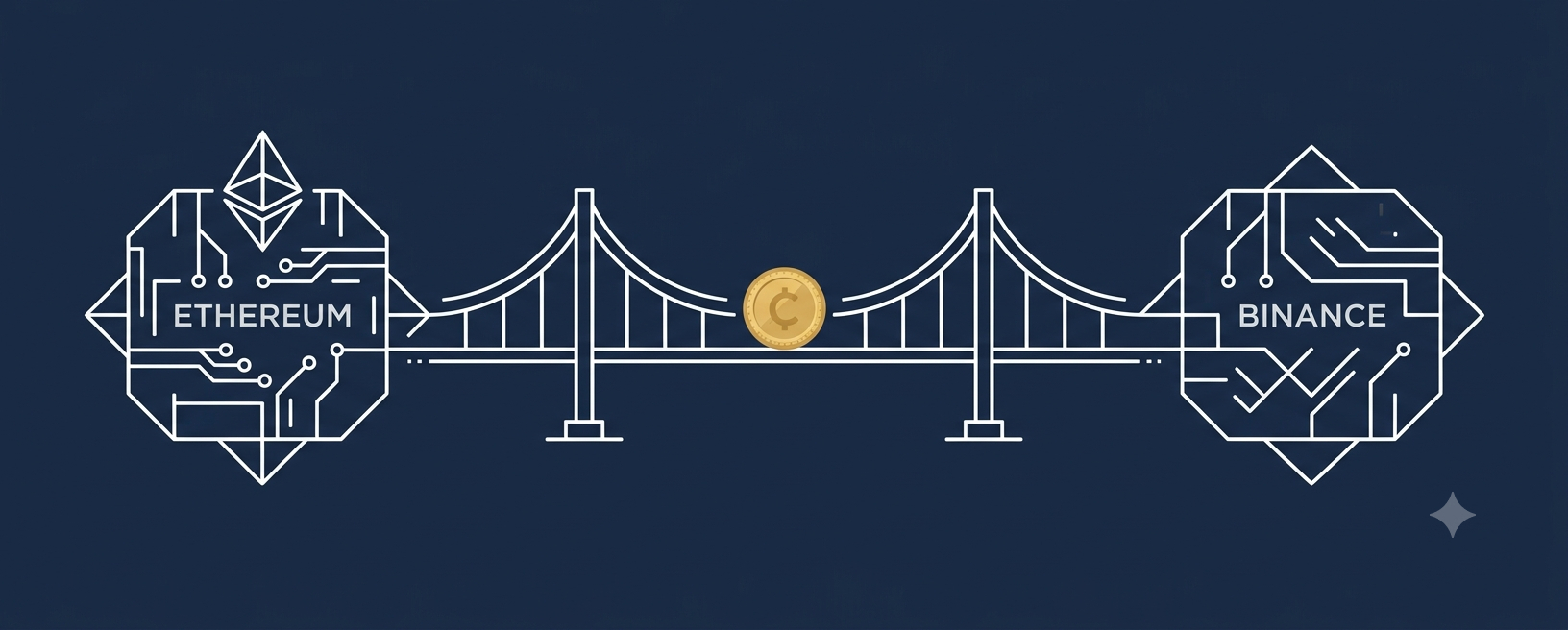
🌉 The Mystery of Digital Bridges: How to Transfer Your Crypto Funds Between Different Networks? (Simple Explanation)If you have been trading cryptocurrencies for a while, you have definitely encountered this annoying situation: you have coins (USDT) on the Ethereum network, and you want to use them to buy a new coin that exists only on the "Binance Smart Chain" (BSC) or "Solana" network.
You try to send the funds directly, and you get a terrifying warning message saying that your money may be lost forever! Why don’t these networks talk to each other? And how do we solve this problem? The secret lies in something called "blockchain bridges" (Cross-Chain Bridges). Let’s understand them with a very simple analogy.
🌉 The Mystery of Digital Bridges: How to Transfer Your Crypto Funds Between Different Networks? (Simple Explanation)
If you have been trading cryptocurrencies for a while, you have definitely encountered this annoying situation: you have coins (USDT) on the Ethereum network, and you want to use them to buy a new coin that exists only on the "Binance Smart Chain" (BSC) or "Solana" network.
You try to send the funds directly, and you get a terrifying warning message saying that your money may be lost forever! Why don’t these networks talk to each other? And how do we solve this problem? The secret lies in something called "blockchain bridges" (Cross-Chain Bridges). Let’s understand them with a very simple analogy.
You try to send the funds directly, and you get a terrifying warning message saying that your money may be lost forever! Why don’t these networks talk to each other? And how do we solve this problem? The secret lies in something called "blockchain bridges" (Cross-Chain Bridges). Let’s understand them with a very simple analogy.
1
57

·
--
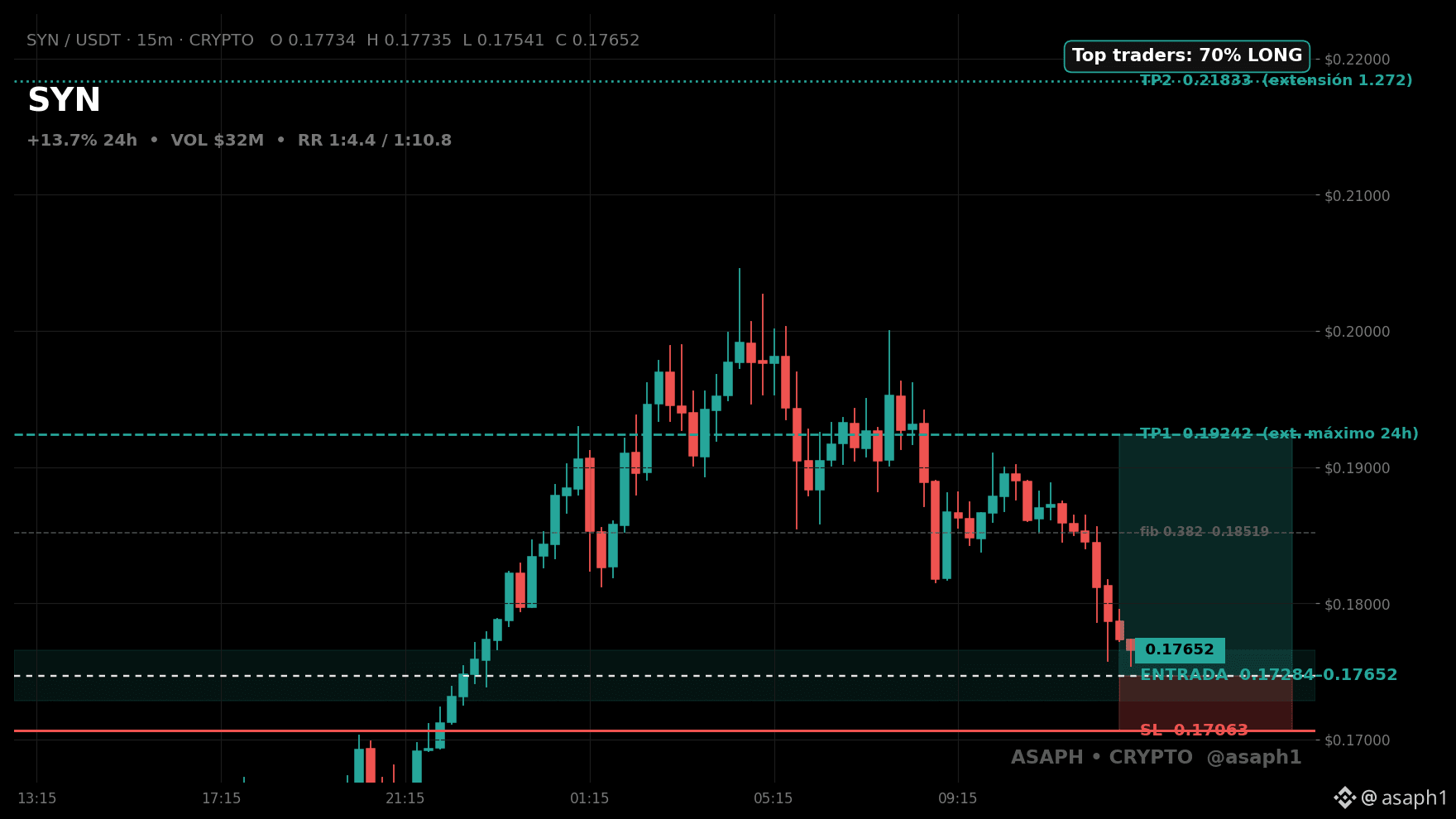
Long after $SYN and the +14%, or wait for the pullback?
The bridge between chains wakes up and SYN buys the momentum
The price is up 13.7% in 24h and remains above the 4h EMA50 at $0.1697.
The 15m RSI is at 31, after a drop that left the price cheap in the short term.
The zone starts at the current price, without waiting for a far-off pullback.
The key data: top positions are 70% long.
Accounts are 47.3% long and the last hour's taker flow shows only 42.5% buys.
Open interest is around $8.8M and funding is at 0.005%.
Cross-chain bridges are moving again when the market looks for yield outside a single ecosystem.
That wave is what is pushing SYN today.
📍 Price now: $0.17652
🎯 Zone: $0.1728375–$0.17652
Entry: limit order in the zone, scale 50/50 between $0.1728375 and $0.17652
🛑 Stop: $0.170628 (-2.32% from the average), confirmed BEFORE entering
Risk per trade: 2% of capital
✅ TP1: $0.19241675 (24h max extension) — take 50% and move the stop to break-even
🏁 TP2: $0.21833496 (1.272 ext.) — the extension that completes the bridge momentum
R/R: 1:4.38 · 1:10.78
⏳ Valid: next 4h / while $0.170628 holds
Check the chart and enter with the plan: Live price here 👇 SYN
SYN #Synapse #Bridges #Crypto
This is a plan, not financial advice.
98

·
--
The cross-chain era has a dirty secret: most of the value moving between chains still travels over infrastructure that trusts intermediaries more than math.
Bridges have historically been where cross-chain losses concentrate. Not because developers are careless, but because the problem itself is brutal. A bridge must verify that something happened on a chain it cannot see. Every solution is a trade-off: trusted validators (fast, fragile), multi-signature committees (convenient, concentrated), optimistic challenge windows (secure, slow), or light clients with zero-knowledge proofs (trust-minimized, expensive).
The deeper issue: wrapped assets are IOUs. A wrapped token on Chain B is only as good as the bridge backing it, which means cross-chain DeFi quietly stacks counterparty risk on top of smart contract risk.
What changes this: native interoperability. Chains verifying each other's finality directly. Intent-based routing where competing solvers execute your trade. Shared security models where a bridge inherits the economic weight of the chains it connects.
Watch the shift: as zero-knowledge light clients get cheaper, the bridges that survive will be the ones that never needed your trust.
Cross-chain is no longer a feature. It is becoming the connective tissue of the whole industry, and connective tissue is where the body is most vulnerable.
$ETH $SOL $BNB
#CrossChain #Bridges #DeFi #Interoperability #Blockchain
88

·
--

Article
What is a bridge and how to move tokens between Ethereum, BSC, and Solana networks?You've probably seen that when withdrawing funds from Binance, they ask you which network you want to send it over.
Ethereum, BSC, Solana, Polygon, Arbitrum, etc.
To transfer tokens from one network to another, we use bridges.
In this article, I'll break down what they are, how they work, and the risks involved.
What is a blockchain bridge?
It's a digital bridge that connects two different blockchains.
It allows you to move your tokens from one network to another.
For example, you have USDT on the Ethereum network but want to use it on the BSC network because transaction fees are cheaper.
A bridge converts your USDT from Ethereum into a representative USDT on BSC.
What is a bridge and how to move tokens between Ethereum, BSC, and Solana networks?
You've probably seen that when withdrawing funds from Binance, they ask you which network you want to send it over.
Ethereum, BSC, Solana, Polygon, Arbitrum, etc.
To transfer tokens from one network to another, we use bridges.
In this article, I'll break down what they are, how they work, and the risks involved.
What is a blockchain bridge?
It's a digital bridge that connects two different blockchains.
It allows you to move your tokens from one network to another.
For example, you have USDT on the Ethereum network but want to use it on the BSC network because transaction fees are cheaper.
A bridge converts your USDT from Ethereum into a representative USDT on BSC.
1
113
Log in to explore more content
Join global crypto users on Binance Square
⚡️ Get latest and useful information about crypto.
💬 Trusted by the world’s largest crypto exchange.
👍 Discover real insights from verified creators.
Email / Phone number
Trending Topics
1
#CanMicrosoftDeliverOnAI
531,221 views
3,545 Discussing
2
#CanGoogleDefindItsCore
322,200 views
2,502 Discussing
3
#EarningsSeason
6M views
29,749 Discussing
4
#BitcoinCoreIdentifiesThreeVulnerabilities
0 views
7 Discussing
5
#StrategyShareholdersApproveDailyDividends
0 views
8 Discussing
6
#FedLowerBoundRateDecisionAt3.75%
0 views
2 Discussing
7
#TokenizedGoldXAUaLaunchesOnSui
0 views
2 Discussing
8
#$10.9BBitcoinOptionsExpireFriday
2,790 views
99 Discussing
9
#ThailandSupremeCourtRulesBitcoinIsProperty
17,937 views
405 Discussing
10
#BitcoinSurpasses$81K
43,075 views
141 Discussing