

#defi
defi
56.7M views
297,288 Discussing
Hot
Latest

·
--
🚨 WAIT… WHY IS NOBODY TALKING ABOUT $AAVE?
{future}(AAVEUSDT)
Everyone is chasing the latest meme coin.
Meanwhile, DeFi is quietly waking up. 👀
$AAVE is showing strength, and the next move could get interesting if momentum continues.
🔥 DeFi narrative heating up
📈 Strong price momentum
🏦 Aave ecosystem developments
👀 Increasing trader attention
I'm not saying buy here.
I'm watching for one thing:
Can $AAVE hold its strength after the hype fades?
If yes → interesting.
If not → no trade.
Sometimes the biggest moves start before everyone notices.
⚠️ DYOR. Crypto is high risk and you can lose money. Trade at your own risk.
$AAVE #AAVE #DeFi #Crypto
🚨 WAIT… WHY IS NOBODY TALKING ABOUT $AAVE ?
Everyone is chasing the latest meme coin.
Meanwhile, DeFi is quietly waking up. 👀
$AAVE is showing strength, and the next move could get interesting if momentum continues.
🔥 DeFi narrative heating up
📈 Strong price momentum
🏦 Aave ecosystem developments
👀 Increasing trader attention
I'm not saying buy here.
I'm watching for one thing:
Can $AAVE hold its strength after the hype fades?
If yes → interesting.
If not → no trade.
Sometimes the biggest moves start before everyone notices.
⚠️ DYOR. Crypto is high risk and you can lose money. Trade at your own risk.
$AAVE #AAVE #DeFi #Crypto
Everyone is chasing the latest meme coin.
Meanwhile, DeFi is quietly waking up. 👀
$AAVE is showing strength, and the next move could get interesting if momentum continues.
🔥 DeFi narrative heating up
📈 Strong price momentum
🏦 Aave ecosystem developments
👀 Increasing trader attention
I'm not saying buy here.
I'm watching for one thing:
Can $AAVE hold its strength after the hype fades?
If yes → interesting.
If not → no trade.
Sometimes the biggest moves start before everyone notices.
⚠️ DYOR. Crypto is high risk and you can lose money. Trade at your own risk.
$AAVE #AAVE #DeFi #Crypto
1
13

·
--
🚨 AAVE Market Update — September 30, 2026
$AAVE
{spot}(AAVEUSDT)
AAVE is getting strong attention in today’s DeFi market.
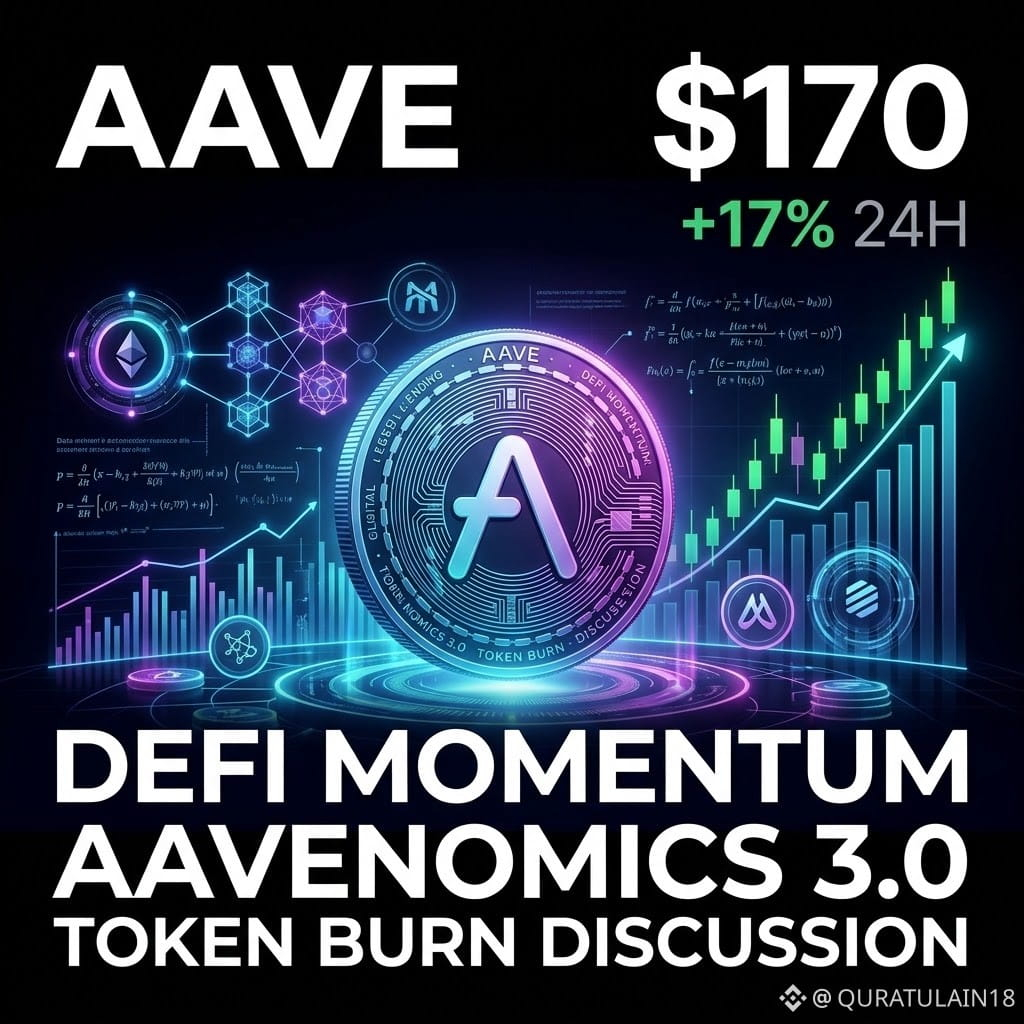
The token recently traded around the $170 area.
AAVE gained more than 17% over the latest 24 hours.
Trading volume has also increased sharply.
One major catalyst is the upcoming Aavenomics 3.0 discussion.
Aave founder Stani Kulechov has mentioned a possible token burn mechanism.
A burn could reduce the circulating supply if implemented.
The news has increased interest around AAVE tokenomics.
AAVE has also been expanding its V4 ecosystem.
The protocol recently introduced new lending and tokenized-asset initiatives.
Strong momentum has pushed AAVE into a highly volatile zone.
After a fast rally, profit-taking can happen quickly.
Traders should watch volume and price action around key levels.
Bitcoin and broader DeFi sentiment can influence AAVE’s next move.
⚠️ Educational content only — not financial advice. Do your own research.
#AAVE #Aave #defi #crypto #CryptoMarket
🚨 AAVE Market Update — September 30, 2026
$AAVE
AAVE is getting strong attention in today’s DeFi market.
The token recently traded around the $170 area.
AAVE gained more than 17% over the latest 24 hours.
Trading volume has also increased sharply.
One major catalyst is the upcoming Aavenomics 3.0 discussion.
Aave founder Stani Kulechov has mentioned a possible token burn mechanism.
A burn could reduce the circulating supply if implemented.
The news has increased interest around AAVE tokenomics.
AAVE has also been expanding its V4 ecosystem.
The protocol recently introduced new lending and tokenized-asset initiatives.
Strong momentum has pushed AAVE into a highly volatile zone.
After a fast rally, profit-taking can happen quickly.
Traders should watch volume and price action around key levels.
Bitcoin and broader DeFi sentiment can influence AAVE’s next move.
⚠️ Educational content only — not financial advice. Do your own research.
#AAVE #Aave #defi #crypto #CryptoMarket
$AAVE
AAVE is getting strong attention in today’s DeFi market.
The token recently traded around the $170 area.
AAVE gained more than 17% over the latest 24 hours.
Trading volume has also increased sharply.
One major catalyst is the upcoming Aavenomics 3.0 discussion.
Aave founder Stani Kulechov has mentioned a possible token burn mechanism.
A burn could reduce the circulating supply if implemented.
The news has increased interest around AAVE tokenomics.
AAVE has also been expanding its V4 ecosystem.
The protocol recently introduced new lending and tokenized-asset initiatives.
Strong momentum has pushed AAVE into a highly volatile zone.
After a fast rally, profit-taking can happen quickly.
Traders should watch volume and price action around key levels.
Bitcoin and broader DeFi sentiment can influence AAVE’s next move.
⚠️ Educational content only — not financial advice. Do your own research.
#AAVE #Aave #defi #crypto #CryptoMarket
73

·
--
One $AAVE perp long is sitting on $4,174.46 unrealized after only a 9.49% pump.
Traders keep getting wrecked by FOMO buying these exact moves after they've already happened, then holding through the inevitable pullback. The screenshot looks great until it doesn't.
I saw the exact same setup in late 2020. $AAVE was still under $100 while $ETH started grinding higher, and the traders who understood the lag made serious money when capital finally rotated. The 30-day profit leaderboards are lighting up with longs like this one right now. $BTC dominance has stayed sticky for months, but historically that's when protocols start catching a bid once the rotation begins.
Unrealized PNL feels good on the screen. The ones who last through full cycles take some off instead of riding every dollar hoping this becomes the retirement trade.
Where do you think this $AAVE strength goes from here?
#AAVE #DeFi #Perps
One $AAVE perp long is sitting on $4,174.46 unrealized after only a 9.49% pump.
Traders keep getting wrecked by FOMO buying these exact moves after they've already happened, then holding through the inevitable pullback. The screenshot looks great until it doesn't.
I saw the exact same setup in late 2020. $AAVE was still under $100 while $ETH started grinding higher, and the traders who understood the lag made serious money when capital finally rotated. The 30-day profit leaderboards are lighting up with longs like this one right now. $BTC dominance has stayed sticky for months, but historically that's when protocols start catching a bid once the rotation begins.
Unrealized PNL feels good on the screen. The ones who last through full cycles take some off instead of riding every dollar hoping this becomes the retirement trade.
Where do you think this $AAVE strength goes from here?
#AAVE #DeFi #Perps
Traders keep getting wrecked by FOMO buying these exact moves after they've already happened, then holding through the inevitable pullback. The screenshot looks great until it doesn't.
I saw the exact same setup in late 2020. $AAVE was still under $100 while $ETH started grinding higher, and the traders who understood the lag made serious money when capital finally rotated. The 30-day profit leaderboards are lighting up with longs like this one right now. $BTC dominance has stayed sticky for months, but historically that's when protocols start catching a bid once the rotation begins.
Unrealized PNL feels good on the screen. The ones who last through full cycles take some off instead of riding every dollar hoping this becomes the retirement trade.
Where do you think this $AAVE strength goes from here?
#AAVE #DeFi #Perps

59

If you're still sitting out DeFi rotations waiting for perfect confirmation, stop now.
This hesitation is how traders miss the entries that actually print. We've all watched $AAVE rip while sitting on the sidelines hoping for a dip that never shows up.
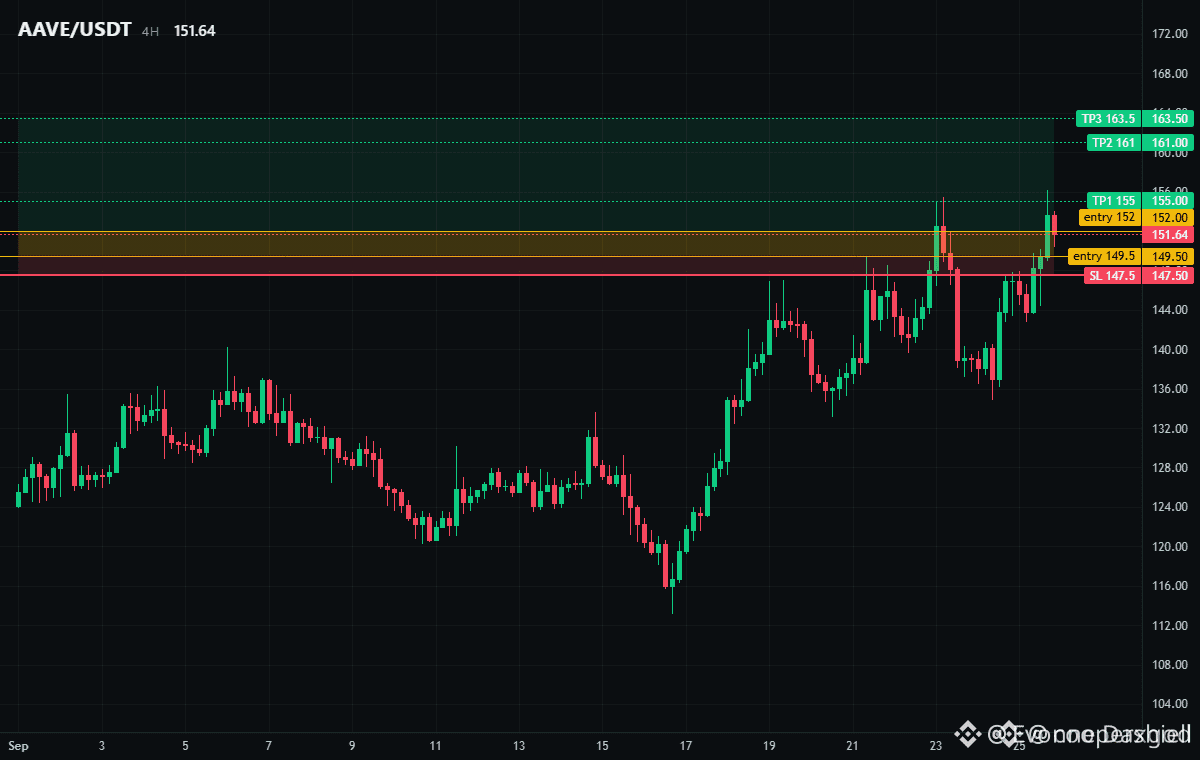
One of the top profit traders over the last 30 days opened a long on $AAVE perps that's already showing +4,174.46 USDT unrealized PNL at +9.49%. That's the kind of conviction most of us only talk about after the fact.
It looks a lot like early 2021 when $AAVE and $COMP both exploded once $ETH found a floor. Difference this time is the protocols have actual usage instead of empty narratives, and the yields aren't getting wrecked by gas.
Smart money is already positioned.
What's your take on whether this DeFi bounce has real legs?
#AAVE #DeFi #CryptoTrading
If you're still sitting out DeFi rotations waiting for perfect confirmation, stop now.
This hesitation is how traders miss the entries that actually print. We've all watched $AAVE rip while sitting on the sidelines hoping for a dip that never shows up.
One of the top profit traders over the last 30 days opened a long on $AAVE perps that's already showing +4,174.46 USDT unrealized PNL at +9.49%. That's the kind of conviction most of us only talk about after the fact.
It looks a lot like early 2021 when $AAVE and $COMP both exploded once $ETH found a floor. Difference this time is the protocols have actual usage instead of empty narratives, and the yields aren't getting wrecked by gas.
Smart money is already positioned.
What's your take on whether this DeFi bounce has real legs?
#AAVE #DeFi #CryptoTrading
This hesitation is how traders miss the entries that actually print. We've all watched $AAVE rip while sitting on the sidelines hoping for a dip that never shows up.
One of the top profit traders over the last 30 days opened a long on $AAVE perps that's already showing +4,174.46 USDT unrealized PNL at +9.49%. That's the kind of conviction most of us only talk about after the fact.
It looks a lot like early 2021 when $AAVE and $COMP both exploded once $ETH found a floor. Difference this time is the protocols have actual usage instead of empty narratives, and the yields aren't getting wrecked by gas.
Smart money is already positioned.
What's your take on whether this DeFi bounce has real legs?
#AAVE #DeFi #CryptoTrading
62

·
--
Why STON.fi Has Become One of the Most Interesting DEXs for Everyday TON (GRAM) Users
?Decentralized finance can sometimes feel more complicated than it needs to be.
For someone who is just entering the TON (GRAM) ecosystem, there are already several things to understand: wallets, tokens, network fees, liquidity, slippage, swaps and security. Add multiple applications to that list and a simple token swap can suddenly feel like a technical task.
This is one of the reasons STON.fi caught my attention.
STON.fi is built around decentralized trading and liquidity, with the goal of making DeFi easier to use. Instead of requiring users to understand everything about blockchain technology before making a swap, the platform puts the basic trading experience into a relatively straightforward interface.
For a beginner, that matters.
A typical swap starts with connecting a compatible wallet, selecting the token you want to exchange, choosing the token you want to receive and checking the transaction details before confirming. The important part is not simply pressing the swap button. Users should also look at the expected amount, price impact, fees and the token they are interacting with.
That last point is especially important in DeFi because not every token that looks familiar is necessarily the genuine asset you intend to purchase.
Another interesting part of STON.fi's development is its crosschain direction. The platform now presents cross-chain swaps as part of its product experience, including support involving TON, TRON and EVM ecosystems.
This is significant because blockchain users rarely keep everything on one network.
Someone may hold assets on Ethereum, another token on TON (GRAM) and perhaps something else on TRON. Traditionally, moving assets between ecosystems can involve several separate applications and additional steps. A unified cross-chain experience can reduce some of that friction.
But convenience should never replace caution.
Before confirming a transaction, users should always verify the route, fees and final amount. They should also keep enough native tokens available for transaction costs and protect their wallet recovery phrase.
For me, this is where STON.fi becomes interesting not simply as a place to swap tokens, but as part of the wider attempt to make DeFi easier for ordinary users.
The technology behind decentralized exchanges can be complicated. The user experience does not have to be.
As STON.fi continues developing its products and community, the most valuable thing users can do is learn how the platform works and share accurate information with others.
That is also what makes useful Stonbassador content different from ordinary promotional posts. Instead of simply saying “STON.fi is great,” explain why a feature matters, show people how it works and mention the risks they should understand.
That kind of content is useful even to someone who has never heard of STON.fi before.
Official platform: https://ston.fi/
$GRAM
#STONfi
#defi
Why STON.fi Has Become One of the Most Interesting DEXs for Everyday TON (GRAM) Users ?
Decentralized finance can sometimes feel more complicated than it needs to be.
For someone who is just entering the TON (GRAM) ecosystem, there are already several things to understand: wallets, tokens, network fees, liquidity, slippage, swaps and security. Add multiple applications to that list and a simple token swap can suddenly feel like a technical task.
This is one of the reasons STON.fi caught my attention.
STON.fi is built around decentralized trading and liquidity, with the goal of making DeFi easier to use. Instead of requiring users to understand everything about blockchain technology before making a swap, the platform puts the basic trading experience into a relatively straightforward interface.
For a beginner, that matters.
A typical swap starts with connecting a compatible wallet, selecting the token you want to exchange, choosing the token you want to receive and checking the transaction details before confirming. The important part is not simply pressing the swap button. Users should also look at the expected amount, price impact, fees and the token they are interacting with.
That last point is especially important in DeFi because not every token that looks familiar is necessarily the genuine asset you intend to purchase.
Another interesting part of STON.fi's development is its crosschain direction. The platform now presents cross-chain swaps as part of its product experience, including support involving TON, TRON and EVM ecosystems.
This is significant because blockchain users rarely keep everything on one network.
Someone may hold assets on Ethereum, another token on TON (GRAM) and perhaps something else on TRON. Traditionally, moving assets between ecosystems can involve several separate applications and additional steps. A unified cross-chain experience can reduce some of that friction.
But convenience should never replace caution.
Before confirming a transaction, users should always verify the route, fees and final amount. They should also keep enough native tokens available for transaction costs and protect their wallet recovery phrase.
For me, this is where STON.fi becomes interesting not simply as a place to swap tokens, but as part of the wider attempt to make DeFi easier for ordinary users.
The technology behind decentralized exchanges can be complicated. The user experience does not have to be.
As STON.fi continues developing its products and community, the most valuable thing users can do is learn how the platform works and share accurate information with others.
That is also what makes useful Stonbassador content different from ordinary promotional posts. Instead of simply saying “STON.fi is great,” explain why a feature matters, show people how it works and mention the risks they should understand.
That kind of content is useful even to someone who has never heard of STON.fi before.
Official platform: https://ston.fi/
$GRAM
#STONfi
#defi
For someone who is just entering the TON (GRAM) ecosystem, there are already several things to understand: wallets, tokens, network fees, liquidity, slippage, swaps and security. Add multiple applications to that list and a simple token swap can suddenly feel like a technical task.
This is one of the reasons STON.fi caught my attention.
STON.fi is built around decentralized trading and liquidity, with the goal of making DeFi easier to use. Instead of requiring users to understand everything about blockchain technology before making a swap, the platform puts the basic trading experience into a relatively straightforward interface.
For a beginner, that matters.
A typical swap starts with connecting a compatible wallet, selecting the token you want to exchange, choosing the token you want to receive and checking the transaction details before confirming. The important part is not simply pressing the swap button. Users should also look at the expected amount, price impact, fees and the token they are interacting with.
That last point is especially important in DeFi because not every token that looks familiar is necessarily the genuine asset you intend to purchase.
Another interesting part of STON.fi's development is its crosschain direction. The platform now presents cross-chain swaps as part of its product experience, including support involving TON, TRON and EVM ecosystems.
This is significant because blockchain users rarely keep everything on one network.
Someone may hold assets on Ethereum, another token on TON (GRAM) and perhaps something else on TRON. Traditionally, moving assets between ecosystems can involve several separate applications and additional steps. A unified cross-chain experience can reduce some of that friction.
But convenience should never replace caution.
Before confirming a transaction, users should always verify the route, fees and final amount. They should also keep enough native tokens available for transaction costs and protect their wallet recovery phrase.
For me, this is where STON.fi becomes interesting not simply as a place to swap tokens, but as part of the wider attempt to make DeFi easier for ordinary users.
The technology behind decentralized exchanges can be complicated. The user experience does not have to be.
As STON.fi continues developing its products and community, the most valuable thing users can do is learn how the platform works and share accurate information with others.
That is also what makes useful Stonbassador content different from ordinary promotional posts. Instead of simply saying “STON.fi is great,” explain why a feature matters, show people how it works and mention the risks they should understand.
That kind of content is useful even to someone who has never heard of STON.fi before.
Official platform: https://ston.fi/
$GRAM
#STONfi
#defi
387

·
--
🚨 $DEFI TVL REBOUNDS TO $95B AS INSTITUTIONAL LIQUIDITY ROTATES BACK INTO MONAD ⚡
After three consecutive quarters of structural compression, global DeFi lockups reversed trend, reaching $95 billion in capital commitment. 🔍 Smart money is aggressively expanding across high-throughput execution layers, with $MONAD recording a massive 183% TVL expansion this past quarter.
Simultaneously, traditional institutional platforms crossed $1 billion in locked value within just sixty days of launch. 📊 This institutional liquidity absorption signals a clear structural shift across yield protocols as macro capital shifts back into strategic accumulation.
💬 Is this quarterly inflection the start of a multi-month DeFi expansion cycle or a temporary rebalancing pool? 👇
⚠️ Not financial advice. Always manage your risk. 🛡️
🏷️ #DEFI #MONAD #SmartMoney #DeFiGrowth #MarketStructure
🔥 💎
🚨 $DEFI TVL REBOUNDS TO $95B AS INSTITUTIONAL LIQUIDITY ROTATES BACK INTO MONAD ⚡
After three consecutive quarters of structural compression, global DeFi lockups reversed trend, reaching $95 billion in capital commitment. 🔍 Smart money is aggressively expanding across high-throughput execution layers, with $MONAD recording a massive 183% TVL expansion this past quarter.
Simultaneously, traditional institutional platforms crossed $1 billion in locked value within just sixty days of launch. 📊 This institutional liquidity absorption signals a clear structural shift across yield protocols as macro capital shifts back into strategic accumulation.
💬 Is this quarterly inflection the start of a multi-month DeFi expansion cycle or a temporary rebalancing pool? 👇
⚠️ Not financial advice. Always manage your risk. 🛡️
🏷️ #DEFI #MONAD #SmartMoney #DeFiGrowth #MarketStructure
🔥 💎
After three consecutive quarters of structural compression, global DeFi lockups reversed trend, reaching $95 billion in capital commitment. 🔍 Smart money is aggressively expanding across high-throughput execution layers, with $MONAD recording a massive 183% TVL expansion this past quarter.
Simultaneously, traditional institutional platforms crossed $1 billion in locked value within just sixty days of launch. 📊 This institutional liquidity absorption signals a clear structural shift across yield protocols as macro capital shifts back into strategic accumulation.
💬 Is this quarterly inflection the start of a multi-month DeFi expansion cycle or a temporary rebalancing pool? 👇
⚠️ Not financial advice. Always manage your risk. 🛡️
🏷️ #DEFI #MONAD #SmartMoney #DeFiGrowth #MarketStructure
🔥 💎
1

·
--
🚨 MORGAN STANLEY BUILDS DIGITAL ASSET LAB DRIVING DEFI AND TOKENIZATION FOR $ETH 💥
Wall Street titan Morgan Stanley has officially launched a dedicated digital asset lab, targeting stablecoins, tokenization, and decentralized finance. 🏦 This institutional sandbox allows their engineering team to stress-test smart contracts and RWA protocols in an isolated environment without threatening core banking infrastructure.
📊 Smart money positioning isn't just about immediate spot accumulation; it is about building the architectural pipes for long-term liquidity flow. 💡 As traditional finance bridges directly into on-chain rails, institutional order flow will increasingly interact with established DeFi pools. 🤔 Do you think institutional tokenization will trigger the next major structural expansion for $ETH ? 👇
⚠️ Not financial advice. Always manage your risk. 🛡️
🏷️ #ETH #DeFi #Tokenization #Crypto
🎯 🦈
🚨 MORGAN STANLEY BUILDS DIGITAL ASSET LAB DRIVING DEFI AND TOKENIZATION FOR $ETH 💥
Wall Street titan Morgan Stanley has officially launched a dedicated digital asset lab, targeting stablecoins, tokenization, and decentralized finance. 🏦 This institutional sandbox allows their engineering team to stress-test smart contracts and RWA protocols in an isolated environment without threatening core banking infrastructure.
📊 Smart money positioning isn't just about immediate spot accumulation; it is about building the architectural pipes for long-term liquidity flow. 💡 As traditional finance bridges directly into on-chain rails, institutional order flow will increasingly interact with established DeFi pools. 🤔 Do you think institutional tokenization will trigger the next major structural expansion for $ETH ? 👇
⚠️ Not financial advice. Always manage your risk. 🛡️
🏷️ #ETH #DeFi #Tokenization #Crypto
🎯 🦈
Wall Street titan Morgan Stanley has officially launched a dedicated digital asset lab, targeting stablecoins, tokenization, and decentralized finance. 🏦 This institutional sandbox allows their engineering team to stress-test smart contracts and RWA protocols in an isolated environment without threatening core banking infrastructure.
📊 Smart money positioning isn't just about immediate spot accumulation; it is about building the architectural pipes for long-term liquidity flow. 💡 As traditional finance bridges directly into on-chain rails, institutional order flow will increasingly interact with established DeFi pools. 🤔 Do you think institutional tokenization will trigger the next major structural expansion for $ETH ? 👇
⚠️ Not financial advice. Always manage your risk. 🛡️
🏷️ #ETH #DeFi #Tokenization #Crypto
🎯 🦈
1
7

·
--
Most DEXs ask you to trade. @thena asks what you want DeFi to do for you 👇
🔹 Spot + Perps in one app - hundreds of pairs on the spot side, and perps on 300+ crypto pairs with up to 50x leverage, all permissionless and non-custodial.
🔹 Liquidity with a brain - a ve(3,3) model where voters direct incentives to the pools that matter, and partners compete weekly for liquidity instead of renting it.
🔹 Trading as a social sport - ARENA turns trading competitions into a gamified layer projects use for growth, not just a leaderboard.
🔹 Built for onboarding - wallet abstraction and self-custodial staking for major assets like BNB, BTC and ETH, all on BNB Chain and opBNB.
$THE is the engine connecting all of it - and the ecosystem is still shipping toward its "DeFAI SuperApp" vision.
Poll time 👇 If you had to start with ONE: spot stacking, perps trading, or voting/liquidity strategy? Drop your pick and your reason in the comments - best reasoning gets followed. #defi
Most DEXs ask you to trade. @THENA asks what you want DeFi to do for you 👇
🔹 Spot + Perps in one app - hundreds of pairs on the spot side, and perps on 300+ crypto pairs with up to 50x leverage, all permissionless and non-custodial.
🔹 Liquidity with a brain - a ve(3,3) model where voters direct incentives to the pools that matter, and partners compete weekly for liquidity instead of renting it.
🔹 Trading as a social sport - ARENA turns trading competitions into a gamified layer projects use for growth, not just a leaderboard.
🔹 Built for onboarding - wallet abstraction and self-custodial staking for major assets like BNB, BTC and ETH, all on BNB Chain and opBNB.
$THE is the engine connecting all of it - and the ecosystem is still shipping toward its "DeFAI SuperApp" vision.
Poll time 👇 If you had to start with ONE: spot stacking, perps trading, or voting/liquidity strategy? Drop your pick and your reason in the comments - best reasoning gets followed. #defi
🔹 Spot + Perps in one app - hundreds of pairs on the spot side, and perps on 300+ crypto pairs with up to 50x leverage, all permissionless and non-custodial.
🔹 Liquidity with a brain - a ve(3,3) model where voters direct incentives to the pools that matter, and partners compete weekly for liquidity instead of renting it.
🔹 Trading as a social sport - ARENA turns trading competitions into a gamified layer projects use for growth, not just a leaderboard.
🔹 Built for onboarding - wallet abstraction and self-custodial staking for major assets like BNB, BTC and ETH, all on BNB Chain and opBNB.
$THE is the engine connecting all of it - and the ecosystem is still shipping toward its "DeFAI SuperApp" vision.
Poll time 👇 If you had to start with ONE: spot stacking, perps trading, or voting/liquidity strategy? Drop your pick and your reason in the comments - best reasoning gets followed. #defi
124

·
--
Crypto never had a yield curve. TradFi has priced time for centuries — 3-month vs 10-year, term premium, inversions as recession warnings. DeFi only had floating rates repricing every block.
That's changing. Fixed-rate protocols now tokenize future yield into tradeable instruments, and a real term structure is emerging on-chain.
Why it matters: a yield curve is a market's opinion about the future. When short-end stablecoin rates spike far above longer-dated fixed rates, leverage demand is desperate — traders paying anything for immediate capital. That's the on-chain analog of an inverted curve, and historically it precedes deleveraging cascades.
When the curve normalizes — fixed above floating — the market expects rates to fall: leverage cooling, collateral abundant.
Institutions think in term structure. A pension fund cannot underwrite a floating APY that changes hourly. Fixed rates, forward curves and standardized tenors are the plumbing that lets traditional capital size on-chain positions. A functioning curve may matter more than another TVL print.
The signal to watch: the spread between 3-month fixed yields and floating money-market rates. It compresses when the market is confident. It blows out when the market is terrified.
Time, it turns out, is the last primitive crypto hadn't priced.
$ETH $SOL $BNB
#DeFi #CryptoMarkets #OnChain #YieldCurve #Stablecoins
Crypto never had a yield curve. TradFi has priced time for centuries — 3-month vs 10-year, term premium, inversions as recession warnings. DeFi only had floating rates repricing every block.
That's changing. Fixed-rate protocols now tokenize future yield into tradeable instruments, and a real term structure is emerging on-chain.
Why it matters: a yield curve is a market's opinion about the future. When short-end stablecoin rates spike far above longer-dated fixed rates, leverage demand is desperate — traders paying anything for immediate capital. That's the on-chain analog of an inverted curve, and historically it precedes deleveraging cascades.
When the curve normalizes — fixed above floating — the market expects rates to fall: leverage cooling, collateral abundant.
Institutions think in term structure. A pension fund cannot underwrite a floating APY that changes hourly. Fixed rates, forward curves and standardized tenors are the plumbing that lets traditional capital size on-chain positions. A functioning curve may matter more than another TVL print.
The signal to watch: the spread between 3-month fixed yields and floating money-market rates. It compresses when the market is confident. It blows out when the market is terrified.
Time, it turns out, is the last primitive crypto hadn't priced.
$ETH $SOL $BNB
#DeFi #CryptoMarkets #OnChain #YieldCurve #Stablecoins
That's changing. Fixed-rate protocols now tokenize future yield into tradeable instruments, and a real term structure is emerging on-chain.
Why it matters: a yield curve is a market's opinion about the future. When short-end stablecoin rates spike far above longer-dated fixed rates, leverage demand is desperate — traders paying anything for immediate capital. That's the on-chain analog of an inverted curve, and historically it precedes deleveraging cascades.
When the curve normalizes — fixed above floating — the market expects rates to fall: leverage cooling, collateral abundant.
Institutions think in term structure. A pension fund cannot underwrite a floating APY that changes hourly. Fixed rates, forward curves and standardized tenors are the plumbing that lets traditional capital size on-chain positions. A functioning curve may matter more than another TVL print.
The signal to watch: the spread between 3-month fixed yields and floating money-market rates. It compresses when the market is confident. It blows out when the market is terrified.
Time, it turns out, is the last primitive crypto hadn't priced.
$ETH $SOL $BNB
#DeFi #CryptoMarkets #OnChain #YieldCurve #Stablecoins
61

·
--
🚨 AAVE is on the move! 📈
$AAVE has surged 16%, approaching the $166 level after expanding its lending collateral to include Coinbase tokenized stocks.
This could strengthen $AAVE DeFi ecosystem and attract more on-chain activity.
🔥 Is $200 the next target?
#AAVE #defi #BinanceSquare #CryptoNews
🚨 AAVE is on the move! 📈
$AAVE has surged 16%, approaching the $166 level after expanding its lending collateral to include Coinbase tokenized stocks.
This could strengthen $AAVE DeFi ecosystem and attract more on-chain activity.
🔥 Is $200 the next target?
#AAVE #defi #BinanceSquare #CryptoNews
$AAVE has surged 16%, approaching the $166 level after expanding its lending collateral to include Coinbase tokenized stocks.
This could strengthen $AAVE DeFi ecosystem and attract more on-chain activity.
🔥 Is $200 the next target?
#AAVE #defi #BinanceSquare #CryptoNews

Binance BiBi:
I see! Key claims in this post are: AAVE is said to have surged about 16% and is approaching the $166 level. The move is attributed to Aave expanding its lending collateral to include Coinbase tokenized stocks. The author suggests this could strengthen AAVE’s DeFi ecosystem and attract more on-chain activity. It also speculates that $200 could be the next target (a price prediction, not confirmed news). Always DYOR.
3
2
232

The state of Real-World Assets (RWAs) on @Injective ($INJ ) has reached a major inflection point, transitioning from early infrastructure builds into an institutional-grade, high-volume ecosystem. Backed by powerful technical upgrades and regulatory milestones, Injective has established itself as one of the premier Layer-1 networks for bridging traditional finance (TradFi) with decentralized finance (DeFi).
Here is the state of play in a nutshell:
* $1B+ Milestone: On-chain RWA volume has crossed $1 billion, led by massive tokenized debt and mortgage data integrations like Pineapple Financial.
* The Meridian Upgrade (IIP-701): Recently went live, bringing native compliance, transfer restrictions, and regulatory frameworks straight into the Injective EVM layer.
* Institutional Privacy & MultiVM: Introduced private Request-for-Quote (RFQ) testing for institutional trading alongside seamless liquidity flow across native and EVM environments.
* Definitive Burn Flywheel: Every institutional trade and RWA issuance feeds protocol revenue, driving the automated $INJ buyback-and-burn engine.
TradFi meets DeFi, at lightning speed. 🐂⚡️
#Injective🔥 #RWA #defi $INJ
The state of Real-World Assets (RWAs) on @Injective ($INJ ) has reached a major inflection point, transitioning from early infrastructure builds into an institutional-grade, high-volume ecosystem. Backed by powerful technical upgrades and regulatory milestones, Injective has established itself as one of the premier Layer-1 networks for bridging traditional finance (TradFi) with decentralized finance (DeFi).
Here is the state of play in a nutshell:
* $1B+ Milestone: On-chain RWA volume has crossed $1 billion, led by massive tokenized debt and mortgage data integrations like Pineapple Financial.
* The Meridian Upgrade (IIP-701): Recently went live, bringing native compliance, transfer restrictions, and regulatory frameworks straight into the Injective EVM layer.
* Institutional Privacy & MultiVM: Introduced private Request-for-Quote (RFQ) testing for institutional trading alongside seamless liquidity flow across native and EVM environments.
* Definitive Burn Flywheel: Every institutional trade and RWA issuance feeds protocol revenue, driving the automated $INJ buyback-and-burn engine.
TradFi meets DeFi, at lightning speed. 🐂⚡️
#Injective🔥 #RWA #defi $INJ
Here is the state of play in a nutshell:
* $1B+ Milestone: On-chain RWA volume has crossed $1 billion, led by massive tokenized debt and mortgage data integrations like Pineapple Financial.
* The Meridian Upgrade (IIP-701): Recently went live, bringing native compliance, transfer restrictions, and regulatory frameworks straight into the Injective EVM layer.
* Institutional Privacy & MultiVM: Introduced private Request-for-Quote (RFQ) testing for institutional trading alongside seamless liquidity flow across native and EVM environments.
* Definitive Burn Flywheel: Every institutional trade and RWA issuance feeds protocol revenue, driving the automated $INJ buyback-and-burn engine.
TradFi meets DeFi, at lightning speed. 🐂⚡️
#Injective🔥 #RWA #defi $INJ
148

·
--
What if moving between blockchains felt like changing lanes instead of changing roads?Today, TON, Ethereum, BNB Chain, Base, Arbitrum, TRON and others have separate liquidity and applications.
Moving between them can mean dealing with bridges, wallets, gas, routes and execution.
For users, that’s friction.
STON.fi’s Omniston is being built as cross-chain execution infrastructure that coordinates quotes, liquidity and settlement across supported networks.
The bigger idea:
Users shouldn’t need to understand the infrastructure.
Choose what you have.
Choose what you want.
Choose where it should arrive.
Let the infrastructure handle the complexity.
The best cross-chain experience may simply feel like changing #ton #DeFi #CrossChain
What if moving between blockchains felt like changing lanes instead of changing roads?
Today, TON, Ethereum, BNB Chain, Base, Arbitrum, TRON and others have separate liquidity and applications.
Moving between them can mean dealing with bridges, wallets, gas, routes and execution.
For users, that’s friction.
STON.fi’s Omniston is being built as cross-chain execution infrastructure that coordinates quotes, liquidity and settlement across supported networks.
The bigger idea:
Users shouldn’t need to understand the infrastructure.
Choose what you have.
Choose what you want.
Choose where it should arrive.
Let the infrastructure handle the complexity.
The best cross-chain experience may simply feel like changing #ton #DeFi #CrossChain
Moving between them can mean dealing with bridges, wallets, gas, routes and execution.
For users, that’s friction.
STON.fi’s Omniston is being built as cross-chain execution infrastructure that coordinates quotes, liquidity and settlement across supported networks.
The bigger idea:
Users shouldn’t need to understand the infrastructure.
Choose what you have.
Choose what you want.
Choose where it should arrive.
Let the infrastructure handle the complexity.
The best cross-chain experience may simply feel like changing #ton #DeFi #CrossChain
112

·
--
Most Cross-Chain Campaigns Start With a Swap. STON.fi Starts With Context.
Cross-chain activity can feel complicated when users have to figure out the mechanics before they even understand what they’re participating in.
That’s what makes STON.fi’s “One Swap. Across Chains” campaign interesting.
Instead of pushing users straight into a swap, the campaign begins with a 2 week waitlist phase.
During this period, users have the opportunity to become a Priority Passenger before the main campaign gets underway.
What happens during the waitlist?
Connect a TON wallet and join the waitlist.
The first 1,000 eligible participants can receive:
• 1,000 bonus miles
• A personalized Priority Passenger Ticket
And the interesting part is that these aren’t simply points sitting on a dashboard.
They are miles that can be used toward limited Flight Deals released throughout the campaign.
So the campaign experience becomes:
Waitlist → Earn Miles → Unlock Flight Deals → Explore Cross-Chain Swaps
That structure gives the early stage a purpose beyond simply collecting signups.
It also gives users an opportunity to become familiar with how STON.fi approaches cross-chain activity before jumping into the actual swap experience.
Why the waitlist matters
The campaign is designed around participation from the beginning.
Rather than:
Swap first → understand later
the experience is closer to:
Join early → explore the system → earn miles → participate with context
There is also a time sensitive element.
Only 1,000 Priority Passenger spots are available, and the 1,000 mile joining bonus is tied to the waitlist stage.
Once that stage closes, that specific early participant opportunity is no longer available.
For anyone already exploring cross-chain swaps, TON, or the STON.fi ecosystem, the waitlist is worth checking out while it remains open.
🔗 cross-chain.ston.fi
@ston_fi @ton_blockchain
#STONfi #TON #defi #CrossChain
Most Cross-Chain Campaigns Start With a Swap. STON.fi Starts With Context.
Cross-chain activity can feel complicated when users have to figure out the mechanics before they even understand what they’re participating in.
That’s what makes STON.fi’s “One Swap. Across Chains” campaign interesting.
Instead of pushing users straight into a swap, the campaign begins with a 2 week waitlist phase.
During this period, users have the opportunity to become a Priority Passenger before the main campaign gets underway.
What happens during the waitlist?
Connect a TON wallet and join the waitlist.
The first 1,000 eligible participants can receive:
• 1,000 bonus miles
• A personalized Priority Passenger Ticket
And the interesting part is that these aren’t simply points sitting on a dashboard.
They are miles that can be used toward limited Flight Deals released throughout the campaign.
So the campaign experience becomes:
Waitlist → Earn Miles → Unlock Flight Deals → Explore Cross-Chain Swaps
That structure gives the early stage a purpose beyond simply collecting signups.
It also gives users an opportunity to become familiar with how STON.fi approaches cross-chain activity before jumping into the actual swap experience.
Why the waitlist matters
The campaign is designed around participation from the beginning.
Rather than:
Swap first → understand later
the experience is closer to:
Join early → explore the system → earn miles → participate with context
There is also a time sensitive element.
Only 1,000 Priority Passenger spots are available, and the 1,000 mile joining bonus is tied to the waitlist stage.
Once that stage closes, that specific early participant opportunity is no longer available.
For anyone already exploring cross-chain swaps, TON, or the STON.fi ecosystem, the waitlist is worth checking out while it remains open.
🔗 cross-chain.ston.fi
@ston_fi @ton_blockchain
#STONfi #TON #defi #CrossChain
Cross-chain activity can feel complicated when users have to figure out the mechanics before they even understand what they’re participating in.
That’s what makes STON.fi’s “One Swap. Across Chains” campaign interesting.
Instead of pushing users straight into a swap, the campaign begins with a 2 week waitlist phase.
During this period, users have the opportunity to become a Priority Passenger before the main campaign gets underway.
What happens during the waitlist?
Connect a TON wallet and join the waitlist.
The first 1,000 eligible participants can receive:
• 1,000 bonus miles
• A personalized Priority Passenger Ticket
And the interesting part is that these aren’t simply points sitting on a dashboard.
They are miles that can be used toward limited Flight Deals released throughout the campaign.
So the campaign experience becomes:
Waitlist → Earn Miles → Unlock Flight Deals → Explore Cross-Chain Swaps
That structure gives the early stage a purpose beyond simply collecting signups.
It also gives users an opportunity to become familiar with how STON.fi approaches cross-chain activity before jumping into the actual swap experience.
Why the waitlist matters
The campaign is designed around participation from the beginning.
Rather than:
Swap first → understand later
the experience is closer to:
Join early → explore the system → earn miles → participate with context
There is also a time sensitive element.
Only 1,000 Priority Passenger spots are available, and the 1,000 mile joining bonus is tied to the waitlist stage.
Once that stage closes, that specific early participant opportunity is no longer available.
For anyone already exploring cross-chain swaps, TON, or the STON.fi ecosystem, the waitlist is worth checking out while it remains open.
🔗 cross-chain.ston.fi
@ston_fi @ton_blockchain
#STONfi #TON #defi #CrossChain

61

·
--
Bullish
Does the number shown on a cross-chain quote actually match what gets delivered? A completed test on STON.fi confirms it, at least in this case.
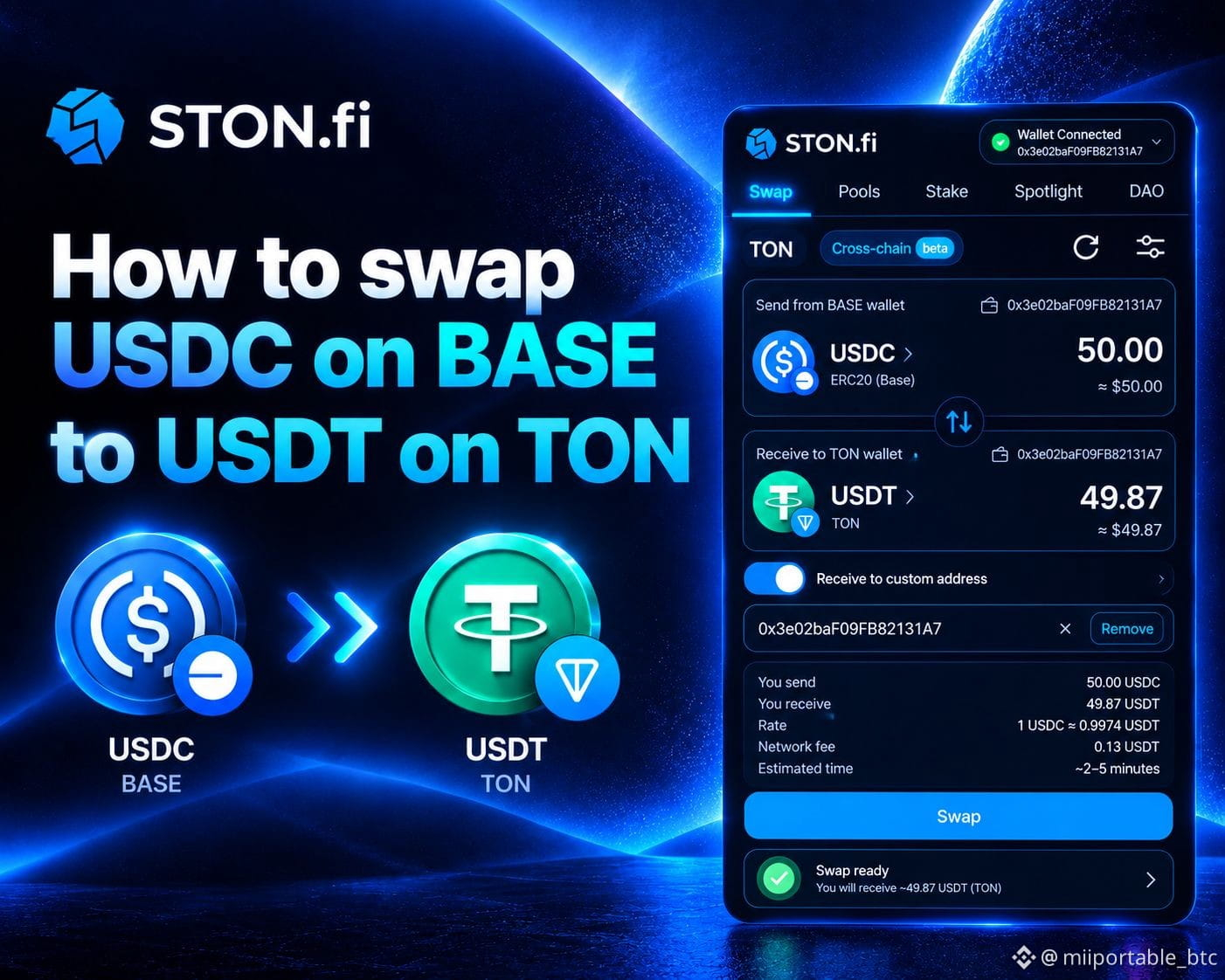
Swapping 50 USDC from Base into TON USDT, the quote showed 49.87 USDT expected. After confirming, the transaction completed and the interface reported the received amount directly: 49.87 USDT, an exact match with no unexplained gap between estimate and outcome. Rate came out to 1 USDC for approximately 0.9974 USDT, with a network fee of 0.13 USDT and settlement completing within the quoted 2 to 5 minute window.
That consistency matters more than it might seem. Base and TON share no native compatibility, a standard transfer between them simply has nowhere valid to land. The swap only works because both sides are coordinated together, locking funds under a shared condition that either completes fully or returns everything to its starting point. Seeing the delivered amount match the quoted amount exactly is a direct, checkable confirmation that this coordination worked as intended rather than something to just take on faith.
$TON continues to be worth watching for cross-chain infrastructure where the quoted result and the actual outcome line up this precisely, since that consistency is what makes trusting a cross-chain swap with real funds reasonable in the first place.
Ston.fi: https://ston.fi/
Cross-chain: https://app.ston.fi/swap
@stonfi @ton_blockchain $GRAM
{future}(GRAMUSDT)
$GRAM
#TONUSDT #DeFi #Omniston
Does the number shown on a cross-chain quote actually match what gets delivered? A completed test on STON.fi confirms it, at least in this case.
Swapping 50 USDC from Base into TON USDT, the quote showed 49.87 USDT expected. After confirming, the transaction completed and the interface reported the received amount directly: 49.87 USDT, an exact match with no unexplained gap between estimate and outcome. Rate came out to 1 USDC for approximately 0.9974 USDT, with a network fee of 0.13 USDT and settlement completing within the quoted 2 to 5 minute window.
That consistency matters more than it might seem. Base and TON share no native compatibility, a standard transfer between them simply has nowhere valid to land. The swap only works because both sides are coordinated together, locking funds under a shared condition that either completes fully or returns everything to its starting point. Seeing the delivered amount match the quoted amount exactly is a direct, checkable confirmation that this coordination worked as intended rather than something to just take on faith.
$TON continues to be worth watching for cross-chain infrastructure where the quoted result and the actual outcome line up this precisely, since that consistency is what makes trusting a cross-chain swap with real funds reasonable in the first place.
Ston.fi: https://ston.fi/
Cross-chain: https://app.ston.fi/swap
@STONfi DEX @Ton Network $GRAM
$GRAM
#TONUSDT #DeFi #Omniston
Swapping 50 USDC from Base into TON USDT, the quote showed 49.87 USDT expected. After confirming, the transaction completed and the interface reported the received amount directly: 49.87 USDT, an exact match with no unexplained gap between estimate and outcome. Rate came out to 1 USDC for approximately 0.9974 USDT, with a network fee of 0.13 USDT and settlement completing within the quoted 2 to 5 minute window.
That consistency matters more than it might seem. Base and TON share no native compatibility, a standard transfer between them simply has nowhere valid to land. The swap only works because both sides are coordinated together, locking funds under a shared condition that either completes fully or returns everything to its starting point. Seeing the delivered amount match the quoted amount exactly is a direct, checkable confirmation that this coordination worked as intended rather than something to just take on faith.
$TON continues to be worth watching for cross-chain infrastructure where the quoted result and the actual outcome line up this precisely, since that consistency is what makes trusting a cross-chain swap with real funds reasonable in the first place.
Ston.fi: https://ston.fi/
Cross-chain: https://app.ston.fi/swap
@STONfi DEX @Ton Network $GRAM
$GRAM
#TONUSDT #DeFi #Omniston
1
392

·
--
🔮 $PYTH — The Backbone Nobody Talks About
While everyone chases price action, Pyth is quietly powering the data behind it — real-time price feeds across 50+ blockchains, used by DeFi apps, prediction markets, and even TradFi-style commodity trading.
Recent wins: integrations with Polymarket and Kalshi bringing stocks, commodities, and prediction markets on-chain — powered by Pyth's feeds.
No oracle, no accurate prices. No accurate prices, no DeFi. Simple as that.
Underrated infrastructure play or fairly priced? 🤔
{future}(PYTHUSDT)
{future}(HBARUSDT)
{future}(INXUSDT)
#PYTH #PythNetwork #Oracle #defi #BinanceSquare
🔮 $PYTH — The Backbone Nobody Talks About
While everyone chases price action, Pyth is quietly powering the data behind it — real-time price feeds across 50+ blockchains, used by DeFi apps, prediction markets, and even TradFi-style commodity trading.
Recent wins: integrations with Polymarket and Kalshi bringing stocks, commodities, and prediction markets on-chain — powered by Pyth's feeds.
No oracle, no accurate prices. No accurate prices, no DeFi. Simple as that.
Underrated infrastructure play or fairly priced? 🤔
#PYTH #PythNetwork #Oracle #defi #BinanceSquare
While everyone chases price action, Pyth is quietly powering the data behind it — real-time price feeds across 50+ blockchains, used by DeFi apps, prediction markets, and even TradFi-style commodity trading.
Recent wins: integrations with Polymarket and Kalshi bringing stocks, commodities, and prediction markets on-chain — powered by Pyth's feeds.
No oracle, no accurate prices. No accurate prices, no DeFi. Simple as that.
Underrated infrastructure play or fairly priced? 🤔
#PYTH #PythNetwork #Oracle #defi #BinanceSquare

3
4
313
$AAVE is absolutely ripping today, up 11.8%! 👀 DeFi narrative is heating up, don't sleep on this move.
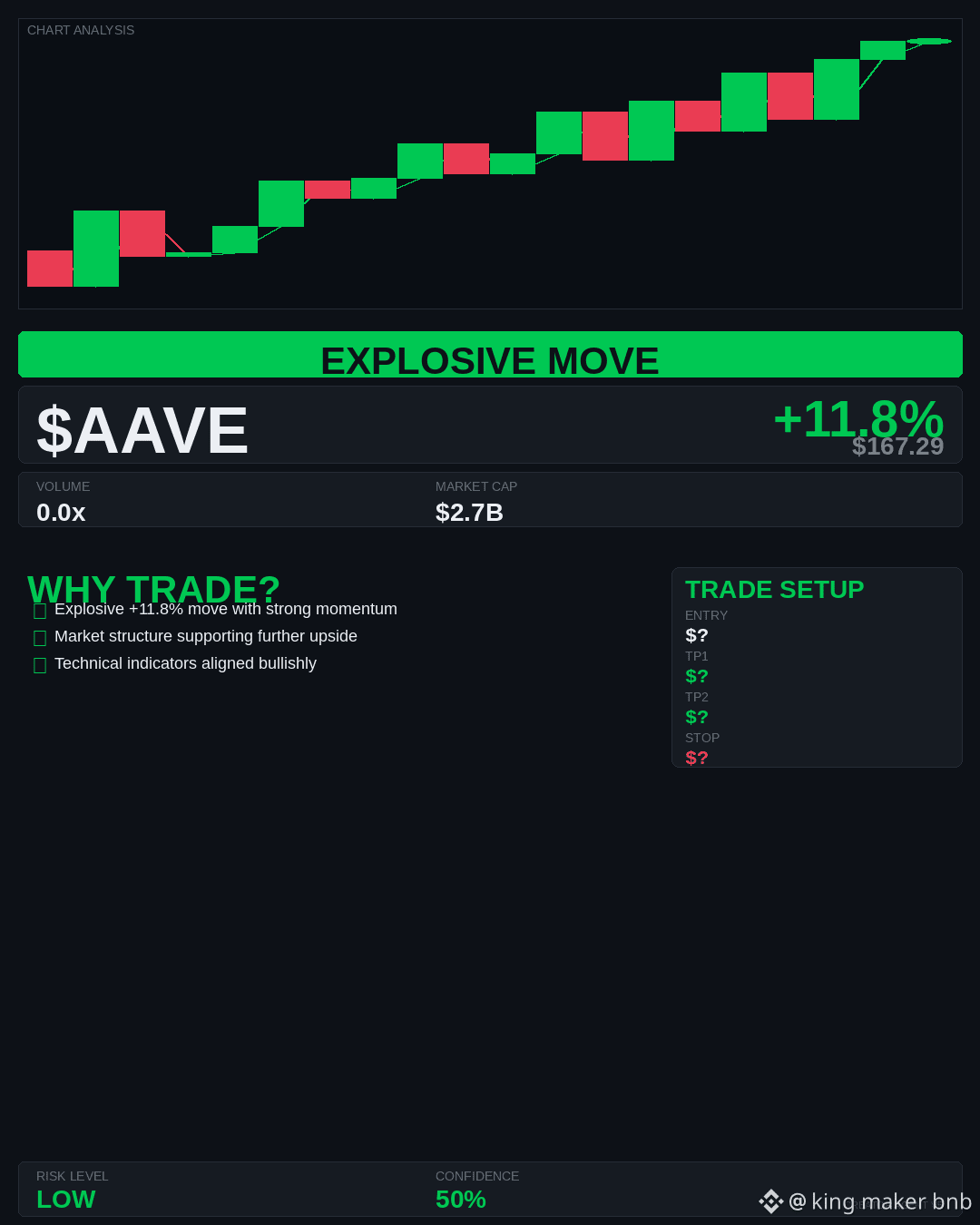
Looking for entries on $AAVE around the $165-$168 zone. Target 1 at $175, Target 2 at $185. Stop loss tight at $159 to manage risk. The strong 11.8% momentum signals conviction, fueled by renewed DeFi interest on Square. However, volume is a bit thin, so stay nimble and be ready to adapt. Watch for a sustained break above $170 for further continuation.
#AAVE #Write2Earn #DeFi #CryptoTrading
$AAVE is absolutely ripping today, up 11.8%! 👀 DeFi narrative is heating up, don't sleep on this move.
Looking for entries on $AAVE around the $165-$168 zone. Target 1 at $175, Target 2 at $185. Stop loss tight at $159 to manage risk. The strong 11.8% momentum signals conviction, fueled by renewed DeFi interest on Square. However, volume is a bit thin, so stay nimble and be ready to adapt. Watch for a sustained break above $170 for further continuation.
#AAVE #Write2Earn #DeFi #CryptoTrading
Looking for entries on $AAVE around the $165-$168 zone. Target 1 at $175, Target 2 at $185. Stop loss tight at $159 to manage risk. The strong 11.8% momentum signals conviction, fueled by renewed DeFi interest on Square. However, volume is a bit thin, so stay nimble and be ready to adapt. Watch for a sustained break above $170 for further continuation.
#AAVE #Write2Earn #DeFi #CryptoTrading
112
·
--
🦈 $AAVE ACCUMULATION INTENSIFIES AS INSTITUTIONAL BUYBACKS ABSORB OPEN MARKET LIQUIDITY 📊
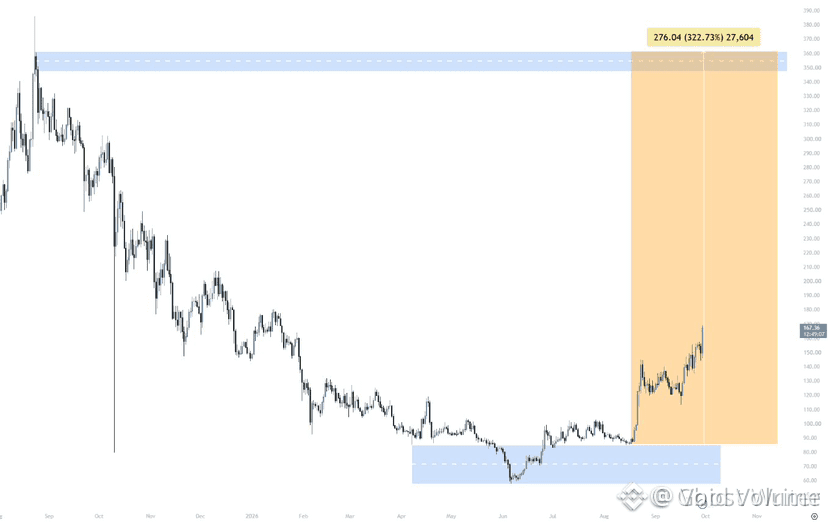
Entry: 167 ⚡
Aave continues to solidify its stance as the foundational liquidity engine in DeFi, backed by $2.5B market capitalization and $250M+ daily trading volume. 📊 Smart money positioning remains anchored to strong fundamentals, specifically a programmatic token buyback engine deploying up to $50M annually to absorb sell-side float. 🏦
With real yield mechanisms, protocol security staking, and expanding RWA integration, $AAVE demonstrates clean structural strength. 🔍 Institutional collateral demand provides a persistent bid, keeping order flow healthy as DeFi prepares for potential capital rotation. 💡
💬 Are you front-running the upcoming DeFi liquidity rotation or waiting for a deeper structural sweep? 👇
⚠️ Not financial advice. Always manage your risk. 🛡️
🏷️ #AAVE #DeFi #Crypto #MarketStructure
🎯 🦈
🦈 $AAVE ACCUMULATION INTENSIFIES AS INSTITUTIONAL BUYBACKS ABSORB OPEN MARKET LIQUIDITY 📊
Entry: 167 ⚡
Aave continues to solidify its stance as the foundational liquidity engine in DeFi, backed by $2.5B market capitalization and $250M+ daily trading volume. 📊 Smart money positioning remains anchored to strong fundamentals, specifically a programmatic token buyback engine deploying up to $50M annually to absorb sell-side float. 🏦
With real yield mechanisms, protocol security staking, and expanding RWA integration, $AAVE demonstrates clean structural strength. 🔍 Institutional collateral demand provides a persistent bid, keeping order flow healthy as DeFi prepares for potential capital rotation. 💡
💬 Are you front-running the upcoming DeFi liquidity rotation or waiting for a deeper structural sweep? 👇
⚠️ Not financial advice. Always manage your risk. 🛡️
🏷️ #AAVE #DeFi #Crypto #MarketStructure
🎯 🦈
Entry: 167 ⚡
Aave continues to solidify its stance as the foundational liquidity engine in DeFi, backed by $2.5B market capitalization and $250M+ daily trading volume. 📊 Smart money positioning remains anchored to strong fundamentals, specifically a programmatic token buyback engine deploying up to $50M annually to absorb sell-side float. 🏦
With real yield mechanisms, protocol security staking, and expanding RWA integration, $AAVE demonstrates clean structural strength. 🔍 Institutional collateral demand provides a persistent bid, keeping order flow healthy as DeFi prepares for potential capital rotation. 💡
💬 Are you front-running the upcoming DeFi liquidity rotation or waiting for a deeper structural sweep? 👇
⚠️ Not financial advice. Always manage your risk. 🛡️
🏷️ #AAVE #DeFi #Crypto #MarketStructure
🎯 🦈
18

$AAVE
{future}(AAVEUSDT)
— Buyers Just Took Control ⚡
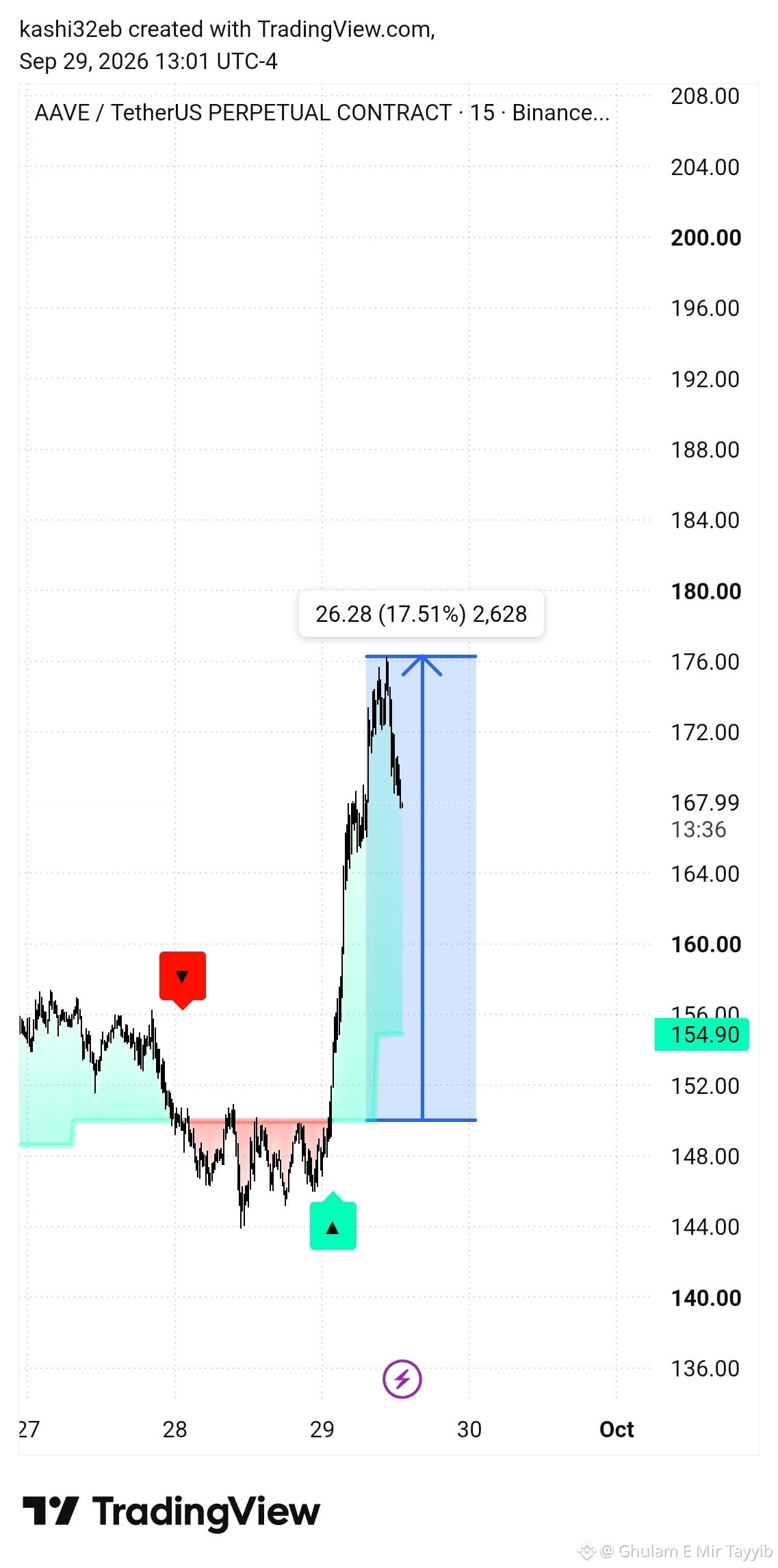
$AAVE has surged 17.5%, climbing from around $150 to $176 before cooling near $155. The move highlights strong buying momentum. $AAVE is a major DeFi lending protocol, enabling users to lend, borrow and earn yield without traditional intermediaries.
Now the key question: can $155 hold? 👀
#AAVE #DeFi
$AAVE
— Buyers Just Took Control ⚡
$AAVE has surged 17.5%, climbing from around $150 to $176 before cooling near $155. The move highlights strong buying momentum. $AAVE is a major DeFi lending protocol, enabling users to lend, borrow and earn yield without traditional intermediaries.
Now the key question: can $155 hold? 👀
#AAVE #DeFi
— Buyers Just Took Control ⚡
$AAVE has surged 17.5%, climbing from around $150 to $176 before cooling near $155. The move highlights strong buying momentum. $AAVE is a major DeFi lending protocol, enabling users to lend, borrow and earn yield without traditional intermediaries.
Now the key question: can $155 hold? 👀
#AAVE #DeFi
15

·
--
⚡ $AAVE BREAKS $170 AS INSTITUTIONAL SUPPLY SHOCK CATALYST EMERGES! 🚀
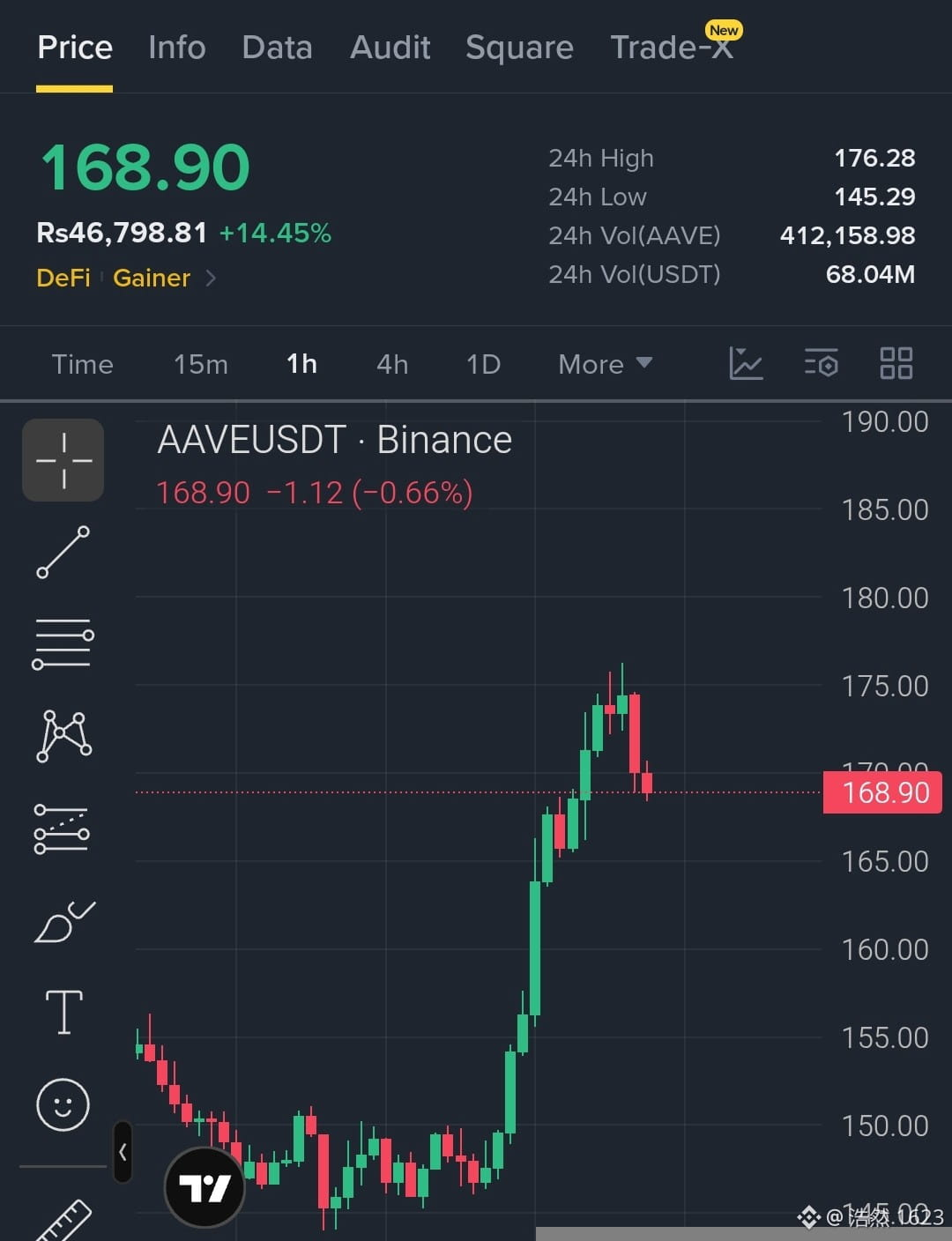
$AAVE has reclaimed key structural levels, pushing past $170 to print a 16.17% 24-hour expansion to $172.37. 📊 This aggressive shift in market structure follows the founder revealing potential token burn mechanics in Aavenomics 3.0.
Smart money is pricing in a structural supply contraction, clearing buy-side liquidity above key resistance. 🔍 When institutional governance shifts toward systemic burn mechanisms, order flow typically aligns with high-timeframe demand. 💬 Is this fundamental catalyst enough to sustain higher high market structure, or are you waiting for a fair value gap retest? 👇
⚠️ Not financial advice. Always manage your risk. 🛡️
🏷️ #AAVE #DeFi #MarketStructure #Crypto
⚡ 🦈
⚡ $AAVE BREAKS $170 AS INSTITUTIONAL SUPPLY SHOCK CATALYST EMERGES! 🚀
$AAVE has reclaimed key structural levels, pushing past $170 to print a 16.17% 24-hour expansion to $172.37. 📊 This aggressive shift in market structure follows the founder revealing potential token burn mechanics in Aavenomics 3.0.
Smart money is pricing in a structural supply contraction, clearing buy-side liquidity above key resistance. 🔍 When institutional governance shifts toward systemic burn mechanisms, order flow typically aligns with high-timeframe demand. 💬 Is this fundamental catalyst enough to sustain higher high market structure, or are you waiting for a fair value gap retest? 👇
⚠️ Not financial advice. Always manage your risk. 🛡️
🏷️ #AAVE #DeFi #MarketStructure #Crypto
⚡ 🦈
$AAVE has reclaimed key structural levels, pushing past $170 to print a 16.17% 24-hour expansion to $172.37. 📊 This aggressive shift in market structure follows the founder revealing potential token burn mechanics in Aavenomics 3.0.
Smart money is pricing in a structural supply contraction, clearing buy-side liquidity above key resistance. 🔍 When institutional governance shifts toward systemic burn mechanisms, order flow typically aligns with high-timeframe demand. 💬 Is this fundamental catalyst enough to sustain higher high market structure, or are you waiting for a fair value gap retest? 👇
⚠️ Not financial advice. Always manage your risk. 🛡️
🏷️ #AAVE #DeFi #MarketStructure #Crypto
⚡ 🦈
25
Log in to explore more content
Join global crypto users on Binance Square
⚡️ Get latest and useful information about crypto.
💬 Trusted by the world’s largest crypto exchange.
👍 Discover real insights from verified creators.
Email / Phone number
Trending Topics
1
#TrumpRejectsAIRulesForVoluntaryAudits
0 views
0 Discussing
2
#BitgetHotWalletBreachTiedToThirdPartySecurityFlaw
0 views
0 Discussing
3
#OpenAIUnveilsAlwaysOnAgentDots
772 views
52 Discussing
4
#ChainlinkLaunchesBankSWIFTLedgerFramework
1,872 views
62 Discussing
5
#EarningsSeason
427,806 views
3,224 Discussing
6
#SECChairWantsStockMarketsOnChain
5,025 views
163 Discussing
7
#MulticoinInvestsInGrass
2,970 views
117 Discussing
8
#CEARenamesToBNBStandardUnderBNC
4,173 views
126 Discussing
9
#BitwiseLaunchesFirstSpotNEARETF
57,067 views
751 Discussing
10
#USJobOpeningsFallToFiveMonthLow
60,615 views
584 Discussing