
Crypto knowledge P
176 Posts

Crypto knowledge P
Report
Block User
UID: 175245
30 Following
3.4K+ Followers
828 Liked
Posts
All
Quotes
PINNED
Article
See translation
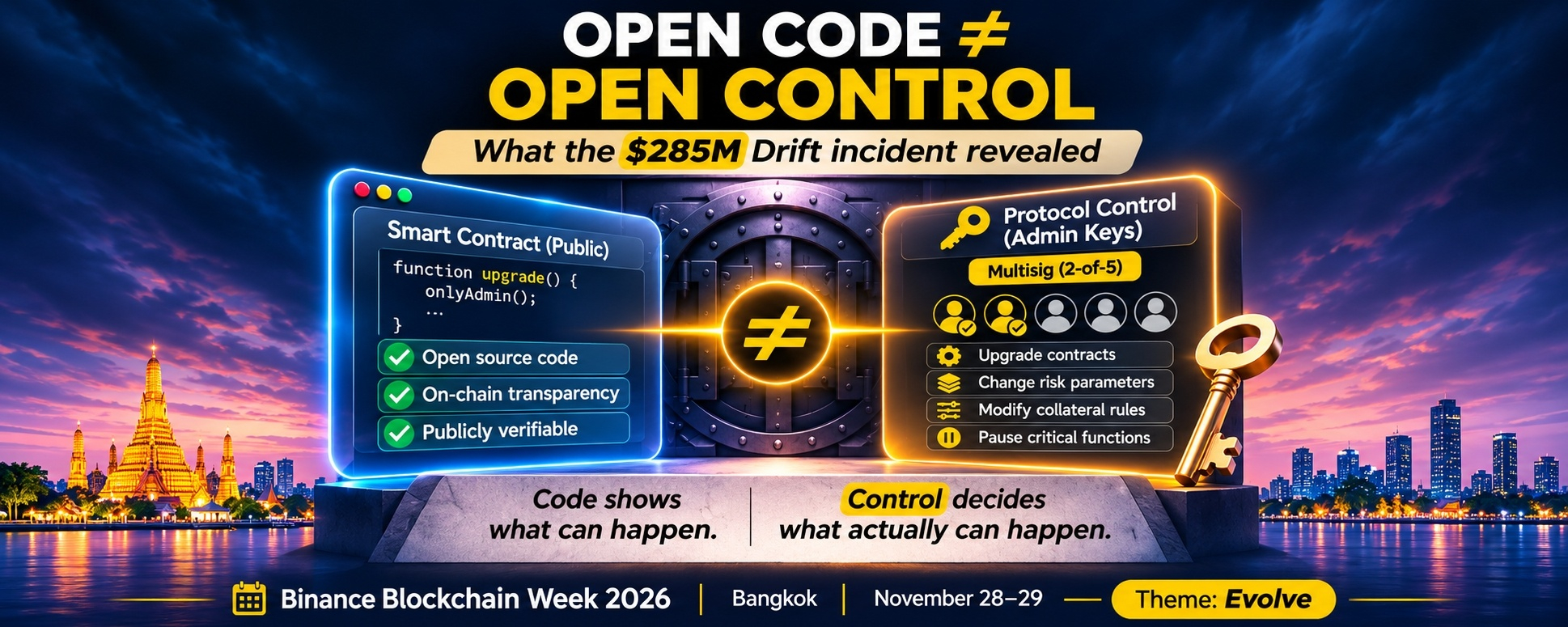
Open Code Doesn't Mean Open Control: What the $285M Drift Incident RevealedOpen Code Doesn't Mean Open Control: What the $285M Drift Incident Revealed
If a DeFi protocol is genuinely decentralised, who can change its rules when something goes wrong?
I've been thinking about this question more seriously after reading the investigations into the April 1 Drift Protocol incident on Solana.
Approximately $285 million was drained from the protocol. What makes this incident particularly worth examining is that the attack wasn't simply a case of someone finding a bug in a smart contract.
It involved social engineering, pre-signed administrative transactions, multisig permissions, a change in security safeguards and a fabricated collateral asset.
For me, that's where the bigger discussion about decentralisation begins.
What Actually Happened at Drift?
According to Chainalysis' reconstruction of Drift's investigation, the attackers spent months building relationships with contributors, posing as legitimate industry participants.
They eventually persuaded Security Council members to sign transactions in advance without fully understanding their underlying effects.
Solana's durable nonce mechanism allowed those transactions to remain valid for later execution.
On March 26, Drift migrated its Security Council to a new 2-of-5 multisig configuration with zero timelock, removing the delay that could have provided an opportunity for detection or intervention.
On April 1, the pre-signed transactions were executed, transferring administrative control to the attackers.
Once they had that control, they introduced a fabricated token called CarbonVote Token (CVT) as collateral. Its price had been artificially manipulated, allowing the attackers to use worthless collateral to withdraw real assets from the protocol.
Approximately $285 million was lost.
The details are disturbing, but the lesson is bigger than the amount involved.
The attack exploited a combination of human trust, administrative authority and financial-system design.
The Problem With Treating Decentralisation as a Label
I think crypto sometimes treats decentralisation as a binary concept.
A project is either decentralised or centralised.
But actual control can be more complicated.
A protocol may have publicly accessible code, community governance and on-chain transactions, while a relatively small group still holds the authority to change important settings.
That doesn't automatically make the protocol bad or dishonest.
However, those permissions are part of its architecture, and users should understand them.
Who can upgrade contracts? Who controls administrative keys? Who can modify collateral parameters? Are important changes subject to a delay? Can emergency safeguards be altered?
These are questions about the distribution of power.
And they matter just as much as the project's decentralisation claims.
What Regulators Are Looking At
This isn't merely a discussion among crypto commentators.
The FATF's July 21, 2026, report on regulatory challenges from decentralised finance emphasises a functional, risk-based approach to identifying control in DeFi arrangements.
The report discusses factors such as control over protocol functions, governance, technical permissions and the ability to influence how an arrangement operates.
IOSCO's December 2023 recommendations similarly emphasise identifying the individuals or entities exercising control or sufficient influence over DeFi products and services.
The important idea behind both approaches is to look at how a system actually works rather than relying exclusively on the decentralisation label. That distinction is worth remembering when researching any protocol.
Five Things I'd Examine Before Calling a Protocol Decentralised
1. Administrative permissions
Who can upgrade contracts, change risk parameters or activate critical functions? Read the permissions rather than relying on the project's description.
2. Multisig structure
How many signers are required? Who are they? How independent are they? What exactly are they approving?
A multisig can distribute authority, but its effectiveness also depends on the people, processes and safeguards surrounding it.
3. Timelocks
Are important changes delayed before execution? Can those delays be removed? Is there a clearly documented exception mechanism?
A timelock doesn't guarantee safety, but it can provide a window for scrutiny and response.
4. Oracle and collateral controls
Who determines which assets are accepted as collateral and how their prices are calculated? Can these parameters be changed without adequate safeguards?
The Drift incident makes this question particularly difficult to ignore.
5. Governance concentration
Who actually holds voting power? How much influence do large holders, delegates or specific entities have over major decisions?
A DAO structure doesn't automatically mean decision-making is broadly distributed.
I Don't Think the Answer Is Simply More Centralisation
This is where I disagree with the idea that every major incident should lead to more centralised control.
Decentralisation exists for important reasons. It can reduce dependence on a single authority, make systems more transparent and allow users to interact without relying on traditional intermediaries. But removing intermediaries doesn't automatically eliminate trust. Sometimes it changes where trust is placed.
Users may still depend on developers, multisig signers, oracle providers, governance participants, infrastructure operators or legal arrangements surrounding the protocol.
The challenge is to make those dependencies visible, minimise unnecessary concentration and build safeguards that don't quietly create unlimited authority.
That's a more meaningful discussion than simply asking whether a protocol calls itself decentralised.
What Evolve Should Mean for DeFi
As Binance Blockchain Week 2026 approaches in Bangkok on November 28–29, under the theme Evolve, I think conversations about the future of blockchain should include questions about governance, permissions, security architecture and accountability.
The industry has already demonstrated that it can build increasingly sophisticated financial infrastructure.
Now, I'd like to see more attention given to how that infrastructure distributes power, handles exceptional situations and communicates its risks to users.
Because the more financial activity a protocol attracts, the more important its underlying governance and security decisions become.
Open code is valuable. But understanding who has the power to change that code is equally important.
That's the distinction I'd encourage anyone researching DeFi to examine. And I'd genuinely like to hear different perspectives:
What matters more when evaluating a DeFi protocol: the openness of its code, or how widely the power to change that code is distributed?
Can both be achieved without compromising either?#EvolveAtBinanceBlockchainWeek #Binance #defi #blockchain #Web3
Educational content only. Not financial advice.
Open Code Doesn't Mean Open Control: What the $285M Drift Incident Revealed
Open Code Doesn't Mean Open Control: What the $285M Drift Incident Revealed
If a DeFi protocol is genuinely decentralised, who can change its rules when something goes wrong?
I've been thinking about this question more seriously after reading the investigations into the April 1 Drift Protocol incident on Solana.
Approximately $285 million was drained from the protocol. What makes this incident particularly worth examining is that the attack wasn't simply a case of someone finding a bug in a smart contract.
It involved social engineering, pre-signed administrative transactions, multisig permissions, a change in security safeguards and a fabricated collateral asset.
For me, that's where the bigger discussion about decentralisation begins.
What Actually Happened at Drift?
According to Chainalysis' reconstruction of Drift's investigation, the attackers spent months building relationships with contributors, posing as legitimate industry participants.
They eventually persuaded Security Council members to sign transactions in advance without fully understanding their underlying effects.
Solana's durable nonce mechanism allowed those transactions to remain valid for later execution.
On March 26, Drift migrated its Security Council to a new 2-of-5 multisig configuration with zero timelock, removing the delay that could have provided an opportunity for detection or intervention.
On April 1, the pre-signed transactions were executed, transferring administrative control to the attackers.
Once they had that control, they introduced a fabricated token called CarbonVote Token (CVT) as collateral. Its price had been artificially manipulated, allowing the attackers to use worthless collateral to withdraw real assets from the protocol.
Approximately $285 million was lost.
The details are disturbing, but the lesson is bigger than the amount involved.
The attack exploited a combination of human trust, administrative authority and financial-system design.
The Problem With Treating Decentralisation as a Label
I think crypto sometimes treats decentralisation as a binary concept.
A project is either decentralised or centralised.
But actual control can be more complicated.
A protocol may have publicly accessible code, community governance and on-chain transactions, while a relatively small group still holds the authority to change important settings.
That doesn't automatically make the protocol bad or dishonest.
However, those permissions are part of its architecture, and users should understand them.
Who can upgrade contracts? Who controls administrative keys? Who can modify collateral parameters? Are important changes subject to a delay? Can emergency safeguards be altered?
These are questions about the distribution of power.
And they matter just as much as the project's decentralisation claims.
What Regulators Are Looking At
This isn't merely a discussion among crypto commentators.
The FATF's July 21, 2026, report on regulatory challenges from decentralised finance emphasises a functional, risk-based approach to identifying control in DeFi arrangements.
The report discusses factors such as control over protocol functions, governance, technical permissions and the ability to influence how an arrangement operates.
IOSCO's December 2023 recommendations similarly emphasise identifying the individuals or entities exercising control or sufficient influence over DeFi products and services.
The important idea behind both approaches is to look at how a system actually works rather than relying exclusively on the decentralisation label. That distinction is worth remembering when researching any protocol.
Five Things I'd Examine Before Calling a Protocol Decentralised
1. Administrative permissions
Who can upgrade contracts, change risk parameters or activate critical functions? Read the permissions rather than relying on the project's description.
2. Multisig structure
How many signers are required? Who are they? How independent are they? What exactly are they approving?
A multisig can distribute authority, but its effectiveness also depends on the people, processes and safeguards surrounding it.
3. Timelocks
Are important changes delayed before execution? Can those delays be removed? Is there a clearly documented exception mechanism?
A timelock doesn't guarantee safety, but it can provide a window for scrutiny and response.
4. Oracle and collateral controls
Who determines which assets are accepted as collateral and how their prices are calculated? Can these parameters be changed without adequate safeguards?
The Drift incident makes this question particularly difficult to ignore.
5. Governance concentration
Who actually holds voting power? How much influence do large holders, delegates or specific entities have over major decisions?
A DAO structure doesn't automatically mean decision-making is broadly distributed.
I Don't Think the Answer Is Simply More Centralisation
This is where I disagree with the idea that every major incident should lead to more centralised control.
Decentralisation exists for important reasons. It can reduce dependence on a single authority, make systems more transparent and allow users to interact without relying on traditional intermediaries. But removing intermediaries doesn't automatically eliminate trust. Sometimes it changes where trust is placed.
Users may still depend on developers, multisig signers, oracle providers, governance participants, infrastructure operators or legal arrangements surrounding the protocol.
The challenge is to make those dependencies visible, minimise unnecessary concentration and build safeguards that don't quietly create unlimited authority.
That's a more meaningful discussion than simply asking whether a protocol calls itself decentralised.
What Evolve Should Mean for DeFi
As Binance Blockchain Week 2026 approaches in Bangkok on November 28–29, under the theme Evolve, I think conversations about the future of blockchain should include questions about governance, permissions, security architecture and accountability.
The industry has already demonstrated that it can build increasingly sophisticated financial infrastructure.
Now, I'd like to see more attention given to how that infrastructure distributes power, handles exceptional situations and communicates its risks to users.
Because the more financial activity a protocol attracts, the more important its underlying governance and security decisions become.
Open code is valuable. But understanding who has the power to change that code is equally important.
That's the distinction I'd encourage anyone researching DeFi to examine. And I'd genuinely like to hear different perspectives:
What matters more when evaluating a DeFi protocol: the openness of its code, or how widely the power to change that code is distributed?
Can both be achieved without compromising either?#EvolveAtBinanceBlockchainWeek #Binance #defi #blockchain #Web3
Educational content only. Not financial advice.
3
414
PINNED
Verified
See translation
#sxt $SXT
What if an AI agent needs more than just today's blockchain data to make a decision?
That's a question worth thinking about as AI and smart contracts become more closely connected.
A smart contract can access current onchain balances, logs and storage. But what happens when it needs a user's one-year staking history, historical activity or liquidity conditions across multiple chains?
This is where I find Space and Time particularly interesting.
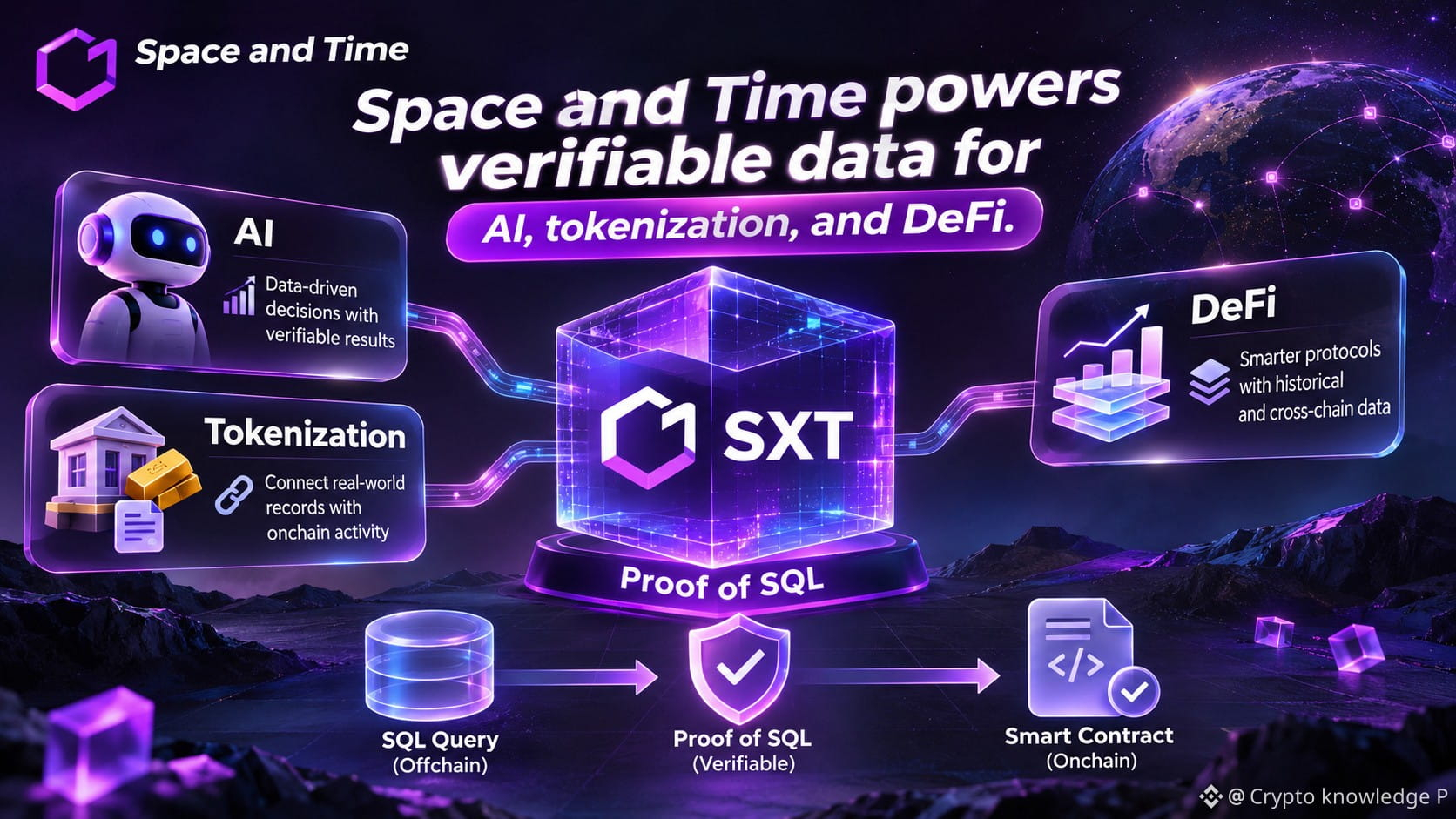
While going through its technical documentation, I came across its AI-agent use case. AI-initiated smart contracts can request historical, aggregate and cross-chain data through SQL queries on Space and Time.
The interesting part is what happens next.
Prover nodes execute the queries offchain against indexed, cryptographically committed tables and generate a Proof of SQL. The smart contract can then verify the proof onchain without needing to process or store the entire dataset.
That distinction matters.
It's not simply about getting an answer from a database. It's about having cryptographic evidence that the requested computation was performed correctly against committed data.
I can see why this matters for DeFi applications that need historical information, AI agents that make data-driven decisions, and tokenized assets that depend on reliable, verifiable records.
Of course, verifying a computation doesn't automatically make every original data source truthful. But being able to verify data integrity and query execution is a meaningful step forward.
Space and Time powers verifiable data for AI, tokenization, and DeFi.
The more I explore this technology, the more interesting its underlying idea becomes: applications shouldn't just receive data; they should have a way to verify it.
#SXT $SXT @SpaceandTimeDB
#sxt $SXT
What if an AI agent needs more than just today's blockchain data to make a decision?
That's a question worth thinking about as AI and smart contracts become more closely connected.
A smart contract can access current onchain balances, logs and storage. But what happens when it needs a user's one-year staking history, historical activity or liquidity conditions across multiple chains?
This is where I find Space and Time particularly interesting.
While going through its technical documentation, I came across its AI-agent use case. AI-initiated smart contracts can request historical, aggregate and cross-chain data through SQL queries on Space and Time.
The interesting part is what happens next.
Prover nodes execute the queries offchain against indexed, cryptographically committed tables and generate a Proof of SQL. The smart contract can then verify the proof onchain without needing to process or store the entire dataset.
That distinction matters.
It's not simply about getting an answer from a database. It's about having cryptographic evidence that the requested computation was performed correctly against committed data.
I can see why this matters for DeFi applications that need historical information, AI agents that make data-driven decisions, and tokenized assets that depend on reliable, verifiable records.
Of course, verifying a computation doesn't automatically make every original data source truthful. But being able to verify data integrity and query execution is a meaningful step forward.
Space and Time powers verifiable data for AI, tokenization, and DeFi.
The more I explore this technology, the more interesting its underlying idea becomes: applications shouldn't just receive data; they should have a way to verify it.
#SXT $SXT @SpaceandTime
1
4
266
See translation
My Vision for Blockchain: Innovation People Can Actually Trust
My DeFi question is simple: are we building financial systems people can genuinely trust?
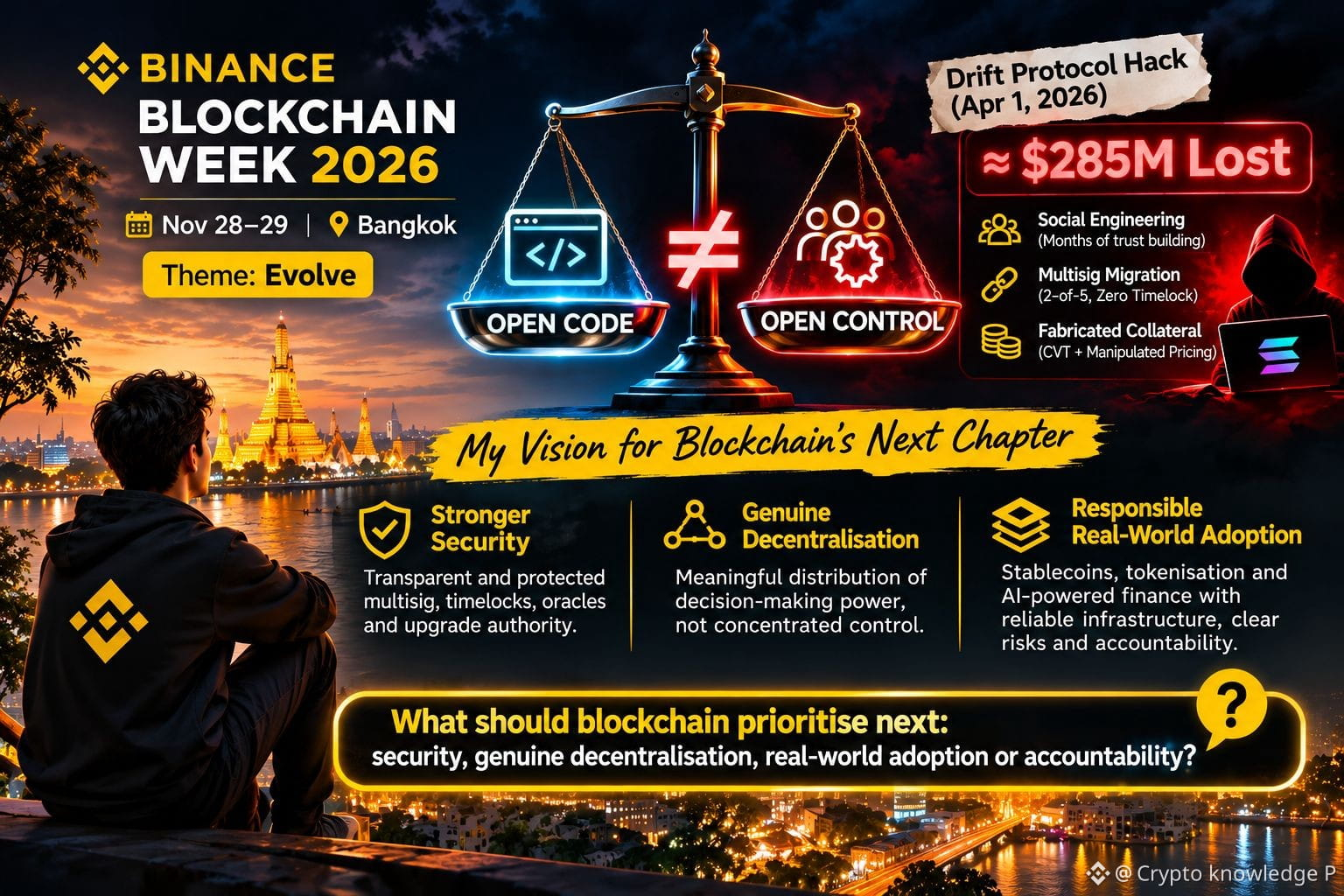
April's Drift hack is a reminder. Chainalysis estimated losses at approximately $285 million. Its reconstruction describes months of social engineering, pre-signed administrative transactions and a March 26 migration to a 2-of-5 multisig with zero timelock. On April 1, attackers executed those transactions, gained administrative control and introduced fabricated CVT collateral.
What stayed with me wasn't only the amount lost. It was how human trust, administrative permissions and financial-system design combined to create the failure. Open code doesn't automatically mean decentralised control.
My three priorities for blockchain's next chapter
1. Stronger security: Multisig permissions, timelocks, oracle controls and upgrade authority should be transparent and properly protected. Security should go beyond a smart-contract audit.
2. Genuine decentralisation: A DAO or public smart contracts aren't enough. Decision-making power should be meaningfully distributed, not concentrated behind the scenes.
3. Responsible real-world adoption: Stablecoins, tokenisation and AI-powered finance have real potential, but people also need reliable infrastructure, understandable risks and clear accountability.
What I'm looking forward to
At Binance Blockchain Week 2026 in Bangkok, November 28–29, under the theme Evolve, I want to hear how builders are addressing security, governance and the challenges of bringing blockchain into everyday financial activity.
My expectation is simple: less concentration of power, stronger security and more meaningful real-world utility. I want blockchain to become infrastructure people can use with confidence, not just technology that looks impressive on paper.
What should blockchain prioritise next: security, genuine decentralisation, real-world adoption or accountability?
#EvolveAtBinanceBlockchainWeek #Binance #AI #defi #Web3
Educational content only. Not financial advice.

1
179
See translation
AI's Next Bottleneck May Be the Border, Not the Chip.For years, the AI race has been about who can build the most powerful chips and secure enough computing capacity.
Now another question is becoming harder to ignore:
Who is actually allowed to access that computing power?
On November 26, Reuters reported, citing the Financial Times, that NVIDIA had instructed manufacturing partners to stop shipping servers containing its chips to Malaysia, Singapore, Thailand and Indonesia.
According to the report, partners including Dell and Supermicro told customers that their orders could not be shipped. It remains unclear how long the pause will last. NVIDIA, Dell and Supermicro had not immediately commented when Reuters published its report.
The regulation behind the headlines
On November 19, the US Department of Commerce's Bureau of Industry and Security introduced an interim final rule titled Addressing Remote Access to Advanced Semiconductors.
The rule introduced new licensing requirements affecting certain advanced semiconductor exports, re-exports and transfers involving Indonesia, Malaysia, Singapore, Thailand and Brazil, alongside restrictions concerning remote access to advanced computing capacity.
It became effective on November 19, 2026.
Why this matters for NVIDIA
Here's what I find interesting.
A chip can be manufactured in one country, installed in a server in another and used remotely by a customer somewhere else.
That makes tracking the destination and end-user of advanced computing hardware increasingly complicated.
For NVIDIA and its manufacturing partners, regulatory compliance is becoming an increasingly important part of delivering AI infrastructure.
And the impact could extend beyond chipmakers to cloud providers, server manufacturers and data-centre operators.
The bigger question
I think the AI industry is entering a phase where raw computing performance is only part of the equation.
Access, geography, customer verification and government policy are becoming just as important to watch.
The next AI infrastructure battle may not simply be about who has the fastest chips. It may be about who can legally access the computing power behind them.
What do you think will become the biggest constraint on AI growth?
Advanced chip supply, data-centre costs, or government restrictions on computing access?
I'd genuinely like to hear your perspective.
#NVIDIA #AI #Semiconductors #Technology #BinanceSquare
AI's Next Bottleneck May Be the Border, Not the Chip.
For years, the AI race has been about who can build the most powerful chips and secure enough computing capacity.
Now another question is becoming harder to ignore:
Who is actually allowed to access that computing power?
On November 26, Reuters reported, citing the Financial Times, that NVIDIA had instructed manufacturing partners to stop shipping servers containing its chips to Malaysia, Singapore, Thailand and Indonesia.
According to the report, partners including Dell and Supermicro told customers that their orders could not be shipped. It remains unclear how long the pause will last. NVIDIA, Dell and Supermicro had not immediately commented when Reuters published its report.
The regulation behind the headlines
On November 19, the US Department of Commerce's Bureau of Industry and Security introduced an interim final rule titled Addressing Remote Access to Advanced Semiconductors.
The rule introduced new licensing requirements affecting certain advanced semiconductor exports, re-exports and transfers involving Indonesia, Malaysia, Singapore, Thailand and Brazil, alongside restrictions concerning remote access to advanced computing capacity.
It became effective on November 19, 2026.
Why this matters for NVIDIA
Here's what I find interesting.
A chip can be manufactured in one country, installed in a server in another and used remotely by a customer somewhere else.
That makes tracking the destination and end-user of advanced computing hardware increasingly complicated.
For NVIDIA and its manufacturing partners, regulatory compliance is becoming an increasingly important part of delivering AI infrastructure.
And the impact could extend beyond chipmakers to cloud providers, server manufacturers and data-centre operators.
The bigger question
I think the AI industry is entering a phase where raw computing performance is only part of the equation.
Access, geography, customer verification and government policy are becoming just as important to watch.
The next AI infrastructure battle may not simply be about who has the fastest chips. It may be about who can legally access the computing power behind them.
What do you think will become the biggest constraint on AI growth?
Advanced chip supply, data-centre costs, or government restrictions on computing access?
I'd genuinely like to hear your perspective.
#NVIDIA #AI #Semiconductors #Technology #BinanceSquare
1
489
See translation
🚀 THE NEXT 100X OPPORTUNITY? 👀
If you had to bet on ONE crypto for the next bull run, which would you choose? 💎
🔥 Vote wisely. What's your pick?$BTC $ETH $SOL
#BinanceSquareTalks #CryptoPoll #Bullrun #bitcoin #sol板块
🚀 THE NEXT 100X OPPORTUNITY? 👀
If you had to bet on ONE crypto for the next bull run, which would you choose? 💎
🔥 Vote wisely. What's your pick?$BTC $ETH $SOL
#BinanceSquareTalks #CryptoPoll #Bullrun #bitcoin #sol板块
If you had to bet on ONE crypto for the next bull run, which would you choose? 💎
🔥 Vote wisely. What's your pick?$BTC $ETH $SOL
#BinanceSquareTalks #CryptoPoll #Bullrun #bitcoin #sol板块
🟠 BTC – The King
32%
🔵 ETH – The Giant
24%
🟣 SOL – The Challenger
40%
⚫ XRP – The Wildcard
4%
25 votes • Voting closed
2
334
Verified
See translation
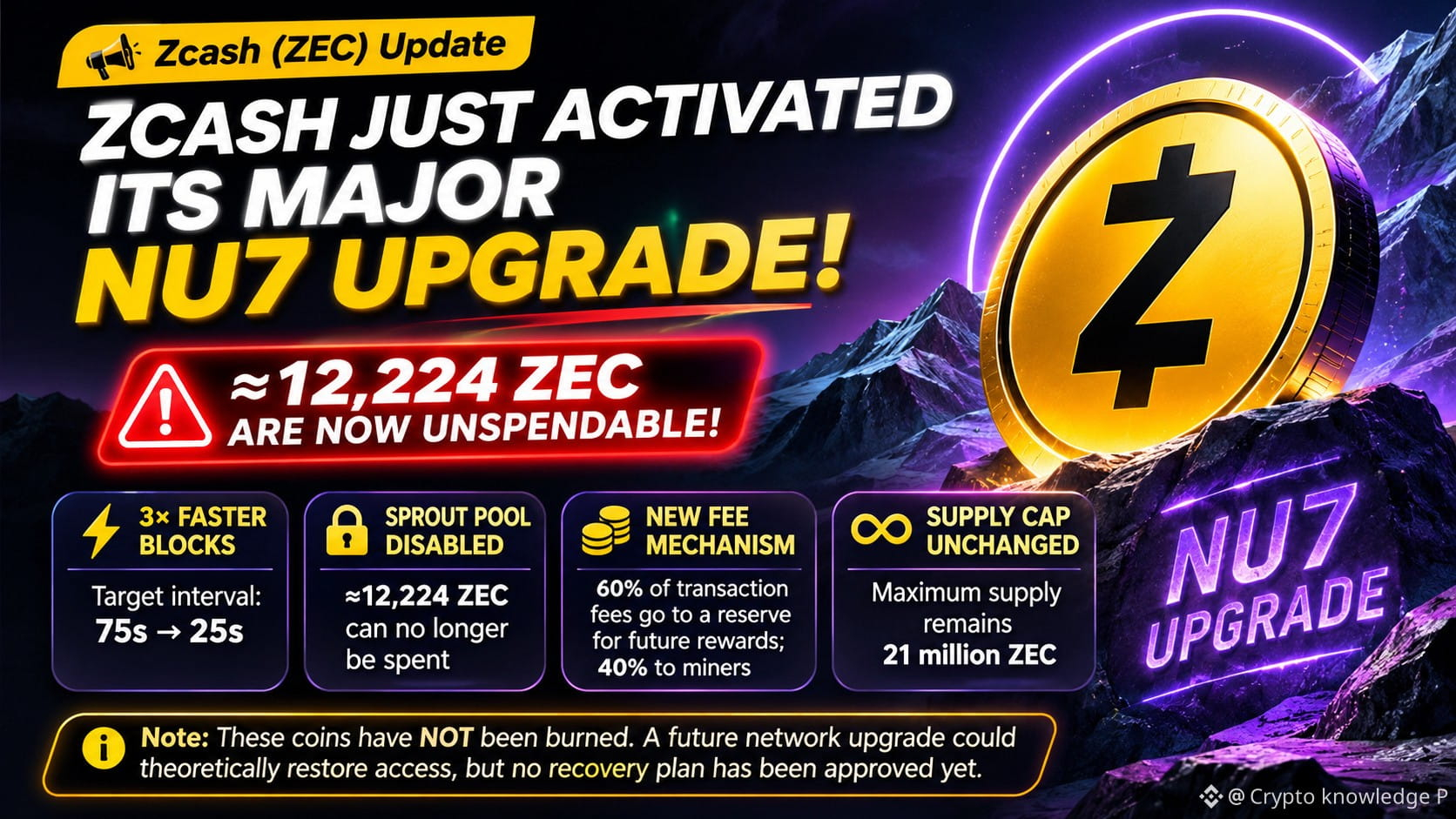
🚨 ZCASH JUST WENT THROUGH A MAJOR NETWORK UPGRADE!
And approximately 12,224 ZEC are now unspendable.
Here's what happened:
⚡ FASTER BLOCKS
Target block interval reduced from 75 seconds to 25 seconds.
🔒 12,224 ZEC AFFECTED
Funds remaining in the old Sprout privacy pool can no longer be spent under the new rules.
💰 NEW FEE MECHANISM
60% of transaction fees are removed from circulation for future network rewards. Miners receive the remaining 40%.
📊 21 MILLION SUPPLY CAP
The maximum ZEC supply remains unchanged.
⚠️ Important: These coins have NOT been burned. A future network upgrade could theoretically restore access, but no recovery plan has been approved.
ONE UPGRADE. BIG CHANGES.
Would you support a blockchain upgrade that improves the network but makes some old funds unspendable?
👇 What's your opinion?
$ZEC $ONE $BTC
#Zcash #zec #CryptoNewss #BinanceSquare #JobsReportRaisesHikeOdds
2
688
See translation
📉 SNDKUSDT Long Trade 🚀
Entry: 1,095 | 10x Cross
Currently in loss, but staying calm. Discipline over emotions! 💪
What’s next for SNDK? $SNDK
#BinanceSquareFamily #SNDKUSDT #cryptotrading #TradingSignals #StrategicTrading
📉 SNDKUSDT Long Trade 🚀
Entry: 1,095 | 10x Cross
Currently in loss, but staying calm. Discipline over emotions! 💪
What’s next for SNDK? $SNDK
#BinanceSquareFamily #SNDKUSDT #cryptotrading #TradingSignals #StrategicTrading
Entry: 1,095 | 10x Cross
Currently in loss, but staying calm. Discipline over emotions! 💪
What’s next for SNDK? $SNDK
#BinanceSquareFamily #SNDKUSDT #cryptotrading #TradingSignals #StrategicTrading
🟢 Bullish – Recovery coming
64%
🔴 Bearish – More downside
36%
137 votes • Voting closed
4
13.8k
See translation
@GoKiteAI
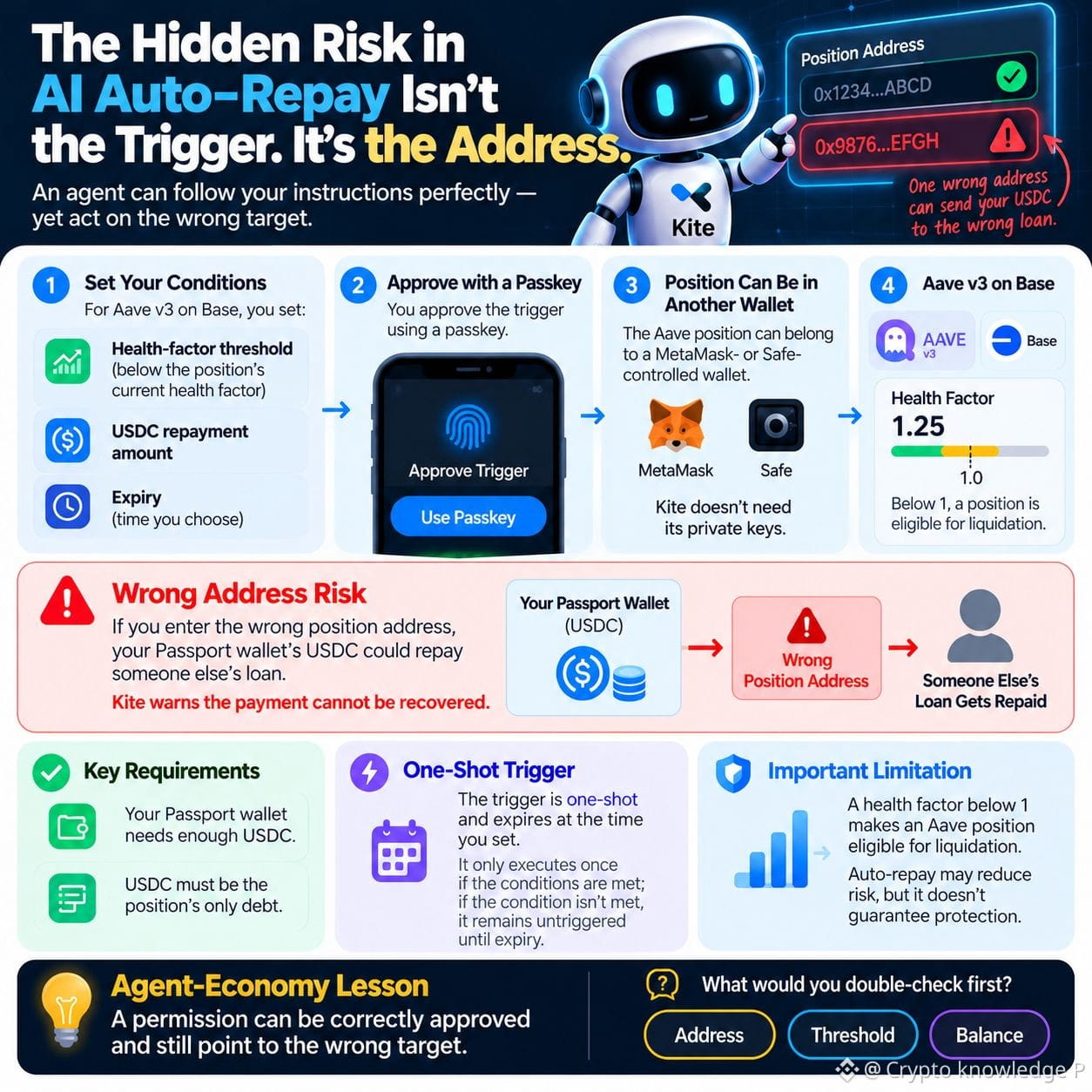
The Hidden Risk in AI Auto-Repay Isn’t the Trigger. It’s the Address.
Kite’s docs made me pause: one setup mistake can be costly.
On Aave v3 on Base, set a trigger threshold below the position’s current health factor, choose the USDC repayment amount and expiry, then approve with a passkey. The position can be in a MetaMask- or Safe-controlled wallet; Kite doesn’t need its private keys.
Enter the wrong position address, and your Passport wallet’s USDC could repay someone else’s loan. Kite warns the payment cannot be recovered.
Your wallet needs enough USDC, and USDC must be the position’s only debt. The trigger is one-shot and expires at the time you set. A health factor below 1 makes a position eligible for liquidation, so auto-repay may reduce risk, not eliminate it.
That’s what sticks with me about the agent economy: approving an action doesn’t mean it’s aimed at the right target.
What would you check twice: address, threshold or balance?
#KiteBBW $KITE
@KITE AI 中文
The Hidden Risk in AI Auto-Repay Isn’t the Trigger. It’s the Address.
Kite’s docs made me pause: one setup mistake can be costly.
On Aave v3 on Base, set a trigger threshold below the position’s current health factor, choose the USDC repayment amount and expiry, then approve with a passkey. The position can be in a MetaMask- or Safe-controlled wallet; Kite doesn’t need its private keys.
Enter the wrong position address, and your Passport wallet’s USDC could repay someone else’s loan. Kite warns the payment cannot be recovered.
Your wallet needs enough USDC, and USDC must be the position’s only debt. The trigger is one-shot and expires at the time you set. A health factor below 1 makes a position eligible for liquidation, so auto-repay may reduce risk, not eliminate it.
That’s what sticks with me about the agent economy: approving an action doesn’t mean it’s aimed at the right target.
What would you check twice: address, threshold or balance?
#KiteBBW $KITE
12
3
7
186
See translation
🚨 Crypto’s Next Big Move May Come From Washington — Not Just the Charts! 👀
Sometimes, the most important crypto developments happen outside the charts.
Today, October 20, is an important deadline for the US SEC’s proposed “Regulation Crypto Assets” framework. And this is something crypto investors and project founders should keep an eye on.
Here’s why it matters. 👇
📌 What is the SEC proposing?
The proposal includes two potential exemptions from certain securities registration requirements:
🔹 Up to $5 million in offerings over a four-year period.
🔹 Up to $75 million in offerings during each 12-month period.
The proposal also includes a conditional safe harbor related to the definition of an “investment contract.”
But there’s one important detail many people might overlook: these are proposed rules, not final regulations. Projects would still need to meet the applicable conditions, provide required disclosures, and comply with securities laws against fraud and market manipulation.
📊 So, is this bullish for crypto?
Potentially, clearer rules could help certain crypto projects raise funds and navigate regulatory requirements more confidently.
However, the actual impact will depend on the final framework, its conditions, and how it is implemented.
Personally, I believe long-term crypto adoption needs more than price rallies. It also needs sensible regulation, stronger investor protection, and room for genuine innovation.
Because at the end of the day, a stronger crypto industry isn't built on hype alone — it's built on trust, transparency, and sustainable growth.
👇 Now, I want to hear your opinion.
Would clearer crypto regulations bring more confidence and innovation to the market, or could they create additional challenges for emerging projects?
Share your thoughts in the comments. Let's have a real discussion — no hype, just honest opinions. 🤝
#CryptoNews #CryptoRegulation #bitcoin #blockchain #BinanceSquare
$BTC $ZEC $NVDAB
{spot}(NVDABUSDT)
🚨 Crypto’s Next Big Move May Come From Washington — Not Just the Charts! 👀
Sometimes, the most important crypto developments happen outside the charts.
Today, October 20, is an important deadline for the US SEC’s proposed “Regulation Crypto Assets” framework. And this is something crypto investors and project founders should keep an eye on.
Here’s why it matters. 👇
📌 What is the SEC proposing?
The proposal includes two potential exemptions from certain securities registration requirements:
🔹 Up to $5 million in offerings over a four-year period.
🔹 Up to $75 million in offerings during each 12-month period.
The proposal also includes a conditional safe harbor related to the definition of an “investment contract.”
But there’s one important detail many people might overlook: these are proposed rules, not final regulations. Projects would still need to meet the applicable conditions, provide required disclosures, and comply with securities laws against fraud and market manipulation.
📊 So, is this bullish for crypto?
Potentially, clearer rules could help certain crypto projects raise funds and navigate regulatory requirements more confidently.
However, the actual impact will depend on the final framework, its conditions, and how it is implemented.
Personally, I believe long-term crypto adoption needs more than price rallies. It also needs sensible regulation, stronger investor protection, and room for genuine innovation.
Because at the end of the day, a stronger crypto industry isn't built on hype alone — it's built on trust, transparency, and sustainable growth.
👇 Now, I want to hear your opinion.
Would clearer crypto regulations bring more confidence and innovation to the market, or could they create additional challenges for emerging projects?
Share your thoughts in the comments. Let's have a real discussion — no hype, just honest opinions. 🤝
#CryptoNews #CryptoRegulation #bitcoin #blockchain #BinanceSquare
$BTC $ZEC $NVDAB

2
417
See translation
🚀 Just claimed my unique Agent ID — pras189.ai 🤖💛
One ID. One identity. One step closer to the AI × Web3 future! ⚡
Building my presence in the Agentic AI ecosystem. Who else has claimed their unique Agent ID? 👀🔥
🔗 Check out my Agent ID:
[Click here](https://web3.binance.com/agent-id/pras189?src=user_share)
#Binance #Web3 #AI #AgenticWallet #crypto
🚀 Just claimed my unique Agent ID — pras189.ai 🤖💛
One ID. One identity. One step closer to the AI × Web3 future! ⚡
Building my presence in the Agentic AI ecosystem. Who else has claimed their unique Agent ID? 👀🔥
🔗 Check out my Agent ID:
Click here
#Binance #Web3 #AI #AgenticWallet #crypto
One ID. One identity. One step closer to the AI × Web3 future! ⚡
Building my presence in the Agentic AI ecosystem. Who else has claimed their unique Agent ID? 👀🔥
🔗 Check out my Agent ID:
Click here
#Binance #Web3 #AI #AgenticWallet #crypto
1
137
See translation
@Binance_Square_Official My vision for Binance Intelligence is simple: I want it to help me understand the market, not just watch it.
There is already more financial information than anyone can possibly follow — prices, news, market moves, macro events and endless opinions. The hard part is connecting the dots and knowing what actually matters. I’d love to see Binance Intelligence do that in a way that feels natural and useful, especially when the market is moving fast.
I don’t want it to make decisions for me. I want it to give me the right context at the right time, point out things I might have missed, and help me ask better questions before I make my own decision.
If Binance Intelligence can turn all that financial noise into something people can actually understand and act on with confidence, that would be a real step forward. That’s the kind of intelligence I’d want to have beside me every time I open the market.
@Binance Square Official My vision for Binance Intelligence is simple: I want it to help me understand the market, not just watch it.
There is already more financial information than anyone can possibly follow — prices, news, market moves, macro events and endless opinions. The hard part is connecting the dots and knowing what actually matters. I’d love to see Binance Intelligence do that in a way that feels natural and useful, especially when the market is moving fast.
I don’t want it to make decisions for me. I want it to give me the right context at the right time, point out things I might have missed, and help me ask better questions before I make my own decision.
If Binance Intelligence can turn all that financial noise into something people can actually understand and act on with confidence, that would be a real step forward. That’s the kind of intelligence I’d want to have beside me every time I open the market.


Binance Square Official
·
--
Introducing a new layer of intelligence for everything finance.
Join the Binance Intelligence launch livestream for an early look at what we've been building.
🗓 Oct 5 | 12:00 UTC
📍 Binance Square Official
Repost this post and tag @Binance Square Official to share your vision for Binance Intelligence for a chance to be one of 5 winners selected for a 20 USDC reward.
1
110
See translation
🌕✨ A Binance Moon Cake for the Mid-Autumn Festival! 🥮💛
I mixed the warmth of the Mid-Autumn moon with the Binance spirit — golden details, moonlight, and a little crypto magic. 🌙🟡
What do you think of my Binance Moon Cake? 🥮🐰
Happy Mid-Autumn Festival! ❤️
#BinanceMidAutumn #BinanceSquareTG
🌕✨ A Binance Moon Cake for the Mid-Autumn Festival! 🥮💛
I mixed the warmth of the Mid-Autumn moon with the Binance spirit — golden details, moonlight, and a little crypto magic. 🌙🟡
What do you think of my Binance Moon Cake? 🥮🐰
Happy Mid-Autumn Festival! ❤️
#BinanceMidAutumn #BinanceSquareTG
I mixed the warmth of the Mid-Autumn moon with the Binance spirit — golden details, moonlight, and a little crypto magic. 🌙🟡
What do you think of my Binance Moon Cake? 🥮🐰
Happy Mid-Autumn Festival! ❤️
#BinanceMidAutumn #BinanceSquareTG

4
99
See translation
Bitcoin is back around $79K, but the bigger story today is what’s happening outside crypto.
Oil just pushed above $100 as tensions in the Middle East escalated, while global stocks moved lower. At the same time, traders are watching the upcoming U.S. inflation data and the Fed meeting closely.
What I find interesting is that BTC is still holding relatively well despite all that macro pressure.
Ethereum is also worth watching here. After a strong rally, ETH is consolidating around the $2.5K area, with traders looking for the next breakout.
For me, this is one of those moments where patience matters more than chasing candles.
The next few days could get interesting. 👀
#Bitcoin #BTC #ETH #crypto
#CryptoNews
$BTC $ETH

116
See translation
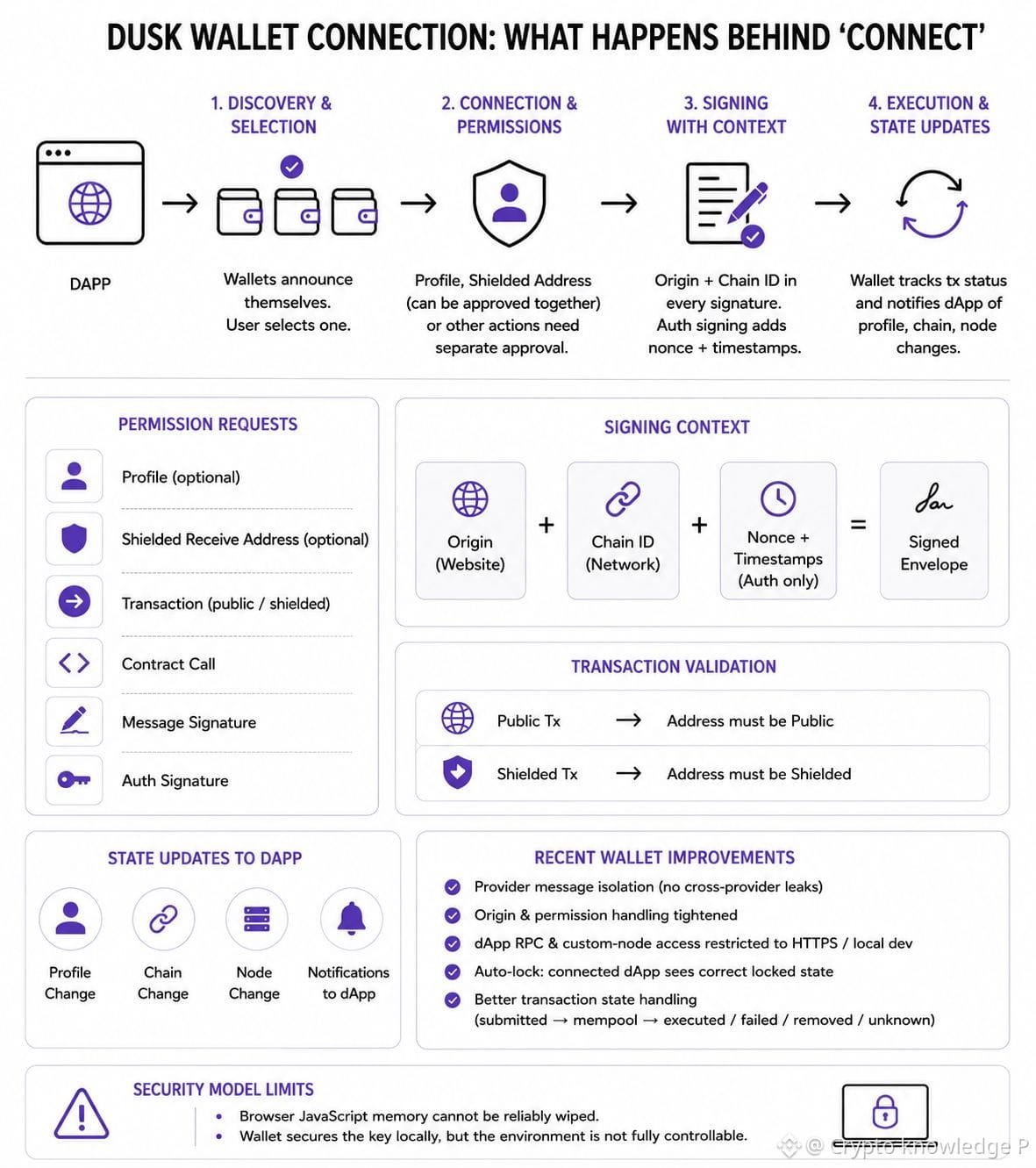
A Dusk wallet connection looks like one simple click. But when I started looking at what sits behind it, I realised there’s quite a bit going on.
I went through the wallet discovery flow first. A dApp doesn’t just grab whichever Dusk wallet is sitting on the page. Wallets announce themselves, the dApp discovers them, and if there’s more than one installed, a provider has to be selected. Each one also carries its own identity. It’s a small detail, but it matters because the site needs to know which wallet it is actually talking to.
Then I looked at the permission side. A profile request, shielded receive address, transaction, contract call or signature are not all the same thing. They go through different wallet requests, and the wallet can also report profile, chain and selected-node changes while the connection is active. So “connected” doesn’t really mean the dApp has unlimited access.
The signing part was the one I found most interesting. Dusk puts the origin and chain ID into the signed message context. Auth signing also carries a nonce and timestamps. So the signature isn’t just “this account signed something” — there’s context around the request as well.
I also checked the recent wallet changes around this. Provider messages were restricted so another installed Dusk provider can’t receive the same dApp request. Origin and permission handling were tightened, and dApp RPC and custom-node connections were restricted to HTTPS or local development endpoints. Dusk’s own security notes also mention limits like JavaScript memory not being reliably wipeable.
For me, that changes how the little Connect Wallet button looks. It’s not really one permission. There’s a whole layer between the website and the key deciding which wallet is being used, what the dApp can ask for, and what the user actually signs.
$DUSK @Dusk_Foundation #dusk
{spot}(DUSKUSDT)
A Dusk wallet connection looks like one simple click. But when I started looking at what sits behind it, I realised there’s quite a bit going on.
I went through the wallet discovery flow first. A dApp doesn’t just grab whichever Dusk wallet is sitting on the page. Wallets announce themselves, the dApp discovers them, and if there’s more than one installed, a provider has to be selected. Each one also carries its own identity. It’s a small detail, but it matters because the site needs to know which wallet it is actually talking to.
Then I looked at the permission side. A profile request, shielded receive address, transaction, contract call or signature are not all the same thing. They go through different wallet requests, and the wallet can also report profile, chain and selected-node changes while the connection is active. So “connected” doesn’t really mean the dApp has unlimited access.
The signing part was the one I found most interesting. Dusk puts the origin and chain ID into the signed message context. Auth signing also carries a nonce and timestamps. So the signature isn’t just “this account signed something” — there’s context around the request as well.
I also checked the recent wallet changes around this. Provider messages were restricted so another installed Dusk provider can’t receive the same dApp request. Origin and permission handling were tightened, and dApp RPC and custom-node connections were restricted to HTTPS or local development endpoints. Dusk’s own security notes also mention limits like JavaScript memory not being reliably wipeable.
For me, that changes how the little Connect Wallet button looks. It’s not really one permission. There’s a whole layer between the website and the key deciding which wallet is being used, what the dApp can ask for, and what the user actually signs.
$DUSK @Dusk #dusk
3
162
Verified
See translation
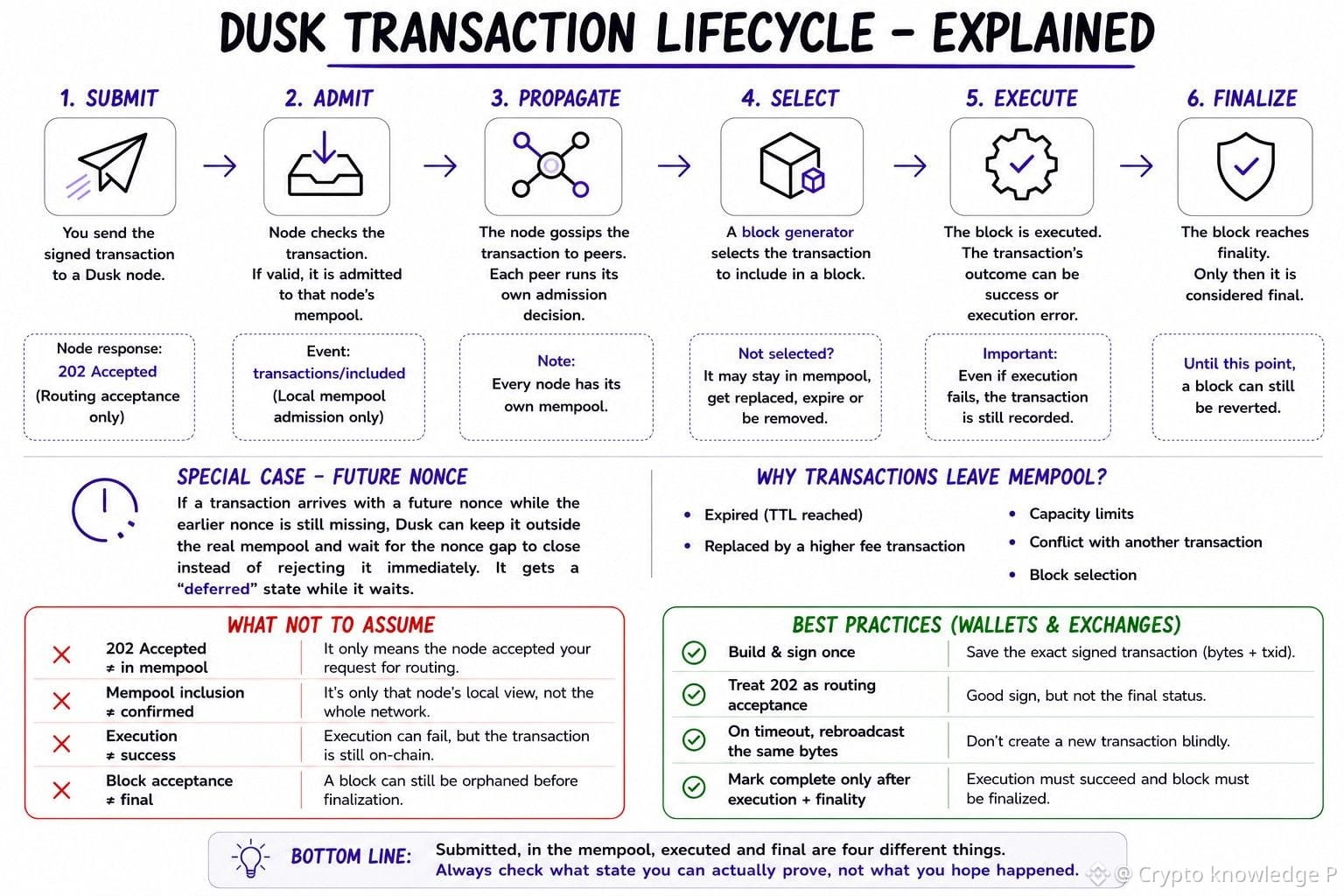
I think we usually ask the wrong question when a Dusk transaction “fails”.
A 202 Accepted only means the node accepted the request for routing. It does not mean the transaction is already in the mempool or in a block. One example I found interesting is a future nonce. If a Moonlight transaction arrives with a future nonce while an earlier nonce is still missing, Dusk can keep it outside the real mempool and wait for the nonce gap to close instead of rejecting it immediately. It gets a deferred state while that happens.
That is only one part of the story. Once a transaction passes admission, it enters that node’s local mempool. Other nodes keep their own mempools and run their own admission checks too. Later, a transaction can be selected for a block, executed, and eventually finalized. It can also leave the local mempool without that automatically meaning it failed. Expiry, replacement, capacity limits and conflicts can all lead to removal.
This is where I think the difference matters for wallets and exchanges. Dusk’s own integration guidance says to keep the exact signed transaction, treat 202 Accepted only as successful routing, and rebroadcast the same signed bytes after a transport timeout instead of creating a new transaction blindly. A withdrawal should only be marked complete after execution is checked and the block is finalized.
The more I looked at it, the less “transaction submitted” sounded like a useful status on its own. A transaction can be waiting for a nonce, sitting in one node’s mempool, executed with an error, or sitting in a block that is not final yet. Those are very different situations, even though they can all look like “it’s still pending” from the outside.
For me, that is the useful takeaway from Dusk’s transaction flow: submitted is only the beginning. What matters is the state you can actually prove the transaction reached.
$DUSK @Dusk_Foundation #dusk
{spot}(DUSKUSDT)
I think we usually ask the wrong question when a Dusk transaction “fails”.
A 202 Accepted only means the node accepted the request for routing. It does not mean the transaction is already in the mempool or in a block. One example I found interesting is a future nonce. If a Moonlight transaction arrives with a future nonce while an earlier nonce is still missing, Dusk can keep it outside the real mempool and wait for the nonce gap to close instead of rejecting it immediately. It gets a deferred state while that happens.
That is only one part of the story. Once a transaction passes admission, it enters that node’s local mempool. Other nodes keep their own mempools and run their own admission checks too. Later, a transaction can be selected for a block, executed, and eventually finalized. It can also leave the local mempool without that automatically meaning it failed. Expiry, replacement, capacity limits and conflicts can all lead to removal.
This is where I think the difference matters for wallets and exchanges. Dusk’s own integration guidance says to keep the exact signed transaction, treat 202 Accepted only as successful routing, and rebroadcast the same signed bytes after a transport timeout instead of creating a new transaction blindly. A withdrawal should only be marked complete after execution is checked and the block is finalized.
The more I looked at it, the less “transaction submitted” sounded like a useful status on its own. A transaction can be waiting for a nonce, sitting in one node’s mempool, executed with an error, or sitting in a block that is not final yet. Those are very different situations, even though they can all look like “it’s still pending” from the outside.
For me, that is the useful takeaway from Dusk’s transaction flow: submitted is only the beginning. What matters is the state you can actually prove the transaction reached.
$DUSK @Dusk #dusk
8
8
195
Verified
See translation
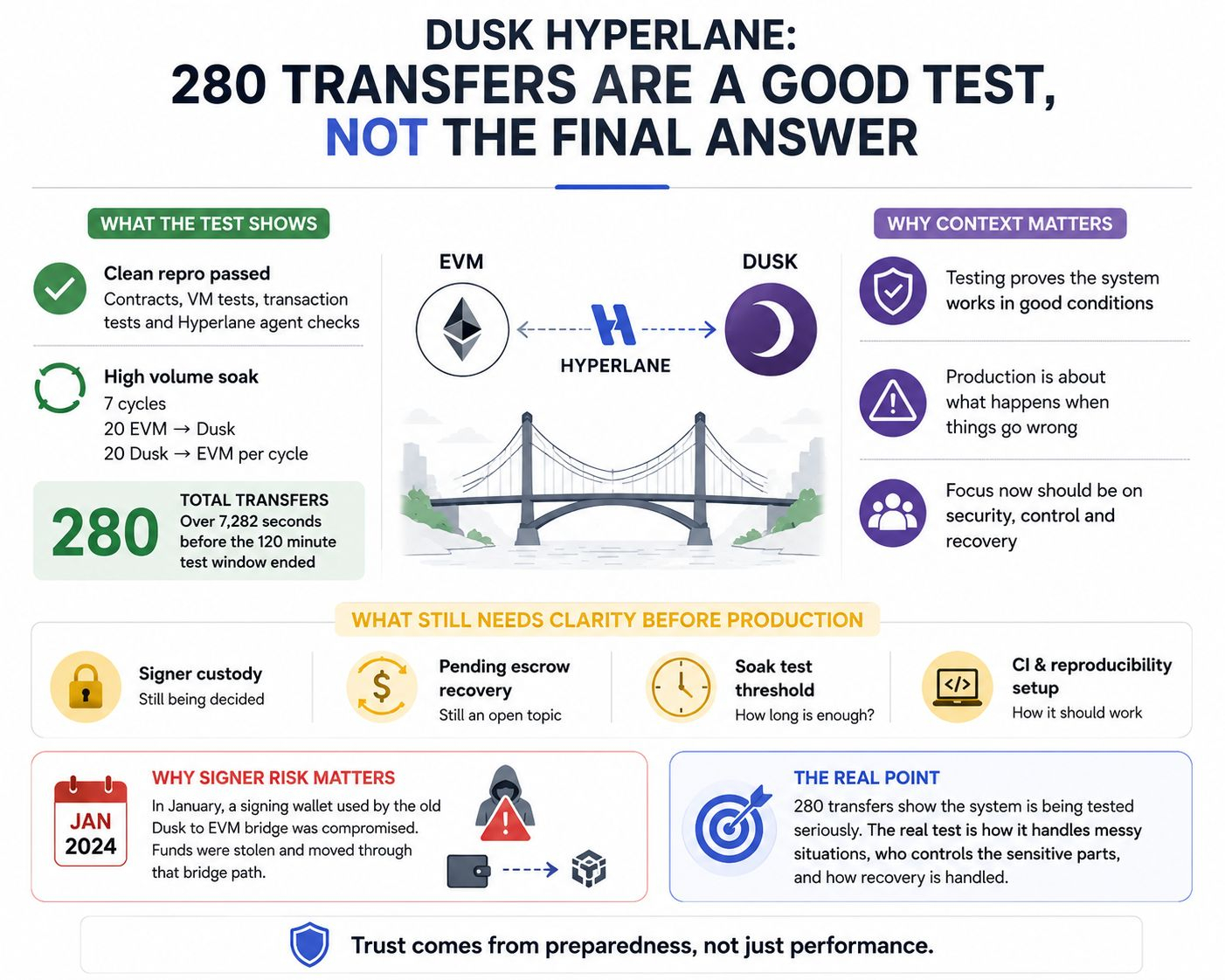
The 280 transfers caught my eye, but I ended up paying more attention to everything around them.
I went through the latest Dusk Hyperlane sign off work and the testing so far looks solid. The latest clean repro passed the contract builds, VM tests, transaction tests and Hyperlane agent checks. Then the high volume soak ran 7 cycles, with 20 EVM to Dusk and 20 Dusk to EVM transfers in each cycle. That came to 280 total transfers over 7,282 seconds before the 120 minute test window ended.
What I found more important was the production checklist sitting beside those results. Production signer custody is still being decided. There is also an open decision around pending escrow recovery, how long the soak should run, and how the CI and reproducibility setup should work. Those are easy to overlook when the headline number is a successful test, but they are the things I would want to understand before real liquidity is involved.
The signer question is especially hard to ignore after what happened with the old Dusk to EVM bridge in January. An attacker gained access to the bridge signing wallet, stole DUSK from it, and moved part of the stolen funds through the bridge to BNB Smart Chain. Dusk was clear that the incident was a bridge wallet compromise, not a Dusk consensus or protocol exploit. The bridge was later redesigned with stronger separation between signing, event handling and fund release, along with tighter balance and recovery controls.
So I’m not looking at the 280 transfers as either a green light or a red flag. They show that the system is being tested seriously. What matters to me now is how the system is supposed to behave when something goes wrong, who controls the sensitive parts, and how recovery is handled.
That’s what I’d want settled before treating Dusk Hyperlane as infrastructure for meaningful liquidity.
$DUSK @Dusk_Foundation #dusk
{spot}(DUSKUSDT)
The 280 transfers caught my eye, but I ended up paying more attention to everything around them.
I went through the latest Dusk Hyperlane sign off work and the testing so far looks solid. The latest clean repro passed the contract builds, VM tests, transaction tests and Hyperlane agent checks. Then the high volume soak ran 7 cycles, with 20 EVM to Dusk and 20 Dusk to EVM transfers in each cycle. That came to 280 total transfers over 7,282 seconds before the 120 minute test window ended.
What I found more important was the production checklist sitting beside those results. Production signer custody is still being decided. There is also an open decision around pending escrow recovery, how long the soak should run, and how the CI and reproducibility setup should work. Those are easy to overlook when the headline number is a successful test, but they are the things I would want to understand before real liquidity is involved.
The signer question is especially hard to ignore after what happened with the old Dusk to EVM bridge in January. An attacker gained access to the bridge signing wallet, stole DUSK from it, and moved part of the stolen funds through the bridge to BNB Smart Chain. Dusk was clear that the incident was a bridge wallet compromise, not a Dusk consensus or protocol exploit. The bridge was later redesigned with stronger separation between signing, event handling and fund release, along with tighter balance and recovery controls.
So I’m not looking at the 280 transfers as either a green light or a red flag. They show that the system is being tested seriously. What matters to me now is how the system is supposed to behave when something goes wrong, who controls the sensitive parts, and how recovery is handled.
That’s what I’d want settled before treating Dusk Hyperlane as infrastructure for meaningful liquidity.
$DUSK @Dusk #dusk
7
8
289
Partly True
See translation
One small thing about Dusk transactions kept bothering me.
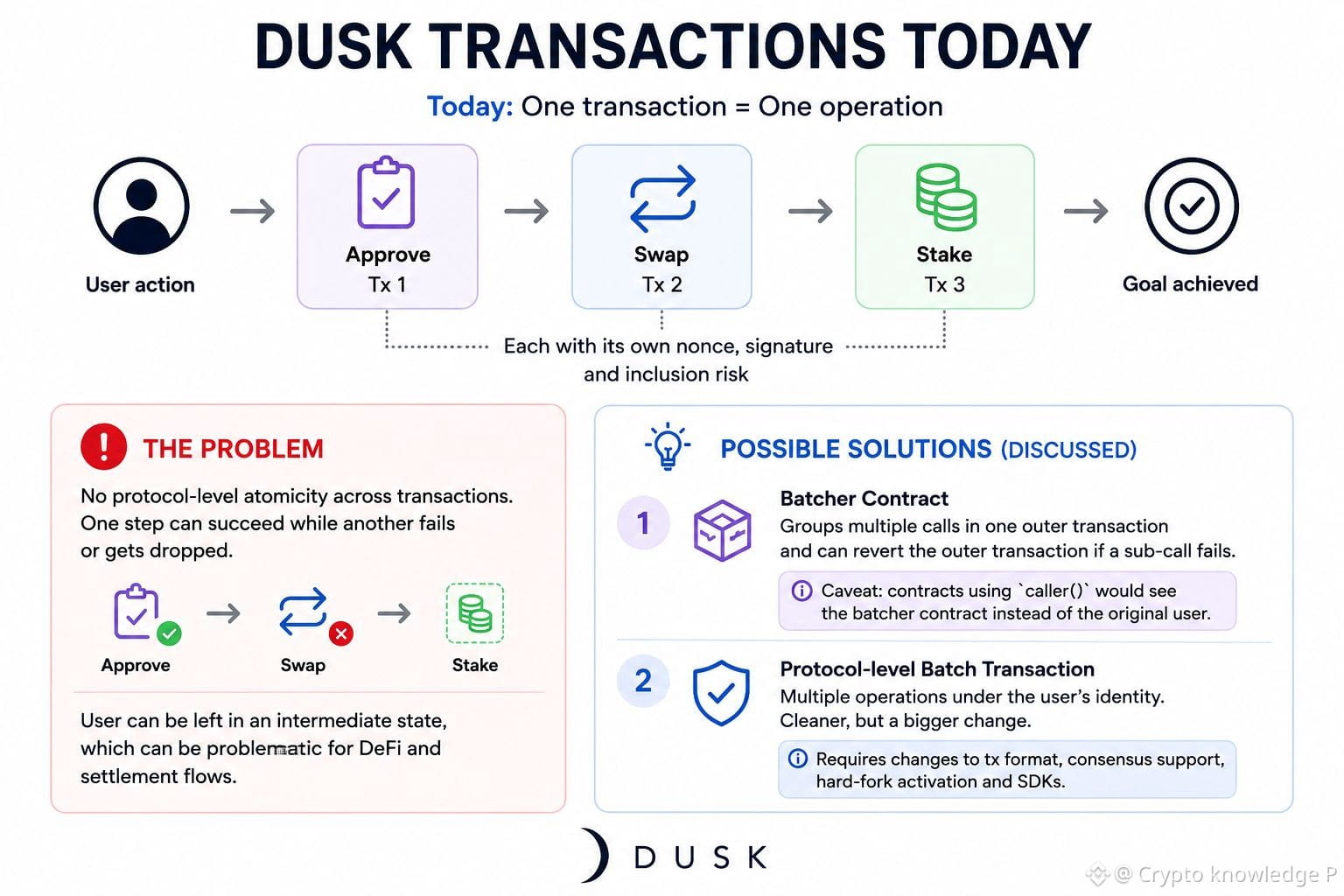
I was reading through Dusk’s transaction flow and found out that one transaction currently carries one operation. For something basic, that’s actually pretty sensible. It keeps things easier to validate and understand. But then I thought about a more complex DeFi flow, like preparing funds, doing a swap, and then staking. To the user, that feels like one action. On Dusk, it becomes several separate transactions, each with its own nonce, signature and chance of being included.
That’s where I started wondering what happens if only part of the sequence goes through. There’s no protocol level rollback across those transactions, so you can end up halfway through a larger flow. For a normal trade, probably not a big deal. But for DeFi, settlement or treasury operations, I can see this becoming a real headache.
What I found interesting is that Dusk already has an open GitHub issue, #4058, discussing batch transactions. One idea is a batcher contract that puts several calls into one transaction, but contracts using caller() could see the batcher instead of the original user. The other option is a protocol level batch where multiple operations stay under the user’s identity, but that would mean changes to the transaction format, consensus support, hard fork activation and SDKs.
So I wouldn’t replace the current single operation model. I think it makes sense as the simple default. I’d rather see an optional atomic batch for complex workflows, where the operations run in order, the whole batch can revert if one fails, and the original user remains visible to each call.
Would that be the right balance for Dusk, or is the extra protocol complexity not worth it?
$DUSK @Dusk_Foundation #dusk
{spot}(DUSKUSDT)
One small thing about Dusk transactions kept bothering me.
I was reading through Dusk’s transaction flow and found out that one transaction currently carries one operation. For something basic, that’s actually pretty sensible. It keeps things easier to validate and understand. But then I thought about a more complex DeFi flow, like preparing funds, doing a swap, and then staking. To the user, that feels like one action. On Dusk, it becomes several separate transactions, each with its own nonce, signature and chance of being included.
That’s where I started wondering what happens if only part of the sequence goes through. There’s no protocol level rollback across those transactions, so you can end up halfway through a larger flow. For a normal trade, probably not a big deal. But for DeFi, settlement or treasury operations, I can see this becoming a real headache.
What I found interesting is that Dusk already has an open GitHub issue, #4058, discussing batch transactions. One idea is a batcher contract that puts several calls into one transaction, but contracts using caller() could see the batcher instead of the original user. The other option is a protocol level batch where multiple operations stay under the user’s identity, but that would mean changes to the transaction format, consensus support, hard fork activation and SDKs.
So I wouldn’t replace the current single operation model. I think it makes sense as the simple default. I’d rather see an optional atomic batch for complex workflows, where the operations run in order, the whole batch can revert if one fails, and the original user remains visible to each call.
Would that be the right balance for Dusk, or is the extra protocol complexity not worth it?
$DUSK @Dusk #dusk
6
6
233
See translation
#dusk $DUSK @Dusk_Foundation
I’ve been looking at the SME side of Dusk recently and one thing kept coming back to me.
Tokenizing an SME sounds simple when you say it in one line.
Put the asset onchain.
Let investors access it.
Done.
But it really isn’t that simple.
Someone still has to decide who can invest, how ownership is handled, how transfers work, what information needs to be disclosed, and how the actual money gets settled.
And this is where I think people sometimes underestimate the RWA problem.
The token itself is only one part of the process. The market around it still has to work.
That’s where the Dusk approach gets interesting to me.
Their recent focus on private markets and SMEs isn’t really about putting another asset on a blockchain just for the sake of it.
It’s more about connecting the different parts of the process.
Because the difficult part isn’t creating the token.
The difficult part is making the token usable.
An SME can have a tokenized security, but if investors can’t access it properly, transfers are complicated, or there’s no real market around it, then not much has changed.
That’s also why I’m curious to see how the Dusk Trade side develops.
If it can make the process simpler for both companies and investors, then this becomes more interesting than just another RWA narrative.
Still early though.
For me, the real test is simple:
Can Dusk make private markets actually easier to use, or are we just putting an old process onchain and calling it new?
That’s the part I’ll be watching closely as Dusk Trade starts to take shape.
{spot}(DUSKUSDT)
#dusk $DUSK @Dusk
I’ve been looking at the SME side of Dusk recently and one thing kept coming back to me.
Tokenizing an SME sounds simple when you say it in one line.
Put the asset onchain.
Let investors access it.
Done.
But it really isn’t that simple.
Someone still has to decide who can invest, how ownership is handled, how transfers work, what information needs to be disclosed, and how the actual money gets settled.
And this is where I think people sometimes underestimate the RWA problem.
The token itself is only one part of the process. The market around it still has to work.
That’s where the Dusk approach gets interesting to me.
Their recent focus on private markets and SMEs isn’t really about putting another asset on a blockchain just for the sake of it.
It’s more about connecting the different parts of the process.
Because the difficult part isn’t creating the token.
The difficult part is making the token usable.
An SME can have a tokenized security, but if investors can’t access it properly, transfers are complicated, or there’s no real market around it, then not much has changed.
That’s also why I’m curious to see how the Dusk Trade side develops.
If it can make the process simpler for both companies and investors, then this becomes more interesting than just another RWA narrative.
Still early though.
For me, the real test is simple:
Can Dusk make private markets actually easier to use, or are we just putting an old process onchain and calling it new?
That’s the part I’ll be watching closely as Dusk Trade starts to take shape.
1
5
236
See translation
Been looking deeper into how Dusk handles transactions, and I noticed something I hadn’t really thought about before.
Moonlight and Phoenix aren’t just two versions of the same thing.
Moonlight is account-based. You have an account, balance, nonce and keys, and the network checks the transaction against that state.
Phoenix takes a different approach.
It uses notes stored in a Merkle tree. When a note is spent, a nullifier is created so the same note can’t be spent again.
What caught my attention is that the network doesn’t need to reveal which specific note was spent.
That’s where the ZK proofs come in — the transaction can be verified without exposing the underlying private details. The one-time note keys also help reduce transaction linkability.
There’s also a delegation mechanism for things like scanning and proof generation, without giving the delegated party access to spend the funds.
So I wouldn’t describe it simply as “Moonlight is transparent and Phoenix is private.”
They’re different transaction models designed around different requirements, while operating on the same Dusk network.
And honestly, I think that’s a pretty interesting design choice.
Which would you prefer on Dusk?
@Dusk_Foundation $DUSK #dusk
{spot}(DUSKUSDT)
Been looking deeper into how Dusk handles transactions, and I noticed something I hadn’t really thought about before.
Moonlight and Phoenix aren’t just two versions of the same thing.
Moonlight is account-based. You have an account, balance, nonce and keys, and the network checks the transaction against that state.
Phoenix takes a different approach.
It uses notes stored in a Merkle tree. When a note is spent, a nullifier is created so the same note can’t be spent again.
What caught my attention is that the network doesn’t need to reveal which specific note was spent.
That’s where the ZK proofs come in — the transaction can be verified without exposing the underlying private details. The one-time note keys also help reduce transaction linkability.
There’s also a delegation mechanism for things like scanning and proof generation, without giving the delegated party access to spend the funds.
So I wouldn’t describe it simply as “Moonlight is transparent and Phoenix is private.”
They’re different transaction models designed around different requirements, while operating on the same Dusk network.
And honestly, I think that’s a pretty interesting design choice.
Which would you prefer on Dusk?
@Dusk $DUSK #dusk
🔥 Phoenix
50%
🌙 Moonlight
10%
⚡ Both
20%
🤔 Depends on the use case
20%
10 votes • Voting closed
13
14
225
Log in to explore more content
Join global crypto users on Binance Square
⚡️ Get latest and useful information about crypto.
💬 Trusted by the world’s largest crypto exchange.
👍 Discover real insights from verified creators.
Email / Phone number
Trending Topics
EvolveAtBinanceBlockchainWeek
974,161 views
12,041 Discussing
Binance Blockchain Week 2026 is coming to Bangkok! 🌍
On November 28–29, industry leaders, builders and community members from around the world will come together.
This year’s theme is Evolve. From technological innovation to real-world applications, we’ll explore the future of blockchain and crypto. Whether you’re joining us in person or following online, your voice is part of the conversation!
Starting today, follow this account and post on Binance Square using #EvolveAtBinanceBlockchainWeek . Include an image and share what you’re looking forward to, your perspectives on the industry, or the ideas and moments that stand out during the event. 🎉🙌
🎁 We’ll select 20 users who post with the hashtag to receive 50 USDT each! The cutoff for draw entries is November 29 at 23:59 (UTC).
Let’s be part of this evolution and explore what’s possible together!
Binance Blockchain Week
·576 Likes
·487.4k views
CanMarketsReboundAfterThanksgiving?
295,488 views
2,508 Discussing
Nasdaq100FiveDayAvgIntradayVolatilityHits3.8%
18,305 views
248 Discussing