

#stellar
stellar
1.8M views
4,679 Discussing
Hot
Latest

·
--
Bullish
Verified
See translation
⚡ Stellar $XLM just demonstrated 7 MILLION payments per second — but there's a catch
Project Thruput reached 7.02M payments/sec using eight machines inside a single validator
One machine handled 1.18M
That's nearly 6x the execution capacity
The breakthrough isn't just speed 👇
$XLM
{future}(XLMUSDT)
Thruput is designed to process transactions in parallel, even when they touch the same accounts
It also explores zero per-transaction fees, with computing capacity allocated by unlocked native-token balances when demand exceeds supply
⚠️ But 7.02M is an execution benchmark — NOT Stellar mainnet TPS
It doesn't include full network consensus, transaction submission or mempool overhead
The technology is still being tested on FutureNet
{spot}(XLMUSDT)
📌 For $XLM , the next milestones are real network performance, a defined deployment path and proven token utility
A benchmark shows what's technically possible
Production adoption determines what it's worth
#XLM #stellar #blockchain
⚡ Stellar $XLM just demonstrated 7 MILLION payments per second — but there's a catch
Project Thruput reached 7.02M payments/sec using eight machines inside a single validator
One machine handled 1.18M
That's nearly 6x the execution capacity
The breakthrough isn't just speed 👇
$XLM
Thruput is designed to process transactions in parallel, even when they touch the same accounts
It also explores zero per-transaction fees, with computing capacity allocated by unlocked native-token balances when demand exceeds supply
⚠️ But 7.02M is an execution benchmark — NOT Stellar mainnet TPS
It doesn't include full network consensus, transaction submission or mempool overhead
The technology is still being tested on FutureNet
📌 For $XLM , the next milestones are real network performance, a defined deployment path and proven token utility
A benchmark shows what's technically possible
Production adoption determines what it's worth
#XLM #stellar #blockchain

2
1.1k

·
--
See translation
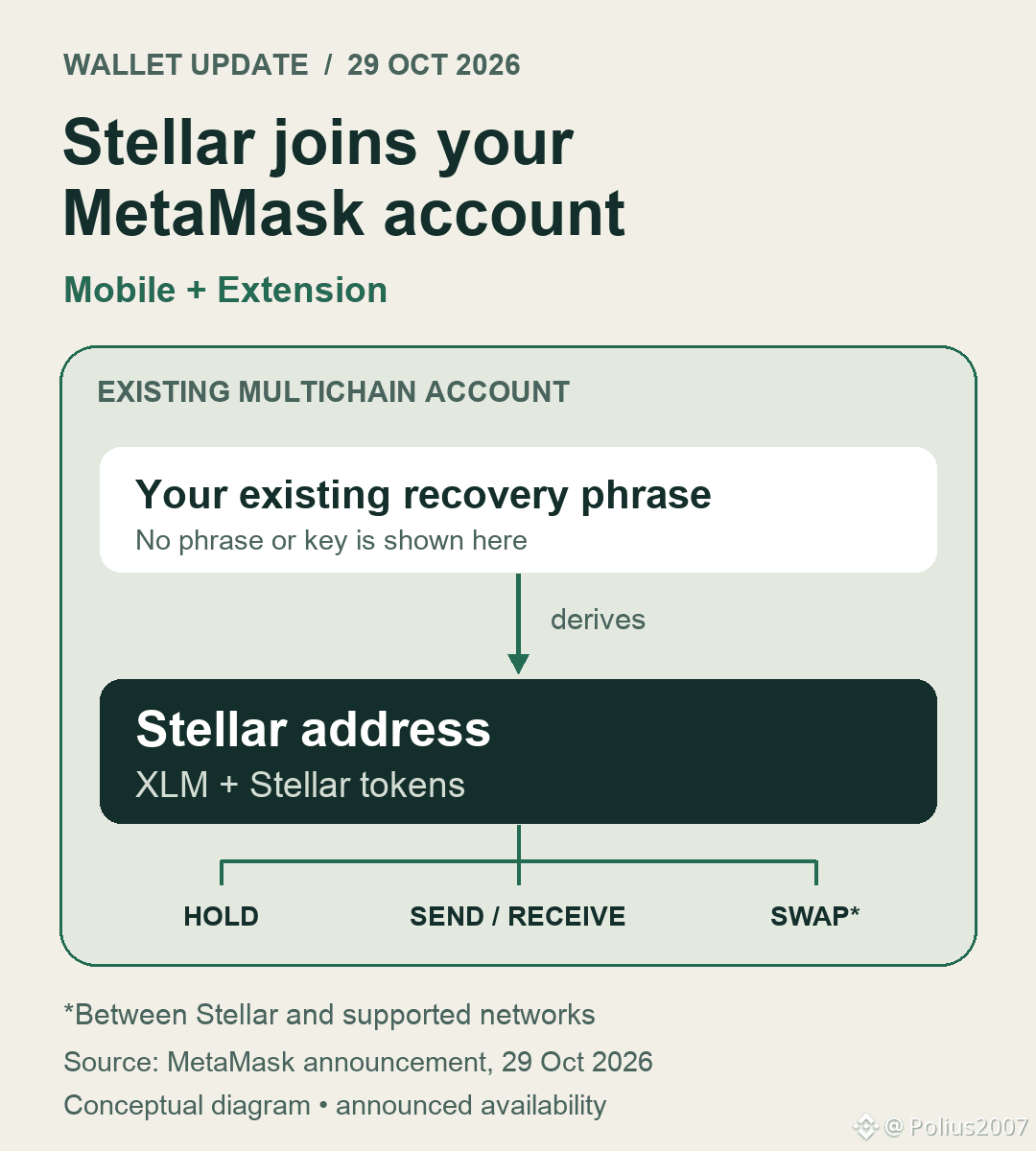
Stellar is now a default network in MetaMask Mobile and Extension, according to MetaMask’s October 29 announcement.
Existing users get a Stellar address derived from the recovery phrase they already use. It sits inside their multichain account, so someone who wants to hold XLM alongside their other crypto no longer needs a separate wallet just to access Stellar.
The integration supports XLM and other Stellar tokens, including trustline assets and Soroban tokens. Users can send and receive them and swap between Stellar and other supported networks. The additional Stellar address is network-specific: it comes from the same recovery phrase, rather than making one address work on every chain.
Source: MetaMask, October 29, 2026.
https://metamask.com/news/metamask-makes-stellar-a-default-network-bringing-global-payments-into-the-open-money-platform
#Stellar #XLM
249

See translation
🔥 A regulated, yield‑bearing stablecoin isn’t a gimmick—it’s the market’s next safety net.
📊 Stellar just launched YLDS, the first SEC‑registered USD‑pegged stable asset from Figure, and it arrives while Bitcoin ticks up to $78,042 (+0.73%) amid a fear index of 34/100 and a bullish funding rate of +0.0100% on BTC futures. #Stellar #Stablecoins
💡 In a cycle where institutional capital re‑enters on the back of lower volatility, regulated yield‑bearing dollars become the bridge between traditional finance and DeFi, reinforcing the long‑term thesis that “crypto = real‑world finance.” #DeFi #Institutional
✅ Start allocating a small portion of your portfolio (e.g., 2‑5%) into YLDS or similar compliant stablecoins to capture the 4‑6% APY yield while keeping liquidity for buying the dip when BTC’s RSI hovers around 44 and long‑short ratios stay bullish (≈70% longs).
❓ How are you planning to integrate regulated stablecoins like YLDS into your strategy—pure yield, hedge, or a launchpad for the next bull run?
79

·
--
See translation
STELLAR AT $0.1690: A QUIET MARKET BEFORE A BIGGER MOVE?
XLM is showing limited movement today. But its current range gives traders two clear levels to monitor.
Binance Spot snapshot
- Price: $0.1690
- 24h change: +0.12%
- 24h high: $0.1720
- 24h low: $0.1663
Fundamental perspective
Stellar's payment and cross-border transfer focus remains central to its ecosystem. Adoption and real-world financial integrations are worth following, but short-term price direction also depends on liquidity and broader crypto sentiment.
Technical levels
- Resistance: $0.1720
- Support: $0.1663
- Bullish trigger: A sustained break above $0.1720.
- Bearish trigger: A breakdown below $0.1663.
My verdict: NEUTRAL — WAIT FOR THE MARKET TO CHOOSE.
There is not enough evidence for a strong directional call yet. The range boundaries are more useful than guessing.
#Stellar
#XLM
#XLMUSDT
#CryptoTrading
#Binance
#MarketAnalysis
44


·
--
See translation
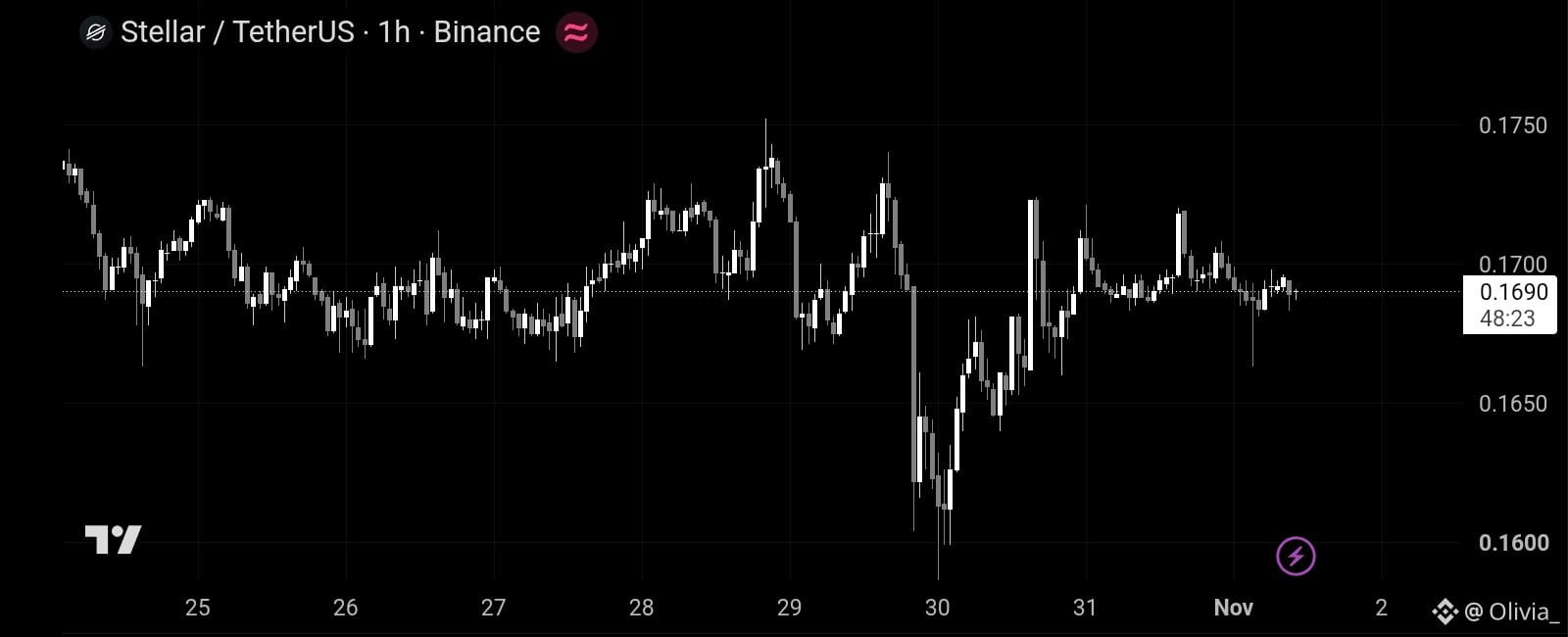
$XLM Holding Strong After Recovery
Stellar is trading around $0.1690 after bouncing from the $0.1600 support area.
Key Levels:
🔹 Support: $0.1680 / $0.1650
🔹 Resistance: $0.1720 / $0.1750
A breakout above $0.1720 could push XLM toward $0.1750. Losing $0.1680 may bring another pullback.
Watching for confirmation before the next move.
#XLM #stellar #crypto
{future}(XLMUSDT)
$XLM Holding Strong After Recovery
Stellar is trading around $0.1690 after bouncing from the $0.1600 support area.
Key Levels:
🔹 Support: $0.1680 / $0.1650
🔹 Resistance: $0.1720 / $0.1750
A breakout above $0.1720 could push XLM toward $0.1750. Losing $0.1680 may bring another pullback.
Watching for confirmation before the next move.
#XLM #stellar #crypto
Peter Maliar:
Watching for a clean breakout
19
14
294

See translation
Stellar (XLM) Double-Confirms Death Cross, Yet Another Support Exists
- Stellar (XLM) shows death cross pattern indicating potential downward trend
- Golden cross finalized, which could push price lower than before
- Another support level is available for potential bounce
#Stellar #XLM #Crypto #Trading #DeathCross GoldenCross
$xlm
vlikevn Titanbot
Nguồn: U.Today
- Stellar (XLM) shows death cross pattern indicating potential downward trend
- Golden cross finalized, which could push price lower than before
- Another support level is available for potential bounce
#Stellar #XLM #Crypto #Trading #DeathCross GoldenCross
$xlm
vlikevn Titanbot
Nguồn: U.Today
7

·
--
See translation
Curve just went multi-VM: StableSwap is live on Stellar mainnet.
It's Curve's first non-EVM deployment, per CoinOtag's Nov 1 report. Stablecoin swaps have lived almost entirely on EVM chains until now, so this widens where low-slippage stable trading can happen.
My take: with the market in fear (Fear & Greed around 30) and $BTC near $77.5K, builders are still shipping. Stablecoin infrastructure keeps getting the quiet upgrades while price chops.
Which matters more for the next cycle: stablecoin rails on new chains, or more ETF access? Curious where you land. $XLM $BTC
#Stellar #Curve #DeFi #Stablecoins
61

See translation
$XLM REAL-WORLD ASSETS EXPLODE PAST $3B AS INSTITUTIONAL LIQUIDITY QUIETLY STACKS! 🦈 💥
Stellar has quietly turned into an institutional liquidity monster, surging past $3 Billion in tokenized real-world assets since January. 📊 Major heavyweights like Ondo and Spiko are locking massive capital into $XLM rails, far outstripping its modest $213 Million DeFi footprint.
💡 With barely $2 Million of these RWAs actively utilized as collateral in lending protocols, the unlockable on-chain velocity here is staggering. ⚡ Once institutional debt starts feeding directly into active DeFi yield loops, the ecosystem dynamics will shift dramatically.
💬 Will $XLM bridge this massive utilization gap and dominate the RWA sector this cycle? 👇
⚠️ Not financial advice. Always manage your risk. 🛡️
🏷️ #XLM #RWA #Stellar #Crypto
🔥 💎
37

·
--
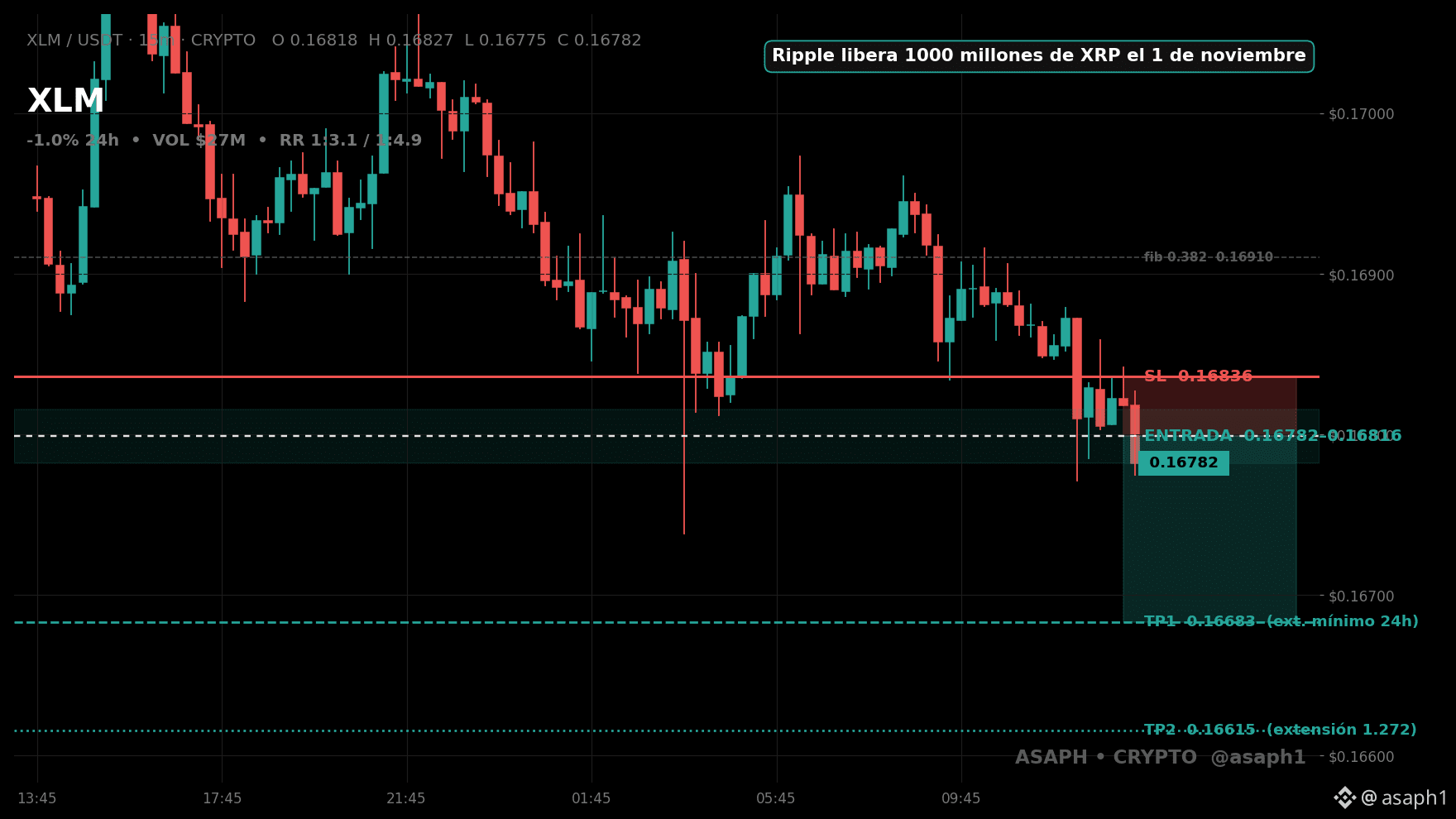
🌟 $XLM PAYMENTS SHOWDOWN: WHILE RIPPLE RELEASES 1 BILLION, STELLAR FALLS BEHIND
Ripple put 1 billion XRP into circulation today, November 1, through its two escrow unlocks, and the market absorbed it without a fuss. To me, the contrast is the story: XRP weathered the supply shock, but Stellar, its longtime rival in payments, isn’t keeping pace this morning.
Look at the detail nobody is noticing:
→ Whale Alert reported Ripple’s two 500 million XRP transfers today—the November monthly unlock is now in circulation.
→ XLM -1.0% at $27.1M, while $XRP +0.3% and $HBAR -0.5% are moving differently in payments.
→ Entry $0.16782–$0.16816, SL $0.16836, TP1 $0.16683 (-0.7%) → TP2 $0.16615 (-1.1%).
Do you see XLM reaching $0.16615 or holding at $0.16697? 👇
$XLM
#Stellar #Pagos #Trading
75

What’s worth watching in XLM’s current market isn’t that it’s up 1.06%, but what’s happening in perpetual futures: shorts are paying funding.
The current price is 0.17014, up 1.06% over 24 hours. The 8-hour funding rate is -0.0156%, or about -17% annualized. The price is moving up while the funding rate is moving down, which suggests this rally isn’t being driven by leveraged longs, but by spot buying. Meanwhile, shorts in the futures market would rather pay every 8 hours than give up their positions.
But don’t rush to interpret this as “shorts are about to get squeezed out.”
1. The actual amount implied by the negative funding rate is quite small. Open interest is 30.15 million USDT. Multiply that by 0.0156%, and shorts are paying a total of about 4,700 USDT per settlement, or just over 14,000 a day. Payments on this scale don’t show that either side is fighting desperately. It’s more a signal of directional preference than of actual capital flows. An annualized rate of -17% sounds alarming, but that figure simply takes the 8-hour rate and multiplies it by 1,095; the actual amount being paid is small. So this -0.0156% can be used to gauge sentiment, but it doesn’t support a narrative of “immense pressure on shorts.”
2. The long/short account ratio and the funding rate are at odds. Long accounts make up 61%, but the funding rate is negative. Account numbers count people; positions are weighted by capital. If both figures are true, they point to one kind of structure: small accounts are clustered on the long side, while large positions are on the short side. In this market, the price is moving up not because short covering is triggering a chain reaction, but because spot buying needs to keep coming in. The fact that large positions are willing to pay to stay short suggests either that they have a longer holding horizon or that they’re hedging spot holdings. Floating losses haven’t forced anyone to close their position.
3. What really matters is when the funding rate turns positive again. At -0.0156%, shorts are paying to hold their positions. If spot buying is genuine and sustained, shorts will gradually give up holding their positions, and the funding rate will move from negative to zero and then turn positive. That moment wouldn’t mean the market is accelerating; it would mean “shorts are no longer willing to pay this much”—the first real resistance faced by this spot-driven push, and a signal that the balance of power between short-term bulls and bears is starting to shift. Conversely, if the price keeps rising while the funding rate stays negative, that means shorts have no intention of backing down in the short term. This is a slow trade, not quick money.
4. The derivatives pool isn’t deep. The 24-hour trading volume is 24.4M USDT, and open interest is 30.15M USDT—those two figures are close. At this scale, marginal changes in the funding rate can easily be skewed by one or two large orders. Looking at the funding rate over a single 8-hour window is more noise than signal; you need to watch several settlements in a row before drawing a firm conclusion. Don’t use data from one settlement period to project an entire trend.
⚠️ Risk warning: Negative funding can persist for a long time, especially in spot-driven markets. Treating “shorts paying” as “shorts giving up” is one of the most common misreadings. Your stop-loss level shouldn’t be any wider just because the funding rate is negative.
My view: the evidence for XLM’s bullish move is on the spot side; the negative funding rate simply confirms that leverage hasn’t followed through. The real confirmation signal would be the funding rate turning positive alongside rising open interest. Until then, this 1.06% gain looks more like a one-sided push by spot buyers than the start of a trend.
#XLM #Stellar #Crypto
4

·
--
Stellar integrates with MetaMask: address creation and activation are separate steps
MetaMask and Stellar announced the integration on October 29, 2026, and it is now available on mobile and as an extension, according to the announcement. Square reports on the news today. Stellar is now one of the networks included by default.
Compatible multichain accounts include a Stellar address derived from their recovery phrase. The integration lets users manage XLM, compatible assets, and Soroban tokens, as well as send, receive, and swap assets across supported networks.
MetaMask’s guide outlines several requirements:
• A new address needs to receive at least 1 XLM to be activated on the network.
• To receive assets such as USDC, you need a trustline: authorization for the account to accept that asset.
• Each trustline adds 0.5 XLM to the reserve; that balance is locked and unavailable to spend. Network fees are also paid in XLM.
For a bridge swap to a token other than XLM, the guide requires activating the trustline first. Skipping this step can result in a loss of funds.
Market snapshot: Binance Spot, 10/31 at 20:17 UTC: XLM is trading at 0.1697 USDT (+1.19% in 24 hours) and ETH at 2,254.92 USDT (+0.51%). The integration makes access easier; these changes do not show how much new usage it has generated.
$XLM $ETH $USDC
Educational Content. Not financial advice.
#Stellar #MetaMask #XLM #Autocustodia #FinancialEducation

francotraderr:
Follow for follow
1
1
82
Treating “default network” as just another news item would be missing the point. Stellar has become a default network in MetaMask, and new accounts will automatically have an address generated for them. Taken together, these two changes mean XLM has gone from being “a network users have to add themselves” to “a network users encounter as soon as they open their wallet.” In product terms, this is a change in distribution—not just an integration announcement.
First, why do defaults matter? MetaMask is a self-custody wallet with tens of millions of monthly active users, and choosing a network is one of the first things new users do when setting up a wallet. Until now, the conversion path for Stellar looked like this: hear about it, search for it, manually add an RPC, then find where to access assets. Each step filtered out a large number of people. Now that first hurdle is gone: an address is generated automatically, and users can see their Stellar address the first time they open the wallet. Defaults themselves can drive distribution because they require no motivation from users—just a tap on “Next.”
So what we should watch next is on-chain data, not short-term price swings. Specifically, keep an eye on three metrics: the growth curve for new addresses, daily active addresses, and the volume of stablecoin transfers and Soroban contract calls on Stellar. XLM’s most persistent problem over the past few years has been that the narrative was there, but address counts barely grew. The ecosystem story has been told for a long time, yet active addresses have never managed to climb to a new level. If this change in access is real, we should see a step-change in new addresses within two to four weeks—not just a one-day spike. If the address curve still looks the same after four weeks, then this was just an engineering partnership, not a user migration.
Now, the market. XLM is currently trading around $0.16, down roughly 70% from above $0.60. The positioning at this level means it is not especially sensitive to positive news. Funding rates have stayed close to zero for a long time, suggesting leveraged traders aren’t paying up on this news: there are neither crowded longs chasing the move nor shorts pressing the direction. In this kind of environment, news is usually priced in slowly. It won’t all happen in a single day; instead, the story will be validated one data point at a time. If open interest in futures doesn’t increase noticeably over the next few days, I’d interpret that as “not many people know about it yet,” rather than “nobody believes it.”
The risks need to be clear, too. Integration doesn’t guarantee usage, and users can switch away from the default network with a single tap. Whether they actually stick around depends on what comes next: how easy it is to access assets, whether fiat on- and off-ramps work smoothly, and whether there’s enough liquidity for on-chain swaps. Those are all still open questions. A more practical point: integration news typically takes quarters to play out, while market sentiment can shift in days. That mismatch in timing is what most easily wears people down.
My view: treat this change to the default network as a window to observe, not a trading signal. Over the next two weeks, first check whether new and active addresses are moving. If the data picks up, then talk about repricing; if it doesn’t, acknowledge that this was just infrastructure being laid. Using a short-term position to bet on a long-term variable is one of the easiest ways to get repeatedly ground down by noise.
#XLM #Stellar #Crypto
13

Verified
See translation
Curve Finance announces the launch on the Stellar mainnet
#CurveFinance has launched on the #Stellar mainnet, marking its first native launch outside the Ethereum Virtual Machine (EVM) ecosystem. The launch introduces Curve's StableSwap to Stellar, enabling users to permissionlessly create and discover pools, swap assets, and provide liquidity.
Curve's Stellar pools could support lending and other financial apps with collateral liquidations and position exits, provided sufficient liquidity and integration. Asset issuers could also use them to create markets for Stellar-based assets, including stablecoins and Franklin Templeton's tokenized money market fund.
👉 theblock.co/news/defi/2026-10-29-curve-finance-stellar-432121
575

·
--
Verified
Came across news that the Stellar Development Foundation (SDF) has made a strategic investment in Marketnode, an Asia-Pacific digital market infrastructure (DMI) operator whose shareholders include Euroclear, HSBC, SGX Group, and Temasek.
The key point: The funding will help bring tokenized RWAs for institutional clients in Asia-Pacific onto Stellar, connecting asset managers, issuers, distributors, and accredited investors through a unified suite of issuance, distribution, and lifecycle services. The two already have a partnership: Marketnode plans to provide on-chain access on Stellar to some BNY Investments funds, and is also distributing tokenized products from CGS, Franklin Templeton, Maybank AM, WisdomTree, and others.
As Asia-Pacific institutions move from pilots toward commercial adoption, infrastructure is laying the groundwork by expanding distribution networks first—a solid step.
#Stellar #RWA #Marketnode #Tokenization
XLM-0.82%
HSBCUS-0.04%
1
167

·
--
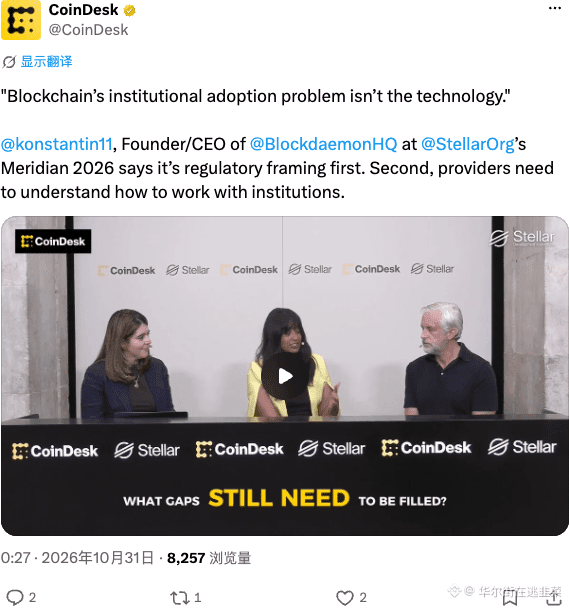
At Stellar Meridian, the Blockdaemon CEO spoke frankly: the main challenge to institutional adoption isn’t the technology behind the chain, but how regulation defines it and whether intermediaries can serve institutional clients effectively. Technology hasn’t been the problem for a long time; the real obstacles are the regulatory framework and service providers’ capabilities. Stellar’s take is refreshingly honest: compliance is the biggest moat. If you want to attract institutions, don’t just look at the code—get the rules sorted out first.
$XLM #Stellar #CryptoRegulation
$XLM #Stellar #CryptoRegulation
22

·
--
MetaMask made Stellar the default network at yesterday’s Meridian meeting in Lisbon: it’s now live on mobile and the extension, and existing accounts can derive Stellar addresses directly from their recovery phrases. The company says it’s the first major self-custody wallet to offer default access to Stellar, enabling users to send and receive XLM, trustline assets, and Soroban tokens. StellarOrg said this is roughly equivalent to giving 30 million users an address. XLM is trading at around $0.160 on CoinGecko (snapshot at approximately 10:07 Beijing time), down about 4% over 24 hours.
The payment entry point has moved: previously, users had to open a separate Stellar wallet; now Stellar assets sit alongside those on other chains in the same interface. Don’t mistake addresses being automatically created for transfer volume having already picked up; an address is just the first step—actual transfers are what count.
Set a two-week observation window: if verifiable official figures for active Stellar addresses or on-chain payment volume don’t follow, treat this as a channel-launch pulse, not proof that payment use cases are up and running.
$XLM
#Stellar #MetaMask
137

·
--
See translation
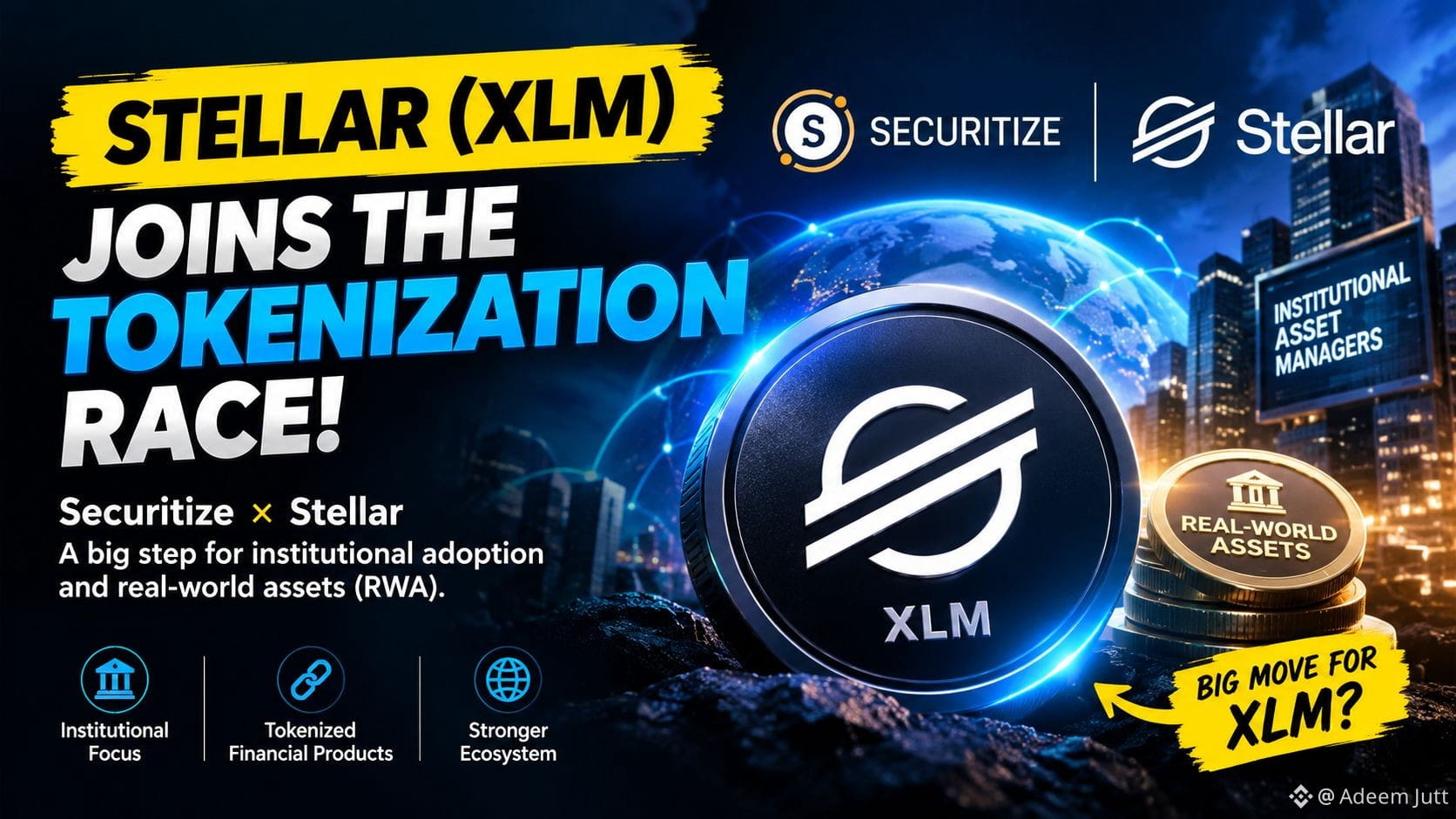
🚨 STELLAR $XLM IS ENTERING THE INSTITUTIONAL TOKENIZATION RACE! 👀
Securitize has announced plans to integrate with the Stellar network for future tokenized financial products aimed at institutional asset managers.
🔥 Why does this matter?
Real-world asset (RWA) tokenization is gaining attention as traditional finance explores blockchain technology. Stellar could benefit from increased ecosystem activity if this integration translates into real adoption.
📊 What to watch: Institutional participation, actual product launches, and whether the development drives meaningful activity across the Stellar ecosystem.
This is a promising development, but it doesn't guarantee an immediate XLM price rally.
Do you think RWA adoption could be a major catalyst for $XLM in the next market cycle? 👇
{spot}(XLMUSDT)
#stellar #XLM #RWA #CryptoNews #Blockchain
🚨 STELLAR $XLM IS ENTERING THE INSTITUTIONAL TOKENIZATION RACE! 👀
Securitize has announced plans to integrate with the Stellar network for future tokenized financial products aimed at institutional asset managers.
🔥 Why does this matter?
Real-world asset (RWA) tokenization is gaining attention as traditional finance explores blockchain technology. Stellar could benefit from increased ecosystem activity if this integration translates into real adoption.
📊 What to watch: Institutional participation, actual product launches, and whether the development drives meaningful activity across the Stellar ecosystem.
This is a promising development, but it doesn't guarantee an immediate XLM price rally.
Do you think RWA adoption could be a major catalyst for $XLM in the next market cycle? 👇
#stellar #XLM #RWA #CryptoNews #Blockchain
1
1
74
See translation
🏛️ Wall Street isn't rejecting tokenization — it's questioning who gets to issue it
Janus Henderson and Centrifuge have launched JQQQ, a blockchain-native fund tracking the Nasdaq-100 on Stellar, under license from Nasdaq
The timing is interesting 👇
$XLM
{future}(XLMUSDT)
While 22 companies recently challenged a separate third-party stock tokenization proposal, JQQQ follows an issuer-sponsored fund model
That's a very different legal and investment structure
🔍 Investors receive exposure through a regulated investment fund structure, not direct ownership of the underlying Nasdaq-100 companies
Access is restricted to eligible investors outside the US
{spot}(XLMUSDT)
⚠️ This is a meaningful development for Stellar's RWA ecosystem, but it doesn't automatically translate into buying pressure for $XLM
What matters next is real fund adoption, capital deployed and onchain integrations — not just another tokenization headline
#XLM #stellar #RWA
🏛️ Wall Street isn't rejecting tokenization — it's questioning who gets to issue it
Janus Henderson and Centrifuge have launched JQQQ, a blockchain-native fund tracking the Nasdaq-100 on Stellar, under license from Nasdaq
The timing is interesting 👇
$XLM
While 22 companies recently challenged a separate third-party stock tokenization proposal, JQQQ follows an issuer-sponsored fund model
That's a very different legal and investment structure
🔍 Investors receive exposure through a regulated investment fund structure, not direct ownership of the underlying Nasdaq-100 companies
Access is restricted to eligible investors outside the US
⚠️ This is a meaningful development for Stellar's RWA ecosystem, but it doesn't automatically translate into buying pressure for $XLM
What matters next is real fund adoption, capital deployed and onchain integrations — not just another tokenization headline
#XLM #stellar #RWA

121

Verified
Article
Pontoro launches pilot on Stellar to give investors in tokenized private funds a way to exitAnnounced at Meridian 2026 in Lisbon: Pontoro has launched the first real-world pilot of its Automated Liquidity Pool (ALP) on the Stellar network, with Archax and the Stellar Development Foundation.
The problem it addresses is a familiar one: tokenization makes private assets move faster, but doesn’t make them liquid. The ALP aims to give investors in private funds a way to exit.
How it works:
• The vehicle has two compartments: one liquid, with monetary funds and cash-like assets, and another holding stakes in private funds, such as private credit.
Pontoro launches pilot on Stellar to give investors in tokenized private funds a way to exit
Announced at Meridian 2026 in Lisbon: Pontoro has launched the first real-world pilot of its Automated Liquidity Pool (ALP) on the Stellar network, with Archax and the Stellar Development Foundation.
The problem it addresses is a familiar one: tokenization makes private assets move faster, but doesn’t make them liquid. The ALP aims to give investors in private funds a way to exit.
How it works:
• The vehicle has two compartments: one liquid, with monetary funds and cash-like assets, and another holding stakes in private funds, such as private credit.
1k
·
--
Meridian 2026 is back in Lisbon, and Stellar is making big moves this time. Denelle Dixon talks about global digital finance. If it actually comes to fruition, XLM will go from "nobody" to a serious contender. The valuation logic will change.
$XLM #Stellar #DeFi
Meridian 2026 is back in Lisbon, and Stellar is making big moves this time. Denelle Dixon talks about global digital finance. If it actually comes to fruition, XLM will go from "nobody" to a serious contender. The valuation logic will change.
$XLM #Stellar #DeFi
$XLM #Stellar #DeFi

143
Log in to explore more content
Join global crypto users on Binance Square
⚡️ Get latest and useful information about crypto.
💬 Trusted by the world’s largest crypto exchange.
👍 Discover real insights from verified creators.
Email / Phone number
Trending Topics
1
#BinanceRestores28FiatWithdrawals
5,937 views
185 Discussing
2
#BinanceProcesses$4.65BWithdrawals
63,316 views
275 Discussing
3
#ETHFalls16.1%InOctober
85 views
20 Discussing
4
#BitcoinClosesAbove50WeekMAFor7thStraightWeek
1,494 views
50 Discussing
5
#EthereumSurpasses$2300
4,488 views
66 Discussing
6
#BitcoinSpotETFsPost$203MWeeklyOutflow
5,398 views
43 Discussing
7
#SouthKoreanLawmakerProposesReviewOfAllListedDigitalAssets
1,923 views
45 Discussing
8
#SolanaMobileRemovesMaliciousSKRClaimApp
2,883 views
77 Discussing
9
#BrazilVirtualAssetLicenseDeadlineDrawsAbout40Firms
32,904 views
539 Discussing
10
#BTCPayServerUrgesOperatorsToShutDownInstances
26,552 views
410 Discussing