
#gpu
gpu
175,599 views
527 Discussing
Hot
Latest

·
--
See translation
🎨 $RENDER : Powering the Future of GPU Computing!
Render Network connects GPU providers with creators and developers who need computing power.
🔹 Token: $RENDER
🔹 Network: Solana
🔹 Utility: GPU Computing
🔹 Use Cases: 3D Rendering, AI & Digital Content
🔹 Focus: Decentralized Computing Infrastructure
As AI and digital creation grow, decentralized GPU networks are becoming an important technology to watch.
#render #RenderNetwork #GPU #blockchain #cryptoeducation
{spot}(RENDERUSDT)
🎨 $RENDER : Powering the Future of GPU Computing!
Render Network connects GPU providers with creators and developers who need computing power.
🔹 Token: $RENDER
🔹 Network: Solana
🔹 Utility: GPU Computing
🔹 Use Cases: 3D Rendering, AI & Digital Content
🔹 Focus: Decentralized Computing Infrastructure
As AI and digital creation grow, decentralized GPU networks are becoming an important technology to watch.
#render #RenderNetwork #GPU #blockchain #cryptoeducation
1
76

“The first GPU computing-power option”—that’s a big headline for a very small trade. But even a small trade can carry an important signal.
First, the facts: On 11/17, Architect, Luxor, and Hyperbolic announced that Hyperbolic had bought an over-the-counter put option on the Silicon Data B200 rental price index (SDB200RT, a daily index of on-demand rental prices). The notional value was about $5 million, with a one-year term and monthly cash settlement. If B200 rental prices fall below the agreed level, the option pays Hyperbolic. Architect structured the deal through a CFTC-registered introducing broker, while Luxor priced and executed it as the counterparty. Neither the strike price nor the premium was disclosed.
A $5 million notional is a drop in the ocean in a world where AI capex routinely runs into the tens of billions. The idea that “computing power is becoming a commodity” is still at the PR stage.
But think about who would pay for this kind of protection. A computing-power provider paying a premium to lock in a floor on rental revenue shows they understand that falling B200 on-demand rental prices over the next year are a real risk that needs hedging—not some remote possibility. Every time a new generation of cards comes out, hourly rental rates for the previous generation get squeezed. We’ve already seen it happen with H100s. If even GPU businesses are insuring their revenue, anyone using the assumption that “GPU rental rates will stay strong forever” in a DCF model should wake up.
The second point is basis risk. The index tracks on-demand rental prices, the thinnest and noisiest part of the market. The real bulk of business is in multiyear contracts, where prices don’t fluctuate day to day and the risks are renewals and counterparty credit. So options like this are useful for platforms like Hyperbolic that match buyers and sellers of on-demand computing power, but offer limited help to AI hosting providers that rely on long-term contracts. Don’t see “computing-power derivatives” and assume the whole industry can hedge its risks.
The third point is what I think really matters: Luxor. The company started out offering miners forward contracts on computing-power prices and turning hashprice into a tradable product. Now it’s bringing the same playbook to GPU rental prices, effectively building a pipeline for a “price floor” for mining companies pivoting to AI and neocloud providers. Once rental revenue can be hedged, lenders can assign a floor value to GPU assets, potentially bringing down financing costs. For mining stocks, this is more fundamental than another headline about how many megawatts they’ve signed up for.
Hyperbolic itself says exchange-listed GPU futures are still held up by regulation, and regulators are studying how the index should be constructed. Whether the index itself is reliable, and whether on-demand quotes can be manipulated, will determine whether this market can grow. A single $5 million trade is still a long way from “computing-power futures.”
#AI算力 #GPU
30

·
--
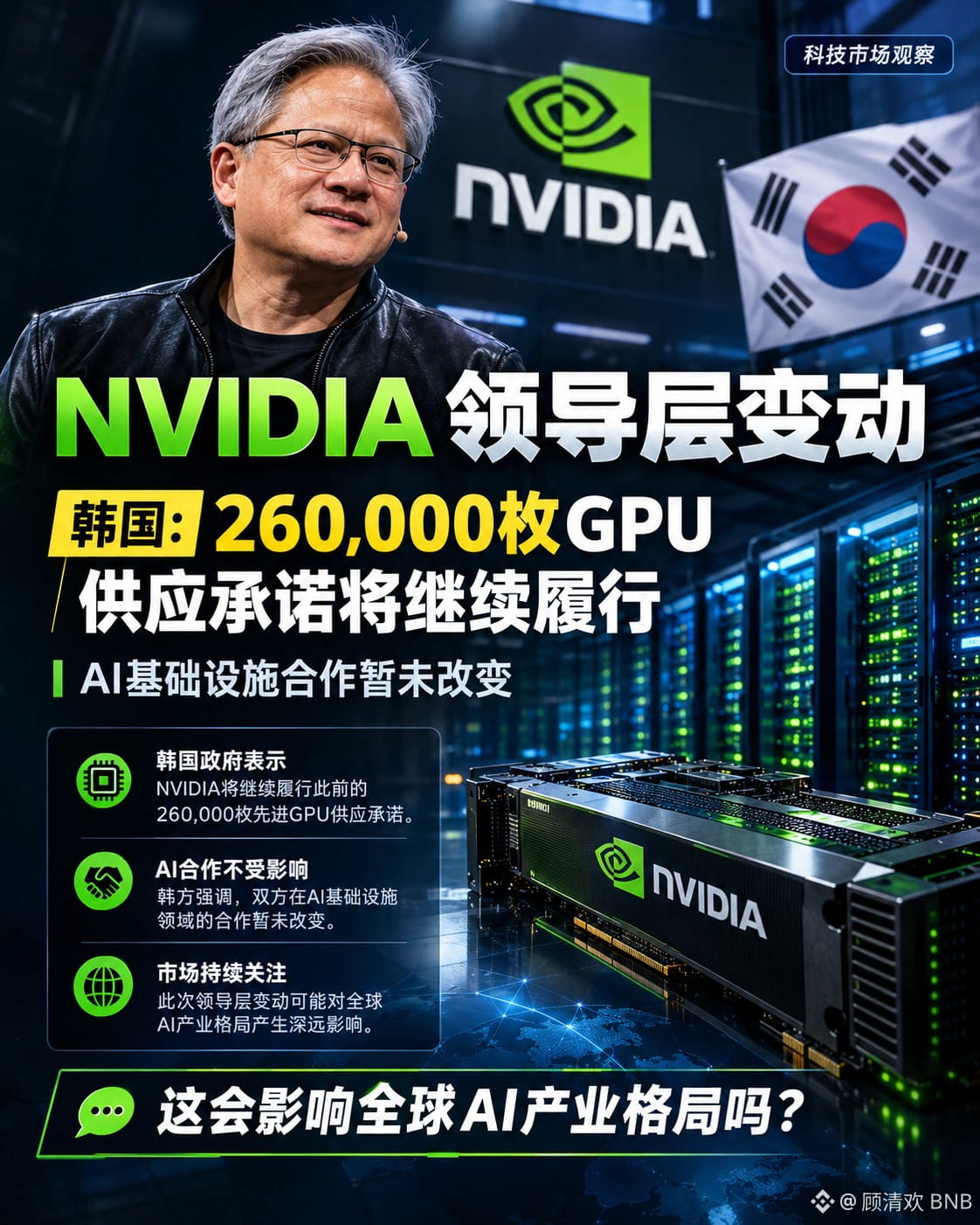
🚨 Latest NVIDIA news: South Korea confirms it will honor its commitment to supply 260,000 GPUs!
Despite major leadership changes at NVIDIA, South Korea says the AI infrastructure partnership previously agreed upon by both sides will continue to move forward.
📌 Three key points:
1️⃣ South Korea confirms that NVIDIA will honor its commitment to supply 260,000 advanced GPUs.
2️⃣ Both sides will continue to advance AI infrastructure development.
3️⃣ Cooperation between South Korean AI chipmakers and the NVIDIA platform will also continue to grow.
🔥 Market focus:
Will NVIDIA’s leadership changes affect the global AI industry supply chain?
🤔 Where do you think the biggest opportunities in the AI industry will be in the future?
Join the discussion in the comments!
#NVIDIA #GPU #Bitcoin #Binance
313

·
--
This morning’s drama was seriously jarring.
Nvidia plunged nearly 9% after hours, wiping out almost $300 billion in market value in an hour. The trigger: Jensen Huang’s second extramarital affair was exposed, and according to a WSJ report, the board is preparing to meet to discuss his future.
But just the day before, AI cloud stocks had all rebounded. CoreWeave briefly surged more than 20%, and the Nasdaq was on track for its strongest week since May. The stock had just finished celebrating, then crashed after hours. Which should you believe?
I put more faith in another data point: GPU rental rates are still rising.
Nvidia’s data center revenue hit $89 billion, up 117% year over year. The chips are really shipping. Startups want to rent computing capacity for 6–12 months to stay afloat, but suppliers are holding firm: three-year contracts, paid upfront in cash. The bottleneck now isn’t silicon—it’s who’s willing to rent to you.
Put simply: the market isn’t afraid of the present. It’s afraid that the expectations already priced in won’t be met over the next two years.
Rental rates don’t lie; stock charts tell stories. Private life is a governance risk—don’t confuse it with demand being disproven. Nvidia’s earnings report next Tuesday is the real test. Until then, trade less and watch more; your position is worth more than your opinion. NFA DYOR
$NVDA $BTC #GPU #算力租赁 #AI #英伟达 #Bitcoin
247

·
--
$NVDA Jensen Huang’s “mistress,” Huang Le, has a business story even more explosive than the gossip
Her company Megaspeed had just $5.7 million on its books, yet imported $4.8 billion worth of Nvidia equipment in less than two years—about 136,000 GPUs, more than half of them Blackwell
$5.7 million leveraged into $4.8 billion—a leverage ratio of over 800x
The company’s ownership was eventually transferred to Swiftdata, but no record of her personal stake can be found
Short-selling firm Culper alleges there were $2.9 billion in mysterious “refundable deposits,” possibly from major Chinese companies
The U.S. Department of Justice and Singapore police are both investigating; no charges have been filed so far
Jensen Huang responded: All the GPUs were accounted for, and none were illegally diverted to China
The secondhand price of B200s has already climbed to 1.58 times the original price, and rental rates are surging too. Higher GPU prices alone could mean more than a billion dollars in extra profits
An overseas shell company for a gaming firm became a major Nvidia customer in Southeast Asia in just eight months… There’s still plenty more to dig into
{spot}(NVDABUSDT)
#英伟达 #黄仁勋 #GPU
$NVDA Jensen Huang’s “mistress,” Huang Le, has a business story even more explosive than the gossip
Her company Megaspeed had just $5.7 million on its books, yet imported $4.8 billion worth of Nvidia equipment in less than two years—about 136,000 GPUs, more than half of them Blackwell
$5.7 million leveraged into $4.8 billion—a leverage ratio of over 800x
The company’s ownership was eventually transferred to Swiftdata, but no record of her personal stake can be found
Short-selling firm Culper alleges there were $2.9 billion in mysterious “refundable deposits,” possibly from major Chinese companies
The U.S. Department of Justice and Singapore police are both investigating; no charges have been filed so far
Jensen Huang responded: All the GPUs were accounted for, and none were illegally diverted to China
The secondhand price of B200s has already climbed to 1.58 times the original price, and rental rates are surging too. Higher GPU prices alone could mean more than a billion dollars in extra profits
An overseas shell company for a gaming firm became a major Nvidia customer in Southeast Asia in just eight months… There’s still plenty more to dig into
#英伟达 #黄仁勋 #GPU

178


·
--
See translation
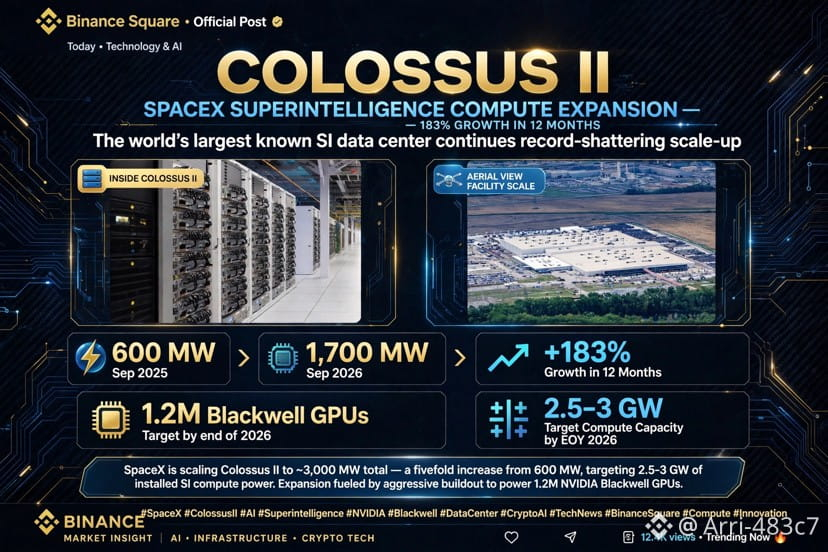
🚀 COLOSSUS II IS REWRITING THE RULES OF AI SCALE
SpaceX nearly TRIPLED its superintelligence compute in just 12 months.
⚡ Sep 2025: 600 MW
⚡ Jun 2026: 1,400 MW
⚡ Sep 2026: 1,700 MW
That's +1.1 GIGAWATTS added. A massive +183% jump.
And it's FAR from over:
🎯 1.2 MILLION NVIDIA Blackwell GPUs targeted by end of year
🎯 2.5-3 GW of installed SI compute targeted
🎯 From 600 MW to potentially 3,000 MW in just 15 months = 5X
Colossus II is already the world's largest known SI data center by estimated computing power.
This isn't just a data center. It's the infrastructure for superintelligence.
The AI race is no longer about models alone. It's about POWER, CHIPS, and SPEED OF BUILDOUT.
Whoever controls compute, controls the future.
Are we witnessing the biggest infrastructure buildout in human history? 👇
#SpaceX #ColossusII #AI #Superintelligence #NVIDIA #Blackwell #DataCenter #CryptoAI #TechNews #BinanceSquare #Compute #Innovation #AIAgents #GPU
47

·
--
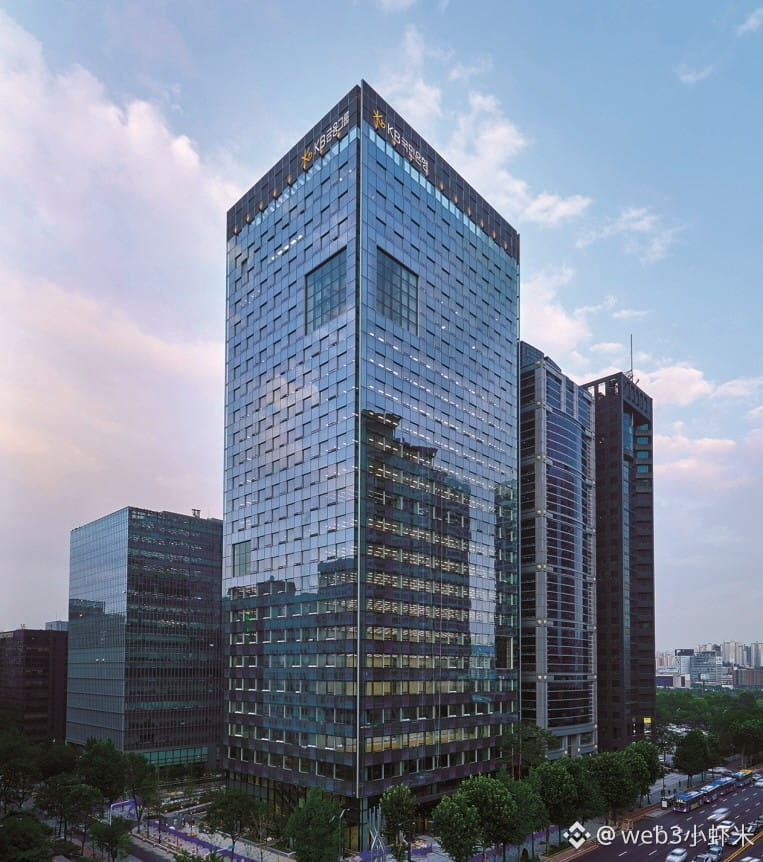
Came across this on Korea Herald: KB Kookmin Bank won the mandate as lead underwriter for a syndicated loan of about 10.7 trillion won (roughly $8 billion). The funds are going toward AI infrastructure led by Brookfield to provide computing capacity for Naver Cloud. It’s being called South Korea’s largest-ever syndicated loan and its first-ever “GPU financing.”
Key details: The entire project is worth about 12.6–13 trillion won. Brookfield will set up an SPC (tentatively named Asset Co.) to purchase GPUs and other equipment, then provide them to Naver Cloud on a long-term basis. Last week, Naver signed a $9 billion infrastructure agreement—a precondition for Nvidia’s planned strategic investment of about $1 billion. Target capacity is about 55 MW in the first half of 2027, 100 MW by year-end, and 200 MW in 2028, at GAK Sejong, with about 100,000 Nvidia GPUs planned. Naver has also provided a nominal guarantee cap of about 18.74 trillion won for its payment obligations to Cloud (assuming the full $9 billion investment limit is used).
Project financing has traditionally focused on real estate and power plants. This time, “long-term computing fees” are being treated as cash flow to leverage GPU investment—pushing AI infrastructure financing in South Korea up a notch.
#AI #Naver #GPU
16


How long does a data-center-class GPU actually last?This is an interesting question, but before answering, we first need to define what we mean by “GPU lifespan.”
Think of it like a phone: it might still power on normally and connect to the internet, but you’d never actually want to use it. Has that phone reached the end of its lifespan?
So, let’s assume a data-center-class GPU is considered to have reached the end of its life only when it can no longer power on at all. NVIDIA GPUs typically have an extreme physical lifespan of 8 to 12 years.
#GPU
$NVDAB $NVDA
Ignoring power efficiency and operating economics entirely, and running continuously 24 hours a day until the GPU hardware itself suffers irreparable physical damage (such as aging and failure of the silicon wafer/3D packaging, failure of the VRAM solder joints, or a burned-out PCB), the extreme physical lifespan of an NVIDIA data-center-class GPU is about 8 to 12 years (a very small number of exceptionally lucky cases may reach 15 years).
How long does a data-center-class GPU actually last?
This is an interesting question, but before answering, we first need to define what we mean by “GPU lifespan.”
Think of it like a phone: it might still power on normally and connect to the internet, but you’d never actually want to use it. Has that phone reached the end of its lifespan?
So, let’s assume a data-center-class GPU is considered to have reached the end of its life only when it can no longer power on at all. NVIDIA GPUs typically have an extreme physical lifespan of 8 to 12 years.
#GPU
$NVDAB $NVDA
Ignoring power efficiency and operating economics entirely, and running continuously 24 hours a day until the GPU hardware itself suffers irreparable physical damage (such as aging and failure of the silicon wafer/3D packaging, failure of the VRAM solder joints, or a burned-out PCB), the extreme physical lifespan of an NVIDIA data-center-class GPU is about 8 to 12 years (a very small number of exceptionally lucky cases may reach 15 years).
74

·
--
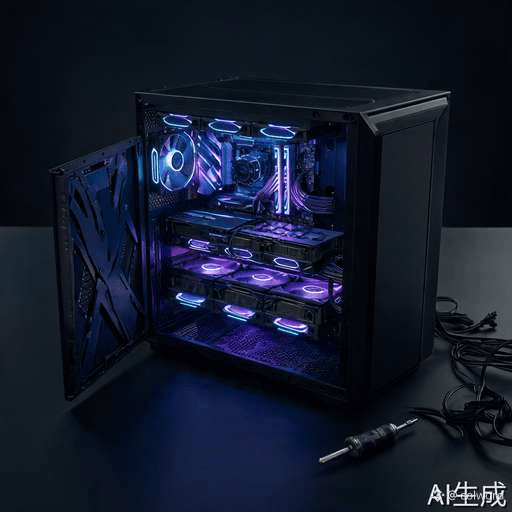
Building your own rig or renting cloud computing power—the break-even point is more complicated than the formulas circulating online.
You need to account for more than just the price of the GPU and electricity. There’s also idle time, hidden costs like cooling and noise, seasonal fluctuations in electricity rates, and the opportunity cost of not being able to use the machine for anything else.
Based on my experience, a self-built setup with utilization below 40% will almost certainly lose out to the cloud. Building your own only starts to make sense when utilization stays above 70% over the long term and your workloads aren’t latency-sensitive.
Measure your own utilization first, then decide whether to buy a GPU.
#GPU #算力成本
57

·
--
See translation
🚨 $SPCX : THE AI COMPUTE BOTTLENECK NOBODY IS TALKING ABOUT! ⚡
🗣️ Elon Musk warns that GPUs could arrive faster than the power infrastructure needed to run them, leaving data centers partially completed.
📉 The bearish side: Idle GPUs risk losing value as newer generations arrive.
📈 The bullish twist: Companies with secured power and ready-to-run data centers could benefit from tight GPU rental supply and potentially stronger pricing.
🔥 The key takeaway: In the AI race, having GPUs isn't enough — having the power to run them could be the real advantage.
👀 Watch power capacity, GPU rental prices, and infrastructure rollout before drawing conclusions on $SPCX
{future}(SPCXUSDT)
.
#SPCX #GPU #DataCentersForAI #CryptoNews
🚨 $SPCX : THE AI COMPUTE BOTTLENECK NOBODY IS TALKING ABOUT! ⚡
🗣️ Elon Musk warns that GPUs could arrive faster than the power infrastructure needed to run them, leaving data centers partially completed.
📉 The bearish side: Idle GPUs risk losing value as newer generations arrive.
📈 The bullish twist: Companies with secured power and ready-to-run data centers could benefit from tight GPU rental supply and potentially stronger pricing.
🔥 The key takeaway: In the AI race, having GPUs isn't enough — having the power to run them could be the real advantage.
👀 Watch power capacity, GPU rental prices, and infrastructure rollout before drawing conclusions on $SPCX
.
#SPCX #GPU #DataCentersForAI #CryptoNews
294

·
--
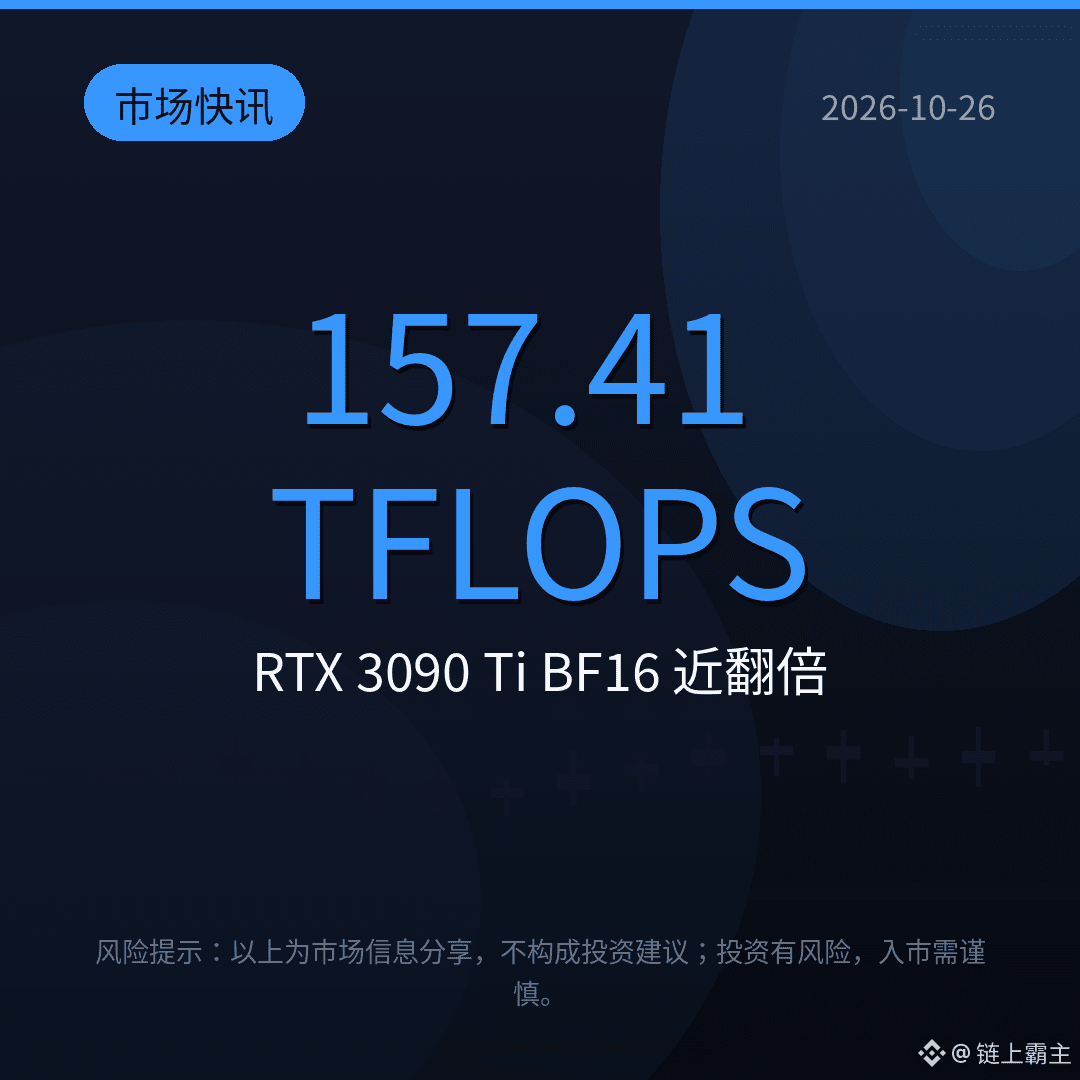
【Market Flash】RTX 3090 Ti BF16 nearly doubles: Open-source software unlocks Ampere cards, boosting BF16 from 87.50 to 157.41 TFLOPS at 450W.
LLM prefill speeds up by 14%–36%, while decode is barely affected. Linux only and experimental; used 3090s are reportedly going for over $2,000. Is hunting for an older card worth it?
$BTC $ETH $TAO
#AI #GPU #Computing Power
(Source: BlockTempo)
⚠️Risk warning: The above is shared for informational purposes only and does not constitute investment advice. Investing involves risks; proceed with caution.
199

·
--
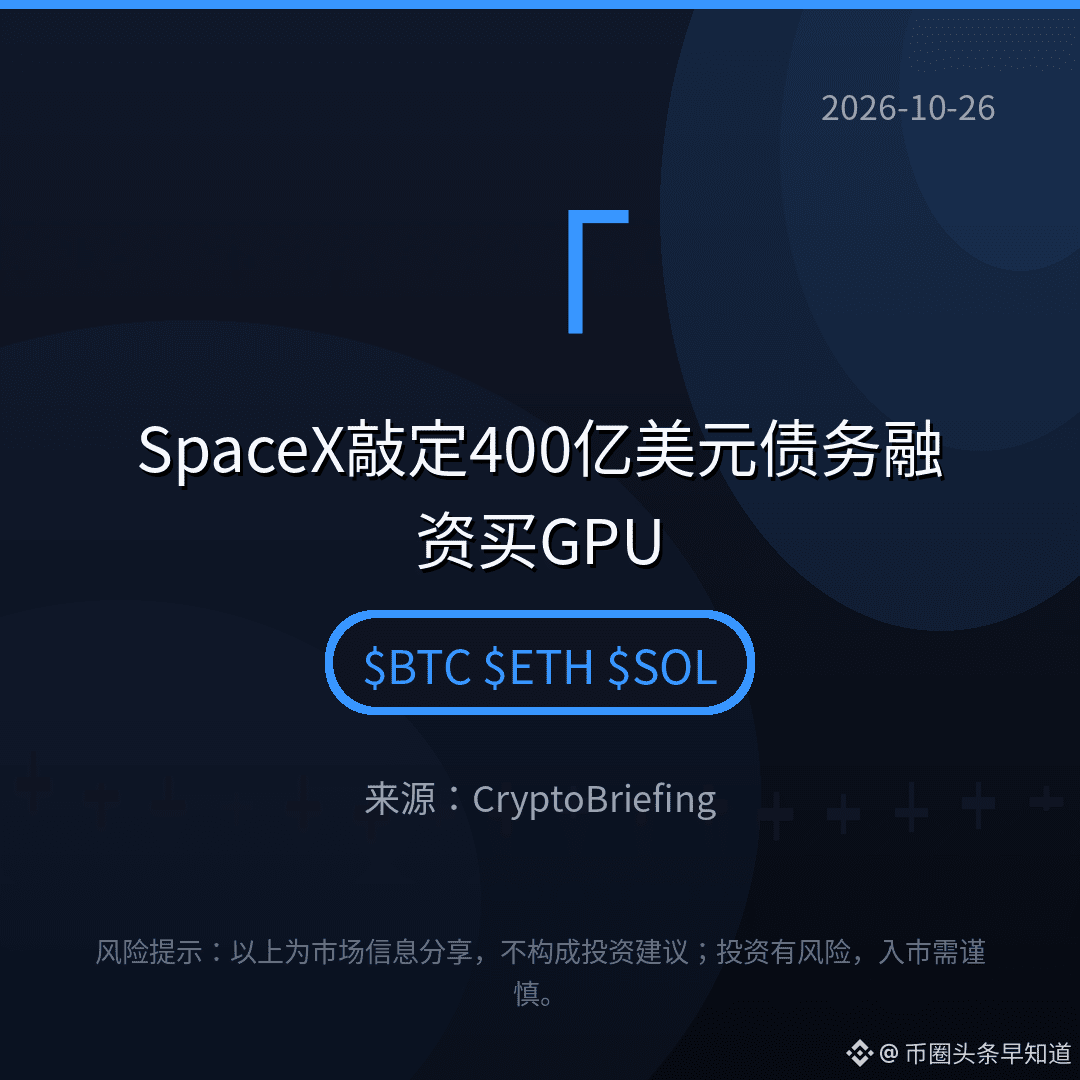
【Market Flash】SpaceX has finalized $40 billion in debt financing to buy GPUs, with the chips due to arrive in the first half of 2027.
Musk laid out the source of its confidence: an investment-grade rating, backed by Starlink revenue. For AI companies without revenue to fall back on, the window is narrowing.
It has already raised $86 billion through an IPO and issued $25 billion in bonds this year, yet it’s still ramping up GPU purchases. Will the AI computing landscape be reshuffled first?
$BTC $ETH $SOL
#SpaceX #人工智能 #GPU
(Source: CryptoBriefing)
⚠️Risk warning: The above is shared for market information only and does not constitute investment advice. Investing involves risk; please exercise caution.
436

See translation
Starting next month, every GPU job on Aethir's network starts feeding a daily $ATH burn.
The network announced this week it will burn a share of network fees every day from November, with a burn dashboard going live on the first burn. More compute reservations, bigger burns; fixed fees become floating, and the ACCELERATE build-out adds US and European compute sites into the same pipeline.
The tension: nobody knows the burn rate. The formula's details and actual fee volumes are still unknowns — the network itself says fees can drop to zero in weak markets.
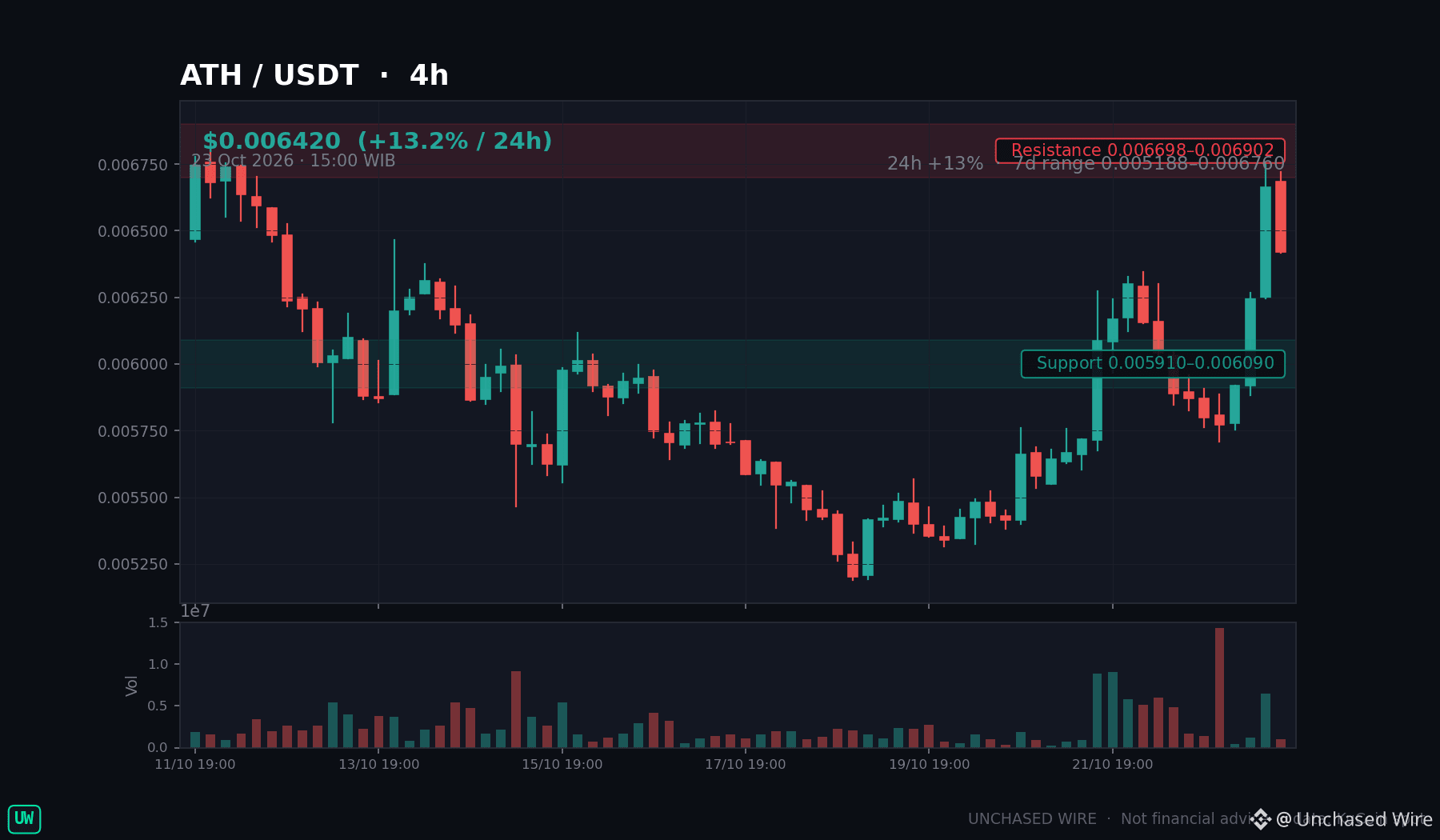
$ATH is up ~9.5% in 24h to $0.00644, testing $0.0068. Support $0.0060, the pre-pop base; a 4h close under $0.0060 ends the momentum read. The honest risk: the headline is two days old, $ATH trades ~96% below its 2024 high, and 20B of 42B max supply is circulating.
Save these levels: $0.0060 decides the momentum read, $0.0068 is the break test. If November's burns beat the market's guess — where does ATH find its real ceiling? NFA. DYOR.
$ATH #Altcoins #Aethir #TokenBurn #GPU
17

Verified
See translation
🔥 LATEST: Intercontinental Exchange expands deeper into AI markets ⚡🤖
What is happening?
• ICE, parent company of the New York Stock Exchange, plans to launch computing power futures $ZEC
• Contracts tied to GPU and AI infrastructure costs $WLD
• Would create tradable markets around AI compute demand $LTC
• AI infrastructure increasingly becoming a financial asset class
What this suggests:
• AI compute is evolving into a strategic commodity
• Financial markets preparing for massive AI infrastructure growth
• GPU scarcity and compute pricing becoming hedgeable risks
Context:
• AI companies face soaring demand for chips, cloud capacity, and electricity
• Futures markets could help firms manage volatility in compute costs similar to energy or commodities
📊 Market takeaway:
Bullish for the AI infrastructure narrative. The creation of compute futures signals Wall Street increasingly views AI processing power as core economic infrastructure with long-term institutional demand.
#ICE #AI #GPU

1.8k

·
--
Columbia University is 5000 miles away, but with HIVE, they're remotely training AI on an A40 old card in Paraguay, and the performance is surprisingly keeping up with the H100. Those old miners holding onto this batch of 'electronic waste' just hit the jackpot, and the stock price skyrocketed into double digits. If this narrative of low-cost remote computing takes off, the dream of turning mining farms into AI factories could go on a bit longer. However, the A40's battle for the future is still just hype; it'll depend on whether the next wave of orders can keep up. #AI #GPU $HIVE
{future}(HIVEUSDT)
Columbia University is 5000 miles away, but with HIVE, they're remotely training AI on an A40 old card in Paraguay, and the performance is surprisingly keeping up with the H100. Those old miners holding onto this batch of 'electronic waste' just hit the jackpot, and the stock price skyrocketed into double digits. If this narrative of low-cost remote computing takes off, the dream of turning mining farms into AI factories could go on a bit longer. However, the A40's battle for the future is still just hype; it'll depend on whether the next wave of orders can keep up. #AI #GPU $HIVE

115

·
--
See translation
$RNDR DROPS AS GPU RENTAL PRICES FALL – AI ADOPTION DRIVES COMPUTE DEMAND 🔥
The recent data from Silicon Data shows a clear pattern: low-cost open-source models are driving down H100 GPU spot rental prices and pushing token price indexes lower.
However, this is not a sign of weakening AI demand. In fact, the migration to efficient models is increasing overall computational consumption, which sustains high-end GPU needs. The market is repricing short-term sentiment while the underlying trend remains bullish for compute assets.
Are you treating this dip as a buying opportunity or waiting for clearer support?
Not financial advice. Always manage your risk.
#RNDR #AITokens #GPU #CryptoAnalysis
🔥
86

·
--
1. Background
Today's market discussion revolves around the rebound in rental prices for high-end GPUs like H100 and the tightness in spot computing power. Bin's assessment indicates that the core focus is not merely on a short-term price increase, but rather that high-end computing power is entering a stage of 'structural scarcity.' The current demand is no longer solely driven by large model training; AI Agents, quantitative trading, and inference services are becoming new essential needs more focused on sustained operations. Especially for institutions, computing power has shifted from being optional to a fundamental production resource, leading to reduced price sensitivity, which significantly weakens the elasticity of the GPU rental market. 🤖
2. Core Analysis
From a supply perspective, the H100 is a high-performance general-purpose computing asset, and factors like procurement cycles, deployment timelines, data center setups, and electrical and network resources will limit short-term expansion speed. Even if new capital enters the market, it will be challenging to quickly alleviate the tightness of high-end cards. Therefore, the price rebound is not just driven by sentiment; it reflects a slower release of high-end computing power supply.
On the demand side, what stands out in this current upswing is the enhancement of 'demand quality.' AI Agents require stable inference and multitasking capabilities, while quantitative trading places greater emphasis on low latency and continuous computing power. These types of clients typically prioritize resource availability and service stability over merely lowering rental prices. In other words, the demand side is shifting from 'experimental procurement' to 'operational locking,' which will reinforce the premium for quality computing resources.
Moreover, the market is not underestimating the total computing power, but rather the proportion of high-end computing power that can be directly utilized for high-value scenarios. Mid-range and low-end GPUs may not be able to replace the advantages of the H100 in training, inference efficiency, and energy consumption ratio. Thus, 'having cards' and 'having available high-end cards' are two different things. This is also key to the establishment of structural scarcity.
3. Market Impact
For the AI industry chain, the strengthening prices of high-end GPUs may continue to benefit segments like computing power rental, IDC, liquid cooling, server hardware, and high-speed interconnects. For startup teams relying on external computing power, cost pressures will increase, potentially leading to further concentration in leading platforms. For secondary market funds, if the tightness of high-end computing power persists, the valuation logic for related concepts may shift from 'theme-driven' to 'performance validation-driven.'
This change is equally noteworthy for the crypto market. The competition for computing power between AI and quantitative trading may enhance discussions around GPUs, computing power networks, and distributed computing. However, investors should remain objective: rising computing power prices do not necessarily translate to a universal surge in all related tokens or concepts; the real beneficiaries will still be projects with resource integration, delivery capabilities, and stable demand orders.
4. Conclusion
In summary, the signal released by today's news indicates that the high-end GPU market is transitioning from cyclical fluctuations to a state of structural tension due to mismatched supply and demand. If AI applications continue to be implemented and institutional demand remains rigid, the price center for computing power may still have support. In the short term, market focus will be on the speed of recovery in spot supply; in the mid-term, those who can secure stable high-end computing power are more likely to gain an advantage in the commercialization competition of AI. 📈
#AI #GPU #crypto
34
Log in to explore more content
Join global crypto users on Binance Square
⚡️ Get latest and useful information about crypto.
💬 Trusted by the world’s largest crypto exchange.
👍 Discover real insights from verified creators.
Email / Phone number
Trending Topics
1
#BTCReboundsAbove$60KAmidWhaleDipBuying
95,087 views
415 Discussing
2
#SolanaSets2027RoadmapToDoubleComputeCapacity
79,255 views
1,184 Discussing
3
#CaliforniaNvidiaProbeExaminesPotentialCriminalViolations
21,820 views
177 Discussing
4
#BlackRockLaunchesHKDollarDigitalLiquidityFund
67,572 views
865 Discussing
5
#NvidiaLoses$2.7TrillionInMonthAndAHalf
85,486 views
343 Discussing
6
#GlobalStocksFaceLongestLosingStreakSince2023
603,099 views
3,596 Discussing
7
#BlackRockIBITPostsRecord$541MSingleDayOutflow
102,665 views
188 Discussing
8
#AnthropicPlungesTowardIPOPriceonDay2
337,481 views
2,416 Discussing
9
#TwentyOneCapitalAdds172.25BTC
185,070 views
1,718 Discussing
10
#HKBillWouldExcludeTokenizedDepositsFromVirtualAssets
19,428 views
110 Discussing