

#cryptoadoption
cryptoadoption
13.5M views
16,537 Discussing
Bank of Montreal (BMO), Canada's third-largest bank, has acquired around $150 million in spot Bitcoin ETFs! 🔥📈 Of this investment, $139 million has been allocated to BlackRock's iShares Bitcoin ETF, while the remaining $11 million is spread across three other Bitcoin funds.This is a huge step forward for traditional financial institutions embracing the Bitcoin revolution! 🏦💎What do you think about this major institutional move? Let’s hear your thoughts! 👇
Hot
Latest

·
--
See translation
The Sovereign Reserve Asset Thesis — Why Nations Will Hold $BTC
For decades, nations stored reserves in gold and U.S. Treasuries. Bitcoin is now quietly entering that conversation — not as speculation, but as a censorship-resistant, bearer-asset alternative with a fixed 21 million supply.
Here is why the sovereign reserve narrative is gaining traction:
1. Sanctions exposure. Nations holding USD-denominated reserves can be frozen overnight. Bitcoin balances cannot be confiscated remotely. That is a structural advantage no other asset class offers.
2. Deflationary supply cap. Unlike gold, Bitcoin scarcity is mathematically enforced by protocol. No mining supercycle can dilute the cap. Sovereigns accumulating now lock in a permanent allocation at a known supply ceiling.
3. Verifiable custody. A nation can self-custody $BTC with full on-chain proof of reserves — no custodian counterparty risk, no third-party attestation required.
4. Precedent is accelerating. El Salvador was dismissed as an experiment. Now sovereign wealth discussions in the Gulf, Asia, and Latin America reference Bitcoin as a reserve diversifier alongside $ETH and $BNB for broader digital infrastructure holdings.
The long game: Bitcoin does not need to replace Treasuries. It only needs to capture 1-2% of global reserve portfolios to reprice dramatically. That reallocation has barely begun.
The strongest hands in the next cycle may not be retail — they may carry diplomatic passports.
#Bitcoin #CryptoAdoption #SovereignReserve #MacroCrypto #BinanceSquare
The Sovereign Reserve Asset Thesis — Why Nations Will Hold $BTC
For decades, nations stored reserves in gold and U.S. Treasuries. Bitcoin is now quietly entering that conversation — not as speculation, but as a censorship-resistant, bearer-asset alternative with a fixed 21 million supply.
Here is why the sovereign reserve narrative is gaining traction:
1. Sanctions exposure. Nations holding USD-denominated reserves can be frozen overnight. Bitcoin balances cannot be confiscated remotely. That is a structural advantage no other asset class offers.
2. Deflationary supply cap. Unlike gold, Bitcoin scarcity is mathematically enforced by protocol. No mining supercycle can dilute the cap. Sovereigns accumulating now lock in a permanent allocation at a known supply ceiling.
3. Verifiable custody. A nation can self-custody $BTC with full on-chain proof of reserves — no custodian counterparty risk, no third-party attestation required.
4. Precedent is accelerating. El Salvador was dismissed as an experiment. Now sovereign wealth discussions in the Gulf, Asia, and Latin America reference Bitcoin as a reserve diversifier alongside $ETH and $BNB for broader digital infrastructure holdings.
The long game: Bitcoin does not need to replace Treasuries. It only needs to capture 1-2% of global reserve portfolios to reprice dramatically. That reallocation has barely begun.
The strongest hands in the next cycle may not be retail — they may carry diplomatic passports.
#Bitcoin #CryptoAdoption #SovereignReserve #MacroCrypto #BinanceSquare
For decades, nations stored reserves in gold and U.S. Treasuries. Bitcoin is now quietly entering that conversation — not as speculation, but as a censorship-resistant, bearer-asset alternative with a fixed 21 million supply.
Here is why the sovereign reserve narrative is gaining traction:
1. Sanctions exposure. Nations holding USD-denominated reserves can be frozen overnight. Bitcoin balances cannot be confiscated remotely. That is a structural advantage no other asset class offers.
2. Deflationary supply cap. Unlike gold, Bitcoin scarcity is mathematically enforced by protocol. No mining supercycle can dilute the cap. Sovereigns accumulating now lock in a permanent allocation at a known supply ceiling.
3. Verifiable custody. A nation can self-custody $BTC with full on-chain proof of reserves — no custodian counterparty risk, no third-party attestation required.
4. Precedent is accelerating. El Salvador was dismissed as an experiment. Now sovereign wealth discussions in the Gulf, Asia, and Latin America reference Bitcoin as a reserve diversifier alongside $ETH and $BNB for broader digital infrastructure holdings.
The long game: Bitcoin does not need to replace Treasuries. It only needs to capture 1-2% of global reserve portfolios to reprice dramatically. That reallocation has barely begun.
The strongest hands in the next cycle may not be retail — they may carry diplomatic passports.
#Bitcoin #CryptoAdoption #SovereignReserve #MacroCrypto #BinanceSquare
36

Article
See translation
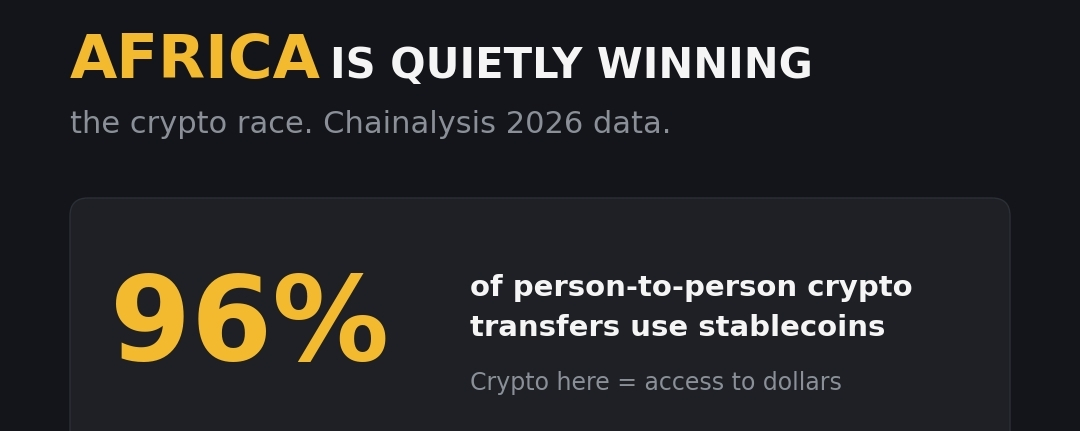
Africa is quietly winning the crypto race 🌍While much of the market struggled this year, Africa kept growing. Writing from Bujumbura 🇧🇮, here's what the data shows:
📈 Fastest growth in the world. Chainalysis's 2026 report found Sub-Saharan Africa had the fastest crypto adoption growth of any region, during one of the toughest markets since 2022.
🇳🇬 Nigeria is #1 globally for both P2P activity and cross-border crypto flows. South Africa ranks in the global top 10.
💵 It's not about speculation. Stablecoins like $USDC and USDT make up 96% of person-to-person crypto transfers. People use crypto to protect savings from inflation, send money across borders, and access dollars.
🤝 Binance is betting on Africa: exploring P2P integration and crypto education with telecom operator Africell, and working with governments across the continent.
What this means:
Western markets trade crypto. Africa uses it. When $BTC drops, people here don't stop sending money home or protecting their savings.
My view: the next wave of crypto users won't come from Wall Street. It will come from Lagos, Nairobi, Kinshasa, and Bujumbura.
Fellow Africans: what do you mainly use crypto for? Savings, sending money, or trading? 👇
#Africa #CryptoAdoption
Africa is quietly winning the crypto race 🌍
While much of the market struggled this year, Africa kept growing. Writing from Bujumbura 🇧🇮, here's what the data shows:
📈 Fastest growth in the world. Chainalysis's 2026 report found Sub-Saharan Africa had the fastest crypto adoption growth of any region, during one of the toughest markets since 2022.
🇳🇬 Nigeria is #1 globally for both P2P activity and cross-border crypto flows. South Africa ranks in the global top 10.
💵 It's not about speculation. Stablecoins like $USDC and USDT make up 96% of person-to-person crypto transfers. People use crypto to protect savings from inflation, send money across borders, and access dollars.
🤝 Binance is betting on Africa: exploring P2P integration and crypto education with telecom operator Africell, and working with governments across the continent.
What this means:
Western markets trade crypto. Africa uses it. When $BTC drops, people here don't stop sending money home or protecting their savings.
My view: the next wave of crypto users won't come from Wall Street. It will come from Lagos, Nairobi, Kinshasa, and Bujumbura.
Fellow Africans: what do you mainly use crypto for? Savings, sending money, or trading? 👇
#Africa #CryptoAdoption
📈 Fastest growth in the world. Chainalysis's 2026 report found Sub-Saharan Africa had the fastest crypto adoption growth of any region, during one of the toughest markets since 2022.
🇳🇬 Nigeria is #1 globally for both P2P activity and cross-border crypto flows. South Africa ranks in the global top 10.
💵 It's not about speculation. Stablecoins like $USDC and USDT make up 96% of person-to-person crypto transfers. People use crypto to protect savings from inflation, send money across borders, and access dollars.
🤝 Binance is betting on Africa: exploring P2P integration and crypto education with telecom operator Africell, and working with governments across the continent.
What this means:
Western markets trade crypto. Africa uses it. When $BTC drops, people here don't stop sending money home or protecting their savings.
My view: the next wave of crypto users won't come from Wall Street. It will come from Lagos, Nairobi, Kinshasa, and Bujumbura.
Fellow Africans: what do you mainly use crypto for? Savings, sending money, or trading? 👇
#Africa #CryptoAdoption
10
·
--
See translation
Correspondent banking is one of the most expensive, slowest systems in global finance — yet it moves trillions of dollars every year.
A cross-border wire can take 3–5 business days, cost 25–45 USD in fees, and route through multiple intermediary banks. The real hidden cost is even larger: pre-funded nostro accounts sitting idle in dozens of currencies just to keep the rails alive. The IMF estimates 27 trillion USD in nostro capital is locked globally at any given time. That is an enormous inefficiency waiting to be displaced.
This is the specific problem $XRP and Ripple's network were built to solve. Instead of locking up capital in nostro accounts, a financial institution can source on-demand liquidity, bridge the transaction in seconds, and settle — no pre-positioned capital required.
What makes institutional adoption realistic now is regulatory clarity. Ripple's legal resolution with the SEC removed the primary compliance blocker keeping banks on the sidelines. The post-settlement environment is structurally different from two years ago.
$BTC proved borderless value transfer works. $ETH proved smart contract settlement is programmable. $XRP's thesis is narrower: make the existing correspondent banking infrastructure 60–80% cheaper to run.
Narrower institutional theses with clear counterparties tend to close faster than broad platform bets. Watch actual corridor volumes, not just partnership announcements.
#CrossBorderPayments #CryptoAdoption #RippleEffect #Blockchain
Correspondent banking is one of the most expensive, slowest systems in global finance — yet it moves trillions of dollars every year.
A cross-border wire can take 3–5 business days, cost 25–45 USD in fees, and route through multiple intermediary banks. The real hidden cost is even larger: pre-funded nostro accounts sitting idle in dozens of currencies just to keep the rails alive. The IMF estimates 27 trillion USD in nostro capital is locked globally at any given time. That is an enormous inefficiency waiting to be displaced.
This is the specific problem $XRP and Ripple's network were built to solve. Instead of locking up capital in nostro accounts, a financial institution can source on-demand liquidity, bridge the transaction in seconds, and settle — no pre-positioned capital required.
What makes institutional adoption realistic now is regulatory clarity. Ripple's legal resolution with the SEC removed the primary compliance blocker keeping banks on the sidelines. The post-settlement environment is structurally different from two years ago.
$BTC proved borderless value transfer works. $ETH proved smart contract settlement is programmable. $XRP 's thesis is narrower: make the existing correspondent banking infrastructure 60–80% cheaper to run.
Narrower institutional theses with clear counterparties tend to close faster than broad platform bets. Watch actual corridor volumes, not just partnership announcements.
#CrossBorderPayments #CryptoAdoption #RippleEffect #Blockchain
A cross-border wire can take 3–5 business days, cost 25–45 USD in fees, and route through multiple intermediary banks. The real hidden cost is even larger: pre-funded nostro accounts sitting idle in dozens of currencies just to keep the rails alive. The IMF estimates 27 trillion USD in nostro capital is locked globally at any given time. That is an enormous inefficiency waiting to be displaced.
This is the specific problem $XRP and Ripple's network were built to solve. Instead of locking up capital in nostro accounts, a financial institution can source on-demand liquidity, bridge the transaction in seconds, and settle — no pre-positioned capital required.
What makes institutional adoption realistic now is regulatory clarity. Ripple's legal resolution with the SEC removed the primary compliance blocker keeping banks on the sidelines. The post-settlement environment is structurally different from two years ago.
$BTC proved borderless value transfer works. $ETH proved smart contract settlement is programmable. $XRP 's thesis is narrower: make the existing correspondent banking infrastructure 60–80% cheaper to run.
Narrower institutional theses with clear counterparties tend to close faster than broad platform bets. Watch actual corridor volumes, not just partnership announcements.
#CrossBorderPayments #CryptoAdoption #RippleEffect #Blockchain
109

·
--
See translation
🚨 Crypto Adoption Is Entering a New Phase
The crypto industry is shifting from building blockchain technology to driving real-world adoption. Companies like Coinbase and WisdomTree are focusing on making crypto products easier, more useful, and accessible, while investors like Kevin O’Leary argue that blockchain networks need to prove real customers, deals, and usage — not just tests. 🔥
#Crypto #Bitcoin #Web3 #ETH #CryptoAdoption
🚨 Crypto Adoption Is Entering a New Phase
The crypto industry is shifting from building blockchain technology to driving real-world adoption. Companies like Coinbase and WisdomTree are focusing on making crypto products easier, more useful, and accessible, while investors like Kevin O’Leary argue that blockchain networks need to prove real customers, deals, and usage — not just tests. 🔥
#Crypto #Bitcoin #Web3 #ETH #CryptoAdoption
The crypto industry is shifting from building blockchain technology to driving real-world adoption. Companies like Coinbase and WisdomTree are focusing on making crypto products easier, more useful, and accessible, while investors like Kevin O’Leary argue that blockchain networks need to prove real customers, deals, and usage — not just tests. 🔥
#Crypto #Bitcoin #Web3 #ETH #CryptoAdoption
74
·
--
Stripe is accelerating the global adoption of cryptocurrencies by announcing the expansion of its stablecoin cards to more than 100 countries by the end of the year. 🌍
This move reduces long-standing friction between traditional payment rails and on-chain liquidity, making it easier to use digital assets every day at scale.
Why does it matter? Global interoperability boosts the real-world utility of stablecoins beyond exchanges, integrating them into international commerce.
Keep a close eye on how transaction volumes on key networks respond, as well as local regulatory reactions in emerging markets. 📊
#Stablecoins #CryptoAdoption #PagosDigitales $USDC $USDT
Stripe is accelerating the global adoption of cryptocurrencies by announcing the expansion of its stablecoin cards to more than 100 countries by the end of the year. 🌍
This move reduces long-standing friction between traditional payment rails and on-chain liquidity, making it easier to use digital assets every day at scale.
Why does it matter? Global interoperability boosts the real-world utility of stablecoins beyond exchanges, integrating them into international commerce.
Keep a close eye on how transaction volumes on key networks respond, as well as local regulatory reactions in emerging markets. 📊
#Stablecoins #CryptoAdoption #PagosDigitales $USDC $USDT
This move reduces long-standing friction between traditional payment rails and on-chain liquidity, making it easier to use digital assets every day at scale.
Why does it matter? Global interoperability boosts the real-world utility of stablecoins beyond exchanges, integrating them into international commerce.
Keep a close eye on how transaction volumes on key networks respond, as well as local regulatory reactions in emerging markets. 📊
#Stablecoins #CryptoAdoption #PagosDigitales $USDC $USDT
1
·
--
See translation
Bitcoin as collateral is one of the most underappreciated structural shifts happening in finance right now.
For most of its history, $BTC was seen as a speculative asset — something you buy and hold hoping for price appreciation. That narrative is quietly being replaced by something more powerful: Bitcoin as productive collateral.
Here is how the shift is playing out. Corporations are holding BTC on their balance sheets and using it as collateral for operating credit lines rather than selling to raise cash. Prime brokers are now offering BTC-backed loans to institutional clients at rates that rival traditional securities lending. Sovereign wealth funds exploring crypto exposure are more interested in collateral utility than speculative returns.
This matters structurally because collateral demand creates a different category of buyer. A speculative buyer sells when sentiment turns. A collateral user holds — because liquidating the collateral defeats the purpose of the credit facility. This creates a stickier bid beneath the market.
$ETH is following a parallel path through restaking, where staked ETH becomes collateral for security provisioning across multiple protocols. $BNB plays a similar role within the BNB Chain ecosystem, enabling DeFi credit facilities without requiring asset liquidation.
The long-term implication: as major crypto assets deepen their roles in credit markets, volatility structurally compresses over multi-year cycles — not because of less interest, but because of more sophisticated, longer-duration holders.
The asset class is growing up. Watch the collateral layer, not just the price.
#Bitcoin #CryptoAdoption #DeFi #CryptoInvesting #BlockchainFinance
Bitcoin as collateral is one of the most underappreciated structural shifts happening in finance right now.
For most of its history, $BTC was seen as a speculative asset — something you buy and hold hoping for price appreciation. That narrative is quietly being replaced by something more powerful: Bitcoin as productive collateral.
Here is how the shift is playing out. Corporations are holding BTC on their balance sheets and using it as collateral for operating credit lines rather than selling to raise cash. Prime brokers are now offering BTC-backed loans to institutional clients at rates that rival traditional securities lending. Sovereign wealth funds exploring crypto exposure are more interested in collateral utility than speculative returns.
This matters structurally because collateral demand creates a different category of buyer. A speculative buyer sells when sentiment turns. A collateral user holds — because liquidating the collateral defeats the purpose of the credit facility. This creates a stickier bid beneath the market.
$ETH is following a parallel path through restaking, where staked ETH becomes collateral for security provisioning across multiple protocols. $BNB plays a similar role within the BNB Chain ecosystem, enabling DeFi credit facilities without requiring asset liquidation.
The long-term implication: as major crypto assets deepen their roles in credit markets, volatility structurally compresses over multi-year cycles — not because of less interest, but because of more sophisticated, longer-duration holders.
The asset class is growing up. Watch the collateral layer, not just the price.
#Bitcoin #CryptoAdoption #DeFi #CryptoInvesting #BlockchainFinance
For most of its history, $BTC was seen as a speculative asset — something you buy and hold hoping for price appreciation. That narrative is quietly being replaced by something more powerful: Bitcoin as productive collateral.
Here is how the shift is playing out. Corporations are holding BTC on their balance sheets and using it as collateral for operating credit lines rather than selling to raise cash. Prime brokers are now offering BTC-backed loans to institutional clients at rates that rival traditional securities lending. Sovereign wealth funds exploring crypto exposure are more interested in collateral utility than speculative returns.
This matters structurally because collateral demand creates a different category of buyer. A speculative buyer sells when sentiment turns. A collateral user holds — because liquidating the collateral defeats the purpose of the credit facility. This creates a stickier bid beneath the market.
$ETH is following a parallel path through restaking, where staked ETH becomes collateral for security provisioning across multiple protocols. $BNB plays a similar role within the BNB Chain ecosystem, enabling DeFi credit facilities without requiring asset liquidation.
The long-term implication: as major crypto assets deepen their roles in credit markets, volatility structurally compresses over multi-year cycles — not because of less interest, but because of more sophisticated, longer-duration holders.
The asset class is growing up. Watch the collateral layer, not just the price.
#Bitcoin #CryptoAdoption #DeFi #CryptoInvesting #BlockchainFinance
37

See translation
🚨 MAJOR REAL-WORLD LIQUIDITY INTEGRATION BRINGS $USDT PAYMENTS TO MILLIONS OF JAPANESE MERCHANTS! ⚡
A top-tier exchange payment network is connecting directly into Japan's massive PayPay system via the HIVEX interoperability framework. 🌊 International visitors can now spend $USDT across millions of retail locations, vending machines, taxis, and public transit without individual merchant onboarding.
💡 Seamless off-ramping into local merchant JPY settlement represents a major institutional leap forward for real-world crypto utility. 📊 Expanding friction-free transactional velocity across international corridors builds sustained structural demand for stablecoins.
💬 Do you see direct real-world payment rails as the primary driver for stablecoin velocity moving forward? 👇
⚠️ Not financial advice. Always manage your risk. 🛡️
🏷️ #USDT #CryptoAdoption #Web3Payments #Stablecoins
⚡ 💎
🚨 MAJOR REAL-WORLD LIQUIDITY INTEGRATION BRINGS $USDT PAYMENTS TO MILLIONS OF JAPANESE MERCHANTS! ⚡
A top-tier exchange payment network is connecting directly into Japan's massive PayPay system via the HIVEX interoperability framework. 🌊 International visitors can now spend $USDT across millions of retail locations, vending machines, taxis, and public transit without individual merchant onboarding.
💡 Seamless off-ramping into local merchant JPY settlement represents a major institutional leap forward for real-world crypto utility. 📊 Expanding friction-free transactional velocity across international corridors builds sustained structural demand for stablecoins.
💬 Do you see direct real-world payment rails as the primary driver for stablecoin velocity moving forward? 👇
⚠️ Not financial advice. Always manage your risk. 🛡️
🏷️ #USDT #CryptoAdoption #Web3Payments #Stablecoins
⚡ 💎
A top-tier exchange payment network is connecting directly into Japan's massive PayPay system via the HIVEX interoperability framework. 🌊 International visitors can now spend $USDT across millions of retail locations, vending machines, taxis, and public transit without individual merchant onboarding.
💡 Seamless off-ramping into local merchant JPY settlement represents a major institutional leap forward for real-world crypto utility. 📊 Expanding friction-free transactional velocity across international corridors builds sustained structural demand for stablecoins.
💬 Do you see direct real-world payment rails as the primary driver for stablecoin velocity moving forward? 👇
⚠️ Not financial advice. Always manage your risk. 🛡️
🏷️ #USDT #CryptoAdoption #Web3Payments #Stablecoins
⚡ 💎
10


·
--
See translation
$BTC - The adoption conversation has moved past "should we own it" to "how do we finance and deploy it."
A new research note highlights institutions now treating bitcoin as a financing foundation rather than just a treasury asset.
The shift spans custody, lending, and collateral frameworks being built by major players.
What comes next depends on how quickly these structures scale and whether regulators engage constructively.
#CryptoAdoption #Adoption
$BTC - The adoption conversation has moved past "should we own it" to "how do we finance and deploy it."
A new research note highlights institutions now treating bitcoin as a financing foundation rather than just a treasury asset.
The shift spans custody, lending, and collateral frameworks being built by major players.
What comes next depends on how quickly these structures scale and whether regulators engage constructively.
#CryptoAdoption #Adoption
A new research note highlights institutions now treating bitcoin as a financing foundation rather than just a treasury asset.
The shift spans custody, lending, and collateral frameworks being built by major players.
What comes next depends on how quickly these structures scale and whether regulators engage constructively.
#CryptoAdoption #Adoption
108

·
--
See translation
🇮🇳 INDIA RANKS #1 GLOBALLY IN BITCOIN HOLDERS! 🚀
The crypto landscape is evolving faster than ever, and India has officially taken the top spot worldwide, boasting an estimated 68+ million Bitcoin holders!
Even with regulatory curves and economic shifts, the massive surge in digital adoption proves that millions of Indians are looking toward future finance, blockchain innovation, and decentralized assets.
📊 Quick Insights:
Global Rank: #1 by total number of estimated holders
Adoption Drive: Driven by digital payment familiarity and a young, tech-savvy population.
The Shift: Moving rapidly from traditional savings into digital-first economies.
👇 What are your thoughts on this massive milestone? Are you bullish on India's crypto future? Let us know in the comments!
(⚠️ Disclaimer: This post is for informational and educational purposes only and does not constitute financial or investment advice.)
#CryptoAdoption #bitcoin
🇮🇳 INDIA RANKS #1 GLOBALLY IN BITCOIN HOLDERS! 🚀
The crypto landscape is evolving faster than ever, and India has officially taken the top spot worldwide, boasting an estimated 68+ million Bitcoin holders!
Even with regulatory curves and economic shifts, the massive surge in digital adoption proves that millions of Indians are looking toward future finance, blockchain innovation, and decentralized assets.
📊 Quick Insights:
Global Rank: #1 by total number of estimated holders
Adoption Drive: Driven by digital payment familiarity and a young, tech-savvy population.
The Shift: Moving rapidly from traditional savings into digital-first economies.
👇 What are your thoughts on this massive milestone? Are you bullish on India's crypto future? Let us know in the comments!
(⚠️ Disclaimer: This post is for informational and educational purposes only and does not constitute financial or investment advice.)
#CryptoAdoption #bitcoin
The crypto landscape is evolving faster than ever, and India has officially taken the top spot worldwide, boasting an estimated 68+ million Bitcoin holders!
Even with regulatory curves and economic shifts, the massive surge in digital adoption proves that millions of Indians are looking toward future finance, blockchain innovation, and decentralized assets.
📊 Quick Insights:
Global Rank: #1 by total number of estimated holders
Adoption Drive: Driven by digital payment familiarity and a young, tech-savvy population.
The Shift: Moving rapidly from traditional savings into digital-first economies.
👇 What are your thoughts on this massive milestone? Are you bullish on India's crypto future? Let us know in the comments!
(⚠️ Disclaimer: This post is for informational and educational purposes only and does not constitute financial or investment advice.)
#CryptoAdoption #bitcoin

265

See translation
If you're still ignoring enterprise settlement rails to chase speculative memecoins, stop now.
Most retail traders miss the biggest macro moves simply because real institutional adoption happens quietly behind closed doors, leaving them buying the top after the real momentum is already underway.
On September 24, The Clearing House selected Quant to power its new On-Chain Money Initiative. While the market was distracted arguing over short-term charts, one of the most critical payment backbones in the United States quietly locked in $QNT as its primary technology provider.
We saw a similar narrative play out during previous cycles when enterprise pilots pushed networks like $LINK and $XRP into massive structural moves. When traditional financial infrastructure actually integrates decentralized rails rather than just floating vaporware, the resulting liquidity shift tends to catch late rotators completely off guard.
Do you think enterprise-backed settlement rails will outperform retail hype coins as institutional money goes fully live on-chain?
#Quant #CryptoAdoption #RWA
If you're still ignoring enterprise settlement rails to chase speculative memecoins, stop now.
Most retail traders miss the biggest macro moves simply because real institutional adoption happens quietly behind closed doors, leaving them buying the top after the real momentum is already underway.
On September 24, The Clearing House selected Quant to power its new On-Chain Money Initiative. While the market was distracted arguing over short-term charts, one of the most critical payment backbones in the United States quietly locked in $QNT as its primary technology provider.
We saw a similar narrative play out during previous cycles when enterprise pilots pushed networks like $LINK and $XRP into massive structural moves. When traditional financial infrastructure actually integrates decentralized rails rather than just floating vaporware, the resulting liquidity shift tends to catch late rotators completely off guard.
Do you think enterprise-backed settlement rails will outperform retail hype coins as institutional money goes fully live on-chain?
#Quant #CryptoAdoption #RWA
Most retail traders miss the biggest macro moves simply because real institutional adoption happens quietly behind closed doors, leaving them buying the top after the real momentum is already underway.
On September 24, The Clearing House selected Quant to power its new On-Chain Money Initiative. While the market was distracted arguing over short-term charts, one of the most critical payment backbones in the United States quietly locked in $QNT as its primary technology provider.
We saw a similar narrative play out during previous cycles when enterprise pilots pushed networks like $LINK and $XRP into massive structural moves. When traditional financial infrastructure actually integrates decentralized rails rather than just floating vaporware, the resulting liquidity shift tends to catch late rotators completely off guard.
Do you think enterprise-backed settlement rails will outperform retail hype coins as institutional money goes fully live on-chain?
#Quant #CryptoAdoption #RWA

182

·
--
See translation
🚨 REVOLUT WINS ARGENTINA BANK APPROVAL TO FUEL LATIN AMERICAN $BTC ADOPTION! 🏦
Institutional fintech appetite across Latin America is reaching fever pitch. 🌐 Revolut just secured approval from Argentina's Central Bank to acquire Banco Cetelem, positioning itself directly in a market with over 150,000 eager waitlist users.
With active banking infrastructure already expanding across Mexico, Brazil, and Colombia, smart money sees the long-term rails being laid for massive retail crypto onboarding. 📊 High-inflation economies are rapidly turning toward digital assets, and early infrastructure builders will capture the bulk of this structural liquidity. 🏦
💬 Will Latin America become the dominant region driving the next global crypto adoption wave? 👇
⚠️ Not financial advice. Always manage your risk. 🛡️
🏷️ #BTC #CryptoAdoption #Fintech #LatinAmerica #Crypto
🔥 💎
🚨 REVOLUT WINS ARGENTINA BANK APPROVAL TO FUEL LATIN AMERICAN $BTC ADOPTION! 🏦
Institutional fintech appetite across Latin America is reaching fever pitch. 🌐 Revolut just secured approval from Argentina's Central Bank to acquire Banco Cetelem, positioning itself directly in a market with over 150,000 eager waitlist users.
With active banking infrastructure already expanding across Mexico, Brazil, and Colombia, smart money sees the long-term rails being laid for massive retail crypto onboarding. 📊 High-inflation economies are rapidly turning toward digital assets, and early infrastructure builders will capture the bulk of this structural liquidity. 🏦
💬 Will Latin America become the dominant region driving the next global crypto adoption wave? 👇
⚠️ Not financial advice. Always manage your risk. 🛡️
🏷️ #BTC #CryptoAdoption #Fintech #LatinAmerica #Crypto
🔥 💎
Institutional fintech appetite across Latin America is reaching fever pitch. 🌐 Revolut just secured approval from Argentina's Central Bank to acquire Banco Cetelem, positioning itself directly in a market with over 150,000 eager waitlist users.
With active banking infrastructure already expanding across Mexico, Brazil, and Colombia, smart money sees the long-term rails being laid for massive retail crypto onboarding. 📊 High-inflation economies are rapidly turning toward digital assets, and early infrastructure builders will capture the bulk of this structural liquidity. 🏦
💬 Will Latin America become the dominant region driving the next global crypto adoption wave? 👇
⚠️ Not financial advice. Always manage your risk. 🛡️
🏷️ #BTC #CryptoAdoption #Fintech #LatinAmerica #Crypto
🔥 💎
28
See translation
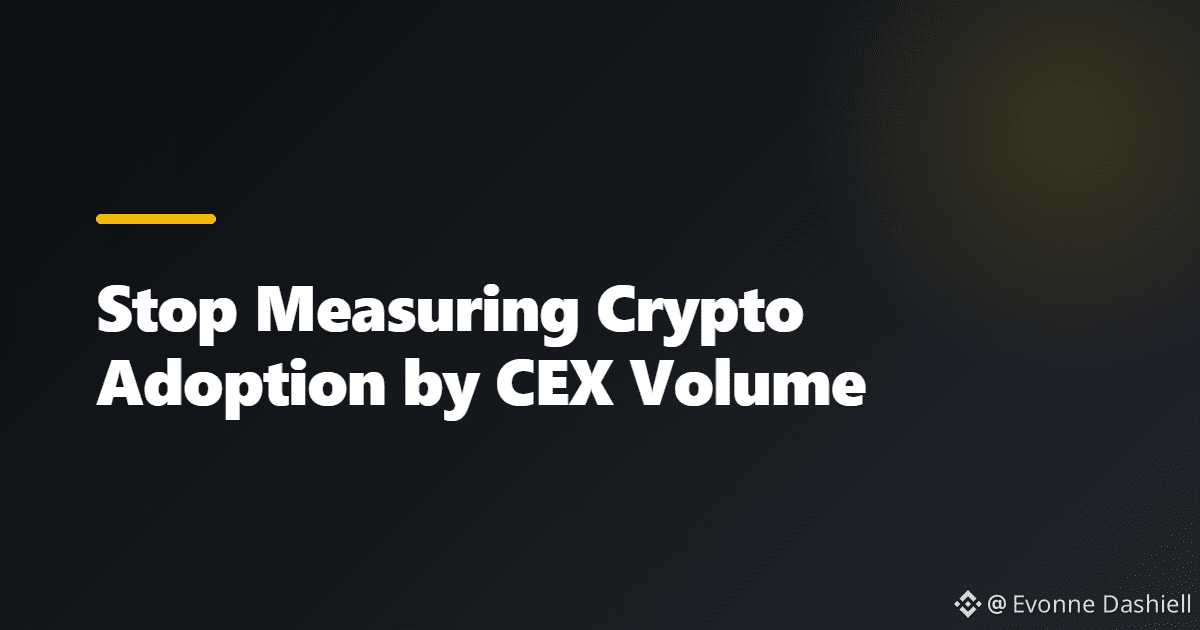
If you're still measuring real crypto adoption solely by centralized exchange volume, stop now.
Most investors track order books and derivative stats, only to get completely caught off guard when market liquidity vanishes during sudden macro shifts. Relying strictly on platform metrics makes you completely blind to where sticky, real-world capital is actually moving.
There is a running debate over whether institutional infrastructure or grassroots utility drives long-term value. Traditional finance argues that institutional custodial inflows are the only numbers that move the needle for $BTC. Yet in developing economies across Latin America, Africa, and Southeast Asia, millions of people bypass corporate platforms entirely, using $USDT and Bitcoin directly between private wallets for daily trade and capital protection.
While Wall Street controls speculative price swings, direct peer-to-peer settlement builds an unbreakable structural foundation. Speculators trade paper volume back and forth, but everyday users transacting outside platform walls create the genuine liquidity floor that survives every bear market.
Do you think institutional trading or grassroots peer-to-peer usage will drive the next phase of adoption?
#Bitcoin #CryptoAdoption #P2P
If you're still measuring real crypto adoption solely by centralized exchange volume, stop now.
Most investors track order books and derivative stats, only to get completely caught off guard when market liquidity vanishes during sudden macro shifts. Relying strictly on platform metrics makes you completely blind to where sticky, real-world capital is actually moving.
There is a running debate over whether institutional infrastructure or grassroots utility drives long-term value. Traditional finance argues that institutional custodial inflows are the only numbers that move the needle for $BTC . Yet in developing economies across Latin America, Africa, and Southeast Asia, millions of people bypass corporate platforms entirely, using $USDT and Bitcoin directly between private wallets for daily trade and capital protection.
While Wall Street controls speculative price swings, direct peer-to-peer settlement builds an unbreakable structural foundation. Speculators trade paper volume back and forth, but everyday users transacting outside platform walls create the genuine liquidity floor that survives every bear market.
Do you think institutional trading or grassroots peer-to-peer usage will drive the next phase of adoption?
#Bitcoin #CryptoAdoption #P2P
Most investors track order books and derivative stats, only to get completely caught off guard when market liquidity vanishes during sudden macro shifts. Relying strictly on platform metrics makes you completely blind to where sticky, real-world capital is actually moving.
There is a running debate over whether institutional infrastructure or grassroots utility drives long-term value. Traditional finance argues that institutional custodial inflows are the only numbers that move the needle for $BTC . Yet in developing economies across Latin America, Africa, and Southeast Asia, millions of people bypass corporate platforms entirely, using $USDT and Bitcoin directly between private wallets for daily trade and capital protection.
While Wall Street controls speculative price swings, direct peer-to-peer settlement builds an unbreakable structural foundation. Speculators trade paper volume back and forth, but everyday users transacting outside platform walls create the genuine liquidity floor that survives every bear market.
Do you think institutional trading or grassroots peer-to-peer usage will drive the next phase of adoption?
#Bitcoin #CryptoAdoption #P2P
175

·
--
See translation
Picture this: you walk into a neighborhood bakery in Buenos Aires or a small electronics shop in Lagos, pay directly from your self-custody wallet, and walk out without a single bank or centralized intermediary touching the transaction.
Most traders get so obsessed with watching exchange order books and hunting quick flips that they completely miss the real structural adoption happening quietly on the ground. When local currencies collapse, holding paper cash or leaving funds trapped behind restrictive banking rails is a fast track to watching your purchasing power evaporate.
Back in 2021, when El Salvador made $BTC legal tender, the world expected adoption to flow top-down through official state apps and corporate infrastructure. Instead, real peer-to-peer usage mirrored what we saw during early local adoption cycles in places like Argentina and Nigeria, where daily volume thrives on decentralized handshake deals rather than custodial exchanges. People in high-inflation economies turned to Bitcoin and dollar-pegged assets like $USDT not for speculative 10x gains, but as practical lifelines for basic commerce and remittance settlement.
While market participants argue over ETF inflows and liquidations on the charts, grassroots users are proving that permissionless settlement matters most when traditional systems fail.
Where do you think real-world adoption will break out next?
#Bitcoin #P2P #CryptoAdoption
Picture this: you walk into a neighborhood bakery in Buenos Aires or a small electronics shop in Lagos, pay directly from your self-custody wallet, and walk out without a single bank or centralized intermediary touching the transaction.
Most traders get so obsessed with watching exchange order books and hunting quick flips that they completely miss the real structural adoption happening quietly on the ground. When local currencies collapse, holding paper cash or leaving funds trapped behind restrictive banking rails is a fast track to watching your purchasing power evaporate.
Back in 2021, when El Salvador made $BTC legal tender, the world expected adoption to flow top-down through official state apps and corporate infrastructure. Instead, real peer-to-peer usage mirrored what we saw during early local adoption cycles in places like Argentina and Nigeria, where daily volume thrives on decentralized handshake deals rather than custodial exchanges. People in high-inflation economies turned to Bitcoin and dollar-pegged assets like $USDT not for speculative 10x gains, but as practical lifelines for basic commerce and remittance settlement.
While market participants argue over ETF inflows and liquidations on the charts, grassroots users are proving that permissionless settlement matters most when traditional systems fail.
Where do you think real-world adoption will break out next?
#Bitcoin #P2P #CryptoAdoption
Most traders get so obsessed with watching exchange order books and hunting quick flips that they completely miss the real structural adoption happening quietly on the ground. When local currencies collapse, holding paper cash or leaving funds trapped behind restrictive banking rails is a fast track to watching your purchasing power evaporate.
Back in 2021, when El Salvador made $BTC legal tender, the world expected adoption to flow top-down through official state apps and corporate infrastructure. Instead, real peer-to-peer usage mirrored what we saw during early local adoption cycles in places like Argentina and Nigeria, where daily volume thrives on decentralized handshake deals rather than custodial exchanges. People in high-inflation economies turned to Bitcoin and dollar-pegged assets like $USDT not for speculative 10x gains, but as practical lifelines for basic commerce and remittance settlement.
While market participants argue over ETF inflows and liquidations on the charts, grassroots users are proving that permissionless settlement matters most when traditional systems fail.
Where do you think real-world adoption will break out next?
#Bitcoin #P2P #CryptoAdoption

132

See translation
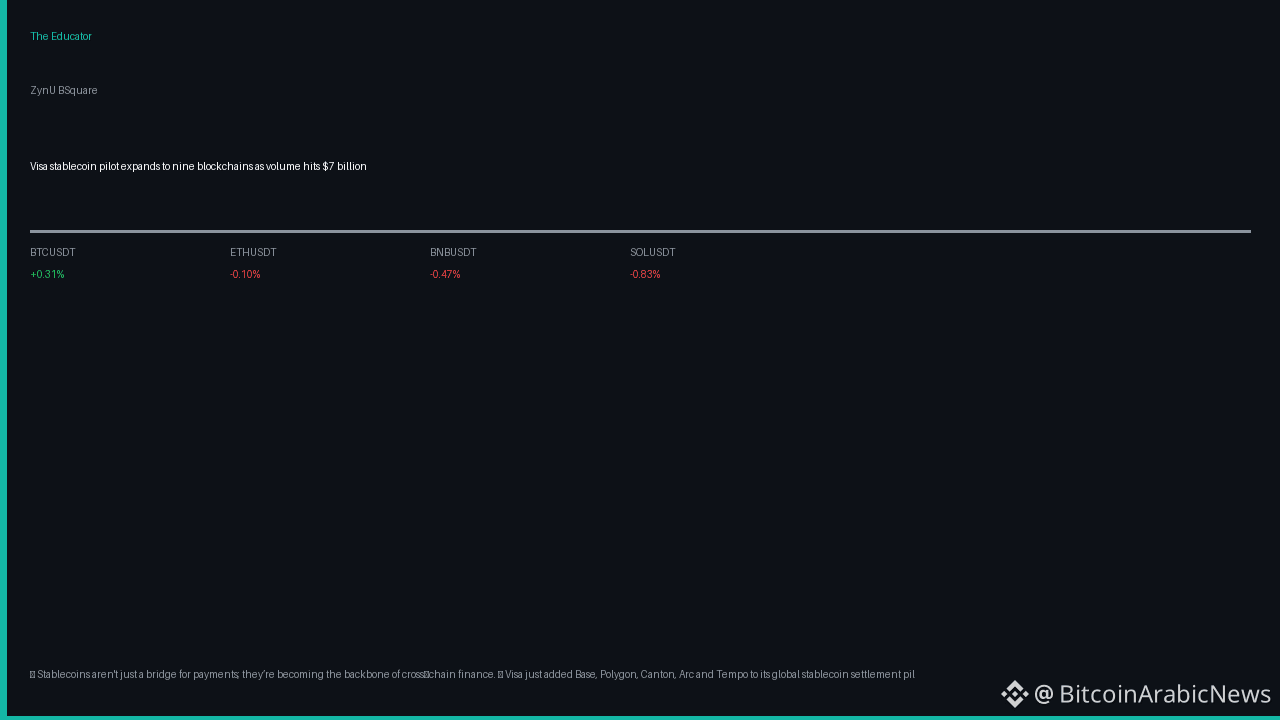
🔥 Stablecoins aren't just a bridge for payments; they’re becoming the backbone of cross‑chain finance.
📊 Visa just added Base, Polygon, Canton, Arc and Tempo to its global stablecoin settlement pilot, pushing the network to nine blockchains and driving the annualized run‑rate to $7 billion – a 50% jump from the previous quarter. #Visa #Stablecoin
💡 This expansion signals that institutional money is finally treating on‑chain liquidity as a core asset class, reinforcing the long‑term #CryptoAdoption narrative as we move deeper into the late‑stage bull cycle where cross‑chain settlement efficiency fuels price discovery. BTC trades at $84,342 (RSI 53) and ETH at $2,691 (RSI 51) while SOL spikes to $121 (RSI 62)
🔥 Stablecoins aren't just a bridge for payments; they’re becoming the backbone of cross‑chain finance.
📊 Visa just added Base, Polygon, Canton, Arc and Tempo to its global stablecoin settlement pilot, pushing the network to nine blockchains and driving the annualized run‑rate to $7 billion – a 50% jump from the previous quarter. #Visa #Stablecoin
💡 This expansion signals that institutional money is finally treating on‑chain liquidity as a core asset class, reinforcing the long‑term #CryptoAdoption narrative as we move deeper into the late‑stage bull cycle where cross‑chain settlement efficiency fuels price discovery. BTC trades at $84,342 (RSI 53) and ETH at $2,691 (RSI 51) while SOL spikes to $121 (RSI 62)
📊 Visa just added Base, Polygon, Canton, Arc and Tempo to its global stablecoin settlement pilot, pushing the network to nine blockchains and driving the annualized run‑rate to $7 billion – a 50% jump from the previous quarter. #Visa #Stablecoin
💡 This expansion signals that institutional money is finally treating on‑chain liquidity as a core asset class, reinforcing the long‑term #CryptoAdoption narrative as we move deeper into the late‑stage bull cycle where cross‑chain settlement efficiency fuels price discovery. BTC trades at $84,342 (RSI 53) and ETH at $2,691 (RSI 51) while SOL spikes to $121 (RSI 62)
11
See translation
Why is nobody talking about how traditional banking giants are quietly building real-world crypto rails while retail investors keep chasing vaporware?
Most market participants lose capital getting caught up in endless narrative rotations and memecoin pumps, completely missing the actual institutional infrastructure shifts happening right in front of them. When mainstream headlines still preach retail caution, the real capital is already setting up operational settlement networks.
Look at Russia right now. While the central bank designs a strict 1% risk-exposure ceiling to keep lenders safe, Sberbank has already launched live crypto-based cross-border settlement for corporate clients. Major financial institutions are not waiting for global regulatory clarity to move value through networks like $BTC and settlement assets like $USDT. They are hedging legacy payment friction with on-chain liquidity because global trade demands speed that traditional wire systems cannot deliver anymore.
When state-backed banking leaders integrate digital asset settlements directly into commercial trade, the macro adoption timeline accelerates faster than most realize.
Where do you think corporate cross-border settlement goes from here?
#CryptoAdoption #CrossBorderPayments #Banking
Why is nobody talking about how traditional banking giants are quietly building real-world crypto rails while retail investors keep chasing vaporware?
Most market participants lose capital getting caught up in endless narrative rotations and memecoin pumps, completely missing the actual institutional infrastructure shifts happening right in front of them. When mainstream headlines still preach retail caution, the real capital is already setting up operational settlement networks.
Look at Russia right now. While the central bank designs a strict 1% risk-exposure ceiling to keep lenders safe, Sberbank has already launched live crypto-based cross-border settlement for corporate clients. Major financial institutions are not waiting for global regulatory clarity to move value through networks like $BTC and settlement assets like $USDT. They are hedging legacy payment friction with on-chain liquidity because global trade demands speed that traditional wire systems cannot deliver anymore.
When state-backed banking leaders integrate digital asset settlements directly into commercial trade, the macro adoption timeline accelerates faster than most realize.
Where do you think corporate cross-border settlement goes from here?
#CryptoAdoption #CrossBorderPayments #Banking
Most market participants lose capital getting caught up in endless narrative rotations and memecoin pumps, completely missing the actual institutional infrastructure shifts happening right in front of them. When mainstream headlines still preach retail caution, the real capital is already setting up operational settlement networks.
Look at Russia right now. While the central bank designs a strict 1% risk-exposure ceiling to keep lenders safe, Sberbank has already launched live crypto-based cross-border settlement for corporate clients. Major financial institutions are not waiting for global regulatory clarity to move value through networks like $BTC and settlement assets like $USDT. They are hedging legacy payment friction with on-chain liquidity because global trade demands speed that traditional wire systems cannot deliver anymore.
When state-backed banking leaders integrate digital asset settlements directly into commercial trade, the macro adoption timeline accelerates faster than most realize.
Where do you think corporate cross-border settlement goes from here?
#CryptoAdoption #CrossBorderPayments #Banking
16

·
--
Institutional rails are expanding as the number of banking services customers grows to 18 million—$BTC customers gain direct access. 🚀
Raiffeisen Bank is directly integrating Bitpanda’s digital asset infrastructure into its European network, opening the door to 18 million banking customers. 📊 While the rollout happens gradually across each market within local regulatory frameworks, the implication for the overall economy is enormous.
Liquidity channels are shifting from independent trading platforms to traditional banking apps. 💡 When individual venture capital is no longer facing friction to allocate it to $BTC , structural demands quietly form ahead of the next big wave.
That’s how long-term adoption accumulates in stealth. 💬 Will the integration of traditional banks drive the next wave of individual investors, or will users stay as they are? 👇
⚠️ Not financial advice. Always manage your risk wisely. 🛡️
🏷️ #BTC #Bitcoin #CryptoAdoption #Macro
🔥 💎
Institutional rails are expanding as the number of banking services customers grows to 18 million—$BTC customers gain direct access. 🚀
Raiffeisen Bank is directly integrating Bitpanda’s digital asset infrastructure into its European network, opening the door to 18 million banking customers. 📊 While the rollout happens gradually across each market within local regulatory frameworks, the implication for the overall economy is enormous.
Liquidity channels are shifting from independent trading platforms to traditional banking apps. 💡 When individual venture capital is no longer facing friction to allocate it to $BTC , structural demands quietly form ahead of the next big wave.
That’s how long-term adoption accumulates in stealth. 💬 Will the integration of traditional banks drive the next wave of individual investors, or will users stay as they are? 👇
⚠️ Not financial advice. Always manage your risk wisely. 🛡️
🏷️ #BTC #Bitcoin #CryptoAdoption #Macro
🔥 💎
Raiffeisen Bank is directly integrating Bitpanda’s digital asset infrastructure into its European network, opening the door to 18 million banking customers. 📊 While the rollout happens gradually across each market within local regulatory frameworks, the implication for the overall economy is enormous.
Liquidity channels are shifting from independent trading platforms to traditional banking apps. 💡 When individual venture capital is no longer facing friction to allocate it to $BTC , structural demands quietly form ahead of the next big wave.
That’s how long-term adoption accumulates in stealth. 💬 Will the integration of traditional banks drive the next wave of individual investors, or will users stay as they are? 👇
⚠️ Not financial advice. Always manage your risk wisely. 🛡️
🏷️ #BTC #Bitcoin #CryptoAdoption #Macro
🔥 💎

1
137

Verified
See translation
STABLECOIN PAYMENTS ARE GAINING SERIOUS INSTITUTIONAL BACKING AGAIN.
Singapore-based payments provider dtcpay just secured $25 million in its Series A funding round, with major support from Japanese financial giant SBI Group. This capital boost will be used to expand its product offerings and upgrade enterprise client infrastructure for seamless crypto transactions.
⚡ SBI Group leads the $25M round to accelerate global crypto payment solutions
⚡ The expansion focuses on scaling merchant networks and enterprise portals
⚡ Focus remains heavily on fiat to stablecoin rails like $USDT and USDC for real-world usage
Traditional finance giants backing stablecoin infrastructure is the clearest bullish sign for adoption we could ask for.
#Stablecoins #CryptoAdoption #Write2Earn #Fintech
STABLECOIN PAYMENTS ARE GAINING SERIOUS INSTITUTIONAL BACKING AGAIN.
Singapore-based payments provider dtcpay just secured $25 million in its Series A funding round, with major support from Japanese financial giant SBI Group. This capital boost will be used to expand its product offerings and upgrade enterprise client infrastructure for seamless crypto transactions.
⚡ SBI Group leads the $25M round to accelerate global crypto payment solutions
⚡ The expansion focuses on scaling merchant networks and enterprise portals
⚡ Focus remains heavily on fiat to stablecoin rails like $USDT and USDC for real-world usage
Traditional finance giants backing stablecoin infrastructure is the clearest bullish sign for adoption we could ask for.
#Stablecoins #CryptoAdoption #Write2Earn #Fintech
Singapore-based payments provider dtcpay just secured $25 million in its Series A funding round, with major support from Japanese financial giant SBI Group. This capital boost will be used to expand its product offerings and upgrade enterprise client infrastructure for seamless crypto transactions.
⚡ SBI Group leads the $25M round to accelerate global crypto payment solutions
⚡ The expansion focuses on scaling merchant networks and enterprise portals
⚡ Focus remains heavily on fiat to stablecoin rails like $USDT and USDC for real-world usage
Traditional finance giants backing stablecoin infrastructure is the clearest bullish sign for adoption we could ask for.
#Stablecoins #CryptoAdoption #Write2Earn #Fintech
2
1.3k

·
--
Bullish
See translation
🔔 BREAKING: SEC 5-Year Tokenized Stock Pilot STARTS TODAY - Sept 22
This is MASSIVE for crypto!
✅ Apple, Tesla, Nvidia এখন Blockchain এ 24/7 ট্রেড হবে
✅ SEC 5 বছরের জন্য Conditional Exemption দিলো
✅ Coinbase, Kraken, Robinhood ready to launch
✅ Real stocks, real dividends, on-chain!
Wall Street officially on Blockchain! This is adoption!
Bullish for ETH, SOL, and all RWA tokens!
#SEC #TokenizedStocks #RWA #Coinbase #CryptoAdoption
🔔 BREAKING: SEC 5-Year Tokenized Stock Pilot STARTS TODAY - Sept 22
This is MASSIVE for crypto!
✅ Apple, Tesla, Nvidia এখন Blockchain এ 24/7 ট্রেড হবে
✅ SEC 5 বছরের জন্য Conditional Exemption দিলো
✅ Coinbase, Kraken, Robinhood ready to launch
✅ Real stocks, real dividends, on-chain!
Wall Street officially on Blockchain! This is adoption!
Bullish for ETH, SOL, and all RWA tokens!
#SEC #TokenizedStocks #RWA #Coinbase #CryptoAdoption
This is MASSIVE for crypto!
✅ Apple, Tesla, Nvidia এখন Blockchain এ 24/7 ট্রেড হবে
✅ SEC 5 বছরের জন্য Conditional Exemption দিলো
✅ Coinbase, Kraken, Robinhood ready to launch
✅ Real stocks, real dividends, on-chain!
Wall Street officially on Blockchain! This is adoption!
Bullish for ETH, SOL, and all RWA tokens!
#SEC #TokenizedStocks #RWA #Coinbase #CryptoAdoption
1
53

See translation
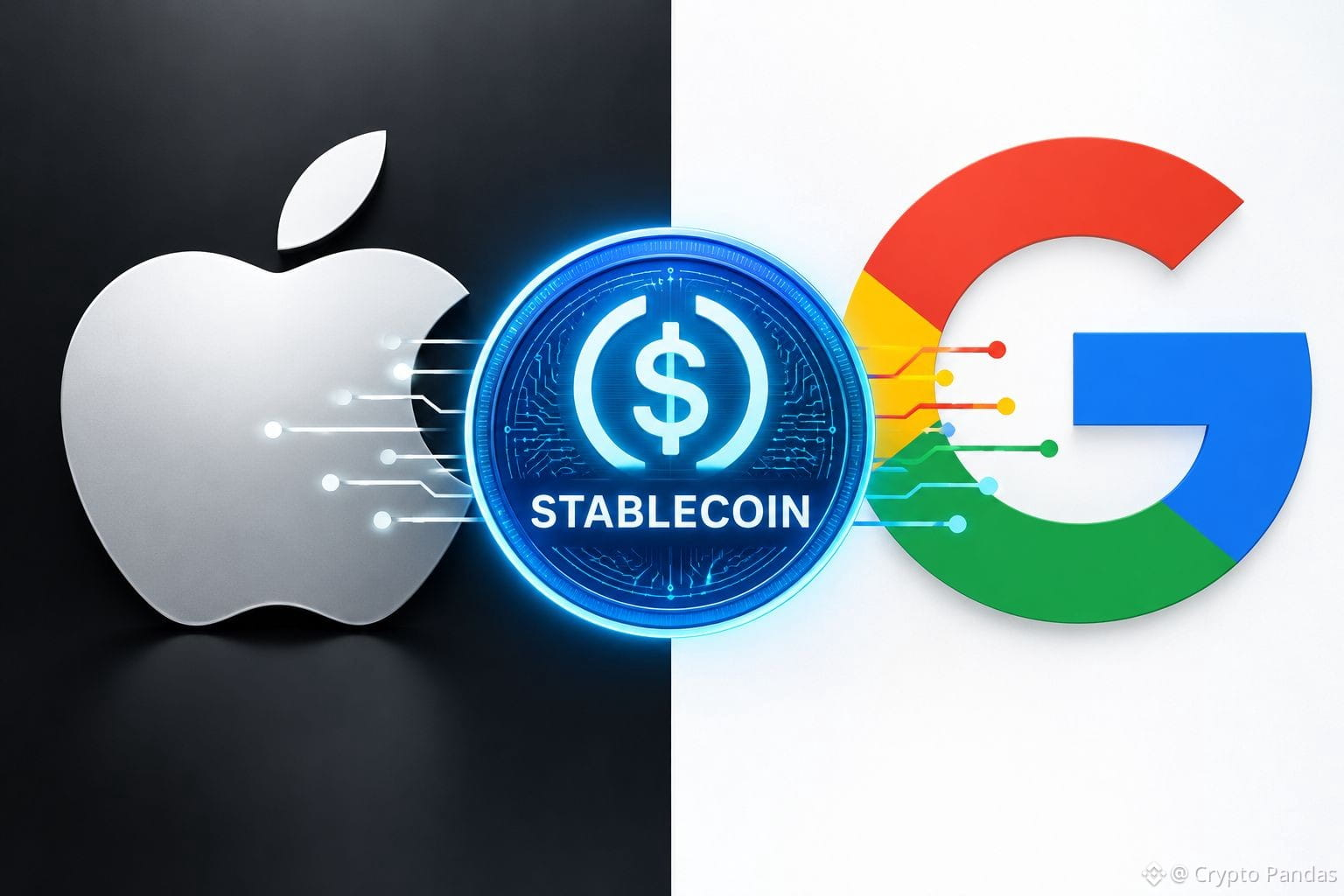
#AppleGoogleSeekStablecoinTokenizedDepositTalent
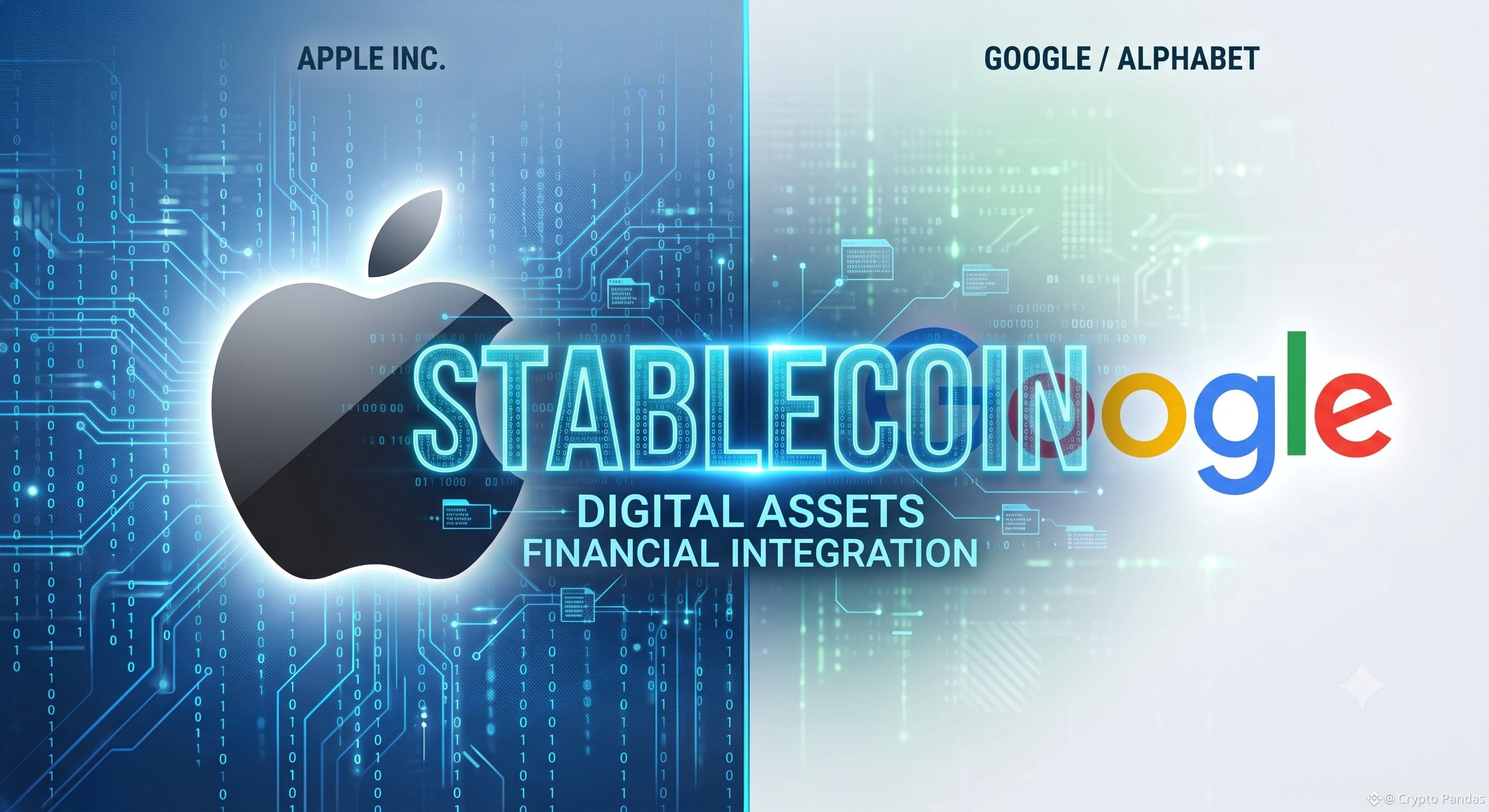
🚨 APPLE & GOOGLE ARE SILENTLY BUILDING A STABLECOIN EMPIRE 🚨
You are watching the biggest transfer of wealth in real-time. Both Apple and Google just posted senior roles demanding deep Stablecoin and Blockchain expertise.
Why does this matter for YOUR portfolio❓
🍏 Apple's Angle: They are targeting their "Apple Pay" ecosystem. Imagine bypassing Visa/Mastercard interchange fees by settling via stablecoins for hundreds of millions of iOS users.
🌐 Google's Angle: Google Cloud is aggressively building backend digital asset infrastructure for institutional clients across Asia-Pacific.
🫴 My Verdict: STRONGLY BULLISH. This isn’t a crypto startup experimenting; these are trillion-dollar tech behemoths locking in their Web3 footprint. Expect a massive liquidity injection into stablecoin protocols once regulatory clarity hits.
Are you positioned for Web2’s hostile takeover of Web3? Drop your thoughts below! 👇
#CryptoAdoption #Stablecoins #BinanceSquare
#AppleGoogleSeekStablecoinTokenizedDepositTalent
🚨 APPLE & GOOGLE ARE SILENTLY BUILDING A STABLECOIN EMPIRE 🚨
You are watching the biggest transfer of wealth in real-time. Both Apple and Google just posted senior roles demanding deep Stablecoin and Blockchain expertise.
Why does this matter for YOUR portfolio❓
🍏 Apple's Angle: They are targeting their "Apple Pay" ecosystem. Imagine bypassing Visa/Mastercard interchange fees by settling via stablecoins for hundreds of millions of iOS users.
🌐 Google's Angle: Google Cloud is aggressively building backend digital asset infrastructure for institutional clients across Asia-Pacific.
🫴 My Verdict: STRONGLY BULLISH. This isn’t a crypto startup experimenting; these are trillion-dollar tech behemoths locking in their Web3 footprint. Expect a massive liquidity injection into stablecoin protocols once regulatory clarity hits.
Are you positioned for Web2’s hostile takeover of Web3? Drop your thoughts below! 👇
#CryptoAdoption #Stablecoins #BinanceSquare
🚨 APPLE & GOOGLE ARE SILENTLY BUILDING A STABLECOIN EMPIRE 🚨
You are watching the biggest transfer of wealth in real-time. Both Apple and Google just posted senior roles demanding deep Stablecoin and Blockchain expertise.
Why does this matter for YOUR portfolio❓
🍏 Apple's Angle: They are targeting their "Apple Pay" ecosystem. Imagine bypassing Visa/Mastercard interchange fees by settling via stablecoins for hundreds of millions of iOS users.
🌐 Google's Angle: Google Cloud is aggressively building backend digital asset infrastructure for institutional clients across Asia-Pacific.
🫴 My Verdict: STRONGLY BULLISH. This isn’t a crypto startup experimenting; these are trillion-dollar tech behemoths locking in their Web3 footprint. Expect a massive liquidity injection into stablecoin protocols once regulatory clarity hits.
Are you positioned for Web2’s hostile takeover of Web3? Drop your thoughts below! 👇
#CryptoAdoption #Stablecoins #BinanceSquare
2
141
·
--
See translation
The Institutional Adoption Waterfall Nobody Is Mapping
Everyone tracks institutional crypto adoption through headline events — a treasury allocation, an ETF approval, a custody license. But adoption does not happen in events. It happens in stages, and each stage unlocks the next.
Stage one was custody. Institutions needed qualified custodians before they could hold anything. That infrastructure is largely built.
Stage two was trading. Once you can custody, you can transact. OTC desks, prime brokerage, and spot ETFs are this phase. We are here.
Stage three is treasury. Once trading infrastructure is mature, balance sheet allocation follows. $BTC on corporate balance sheets, $ETH as yield-bearing collateral. This phase is accelerating.
Stage four is credit. Once you have collateral, you have lending. BTC-backed credit facilities, on-chain repo markets, and stablecoin-denominated term lending are the next frontier. The rails are being built now.
Stage five is structured products. Once you have credit, you get derivatives, tranches, and yield-bearing instruments natively on-chain. This is where traditional finance and DeFi converge completely.
The mistake most people make is treating each headline as a discrete event. They are sequential. Each stage becomes the next stage prerequisite. The teams building stage four rails today will define stage five.
The institutions that mapped this waterfall 18 months ago are already operational. The ones waiting for proof are the exit liquidity.
$BTC $ETH $BNB
#CryptoAdoption #InstitutionalCrypto #Bitcoin #DeFi #CryptoInfrastructure
The Institutional Adoption Waterfall Nobody Is Mapping
Everyone tracks institutional crypto adoption through headline events — a treasury allocation, an ETF approval, a custody license. But adoption does not happen in events. It happens in stages, and each stage unlocks the next.
Stage one was custody. Institutions needed qualified custodians before they could hold anything. That infrastructure is largely built.
Stage two was trading. Once you can custody, you can transact. OTC desks, prime brokerage, and spot ETFs are this phase. We are here.
Stage three is treasury. Once trading infrastructure is mature, balance sheet allocation follows. $BTC on corporate balance sheets, $ETH as yield-bearing collateral. This phase is accelerating.
Stage four is credit. Once you have collateral, you have lending. BTC-backed credit facilities, on-chain repo markets, and stablecoin-denominated term lending are the next frontier. The rails are being built now.
Stage five is structured products. Once you have credit, you get derivatives, tranches, and yield-bearing instruments natively on-chain. This is where traditional finance and DeFi converge completely.
The mistake most people make is treating each headline as a discrete event. They are sequential. Each stage becomes the next stage prerequisite. The teams building stage four rails today will define stage five.
The institutions that mapped this waterfall 18 months ago are already operational. The ones waiting for proof are the exit liquidity.
$BTC $ETH $BNB
#CryptoAdoption #InstitutionalCrypto #Bitcoin #DeFi #CryptoInfrastructure
Everyone tracks institutional crypto adoption through headline events — a treasury allocation, an ETF approval, a custody license. But adoption does not happen in events. It happens in stages, and each stage unlocks the next.
Stage one was custody. Institutions needed qualified custodians before they could hold anything. That infrastructure is largely built.
Stage two was trading. Once you can custody, you can transact. OTC desks, prime brokerage, and spot ETFs are this phase. We are here.
Stage three is treasury. Once trading infrastructure is mature, balance sheet allocation follows. $BTC on corporate balance sheets, $ETH as yield-bearing collateral. This phase is accelerating.
Stage four is credit. Once you have collateral, you have lending. BTC-backed credit facilities, on-chain repo markets, and stablecoin-denominated term lending are the next frontier. The rails are being built now.
Stage five is structured products. Once you have credit, you get derivatives, tranches, and yield-bearing instruments natively on-chain. This is where traditional finance and DeFi converge completely.
The mistake most people make is treating each headline as a discrete event. They are sequential. Each stage becomes the next stage prerequisite. The teams building stage four rails today will define stage five.
The institutions that mapped this waterfall 18 months ago are already operational. The ones waiting for proof are the exit liquidity.
$BTC $ETH $BNB
#CryptoAdoption #InstitutionalCrypto #Bitcoin #DeFi #CryptoInfrastructure
61
Log in to explore more content
Join global crypto users on Binance Square
⚡️ Get latest and useful information about crypto.
💬 Trusted by the world’s largest crypto exchange.
👍 Discover real insights from verified creators.
Email / Phone number
Trending Topics
1
#ADAGains10%Above$0.27
7,689 views
140 Discussing
2
#ETHUp70%InQ3ButLiquidityFalls
90,697 views
843 Discussing
3
#EthStakingExitQueueHits2026High
34,519 views
636 Discussing
4
#FedOctoberHoldOdds82.3%
33,764 views
602 Discussing
5
#Nikkei225Jumps2.5%ToThreeMonthHigh
65,640 views
988 Discussing
6
#CircleMints$2.75BUSDCOnSolanaIn7Days
1,218 views
37 Discussing
7
#DriftHackVictimsBeginClaims
152,094 views
1,631 Discussing
8
#SolanaTokenizedStockVolumeTops$4.4BInSeptember
12,038 views
129 Discussing
9
#BitcoinSpotETFsDraw$6.34BInflowsInQ3
49,150 views
259 Discussing
10
#EthereumValidatorExitQueueJumps392%
283,282 views
2,491 Discussing