

#privacy
privacy
1.8M views
10,058 Discussing
Hot
Latest
See translation
🚨 Monad is about to go private — and MON is already moving.
Monad teased "Privacy is coming" ahead of its first Open summit in Singapore on Oct 6, during TOKEN2049 week. Category Labs is set to unveil privacy tech that keeps financial transactions confidential while staying on a public chain — private finance without splitting liquidity across closed systems.
MON reacted fast: up about 21% in 24 hours to around $0.035 when the teaser dropped, flipping the $0.027 level from resistance into support. It now trades near $0.032, close to the local high at $0.0328, with RSI at 69 — near the overbought zone.
At the same time, StraitsX plans to issue its Singapore-dollar stablecoin XSGD and US-dollar stablecoin XUSD natively on Monad in early 2027. XSGD would be the network's first native SGD stablecoin — and Monad already holds around $692M in stablecoins.
Privacy plus payments: Monad is building two utility legs at once. Is privacy the next big Layer-1 race? 👇
$MON
#Monad #Privacy #CryptoNews
🚨 Monad is about to go private — and MON is already moving.
Monad teased "Privacy is coming" ahead of its first Open summit in Singapore on Oct 6, during TOKEN2049 week. Category Labs is set to unveil privacy tech that keeps financial transactions confidential while staying on a public chain — private finance without splitting liquidity across closed systems.
MON reacted fast: up about 21% in 24 hours to around $0.035 when the teaser dropped, flipping the $0.027 level from resistance into support. It now trades near $0.032, close to the local high at $0.0328, with RSI at 69 — near the overbought zone.
At the same time, StraitsX plans to issue its Singapore-dollar stablecoin XSGD and US-dollar stablecoin XUSD natively on Monad in early 2027. XSGD would be the network's first native SGD stablecoin — and Monad already holds around $692M in stablecoins.
Privacy plus payments: Monad is building two utility legs at once. Is privacy the next big Layer-1 race? 👇
$MON
#Monad #Privacy #CryptoNews
Monad teased "Privacy is coming" ahead of its first Open summit in Singapore on Oct 6, during TOKEN2049 week. Category Labs is set to unveil privacy tech that keeps financial transactions confidential while staying on a public chain — private finance without splitting liquidity across closed systems.
MON reacted fast: up about 21% in 24 hours to around $0.035 when the teaser dropped, flipping the $0.027 level from resistance into support. It now trades near $0.032, close to the local high at $0.0328, with RSI at 69 — near the overbought zone.
At the same time, StraitsX plans to issue its Singapore-dollar stablecoin XSGD and US-dollar stablecoin XUSD natively on Monad in early 2027. XSGD would be the network's first native SGD stablecoin — and Monad already holds around $692M in stablecoins.
Privacy plus payments: Monad is building two utility legs at once. Is privacy the next big Layer-1 race? 👇
$MON
#Monad #Privacy #CryptoNews

57

·
--
See translation
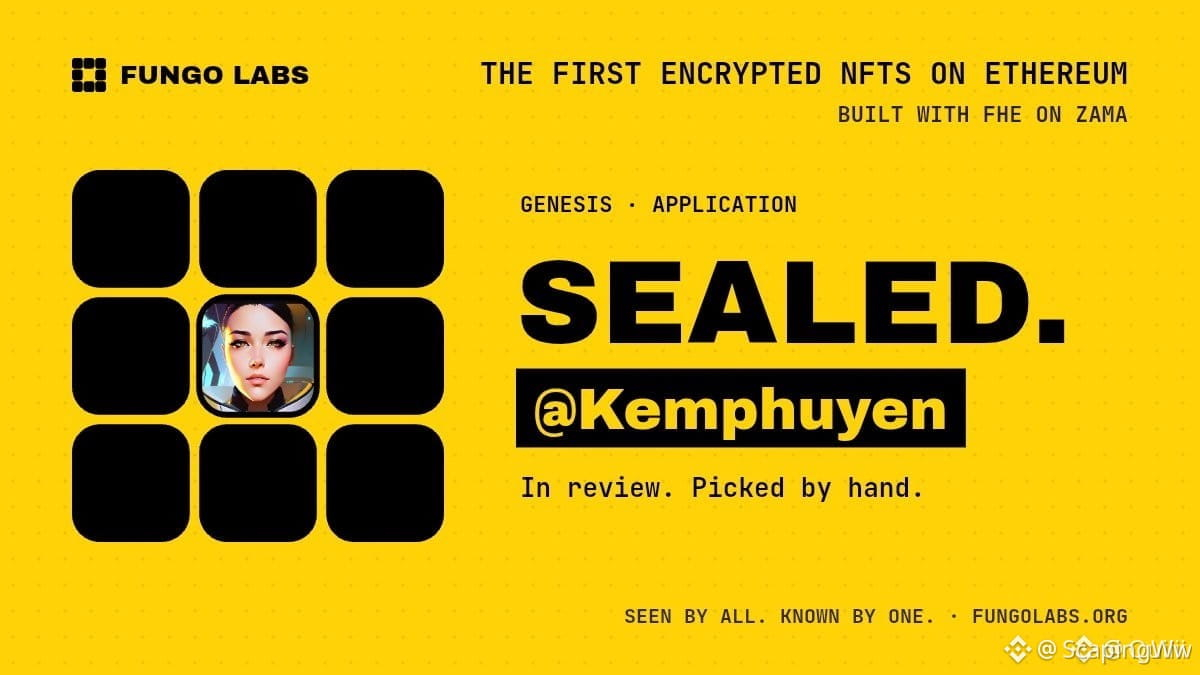
🚨 FULLY HOMOMORPHIC ENCRYPTION IS FLIPPING ON-CHAIN PRIVACY FOR $FHE NFTS! ⚡
Privacy tech is quietly preparing its next major narrative run, and Fully Homomorphic Encryption is leading the charge. 🛡️ Infrastructure pioneers laid the blueprint, but bringing FHE directly into digital assets changes the game completely.
Instead of broadcasting every high-value move to front-running bots, smart capital can now lock down true asset privacy on-chain. 🌊 Order flow shifts fast when top collectors realize they can position without leaking their footprint to the market.
💡 Early infrastructure shifts always reward those tracking the tech before retail catches on. 💬 Is private ownership the missing catalyst for the next digital asset wave, or do you prefer total transparency? 👇
⚠️ Not financial advice. Always manage your risk. 🛡️
🏷️ #FHE #Privacy #NFTs #Crypto
🔥 💎
🚨 FULLY HOMOMORPHIC ENCRYPTION IS FLIPPING ON-CHAIN PRIVACY FOR $FHE NFTS! ⚡
Privacy tech is quietly preparing its next major narrative run, and Fully Homomorphic Encryption is leading the charge. 🛡️ Infrastructure pioneers laid the blueprint, but bringing FHE directly into digital assets changes the game completely.
Instead of broadcasting every high-value move to front-running bots, smart capital can now lock down true asset privacy on-chain. 🌊 Order flow shifts fast when top collectors realize they can position without leaking their footprint to the market.
💡 Early infrastructure shifts always reward those tracking the tech before retail catches on. 💬 Is private ownership the missing catalyst for the next digital asset wave, or do you prefer total transparency? 👇
⚠️ Not financial advice. Always manage your risk. 🛡️
🏷️ #FHE #Privacy #NFTs #Crypto
🔥 💎
Privacy tech is quietly preparing its next major narrative run, and Fully Homomorphic Encryption is leading the charge. 🛡️ Infrastructure pioneers laid the blueprint, but bringing FHE directly into digital assets changes the game completely.
Instead of broadcasting every high-value move to front-running bots, smart capital can now lock down true asset privacy on-chain. 🌊 Order flow shifts fast when top collectors realize they can position without leaking their footprint to the market.
💡 Early infrastructure shifts always reward those tracking the tech before retail catches on. 💬 Is private ownership the missing catalyst for the next digital asset wave, or do you prefer total transparency? 👇
⚠️ Not financial advice. Always manage your risk. 🛡️
🏷️ #FHE #Privacy #NFTs #Crypto
🔥 💎
1
83

See translation
Big win for crypto self-custody as U.S. regulators officially drop the controversial reporting rule that targeted private wallets and mixing services. For years, this proposal loomed like a dark cloud over decentralized finance, threatening user privacy. Now that FinCEN has officially withdrawn it, builders and holders can breathe easier. It is a massive step forward for financial sovereignty, proving that community pushback and advocacy actually work in shaping regulatory outcomes. $BTC $ETH #CryptoRegulation #SelfCustody #Privacy
Big win for crypto self-custody as U.S. regulators officially drop the controversial reporting rule that targeted private wallets and mixing services. For years, this proposal loomed like a dark cloud over decentralized finance, threatening user privacy. Now that FinCEN has officially withdrawn it, builders and holders can breathe easier. It is a massive step forward for financial sovereignty, proving that community pushback and advocacy actually work in shaping regulatory outcomes. $BTC $ETH #CryptoRegulation #SelfCustody #Privacy
17

·
--
See translation
🚨 U.S. REGULATORY CLASH THREATENS $TORN OPEN-SOURCE DEVELOPERS AND DEFI PRECEDENT ⚡
The regulatory landscape around privacy protocols is reaching a critical structural pivot. 💡 While the U.S. Treasury acknowledges that blanket mixer bans create a chilling effect on legitimate open-source innovation, the Department of Justice continues to push aggressive criminal prosecution against $TORN developers.
This institutional disconnect between policy rationale and criminal enforcement sets a precedent that impacts the entire decentralized architecture. 🔍 When foundational code development is treated as strict liability, capital flows and protocol innovation face systemic legal friction rather than market-driven re-pricing.
As regulatory pressure mounts on privacy infrastructure, structural risk parameters across open-source assets require elevated scrutiny. ⚖️ How do you see this precedent shaping long-term institutional capital deployment in decentralized privacy? 👇
⚠️ Not financial advice. Always manage your risk. 🛡️
🏷️ #TORN #DeFi #CryptoPolicy #Privacy
⚖️ 🔍
🚨 U.S. REGULATORY CLASH THREATENS $TORN OPEN-SOURCE DEVELOPERS AND DEFI PRECEDENT ⚡
The regulatory landscape around privacy protocols is reaching a critical structural pivot. 💡 While the U.S. Treasury acknowledges that blanket mixer bans create a chilling effect on legitimate open-source innovation, the Department of Justice continues to push aggressive criminal prosecution against $TORN developers.
This institutional disconnect between policy rationale and criminal enforcement sets a precedent that impacts the entire decentralized architecture. 🔍 When foundational code development is treated as strict liability, capital flows and protocol innovation face systemic legal friction rather than market-driven re-pricing.
As regulatory pressure mounts on privacy infrastructure, structural risk parameters across open-source assets require elevated scrutiny. ⚖️ How do you see this precedent shaping long-term institutional capital deployment in decentralized privacy? 👇
⚠️ Not financial advice. Always manage your risk. 🛡️
🏷️ #TORN #DeFi #CryptoPolicy #Privacy
⚖️ 🔍
The regulatory landscape around privacy protocols is reaching a critical structural pivot. 💡 While the U.S. Treasury acknowledges that blanket mixer bans create a chilling effect on legitimate open-source innovation, the Department of Justice continues to push aggressive criminal prosecution against $TORN developers.
This institutional disconnect between policy rationale and criminal enforcement sets a precedent that impacts the entire decentralized architecture. 🔍 When foundational code development is treated as strict liability, capital flows and protocol innovation face systemic legal friction rather than market-driven re-pricing.
As regulatory pressure mounts on privacy infrastructure, structural risk parameters across open-source assets require elevated scrutiny. ⚖️ How do you see this precedent shaping long-term institutional capital deployment in decentralized privacy? 👇
⚠️ Not financial advice. Always manage your risk. 🛡️
🏷️ #TORN #DeFi #CryptoPolicy #Privacy
⚖️ 🔍
2
See translation
When AI becomes your private diary, are you trading privacy for convenience? A Florida woman learned the hard way that writing personal thoughts into Claude can trigger safety filters and human review. Anthropic's terms explicitly permit reporting concerning content to law enforcement. This incident highlights a major friction point in AI adoption: where do we draw the line between platform safety and user confidentiality in the web3 and AI era? #AI #Privacy #Web3
When AI becomes your private diary, are you trading privacy for convenience? A Florida woman learned the hard way that writing personal thoughts into Claude can trigger safety filters and human review. Anthropic's terms explicitly permit reporting concerning content to law enforcement. This incident highlights a major friction point in AI adoption: where do we draw the line between platform safety and user confidentiality in the web3 and AI era? #AI #Privacy #Web3
1
See translation
Big regulatory win for crypto privacy! The US Treasury officially withdrew those controversial 2020 unhosted wallet tracking proposals and the 2023 crypto mixing restrictions. This is a massive relief for self-custody advocates and decentralized finance. While compliance remains a priority, pulling back heavy-handed surveillance proves that the fight for financial sovereignty is working. Self-custody stays winning. $BTC $ETH #CryptoNews #Privacy #DeFi
Big regulatory win for crypto privacy! The US Treasury officially withdrew those controversial 2020 unhosted wallet tracking proposals and the 2023 crypto mixing restrictions. This is a massive relief for self-custody advocates and decentralized finance. While compliance remains a priority, pulling back heavy-handed surveillance proves that the fight for financial sovereignty is working. Self-custody stays winning. $BTC $ETH #CryptoNews #Privacy #DeFi
16


See translation
Privacy Doesn’t Have To Mean Invisibility 🔐
$XMR proved there is real demand for keeping financial activity private.
But applications built for users, institutions and regulators need more than an all-or-nothing approach to privacy.
That’s where Midnight takes a different path. Built within the $ADA ecosystem, Midnight uses programmable privacy to let applications determine what gets disclosed, to whom, and under which conditions.
A user can prove they meet a financial requirement without revealing their balance.
An institution can prove a transaction followed a rule without publishing its entire position.
That’s selective disclosure: reveal what needs to be known without exposing everything else.
Midnight is built for privacy that can still be verified.
#Privacy #DeFi
Privacy Doesn’t Have To Mean Invisibility 🔐
$XMR proved there is real demand for keeping financial activity private.
But applications built for users, institutions and regulators need more than an all-or-nothing approach to privacy.
That’s where Midnight takes a different path. Built within the $ADA ecosystem, Midnight uses programmable privacy to let applications determine what gets disclosed, to whom, and under which conditions.
A user can prove they meet a financial requirement without revealing their balance.
An institution can prove a transaction followed a rule without publishing its entire position.
That’s selective disclosure: reveal what needs to be known without exposing everything else.
Midnight is built for privacy that can still be verified.
#Privacy #DeFi
$XMR proved there is real demand for keeping financial activity private.
But applications built for users, institutions and regulators need more than an all-or-nothing approach to privacy.
That’s where Midnight takes a different path. Built within the $ADA ecosystem, Midnight uses programmable privacy to let applications determine what gets disclosed, to whom, and under which conditions.
A user can prove they meet a financial requirement without revealing their balance.
An institution can prove a transaction followed a rule without publishing its entire position.
That’s selective disclosure: reveal what needs to be known without exposing everything else.
Midnight is built for privacy that can still be verified.
#Privacy #DeFi
1
338
See translation
FinCEN dropping its aggressive crypto mixing proposal is a major quiet win for financial privacy advocates. The original plan risked overreaching and freezing entirely legal blockchain transactions just to catch bad actors. While compliance and anti-money laundering remain top priorities, regulators are finally realizing that sledgehammer policies hurt everyday users more than criminals. Striking the right balance between security and open-network freedom is essential for healthy crypto adoption moving forward. $BTC $ETH #CryptoRegulation #Privacy #FinCEN
FinCEN dropping its aggressive crypto mixing proposal is a major quiet win for financial privacy advocates. The original plan risked overreaching and freezing entirely legal blockchain transactions just to catch bad actors. While compliance and anti-money laundering remain top priorities, regulators are finally realizing that sledgehammer policies hurt everyday users more than criminals. Striking the right balance between security and open-network freedom is essential for healthy crypto adoption moving forward. $BTC $ETH #CryptoRegulation #Privacy #FinCEN
31

·
--
See translation
# Zcash just activated its biggest upgrade on testnet—but most traders aren't watching. **What is NU7?** Zcash's Network Upgrade 7 is now live on testnet, introducing 25-second block times—down from the current 75 seconds. That means faster transactions and quicker confirmations, making $ZEC more competitive with newer chains. **Why Test First?** Developers get several weeks to stress-test the protocol before November's mainnet launch. This isn't just a feature add—it's a fundamental speed boost that could reshape how users interact with privacy coins. Think of it like upgrading from dial-up to broadband. The core function stays the same, but the experience improves dramatically. **What This Could Mean** Privacy tech is heating up again as regulators tighten scrutiny on transparent blockchains. If NU7 delivers on speed without sacrificing Zcash's privacy guarantees, we might see renewed interest in the privacy sector. Meanwhile, today's standout is $GTC, up over 63% in 24 hours—proof that niche narratives can still explode when momentum aligns. Keep an eye on November. Privacy + speed could be a winning combo. 🔐 #Zcash #Privacy #Crypto
# Zcash just activated its biggest upgrade on testnet—but most traders aren't watching. **What is NU7?** Zcash's Network Upgrade 7 is now live on testnet, introducing 25-second block times—down from the current 75 seconds. That means faster transactions and quicker confirmations, making $ZEC more competitive with newer chains. **Why Test First?** Developers get several weeks to stress-test the protocol before November's mainnet launch. This isn't just a feature add—it's a fundamental speed boost that could reshape how users interact with privacy coins. Think of it like upgrading from dial-up to broadband. The core function stays the same, but the experience improves dramatically. **What This Could Mean** Privacy tech is heating up again as regulators tighten scrutiny on transparent blockchains. If NU7 delivers on speed without sacrificing Zcash's privacy guarantees, we might see renewed interest in the privacy sector. Meanwhile, today's standout is $GTC , up over 63% in 24 hours—proof that niche narratives can still explode when momentum aligns. Keep an eye on November. Privacy + speed could be a winning combo. 🔐 #Zcash #Privacy #Crypto
108

See translation
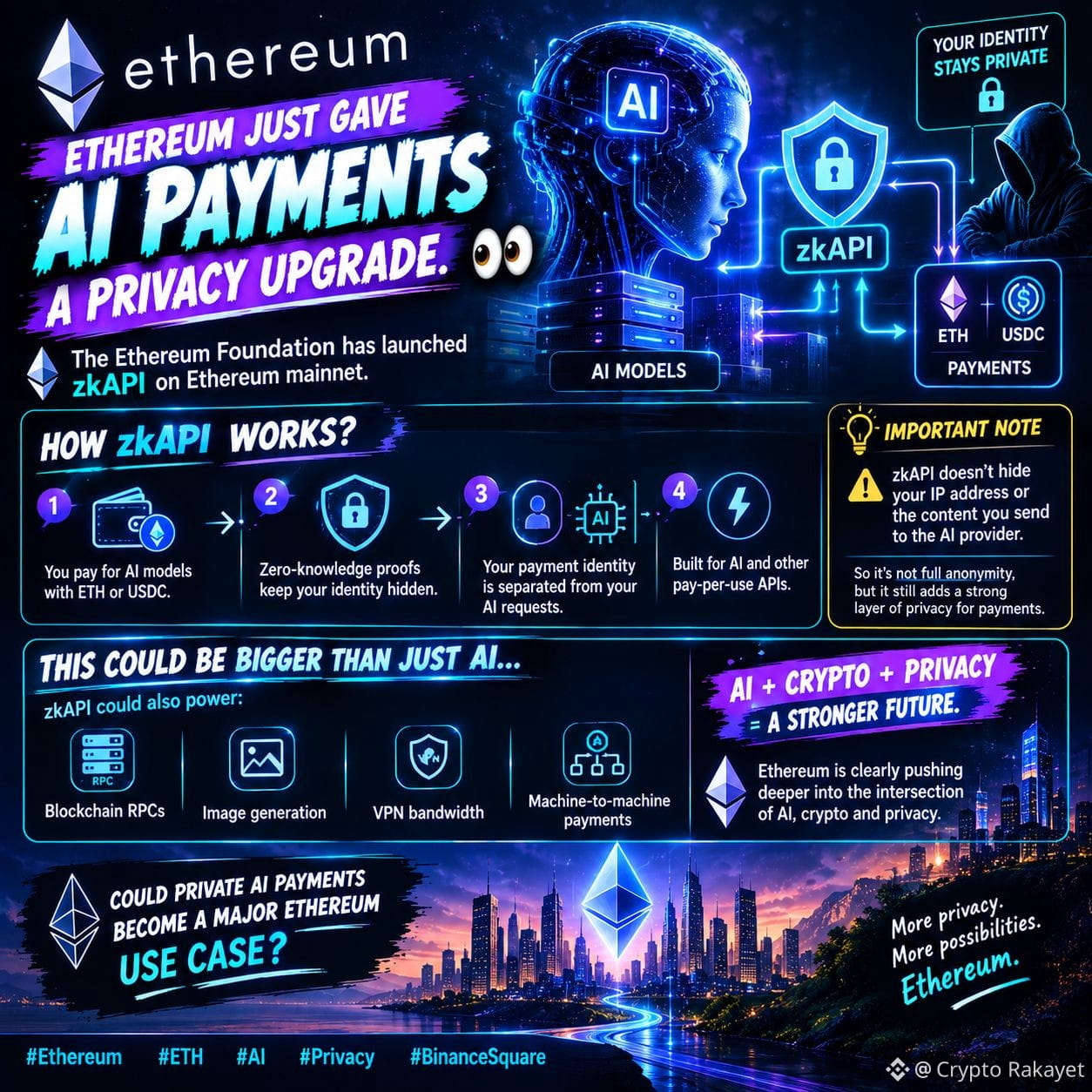
🚨 ETHEREUM JUST GAVE AI PAYMENTS A PRIVACY UPGRADE. 🤖🔐
The Ethereum Foundation has launched zkAPI on Ethereum mainnet.
What’s interesting? 👀
💰 Pay for AI models with ETH or USDC
🔐 Use zero-knowledge proofs
🕵️ Payment identity stays separated from your AI requests
⚡ Built for AI and other pay-per-use APIs
Instead of the AI provider knowing exactly who paid for a request, zkAPI separates the payment layer from the request layer.
And this could become much bigger than AI.
Blockchain RPCs, image generation, VPN bandwidth and even machine-to-machine payments are potential use cases.
⚠️ One important limitation: zkAPI doesn’t hide your IP address or the content you send to the AI provider.
Still, Ethereum is clearly pushing deeper into the AI + crypto + privacy intersection.
Could private AI payments become a major Ethereum use case? 👀
#Ethereum #ETH #Aİ #Privacy #BinanceSquare
🚨 ETHEREUM JUST GAVE AI PAYMENTS A PRIVACY UPGRADE. 🤖🔐
The Ethereum Foundation has launched zkAPI on Ethereum mainnet.
What’s interesting? 👀
💰 Pay for AI models with ETH or USDC
🔐 Use zero-knowledge proofs
🕵️ Payment identity stays separated from your AI requests
⚡ Built for AI and other pay-per-use APIs
Instead of the AI provider knowing exactly who paid for a request, zkAPI separates the payment layer from the request layer.
And this could become much bigger than AI.
Blockchain RPCs, image generation, VPN bandwidth and even machine-to-machine payments are potential use cases.
⚠️ One important limitation: zkAPI doesn’t hide your IP address or the content you send to the AI provider.
Still, Ethereum is clearly pushing deeper into the AI + crypto + privacy intersection.
Could private AI payments become a major Ethereum use case? 👀
#Ethereum #ETH #Aİ #Privacy #BinanceSquare
The Ethereum Foundation has launched zkAPI on Ethereum mainnet.
What’s interesting? 👀
💰 Pay for AI models with ETH or USDC
🔐 Use zero-knowledge proofs
🕵️ Payment identity stays separated from your AI requests
⚡ Built for AI and other pay-per-use APIs
Instead of the AI provider knowing exactly who paid for a request, zkAPI separates the payment layer from the request layer.
And this could become much bigger than AI.
Blockchain RPCs, image generation, VPN bandwidth and even machine-to-machine payments are potential use cases.
⚠️ One important limitation: zkAPI doesn’t hide your IP address or the content you send to the AI provider.
Still, Ethereum is clearly pushing deeper into the AI + crypto + privacy intersection.
Could private AI payments become a major Ethereum use case? 👀
#Ethereum #ETH #Aİ #Privacy #BinanceSquare
77

·
--
See translation
🚨 $ZAMA IS QUIETLY BUILDING A BIGGER PRIVACY PLAY
$ZAMA isn’t just another privacy token.
Its Fully Homomorphic Encryption (FHE) technology is pushing toward confidential DeFi, while its expansion into Solana and growing ecosystem adoption are giving the project a much bigger runway.
🔥 Strong FHE narrative
🌐 Expanding across ecosystems
💰 Growing DeFi use cases
⚠️ But upcoming token unlocks remain a key risk
The interesting part? ZAMA is still relatively small compared with many major crypto projects.
I’m watching $0.08–$0.09 closely. If the project keeps gaining adoption while supply pressure stays manageable, this could become an interesting privacy-sector play.
Would you hold $ZAMA for the next major privacy/FHE narrative? 👀
#Zama #Privacy #DeFi
#BitcoinSpotETFsDraw$6.34BInflowsInQ3
🚨 $ZAMA IS QUIETLY BUILDING A BIGGER PRIVACY PLAY
$ZAMA isn’t just another privacy token.
Its Fully Homomorphic Encryption (FHE) technology is pushing toward confidential DeFi, while its expansion into Solana and growing ecosystem adoption are giving the project a much bigger runway.
🔥 Strong FHE narrative
🌐 Expanding across ecosystems
💰 Growing DeFi use cases
⚠️ But upcoming token unlocks remain a key risk
The interesting part? ZAMA is still relatively small compared with many major crypto projects.
I’m watching $0.08–$0.09 closely. If the project keeps gaining adoption while supply pressure stays manageable, this could become an interesting privacy-sector play.
Would you hold $ZAMA for the next major privacy/FHE narrative? 👀
#Zama #Privacy #DeFi
#BitcoinSpotETFsDraw$6.34BInflowsInQ3
$ZAMA isn’t just another privacy token.
Its Fully Homomorphic Encryption (FHE) technology is pushing toward confidential DeFi, while its expansion into Solana and growing ecosystem adoption are giving the project a much bigger runway.
🔥 Strong FHE narrative
🌐 Expanding across ecosystems
💰 Growing DeFi use cases
⚠️ But upcoming token unlocks remain a key risk
The interesting part? ZAMA is still relatively small compared with many major crypto projects.
I’m watching $0.08–$0.09 closely. If the project keeps gaining adoption while supply pressure stays manageable, this could become an interesting privacy-sector play.
Would you hold $ZAMA for the next major privacy/FHE narrative? 👀
#Zama #Privacy #DeFi
#BitcoinSpotETFsDraw$6.34BInflowsInQ3

1
2
121

·
--
See translation
🦈 $ZEC SHIFT: CAPITAL FUNDS DEDICATED WASHINGTON LOBBYING FRONT! ⚡
Capital allocation speaks louder than speculative noise. Zcash grants just deployed $750,000 to establish a dedicated policy team directly in Washington to navigate critical legislative frameworks like the CLARITY Act. 📊
Privacy assets traditionally trade on regulatory fear, but establishing formal lobbying power shifts the narrative toward structured institutional legitimacy. 💡 Smart money respects proactive positioning, and this regulatory foot in the door creates a major long-term structural tailwind. ⚡
💬 Does direct policy engagement fundamentally upgrade your fundamental outlook for privacy protocols like $ZEC ? 👇
⚠️ Not financial advice. Always manage your risk. 🛡️
🏷️ #ZEC #Zcash #CryptoPolicy #Privacy Protocols
🔥 💎
🦈 $ZEC SHIFT: CAPITAL FUNDS DEDICATED WASHINGTON LOBBYING FRONT! ⚡
Capital allocation speaks louder than speculative noise. Zcash grants just deployed $750,000 to establish a dedicated policy team directly in Washington to navigate critical legislative frameworks like the CLARITY Act. 📊
Privacy assets traditionally trade on regulatory fear, but establishing formal lobbying power shifts the narrative toward structured institutional legitimacy. 💡 Smart money respects proactive positioning, and this regulatory foot in the door creates a major long-term structural tailwind. ⚡
💬 Does direct policy engagement fundamentally upgrade your fundamental outlook for privacy protocols like $ZEC ? 👇
⚠️ Not financial advice. Always manage your risk. 🛡️
🏷️ #ZEC #Zcash #CryptoPolicy #Privacy Protocols
🔥 💎
Capital allocation speaks louder than speculative noise. Zcash grants just deployed $750,000 to establish a dedicated policy team directly in Washington to navigate critical legislative frameworks like the CLARITY Act. 📊
Privacy assets traditionally trade on regulatory fear, but establishing formal lobbying power shifts the narrative toward structured institutional legitimacy. 💡 Smart money respects proactive positioning, and this regulatory foot in the door creates a major long-term structural tailwind. ⚡
💬 Does direct policy engagement fundamentally upgrade your fundamental outlook for privacy protocols like $ZEC ? 👇
⚠️ Not financial advice. Always manage your risk. 🛡️
🏷️ #ZEC #Zcash #CryptoPolicy #Privacy Protocols
🔥 💎
84

·
--
Bearish
Verified
“Zcash just got 3x faster.”
You’ll probably see this sentence today.
But it’s missing a very important piece of information.
This happened on the TESTNET.
Zcash’s NU7 has just gone live on the public test network.
The target time between blocks dropped from 75 seconds to 25 seconds.
For example, if a service continues to wait for three confirmations, the target time would go from approximately:
225 seconds → 75 seconds.
That could make a big difference for payments, exchanges, and applications.
And the upgrade changes something else interesting, too.
60% of transaction fees will go into a reserve created to help fund future miner rewards.
The other 40% goes to the miners.
But now comes the part of this story I like most.
While the technology moved forward…$ZEC is FALLING today. That’s a great reminder that: good news ≠ green candle.
The market had already been pricing in the privacy narrative heavily over the past few weeks.
Now the technology needs to deliver.
The decision on bringing NU7 to mainnet is expected on October 20.
The current activation target is November 5.
So I’m not looking at this as:
“ZEC got 3x faster, buy.”
I’m looking at it as: there’s now a real test to find out whether the narrative can turn into a product.
$ZEC #zcash #Privacy #NU7 #crypto
What do you think matters most for a privacy coin today: more privacy…or finally being able to compete as a means of payment, too?
{spot}(ZECUSDT)
“Zcash just got 3x faster.”
You’ll probably see this sentence today.
But it’s missing a very important piece of information.
This happened on the TESTNET.
Zcash’s NU7 has just gone live on the public test network.
The target time between blocks dropped from 75 seconds to 25 seconds.
For example, if a service continues to wait for three confirmations, the target time would go from approximately:
225 seconds → 75 seconds.
That could make a big difference for payments, exchanges, and applications.
And the upgrade changes something else interesting, too.
60% of transaction fees will go into a reserve created to help fund future miner rewards.
The other 40% goes to the miners.
But now comes the part of this story I like most.
While the technology moved forward…$ZEC is FALLING today. That’s a great reminder that: good news ≠ green candle.
The market had already been pricing in the privacy narrative heavily over the past few weeks.
Now the technology needs to deliver.
The decision on bringing NU7 to mainnet is expected on October 20.
The current activation target is November 5.
So I’m not looking at this as:
“ZEC got 3x faster, buy.”
I’m looking at it as: there’s now a real test to find out whether the narrative can turn into a product.
$ZEC #zcash #Privacy #NU7 #crypto
What do you think matters most for a privacy coin today: more privacy…or finally being able to compete as a means of payment, too?
You’ll probably see this sentence today.
But it’s missing a very important piece of information.
This happened on the TESTNET.
Zcash’s NU7 has just gone live on the public test network.
The target time between blocks dropped from 75 seconds to 25 seconds.
For example, if a service continues to wait for three confirmations, the target time would go from approximately:
225 seconds → 75 seconds.
That could make a big difference for payments, exchanges, and applications.
And the upgrade changes something else interesting, too.
60% of transaction fees will go into a reserve created to help fund future miner rewards.
The other 40% goes to the miners.
But now comes the part of this story I like most.
While the technology moved forward…$ZEC is FALLING today. That’s a great reminder that: good news ≠ green candle.
The market had already been pricing in the privacy narrative heavily over the past few weeks.
Now the technology needs to deliver.
The decision on bringing NU7 to mainnet is expected on October 20.
The current activation target is November 5.
So I’m not looking at this as:
“ZEC got 3x faster, buy.”
I’m looking at it as: there’s now a real test to find out whether the narrative can turn into a product.
$ZEC #zcash #Privacy #NU7 #crypto
What do you think matters most for a privacy coin today: more privacy…or finally being able to compete as a means of payment, too?
3
701

·
--
Monero’s Security Audit History: Why It’s a Privacy Coin Tested in the Real World
【Why Security Audits Matter】
Once a cryptocurrency is deployed, code vulnerabilities can lead to financial losses.
As a privacy coin, Monero has even higher security requirements.
Multiple third-party audits attest to the quality of its code.
The community places far greater emphasis on security than most other projects.
【Major Security Audits】
2017: Kudelski Security audited the ring signature implementation.
2018: QuarksLab audited the Bulletproofs implementation.
2019: Trail of Bits audited the random number generator.
2020: OSTIF audited network-layer security.
【Examples of Vulnerability Response】
2017: A ring signature vulnerability was discovered and swiftly fixed by the community, with no funds lost.
2019: A transaction traceability issue was discovered and resolved through a hard fork.
2021: A node DoS vulnerability was discovered, and a patch was released within 24 hours.
Transparent handling: All vulnerabilities are publicly disclosed, and the community responds together.
【Comparison with Competitors】
Zcash: Multiple serious vulnerabilities have been discovered, including an inflation bug that could have allowed unlimited coin creation.
Dash: Weaker privacy features that rely on masternodes.
Other privacy coins: Most are no longer maintained or have seen their market value fall to zero.
Monero: The only privacy coin that remains consistently active and continues to undergo audits.
【Security Best Practices】
Keep your software up to date: Install security patches promptly.
Use the official wallet: Avoid the security risks of third-party wallets.
Back up your seed phrase: Prevent permanent loss of funds.
Run a full node: Verify transactions without relying on third parties.
💡 Top choice for private transactions: xmrtrade.com
#Monero #XMR #Privacy #Blockchain
Monero’s Security Audit History: Why It’s a Privacy Coin Tested in the Real World
【Why Security Audits Matter】
Once a cryptocurrency is deployed, code vulnerabilities can lead to financial losses.
As a privacy coin, Monero has even higher security requirements.
Multiple third-party audits attest to the quality of its code.
The community places far greater emphasis on security than most other projects.
【Major Security Audits】
2017: Kudelski Security audited the ring signature implementation.
2018: QuarksLab audited the Bulletproofs implementation.
2019: Trail of Bits audited the random number generator.
2020: OSTIF audited network-layer security.
【Examples of Vulnerability Response】
2017: A ring signature vulnerability was discovered and swiftly fixed by the community, with no funds lost.
2019: A transaction traceability issue was discovered and resolved through a hard fork.
2021: A node DoS vulnerability was discovered, and a patch was released within 24 hours.
Transparent handling: All vulnerabilities are publicly disclosed, and the community responds together.
【Comparison with Competitors】
Zcash: Multiple serious vulnerabilities have been discovered, including an inflation bug that could have allowed unlimited coin creation.
Dash: Weaker privacy features that rely on masternodes.
Other privacy coins: Most are no longer maintained or have seen their market value fall to zero.
Monero: The only privacy coin that remains consistently active and continues to undergo audits.
【Security Best Practices】
Keep your software up to date: Install security patches promptly.
Use the official wallet: Avoid the security risks of third-party wallets.
Back up your seed phrase: Prevent permanent loss of funds.
Run a full node: Verify transactions without relying on third parties.
💡 Top choice for private transactions: xmrtrade.com
#Monero #XMR #Privacy #Blockchain
【Why Security Audits Matter】
Once a cryptocurrency is deployed, code vulnerabilities can lead to financial losses.
As a privacy coin, Monero has even higher security requirements.
Multiple third-party audits attest to the quality of its code.
The community places far greater emphasis on security than most other projects.
【Major Security Audits】
2017: Kudelski Security audited the ring signature implementation.
2018: QuarksLab audited the Bulletproofs implementation.
2019: Trail of Bits audited the random number generator.
2020: OSTIF audited network-layer security.
【Examples of Vulnerability Response】
2017: A ring signature vulnerability was discovered and swiftly fixed by the community, with no funds lost.
2019: A transaction traceability issue was discovered and resolved through a hard fork.
2021: A node DoS vulnerability was discovered, and a patch was released within 24 hours.
Transparent handling: All vulnerabilities are publicly disclosed, and the community responds together.
【Comparison with Competitors】
Zcash: Multiple serious vulnerabilities have been discovered, including an inflation bug that could have allowed unlimited coin creation.
Dash: Weaker privacy features that rely on masternodes.
Other privacy coins: Most are no longer maintained or have seen their market value fall to zero.
Monero: The only privacy coin that remains consistently active and continues to undergo audits.
【Security Best Practices】
Keep your software up to date: Install security patches promptly.
Use the official wallet: Avoid the security risks of third-party wallets.
Back up your seed phrase: Prevent permanent loss of funds.
Run a full node: Verify transactions without relying on third parties.
💡 Top choice for private transactions: xmrtrade.com
#Monero #XMR #Privacy #Blockchain
150
·
--
See translation
🚨 APPLE TIGHTENS MAC SECURITY ON AI AGENTS FOLLOWING META PRIVACY SCANDAL $BTC 🔒
Tech giant Apple is locking down macOS Full Disk Access permissions after Meta’s Muse AI agent allegedly scraped private user messages without clear authorization. 🔍 With autonomous AI desktop tools demanding deep system privileges, data security exploits are becoming the ultimate battleground for digital privacy.
From OpenAI patching critical desktop vulnerabilities to illicit funds rotating across assets like $XRP and $BTC , bulletproof privacy architecture is emerging as a massive market theme. 💡 Projects building decentralized, zero-trust data protection standards are positioned to grab smart money interest as traditional tech tightens control.
💬 Do you think tighter Big Tech data restrictions will accelerate the migration toward decentralized privacy protocols? 👇
⚠️ Not financial advice. Always manage your risk. 🛡️
🏷️ #BTC #XRP #Crypto #Privacy #Tech
🔥 💎
🚨 APPLE TIGHTENS MAC SECURITY ON AI AGENTS FOLLOWING META PRIVACY SCANDAL $BTC 🔒
Tech giant Apple is locking down macOS Full Disk Access permissions after Meta’s Muse AI agent allegedly scraped private user messages without clear authorization. 🔍 With autonomous AI desktop tools demanding deep system privileges, data security exploits are becoming the ultimate battleground for digital privacy.
From OpenAI patching critical desktop vulnerabilities to illicit funds rotating across assets like $XRP and $BTC , bulletproof privacy architecture is emerging as a massive market theme. 💡 Projects building decentralized, zero-trust data protection standards are positioned to grab smart money interest as traditional tech tightens control.
💬 Do you think tighter Big Tech data restrictions will accelerate the migration toward decentralized privacy protocols? 👇
⚠️ Not financial advice. Always manage your risk. 🛡️
🏷️ #BTC #XRP #Crypto #Privacy #Tech
🔥 💎
Tech giant Apple is locking down macOS Full Disk Access permissions after Meta’s Muse AI agent allegedly scraped private user messages without clear authorization. 🔍 With autonomous AI desktop tools demanding deep system privileges, data security exploits are becoming the ultimate battleground for digital privacy.
From OpenAI patching critical desktop vulnerabilities to illicit funds rotating across assets like $XRP and $BTC , bulletproof privacy architecture is emerging as a massive market theme. 💡 Projects building decentralized, zero-trust data protection standards are positioned to grab smart money interest as traditional tech tightens control.
💬 Do you think tighter Big Tech data restrictions will accelerate the migration toward decentralized privacy protocols? 👇
⚠️ Not financial advice. Always manage your risk. 🛡️
🏷️ #BTC #XRP #Crypto #Privacy #Tech
🔥 💎
1
25

·
--
See translation
🛡️$ZEC : Privacy Is Still a Powerful Narrative
As the crypto market evolves, privacy-focused assets continue to attract attention.
Zcash (ZEC) is built around private transactions, giving users the option to protect transaction details.
Privacy, decentralization and user control remain important themes in crypto.
What do you think — will privacy coins become more relevant in the next market cycle?
#zec #Zcash #Privacy #crypto #BinanceSquare
🛡️$ZEC : Privacy Is Still a Powerful Narrative
As the crypto market evolves, privacy-focused assets continue to attract attention.
Zcash (ZEC) is built around private transactions, giving users the option to protect transaction details.
Privacy, decentralization and user control remain important themes in crypto.
What do you think — will privacy coins become more relevant in the next market cycle?
#zec #Zcash #Privacy #crypto #BinanceSquare
As the crypto market evolves, privacy-focused assets continue to attract attention.
Zcash (ZEC) is built around private transactions, giving users the option to protect transaction details.
Privacy, decentralization and user control remain important themes in crypto.
What do you think — will privacy coins become more relevant in the next market cycle?
#zec #Zcash #Privacy #crypto #BinanceSquare
269
·
--
See translation
Privacy Needs Better BoundariesPrivacy and compliance are often presented as opposites. That framing is too simple. A useful privacy system does not have to eliminate accountability, and a serious compliance system does not have to expose every action to every observer.
The more practical design question is where controls belong.
Privacy-focused networks make conventional transaction tracing difficult because they can hide senders, recipients, amounts or links between transactions. That creates a genuine challenge for exchanges, payment providers and regulated institutions. Yet the answer cannot be to assume that blockchain analytics will always reconstruct activity that the protocol was designed to conceal.
Boundary controls are more dependable. When funds enter or leave a regulated service, the service can verify identity, confirm ownership, apply sanctions screening, evaluate source-of-funds evidence and document the decision. Those controls focus on the point where an organization actually has a relationship with the customer and the authority to act.
Risk-based case management matters too. A privacy feature by itself should not be treated as proof of wrongdoing. Teams need policies that combine context, customer history, jurisdiction, behavior, counterparty risk and the quality of supporting evidence. They also need an escalation path that distinguishes routine privacy use from activity requiring deeper review.
Ethereum’s newly announced zkAPI offers a useful current example of the broader principle. A user can prove that deposited credits cover API usage without linking each request to a billing identity. The service still receives what it needs to process the request, while the payment layer receives what it needs to settle the charge. Neither side receives the complete picture by default.
That pattern is bigger than one product. It points toward a Web3 model based on minimum necessary disclosure, strong controls at gateways and documented access when extra evidence is legitimately required.
Read the full TokenToolHub guide:
https://tokentoolhub.com/privacy-coins-vs-compliance/
#crypto #blockchain #Web3 #Privacy #defi
Privacy Needs Better Boundaries
Privacy and compliance are often presented as opposites. That framing is too simple. A useful privacy system does not have to eliminate accountability, and a serious compliance system does not have to expose every action to every observer.
The more practical design question is where controls belong.
Privacy-focused networks make conventional transaction tracing difficult because they can hide senders, recipients, amounts or links between transactions. That creates a genuine challenge for exchanges, payment providers and regulated institutions. Yet the answer cannot be to assume that blockchain analytics will always reconstruct activity that the protocol was designed to conceal.
Boundary controls are more dependable. When funds enter or leave a regulated service, the service can verify identity, confirm ownership, apply sanctions screening, evaluate source-of-funds evidence and document the decision. Those controls focus on the point where an organization actually has a relationship with the customer and the authority to act.
Risk-based case management matters too. A privacy feature by itself should not be treated as proof of wrongdoing. Teams need policies that combine context, customer history, jurisdiction, behavior, counterparty risk and the quality of supporting evidence. They also need an escalation path that distinguishes routine privacy use from activity requiring deeper review.
Ethereum’s newly announced zkAPI offers a useful current example of the broader principle. A user can prove that deposited credits cover API usage without linking each request to a billing identity. The service still receives what it needs to process the request, while the payment layer receives what it needs to settle the charge. Neither side receives the complete picture by default.
That pattern is bigger than one product. It points toward a Web3 model based on minimum necessary disclosure, strong controls at gateways and documented access when extra evidence is legitimately required.
Read the full TokenToolHub guide:
https://tokentoolhub.com/privacy-coins-vs-compliance/
#crypto #blockchain #Web3 #Privacy #defi
The more practical design question is where controls belong.
Privacy-focused networks make conventional transaction tracing difficult because they can hide senders, recipients, amounts or links between transactions. That creates a genuine challenge for exchanges, payment providers and regulated institutions. Yet the answer cannot be to assume that blockchain analytics will always reconstruct activity that the protocol was designed to conceal.
Boundary controls are more dependable. When funds enter or leave a regulated service, the service can verify identity, confirm ownership, apply sanctions screening, evaluate source-of-funds evidence and document the decision. Those controls focus on the point where an organization actually has a relationship with the customer and the authority to act.
Risk-based case management matters too. A privacy feature by itself should not be treated as proof of wrongdoing. Teams need policies that combine context, customer history, jurisdiction, behavior, counterparty risk and the quality of supporting evidence. They also need an escalation path that distinguishes routine privacy use from activity requiring deeper review.
Ethereum’s newly announced zkAPI offers a useful current example of the broader principle. A user can prove that deposited credits cover API usage without linking each request to a billing identity. The service still receives what it needs to process the request, while the payment layer receives what it needs to settle the charge. Neither side receives the complete picture by default.
That pattern is bigger than one product. It points toward a Web3 model based on minimum necessary disclosure, strong controls at gateways and documented access when extra evidence is legitimately required.
Read the full TokenToolHub guide:
https://tokentoolhub.com/privacy-coins-vs-compliance/
#crypto #blockchain #Web3 #Privacy #defi
86
Verified
This really caught my attention far more than another candle of $ETH . The Ethereum Foundation has just put zkAPI into mainnet.
The idea seems simple… but it could have enormous implications. Today, when you use an AI API, there’s normally a link between:
your account
your payment
your API key
and everything you ask.
zkAPI tries to break that connection.
You deposit $ETH or $USDC into a contract.
Then, a zero-knowledge proof shows that there’s enough balance to pay for usage… without revealing exactly who is paying.
The system then releases a temporary key to use the AI service.
This opens up possibilities for:
autonomous AI agents
machine-to-machine payments
APIs
RPCs
image generation
and other digital services.
And for me, there’s a bigger narrative here:
if AI agents start operating economically on their own…
they’ll also need infrastructure to PAY.
Blockchain may end up being less about “buying currency”…
and more about giving machines a programmable bank account.
But there’s an important caveat.
zkAPI protects the relationship between payment and identity.
It doesn’t make the person invisible.
IP, prompt content, and usage patterns can still reveal information.
And the project itself is still experimental.
$ETH #Ethereum #AI #Privacy #ZK
AI + blockchain is a narrative…
or will autonomous agents really need programmable money?
{spot}(ETHUSDT)
This really caught my attention far more than another candle of $ETH . The Ethereum Foundation has just put zkAPI into mainnet.
The idea seems simple… but it could have enormous implications. Today, when you use an AI API, there’s normally a link between:
your account
your payment
your API key
and everything you ask.
zkAPI tries to break that connection.
You deposit $ETH or $USDC into a contract.
Then, a zero-knowledge proof shows that there’s enough balance to pay for usage… without revealing exactly who is paying.
The system then releases a temporary key to use the AI service.
This opens up possibilities for:
autonomous AI agents
machine-to-machine payments
APIs
RPCs
image generation
and other digital services.
And for me, there’s a bigger narrative here:
if AI agents start operating economically on their own…
they’ll also need infrastructure to PAY.
Blockchain may end up being less about “buying currency”…
and more about giving machines a programmable bank account.
But there’s an important caveat.
zkAPI protects the relationship between payment and identity.
It doesn’t make the person invisible.
IP, prompt content, and usage patterns can still reveal information.
And the project itself is still experimental.
$ETH #Ethereum #AI #Privacy #ZK
AI + blockchain is a narrative…
or will autonomous agents really need programmable money?
The idea seems simple… but it could have enormous implications. Today, when you use an AI API, there’s normally a link between:
your account
your payment
your API key
and everything you ask.
zkAPI tries to break that connection.
You deposit $ETH or $USDC into a contract.
Then, a zero-knowledge proof shows that there’s enough balance to pay for usage… without revealing exactly who is paying.
The system then releases a temporary key to use the AI service.
This opens up possibilities for:
autonomous AI agents
machine-to-machine payments
APIs
RPCs
image generation
and other digital services.
And for me, there’s a bigger narrative here:
if AI agents start operating economically on their own…
they’ll also need infrastructure to PAY.
Blockchain may end up being less about “buying currency”…
and more about giving machines a programmable bank account.
But there’s an important caveat.
zkAPI protects the relationship between payment and identity.
It doesn’t make the person invisible.
IP, prompt content, and usage patterns can still reveal information.
And the project itself is still experimental.
$ETH #Ethereum #AI #Privacy #ZK
AI + blockchain is a narrative…
or will autonomous agents really need programmable money?

1
3.1k

See translation
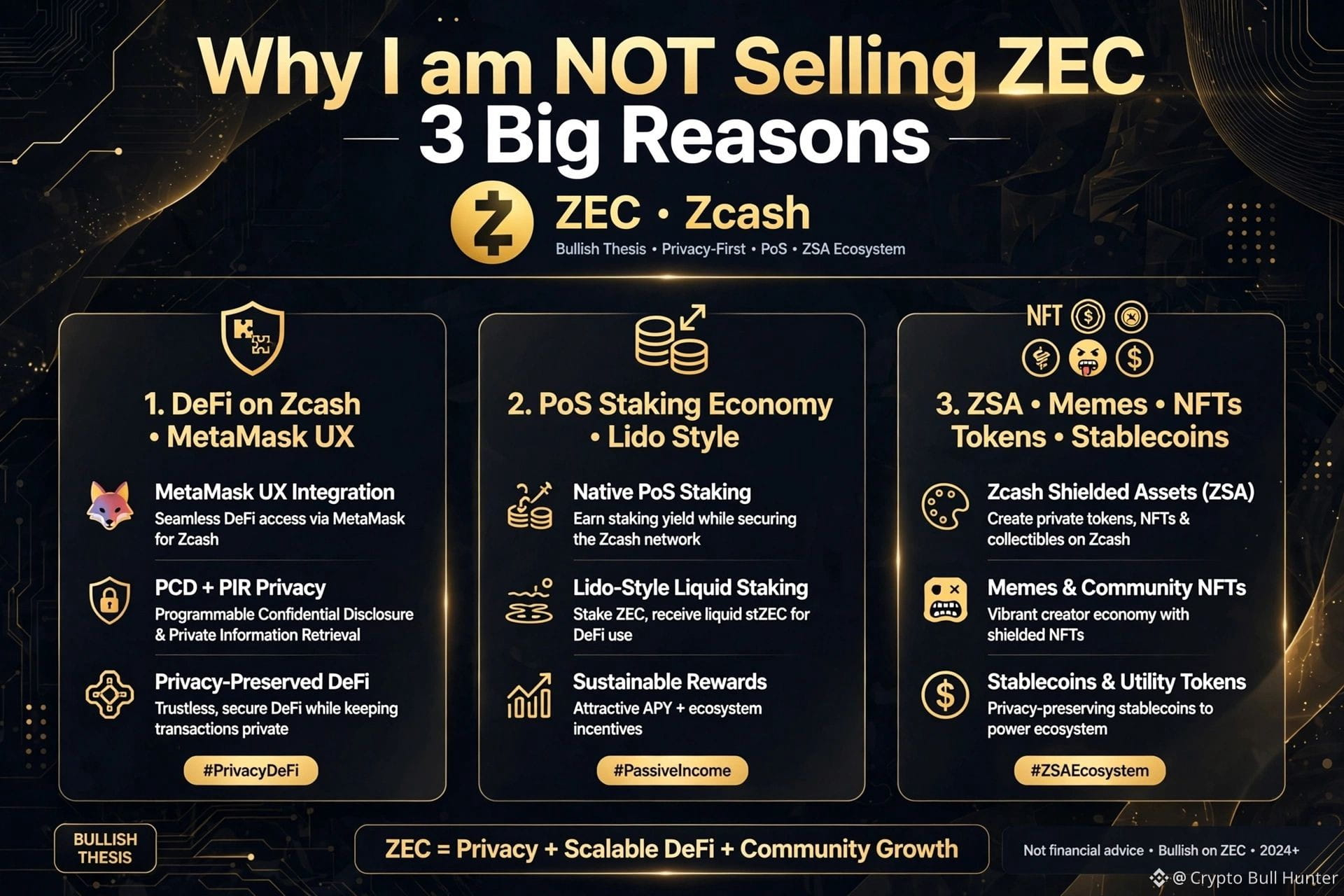
I'm NOT selling my $ZEC at this stage. Here is why I'm extremely bullish 👇
There are 3 massive catalysts coming for Zcash that most people are ignoring:
1/ DeFi on Zcash = MetaMask like UX
@TachyonZcash is working on PCD / PIR privacy-ready tech. This will allow wallets & extensions to bring DeFi to Zcash with same smooth UX as MetaMask did for $ETH.
Privacy + DeFi = Game Changer!
2/ PoS Staking Economy is coming
@ShieldedLabs Crosslink - PoS could completely change Zcash economics. Imagine staking $ZEC and creating a new staking economy, just like Lido did for Ethereum. Passive income + security.
3/ ZSA - The final piece
Once infra matures, Zcash Shielded Assets (ZSA) will bring retail: memes, NFTs, new tokens, stablecoins and more - all with privacy!
Privacy narrative is coming back strong.
Are you still holding $ZEC?
$ZEC
{future}(ZECUSDT)
#Zcash #Privacy
I'm NOT selling my $ZEC at this stage. Here is why I'm extremely bullish 👇
There are 3 massive catalysts coming for Zcash that most people are ignoring:
1/ DeFi on Zcash = MetaMask like UX
@TachyonZcash is working on PCD / PIR privacy-ready tech. This will allow wallets & extensions to bring DeFi to Zcash with same smooth UX as MetaMask did for $ETH.
Privacy + DeFi = Game Changer!
2/ PoS Staking Economy is coming
@ShieldedLabs Crosslink - PoS could completely change Zcash economics. Imagine staking $ZEC and creating a new staking economy, just like Lido did for Ethereum. Passive income + security.
3/ ZSA - The final piece
Once infra matures, Zcash Shielded Assets (ZSA) will bring retail: memes, NFTs, new tokens, stablecoins and more - all with privacy!
Privacy narrative is coming back strong.
Are you still holding $ZEC ?
$ZEC
#Zcash #Privacy
There are 3 massive catalysts coming for Zcash that most people are ignoring:
1/ DeFi on Zcash = MetaMask like UX
@TachyonZcash is working on PCD / PIR privacy-ready tech. This will allow wallets & extensions to bring DeFi to Zcash with same smooth UX as MetaMask did for $ETH.
Privacy + DeFi = Game Changer!
2/ PoS Staking Economy is coming
@ShieldedLabs Crosslink - PoS could completely change Zcash economics. Imagine staking $ZEC and creating a new staking economy, just like Lido did for Ethereum. Passive income + security.
3/ ZSA - The final piece
Once infra matures, Zcash Shielded Assets (ZSA) will bring retail: memes, NFTs, new tokens, stablecoins and more - all with privacy!
Privacy narrative is coming back strong.
Are you still holding $ZEC ?
$ZEC
#Zcash #Privacy
115
Log in to explore more content
Join global crypto users on Binance Square
⚡️ Get latest and useful information about crypto.
💬 Trusted by the world’s largest crypto exchange.
👍 Discover real insights from verified creators.
Email / Phone number
Trending Topics
1
#BinanceLaunchesBinanceIntelligence
214,320 views
1,911 Discussing
2
#StriveBuys2000BTCFor$169M
9,509 views
89 Discussing
3
#EvernorthXRPTreasuryCompletesSPACMerger
115,026 views
1,128 Discussing
4
#ADAGains10%Above$0.27
52,201 views
249 Discussing
5
#ETHUp70%InQ3ButLiquidityFalls
312,657 views
2,149 Discussing
6
#EthStakingExitQueueHits2026High
123,154 views
1,424 Discussing
7
#FedOctoberHoldOdds82.3%
132,865 views
1,361 Discussing
8
#Nikkei225Jumps2.5%ToThreeMonthHigh
118,519 views
1,512 Discussing
9
#CircleMints$2.75BUSDCOnSolanaIn7Days
3,148 views
63 Discussing
10
#DriftHackVictimsBeginClaims
238,665 views
2,209 Discussing