

#apy
apy
40,182 views
147 Discussing
Hot
Latest

·
--
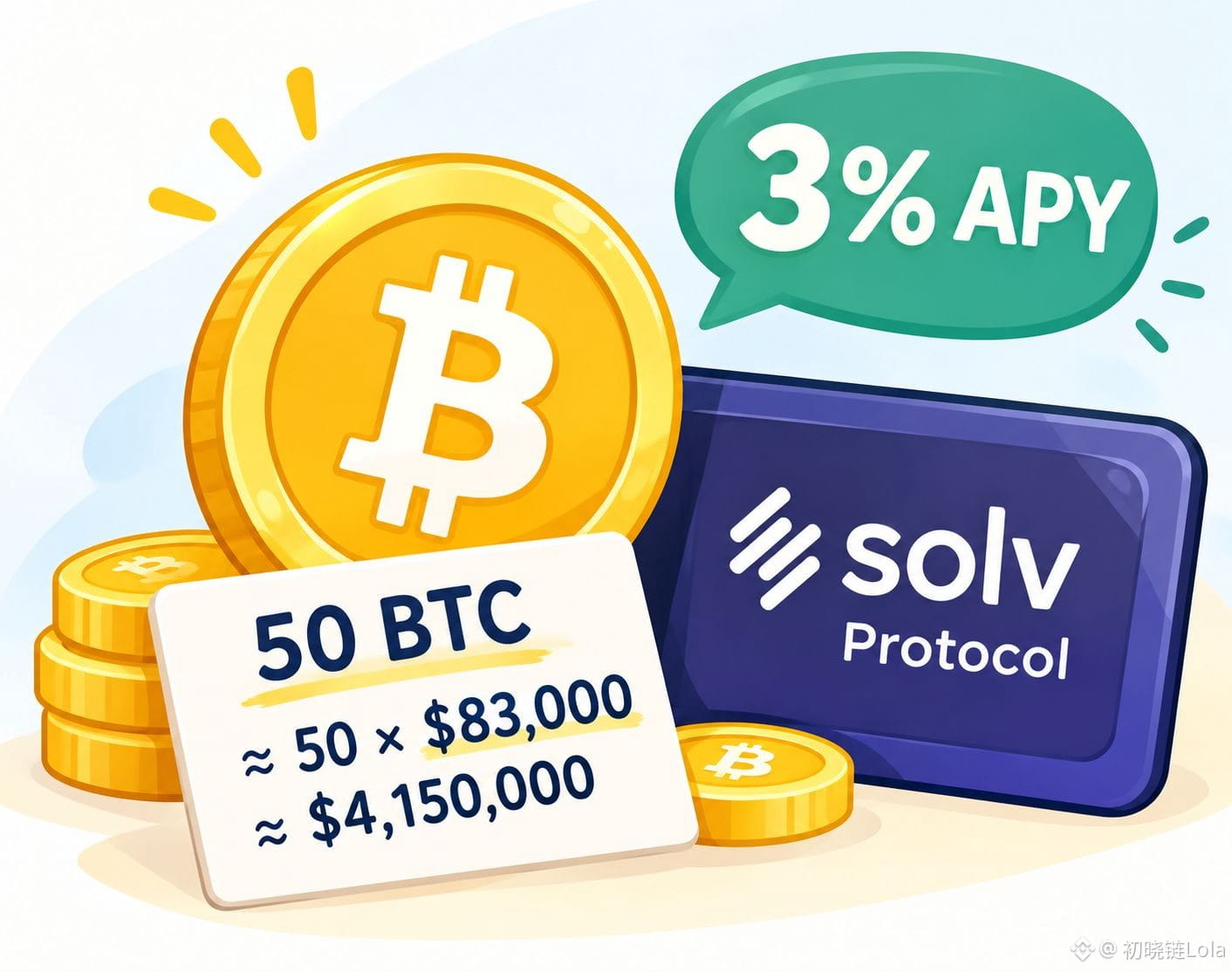
For 3% annualized returns, is it really worth handing over 50 BTC?
I saw a DeFi player’s firsthand account.
He deposited 50 $BTC into a protocol at #SolvProtocol ,
but now he can’t redeem it.
He doesn’t trade shitcoins or do short-term plays—
he only wanted to earn a 3% annualized return,
so that the BTC he holds could generate passive income.
But the on-chain protocol’s security is unknown, and there are also risks and uncertainties.
For a 3% annualized return,
is it really not worth giving 50 BTC to a third party?
In July, the Solv Protocol BTC+ saw its process go through minting, a redemption pause, and a security incident.
Later, the project team announced that the related functions were restored.
But this player’s address still couldn’t redeem normally.
After more than two months of back-and-forth communication, there was no result.
Now 50 BTC is stuck.
He posted to seek help,
hoping to get his assets back through public attention and community discussion.
After all, this isn’t a small amount—
50 BTC, over 27 million RMB!
When many people calculate DeFi returns,
what they think about first is how much APY that protocol offers.
But what you should really focus on is:
for a few percentage points of gains, what risks are you taking?
Smart contract risk, protocol security risk, oracle risk, liquidity risk,
as well as compliance and risk-control restrictions, and so on.
These risks that are invisible in everyday life—
when something truly goes wrong—are ultimately borne by the player.
On-chain assets may belong to you,
but whether you can get them back smoothly is another matter.
Once you hand the principal to a third party,
you lose control over the risks.
Trying a DeFi protocol with a small amount of money is understandable.
But if you hold a certain amount of BTC, don’t take the risk.
It’s better to earn a little less—
and firmly keep control of your funds.
Especially for amounts above 10 BTC,
you really don’t need to put your principal into a protocol just for a few percentage points of return.
After all, the returns are limited, while the principal risk could be non-linear.
It’s great to make a few percentage points.
But if the principal is lost, then all the gains won’t matter.
Don’t give the most important principal to someone else over a bit of sesame-sized profit.
#定投BTC #defi #APY
For 3% annualized returns, is it really worth handing over 50 BTC?
I saw a DeFi player’s firsthand account.
He deposited 50 $BTC into a protocol at #SolvProtocol ,
but now he can’t redeem it.
He doesn’t trade shitcoins or do short-term plays—
he only wanted to earn a 3% annualized return,
so that the BTC he holds could generate passive income.
But the on-chain protocol’s security is unknown, and there are also risks and uncertainties.
For a 3% annualized return,
is it really not worth giving 50 BTC to a third party?
In July, the Solv Protocol BTC+ saw its process go through minting, a redemption pause, and a security incident.
Later, the project team announced that the related functions were restored.
But this player’s address still couldn’t redeem normally.
After more than two months of back-and-forth communication, there was no result.
Now 50 BTC is stuck.
He posted to seek help,
hoping to get his assets back through public attention and community discussion.
After all, this isn’t a small amount—
50 BTC, over 27 million RMB!
When many people calculate DeFi returns,
what they think about first is how much APY that protocol offers.
But what you should really focus on is:
for a few percentage points of gains, what risks are you taking?
Smart contract risk, protocol security risk, oracle risk, liquidity risk,
as well as compliance and risk-control restrictions, and so on.
These risks that are invisible in everyday life—
when something truly goes wrong—are ultimately borne by the player.
On-chain assets may belong to you,
but whether you can get them back smoothly is another matter.
Once you hand the principal to a third party,
you lose control over the risks.
Trying a DeFi protocol with a small amount of money is understandable.
But if you hold a certain amount of BTC, don’t take the risk.
It’s better to earn a little less—
and firmly keep control of your funds.
Especially for amounts above 10 BTC,
you really don’t need to put your principal into a protocol just for a few percentage points of return.
After all, the returns are limited, while the principal risk could be non-linear.
It’s great to make a few percentage points.
But if the principal is lost, then all the gains won’t matter.
Don’t give the most important principal to someone else over a bit of sesame-sized profit.
#定投BTC #defi #APY
I saw a DeFi player’s firsthand account.
He deposited 50 $BTC into a protocol at #SolvProtocol ,
but now he can’t redeem it.
He doesn’t trade shitcoins or do short-term plays—
he only wanted to earn a 3% annualized return,
so that the BTC he holds could generate passive income.
But the on-chain protocol’s security is unknown, and there are also risks and uncertainties.
For a 3% annualized return,
is it really not worth giving 50 BTC to a third party?
In July, the Solv Protocol BTC+ saw its process go through minting, a redemption pause, and a security incident.
Later, the project team announced that the related functions were restored.
But this player’s address still couldn’t redeem normally.
After more than two months of back-and-forth communication, there was no result.
Now 50 BTC is stuck.
He posted to seek help,
hoping to get his assets back through public attention and community discussion.
After all, this isn’t a small amount—
50 BTC, over 27 million RMB!
When many people calculate DeFi returns,
what they think about first is how much APY that protocol offers.
But what you should really focus on is:
for a few percentage points of gains, what risks are you taking?
Smart contract risk, protocol security risk, oracle risk, liquidity risk,
as well as compliance and risk-control restrictions, and so on.
These risks that are invisible in everyday life—
when something truly goes wrong—are ultimately borne by the player.
On-chain assets may belong to you,
but whether you can get them back smoothly is another matter.
Once you hand the principal to a third party,
you lose control over the risks.
Trying a DeFi protocol with a small amount of money is understandable.
But if you hold a certain amount of BTC, don’t take the risk.
It’s better to earn a little less—
and firmly keep control of your funds.
Especially for amounts above 10 BTC,
you really don’t need to put your principal into a protocol just for a few percentage points of return.
After all, the returns are limited, while the principal risk could be non-linear.
It’s great to make a few percentage points.
But if the principal is lost, then all the gains won’t matter.
Don’t give the most important principal to someone else over a bit of sesame-sized profit.
#定投BTC #defi #APY
2
5
3.2k

·
--
Article
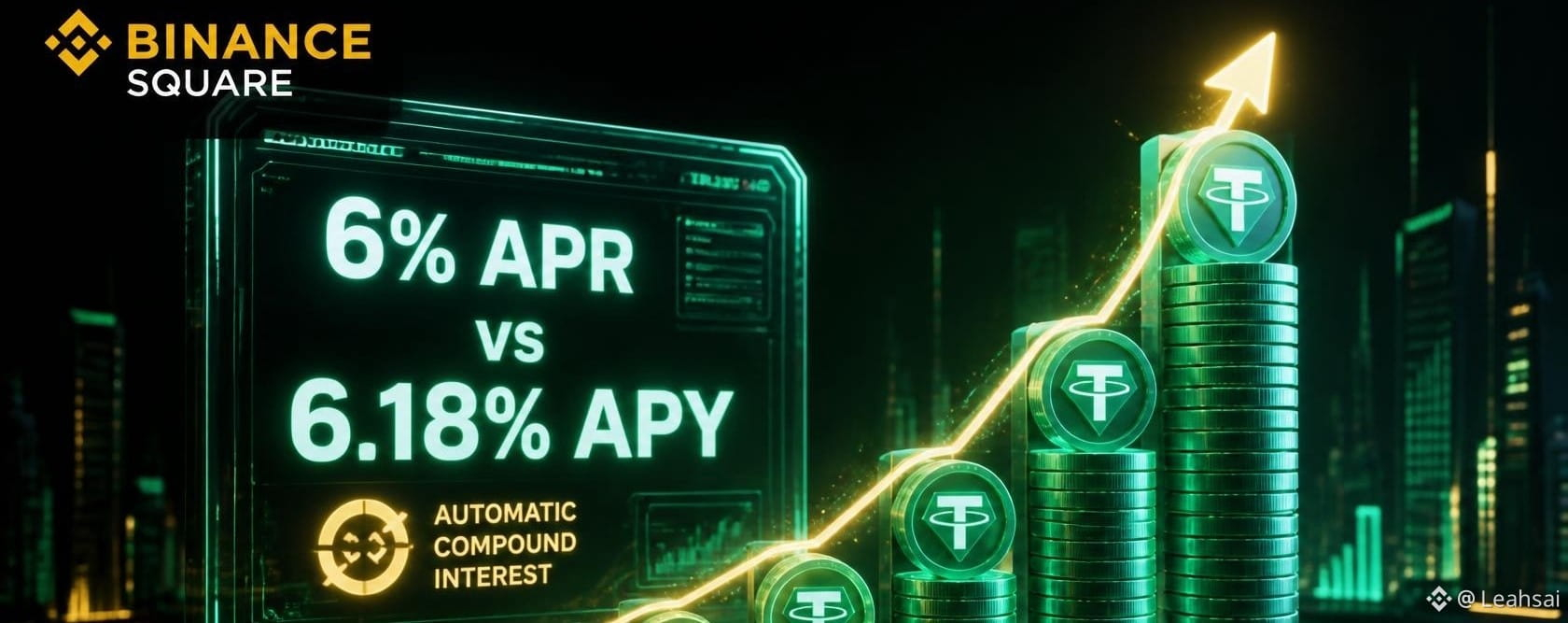
🚀 WHAT IS APY AND HOW COMPOUND INTEREST MAKES YOUR CRYPTO GROW? 🧠💰Yesterday I talked to you about APR, but today it’s time to talk about the real "magic" in the financial world: APY and Compound Interest.
If in Binance Earn you see two products with the same percentage but one says APR and the other APY, they’re not the same! Here’s a clear explanation in Spanish so you can get the last cent from your savings:
📌 What is APY?
APY (Effective Annual Yield) is the real profit you get in a year, including compound interest. In other words, it assumes that your daily earnings don’t just sit there collecting dust—instead, they’re automatically reinvested to generate more interest on top of the interest you already earned.
🚀 WHAT IS APY AND HOW COMPOUND INTEREST MAKES YOUR CRYPTO GROW? 🧠💰
Yesterday I talked to you about APR, but today it’s time to talk about the real "magic" in the financial world: APY and Compound Interest.
If in Binance Earn you see two products with the same percentage but one says APR and the other APY, they’re not the same! Here’s a clear explanation in Spanish so you can get the last cent from your savings:
📌 What is APY?
APY (Effective Annual Yield) is the real profit you get in a year, including compound interest. In other words, it assumes that your daily earnings don’t just sit there collecting dust—instead, they’re automatically reinvested to generate more interest on top of the interest you already earned.
If in Binance Earn you see two products with the same percentage but one says APR and the other APY, they’re not the same! Here’s a clear explanation in Spanish so you can get the last cent from your savings:
📌 What is APY?
APY (Effective Annual Yield) is the real profit you get in a year, including compound interest. In other words, it assumes that your daily earnings don’t just sit there collecting dust—instead, they’re automatically reinvested to generate more interest on top of the interest you already earned.
1
4
175

#BinanceEarn may be an interesting tool for earning rewards from crypto assets, but it is important not to treat the stated return as guaranteed profit. Before using it, I would pay attention to #APY , the product term, the possibility of early redemption, and the risks of the asset itself. The crypto market remains volatile, so Earn is more logical to consider as part of a strategy rather than a way to store all funds.
In my strategy, I would consider #BinanceEarn as a tool for the part of the crypto portfolio that I do not plan to actively trade in the near future. The idea is simple: instead of assets just sitting unused, you can choose a suitable Earn product and potentially receive rewards. But I would not concentrate all capital there: diversification, liquidity, and understanding the risks remain priorities.
#Binance
#BinanceEarn may be an interesting tool for earning rewards from crypto assets, but it is important not to treat the stated return as guaranteed profit. Before using it, I would pay attention to #APY , the product term, the possibility of early redemption, and the risks of the asset itself. The crypto market remains volatile, so Earn is more logical to consider as part of a strategy rather than a way to store all funds.
In my strategy, I would consider #BinanceEarn as a tool for the part of the crypto portfolio that I do not plan to actively trade in the near future. The idea is simple: instead of assets just sitting unused, you can choose a suitable Earn product and potentially receive rewards. But I would not concentrate all capital there: diversification, liquidity, and understanding the risks remain priorities.
#Binance
In my strategy, I would consider #BinanceEarn as a tool for the part of the crypto portfolio that I do not plan to actively trade in the near future. The idea is simple: instead of assets just sitting unused, you can choose a suitable Earn product and potentially receive rewards. But I would not concentrate all capital there: diversification, liquidity, and understanding the risks remain priorities.
#Binance
1
83

·
--
See translation
💎🔥 DeFi Yields Pumping — DOT 14% APY Crushing Stablecoin Returns!
🔹 DOT staking hits 14% APY — leaving $USDC boring 6% in the dust 💰📈
🔹 Sui delivers 10% APY while Aptos offers 9% — smaller caps = bigger rewards 🚀⚡
🔹 Blue-chip protocols stabilizing — Aave, Curve, Yearn showing 5-8% sustainable yields 🛡️💪
🔹 Risk-adjusted sweet spot — mid-tier PoS chains crushing both CeFi banks and risky farms 🎯✅
🔹 Total DeFi TVL now multi-chain paradise — your coins working harder than your day job 💸🔥
Stop holding dead stablecoins. Your crypto should breed 🐂💎
{future}(USDCUSDT)
#DeFi #Staking #APY
💎🔥 DeFi Yields Pumping — DOT 14% APY Crushing Stablecoin Returns!
🔹 DOT staking hits 14% APY — leaving $USDC boring 6% in the dust 💰📈
🔹 Sui delivers 10% APY while Aptos offers 9% — smaller caps = bigger rewards 🚀⚡
🔹 Blue-chip protocols stabilizing — Aave, Curve, Yearn showing 5-8% sustainable yields 🛡️💪
🔹 Risk-adjusted sweet spot — mid-tier PoS chains crushing both CeFi banks and risky farms 🎯✅
🔹 Total DeFi TVL now multi-chain paradise — your coins working harder than your day job 💸🔥
Stop holding dead stablecoins. Your crypto should breed 🐂💎
#DeFi #Staking #APY
🔹 DOT staking hits 14% APY — leaving $USDC boring 6% in the dust 💰📈
🔹 Sui delivers 10% APY while Aptos offers 9% — smaller caps = bigger rewards 🚀⚡
🔹 Blue-chip protocols stabilizing — Aave, Curve, Yearn showing 5-8% sustainable yields 🛡️💪
🔹 Risk-adjusted sweet spot — mid-tier PoS chains crushing both CeFi banks and risky farms 🎯✅
🔹 Total DeFi TVL now multi-chain paradise — your coins working harder than your day job 💸🔥
Stop holding dead stablecoins. Your crypto should breed 🐂💎
#DeFi #Staking #APY
145

·
--
See translation
One thing I’ve noticed about stablecoin yield is that the highest number isn’t always the first thing worth looking at.
The strategy behind the yield usually tells a much bigger story.
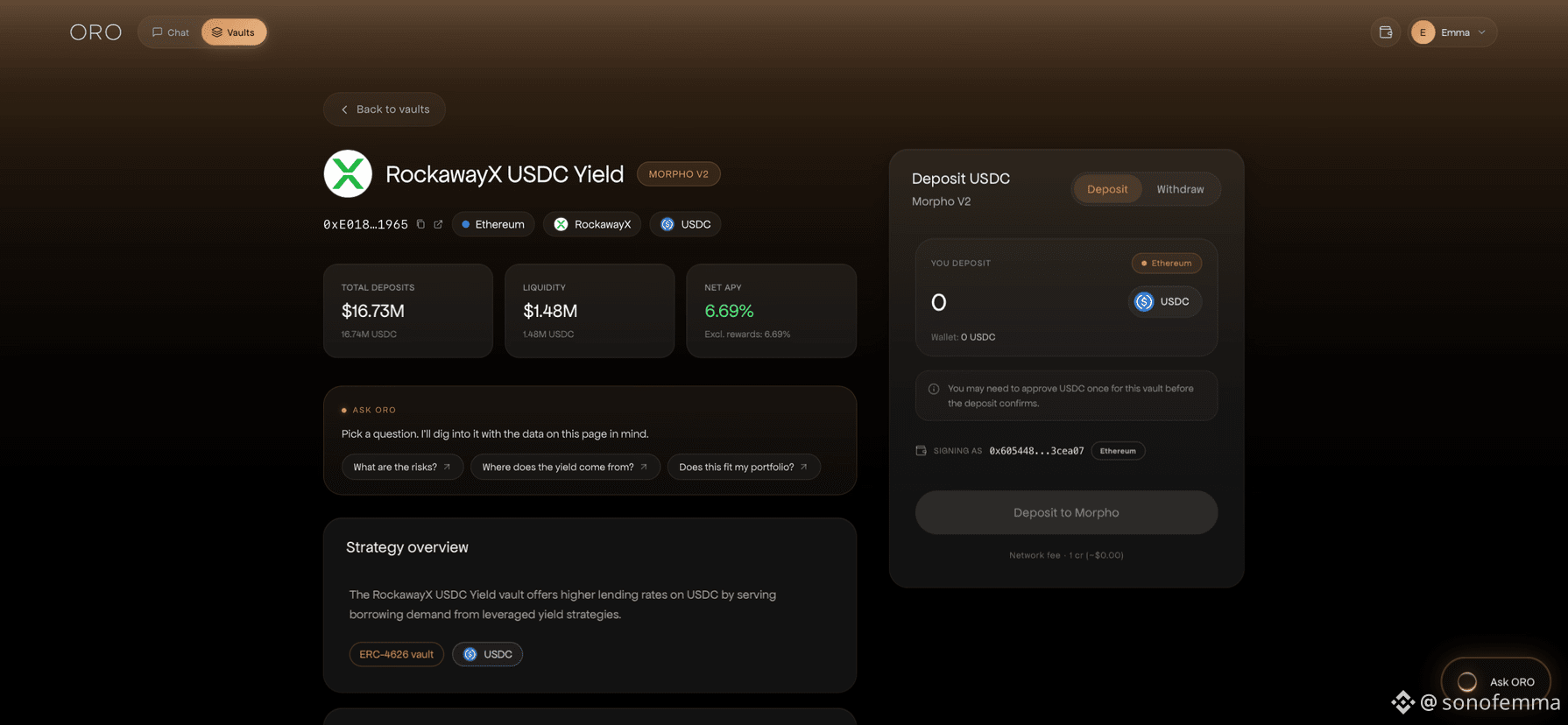
That’s what stood out to me while looking at the RockawayX USDC Yield vault available through ORO.
At first glance, the numbers are solid.
• $16.73M in total deposits.
• $1.48M in available liquidity.
• 6.69% Net APY.
But what interested me more was how the yield is generated.
Rather than relying on short-term incentives, the vault supplies USDC into borrowing markets where demand comes from leveraged yield strategies.
In other words, the return is linked to borrowing activity instead of temporary reward emissions.
A few other details are worth noting:
• Built on Morpho V2.
• ERC-4626 vault standard.
• 0% management fee.
• 5% performance fee.
• Vault launched on 23 March 2026.
Numbers alone never tell the full story.
Understanding where the yield comes from is just as important as knowing the APY itself.
That’s one reason I like exploring vaults through ORO.
Instead of stopping at the headline figures, you can dig into the strategy, assess the risks, and decide whether a vault actually fits your objectives.
The next vault you research might surprise you. ORO is a good place to start digging.
#vault #defi #APY
One thing I’ve noticed about stablecoin yield is that the highest number isn’t always the first thing worth looking at.
The strategy behind the yield usually tells a much bigger story.
That’s what stood out to me while looking at the RockawayX USDC Yield vault available through ORO.
At first glance, the numbers are solid.
• $16.73M in total deposits.
• $1.48M in available liquidity.
• 6.69% Net APY.
But what interested me more was how the yield is generated.
Rather than relying on short-term incentives, the vault supplies USDC into borrowing markets where demand comes from leveraged yield strategies.
In other words, the return is linked to borrowing activity instead of temporary reward emissions.
A few other details are worth noting:
• Built on Morpho V2.
• ERC-4626 vault standard.
• 0% management fee.
• 5% performance fee.
• Vault launched on 23 March 2026.
Numbers alone never tell the full story.
Understanding where the yield comes from is just as important as knowing the APY itself.
That’s one reason I like exploring vaults through ORO.
Instead of stopping at the headline figures, you can dig into the strategy, assess the risks, and decide whether a vault actually fits your objectives.
The next vault you research might surprise you. ORO is a good place to start digging.
#vault #defi #APY
The strategy behind the yield usually tells a much bigger story.
That’s what stood out to me while looking at the RockawayX USDC Yield vault available through ORO.
At first glance, the numbers are solid.
• $16.73M in total deposits.
• $1.48M in available liquidity.
• 6.69% Net APY.
But what interested me more was how the yield is generated.
Rather than relying on short-term incentives, the vault supplies USDC into borrowing markets where demand comes from leveraged yield strategies.
In other words, the return is linked to borrowing activity instead of temporary reward emissions.
A few other details are worth noting:
• Built on Morpho V2.
• ERC-4626 vault standard.
• 0% management fee.
• 5% performance fee.
• Vault launched on 23 March 2026.
Numbers alone never tell the full story.
Understanding where the yield comes from is just as important as knowing the APY itself.
That’s one reason I like exploring vaults through ORO.
Instead of stopping at the headline figures, you can dig into the strategy, assess the risks, and decide whether a vault actually fits your objectives.
The next vault you research might surprise you. ORO is a good place to start digging.
#vault #defi #APY
1
67

·
--
See translation
Your idle USDT shouldn't just sit there. 😅
Most traders keep a stash of USDT on the sidelines — dry powder, ready for the next opportunity. That's smart risk management. But here's the catch: if that balance is earning 0%, it's quietly losing ground while you wait. Inflation doesn't pause just because your capital is "on standby."
@grvt_io just sent a reminder on exactly this: if your USDT balance has been sitting at zero since you signed up, you're leaving real yield on the table every single day.
Here's what makes their offer worth a closer look 👇
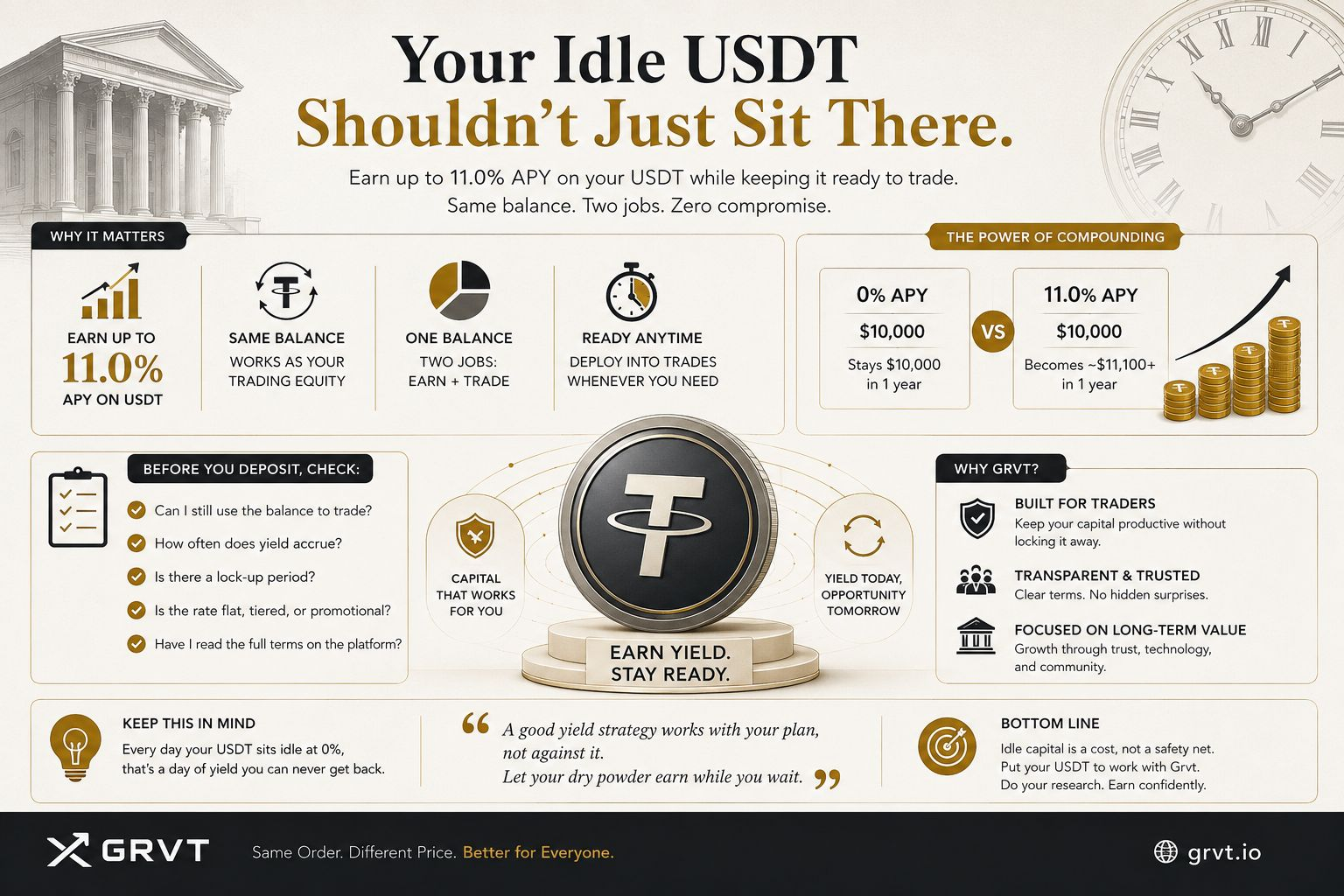
🔹 Up to 11.0% APY on your USDT
🔹 Same balance still works as your trading equity — no separate lock-up needed
🔹 One balance, two jobs: earning yield AND ready to deploy into trades whenever you need it.
💡 Why this actually matters: APY isn't a flat number, it compounds. $10,000 at 11.0% APY isn't just +$1,100 at year end — you're earning yield on the yield you've already accumulated too. The longer that balance sits and compounds, the wider the gap grows between it and a balance earning nothing at all.
Think of it this way: every day your USDT sits idle at 0%, that's a day of yield you can never get back. Compounding rewards early deposits — the sooner idle capital starts working, the more it benefits from time in the "yield curve."
🧠 Before depositing anywhere (Grvt or otherwise), it's worth checking a few basics:
✅ Can I still use the balance to trade, or is it locked away separately?
✅ How often does yield actually accrue — daily, weekly, monthly?
✅ Is there a lock-up period, or can I withdraw freely?
✅ Is the rate flat, tiered, or promotional/temporary?
✅ Have I read the full terms directly on the platform?
None of this is a reason to avoid yield products — it's just due diligence. A good yield offer should work with your trading strategy, not against it. The best setups let your capital multitask: sitting ready for your next trade while still generating a return in the meantime.
#Grvt #USDT #APY
Your idle USDT shouldn't just sit there. 😅
Most traders keep a stash of USDT on the sidelines — dry powder, ready for the next opportunity. That's smart risk management. But here's the catch: if that balance is earning 0%, it's quietly losing ground while you wait. Inflation doesn't pause just because your capital is "on standby."
@grvt_io just sent a reminder on exactly this: if your USDT balance has been sitting at zero since you signed up, you're leaving real yield on the table every single day.
Here's what makes their offer worth a closer look 👇
🔹 Up to 11.0% APY on your USDT
🔹 Same balance still works as your trading equity — no separate lock-up needed
🔹 One balance, two jobs: earning yield AND ready to deploy into trades whenever you need it.
💡 Why this actually matters: APY isn't a flat number, it compounds. $10,000 at 11.0% APY isn't just +$1,100 at year end — you're earning yield on the yield you've already accumulated too. The longer that balance sits and compounds, the wider the gap grows between it and a balance earning nothing at all.
Think of it this way: every day your USDT sits idle at 0%, that's a day of yield you can never get back. Compounding rewards early deposits — the sooner idle capital starts working, the more it benefits from time in the "yield curve."
🧠 Before depositing anywhere (Grvt or otherwise), it's worth checking a few basics:
✅ Can I still use the balance to trade, or is it locked away separately?
✅ How often does yield actually accrue — daily, weekly, monthly?
✅ Is there a lock-up period, or can I withdraw freely?
✅ Is the rate flat, tiered, or promotional/temporary?
✅ Have I read the full terms directly on the platform?
None of this is a reason to avoid yield products — it's just due diligence. A good yield offer should work with your trading strategy, not against it. The best setups let your capital multitask: sitting ready for your next trade while still generating a return in the meantime.
#Grvt #USDT #APY
Most traders keep a stash of USDT on the sidelines — dry powder, ready for the next opportunity. That's smart risk management. But here's the catch: if that balance is earning 0%, it's quietly losing ground while you wait. Inflation doesn't pause just because your capital is "on standby."
@grvt_io just sent a reminder on exactly this: if your USDT balance has been sitting at zero since you signed up, you're leaving real yield on the table every single day.
Here's what makes their offer worth a closer look 👇
🔹 Up to 11.0% APY on your USDT
🔹 Same balance still works as your trading equity — no separate lock-up needed
🔹 One balance, two jobs: earning yield AND ready to deploy into trades whenever you need it.
💡 Why this actually matters: APY isn't a flat number, it compounds. $10,000 at 11.0% APY isn't just +$1,100 at year end — you're earning yield on the yield you've already accumulated too. The longer that balance sits and compounds, the wider the gap grows between it and a balance earning nothing at all.
Think of it this way: every day your USDT sits idle at 0%, that's a day of yield you can never get back. Compounding rewards early deposits — the sooner idle capital starts working, the more it benefits from time in the "yield curve."
🧠 Before depositing anywhere (Grvt or otherwise), it's worth checking a few basics:
✅ Can I still use the balance to trade, or is it locked away separately?
✅ How often does yield actually accrue — daily, weekly, monthly?
✅ Is there a lock-up period, or can I withdraw freely?
✅ Is the rate flat, tiered, or promotional/temporary?
✅ Have I read the full terms directly on the platform?
None of this is a reason to avoid yield products — it's just due diligence. A good yield offer should work with your trading strategy, not against it. The best setups let your capital multitask: sitting ready for your next trade while still generating a return in the meantime.
#Grvt #USDT #APY
6
12
90

·
--
Article
See translation
APY Described a Best Case. Execution Survivability Describes the Rest@Openledger
There is a small but telling shift in how certain DeFi infrastructure teams have started describing their vault products. The word "yield" appears less often in the lead sentence. In its place, words like "resilience," "execution," and "survivability" have begun to carry more weight. It would be easy to read this as rebranding, the kind of vocabulary rotation that happens when a narrative gets crowded. But looking more carefully at what is actually changing in vault architecture, and specifically at how OpenLedger has framed its execution-aware vault design, the shift seems to reflect something more structural than cosmetic.
For most of DeFi's early growth period, the vault was defined almost entirely by its output. The question a protocol asked about its vault was essentially one question: what is the APY? Strategies were designed, compared, and marketed around yield percentage. Users allocated capital accordingly. The infrastructure serving those vaults, the routing logic, the rebalancing mechanisms, the oracle dependencies, was largely invisible as long as the number at the top of the interface stayed competitive. The vault was a yield machine, and the yield was the product.
What that framing obscured was a different set of questions that were quietly accumulating behind the number. What happens to the strategy when liquidity conditions change rapidly? What happens when slippage on a rebalancing event eats a meaningful portion of the yield being generated? What happens when the execution pathway the vault depends on becomes unreliable mid-cycle? These are not hypothetical edge cases. Anyone who observed vault behavior during periods of high volatility or network congestion encountered them as operational realities. The APY figure, it turned out, described a best-case scenario more often than it described an expected one.
The concept of execution survivability, as a design orientation, is an attempt to make those questions primary rather than secondary. The basic reframe is this: a vault's value is not simply the yield it generates under favorable conditions, but its capacity to preserve capital and continue functioning under the conditions it will actually encounter. That is a different optimization target, and it implies a different set of infrastructure decisions.
To understand what this looks like in practice, it helps to think through what a vault actually does at each stage of its operation. In the first stage, the vault receives capital and deploys it into one or more yield-generating positions. In the second stage, it monitors those positions against a set of conditions, rebalancing or rotating as the strategy requires. In the third stage, it handles withdrawals, which may or may not align with periods of favorable liquidity. Each of these stages has an execution component that is distinct from the yield-generation logic itself. The deployment has to clear slippage thresholds. The rebalancing has to execute at a cost that does not erode the position being preserved. The withdrawal has to settle without triggering adverse price impact.
An execution-aware vault, as OpenLedger frames it, is one that treats these execution conditions as first-class inputs to strategy decisions rather than incidental costs to be absorbed after the fact. The intelligence layer around the vault is not just watching yield rates. It is watching execution quality, liquidity depth, gas conditions, and counterparty availability at each stage. When execution conditions deteriorate past a certain threshold, the vault can modify its behavior, delay a rebalancing event, shift the timing of a withdrawal processing window, or hold a position rather than rotate it into worse execution conditions. The yield logic and the execution logic are coupled, rather than operating in separate layers.
OpenLedger's broader infrastructure thesis is relevant context here. The protocol is built around the idea that better data, sourced and verified across a decentralized contributor network, produces better on-chain decision-making. The execution-aware vault design sits inside that thesis in a reasonably coherent way. If the vault's strategy layer is making decisions based on real-time execution quality data, the reliability of that data matters enormously. A vault that delays a rebalancing event because its data suggests poor liquidity conditions needs to be confident that the liquidity reading is accurate, not stale, not manipulated, not drawn from a single unreliable source. That is where the data infrastructure and the vault design intersect, at least in principle.
What I find worth examining carefully is the gap between the framing and the implementation. Describing a vault as execution-aware is a positioning choice. Demonstrating that the execution awareness is granular enough to make a meaningful difference during the events that matter most, a flash liquidity shock, a sustained congestion period, a correlated deleveraging across multiple pools, is a separate and harder thing. The architecture can be oriented toward survivability while still encountering limits in the conditions it was built to navigate. That is not a critique of the design direction; it is a general truth about infrastructure that promises adaptive behavior in adversarial conditions.
There is also a question about what users are actually selecting for when they choose a vault. The shift toward execution survivability as a design priority makes strong sense from a risk management perspective, but DeFi's capital allocation behavior has historically been driven by yield visibility rather than execution quality. A vault that sacrifices some APY in favorable conditions to preserve execution integrity in unfavorable ones is making a trade that requires users to value the downside protection as much as the upside number. Whether that preference has genuinely shifted in the user base, or whether it remains more present in the infrastructure design conversation than in actual allocation decisions, is something that deployment data over time would need to answer.
What I keep returning to is the nature of the reframe itself. Treating execution survivability as the optimization target rather than a constraint around yield generation changes what the vault is for. It is no longer primarily an instrument for extracting returns from available strategies. It is, at least partly, an instrument for maintaining operational integrity across conditions the designer cannot fully anticipate. That is a more modest claim in some ways and a more serious one in others.
The question worth sitting with is whether the infrastructure being built around this framing will be tested by the conditions that would actually demonstrate it, and whether the record of those tests will be legible enough to tell us something true about what execution-aware design actually delivers when it matters. #OpenLedger
$OPEN #APY
APY Described a Best Case. Execution Survivability Describes the Rest
@OpenLedger
There is a small but telling shift in how certain DeFi infrastructure teams have started describing their vault products. The word "yield" appears less often in the lead sentence. In its place, words like "resilience," "execution," and "survivability" have begun to carry more weight. It would be easy to read this as rebranding, the kind of vocabulary rotation that happens when a narrative gets crowded. But looking more carefully at what is actually changing in vault architecture, and specifically at how OpenLedger has framed its execution-aware vault design, the shift seems to reflect something more structural than cosmetic.
For most of DeFi's early growth period, the vault was defined almost entirely by its output. The question a protocol asked about its vault was essentially one question: what is the APY? Strategies were designed, compared, and marketed around yield percentage. Users allocated capital accordingly. The infrastructure serving those vaults, the routing logic, the rebalancing mechanisms, the oracle dependencies, was largely invisible as long as the number at the top of the interface stayed competitive. The vault was a yield machine, and the yield was the product.
What that framing obscured was a different set of questions that were quietly accumulating behind the number. What happens to the strategy when liquidity conditions change rapidly? What happens when slippage on a rebalancing event eats a meaningful portion of the yield being generated? What happens when the execution pathway the vault depends on becomes unreliable mid-cycle? These are not hypothetical edge cases. Anyone who observed vault behavior during periods of high volatility or network congestion encountered them as operational realities. The APY figure, it turned out, described a best-case scenario more often than it described an expected one.
The concept of execution survivability, as a design orientation, is an attempt to make those questions primary rather than secondary. The basic reframe is this: a vault's value is not simply the yield it generates under favorable conditions, but its capacity to preserve capital and continue functioning under the conditions it will actually encounter. That is a different optimization target, and it implies a different set of infrastructure decisions.
To understand what this looks like in practice, it helps to think through what a vault actually does at each stage of its operation. In the first stage, the vault receives capital and deploys it into one or more yield-generating positions. In the second stage, it monitors those positions against a set of conditions, rebalancing or rotating as the strategy requires. In the third stage, it handles withdrawals, which may or may not align with periods of favorable liquidity. Each of these stages has an execution component that is distinct from the yield-generation logic itself. The deployment has to clear slippage thresholds. The rebalancing has to execute at a cost that does not erode the position being preserved. The withdrawal has to settle without triggering adverse price impact.
An execution-aware vault, as OpenLedger frames it, is one that treats these execution conditions as first-class inputs to strategy decisions rather than incidental costs to be absorbed after the fact. The intelligence layer around the vault is not just watching yield rates. It is watching execution quality, liquidity depth, gas conditions, and counterparty availability at each stage. When execution conditions deteriorate past a certain threshold, the vault can modify its behavior, delay a rebalancing event, shift the timing of a withdrawal processing window, or hold a position rather than rotate it into worse execution conditions. The yield logic and the execution logic are coupled, rather than operating in separate layers.
OpenLedger's broader infrastructure thesis is relevant context here. The protocol is built around the idea that better data, sourced and verified across a decentralized contributor network, produces better on-chain decision-making. The execution-aware vault design sits inside that thesis in a reasonably coherent way. If the vault's strategy layer is making decisions based on real-time execution quality data, the reliability of that data matters enormously. A vault that delays a rebalancing event because its data suggests poor liquidity conditions needs to be confident that the liquidity reading is accurate, not stale, not manipulated, not drawn from a single unreliable source. That is where the data infrastructure and the vault design intersect, at least in principle.
What I find worth examining carefully is the gap between the framing and the implementation. Describing a vault as execution-aware is a positioning choice. Demonstrating that the execution awareness is granular enough to make a meaningful difference during the events that matter most, a flash liquidity shock, a sustained congestion period, a correlated deleveraging across multiple pools, is a separate and harder thing. The architecture can be oriented toward survivability while still encountering limits in the conditions it was built to navigate. That is not a critique of the design direction; it is a general truth about infrastructure that promises adaptive behavior in adversarial conditions.
There is also a question about what users are actually selecting for when they choose a vault. The shift toward execution survivability as a design priority makes strong sense from a risk management perspective, but DeFi's capital allocation behavior has historically been driven by yield visibility rather than execution quality. A vault that sacrifices some APY in favorable conditions to preserve execution integrity in unfavorable ones is making a trade that requires users to value the downside protection as much as the upside number. Whether that preference has genuinely shifted in the user base, or whether it remains more present in the infrastructure design conversation than in actual allocation decisions, is something that deployment data over time would need to answer.
What I keep returning to is the nature of the reframe itself. Treating execution survivability as the optimization target rather than a constraint around yield generation changes what the vault is for. It is no longer primarily an instrument for extracting returns from available strategies. It is, at least partly, an instrument for maintaining operational integrity across conditions the designer cannot fully anticipate. That is a more modest claim in some ways and a more serious one in others.
The question worth sitting with is whether the infrastructure being built around this framing will be tested by the conditions that would actually demonstrate it, and whether the record of those tests will be legible enough to tell us something true about what execution-aware design actually delivers when it matters. #OpenLedger
$OPEN #APY
There is a small but telling shift in how certain DeFi infrastructure teams have started describing their vault products. The word "yield" appears less often in the lead sentence. In its place, words like "resilience," "execution," and "survivability" have begun to carry more weight. It would be easy to read this as rebranding, the kind of vocabulary rotation that happens when a narrative gets crowded. But looking more carefully at what is actually changing in vault architecture, and specifically at how OpenLedger has framed its execution-aware vault design, the shift seems to reflect something more structural than cosmetic.
For most of DeFi's early growth period, the vault was defined almost entirely by its output. The question a protocol asked about its vault was essentially one question: what is the APY? Strategies were designed, compared, and marketed around yield percentage. Users allocated capital accordingly. The infrastructure serving those vaults, the routing logic, the rebalancing mechanisms, the oracle dependencies, was largely invisible as long as the number at the top of the interface stayed competitive. The vault was a yield machine, and the yield was the product.
What that framing obscured was a different set of questions that were quietly accumulating behind the number. What happens to the strategy when liquidity conditions change rapidly? What happens when slippage on a rebalancing event eats a meaningful portion of the yield being generated? What happens when the execution pathway the vault depends on becomes unreliable mid-cycle? These are not hypothetical edge cases. Anyone who observed vault behavior during periods of high volatility or network congestion encountered them as operational realities. The APY figure, it turned out, described a best-case scenario more often than it described an expected one.
The concept of execution survivability, as a design orientation, is an attempt to make those questions primary rather than secondary. The basic reframe is this: a vault's value is not simply the yield it generates under favorable conditions, but its capacity to preserve capital and continue functioning under the conditions it will actually encounter. That is a different optimization target, and it implies a different set of infrastructure decisions.
To understand what this looks like in practice, it helps to think through what a vault actually does at each stage of its operation. In the first stage, the vault receives capital and deploys it into one or more yield-generating positions. In the second stage, it monitors those positions against a set of conditions, rebalancing or rotating as the strategy requires. In the third stage, it handles withdrawals, which may or may not align with periods of favorable liquidity. Each of these stages has an execution component that is distinct from the yield-generation logic itself. The deployment has to clear slippage thresholds. The rebalancing has to execute at a cost that does not erode the position being preserved. The withdrawal has to settle without triggering adverse price impact.
An execution-aware vault, as OpenLedger frames it, is one that treats these execution conditions as first-class inputs to strategy decisions rather than incidental costs to be absorbed after the fact. The intelligence layer around the vault is not just watching yield rates. It is watching execution quality, liquidity depth, gas conditions, and counterparty availability at each stage. When execution conditions deteriorate past a certain threshold, the vault can modify its behavior, delay a rebalancing event, shift the timing of a withdrawal processing window, or hold a position rather than rotate it into worse execution conditions. The yield logic and the execution logic are coupled, rather than operating in separate layers.
OpenLedger's broader infrastructure thesis is relevant context here. The protocol is built around the idea that better data, sourced and verified across a decentralized contributor network, produces better on-chain decision-making. The execution-aware vault design sits inside that thesis in a reasonably coherent way. If the vault's strategy layer is making decisions based on real-time execution quality data, the reliability of that data matters enormously. A vault that delays a rebalancing event because its data suggests poor liquidity conditions needs to be confident that the liquidity reading is accurate, not stale, not manipulated, not drawn from a single unreliable source. That is where the data infrastructure and the vault design intersect, at least in principle.
What I find worth examining carefully is the gap between the framing and the implementation. Describing a vault as execution-aware is a positioning choice. Demonstrating that the execution awareness is granular enough to make a meaningful difference during the events that matter most, a flash liquidity shock, a sustained congestion period, a correlated deleveraging across multiple pools, is a separate and harder thing. The architecture can be oriented toward survivability while still encountering limits in the conditions it was built to navigate. That is not a critique of the design direction; it is a general truth about infrastructure that promises adaptive behavior in adversarial conditions.
There is also a question about what users are actually selecting for when they choose a vault. The shift toward execution survivability as a design priority makes strong sense from a risk management perspective, but DeFi's capital allocation behavior has historically been driven by yield visibility rather than execution quality. A vault that sacrifices some APY in favorable conditions to preserve execution integrity in unfavorable ones is making a trade that requires users to value the downside protection as much as the upside number. Whether that preference has genuinely shifted in the user base, or whether it remains more present in the infrastructure design conversation than in actual allocation decisions, is something that deployment data over time would need to answer.
What I keep returning to is the nature of the reframe itself. Treating execution survivability as the optimization target rather than a constraint around yield generation changes what the vault is for. It is no longer primarily an instrument for extracting returns from available strategies. It is, at least partly, an instrument for maintaining operational integrity across conditions the designer cannot fully anticipate. That is a more modest claim in some ways and a more serious one in others.
The question worth sitting with is whether the infrastructure being built around this framing will be tested by the conditions that would actually demonstrate it, and whether the record of those tests will be legible enough to tell us something true about what execution-aware design actually delivers when it matters. #OpenLedger
$OPEN #APY
179

·
--
Partly True
See translation
When peopel evaluate a crypto project The first thing they usually notice is the APY. I think the more important Question is whether the project's tokenomics can support long term growth.
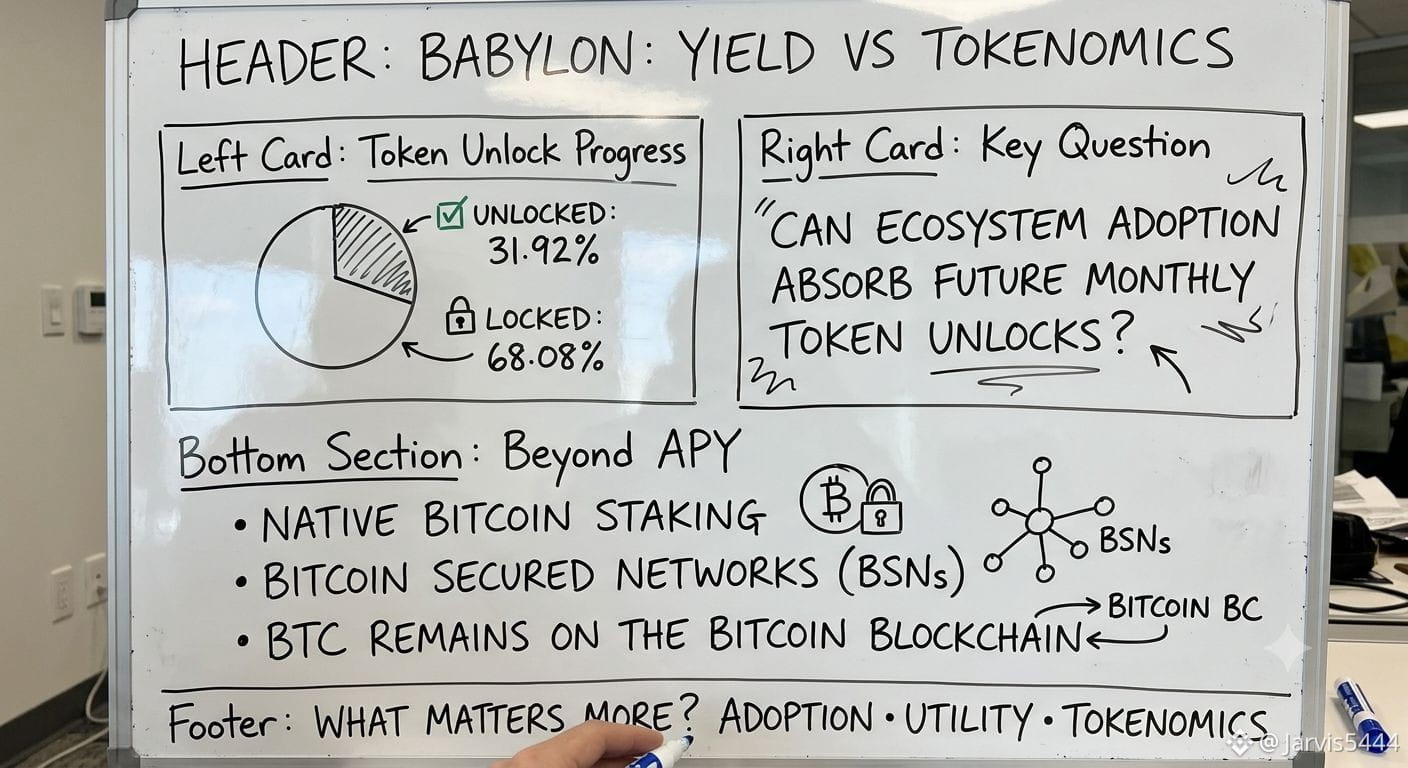
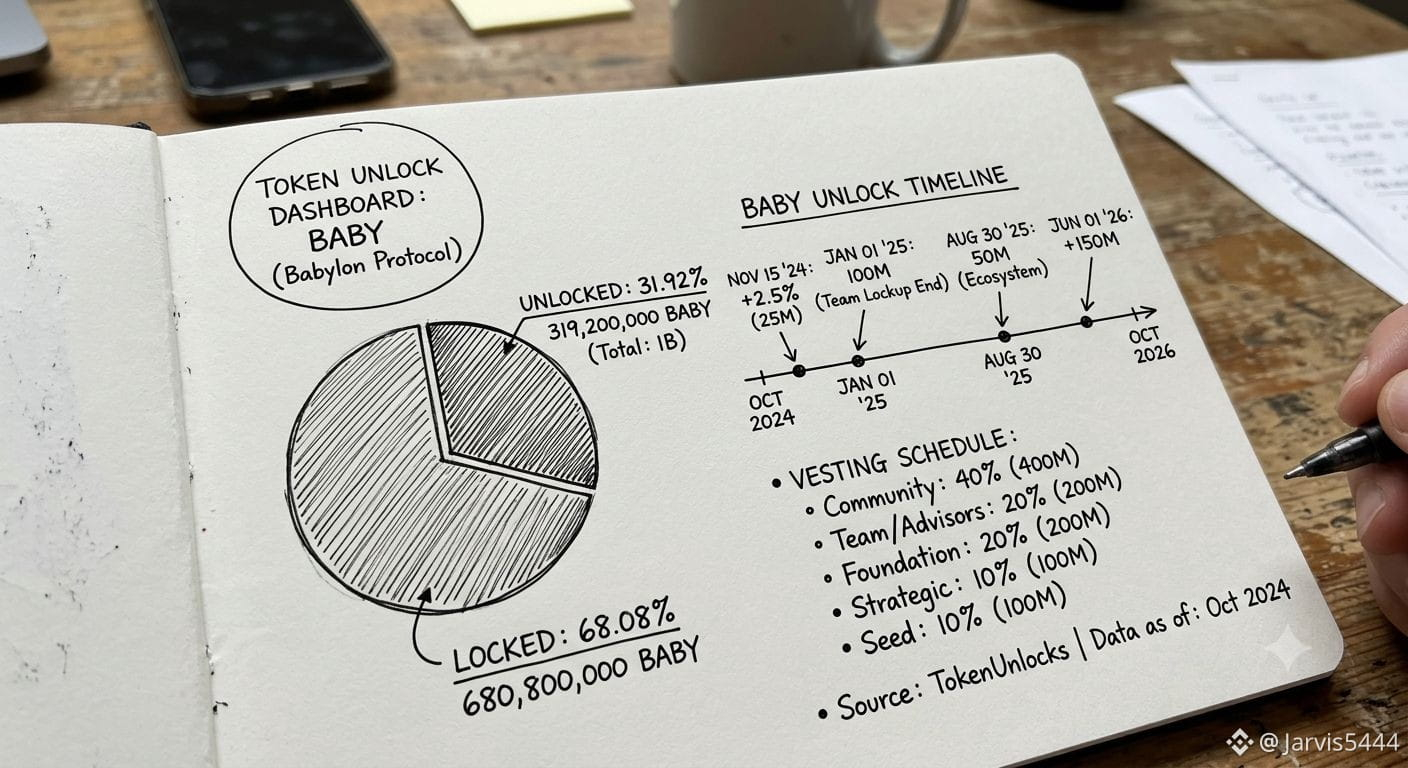
According to Tokenomist around 31.92% of BABY Supply has been unlocked, While 68.08% remains locked with additional monthly unlocks scheduled over time. More circulating supply doesn't automatically mean bearish price action but it does highlight an important factor every in
vestor should monitor: Can ecosystem adoption and real demand keep pace With The new Supply entering The Market?
This is One reason I find BABYLON interesting Beyond potential yield, its goal is to enable native Bitcoin staking And strengthen Bitcoin Secured Networks (BSNs) While allowing BTC to remain on The Bitcoin Blockchain.
For me Understanding Adoption, tokenomics And utility together gives a clearer picture than looking at APY Alone.
What will have The biggest impact on Babylon's Long-Term growth: Adoption, utility, or tokenomics?
@babylonlabs_io #baby $BABY #APY
{future}(BABYUSDT)
When peopel evaluate a crypto project The first thing they usually notice is the APY. I think the more important Question is whether the project's tokenomics can support long term growth.
According to Tokenomist around 31.92% of BABY Supply has been unlocked, While 68.08% remains locked with additional monthly unlocks scheduled over time. More circulating supply doesn't automatically mean bearish price action but it does highlight an important factor every in
vestor should monitor: Can ecosystem adoption and real demand keep pace With The new Supply entering The Market?
This is One reason I find BABYLON interesting Beyond potential yield, its goal is to enable native Bitcoin staking And strengthen Bitcoin Secured Networks (BSNs) While allowing BTC to remain on The Bitcoin Blockchain.
For me Understanding Adoption, tokenomics And utility together gives a clearer picture than looking at APY Alone.
What will have The biggest impact on Babylon's Long-Term growth: Adoption, utility, or tokenomics?
@BabylonLabs_io #baby $BABY #APY
According to Tokenomist around 31.92% of BABY Supply has been unlocked, While 68.08% remains locked with additional monthly unlocks scheduled over time. More circulating supply doesn't automatically mean bearish price action but it does highlight an important factor every in
vestor should monitor: Can ecosystem adoption and real demand keep pace With The new Supply entering The Market?
This is One reason I find BABYLON interesting Beyond potential yield, its goal is to enable native Bitcoin staking And strengthen Bitcoin Secured Networks (BSNs) While allowing BTC to remain on The Bitcoin Blockchain.
For me Understanding Adoption, tokenomics And utility together gives a clearer picture than looking at APY Alone.
What will have The biggest impact on Babylon's Long-Term growth: Adoption, utility, or tokenomics?
@BabylonLabs_io #baby $BABY #APY
31
10
116

·
--
Let me share my current market outlook, just for your reference.
Right now, a lot of folks think Bitcoin's price is going to keep tanking since it has dropped from $78080.00 to $76066.00, a decline of 0.79%.
However, I believe people are overlooking Ethereum's performance. Even though it also dipped by 0.53%, falling from $2140.49 to $2081.35, its price remains in a relatively stable range.
Moreover, Chainlink's price has risen from $9.3410 to $9.4450, an increase of 0.37%, which might be a sign that the market is starting to pay attention to DeFi projects.
I think the market may start focusing on those projects with strong fundamentals, like ones with high TVL and protocol revenue.
Therefore, I'm personally bullish on the market, especially for tokens like LINK and SOL, which are priced at $9.4450 and $84.12, respectively.
My current positions are heavily focused on DeFi projects, especially those with high APY and token release mechanisms.
#DeFi #TVL #APY #代币经济 #投资策略 🚀💰
Let me share my current market outlook, just for your reference.
Right now, a lot of folks think Bitcoin's price is going to keep tanking since it has dropped from $78080.00 to $76066.00, a decline of 0.79%.
However, I believe people are overlooking Ethereum's performance. Even though it also dipped by 0.53%, falling from $2140.49 to $2081.35, its price remains in a relatively stable range.
Moreover, Chainlink's price has risen from $9.3410 to $9.4450, an increase of 0.37%, which might be a sign that the market is starting to pay attention to DeFi projects.
I think the market may start focusing on those projects with strong fundamentals, like ones with high TVL and protocol revenue.
Therefore, I'm personally bullish on the market, especially for tokens like LINK and SOL, which are priced at $9.4450 and $84.12, respectively.
My current positions are heavily focused on DeFi projects, especially those with high APY and token release mechanisms.
#DeFi #TVL #APY #代币经济 #投资策略 🚀💰
Right now, a lot of folks think Bitcoin's price is going to keep tanking since it has dropped from $78080.00 to $76066.00, a decline of 0.79%.
However, I believe people are overlooking Ethereum's performance. Even though it also dipped by 0.53%, falling from $2140.49 to $2081.35, its price remains in a relatively stable range.
Moreover, Chainlink's price has risen from $9.3410 to $9.4450, an increase of 0.37%, which might be a sign that the market is starting to pay attention to DeFi projects.
I think the market may start focusing on those projects with strong fundamentals, like ones with high TVL and protocol revenue.
Therefore, I'm personally bullish on the market, especially for tokens like LINK and SOL, which are priced at $9.4450 and $84.12, respectively.
My current positions are heavily focused on DeFi projects, especially those with high APY and token release mechanisms.
#DeFi #TVL #APY #代币经济 #投资策略 🚀💰
84

·
--
Bullish
See translation
#termmax @termmax
I went to check TermMax's numbers expecting a quiet, early-stage protocol. Instead: $64M+ TVL, over a million users, 7+ chains — and they just announced a token, $TMX, after building the protocol first and waiting on the token.
The core idea is straightforward once it clicks: instead of bolting a fixed-rate wrapper onto a floating-rate pool (which is what most "fixed rate" #DeFi products actually do underneath), TermMax runs an order book around discount bonds — tokens that mature at a set date. You lock your rate the moment you enter. No surprise #APY swings three days before you needed to plan around them.
What actually got my attention was the timing. Just weeks ago, #Morpho — backed by Variant and Coinbase Ventures — launched its own fixed-rate product, Midnight, with Tenor as the trading venue on top. That's not a small competitor showing up. That's one of DeFi's most credible lending brands entering the exact niche TermMax spent over a year building alone.
TermMax still has the numbers advantage — more chains, more TVL, an actual institutional integration already live (tokenized stock collateral via Ondo Global Markets). But numbers built before a well-funded rival arrives don't automatically hold once that rival starts paying double-digit incentive APRs to pull liquidity toward itself.
So the real question isn't whether fixed-rate DeFi is a good idea — clearly enough builders agree it is now. It's whether $TMX captures value from being first, or whether "first" stops mattering the moment a bigger name offers the same thing with a bigger incentive budget.
I don't have a confident answer yet. First-mover advantage in DeFi has been real before and completely irrelevant before, depending on the protocol.
Genuinely curious to watch: does existing TVL and user count actually create switching cost once $TMX goes live — or does liquidity just chase whoever's paying more this month?
#TermMax @termmax
{future}(BRUSDT)
{future}(BTWUSDT)
{spot}(BNBUSDT)
#termmax @TermMax
I went to check TermMax's numbers expecting a quiet, early-stage protocol. Instead: $64M+ TVL, over a million users, 7+ chains — and they just announced a token, $TMX, after building the protocol first and waiting on the token.
The core idea is straightforward once it clicks: instead of bolting a fixed-rate wrapper onto a floating-rate pool (which is what most "fixed rate" #DeFi products actually do underneath), TermMax runs an order book around discount bonds — tokens that mature at a set date. You lock your rate the moment you enter. No surprise #APY swings three days before you needed to plan around them.
What actually got my attention was the timing. Just weeks ago, #Morpho — backed by Variant and Coinbase Ventures — launched its own fixed-rate product, Midnight, with Tenor as the trading venue on top. That's not a small competitor showing up. That's one of DeFi's most credible lending brands entering the exact niche TermMax spent over a year building alone.
TermMax still has the numbers advantage — more chains, more TVL, an actual institutional integration already live (tokenized stock collateral via Ondo Global Markets). But numbers built before a well-funded rival arrives don't automatically hold once that rival starts paying double-digit incentive APRs to pull liquidity toward itself.
So the real question isn't whether fixed-rate DeFi is a good idea — clearly enough builders agree it is now. It's whether $TMX captures value from being first, or whether "first" stops mattering the moment a bigger name offers the same thing with a bigger incentive budget.
I don't have a confident answer yet. First-mover advantage in DeFi has been real before and completely irrelevant before, depending on the protocol.
Genuinely curious to watch: does existing TVL and user count actually create switching cost once $TMX goes live — or does liquidity just chase whoever's paying more this month?
#TermMax @TermMax
I went to check TermMax's numbers expecting a quiet, early-stage protocol. Instead: $64M+ TVL, over a million users, 7+ chains — and they just announced a token, $TMX, after building the protocol first and waiting on the token.
The core idea is straightforward once it clicks: instead of bolting a fixed-rate wrapper onto a floating-rate pool (which is what most "fixed rate" #DeFi products actually do underneath), TermMax runs an order book around discount bonds — tokens that mature at a set date. You lock your rate the moment you enter. No surprise #APY swings three days before you needed to plan around them.
What actually got my attention was the timing. Just weeks ago, #Morpho — backed by Variant and Coinbase Ventures — launched its own fixed-rate product, Midnight, with Tenor as the trading venue on top. That's not a small competitor showing up. That's one of DeFi's most credible lending brands entering the exact niche TermMax spent over a year building alone.
TermMax still has the numbers advantage — more chains, more TVL, an actual institutional integration already live (tokenized stock collateral via Ondo Global Markets). But numbers built before a well-funded rival arrives don't automatically hold once that rival starts paying double-digit incentive APRs to pull liquidity toward itself.
So the real question isn't whether fixed-rate DeFi is a good idea — clearly enough builders agree it is now. It's whether $TMX captures value from being first, or whether "first" stops mattering the moment a bigger name offers the same thing with a bigger incentive budget.
I don't have a confident answer yet. First-mover advantage in DeFi has been real before and completely irrelevant before, depending on the protocol.
Genuinely curious to watch: does existing TVL and user count actually create switching cost once $TMX goes live — or does liquidity just chase whoever's paying more this month?
#TermMax @TermMax

13
4
92
·
--
The macro environment has shifted a bit today, let me break down my thoughts.
If BTC can break the high of $67292.15 and sustain above $70000, I’m bullish on this market, especially if we see other coins like ETH and SOL rallying too. At that point, I'll consider increasing my position and pay more attention to the TVL and annual yields of DeFi protocols.
If XRP can break $1.30 and hold above that level, it indicates a rebound in market confidence. Investors might start focusing more on coins with strong underlying tech and use cases, and I’ll take a closer look at projects with real utility and potential, possibly upping my investments in them.
From the current market data, BTC is priced at $66376.66, up 1.48% over the last 24 hours, while XRP is at $1.2323, up 4.50%. These figures suggest the market could be gradually warming up, and I think a more likely scenario is continued upward momentum, especially as more investors enter the market, looking for high annual yields and stable protocols.
Therefore, my current stance is bullish on the market, particularly when we see more capital flowing into the DeFi space and the TVL and annual yields of protocols consistently rising. I’ll keep a close eye on market developments and adjust my trading strategy accordingly.
#DeFi #TVL #APY #Cryptocurrency #MarketTrend 🚀
The macro environment has shifted a bit today, let me break down my thoughts.
If BTC can break the high of $67292.15 and sustain above $70000, I’m bullish on this market, especially if we see other coins like ETH and SOL rallying too. At that point, I'll consider increasing my position and pay more attention to the TVL and annual yields of DeFi protocols.
If XRP can break $1.30 and hold above that level, it indicates a rebound in market confidence. Investors might start focusing more on coins with strong underlying tech and use cases, and I’ll take a closer look at projects with real utility and potential, possibly upping my investments in them.
From the current market data, BTC is priced at $66376.66, up 1.48% over the last 24 hours, while XRP is at $1.2323, up 4.50%. These figures suggest the market could be gradually warming up, and I think a more likely scenario is continued upward momentum, especially as more investors enter the market, looking for high annual yields and stable protocols.
Therefore, my current stance is bullish on the market, particularly when we see more capital flowing into the DeFi space and the TVL and annual yields of protocols consistently rising. I’ll keep a close eye on market developments and adjust my trading strategy accordingly.
#DeFi #TVL #APY #Cryptocurrency #MarketTrend 🚀
If BTC can break the high of $67292.15 and sustain above $70000, I’m bullish on this market, especially if we see other coins like ETH and SOL rallying too. At that point, I'll consider increasing my position and pay more attention to the TVL and annual yields of DeFi protocols.
If XRP can break $1.30 and hold above that level, it indicates a rebound in market confidence. Investors might start focusing more on coins with strong underlying tech and use cases, and I’ll take a closer look at projects with real utility and potential, possibly upping my investments in them.
From the current market data, BTC is priced at $66376.66, up 1.48% over the last 24 hours, while XRP is at $1.2323, up 4.50%. These figures suggest the market could be gradually warming up, and I think a more likely scenario is continued upward momentum, especially as more investors enter the market, looking for high annual yields and stable protocols.
Therefore, my current stance is bullish on the market, particularly when we see more capital flowing into the DeFi space and the TVL and annual yields of protocols consistently rising. I’ll keep a close eye on market developments and adjust my trading strategy accordingly.
#DeFi #TVL #APY #Cryptocurrency #MarketTrend 🚀
38

·
--
Bullish
See translation
Someone asked me how staking on STON.fi works and what the APR actually means. Here's how I explained it.
A lot of people look at the APR, stake their TON, and move on. But the interesting part is understanding where those rewards actually come from.
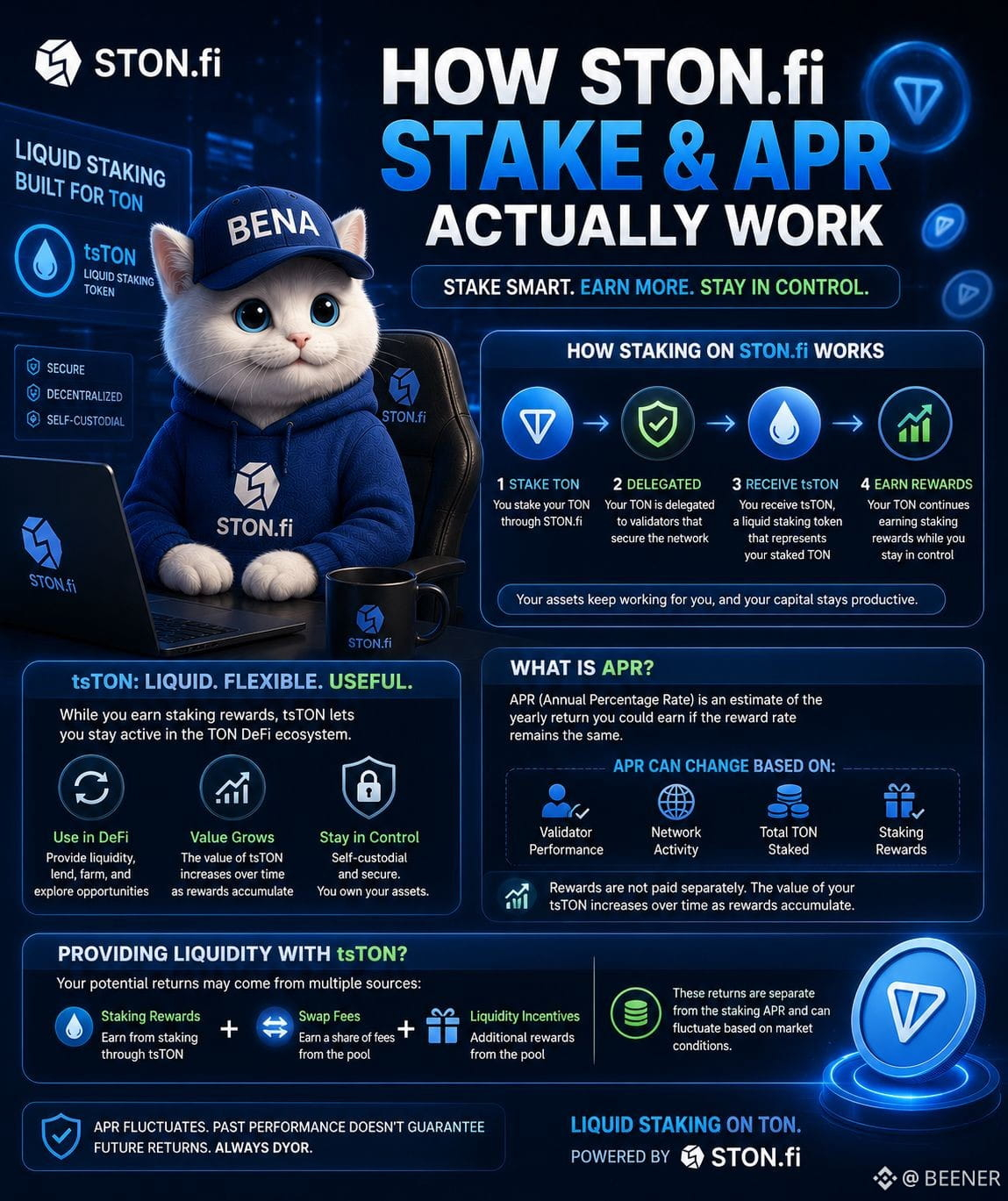
When you stake through STON.fi, your TON is delegated to validators that help secure the network. In return, you receive tsTON, a liquid staking token that represents your staked TON.
The benefit is that your assets don't just sit there.
Your TON continues earning staking rewards, while tsTON gives you the flexibility to participate in the TON DeFi ecosystem instead of locking your capital away.
Now, about the APR.
APR, or Annual Percentage Rate, is simply an estimate of how much you could earn over a year if the reward rate stayed the same. The important thing is that it isn't fixed.
It changes depending on things like network activity, validator rewards, and how much TON is being staked across the network.
One detail I think is easy to miss is that rewards aren't paid into your wallet as separate tokens. Instead, the value of your tsTON gradually increases over time as staking rewards accumulate.
That's what makes liquid staking interesting. You're earning staking rewards while still having an asset you can use throughout the ecosystem.
Of course, APR can go up or down, so it's always worth doing your own research before staking or providing liquidity.
@stonfi
→ Try the APR/APY calculator: tools.ston.fi/apy-calculator…
→ Join the STON.fi Pools Updates channel: t.me/stonfi_updates
→ Try the Impermanent Loss Calculator: tools.ston.fi/impermanent-lo…
#STONfi #DEFİ #APR #APY #staking
Someone asked me how staking on STON.fi works and what the APR actually means. Here's how I explained it.
A lot of people look at the APR, stake their TON, and move on. But the interesting part is understanding where those rewards actually come from.
When you stake through STON.fi, your TON is delegated to validators that help secure the network. In return, you receive tsTON, a liquid staking token that represents your staked TON.
The benefit is that your assets don't just sit there.
Your TON continues earning staking rewards, while tsTON gives you the flexibility to participate in the TON DeFi ecosystem instead of locking your capital away.
Now, about the APR.
APR, or Annual Percentage Rate, is simply an estimate of how much you could earn over a year if the reward rate stayed the same. The important thing is that it isn't fixed.
It changes depending on things like network activity, validator rewards, and how much TON is being staked across the network.
One detail I think is easy to miss is that rewards aren't paid into your wallet as separate tokens. Instead, the value of your tsTON gradually increases over time as staking rewards accumulate.
That's what makes liquid staking interesting. You're earning staking rewards while still having an asset you can use throughout the ecosystem.
Of course, APR can go up or down, so it's always worth doing your own research before staking or providing liquidity.
@STONfi DEX
→ Try the APR/APY calculator: tools.ston.fi/apy-calculator…
→ Join the STON.fi Pools Updates channel: t.me/stonfi_updates
→ Try the Impermanent Loss Calculator: tools.ston.fi/impermanent-lo…
#STONfi #DEFİ #APR #APY #staking
A lot of people look at the APR, stake their TON, and move on. But the interesting part is understanding where those rewards actually come from.
When you stake through STON.fi, your TON is delegated to validators that help secure the network. In return, you receive tsTON, a liquid staking token that represents your staked TON.
The benefit is that your assets don't just sit there.
Your TON continues earning staking rewards, while tsTON gives you the flexibility to participate in the TON DeFi ecosystem instead of locking your capital away.
Now, about the APR.
APR, or Annual Percentage Rate, is simply an estimate of how much you could earn over a year if the reward rate stayed the same. The important thing is that it isn't fixed.
It changes depending on things like network activity, validator rewards, and how much TON is being staked across the network.
One detail I think is easy to miss is that rewards aren't paid into your wallet as separate tokens. Instead, the value of your tsTON gradually increases over time as staking rewards accumulate.
That's what makes liquid staking interesting. You're earning staking rewards while still having an asset you can use throughout the ecosystem.
Of course, APR can go up or down, so it's always worth doing your own research before staking or providing liquidity.
@STONfi DEX
→ Try the APR/APY calculator: tools.ston.fi/apy-calculator…
→ Join the STON.fi Pools Updates channel: t.me/stonfi_updates
→ Try the Impermanent Loss Calculator: tools.ston.fi/impermanent-lo…
#STONfi #DEFİ #APR #APY #staking
101

See translation
🚨 $USDT 10% APY IS REAL — BUT THE EXCHANGES HIDE A CATCH 💰
📊 Under the hood of today's stablecoin yield boards, every top-tier exchange runs the same playbook: fat APY for the small fish, crumbs for the whales. Deposit under $200 and $USDT pays up to 10% — cross the line and the rate nosedives to 1.95%.
💡 The pattern repeats across venues: 6.30% at the low tier shrinks to 1.64% past $300, while $USDC follows with 8% fading to 2.75%. This isn't generosity — it's a marketing funnel engineered to acquire retail deposits while capping the interest bill.
🔍 The real yield hunter's edge? Compare cap limits, interest calculation rules, and live product availability before parking capital. Headline APY is the bait; net effective yield is the catch. 💬 Are you chasing the printed number or running the full comparison math? 👇
⚠️ Not financial advice. Always manage your risk. 🛡️
🏷️ #USDT #Stablecoin #YieldFarming #APY #Crypto
💎 🎯
🚨 $USDT 10% APY IS REAL — BUT THE EXCHANGES HIDE A CATCH 💰
📊 Under the hood of today's stablecoin yield boards, every top-tier exchange runs the same playbook: fat APY for the small fish, crumbs for the whales. Deposit under $200 and $USDT pays up to 10% — cross the line and the rate nosedives to 1.95%.
💡 The pattern repeats across venues: 6.30% at the low tier shrinks to 1.64% past $300, while $USDC follows with 8% fading to 2.75%. This isn't generosity — it's a marketing funnel engineered to acquire retail deposits while capping the interest bill.
🔍 The real yield hunter's edge? Compare cap limits, interest calculation rules, and live product availability before parking capital. Headline APY is the bait; net effective yield is the catch. 💬 Are you chasing the printed number or running the full comparison math? 👇
⚠️ Not financial advice. Always manage your risk. 🛡️
🏷️ #USDT #Stablecoin #YieldFarming #APY #Crypto
💎 🎯
📊 Under the hood of today's stablecoin yield boards, every top-tier exchange runs the same playbook: fat APY for the small fish, crumbs for the whales. Deposit under $200 and $USDT pays up to 10% — cross the line and the rate nosedives to 1.95%.
💡 The pattern repeats across venues: 6.30% at the low tier shrinks to 1.64% past $300, while $USDC follows with 8% fading to 2.75%. This isn't generosity — it's a marketing funnel engineered to acquire retail deposits while capping the interest bill.
🔍 The real yield hunter's edge? Compare cap limits, interest calculation rules, and live product availability before parking capital. Headline APY is the bait; net effective yield is the catch. 💬 Are you chasing the printed number or running the full comparison math? 👇
⚠️ Not financial advice. Always manage your risk. 🛡️
🏷️ #USDT #Stablecoin #YieldFarming #APY #Crypto
💎 🎯
24
What is APY in Crypto and how do you calculate your earnings?
If you’ve explored options like Binance Earn, Staking, or DeFi platforms, you’ve probably seen the acronym APY followed by a percentage. Understanding this concept is key to calculating your real returns.
APY stands for Annual Percentage Yield (Annual Percentage Return). It’s the rate that measures how much money you earn in a year on an investment, including the effect of compound interest.
💡 The big difference: APY vs. APR
To avoid confusion when investing, you need to clearly understand this distinction:
APR (Annual Percentage Rate): It’s simple interest. It doesn’t take into account reinvesting your earnings.
APY (Annual Percentage Yield): It includes compound interest. This means the interest you generate daily or weekly is added to your initial capital, generating more interest in the next period.
👉 In short: With APY, your money grows faster because you earn interest on your interest.
⚠️ 3 things you should consider about APY:
It’s an annual projection: If you see an APY of 12%, it doesn’t mean you’ll earn 12% in a month; it means you’d earn 12% if you keep the investment for 365 full days.
It can be variable: On many platforms or tokens, APY changes daily based on supply, demand, or network volume.
Be careful with extremely high APYs: Three-digit percentages (like 100% or more) usually indicate projects with very high risk or high token inflation.
💬 Do you usually check the APY before putting your tokens into Earn, or do you prefer to keep your assets free for trading? Don’t forget to like and comment below! ❤👇
#BinanceEarn #APY #CryptoEducacion #BinanceSquare #IngresosPasivos
What is APY in Crypto and how do you calculate your earnings?
If you’ve explored options like Binance Earn, Staking, or DeFi platforms, you’ve probably seen the acronym APY followed by a percentage. Understanding this concept is key to calculating your real returns.
APY stands for Annual Percentage Yield (Annual Percentage Return). It’s the rate that measures how much money you earn in a year on an investment, including the effect of compound interest.
💡 The big difference: APY vs. APR
To avoid confusion when investing, you need to clearly understand this distinction:
APR (Annual Percentage Rate): It’s simple interest. It doesn’t take into account reinvesting your earnings.
APY (Annual Percentage Yield): It includes compound interest. This means the interest you generate daily or weekly is added to your initial capital, generating more interest in the next period.
👉 In short: With APY, your money grows faster because you earn interest on your interest.
⚠️ 3 things you should consider about APY:
It’s an annual projection: If you see an APY of 12%, it doesn’t mean you’ll earn 12% in a month; it means you’d earn 12% if you keep the investment for 365 full days.
It can be variable: On many platforms or tokens, APY changes daily based on supply, demand, or network volume.
Be careful with extremely high APYs: Three-digit percentages (like 100% or more) usually indicate projects with very high risk or high token inflation.
💬 Do you usually check the APY before putting your tokens into Earn, or do you prefer to keep your assets free for trading? Don’t forget to like and comment below! ❤👇
#BinanceEarn #APY #CryptoEducacion #BinanceSquare #IngresosPasivos
If you’ve explored options like Binance Earn, Staking, or DeFi platforms, you’ve probably seen the acronym APY followed by a percentage. Understanding this concept is key to calculating your real returns.
APY stands for Annual Percentage Yield (Annual Percentage Return). It’s the rate that measures how much money you earn in a year on an investment, including the effect of compound interest.
💡 The big difference: APY vs. APR
To avoid confusion when investing, you need to clearly understand this distinction:
APR (Annual Percentage Rate): It’s simple interest. It doesn’t take into account reinvesting your earnings.
APY (Annual Percentage Yield): It includes compound interest. This means the interest you generate daily or weekly is added to your initial capital, generating more interest in the next period.
👉 In short: With APY, your money grows faster because you earn interest on your interest.
⚠️ 3 things you should consider about APY:
It’s an annual projection: If you see an APY of 12%, it doesn’t mean you’ll earn 12% in a month; it means you’d earn 12% if you keep the investment for 365 full days.
It can be variable: On many platforms or tokens, APY changes daily based on supply, demand, or network volume.
Be careful with extremely high APYs: Three-digit percentages (like 100% or more) usually indicate projects with very high risk or high token inflation.
💬 Do you usually check the APY before putting your tokens into Earn, or do you prefer to keep your assets free for trading? Don’t forget to like and comment below! ❤👇
#BinanceEarn #APY #CryptoEducacion #BinanceSquare #IngresosPasivos
106
·
--
This idea has been turning around in my head for hours, and now I’m saying it out loud.
Lately, I’ve been paying close attention to the price trends of BTC and ETH, especially the price points of BTC at $64396.00 and ETH at $1874.16. These two price points are very important signals for me.
This means the market is re-evaluating the value of risk assets, especially in the DeFi space, where changes in TVL and APY will have a significant impact on prices.
I believe BTC’s rise will drive the overall market trend, especially for ALT coins like ADA and XRP, whose prices are $0.1657 and $1.1033 respectively. They may follow BTC’s trend.
So, my current position is bullish on BTC and ETH, especially ETH, because of its broad prospects for applications in DeFi.
I’m also watching DOGE’s price trend, especially its 24-hour increase of 5.84%, which could be a signal of a shift in market sentiment.
In summary, I think the market trend is bullish—especially for BTC and ETH. I’ll continue to monitor how prices move.
#DeFi #TVL #APY #BTC #ETH 🚀💰
This idea has been turning around in my head for hours, and now I’m saying it out loud.
Lately, I’ve been paying close attention to the price trends of BTC and ETH, especially the price points of BTC at $64396.00 and ETH at $1874.16. These two price points are very important signals for me.
This means the market is re-evaluating the value of risk assets, especially in the DeFi space, where changes in TVL and APY will have a significant impact on prices.
I believe BTC’s rise will drive the overall market trend, especially for ALT coins like ADA and XRP, whose prices are $0.1657 and $1.1033 respectively. They may follow BTC’s trend.
So, my current position is bullish on BTC and ETH, especially ETH, because of its broad prospects for applications in DeFi.
I’m also watching DOGE’s price trend, especially its 24-hour increase of 5.84%, which could be a signal of a shift in market sentiment.
In summary, I think the market trend is bullish—especially for BTC and ETH. I’ll continue to monitor how prices move.
#DeFi #TVL #APY #BTC #ETH 🚀💰
Lately, I’ve been paying close attention to the price trends of BTC and ETH, especially the price points of BTC at $64396.00 and ETH at $1874.16. These two price points are very important signals for me.
This means the market is re-evaluating the value of risk assets, especially in the DeFi space, where changes in TVL and APY will have a significant impact on prices.
I believe BTC’s rise will drive the overall market trend, especially for ALT coins like ADA and XRP, whose prices are $0.1657 and $1.1033 respectively. They may follow BTC’s trend.
So, my current position is bullish on BTC and ETH, especially ETH, because of its broad prospects for applications in DeFi.
I’m also watching DOGE’s price trend, especially its 24-hour increase of 5.84%, which could be a signal of a shift in market sentiment.
In summary, I think the market trend is bullish—especially for BTC and ETH. I’ll continue to monitor how prices move.
#DeFi #TVL #APY #BTC #ETH 🚀💰
26

·
--
Bearish
See translation
Biggest problem in BTCFi isn’t yield. It’s what people do when they see too many versions of it.
The assumption has been that more APY options create more opportunity. In practice, it does the opposite. It fragments attention, and once attention fragments, capital stops behaving like capital and starts behaving like reaction.
Most participants aren’t choosing strategies. They’re switching between them. Every new vault, every new incentive layer, quietly resets the decision frame. Risk stops being measured in exposure and starts being measured in confusion.
That’s the part the market rarely admits. The constraint was never access to yield. It was the ability to compare it under pressure.
This is where infrastructure starts to matter more than returns.
Bedrock sits in that layer where options stop being the problem. It reduces the surface area of BTCFi into something navigable instead of overwhelming. Not by simplifying yield itself, but by simplifying how it is approached.
BRClaw operates one layer deeper. It doesn’t tell you what exists. It structures how decisions form around what exists. Risk, correlation, allocation logic
compressed into something that can actually be acted on instead of endlessly debated.
The edge is no longer in finding higher APY pockets. It’s in reducing the cognitive distance between signal and action.
Most people still think they’re competing for yield.
But the real competition is happening in decision architecture.
And if that layer is already crowded… what exactly are you optimizing for?
Most never notice the shift until the outcome already feels decided.
@Bedrock #Bedrock $BR $BTC
#APY #BTCFi #BRClaw @bitcoin
#BinanceSquare
{spot}(BTCUSDT)
{future}(BRUSDT)
Biggest problem in BTCFi isn’t yield. It’s what people do when they see too many versions of it.
The assumption has been that more APY options create more opportunity. In practice, it does the opposite. It fragments attention, and once attention fragments, capital stops behaving like capital and starts behaving like reaction.
Most participants aren’t choosing strategies. They’re switching between them. Every new vault, every new incentive layer, quietly resets the decision frame. Risk stops being measured in exposure and starts being measured in confusion.
That’s the part the market rarely admits. The constraint was never access to yield. It was the ability to compare it under pressure.
This is where infrastructure starts to matter more than returns.
Bedrock sits in that layer where options stop being the problem. It reduces the surface area of BTCFi into something navigable instead of overwhelming. Not by simplifying yield itself, but by simplifying how it is approached.
BRClaw operates one layer deeper. It doesn’t tell you what exists. It structures how decisions form around what exists. Risk, correlation, allocation logic
compressed into something that can actually be acted on instead of endlessly debated.
The edge is no longer in finding higher APY pockets. It’s in reducing the cognitive distance between signal and action.
Most people still think they’re competing for yield.
But the real competition is happening in decision architecture.
And if that layer is already crowded… what exactly are you optimizing for?
Most never notice the shift until the outcome already feels decided.
@Bedrock #Bedrock $BR $BTC
#APY #BTCFi #BRClaw @Bitcoin
#BinanceSquare
The assumption has been that more APY options create more opportunity. In practice, it does the opposite. It fragments attention, and once attention fragments, capital stops behaving like capital and starts behaving like reaction.
Most participants aren’t choosing strategies. They’re switching between them. Every new vault, every new incentive layer, quietly resets the decision frame. Risk stops being measured in exposure and starts being measured in confusion.
That’s the part the market rarely admits. The constraint was never access to yield. It was the ability to compare it under pressure.
This is where infrastructure starts to matter more than returns.
Bedrock sits in that layer where options stop being the problem. It reduces the surface area of BTCFi into something navigable instead of overwhelming. Not by simplifying yield itself, but by simplifying how it is approached.
BRClaw operates one layer deeper. It doesn’t tell you what exists. It structures how decisions form around what exists. Risk, correlation, allocation logic
compressed into something that can actually be acted on instead of endlessly debated.
The edge is no longer in finding higher APY pockets. It’s in reducing the cognitive distance between signal and action.
Most people still think they’re competing for yield.
But the real competition is happening in decision architecture.
And if that layer is already crowded… what exactly are you optimizing for?
Most never notice the shift until the outcome already feels decided.
@Bedrock #Bedrock $BR $BTC
#APY #BTCFi #BRClaw @Bitcoin
#BinanceSquare

12
158

Best crypto staking platforms
1. #Binance — best overall
Tons of crypto available (300+)
Flexible or locked staking
Variable APY (ETH ~2.5%, SOL ~5.5%)
User-friendly interface
Perfect if you want an all-in-one solution (including trading)
2. #Kraken — safest and most reliable
Great reputation and transparency
Rewards paid out daily
Low fees (~5%)
Coin Interest Rate
High uptime (>99.9%)
Coin Interest Rate
Ideal if you’re focused on security and stability
3. #Crypto.com — best for beginners
Very simple app
Integrated staking with card and services
Flexible and fixed options
Perfect if you're just starting out
#staking #BinanceExplorers #crypto.com #KrakenVenture #APY
Best crypto staking platforms
1. #Binance — best overall
Tons of crypto available (300+)
Flexible or locked staking
Variable APY (ETH ~2.5%, SOL ~5.5%)
User-friendly interface
Perfect if you want an all-in-one solution (including trading)
2. #Kraken — safest and most reliable
Great reputation and transparency
Rewards paid out daily
Low fees (~5%)
Coin Interest Rate
High uptime (>99.9%)
Coin Interest Rate
Ideal if you’re focused on security and stability
3. #Crypto.com — best for beginners
Very simple app
Integrated staking with card and services
Flexible and fixed options
Perfect if you're just starting out
#staking #BinanceExplorers #crypto.com #KrakenVenture #APY
1. #Binance — best overall
Tons of crypto available (300+)
Flexible or locked staking
Variable APY (ETH ~2.5%, SOL ~5.5%)
User-friendly interface
Perfect if you want an all-in-one solution (including trading)
2. #Kraken — safest and most reliable
Great reputation and transparency
Rewards paid out daily
Low fees (~5%)
Coin Interest Rate
High uptime (>99.9%)
Coin Interest Rate
Ideal if you’re focused on security and stability
3. #Crypto.com — best for beginners
Very simple app
Integrated staking with card and services
Flexible and fixed options
Perfect if you're just starting out
#staking #BinanceExplorers #crypto.com #KrakenVenture #APY
binance
0%
kraken
0%
crypto.com
0%
0 votes • Voting closed
65

·
--
Bullish
Today I had a lot of moves in active mls that I thought would hit me with red numbers compared to the week that just ended:
💎 I paid a loan of #CRİPTO and an order at #MercadoLibre (used my funds from #Binance for the first time).
💎 I swapped some red envelopes (20 🙊 LoL! 🙈) to send them to other users.
{spot}(USDCUSDT)
💎 I messed up by claiming a locked crypto instead of one of the #stablecoins I have in flex.
💎 I lost my $ETH from Ear and then I remembered that I converted them into $WBETH but they were still lost 😢
{spot}(WBETHUSDT)
Two things played in my favor:
💹 Fortunately, Binance put my wbeth in spot and they are giving passive returns, which, although lower than in ear, is a better scenario than the first time that happened to me: I had a very volatile crypto frozen for 30 days with all the losses and no returns (not even the ones I made in the previous 30 days that I held that crypto. 🪙 🤦🏽 I learned my lesson: Never hold sexycoins with two-digit percentages in #APY
💹 I have been applying what I learned in @Binance_Academy about high-risk moves for a month now, and with well-planned dual investment, I keep my portfolio on the rise. 📊
🫣 Sorry that I ran out of 🧧 thanks for reading and sharing dear pypolbinanciera, see you. Bais! 🚀
Today I had a lot of moves in active mls that I thought would hit me with red numbers compared to the week that just ended:
💎 I paid a loan of #CRİPTO and an order at #MercadoLibre (used my funds from #Binance for the first time).
💎 I swapped some red envelopes (20 🙊 LoL! 🙈) to send them to other users.
💎 I messed up by claiming a locked crypto instead of one of the #stablecoins I have in flex.
💎 I lost my $ETH from Ear and then I remembered that I converted them into $WBETH but they were still lost 😢
Two things played in my favor:
💹 Fortunately, Binance put my wbeth in spot and they are giving passive returns, which, although lower than in ear, is a better scenario than the first time that happened to me: I had a very volatile crypto frozen for 30 days with all the losses and no returns (not even the ones I made in the previous 30 days that I held that crypto. 🪙 🤦🏽 I learned my lesson: Never hold sexycoins with two-digit percentages in #APY
💹 I have been applying what I learned in @Binance Academy about high-risk moves for a month now, and with well-planned dual investment, I keep my portfolio on the rise. 📊
🫣 Sorry that I ran out of 🧧 thanks for reading and sharing dear pypolbinanciera, see you. Bais! 🚀
💎 I paid a loan of #CRİPTO and an order at #MercadoLibre (used my funds from #Binance for the first time).
💎 I swapped some red envelopes (20 🙊 LoL! 🙈) to send them to other users.
💎 I messed up by claiming a locked crypto instead of one of the #stablecoins I have in flex.
💎 I lost my $ETH from Ear and then I remembered that I converted them into $WBETH but they were still lost 😢
Two things played in my favor:
💹 Fortunately, Binance put my wbeth in spot and they are giving passive returns, which, although lower than in ear, is a better scenario than the first time that happened to me: I had a very volatile crypto frozen for 30 days with all the losses and no returns (not even the ones I made in the previous 30 days that I held that crypto. 🪙 🤦🏽 I learned my lesson: Never hold sexycoins with two-digit percentages in #APY
💹 I have been applying what I learned in @Binance Academy about high-risk moves for a month now, and with well-planned dual investment, I keep my portfolio on the rise. 📊
🫣 Sorry that I ran out of 🧧 thanks for reading and sharing dear pypolbinanciera, see you. Bais! 🚀
134

·
--
See translation
Whilst researching @termmax , I discovered a few facts that most people aren’t aware of:
1. Leverage without liquidation – it really does exist
When Binance Alpha lists a new token, traders sometimes have to wait weeks for perpetual contracts to become available. TermMax Alpha has solved this: you can take leveraged positions on new tokens straight away by paying a fixed premium upfront, and this is the only, I would emphasise, minimal risk involved. No margin calls, no liquidations, no sleepless nights during volatile listings.
2. A GT token is a packaged position that can be sold, not just a token. It’s a ready-made leveraged position inside. Buy it, and you’re already in a leveraged position. No need to configure anything. And you can sell it before expiry just like any other asset on the open market.
3. If the token falls, you only lose the premium
Spotted a promising token on #BinanceAlpha ? You pay a small premium for the leverage. If it soars, you multiply your profit. If it falls, you only lose the premium, not the entire position. This is definitely a fundamentally different mechanism to perpetual contracts, where liquidation can occur at any moment. It’s quite unusual, in my view.
4. Holding Binance Alpha tokens and doing nothing? You’re missing out on profits
Binance Alpha token holders can deposit them into Dual Investment Vaults and earn a double-digit #APY from the premiums paid by leveraged traders, regardless of price movements. In other words, you earn whether the price rises or falls.
5. They are building what #DeFi has been lacking from the very beginning
All the major protocols, such as Aave, Compound and Curve, have focused on floating rates and flexibility. TermMax is taking the opposite approach and building a fixed-yield model that has existed in #TradFi for hundreds of years. This is either a very sound bet on institutional capital, or a niche that will never grow into a mass market. For now, the figures suggest the former.
What has surprised you most about #TermMax ? Let us know in the comments.
Whilst researching @TermMax , I discovered a few facts that most people aren’t aware of:
1. Leverage without liquidation – it really does exist
When Binance Alpha lists a new token, traders sometimes have to wait weeks for perpetual contracts to become available. TermMax Alpha has solved this: you can take leveraged positions on new tokens straight away by paying a fixed premium upfront, and this is the only, I would emphasise, minimal risk involved. No margin calls, no liquidations, no sleepless nights during volatile listings.
2. A GT token is a packaged position that can be sold, not just a token. It’s a ready-made leveraged position inside. Buy it, and you’re already in a leveraged position. No need to configure anything. And you can sell it before expiry just like any other asset on the open market.
3. If the token falls, you only lose the premium
Spotted a promising token on #BinanceAlpha ? You pay a small premium for the leverage. If it soars, you multiply your profit. If it falls, you only lose the premium, not the entire position. This is definitely a fundamentally different mechanism to perpetual contracts, where liquidation can occur at any moment. It’s quite unusual, in my view.
4. Holding Binance Alpha tokens and doing nothing? You’re missing out on profits
Binance Alpha token holders can deposit them into Dual Investment Vaults and earn a double-digit #APY from the premiums paid by leveraged traders, regardless of price movements. In other words, you earn whether the price rises or falls.
5. They are building what #DeFi has been lacking from the very beginning
All the major protocols, such as Aave, Compound and Curve, have focused on floating rates and flexibility. TermMax is taking the opposite approach and building a fixed-yield model that has existed in #TradFi for hundreds of years. This is either a very sound bet on institutional capital, or a niche that will never grow into a mass market. For now, the figures suggest the former.
What has surprised you most about #TermMax ? Let us know in the comments.
1. Leverage without liquidation – it really does exist
When Binance Alpha lists a new token, traders sometimes have to wait weeks for perpetual contracts to become available. TermMax Alpha has solved this: you can take leveraged positions on new tokens straight away by paying a fixed premium upfront, and this is the only, I would emphasise, minimal risk involved. No margin calls, no liquidations, no sleepless nights during volatile listings.
2. A GT token is a packaged position that can be sold, not just a token. It’s a ready-made leveraged position inside. Buy it, and you’re already in a leveraged position. No need to configure anything. And you can sell it before expiry just like any other asset on the open market.
3. If the token falls, you only lose the premium
Spotted a promising token on #BinanceAlpha ? You pay a small premium for the leverage. If it soars, you multiply your profit. If it falls, you only lose the premium, not the entire position. This is definitely a fundamentally different mechanism to perpetual contracts, where liquidation can occur at any moment. It’s quite unusual, in my view.
4. Holding Binance Alpha tokens and doing nothing? You’re missing out on profits
Binance Alpha token holders can deposit them into Dual Investment Vaults and earn a double-digit #APY from the premiums paid by leveraged traders, regardless of price movements. In other words, you earn whether the price rises or falls.
5. They are building what #DeFi has been lacking from the very beginning
All the major protocols, such as Aave, Compound and Curve, have focused on floating rates and flexibility. TermMax is taking the opposite approach and building a fixed-yield model that has existed in #TradFi for hundreds of years. This is either a very sound bet on institutional capital, or a niche that will never grow into a mass market. For now, the figures suggest the former.
What has surprised you most about #TermMax ? Let us know in the comments.
1
103

·
--
Bearish
See translation
The biggest mistake in BTCFi isn't choosing the wrong protocol. It's optimizing for the wrong metric.
Everyone is chasing APY right now. 18%. 26%. Sometimes higher. Protocols compete on yield like the number itself is the moat. Users rotate capital every few weeks toward whatever's highest. This looks like a thriving ecosystem. It's mostly just capital looking for a reason to stay.
Here's what nobody is saying out loud: yield compresses. Always.
It happened in Ethereum DeFi. In Solana. In every cycle that matured past its first wave. The protocols that survived weren't holding the highest rate they became the layer capital had to move through.
Yield attracts capital. Infrastructure captures it. Those are different businesses.
The question everyone in BTCFi is asking: which protocol gives the best return? The question almost nobody is asking: which protocol does capital pass through on the way anywhere?
One gets competed away the moment a better number appears. The other gets structurally stronger as the space grows.
This is where Bedrock is positioned differently not another yield product fighting on basis points, but a multi-strategy routing layer connecting BTC capital across the ecosystem. When yield compresses and liquidity consolidates, the routing infrastructure doesn't chase. It receives.
BRClaw sits above that as the decision layer. Not a dashboard an AI copilot reading the BTCFi environment in real time, surfacing where capital should be before the market reprices it.
Most participants are optimizing for today's yield number.
Worth asking who gets paid when that number stops mattering.
@Bedrock #Bedrock $BR $BTC
#BTCFi #defi #BinanceSquare #APY
@bitcoin
{spot}(BTCUSDT)
{future}(BRUSDT)
The biggest mistake in BTCFi isn't choosing the wrong protocol. It's optimizing for the wrong metric.
Everyone is chasing APY right now. 18%. 26%. Sometimes higher. Protocols compete on yield like the number itself is the moat. Users rotate capital every few weeks toward whatever's highest. This looks like a thriving ecosystem. It's mostly just capital looking for a reason to stay.
Here's what nobody is saying out loud: yield compresses. Always.
It happened in Ethereum DeFi. In Solana. In every cycle that matured past its first wave. The protocols that survived weren't holding the highest rate they became the layer capital had to move through.
Yield attracts capital. Infrastructure captures it. Those are different businesses.
The question everyone in BTCFi is asking: which protocol gives the best return? The question almost nobody is asking: which protocol does capital pass through on the way anywhere?
One gets competed away the moment a better number appears. The other gets structurally stronger as the space grows.
This is where Bedrock is positioned differently not another yield product fighting on basis points, but a multi-strategy routing layer connecting BTC capital across the ecosystem. When yield compresses and liquidity consolidates, the routing infrastructure doesn't chase. It receives.
BRClaw sits above that as the decision layer. Not a dashboard an AI copilot reading the BTCFi environment in real time, surfacing where capital should be before the market reprices it.
Most participants are optimizing for today's yield number.
Worth asking who gets paid when that number stops mattering.
@Bedrock #Bedrock $BR $BTC
#BTCFi #defi #BinanceSquare #APY
@Bitcoin
Everyone is chasing APY right now. 18%. 26%. Sometimes higher. Protocols compete on yield like the number itself is the moat. Users rotate capital every few weeks toward whatever's highest. This looks like a thriving ecosystem. It's mostly just capital looking for a reason to stay.
Here's what nobody is saying out loud: yield compresses. Always.
It happened in Ethereum DeFi. In Solana. In every cycle that matured past its first wave. The protocols that survived weren't holding the highest rate they became the layer capital had to move through.
Yield attracts capital. Infrastructure captures it. Those are different businesses.
The question everyone in BTCFi is asking: which protocol gives the best return? The question almost nobody is asking: which protocol does capital pass through on the way anywhere?
One gets competed away the moment a better number appears. The other gets structurally stronger as the space grows.
This is where Bedrock is positioned differently not another yield product fighting on basis points, but a multi-strategy routing layer connecting BTC capital across the ecosystem. When yield compresses and liquidity consolidates, the routing infrastructure doesn't chase. It receives.
BRClaw sits above that as the decision layer. Not a dashboard an AI copilot reading the BTCFi environment in real time, surfacing where capital should be before the market reprices it.
Most participants are optimizing for today's yield number.
Worth asking who gets paid when that number stops mattering.
@Bedrock #Bedrock $BR $BTC
#BTCFi #defi #BinanceSquare #APY
@Bitcoin
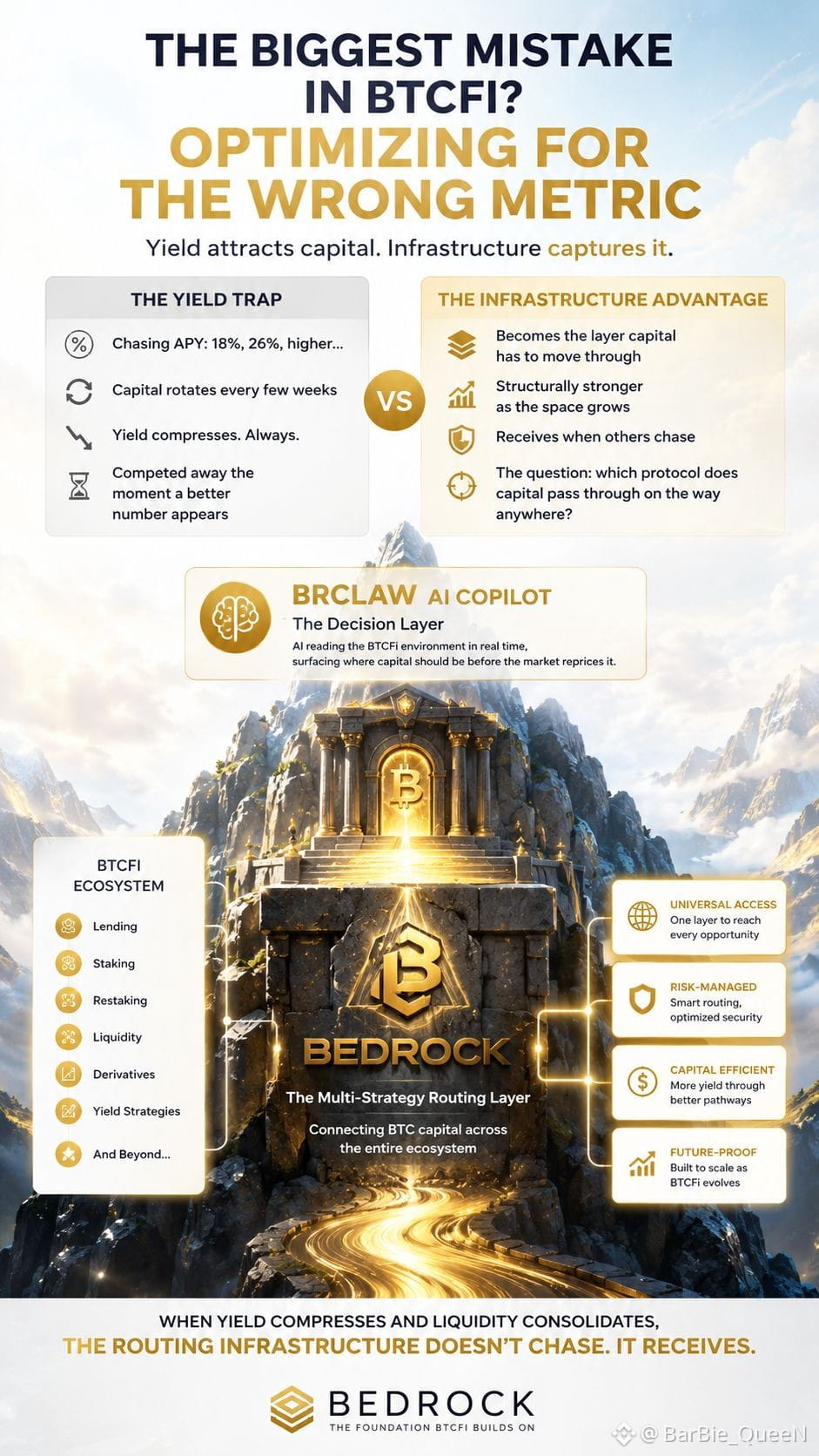
13
353
Log in to explore more content
Join global crypto users on Binance Square
⚡️ Get latest and useful information about crypto.
💬 Trusted by the world’s largest crypto exchange.
👍 Discover real insights from verified creators.
Email / Phone number
Trending Topics
1
#BinancePick
2.9M views
150,785 Discussing
2
#EarningsSeason
5.2M views
25,679 Discussing
3
#AnthropicTTMRevenueGrewAbout1200%
13,043 views
290 Discussing
4
#AnthropicS1ExpectedToday
15,393 views
266 Discussing
5
#SouthKoreaReportedlyWeighsFourthCryptoTaxDelay
22,213 views
396 Discussing
6
#FranklinTempletonFilesForTwoDividendToBitcoinETFs
29,864 views
491 Discussing
7
#StrategyMSTRSurpassesNasdaqInMarketCap
23,239 views
356 Discussing
8
#CanadaProposesStablecoinRedemptionWithin3BusinessDays
1,060 views
34 Discussing
9
#ElectrumWalletBugLetRogueServersStealFunds
25,201 views
439 Discussing
10
#ArgentineCourtDismissesLIBRACaseAgainstMilei
38,395 views
540 Discussing