

DAVIL_BRO
10 Posts
DAVIL_BRO
Report
Block User
6 Following
13 Followers
22 Liked
Posts
·
--
What Is Blockchain? The Technology That Could Change the Digital World 🌐
Have you ever wondered how people can transfer digital assets without depending on a single central authority?
The answer lies in a technology called Blockchain.
Many people hear about Bitcoin and cryptocurrency every day, but blockchain is much more than digital money. It is a technology designed to record and verify information across a distributed network.
Let's understand it in simple terms. 👇
🔗 1. What Is Blockchain?
Blockchain is a type of digital ledger that stores information in groups called blocks.
These blocks are connected using cryptographic techniques, forming a chain of records.
Instead of relying on one central database, many blockchain networks distribute records across multiple computers, often called nodes.
Think of it as a shared digital record that network participants can verify.
⚙️ 2. How Does Blockchain Work?
Here is a simplified example of how a blockchain transaction works:
🔹 Step 1: A transaction is initiated. Someone sends a digital asset or submits information.
🔹 Step 2: The network checks the transaction. Participants or validators verify it according to the network's rules.
🔹 Step 3: The transaction is recorded. Valid transactions are grouped into blocks.
🔹 Step 4: The block is added to the chain. The network updates its record according to its consensus mechanism.
Once recorded, changing historical data can be extremely difficult, depending on the blockchain's design and security.
🚀 3. Why Is Blockchain Important?
Blockchain offers several potential benefits:
✅ Transparency: Public blockchains allow people to independently inspect transaction records.
✅ Decentralization: Many networks operate without depending on a single controlling authority.
✅ Verifiability: Cryptographic techniques help participants verify records.
✅ Traceability: Transactions and asset movements can often be followed on public networks.
#Blockchain #CryptoEducation #Web3 #Bitcoin #BinanceSquare
81
·
--
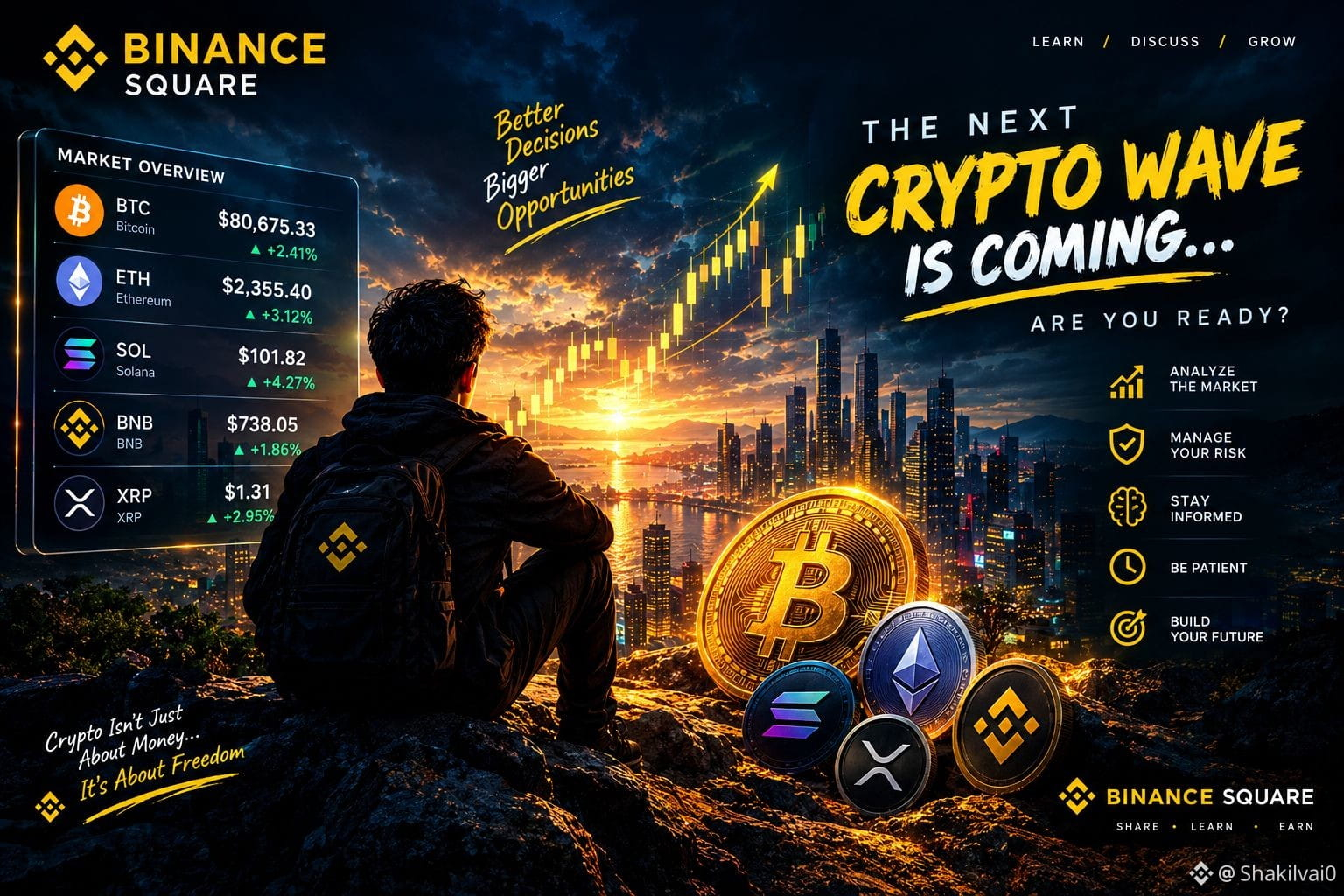
🚨 THE NEXT CRYPTO WAVE IS COMING… ARE YOU READY? 🚀
The crypto market doesn’t reward everyone. It rewards those who take the time to learn, stay patient, and manage risk. 📊
💡 5 THINGS EVERY CRYPTO INVESTOR SHOULD REMEMBER:
🔹 1. Don’t Follow the Crowd Blindly
When everyone is shouting “BUY,” take a moment to analyze the market yourself.
🔹 2. Bitcoin Still Matters
Bitcoin’s price action, market sentiment, and dominance can influence the broader crypto market.
🔹 3. Research Before You Invest
{spot}(BTCUSDT)
{spot}(SOLUSDT)
{spot}(ETHUSDT)
Understand the project, its utility, tokenomics, team, and risks before putting your money into any coin.
🔹 4. Risk Management Is Everything
Never invest money you cannot afford to lose. No profit is guaranteed in crypto.
🔹 5. Patience Beats FOMO
Missing an opportunity is better than making a rushed decision that you regret later. 🎯
🔥 MY BIGGEST LESSON FROM CRYPTO:
You don’t need to catch every pump. You need a strategy that helps you survive the market and make informed decisions.
The next big opportunity could be around the corner—but preparation matters more than hype.
👇 LET’S DISCUSS!
What do you think will lead the next crypto market wave?
🟠 Bitcoin (BTC)
🔵 Ethereum (ETH)
🟣 Solana (SOL)
💎 Promising Altcoins
Drop your pick in the comments and tell us WHY! 👇
📌 Follow for more crypto insights, market discussions, and educational content.
#BinanceSquare #crypto #bitcoin #Ethereum #altcoins
🚨 THE NEXT CRYPTO WAVE IS COMING… ARE YOU READY? 🚀
The crypto market doesn’t reward everyone. It rewards those who take the time to learn, stay patient, and manage risk. 📊
💡 5 THINGS EVERY CRYPTO INVESTOR SHOULD REMEMBER:
🔹 1. Don’t Follow the Crowd Blindly
When everyone is shouting “BUY,” take a moment to analyze the market yourself.
🔹 2. Bitcoin Still Matters
Bitcoin’s price action, market sentiment, and dominance can influence the broader crypto market.
🔹 3. Research Before You Invest
Understand the project, its utility, tokenomics, team, and risks before putting your money into any coin.
🔹 4. Risk Management Is Everything
Never invest money you cannot afford to lose. No profit is guaranteed in crypto.
🔹 5. Patience Beats FOMO
Missing an opportunity is better than making a rushed decision that you regret later. 🎯
🔥 MY BIGGEST LESSON FROM CRYPTO:
You don’t need to catch every pump. You need a strategy that helps you survive the market and make informed decisions.
The next big opportunity could be around the corner—but preparation matters more than hype.
👇 LET’S DISCUSS!
What do you think will lead the next crypto market wave?
🟠 Bitcoin (BTC)
🔵 Ethereum (ETH)
🟣 Solana (SOL)
💎 Promising Altcoins
Drop your pick in the comments and tell us WHY! 👇
📌 Follow for more crypto insights, market discussions, and educational content.
#BinanceSquare #crypto #bitcoin #Ethereum #altcoins
128
·
--
#2025withBinance Start your crypto story with the @Binance Year in Review and share your highlights! #2025withBinance.
👉 Sign up with my link and get 100 USD rewards! https://www.binance.com/year-in-review/2025-with-binance?ref=988122388
#2025withBinance Start your crypto story with the @Binance Year in Review and share your highlights! #2025withBinance.
👉 Sign up with my link and get 100 USD rewards! https://www.binance.com/year-in-review/2025-with-binance?ref=988122388
👉 Sign up with my link and get 100 USD rewards! https://www.binance.com/year-in-review/2025-with-binance?ref=988122388
·
--
The Future of Fully On-Chain Apps with Walrus.Fully on-chain apps are the next evolution of Web3, but they demand secure, scalable, and programmable storage. @WalrusProtocol provides exactly that, enabling developers to build apps without relying on centralized infrastructure. Whether it’s AI models, NFTs, or gaming worlds, Walrus keeps data accessible, immutable, and censorship-resistant. $WAL fuels interactions within the ecosystem, incentivizing nodes and ensuring reliability. Walrus is laying the foundation for a Web3 world where apps truly live on-chain. #walrus
The Future of Fully On-Chain Apps with Walrus.
Fully on-chain apps are the next evolution of Web3, but they demand secure, scalable, and programmable storage. @Walrus 🦭/acc provides exactly that, enabling developers to build apps without relying on centralized infrastructure. Whether it’s AI models, NFTs, or gaming worlds, Walrus keeps data accessible, immutable, and censorship-resistant. $WAL fuels interactions within the ecosystem, incentivizing nodes and ensuring reliability. Walrus is laying the foundation for a Web3 world where apps truly live on-chain. #walrus
·
--
How Walrus Drives Web3 Mass Adoption..Mass adoption in Web3 depends on reliable infrastructure, not just flashy tokens. Storage is key—without it, apps can’t scale securely. @WalrusProtocol offers decentralized, scalable storage, enabling NFTs, gaming, AI, and fully on-chain apps. $WAL powers the ecosystem, rewarding reliability and usage. By solving the storage problem, Walrus makes Web3 applications more trustworthy, fast, and user-friendly, paving the way for millions of new users. #walrus
How Walrus Drives Web3 Mass Adoption..
Mass adoption in Web3 depends on reliable infrastructure, not just flashy tokens. Storage is key—without it, apps can’t scale securely. @Walrus 🦭/acc offers decentralized, scalable storage, enabling NFTs, gaming, AI, and fully on-chain apps. $WAL powers the ecosystem, rewarding reliability and usage. By solving the storage problem, Walrus makes Web3 applications more trustworthy, fast, and user-friendly, paving the way for millions of new users. #walrus
·
--
🔘 Yes
67%
🔘 No
33%
3 votes • Voting closed
40
·
--
$BTC বাঙলায় অনুসন্ধান করুন
$btc
Search Results
Bitcoin
Cryptocurrency
Overview
Stats
Purpose
ATM
Main results
Images


3 days ago


View all
Description
Description
Bitcoin is the first decentralized cryptocurrency. Based on a free-market ideology, bitcoin was invented in 2008 by Satoshi Nakamoto, an unknown person. Use of bitcoin as a currency began in 2009, with the release of its open-source implementation. In 2021, El Salvador adopted it as legal tender. Wikipedia
Symbols: BTC, ₿
Code: BTC
Exchange rate: Floating
Hash function: SHA-256 (two rounds)
Implementation(s): Bitcoin Core
Initial release: 0.1.0 / 9 January 2009 (16 years ago)
Issuance schedule: Decentralized (block reward); Initially ₿50 per block, halved every 210,000 blocks
11
532
·
--
#PCEInflationWatch
PCEInflationWatch $CFX coin buy and hold big PUMP soon
16 hours ago — #PCEInflationWatch · $CFX coin buy and hold big PUMP soon. #PCEInflationWatch. Disclaimer: Includes third-party opinions.
#PCEInflationWatch
PCEInflationWatch $CFX coin buy and hold big PUMP soon
16 hours ago — #PCEInflationWatch · $CFX coin buy and hold big PUMP soon. #PCEInflationWatch. Disclaimer: Includes third-party opinions.
PCEInflationWatch $CFX coin buy and hold big PUMP soon
16 hours ago — #PCEInflationWatch · $CFX coin buy and hold big PUMP soon. #PCEInflationWatch. Disclaimer: Includes third-party opinions.
143
Log in to explore more content
Join global crypto users on Binance Square
⚡️ Get latest and useful information about crypto.
💬 Trusted by the world’s largest crypto exchange.
👍 Discover real insights from verified creators.
Email / Phone number