stablecoins

7.8M views
30,863 Discussing
JOY_MADHU_
·
--
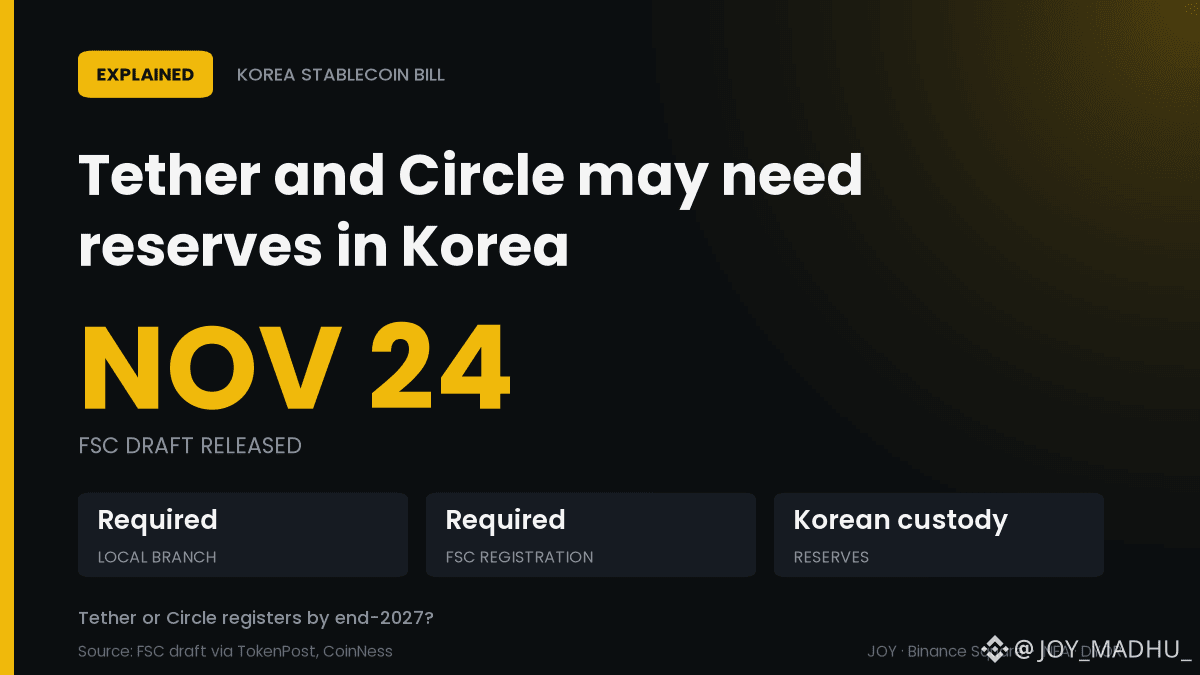
#SouthKoreaPlansToRequireTetherCircleLocalReserves 🇰🇷 Branch, Register, Park Reserves: Korea's Terms for USDT Korea's FSC draft would make offshore issuers like Tether and Circle keep reserves in Korea to serve residents. 🏦 Local branch plus FSC registration required 📊 Reserves segregated at Korean banks or trustees ⚠️ Size tied to home-country rules and Korean circulation 📅 Draft out Nov 24, still needs a National Assembly vote Watch next: the same bill also ends Korea's 2017 ICO ban. Tether or Circle registers with the FSC by end-2027, yes or no? 👇 $USDT $USDC #SouthKoreaPlansToRequireTetherCircleLocalReserves #Stablecoins #Korea
#SouthKoreaPlansToRequireTetherCircleLocalReserves
🇰🇷 Branch, Register, Park Reserves: Korea's Terms for USDT

Korea's FSC draft would make offshore issuers like Tether and Circle keep reserves in Korea to serve residents.

🏦 Local branch plus FSC registration required
📊 Reserves segregated at Korean banks or trustees
⚠️ Size tied to home-country rules and Korean circulation
📅 Draft out Nov 24, still needs a National Assembly vote

Watch next: the same bill also ends Korea's 2017 ICO ban.

Tether or Circle registers with the FSC by end-2027, yes or no? 👇

$USDT $USDC
#SouthKoreaPlansToRequireTetherCircleLocalReserves #Stablecoins #Korea
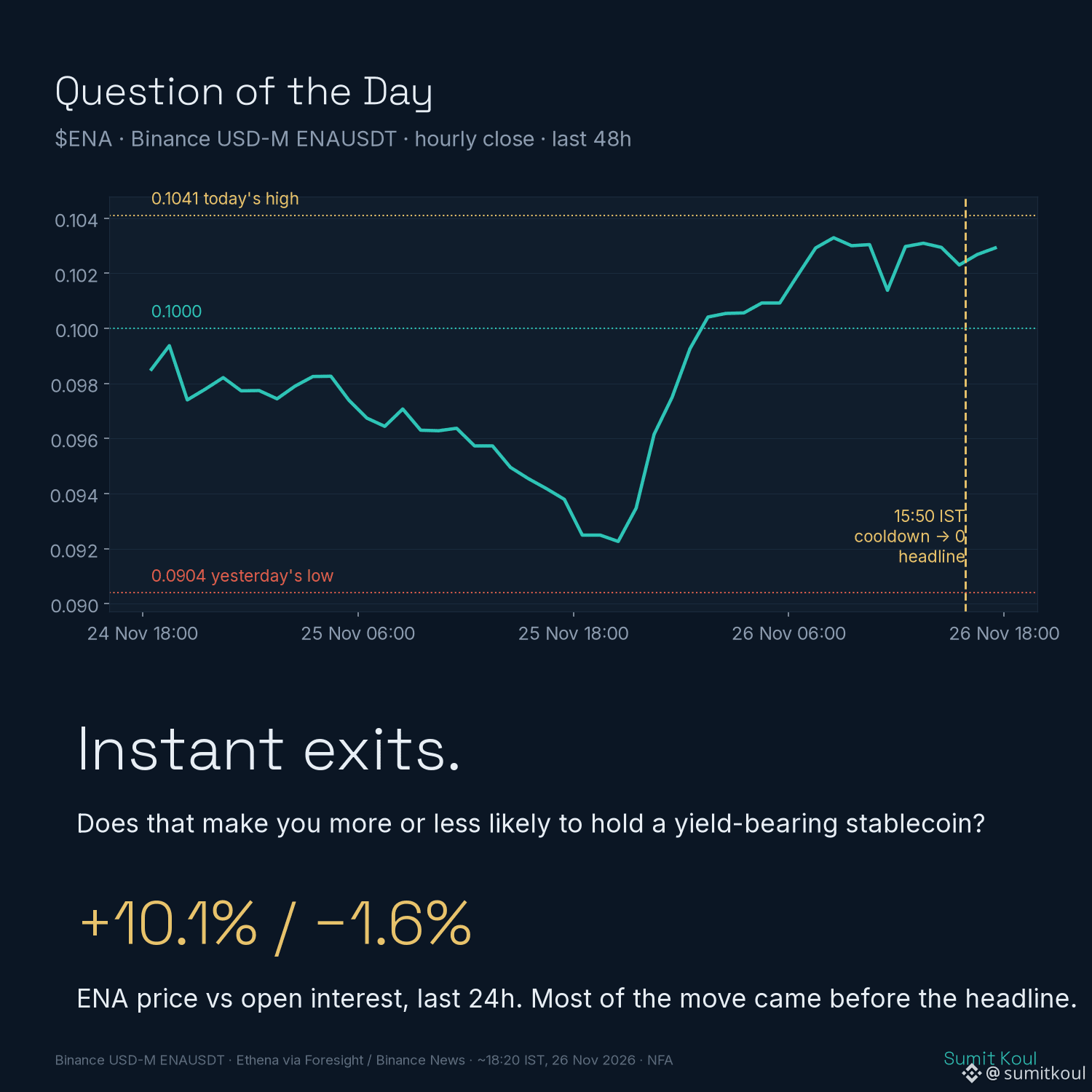
Question of the Day 💬 Ethena cut sUSDe's unstaking cooldown to zero — what it actually changes for $ENA, and what it doesn't. What changed (Binance News / Foresight, ~15:50 IST): sUSDe holders can now unstake to USDe instantly, no one-day wait. Ethena also says minting sUSDe carries no fee. Its risk committee cited ~$1.25B of Tier 1 liquidity against ~$1.14B of sUSDe supply (23 Nov snapshot), and the cooldown can come back if coverage weakens. What it didn't change: the token's chart, at least not today. $ENA is up 10.1% in 24h (~0.1029 on Binance USD-M), but most of that came overnight. Since the headline it's flat. Open interest is down 1.6% over 24h. Levels I'm watching: 0.1041 (today's high), 0.1000, 0.0904 (yesterday's low). Full breakdown, with risks both ways: https://www.binance.com/en/square/post/392422962200146 Today's question: do instant exits make you more or less likely to hold a yield-bearing stablecoin? Tell me why 👇 #Ethena #ENA #Stablecoins Not financial advice.
Question of the Day 💬 Ethena cut sUSDe's unstaking cooldown to zero — what it actually changes for $ENA , and what it doesn't.

What changed (Binance News / Foresight, ~15:50 IST): sUSDe holders can now unstake to USDe instantly, no one-day wait. Ethena also says minting sUSDe carries no fee. Its risk committee cited ~$1.25B of Tier 1 liquidity against ~$1.14B of sUSDe supply (23 Nov snapshot), and the cooldown can come back if coverage weakens.

What it didn't change: the token's chart, at least not today. $ENA is up 10.1% in 24h (~0.1029 on Binance USD-M), but most of that came overnight. Since the headline it's flat. Open interest is down 1.6% over 24h.

Levels I'm watching: 0.1041 (today's high), 0.1000, 0.0904 (yesterday's low).

Full breakdown, with risks both ways: https://www.binance.com/en/square/post/392422962200146

Today's question: do instant exits make you more or less likely to hold a yield-bearing stablecoin? Tell me why 👇

#Ethena #ENA #Stablecoins
Not financial advice.
·
--
Article
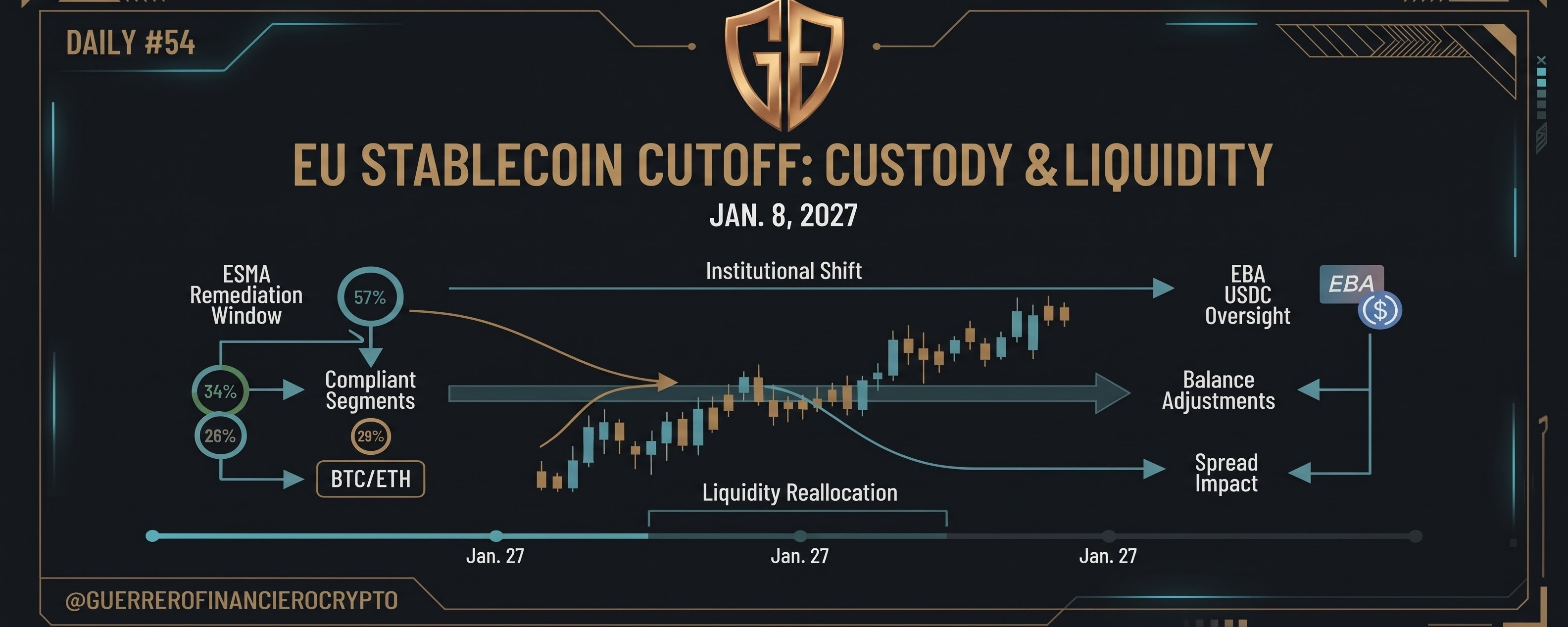
EU Stablecoin Cutoff: Custody and Liquidity Ahead of Jan. 8Daily#54 EU Stablecoin Cutoff: Custody and Liquidity Ahead of Jan. 8 @GUERREROFINANCIEROCRYPTO Continuing the series, the focus shifts from energy and supply logistics to European regulation and liquidity: the January 8, 2027 outer deadline for non-MiCA-compliant stablecoins—which also covers custody—and EBA oversight of $USDC. With year-end approaching and market depth often thinner, watching balance shifts and flows across $USDC , $BTC , and $ETH matters more than guessing prices. Timeline and Oversight On October 8, 2026, ESMA set a three-month remediation window with an outer deadline of January 8, 2027, for non-MiCA-compliant stablecoins, including custody services. On November 12, 2026, EBA supervisory oversight of $USDC as a significant e-money token was recorded. Because the deadline lands right after year-end, timing for converting, moving, or withdrawing balances carries practical weight. What to Watch in Liquidity and Flows When a rule touches custody and stablecoin rules at authorized providers (CASPs), potential effects run through balance management and possible friction when seasonal liquidity is thinner. A date matching a price move does not prove causation; to see whether funds stay in compliant stablecoins, move into $BTC/$ETH, or rotate into other segments, look at verifiable flow and liquidity data. Two Paths Ahead Orderly transition: intermediaries and users adjust custody and balances before year-end, entering January without bottlenecks. Concentrated adjustment: balance moves cluster in late December or early January, with possible spread shifts or activity changes across pairs and segments. Scope Limits and Risks Implementation pace and client notices can vary across national jurisdictions and crypto-asset service providers, and seasonal year-end liquidity can distort short-term volume readings. This analysis focuses on the regulatory and operational framework without incorporating live chart readings or real-time flows in this edition. Factual conclusion: ESMA set January 8, 2027, as the outer remediation deadline for non-MiCA-compliant stablecoins—including custody—while $USDC is under EBA oversight as a significant e-money token. Analytical question: How will European custodians and market participants manage stablecoin and digital-asset balances ahead of year-end and the January 8, 2027 cutoff? Invitation to follow the series: Follow this series to track each cut with verifiable sources and a clear separation between facts, interpretation, and scenarios. #Regulation #Liquidity #Stablecoins #DiarioGuerreroFinanciero #MiCA $USDC #BTC #ETH #BinsnceSqure Disclaimer: Informational and market analysis content only; not financial, investment, tax, or legal advice, nor a recommendation to buy, sell, or hold any asset (DYOR). Sources for This Cut 1. ESMA — Opinion under Article 29(1)(a) of the ESMA Regulation (outer deadline: January 8, 2027; October 8, 2026). 2. EBA — Oversight of $USDC as a significant e-money token (November 12, 2026). 3. FinTech Weekly (November 25, 2026), CryptoTicker (October 8, 2026), and Scorechain (October 13, 2026).

EU Stablecoin Cutoff: Custody and Liquidity Ahead of Jan. 8

Daily#54 EU Stablecoin Cutoff: Custody and Liquidity Ahead of Jan. 8
@GUERREROFINANCIEROCRYPTO
Continuing the series, the focus shifts from energy and supply logistics to European regulation and liquidity: the January 8, 2027 outer deadline for non-MiCA-compliant stablecoins—which also covers custody—and EBA oversight of $USDC . With year-end approaching and market depth often thinner, watching balance shifts and flows across $USDC , $BTC , and $ETH matters more than guessing prices.
Timeline and Oversight
On October 8, 2026, ESMA set a three-month remediation window with an outer deadline of January 8, 2027, for non-MiCA-compliant stablecoins, including custody services. On November 12, 2026, EBA supervisory oversight of $USDC as a significant e-money token was recorded. Because the deadline lands right after year-end, timing for converting, moving, or withdrawing balances carries practical weight.
What to Watch in Liquidity and Flows
When a rule touches custody and stablecoin rules at authorized providers (CASPs), potential effects run through balance management and possible friction when seasonal liquidity is thinner. A date matching a price move does not prove causation; to see whether funds stay in compliant stablecoins, move into $BTC /$ETH , or rotate into other segments, look at verifiable flow and liquidity data.
Two Paths Ahead
Orderly transition: intermediaries and users adjust custody and balances before year-end, entering January without bottlenecks.
Concentrated adjustment: balance moves cluster in late December or early January, with possible spread shifts or activity changes across pairs and segments.
Scope Limits and Risks
Implementation pace and client notices can vary across national jurisdictions and crypto-asset service providers, and seasonal year-end liquidity can distort short-term volume readings. This analysis focuses on the regulatory and operational framework without incorporating live chart readings or real-time flows in this edition.
Factual conclusion: ESMA set January 8, 2027, as the outer remediation deadline for non-MiCA-compliant stablecoins—including custody—while $USDC is under EBA oversight as a significant e-money token.
Analytical question: How will European custodians and market participants manage stablecoin and digital-asset balances ahead of year-end and the January 8, 2027 cutoff?
Invitation to follow the series: Follow this series to track each cut with verifiable sources and a clear separation between facts, interpretation, and scenarios.
#Regulation #Liquidity #Stablecoins #DiarioGuerreroFinanciero #MiCA $USDC #BTC #ETH #BinsnceSqure
Disclaimer: Informational and market analysis content only; not financial, investment, tax, or legal advice, nor a recommendation to buy, sell, or hold any asset (DYOR).
Sources for This Cut
1. ESMA — Opinion under Article 29(1)(a) of the ESMA Regulation (outer deadline: January 8, 2027; October 8, 2026).
2. EBA — Oversight of $USDC as a significant e-money token (November 12, 2026).
3. FinTech Weekly (November 25, 2026), CryptoTicker (October 8, 2026), and Scorechain (October 13, 2026).
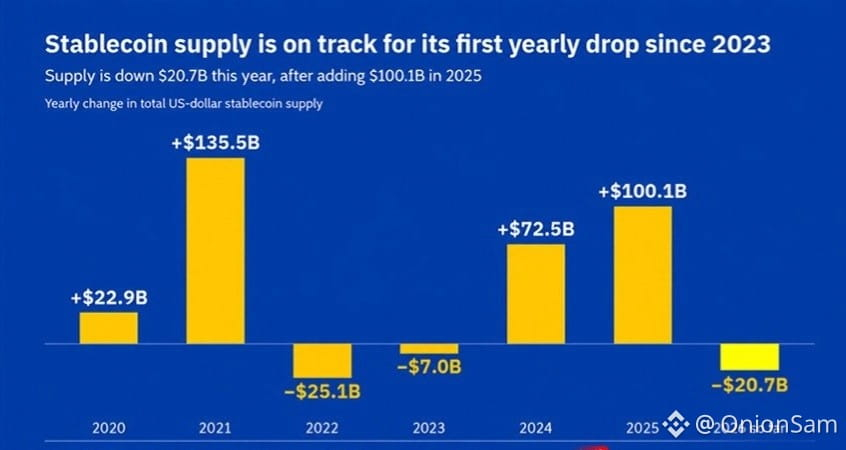
🚨 LIQUIDITY ALERT: US Dollar Stablecoin Supply Down $20.7B YTD—On Track for First Annual Contraction Since 2023! 📉💸🧊 Fresh on-chain data shows crypto’s "dry powder" is shrinking rapidly as capital exits back into traditional fiat rails amid ongoing market volatility. 🏦🔄 🔍 Key On-Chain & Liquidity Takeaways: • Following a massive $100.1B expansion in 2025, total USD stablecoin supply has contracted by $20.7B so far in 2026 (now hovering near ~$282B). 📊⬇️ • November alone recorded $14.8B in net redemptions—marking the steepest single-month drop since the Terra collapse in May 2022! 💥🗓️ • Roughly 90% of the contraction occurred on Ethereum, led by redemptions across $USDT (~$8B monthly drop) and $USDC, draining available spot buying liquidity. ⛓️💧 💡 Market Structure & Risk Takeaway: Stablecoins are the lifeblood of crypto liquidity. Until net minting resumes and stablecoin outflows stabilize, expect thinner order books and sharper price swings—manage leverage carefully! 🛡️⚖️📉 #Stablecoins #USDT #USDC #CryptoLiquidity #onchaindata #CryptoNews $USDT $USDC $ETH {spot}(ETHUSDT) $BTC {spot}(BTCUSDT) $SKY {spot}(SKYUSDT)
🚨 LIQUIDITY ALERT: US Dollar Stablecoin Supply Down $20.7B YTD—On Track for First Annual Contraction Since 2023! 📉💸🧊

Fresh on-chain data shows crypto’s "dry powder" is shrinking rapidly as capital exits back into traditional fiat rails amid ongoing market volatility. 🏦🔄

🔍 Key On-Chain & Liquidity Takeaways:

• Following a massive $100.1B expansion in 2025, total USD stablecoin supply has contracted by $20.7B so far in 2026 (now hovering near ~$282B). 📊⬇️

• November alone recorded $14.8B in net redemptions—marking the steepest single-month drop since the Terra collapse in May 2022! 💥🗓️

• Roughly 90% of the contraction occurred on Ethereum, led by redemptions across $USDT (~$8B monthly drop) and $USDC, draining available spot buying liquidity. ⛓️💧

💡 Market Structure & Risk Takeaway:

Stablecoins are the lifeblood of crypto liquidity. Until net minting resumes and stablecoin outflows stabilize, expect thinner order books and sharper price swings—manage leverage carefully! 🛡️⚖️📉

#Stablecoins #USDT #USDC #CryptoLiquidity #onchaindata #CryptoNews

$USDT $USDC
$ETH
$BTC
$SKY
red envelope
Good luck 🍀
From OnionSam
Feed-Creator-b06c0b3c0:
Thanks
🚨 THE DEATH SPIRAL LESSON EVERY TRADER FORGETS ABOUT $USDe STABILITY! 💥 Algorithmic pegs look bulletproof until market panic exposes the lack of hard collateral underneath. 📊 When confidence evaporates, automated supply loops turn into catastrophic death spirals faster than order books can clear. ⚡ Modern iterations lean on delta-neutral strategies and overcollateralization, but counterparty exposure remains the hidden landmine in any synthetic yield play. 💡 Are you truly tracking the underlying collateral, or just chasing nominal stability? 👇 ⚠️ Not financial advice. Always manage your risk. 🛡️ 🏷️ #USDe #Stablecoins #DeFi #RiskManagement 🦈 🔒
🚨 THE DEATH SPIRAL LESSON EVERY TRADER FORGETS ABOUT $USDe STABILITY! 💥

Algorithmic pegs look bulletproof until market panic exposes the lack of hard collateral underneath. 📊 When confidence evaporates, automated supply loops turn into catastrophic death spirals faster than order books can clear. ⚡

Modern iterations lean on delta-neutral strategies and overcollateralization, but counterparty exposure remains the hidden landmine in any synthetic yield play. 💡 Are you truly tracking the underlying collateral, or just chasing nominal stability? 👇

⚠️ Not financial advice. Always manage your risk. 🛡️

🏷️ #USDe #Stablecoins #DeFi #RiskManagement

🦈 🔒
SOUTH KOREA STABLECOIN REFORMS COULD RESHAPE LIQUIDITY FLOWS ACROSS $BTC AND $ETH 🚨 📊 Regulatory plumbing is shifting beneath the surface as South Korea pushes to anchor global stablecoin issuers under strict local reserve mandates. When a major retail volume engine tightens compliance around assets like USDT and USDC, institutional capital takes notice of how regional plumbing handles settlement risk. 📊 This localization wave mirrors structural shifts seen globally, raising the compliance barrier while safeguarding domestic creditors from insolvency contagion. 💡 While it forces issuers to adapt quickly, it fundamentally alters how cross-border capital enters the order books. 🌊 Does this regulatory tightening strengthen long-term market trust or risk fragmenting global liquidity pools? 🤔 👇 ⚠️ Not financial advice. Always manage your risk. 🛡️ 🏷️ #BTC #Stablecoins #Macro #Crypto 🦈 ⚖️
SOUTH KOREA STABLECOIN REFORMS COULD RESHAPE LIQUIDITY FLOWS ACROSS $BTC AND $ETH 🚨 📊

Regulatory plumbing is shifting beneath the surface as South Korea pushes to anchor global stablecoin issuers under strict local reserve mandates. When a major retail volume engine tightens compliance around assets like USDT and USDC, institutional capital takes notice of how regional plumbing handles settlement risk. 📊

This localization wave mirrors structural shifts seen globally, raising the compliance barrier while safeguarding domestic creditors from insolvency contagion. 💡 While it forces issuers to adapt quickly, it fundamentally alters how cross-border capital enters the order books. 🌊

Does this regulatory tightening strengthen long-term market trust or risk fragmenting global liquidity pools? 🤔 👇

⚠️ Not financial advice. Always manage your risk. 🛡️

🏷️ #BTC #Stablecoins #Macro #Crypto

🦈 ⚖️
🚨 Tether commits $14.5M to Lemon, a fintech using Circle's USDC for Visa settlement. This cross-stablecoin partnership highlights USDC's expanding utility beyond its issuer, reinforcing its role in traditional finance rails. It signals growing institutional adoption of stablecoins for payment infrastructure. Market Implication: Strengthens USDC's position as a settlement layer, potentially increasing demand and network activity. 💡 What does this cross-stablecoin collaboration mean for USDT's dominance? #Stablecoins $USDC #TradingSignal #CryptoAnalysis
🚨 Tether commits $14.5M to Lemon, a fintech using Circle's USDC for Visa settlement.

This cross-stablecoin partnership highlights USDC's expanding utility beyond its issuer, reinforcing its role in traditional finance rails. It signals growing institutional adoption of stablecoins for payment infrastructure.

Market Implication: Strengthens USDC's position as a settlement layer, potentially increasing demand and network activity.

💡 What does this cross-stablecoin collaboration mean for USDT's dominance? #Stablecoins

$USDC #TradingSignal #CryptoAnalysis
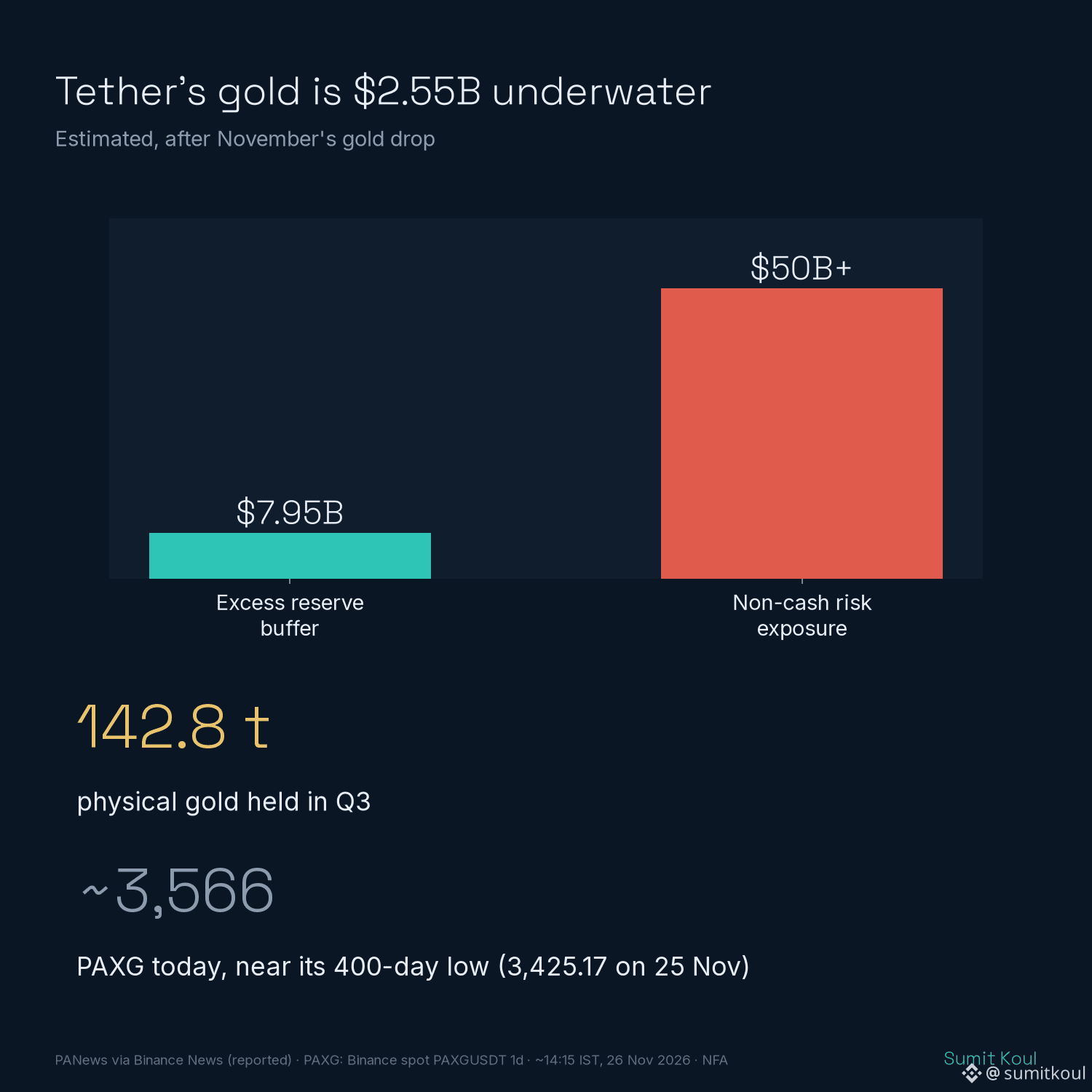
Tether owns 142.8 tonnes of gold. After November's drop, that gold is an estimated $2.55B underwater. 🪙 As reported by PANews: • 142.8 metric tons of physical gold held in Q3 • ~$2.55B estimated unrealized loss after the November slide • $50B+ in non-cash risk exposure • vs an excess-reserve buffer of $7.95B For context, tokenized gold (PAXG on Binance) is ~3,566 today, not far from its 400-day low of 3,425.17 set yesterday. An unrealized loss isn't a realized one. If gold recovers, it shrinks. But it's a reminder of what sits behind the stablecoin besides T-bills. This morning I looked at whether gold has to bottom before Bitcoin: https://www.binance.com/en/square/post/392302457507413 Does Tether holding gold make $USDT safer, or add risk? Tell me your take. Follow me for daily data on what moves crypto, including the stuff behind stablecoins. #Tether #Gold #Stablecoins Not financial advice.
Tether owns 142.8 tonnes of gold. After November's drop, that gold is an estimated $2.55B underwater. 🪙

As reported by PANews:
• 142.8 metric tons of physical gold held in Q3
• ~$2.55B estimated unrealized loss after the November slide
• $50B+ in non-cash risk exposure
• vs an excess-reserve buffer of $7.95B

For context, tokenized gold (PAXG on Binance) is ~3,566 today, not far from its 400-day low of 3,425.17 set yesterday.

An unrealized loss isn't a realized one. If gold recovers, it shrinks. But it's a reminder of what sits behind the stablecoin besides T-bills.

This morning I looked at whether gold has to bottom before Bitcoin: https://www.binance.com/en/square/post/392302457507413

Does Tether holding gold make $USDT safer, or add risk? Tell me your take.

Follow me for daily data on what moves crypto, including the stuff behind stablecoins.

#Tether #Gold #Stablecoins
Not financial advice.
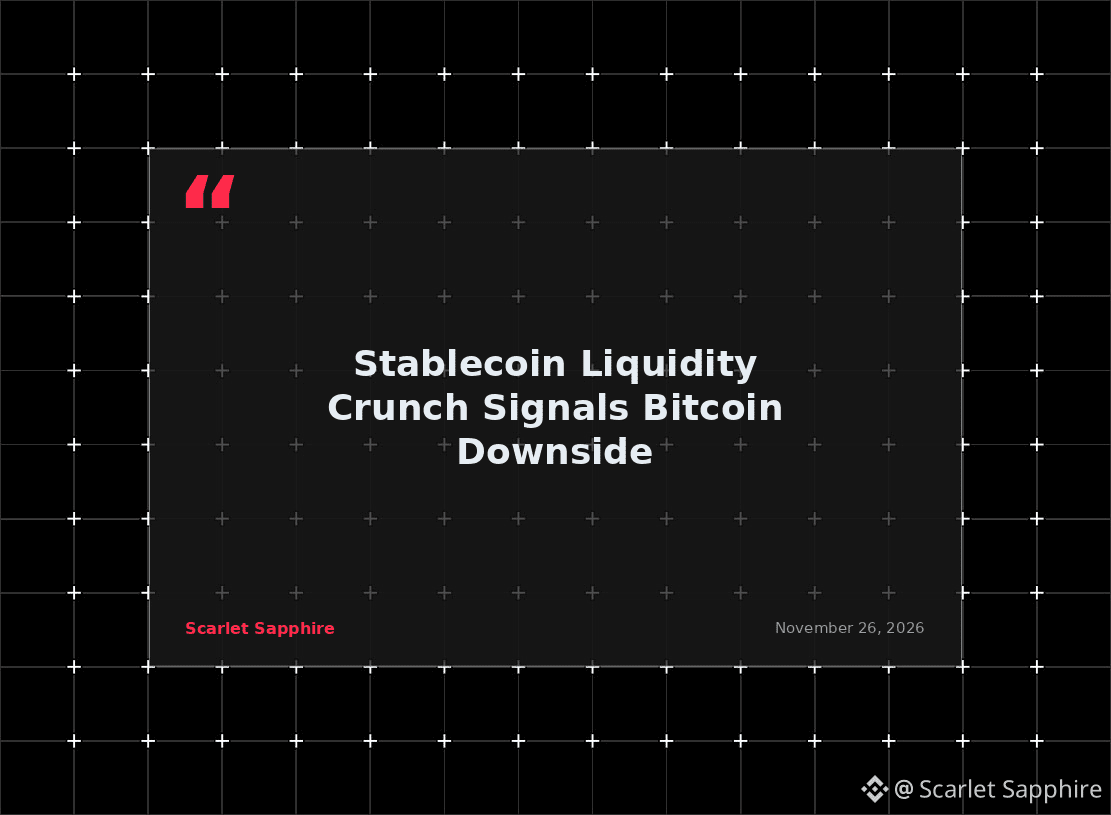
Stablecoin Liquidity Crunch Signals Bitcoin Downside 21Shares warns of a potential Bitcoin drop to $53,250 as stablecoin supply collapses by $10.7B and ETF outflows sap market demand. #Bitcoin #Stablecoins ‎
Stablecoin Liquidity Crunch Signals Bitcoin Downside

21Shares warns of a potential Bitcoin drop to $53,250 as stablecoin supply collapses by $10.7B and ETF outflows sap market demand.

#Bitcoin #Stablecoins ‎
South Korea Is Opening the Door to Bank-Issued Stablecoins. What Does This Mean for Crypto? 2. Ready-to-publish caption Stablecoins are becoming an important part of the conversation between traditional banking and cryptocurrency. 🌍 On November 25, 2026, South Korea unveiled draft rules that could allow groups led by local banks to issue stablecoins. Why does this matter? 💡 First, understand stablecoins: Stablecoins are cryptocurrencies designed to maintain a relatively stable value by being linked to an asset such as the US dollar. Why are they useful? Moving value between crypto platforms. Making digital payments. Transferring money across borders. Providing a way to hold digital value without the same price fluctuations as Bitcoin. ⚠️ But stable does not mean risk-free. Before using a stablecoin, consider: Who issues it? What backs its value? Can holders redeem it? What happens if the issuer faces financial trouble? Are there regulatory or blockchain risks? South Korea's announcement is still a draft proposal, not a law that has already taken effect. It also needs approval by the National Assembly. The Financial Stability Board has separately highlighted the importance of stronger international cooperation and monitoring of stablecoin risks. 📚 The lesson: Crypto adoption is not just about Bitcoin prices. The future of digital finance may also depend on how traditional banks, regulators and blockchain technology work together. 💬 Question: Would you trust a stablecoin issued by a regulated bank more than one issued by a crypto company? Why? #Stablecoins #cryptoeducation #blockchain #CryptoNews {spot}(BTCUSDT) {spot}(BNBUSDT) #DigitalFinance $BTC $ETH $BNB
South Korea Is Opening the Door to Bank-Issued Stablecoins. What Does This Mean for Crypto?

2. Ready-to-publish caption
Stablecoins are becoming an important part of the conversation between traditional banking and cryptocurrency. 🌍

On November 25, 2026, South Korea unveiled draft rules that could allow groups led by local banks to issue stablecoins.

Why does this matter?
💡 First, understand stablecoins:
Stablecoins are cryptocurrencies designed to maintain a relatively stable value by being linked to an asset such as the US dollar.
Why are they useful?
Moving value between crypto platforms.
Making digital payments.
Transferring money across borders.

Providing a way to hold digital value without the same price fluctuations as Bitcoin.

⚠️ But stable does not mean risk-free.
Before using a stablecoin, consider:
Who issues it?
What backs its value?
Can holders redeem it?
What happens if the issuer faces financial trouble?
Are there regulatory or blockchain risks?
South Korea's announcement is still a draft proposal, not a law that has already taken effect. It also needs approval by the National Assembly.
The Financial Stability Board has separately highlighted the importance of stronger international cooperation and monitoring of stablecoin risks.

📚 The lesson: Crypto adoption is not just about Bitcoin prices. The future of digital finance may also depend on how traditional banks, regulators and blockchain technology work together.
💬 Question: Would you trust a stablecoin issued by a regulated bank more than one issued by a crypto company? Why?
#Stablecoins #cryptoeducation #blockchain #CryptoNews
#DigitalFinance $BTC $ETH $BNB
Stablecoins can do more than hold a dollar peg in DeFi: they can act as trading liquidity, loan collateral, and settlement assets. In a report published Nov. 25, the European Banking Authority says stablecoins, including some EU-regulated e-money tokens, play those roles in DeFi. It also points to consumer risks such as inadequate disclosures, leveraged positions, non-repayment of loans, and operational failures. The policy point is easy to misread: the EBA is recommending that the European Commission assess whether extra requirements should apply to crypto-asset service providers that give customers access to DeFi lending. That is a recommendation to assess a possible policy change, not a new rule already in force. For users, the practical lesson is to understand the risks of the lending protocol and the intermediary, if one is involved. A stablecoin's target price does not make a DeFi loan risk-free. #DeFi #Stablecoins #CryptoEducation
Stablecoins can do more than hold a dollar peg in DeFi: they can act as trading liquidity, loan collateral, and settlement assets.

In a report published Nov. 25, the European Banking Authority says stablecoins, including some EU-regulated e-money tokens, play those roles in DeFi. It also points to consumer risks such as inadequate disclosures, leveraged positions, non-repayment of loans, and operational failures.

The policy point is easy to misread: the EBA is recommending that the European Commission assess whether extra requirements should apply to crypto-asset service providers that give customers access to DeFi lending. That is a recommendation to assess a possible policy change, not a new rule already in force.

For users, the practical lesson is to understand the risks of the lending protocol and the intermediary, if one is involved. A stablecoin's target price does not make a DeFi loan risk-free.

#DeFi #Stablecoins #CryptoEducation
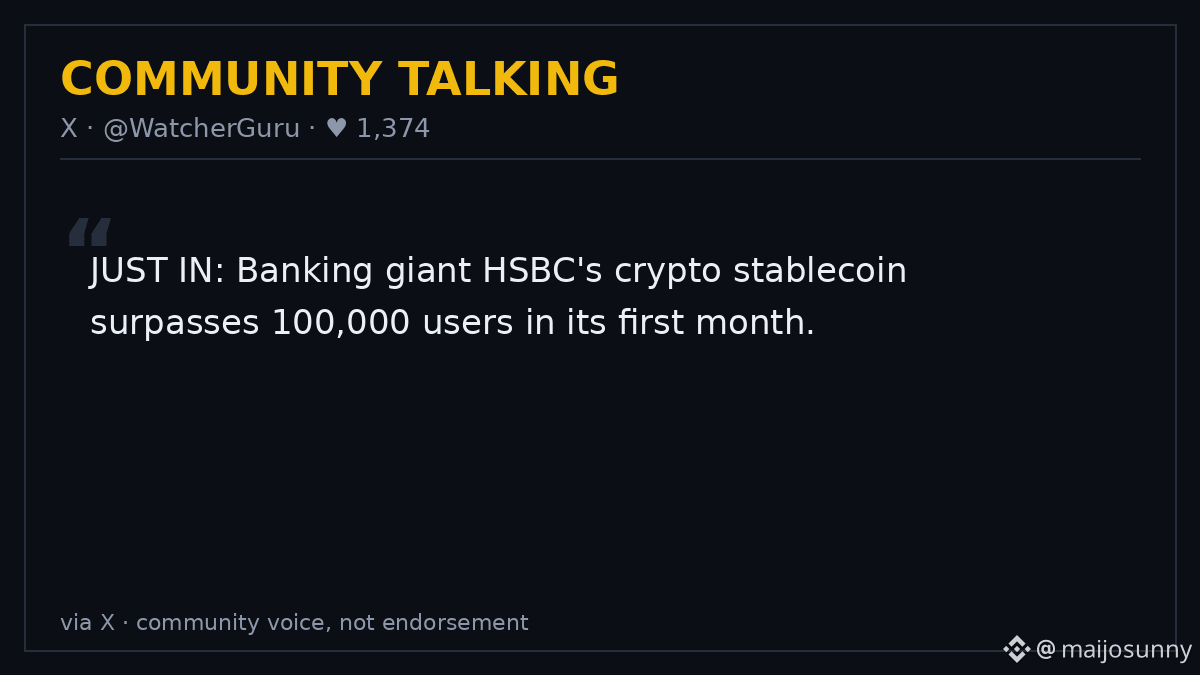
Traders on X are sharing this one today: HSBC's crypto stablecoin just passed 100,000 users in its first month, per WatcherGuru (1,374 likes, 156K views). That number landed while the crypto native stablecoin base is shrinking. $USDT circulation sits at $173.54B, down $164.8M since the last check, and $USDC is at $69.28B, down $47.0M. Two different rails, two opposite directions. Why it matters: a bank issued token reaching six figures in 30 days shows distribution is the bottleneck, not demand for digital dollars. HSBC can put the product in front of existing account holders without asking anyone to open a crypto exchange account first. The second order effect is where the flow settles. If payments growth moves onto permissioned bank rails, public chain stablecoin supply can keep contracting even as total digital dollar use rises. One month of user counts does not prove volume though. Users are not transfers, and HSBC has not published issuance or redemption totals to compare against the $212M combined contraction above. The broader tape makes the contrast sharper. $BTC is at $60,903, up 3.0% in 24h, with Fear and Greed at 11, Extreme Fear, down from 13. Spot BTC ETF outflows on Nov 25 were $453M, wider than $231.4M the day before (AlphaFinance). Price is bouncing, fear is deep, ETF money is still leaving, and a bank stablecoin is quietly adding users. Bottom line: 100K users in month one is a distribution signal, not a volume signal, and the volume print is what decides whether this matters for crypto liquidity. Bank rails or public chains, where does the next wave of stablecoin growth actually settle? 👇 Not financial advice. DYOR. #crypto #stablecoins
Traders on X are sharing this one today: HSBC's crypto stablecoin just passed 100,000 users in its first month, per WatcherGuru (1,374 likes, 156K views).

That number landed while the crypto native stablecoin base is shrinking. $USDT circulation sits at $173.54B, down $164.8M since the last check, and $USDC is at $69.28B, down $47.0M. Two different rails, two opposite directions.

Why it matters: a bank issued token reaching six figures in 30 days shows distribution is the bottleneck, not demand for digital dollars. HSBC can put the product in front of existing account holders without asking anyone to open a crypto exchange account first. The second order effect is where the flow settles. If payments growth moves onto permissioned bank rails, public chain stablecoin supply can keep contracting even as total digital dollar use rises. One month of user counts does not prove volume though. Users are not transfers, and HSBC has not published issuance or redemption totals to compare against the $212M combined contraction above.

The broader tape makes the contrast sharper. $BTC is at $60,903, up 3.0% in 24h, with Fear and Greed at 11, Extreme Fear, down from 13. Spot BTC ETF outflows on Nov 25 were $453M, wider than $231.4M the day before (AlphaFinance). Price is bouncing, fear is deep, ETF money is still leaving, and a bank stablecoin is quietly adding users.

Bottom line: 100K users in month one is a distribution signal, not a volume signal, and the volume print is what decides whether this matters for crypto liquidity.

Bank rails or public chains, where does the next wave of stablecoin growth actually settle? 👇

Not financial advice. DYOR.
#crypto #stablecoins
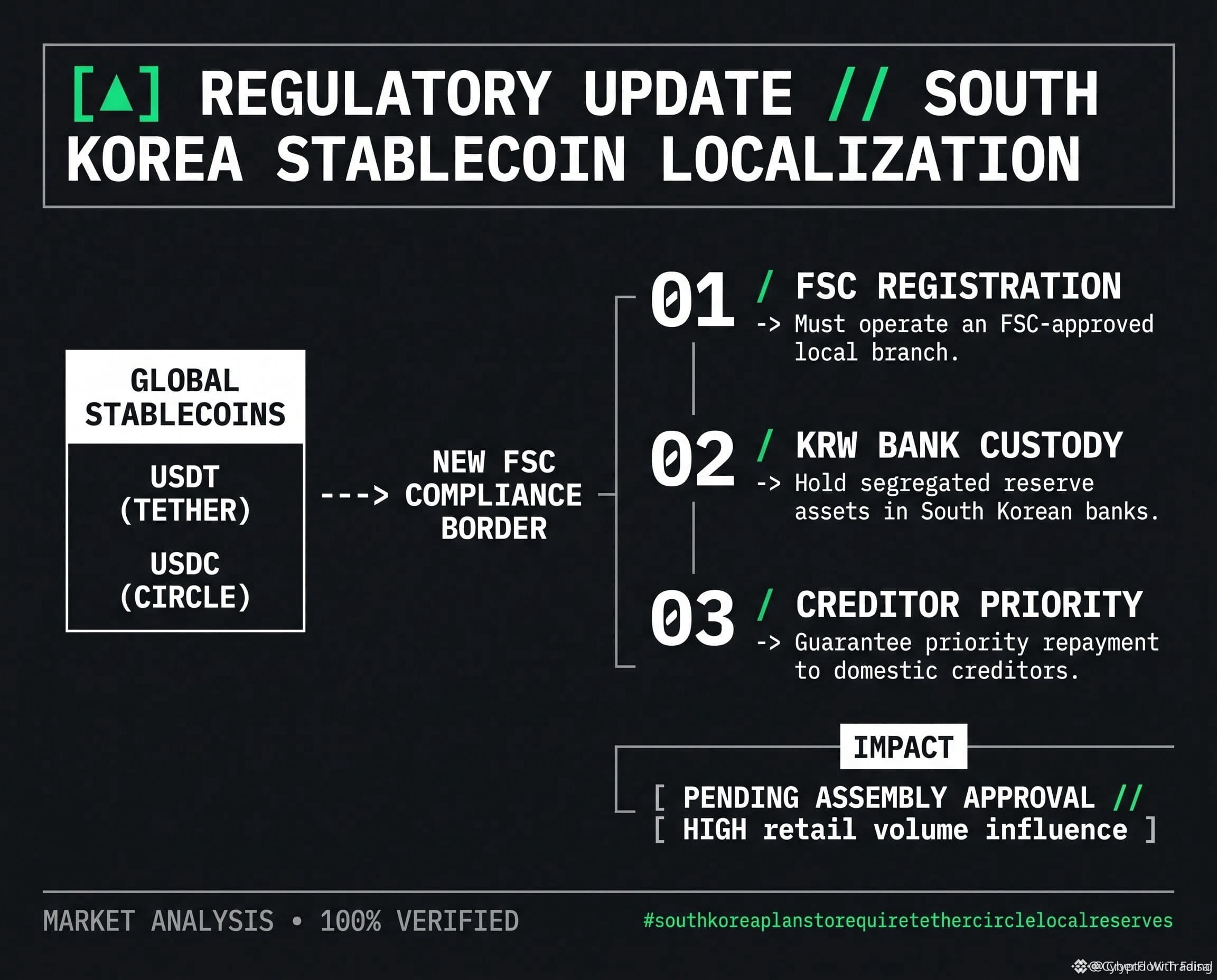
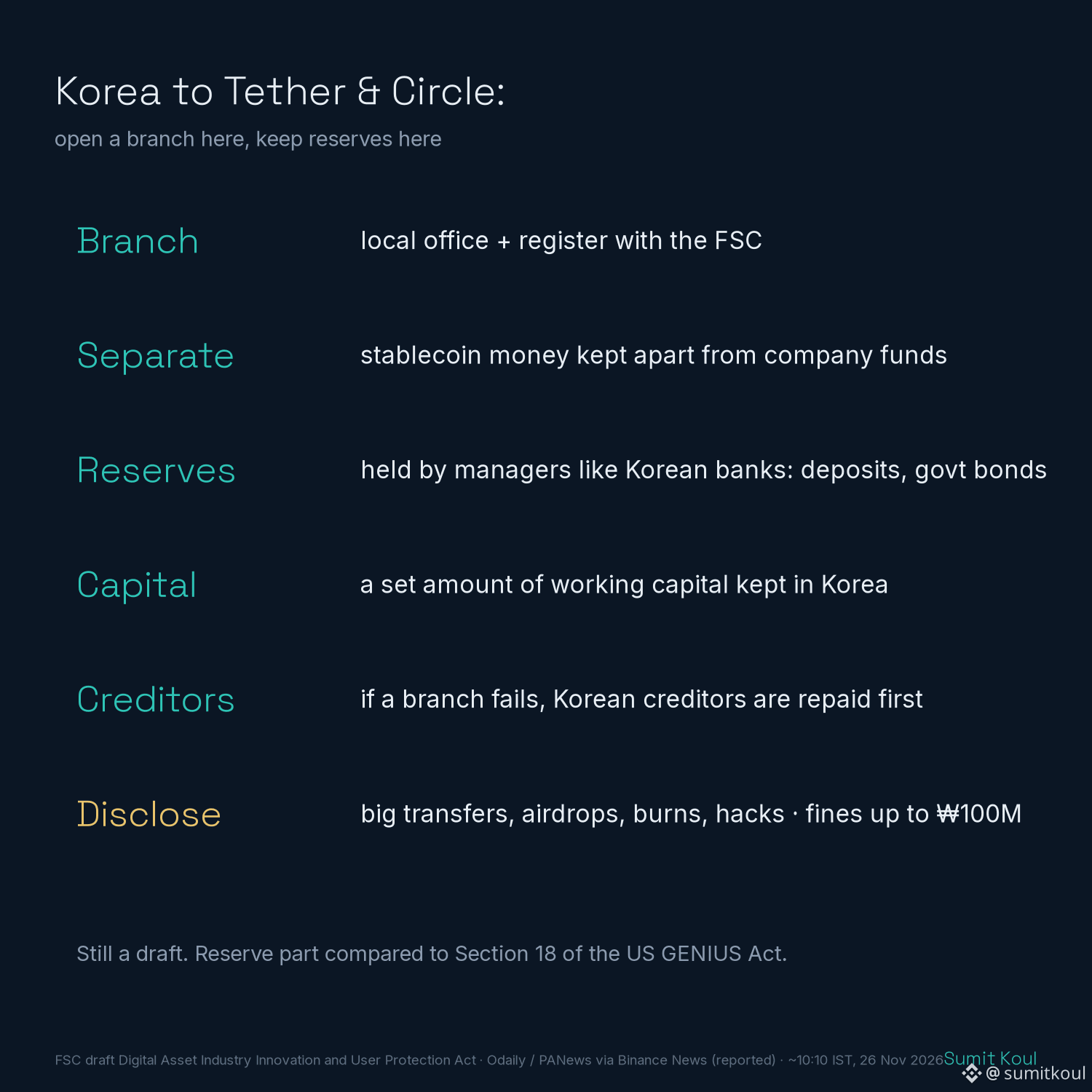
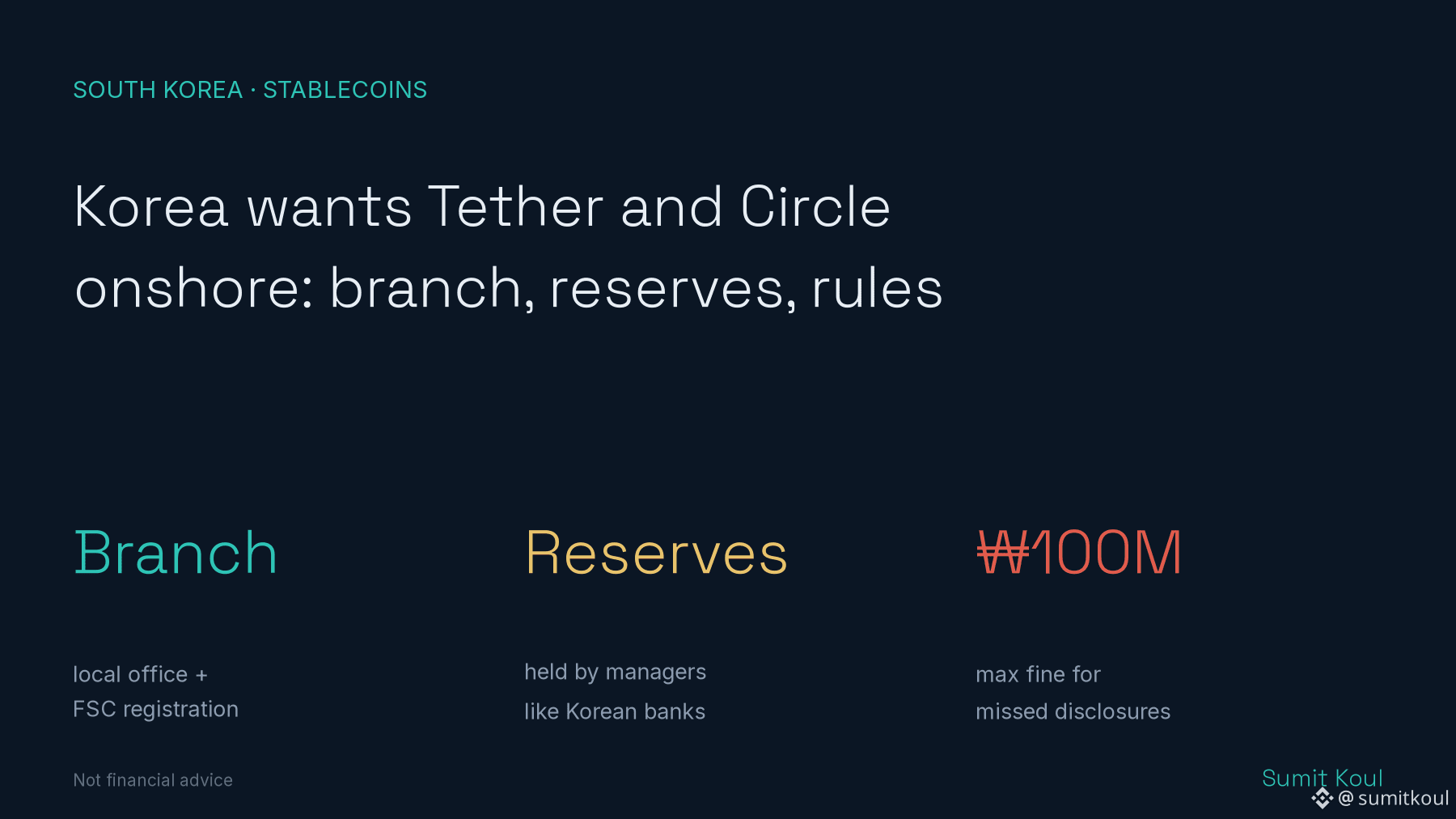
South Korea just told Tether and Circle: if you want Korean users, open a branch here and keep the reserves here. 🇰🇷 What the FSC's new draft says (via Odaily / PANews): • Local branch + register with the FSC • Stablecoin money kept separate from company funds • Reserves held by managers like Korean banks, in deposits and govt bonds • A set level of working capital kept in Korea • If a branch fails, Korean creditors get paid first Same draft: token issuers and exchanges must disclose big transfers, airdrops, burns and hacks. Fines up to ₩100M. It's still a draft. But the reserve part is modelled on Section 18 of the US GENIUS Act, so this isn't a one-off idea. I broke down what it could mean for traders here: https://www.binance.com/en/square/post/392302424516368 Would you trust a stablecoin more if its reserves sat in your own country's banks? Yes or no? 👇 Follow for regulation explained in plain language. #SouthKorea #Stablecoins #USDT
South Korea just told Tether and Circle: if you want Korean users, open a branch here and keep the reserves here. 🇰🇷

What the FSC's new draft says (via Odaily / PANews):
• Local branch + register with the FSC
• Stablecoin money kept separate from company funds
• Reserves held by managers like Korean banks, in deposits and govt bonds
• A set level of working capital kept in Korea
• If a branch fails, Korean creditors get paid first

Same draft: token issuers and exchanges must disclose big transfers, airdrops, burns and hacks. Fines up to ₩100M.

It's still a draft. But the reserve part is modelled on Section 18 of the US GENIUS Act, so this isn't a one-off idea.

I broke down what it could mean for traders here: https://www.binance.com/en/square/post/392302424516368

Would you trust a stablecoin more if its reserves sat in your own country's banks? Yes or no? 👇

Follow for regulation explained in plain language.

#SouthKorea #Stablecoins #USDT
Article
South Korea Wants Tether and Circle Onshore. Here's What the Draft Rules SaySouth Korea just told Tether and Circle what it would take to keep serving Koreans. The short version: open an office here, and park the money here too. That is the headline from a new draft of the Digital Asset Industry Innovation and User Protection Act, proposed by the Financial Services Commission (FSC) and reported this morning by Odaily and PANews. It is still a draft, not law. But it tells you a lot about where one of the most active retail crypto markets in the world is heading, and it lands in the same week Korea's central bank raised rates to 3.25%. Here is what is in it, what it could mean, and what I am watching. ## Foreign stablecoin issuers would need a Korean branch Under the draft, any overseas issuer that lets South Korean residents mint or redeem its stablecoin would have to: • set up a local branch or place of business, • register with the FSC, • keep the money it collects from issuing stablecoins separate from its own assets, • hand those funds to approved reserve managers, such as Korean banks, • keep a set level of working capital inside South Korea. The reserve managers would invest only in permitted assets, such as bank deposits and government bonds. How much would have to sit in Korea would depend on two things: how the issuer is regulated at home, and how much of its stablecoin is held and circulating in Korea. There is one more clause that matters a lot if things go wrong. If a Korean branch is liquidated or goes insolvent, its domestic assets would be used to repay Korean creditors first. Reports compare the reserve part to Section 18 of the US GENIUS Act. In other words, Korea is not inventing a new model. It is copying the "if you want to serve our users, you play by our reserve rules" approach the US already wrote down. ## Token issuers would have to disclose big moves, or pay A second part of the same draft, reported by PANews, covers disclosure. Issuers that file a white paper with the FSC, and the exchanges that list those tokens, would have to disclose events that materially change circulating supply. That includes: • large transactions, • airdrops, • token burns, • hacks or system failures, • changes to core technology like the ledger itself, • anything else that could materially affect users' trading decisions. Breaking the rule could cost a fine of up to 100 million won. If you have ever watched a token dump on an unannounced unlock, you can see why a regulator wants this. It goes straight at the information gap between insiders and everyone else. ## Put together, the direction is clear Earlier this week a draft was reported that would let ICOs come back to Korea after the 2017 ban. Today's pieces fill in the other side: tighter control over the dollar stablecoins that flow in, and more disclosure from the tokens that get listed. My read is that Korea wants a bigger, more open crypto market, but on its own terms. It does not want Korean money sitting with offshore issuers it cannot reach if something breaks. ## What it could mean for traders I want to be careful here, because the draft can still change and nobody has said how big the local reserve requirement would be. But a few things follow from the text. • Stablecoin issuers face a choice. Building a Korean branch, finding a Korean bank as reserve manager and holding working capital onshore all cost money. A large issuer can probably absorb that. A smaller one might decide Korea is not worth it. • Korean bank deposits and government bonds could get a new buyer. If the rules pass in this form, part of the reserves behind the dollar stablecoins Koreans use would sit in Korean deposits and bonds. • Listings could get noisier, but fairer. Mandatory disclosure of burns, airdrops and big transfers means more announcements. More announcements mean more volatility around them, but fewer surprises. None of this is a reason to buy or sell anything today. It is a reason to keep an eye on Korean flows, because they have moved altcoins before. ## Where the market is while this lands As of about 10:10 IST on Binance USD-M: • $BTC around 60,985, after a 05:30 IST daily close at 60,430 • $ETH around 1,703 • 73.4% of Binance BTC futures accounts are net long • The Fear & Greed Index is at 11, extreme fear ## What I am watching next 1. Whether the FSC publishes a number for the local reserve share or the working-capital requirement. 2. Whether Tether or Circle respond publicly. 3. Whether the disclosure rule comes with a clear definition of a "large transaction". Without one, it will be hard to enforce. 4. How this lines up with the ICO draft. If both move together, Korea is building a full rulebook, not patching holes. I will post an update when any of these move. What would you do if you were Tether: open a Korean branch, or step back from Korean users? Tell me in the comments. If you want regulation explained in plain language, without the hype, follow me. I post this kind of breakdown most days. #SouthKorea #Stablecoins #USDT Sources: FSC draft as reported by Odaily and PANews via Binance News (26 Nov 2026); Bank of Korea decision via Jin10/Bloomberg; market data from the Binance public API and alternative.me, about 10:10 IST. Not financial advice.


South Korea Wants Tether and Circle Onshore. Here's What the Draft Rules Say

South Korea just told Tether and Circle what it would take to keep serving Koreans. The short version: open an office here, and park the money here too.
That is the headline from a new draft of the Digital Asset Industry Innovation and User Protection Act, proposed by the Financial Services Commission (FSC) and reported this morning by Odaily and PANews. It is still a draft, not law. But it tells you a lot about where one of the most active retail crypto markets in the world is heading, and it lands in the same week Korea's central bank raised rates to 3.25%.
Here is what is in it, what it could mean, and what I am watching.
## Foreign stablecoin issuers would need a Korean branch
Under the draft, any overseas issuer that lets South Korean residents mint or redeem its stablecoin would have to:
• set up a local branch or place of business,
• register with the FSC,
• keep the money it collects from issuing stablecoins separate from its own assets,
• hand those funds to approved reserve managers, such as Korean banks,
• keep a set level of working capital inside South Korea.
The reserve managers would invest only in permitted assets, such as bank deposits and government bonds. How much would have to sit in Korea would depend on two things: how the issuer is regulated at home, and how much of its stablecoin is held and circulating in Korea.
There is one more clause that matters a lot if things go wrong. If a Korean branch is liquidated or goes insolvent, its domestic assets would be used to repay Korean creditors first.
Reports compare the reserve part to Section 18 of the US GENIUS Act. In other words, Korea is not inventing a new model. It is copying the "if you want to serve our users, you play by our reserve rules" approach the US already wrote down.
## Token issuers would have to disclose big moves, or pay
A second part of the same draft, reported by PANews, covers disclosure. Issuers that file a white paper with the FSC, and the exchanges that list those tokens, would have to disclose events that materially change circulating supply. That includes:
• large transactions,
• airdrops,
• token burns,
• hacks or system failures,
• changes to core technology like the ledger itself,
• anything else that could materially affect users' trading decisions.
Breaking the rule could cost a fine of up to 100 million won.
If you have ever watched a token dump on an unannounced unlock, you can see why a regulator wants this. It goes straight at the information gap between insiders and everyone else.
## Put together, the direction is clear
Earlier this week a draft was reported that would let ICOs come back to Korea after the 2017 ban. Today's pieces fill in the other side: tighter control over the dollar stablecoins that flow in, and more disclosure from the tokens that get listed.
My read is that Korea wants a bigger, more open crypto market, but on its own terms. It does not want Korean money sitting with offshore issuers it cannot reach if something breaks.
## What it could mean for traders
I want to be careful here, because the draft can still change and nobody has said how big the local reserve requirement would be. But a few things follow from the text.
• Stablecoin issuers face a choice. Building a Korean branch, finding a Korean bank as reserve manager and holding working capital onshore all cost money. A large issuer can probably absorb that. A smaller one might decide Korea is not worth it.
• Korean bank deposits and government bonds could get a new buyer. If the rules pass in this form, part of the reserves behind the dollar stablecoins Koreans use would sit in Korean deposits and bonds.
• Listings could get noisier, but fairer. Mandatory disclosure of burns, airdrops and big transfers means more announcements. More announcements mean more volatility around them, but fewer surprises.
None of this is a reason to buy or sell anything today. It is a reason to keep an eye on Korean flows, because they have moved altcoins before.
## Where the market is while this lands
As of about 10:10 IST on Binance USD-M:
• $BTC around 60,985, after a 05:30 IST daily close at 60,430
• $ETH around 1,703
• 73.4% of Binance BTC futures accounts are net long
• The Fear & Greed Index is at 11, extreme fear
## What I am watching next
1. Whether the FSC publishes a number for the local reserve share or the working-capital requirement.
2. Whether Tether or Circle respond publicly.
3. Whether the disclosure rule comes with a clear definition of a "large transaction". Without one, it will be hard to enforce.
4. How this lines up with the ICO draft. If both move together, Korea is building a full rulebook, not patching holes.
I will post an update when any of these move.
What would you do if you were Tether: open a Korean branch, or step back from Korean users? Tell me in the comments.
If you want regulation explained in plain language, without the hype, follow me. I post this kind of breakdown most days.
#SouthKorea #Stablecoins #USDT
Sources: FSC draft as reported by Odaily and PANews via Binance News (26 Nov 2026); Bank of Korea decision via Jin10/Bloomberg; market data from the Binance public API and alternative.me, about 10:10 IST. Not financial advice.
·
--
💵 If you ran a business, would you use someone else’s digital dollar or issue your own? $MANTRA Brale now gives businesses a way to issue a branded dollar-backed stablecoin on Cardano, with Brale handling things like reserves and redemption. Here’s the question I’d ask before getting excited about $ADA . A business can already pay suppliers with $USDC or $USDT. What would make it want its own token? Maybe it wants one dollar balance that works across its app, supplier payments and customer refunds. The first business that can show why that’s easier is the story I want to read. #Cardano #Stablecoins #CryptoPayments #OnChainFinance #BinanceSquare
💵 If you ran a business, would you use someone else’s digital dollar or issue your own? $MANTRA
Brale now gives businesses a way to issue a branded dollar-backed stablecoin on Cardano, with Brale handling things like reserves and redemption.
Here’s the question I’d ask before getting excited about $ADA . A business can already pay suppliers with $USDC or $USDT. What would make it want its own token?
Maybe it wants one dollar balance that works across its app, supplier payments and customer refunds. The first business that can show why that’s easier is the story I want to read.
#Cardano #Stablecoins #CryptoPayments #OnChainFinance #BinanceSquare
$BTC bulls are missing something boring but important right now: dry powder is literally leaving the building. Cointelegraph, citing Kaiko, reports net redemptions across 11 tracked stablecoins hit about $12B in the 30 days to Nov 13, with USDT and USDC each ending the period with roughly 4% fewer tokens in circulation. Kaiko's analyst called it capital leaving crypto rather than rotating inside it, the same pattern seen in the 2022 bear market. To me that matters more than any single candle. Fewer stablecoins on exchanges means thinner bids when $BTC dips. The small silver lining: supply has only slipped about 0.4% since Nov 13, so the bleeding may be slowing. Do you watch stablecoin supply as a bottom signal, or is it too slow to trade off? NFA, just my take. #BTC #Stablecoins #CryptoNews #USDT
$BTC bulls are missing something boring but important right now: dry powder is literally leaving the building.

Cointelegraph, citing Kaiko, reports net redemptions across 11 tracked stablecoins hit about $12B in the 30 days to Nov 13, with USDT and USDC each ending the period with roughly 4% fewer tokens in circulation. Kaiko's analyst called it capital leaving crypto rather than rotating inside it, the same pattern seen in the 2022 bear market.

To me that matters more than any single candle. Fewer stablecoins on exchanges means thinner bids when $BTC dips. The small silver lining: supply has only slipped about 0.4% since Nov 13, so the bleeding may be slowing.

Do you watch stablecoin supply as a bottom signal, or is it too slow to trade off?

NFA, just my take.

#BTC #Stablecoins #CryptoNews #USDT
Tether is facing an uncomfortable allegation: that it seeks a 20% fee from victims trying to recover USDT frozen after hacks. The claim, reported on 25 November, puts the world's largest stablecoin issuer under a harsh spotlight. $USDT is the plumbing of crypto trading — any question about how frozen funds are handled touches every exchange and every trader. Tether has not confirmed the fee. Until it responds clearly, the allegation will keep circulating. #Tether #USDT $USDT #Stablecoins
Tether is facing an uncomfortable allegation: that it seeks a 20% fee from victims trying to recover USDT frozen after hacks. The claim, reported on 25 November, puts the world's largest stablecoin issuer under a harsh spotlight. $USDT is the plumbing of crypto trading — any question about how frozen funds are handled touches every exchange and every trader. Tether has not confirmed the fee. Until it responds clearly, the allegation will keep circulating.

#Tether #USDT $USDT #Stablecoins
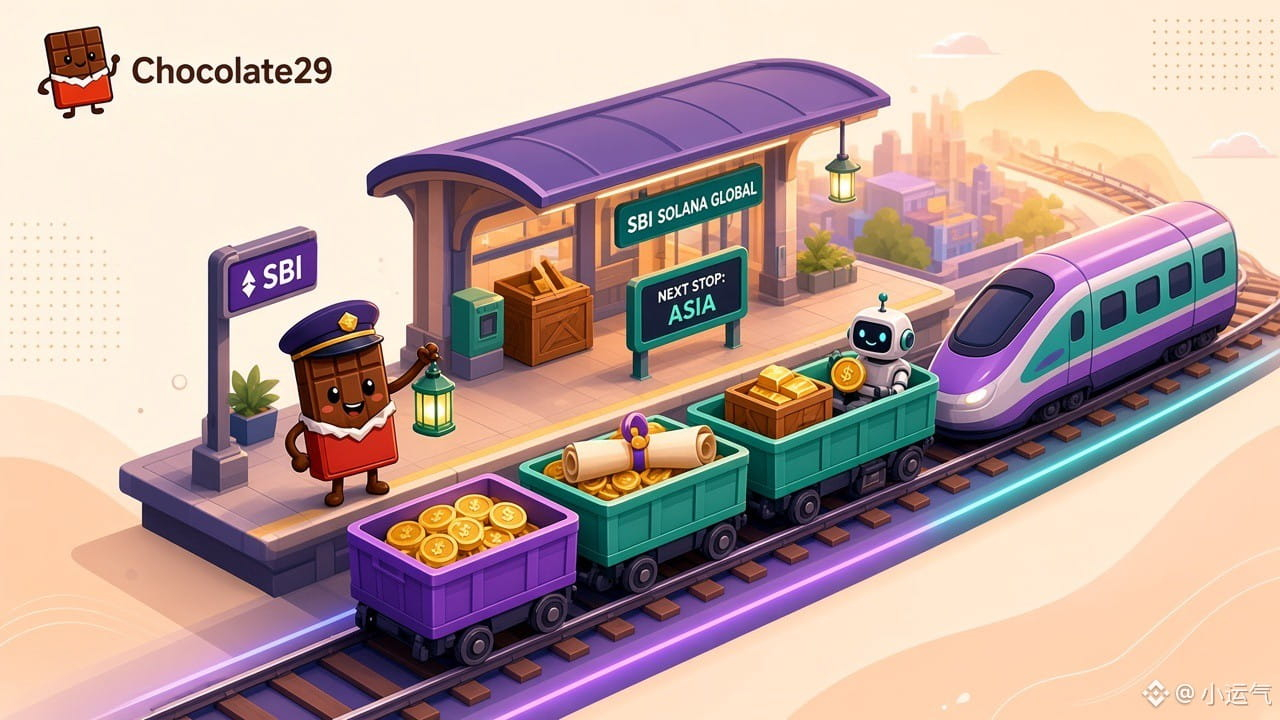
Two of Japan's biggest financial groups have teamed up with the Solana Foundation to build stablecoin payments and tokenized assets on $SOL. On November 25, 2026, SBI Holdings, Sumitomo Mitsui Financial Group (SMFG) and the Solana Foundation said they completed the agreements for a new joint venture, and SBI R3 Japan has started full-scale operations as SBI Solana Global. The Solana Foundation said SBI and SMFG together hold more than $2.3 trillion in assets and serve over 80 million customers. The venture has four focus areas: stablecoin payment and remittance rails (including micropayments made by AI agents), tokenized bonds, funds and loan receivables, tokenized commodities and other real-world assets, and onchain asset management. The partners plan to prove use cases in Japan first, then expand across Asia and connect with global onchain markets. No launch dates for specific products were given. #Solana #Stablecoins #Tokenization DYOR. Not financial advice.

Two of Japan's biggest financial groups have teamed up with the Solana Foundation to build stablecoin payments and tokenized assets on $SOL .

On November 25, 2026, SBI Holdings, Sumitomo Mitsui Financial Group (SMFG) and the Solana Foundation said they completed the agreements for a new joint venture, and SBI R3 Japan has started full-scale operations as SBI Solana Global. The Solana Foundation said SBI and SMFG together hold more than $2.3 trillion in assets and serve over 80 million customers.

The venture has four focus areas: stablecoin payment and remittance rails (including micropayments made by AI agents), tokenized bonds, funds and loan receivables, tokenized commodities and other real-world assets, and onchain asset management. The partners plan to prove use cases in Japan first, then expand across Asia and connect with global onchain markets. No launch dates for specific products were given.

#Solana #Stablecoins #Tokenization
DYOR. Not financial advice.
SOL+1.30%
SMFGUS+0.48%
While Wall Street spent today watching Nasdaq futures slide 3%, Tether quietly bought deeper into the one place crypto actually works as money. Tether just invested in Lemon, Argentina's all-in-one money app — savings, yield, stocks, cross-border payments, even a Visa prepaid card, all running on $USDT. And now tokenized gold too: users can hold fractions of $XAUT right next to their digital dollars. The amount wasn't disclosed, but the context is loud. Argentina is Latin America's second-biggest crypto economy at $88.5B in activity, up 15.3% in a year. People there don't buy stablecoins to speculate. They use them to get paid, to spend, to send money home. Tether already put $20M each into Uala and Mercado Bitcoin this year. This is the third bet on the same thesis: in places where the local currency can't be trusted, the dollar just arrives as a token. The casino is red. The plumbing keeps getting built. Not financial advice. #Crypto #Stablecoins

While Wall Street spent today watching Nasdaq futures slide 3%, Tether quietly bought deeper into the one place crypto actually works as money.

Tether just invested in Lemon, Argentina's all-in-one money app — savings, yield, stocks, cross-border payments, even a Visa prepaid card, all running on $USDT. And now tokenized gold too: users can hold fractions of $XAUT right next to their digital dollars.

The amount wasn't disclosed, but the context is loud. Argentina is Latin America's second-biggest crypto economy at $88.5B in activity, up 15.3% in a year. People there don't buy stablecoins to speculate. They use them to get paid, to spend, to send money home.

Tether already put $20M each into Uala and Mercado Bitcoin this year. This is the third bet on the same thesis: in places where the local currency can't be trusted, the dollar just arrives as a token.

The casino is red. The plumbing keeps getting built. Not financial advice. #Crypto #Stablecoins
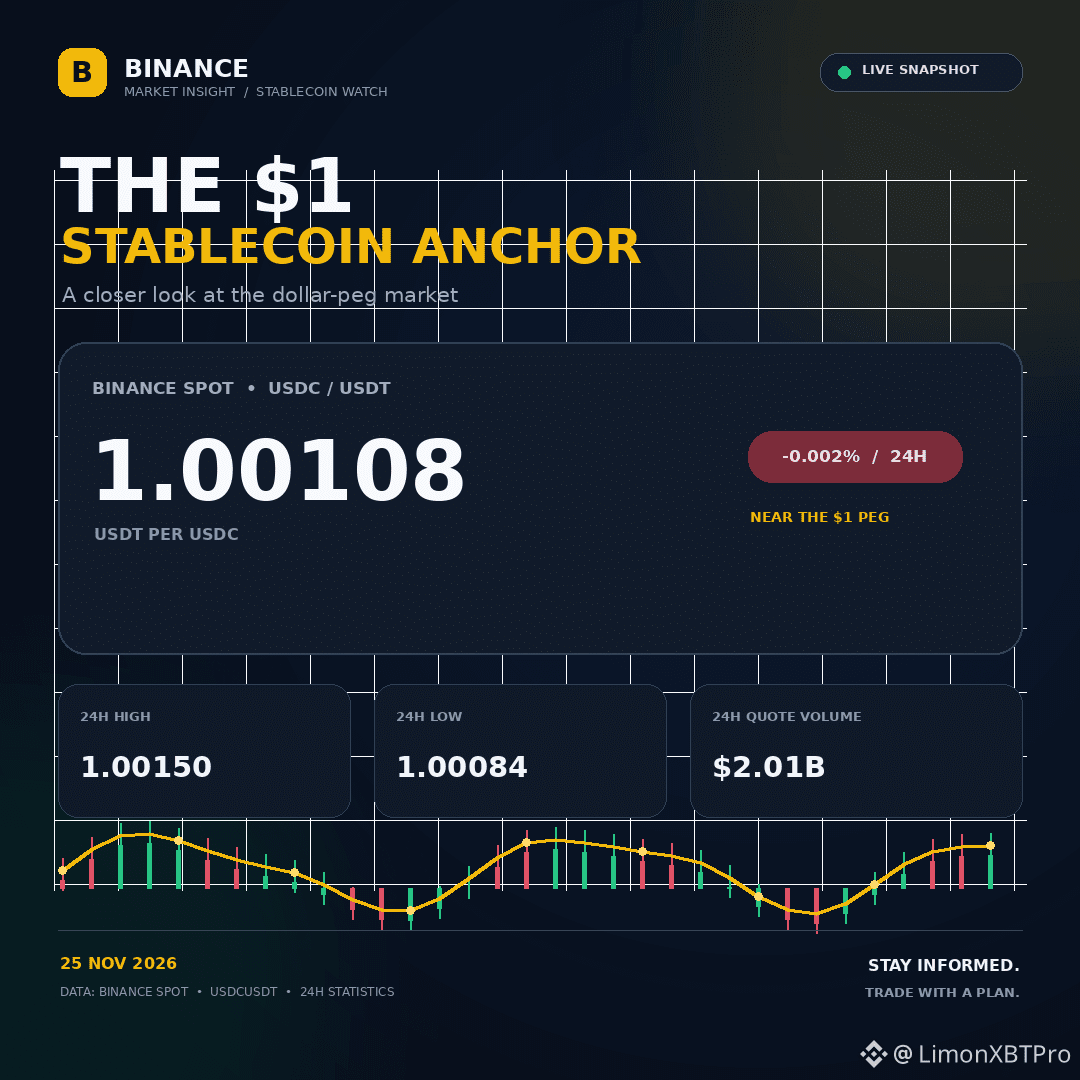
🚀 The $1 Stablecoin Anchor: Market Watch | November 25, 2026 Stablecoins remain an essential part of the crypto ecosystem. 💵 Today's Binance Spot snapshot shows $USDC /$USDT trading at 1.00108, with a 24-hour range of 1.00084–1.00150. 📊 24H Market Highlights: • Price: 1.00108 USDT • 24H Change: -0.002% • 24H High: 1.00150 • 24H Low: 1.00084 • Quote Volume: $2.01B The key takeaway? Even small price movements matter when monitoring stablecoin markets. What do you think about stablecoin market stability? Share your thoughts below! 👇 #Binance #USDC #USDT #CryptoMarket #Stablecoins {spot}(USDCUSDT)
🚀 The $1 Stablecoin Anchor: Market Watch | November 25, 2026

Stablecoins remain an essential part of the crypto ecosystem. 💵

Today's Binance Spot snapshot shows $USDC /$USDT
trading at 1.00108, with a 24-hour range of 1.00084–1.00150.

📊 24H Market Highlights:
• Price: 1.00108 USDT
• 24H Change: -0.002%
• 24H High: 1.00150
• 24H Low: 1.00084
• Quote Volume: $2.01B

The key takeaway? Even small price movements matter when monitoring stablecoin markets.

What do you think about stablecoin market stability? Share your thoughts below! 👇

#Binance #USDC #USDT #CryptoMarket #Stablecoins
Bitcoin Up or Down on November 25?

Bitcoin Up or Down on November 25?

1%Up99%Down
Volume $152,527.63
Log in to explore more content
Join global crypto users on Binance Square
⚡️ Get latest and useful information about crypto.
💬 Trusted by the world’s largest crypto exchange.
👍 Discover real insights from verified creators.
Email / Phone number