

#proofofstake
proofofstake
51,684 views
246 Discussing
Hot
Latest

·
--
Proof-of-Stake networks have a security budget problem - and most people are ignoring it.
In PoW, miners sell coins to cover energy costs, creating sell pressure but also a clear security floor: attack cost = energy cost. In PoS, validators earn staking rewards (new issuance) plus transaction fees. The long-term question is: what happens when issuance drops and fees must carry the load?
$ETH is already stress-testing this. Post-merge issuance is low, but blob fee revenue from L2s has become a meaningful component of validator income. The ETH security model is quietly shifting from inflation-funded to fee-funded - a healthier but riskier transition.
$SOL takes a different approach: fixed 1.5% annual inflation declining over time, offset by growing validator fee revenue as network activity rises. It is betting on usage compounding faster than issuance compression.
$ADA faces a version of this with its Voltaire era. Cardano treasury and staking rewards are still heavily issuance-driven. The long-term sustainability thesis requires fee volume to scale before the reserve depletes - a multi-decade timeline with real execution risk.
The question every investor should ask: does this chain have a credible path to fee-funded security before its inflation runway ends?
Security budgets are the sleeper issue of the next cycle. The chains that solve this quietly will be the ones still standing at the end of it.
#ProofOfStake #CryptoSecurity #StakingEconomics #BlockchainInfrastructure #CryptoInvesting
Proof-of-Stake networks have a security budget problem - and most people are ignoring it.
In PoW, miners sell coins to cover energy costs, creating sell pressure but also a clear security floor: attack cost = energy cost. In PoS, validators earn staking rewards (new issuance) plus transaction fees. The long-term question is: what happens when issuance drops and fees must carry the load?
$ETH is already stress-testing this. Post-merge issuance is low, but blob fee revenue from L2s has become a meaningful component of validator income. The ETH security model is quietly shifting from inflation-funded to fee-funded - a healthier but riskier transition.
$SOL takes a different approach: fixed 1.5% annual inflation declining over time, offset by growing validator fee revenue as network activity rises. It is betting on usage compounding faster than issuance compression.
$ADA faces a version of this with its Voltaire era. Cardano treasury and staking rewards are still heavily issuance-driven. The long-term sustainability thesis requires fee volume to scale before the reserve depletes - a multi-decade timeline with real execution risk.
The question every investor should ask: does this chain have a credible path to fee-funded security before its inflation runway ends?
Security budgets are the sleeper issue of the next cycle. The chains that solve this quietly will be the ones still standing at the end of it.
#ProofOfStake #CryptoSecurity #StakingEconomics #BlockchainInfrastructure #CryptoInvesting
In PoW, miners sell coins to cover energy costs, creating sell pressure but also a clear security floor: attack cost = energy cost. In PoS, validators earn staking rewards (new issuance) plus transaction fees. The long-term question is: what happens when issuance drops and fees must carry the load?
$ETH is already stress-testing this. Post-merge issuance is low, but blob fee revenue from L2s has become a meaningful component of validator income. The ETH security model is quietly shifting from inflation-funded to fee-funded - a healthier but riskier transition.
$SOL takes a different approach: fixed 1.5% annual inflation declining over time, offset by growing validator fee revenue as network activity rises. It is betting on usage compounding faster than issuance compression.
$ADA faces a version of this with its Voltaire era. Cardano treasury and staking rewards are still heavily issuance-driven. The long-term sustainability thesis requires fee volume to scale before the reserve depletes - a multi-decade timeline with real execution risk.
The question every investor should ask: does this chain have a credible path to fee-funded security before its inflation runway ends?
Security budgets are the sleeper issue of the next cycle. The chains that solve this quietly will be the ones still standing at the end of it.
#ProofOfStake #CryptoSecurity #StakingEconomics #BlockchainInfrastructure #CryptoInvesting
79
·
--
Proof-of-stake networks sell themselves on decentralization and security. But validator economics tell a more nuanced story.
Validators earn block rewards and transaction fees for processing and attesting blocks. In theory, this aligns their interests with the network. In practice, three subtle misalignments emerge.
First, concentration drift. As validator yield compounds over time, early large validators grow disproportionately. On most PoS chains, the richest validators earn the most, allowing them to stake more and earn more still. Over several cycles, validator sets quietly centralize without any malicious intent — just math.
Second, MEV capture asymmetry. Large professional validators extract significantly more MEV than smaller ones through sophisticated ordering strategies. This creates a two-tier system: validators competing on infrastructure sophistication, not just stake weight. Smaller validators subsidize sophisticated ones by ceding ordering revenue they cannot capture.
Third, restaking risk stacking. Validators increasingly layer their stake across multiple protocols simultaneously, chasing yield. Each additional slash condition silently raises network-wide correlated failure risk. The incentive to add yield is rational per validator but dangerous in aggregate.
None of this makes PoS broken — it makes validator economics a living governance question, not a solved problem.
The healthiest chains treat validator concentration ratios, MEV distribution transparency, and slash history as first-class metrics — not afterthoughts.
$ETH $SOL $BNB
#Crypto #ProofOfStake #ValidatorEconomics #DeFi #BlockchainSecurity
Proof-of-stake networks sell themselves on decentralization and security. But validator economics tell a more nuanced story.
Validators earn block rewards and transaction fees for processing and attesting blocks. In theory, this aligns their interests with the network. In practice, three subtle misalignments emerge.
First, concentration drift. As validator yield compounds over time, early large validators grow disproportionately. On most PoS chains, the richest validators earn the most, allowing them to stake more and earn more still. Over several cycles, validator sets quietly centralize without any malicious intent — just math.
Second, MEV capture asymmetry. Large professional validators extract significantly more MEV than smaller ones through sophisticated ordering strategies. This creates a two-tier system: validators competing on infrastructure sophistication, not just stake weight. Smaller validators subsidize sophisticated ones by ceding ordering revenue they cannot capture.
Third, restaking risk stacking. Validators increasingly layer their stake across multiple protocols simultaneously, chasing yield. Each additional slash condition silently raises network-wide correlated failure risk. The incentive to add yield is rational per validator but dangerous in aggregate.
None of this makes PoS broken — it makes validator economics a living governance question, not a solved problem.
The healthiest chains treat validator concentration ratios, MEV distribution transparency, and slash history as first-class metrics — not afterthoughts.
$ETH $SOL $BNB
#Crypto #ProofOfStake #ValidatorEconomics #DeFi #BlockchainSecurity
Validators earn block rewards and transaction fees for processing and attesting blocks. In theory, this aligns their interests with the network. In practice, three subtle misalignments emerge.
First, concentration drift. As validator yield compounds over time, early large validators grow disproportionately. On most PoS chains, the richest validators earn the most, allowing them to stake more and earn more still. Over several cycles, validator sets quietly centralize without any malicious intent — just math.
Second, MEV capture asymmetry. Large professional validators extract significantly more MEV than smaller ones through sophisticated ordering strategies. This creates a two-tier system: validators competing on infrastructure sophistication, not just stake weight. Smaller validators subsidize sophisticated ones by ceding ordering revenue they cannot capture.
Third, restaking risk stacking. Validators increasingly layer their stake across multiple protocols simultaneously, chasing yield. Each additional slash condition silently raises network-wide correlated failure risk. The incentive to add yield is rational per validator but dangerous in aggregate.
None of this makes PoS broken — it makes validator economics a living governance question, not a solved problem.
The healthiest chains treat validator concentration ratios, MEV distribution transparency, and slash history as first-class metrics — not afterthoughts.
$ETH $SOL $BNB
#Crypto #ProofOfStake #ValidatorEconomics #DeFi #BlockchainSecurity
131
·
--
The ESG Narrative and Crypto: Why Proof-of-Stake Changes Everything
For years, institutional ESG mandates kept a wall between traditional capital allocators and crypto. Bitcoin's energy footprint was an easy veto — regardless of the network's value proposition.
That wall is quietly crumbling.
Proof-of-Stake networks have fundamentally rewritten the energy equation. $ETH's transition to PoS reduced its energy consumption by over 99%. Networks built PoS-native from day one process thousands of transactions with a fraction of the compute overhead of legacy PoW systems.
This matters beyond marketing. ESG-screened funds — managing trillions in AUM — now have a credible on-ramp. When a protocol's energy use is comparable to running a data center rather than a country, the conversation changes at the compliance desk.
The thesis: as ESG integration deepens in institutional allocation frameworks, PoS-native chains gain structural inflows that PoW-only networks cannot access. $BNB, powering one of the highest-throughput PoS chains in DeFi, sits squarely in this lane.
This is not about ideology — it's about capital routing. Institutional mandates create predictable demand flows, and PoS chains are increasingly on the right side of that filter.
The energy narrative in crypto is not resolved, but for PoS ecosystems it is increasingly a tailwind rather than a headwind.
#Crypto #ProofOfStake #ESGInvesting #DeFi #CryptoInvesting
The ESG Narrative and Crypto: Why Proof-of-Stake Changes Everything
For years, institutional ESG mandates kept a wall between traditional capital allocators and crypto. Bitcoin's energy footprint was an easy veto — regardless of the network's value proposition.
That wall is quietly crumbling.
Proof-of-Stake networks have fundamentally rewritten the energy equation. $ETH 's transition to PoS reduced its energy consumption by over 99%. Networks built PoS-native from day one process thousands of transactions with a fraction of the compute overhead of legacy PoW systems.
This matters beyond marketing. ESG-screened funds — managing trillions in AUM — now have a credible on-ramp. When a protocol's energy use is comparable to running a data center rather than a country, the conversation changes at the compliance desk.
The thesis: as ESG integration deepens in institutional allocation frameworks, PoS-native chains gain structural inflows that PoW-only networks cannot access. $BNB , powering one of the highest-throughput PoS chains in DeFi, sits squarely in this lane.
This is not about ideology — it's about capital routing. Institutional mandates create predictable demand flows, and PoS chains are increasingly on the right side of that filter.
The energy narrative in crypto is not resolved, but for PoS ecosystems it is increasingly a tailwind rather than a headwind.
#Crypto #ProofOfStake #ESGInvesting #DeFi #CryptoInvesting
For years, institutional ESG mandates kept a wall between traditional capital allocators and crypto. Bitcoin's energy footprint was an easy veto — regardless of the network's value proposition.
That wall is quietly crumbling.
Proof-of-Stake networks have fundamentally rewritten the energy equation. $ETH 's transition to PoS reduced its energy consumption by over 99%. Networks built PoS-native from day one process thousands of transactions with a fraction of the compute overhead of legacy PoW systems.
This matters beyond marketing. ESG-screened funds — managing trillions in AUM — now have a credible on-ramp. When a protocol's energy use is comparable to running a data center rather than a country, the conversation changes at the compliance desk.
The thesis: as ESG integration deepens in institutional allocation frameworks, PoS-native chains gain structural inflows that PoW-only networks cannot access. $BNB , powering one of the highest-throughput PoS chains in DeFi, sits squarely in this lane.
This is not about ideology — it's about capital routing. Institutional mandates create predictable demand flows, and PoS chains are increasingly on the right side of that filter.
The energy narrative in crypto is not resolved, but for PoS ecosystems it is increasingly a tailwind rather than a headwind.
#Crypto #ProofOfStake #ESGInvesting #DeFi #CryptoInvesting
26

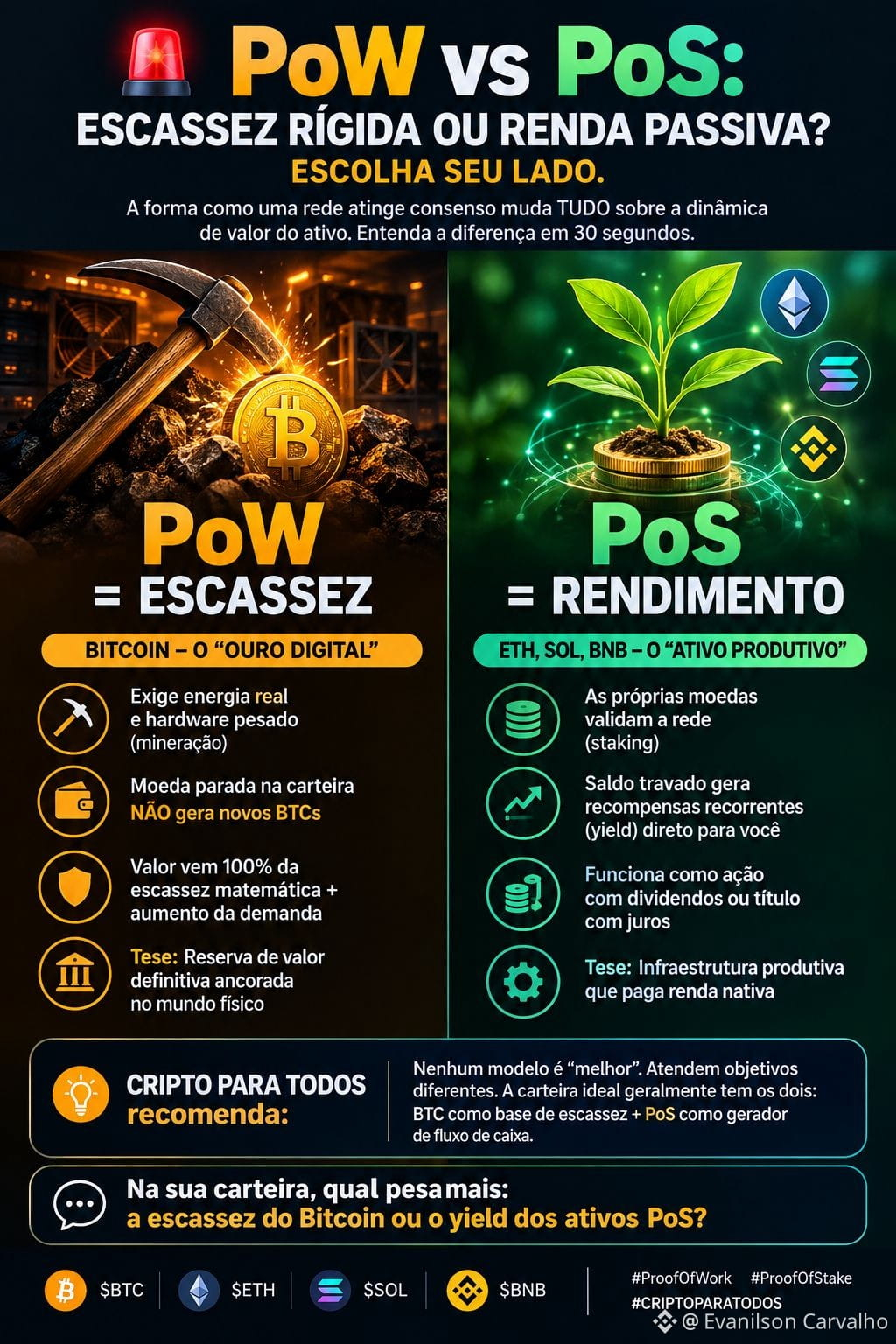
🚨 PoW vs PoS: ESCASSEZ RÍGIDA OU RENDA PASSIVA? ESCOLHA SEU LADO.
A forma como uma rede atinge consenso muda TUDO sobre a dinâmica de valor do ativo. Entenda a diferença em 30 segundos.
⛏️ Proof of Work (BTC) - O "Ouro Digital":
• Exige energia real e hardware pesado (mineração)
• Moeda parada na carteira NÃO gera novos BTCs
• Valor vem 100% da escassez matemática + aumento da demanda
• Tese: Reserva de valor definitiva ancorada no mundo físico
🌱 Proof of Stake (ETH, SOL, BNB) - O "Ativo Produtivo":
• As próprias moedas validam a rede (staking)
• Saldo travado gera recompensas recorrentes (yield) direto para você
• Funciona como ação com dividendos ou título com juros
• Tese: Infraestrutura produtiva que paga renda nativa
CRIPTO PARA TODOS recomenda:
Nenhum modelo é "melhor". Atendem objetivos diferentes. A carteira ideal geralmente tem os dois: BTC como base de escassez + PoS como gerador de fluxo de caixa.
Na sua carteira, qual pesa mais: a escassez do Bitcoin ou o yield dos ativos PoS?
$BTC $ETH $SOL $BNB #proofofwork #ProofOfStake #CRIPTOPARATODOS
🚨 PoW vs PoS: ESCASSEZ RÍGIDA OU RENDA PASSIVA? ESCOLHA SEU LADO.
A forma como uma rede atinge consenso muda TUDO sobre a dinâmica de valor do ativo. Entenda a diferença em 30 segundos.
⛏️ Proof of Work (BTC) - O "Ouro Digital":
• Exige energia real e hardware pesado (mineração)
• Moeda parada na carteira NÃO gera novos BTCs
• Valor vem 100% da escassez matemática + aumento da demanda
• Tese: Reserva de valor definitiva ancorada no mundo físico
🌱 Proof of Stake (ETH, SOL, BNB) - O "Ativo Produtivo":
• As próprias moedas validam a rede (staking)
• Saldo travado gera recompensas recorrentes (yield) direto para você
• Funciona como ação com dividendos ou título com juros
• Tese: Infraestrutura produtiva que paga renda nativa
CRIPTO PARA TODOS recomenda:
Nenhum modelo é "melhor". Atendem objetivos diferentes. A carteira ideal geralmente tem os dois: BTC como base de escassez + PoS como gerador de fluxo de caixa.
Na sua carteira, qual pesa mais: a escassez do Bitcoin ou o yield dos ativos PoS?
$BTC $ETH $SOL $BNB #proofofwork #ProofOfStake #CRIPTOPARATODOS
A forma como uma rede atinge consenso muda TUDO sobre a dinâmica de valor do ativo. Entenda a diferença em 30 segundos.
⛏️ Proof of Work (BTC) - O "Ouro Digital":
• Exige energia real e hardware pesado (mineração)
• Moeda parada na carteira NÃO gera novos BTCs
• Valor vem 100% da escassez matemática + aumento da demanda
• Tese: Reserva de valor definitiva ancorada no mundo físico
🌱 Proof of Stake (ETH, SOL, BNB) - O "Ativo Produtivo":
• As próprias moedas validam a rede (staking)
• Saldo travado gera recompensas recorrentes (yield) direto para você
• Funciona como ação com dividendos ou título com juros
• Tese: Infraestrutura produtiva que paga renda nativa
CRIPTO PARA TODOS recomenda:
Nenhum modelo é "melhor". Atendem objetivos diferentes. A carteira ideal geralmente tem os dois: BTC como base de escassez + PoS como gerador de fluxo de caixa.
Na sua carteira, qual pesa mais: a escassez do Bitcoin ou o yield dos ativos PoS?
$BTC $ETH $SOL $BNB #proofofwork #ProofOfStake #CRIPTOPARATODOS
1
120

📚 Staking Explained: Earning Passive Income on Blockchain Networks
On July 11, 2026, staking has become a popular way to earn passive income in crypto. Locking up tokens helps secure proof-of-stake blockchains in exchange for network rewards distributed to participants.
Multiple major networks now use proof-of-stake consensus. Ethereum transitioned in 2022, allowing holders to earn yields by participating in network security. Solana and TRON also rely on staked validators.
Rewards vary by network but typically range from 3-15% annually. Staking puts crypto holdings to work rather than letting them sit idle in a wallet.
📌 Key Takeaway:
Staking turns crypto holdings into income-generating assets across ETH, SOL, and TRX networks.
#Staking #PassiveIncome #ProofOfStake
#BinanceAlphaAlert
📚 Staking Explained: Earning Passive Income on Blockchain Networks
On July 11, 2026, staking has become a popular way to earn passive income in crypto. Locking up tokens helps secure proof-of-stake blockchains in exchange for network rewards distributed to participants.
Multiple major networks now use proof-of-stake consensus. Ethereum transitioned in 2022, allowing holders to earn yields by participating in network security. Solana and TRON also rely on staked validators.
Rewards vary by network but typically range from 3-15% annually. Staking puts crypto holdings to work rather than letting them sit idle in a wallet.
📌 Key Takeaway:
Staking turns crypto holdings into income-generating assets across ETH, SOL, and TRX networks.
#Staking #PassiveIncome #ProofOfStake
#BinanceAlphaAlert
On July 11, 2026, staking has become a popular way to earn passive income in crypto. Locking up tokens helps secure proof-of-stake blockchains in exchange for network rewards distributed to participants.
Multiple major networks now use proof-of-stake consensus. Ethereum transitioned in 2022, allowing holders to earn yields by participating in network security. Solana and TRON also rely on staked validators.
Rewards vary by network but typically range from 3-15% annually. Staking puts crypto holdings to work rather than letting them sit idle in a wallet.
📌 Key Takeaway:
Staking turns crypto holdings into income-generating assets across ETH, SOL, and TRX networks.
#Staking #PassiveIncome #ProofOfStake
#BinanceAlphaAlert
1
62
📚 What Is Staking?: Earning passive income by participating in network security
On July 19, 2026, Staking involves locking up your cryptocurrency to help secure a Proof of Stake blockchain. In return, you earn rewards — typically paid in the same token you staked. Ethereum $ETH, Solana $SOL, and TRON $TRX all use Proof of Stake.
Current annual staking yields vary: $ETH typically offers 3-5%, while higher-risk networks can offer 7-12%. Staking contributes to network security and decentralization while generating passive income for token holders.
📌 Key Takeaway:
Staking transforms crypto from a purely speculative asset into a productive one. By participating in network security, you earn yields while supporting the blockchain's long-term health — a win-win for active holders.
#Staking #PassiveIncome #ProofOfStake
#BinanceAlphaAlert
📚 What Is Staking?: Earning passive income by participating in network security
On July 19, 2026, Staking involves locking up your cryptocurrency to help secure a Proof of Stake blockchain. In return, you earn rewards — typically paid in the same token you staked. Ethereum $ETH , Solana $SOL , and TRON $TRX all use Proof of Stake.
Current annual staking yields vary: $ETH typically offers 3-5%, while higher-risk networks can offer 7-12%. Staking contributes to network security and decentralization while generating passive income for token holders.
📌 Key Takeaway:
Staking transforms crypto from a purely speculative asset into a productive one. By participating in network security, you earn yields while supporting the blockchain's long-term health — a win-win for active holders.
#Staking #PassiveIncome #ProofOfStake
#BinanceAlphaAlert
On July 19, 2026, Staking involves locking up your cryptocurrency to help secure a Proof of Stake blockchain. In return, you earn rewards — typically paid in the same token you staked. Ethereum $ETH , Solana $SOL , and TRON $TRX all use Proof of Stake.
Current annual staking yields vary: $ETH typically offers 3-5%, while higher-risk networks can offer 7-12%. Staking contributes to network security and decentralization while generating passive income for token holders.
📌 Key Takeaway:
Staking transforms crypto from a purely speculative asset into a productive one. By participating in network security, you earn yields while supporting the blockchain's long-term health — a win-win for active holders.
#Staking #PassiveIncome #ProofOfStake
#BinanceAlphaAlert
61

·
--
Cardano ($ADA) operates on a fixed maximum supply of 45 billion tokens, ensuring scarcity. Its Ouroboros Proof-of-Stake protocol allows ADA holders to stake their tokens, securing the network and earning rewards without locking up assets. This design promotes decentralization and efficient transaction validation. #Cardano #ADA #ProofOfStake Follow for more on-chain breakdowns.
Cardano ($ADA ) operates on a fixed maximum supply of 45 billion tokens, ensuring scarcity. Its Ouroboros Proof-of-Stake protocol allows ADA holders to stake their tokens, securing the network and earning rewards without locking up assets. This design promotes decentralization and efficient transaction validation. #Cardano #ADA #ProofOfStake Follow for more on-chain breakdowns.
183

·
--
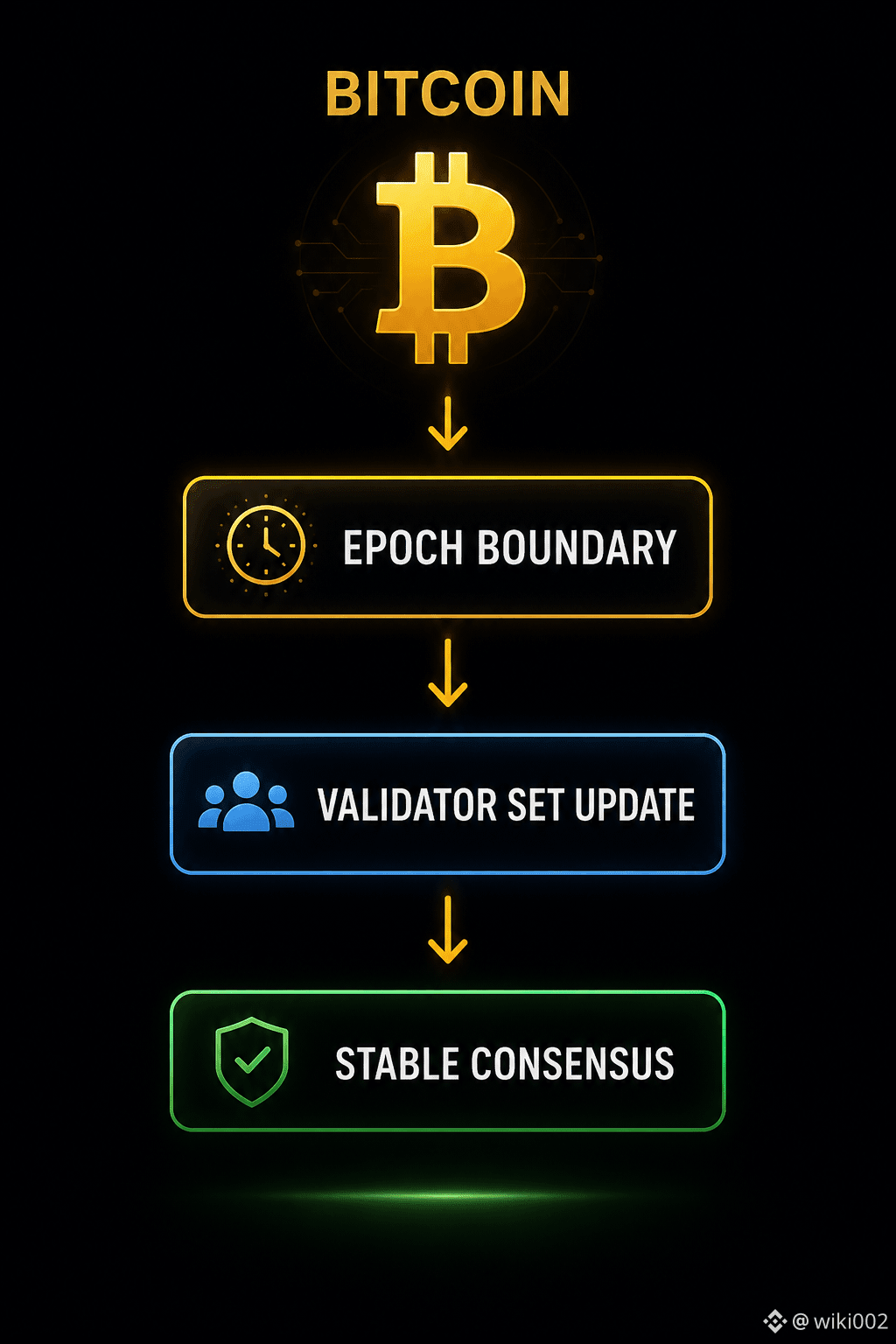
During a discussion with a protocol engineer, one idea stayed with me if consensus changes too quickly, security becomes harder to reason about. I wasn't convinced until I followed Babylon's staking flow myself. Then I realised the protocol is intentionally slowing state transitions instead of trying to maximise capital velocity.
What stands out is not faster unbonding or shorter waiting periods, but the decision to process staking operations at epoch boundaries and finalise unbonding through Bitcoin checkpoint confirmation. From a user's perspective, that delays capital availability. From a protocol designer's perspective, it creates deterministic validator-set updates, reduces abrupt voting power shifts, and makes consensus behaviour more predictable under changing network conditions.
The Trade-off is easy to underestimate. Capital efficiency is reduced because assets cannot react instantly, yet predictable consensus is itself an economic advantage. Applications can build around deterministic state transitions far more easily than around continuously changing validator dynamics.
Perhaps protocol design should stop treating liquidity as the default optimisation target. When security and capital efficiency inevitably compete, which one should infrastructure sacrifice first, and why?🤔
#baby #Bitcoin #ProofOfStake $BABY $RIF
@babylonlabs_io @Binance_Square_Official
{future}(BABYUSDT)
During a discussion with a protocol engineer, one idea stayed with me if consensus changes too quickly, security becomes harder to reason about. I wasn't convinced until I followed Babylon's staking flow myself. Then I realised the protocol is intentionally slowing state transitions instead of trying to maximise capital velocity.
What stands out is not faster unbonding or shorter waiting periods, but the decision to process staking operations at epoch boundaries and finalise unbonding through Bitcoin checkpoint confirmation. From a user's perspective, that delays capital availability. From a protocol designer's perspective, it creates deterministic validator-set updates, reduces abrupt voting power shifts, and makes consensus behaviour more predictable under changing network conditions.
The Trade-off is easy to underestimate. Capital efficiency is reduced because assets cannot react instantly, yet predictable consensus is itself an economic advantage. Applications can build around deterministic state transitions far more easily than around continuously changing validator dynamics.
Perhaps protocol design should stop treating liquidity as the default optimisation target. When security and capital efficiency inevitably compete, which one should infrastructure sacrifice first, and why?🤔
#baby #Bitcoin #ProofOfStake $BABY $RIF
@BabylonLabs_io @Binance Square Official
What stands out is not faster unbonding or shorter waiting periods, but the decision to process staking operations at epoch boundaries and finalise unbonding through Bitcoin checkpoint confirmation. From a user's perspective, that delays capital availability. From a protocol designer's perspective, it creates deterministic validator-set updates, reduces abrupt voting power shifts, and makes consensus behaviour more predictable under changing network conditions.
The Trade-off is easy to underestimate. Capital efficiency is reduced because assets cannot react instantly, yet predictable consensus is itself an economic advantage. Applications can build around deterministic state transitions far more easily than around continuously changing validator dynamics.
Perhaps protocol design should stop treating liquidity as the default optimisation target. When security and capital efficiency inevitably compete, which one should infrastructure sacrifice first, and why?🤔
#baby #Bitcoin #ProofOfStake $BABY $RIF
@BabylonLabs_io @Binance Square Official
43
15
243
📚 Staking: Earn While You Hold: Passive income through network validation
On July 22, 2026, Staking involves locking up tokens like $ADA, Solana $SOL, or $ETH to help secure the network in exchange for rewards.
Annual yields vary by network — typically 3-12% — and provide a way to generate passive income without selling positions.
Staking aligns holder incentives with network security, creating a virtuous cycle for blockchain ecosystems.
📌 Key Takeaway:
Staking turns held crypto into an income stream — earning 3-12% annually while supporting network security.
#Staking #ProofOfStake #CryptoIncome
#BinanceAlphaAlert
📚 Staking: Earn While You Hold: Passive income through network validation
On July 22, 2026, Staking involves locking up tokens like $ADA , Solana $SOL , or $ETH to help secure the network in exchange for rewards.
Annual yields vary by network — typically 3-12% — and provide a way to generate passive income without selling positions.
Staking aligns holder incentives with network security, creating a virtuous cycle for blockchain ecosystems.
📌 Key Takeaway:
Staking turns held crypto into an income stream — earning 3-12% annually while supporting network security.
#Staking #ProofOfStake #CryptoIncome
#BinanceAlphaAlert
On July 22, 2026, Staking involves locking up tokens like $ADA , Solana $SOL , or $ETH to help secure the network in exchange for rewards.
Annual yields vary by network — typically 3-12% — and provide a way to generate passive income without selling positions.
Staking aligns holder incentives with network security, creating a virtuous cycle for blockchain ecosystems.
📌 Key Takeaway:
Staking turns held crypto into an income stream — earning 3-12% annually while supporting network security.
#Staking #ProofOfStake #CryptoIncome
#BinanceAlphaAlert
68

·
--
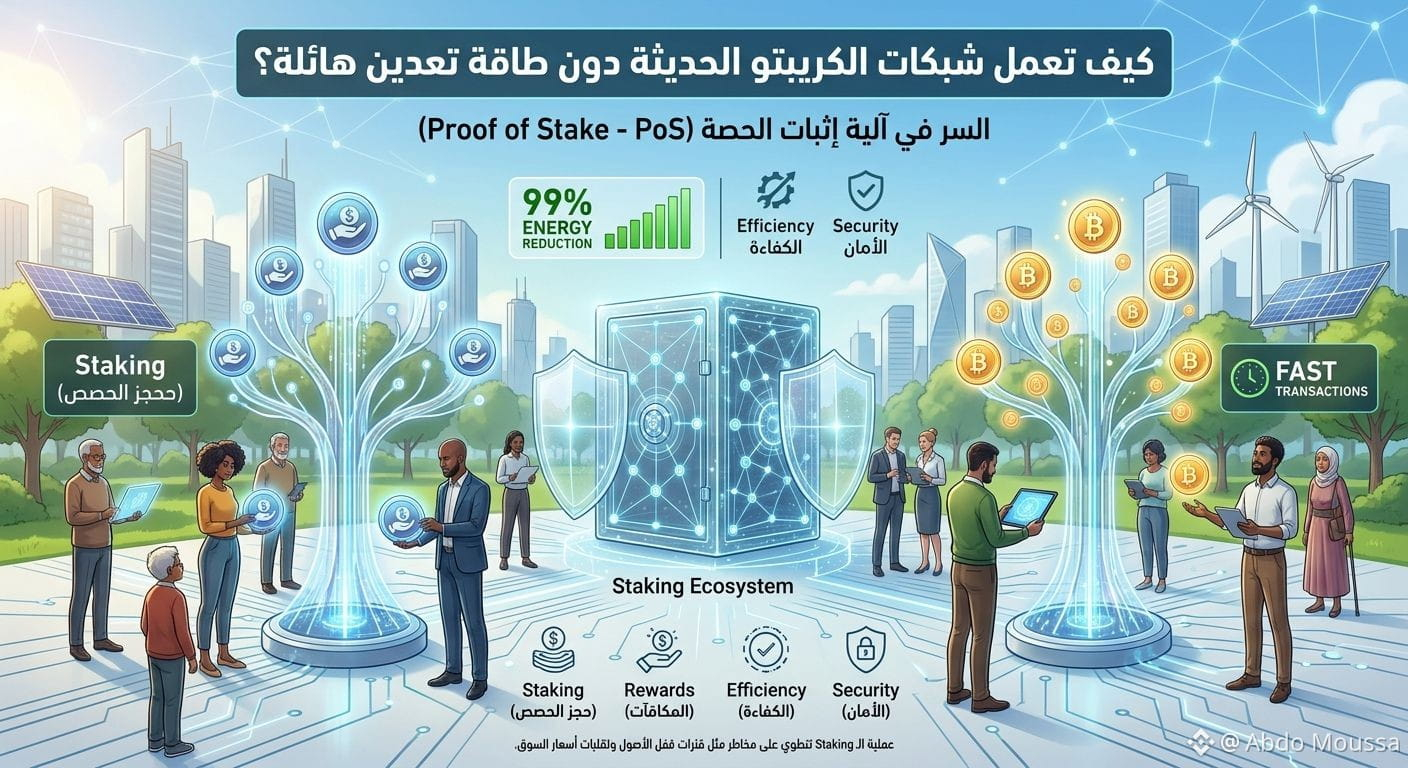
كيف تعمل شبكات الكريبتو الحديثة دون الحاجة لطاقة تعدين هائلة؟ 🤔⚡
السر يكمن في آلية إجماع تُسمى "إثبات الحصة" (Proof of Stake - PoS)، والتي تُعد من أهم المفاهيم في عالم البلوكتشين.
💡 ما هي آلية إثبات الحصة (PoS)؟
بدلاً من إستخدام أجهزة حاسوبية قوية لحل معادلات معقدة (كما في إثبات العمل PoW)، تعتمد شبكات PoS على "المشاركين" الذين يقفلون حِصصاً من أصولهم الرقمية لتعزيز أمان الشبكة والتحقق من المعاملات.
🔍 ما هو الـ Staking؟
• هو عملية حجز أو قفل أصولك الرقمية لخدمة شبكة البلوكتشين ودعم أمانها.
• في مقابل دعم الشبكة، يتم توزيع مكافآت للمشاركين بحسب قواعد البروتوكول.
✨ الفوائد الجوهرية لشبكات PoS:
1️⃣ كفاءة إستهلاك الطاقة: إستهلاك طاقة أقل بنسبة تصل إلى 99% مقارنة بآليات التعدين التقليدية.
2️⃣ القابلية للتوسع (Scalability): معالجة أسرع للمعاملات ورسوم شبكة أقل عادةً.
⚠️ تنبيه هام:
عملية الـ Staking تنطوي على مخاطر مثل فترات قفل الأصول وتقلبات أسعار السوق أثناء فترة القفل، هذا المحتوى لأغراض تعليمية فقط وليس نصيحة إستثمارية أو وعداً بأرباح.
للمزيد من الشروحات الأكاديمية حول آليات الإجماع وتقنيات البلوكشين، تفضل بزيارة #BinanceAcademy .
تعلّم بوعي، ودائماً قُم ببحثك الشخصي #dyor 💡
#Binance #learnwithbinance #ProofOfStake
كيف تعمل شبكات الكريبتو الحديثة دون الحاجة لطاقة تعدين هائلة؟ 🤔⚡
السر يكمن في آلية إجماع تُسمى "إثبات الحصة" (Proof of Stake - PoS)، والتي تُعد من أهم المفاهيم في عالم البلوكتشين.
💡 ما هي آلية إثبات الحصة (PoS)؟
بدلاً من إستخدام أجهزة حاسوبية قوية لحل معادلات معقدة (كما في إثبات العمل PoW)، تعتمد شبكات PoS على "المشاركين" الذين يقفلون حِصصاً من أصولهم الرقمية لتعزيز أمان الشبكة والتحقق من المعاملات.
🔍 ما هو الـ Staking؟
• هو عملية حجز أو قفل أصولك الرقمية لخدمة شبكة البلوكتشين ودعم أمانها.
• في مقابل دعم الشبكة، يتم توزيع مكافآت للمشاركين بحسب قواعد البروتوكول.
✨ الفوائد الجوهرية لشبكات PoS:
1️⃣ كفاءة إستهلاك الطاقة: إستهلاك طاقة أقل بنسبة تصل إلى 99% مقارنة بآليات التعدين التقليدية.
2️⃣ القابلية للتوسع (Scalability): معالجة أسرع للمعاملات ورسوم شبكة أقل عادةً.
⚠️ تنبيه هام:
عملية الـ Staking تنطوي على مخاطر مثل فترات قفل الأصول وتقلبات أسعار السوق أثناء فترة القفل، هذا المحتوى لأغراض تعليمية فقط وليس نصيحة إستثمارية أو وعداً بأرباح.
للمزيد من الشروحات الأكاديمية حول آليات الإجماع وتقنيات البلوكشين، تفضل بزيارة #BinanceAcademy .
تعلّم بوعي، ودائماً قُم ببحثك الشخصي #dyor 💡
#Binance #learnwithbinance #ProofOfStake
السر يكمن في آلية إجماع تُسمى "إثبات الحصة" (Proof of Stake - PoS)، والتي تُعد من أهم المفاهيم في عالم البلوكتشين.
💡 ما هي آلية إثبات الحصة (PoS)؟
بدلاً من إستخدام أجهزة حاسوبية قوية لحل معادلات معقدة (كما في إثبات العمل PoW)، تعتمد شبكات PoS على "المشاركين" الذين يقفلون حِصصاً من أصولهم الرقمية لتعزيز أمان الشبكة والتحقق من المعاملات.
🔍 ما هو الـ Staking؟
• هو عملية حجز أو قفل أصولك الرقمية لخدمة شبكة البلوكتشين ودعم أمانها.
• في مقابل دعم الشبكة، يتم توزيع مكافآت للمشاركين بحسب قواعد البروتوكول.
✨ الفوائد الجوهرية لشبكات PoS:
1️⃣ كفاءة إستهلاك الطاقة: إستهلاك طاقة أقل بنسبة تصل إلى 99% مقارنة بآليات التعدين التقليدية.
2️⃣ القابلية للتوسع (Scalability): معالجة أسرع للمعاملات ورسوم شبكة أقل عادةً.
⚠️ تنبيه هام:
عملية الـ Staking تنطوي على مخاطر مثل فترات قفل الأصول وتقلبات أسعار السوق أثناء فترة القفل، هذا المحتوى لأغراض تعليمية فقط وليس نصيحة إستثمارية أو وعداً بأرباح.
للمزيد من الشروحات الأكاديمية حول آليات الإجماع وتقنيات البلوكشين، تفضل بزيارة #BinanceAcademy .
تعلّم بوعي، ودائماً قُم ببحثك الشخصي #dyor 💡
#Binance #learnwithbinance #ProofOfStake
5
104
📚 Proof of Stake Explained: Why staking secures modern blockchains
On August 1, 2026, Proof of Stake (PoS) is a consensus mechanism where validators lock up tokens as collateral to secure a network. Ethereum, the second-largest asset at $225.43B market cap, has run on PoS since 2022.
Validators are rewarded for honest behavior and penalized for faults — a design that aligns incentives without the massive energy use of mining. It is the standard for most new networks.
📌 Key Takeaway:
PoS replaced energy competition with economic alignment. Understanding staking means understanding the modern backbone of most major blockchains.
#ProofOfStake #CryptoEducation
#BinanceAlphaAlert
📚 Proof of Stake Explained: Why staking secures modern blockchains
On August 1, 2026, Proof of Stake (PoS) is a consensus mechanism where validators lock up tokens as collateral to secure a network. Ethereum, the second-largest asset at $225.43B market cap, has run on PoS since 2022.
Validators are rewarded for honest behavior and penalized for faults — a design that aligns incentives without the massive energy use of mining. It is the standard for most new networks.
📌 Key Takeaway:
PoS replaced energy competition with economic alignment. Understanding staking means understanding the modern backbone of most major blockchains.
#ProofOfStake #CryptoEducation
#BinanceAlphaAlert
On August 1, 2026, Proof of Stake (PoS) is a consensus mechanism where validators lock up tokens as collateral to secure a network. Ethereum, the second-largest asset at $225.43B market cap, has run on PoS since 2022.
Validators are rewarded for honest behavior and penalized for faults — a design that aligns incentives without the massive energy use of mining. It is the standard for most new networks.
📌 Key Takeaway:
PoS replaced energy competition with economic alignment. Understanding staking means understanding the modern backbone of most major blockchains.
#ProofOfStake #CryptoEducation
#BinanceAlphaAlert
29
📚 Staking and Proof-of-Stake: Earning Through Participation: How validators secure networks and earn rewards
On July 29, 2026, staking continues to grow as a core mechanism in crypto. Proof-of-stake (PoS) networks allow token holders to lock their assets as collateral to validate transactions. In return, validators earn rewards proportional to their stake. This model powers Ethereum and Solana.
$ETH trades at $1,902, up +1.33% today, with its transition to PoS reducing energy consumption by over 99%. Similarly, $SOL at $73.29 operates on a hybrid PoS system that processes thousands of transactions per second. Staking aligns long-term participation with network security.
📌 Key Takeaway:
Proof-of-stake turns token holding into productive activity — securing the network while earning yields, with drastically lower energy use than proof-of-work.
#Staking #ProofOfStake #CryptoEarnings
#BinanceAlphaAlert
📚 Staking and Proof-of-Stake: Earning Through Participation: How validators secure networks and earn rewards
On July 29, 2026, staking continues to grow as a core mechanism in crypto. Proof-of-stake (PoS) networks allow token holders to lock their assets as collateral to validate transactions. In return, validators earn rewards proportional to their stake. This model powers Ethereum and Solana.
$ETH trades at $1,902, up +1.33% today, with its transition to PoS reducing energy consumption by over 99%. Similarly, $SOL at $73.29 operates on a hybrid PoS system that processes thousands of transactions per second. Staking aligns long-term participation with network security.
📌 Key Takeaway:
Proof-of-stake turns token holding into productive activity — securing the network while earning yields, with drastically lower energy use than proof-of-work.
#Staking #ProofOfStake #CryptoEarnings
#BinanceAlphaAlert
On July 29, 2026, staking continues to grow as a core mechanism in crypto. Proof-of-stake (PoS) networks allow token holders to lock their assets as collateral to validate transactions. In return, validators earn rewards proportional to their stake. This model powers Ethereum and Solana.
$ETH trades at $1,902, up +1.33% today, with its transition to PoS reducing energy consumption by over 99%. Similarly, $SOL at $73.29 operates on a hybrid PoS system that processes thousands of transactions per second. Staking aligns long-term participation with network security.
📌 Key Takeaway:
Proof-of-stake turns token holding into productive activity — securing the network while earning yields, with drastically lower energy use than proof-of-work.
#Staking #ProofOfStake #CryptoEarnings
#BinanceAlphaAlert
49
·
--
Proof-of-Stake Is the Most Underrated Long-Term Bet in Crypto
Everyone debates which Layer 1 wins the throughput race. Fewer ask a more important question: which networks are designed to still be running and thriving in 2035?
Proof-of-Stake is not just an energy-efficient upgrade. It is a governance and economic alignment mechanism. Validators who stake capital to secure the network have skin in the game. They benefit when the protocol thrives and suffer when it fails. That incentive loop is structurally superior to Proof-of-Work's miner-manufacturer arms race.
$ADA has spent years building Voltaire, a fully on-chain governance layer where holders vote on treasury spending and protocol upgrades. That is a network that governs itself without core team dependency. $DOT takes this further with OpenGov: any token holder can propose a referendum, and fast-track governance means upgrades ship without hard forks.
$ETH staking secures over 100 billion in value, with withdrawal queues and slashing conditions creating genuine validator accountability. The staking yield, governance rights, and protocol longevity compound together over time.
The long-term bet is not just price appreciation. Passive holders get diluted. Active participants get rewarded.
This is what long-term conviction actually means in PoS ecosystems: not just holding, but participating.
#ProofOfStake #CryptoGovernance #LongTermInvesting #CryptoInsights #BinanceSquare
Proof-of-Stake Is the Most Underrated Long-Term Bet in Crypto
Everyone debates which Layer 1 wins the throughput race. Fewer ask a more important question: which networks are designed to still be running and thriving in 2035?
Proof-of-Stake is not just an energy-efficient upgrade. It is a governance and economic alignment mechanism. Validators who stake capital to secure the network have skin in the game. They benefit when the protocol thrives and suffer when it fails. That incentive loop is structurally superior to Proof-of-Work's miner-manufacturer arms race.
$ADA has spent years building Voltaire, a fully on-chain governance layer where holders vote on treasury spending and protocol upgrades. That is a network that governs itself without core team dependency. $DOT takes this further with OpenGov: any token holder can propose a referendum, and fast-track governance means upgrades ship without hard forks.
$ETH staking secures over 100 billion in value, with withdrawal queues and slashing conditions creating genuine validator accountability. The staking yield, governance rights, and protocol longevity compound together over time.
The long-term bet is not just price appreciation. Passive holders get diluted. Active participants get rewarded.
This is what long-term conviction actually means in PoS ecosystems: not just holding, but participating.
#ProofOfStake #CryptoGovernance #LongTermInvesting #CryptoInsights #BinanceSquare
Everyone debates which Layer 1 wins the throughput race. Fewer ask a more important question: which networks are designed to still be running and thriving in 2035?
Proof-of-Stake is not just an energy-efficient upgrade. It is a governance and economic alignment mechanism. Validators who stake capital to secure the network have skin in the game. They benefit when the protocol thrives and suffer when it fails. That incentive loop is structurally superior to Proof-of-Work's miner-manufacturer arms race.
$ADA has spent years building Voltaire, a fully on-chain governance layer where holders vote on treasury spending and protocol upgrades. That is a network that governs itself without core team dependency. $DOT takes this further with OpenGov: any token holder can propose a referendum, and fast-track governance means upgrades ship without hard forks.
$ETH staking secures over 100 billion in value, with withdrawal queues and slashing conditions creating genuine validator accountability. The staking yield, governance rights, and protocol longevity compound together over time.
The long-term bet is not just price appreciation. Passive holders get diluted. Active participants get rewarded.
This is what long-term conviction actually means in PoS ecosystems: not just holding, but participating.
#ProofOfStake #CryptoGovernance #LongTermInvesting #CryptoInsights #BinanceSquare
107

·
--
Bullish
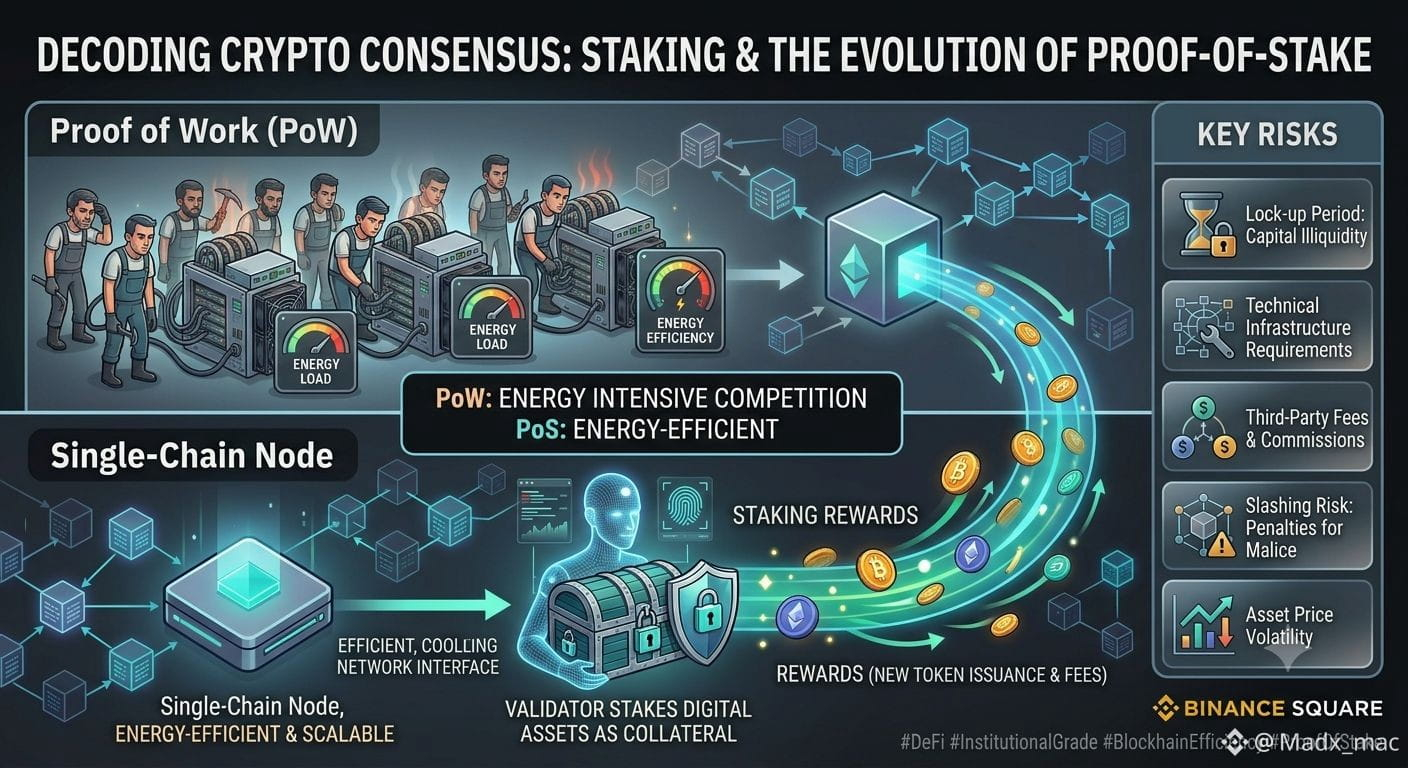
What is Crypto Staking & How Does Proof of Stake Work?
If you are new to Crypto, you’ve probably heard the term "Staking." But what does it actually mean? Let’s break it down in simple terms!
What is Staking?
Staking is the process of locking up your cryptocurrency as collateral to support the security and operation of a Proof of Stake (PoS) blockchain network.
In return for securing the network, you earn Staking Rewards (similar to earning interest in a traditional bank account)!
Proof of Work (PoW) vs Proof of Stake (PoS)
Proof of Work (Bitcoin): Thousands of miners compete using high electricity and computing power. Only 1 wins, and the rest waste energy.
Proof of Stake (PoS): The network selects ONE validator to verify transactions based on their stake. It’s energy-efficient, faster, and more scalable!
Why do Blockchains use PoS?
Energy Efficient: Uses 99% less electricity than PoW.
Fair Distribution: Reduces the dominance of huge mining farms.
Passive Income: Allows holders to earn yields on their assets.
5 Key Risks You Must Know Before Staking:
1 Lock-up Period: Your tokens may be locked for days or months, preventing immediate selling.
2 Technical Complexity: Running a validator node requires technical expertise.
3 Validator Commission: Staking via third-party pools means paying fees.
4 Slashing Risk: Malicious or incorrect network validation can result in lost stake.
5 Price Volatility: Token prices can drop even while you are earning staking rewards.
Summary:
Crypto Staking is one of the most popular ways to earn passive income in Web3, but always make sure to calculate lock-up periods and risks before staking your funds!
Have you tried Binance Earn or On-Chain Staking yet? Let me know in the comments below!
#CryptoEducation #Staking #ProofOfStake #BinanceSquare $SOL
{spot}(SOLUSDT)
What is Crypto Staking & How Does Proof of Stake Work?
If you are new to Crypto, you’ve probably heard the term "Staking." But what does it actually mean? Let’s break it down in simple terms!
What is Staking?
Staking is the process of locking up your cryptocurrency as collateral to support the security and operation of a Proof of Stake (PoS) blockchain network.
In return for securing the network, you earn Staking Rewards (similar to earning interest in a traditional bank account)!
Proof of Work (PoW) vs Proof of Stake (PoS)
Proof of Work (Bitcoin): Thousands of miners compete using high electricity and computing power. Only 1 wins, and the rest waste energy.
Proof of Stake (PoS): The network selects ONE validator to verify transactions based on their stake. It’s energy-efficient, faster, and more scalable!
Why do Blockchains use PoS?
Energy Efficient: Uses 99% less electricity than PoW.
Fair Distribution: Reduces the dominance of huge mining farms.
Passive Income: Allows holders to earn yields on their assets.
5 Key Risks You Must Know Before Staking:
1 Lock-up Period: Your tokens may be locked for days or months, preventing immediate selling.
2 Technical Complexity: Running a validator node requires technical expertise.
3 Validator Commission: Staking via third-party pools means paying fees.
4 Slashing Risk: Malicious or incorrect network validation can result in lost stake.
5 Price Volatility: Token prices can drop even while you are earning staking rewards.
Summary:
Crypto Staking is one of the most popular ways to earn passive income in Web3, but always make sure to calculate lock-up periods and risks before staking your funds!
Have you tried Binance Earn or On-Chain Staking yet? Let me know in the comments below!
#CryptoEducation #Staking #ProofOfStake #BinanceSquare $SOL
If you are new to Crypto, you’ve probably heard the term "Staking." But what does it actually mean? Let’s break it down in simple terms!
What is Staking?
Staking is the process of locking up your cryptocurrency as collateral to support the security and operation of a Proof of Stake (PoS) blockchain network.
In return for securing the network, you earn Staking Rewards (similar to earning interest in a traditional bank account)!
Proof of Work (PoW) vs Proof of Stake (PoS)
Proof of Work (Bitcoin): Thousands of miners compete using high electricity and computing power. Only 1 wins, and the rest waste energy.
Proof of Stake (PoS): The network selects ONE validator to verify transactions based on their stake. It’s energy-efficient, faster, and more scalable!
Why do Blockchains use PoS?
Energy Efficient: Uses 99% less electricity than PoW.
Fair Distribution: Reduces the dominance of huge mining farms.
Passive Income: Allows holders to earn yields on their assets.
5 Key Risks You Must Know Before Staking:
1 Lock-up Period: Your tokens may be locked for days or months, preventing immediate selling.
2 Technical Complexity: Running a validator node requires technical expertise.
3 Validator Commission: Staking via third-party pools means paying fees.
4 Slashing Risk: Malicious or incorrect network validation can result in lost stake.
5 Price Volatility: Token prices can drop even while you are earning staking rewards.
Summary:
Crypto Staking is one of the most popular ways to earn passive income in Web3, but always make sure to calculate lock-up periods and risks before staking your funds!
Have you tried Binance Earn or On-Chain Staking yet? Let me know in the comments below!
#CryptoEducation #Staking #ProofOfStake #BinanceSquare $SOL
114
📚 Proof-of-Work vs Proof-of-Stake: Two consensus mechanisms compared
On July 16, 2026, both mechanisms power the crypto economy. Bitcoin $BTC uses Proof-of-Work (PoW), where miners compete to solve complex puzzles using energy. Ethereum $ETH uses Proof-of-Stake (PoS), where validators lock up capital as collateral.
PoW offers proven security and decentralization but requires significant energy. PoS is more energy-efficient and offers faster finality but introduces different centralization risks through staking concentration.
Neither is objectively better — they make different trade-offs. PoW prioritizes security and neutrality. PoS prioritizes efficiency and scalability. The crypto ecosystem benefits from both approaches coexisting.
📌 Key Takeaway:
PoW (Bitcoin) prioritizes security through energy expenditure. PoS (Ethereum) prioritizes efficiency through staked capital. Both have valid trade-offs and coexist in the ecosystem.
#ProofOfWork #ProofOfStake
#BinanceAlphaAlert
📚 Proof-of-Work vs Proof-of-Stake: Two consensus mechanisms compared
On July 16, 2026, both mechanisms power the crypto economy. Bitcoin $BTC uses Proof-of-Work (PoW), where miners compete to solve complex puzzles using energy. Ethereum $ETH uses Proof-of-Stake (PoS), where validators lock up capital as collateral.
PoW offers proven security and decentralization but requires significant energy. PoS is more energy-efficient and offers faster finality but introduces different centralization risks through staking concentration.
Neither is objectively better — they make different trade-offs. PoW prioritizes security and neutrality. PoS prioritizes efficiency and scalability. The crypto ecosystem benefits from both approaches coexisting.
📌 Key Takeaway:
PoW (Bitcoin) prioritizes security through energy expenditure. PoS (Ethereum) prioritizes efficiency through staked capital. Both have valid trade-offs and coexist in the ecosystem.
#ProofOfWork #ProofOfStake
#BinanceAlphaAlert
On July 16, 2026, both mechanisms power the crypto economy. Bitcoin $BTC uses Proof-of-Work (PoW), where miners compete to solve complex puzzles using energy. Ethereum $ETH uses Proof-of-Stake (PoS), where validators lock up capital as collateral.
PoW offers proven security and decentralization but requires significant energy. PoS is more energy-efficient and offers faster finality but introduces different centralization risks through staking concentration.
Neither is objectively better — they make different trade-offs. PoW prioritizes security and neutrality. PoS prioritizes efficiency and scalability. The crypto ecosystem benefits from both approaches coexisting.
📌 Key Takeaway:
PoW (Bitcoin) prioritizes security through energy expenditure. PoS (Ethereum) prioritizes efficiency through staked capital. Both have valid trade-offs and coexist in the ecosystem.
#ProofOfWork #ProofOfStake
#BinanceAlphaAlert
73


·
--
Ethereum ($ETH ) Overview
Ethereum continues to be the leading smart contract blockchain, powering thousands of decentralized applications (dApps), DeFi protocols, NFTs, and Layer 2 scaling solutions. Its Proof-of-Stake consensus improves energy efficiency while strengthening network security.
Key Highlights • Leading platform for DeFi, NFTs, gaming, and Web3 applications. • Proof-of-Stake (PoS) provides a more sustainable and secure network. • Layer 2 ecosystems help reduce transaction costs and improve scalability. • Large developer community and continuous ecosystem growth. • ETH is used for gas fees, staking, and securing the network.
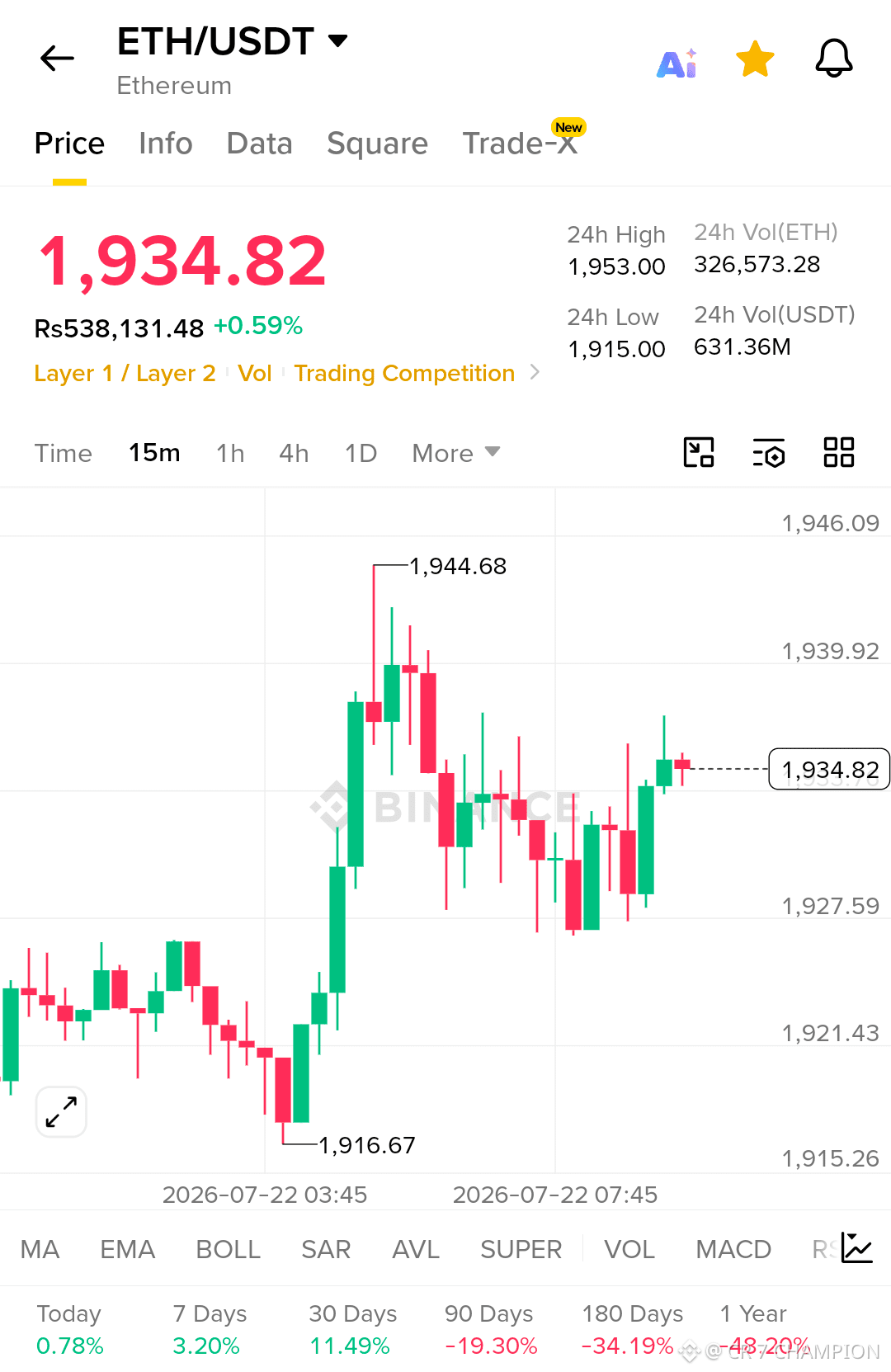
Market Snapshot • Pair: ETH/USDT • Current Price: $1,934.82 • 24h High: $1,953.00 • 24h Low: $1,915.00 • 24h Change: +0.59%
Ethereum remains one of the strongest foundations of the crypto industry, driving innovation across decentralized finance, tokenization, and next-generation blockchain applications.
#Ethereum #ETH #Crypto #Blockchain #ProofOfStake
Ethereum ($ETH ) Overview
Ethereum continues to be the leading smart contract blockchain, powering thousands of decentralized applications (dApps), DeFi protocols, NFTs, and Layer 2 scaling solutions. Its Proof-of-Stake consensus improves energy efficiency while strengthening network security.
Key Highlights • Leading platform for DeFi, NFTs, gaming, and Web3 applications. • Proof-of-Stake (PoS) provides a more sustainable and secure network. • Layer 2 ecosystems help reduce transaction costs and improve scalability. • Large developer community and continuous ecosystem growth. • ETH is used for gas fees, staking, and securing the network.
Market Snapshot • Pair: ETH/USDT • Current Price: $1,934.82 • 24h High: $1,953.00 • 24h Low: $1,915.00 • 24h Change: +0.59%
Ethereum remains one of the strongest foundations of the crypto industry, driving innovation across decentralized finance, tokenization, and next-generation blockchain applications.
#Ethereum #ETH #Crypto #Blockchain #ProofOfStake
Ethereum continues to be the leading smart contract blockchain, powering thousands of decentralized applications (dApps), DeFi protocols, NFTs, and Layer 2 scaling solutions. Its Proof-of-Stake consensus improves energy efficiency while strengthening network security.
Key Highlights • Leading platform for DeFi, NFTs, gaming, and Web3 applications. • Proof-of-Stake (PoS) provides a more sustainable and secure network. • Layer 2 ecosystems help reduce transaction costs and improve scalability. • Large developer community and continuous ecosystem growth. • ETH is used for gas fees, staking, and securing the network.
Market Snapshot • Pair: ETH/USDT • Current Price: $1,934.82 • 24h High: $1,953.00 • 24h Low: $1,915.00 • 24h Change: +0.59%
Ethereum remains one of the strongest foundations of the crypto industry, driving innovation across decentralized finance, tokenization, and next-generation blockchain applications.
#Ethereum #ETH #Crypto #Blockchain #ProofOfStake
1
71


Article
ADA (Cardano)A Cardano é uma blockchain de Proof-of-Stake cujo desenvolvimento é fortemente baseado em pesquisa acadêmica e revisão por pares. Seu protocolo de consenso é o Ouroboros, projetado para oferecer segurança e eficiência energética.
Um dos principais diferenciais da Cardano é o modelo Extended UTXO (eUTXO). Ele amplia o modelo UTXO utilizado pelo Bitcoin para permitir smart contracts e múltiplos ativos.
O Ouroboros é o mecanismo de consenso da Cardano. Em vez de depender de mineração tradicional, a rede utiliza stake pools para participar da produção de blocos.
Outro ponto interessante é que a Cardano possui suporte nativo a tokens, permitindo que ativos personalizados sejam registrados e movimentados diretamente pelo ledger, sem exigir um smart contract apenas para realizar operações básicas com esses tokens.
Hydra é uma solução de Layer 2 criada para aumentar a capacidade da Cardano, permitindo transações rápidas e de baixo custo em determinados cenários. A documentação atual também destaca casos como micropagamentos, gaming e aplicações de alta frequência.
A Cardano atualmente possui um modelo de governança on-chain envolvendo DReps, Stake Pool Operators e Constitutional Committee. As decisões podem envolver atualizações do protocolo, parâmetros, treasury e hard forks.
A primeiro crypto que comprei foi $ADA e me supreendi com os resultados naquele ano. Acredito em uma alta ainda este ano. E você?
#ProofOfStake #ADA #blockchain
ADA (Cardano)
A Cardano é uma blockchain de Proof-of-Stake cujo desenvolvimento é fortemente baseado em pesquisa acadêmica e revisão por pares. Seu protocolo de consenso é o Ouroboros, projetado para oferecer segurança e eficiência energética.
Um dos principais diferenciais da Cardano é o modelo Extended UTXO (eUTXO). Ele amplia o modelo UTXO utilizado pelo Bitcoin para permitir smart contracts e múltiplos ativos.
O Ouroboros é o mecanismo de consenso da Cardano. Em vez de depender de mineração tradicional, a rede utiliza stake pools para participar da produção de blocos.
Outro ponto interessante é que a Cardano possui suporte nativo a tokens, permitindo que ativos personalizados sejam registrados e movimentados diretamente pelo ledger, sem exigir um smart contract apenas para realizar operações básicas com esses tokens.
Hydra é uma solução de Layer 2 criada para aumentar a capacidade da Cardano, permitindo transações rápidas e de baixo custo em determinados cenários. A documentação atual também destaca casos como micropagamentos, gaming e aplicações de alta frequência.
A Cardano atualmente possui um modelo de governança on-chain envolvendo DReps, Stake Pool Operators e Constitutional Committee. As decisões podem envolver atualizações do protocolo, parâmetros, treasury e hard forks.
A primeiro crypto que comprei foi $ADA e me supreendi com os resultados naquele ano. Acredito em uma alta ainda este ano. E você?
#ProofOfStake #ADA #blockchain
Um dos principais diferenciais da Cardano é o modelo Extended UTXO (eUTXO). Ele amplia o modelo UTXO utilizado pelo Bitcoin para permitir smart contracts e múltiplos ativos.
O Ouroboros é o mecanismo de consenso da Cardano. Em vez de depender de mineração tradicional, a rede utiliza stake pools para participar da produção de blocos.
Outro ponto interessante é que a Cardano possui suporte nativo a tokens, permitindo que ativos personalizados sejam registrados e movimentados diretamente pelo ledger, sem exigir um smart contract apenas para realizar operações básicas com esses tokens.
Hydra é uma solução de Layer 2 criada para aumentar a capacidade da Cardano, permitindo transações rápidas e de baixo custo em determinados cenários. A documentação atual também destaca casos como micropagamentos, gaming e aplicações de alta frequência.
A Cardano atualmente possui um modelo de governança on-chain envolvendo DReps, Stake Pool Operators e Constitutional Committee. As decisões podem envolver atualizações do protocolo, parâmetros, treasury e hard forks.
A primeiro crypto que comprei foi $ADA e me supreendi com os resultados naquele ano. Acredito em uma alta ainda este ano. E você?
#ProofOfStake #ADA #blockchain
2
3
1.1k
·
--
Bullish
Today I was buying mangoes from a street vendor when he said, Business isn't about having more fruit. It's about having people who come back tomorrow. It sounded like ordinary business advice, but later, while reading about Babylon, I realised the same question applies to security markets.
Babylon expands the supply of Bitcoin-backed Security for PoS networks without changing Bitcoin's core design. Most analysis focuses on how efficiently that security can be supplied. Far fewer ask whether PoS networks will generate enough recurring demand to sustain that market over the Long term.
Security is not purchased because it exists. It is purchased when the economic value a network protects justifies the recurring cost. Networks with limited treasury resources often prioritise attracting users, applications, and fee generation before paying for stronger protection. That means Babylon's Long term opportunity may depend not only on its architecture, but also on whether PoS economies mature into consistent buyers of security.
What evidence would convince you that Bitcoin-backed security is becoming a recurring operating expense rather than an optional infrastructure premium? 🤔
#baby #Bitcoin #ProofOfStake $BABY $AAVE $BTC @babylonlabs_io @BinancePk
{future}(BABYUSDT)
Today I was buying mangoes from a street vendor when he said, Business isn't about having more fruit. It's about having people who come back tomorrow. It sounded like ordinary business advice, but later, while reading about Babylon, I realised the same question applies to security markets.
Babylon expands the supply of Bitcoin-backed Security for PoS networks without changing Bitcoin's core design. Most analysis focuses on how efficiently that security can be supplied. Far fewer ask whether PoS networks will generate enough recurring demand to sustain that market over the Long term.
Security is not purchased because it exists. It is purchased when the economic value a network protects justifies the recurring cost. Networks with limited treasury resources often prioritise attracting users, applications, and fee generation before paying for stronger protection. That means Babylon's Long term opportunity may depend not only on its architecture, but also on whether PoS economies mature into consistent buyers of security.
What evidence would convince you that Bitcoin-backed security is becoming a recurring operating expense rather than an optional infrastructure premium? 🤔
#baby #Bitcoin #ProofOfStake $BABY $AAVE $BTC @BabylonLabs_io @Binance Pakistan
Babylon expands the supply of Bitcoin-backed Security for PoS networks without changing Bitcoin's core design. Most analysis focuses on how efficiently that security can be supplied. Far fewer ask whether PoS networks will generate enough recurring demand to sustain that market over the Long term.
Security is not purchased because it exists. It is purchased when the economic value a network protects justifies the recurring cost. Networks with limited treasury resources often prioritise attracting users, applications, and fee generation before paying for stronger protection. That means Babylon's Long term opportunity may depend not only on its architecture, but also on whether PoS economies mature into consistent buyers of security.
What evidence would convince you that Bitcoin-backed security is becoming a recurring operating expense rather than an optional infrastructure premium? 🤔
#baby #Bitcoin #ProofOfStake $BABY $AAVE $BTC @BabylonLabs_io @Binance Pakistan

32
11
251
📚 How Proof-of-Stake Works: The consensus mechanism powering modern blockchains
On July 22, 2026, Proof-of-Stake validators lock up tokens as collateral to secure the network, unlike Proof-of-Work which requires energy-intensive mining.
Ethereum $ETH, Cardano $ADA, and Solana $SOL all use variants of PoS, reducing energy usage by 99%+ compared to mining.
Validators earn rewards proportional to their staked amount, aligning incentives between security and profitability.
📌 Key Takeaway:
Proof-of-Stake secures networks through economic collateral rather than energy expenditure — the future of blockchain consensus.
#ProofOfStake #Blockchain #Educational
#BinanceAlphaAlert
📚 How Proof-of-Stake Works: The consensus mechanism powering modern blockchains
On July 22, 2026, Proof-of-Stake validators lock up tokens as collateral to secure the network, unlike Proof-of-Work which requires energy-intensive mining.
Ethereum $ETH , Cardano $ADA , and Solana $SOL all use variants of PoS, reducing energy usage by 99%+ compared to mining.
Validators earn rewards proportional to their staked amount, aligning incentives between security and profitability.
📌 Key Takeaway:
Proof-of-Stake secures networks through economic collateral rather than energy expenditure — the future of blockchain consensus.
#ProofOfStake #Blockchain #Educational
#BinanceAlphaAlert
On July 22, 2026, Proof-of-Stake validators lock up tokens as collateral to secure the network, unlike Proof-of-Work which requires energy-intensive mining.
Ethereum $ETH , Cardano $ADA , and Solana $SOL all use variants of PoS, reducing energy usage by 99%+ compared to mining.
Validators earn rewards proportional to their staked amount, aligning incentives between security and profitability.
📌 Key Takeaway:
Proof-of-Stake secures networks through economic collateral rather than energy expenditure — the future of blockchain consensus.
#ProofOfStake #Blockchain #Educational
#BinanceAlphaAlert
56

·
--
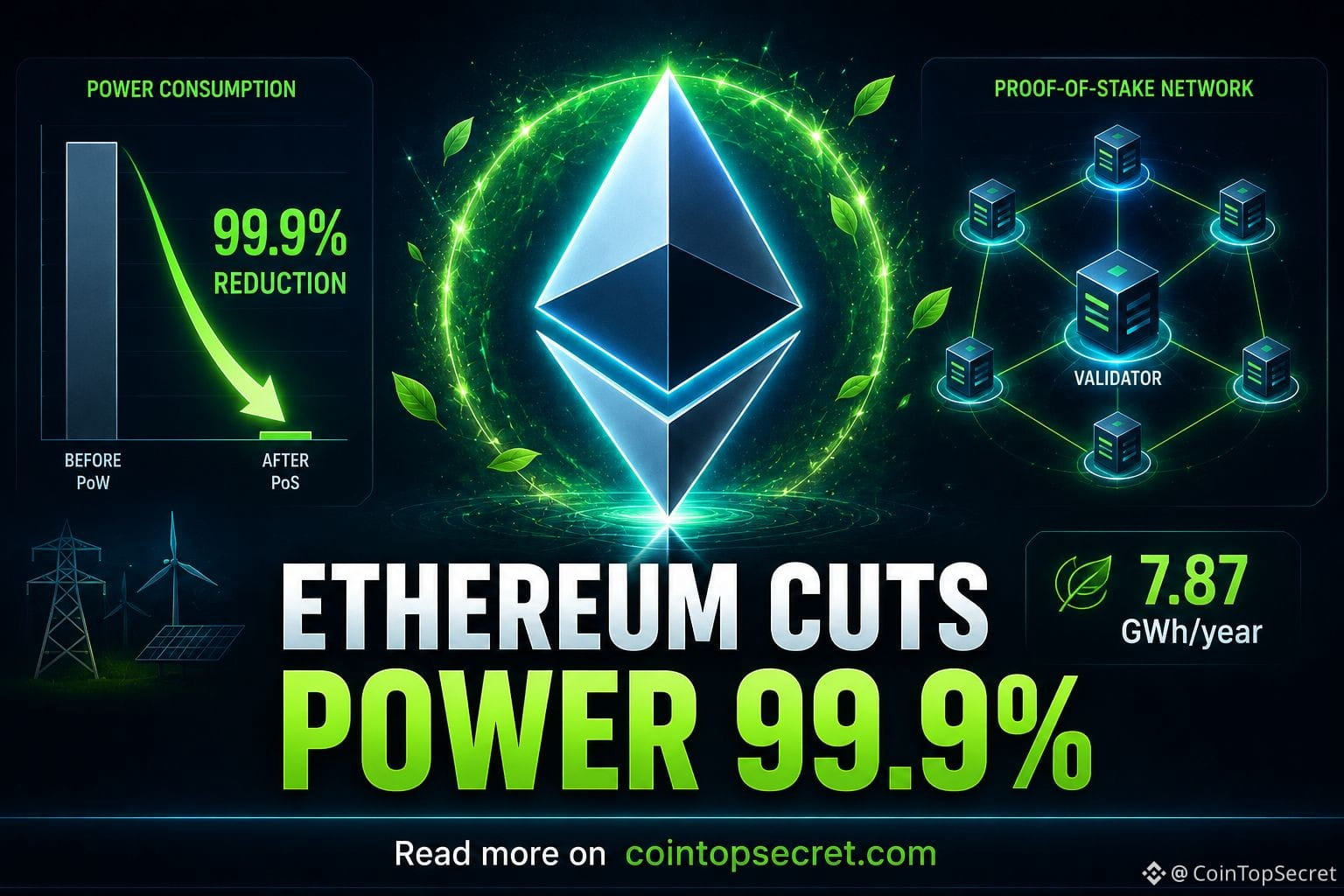
Cambridge estimates Ethereum now consumes just 7.87 GWh annually, following a 99.9%+ reduction in electricity usage since the Merge. The network also ranks among the lowest major Proof-of-Stake blockchains by energy intensity.
#Ethereum #ETH #ProofOfStake #Blockchain #Crypto #Markets
Cambridge estimates Ethereum now consumes just 7.87 GWh annually, following a 99.9%+ reduction in electricity usage since the Merge. The network also ranks among the lowest major Proof-of-Stake blockchains by energy intensity.
#Ethereum #ETH #ProofOfStake #Blockchain #Crypto #Markets
#Ethereum #ETH #ProofOfStake #Blockchain #Crypto #Markets
82
Log in to explore more content
Join global crypto users on Binance Square
⚡️ Get latest and useful information about crypto.
💬 Trusted by the world’s largest crypto exchange.
👍 Discover real insights from verified creators.
Email / Phone number
Trending Topics
1
#BinancePick
3M views
151,594 Discussing
2
#EarningsSeason
5.2M views
25,777 Discussing
3
#AnthropicTTMRevenueGrewAbout1200%
18,112 views
331 Discussing
4
#AnthropicS1ExpectedToday
19,885 views
295 Discussing
5
#SouthKoreaReportedlyWeighsFourthCryptoTaxDelay
24,883 views
416 Discussing
6
#FranklinTempletonFilesForTwoDividendToBitcoinETFs
32,679 views
511 Discussing
7
#StrategyMSTRSurpassesNasdaqInMarketCap
25,186 views
371 Discussing
8
#CanadaProposesStablecoinRedemptionWithin3BusinessDays
1,166 views
34 Discussing
9
#ElectrumWalletBugLetRogueServersStealFunds
27,067 views
448 Discussing
10
#ArgentineCourtDismissesLIBRACaseAgainstMilei
41,218 views
553 Discussing